
XKIG Acquires Jensen’s Tree Service: What It Means for Oregon Owners
XKIG acquired Jensen’s Tree Service on November 16, 2026: the Sterling-backed utility contractor bought a family-owned southern and central Oregon line clearance firm founded in 1990, extending the Pacific Northwest base it opened with Kemp West.
By Christoph Totter, Founder of CT Acquisitions · Last reviewed: November 2026
Key takeaways
- XKIG bought Jensen’s Tree Service, Inc., an Oregon utility vegetation management and line service provider established in 1990, per the November 16, 2026 release. No price, structure or advisors were disclosed.
- Jensen’s is XKIG’s 15th announced add-on since January 2023 and its 4th in 41 days, after ClearPath (October 6), Wilderness Land Management (October 8) and HTC (November 6), per the XKIG newsroom.
- XKIG grew from more than 2,000 employees in over 20 states at the 2022 Xylem and Kendall merger to more than 7,000 employees and over 300 utility customers in 2026, per Sterling and XKIG.
- Oregon had 1,893 landscaping and tree establishments (NAICS 561730) in 2023, and 1,327 of them, or 70.1%, had fewer than 5 employees, per Census County Business Patterns. Only 7 had 100 or more.
- Line clearance runs on thin margins: Davey Tree’s Utility segment earned a 7.2% segment operating margin and about 9.9% before depreciation and amortization in fiscal 2025, per its Form 10-K.
What did XKIG announce about Jensen’s Tree Service?
XKIG announced on November 16, 2026 that it acquired Jensen’s Tree Service, Inc., an Oregon-based utility vegetation management and line service provider established in 1990 as a family business. The PR Newswire release says Jensen’s serves utility line clearance and vegetation management customers across southern and central Oregon. It names no price, no structure, no advisors and no closing conditions, and it reads as a completed acquisition.
XKIG’s own newsroom post carries the same text dated November 13, 2026, three days before the wire date. CEO Randolph Hoover said the goal is to honor the Jensen family’s legacy by giving their people and operations resources to keep growing. Owner Erik Jensen, named alongside his wife Sunday, said joining XKIG lets the company keep doing what it does best while creating opportunities for the team.
| Deal term | What the release says | Source |
|---|---|---|
| Buyer | XKIG, Norfolk, Virginia; controlled by Sterling Investment Partners | Sterling, Oct 28, 2025 |
| Target | Jensen’s Tree Service, Inc.; utility line clearance and vegetation management; southern and central Oregon | PR Newswire, Nov 16, 2026 |
| Founded | 1990, as a family business | PR Newswire |
| Owners named | Erik Jensen, Owner, alongside his wife Sunday | PR Newswire |
| Stated rationale | Complements existing utility vegetation management operations in the Pacific Northwest | PR Newswire |
| Price, structure, advisors | Not disclosed | PR Newswire |
| Leadership after close | Not stated; release promises resources for “their people and operations” | PR Newswire |
Undisclosed terms are the norm in this sector: in CT’s November 2026 home services acquisitions roundup, only 1 of 21 announcements put a price on the deal. That one, Installed Building Products buying Old Dominion Group, priced at 9.3x LTM adjusted EBITDA including synergies, per the IBP Form 8-K exhibit.
Who is XKIG and who backs it?
XKIG is a Norfolk, Virginia utility infrastructure contractor built by Sterling Investment Partners from two vegetation managers: Kendall Vegetation Services, which Sterling backed on April 26, 2022, and Xylem Tree Experts, merged in on September 20, 2022. Sterling recapitalized XKIG through its first single-asset continuation vehicle on October 28, 2025, co-led by HarbourVest Partners, StepStone Group and ICONIQ, per the Sterling release.
The leadership is the Hoover brothers: CEO Randolph Hoover, who co-founded Xylem Tree Experts and became CEO of the combined company effective July 1, 2023, and President Benjamin Hoover. Sterling says it has completed over 270 transactions worth over $33 billion. Evercore led advisory on the 2025 recapitalization, with Kirkland & Ellis and Norton Rose Fulbright as counsel. Operating units today are Xylem Tree Experts, Kendall Vegetation Services, River City Construction and Canopy Infrastructure Solutions.
| Date | Milestone | Employees | States | Other scale data | Source |
|---|---|---|---|---|---|
| Apr 2022 | Sterling invests in Kendall (Lawrenceville, GA) | Not stated | Not stated | Nearly 20,000 miles of utility lines serviced | Sterling |
| Sep 2022 | Xylem merges with Kendall | More than 2,000 | More than 20 | Co-CEOs Randolph Hoover and Robert Williams | Sterling |
| Oct 2025 | Continuation vehicle recapitalization | More than 6,500 | 39 | More than 7,800 rolling assets; more than 85,000 miles of lines | Sterling |
| Nov 2026 | Jensen’s acquisition month | More than 7,000 | 39 | More than 300 utility customers | XKIG |
What has XKIG bought before Jensen’s?
XKIG and its predecessors announced 15 add-ons between January 2023 and November 2026, every one a utility vegetation, right-of-way or line services business, and none with a disclosed price. The pattern is regional density first, then adjacent service lines: line construction with River City in 2025, gas and rail corridors with Timberline, and emergency management consulting with ClearPath in 2026. Dates below come from each company’s own release.
| Announced | Company | Base or market | Founded | What it added | Source |
|---|---|---|---|---|---|
| Jan 5, 2023 | ElectriCom Right of Way Services division | Rural utility markets | Not stated | Rural utility right-of-way customers | Sterling |
| Aug 18, 2023 | Tom’s Tree Service | Iowa and Missouri | Over two decades before 2023 | Midwest vegetation management | Sterling |
| Apr 5, 2024 | Texar Line Clearance | Texarkana, Arkansas | About 15 years before 2024 | Southwest edge of the Kendall footprint | XKIG |
| Jun 28, 2024 | Endrizzi Contracting | Vienna, Illinois | 1998 | Illinois, Missouri, Michigan, Wisconsin, Kentucky | XKIG |
| Nov 25, 2024 | Bryant Tree Services | Live Oak, Florida | 2007 | Florida right-of-way and storm capacity | XKIG |
| Dec 6, 2024 | Kemp West | Snohomish, Washington | 1982 | First Pacific Northwest base; “coast-to-coast” | XKIG |
| Dec 13, 2024 | TTS Tree Service and Larch Tree Service | Canton, New York | 2010 | Maine, New Hampshire, New York, Vermont | XKIG |
| Mar 24, 2025 | Tree Care of New York | Buffalo, New York | 1996 | New York and neighboring states | XKIG |
| Aug 1, 2025 | River City Construction | NC, SC, VA, WV, MD, DE | 1975 | Line construction and maintenance | XKIG |
| Oct 10, 2025 | Thomas Contracting | Tennessee | 2000 | Joined Xylem Tree Experts | XKIG |
| Nov 28, 2025 | Timberline Clearing | National | 2007 | Gas, electric and railroad right-of-way clearing | XKIG |
| Oct 6, 2026 | ClearPath Solutions Group | Not stated | Not stated | Emergency management and debris; joined Canopy | XKIG |
| Oct 8, 2026 | Wilderness Land Management | Iowa | Not stated | Merged into Kendall Vegetation Services | XKIG |
| Nov 6, 2026 | HTC LLC | Southern Alabama | 2013 | Line clearance, land clearing, storm cleanup | XKIG |
| Nov 16, 2026 | Jensen’s Tree Service, Inc. | Southern and central Oregon | 1990 | Second Pacific Northwest company | PR Newswire |
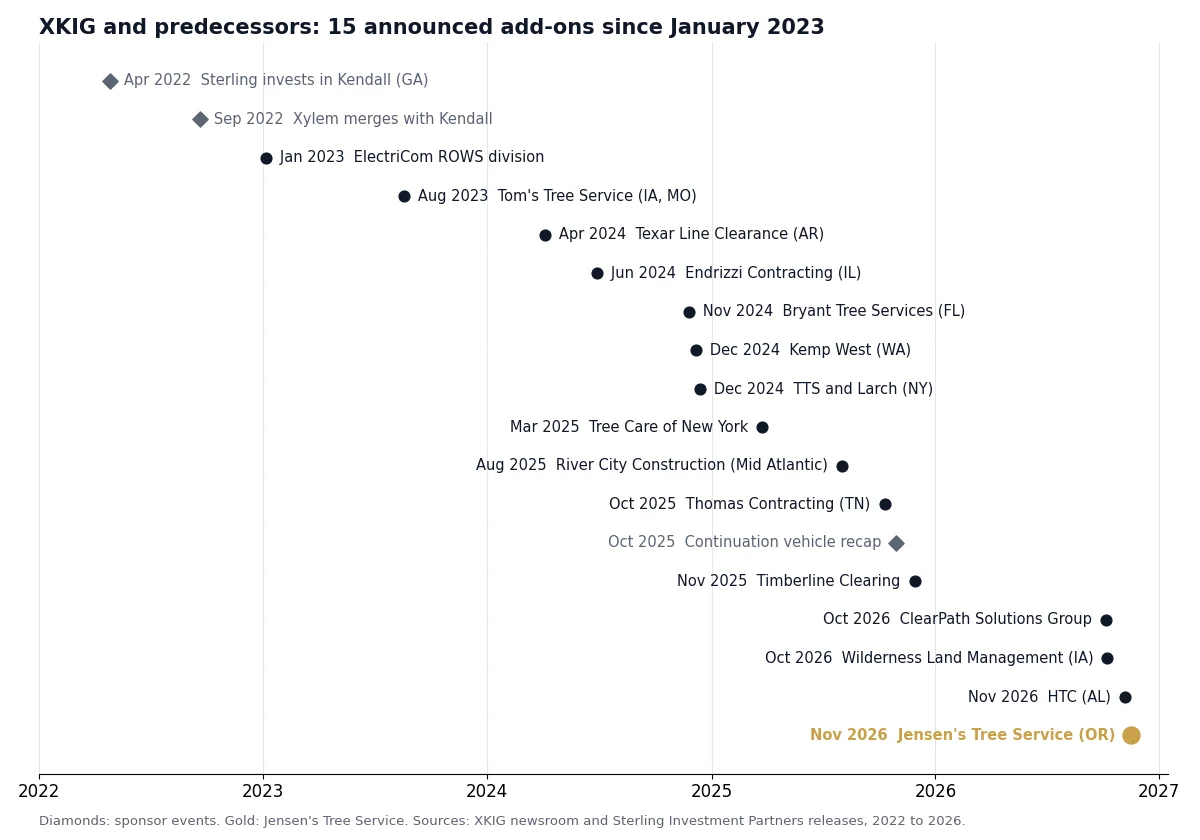
The Jensen’s deal closes a gap XKIG opened in December 2024, when it called Kemp West of Snohomish, Washington its route to “coast-to-coast operational capabilities.” Jensen’s now adds southern and central Oregon to that Washington base. On XKIG’s public record, no acquired company is based in Idaho, California, Nevada or Montana, which marks where the next Western add-on would extend the map.
How big is the tree and vegetation market in southern and central Oregon?
Oregon had 1,893 establishments and 11,299 employees in NAICS 561730, landscaping services, which includes tree trimming and line clearance, in 2023, per Census County Business Patterns. The 7 southern and central counties shown below held 411 of those establishments and 1,589 employees. NAICS 561730 also counts lawn and landscape firms, so treat these as the ceiling of the competitive field, not a count of line clearance contractors.
| County | Establishments (2023) | Employees (2023) | Population Jul 2020 | Population Jul 2025 | Change |
|---|---|---|---|---|---|
| Deschutes | 148 | 640 | 199,461 | 213,072 | +6.8% |
| Jackson | 128 | 443 | 223,753 | 221,795 | -0.9% |
| Douglas | 46 | 222 | 111,294 | 111,951 | +0.6% |
| Josephine | 44 | 169 | 88,214 | 87,867 | -0.4% |
| Klamath | 24 | 47 | 69,624 | 70,274 | +0.9% |
| Crook | 11 | 57 | 24,933 | 27,564 | +10.6% |
| Jefferson | 10 | 11 | 24,582 | 25,740 | +4.7% |
| Oregon total | 1,893 | 11,299 | 4,243,544 | 4,273,586 | +0.7% |
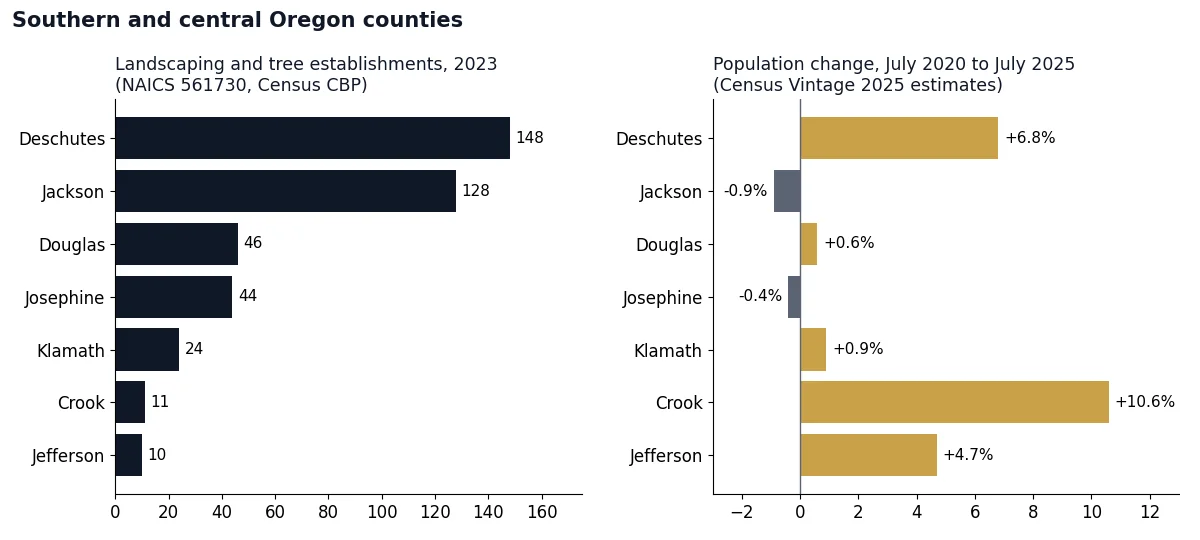
Population data come from the Census Vintage 2025 county estimates; establishment counts come from the 2023 county file. Central Oregon is where growth is: Crook County added 10.6% and Deschutes 6.8% from July 2020 to July 2025, against 0.7% statewide. New homes in the wildland edge mean more distribution line to clear, and Jackson County, the largest southern county, shrank 0.9%.
The field is small companies. Of Oregon’s 1,893 establishments, 1,327 had fewer than 5 employees, 148 had 10 to 19, 83 had 20 to 49, 17 had 50 to 99 and 7 had 100 to 249; none had 250 or more. Payroll was $540.3 million, about $47,815 per employee. Washington, where Kemp West sits, had 3,194 establishments and 19,278 employees; Idaho had 1,166 and 6,135.
Why are Oregon utilities spending more on vegetation work?
Oregon law makes vegetation management a filed, approved obligation. ORS 757.963, enacted by Senate Bill 762 in 2021, requires every electric public utility to operate under a risk-based wildfire protection plan that describes the procedures, standards and time frames for vegetation management in heightened-risk areas. The Oregon Public Utility Commission must approve each plan or update within 180 days of filing.
On June 25, 2026, the Oregon PUC approved the 2026 to 2028 wildfire mitigation plans of Pacific Power (docket UM 2207), Portland General Electric (UM 2208) and Idaho Power (UM 2209). Each plan includes enhanced vegetation management and inspection programs, and PUC staff run independent inspections of clearances in high fire risk areas. That gives a regional line clearance contractor three years of approved utility demand, which is what a buyer underwrites.
What is a utility line clearance company worth?
No price was disclosed for Jensen’s, and no Oregon multiple is published. The closest sourced references are general tree service ranges of 3.79x to 4.10x EBITDA, 3.14x to 3.64x SDE and 0.58x to 1.03x revenue, per Peak Business Valuation, and margin data from Davey Tree’s fiscal 2025 Form 10-K, an employee-owned company that files with the SEC and reports a separate Utility segment.
| Davey Tree Utility segment, fiscal 2025 | $ thousands | % of revenue | Source |
|---|---|---|---|
| Revenue | 1,067,171 | 100% | Davey 10-K |
| Payroll expense | 456,754 | 42.8% | Davey 10-K |
| Equipment and fuel expense | 73,105 | 6.9% | Davey 10-K |
| Subcontractor expense | 110,803 | 10.4% | Davey 10-K |
| Other segment expenses | 349,523 | 32.8% | Davey 10-K |
| Segment operating income | 76,986 | 7.2% | Davey 10-K |
| Add back depreciation and amortization | 28,628 | 2.7% | Davey 10-K (27,207 plus 1,421) |
| Segment EBITDA (CT arithmetic) | 105,614 | 9.9% | CT arithmetic |
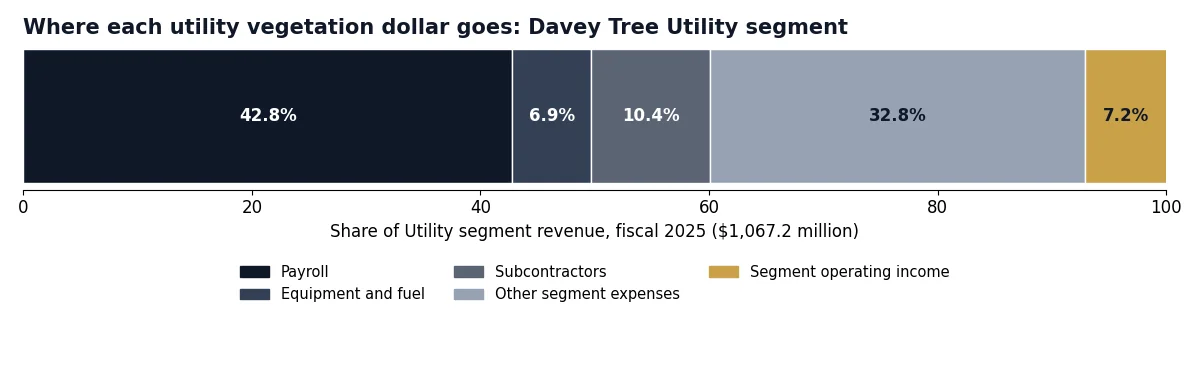
Davey’s Utility revenue grew 5.4% in 2025 on new accounts and price increases, while storm damage revenue in the segment fell from $49.3 million to $35.5 million. Its Residential and Commercial segment earned about 13.2% before depreciation and amortization. Utility work trades margin for contract stability, so buyers price it on the contract book, not on storm years.
Worked example: a $6 million Oregon line clearance contractor (illustrative)
Assumptions are illustrative: $6.0 million revenue and a 9.9% EBITDA margin, matching the Davey Utility segment. The multiples are the Peak Business Valuation tree service EBITDA range.
| Line (illustrative) | Low case | High case |
|---|---|---|
| Revenue | $6,000,000 | $6,000,000 |
| EBITDA margin | 9.9% | 9.9% |
| EBITDA | $594,000 | $594,000 |
| EBITDA multiple | 3.79x | 4.10x |
| Enterprise value | $2,251,260 | $2,435,400 |
| Value of each extra margin point ($60,000 EBITDA) | $227,400 | $246,000 |
| Rollover at 20% of value, if offered | $450,252 | $487,080 |
The lesson in the table is margin, not multiple: one extra point of EBITDA margin on $6 million of revenue adds $227,400 to $246,000 of value. A platform at XKIG’s scale may pay more than the general range for a contractor that fills a map gap, as the 9.3x IBP paid for a much larger Old Dominion Group shows, but that is a negotiated outcome. Our tree care business valuation guide covers the drivers.
What this means for tree and line clearance owners in the Pacific Northwest
XKIG has now bought companies in Washington and Oregon and is spending: 4 add-ons in 41 days. Owners of utility line clearance, right-of-way or storm response companies in Idaho, northern California, eastern Oregon and eastern Washington are the obvious next calls, because no XKIG company is based there on the public record. Service lines it bought in 2025 and 2026, line construction and land clearing, tell you which adjacent crews it also values.
What makes an owner valuable to XKIG
- Direct utility contracts: master service agreements with an investor-owned utility, cooperative or municipal, with renewal dates and change-of-control terms listed.
- Qualified crews: line-clearance tree trimmers trained to OSHA 29 CFR 1910.269, which sets minimum approach distances from Table R-3 under paragraph (l)(3)(i).
- Fleet and equipment schedule: bucket trucks, mulchers and chippers with age, hours and lien status; XKIG reported more than 7,800 rolling assets in 2025.
- Licenses in order: an Oregon CCB or LCB license for tree work and Oregon Department of Agriculture pesticide licensing for herbicide crews.
- Storm response record: mutual-aid and emergency callouts by year, since XKIG markets storm restoration as a core service.
The negotiating window is now. XKIG raised continuation vehicle capital in October 2025 that Sterling said would fund growth and geographic expansion, and the three Oregon wildfire plans approved on June 25, 2026 run through 2028. A buyer filling a map gap with funded capital is the strongest position a regional seller gets; the same company sold after the gap is filled becomes one more bid. For how add-ons differ from platform deals, read platform acquisition vs add-on.
Risks to price before you sign
Customer concentration is the big one: even Davey Tree, with $1.95 billion of 2025 revenue, took about $167 million, or 9%, from PG&E. A contractor with one utility above 50% of revenue should expect part of the price deferred. Check how earnouts in home services deals pay and founder rollover equity benchmarks before you accept a structure, and price key-person terms if the founder holds the utility relationships.
Should you talk to XKIG or run a process?
| If your company is… | Then… | Why |
|---|---|---|
| A line clearance contractor in Idaho, northern California or eastern Oregon with a direct utility contract | Expect interest; prepare a contract schedule before any call | No XKIG company is based there on the public record |
| Already overlapping Kemp West or Jensen’s territory | Lead with crews and equipment, not geography | XKIG already has the map; it is buying capacity |
| More than 50% dependent on one utility | Price the concentration risk into structure before signing | Buyers defer price against renewal risk |
| A residential tree service with no utility work | Talk to residential platforms first | XKIG’s 15 add-ons are all utility, right-of-way or line services |
| Below about $3 million revenue with owner-held relationships | Document crews and contracts for 12 months, then go to market | Key-person risk lowers the multiple |
| Receiving an unsolicited letter of intent | Compare it with 2 to 3 other utility vegetation buyers before exclusivity | Exclusivity ends your negotiating window |
Other active buyers exist. Davey Tree invested $8.5 million in businesses in 2025, $28.1 million in 2024 and $34.1 million in 2023, and names Asplundh Tree Expert, LLC as its principal national utility competitor, per its 10-K. CT’s tree service PE roll-up tracker lists the sponsor-backed platforms, and our guide on how to sell a tree service business covers preparation step by step.
How we compiled this
We read 32 primary documents in November 2026: the PR Newswire and XKIG versions of the Jensen’s release, 18 other XKIG newsroom and Sterling Investment Partners releases, Davey Tree’s fiscal 2025 Form 10-K, 3 Census data files, 6 statute and agency pages, the Peak Business Valuation benchmarks and the IBP Form 8-K exhibit. We excluded forum posts and unsourced deal multiples. Nothing here is a reported price for this deal.
If you own a utility line clearance, right-of-way or tree service company and want to know what XKIG or a competing buyer would pay, book a confidential call. We work for owners on the sell side. Our fee is success only: nothing upfront, and you pay nothing unless the business sells. Talk to your CPA and M&A attorney about tax and contract terms before signing a letter of intent.
Frequently asked questions
Who owns Jensen’s Tree Service now?
XKIG owns Jensen’s Tree Service, Inc. after the acquisition announced on November 16, 2026. XKIG is a Norfolk, Virginia utility infrastructure contractor controlled by Sterling Investment Partners, which recapitalized it through a single-asset continuation vehicle on October 28, 2025, with HarbourVest Partners, StepStone Group and ICONIQ co-leading. Erik and Sunday Jensen founded the Oregon company as a family business in 1990.
How much did XKIG pay for Jensen’s Tree Service?
The price was not disclosed. Neither the PR Newswire release of November 16, 2026 nor XKIG’s own newsroom post names a price, a deal structure, financing or advisors. None of the 15 add-ons XKIG and its predecessors announced since January 2023 carried a disclosed price, so any figure you see quoted for this deal is an estimate, not a reported number.
Is XKIG still buying tree service companies?
Yes, on the public record. XKIG announced 4 acquisitions in 41 days between October 6 and November 16, 2026: ClearPath Solutions Group, Wilderness Land Management in Iowa, HTC in southern Alabama and Jensen’s Tree Service in Oregon. Sterling said in October 2025 that the continuation vehicle capital would help fund continued growth and geographic expansion.
How much is a tree service company worth in Oregon?
Published tree service benchmarks run 3.79x to 4.10x EBITDA, 3.14x to 3.64x SDE and 0.58x to 1.03x revenue, per Peak Business Valuation. No Oregon-specific multiple is published. A utility line clearance contractor with $6 million of revenue at a 9.9% EBITDA margin would price at roughly $2.25 million to $2.44 million on those ranges (illustrative).
What license does a tree service need in Oregon?
Oregon’s Landscape Contractors Board says either an LCB license or a Construction Contractors Board license allows tree removal, stump grinding and guying limbs, but planting trees requires an LCB license. Work near energized lines also falls under OSHA 29 CFR 1910.269, and herbicide work falls under Oregon Department of Agriculture pesticide licensing.
How do private equity add-on acquisitions work?
A sponsor-backed platform such as XKIG buys smaller companies and folds them into an existing operating unit. Wilderness Land Management merged into Kendall Vegetation Services in October 2026, while Thomas Contracting joined Xylem Tree Experts in October 2025. Sellers usually keep their crews and customers, and price, rollover equity and earnout terms are negotiated privately.
Sources
- XKIG Expands Pacific Northwest Presence with Acquisition of Jensen’s Tree Service, Inc., PR Newswire, November 16, 2026, accessed November 2026.
- XKIG Expands Pacific Northwest Presence with Acquisition of Jensen’s Tree Service, XKIG newsroom, November 13, 2026, accessed November 2026.
- Sterling Investment Partners Completes Continuation Vehicle Recapitalization of XKIG, Sterling, October 28, 2025, accessed November 2026.
- Sterling Investment Partners Invests in Kendall, Sterling, April 26, 2022, accessed November 2026.
- Xylem Merges with Kendall, a Sterling Investment Partners Portfolio Company, Sterling, September 20, 2022, accessed November 2026.
- XKIG Increases Southeastern Operations with Acquisition of HTC, XKIG newsroom, November 6, 2026, accessed November 2026.
- XKIG Strengthens Midwest Presence with Acquisition of Wilderness Land Management, XKIG newsroom, October 8, 2026, accessed November 2026.
- Xylem Announces Coast-to-Coast Operational Footprint with Kemp West Acquisition, XKIG newsroom, December 6, 2024, accessed November 2026.
- Randolph and Benjamin Hoover Named Entrepreneurs of the Year, XKIG newsroom, November 10, 2026, accessed November 2026.
- The Davey Tree Expert Company Form 10-K for fiscal 2025, SEC EDGAR, February 2026, accessed November 2026.
- County Business Patterns 2023, state file, U.S. Census Bureau, 2025 release, accessed November 2026.
- County Population Totals, Vintage 2025, U.S. Census Bureau, 2026 release, accessed November 2026.
- ORS 757.963, wildfire protection plans (2021 c.592), current, accessed November 2026.
- Oregon PUC approves wildfire mitigation plans for Idaho Power, Pacific Power, and PGE, June 25, 2026, accessed November 2026.
- FAQ: Tree Work, Oregon Landscape Contractors Board, current, accessed November 2026.
- 29 CFR 1910.269, Electric power generation, transmission, and distribution, OSHA, current, accessed November 2026.
- Tree Service Valuation Multiples, Peak Business Valuation, 2026, accessed November 2026.
- Installed Building Products to acquire Old Dominion Group, SEC Form 8-K exhibit 99.1, November 12, 2026, accessed November 2026.