
How to Buy a Landscaping Business (2026): Buyer Playbook

Christoph Totter · Managing Partner, CT Acquisitions
M&A advisory across 500+ active capital partners · Landscaping acquisitions: route density + commercial mix · Updated June 8, 2026
If you are working out how to buy a landscaping business in 2026, expect to pay $250K-$2M for owner-operator single-crew businesses (1x-1.5x annual revenue or 2.5x-3.5x SDE), and $2M-$15M for multi-crew commercial operations (4x-6x EBITDA). The acquisition is 4 separable components: route book (recurring weekly / bi-weekly maintenance contracts, the real moat), commercial accounts (HOA, multifamily, retail center, office park contracts), equipment fleet (trucks, mowers, trailers, blowers, typically 5-10 years remaining life), and crew continuity (foreman tenure, H-2B visa workers, training depth). SBA 7(a) covers most acquisitions under $5M. Critical diligence: customer contract assignability, commercial account renewal track record, equipment maintenance log, and seasonal cash flow patterns.
TL;DR, the 90-second brief
- Buying a landscaping company means acquiring a route-based service business with seasonal cash flow patterns, equipment-heavy operations, and labor-intensive crew structures.
- Landscaping companies trade at 2.5 to 3.5 times SDE or 3 to 8 times EBITDA depending on commercial vs residential mix, recurring contract percentage, and route density.
- Commercial maintenance contracts trade at premium multiples (5 to 6 times EBITDA) versus residential one-time projects (3 to 4 times EBITDA), with the difference driven by revenue predictability.
- SBA 7(a) financing dominates landscaping acquisitions under $5M with 10 to 15 percent buyer equity. Equipment financing through Caterpillar Financial or John Deere Financial handles fleet acquisitions separately.
- The full acquisition timeline runs 5 to 8 months, with seasonal cash flow analysis taking 30 days, equipment audit 14 days, and SBA underwriting 60 to 90 days.
Key Takeaways
- Commercial vs residential mix drives valuation. Commercial maintenance contracts above 60 percent of revenue support 5 to 6x EBITDA. Residential project work above 50 percent of revenue trades at 3 to 4x EBITDA.
- Route density matters as much as revenue size. A $3M company with 12 routes within a 15-mile radius trades at higher multiples than a $4M company with 18 routes across 60 miles.
- Equipment age and condition requires 5 to 12 percent of revenue in annual replacement capex. Practices with aging fleet need $200K to $800K of upgrade capex in the first 24 months post-close.
- H-2B visa worker dependency creates risk concentration. Companies sourcing 50 percent plus of seasonal labor through H-2B face annual cap uncertainty and rising sponsor costs.
- Pesticide and chemical licensure at the operator level affects which buyers can operate post-close. License transfer typically requires 30 to 90 days and a state-specific exam for the new operator.
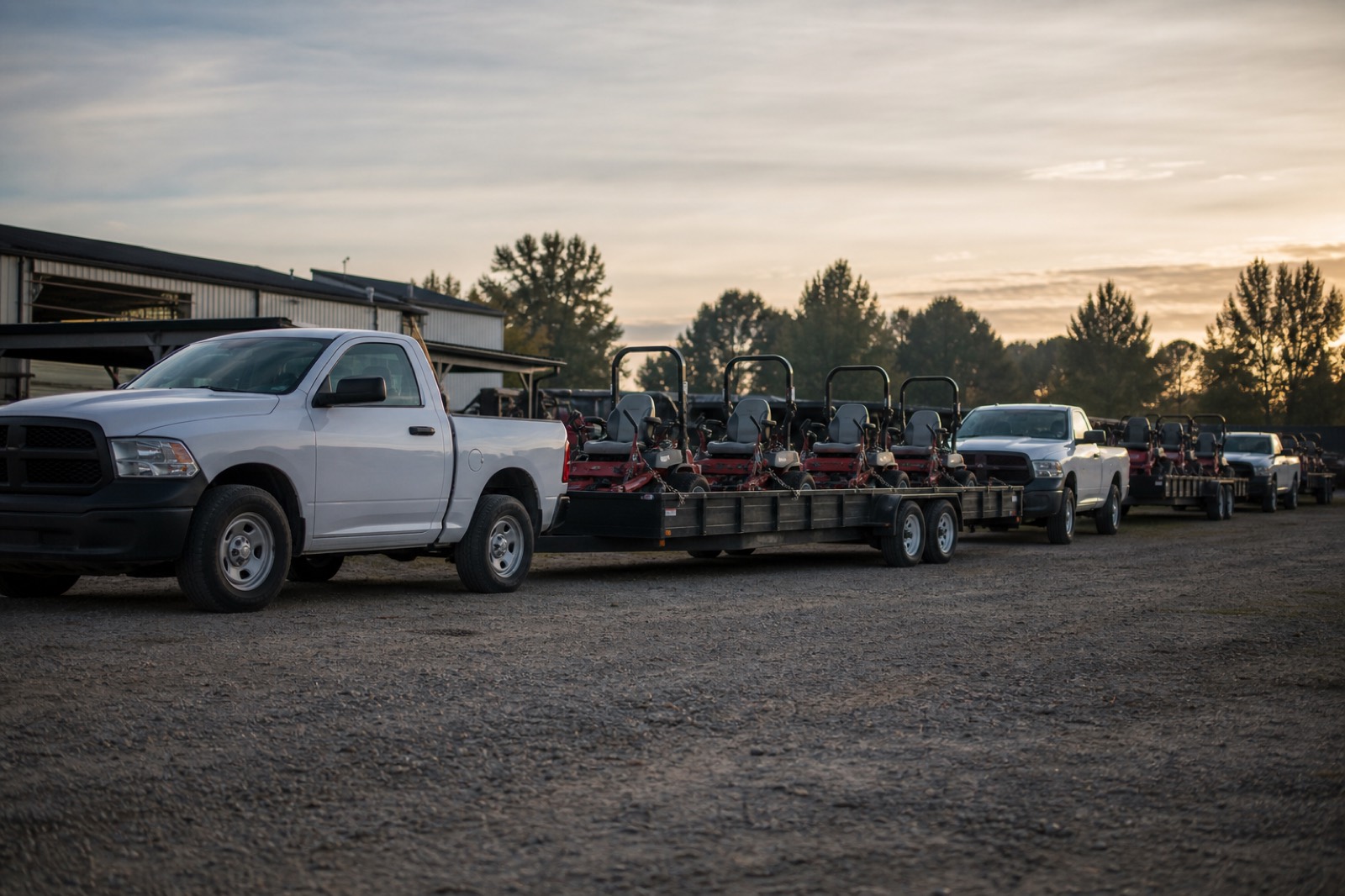
- PE-backed roll-up platforms (BrightView, Yellowstone Landscape, SiteOne Landscape Supply backed network, Greenleaf Landscape Services) compete aggressively for $3M plus revenue platforms.
- Snow removal revenue in northern markets adds 15 to 30 percent annual revenue and material seasonal cash flow swings. Underwrite snow revenue conservatively due to weather variability.
What you actually buy in a landscaping company acquisition
For 2026 sell a fence installation business at 3x-7x EBITDA with residential vs commercial mix, fence-type specialization, and named buyers (Empire Today, Long Fence), see our reference.
No fee to you on buy-side introductions; sell-side mandates are paid on success at closing.
CT Acquisitions · 2026 Landscaping Acquisition Signal
What Landscaping Buyers Find Out in Diligence
Across our buy-side conversations with landscaping consolidators in 2026:
- Customer contract assignability is the deal-cliff issue. HOA, multifamily, and commercial property management contracts often contain non-assignment clauses requiring landlord / board consent (30-90 day timeline).
- Crew foreman tenure drives the operating moat. Stable foremen with 5+ years tenure drive crew-leader multiplier; high turnover caps multiples regardless of revenue scale.
- Snow removal + design-build mix commands multi-turn premium. Year-round revenue diversification (snow contracts in northern markets, design-build in shoulder seasons) unlocks platform-tier pricing.
Multiple at a Glance · 2026
Landscaping Acquisition Multiples · 2026
By scale and service mix.
Source: CT Acquisitions analysis. SBA 7(a) under $5M typical. Diligence: customer contract assignability, commercial account renewals, equipment maintenance log, H-2B visa crew mix.
Related Cluster GuideFor the sell-side companion on how to sell a landscaping business, see our reference guide.
No fee to you on buy-side introductions; sell-side mandates are paid on success at closing.
For 2026 home services multiples by sub-sector with 3x-8x EBITDA ranges and what drives premium across HVAC/plumbing/electrical/roofing/pest, see our guide.
For 2026 tree care valuation factors with the 8 factors that drive top-of-range multiples, see our reference guide.
For the founder quick-answer on how much a landscaping business is worth with 2026 multiples, see our guide.
For 2026 tree service multiples and PE roll-up activity, see our how to sell a tree service business guide.
For a deeper breakdown of multiples by operator type and the value drivers buyers pay premiums for, see our 2026 guide to landscaping business valuation.
Why route density matters more than total revenue
How landscaping companies are valued
How PE-backed roll-up competition reshaped the market
Step 1: build the acquisition thesis
To buy a landscaping business, work in six steps: set a thesis on size, service mix and geography; source deals through brokers, listings and direct owner outreach; run diligence on contracts, crews and equipment; line up SBA 7(a) or conventional financing; negotiate a seller transition; then protect the route book in the first three months.
Your thesis decides which listings you even look at. Pick a revenue band you can finance, a service mix (recurring commercial maintenance, residential maintenance, design-build, or snow), and a drive-time radius you can manage. Commercial maintenance contracts give the most predictable cash flow and the strongest lender story. Residential project work is cheaper to buy but harder to keep through an ownership change.
Step 2: sourcing landscaping acquisitions
Where to buy a landscaping business comes down to three channels. Listing sites carry the smaller deals: BizBuySell reports a median asking price of $399,000 for established landscape and yard service businesses on its marketplace, with listings running from under $164,950 to well over $975,000. Those are asking prices, not sale prices, and many listed companies are single-crew residential operators.
Business brokers and M&A advisors hold most of the mid-sized commercial operators, often under NDA before anything is posted. Ask brokers in your target metro to add you to their buyer list and send them your criteria in writing.
Direct outreach finds the best deals. Many owners of route-dense maintenance companies have never listed. A short letter or call to owners in your target radius, followed up through the season, surfaces sellers before PE-backed roll-ups reach them. Equipment dealers, nurseries and suppliers also know which owners are close to retirement.
Step 3: due diligence on a landscaping company
Use this buying a landscaping business checklist before you sign a purchase agreement. Each item maps to a way landscaping deals lose value after close.
- Tax returns and P&L: three to five years, reconciled to bank deposits, with snow and project revenue split out from maintenance revenue.
- Customer contracts: every maintenance contract with term, renewal date, price escalator and any assignment or change-of-control clause. HOA and property management contracts often need consent to assign.
- Revenue concentration: share of revenue from the top ten customers and from any single property manager.
- Route map: stops per crew per day and drive time between stops.
- Equipment list: every truck, trailer and mower with age, hours, title and maintenance log, plus which items are leased or financed.
- Crew roster: foreman tenure, pay rates, overtime history, I-9 files, and any H-2B petitions and sponsor agreements.
- Licenses and insurance: state pesticide applicator and irrigation licenses, who holds them, and loss runs on auto and workers comp policies.
- Seller transition: how long the owner will stay, which customer relationships the owner holds personally, and a written non-compete.
For a general framework that applies across industries, see our buying an existing business checklist.
Step 4: financing the acquisition
Step 5: the transition period
Step 6: the first 90 days post-close
Conclusion
Buying a landscaping company in 2026 means navigating a market shaped by PE-backed roll-up competition for $3M plus revenue commercial-heavy platforms and durable opportunity for solo buyers in smaller and residential-heavy operators. The buyers who win in this category share three operational habits. They run the route density math first and pass on geographically sprawled operations even at attractive headline multiples. They run customer retention math against transition length and pay 5 to 8 percent more for a 12-month selling owner transition commitment because the math demands it. They verify pesticide license transferability and H-2B labor sustainability before signing any LOI. Done with that discipline, a landscaping company acquisition compounds 12 to 20 percent unleveraged returns annually plus principal paydown and any value-add execution on procurement, fleet management, and service expansion.
Frequently Asked Questions
How much does it cost to buy a landscaping company in 2026?
Solo landscaping companies in the $500K to $1.5M annual revenue range trade at $400K to $1.2M purchase price (depending on customer mix and equipment fleet condition). Mid-sized companies with $1.5M to $4M revenue trade at $900K to $3.5M. Larger commercial-heavy companies with $4M plus revenue trade at $3M to $12M or higher when PE-backed platforms compete. Plan for total capital required of 1.15 to 1.25x the purchase price once equipment upgrade capex, working capital reserves, and closing costs are included.
What multiple should I expect to pay for a landscaping company?
Residential-heavy operators with high project revenue percentage trade at 3 to 4 times EBITDA. Mixed operators with 40 to 60 percent commercial maintenance contracts trade at 4 to 5 times EBITDA. Commercial-heavy operators with 60 percent plus recurring maintenance contracts trade at 5 to 6 times EBITDA. PE-backed roll-up platforms acquiring $3M plus revenue commercial platforms pay 6 to 8 times EBITDA, supported by lower cost of capital and operational synergies.
Can I buy a landscaping company with an SBA loan?
Yes. SBA 7(a) loans cover landscaping company acquisitions up to $5M. Specialty practice lenders including Live Oak Bank, US Bank, and regional banks with green industry experience underwrite roughly 70 percent of practice acquisitions under $5M. Typical terms include 10 to 15 percent buyer equity, 10-year amortization on goodwill and equipment, and 25-year amortization on real estate. Equipment financing for truck and major equipment fleets is typically handled separately through Caterpillar Financial, John Deere Financial, or similar specialty lenders.
What is the biggest risk in buying a landscaping company?
Commercial maintenance contract retention through the transition period. Property management companies and HOAs frequently rebid services after ownership changes, particularly when the selling owner does not commit to a meaningful transition period. A landscaping company losing 20 to 30 percent of commercial maintenance contracts in year 1 sees proportional revenue decline that often breaks SBA debt service coverage covenants. Buyers should pay 5 to 8 percent more for a 12-month selling owner transition commitment because the retention math more than compensates.
How do PE-backed landscaping platforms affect the market?
Fourteen PE-backed platforms collectively own roughly 8 percent of U.S. commercial landscaping revenue. The largest include BrightView Holdings ($2.8B revenue), Yellowstone Landscape (KKR portfolio, $700M plus), Greenleaf Landscape Services (Caltius), Mainscape (KKR Crescent), and Schill Grounds Management. These platforms compete for $3M plus revenue commercial-heavy operators, paying 6 to 8 times EBITDA. Solo buyers compete by focusing on smaller acquisitions, markets with less PE coverage, or value-add theses that PE platforms cannot easily execute.
What due diligence should I do on a landscaping company?
Six workstreams. Financial diligence reconciles revenue against bank deposits and validates seasonal cash flow patterns. Customer contract diligence reviews maintenance contracts for renewal terms, escalators, and change-of-control provisions. Equipment diligence inspects every truck, trailer, and major piece of equipment for age and condition. Labor diligence reviews crew compensation, H-2B visa history, and pesticide license records. State licensure diligence verifies pesticide applicator and irrigation contractor licenses are current. Operational diligence reviews scheduling, dispatch, and customer billing systems.
How do I handle pesticide license transfer?
Pesticide applicator licenses are typically issued at the operator level, not the company level. Most states require the new operator-of-record to pass a state-specific exam and provide proof of insurance before the license transfers. The transfer process typically takes 30 to 90 days. Buyers should initiate the transfer application immediately upon closing to prevent service interruption during the spring or peak season. In some states, the seller’s operator-of-record can serve in that capacity for the new owner during a 60 to 90 day transition while the buyer’s designee completes the licensure process.
What about H-2B visa workers?
Many landscaping companies source 30 to 60 percent of seasonal labor through the H-2B visa program. The annual H-2B cap of 66,000 visas creates uncertainty because demand routinely exceeds supply, and supplemental allocations under Trump and Biden administrations have varied year to year. Buyers should verify the seller’s H-2B history, sponsor relationship (with firms like Mas Labor, OPTNation, or USA H2B), and any pending denied applications. Companies dependent on H-2B above 50 percent of seasonal labor face execution risk that affects valuation and capital requirements.
How does snow removal revenue affect valuation?
Snow removal revenue in northern markets adds 15 to 30 percent of annual revenue and creates material seasonal cash flow swings. Snow revenue is highly variable based on weather patterns, with year-over-year swings of 30 to 50 percent common. Buyers should underwrite snow revenue conservatively using a trailing 5-year average rather than peak year, and ensure the financial model can withstand a low-snow year without breaking covenants. Snow equipment (plows, salt spreaders, snow blowers) adds $50K to $250K of acquisition cost depending on fleet size.
Should I buy a landscaping company with the real estate?
Acquiring the real estate (operations yard, fleet storage, equipment maintenance facility) alongside the company generally improves long-term economics. The buyer captures the rent payment that would otherwise flow to a third-party landlord, builds equity in the property, and gains operational control over yard expansion and fleet capacity. SBA 7(a) loans cover combined company-plus-real-estate transactions with 25-year amortization on the real estate portion. The trade-off is higher upfront equity requirement and concentrated geographic risk. Most landscaping buyers acquire real estate when the seller offers it.
Is buying a landscaping business worth it?
It can be, if the price matches the recurring revenue you keep after close. An established company gives you customers, crews, equipment and cash flow from day one, which a startup takes years to build. The main risks are contract losses during the transition, aging equipment and crew turnover. Buyers who pay for documented maintenance contracts and secure a seller transition usually do better than buyers who pay for one-time project revenue.
Where can I find a landscaping business for sale?
Start with listing marketplaces such as BizBuySell, which reports a median asking price of $399,000 for established landscape and yard service businesses. Then register with business brokers in your target metro, who often hold larger commercial operators off-market. The best deals usually come from direct outreach to owners near retirement in your target radius, before PE-backed roll-up platforms reach them.
Will the seller finance part of a landscaping business purchase?
Often, yes. A seller note is common in landscaping deals and signals that the owner expects the customers to stay. If you use an SBA 7(a) loan, SBA SOP 50 10 8 lets a seller note count toward your equity injection only when it is on full standby for the life of the loan, meaning no payments until the SBA loan is repaid. Otherwise the note is extra financing on top of your own cash.
Related Guide: Landscaping Company Valuation, How landscaping companies are valued in detail.
Related Guide: Buying an Existing Business Checklist, General acquisition framework applicable across industries.
Related Guide: SBA 7(a) Loan for Business Acquisition, How SBA financing works for service business acquisitions.
Related Guide: How to Determine if a Business Is Worth Buying, Screening framework before LOI.
Want a Specific Read on Your Business?
30 minutes, confidential, no contract, no cost. You leave with a read on your local buyer market and a likely valuation range.
30 N Gould St, Ste N, Sheridan, WY 82801, USA · (307) 522-0262 · Contact