
How to Buy a Car Wash in 2026: Acquisition Playbook

Christoph Totter · Managing Partner, CT Acquisitions
M&A advisory across 500+ active capital partners · Specialty service M&A: car washes, laundromats, vending, route businesses · Updated June 6, 2026
If you are working out how to buy a car wash in 2026, expect to pay 3x to 6x SDE for owner-operator single-site operators and 5x to 8x EBITDA for multi-site / tunnel-format platforms. Tunnel express car washes with high membership penetration command the top of range; in-bay and self-service operators trade at the lower end. SBA 7(a) financing covers most acquisitions under $5M; critical diligence items include equipment age, water recycling compliance, lease term remaining, and verified membership / unlimited-plan retention metrics.
TL;DR, the 90-second brief
- Car washes have become one of the most attractive small-to-middle-market acquisitions in the 2020s.
- The asset class combines real estate with operating business cash flow, semi-passive operations (especially express tunnel formats), strong unit economics, and meaningful PE-backed roll-up activity driving multiples upward.
- Three formats dominate: express exterior tunnel ($2M-$10M deals, 35-50 percent EBITDA margin), in-bay automatic ($500K-$3M deals, 25-40 percent margin), and self-service ($300K-$1.5M deals, 20-35 percent margin).
- Most car washes sell at 4x to 7x EBITDA, with tunnel formats at the upper end.
- Critical due diligence: equipment age, water recycling compliance, real estate value, and trailing 24-month vehicle count.
Key Takeaways
- Three car wash formats: express tunnel (highest margin), in-bay automatic (mid-tier), self-service (lower margin)
- Express tunnels trade at 5x-8x EBITDA; in-bay automatic at 4x-6x; self-service at 3x-5x
- Unlimited monthly wash club memberships drive 30-60 percent of revenue at successful express tunnels (recurring revenue premium)
- Equipment is significant: tunnel equipment $500K-$2M, in-bay $80K-$250K per bay, self-service bays $30K-$80K each
- Water recycling compliance is required in most jurisdictions; water cost is 5-10 percent of revenue
- PE-backed roll-up activity (Mister Car Wash, Driven Brands, Spotless, Splash) drives multiple expansion in 2026
How to buy a car wash: the step-by-step process
Buying a car wash means moving through a defined sequence: pick the format that fits your capital and time, source deals through brokers and direct outreach, verify the operation with hands-on diligence, secure acquisition financing, then close and take over daily operations. Purchasing a car wash is less about the sticker price and more about confirming the wash volume, equipment condition, and recurring membership base behind it.
Start by deciding which of the three car wash formats matches your goals. Express exterior tunnels run the highest volume and demand the most capital, in-bay automatics sit in the middle, and self-service sites carry the lightest operating load. That choice frames every step that follows, because the format sets the deal size, the diligence checklist, and the financing path you will use.
Once you know the format, buying a car wash follows a repeatable order. Source targets through business brokers and direct owner outreach, sign an NDA, and request trailing financials. Then run the diligence that this guide covers in depth: equipment age and remaining life, water and reclaim compliance, lease term, and verified vehicle counts. Membership retention deserves its own hard look, since recurring plans carry a car wash far more than one-off traffic. Only after the numbers hold up do you move to financing and closing.
The buyers who purchase a car wash successfully treat the first 100 days as part of the acquisition, not the aftermath. Retaining the manager, honoring existing memberships, and holding service quality steady protects the revenue you paid for. If you want a grounded read on what a specific site is worth before you make an offer, run the numbers through our free business valuation calculator and bring the output into your diligence.
Buying a car wash checklist: what to verify before you sign
A buying a car wash checklist has five parts: price against format, verified wash volume, equipment condition, water and environmental compliance, and the lease or real estate. Work through each one before your LOI expires. A site that fails an item can still be a good deal, but only if the price reflects the fix.
Use this list as the working order for an established site. Each line maps to a section further down this guide.
- Price against format. BizBuySell’s car wash marketplace listed a median asking price of $1,200,000 for an established car wash when we checked in October 2026. Express tunnels with land sit well above that median, self-serve sites below it.
- Financials tied to the register. Match POS transaction reports to tax returns and bank deposits month by month. Cash-heavy self-serve bays deserve the closest look.
- Vehicle count in person. Count cars yourself at a weekday peak, a weekend peak and a rainy day. Compare your counts to what the POS reports for the same hours.
- Membership roster. Pull active members, monthly cancellations and failed card charges from the billing processor, not from a seller summary.
- Equipment. Hire an independent inspector, record the manufacturer and install year of each major component, and read the service log.
- Water and discharge. Get water and sewer bills, the reclaim system status and any local discharge permit.
- Environmental. Order a Phase I Environmental Site Assessment under the ASTM E1527-21 standard and check the oil and grit separators.
- Lease or real estate. Confirm years remaining, renewal options and whether the landlord must consent to assignment.
- Permits and zoning. Confirm the conditional use permit, signage approvals and business licenses transfer to you.
- Insurance quotes. Price property, equipment breakdown, general liability and garagekeepers coverage before closing, since a car wash has custody of customer vehicles.
- Financing. SBA 7(a) loans go up to $5 million (SBA), and SBA SOP 50 10 8 requires at least a 10% equity injection on a change of ownership.
Three car wash formats and their economics
For 2026 strategic acquisition playbook (2026) covering approach mechanics, synergy valuation, deal structure, financing, and antitrust considerations, see our reference.
For 2026 route-based business acquisition playbook covering route value drivers (customer concentration, contract terms, equipment), capital required, financing, and diligence, see our reference.
For 2026 how to buy a motel covering real-estate value, room economics, brand vs independent, SBA financing, diligence, and operating reality, see our reference.
For 2026 how to buy a bed and breakfast covering real-estate vs business split, capital required, financing options, diligence checklist, and operational realities, see our reference.
CT Acquisitions · 2026 Car Wash Signal
What Car Wash Buyers Find Out the Hard Way
Across our buy-side conversations with car wash buyers in 2026:
- Membership penetration is the underwriting headline. Operators with 50%+ unlimited-membership penetration trade at material premium vs single-wash heavy peers.
- Water recycling compliance gates the deal. Operators without compliant water recycling systems face capex line item in buyer model; compliant systems drive premium.
- Lease term remaining is the diligence cliff. Below 10 years remaining triggers renegotiation or buyer-led extension as LOI condition.
Multiple at a Glance · 2026
Car Wash Acquisition Multiples · 2026
By format and operator scale.
Source: CT Acquisitions analysis of car wash acquisitions. Tunnel express dominates PE consolidation in 2026. SBA 7(a) financing covers most acquisitions under $5M.
Related Cluster GuideAdjacent specialty-service buyer playbook: see how how to buy a laundromat works in 2026.
For the 2026 how to buy a FedEx route with ISP costs, approval process, and SBA 7(a) financing, see our buyer’s guide.
Car wash is a category that includes three distinct business formats with different unit economics, capital requirements, and operating profiles. Buyers should understand which format they are evaluating.
Format 1: Express exterior tunnel
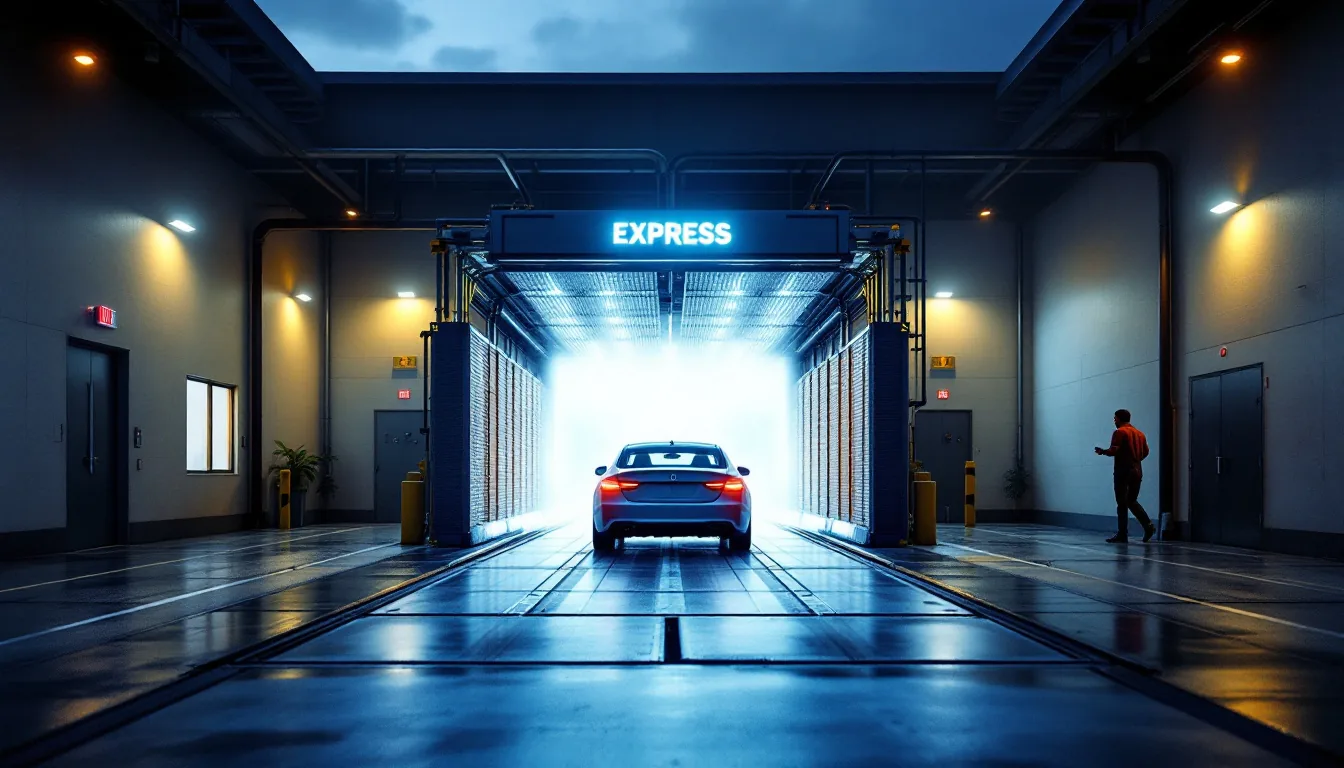
Most attractive format in 2026. Cars drive through automated tunnel (typically 80-150 feet long) on a conveyor belt. Exterior-only wash. Premium positioning. Membership models drive recurring revenue.
Economics:
- Investment: $2M-$10M total (land + tunnel + equipment + working capital)
- Daily vehicle count: 200-800 cars/day at maturity
- Average ticket: $8-$20 per wash; membership $15-$40/month
- Membership penetration: 30-60 percent of customers at strong locations
- EBITDA margin: 35-50 percent (highest in the industry)
- Real estate as percentage of total deal: 50-70 percent typical
Format 2: In-bay automatic
Drive-in single-bay or multi-bay format. Driver pulls into bay, equipment cleans the car automatically. Customer waits in vehicle. Single bay or 2-4 bays typical.
Economics:
- Investment: $500K-$3M total
- Daily vehicle count: 30-150 cars/day per bay
- Average ticket: $5-$15 per wash
- Membership uncommon (some locations have limited memberships)
- EBITDA margin: 25-40 percent
- Real estate as percentage of total deal: 60-75 percent typical
Format 3: Self-service
Customer washes their own vehicle in equipped bay. Coin or card-operated equipment. Multiple bays typical (4-12 bays).
Economics:
- Investment: $300K-$1.5M total
- Daily vehicle count: 30-100 cars per day across all bays
- Average ticket: $3-$8 per wash
- EBITDA margin: 20-35 percent
- Real estate as percentage of total deal: 65-80 percent typical
Why express tunnel dominates new development:
Unit economics favor tunnels: highest throughput per square foot of real estate, lowest per-wash variable cost, recurring revenue through memberships, semi-passive operations after stabilization, attractive to PE-backed roll-up buyers driving exit multiples.
The combined effect: tunnel car washes have become the most attractive small-to-middle-market real-estate-included business acquisition in 2026. PE-backed roll-up activity has driven tunnel acquisition multiples up 20-40 percent over the past 5 years.
For adjacent real-estate-included business framework, see how to buy a hotel.
Why memberships transform tunnel economics
Unlimited monthly wash club memberships (typically $15-$40/month) convert tunnel car washes from transactional to subscription businesses. At 40 percent membership penetration, a tunnel doing 400 cars/day has roughly 160 members generating $4,000-$6,000/month in recurring revenue. The recurring revenue compounds: predictable monthly cash flow, ability to invest in marketing knowing customer lifetime value, premium valuation multiples (5x-8x EBITDA vs 4x-6x for non-membership tunnels). Implementing memberships at an existing tunnel typically lifts EBITDA 25-50 percent within 18-24 months.
Why PE backers are paying premium multiples
Mister Car Wash (publicly traded, MAC), Driven Brands (BRAD owns Take 5 Car Wash and Meineke), Spotless Brands, Splash Car Wash, El Car Wash, Tommy’s Express, and dozens of regional roll-ups are actively acquiring tunnel car washes. Their thesis: fragmented industry, attractive unit economics, scalable operations, real estate appreciation. They pay 7x-10x EBITDA for institutional-quality tunnels. Individual operators selling to PE buyers see strong exits.
Buying an established car wash: where listings come up and what to ask the seller
Buying an established car wash gives you a trading history to underwrite, which a new-build tunnel does not. The trade-off is that you inherit the seller’s equipment, reputation and lease. Most first-time buyers are better served by an operating site with clean records than by a development project.
Where car wash listings come up. Start with the car wash category on BizBuySell, then LoopNet and Crexi for sites sold with the real estate. Specialist car wash brokers carry many of the larger tunnel deals. The best off-market leads often come from the people who service washes every week: equipment distributors and chemical suppliers hear early when an owner is tired or planning to retire. Direct letters to independent owners in your target area work too, especially single-site operators who have never been approached.
What to ask the seller before you make an offer.
- Why are you selling, and why now?
- Are any new express tunnels permitted or under construction nearby?
- When were the conveyor, brushes and dryers last rebuilt or replaced?
- What is monthly membership churn, and has it changed since prices last went up?
- Will you carry a seller note, and on what terms?
On seller notes, read the SBA rule closely: under SBA SOP 50 10 8, a seller note can count toward your equity injection only if it is on full standby for the life of the SBA loan, and for no more than half of the required injection. A note that pays the seller during the loan term does not count. If you are financing with SBA debt, our guide to using an SBA 7(a) loan to buy a business walks through the structure.
Car wash valuation methodology
Car washes value on EBITDA multiples with real estate considered separately or included. The multiples vary by format and quality.
Independent car wash EBITDA multiples:
Express tunnel (newer, with strong membership program): 6x to 8x EBITDA Express tunnel (standard, limited or no membership): 5x to 6.5x EBITDA In-bay automatic (single or multi-bay): 4x to 6x EBITDA Self-service multi-bay: 3x to 5x EBITDA Multi-location operator (3+ locations): 5x to 8x EBITDA across portfolio PE-quality platform (10+ locations, regional): 7x to 10x EBITDA
Factors driving multiple higher:
- Strong membership program (30-60 percent of revenue recurring)
- High vehicle count at peak hours
- Premium location (high traffic count, growing trade area)
- Modern equipment (under 8 years old)
- Long ground lease or owned real estate
- Water recycling compliance and efficiency systems
- Strong online reputation (4.0+ Google rating, 200+ reviews)
- Operating efficiency metrics (vehicles per hour, labor cost ratio)
Factors driving multiple lower:
- Old equipment (12+ years, replacement imminent)
- No or weak membership program
- Low vehicle count or declining trend
- Short lease (under 5 years)
- Water compliance issues
- Competing tunnel within 1-mile radius (oversupply)
- Operating issues (employee turnover, customer complaints)
- Recent vandalism or theft history
Real estate valuation: Most car washes are sold as real estate + operating business combined. The real estate alone has significant value (often 60-70 percent of total deal). Land + improvements typically value at retail commercial cap rate (6-9 percent of NOI from rent if it were rented out separately).
For a $5M express tunnel deal:
- Real estate value: $2.5M-$3.5M
- Operating business value: $1.5M-$2.5M
- EBITDA: $700K-$1M
- Implied EBITDA multiple: 5x-7x (depending on growth, membership, market)
Equipment value: Tunnel equipment (conveyor, washers, dryers, water systems): $500K-$2M new In-bay automatic equipment per bay: $80K-$250K Self-service equipment per bay: $30K-$80K Vacuum and detail equipment: $20K-$100K Water recycling systems: $50K-$300K (often retrofitted)
Working example-mid-size express tunnel:
- Daily vehicle count: 400 cars/day
- Average ticket including memberships: $12
- Annual revenue: $1.75M
- EBITDA margin: 42 percent
- EBITDA: $735K
- 6x EBITDA = $4.4M
- Plus real estate value: $2M
- Total deal: $6.4M
For the broader valuation methodology, see business valuation methods 2026.
Why real estate value matters
Car washes are real-estate-intensive businesses. The real estate alone has substantial value separate from the operating business. Some buyers acquire only the real estate and lease to operators (sale-leaseback structures). Others own both. The real estate appreciates over time (3-7 percent annually in stable markets) providing wealth building on top of operating returns. Long-term car wash investors often value real estate appreciation more than operating cash flow.
PE roll-up multiple vs independent multiple
Independent car washes trade at 4x-7x EBITDA. PE-backed multi-location platforms trade at 7x-10x EBITDA. The multiple expansion reflects: scale economies, professional management, brand value, growth pipeline, exit potential to larger PE buyer or public market. Operators building toward PE exit can target multi-location strategy to capture this multiple expansion.
Membership program economics and the recurring revenue play
Monthly unlimited wash club memberships are the single biggest value driver in modern car wash operations. Understanding membership economics is critical to evaluating tunnel car wash acquisitions.
How memberships work:
- Customer signs up for monthly unlimited wash club ($15-$40/month)
- Membership auto-renews until cancelled
- Customer receives unlimited washes during the month
- Member visits typically 2-4 washes per month
- Per-visit cost to operator: $2-$5 (water, chemicals, labor, depreciation)
- Per-member margin: $10-$30 per month
Membership penetration drives value:
- Low membership (under 15 percent): tunnel operates as transactional business
- Average membership (15-30 percent): meaningful recurring revenue base
- Strong membership (30-50 percent): subscription-like business model
- Excellent membership (50+ percent): premium asset with predictable cash flow
Membership program execution:
- Sign-up incentive (first month free or discounted)
- Easy auto-renewal (frictionless)
- Multiple tier options (express wash only, premium with vacuum, etc.)
- Family plans (multiple vehicles)
- Mobile app for easy management
- Cancellation friction (not too easy, not predatory)
Membership penetration improvement post-acquisition:
- Add new tier options (premium, family)
- Increase sign-up incentives (free month vs discounted)
- Improve mobile app and customer experience
- Marketing campaign targeted at high-frequency users
- Staff training on membership pitching at point of sale
- Loyalty rewards integration
Typical improvement trajectory:
- Year 1: 20-30 percent membership penetration (typical acquired state)
- Year 2: 30-40 percent
- Year 3-4: 40-50 percent
- Maturity: 45-55 percent for well-run programs
NOI impact of membership improvement: A tunnel with 25 percent membership penetration that improves to 45 percent over 24-36 months sees revenue lift of 25-40 percent without infrastructure investment. At 45 percent EBITDA margin, that’s 10-18 percent EBITDA growth. At 6x EBITDA multiple, that’s $300K-$600K+ value creation on a typical tunnel.
This explains why PE buyers pay premium multiples: they can grow EBITDA materially through professional membership program execution.
Why some markets reject membership models
Membership penetration varies by demographics. Younger, urban, professional demographics adopt memberships at 50-70 percent rates. Older, rural, traditional demographics may stay at 15-25 percent regardless of execution. Underwrite membership ceiling based on actual demographics, not generic targets.
Membership cannibalization risk
Some tunnel operators worry memberships cannibalize per-visit revenue. The math typically works the other way: members visit 3-4 times monthly vs non-members at 1-2 times. Total revenue per customer typically increases 50-100 percent on membership conversion. The challenge is operational (capacity at peak hours) not financial.
Critical due diligence: equipment, water, and vehicle count
Car wash due diligence covers standard items plus three industry-specific concerns.
1. Equipment audit
Independent equipment inspection by car wash equipment company ($2K-$5K). Critical items:
- Tunnel equipment age and remaining life (conveyor, brushes, dryers, water systems)
- Equipment manufacturer (Sonny’s, MacNeil, Mark VII, Vacutech, ICS) and parts availability
- Maintenance history and service contract status
- Power utility infrastructure (sufficient for current and growth)
- Water heating and recycling systems
- Customer-facing equipment (kiosks, vacuums, pay stations)
- Compliance with current OSHA and ADA standards
Replacement cost benchmarks:
- Full tunnel re-equipping: $500K-$1.5M depending on length and features
- In-bay automatic replacement: $80K-$250K per bay
- Self-service bay re-equipping: $20K-$50K
- Water reclaim system retrofit: $50K-$300K
2. Water consumption and recycling compliance
Water is significant cost and regulated., Trailing 24 months of water bills (compare to vehicle count and revenue), Water reclaim/recycling system status-Local jurisdiction recycling requirements-Sewer discharge compliance-Stormwater management compliance
Water costs typically 5-10 percent of revenue. Higher signals operational issues or pricing not matching costs.
3. Vehicle count verification
Vehicle count is the canonical car wash performance metric. Verify through:
- POS system transaction records (trailing 24-36 months)
- Membership records (member visit logs)
- Vacuum vendor revenue (some operators have vacuum/detail vendor that pays per use)
- Site visits at peak hours to verify reported numbers
- Inquiry with neighboring businesses about traffic patterns
Vehicle count by format:
- Strong express tunnel: 300-800 cars/day
- Average express tunnel: 150-300 cars/day
- Strong in-bay automatic: 75-150 cars/day per bay
- Average in-bay automatic: 40-75 cars/day per bay
- Self-service: 30-100 cars/day across all bays
4. Lease and real estate For leased properties: lease term, assignment, escalation. For owned properties: real estate value separate from operating business, title, survey, environmental Phase 1.
5. Environmental compliance Phase 1 environmental assessment ($2K-$5K). Car washes have specific environmental concerns: oil/grease separators, underground tanks (if applicable), stormwater management, soil contamination from prior operations.
6. Trade area demographics-Traffic count (state DOT records), Income demographics within 3-mile radius-Competition within 1-mile and 3-mile radius-Growth trends in vehicle registrations and population-Recent or planned road construction affecting traffic patterns
For the broader due diligence framework, see business acquisition due diligence process.
Why equipment manufacturer matters
Sonny’s, MacNeil, PECO, ICS, Mark VII, and Vacutech are the major equipment manufacturers. Each has parts availability, service network, and operational characteristics. Sonny’s has the largest installed base and best parts availability. MacNeil is premium quality. PECO is value-focused. Buyers should know equipment manufacturer because: parts availability affects downtime, service network varies, and future expansion/replacement decisions affect operational consistency.
Why water recycling is increasingly mandatory
Many jurisdictions (California, drought-affected southwestern states, several major metros) require water recycling for car wash operations. Reclaim systems capture, filter, and reuse water (typically 60-80 percent of water can be reclaimed). Capital cost $50K-$300K. Some new car washes can’t be permitted without reclaim systems. Verify regulatory status during due diligence.
Financing car wash acquisitions
Car wash financing typically combines SBA 7(a) for owner-operator deals with commercial real estate loans for the real estate portion. PE-backed deals use bank debt and equity.
Most first-time car wash buyers structure the deal around SBA 7(a) car wash financing, which sets the equity-to-debt ratio for the working-capital load.
SBA 7(a) loans for car washes:
- Deal size: up to $5M
- Owner-operator requirement
- Down payment: 15-25 percent typical
- Amortization: 10 years on goodwill, 10 years on equipment, 25 years on real estate
- Interest rate: SOFR + 2.75-4.75 percent
- Active SBA lenders: Live Oak Bank (specialty car wash practice), Pinnacle Bank, BHG Bank, Newtek
SBA 504 for real estate portion:
- Combined with SBA 7(a) for total deal up to $15M
- 10-15 percent down payment on real estate
- 25-year amortization at below-market fixed rate
- Significant savings vs full conventional financing
Conventional commercial real estate loans:
- For larger deals ($5M+) or non-SBA buyers
- Down payment: 25-35 percent
- Amortization: 20-25 years
- Recourse typically required
- Active lenders: regional commercial banks, life insurance companies, debt funds
Specialty car wash lenders:
- Live Oak Bank has dedicated car wash practice
- Several regional banks specialize in retail real estate including car washes
- Equipment financing through Wells Fargo, US Bank, Capital One specialty divisions
PE-backed acquisition financing:
- For multi-location or platform acquisitions
- Capital stack: senior debt 50-65 percent, mezzanine 10-15 percent, equity 25-35 percent
- PE platforms: Mister Car Wash (MAC), Driven Brands (BRAD), Spotless, Splash, El Car Wash, Tommy’s Express, regional roll-ups
Seller financing:
- 15-25 percent of purchase price common
- 5-year amortization, 6-8 percent interest
- Full standby for the life of the SBA loan when the note counts toward the equity injection (SBA SOP 50 10 8)
- Often used to bridge valuation gaps
Typical capital stack for $5M express tunnel acquisition (owner-operator):
- SBA 7(a) for business + equipment: $1.5M
- SBA 504 for real estate: $1.5M
- Conventional bank for excess real estate: $750K
- Seller note: $500K (10 percent on standby)
- Buyer cash: $750K (15 percent total down payment)
For SBA framework specifically, see can an SBA loan be used to buy a business 2026.
Why Live Oak Bank dominates car wash SBA lending
Live Oak Bank built a dedicated car wash practice with underwriters who understand: tunnel vs in-bay vs self-service economics, membership program valuation, equipment lifecycles, water compliance, vehicle count verification. Their car wash approval rate is higher than generalist SBA lenders. For owner-operator car wash acquisitions, Live Oak is typically the first call.
Why PE-backed multiples create exit opportunity
Owner-operators building toward eventual PE exit can capture multiple expansion. A single-location tunnel at 5x EBITDA sold to multi-location PE platform may achieve 7x-9x EBITDA based on platform value. Multi-location regional operators can build to 8x-10x EBITDA exit multiples. The strategy works for operators willing to scale to 3-10 locations before exiting.
First 100 days of car wash operations
Car wash operations have distinct rhythms by format. The first 100 days focus on operational continuity, equipment uptime, and membership program optimization.
Days 1-14:
- Real estate and equipment title transfer
- POS and membership system ownership transfer
- Equipment service contract renewal
- Water utility account transfer
- Insurance policy updates (property, equipment, business interruption, general liability)
- Banking and merchant processing transitions
- Employee one-on-one meetings (manager, lead technicians, cashiers)
- Membership database review and customer continuity
Days 15-30:
- Equipment audit and maintenance schedule
- Water consumption analysis vs reported revenue
- Vehicle count verification (in-person observation, POS data analysis)
- Membership program assessment (penetration, churn, ARPU)
- Vendor relationship review (chemical supplier, equipment service, vacuum vendor)
- Customer experience walk-through (peak hours, weekends, weather conditions)
- Marketing review (signage, social media, local advertising, paid search)
Days 31-60:
- First monthly close under new ownership
- Membership program optimization initiatives
- Equipment maintenance schedule implementation
- Pricing analysis (per-wash, membership tiers, add-on services)
- Customer satisfaction monitoring (Google reviews, surveys)
- Local community outreach and corporate accounts
Days 61-100:
- Quarterly performance review against underwriting
- Membership program expansion (new tiers, sign-up campaigns, retention)
- Equipment lifecycle planning (which equipment needs replacement in 24-36 months)
- Capital expenditure planning
- Strategic decisions on expansion (additional services, sister locations)
- First quarterly board meeting with financial sponsors if applicable
Key first-100-days success factors:
1. Equipment uptime is everything. Out-of-service tunnel = zero revenue that day. Maintain rigorous preventive maintenance. Equipment service contract with guaranteed response times is essential.
2. Membership program improvement is the highest-ROI initiative. Push membership penetration from current baseline toward 40-50 percent over 12-24 months.
3. Vehicle count optimization. Peak hour capacity, off-peak marketing, weather-day operations all affect daily count.
4. Customer experience consistency. Speed, quality, cleanliness of facility, working vacuum equipment. Bad experience drives long-term decline.
5. Staff retention. Tunnel operator, equipment maintenance lead, manager-each has institutional knowledge. Retention bonuses for key staff.
For the broader transition framework, see how to replace the seller after business acquisition.
Why equipment maintenance is critical
Tunnel car washes operate 12-14 hours daily. Equipment runs constantly during operating hours. Preventive maintenance prevents breakdowns. A broken tunnel for a day costs the daily revenue (potentially $5K-$15K) plus customer disappointment. Service contracts with guaranteed response times ($300-$800/month typical) are essential operational insurance.
Why membership penetration is the value lever
A tunnel with 25 percent membership has different economics than one with 45 percent membership. Membership penetration improvement: each 5 percentage points typically adds 8-12 percent revenue and 10-15 percent EBITDA. Improving from 25 percent to 45 percent over 24-36 months creates substantial value. This is the central reason PE-backed buyers pay premium multiples.
Frequently Asked Questions
How do you buy a car wash?
You buy a car wash by choosing the format that fits your capital and time, sourcing deals through brokers and direct outreach, running diligence on equipment, water compliance, lease terms, and vehicle counts, then securing acquisition financing and closing. The recurring membership base and verified wash volume matter more than the asking price, so confirm both before you commit.
How much does it cost to buy a car wash?
Wide range by format. Express tunnel: $2M-$10M total (real estate + equipment + business). In-bay automatic: $500K-$3M. Self-service multi-bay: $300K-$1.5M. Most independent express tunnels under $10M trade at 5x to 7x EBITDA plus real estate value. PE-quality multi-location platforms trade at 7x-10x EBITDA.
What is the most profitable type of car wash?
Express tunnel format is the most profitable. EBITDA margins of 35-50 percent are typical (vs 25-40 percent for in-bay automatic and 20-35 percent for self-service). Strong membership programs drive recurring revenue that compounds margin. PE-backed buyers prefer this format, supporting premium exit multiples.
Can I use an SBA loan to buy a car wash?
Yes. SBA 7(a) for owner-operator deals up to $5M, often combined with SBA 504 for real estate portion. Live Oak Bank has dedicated car wash practice. Down payment typically 15-25 percent. Approval requires owner-operator commitment, clean compliance history, and stable revenue trend.
What is the most important due diligence item for car washes?
Equipment audit by independent car wash equipment company ($2K-$5K). Equipment age and condition determines: ongoing maintenance costs, replacement timing, downtime risk, and customer experience. A tunnel with 12-year-old equipment may need $500K-$1M replacement in next 24-36 months that wasn’t budgeted.
How do unlimited monthly wash club memberships work?
Customer pays $15-$40/month for unlimited washes during the month. Member visits typically 2-4 washes/month. Auto-renewal continues monthly. Per-member margin: $10-$30/month (after variable wash cost). Strong tunnels achieve 30-60 percent membership penetration. Memberships drive recurring revenue, customer loyalty, and valuation premium.
How long does it take to close a car wash acquisition?
Typical timeline: 90-150 days for owner-operator SBA deals, 120-180 days for larger conventional deals. Gates: SBA approval (60-90 days), environmental Phase 1 (30-45 days), equipment inspection (15-30 days), title and survey work (30-60 days, often parallel).
Why are PE buyers paying premium multiples for car washes?
Three reasons: (1) Fragmented industry presents roll-up opportunity, (2) Tunnel format has attractive unit economics with recurring membership revenue, (3) Real estate appreciation provides wealth-building on top of operating returns. Active PE-backed acquirers: Mister Car Wash (MAC), Driven Brands (BRAD), Spotless Brands, Splash Car Wash, El Car Wash, Tommy’s Express.
How important is location for car wash success?
Critical. Traffic count, demographics, competing tunnels within 1-3 mile radius, visibility, parking, and accessibility all materially affect vehicle count. Strong tunnel locations in growing markets command premium multiples. Poor locations cannot be saved by operational excellence.
What is water recycling and is it required?
Water recycling (reclaim) systems capture, filter, and reuse wash water (typically 60-80 percent reclaim rate). Many jurisdictions require reclaim systems for new car washes, especially in California, drought-affected southwestern states, and several major metros. Capital cost $50K-$300K. Verify regulatory requirements during due diligence.
Should I buy an express tunnel or in-bay automatic?
Express tunnel if: capital available is $2M+, you can commit to active management of larger operation, market supports the format (sufficient traffic, demographics). In-bay automatic if: capital is $500K-$2M, want simpler operating model, market is smaller. Express tunnel typically produces higher returns but requires more capital and operational expertise.
How much money do you need to buy a car wash?
Plan for the down payment, closing costs and working capital. SBA SOP 50 10 8 requires at least a 10% equity injection on a change of ownership, so on the $1,200,000 median asking price BizBuySell listed for an established car wash in October 2026, that is $120,000 before closing costs. Tunnels with land need far more.
Where can I find car washes for sale?
Check the car wash category on BizBuySell, then LoopNet and Crexi for sites sold with the real estate. Specialist car wash brokers handle many larger tunnel deals. For off-market sites, ask equipment distributors and chemical suppliers who service local washes, and write directly to independent owners in your target area.
What are the weaknesses of a car wash business?
Revenue swings with weather, a broken tunnel earns nothing until it is fixed, and a new express tunnel nearby can pull members away quickly. Water and sewer costs keep rising in many cities, and labor turnover is common. Good diligence prices each of these risks before you buy.
Related Guide: How to Buy a Hotel, Real estate-included business acquisition framework with similar dynamics.
Related Guide: Business Acquisition Due Diligence Process, Complete due diligence framework for real estate-included acquisitions.
Related Guide: Can an SBA Loan Be Used to Buy a Business, SBA 7(a) qualification framework including car wash acquisitions.
Related Guide: Business Valuation Methods 2026, Valuation methodologies for operating businesses with real estate.
Want a Specific Read on Your Business?
30 minutes, confidential, no contract, no cost. You leave with a read on your local buyer market and a likely valuation range.
30 N Gould St, Ste N, Sheridan, WY 82801, USA · (307) 522-0262 · Contact