
Tire Shop Business Valuation: Free Tire Shop Valuation Calculator. What’s Your Tire Shop Business Worth in 2026?
What Is a Tire Shop Business Worth in 2026?
Quick Answer
Tire shop business valuation in 2026 ranges from 3x SDE for a single-bay independent installer to 11x EBITDA for platform-grade multi-unit tire-and-mechanical chains with owned real estate and OEM dealer status. Independent single-store operators typically trade at 3x to 5x SDE, multi-unit tire-and-mechanical service centers trade at 5x to 8x EBITDA, and platform-quality regional chains command 7x to 11x EBITDA per public-company comparables and disclosed PE transactions. The wide range is driven by four structural levers buyers underwrite separately: mechanical-service mix as a percentage of revenue (50%+ of EBITDA at multi-bay shops), real-estate ownership (often 30% to 50% of enterprise value), OEM dealer authorization with Goodyear, Bridgestone, Michelin, or Continental, and fleet account concentration. The central valuation driver is mechanical-service penetration rather than tire-unit volume, because mechanical work carries 55% to 70% gross margin against 22% to 28% on tires alone.

Thinking about selling your tire shop?
Skip the formulas. A 15-minute confidential call gives you a real valuation range and tells you which buyers would compete for your business. The call is free, with no obligation.
Free Tire Shop Valuation Calculator
Enter your revenue, mechanical-service mix, and store count. The calculator applies the same size-band and sub-segment logic documented in this guide and returns a starting-point range in under a minute. It is a screening estimate, not a Quality of Earnings.
Buy-side M&A across 200+ active capital partners · Automotive aftermarket M&A: tire shops, tire-and-service centers, auto repair, quick lube · Updated June 24, 2026
Tire shop business valuation spans the widest range in the automotive aftermarket because the label “tire shop” actually covers four different operating models that trade at very different multiples. A single-bay independent tire installer with a heavy retail tire mix trades at 3x to 5x SDE. A multi-bay tire-and-mechanical service center with strong alignment, brake, suspension, and battery work trades at 5x to 8x EBITDA. A regional chain of 8 to 30 stores with owned real estate and OEM dealer status trades at 7x to 11x EBITDA. And the institutional platforms (Mavis, Discount Tire, Sun Auto, Monro) anchor at the high end on strategic add-on bids. This guide maps the four sub-models, walks through the mechanical-service integration economics that drive 60% of valuation outcomes, covers the real-estate ownership premium structure, and lays out a worked example for a $1.8M EBITDA Ohio four-store Goodyear dealer. If you are a tire shop founder thinking about a sale, this is the valuation framework. A deeper read on auto service business valuation covers adjacent mechanical-only operators with similar buyer dynamics.
How CT Acquisitions Works
- $0 to sellers on buy-side mandates. The buyer in our network pays us at close, so there is no retainer, listing fee, or commission on that path. Sell-side representation is a separate, fee-based engagement agreed in writing upfront.
- No exclusivity on buy-side introductions. Walk at any time. If our buyer isn’t paying enough, hire a banker the next day. We have zero claim on you. Sell-side engagements run on their own written terms.
- No auction, no leaks. We introduce you to one or two pre-mandated buyers sequentially. Your business never gets shopped.
- Top-of-market price AND the right buyer. Our fee scales with sale price (same incentive as a banker), matched on fit, not just the highest check.
- 60-120 days, not 9-12 months. We already know our buyers’ mandates before we pick up the phone with you.
Key takeaways
- 2026 tire shop multiples span 3x SDE (single-bay independent installers) to 11x EBITDA (multi-state platform candidates with strong mechanical mix and owned real estate).
- Mechanical service mix is the single largest valuation lever; 50%+ of EBITDA typically comes from mechanical work at well-run multi-bay shops.
- Real-estate ownership often represents 30% to 50% of enterprise value at owned-location stores and is typically valued separately at 6.5% to 8% cap rates.
- Mavis Tire Express grew from approximately 200 stores in 2018 to over 2,500 in 2024 through BayPine, West Street Capital Partners VIII, and TSG Consumer Partners, anchoring the consolidator-buyer pool.
- OEM dealer status (Goodyear, Bridgestone, Michelin, Continental, Cooper) is a real asset; non-dealer or lapsed-dealer status compresses multiple by 0.5x to 1x.
- Fleet account mix is a double-edged sword: it adds recurring revenue but concentrates risk; 25%+ from one fleet customer triggers discount.
- EV transition is a tailwind for tire shops because EV tires wear 20% faster than ICE-vehicle tires due to instant torque and heavier curb weight.
Table of contents
- Methodology and data sources
- The short answer: typical tire shop valuations in 2026
- The four tire shop business models
- Where the real value lives: mechanical service integration
- How tire shop buyers actually calculate the number
- The six factors that move tire shop multiples
- The real estate ownership premium
- Tire distribution channel and supply economics
- Other factors buyers evaluate
- Worked example: $1.8M EBITDA Ohio four-store Goodyear dealer
- How to increase your tire shop value before selling
- Common mistakes that destroy tire shop valuations
- Getting a valuation for your tire shop
- Sources and references
- Frequently asked questions
Methodology and data sources
Across our buy-side conversations with PE-backed tire-and-service platforms (Mavis, Sun Auto, TBC Corporation, regional consolidators) in 2026, mechanical service mix above 40% of revenue is the gating criterion.
CT Acquisitions · 2026 Buyer-Market Signal
What Tire Shop PE Platforms Pay Premium For
Across our buy-side conversations with PE-backed tire-and-service platforms (Mavis, Sun Auto, TBC Corporation, regional consolidators) in 2026:
- Mechanical service mix above 40% of revenue is the gating criterion. Shops doing primarily retail tire installation with limited mechanical work trade at 1.0x to 1.5x lower EBITDA multiples because the buyer needs to invest capex and recruit mechanical technicians post-close.
- Owned real estate at locations with 30,000+ traffic counts trades at premium cap rates. Owner-rolled or sale-leaseback real estate at 6.5% to 7.5% cap is structured separately and adds materially to total exit proceeds.
- OEM dealer authorization is verified in diligence. Active Goodyear, Bridgestone Firestone, Michelin, Continental, or Cooper dealer status with current pricing programs (TIA, GTS) is worth 0.5x to 1x on the multiple.
- Fleet account books with documented contracts pay. National account programs through TIA, ATD, or direct fleet contracts (Penske, Ryder, Enterprise Fleet Management) add recurring revenue that lifts multiple, though concentration above 25% triggers offsetting discount.
Multiple at a Glance · 2026
Tire Shop Business Valuation Multiples · 2026
By operator type, store count, and mechanical-service mix.
Source: CT Acquisitions analysis of tire-and-service M&A. Mechanical service mix (gross margin lift) and real estate ownership drive top-of-range multiples.
This valuation guide follows CT Acquisitions’ 5-tier source hierarchy: T1 press releases for major sponsor and platform transactions, T2 SEC filings of public comparables (Monro Inc. NASDAQ: MNRO, Goodyear Tire & Rubber NASDAQ: GT), T3 sponsor portfolio pages for BayPine, Leonard Green Partners, TSG Consumer Partners, and Sumitomo Corporation, T4 industry-research publishers (Tire Business, Modern Tire Dealer, Tire Industry Association, BizBuySell, Capstone Partners, Peak Business Valuation), and T5 M&A trade press. Every numeric multiple range cited on this page is reconciled against at least two T4 sources plus CT Acquisitions’ internal VERIFIED_MULTIPLES benchmark.
Tier framing: Headline multiple ranges reflect broad-market mid-market transactions. Premium PE-platform-tier multiples (where cited) reflect institutional-buyer underwriting on businesses that clear specific scale, geography, mechanical-mix, and management-bench thresholds; they are not universally available and require platform-quality operator characteristics.
Verification window: All multiples and operator-tier figures verified June 24, 2026 against the named T4 publishers’ most-recent reports plus CT’s active-engagement data. Multiples by tier are sensitive to credit-market conditions, mechanical-service mix, real estate ownership, OEM dealer status, and fleet account concentration; the cited ranges are starting points for transaction-specific valuation, not deal-specific quotes.
Tire-shop-specific industry-data sources: Tire Business Top 100 Independent Tire Dealers (annual ranking), Modern Tire Dealer Performance Survey, TIA Big O Tires and franchise-system data, Monro Inc. (NASDAQ: MNRO) 10-K and quarterly filings as the largest publicly traded comparable at roughly $1B market capitalization with approximately 1,260 company-operated and franchised stores. Goodyear Tire & Rubber (NASDAQ: GT) 10-K covers approximately 600 company-owned retail stores. The CT VERIFIED_MULTIPLES tire shop lock is 3x to 5x SDE single-store, 5x to 8x EBITDA multi-unit, and 7x to 11x EBITDA platform-grade.
What are typical tire shop valuations in 2026?
| Business profile | Typical multiple | Example: $1M EBITDA |
|---|---|---|
| Single-store independent, retail tire heavy | 3.0 to 4.0x SDE | $3.0M to $4.0M (SDE basis) |
| Single-store with mechanical mix 30%+ | 4.0 to 5.0x SDE | $4.0M to $5.0M (SDE basis) |
| 2 to 3 store local operator | 4.5 to 6.0x EBITDA | $4.5M to $6.0M |
| 4 to 8 store regional, mechanical 35%+ | 5.5 to 7.5x EBITDA | $5.5M to $7.5M |
| 8 to 15 stores, multi-market, owned RE | 6.5 to 8.5x EBITDA | $6.5M to $8.5M |
| 15 to 30+ store regional platform | 7.5 to 11.0x EBITDA* | $7.5M to $11.0M* |
| Specialty fleet-only or commercial tire | 5.0 to 7.5x EBITDA | $5.0M to $7.5M |
*Platform-grade tier reflects publicly disclosed PE-backed tire-and-service transactions and Monro Inc. (NASDAQ: MNRO) trading multiples; see Mavis Tire Express (BayPine + West Street + TSG), Sun Auto Tire & Service (Leonard Green Partners), and TBC Corporation (Sumitomo Corporation) public deal histories. These multiples apply only to platform-quality operators (15+ stores, $3M+ EBITDA, multi-market footprint, mechanical mix above 40%, professional management). On valuation methodology, our deeper look at auto service valuation covers adjacent mechanical-only operators.
What are the four tire shop business models?
Before any valuation analysis, identify which of these models describes your business. The valuation calculus is structurally different across the four.
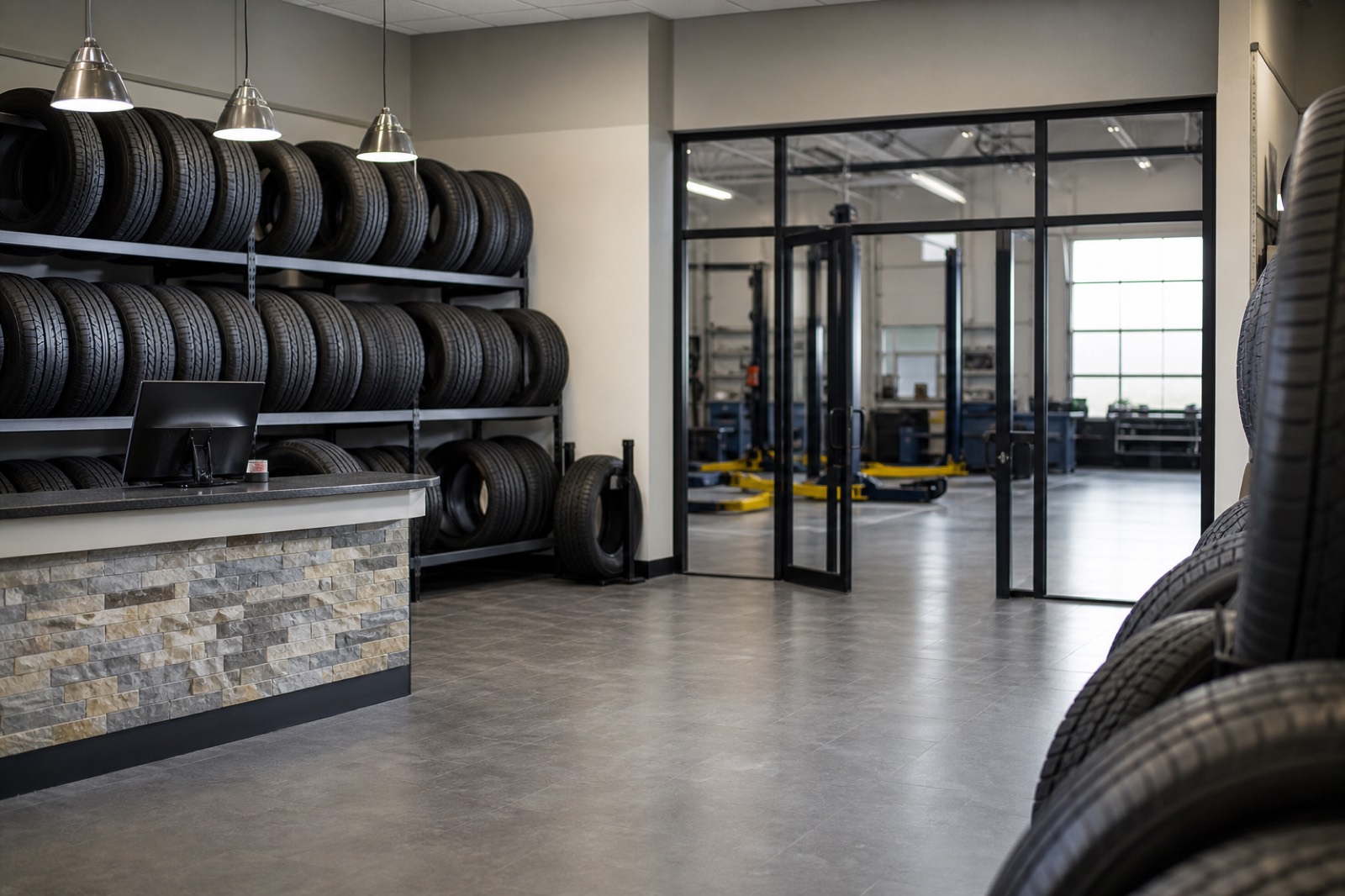
Before any valuation analysis, identify which of these models describes your business. The valuation calculus is structurally different across the four.
1. Independent single-store tire installer
One location, 4 to 8 service bays, primarily retail consumer tire sales and installation. Annual revenue typically $1.5M to $4M. Owner-operator or owner plus 1 manager. Mechanical work often limited to oil changes, basic brake jobs, alignments. Margins: 12% to 18% EBITDA, often run as SDE because of single-owner economics. Tire-distribution channel through American Tire Distributors (ATD), Goodyear Tire & Rubber direct, or Bridgestone Firestone GCR. Valuations 3x to 5x SDE. Most fragmented sub-category. This is the bread-and-butter target for first add-ons in regional roll-ups.
2. Multi-bay tire-and-mechanical service center
2 to 8 store local or regional chain. 6 to 12 service bays per location. Tire-and-mechanical integration with brake, alignment, suspension, battery, oil change, AC service, and increasingly diagnostic and electrical work. Mechanical work typically 30% to 50% of revenue and 50% to 70% of gross profit. Annual revenue $5M to $30M. Valuations 5x to 8x EBITDA. The platform-grade entry tier. Most active acquisition target for PE consolidators because of mechanical margin lift.
3. Multi-unit regional chain
8 to 30+ stores across a region. Often built through 5 to 15 years of add-on acquisitions or organic expansion. Multi-market real estate footprint, professional GM bench, centralized purchasing and inventory through ATD or direct OEM. Mechanical mix typically 40% to 55% of revenue. Annual revenue $30M to $200M+. Annual EBITDA $3M to $25M. Valuations 7x to 11x EBITDA. The premium tier. These trade as platforms or as strategic add-ons to Mavis, Sun Auto, Monro, or TBC Corporation roll-ups.
4. Specialty and commercial-fleet operator
Commercial truck tire centers (TBR), agricultural and off-the-road (OTR) tire specialists, fleet-account-focused operators with national accounts through TIA or direct fleet contracts. Lower retail walk-in, higher contract revenue. Annual revenue ranges widely. Valuations 5x to 7.5x EBITDA, with strong commercial fleet books reaching the high end. Customer concentration risk is the primary multiple compressor.
Most tire shop businesses are some combination of the first two models. The valuation approach depends on the mix. A business that is 65% retail tire + 35% mechanical at 2 stores is valued as a multi-bay tire-and-mechanical operator. A single store doing 90% retail tire installation is valued on SDE as model 1. The mechanical mix percentage is the single line item buyers focus on first.
Where the real value lives: mechanical service integration
Mechanical service integration is the structural lever that separates a 4x SDE single-store operator from an 8x EBITDA multi-unit platform candidate. Understanding the economics is essential. Retail tire gross margin compresses. A new passenger or light-truck tire sold through a retail tire shop typically carries 22% to 28% gross margin. Most independent operators run mid-20s. ATD distribution adds 8% to 12% delivered to the bay. There is limited margin headroom.
Mechanical service integration is the structural lever that separates a 4x SDE single-store operator from an 8x EBITDA multi-unit platform candidate. Understanding the economics is essential.
- Retail tire gross margin compresses. A new passenger or light-truck tire sold through a retail tire shop typically carries 22% to 28% gross margin. Most independent operators run mid-20s. ATD distribution adds 8% to 12% delivered to the bay. There is limited margin headroom on the tire itself.
- Mechanical service gross margin is structurally higher. Brake jobs run 55% to 65% gross. Alignments 65% to 75%. Battery installations 50% to 60%. Suspension and shock work 55% to 65%. Oil changes 50% to 60%. The labor side of mechanical work is the margin engine.
- Tire visits drive mechanical attach. A customer in for tire installation or rotation is a captured audience for inspection-based upsell on brakes, alignment, battery, and suspension. The best-run multi-bay shops convert 35% to 50% of tire-only visits to combined tire-plus-mechanical tickets.
- Bay productivity scales differently. A tire-only bay turns 8 to 12 tickets per day at $80 to $200 each. A mechanical-capable bay turns 4 to 6 tickets per day at $300 to $1,200 each. Mechanical bays produce 2x to 3x the gross profit per bay per day.
- Customer lifetime value lifts materially. Tire-only customers visit 1 to 2 times per 4 years. Customers using the shop for both tires and mechanical work visit 4 to 8 times per year and have 3 to 5x higher lifetime gross profit contribution.
The Mavis Tire Express thesis (built by BayPine, West Street Capital Partners VIII, and TSG Consumer Partners since the 2021 carve-out from Express Oil Change) is fundamentally a mechanical-attach play. Mavis grew from roughly 200 stores in 2018 to over 2,500 stores by 2024 by acquiring tire shops and systematically lifting mechanical mix at every acquired location. Sun Auto Tire & Service (Leonard Green Partners since 2019, approximately 500 stores) and TBC Corporation (Sumitomo Corporation, parent of Big O Tires, NTB, Tire Kingdom, and Midas franchise systems) follow the same playbook.
If you are a tire-installation-heavy operator considering a sale, the highest-payoff 12 to 24 month pre-sale investment is building mechanical capability. Hire 1 to 2 ASE-certified technicians per store, invest in alignment racks and brake equipment if missing, build technician comp plans tied to mechanical attach, and document the mix shift in monthly financials.

How tire shop buyers actually calculate the number
Normalize the EBITDA. Adjust for owner compensation, related-party transactions, personal expenses, equipment depreciation accounting, and rent normalization if owner owns the real estate. Real-estate normalization is critical for tire shops because owner-occupied buildings often carry below-market rent. Decompose the revenue. Split by category: retail consumer tire installation, commercial tire (TBR, agricultural, OTR), fleet account revenue, mechanical service categories (brake, alignment, suspension, battery, oil, AC, diagnostic), and any ancillary (wheel sales.
- Normalize the EBITDA. Adjust for owner compensation, related-party transactions, personal expenses, equipment depreciation accounting, and rent normalization if owner owns the real estate. Real-estate normalization is critical for tire shops because owner-occupied buildings often carry below-market rent.
- Decompose the revenue. Split by category: retail consumer tire installation, commercial tire (TBR, agricultural, OTR), fleet account revenue, mechanical service categories (brake, alignment, suspension, battery, oil, AC, diagnostic), and any ancillary (wheel sales, accessories). Mechanical-mix percentage is the headline metric.
- Analyze the customer file. Repeat rate, average ticket, mechanical-attach rate on tire visits, fleet account contract terms, customer concentration in fleet book.
- Real estate analysis. Owned vs leased per location. For owned, square footage, lot size, traffic count, demographic density, market cap rate. For leased, term remaining, renewal options, escalator structure, sublet rights.
- OEM dealer audit. Active dealer agreements with Goodyear, Bridgestone Firestone, Michelin, Continental, Cooper, BFGoodrich, Pirelli. Co-op funds, dealer purchase requirements, current standing.
- Inventory and supply chain. Tire SKU count, inventory turns, ATD or direct OEM relationship, RFID inventory tracking deployment, just-in-time delivery arrangements.
- Compare to comparables. Adjust for geography, store count, mechanical mix, real estate ownership, fleet account mix.
- Apply the concluding multiple.
What six factors move tire shop multiples?
1. Mechanical service mix
The single largest valuation driver. A multi-bay shop at 45% to 55% mechanical mix trades at 6.5x to 8x EBITDA. A retail-tire-heavy operator at 10% to 20% mechanical mix trades at 3.5x to 5x SDE. This is a 2 to 3 turn differential, worth $2M to $5M on a $1.5M EBITDA business. Buyers will rebuild the revenue decomposition by category and verify against repair-order line items. Mechanical-mix above 40% is the consistent threshold for platform-grade pricing.
2. Store count and multi-market footprint
Single-store operators face a structural ceiling around 4.5x to 5x SDE no matter how strong the business is, because buyers underwrite key-person risk and lack of GM bench. Multi-store operators with at least 3 locations and a documented GM at each store qualify for EBITDA-basis valuation. Store count thresholds where multiples step up: 2 stores (acceptable, modest premium), 5 stores (platform-entry consideration), 10 stores (multi-market consolidator entry), 20+ stores (strategic add-on tier for Mavis, Sun Auto, Monro). Geographic clustering matters: 8 stores in one MSA are worth more than 8 stores scattered across 4 states.
3. Real estate ownership
Tire shops sit on high-traffic, high-visibility commercial corners. The real estate often represents 30% to 50% of total enterprise value at owned locations. Real estate is generally valued separately from the operating business at 6.5% to 8% cap rates depending on credit tenant strength, location quality, and lease terms post-close. Common structures: owner-rolled real estate (rolled into NewCo for ongoing income), sale-leaseback at close, sold separately to a real estate investor with master lease. Operators with strong owned-real-estate portfolios should expect total exit proceeds to substantially exceed the operating-EBITDA multiple alone.
4. OEM dealer status and tier
- Premium: Active dealer agreements with 3+ tier-1 OEMs (Goodyear, Bridgestone Firestone, Michelin, Continental) in good standing, with co-op marketing funds, dealer pricing programs, and quota fulfillment.
- Good: Active dealer status with 1 to 2 tier-1 OEMs, plus tier-2 (Cooper, BFGoodrich, Pirelli, Yokohama, Hankook, Toyo, Falken).
- Average: Tier-2 dealer status only, primarily sourcing through ATD or other distributors at street pricing.
- Discount: No dealer programs, all sourcing through distribution at street pricing. 0.5x to 1x multiple discount.
Cooper Tire was acquired by Goodyear in June 2021 ($2.5B transaction), consolidating dealer programs. Dealer agreements are not automatically transferable in a sale; buyers will verify standing and assignability in diligence.
5. Fleet account book quality
Fleet contracts add recurring revenue but concentrate risk:
- Premium fleet book: 15% to 25% of revenue from fleet contracts with national fleet management companies (Penske Truck Leasing, Ryder System, Enterprise Fleet Management, Element Fleet Management), multi-year contracts with escalators, fleet count diversified across 30+ accounts.
- Good fleet book: 10% to 20% from regional fleet accounts (local delivery, contractors, municipal), 2-year contracts, 10 to 20 accounts.
- Risk-flagged fleet book: 25%+ from one or two fleet customers triggers material discount; loss of one large fleet contract can wipe out deal thesis.
6. Technology and operational systems
- Premium: Tire-specific POS and shop management (Tekmetric, Shop-Ware, Mitchell 1, Tire Shop Plus, Tire Profiles), RFID inventory tracking, integrated digital vehicle inspection (DVI), 2+ years of clean data, documented service protocols, technician productivity tracking, customer CRM integration.
- Standard: Basic shop management system and accounting separation.
- Discount: Spreadsheets, paper repair orders, manual inventory counts. Post-close systems implementation costs $50K to $150K per store and takes 3 to 9 months.
What is the real estate ownership premium for tire shops?
Tire shop real estate deserves its own section because it often represents the largest single value component in a tire shop sale. The economics: Typical store footprint. 0.5 to 1.5 acre lot, 6,000 to 15,000 square foot building, 6 to 14 service bays, customer waiting area, retail showroom, alignment rack pit if installed. Site characteristics that drive value. Corner location, traffic counts of 20,000+ AADT (annual average daily traffic), visibility.
Tire shop real estate deserves its own section because it often represents the largest single value component in a tire shop sale. The economics:
- Typical store footprint. 0.5 to 1.5 acre lot, 6,000 to 15,000 square foot building, 6 to 14 service bays, customer waiting area, retail showroom, alignment rack pit if installed.
- Site characteristics that drive value. Corner location, traffic counts of 20,000+ AADT (annual average daily traffic), visibility from a primary arterial, signalized intersection, demographic density supporting middle-market vehicle owners, adequate parking.
- Cap rate ranges (2026). Tire shop net-lease real estate trades at 6.0% to 8.0% cap rates depending on tenant credit quality (national chain credit lower cap, independent operator higher cap), lease term remaining (10+ year NNN lower cap), and location quality. Sale-leaseback rents typically set at market rate to maximize cap rate buyer pays.
- Owner-rolled vs sale-leaseback structures. Sellers with multiple owned locations can elect to roll real estate into a separate NewCo for ongoing income (rent stream from buyer’s NewCo OpCo), or sale-leaseback at close to capture immediate proceeds. Sale-leaseback typically generates an additional 25% to 45% of operating-EBITDA-multiple value at signing.
- Common buyer of the real estate. Net-lease REITs (Realty Income NYSE: O, Spirit Realty Capital, STORE Capital, Essential Properties Realty Trust), 1031 exchange buyers, family office real estate funds.
A four-store operator with all four locations owned at quality intersections could see real estate proceeds of $4M to $7M layered on top of an operating-business sale at 6.5x EBITDA. Real estate planning should start 12 to 24 months before sale; tax structuring through 1031 exchanges or installment sales can materially affect after-tax proceeds.
How do tire distribution channels and supply economics affect valuation?
Tire distribution is a structural risk and opportunity that buyers analyze closely. The 2018 ATD (American Tire Distributors) Chapter 11 bankruptcy, followed by reorganization under new sponsor ownership, reshaped independent tire dealer distribution. ATD (American Tire Distributors). The largest independent tire distributor in North America, serving independent dealers with daily delivery of replacement tires from Goodyear, Bridgestone, Michelin, Continental, Cooper, and tier-2 brands. Emerged from 2018 Chapter 11 with restructured.
Tire distribution is a structural risk and opportunity that buyers analyze closely. The 2018 ATD (American Tire Distributors) Chapter 11 bankruptcy, followed by reorganization under new sponsor ownership, reshaped independent tire dealer distribution.
- ATD (American Tire Distributors). The largest independent tire distributor in North America, serving independent dealers with daily delivery of replacement tires from Goodyear, Bridgestone, Michelin, Continental, Cooper, and tier-2 brands. Emerged from 2018 Chapter 11 with restructured balance sheet and continues to serve thousands of independent dealers.
- US Auto Forces. Consolidation of regional tire distributors competing with ATD in select markets.
- Direct OEM relationships. Goodyear, Bridgestone, Michelin, and Continental run direct distribution programs (Goodyear Tire Network, Bridgestone Firestone Affiliated Dealer, Michelin TIA, Continental Gold) that bypass distribution and offer dealers better pricing, co-op funds, and inventory programs in exchange for volume commitments.
- Direct-from-manufacturer programs. Larger multi-unit operators (typically 10+ stores) qualify for direct truckload buying that can save 6% to 10% on cost per tire vs ATD distribution.
- RFID inventory tracking. The 2026 standard for multi-unit operators. Continental announced industry-wide RFID adoption in 2023, with Michelin and Bridgestone following. Operators with RFID-enabled inventory visibility (real-time SKU counts across locations, automatic reorder triggers, theft and shrink reduction) trade at modest premium.
- Just-in-time vs warehoused inventory. Independent single-store operators carry $80K to $250K in tire inventory. Multi-unit chains can run leaner with central warehousing and overnight redistribution. Inventory carrying cost is a real working-capital line item buyers underwrite.
The CARES Act extension and 2025 LIFO inventory rule adjustments affect tire shop working capital. Sellers with significant LIFO reserves should engage transaction tax counsel 12 months before sale.
What other factors do buyers evaluate in tire shops?
Customer concentration
For retail-focused operators, customer concentration is rarely an issue (thousands of consumer transactions per year). For fleet-account operators, top 5 fleet customers below 35% of revenue is healthy. Above 50% concentration in fleet book is a material risk that compresses multiple by 0.5x to 1.5x.
Technician staffing and ASE certification
Mechanical-capable shops depend on ASE-certified technicians. Industry-wide technician shortage is real. Shops with stable technician tenure (3+ years average), documented training programs, and ASE certification across the bench command premium. High technician turnover is a yellow flag for buyer integration risk.
EPA and OSHA compliance
Used oil disposal, refrigerant handling (Section 609 certification for AC service), used tire disposal under state scrap tire programs, and OSHA-mandated safety protocols (lift inspections, tire-mounting cage requirements). Clean compliance is expected; gaps are material risks.
EV transition exposure
EV transition is a net tailwind for tire shops, not a headwind, contrary to common founder anxiety. EV-specific dynamics:
- EV tires wear approximately 20% faster than ICE-vehicle tires due to instant torque delivery and 20% to 30% higher curb weight.
- EV-specific tire SKUs (Continental EcoContact 6, Michelin Pilot Sport EV, Bridgestone Turanza EV, Goodyear ElectricDrive GT) carry premium pricing.
- EVs still require alignment, brake (regenerative braking reduces wear but does not eliminate it), suspension, battery service (12V auxiliary), AC, and tire rotation.
- EVs require fewer oil changes, eliminating one revenue line, but the mechanical-service basket as a whole remains intact and shifts.
Buyers underwrite the EV transition as a multi-year tailwind for tire revenue specifically. Operators that have adapted (EV-certified technicians, EV alignment specs, EV-specific tire SKU stocking) can document the readiness in diligence.
Geographic footprint
Single-metro focus vs multi-region. For platform-grade operators, multi-region adds optionality but density in a target MSA often wins. For 2 to 8 store operators, tight clustering in a single metro with overlapping advertising and central administration is generally preferred to scattered footprint.
Online and adjacent disruption
Tire Rack, SimpleTire, and DiscountTireDirect drive 8% to 12% of US replacement-tire dollar volume online. Most independent shops participate as installer-partners through Tire Rack’s Recommended Installer program. Carvana (NYSE: CVNA) and other online used-vehicle players are adjacent to but not direct competitors with tire shops. The online channel is a customer-acquisition source, not a threat, when shops execute installer-partner economics correctly.

How would you value a $1.8M EBITDA Ohio four-store Goodyear dealer?
Business profile:
- $12.5M revenue, $1.8M reported EBITDA (14.4% margin)
- 4 store locations across Cleveland and Akron metros, Ohio
- Mix: 58% retail consumer tire (installation, balancing, rotation), 34% mechanical service (brake 12%, alignment 8%, suspension 5%, battery 4%, oil 3%, other 2%), 8% commercial light-truck and fleet
- Mechanical mix: 34% of revenue, approximately 51% of gross profit
- Active Goodyear Tire & Rubber Gold-level dealer (lead OEM), secondary Continental and Cooper dealer agreements
- Real estate: 2 of 4 locations owned by owner (Cleveland Heights and Akron flagship), 2 leased (Beachwood, Stow)
- Top fleet customer: regional HVAC contractor, 6% of total revenue
- Operations manager at each store (4 GMs), founder handles OEM relationships and centralized purchasing
- Tekmetric shop management system in use 2.5 years with clean data
- ASE-certified tech bench: 14 technicians across 4 stores, average tenure 4 years
- ATD primary distribution, direct Goodyear truckload buying on consumer tire SKUs
- Owner comp $220K, replacement GM/CEO $175K. Personal expenses $48K. One-time legal/professional costs $35K.
EBITDA normalization:
- Reported EBITDA: $1.80M
- Owner compensation adjustment: +$45K
- Personal expenses: +$48K
- One-time costs: +$35K
- Rent normalization (owned locations at below-market rent): -$72K (rent reset to market for diligence)
- Normalized EBITDA: $1.856M
Multiple assessment (operating business only, excluding owned real estate):
- Starting benchmark for 4-store multi-bay operator with 34% mechanical mix and quality OEM dealer status: 6.5x
- +0.3x for Tekmetric platform and documented operations
- +0.2x for Goodyear Gold-level dealer status and direct truckload buying
- +0.2x for ASE-certified technician bench depth
- -0.3x for mechanical mix below 40% (under platform-grade threshold)
- -0.3x for founder-handled OEM and purchasing relationships
- Concluding operating multiple: 6.6x
Operating business indicative valuation: $1.856M x 6.6x = $12.25M
Real estate component (separate analysis):
- 2 owned locations, market rent reset $108K/year combined ($54K each)
- Cap rate at 7.25% for 15-year NNN lease to NewCo OpCo: $108K / 7.25% = $1.49M real estate value
- Owner can roll real estate into separate NewCo (ongoing rent income) or sell at close to a net-lease REIT
Total exit proceeds (operating + real estate): $12.25M + $1.49M = $13.74M
18 to 24 month improvement path:
- Lift mechanical mix from 34% to 42% through technician hiring and attach-rate training: operating multiple to 7.0x. Operating outcome: $13.0M.
- Transition OEM and purchasing relationships to centralized purchasing manager: multiple to 7.2x. Operating outcome: $13.4M.
- Add 5th store via tuck-in acquisition (existing market): scale to $2.3M normalized EBITDA, multiple to 7.4x. Operating outcome: $17.0M.
- Combined operating: $17.0M. Plus $1.5M real estate. Total: $18.5M, a $4.8M lift over 18 months.
The mechanical-mix lift alone is worth approximately $750K of multiple expansion. The store-count expansion via tuck-in adds the largest dollar lift. Real estate value is independent of operating improvements.

How to increase your tire shop value before selling
Highest ROI
- Lift mechanical service mix. If below 35%, hire ASE-certified technicians 12 to 24 months before sale. Invest in alignment racks at any store without one. Build technician comp plans tied to mechanical attach rate. Target 40%+ mechanical mix at the time of sale.
- Document the mechanical-attach training program. Service-writer training, digital vehicle inspection (DVI) deployment, customer-facing repair-justification workflow. Buyers underwrite the mechanical-mix lift as durable when documented.
- Pursue OEM dealer status upgrades. Move from tier-2-only to Goodyear, Bridgestone Firestone, Michelin, or Continental dealer status. Engage OEM dealer development reps 12+ months before sale.
- Add a tuck-in store in existing market. Single-store-to-2 stores or 4-to-5 stores in the same MSA unlocks EBITDA-basis valuation and crosses scale thresholds.
- Transition founder-led OEM and fleet relationships. Dedicated purchasing manager and fleet account manager 12 to 18 months before sale.
- Real estate planning. 1031 exchange structuring, sale-leaseback timing, owned-real-estate cap-rate optimization. Engage real estate counsel 12 to 24 months out.
Medium ROI
- Implement Tekmetric, Shop-Ware, Mitchell 1, or equivalent shop management system if not on tire-specific platform.
- RFID inventory tracking deployment for multi-unit operators.
- Diversify fleet account concentration.
- Build commercial light-truck and fleet account book to 10% to 15% of revenue.
- Document technician retention programs and ASE certification.
Lower ROI
- Website redesign.
- Social media programs.
- Minor retail tire SKU expansion.
What common mistakes destroy tire shop valuations?
Retail-tire-only mix without a mechanical build plan. Limits multiple ceiling severely. Buyers will price the post-close capex and technician hiring cost. Mechanical mix overstated. Classifying basic tire-related labor (mounting, balancing) as mechanical. Buyers will rebuild the categorization from line-item repair orders. OEM dealer agreements lapsed or in poor standing. Material risk; can be a deal-breaker. Verify standing 12 months before sale. Fleet account concentration above 30%. One large fleet customer.
- Retail-tire-only mix without a mechanical build plan. Limits multiple ceiling severely. Buyers will price the post-close capex and technician hiring cost.
- Mechanical mix overstated. Classifying basic tire-related labor (mounting, balancing) as mechanical. Buyers will rebuild the categorization from line-item repair orders.
- OEM dealer agreements lapsed or in poor standing. Material risk; can be a deal-breaker. Verify standing 12 months before sale.
- Fleet account concentration above 30%. One large fleet customer that represents 30%+ of revenue compresses multiple by 0.5x to 1.5x.
- Below-market rent on owner-owned real estate. Buyers will normalize rent to market for diligence; understated rent inflates reported EBITDA artificially and gets caught.
- Founder handles all OEM relationships and large fleet contracts. Post-close retention is a real risk. Buyers underwrite a discount for transition.
- Deferred capex on lifts, alignment racks, brake equipment. Direct purchase price deduction.
- Technician comp plans not aligned with mechanical attach. Suggests structural ceiling on mechanical-mix growth.
- Inventory not reconciled or LIFO reserve not documented. Working capital adjustments at close can materially affect net proceeds.
Want to know what your tire shop is actually worth?
Benchmarks give you a range. A 15-minute confidential call gives you a real number, based on what active buyers are paying right now and which ones would compete for your business. The call is free, with no obligation.
How do you get a valuation for your tire shop?
CT Acquisitions offers confidential valuations for tire shop and tire-and-mechanical service center founders. We specialize in multi-bay and multi-unit operators in the $500K to $10M EBITDA range, with active mandates from Mavis-style consolidators, Sun Auto and TBC Corporation, and regional roll-up sponsors. CT Acquisitions is paid by the buyer at close; founders pay nothing. Book a 15-minute conversation or visit our tire shop seller hub for state-by-state buyer activity.
CT Acquisitions offers confidential valuations for tire shop and tire-and-mechanical service center founders. We specialize in multi-bay and multi-unit operators in the $500K to $10M EBITDA range, with active mandates from Mavis-style consolidators, Sun Auto and TBC Corporation, and regional roll-up sponsors. CT Acquisitions is paid by the buyer at close; founders pay nothing. Book a 15-minute conversation or visit our tire shop seller hub for state-by-state buyer activity.

About the Author
Christoph Totter is the founder of CT Acquisitions, a buy-side partner headquartered in Sheridan, Wyoming. We work directly with 200+ buyers, search funders, family offices, lower middle-market PE, and strategic consolidators, including direct mandates with the largest tire-and-service consolidators that other intermediaries cannot access. On buy-side mandates the buyers pay us when a deal closes, not the seller. Sell-side engagements are fee-based, agreed in writing before we start. Connect on LinkedIn · Get in touch
Sources and references
Every multiple range, operator-tier figure, and industry-data citation on this page is sourced to a published industry-research publisher or to CT Acquisitions’ internal benchmark dataset. Monro Inc. (NASDAQ: MNRO) 10-K annual reports and quarterly earnings, the largest publicly traded tire-and-service comparable at approximately $1B market capitalization and approximately 1,260 stores. Goodyear Tire & Rubber Company (NASDAQ: GT) 10-K filings disclosing approximately 600 company-owned retail stores, Cooper Tire acquisition (June 2021.
Every multiple range, operator-tier figure, and industry-data citation on this page is sourced to a published industry-research publisher or to CT Acquisitions’ internal benchmark dataset.
- Monro Inc. (NASDAQ: MNRO) 10-K annual reports and quarterly earnings, the largest publicly traded tire-and-service comparable at approximately $1B market capitalization and approximately 1,260 stores.
- Goodyear Tire & Rubber Company (NASDAQ: GT) 10-K filings disclosing approximately 600 company-owned retail stores, Cooper Tire acquisition (June 2021, $2.5B), and Americas Retail Tire segment financials.
- Tire Business Top 100 Independent Tire Dealers, annual ranking with revenue and store count data on the largest US independent operators.
- Modern Tire Dealer Performance Survey for industry margin and operating benchmarks.
- Tire Industry Association (TIA) commercial dealer programs, certification standards, and industry training data.
- Peak Business Valuation, automotive aftermarket and tire shop valuation reports.
- BizBuySell Insight Report, tire and automotive service category benchmarks.
- CT Acquisitions VERIFIED_MULTIPLES dataset, locked-in vertical-specific multiple ranges reconciled against the above sources; updated quarterly.
- CT Acquisitions PE Roll-Up Tracker series, cross-references include auto repair, auto body, HVAC, and auto service.
Last verified: June 24, 2026. Next refresh: quarterly (target 2026-09-24).
Disclaimer: This guide is general valuation framework intelligence, not legal, tax, accounting, or transaction advice. CT Acquisitions is a buy-side advisor.
Tire shop revenue, gross, and cash flow multiples
Owners hear four different multiples for the same tire shop: a revenue (or gross) multiple, a net income multiple, a cash flow multiple, and an EBITDA multiple. They measure different things, and mixing them up is the fastest way to misprice a tire business.
Revenue or gross multiple. This is a rule of thumb, not a valuation method. DealStream’s tire dealer guide puts typical tire business sales at 0.3x to 0.6x annual revenue, so a shop doing $1,000,000 in sales would land around $300,000 to $600,000 on that rule alone. The spread is wide because revenue says nothing about margin. A retail-tire-heavy shop and a shop with a strong mechanical book can post the same sales and very different profit.
Cash flow (SDE) multiple. For owner-operated single stores, buyers price seller’s discretionary earnings: net income plus the owner’s salary, interest, depreciation, and one-time or personal expenses. Peak Business Valuation’s transaction database shows tire dealerships trading at 2.10x to 3.10x SDE, and Sigma Mergers reports tire stores selling at 2.18x to 3.14x SDE. Those databases lean toward small Main Street sales, which is why they sit below the 3x to 5x SDE this guide uses for well-run independents with a solid mechanical mix.
Net income multiple. Buyers rarely use it. Net income is reduced by owner pay, interest, and depreciation choices that change with the owner, so it understates what a new owner would earn. If someone quotes you a net income multiple, convert it back to SDE or EBITDA before comparing.
EBITDA multiple. Once a shop has a general manager and more than one location, buyers switch to EBITDA, which adds back a market salary for management instead of the owner’s full pay. That is where the 5x to 8x EBITDA tier in this guide’s table below applies.
Inventory sits on top. Tire inventory is usually counted at closing and paid for at cost, separate from the multiple. SourceCo puts a typical shop’s inventory at $100,000 to $200,000 or more, so confirm in the letter of intent whether the price includes inventory or adds it at closing.
What are tire shop business valuation multiples?
Tire shop business valuation multiples typically run 3x to 5x SDE for independent single-store owner-operated tire installers and 5x to 8x EBITDA for established multi-unit tire-and-mechanical service centers, with platform-grade regional chains commanding 7x to 11x EBITDA . The single biggest driver is mechanical service mix as a percentage of revenue: a tire shop with 45%+ of revenue from mechanical work (brake, alignment, suspension, battery, oil) trades far higher than a shop that relies mainly on retail tire installation.
Tire shop business valuation multiples typically run 3x to 5x SDE for independent single-store owner-operated tire installers and 5x to 8x EBITDA for established multi-unit tire-and-mechanical service centers, with platform-grade regional chains commanding 7x to 11x EBITDA. The single biggest driver is mechanical service mix as a percentage of revenue: a tire shop with 45%+ of revenue from mechanical work (brake, alignment, suspension, battery, oil) trades far higher than one reliant primarily on retail tire installation. A deeper read on auto service business valuation covers adjacent mechanical-only operators with the supporting data.
| Tire shop profile | Typical multiple | What drives it |
|---|---|---|
| Single-store, retail-tire heavy | 3x to 4.5x SDE | Margin compression, key-person risk |
| Multi-bay, 30%+ mechanical mix | 5x to 7x EBITDA | Mechanical gross margin lift, repeat customer base |
| Multi-unit chain, owned real estate | 7x to 11x EBITDA | Platform optionality, real estate separately valued |
The factors that move a tire shop valuation most are mechanical service mix, store count and clustering, real estate ownership, OEM dealer status with Goodyear, Bridgestone, Michelin, Continental, or Cooper, and fleet account book quality. Lifting mechanical mix from 25% to 45% is the most reliable way to expand the multiple.
Frequently asked questions about tire shop business valuation
What is the average tire shop multiple in 2026?
Across all transactions, simple average is 4.5x to 6x EBITDA. Independent single-store retail-tire-heavy operators trade at 3x to 4.5x SDE. Multi-bay tire-and-mechanical service centers trade at 5x to 8x EBITDA. Multi-unit regional chains command 7x to 11x EBITDA on the operating business, with real estate often valued separately and adding materially to total proceeds.
Is single-store tire installation worth acquiring?
Depends on thesis. A single-store retail-tire-heavy operator is a small-business acquisition typically aimed at first-time buyers, search funders, or local consolidators. PE platforms generally do not pursue single-store acquisitions unless the location is geographically strategic to an existing footprint. Multi-bay single-store operators with strong mechanical mix and owned real estate can attract regional consolidator interest.
How much does mechanical service mix really add to my valuation?
Substantial. Shifting from 20% mechanical to 45% mechanical can expand the multiple from 4x to 7x, producing a 75% increase in valuation at constant EBITDA. This is the single most impactful pre-sale improvement available to most tire shop operators. The mechanical-mix lift typically requires 12 to 24 months of technician hiring, equipment investment, and attach-rate training.
Do I add back owner salary to EBITDA?
Partially. Normalize to a market-rate replacement cost for a general manager or CEO depending on store count. For a $1.5M EBITDA tire shop, the add-back is typically $40K to $80K on owner compensation, plus add-backs for personal expenses and related-party transactions.
How does owned real estate affect tire shop valuation?
Real estate is valued separately from the operating business at 6.5% to 8% cap rates depending on location quality, lease terms, and tenant credit. Owned real estate often represents 30% to 50% of total enterprise value at owned-location stores. Sellers can roll real estate into a separate NewCo, sale-leaseback at close, or sell separately to a net-lease REIT or 1031 exchange buyer.
How do buyers evaluate my OEM dealer status?
Buyers verify active dealer agreements with Goodyear, Bridgestone Firestone, Michelin, Continental, Cooper, and tier-2 brands during diligence. Active tier-1 dealer status (especially Goodyear Gold-level, Bridgestone Affiliated, Michelin TIA, or Continental Gold) adds 0.5x to 1x to the multiple. Lapsed or downgraded dealer status compresses multiple correspondingly.
Is fleet account concentration a valuation issue?
It depends on diversification. A fleet book with 30 accounts where no single account exceeds 5% of revenue is a positive. A fleet book where one account represents 25%+ of revenue is a material risk and compresses multiple by 0.5x to 1.5x. Buyers will model the loss of the largest fleet customer in downside scenarios.
How does the EV transition affect tire shop value?
EV transition is a net tailwind. EV tires wear approximately 20% faster than ICE-vehicle tires due to instant torque and 20% to 30% higher curb weight. EV-specific tire SKUs carry premium pricing. EVs still need alignment, brake, suspension, AC, and battery service. The mechanical-service basket shifts but stays largely intact. Operators that have stocked EV-specific SKUs and trained technicians on EV procedures can document the readiness.
How long does it take to sell a tire shop?
90 to 150 days from LOI to close for a well-prepared multi-bay or multi-unit operator. Preparation runway is 12 to 24 months depending on starting position (real estate planning, mechanical-mix lift, dealer status upgrades). Real estate diligence can extend timelines if owned real estate is involved.
What is the typical multiple for a tire shop business?
2026 multiples range from 3x SDE for single-store independent tire installers to 11x EBITDA for platform-grade multi-unit regional chains. Most transactions fall between 4.5x and 7x EBITDA. Multi-bay operators with 40%+ mechanical mix command 6x to 8x. Real estate is typically valued separately.
How is a tire shop valued?
Revenue decomposition by category (retail tire, commercial tire, fleet account, mechanical service categories), mechanical-mix percentage analysis, OEM dealer status verification, real estate valuation (separate from operating business), inventory and ATD/direct OEM supply chain review, and customer concentration check.
How much will I pay in taxes on the sale?
Federal long-term capital gains plus 3.8% NIIT on goodwill portion. State taxes vary. Real estate may qualify for 1031 exchange treatment. Inventory and equipment may carry ordinary-income recapture. See our complete selling playbook.
What is the best time of year to sell a tire shop?
Most owners prefer to close after the high-volume fall tire-buying season (October through December in snow-belt markets). Buyers prefer to have a clean trailing 12 months that includes a full year cycle. LOI timing typically aligns with late summer or early fall; close in winter or early spring.
How much is a tire shop worth with $1 million in sales?
On revenue alone, DealStream’s rule of thumb of 0.3x to 0.6x annual sales points to roughly $300,000 to $600,000 before inventory. The real number depends on profit. Buyers value the shop on SDE or EBITDA, so a $1 million shop with a strong mechanical mix and clean books can sell above that range, and a thin-margin, tire-only shop can sell below it.
Is inventory included in a tire shop sale price?
Usually not. Most tire shop deals price the business on a multiple of SDE or EBITDA and then add inventory at cost, based on a physical count taken just before closing. SourceCo puts typical shop inventory at $100,000 to $200,000 or more. Agree in the letter of intent how slow-moving or aged tires will be valued so the count does not turn into a dispute at closing.
Should I value my tire shop on SDE or EBITDA?
Use SDE if you run the shop yourself and it has one location, because buyers of owner-operated stores think in SDE. Use EBITDA once a general manager runs the shop and you have several locations, because institutional buyers price on EBITDA after a market salary for management. Quoting the wrong measure can make your asking price look far off to a buyer.
Related resources
Limitations of this analysis
Industry-data tier multiples are aggregated. Tire Business, Modern Tire Dealer, Peak Business Valuation, BizBuySell, and Capstone Partners all publish blended ranges across regional, mix, and capital-structure differences. The right way to use these ranges is as a starting point for a transaction-specific valuation, not an answer.
- Industry-data tier multiples are aggregated. Tire Business, Modern Tire Dealer, Peak Business Valuation, BizBuySell, and Capstone Partners all publish blended ranges across regional, mix, and capital-structure differences. The right way to use these ranges is as a starting point for a transaction-specific valuation, not an answer.
- Public-company comparables are limited. Monro Inc. (NASDAQ: MNRO) is the only pure-play publicly traded comparable; Goodyear Tire & Rubber (NASDAQ: GT) operates approximately 600 retail stores but is dominated by manufacturing. PE-backed platform multiples (Mavis, Sun Auto, TBC, Discount Tire) are not publicly disclosed at the platform-EV level.
- Premium-tier multiples reflect platform-quality operators only. The upper end of the range cited on this page applies to operators with 15+ stores, $3M+ EBITDA, multi-market footprint, mechanical mix above 40%, owned real estate at quality locations, and transferable management bench. Single-store owner-operators should anchor on the lower-tier SDE multiples for realistic valuation expectations.
- Real estate is valued separately. Owned real estate is generally valued at cap-rate value (typically 6.0% to 8.0% for tire shop net-lease properties) outside the operating-business multiple. Sale-leaseback structures, owner-rolled real estate, and lease-quality variations materially affect total exit proceeds.
- Tire shop valuation is sharply tiered by mechanical-service mix and store count. Mechanical-service revenue (vs retail-tire-only installation) compresses multiples upward materially. Real estate ownership and OEM dealer status are first-order valuation factors that aggregated industry data does not always capture.
- CT Acquisitions internal data is disclosed where used. Where this page cites CT’s active-engagement observations or VERIFIED_MULTIPLES benchmarks, those are clearly framed as internal benchmarks and not published industry statistics.
- This guide is general valuation framework intelligence, not legal, tax, accounting, or transaction advice. Specific operator outcomes depend on deal structure, buyer fit, geography, real estate disposition, and active negotiation dynamics.
Sources and further reading
The multiple ranges and business-model tier figures in this guide draw on the following published 2025-2026 industry sources and CT Acquisitions internal benchmarks. Monro Inc. (NASDAQ: MNRO), 10-K and quarterly earnings filings 2024 to 2026, store count and segment financial disclosures. Goodyear Tire & Rubber Company (NASDAQ: GT), 10-K filings 2024 to 2026 including Americas Retail segment and Cooper Tire acquisition integration disclosures. Tire Business, Top 100.
The multiple ranges and business-model tier figures in this guide draw on the following published 2025-2026 industry sources and CT Acquisitions internal benchmarks.
- Monro Inc. (NASDAQ: MNRO), 10-K and quarterly earnings filings 2024 to 2026, store count and segment financial disclosures.
- Goodyear Tire & Rubber Company (NASDAQ: GT), 10-K filings 2024 to 2026 including Americas Retail segment and Cooper Tire acquisition integration disclosures.
- Tire Business, Top 100 Independent Tire Dealers ranking, annual.
- Modern Tire Dealer, annual Performance Survey and dealer benchmark studies.
- Peak Business Valuation, automotive aftermarket valuation reports and tire shop industry overview.
- BizBuySell Insight Report, tire and automotive service category benchmarks 2024 to 2026.
- Capstone Partners, automotive aftermarket M&A market reports.
- CT Acquisitions VERIFIED_MULTIPLES for tire shop: SDE 3.0x to 5.0x single-store, EBITDA 5.0x to 8.0x multi-unit, EBITDA 7.0x to 11.0x platform-grade, as of June 2026.
Last verified: June 2026. Next refresh: quarterly.
Want a Specific Read on Your Business?
15 minutes, confidential, no contract, no cost. You leave with a read on your local buyer market and a likely valuation range. Book a 15-Min Call See Our Full Approach Confidential · No Cost.
15 minutes, confidential, no contract, no cost. You leave with a read on your local buyer market and a likely valuation range.