Collision Repair M&A and Private Equity in Auto Body: The 2026 Consolidation Report, Acquisition Trends, Named Platforms, DRPs, and Multiples
Collision repair M&A in 2026: consolidators and 14 PE-backed platforms are still buying body shops, but they added only 81 locations in H1 2026, while quality multi-shop operators still sell at roughly 3.5x to 6.0x EBITDA.
By Christoph Totter, Founder of CT Acquisitions · Last reviewed: November 2026
Key takeaways
- Consolidators, regional platforms and new entrants added 81 collision locations in H1 2026, against more than 300 in H1 2024, even with a record number of buyers (Focus Advisors 2026 Mid-Year Review, August 20, 2026).
- Quality multi-shop operators trade at roughly 3.5x to 6.0x EBITDA and platform-caliber businesses at 7.0x to 10.0x or more (Matthews Collision Repair Net Lease Report H1 2026, September 16, 2026).
- Boyd Group paid about $1.3 billion for Joe Hudson’s 258 shops: 13.3x adjusted EBITDA, or about 9.3x after expected synergies (Boyd Group release, October 29, 2025).
- Caliber Collision filed a confidential draft S-1 on July 28, 2025; as of September 2026 the offering had not priced and Caliber remains private (CollisionWeek; Matthews).
- 14 PE-backed consolidators were actively acquiring at year-end 2025, and buyers now pursue operators with as few as 1 to 3 locations (Focus Advisors Year in Review 2025, February 2026).
Who is buying collision repair shops in 2026?
Three groups buy body shops in 2026. The Big Four national consolidators (Caliber, Gerber, Crash Champions and Classic Collision) buy selectively and build new sites. About 14 PE-backed regional platforms do most of the acquiring. New entrants such as Collision Partners and Minuteman Collision start from single shops. Driven Brands grows CARSTAR, ABRA and Fix Auto by franchising, not by buying shops.
The table lists every active buyer we could tie to a dated primary source. Sizes are the latest dated count, so they do not share one date.
| Buyer | Owner or sponsor (since) | Size (as of) | 2025 to 2026 activity | Source |
|---|---|---|---|---|
| Caliber Collision | Hellman & Friedman majority; Leonard Green & Partners and OMERS minority | 1,800+ centers, 44 states (Sept 2026) | Barnett’s, 5 shops, Mississippi (closed July 9, 2026); Key Collision, 10 shops in Maine, New Hampshire, Vermont (Sept 2026) | PCI Magazine, Sept 11, 2026; Matthews |
| Gerber Collision & Glass (Boyd Group, TSX: BYD, NYSE: BGSI) | Public company | 1,321 collision locations (June 30, 2026) | Joe Hudson’s, 258 shops (closed Jan 9, 2026); 7 single-shop acquisitions in H1 2026 | Boyd Q2 2026 results, Aug 12, 2026 |
| Crash Champions | Clearlake Capital (July 2022) | About 650 centers, 38 states (Aug 2026) | 2 new builds in H1 2026 (Windham, NH; Dade City, FL) | PR Newswire, July 14, 2022; Matthews; Focus |
| Classic Collision | TPG (agreed April 2024, from New Mountain Capital) | 350+ locations (Aug 2026) | Kendrick Paint & Body, 9 shops, Atlanta (Dec 2025); shops in Waco, TX and Hampton, VA (H1 2026) | Classic Collision release, April 2024; Matthews; Focus |
| CollisionRight | Summit Partners (Jan 30, 2024) | 130 locations (H1 2026) | 2 acquisitions in Ohio and West Virginia | Business Wire, Jan 30, 2024; Focus |
| VIVE Collision | Greenbriar Equity Group (Nov 20, 2023) | 79 locations (H1 2026) | 11 Northeast shops in H1 2026, first in western Pennsylvania | Business Wire, Nov 20, 2023; Focus |
| Puget Collision | Eagle Merchant Partners (Sept 2022) | 72 locations (May 2026) | Six-shop Fix Auto MSO in Southern California (May 2026) | CollisionWeek, Sept 27, 2022; Focus |
| Quality Collision Group | Susquehanna Private Capital (Oct 2020) | 86 locations (year-end 2025) | Tracy Collision, California (Aug 11, 2026); 2 new builds in Texas | Business Wire, Oct 6, 2020; Focus |
| Kaizen Collision | Kinderhook Industries (March 2024) | 45 stores (H1 2026) | No acquisitions in H1 2026 | Kinderhook release, March 2024; Focus |
| Chilton Auto Body | Trive Capital (Feb 2025) | Not published | Marina Auto Body, Los Angeles; a Modesto shop (H1 2026) | Focus |
| G&C Auto Body | Independent, no PE sponsor | 63 locations (H1 2026) | 7 shops; first move into Nevada | Focus |
| New entrants: Collision Partners, Minuteman Collision, Collision Leaders, Driving Force Collision | Collision Leaders: Bestige Holdings; Driving Force: TRP Capital | 1 to 13 shops each (H1 2026) | Building platforms from single shops and small MSOs | Focus |
| CARSTAR, ABRA, Fix Auto (Driven Brands) | Public franchisor | 1,077 collision locations, almost all franchised (Dec 27, 2025) | Franchise conversions, not purchases | Driven Brands FY2025 Form 10-K |
Mechanical, tire and quick-lube chains are a separate buyer set with their own sponsors, mapped in our private equity in auto repair tracker.
How big is each collision consolidator?
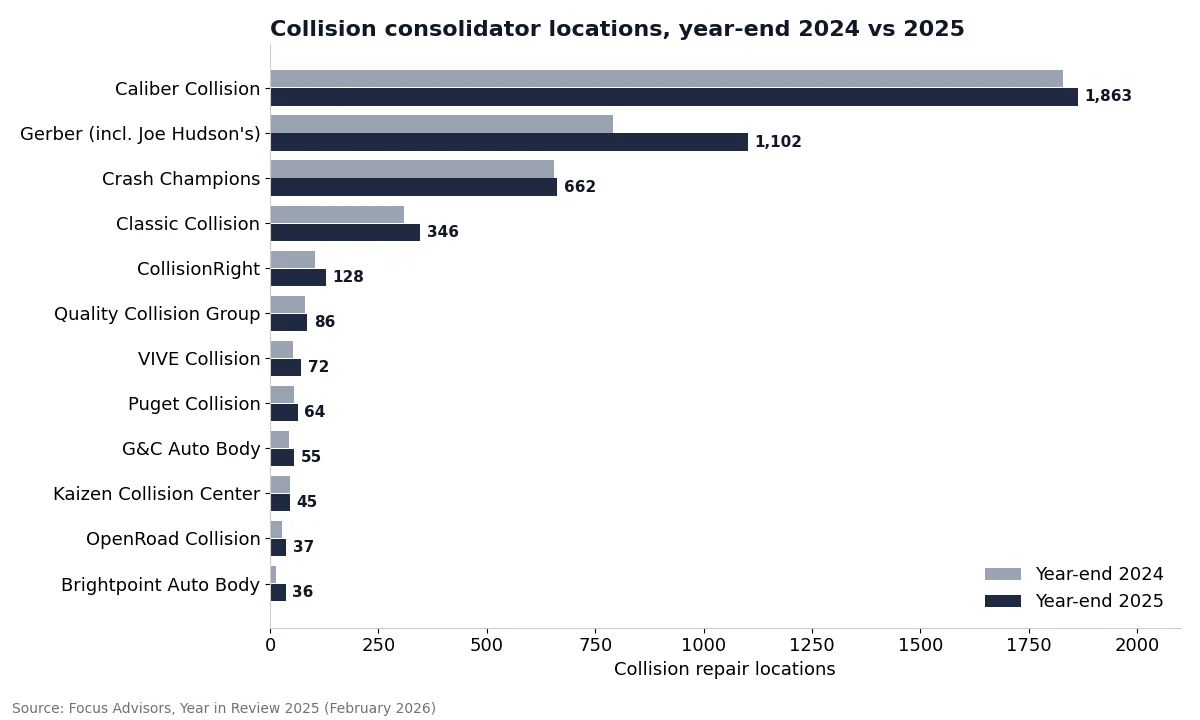
Caliber Collision is the largest US collision repair company by location count: 1,863 at year-end 2025, against 1,102 for Gerber including Joe Hudson’s, per Focus Advisors’ February 2026 count. Classic Collision grew fastest of the Big Four in 2025 at 11.6%, while Caliber grew 1.9% and Crash Champions 1.2%.
| Operator | Year-end 2024 | Year-end 2025 | Change |
|---|---|---|---|
| Caliber Collision | 1,829 | 1,863 | +34 (+1.9%) |
| Gerber Collision (incl. Joe Hudson’s) | 791 | 1,102 | +311 (+39.3%) |
| Crash Champions | 654 | 662 | +8 (+1.2%) |
| Classic Collision | 310 | 346 | +36 (+11.6%) |
| CollisionRight | 103 | 128 | +25 |
| Quality Collision Group | 81 | 86 | +5 |
| VIVE Collision | 53 | 72 | +19 |
| Puget Collision | 54 | 64 | +10 |
| G&C Auto Body | 44 | 55 | +11 |
| Kaizen Collision Center | 46 | 45 | 1 fewer |
| OpenRoad Collision | 28 | 37 | +9 |
| Brightpoint Auto Body | 13 | 36 | +23 |
How much has collision repair M&A slowed?
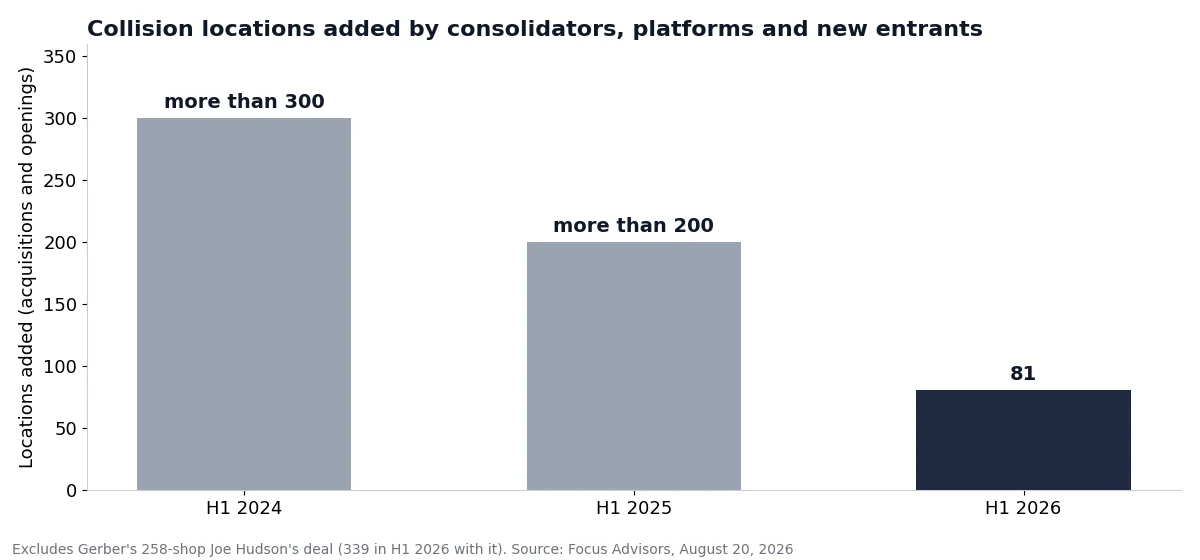
Deal count fell sharply; prices for premium shops did not. Focus Advisors counted 81 locations added by the Big Four, established consolidators and new entrants in H1 2026, excluding Joe Hudson’s 258, against more than 300 in H1 2024. Focus says EBITDA multiples for premium assets held firm, and total values fell where trailing EBITDA fell.
| Period | Locations added | Note | Source |
|---|---|---|---|
| H1 2024 | More than 300 | Peak consolidation pace (343 shops acquired or opened by consolidators and market-leading MSOs in the 2025 review’s scope) | Focus Advisors, Aug 2026 and Sept 2025 |
| H1 2025 | More than 200 | 223 in the 2025 review’s scope, down 35% | Focus Advisors, Sept 5, 2025 |
| H1 2026 | 81 | 339 including Joe Hudson’s 258 | Focus Advisors, Aug 20, 2026 |
Focus Advisors gives three reasons in its February and August 2026 reviews. Industry revenue fell just under 5% year on year by its estimate. Buyers scrutinized every deal and closings took longer, even on very small transactions. And when projected EBITDA did not hold up in a Quality of Earnings review, some buyers walked away or re-priced. Matthews adds the claims backdrop: repairable claims fell 9.7% in 2025 and total losses reached 23.1% of claims, per CCC Intelligent Solutions.
The buying did not stop; it moved down a size tier. CollisionRight, Quality Collision Group, VIVE, Puget, BrightPoint, G&C, OpenRoad and Chilton grew five to seven times faster than the Big Four in H1 2026, per Focus. Boyd Group says new start-ups will be paired with single-location acquisitions, and it closed seven single-shop deals in H1 2026. Focus expects a step-up in activity from the fourth quarter of 2026 into 2027.
What are collision repair shops selling for in 2026?
Matthews puts quality multi-shop operators at roughly 3.5x to 6.0x EBITDA and platform-caliber businesses at 7.0x to 10.0x or more as of September 2026. The one fully disclosed platform price is Boyd’s: 13.3x Joe Hudson’s adjusted EBITDA, about 9.3x after synergies. No public dataset reports single-shop collision multiples separately, so any single-shop figure is an estimate.
| Seller profile | Multiple | Earnings basis | Source and date |
|---|---|---|---|
| Quality multi-shop operator (MSO) | 3.5x to 6.0x | EBITDA | Matthews, Sept 16, 2026 |
| Platform-caliber business with strong insurer relationships and OEM certifications | 7.0x to 10.0x or more | EBITDA | Matthews, Sept 16, 2026 |
| Joe Hudson’s Collision Center (258 shops, $722 million sales) | 13.3x; about 9.3x after synergies | Adjusted EBITDA for the 12 months to June 30, 2025, net of about $150 million tax benefits | Boyd Group, Oct 29, 2025 |
| Single shop | No published dataset | Usually SDE (owner pay added back) | Axia Growth, Oct 30, 2026 |
To screen your own numbers against these ranges, our auto body shop valuation guide walks through the SDE and EBITDA math line by line.
Why a 10% revenue dip cuts the price by about 19%
Focus Advisors’ February 2026 review shows the arithmetic with a 7.0x multiple held constant. Revenue falls 10%, the EBITDA margin falls with it because only part of the cost base flexes, and the price falls almost twice as far as revenue.
| Line | Before | After a 10% revenue decline |
|---|---|---|
| Revenue | $30 million | $27 million |
| EBITDA margin | About 15% | About 13.5% |
| EBITDA | About $4.5 million | About $3.65 million |
| Multiple | 7.0x | 7.0x |
| Purchase price | About $31.5 million | About $25.6 million (19% lower) |
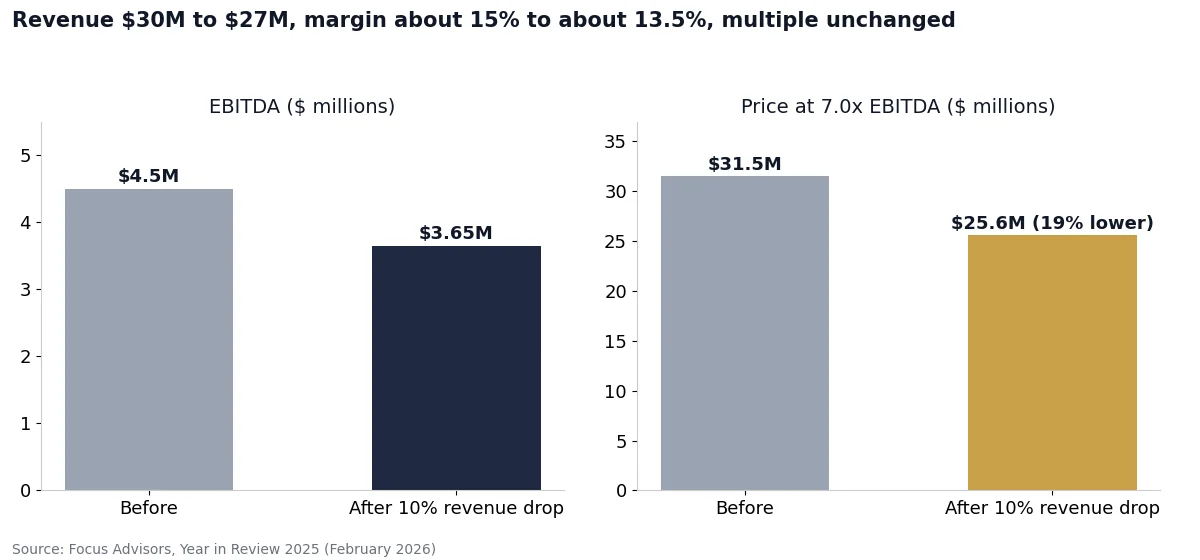
The seller’s takeaway: the multiple did not move in Focus’s example, so the entire 19% came from earnings. Going to market on a trailing 12 months that includes a weak claims stretch costs more than a half-turn of multiple would. The reverse also holds: Focus shows a 23% higher price when revenue recovers by the same amount.
How is your body shop’s real estate valued in a sale?
If you own the building, the buyer usually leases it from you, and the property is priced on rent and the tenant’s credit, not on your EBITDA multiple. Matthews reports a collision property in a major Texas metro under contract at a 5.20% cap rate in 2026, and says buildings leased to indebted or unrated guarantors trade meaningfully wider. A public REIT bought a VIVE Collision portfolio in a 2025 sale-leaseback on roughly 20-year triple-net terms.
| Lease guarantor | Credit rating | Source |
|---|---|---|
| Boyd Group / Gerber | Morningstar DBRS BB (high), Stable; pro forma debt 2.8x EBITDA | Matthews, Sept 2026 |
| Caliber Collision | S&P single-B tier | Matthews, Sept 2026 |
| Crash Champions | Moody’s Caa1 at Champions Financing, Inc. (Aug 2025 downgrade) | Matthews, Sept 2026 |
| Classic Collision | No public rating | Matthews, Sept 2026 |
An illustrative example: a building leased at $200,000 a year triple net is worth about $3.85 million at a 5.20% cap rate and about $2.86 million at a 7.00% cap rate. The 7.00% rate is an assumption for a weaker guarantor, not a quoted figure. Rent, term, escalations and the entity that signs the lease are set at the operating sale, so negotiate them in the same deal.
Is Caliber Collision going public?
Not yet. Caliber Holdings confidentially submitted a draft S-1 to the SEC on July 28, 2025, and Bloomberg reported on September 19, 2025 that a listing could come as soon as 2026. As of Matthews’ September 16, 2026 report the filing was still confidential and unpriced, so Caliber Collision is not publicly traded and has no IPO date.
The 2026 record on Caliber: Hellman & Friedman is the majority owner, with Leonard Green & Partners and OMERS as minority holders. S&P rates its debt-issuing entity in the single-B tier, and Jason Monaco became permanent CFO on May 4, 2026 (Matthews). Caliber kept buying through the IPO window, closing the five-shop Barnett’s on July 9, 2026 and adding Key Collision’s 10 shops in September 2026.
Is Caliber in financial trouble? The public record shows a large, indebted private company that is still acquiring, not a distressed one. A single-B rating is speculative grade, and Caliber said IPO proceeds may go to repaying debt (CollisionWeek, July 28, 2025). Caliber does not publish revenue, so revenue and valuation figures quoted online are estimates until a public S-1 appears.
Why it matters to a seller: Matthews notes that a completed Caliber IPO would give the collision sector its first transparent public valuation benchmark beside Boyd Group. Until then, Boyd’s 13.3x Joe Hudson’s multiple is the only fully disclosed platform price.
Did Caliber Collision buy Classic Collision?
No. Classic Collision, the national platform with 350+ locations, has been owned by TPG since TPG agreed in April 2024 to buy it from New Mountain Capital. The deal people remember is from June 2014, when Caliber bought four Classic Collision Center Inc. shops in Los Angeles, taking Caliber to 172 locations (FenderBender, June 3, 2014). We found no filing or release from Caliber, TPG or Classic announcing a combination through early November 2026.
What do collision buyers pay more for?
Buyers pay for revenue that survives the sale: diversified insurer DRP volume, OEM certifications, in-house calibration and EBITDA that holds up in a Quality of Earnings review. In 2026 they also discount revenue that can vanish, such as Tesla-referred work, because Tesla is building its own repair network and revoking certifications, per Focus Advisors’ August 2026 review.
| Factor | What buyers check | 2025 to 2026 evidence | Source |
|---|---|---|---|
| Insurer DRP mix | Revenue share by carrier; DRP scorecards | Some carriers dropped shops from DRPs in 2026 reshuffles; carrier mix now moves the offer | Focus, Aug 2026 |
| OEM certifications | Certified brands versus the local car parc | Classic built its model on OEM certification; Collision Partners targets high-line certified shops | Matthews; Focus |
| Tesla-referred revenue | Share of sales tied to Tesla certification | Tesla-owned collision sites went from 60 to 67 between January and July 2026; buyers discount this revenue | Focus, Aug 2026 |
| ADAS calibration | In-house scan and calibration bays, equipment and staff | 28.3% of repairable estimates include a calibration (CCC Crash Course 2026) | Axia Growth, Oct 2026 |
| Earnings quality | Trailing EBITDA against projections | Deals re-priced or died when EBITDA failed the Quality of Earnings review | Focus, Feb 2026 |
| Lease and environmental file | Lease term, landlord consent, paint booth and waste records | Landlord and environmental issues lengthened 2025 closings | Focus, Feb 2026 |
Earnings quality is the factor most within your control before a sale, and our guide to the Quality of Earnings review in a business sale shows what reviewers test.
Which collision buyer should you talk to first?
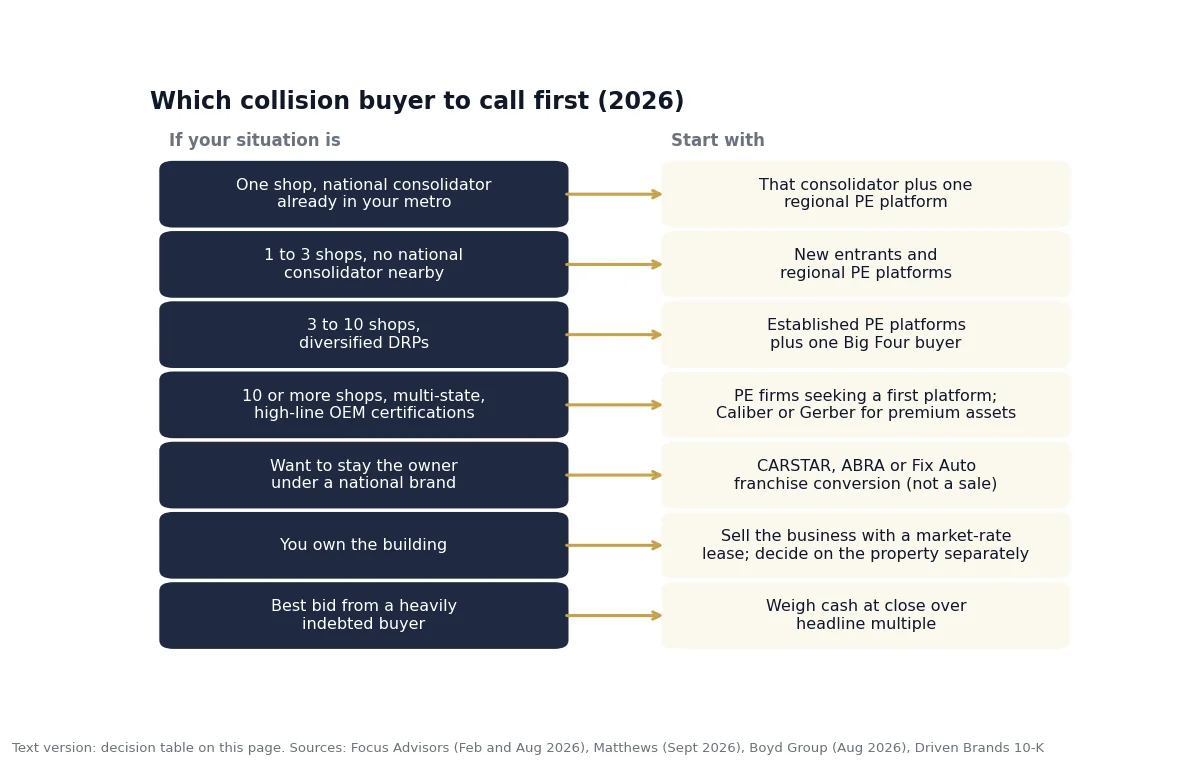
Match your shop count and profile to the buyer tier that is closing deals at your size in 2026. Single shops and small MSOs now draw PE platforms and new entrants, since 14 PE-backed consolidators look at operators with as few as 1 to 3 locations. The Big Four favor premium, larger-format assets and markets where they already have density.
| If your situation is | Start with | Why (dated evidence) |
|---|---|---|
| One shop in a metro where a national consolidator already operates | That consolidator, plus one regional PE platform for price tension | Boyd closed 7 single-shop deals in H1 2026 and plans more (Boyd, Aug 12, 2026) |
| 1 to 3 shops in a region without a national consolidator nearby | New entrants and regional PE platforms | Collision Partners, Minuteman and Collision Leaders built platforms from single shops in 2026 (Focus) |
| 3 to 10 shops with diversified DRPs | Established PE platforms (VIVE, Puget, CollisionRight, Quality Collision Group) plus one Big Four buyer | PE platforms grew five to seven times faster than the Big Four in H1 2026 (Focus) |
| 10 or more shops, multi-state, high-line OEM certifications | PE firms seeking a first collision platform, and Caliber or Gerber for premium assets | Platform-caliber multiples of 7.0x to 10.0x or more (Matthews); Caliber pursuing premium assets (Focus) |
| You want to stay the owner under a national brand | A CARSTAR, ABRA or Fix Auto franchise conversion | Driven Brands’ 1,077 collision locations are almost all franchised; a conversion is not a sale (10-K) |
| You own the building | Sell the business with a market-rate lease, then decide on the property separately | Tenant credit sets the cap rate (Matthews) |
| The best bid comes from a heavily indebted buyer | Weigh cash at close over headline multiple; ask how the deal is funded | Crash Champions rated Caa1 after the Aug 2025 downgrade (Moody’s, via Matthews) |
First-time PE buyers often offer rollover equity, which Chris Lane of Focus Advisors called a “second bite of the apple” in Autobody News on September 11, 2025. Our rollover equity guide covers how that stake is valued. For the full sale process, from preparing the books to closing, see how to sell an auto collision repair business.
Which widely repeated collision M&A figures are out of date?
Several figures quoted across collision M&A coverage, including on an earlier version of this page, are stale or mix scopes. Location counts change every quarter, and Gerber’s count depends on whether Canada and Joe Hudson’s are included. The table pairs each common claim with what the primary source says, with its date, so you can quote the right number.
| Often repeated | What the primary source says | Source |
|---|---|---|
| Caliber is going public in early 2026 | Draft S-1 filed confidentially July 28, 2025; not priced as of September 2026 | CollisionWeek; Matthews |
| The Big 5 consolidators | Joe Hudson’s became part of Gerber on January 9, 2026; Focus now tracks a Big Four | Focus, Aug 2026 |
| Gerber has 1,301 locations | 1,301 was the count at the January 2026 close; Boyd reported 1,321 collision locations at June 30, 2026 | Boyd Q2 2026 |
| CARSTAR has about 755 units | Driven Brands reports 1,077 collision locations across CARSTAR, ABRA and Fix Auto at December 27, 2025, with no per-brand split | Driven Brands 10-K |
| The US has about 40,000 collision shops | Matthews and Focus use roughly 40,000; Boyd uses about 30,000 repair locations, so the count depends on definition | Matthews; Axia Growth citing Boyd |
| MSOs sell for 3.5x to 6.5x EBITDA | Matthews’ H1 2026 range for quality multi-shop operators is 3.5x to 6.0x | Matthews, Sept 2026 |
Free Auto Body Shop Valuation Calculator
Enter your revenue, earnings and the details the calculator asks for. It returns a starting-point value range using the same kind of multiples covered on this page. It is a screening estimate, not a formal appraisal or a Quality of Earnings review.
How we compiled this
We compiled this page in October and November 2026 from more than 20 dated public documents: company releases and results (Boyd Group, Classic Collision, Summit Partners, Greenbriar, Susquehanna Private Capital, Kinderhook), Driven Brands’ FY2025 Form 10-K, Focus Advisors’ three most recent market reviews, the Matthews H1 2026 net lease report, and trade press (CollisionWeek, Autobody News, FenderBender, PCI Magazine). We did not interview buyers and used no CT Acquisitions deal data. We excluded forum posts, Reddit threads and any multiple without a named, dated source.
Thinking about selling your collision shop?
CT Acquisitions helps owners of founder-owned businesses make the most of their exit through a confidential sale, a recapitalization or exit planning, with a 500+ buyer network. We work for owners on the sell side. Our fee is success only: nothing upfront, and you pay nothing unless the business sells.
See who is buying shops like yours on our sell your auto body shop page, or book a confidential call.
Frequently asked questions
Who is the largest collision repair company in the US?
Caliber Collision, with 1,863 locations at year-end 2025 per Focus Advisors and more than 1,800 service centers in 44 states after its September 2026 Key Collision deal. Boyd Group’s Gerber Collision & Glass is second, with 1,321 collision locations across North America at June 30, 2026, followed by Crash Champions and Classic Collision.
Who bought Joe Hudson’s Collision Center?
Boyd Group Services, the parent of Gerber Collision & Glass, bought Joe Hudson’s from TSG Consumer Partners for about $1.3 billion. The deal was announced October 29, 2025 and closed January 9, 2026, adding 258 shops in 18 states. Boyd put the price at 13.3x Joe Hudson’s adjusted EBITDA, or about 9.3x after expected synergies.
Is Caliber Collision publicly traded?
No. Caliber Collision is privately owned by Hellman & Friedman, with Leonard Green & Partners and OMERS as minority holders. Its parent, Caliber Holdings, filed a confidential draft S-1 on July 28, 2025, and as of September 2026 the offering had not priced. Boyd Group (TSX: BYD, NYSE: BGSI) is the only publicly traded company among the Big Four.
Is Caliber Collision a franchise?
No. Caliber operates corporate-owned centers and grows through acquisitions, such as Key Collision in September 2026, and new builds. The large franchise collision network is Driven Brands’ CARSTAR, ABRA and Fix Auto, which reported 1,077 collision locations, almost all franchised, at December 27, 2025. A franchise conversion keeps you as the owner; a sale to Caliber does not.
Who did Caliber Collision buy in 2026?
Caliber closed the five-shop Barnett’s Body Shops in Mississippi on July 9, 2026, and bought Key Collision’s 10 locations in Maine, New Hampshire and Vermont in September 2026, its first shops in those three states. Focus Advisors counted nine Caliber additions in the first half of 2026, two of them new builds rather than acquisitions.
Why is collision repair M&A slow in 2026?
Buyers are scrutinizing deals harder after a weak claims year. Repairable claims fell 9.7% in 2025 and total losses reached 23.1% of claims (CCC, via Matthews), so many shops show lower trailing EBITDA. Focus Advisors counted 81 locations added in H1 2026 and expects a step-up in activity from the fourth quarter of 2026 into 2027.
Do collision buyers offer rollover equity?
Often, when a private equity firm is making its first investment in the sector. Chris Lane of Focus Advisors told Autobody News in September 2025 that such buyers commonly let sellers roll part of their proceeds into the platform for a second bite of the apple, or offer an executive role. Ask how the rolled stake is valued and when the sponsor plans to sell.
Sources
- Focus Advisors, 2026 Mid-Year Review: Different Drivers, Different Gears, August 20, 2026 (accessed November 2026)
- Focus Advisors, Year in Review 2025: Slowdown, and Then a Blockbuster, February 2026 (accessed November 2026)
- Focus Advisors, 2025 Mid-Year Review, September 5, 2025 (accessed November 2026)
- Matthews, Collision Repair Net Lease Report H1 2026, September 16, 2026 (accessed November 2026)
- Boyd Group Services, agreement to acquire Joe Hudson’s Collision Center, October 29, 2025 (accessed November 2026)
- Autobody News via ABPA, Boyd Group closes Joe Hudson’s acquisition, January 12, 2026 (accessed November 2026)
- Boyd Group Services, Second Quarter 2026 Results, August 12, 2026 (accessed November 2026)
- PCI Magazine, Caliber Acquires 10-Shop Key Collision Network, September 11, 2026 (accessed November 2026)
- CollisionWeek, Caliber files confidential draft registration statement, July 28, 2025 (accessed November 2026)
- Bloomberg, H&F-backed Caliber weighs IPO as soon as next year, September 19, 2025 (accessed November 2026)
- Classic Collision, TPG Agrees to Acquire Classic Collision, April 2024 (accessed November 2026)
- FenderBender, Caliber Collision acquires Classic Collision Center, June 3, 2014 (accessed November 2026)
- Driven Brands Holdings, Form 10-K for fiscal 2025, SEC EDGAR, 2026 (accessed November 2026)
- PR Newswire, Crash Champions growth investment from Clearlake and Service King transaction, July 14, 2022 (accessed November 2026)
- Business Wire, CollisionRight investment from Summit Partners, January 30, 2024 (accessed November 2026)
- Business Wire, Greenbriar recapitalization of VIVE Collision, November 20, 2023 (accessed November 2026)
- CollisionWeek, Eagle Merchant Partners invests in Puget Collision, September 27, 2022 (accessed November 2026)
- Business Wire, Susquehanna Private Capital forms Quality Collision Group, October 6, 2020 (accessed November 2026)
- Kinderhook Industries, acquisition of Kaizen Collision, March 2024 (accessed November 2026)
- Autobody News, Private Equity Drives Collision Repair Industry Consolidation in First Half of 2025, September 11, 2025 (accessed November 2026)
- Axia Growth, Auto Repair & Collision M&A, updated October 30, 2026 (accessed November 2026)
Disclaimer: This page is general market information compiled from public sources, not investment, legal or tax advice. Multiples and outcomes depend on a business’s earnings, buyer competition and deal structure; past transaction values do not predict future results.