Private Equity in Veterinary: The 2026 Consolidation Report, $36B Market, ~50% Corporate-Owned
Veterinary private equity in 2026 means sponsor-backed groups such as Mission Pet Health (Shore Capital, Silver Lake), NVA (JAB) and PetVet (KKR) buying practices beside Mars: Mission Pet Health is PE-backed, not a private equity firm.

Key takeaways
- Mission Pet Health, the July 21, 2025 combination of Southern Veterinary Partners and Mission Veterinary Partners, has been held by Shore Capital Partners since December 2024 with Silver Lake as partner, and an SEC EDGAR search on November 7, 2026 found no IPO filing (Shore Capital).
- Four of six major veterinary sponsors have owned their platform longer than the 6.6-year median for 2025 healthcare services exits: KKR at PetVet (8.8 years), VetCor’s 2018 sponsors (8.3), JAB at NVA (7.4) and Gryphon at Heartland (6.9) (Private Equity Info, Sep 2026).
- Chewy paid an estimated $399.8 million for Modern Animal’s 29 clinics on May 21, 2026, about $13.8 million per clinic, and booked 55.4% of the price as goodwill (Chewy Form 10-Q).
- Four Corners Property Trust bought 102 Mission Pet Health clinic buildings for $268.0 million on July 16, 2026, on about $17.37 million of annual rent, an implied 6.5% cap rate (FCPT).
- FTC orders require JAB, owner of NVA and Ethos, to get Commission approval before buying a specialty or emergency clinic within 25 miles of its own clinics in California, Colorado, Texas, Maryland, Virginia or the District of Columbia until 2032 (FTC, June 2022).
Is Mission Pet Health private equity?
No. Mission Pet Health is a veterinary group owned by private equity, not a private equity firm. Mission Pet Health announced on July 21, 2025 that Southern Veterinary Partners and Mission Veterinary Partners now operate under one name. Shore Capital Partners lists it as held since December 2024, and Silver Lake lists it as a partner since 2024. Dr. Jay Price is CEO, based in Birmingham, Alabama.
Shore Capital backed Southern Veterinary Partners from 2014 and Mission Veterinary Partners from 2017. At the December 2024 close the two had more than 730 practices in 41 states, and the deal was financed with a $2.9 billion first-lien term loan, $200 million of nonconvertible preferred stock and an undrawn $250 million revolver, per S&P data reported by pets.care. Bloomberg put the combination at about $8.6 billion during the November 2024 talks (Private Equity Wire); the parties never published a price.
The group kept buying. It counted more than 930 locations by May 2026 (IREI), and the Private Equity Vet database showed 984 Mission Pet Health listings in the US on October 24, 2026, behind only Banfield and NVA.
Is Mission Pet Health going public?
Not on the public record. A full-text search of SEC EDGAR on November 7, 2026 returned no Form S-1 naming Mission Pet Health. The visible 2026 event was real estate: Shore Capital Real Estate Partners Fund I sold 102 Mission Pet Health clinic buildings to Four Corners Property Trust for $268.0 million, closed on July 16, 2026, with Mission Pet Health staying on as tenant under triple-net master leases.
Which private equity firms own veterinary practices in 2026?
The largest private equity owners of US veterinary practices are JAB (NVA and Ethos), Shore Capital and Silver Lake (Mission Pet Health), Oak Hill, Harvest Partners and Cressey & Company (VetCor), KKR (PetVet Care Centers), TSG Consumer Partners (Thrive Pet Healthcare) and Gryphon Investors (Heartland). The largest owner of all is Mars, a family-owned company, through Banfield, VCA and BluePearl.
| Group | Owner and type | Current sponsor since | Years held, Nov 2026 | Size, dated | Latest dated signal | Source |
|---|---|---|---|---|---|---|
| PetVet Care Centers | KKR (private equity) | Jan 3, 2018 | 8.8 | 439 US listings (Oct 2026) | Bought from L Catterton and Ontario Teachers’ at about 125 hospitals | Ontario Teachers’ |
| VetCor | Oak Hill Capital, Harvest Partners, Cressey & Company (private equity) | Jul 2, 2018 recapitalization | 8.3 | 900 US and Canada locations (VetCor site, Nov 2026) | 272 hospitals in 28 states at the 2018 recap | Harvest Partners |
| NVA and Ethos Veterinary Health | JAB (private investment firm) | Jun 17, 2019 | 7.4 | About 1,400 NVA locations and 145 Ethos hospitals (Mar 2023) | Split into two businesses to prepare for separate IPOs in two to three years; no S-1 found Nov 7, 2026 | NVA, Ares |
| Heartland Veterinary Partners | Gryphon Investors (private equity) | Dec 12, 2019 | 6.9 | 333 US listings (Oct 2026) | Nearly 100 practices at Gryphon’s entry | Gryphon |
| Thrive Pet Healthcare | TSG Consumer Partners (private equity) | Apr 3, 2020 | 6.6 | 362 US listings (Oct 2026) | Moody’s Caa3 (Mar 2026); $1.325 billion term loan due Jun 2028 | Ropes & Gray, Octus |
| Mission Pet Health | Shore Capital Partners and Silver Lake (private equity) | Dec 2024 recapitalization | 1.9 | More than 930 locations (May 2026) | 102 clinic buildings sold to FCPT, Jul 16, 2026 | Shore Capital |
| Mars Veterinary Health (Banfield, VCA, BluePearl) | Mars, Incorporated (family-owned strategic, not a fund) | No sponsor | No exit clock | 3,000 clinics worldwide; Banfield 1,019 and VCA 859 US listings | FTC prior-notice order on specialty and emergency deals runs to Dec 2027 | Mars Veterinary Health |
| Chewy Vet Care | Chewy, Inc., NYSE: CHWY (public strategic) | No sponsor | No exit clock | 47 locations after Modern Animal | Modern Animal closed May 21, 2026 | Chewy |
Below the top six, the Private Equity Vet database lists 75 US groups in total, including Western Veterinary Partners (Tyree & D’Angelo Partners, 336 listings). Treat its counts as listings, not audited hospital totals: the database includes planned and closed sites.
What percent of vet clinics are owned by private equity?
No count is official. The most cited figure is a revenue share: FTC Chair Lina Khan’s June 13, 2022 statement cited a VIN News estimate that consolidators held close to 50% of US companion-animal practice revenue in 2021. By clinic count, Private Equity Vet reported over 30% of general practices and over 75% of specialty practices under corporate ownership in 2024.
Those shares apply to a market Grand View Research sized at $36.52 billion in 2024 and projects at $68.67 billion by 2033. Corporate owners include Mars, which is not private equity. Many acquired clinics keep their original name, so check the website footer, the careers page and the Private Equity Vet map before assuming a nearby practice is independent.
When will your buyer’s sponsor sell, and why does that matter for your rollover?
Rolled equity usually turns into cash when the sponsor sells or recapitalizes the platform. The median 2025 exit in healthcare services came 6.6 years after the sponsor invested, across 181 exits (Private Equity Info, September 2026). By November 2026, KKR had owned PetVet for 8.8 years, VetCor’s 2018 sponsors 8.3, JAB had owned NVA for 7.4 and Gryphon Heartland for 6.9.
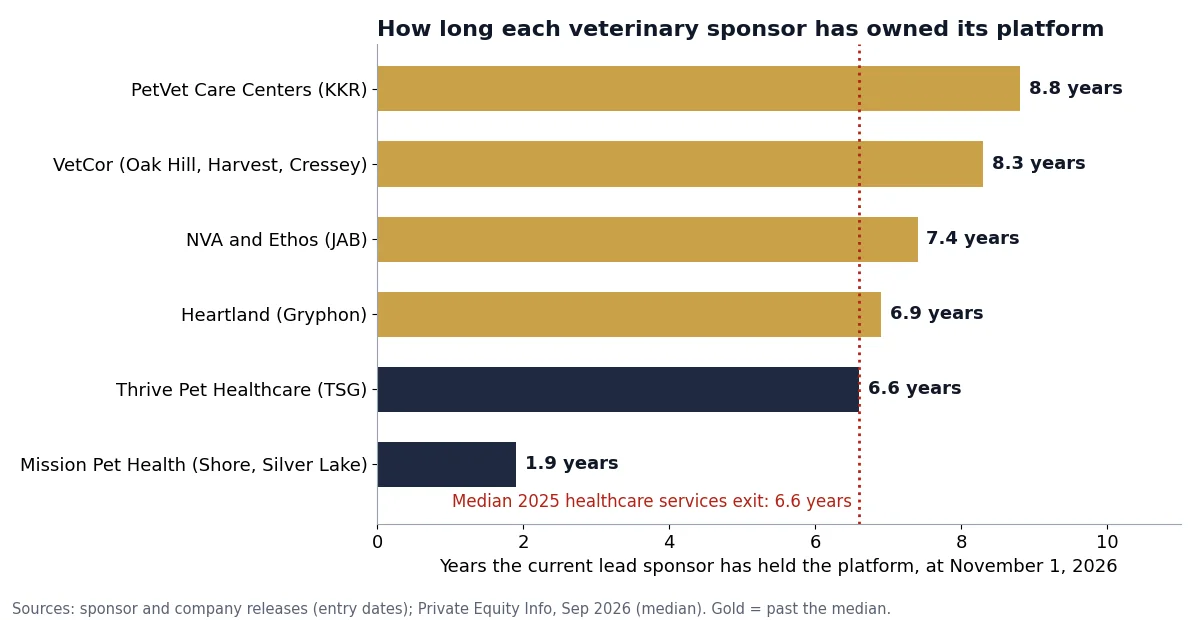
A sponsor past the 6.6-year median is closer to a sale, a continuation vehicle or a recapitalization, and any of those can price your rolled shares. That cuts both ways: an early exit can return your second payday sooner, while a sponsor under pressure to sell may accept a lower platform price. Before signing with PetVet, VetCor, NVA or Heartland, ask in writing when the fund expects to exit, whether your shares tag along at the same price per share, and whether you can be forced to roll again.
Mission Pet Health sits at the other end: Shore Capital and Silver Lake recapitalized it in December 2024, 1.9 years before this review. Equity rolled there in 2026 starts a longer clock, which suits a seller planning to keep practicing for five or more years more than one who wants liquidity within two. Our guide to rollover equity in a business sale lists the governance terms to request.
Debt matters as much as the clock. Thrive Pet Healthcare was cut to selective default by S&P on April 3, 2025 after a distressed exchange (S&P), raised to CCC+ on April 9, 2025 with its capital structure called likely unsustainable (S&P), and cut to Caa3 by Moody’s in March 2026. Its $1.325 billion term loan due June 2028 was priced at 80.17 in September 2026, per Octus. Equity in a platform priced that way can be worth little at exit, so favor cash at closing with any buyer rated CCC or Caa.
What have buyers paid in disclosed veterinary deals?
Most veterinary deals never publish a price. The few that did show how platform buyers value locations: JAB agreed $1.1 billion for SAGE Veterinary Partners’ 16 specialty and emergency clinics in 2022, about $68.8 million per clinic, and Chewy paid an estimated $399.8 million for Modern Animal’s 29 clinics in 2026, about $13.8 million each.
| Deal | Date | Disclosed value | Units | Per unit (our arithmetic) | Source |
|---|---|---|---|---|---|
| Mars buys VCA | Agreed Jan 9, 2017; FTC final order Dec 19, 2017 | About $9.1 billion | Whole company, hospitals plus other lines | Not meaningful per hospital | FTC analysis |
| JAB (via NVA) buys Ethos | 2021; FTC final order Oct 2022 | $1.65 billion | Specialty and emergency platform | Not computed: hospital count at signing not disclosed | PE Hub |
| JAB buys SAGE Veterinary Partners | FTC complaint Jun 13, 2022 | $1.1 billion | 16 clinics | About $68.8 million per clinic | FTC |
| Southern and Mission Veterinary Partners combine (reported) | Nov 4, 2024 | About $8.6 billion, reported by Bloomberg | More than 730 practices | About $11.8 million per practice | Private Equity Wire |
| Chewy buys Modern Animal | Closed May 21, 2026 | $399.8 million (estimated) | 29 clinics | About $13.8 million per clinic; 55.4% goodwill | Chewy 10-Q |
| FCPT buys Mission Pet Health buildings | Closed Jul 16, 2026 | $268.0 million | 102 properties | About $2.63 million per property; 6.48% implied cap rate | FCPT |
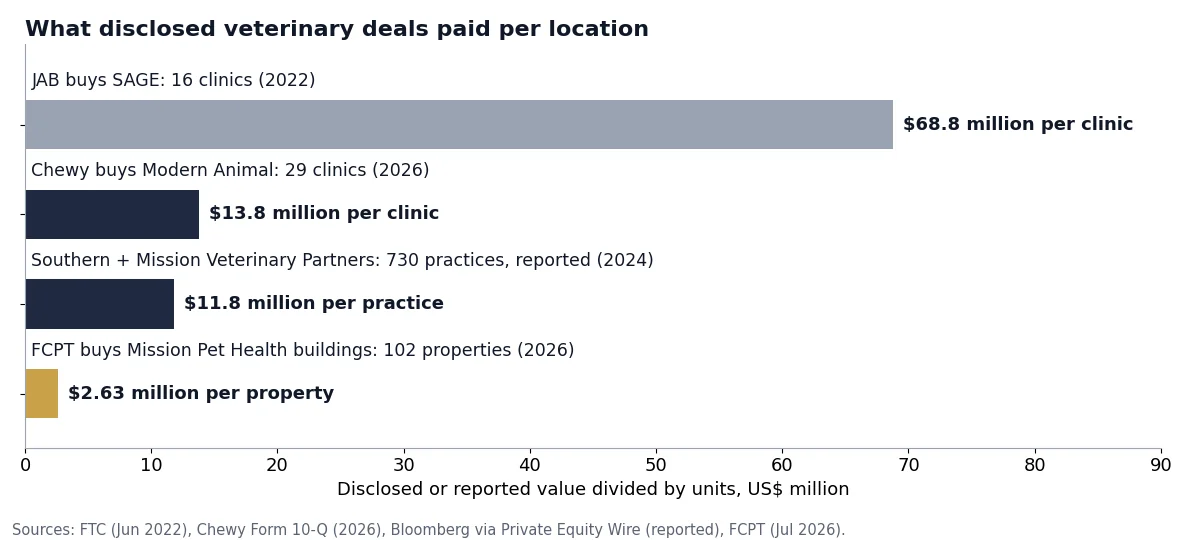
Platform prices per clinic run far above what one practice sells for, because they buy a management team, brands and a pipeline of future deals. Chewy booked $221.6 million of the $399.8 million Modern Animal price, or 55.4%, as goodwill, the share paid for earnings power rather than equipment and buildings. Modern Animal brought more than $125 million of annualized revenue, so Chewy paid at most 3.2 times revenue.
Your own practice is priced on its own earnings. Our veterinary practice M&A multiples report sets out 2026 EBITDA and SDE bands by practice size and type, and the veterinary valuation calculator applies them to your numbers.
Does FTC scrutiny change who can buy your practice?
Only for specialty and emergency clinics near a restricted buyer. FTC orders require JAB, owner of NVA and Ethos, to get Commission approval before buying a specialty or emergency clinic within 25 miles of its own clinics in six jurisdictions until 2032, and require Mars to give prior notice of such deals in certain areas until December 2027. The orders do not cover general practices.
| Order | Final | Runs until | What it requires | Source |
|---|---|---|---|---|
| Mars and VCA | Dec 19, 2017 | Dec 2027 (10 years) | 12 clinics divested in 10 markets to NVA, PetVet and Pathway; prior notice of specialty or emergency clinic purchases in certain areas | FTC |
| JAB and SAGE | Aug 2022 | Aug 2032 (10 years) | 6 clinics divested (3 in Austin; San Mateo, Berkeley, Fairfield); prior approval within 25 miles of a JAB clinic in California or Texas; 30 days’ notice nationwide for deals HSR does not cover | FTC |
| JAB and Ethos | Oct 2022 | Oct 2032 (10 years) | 5 clinics divested (Richmond, Springfield, Leesburg, Wheat Ridge, Marin); prior approval within 25 miles in California, Colorado, Maryland, Virginia and the District of Columbia; 30 days’ notice nationwide | FTC |
| Hart-Scott-Rodino threshold | Feb 17, 2026 | Reset each year | Federal premerger filing for deals above $133.9 million | Goodwin |
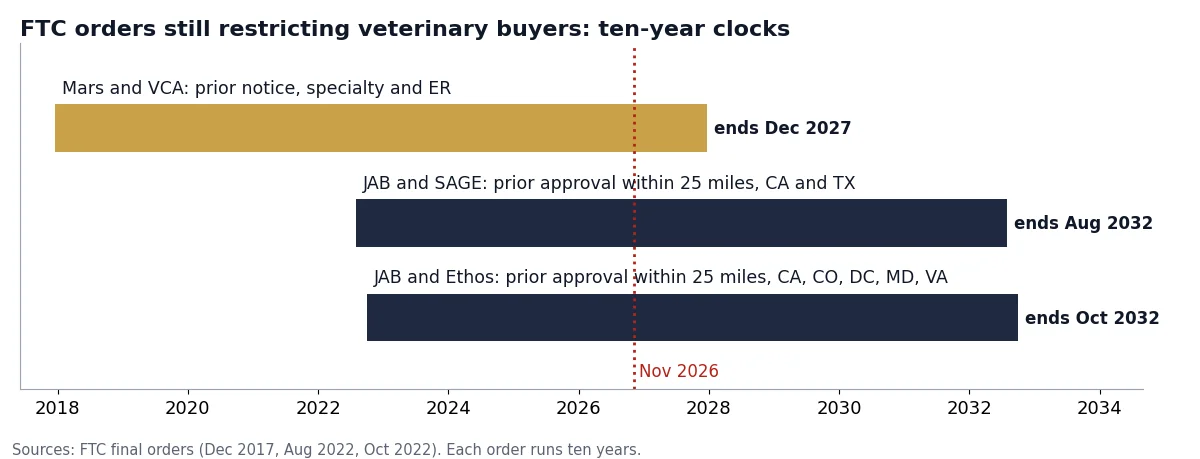
A single-practice sale almost always falls below the $133.9 million Hart-Scott-Rodino threshold, so it needs no federal premerger filing. The JAB orders reach below that line: they require 30 days’ written notice for specialty and emergency deals anywhere in the US that HSR does not capture. On February 18, 2025, FTC Chairman Andrew Ferguson kept the 2023 Merger Guidelines, which address serial acquisitions, as the agency’s review framework (WilmerHale).
If you own a specialty or emergency hospital in one of those six jurisdictions and NVA or Ethos is bidding, put the FTC approval period into the letter of intent and state who bears the cost if approval is refused. Our guide to selling a veterinary specialty hospital covers the rest of that process.
How do you compare a private equity offer line by line?
Split every offer into four lines: cash at closing, rolled equity, the building and the rent you will be paid. Transitions Elite, a practice broker, reports cash at closing of 60% to 80% of deal value and rollover of 10% to 30% in 2026 PE offers. The illustrative example below runs one offer through five steps so two letters of intent compare line for line.
- Reset EBITDA to market rent. Illustrative example: a three-DVM general practice reports $1,200,000 of EBITDA while paying its owner $96,000 a year in rent. A market lease is $156,000, so the buyer underwrites $1,140,000.
- Apply the multiple. At 8x, an assumption for the arithmetic only, the headline price is $9,120,000.
- Split cash from rollover. At 20% rollover, inside the 10% to 30% range Transitions Elite reports, $1,824,000 is rolled and $7,296,000 arrives at closing, before escrow and working capital adjustments.
- Price the building on its own. At the $156,000 market rent and a 6.5% cap rate, close to the 6.48% implied by FCPT’s Mission Pet Health purchase, the building is worth about $2,400,000 to a net-lease buyer.
- Stress-test the rollover. Value the rolled shares at 0x, 1x and 2x of their closing value, then decide whether the deal still works at 0x.
| Line | Illustrative figure | Basis |
|---|---|---|
| Underwritten EBITDA | $1,140,000 | $1,200,000 reported, less $60,000 rent gap |
| Headline price | $9,120,000 | 8x, assumed |
| Cash at closing | $7,296,000 | 80% of headline |
| Rolled equity at closing value | $1,824,000 | 20% of headline |
| Building value | $2,400,000 | $156,000 rent at a 6.5% cap rate |
| Total if rollover is worth 0x | $9,696,000 | Cash plus building |
| Total if rollover is worth 1x | $11,520,000 | Adds $1,824,000 |
| Total if rollover is worth 2x | $13,344,000 | Adds $3,648,000 |
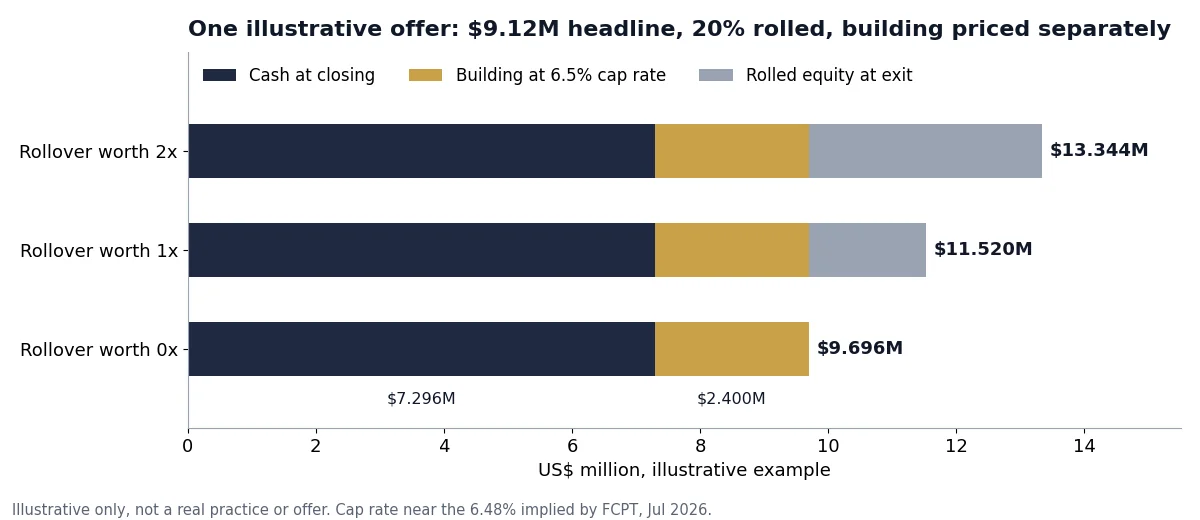
The rent trade-off. In this example, every extra $10,000 of market rent takes $80,000 off the practice price at 8x and adds about $153,800 to the building’s value at a 6.5% cap rate. Owners selling both should set a market lease backed by an independent appraisal. Owners keeping the building should negotiate lease length and annual escalators, because the lease becomes their income, and buyers test the rent against appraisal in diligence.
Which veterinary private equity buyer fits your practice?
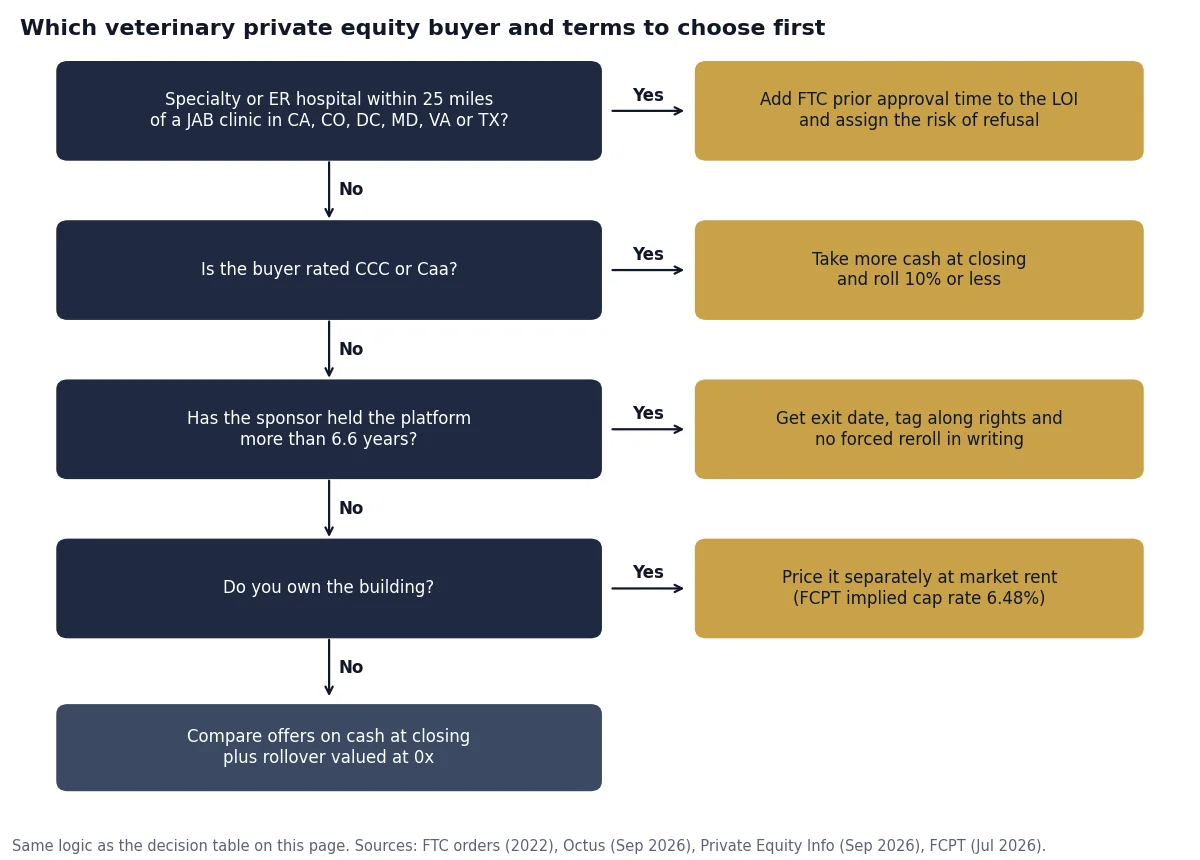
Match the buyer to the line you care most about. If cash at closing matters most, favor a strategic such as Mars or Chewy or a sponsor with no CCC or Caa rating. If you want a second payday, pick a sponsor early in its hold. If you own a specialty hospital within 25 miles of a JAB clinic, check the FTC orders first, and price any building you own as a separate asset.
| If your situation is | Do this | Threshold behind it | Source |
|---|---|---|---|
| You own a specialty or ER hospital within 25 miles of a JAB clinic in CA, CO, DC, MD, VA or TX | Add FTC prior-approval time to the letter of intent and assign the risk of refusal | Orders run to Aug and Oct 2032 | FTC |
| The buyer is rated CCC or Caa | Take more cash at closing and roll 10% or less | Thrive: Moody’s Caa3, Mar 2026 | Octus |
| The sponsor has held the platform more than 6.6 years | Get the expected exit date, tag-along rights and a no-forced-re-roll clause in writing | PetVet 8.8, VetCor 8.3, NVA 7.4, Heartland 6.9 years | Private Equity Info |
| You plan to keep practicing five or more years and want a second payday | Favor a sponsor early in its hold | Mission Pet Health: 1.9 years held | Shore Capital |
| You own the building | Price it separately at market rent | 6.48% implied cap rate, FCPT, Jul 2026 | FCPT |
| None of the above | Compare offers on cash at closing plus rollover valued at 0x | Worked example on this page | This page |
Before you choose, have the practice valued on its own numbers and ready for diligence. The veterinary practice exit playbook lists the 12- to 18-month pre-sale work these buyers check, and our guide on how to sell a veterinary practice walks through the process step by step. If you want to keep control and take some cash now, a recapitalization is the third route.
What do other guides get wrong about veterinary private equity?
Several widely repeated claims do not match the primary record, including two that appeared on an earlier version of this page. The table sets each claim beside the document that settles it: an NVA announcement, FTC orders, sponsor portfolio pages, S&P research abstracts and an SEC EDGAR search, all checked in November 2026.
| Claim you may see | What the primary source says | Source |
|---|---|---|
| Ethos Veterinary Health acquired NVA in July 2025 (on an earlier version of this page) | On March 27, 2023, NVA said it would form two distinct businesses, NVA and Ethos; both remain under JAB | NVA |
| Mission Pet Health is a private equity firm | It is a veterinary operator held by Shore Capital Partners since December 2024, with Silver Lake as partner | Shore Capital |
| Mission Pet Health has filed for an IPO | No Form S-1 naming Mission Pet Health on EDGAR at November 7, 2026 | SEC EDGAR |
| Mars is a private equity owner | Mars, Incorporated is a family-owned company with no fund exit clock | Mars Veterinary Health |
| About half of vet clinics are PE-owned | The 50% figure is a 2021 share of companion-animal practice revenue held by all consolidators, Mars included | FTC Chair statement |
| S&P first cut Thrive to CCC+ in April 2025 (on an earlier version of this page) | Thrive was already CCC+; S&P moved it to SD on April 3, 2025 and back to CCC+ on April 9, 2025 | S&P |
| The FTC has blocked vet roll-ups | The FTC cleared each deal with divestitures of 12, 6 and 5 clinics plus ten-year notice or approval duties | FTC |
How we compiled this
We compiled this page in November 2026 from the 35 sources listed below: FTC releases, analyses and a Chair statement, an SEC Form 10-Q, an SEC EDGAR full-text search, sponsor and company releases, a REIT closing release, two S&P research abstracts, and named reporting from Octus, IREI and Private Equity Wire. Location counts marked as listings come from the Private Equity Vet database, updated October 24, 2026. We did not interview buyers or use CT Acquisitions client data, and we excluded forum posts. Two inputs are second-hand and labeled: the deal-structure ranges from Transitions Elite and the $8.6 billion value reported by Bloomberg.
Frequently asked questions
Is Mission Pet Health a private equity firm?
No. Mission Pet Health is a veterinary group owned by private equity, not a private equity firm. It combines Southern Veterinary Partners and Mission Veterinary Partners, announced on July 21, 2025. Shore Capital Partners has held it since December 2024 and Silver Lake joined as a partner in 2024. Dr. Jay Price is CEO, and the group had more than 930 locations by May 2026.
Is Mission Pet Health going public?
There is no public IPO filing. A full-text search of SEC EDGAR on November 7, 2026 returned no Form S-1 naming Mission Pet Health, which remains privately owned by Shore Capital Partners and Silver Lake. In July 2026 its sponsor’s real estate fund sold the buildings under 102 clinics to Four Corners Property Trust for $268.0 million, and Mission Pet Health stayed on as tenant.
Which vets are owned by private equity?
The largest PE-owned groups in the US are NVA and Ethos (JAB), Mission Pet Health (Shore Capital and Silver Lake), VetCor (Oak Hill, Harvest Partners and Cressey & Company), PetVet Care Centers (KKR), Thrive Pet Healthcare (TSG Consumer Partners) and Heartland Veterinary Partners (Gryphon Investors). Banfield, VCA and BluePearl belong to Mars, a family-owned company. Many acquired clinics keep their original names.
What percent of vet clinics are owned by private equity?
There is no official count. FTC Chair Lina Khan’s June 2022 statement cited an estimate that consolidators held close to 50% of US companion-animal practice revenue in 2021. Private Equity Vet reported in 2024 that over 30% of general practices and over 75% of specialty practices were corporately owned. Those corporate owners include Mars, which is not private equity.
Is Thrive Pet Healthcare private equity?
Yes. Thrive Pet Healthcare, formerly Pathway Vet Alliance, has been majority owned by TSG Consumer Partners since a deal announced on April 3, 2020. Its credit is weak: S&P rated it CCC+ after an April 2025 debt exchange, Moody’s cut it to Caa3 in March 2026, and its $1.325 billion term loan comes due in June 2028.
What happens to my rollover equity when the private equity owner sells?
Rolled shares are usually bought out, or rolled again, when the sponsor sells or recapitalizes the platform. The median healthcare services exit in 2025 came 6.6 years after investment. Get three terms in writing before you sign: tag-along rights at the same price per share, whether you can be forced to re-roll, and how your shares are valued if you leave early.
Sources
- Mission Pet Health, Southern and Mission Veterinary Partners join together (Jul 21, 2025)
- Shore Capital Partners, Mission Pet Health portfolio page (accessed Nov 2026)
- Silver Lake, Mission Pet Health portfolio page (accessed Nov 2026)
- Private Equity Wire citing Bloomberg, Shore Capital and Silver Lake mull $8.6bn merger (Nov 4, 2024)
- pets.care, Southern and Mission Veterinary Partners merger (updated Apr 14, 2025)
- IREI, FCPT to acquire up to 102 veterinary properties (Jun 1, 2026)
- Four Corners Property Trust, closing of 102 Mission Pet Health properties (Jul 16, 2026)
- SEC EDGAR full-text search, Form S-1 (searched Nov 7, 2026)
- Mars Veterinary Health, company site (accessed Nov 2026)
- FTC, Mars and VCA analysis of consent orders, File 171-0057 (Aug 2017)
- FTC, final consent order in Mars and VCA (Dec 19, 2017)
- NVA, NVA and Ethos Veterinary Health form two businesses (Mar 27, 2023)
- Ares Management, agreement to sell NVA to JAB Investors (Jun 17, 2019)
- FTC, action on JAB’s acquisition of SAGE Veterinary Partners (Jun 13, 2022)
- FTC, second action against JAB Consumer Partners over Ethos (Jun 29, 2022)
- FTC, final order in JAB and SAGE (Aug 2022)
- FTC, final order in JAB and Ethos (Oct 2022)
- FTC, Statement of Chair Lina M. Khan regarding NVA and SAGE (Jun 13, 2022)
- Private Equity Vet, US group listings (updated Oct 24, 2026)
- Ontario Teachers’ Pension Plan, KKR to acquire PetVet Care Centers (Dec 27, 2017)
- Harvest Partners, VetCor closes recapitalization (Jul 2, 2018)
- VetCor, company site (accessed Nov 2026)
- Ropes & Gray, TSG purchase of Pathway Vet Alliance (Apr 2020)
- S&P Global Ratings, Pathway Vet Alliance downgraded to SD (Apr 3, 2025)
- S&P Global Ratings, Pathway Vet Alliance upgraded to CCC+ (Apr 9, 2025)
- Octus, Thrive Pet Healthcare lenders regroup with advisors (Sep 22, 2026)
- Gryphon Investors, investment in Heartland Veterinary Partners (Dec 12, 2019)
- Chewy, Inc., Form 10-Q for the quarter ended Aug 2, 2026, Note 3
- Chewy via Business Wire, Chewy to acquire Modern Animal (Apr 8, 2026)
- Private Equity Info, PE holding periods by industry (Sep 7, 2026)
- Goodwin, 2026 HSR thresholds announced (Jan 14, 2026)
- WilmerHale, 2023 Merger Guidelines remain in effect (Feb 28, 2025)
- Grand View Research, US veterinary services market report listing (2025 edition)
- Transitions Elite, how much private equity is paying for veterinary practices (accessed Nov 2026)
- PE Hub, JAB Investors’ NVA buys Ethos Veterinary Health in $1.65bn deal (2021)
CT Acquisitions helps owners of founder-owned businesses, including veterinary practices, make the most of their exit through a confidential sale, a recapitalization or exit planning, with a 500+ buyer network. We work for owners on the sell side. Our fee is success only: nothing upfront, and you pay nothing unless the business sells. Book a 15-minute call to compare your offers line by line.
Disclaimer: This page is general market information, not investment, legal or tax advice. Naming a group or sponsor here does not imply any relationship with CT Acquisitions. Ownership positions change; every fact above carries the date of its source.