Dermatology Private Equity: Who Buys Dermatology Clinics in 2026, 35+ Active MSO Platforms
Dermatology private equity in 2026: more than 30 PE-backed platforms, led by Forefront, QualDerm Partners, Epiphany and the combined U.S. Dermatology Partners and DermCare, typically buy practices for 70% to 80% cash and 20% to 30% rollover equity.

Key takeaways
- Dermatology had the highest private equity penetration of six office-based specialties in 2019: 7.5% of dermatologists (851 of 11,324) worked in PE-acquired practices (Singh et al., JAMA Health Forum, April 2022).
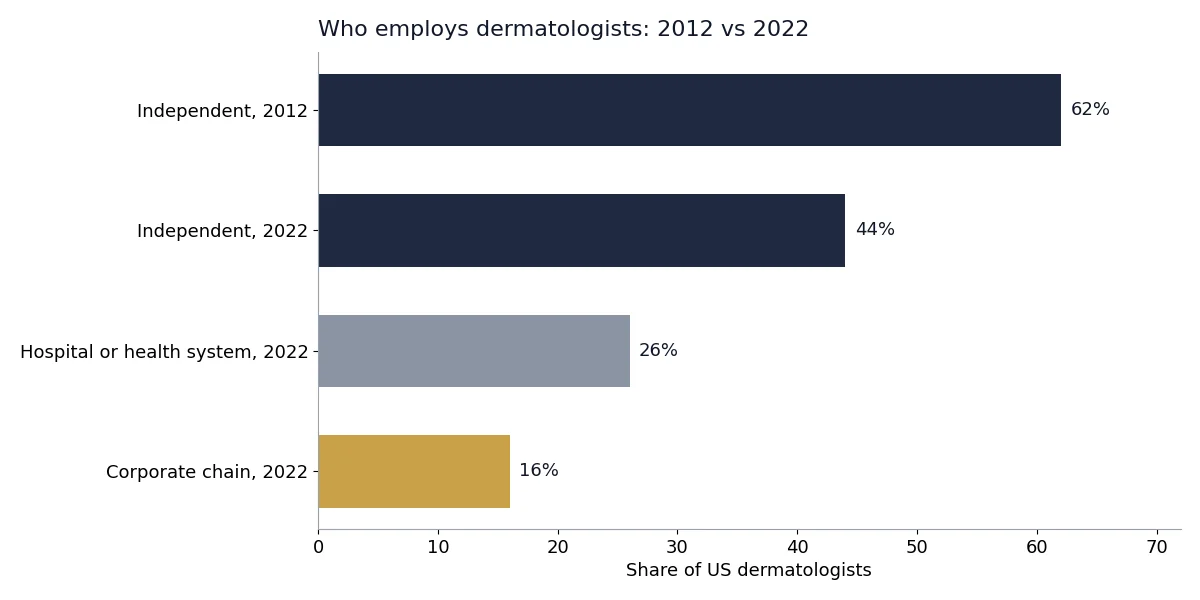
- Independent practice fell from 62% to 44% of US dermatologists between 2012 and 2022, while corporate chains, nearly all PE-backed, reached 16% (Staiger et al., Health Affairs Scholar, July 2026).
- A typical dermatology deal pays 70% to 80% of the price in cash at close and rolls 20% to 30% into platform equity that usually vests over about 5 years (Dermatology Times, August 2026).
- The scrape, the pay cut that creates the EBITDA a buyer prices, typically runs 30% to 40% of physician compensation in MSO deals (Physician Growth Partners in Orthopedics Today, August 2023).
- Oregon SB 951, signed June 9, 2025, bars a management services organization from owning or controlling a majority of a practice’s shares, and California SB 351 took effect January 1, 2026 (Dykema, July 2025; Foley & Lardner, October 2025).
- Seven of the eight platforms with a dated sponsor entry in our hold clock table have been with that sponsor 4.6 years or longer as of November 2026, inside or past the 3 to 7 year hold that Healio’s sources describe.

Who are the private equity dermatology groups buying practices in 2026?
The private equity dermatology groups most likely to call an owner in 2026 are Forefront Dermatology (Partners Group), QualDerm Partners (BayPine), Epiphany Dermatology (Leonard Green & Partners), Anne Arundel Dermatology (Ridgemont Equity Partners), AQUA Dermatology (Gryphon Investors and GTCR) and the combined U.S. Dermatology Partners and DermCare Management. Physician Growth Partners counted more than 30 PE-backed platforms in June 2026.
Each row below ties the sponsor to a dated announcement. Where a sponsor is not named in a primary release, the table says so instead of guessing. About 14,000 dermatologists practice in the United States, per the same Physician Growth Partners update, and Dermatology Times reported in August 2026 that 40% of practices are solo and 73% have fewer than 5 providers, so most sellers join one of these platforms as an add-on rather than as a new platform.
| Platform | Sponsor (entry) | Latest dated event | Source |
|---|---|---|---|
| Forefront Dermatology | Partners Group (agreed February 10, 2022, from OMERS Private Equity; OMERS kept a minority stake) | Swann Dermatology Partners, 3 dermatologists and 5 Missouri locations, joined December 29, 2025 | OMERS release; Practical Dermatology, Jan 2026 |
| QualDerm Partners (with Pinnacle Dermatology) | BayPine (Pinnacle announced October 29, 2021) | Pinnacle and QualDerm merged in 2022: 158 practices in 17 states | BusinessWire; Healio, Apr 2025 |
| Epiphany Dermatology | Leonard Green & Partners (February 1, 2022, from CI Capital Partners) | Continuing add-ons in secondary markets | CI Capital release, PR Newswire |
| Anne Arundel Dermatology | Ridgemont Equity Partners (October 20, 2020, from NMS Capital) | Physician-owners invested alongside Ridgemont at close | BusinessWire |
| AQUA Dermatology | Gryphon Investors and GTCR (Water’s Edge and Riverchase rebranded April 5, 2022) | Over 80 locations and more than 170 providers at launch | Gryphon Investors |
| U.S. Dermatology Partners and DermCare Management | Abry Partners invested in USDP in 2016 (listed as realized); current sponsor not named in the 2026 release | Combination announced August 13, 2026: 12 states, more than three million patients a year | DermCare release; Abry portfolio |
| Schweiger Dermatology Group | LLR Partners led a $35M round (April 13, 2016); LNK Partners later took a $100 million minority stake | Acquired 10 United Skin Specialists locations, January 2024 | BusinessWire; Healio |
| Advanced Dermatology and Cosmetic Surgery | Audax (2012); a reported $600 million from Harvest Partners | 53 clinics when Audax bought in | Healio; Dermatology Times |
| West Dermatology and Platinum Dermatology Partners | PE-backed (sponsor not restated here) | Merged in 2022: 170 physicians, over 300 providers, 100 locations | Healio, Apr 2025 |
| DOCS Dermatology Group | Recapitalized with a new capital partner (sponsor not named in the report) | Recapitalization reported January 2026 | Dermatology Times, Jan 2026 |
The 2026 pattern is the second bite. Michael Kroin of Physician Growth Partners wrote in Dermatology Times on January 5, 2026 that groups backed between 2016 and 2020 are reaching maturity, and named Forefront and DOCS Dermatology Group as completed recapitalizations. For a seller, the platform’s own sale date decides when rollover equity turns into cash, which is why the next table matters as much as the multiple. Our guide to selling a dermatology practice covers the sale process itself.
How long has each sponsor owned its dermatology platform?
Seven of the eight platforms with a dated sponsor entry have been with that sponsor for 4.6 years or more as of November 1, 2026. Healio quotes a 3 to 7 year typical hold, with funds reaching their end at year 9 or 10. A platform near or past year 5 is more likely to sell or recapitalize during your employment term, so your rollover is priced sooner.
| Platform | Sponsor entry | Years held (Nov 1, 2026) | What it means for your rollover |
|---|---|---|---|
| Schweiger Dermatology Group | LLR Partners, April 2016 | 10.6 | Minority investors, physician-led; ask how 2016 era equity was treated in later rounds |
| Advanced Dermatology and Cosmetic Surgery | Harvest Partners recapitalization, May 2016 | 10.5 | Past the 3 to 7 year band; ask whether a sale process has started |
| Anne Arundel Dermatology | Ridgemont, October 2020 | 6.0 | Inside the band, late; a sale or recap during a 5 year term is plausible |
| QualDerm Partners | BayPine, October 2021 | 5.0 | Midpoint of the band; ask for the sponsor’s stated exit window |
| Epiphany Dermatology | Leonard Green, February 2022 | 4.7 | Inside the band |
| Forefront Dermatology | Partners Group, February 2022 | 4.7 | Inside the band; Kroin lists Forefront as recapitalized |
| AQUA Dermatology | Gryphon and GTCR, April 2022 | 4.6 | Inside the band |
| U.S. Dermatology Partners and DermCare | Combination, August 2026 | 0.2 | New combined capital structure; ask who holds the equity |
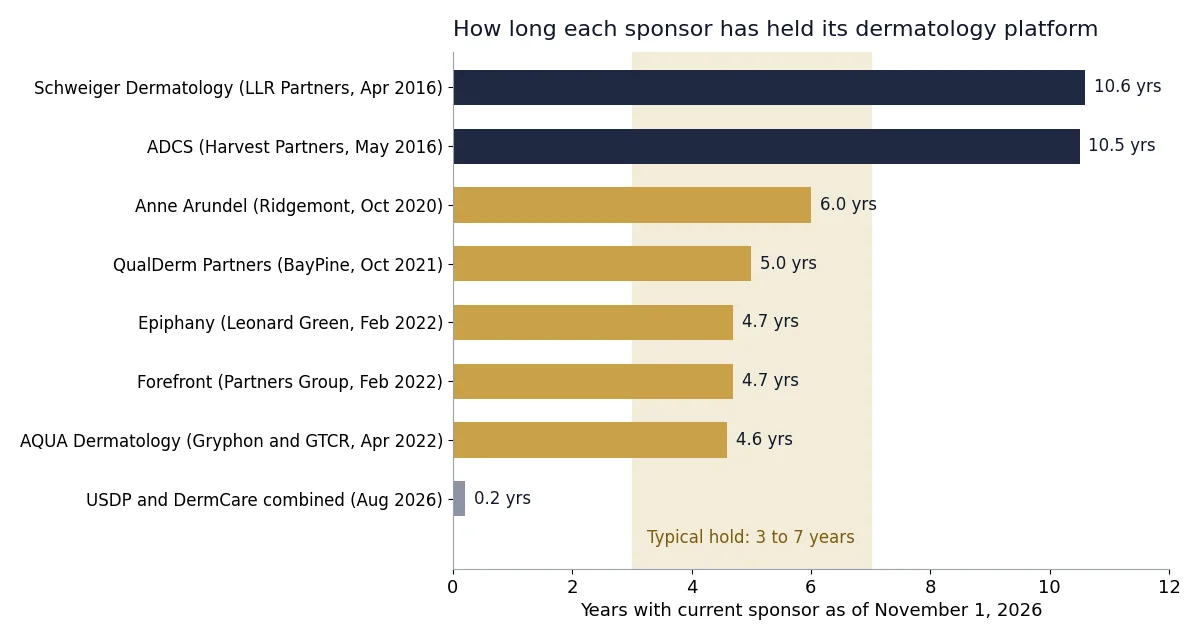
The arithmetic is simple: months from the announcement date to November 1, 2026, divided by 12. Announcement dates come from the releases in the platform table. Abry Partners’ 2016 investment in U.S. Dermatology Partners is excluded because Abry lists it as realized and the August 2026 release names no replacement sponsor.
How does a dermatology practice acquisition work for the physician seller?
A dermatology practice acquisition by a PE platform usually runs through a management services organization (MSO). The MSO buys the nonclinical assets and signs a management agreement, the clinical practice stays physician-owned, and the sellers take cash plus a minority rollover stake in the MSO. Arnold & Porter’s Matt Owens and Naomi Hartman describe this structure as the norm where corporate practice of medicine rules apply.
The stages below follow the Arnold & Porter outline (CRST, March/April 2019), with the document each stage produces:
- Owner consensus. All owners agree in writing on the minimum price and the post-close pay each one needs, because the two trade against each other.
- Advisors hired. A sell-side advisor, a healthcare transaction lawyer and a tax adviser are engaged before any buyer sees numbers.
- Marketing under NDA. Platforms sign nondisclosure agreements and receive the financial package.
- Initial diligence. Management meetings; you also check each sponsor’s hold clock and add-on record.
- Letter of intent. Price, cash share, rollover share and an exclusivity period are set.
- Quality of earnings. The buyer’s accountants rebuild EBITDA after the scrape; our quality of earnings guide for sellers lists what they test.
- Definitive documents. Purchase agreement, employment agreements for each selling dermatologist, and the rollover equity terms.
- Closing. Funds wire, the management agreement starts, and the employment term clock begins.
What a typical dermatology offer contains
Every term in a platform offer has a published range and a question that moves it. The ranges below come from named 2023 to 2026 sources; use them to test an offer, not to price your practice. Our dermatology M&A multiples report breaks the multiple down further by practice size.
| Term | Published range | Source | Question to ask |
|---|---|---|---|
| Cash at close | 70% to 80% of price | Dermatology Times, Aug 2026 | How much sits in escrow or holdback, and for how long? |
| Rollover equity | 20% to 30% of price; vests over about 5 years | Dermatology Times, Aug 2026 | Same class as the sponsor, or junior to a preferred security? |
| Scrape (pay reset) | 30% to 40% of physician compensation | Kroin and Simons, Aug 2023 | Is post-close pay a fixed salary, wRVU based, or a share of collections? |
| Add-on multiple | 2x to 7x EBITDA | Dermatology Times, Aug 2026 | Which EBITDA: before or after the scrape and MSO fee? |
| Platform multiple | 10x to 15x EBITDA (generally $5 million+ EBITDA) | Dermatology Times, Aug 2026 | Is your group large enough to be a platform for a new sponsor? |
| Noncompete | Sale-of-business covenant for a period of years, plus an employment covenant for the term plus a tail | Arnold & Porter, 2019 | What radius, and does it fall away if you are terminated without cause? |
| Real estate | New lease at fair market terms; buyers rarely buy the building | Arnold & Porter, 2019 | Term length and triple net terms you keep as landlord |
Rollover equity and the employment agreement carry most of the risk after closing. Our guides to rollover equity in a business sale and post-sale employment agreements cover the clauses to negotiate. Dermatology Times reported in August 2026 that rollover equity can be forfeited if the seller leaves before it vests, which makes the vesting schedule a price term.
What does the compensation scrape do to your payout?
The scrape converts your future salary into today’s purchase price. In the illustrative example below, a 35% scrape across three owners creates $840K of EBITDA, a 7x multiple turns it into $5.88M, and the $4.41M cash share roughly repays the $4.2M of pay the group gives up over a 5 year term. The rollover is the profit.
Illustrative example: three dermatologist owners, two locations. The practice, pay levels and offer are invented to show the method. The 35% scrape sits inside the 30% to 40% range above, and 7x is the top of the 2x to 7x add-on range.
| Step | Calculation | Group | Per physician |
|---|---|---|---|
| 1. Owner pay today | Current compensation | $2.4M | $800K |
| 2. Scrape | 35% of step 1 | $840K | $280K |
| 3. Pay after closing | Step 1 minus step 2 | $1.56M | $520K |
| 4. EBITDA the buyer prices | Equal to the scrape in a scrape-only model | $840K | $280K |
| 5. Price | Step 4 times 7x | $5.88M | $1.96M |
| 6. Cash at close | 75% of step 5 | $4.41M | $1.47M |
| 7. Rollover equity | 25% of step 5 | $1.47M | $490K |
| 8. Pay given up over a 5 year term | Step 2 times 5 | $4.2M | $1.4M |
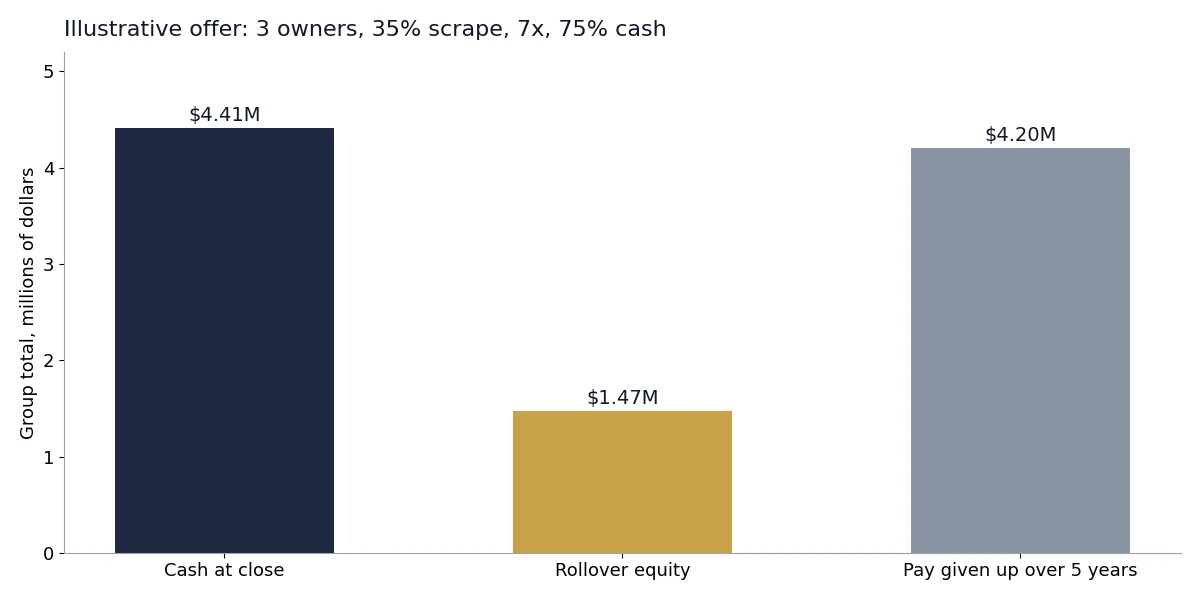
The rollover decides whether the trade pays. The table shows the group’s pre-tax result (cash plus rollover value minus pay given up) under three illustrative outcomes for the platform’s next sale.
| Rollover outcome at the platform sale | Rollover value | Cash plus rollover minus pay given up |
|---|---|---|
| Rollover halves (0.5x) | $735K | $945K |
| Rollover flat (1.0x) | $1.47M | $1.68M |
| Rollover doubles (2.0x) | $2.94M | $3.15M |
The payback ratio: a one-line test for any offer
Divide the multiple times the cash share by the employment term in years. In a scrape-only model the scrape cancels out, so the ratio holds whatever scrape you agree to: at 7x, 75% cash and 5 years it is 1.05, at both a 30% scrape ($3.78M cash against $3.6M of pay given up) and a 40% scrape ($5.04M against $4.8M). Below 1.0, cash at close does not cover the pay you give up during the term.
| Multiple (75% cash) | Payback ratio, 3 year term | Payback ratio, 5 year term |
|---|---|---|
| 4x | 1.0 | 0.6 |
| 5x | 1.25 | 0.75 |
| 6x | 1.5 | 0.9 |
| 7x | 1.75 | 1.05 |
The ratio ignores taxes, the scrape that continues if you stay past the term, and any EBITDA the practice earns beyond the scrape. Sale proceeds are often taxed at capital gains rates while salary is ordinary income, so ask your tax adviser to run steps 6 to 8 after tax. Three tests apply to any real offer:
- Payback test. Is the payback ratio at least 1.0 for your term? If not, you depend on the rollover to break even.
- Rollover test. When did the sponsor invest? A platform at year 5 or later on the hold clock table is likely to price your rollover within your term. Ask what physicians who joined 3 or more years ago received.
- Exit test. What happens to unvested equity, salary and the noncompete if one owner leaves in year 2? A deal that works only if all three stay 5 years is a bigger bet than the multiple suggests.
Which state corporate practice of medicine rules shape a dermatology deal?
Corporate practice of medicine (CPOM) laws decide whether a PE platform can own your practice outright or must use an MSO. California Business and Professions Code §2400 says corporations have no professional rights, Oregon SB 951 (June 9, 2025) caps MSO control, and California SB 351 added PE-specific limits from January 1, 2026. Texas and New York restrict who may own a professional entity.
| State | Rule and citation | What it means for a dermatology seller | Source |
|---|---|---|---|
| California | §2400: corporations have no professional rights, privileges, or powers. SB 351, signed October 6, 2025, effective January 1, 2026: only physicians decide medical records, hiring, payer contracting, billing and coding, and equipment | The MSO model is required; PE practice management contracts may not carry noncompete or non-disparagement clauses, except covenants tied to a sale of the business (§16601). The Attorney General can seek injunctions | §2400; Foley & Lardner, Oct 13, 2025; §16601 |
| Oregon | SB 951, signed June 9, 2025: an MSO may not own or control a majority of shares in a practice it manages, or exercise de facto control of clinical or business operations | Compliance from January 1, 2026 for new or transferred practices, January 1, 2029 for arrangements existing before June 9, 2025. Most physician noncompetes are void; exceptions include owners of 10% or more of the practice | Dykema, Jul 8, 2025; Bass, Berry & Sims, Jun 10, 2025 |
| Texas | Occupations Code §162.001: the Texas Medical Board certifies nonprofit health organizations run by licensed, actively practicing physicians, the main exception to the bar on lay employment of physicians | For-profit PE platforms typically use a physician-owned entity plus an MSO, so your employer after closing is usually the physician entity, not the MSO | Tex. Occ. Code §162.001 |
| New York | Business Corporation Law §1507: a professional service corporation may issue shares only to individuals licensed to practice its profession | The sponsor cannot hold shares in your professional corporation; its equity sits in the MSO, which is where your rollover lands | N.Y. BCL §1507 |
Federal scrutiny sits on top of state law. The FTC, the Department of Justice and HHS opened a joint inquiry into corporate control of health care on March 5, 2024, as Healio reported. None of this page is legal advice. Ask your healthcare lawyer three specific questions: does the management agreement give the MSO approval rights over hiring, coding or payer contracts (the SB 351 list), does your noncompete survive a termination without cause, and which state’s law governs the rollover equity. Our noncompete and non-solicit guide covers the covenant terms.
What does published research say about private equity in dermatology?
Peer-reviewed research from 2019 to 2026 finds that PE reached a larger share of dermatologists than of five other office-based specialties by 2019, raised commercial prices for routine visits by 3% to 5% within 1.5 years (Braun et al., Health Affairs, May 2021), and grew to 16% of dermatologists by 2022. The findings matter to sellers because payers and state lawmakers cite them.
| Study | Journal and date | Data | Finding |
|---|---|---|---|
| Tan, Seiger, Renehan, Mostaghimi | JAMA Dermatology, September 2019 | Acquisitions through May 31, 2018 | 17 PE-backed groups acquired 184 practices (381 clinics) from May 2012 to May 2018; 138 of 381 clinics (36%) were in Texas and Florida |
| Braun, Bond, Qian, Zhang, Casalino | Health Affairs, May 2021 | Health Care Cost Institute claims, 2012 to 2017 | One in eleven dermatologists in PE practices by 2017; routine visit prices 3% to 5% higher at 1.5 years; patient volume 4.7% to 17.0% higher; no consistent change in Mohs, biopsy or total spending |
| Singh, Zhu, Polsky, Song | JAMA Health Forum, April 2022 | 97,094 physicians in 6 specialties, 2019 | Dermatology highest at 7.5% (851 of 11,324), ahead of gastroenterology at 7.4% and urology at 6.5% |
| Borsa, Bejarano, Ellen, Bruch | BMJ, July 2023 | Systematic review of 55 studies, 9 in dermatology settings | PE ownership most consistently associated with higher costs to patients or payers; mixed to harmful effects on quality |
| Agarwal, Orlow | Journal of the American Academy of Dermatology, February 2024 | PE dermatology acquisitions, 2013 to 2022 | Research letter on 2013 to 2022 acquisitions (no published abstract; read the letter for counts) |
| Staiger, Li, Huang, La Forgia | Health Affairs Scholar, July 2026 | Medicare data and hand-collected deals, 2012 to 2022 | Independent share fell from 62% to 44%; 1,001 of 8,151 practices (12%) changed owner, peaking in 2017 to 2018; organic hiring overtook acquisitions by 2021 |
| Grabauskas, Gronbeck, Grant-Kels, Feng | Journal of the American Academy of Dermatology, online August 31, 2026 | Transparency in Coverage negotiated rates | Higher commercial payment rates at PE-backed dermatology clinics |
| Year | Practices acquired by PE-backed groups |
|---|---|
| 2012 | 5 |
| 2013 | 7 |
| 2014 | 13 |
| 2015 | 26 |
| 2016 | 40 |
| 2017 | 59 |
| January 1 to May 31, 2018 | 34 |
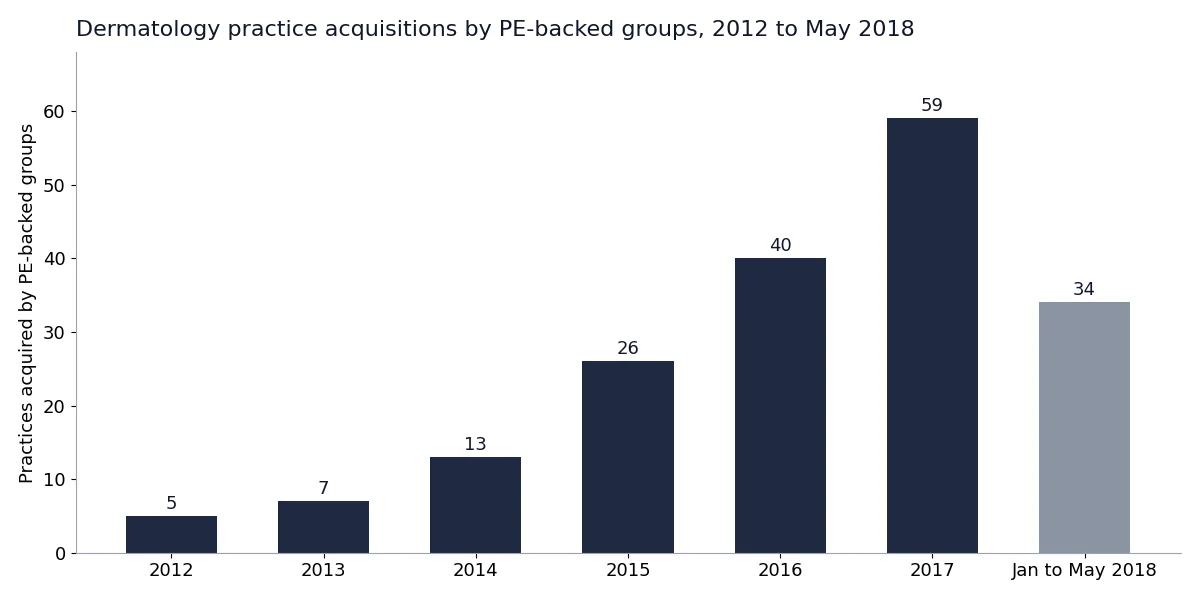
The 2012 and 2017 counts and the 2018 partial year come from the Tan abstract; the 2013 to 2016 counts are as reported from the same study by Dermatology Times. Staiger and colleagues find the acquisition wave peaked in 2017 to 2018, and that by 2021 PE-backed chains grew more by hiring dermatologists directly than by buying practices.
| Ownership of US dermatologists | 2012 | 2022 |
|---|---|---|
| Independent practice | 62% | 44% |
| Hospital or health system | not restated here | 26% |
| Corporate chain (nearly all PE-backed) | not restated here | 16% |
For a seller, two findings change the negotiation. Platforms that can now grow by hiring need your practice less than in 2017, so a practice without a clear edge sells at the low end of the 2x to 7x add-on range. And the price findings in Braun 2021 and the 2026 JAAD letter give payers and states, including Oregon and California, a reason to keep tightening rules, which is why recent deals carry more regulatory diligence. Our 2026 healthcare M&A trends report tracks the wider pattern.
What do dermatology platforms pay a premium for?
Dermatology platforms pay most for practices that are large, commercially insured and staffed with advanced practice providers. Braun et al. found PE firms targeted larger practices seeing more commercially insured patients, and that PE practices ran 4 advanced practitioners per 10 dermatologists against 3 elsewhere. Location matters: Texas and Florida held 36% of acquired clinics in the Tan study.
| What buyers look for | Published evidence | How to prepare |
|---|---|---|
| Commercial payer mix | PE targeted practices seeing more commercially insured patients (Braun 2021) | Report collections by payer for the last 36 months |
| Advanced practice providers | 4 per 10 dermatologists in PE practices vs 3 per 10 (Braun 2021) | Document each PA and NP’s panel and collections |
| Cosmetic volume | Cosmetic work was 40% of clinical volume in PE-backed clinics vs 20% elsewhere (Walsh and Seaton, JEADV 2025, as summarized by Dermatology Times) | Separate cash-pay cosmetic revenue in the books |
| Sunbelt location | 138 of 381 acquired clinics (36%) in Texas and Florida (Tan 2019) | Map your referral area against nearby platform clinics |
| Group size | Platforms (generally $5 million+ EBITDA) trade at 10x to 15x vs 2x to 7x for add-ons (Dermatology Times 2026) | Ask whether a merger with a peer group would cross the platform line |
Mohs surgery is often cited as a value driver, but Braun 2021 found no consistent change in Mohs use after PE acquisition, so price the Mohs line on its own collections rather than on a premium story. An M&A advisor for a dermatology practice should build the EBITDA bridge from these line items before any platform sees the numbers.
Should you sell to a dermatology PE platform, recapitalize or wait?
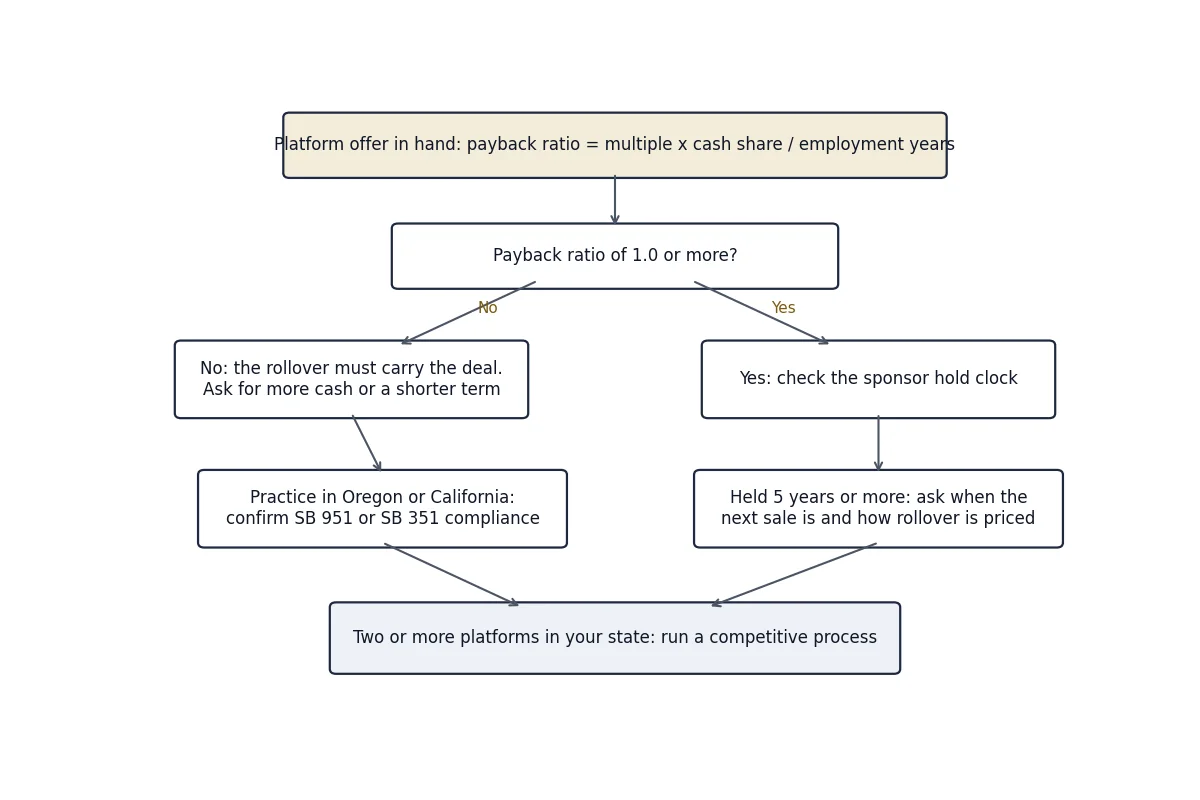
A platform offer works on paper when its payback ratio is 1.0 or higher and the sponsor’s hold clock fits your own timeline; below 1.0, the usual counter is more cash or a shorter term. If your group could reach platform scale, a recapitalization with a new sponsor can outprice an add-on sale. The decision table turns these rules into thresholds.
| If your situation is | Then | Why |
|---|---|---|
| Payback ratio below 1.0 (for example 5x, 75% cash, 5 year term = 0.75) | Ask for more cash, a shorter term, or a smaller scrape on the physicians closest to retirement | Cash at close does not cover the pay you give up during the term |
| The bidding platform’s sponsor has held it 5 years or more | Ask in writing when the next sale is planned and how rollover is priced at that sale | Your rollover is likely to be priced during your employment term |
| You practice in Oregon | Confirm the management agreement meets SB 951 before signing; transfers after June 9, 2025 must comply from January 1, 2026 | A noncompliant structure can unwind your deal |
| You practice in California | Check the management agreement against the SB 351 list (records, hiring, payer contracts, billing, equipment) | The Attorney General can seek injunctive relief from January 1, 2026 |
| You own 10% or more of an Oregon practice | Expect the buyer to ask for a noncompete | SB 951 voids most physician noncompetes but keeps an exception for owners of 10% or more |
| Your group could reach $5 million+ EBITDA with a peer merger | Test a recapitalization as a new platform before accepting an add-on offer | Platforms trade at 10x to 15x vs 2x to 7x for add-ons |
| Two or more platforms already operate in your state | Run a competitive process with signed NDAs and a bid deadline | Competing bids move cash share and term, not only the multiple |
If a recapitalization fits better than a sale, our private equity recapitalization guide explains how a partial sale with majority control changes the cash and rollover split.
How we compiled this
We compiled this page in November 2026 from 9 platform and sponsor announcements, 7 peer-reviewed studies (pulled from PubMed and PubMed Central), 4 state statutes, 4 law firm publications (Arnold & Porter on deal structure; Foley & Lardner, Dykema and Bass, Berry & Sims on SB 351 and SB 951), and 5 dated trade reports from Dermatology Times, Healio, Practical Dermatology and Orthopedics Today. We excluded forum posts, unattributed valuations and any sponsor we could not tie to a dated source. The worked example is illustrative, not a client case.
Frequently asked questions
Which private equity firms are currently buying dermatology practices?
As of November 2026, the most active sponsors are Partners Group (Forefront Dermatology), BayPine (QualDerm Partners), Leonard Green & Partners (Epiphany Dermatology), Ridgemont Equity Partners (Anne Arundel Dermatology) and Gryphon Investors with GTCR (AQUA Dermatology). Physician Growth Partners counted more than 30 PE-backed dermatology platforms in its June 2026 market update, so a regional platform may also bid.
Is U.S. Dermatology Partners private equity backed?
Yes, historically. Abry Partners invested in 2016 and now lists that investment as realized. On August 13, 2026, U.S. Dermatology Partners and DermCare Management announced a combination spanning 12 states and more than three million patients a year. The announcement does not name the current equity sponsor, so ask the platform for its cap table summary before you sign a letter of intent.
Is Advanced Dermatology owned by private equity?
Yes. Audax acquired Advanced Dermatology and Cosmetic Surgery in 2012, when it had 53 clinics (Healio, April 2025), and Dermatology Times reported in August 2026 that the group is backed by a reported $600 million from Harvest Partners. It is one of the oldest PE-backed dermatology platforms in the United States.
Who owns QualDerm Partners?
BayPine. BayPine announced its acquisition of Pinnacle Dermatology on October 29, 2021, and Pinnacle and QualDerm Partners merged in 2022 into one platform supporting 158 practices in 17 states (Healio, April 2025). The combined group operates under the QualDerm Partners name.
Is Epiphany Dermatology private equity backed?
Yes. CI Capital Partners announced the sale of Epiphany Dermatology to Leonard Green & Partners on February 1, 2022, after holding a majority stake since 2016. Under Leonard Green, Epiphany continues to add practices, with a focus on smaller and secondary markets.
What is the scrape in a dermatology private equity deal?
The scrape is the share of your current pay you agree to give up after closing. It becomes the EBITDA the buyer multiplies to set your price. Physician Growth Partners put the typical scrape at 30% to 40% in August 2023. A bigger scrape raises the purchase price and lowers your salary for every year you stay employed.
Sources
- Tan S et al. Trends in Private Equity Acquisition of Dermatology Practices in the United States. JAMA Dermatology, September 2019 (accessed November 2026)
- Braun RT et al. Private Equity in Dermatology: Effect on Price, Utilization, and Spending. Health Affairs, May 2021 (accessed November 2026)
- Singh Y et al. Geographic Variation in Private Equity Penetration Across Select Office-Based Physician Specialties. JAMA Health Forum, April 2022 (accessed November 2026)
- Borsa A et al. Evaluating trends in private equity ownership: systematic review. BMJ, July 2023 (accessed November 2026)
- Agarwal A, Orlow SJ. An update on private equity acquisitions in dermatology, 2013 to 2022. JAAD, February 2024 (accessed November 2026)
- Staiger B et al. Who owns your doctor? Health Affairs Scholar, July 2026 (accessed November 2026)
- Grabauskas T et al. Higher commercial payment rates at private equity-backed dermatology clinics. JAAD, online August 31, 2026 (accessed November 2026)
- Gatti J. Other People’s Money and the Rise of Private Equity in Dermatology, Part 1. Dermatology Times, August 21, 2026 (accessed November 2026)
- Kroin M. Dermatology Market Update 2026. Dermatology Times, January 5, 2026 (accessed November 2026)
- Grasso GM. Private equity in dermatology. Healio, April 16, 2025 (accessed November 2026)
- Practical Dermatology on the Physician Growth Partners 2026 Dermatology Market Update, July 2026 (accessed November 2026)
- Kroin M, Simons E. Orthopedics Today (Healio), August 28, 2023 (accessed November 2026)
- Owens M, Hartman N (Arnold & Porter). Anatomy of a Deal. CRST, March/April 2019 (accessed November 2026)
- Foley & Lardner. California SB 351 Signed, October 13, 2025 (accessed November 2026)
- Dykema. Oregon SB 951 Targets MSO Control, July 8, 2025 (accessed November 2026)
- Bass, Berry & Sims. Oregon Enacts SB 951, June 10, 2025 (accessed November 2026)
- California Business and Professions Code §2400 (accessed November 2026)
- California Business and Professions Code §16601 (accessed November 2026)
- Texas Occupations Code §162.001 (accessed November 2026)
- New York Business Corporation Law §1507 (accessed November 2026)
- DermCare Management. Combination with U.S. Dermatology Partners, August 13, 2026 (accessed November 2026)
- Abry Partners portfolio: U.S. Dermatology (accessed November 2026)
- OMERS Private Equity. Sale of interest in Forefront Dermatology to Partners Group, February 10, 2022 (accessed November 2026)
- Practical Dermatology. Swann Dermatology Partners joins Forefront, January 16, 2026 (accessed November 2026)
- BusinessWire. BayPine to acquire Pinnacle Dermatology, October 29, 2021 (accessed November 2026)
- PR Newswire. CI Capital announces sale of Epiphany Dermatology, February 1, 2022 (accessed November 2026)
- BusinessWire. Ridgemont Equity Partners acquires Anne Arundel Dermatology, October 20, 2020 (accessed November 2026)
- Gryphon Investors. Water’s Edge and Riverchase rebrand as AQUA Dermatology, April 5, 2022 (accessed November 2026)
- BusinessWire. Schweiger Dermatology Group secures $35M led by LLR Partners, April 13, 2016 (accessed November 2026)
Weighing a platform offer? CT Acquisitions helps owners of founder-owned practices make the most of their exit through a confidential sale, a recapitalization or an exit plan, with a 500+ buyer network. We work for owners on the sell side. Our fee is success only: nothing upfront, and you pay nothing unless the business sells. Book a confidential call.
Disclaimer: This page is general market information, not legal, tax, medical or investment advice. Sponsor attributions reflect the dated sources linked above and can change after a recapitalization.