When I Sell My Business Can I Deduct My Basis: The Plain-English Answer (2026)
When I sell my business can I deduct my basis is one of the first questions every owner should ask, and the short answer is yes: you recover your tax basis tax-free, and only the gain above that basis is subject to federal income tax. The hard part is not the rule. The hard part is proving what your basis actually is, because the IRS does not keep that record for you, and most small business owners have not tracked it correctly across years of contributions, distributions, and pass-through income.
This page is a plain-English explainer for owners thinking about a sale in 2026. It is not tax advice. Before you sign an LOI, you need a CPA who has reconciled your basis through every K-1, every capital contribution, and every distribution since the day you started the company. Get that wrong, and you will overpay tax by 15 to 37 percent of the missing number.
Context: Why This Question Matters
For most owners, the business sale is the single largest taxable event of their life. A $5M sale where basis is properly documented at $1.2M produces a $3.8M taxable gain. The same sale where the seller cannot prove basis can default to a $5M taxable gain, costing the seller roughly $456,000 in additional federal long-term capital gains tax at the 23.8 percent top rate (20 percent capital gains plus 3.8 percent net investment income tax). State tax piles on top.
The reason this happens so often is structural. Sole proprietors track basis asset-by-asset through depreciation schedules. Partnerships carry two parallel basis ledgers (inside and outside). S-corp shareholders are required by Treasury Reg 1.1366-2 to track stock basis annually, but most do not. C-corp shareholders track stock basis only. Each structure has its own pitfalls, and each is its own audit-risk profile when the K-1 history does not reconcile.
The Detailed Answer
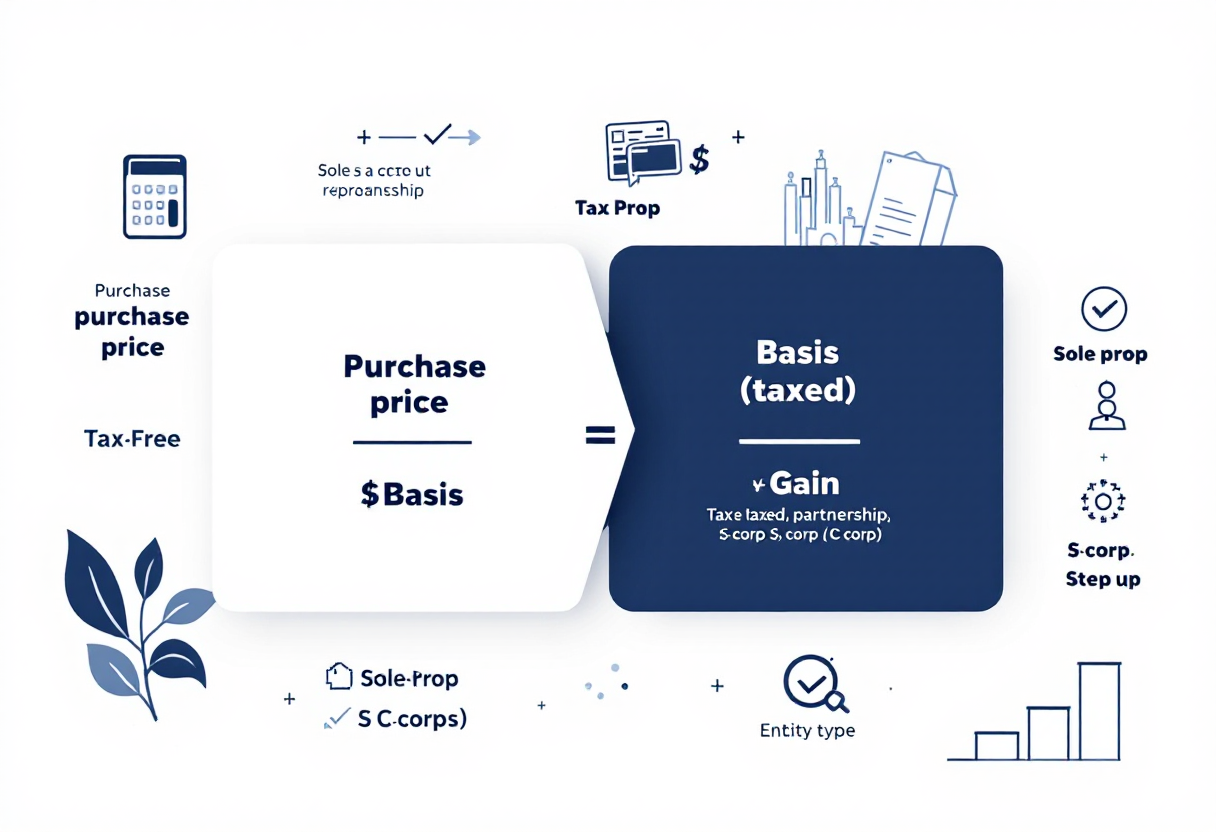
Basis is what you put in, plus what was already taxed, minus what came back out. Tax basis is the IRS’s accounting of what you have already paid tax on, or what you spent after-tax dollars to acquire. When you sell, you do not pay tax on basis again, because you already did. Only the gain above basis is taxed. The mechanics, however, differ sharply by entity type.
Sole proprietorship. There is no entity-level basis. You track basis on each individual asset: equipment, goodwill, real estate, inventory. When you sell, the transaction is broken out asset-by-asset under IRC Section 1060, and each asset class has its own basis and its own character of gain (ordinary, capital, or Section 1231). Depreciation taken over the years reduces basis in those assets, which is why depreciation recapture often surprises sellers. See our guide on deferring depreciation recapture for the mechanics.
Partnership and multi-member LLC. Partnerships carry two basis ledgers. Outside basis is what the partner has in the partnership interest, governed by IRC Sections 722, 733, and 1367-style adjustments. Inside basis is what the partnership has in its assets, governed by IRC Sections 734 and 743. The two can diverge sharply, especially when interests are bought and sold, or when distributions exceed a partner’s share of inside basis. A 754 election can step up inside basis on a sale of partnership interest to match the buyer’s outside basis. Without it, the buyer inherits stale inside basis and loses depreciation deductions they paid for.
S-corp. S-corp shareholders adjust stock basis annually under IRC Section 1366. The formula is straightforward in theory: beginning basis, plus capital contributions, plus pass-through income (ordinary and separately stated items), minus distributions, minus pass-through losses, minus nondeductible expenses. Treasury Reg 1.1366-2 requires you to track this every year. In practice, owners often inherit a CPA who never built the schedule, then discover at closing that ten years of K-1s need to be reconciled in a week.
C-corp. C-corp shareholders track stock basis only. Basis starts at what you paid (or contributed) for the stock and generally does not change over time unless there are additional contributions, returns of capital, or stock splits. Operating profits do not increase basis (they sit at the corporate level and are taxed there). A $5M sale of C-corp stock with $100,000 of original stock basis is a $4.9M long-term capital gain. C-corp asset sales are worse: the corporation pays tax on the gain at 21 percent federal, then the shareholder pays tax again on the liquidating distribution, which is the classic double-tax problem.
Asset sale vs. stock sale. In an asset sale, basis recovery happens at the asset level, one by one. In a stock sale, basis recovery happens at the stock level, in one calculation. Buyers usually prefer asset sales (they get a stepped-up basis to depreciate). Sellers usually prefer stock sales (one capital gain calculation, no depreciation recapture at ordinary rates). The allocation fight in an asset sale is fundamentally a fight about basis, because every dollar moved from goodwill to Section 1245 equipment shifts gain from capital to ordinary.
Section 1014 step-up at death. If the owner dies holding the business, heirs receive a stepped-up basis equal to fair market value at the date of death under IRC Section 1014. A founder with $50,000 of stock basis in a business worth $10M at death passes that business to heirs with $10M of basis. The heirs can sell the next day for zero taxable gain. This is one of the largest legal tax benefits in the code, and it changes the math on whether to sell now vs. hold to death.
Installment-sale basis recovery. If you take seller financing or an earnout, IRC Section 453 lets you recover basis pro rata across the payments. The gross profit percentage is gain divided by contract price, and that percentage is applied to each payment received. IRS Pub 537 walks through the mechanics. Section 453(b)(2)(B) excludes inventory and dealer property from installment treatment, which catches sellers of distributor businesses by surprise.
What Most Owners Get Wrong
“My CPA is tracking it.” Often not. Treasury Reg 1.1366-2 puts the tracking burden on the shareholder, not the preparer. Many CPAs treat the K-1 as the deliverable and do not maintain a running basis schedule. Ask your CPA to send you the current year stock basis schedule. If they cannot produce one in a week, you have a problem and you need to fix it before a buyer’s diligence team finds it.
“Distributions are tax-free, so they don’t matter.” Distributions reduce basis. They are tax-free only to the extent of basis, then become capital gain. More importantly, every dollar of distribution you took over the years is a dollar less of basis you can use to offset sale gain. Owners who took heavy distributions and reinvested elsewhere often have surprisingly low basis at sale.
“I’ll figure out basis at closing.” By closing, it is too late to do anything strategic. Basis planning happens in the year or two before the sale, when you can still make capital contributions, time distributions, accelerate or defer income, and clean up the K-1 history. Once the wire hits, the basis is what it is.
How CT Acquisitions Approaches This
CT Acquisitions represents owners selling to operator-buyers and acquisition holding companies. No fee to you on buy-side introductions; sell-side mandates are paid on success at closing. Our job during sell-side prep is to flag every tax structuring question early enough for the seller’s CPA to act on it, so that the deal we close is the deal the seller actually nets.
That means we ask about basis in the first call. If your CPA cannot produce a current stock basis schedule, we tell you to fix that before we go to market. If your entity is a C-corp and you are looking at an asset sale, we walk through the double-tax math with you so you understand what you are signing. We do not give tax advice; we surface the questions early enough for your CPA to give the advice that matters.
Related Questions
How do I prove my basis to the IRS if I never tracked it?
You reconstruct it. Pull every tax return since formation, every K-1, every bank statement showing capital contributions, every distribution check, and every loan document. A forensic CPA can rebuild a basis schedule from this raw data, but it is expensive and slow. Budget six to twelve weeks and $15,000 to $40,000 for a clean reconstruction on a ten-year-old S-corp.
Does goodwill have basis?
It depends on how it was created. Self-created goodwill in a business you started has zero basis: you never paid for it, so there is nothing to recover. Acquired goodwill from a prior acquisition has basis equal to the purchase-price allocation, reduced by any Section 197 amortization taken over the holding period. See how to calculate goodwill when selling a business for the allocation mechanics.
What happens to basis in a 1031-like exchange of business assets?
The Tax Cuts and Jobs Act eliminated 1031 treatment for personal property in 2018. Like-kind exchange now applies only to real property held for productive use in a trade or business. If your sale includes real estate, that real-estate piece can be 1031-deferred into replacement property, and basis carries over from the relinquished property to the replacement.
Can I use installment-sale treatment if the buyer pays with stock?
Generally no for publicly traded stock (it is treated as payment in the year received), and only sometimes for private stock. The rules under Section 453(f) are narrow. If the deal involves rollover equity, your CPA needs to evaluate the structure under both Section 453 and Section 351 to determine whether basis recovery is deferred or accelerated.
What if I have suspended losses at sale?
Suspended passive losses under Section 469 are generally freed up in the year you fully dispose of the activity to an unrelated party in a fully taxable transaction. That means the trapped losses from prior years can offset gain at sale. For owners with significant suspended losses, the timing of the sale year can be the difference between losing those losses and using them.
What to Do Next
If you are within twelve months of selling, the first call is to your CPA: “Send me my current stock basis schedule” (or “outside basis schedule” if partnership, or “asset basis ledger” if sole prop). If they cannot produce it in a week, fix that problem before you do anything else. If they can, the second call is to a sell-side advisor who can model net-of-tax proceeds at different deal structures, so you know what you are actually negotiating for.
CT Acquisitions runs that modeling as part of sell-side prep. No fee to you on buy-side introductions; sell-side mandates are paid on success at closing. If you want a no-cost net-proceeds model before you decide to go to market, the consultation is free.
Get a Net-of-Tax Proceeds Model Before You Sign Anything
We run the basis math and the deal-structure math with your CPA before you go to market. No fee to you on buy-side introductions; sell-side mandates are paid on success at closing. Confidential. No obligation.
Book a Free ConsultationRelated reading: How to Calculate Goodwill When Selling a Business, Can I Defer Depreciation Recapture on Selling a Business?, and our sell-your-business overview.