Can I Defer Depreciation Recapture on Selling a Business?
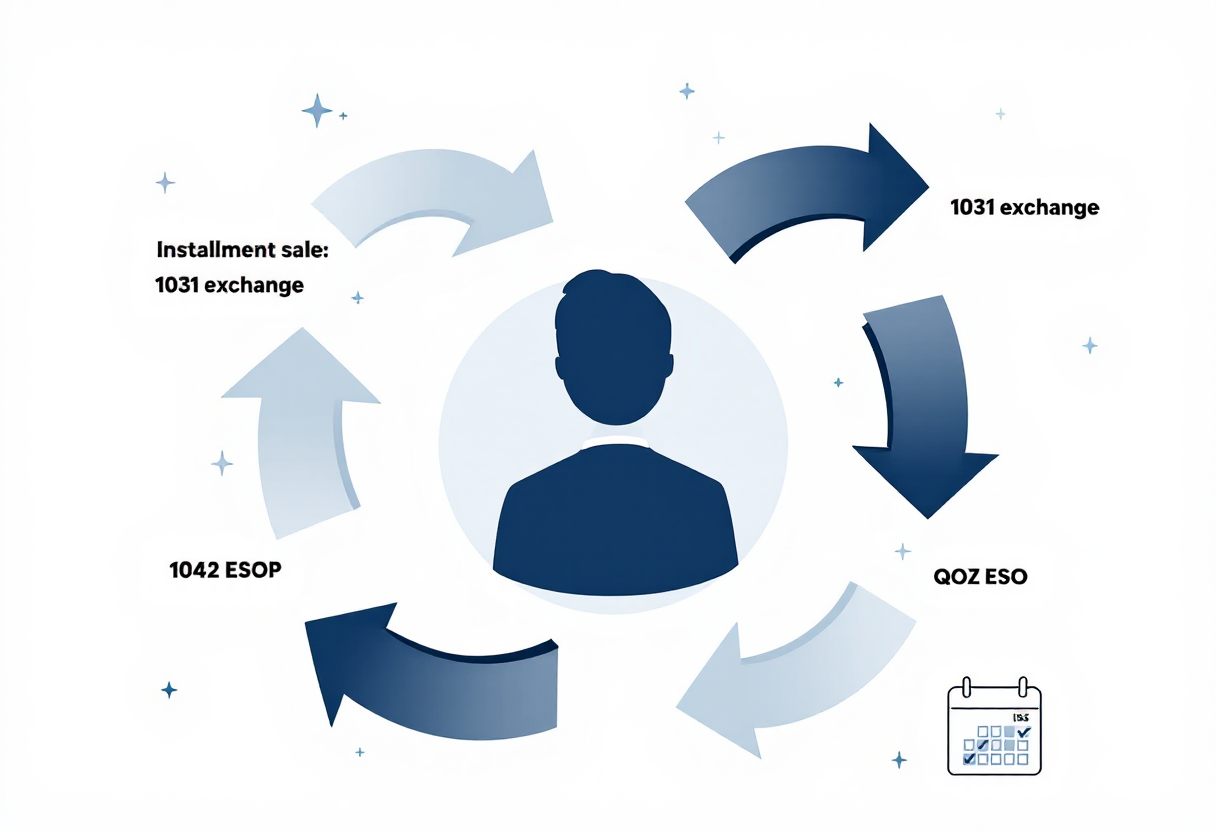
Yes, but only in narrow circumstances, and the rule depends entirely on which kind of recapture you owe. Can I defer depreciation recapture on selling a business is the question every owner with heavily depreciated equipment, vehicles, or real estate asks at the LOI stage, and the short answer is that Section 1245 ordinary-income recapture is almost never deferrable in a standard asset sale, while Section 1250 unrecaptured gain on real property can be deferred through a Section 1031 like-kind exchange, a Qualified Opportunity Fund reinvestment, or an ESOP Section 1042 rollover.
Context: Why This Question Matters
Most owners build a business over 10, 20, or 30 years and depreciate millions of dollars of equipment, vehicles, and building improvements along the way. Those deductions felt free at the time. At exit, the IRS asks for them back. On a $3 million HVAC sale with $1.2 million of historic depreciation taken against the truck fleet, condensers, and shop fit-out, the depreciation recapture bill can hit $400,000 in ordinary-income tax in year one even if the rest of the gain is capital.
The reason this question matters is that recapture sits in a different tax bucket from the rest of the deal. Capital gain rates top out at 23.8 percent federally (20 percent long-term plus 3.8 percent Net Investment Income Tax). Section 1245 recapture is taxed at ordinary rates up to 37 percent. The 13 to 17 percentage-point spread on a meaningful slice of the purchase price is real money, and the strategies to defer it are limited and statute-specific.
The Detailed Answer
Start with the two flavors of recapture. Section 1245 covers personal property: equipment, vehicles, machinery, furniture, and most fixtures. When you sell, the IRS reclaims every dollar of prior depreciation as ordinary income up to the amount of total gain on that asset (IRC Section 1245(a)(1), Treas. Reg. 1.1245-1). Section 1250 covers real property: buildings, structural components, and certain real-estate improvements. Post-1986 residential and nonresidential real estate has been depreciated straight-line, so true Section 1250 recapture is usually zero, but the depreciation taken still gets reclassified as “unrecaptured Section 1250 gain” and taxed at a maximum 25 percent federal rate under IRC Section 1(h)(1)(E).
Section 1245 recapture and the installment sale trap. Owners often assume an installment sale under IRC Section 453 defers all the tax across the payment period. It does not. Section 453(i), added by the Installment Sales Revision Act of 1980 and reaffirmed in Treas. Reg. 15A.453-1(c)(2)(i)(A), requires that the full amount of depreciation recapture be recognized in the year of sale, no matter how the cash arrives. The IRS calls this the “453(i) acceleration.” On a $3 million HVAC sale with $400,000 of Section 1245 recapture, the seller owes ordinary-income tax on the entire $400,000 in year one even if only 20 percent of the cash is collected at close. The capital gain portion stretches across the note term, the recapture does not. IRS Publication 544 walks through the mechanics in Chapter 4. On the tax side, see our breakdown of Is the Sale of a Business Reported to the IRS: Forms & for the structural choices that change after-tax proceeds.
Section 1031 like-kind exchange (real property only). Before the Tax Cuts and Jobs Act, Section 1031 applied to personal property as well, and equipment-heavy businesses could roll equipment gain into replacement equipment. TCJA amended IRC Section 1031(a)(1) to limit like-kind exchanges to “real property held for productive use in a trade or business or for investment.” For operating-business sales, that means only the land and building can be 1031-exchanged, and only the Section 1250 unrecaptured gain on that real-estate slice gets deferred. The shop, warehouse, or storefront can roll into a replacement property under a qualified intermediary structure with 45-day identification and 180-day closing windows. The equipment and goodwill cannot.
Section 1042 ESOP rollover. If the seller is a C-corporation owner who sells at least 30 percent of stock to a qualifying Employee Stock Ownership Plan and reinvests proceeds into Qualified Replacement Property (QRP, generally US operating-company stocks and bonds) within 12 months, the entire gain on the sale, including the portion attributable to recapture, can be deferred indefinitely under IRC Section 1042. Because the seller is exchanging C-corp stock rather than selling underlying assets, the asset-level recapture never gets triggered at the seller level. The C-corporation continues to own the assets, the ESOP owns the corporation, and the gain on the stock sale defers into the QRP basis. Hold the QRP until death and the gain disappears entirely through the Section 1014 basis step-up. S-corp owners can convert to C status, wait 5 years through the Section 1374 built-in gains period, then execute the 1042 rollover.
Qualified Opportunity Zone investment. IRC Section 1400Z-2 allows a seller to defer recognition of eligible capital gains, including the unrecaptured Section 1250 gain on real property, by reinvesting into a Qualified Opportunity Fund within 180 days of the sale. The original deferral cliff under TCJA was December 31, 2026. The 2024 Tax Relief for American Families and Workers Act extended the recognition date for new QOF investments to 2027 (verify current cliff with tax counsel before relying on this). Critically for this question, the QOZ statute only defers capital gain. Section 1245 ordinary-income recapture is NOT capital gain and is not eligible for QOZ deferral. The unrecaptured Section 1250 gain IS eligible, so QOZ works for the real-estate slice of an operating business sale but not for the equipment slice.
The straight answer on Section 1245 recapture deferral. Outside of an ESOP transaction structured as a stock sale, there is no clean way to defer Section 1245 ordinary-income recapture on a standard asset sale of an operating business. The installment method does not defer it (453(i) acceleration), the like-kind exchange does not cover personal property post-TCJA, and the Opportunity Zone statute excludes ordinary-income gain. The only standard-deal lever that helps is allocating less of the purchase price to Section 1245 assets in the asset-allocation schedule (Form 8594), which buyers typically resist because they want the fast depreciation on their side.
Worked Example: $3M HVAC Sale With $400K Section 1245 Recapture
A 22-year HVAC company sells for $3.0 million in an asset sale. The Form 8594 allocation lands at $1.6 million goodwill, $400,000 equipment (original basis $1.4 million, accumulated depreciation $1.2 million, current adjusted basis $200,000), $700,000 real estate (shop and yard, accumulated depreciation $180,000), and $300,000 working capital. The owner is a married-filing-jointly California resident, projected top federal bracket 37 percent, NIIT 3.8 percent, California 12.3 percent.
| Component | Gain | Tax Character | Federal Rate | Deferrable? |
|---|---|---|---|---|
| Equipment (Section 1245) | $200K total gain, all recapture | Ordinary income | 37% | No (453(i) acceleration; QOZ excludes; 1031 excludes post-TCJA) |
| Real estate (Section 1250) | $700K gain, $180K unrecaptured 1250 | $180K at 25% cap; $520K LTCG | 25% / 23.8% | Yes via 1031 or QOF |
| Goodwill | $1.6M | Long-term capital gain | 23.8% | Yes via QOF, CRT, installment |
| Working capital | $0 (sold at book) | None | N/A | N/A |
Year-one federal tax under a straight cash sale: roughly $74,000 on the $200,000 equipment recapture (37 percent), $45,000 on the $180,000 unrecaptured 1250 gain (25 percent), $124,000 on the $520,000 real-estate LTCG (23.8 percent), and $381,000 on the $1.6 million goodwill (23.8 percent). Total federal year-one cash tax: approximately $624,000. California adds roughly $307,000 on the same $2.5 million of gain. Combined: about $931,000.
Now stack deferrals on the deferrable slices. Roll the $700,000 real estate into a like-kind replacement property under Section 1031 (defers the full $700,000 of real-estate gain including the $180,000 unrecaptured 1250). Roll $1.0 million of the $1.6 million goodwill gain into a Qualified Opportunity Fund (defers that slice to 2027 and removes 10-year appreciation from tax under Section 1400Z-2(c)). The $200,000 Section 1245 equipment recapture still hits in year one at ordinary rates. Year-one federal tax drops from $624,000 to roughly $217,000. The $400,000 of Section 1245 recapture exposure that the owner wanted to defer is still partially trapped: only the $200,000 of recaptured gain that exceeds original basis remains, and the full $400,000 of accumulated depreciation that exceeded current adjusted basis was already recaptured up to the gain ceiling. The remaining recapture exposure that cannot be deferred is the $200,000 ordinary-income piece.
What Most Owners Get Wrong
Misconception 1: An installment sale defers depreciation recapture. It does not. IRC Section 453(i) explicitly accelerates recapture to the year of sale regardless of payment timing. Owners discover this when their year-one tax bill is far higher than expected on a 50 percent down payment deal. The capital-gain piece stretches across the note, the recapture does not.
Misconception 2: 1031 will cover the equipment. Not since TCJA. IRC Section 1031(a)(1) limits like-kind exchanges to real property as of January 1, 2018. Personal property exchanges are dead. The equipment slice of an operating-business sale has no like-kind escape.
Misconception 3: A Qualified Opportunity Fund defers all the gain. Only capital gain qualifies under IRC Section 1400Z-2(a)(1)(A). Section 1245 ordinary-income recapture is not capital gain. The QOF route works for goodwill, real-estate LTCG, and unrecaptured 1250 gain, but it leaves the equipment recapture taxable in year one.
Misconception 4: A C-corp stock sale avoids recapture entirely. True at the seller level, false at the deal level. If you sell C-corp stock, you recognize capital gain on the stock and the underlying recapture stays with the corporation. Buyers, however, almost always demand asset sales (or 338(h)(10) elections that recharacterize stock sales as asset sales for tax purposes) precisely to get stepped-up basis and future depreciation. The price premium a seller can extract for a stock-sale structure is real, but it has to outweigh the buyer’s lost tax benefit, which on equipment-heavy businesses is meaningful.
How CT Acquisitions Approaches This
CT Acquisitions is an M&A advisor working both sides of the table. No fee to you on buy-side introductions; sell-side mandates are paid on success at closing.
On every sell-side engagement above $3 million in enterprise value, we run a Form 8594 sensitivity model before the data room opens. The allocation between Section 1245 assets, Section 1250 real estate, and goodwill is the single biggest lever on year-one tax exposure outside of structure, and most sellers learn this only after the LOI is signed and the allocation is locked. No fee to you on buy-side introductions; sell-side mandates are paid on success at closing.
Related Questions
Can I avoid Section 1245 recapture by selling stock instead of assets?
At the seller level, yes. A pure stock sale of a C-corporation triggers capital gain on the stock, not asset-level recapture. The buyer, however, gives up the depreciation step-up that an asset sale provides, so most buyers either insist on an asset sale or use a Section 338(h)(10) election to recharacterize the stock sale as an asset sale for tax purposes. If 338(h)(10) is elected, recapture flows through to the seller. The negotiation is about how much price premium the seller can extract in exchange for taking the stock-sale structure.
Does the 25 percent unrecaptured Section 1250 rate apply to all real-estate gain?
No. The 25 percent cap under IRC Section 1(h)(1)(E) applies only to the portion of gain equal to prior depreciation taken on the real estate. Any gain above that (appreciation in the underlying real estate beyond original cost) is taxed at the standard long-term capital gain rate up to 23.8 percent. Verify the split with your tax preparer using the Unrecaptured Section 1250 Gain Worksheet in the Schedule D instructions.
What if I bonus-depreciated equipment under Section 168(k)?
Bonus depreciation under Section 168(k) creates the same recapture exposure as regular MACRS depreciation. Section 1245 reclaims the prior deductions as ordinary income on sale, whether they came from straight-line MACRS, accelerated MACRS, or bonus. The faster the depreciation was taken, the larger the recapture exposure on exit. Owners who maxed bonus depreciation in 2020 to 2022 are now seeing the tax bill on the other side of those deductions in 2026 exits.
Can a Charitable Remainder Trust defer Section 1245 recapture?
Partially. A CRT under IRC Section 664 is tax-exempt, so it can sell the contributed business equity (including Section 1245 assets inside a corporate wrapper) without paying tax on the gain. The catch is the tier system under IRC Section 664(b): payments out of the CRT to the owner-beneficiary carry the underlying character of the trust’s income, and ordinary-income items (including recapture-flavored income) come out first. The CRT defers the recapture inside the trust but does not convert it to capital gain on the way out.
Is there any way to defer Section 1245 recapture for a sole proprietor?
The honest answer is no, not in a standard asset sale. A sole proprietor cannot do a Section 1042 ESOP rollover (requires C-corp stock) and cannot escape Section 453(i) acceleration on an installment sale. The only practical lever is to allocate less of the purchase price to Section 1245 assets in the Form 8594 schedule, which buyers usually resist. Owners with significant Section 1245 exposure who want deferral should consider a multi-year pre-sale conversion to C-corp followed by a Section 1042 rollover, accepting the 5-year Section 1374 built-in gains wait.
What to Do Next
If the projected sale price is over $3 million and the business owns meaningful equipment, real estate, or both, the cost of running a Form 8594 sensitivity model and a structure comparison before the LOI is signed is the difference between knowing or guessing what the year-one tax bill will be. The deferral tools above only work when they are baked into the deal structure, not bolted on after the purchase agreement is locked.
For deeper background, see our guide on how to avoid capital gains tax when selling a business and the broader playbook on how to avoid taxes when selling a business. The full sell-side process lives on the sell your business hub.
This article is informational, not tax advice. Tax law referenced is current as of 2026 and subject to legislative change. Verify any structure described here with qualified tax counsel before relying on it for an actual transaction.
Want a Form 8594 model on your specific deal?
CT Acquisitions runs after-tax proceeds modeling on every sell-side engagement before the data room opens. No fee to you on buy-side introductions; sell-side mandates are paid on success at closing.
Book a Free Consultation