Sell Your Pest Control Business in Maryland (2026): Multiples, Buyers, & Process
Quick Answer
Maryland residential pest control operators with 70% or more recurring contract revenue typically sell for 6 to 9x EBITDA, while commercial-heavy operators range from 5 to 7x EBITDA and specialty services (termite, wildlife, mosquito) command 5 to 8x EBITDA. Active buyers in Maryland include Rollins (Orkin, HomeTeam, Northwest Exterminating), Rentokil/Terminix, Anticimex, Aptive Environmental, Arrow Exterminators, and regional consolidators, all acquiring off-market deals. Valuation within these ranges depends on customer retention, route density, federal-employee concentration in the Baltimore-Washington-Northern Virginia corridor, and termite warranty reserves.
Before going to market, start with our pest control business valuation guide to place your multiple.
Thinking about selling your pest control business in Maryland?
A 15-minute confidential call gives you a real valuation range and the Maryland buyers most likely to compete for your business. No cost, no obligation.
Christoph Totter · Managing Partner, CT Acquisitions
Buy-side M&A across 200+ active capital partners · Mid-Atlantic home services M&A: pest control, HVAC, plumbing · Updated June 6, 2026
Maryland pest control sits inside the densest residential services corridor on the East Coast. The Baltimore-Washington-Northern Virginia metroplex covers roughly 9.8M residents across Baltimore City, Baltimore County, Anne Arundel, Howard, Montgomery, Prince George’s, Frederick, and Harford counties, with the federal-employee household base producing structurally stable customer retention that Sun Belt operators can’t match. Rollins (NYSE: ROL) operates Orkin, HomeTeam Pest Defense, and Northwest Exterminating in the state. Rentokil/Terminix (NYSE: RTO) post the 2022 $6.7B Terminix merger remains aggressive in MD. Anticimex (EQT Partners) entered the U.S. via 2018 acquisitions and has been quietly active in the Mid-Atlantic. Aptive Environmental (Citation Capital, post-August 2024 majority recap) runs door-to-door in Baltimore and DC suburbs. Arrow Exterminators, Home Paramount Pest Control (FL/MD/VA regional), J.C. Ehrlich (Rentokil), and a dozen sub-regional consolidators all actively buying.
This guide walks through the actual valuation ranges for Maryland pest control specifically. Residential pest control with 70%+ recurring contract revenue: 6-9x EBITDA. Commercial-heavy operators (federal-facility, healthcare, hospitality, multi-family): 5-7x EBITDA. Specialty (termite, wildlife, mosquito): 5-8x EBITDA. We’ll cover the operational metrics buyers underwrite (recurring %, retention, route density, termite warranty reserves), the structural realities specific to Maryland (MDA Pesticide Regulation Section licensing under COMAR 15.05.01, Eastern subterranean termite warranty bonding, Baltimore City rodent enforcement, federal-employee customer base economics, MD’s 6.5% top state rate plus local piggyback up to 3.30%), and the buyer pool that’s actually active in MD pest control M&A in 2026.
The framework draws on direct work with 200+ active U.S. lower middle market buyers, including 12+ pest control consolidators currently buying in Maryland. We’re a buy-side partner. The buyers pay us when a deal closes, not you. If you want a 90-second valuation range before reading further, the free calculator below produces a starting-point estimate based on your EBITDA, recurring revenue %, and concentration. Real-world ranges on actual deals depend on the operating metrics covered in the sections that follow.
One reality check before you start. Maryland’s tax environment is materially worse than Florida or Texas: a 6.5% top state rate on income over $1M single (Maryland Budget Reconciliation and Financing Act of 2025) plus a local piggyback that ranges from 2.25% (Worcester County) to 3.30% (Dorchester, Kent), and a new 2% surtax on net capital gains for households over $350K AGI under the same 2025 law. On a $5M MD pest control exit, the after-tax delta vs FL (0% state) is $400K-$550K. That’s not a reason to relocate, the buyer pool depth in the Baltimore-DC corridor more than compensates, but it is a reason to engage MD-specific tax counsel 12-18 months pre-sale to optimize structure (asset allocation, residency timing, installment treatment, QSBS where applicable). Read the tax section carefully.

“Maryland pest control is structurally underrated by sellers. The Baltimore-DC corridor produces the most stable residential pest customer base in the country, federal employees, defense contractors, and biotech professionals don’t churn the way Sun Belt households do. Rollins, Rentokil, and Anticimex are paying 7-9x EBITDA for MD operators with documented recurring contracts and clean MDA compliance. The mistake MD owners make is comparing to national HVAC valuations, you’re worth materially more, but only if your retention and route density are documented. We’re a buy-side partner, the buyers pay us, no contract required.”
TL;DR, the 90-second brief
- Maryland pest control trades at 6-9x EBITDA on recurring residential contracts. A profitable MD pest control company with $1M EBITDA and 75%+ recurring revenue typically prices in the $6M-$9M range, materially above HVAC, plumbing, or electrical businesses with the same earnings, driven by recurring contract economics and dense Baltimore-DC corridor demand.
- Maryland sits inside the most active East Coast pest control M&A corridor. The Baltimore-Washington-Northern Virginia metroplex is one of the densest residential pest control markets in the country, Rollins (Orkin / HomeTeam Pest Defense / Northwest), Rentokil/Terminix (NYSE: RTO), Anticimex (EQT), Aptive Environmental, Arrow Exterminators, Massey Services, and a wave of regional consolidators (Home Paramount, J.C. Ehrlich, Senate Termite, American Pest, Brody Brothers) all actively buying.
- MDA Pesticide Regulation Section licensing under COMAR 15.05.01 is the closing-path bottleneck. Every MD pest control business needs a designated certified pest control applicator on staff, $150 annual business license, and proof of $100K/$300K bodily injury plus $15K/$30K property damage liability insurance. License period runs July 1-June 30, so timing the qualifying-applicator transfer around renewal cycles can shave 30-45 days off close.
- The four metrics MD buyers underwrite. Recurring contract revenue % (target 70%+), customer retention (target 85%+), route density (8-12 stops/tech/day in dense Baltimore/Bethesda/Columbia routes), and termite warranty reserve liability (Eastern subterranean termite pressure is high statewide). MD operators with strong unit economics across all four hit the top end of the 6-9x range.
- Want a starting-point number? Use our free valuation calculator below for a sub-90-second estimate. If you’d rather talk to someone, we’re a buy-side partner working with 200+ active U.S. lower middle market buyers, including 12+ pest control consolidators actively buying in Maryland, who pay us when a deal closes. You pay nothing. No retainer. No contract required.
Key Takeaways
- Maryland pest control trades at 6-9x EBITDA on residential recurring contracts, driven by Baltimore-DC corridor density and federal-employee retention stability.
- MDA Pesticide Regulation Section governs PCO licensing under COMAR 15.05.01; designated certified applicator transfer adds 30-60 days to closing.
- Eastern subterranean termite warranty reserves are a 5- to 7-figure buyer-side liability in Maryland; disclose early or face material price-down at LOI-to-close.
- Active 2026 MD buyer pool: Rollins (Orkin / HomeTeam / Northwest), Rentokil/Terminix (J.C. Ehrlich brand), Anticimex (EQT), Aptive (Citation Capital), Home Paramount, Arrow Exterminators, plus 20+ regional consolidators.
- Buyers underwrite recurring revenue %, customer retention, route density (8-12 stops/tech/day in dense MD suburban routes), and termite warranty reserve liability.
- Maryland’s 6.5% top state tax + local piggyback up to 3.30% + new 2% capital gains surtax over $350K AGI compress net-of-tax proceeds vs FL/TX/TN; structure matters.
Why Maryland pest control trades at premium home services multiples
CT Acquisitions · 2026 MD Pest Control Signal What MD Pest Control Buyers Pay Premium For Across our buy-side conversations with active pest control consolidators in 2026: Baltimore + DC metro density drives premium pricing. Multi-metro presence with strong route density unlocks platform-tier multiples. Recurring residential contracts above 70% drive top-tier pricing. 6x-9x EBITDA reserved for operators with strong recurring mix and sub-2% monthly churn. MD master license depth drives.
CT Acquisitions · 2026 MD Pest Control Signal
What MD Pest Control Buyers Pay Premium For
Across our buy-side conversations with active pest control consolidators in 2026:
- Baltimore + DC metro density drives premium pricing. Multi-metro presence with strong route density unlocks platform-tier multiples.
- Recurring residential contracts above 70% drive top-tier pricing. 6x-9x EBITDA reserved for operators with strong recurring mix and sub-2% monthly churn.
- MD master license depth drives multi-county expansion potential. Multi-master operators trade above single-master peers.
Multiple at a Glance · 2026
Maryland Pest Control Sale Multiples · 2026
By service mix.
Source: CT Acquisitions analysis of MD pest control M&A. Rollins (Orkin), Rentokil (Terminix), Anticimex active in Baltimore + DC + regional consolidators.
Maryland pest control benefits from the same structural advantages that drive premium pest control multiples nationally, with a Mid-Atlantic-specific overlay that makes the state quietly attractive to institutional buyers. Year-round demand (Eastern subterranean termite swarms April-June, ant colonies May-September, German cockroaches and mice year-round in Baltimore/DC urban cores, mosquitoes May-October, wildlife intrusion September-March) eliminates the seasonality that compresses HVAC and roofing multiples. Recurring contract structure (quarterly residential plans, monthly commercial accounts, annual termite renewals) produces 65-85% recurring revenue mix. And the Baltimore-DC corridor’s federal-employee and biotech-corridor customer base produces structurally stickier retention than tourism- or oil-driven economies.
The federal-employee customer base is Maryland’s secret retention weapon. Roughly 350K federal employees live in Maryland, plus another 200K+ federal contractors and defense workers in the I-95 / I-270 corridor. Federal household income is stable (no oil-price shocks, no tourism seasonality, no startup boom-bust), homeownership tenure is long (average 10-14 years in Bethesda, Columbia, Severna Park, Crofton, Towson), and these households are the prototypical recurring pest contract customer, they sign quarterly plans and renew them for a decade. PE buyers underwrite this stability premium, an MD residential operator with 60% federal-employee customer concentration retains at 90-92% annually, vs 80-85% for comparable Sun Belt operators. That 7-10 point retention delta is worth 0.5-1x EBITDA in multiple.
PE consolidation has been quietly aggressive in the Mid-Atlantic. Rollins (NYSE: ROL, market cap roughly $24B) has acquired 94 pest control operators over the last three years including 26 in 2025 alone, with Mid-Atlantic among its priority geographies via Orkin, HomeTeam, Northwest, and Western Pest Services brands. Rentokil’s 2022 acquisition of Terminix created a $4B+ revenue North American pest platform; Rentokil management has guided to roughly $200M of M&A spend in 2026 (up from $115M in 2025), with the Mid-Atlantic explicitly called out as a focus region. Anticimex (EQT Partners portfolio, $1.4B+ revenue globally) entered the U.S. via 2018 acquisitions and has been adding MD/VA tuck-ins. Home Paramount Pest Control (FL-headquartered but heavy MD/VA/DE footprint) is itself an active acquirer of sub-$1M EBITDA operators. The buyer pool depth means even sub-$500K EBITDA MD operators have multiple bidders if positioned correctly.
Maryland’s tax environment is the structural drag, not a deal-killer, but a real factor. Maryland has a 6.5% top state income tax on income over $1M single or $1.2M joint (Maryland Budget Reconciliation and Financing Act of 2025), plus a local piggyback that runs 2.25% (Worcester County) to 3.30% (Dorchester, Kent), for a combined top state-and-local rate of 8.75% to 9.8%. The 2025 Maryland Budget Reconciliation and Financing Act added a 2% surtax on net capital gains for households over $350K AGI, on a $5M MD pest control exit, that’s another $100K. Total state-and-local tax burden on a $5M exit can run 10-11% of the gain, vs 0% in FL/TX/TN. That delta is real and is the biggest structural reason MD operators benefit disproportionately from clean asset allocation negotiation, installment-sale treatment where appropriate, and pre-sale tax counsel engagement. The 6-9x multiple range still produces strong absolute exits, you just need to optimize the after-tax outcome more deliberately than a FL or TX operator does.
Maryland pest control valuation by operator type: residential, commercial, specialty
Maryland pest control valuation breaks into three distinct operator types, each with its own buyer pool and multiple range. Knowing which type you actually fit determines the buyers you should be marketing to and the realistic price you should anchor on. Owners who blend the categories in their head end up frustrated, a transactional Baltimore termite shop priced like a recurring residential operator, then surprised by 4-5x EBITDA LOIs. Type.
Maryland pest control valuation breaks into three distinct operator types, each with its own buyer pool and multiple range. Knowing which type you actually fit determines the buyers you should be marketing to and the realistic price you should anchor on. Owners who blend the categories in their head end up frustrated, a transactional Baltimore termite shop priced like a recurring residential operator, then surprised by 4-5x EBITDA LOIs.
Type 1: Residential recurring pest control (the premium tier). Quarterly residential service plans across Baltimore County, Howard County, Montgomery County, Anne Arundel County, Prince George’s County, Frederick County, Harford County. Typical EBITDA: $250K-$4M. Typical multiple: 6-9x EBITDA. Buyer pool: Rollins (Orkin / HomeTeam / Northwest), Rentokil/Terminix (J.C. Ehrlich brand), Anticimex, Home Paramount, Aptive, regional consolidators. Multiples push toward 9x when recurring revenue exceeds 80%, customer retention exceeds 88% (federal-employee customer concentration helps materially here), and route density runs 10+ stops/tech/day in dense MD suburban geography. Multiples compress to 6x when recurring is 55-65%, retention is 75-82%, or there’s customer concentration above 5%.
Type 2: Commercial pest control (the mid tier). Federal facilities (subject to federal procurement rules), healthcare (Johns Hopkins, University of Maryland Medical System, MedStar, Adventist HealthCare network facilities), hospitality (Baltimore Inner Harbor, Annapolis, Ocean City), multi-family (large MD-region apartment portfolios), food processing (Eastern Shore poultry, baking, brewing). Typical EBITDA: $300K-$2.5M. Typical multiple: 5-7x EBITDA. Buyer pool: Rentokil/Terminix (commercial-heavy nationally), Rollins, regional commercial-focused operators. Commercial accounts are stickier (8-15 year tenure typical, federal facility contracts can run 10-20 years on GSA schedule) but lower-margin (gross margin 32-42% vs residential 55-65%). Multiples improve when there’s a credible federal-facility, healthcare network, or multi-family portfolio concentration that a strategic buyer can leverage; compress when 1-2 customers exceed 15% of revenue.
Type 3: Specialty (termite, wildlife, mosquito). Termite-only operators (subterranean treatment, baiting systems, Maryland is dominated by Eastern subterranean termites with localized Formosan pressure in Baltimore Harbor / Annapolis / Ocean City coastal areas), wildlife operators (Mid-Atlantic raccoon, squirrel, bat, snake exclusion is a real specialty), mosquito subscription operators (Mid-Atlantic mosquito misting and barrier programs have grown 15-20% annually since 2020). Typical EBITDA: $200K-$1.5M. Typical multiple: 5-8x EBITDA. Buyer pool: Rollins (especially for wildlife via Trutech, mosquito via Crane Pest Control), specialty-focused regional consolidators. Multiples push to 8x when specialty + recurring (mosquito misting subscriptions, termite renewal book); compress to 5x when transactional one-time service is the bulk of revenue.
| Operator type | Typical EBITDA | Multiple range | Dominant buyer type |
|---|---|---|---|
| Residential recurring | $250K-$4M | 6-9x EBITDA | Rollins, Rentokil, Anticimex, Home Paramount, Aptive |
| Commercial / federal / healthcare | $300K-$2.5M | 5-7x EBITDA | Rentokil, Rollins, regional commercial |
| Specialty (termite/wildlife/mosquito) | $200K-$1.5M | 5-8x EBITDA | Rollins (Trutech/Crane), specialty consolidators |
Calculating EBITDA for a Maryland pest control company: add-backs buyers actually accept
Pest control EBITDA calculation follows the standard small-business framework but with industry-specific add-backs and adjustments buyers know to scrutinize. Start with net income from the tax return. Add back interest, taxes, depreciation, amortization. Add back owner’s W-2 salary (replaced with market-rate GM cost). Add back owner’s health and benefits, owner’s auto and phone allowances. Then add back the pest-control-specific items: owner-funded vehicle replacements that aren’t recurring, one-time pesticide applicator certification.
Pest control EBITDA calculation follows the standard small-business framework but with industry-specific add-backs and adjustments buyers know to scrutinize. Start with net income from the tax return. Add back interest, taxes, depreciation, amortization. Add back owner’s W-2 salary (replaced with market-rate GM cost). Add back owner’s health and benefits, owner’s auto and phone allowances. Then add back the pest-control-specific items: owner-funded vehicle replacements that aren’t recurring, one-time pesticide applicator certification or training costs, non-recurring software conversion costs (CRM migration to PestPac, FieldRoutes, ServSuite, GorillaDesk, Pocomos), one-time legal costs related to a non-compete or trademark dispute.
What buyers will challenge in an MD pest control deal. Owner’s salary add-back when the owner is also the designated certified pest control applicator on the MDA business license, the buyer must replace both roles, not just the GM role. Excessive vehicle and fuel add-backs (claiming personal use of branded route trucks is rare in MD because of dense suburban routing). Termite warranty reserve adjustments, sellers sometimes try to add back warranty costs as ‘one-time’ when they’re recurring obligations. Customer acquisition costs being treated as ‘one-time marketing’ when they’re actually the cost of replacing churn (Aptive door-to-door pressure in MD suburbs makes CAC structurally meaningful). Excessive owner family on payroll without documented operational roles.
The quality-of-revenue adjustment buyers will make. Sophisticated PE buyers don’t just underwrite EBITDA, they underwrite quality-of-revenue. They’ll segment your trailing-12-month revenue into recurring contract revenue (highest quality, full multiple), transactional residential revenue (medium quality, discounted multiple), and one-time termite/wildlife/exclusion jobs (lowest quality, materially discounted). An MD operator with $1M EBITDA but only 50% recurring will get a blended multiple closer to 5x, not 8-9x. The adjustment isn’t optional, it shows up in every PE QoE report.
CRM and route data documentation as the cleanest diligence support. Modern pest control CRMs (PestPac by WorkWave, FieldRoutes, ServSuite by ServiceMonster, GorillaDesk, Pocomos) produce exportable customer lifetime value, retention cohorts, route density, ARR per customer, and churn analytics. Pulling 24-36 months of CRM data and reconciling it to bank deposits and tax returns is the cleanest possible diligence support. PE buyers love seeing this; it materially shortens diligence and protects multiple negotiation. Operators still on paper or QuickBooks-only typically face a multiple haircut of 0.5-1x EBITDA because the buyer can’t verify retention and route economics.
Common add-back mistakes that re-price MD pest control deals. Adding back termite warranty reserves as ‘non-recurring’ (they’re a real ongoing liability the buyer inherits, especially in MD where Eastern subterranean termite pressure is statewide and Formosan pockets exist in Baltimore Harbor/Annapolis/Ocean City). Adding back marketing costs that drove the comparable-period new customer acquisition. Adding back pesticide applicator certification renewal costs (these are recurring, not one-time). Adding back CRM software costs (recurring operational tooling). Adding back the $30 per-employee MDA registration fee or the $150 annual MDA business license fee (recurring regulatory cost). These mistakes typically re-price deals 0.5-1.5x EBITDA downward during diligence.
The four operational metrics Maryland pest control buyers underwrite
Maryland pest control buyers and their lenders underwrite a specific set of operational metrics. Outside the standard EBITDA, the four numbers that determine whether a deal closes, and at what multiple, are recurring contract revenue %, customer retention %, route density (stops/tech/day), and termite warranty reserve liability. MD operators outside the target bands either close at the low end of multiple ranges or don’t close at all. Metric 1: Recurring.
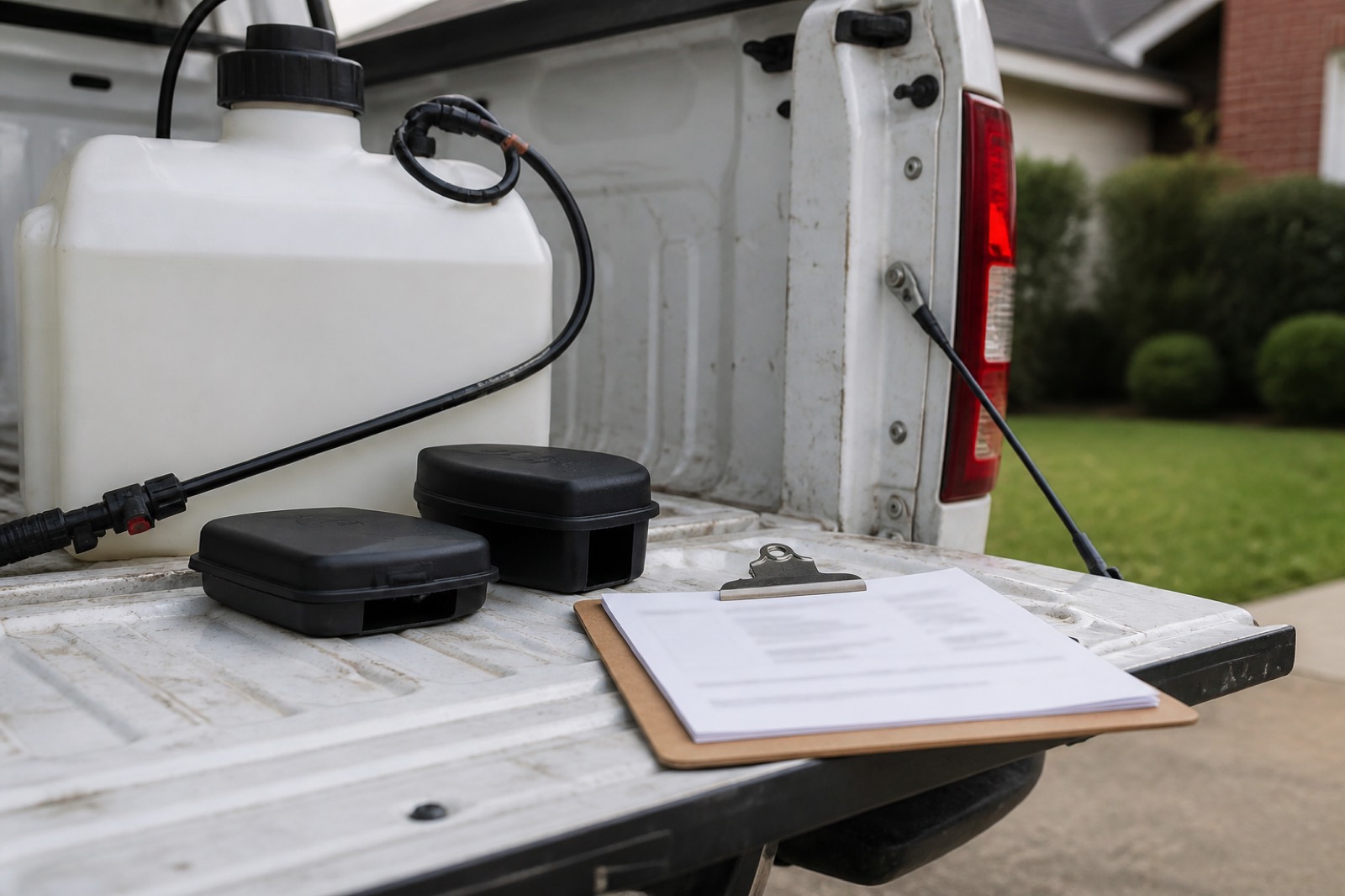
Maryland pest control buyers and their lenders underwrite a specific set of operational metrics. Outside the standard EBITDA, the four numbers that determine whether a deal closes, and at what multiple, are recurring contract revenue %, customer retention %, route density (stops/tech/day), and termite warranty reserve liability. MD operators outside the target bands either close at the low end of multiple ranges or don’t close at all.
Metric 1: Recurring contract revenue percentage. Target: 70%+ for premium multiples. Calculated as annualized recurring contract revenue divided by total revenue. 80%+ is exceptional and unlocks the 8-9x EBITDA range. 70-80% is strong and unlocks 7-8x. 60-70% is acceptable but compresses to 6-7x. Below 60%, you’re a transactional services business not a recurring services business, and multiples are 4-6x. The mix matters: residential quarterly contracts are highest-quality recurring; commercial monthly contracts (especially federal-facility GSA contracts and healthcare-system master agreements) are highest-quality recurring with very long tenure; annual termite renewals are recurring but with retention risk; one-time termite or wildlife exclusion jobs are not recurring.
Metric 2: Customer retention rate. Target: 85%+ annual retention; 90%+ unlocks the top of the range. Calculated as customers retained at month 13 divided by customers active at month 1. Maryland has a structural retention advantage: federal-employee household tenure averages 10-14 years in Bethesda, Columbia, Severna Park, Crofton, Towson, and the I-270 biotech corridor. Documented MD retention in the 90-92% range supports premium 8-9x multiples. 85-90% is strong. 80-85% is acceptable. Below 80% is a structural problem the buyer must fix or refuse the deal. Aptive door-to-door competition in MD suburbs puts retention pressure on smaller operators, a documented retention story (NPS scores, retention cohorts, churn reasons) is worth 0.5-1x EBITDA in negotiation.
Metric 3: Route density. Target: 8-12 residential stops/tech/day, 4-8 commercial stops/tech/day. Route density is the gross margin lever. A residential tech doing 12 stops/day at $85 average revenue per stop produces $1,020/day of revenue. The same tech doing 6 stops/day produces $510/day, same labor cost, half the revenue. Maryland’s dense suburban geography (Bethesda, Columbia, Towson, Annapolis, Ellicott City, Glen Burnie, Catonsville, Pikesville) supports 10-12 stops/tech/day for well-routed operators. PE buyers underwrite route density as the leading indicator of operational maturity. MD operators in the 10+ stops/day range run 55-62% gross margins; operators at 6-7 stops/day run 35-42% gross margins. The same EBITDA dollar from a high-density route is worth more to a buyer than from a low-density rural Eastern Shore or Western MD route.
Metric 4: Termite warranty reserve liability. Target: fully reserved on the balance sheet. Maryland’s Eastern subterranean termite pressure (April-June swarm season is heavy statewide) plus localized Formosan pressure in Baltimore Harbor, Annapolis, and the Eastern Shore, means termite warranty obligations are a real ongoing cost. A typical MD residential termite warranty (post-treatment retreat-only or retreat-plus-repair) runs 1-5 years with annual renewal options. The reserve obligation is the expected future cost of honoring those warranties. Operators who don’t reserve properly look highly profitable on the P&L, until the buyer’s QoE catches the off-balance-sheet liability and re-prices the deal. An MD operator with a $2M-$3M termite warranty book might face a 5- to 7-figure reserve adjustment that comes directly out of purchase price. Reserve transparently from the start.
How buyers actually verify these metrics in Maryland deals. CRM exports for retention cohorts and route density. PestPac / FieldRoutes / ServSuite data for stops-per-day. Bank deposits cross-checked to CRM ARR. Termite warranty database with start dates, expiration dates, and reserve balances. MDA Pesticide Regulation Section records for any open complaints, violations, or restitution orders. Baltimore City Health Department rodent control compliance records (where applicable for commercial accounts). The cleaner the documentation, the higher the multiple, because the buyer’s downside scenario is bounded. Messy data forces the buyer to assume worst-case, and price accordingly.
Maryland MDA Pesticide Regulation Section licensing: the closing-path bottleneck
Maryland pest control licensing under COMAR Title 15, Subtitle 05, Chapter 01 (Use and Sale of Pesticides, Certification of Pesticide Applicators and Pest Control Consultants, and Licensing of Pesticide Businesses) is the most material regulatory factor in any MD pest control sale.
Maryland pest control licensing under COMAR Title 15, Subtitle 05, Chapter 01 (Use and Sale of Pesticides, Certification of Pesticide Applicators and Pest Control Consultants, and Licensing of Pesticide Businesses) is the most material regulatory factor in any MD pest control sale. The Maryland Department of Agriculture (MDA), Pesticide Regulation Section, regulates pest control businesses, certified pest control applicator credentials, and the categories under which a business can operate (general pest, termite/wood-destroying insects, fumigation, lawn and ornamental, public health, structural). Every pest control business operating in Maryland must hold an MDA Pesticide Business License ($150 annual fee) and must designate at least one Certified Pest Control Applicator on staff who is the company’s licensed credential holder.
What changes at sale. When the company sells, the designated certified applicator question becomes critical. Three scenarios: (1) the seller is the certified applicator and stays post-close as a transition operator (typical 6-24 month employment agreement, often the cleanest path); (2) the seller is the certified applicator and exits, requiring the buyer to install their own certified applicator before the next license renewal cycle or face MDA enforcement; (3) a non-owner certified applicator stays through the transition. Buyers strongly prefer scenario 1 because it removes regulatory risk; sellers sometimes prefer scenario 2 because it allows a clean exit. The structure choice affects multiple by 0.25-0.5x EBITDA.
MDA license requirements and timeline. MDA Pesticide Business License requirements: $150 annual fee, designated certified applicator in each category the business operates in, $100,000 bodily injury per person plus $300,000 per occurrence general liability insurance, $15,000 property damage per occurrence and $30,000 annual aggregate. Certified Pest Control Applicator: minimum 18 years old, at least one year of practical pesticide application experience as a registered employee in the category(ies), $75 initial-category annual fee plus $25 for each additional main category. Each employee involved in pest control sales, service, or inspections must complete MDA-approved training within 30 days of employment plus a $30 initial registration fee. License period: July 1 through June 30. A sale closing in May-June often benefits from timing the certified-applicator transfer to the renewal cycle, saves 30-45 days vs mid-cycle changes.
The pre-sale MDA audit. Every MD pest control operator should pull their own MDA Pesticide Regulation Section compliance record 12-18 months before going to market. Review for any open complaints, settled violations, restitution orders, or category-license gaps. Resolve open issues before the buyer’s diligence team finds them. The buyer’s QoE will pull the same record, so anything unresolved becomes a re-pricing event, typically 0.25-0.75x EBITDA depending on severity. MDA records are accessible by request; build the audit into your data room early.
Local jurisdiction overlays in Maryland. Several Maryland jurisdictions maintain additional pest control operator registration or business license requirements on top of state MDA licensing, Baltimore City (with a particularly active Health Department rodent control program tied to commercial multi-family enforcement), Montgomery County (commercial pest control vendor registration tied to county facility contracts), Prince George’s County, Anne Arundel County. Several federal facilities (NIH, NIST, FDA, NSA Fort Meade, Walter Reed, Patuxent, Aberdeen Proving Ground, Andrews) require contractor security clearance and federal procurement registration (SAM.gov, GSA Schedule). These local and federal registrations transfer separately and on different timelines, some require in-person renewal, others require federal background re-verification. A multi-jurisdiction MD operator can have 5-15 separate registrations to transfer. Build the local-license inventory into your data room early; missing a federal-facility contract registration is the kind of detail that delays close by 60-90 days.
Termite warranty reserves: Maryland’s 5- to 7-figure deal-killer if undisclosed
Termite warranty reserves are the single most underestimated liability in Maryland pest control deals. A Maryland pest control company with a 4,000-customer Eastern subterranean termite warranty book carries a real ongoing obligation.
Termite warranty reserves are the single most underestimated liability in Maryland pest control deals. A Maryland pest control company with a 4,000-customer Eastern subterranean termite warranty book carries a real ongoing obligation. If the average warranty represents $150-400 of expected future retreat cost (varies by warranty type, treatment age, and structure), the reserve obligation is $600K-$1.6M, potentially a 6- to 7-figure carve-out from purchase price if it’s not on the balance sheet at close. Operators with Formosan exposure in Baltimore Harbor, Annapolis, or Eastern Shore coastal communities face higher per-warranty reserve numbers because Formosan retreat costs are materially higher.
Two warranty types, two liability profiles. Retreat-only warranties: if termites return after initial treatment, the company retreats at no cost. Liability is the expected future retreat labor and chemical cost. Retreat-plus-repair warranties: company retreats and repairs structural damage caused by termites covered under the warranty. Liability is materially higher and may include subterranean structural repair (sill plates, sub-floor, drywall, support beams) running $5K-$30K per claim. Some MD operators issue both types; pricing and reserve obligations are very different. Document the mix and the historical claim frequency for the buyer’s QoE.
Maryland’s financial responsibility requirements. MDA’s COMAR 15.05.01 requires pest control operators to maintain financial responsibility ($100K/$300K bodily injury, $15K/$30K property damage). For termite warranty obligations specifically, some operators self-insure with reserves on the balance sheet; others bond through surety companies. The buyer will inherit the bonding obligation or the reserve liability. Operators who have been self-insuring without proper reserve accounting effectively have an off-balance-sheet liability that the buyer’s QoE will surface and assign a dollar value to. Disclose the warranty book size, warranty type mix, historical claim rate, and reserve methodology upfront, surprises at LOI-to-close cost more than disclosure at LOI.
How sophisticated MD buyers underwrite the warranty reserve. Pull the warranty database (customer, treatment date, warranty expiration, warranty type, geography). Pull the historical claims database (claim date, claim cost, claim type). Calculate claim frequency per active warranty, segmented by Eastern subterranean vs Formosan geography. Project forward the expected future claim cost over the warranty’s remaining life. Discount to present value. The result is the reserve liability the buyer carves out of purchase price. For a $750K EBITDA MD pest control operator with a strong termite book, this reserve carve-out can be $300K-$1.2M, meaningful relative to the $5M-$7M purchase price.
How to position the warranty book to your advantage. If the warranty book has a strong claim history (low claim frequency, low average claim cost), document it, this lets you negotiate a smaller reserve carve-out. If the warranty book includes annual renewal premiums after the initial term, document the renewal economics, these are recurring revenue and add to the multiple. For Formosan-exposed warranties (Baltimore Harbor, Annapolis, Eastern Shore), price them separately and reserve them at a higher rate to avoid a single blended re-price. The cleaner and better-documented the warranty book, the smaller the reserve carve-out at close.
Active 2026 Maryland pest control buyer pool: who’s actually buying
Maryland sits inside one of the most actively consolidated pest control corridors in the United States. The Baltimore-Washington-Northern Virginia metroplex buyer pool depth is structurally different from rural states, even sub-$500K EBITDA Maryland operators receive multiple LOIs from credible institutional buyers if positioned correctly. Below is the actual 2026 active buyer roster, with notes on what each buyer is looking for and what they pay. Tier 1: National public consolidators.
Maryland sits inside one of the most actively consolidated pest control corridors in the United States. The Baltimore-Washington-Northern Virginia metroplex buyer pool depth is structurally different from rural states, even sub-$500K EBITDA Maryland operators receive multiple LOIs from credible institutional buyers if positioned correctly. Below is the actual 2026 active buyer roster, with notes on what each buyer is looking for and what they pay.
Tier 1: National public consolidators. Rollins (NYSE: ROL) operating Orkin, HomeTeam Pest Defense, Northwest Exterminating, Western Pest Services, Trutech (wildlife), Crane Pest Control (mosquito), and Critter Control. Rollins acquired 26 pest control operators in 2025 alone (94 over the last three years), with the Mid-Atlantic among priority geographies. Pays 7-9x EBITDA for residential recurring operators, 5-7x for commercial. Rentokil/Terminix (NYSE: RTO) post the 2022 $6.7B Terminix merger, second-largest national consolidator, strong commercial and termite focus, J.C. Ehrlich brand active in MD/VA/DE. Rentokil guided to roughly $200M of M&A spend in 2026, up from $115M in 2025. Pays similar multiples to Rollins.
Tier 2: PE-backed national platforms. Anticimex (EQT Partners), Swedish parent, $1.4B+ global revenue, entered U.S. market in 2018 via acquisitions of Modern Pest, Viking, and others. Active in MD/VA/PA tuck-ins. Pays 6-8x EBITDA for residential recurring. Aptive Environmental (Citation Capital, post-August 2024 majority recap), door-to-door residential model, headquartered in Provo UT but Baltimore and DC suburbs are major markets, generated $532.8M in revenue in 2024. Pays 5-8x EBITDA depending on contract structure. Both buyers have institutional process discipline (full QoE, formal closing checklists, escrow holdbacks 10-15%) and can move from LOI to close in 90-150 days.
Tier 3: Regional Mid-Atlantic-active platforms. Home Paramount Pest Control, FL-headquartered but heavy MD/VA/DE/PA footprint, privately held, multi-state regional operator that periodically acquires smaller operators. American Pest, Fulton MD-headquartered, regional Mid-Atlantic operator. Brody Brothers, Owings Mills MD-headquartered, regional Baltimore-area operator. Senate Termite & Pest Control, Maryland regional operator. Arrow Exterminators, GA-headquartered but MD-active, privately held, 100+ locations across the Southeast and Mid-Atlantic. PMP Holdings, PE-backed pest platform actively buying in the Mid-Atlantic. These regional platforms typically pay 6-8x EBITDA, slightly below the public consolidators but with faster decision cycles and less institutional friction. Often the right buyer for $500K-$2M EBITDA MD operators.
Tier 4: Sub-regional and search-fund / individual buyers. 20+ regional MD pest control consolidators in the $200K-$1M EBITDA range. Many search funds and individual SBA-financed buyers actively pursuing MD pest control because of the recurring revenue profile (much easier to get an SBA 7(a) loan approved against pest control recurring revenue than against transactional businesses) and the federal-employee customer base (perceived as recession-resistant). Multiples 5-7x EBITDA, sometimes 7-8x for the rare premium-positioned smaller operator. These buyers often pay through SBA financing with 10-20% seller note, less cash at close than institutional buyers but a path for sub-$500K EBITDA operators where the institutional pool is thinner.
Maryland-specific pest pressure and what drives demand by region
Maryland’s pest pressure varies materially by region, and buyers underwrite regional concentration carefully. An operator concentrated in one Maryland region versus diversified across multiple regions has different risk profiles, customer demographics, and average revenue per customer. The state breaks naturally into five distinct pest geographies: Baltimore Metro, DC Suburbs (Montgomery + Prince George’s), Annapolis / Anne Arundel, Eastern Shore, and Western Maryland. Baltimore Metro (Baltimore City, Baltimore County, Harford, Howard).
Maryland’s pest pressure varies materially by region, and buyers underwrite regional concentration carefully. An operator concentrated in one Maryland region versus diversified across multiple regions has different risk profiles, customer demographics, and average revenue per customer. The state breaks naturally into five distinct pest geographies: Baltimore Metro, DC Suburbs (Montgomery + Prince George’s), Annapolis / Anne Arundel, Eastern Shore, and Western Maryland.
Baltimore Metro (Baltimore City, Baltimore County, Harford, Howard). Eastern subterranean termites dominant (heavy April-June swarm season), German cockroaches and Norway rats year-round in dense urban Baltimore City rowhouse stock, ants (carpenter and pavement ants) May-September, mice October-March, mosquitoes May-October. Baltimore City’s active Health Department rodent enforcement creates structural commercial demand from multi-family operators and restaurants. Higher density supports premium route economics in Towson, Catonsville, Pikesville, Glen Burnie, Columbia. Baltimore Inner Harbor has localized Formosan termite pressure.
DC Suburbs (Montgomery County, Prince George’s County, Frederick). Eastern subterranean termites (April-June swarm), ants (carpenter, pavement, odorous house ants), mice (heavy in suburban garages September-March), stinking bugs (Brown Marmorated Stink Bug invasion is Mid-Atlantic-specific), mosquitoes May-October, wildlife (raccoons, squirrels, bats in attic spaces). The federal-employee and biotech-corridor customer base in Bethesda, Rockville, Chevy Chase, Silver Spring, Gaithersburg, Germantown, Kensington, Potomac, and Frederick produces the highest average revenue per residential customer in the state, and the highest retention rates.
Annapolis / Anne Arundel County. Eastern subterranean termites with localized Formosan pressure near the Bay, ants, mice, mosquitoes (heavy May-October due to Bay proximity), wildlife (snakes, raccoons), waterfront-specific pests (carpenter bees, wood-destroying beetles in older waterfront stock). Mix of high-net-worth waterfront residential, military (Naval Academy, Fort Meade adjacent), and federal-civilian. Average ticket runs higher than Baltimore Metro on residential.
Eastern Shore (Talbot, Queen Anne’s, Kent, Caroline, Dorchester, Wicomico, Worcester, Somerset, Cecil). Mosquitoes (extreme pressure due to tidal marshes, May-October), Eastern subterranean termites with Formosan pressure in Ocean City beach communities, fleas/ticks tied to wildlife and agricultural land, agricultural pest pressure (poultry-house specific in Wicomico/Worcester/Somerset), wildlife (deer mice, snakes, foxes). Lower density, lower revenue per customer, but lower competition. Often an opportunity for regional operators to roll up smaller Eastern Shore operators at 5-7x EBITDA before a national consolidator notices.
Western Maryland (Garrett, Allegany, Washington, Carroll, Frederick western). Eastern subterranean termites (lower density), ants, mice (heavy October-March), wildlife intrusion (raccoons, squirrels, bats, the occasional black bear), wood-destroying beetles in older mountain housing stock, fewer mosquitoes than Eastern Shore but more wildlife specialty work. Lower density translates to lower route efficiency, but lower competition and longer customer tenure. Hagerstown, Cumberland, Frederick (western), Westminster are the population centers.
Sale process and timeline: what to expect at each Maryland pest control deal size
Maryland pest control sale processes vary by EBITDA tier and buyer type. Sub-$500K EBITDA deals typically run 4-7 months from prep-complete to close. $500K-$2M EBITDA deals run 5-9 months. $2M+ EBITDA institutional deals run 7-12 months. The timeline difference reflects buyer pool depth, financing complexity, MDA license transfer process, federal-facility contract assignment requirements, and the QoE requirements at each tier. Sub-$500K EBITDA: 4-7 month process, individual / search fund buyer.
Maryland pest control sale processes vary by EBITDA tier and buyer type. Sub-$500K EBITDA deals typically run 4-7 months from prep-complete to close. $500K-$2M EBITDA deals run 5-9 months. $2M+ EBITDA institutional deals run 7-12 months. The timeline difference reflects buyer pool depth, financing complexity, MDA license transfer process, federal-facility contract assignment requirements, and the QoE requirements at each tier.
Sub-$500K EBITDA: 4-7 month process, individual / search fund buyer. Months 1-2: positioning, CIM, buyer outreach (typically 15-40 prospect inquiries narrowing to 4-8 serious conversations). Months 2-4: management calls, IOIs, LOI signing. Months 4-6: SBA loan processing, MDA license transfer prep, financial diligence, purchase agreement drafting. Months 6-7: close, with 60-180 day post-close transition (seller often stays as designated certified applicator through transition). Common fall-through: SBA denial (10-20% of cases), MDA license transfer delay (especially with seller compliance issues), buyer’s CRM data review surfacing retention surprises.
$500K-$2M EBITDA: 5-9 month process, regional consolidator or PE platform. More buyer due diligence (full operational and financial QoE). More complex closing mechanics (multi-jurisdiction MDA local registrations, federal-facility contract novation if applicable, termite warranty reserve negotiation, working capital target setting). Buyer pool typically 10-25 prospects narrowing to 4-7 management meetings and 2-3 LOIs. At this tier, you’re attractive to regional consolidators (Home Paramount, American Pest, Brody Brothers, Arrow, PMP Holdings) and the smaller acquisitions teams at Rollins / Rentokil / Anticimex / Aptive.
$2M+ EBITDA: 7-12 month institutional process. Institutional process. Months 1-3: investment-bank or buy-side intermediary engagement, CIM and management presentation development, buyer pool identification. Months 3-5: management presentations to 8-15 platform buyers (Rollins, Rentokil, Anticimex, Aptive, plus regional PE-backed pest platforms), IOIs, narrowing to 2-4 LOIs. Months 5-9: LOI signing, formal QoE engagement, full operational diligence including termite warranty reserve analysis, CRM data audit, MDA compliance review, federal-facility contract review, purchase agreement negotiation. Months 9-12: MDA license transfer, federal contract novations, close, 6-24 month transition. This tier requires institutional sell-side or buy-side support; generalist business brokers can’t reach this buyer pool.
Pre-sale prep: the 18-24 month playbook for Maryland pest control specifically
Maryland pest control benefits from 18-24 month pre-sale prep because the four metrics buyers underwrite take 12+ months to materially shift, and because MD’s tax environment makes structuring optimization material to after-tax outcome. Owners who skip prep don’t exit faster, they exit at 25-45% lower after-tax proceeds. The playbook below is what MD buyers and their CPAs actually look for during diligence. Months 24-18: financial cleanup, recurring revenue tightening, CRM.
Maryland pest control benefits from 18-24 month pre-sale prep because the four metrics buyers underwrite take 12+ months to materially shift, and because MD’s tax environment makes structuring optimization material to after-tax outcome. Owners who skip prep don’t exit faster, they exit at 25-45% lower after-tax proceeds. The playbook below is what MD buyers and their CPAs actually look for during diligence.
Months 24-18: financial cleanup, recurring revenue tightening, CRM hygiene. Move to monthly closes by the 15th of the following month. CPA-prepared annual financial statements (not just bookkeeper-prepared). CRM (PestPac / FieldRoutes / ServSuite / GorillaDesk / Pocomos) tied to QuickBooks for daily revenue reconciliation. Begin tracking the four operational metrics monthly: recurring revenue %, retention, route density, termite warranty reserve. Identify operations-fix opportunities (route optimization across Baltimore + DC suburbs, customer concentration reduction, recurring conversion of transactional residential) and execute over the next 18-24 months.
Months 18-12: MDA license, termite warranty reserve, federal-facility contract review. Pull your MDA Pesticide Regulation Section compliance record. Resolve any open complaints or violations. Verify all county/local pest control operator registrations are current (Baltimore City, Montgomery County, Prince George’s County). Audit federal-facility contracts for assignment language (some GSA Schedule contracts require formal novation). Audit termite warranty book (size, warranty type mix, Eastern subterranean vs Formosan exposure, historical claim rate, reserve methodology). Move to proper warranty reserve accounting if not already there. For owned real estate (the office/warehouse facility), decide: sell with the business (lump-sum capital gains, but MD 6.5% top state rate + local piggyback up to 3.30% applies) or retain and lease to buyer at market rent (ongoing income, often better after-tax economics over 10+ years).
Months 12-6: reduce owner dependency, professionalize ops bench. Identify what only you do today (designated certified applicator role, key federal-facility relationships, sales close, technical termite inspections). For the certified applicator role specifically, develop a non-owner certified applicator on staff so the buyer has flexibility on the transition structure. Document SOPs (route management, technician training, customer onboarding, complaint handling, MDA compliance, federal-facility security clearance protocols). Promote or hire a GM/Operations Manager. Take a 30-day vacation 9 months before going to market. If the business survives, the multiple uplift is 0.5-1x EBITDA.
Months 6-0: data room, CIM, MD-specific tax planning. Compile 36 months of tax returns, P&Ls, balance sheets, bank statements, payroll registers, customer contracts, MDA license and renewals, county registrations, federal-facility contracts (with assignment language flagged), termite warranty database, claim history, CRM cohort exports, route density reports, and ARR per customer reports. Build a CIM emphasizing your operator type’s buyer-relevant story: federal-employee customer concentration and retention for residential recurring operators, federal-facility contract stickiness for commercial operators, specialty premium economics for termite/wildlife/mosquito operators. Engage MD-licensed tax counsel for asset allocation strategy, residency timing if applicable, installment-sale evaluation, and (where applicable) Maryland’s qualified small business stock equivalent treatment. The cleaner the package, the faster diligence runs and the better the multiple holds.
Maryland tax treatment and asset allocation for pest control exits
Maryland’s tax environment is materially less favorable than no-income-tax states, but the buyer pool depth in the Baltimore-DC corridor more than compensates, provided you optimize structure deliberately. Maryland has a 6.5% top state income tax (on income over $1M single / $1.2M joint since tax year 2025, per the Maryland Budget Reconciliation and Financing Act of 2025), plus a county piggyback that runs 2.25% (Worcester County) to 3.30% (Dorchester, Kent), for a combined top state-and-local rate of 8.75% to 9.8% on capital gains. The 2026.

Maryland’s tax environment is materially less favorable than no-income-tax states, but the buyer pool depth in the Baltimore-DC corridor more than compensates, provided you optimize structure deliberately. Maryland has a 6.5% top state income tax (on income over $1M single / $1.2M joint since tax year 2025, per the Maryland Budget Reconciliation and Financing Act of 2025), plus a county piggyback that runs 2.25% (Worcester County) to 3.30% (Dorchester, Kent), for a combined top state-and-local rate of 8.75% to 9.8% on capital gains. The 2025 Maryland Budget Reconciliation and Financing Act added a 2% surtax on net capital gains for households over $350K AGI, on a $5M MD pest control exit, that’s another $100K. Total state-and-local tax burden on a $5M gain can run 10-11%, vs 0% in FL/TX/TN. That delta matters, particularly on $5M+ exits where dollar amounts get large.
Asset sale vs stock sale structure for MD pest control. MD pest control deals are typically structured as asset sales for liability and depreciation reasons. The buyer wants to step into the operating entity without inheriting unknown legal exposure (MDA violations, termite warranty disputes, employee misclassification, customer disputes, prior chemical-use claims). The buyer also wants depreciation step-up on the assets purchased. Sellers face a dual-tax problem: ordinary income tax on equipment, vehicle, and inventory recapture (federal up to 37% + MD state-and-local up to 11%), and capital gains on goodwill (federal 15-20% + MD state-and-local up to 11% + the 2% surtax over $350K AGI). The asset allocation matters enormously for after-tax outcome.
Typical asset allocation in a $3M MD pest control sale. Tangible equipment (route trucks, sprayers, baiting equipment, smallwares): $200K-$500K, ordinary income recapture (federal up to 37% + MD up to 11%). Inventory (chemicals, baiting stations, supplies): $50K-$150K, ordinary income. Vehicles: $300K-$700K depending on fleet age, ordinary income recapture. MDA license and customer contracts: capital gains as goodwill. Termite warranty book: typically allocated to goodwill but with a reserve carve-out. Goodwill (brand, customer base, recurring contract book): the largest bucket, capital gains. Non-compete: $100K-$500K, ordinary income to seller, deductible to buyer.
Why allocation negotiation matters even more for MD pest control. Pest control operators have proportionally more vehicles and equipment than most service businesses (route trucks, sprayers, equipment for Mid-Atlantic-specific needs like Brown Marmorated Stink Bug treatment, thermal-imaging gear for termite inspection). Pushing too much value to vehicles and equipment creates a large ordinary-income tax bill for the seller, and MD’s state-and-local rate makes that bill 11 points worse than in FL. Pushing too much to goodwill produces capital-gains treatment (federal 15-20% + MD 7.75-11%) but slower depreciation for the buyer. A skilled MD-licensed tax attorney can typically shift $150K-$700K of after-tax proceeds in the seller’s favor through allocation negotiation, particularly with proper supporting appraisals.
Owned real estate as a parallel tax question. If you own the office/warehouse facility (common in MD pest control given the value of a properly zoned and chemical-storage-permitted facility), you have several options at sale: (1) sell building with the business (lump-sum capital gains, MD 6.5% top state rate + local piggyback up to 3.30% applies); (2) retain building and lease to buyer at market rent (ongoing income, taxed at lower brackets, plus continued depreciation deductions); (3) 1031 exchange the building into another investment property to defer the gain. Option 2 often produces better after-tax economics over a 10-15 year horizon if you don’t need the lump-sum cash, especially relevant in MD where the lump-sum gain triggers the new 2% capital gains surtax above $350K AGI.
Common Maryland pest control sale mistakes and how to avoid them
Mistake 1: anchoring on national pest control multiples without understanding the MD tier. Reading about Rollins paying 9x EBITDA for a Florida residential recurring operator and assuming your transactional Baltimore termite shop will sell for 9x EBITDA. The buyer pool, financing structure, and underwriting model are different. A 9x multiple is for a residential recurring operator with 80%+ recurring revenue, 88%+ retention (Maryland’s federal-employee retention helps here), and clean route.
Mistake 1: anchoring on national pest control multiples without understanding the MD tier. Reading about Rollins paying 9x EBITDA for a Florida residential recurring operator and assuming your transactional Baltimore termite shop will sell for 9x EBITDA. The buyer pool, financing structure, and underwriting model are different. A 9x multiple is for a residential recurring operator with 80%+ recurring revenue, 88%+ retention (Maryland’s federal-employee retention helps here), and clean route density, not for a 50%-recurring 75%-retention operator. Anchor on your operator type’s range (residential recurring 6-9x, commercial 5-7x, specialty 5-8x), not on national headlines.
Mistake 2: undisclosed termite warranty reserve liability. Going to market without a properly reserved Eastern subterranean termite warranty book is the most expensive mistake in MD pest control deals. The buyer’s QoE will calculate the reserve liability and carve it out of purchase price, sometimes $300K-$1.2M on a $750K EBITDA operator. Operators with Formosan exposure in Baltimore Harbor / Annapolis / Eastern Shore face higher reserve numbers. Sellers who reserve transparently from day one negotiate the reserve number directly; sellers who don’t reserve give up multiple negotiation leverage. Reserve from the start; disclose at LOI.
Mistake 3: not pulling MDA compliance record before going to market. Open MDA Pesticide Regulation Section complaints, settled violations, restitution orders, or category-license gaps that surface during buyer diligence cause re-pricing events of 0.25-0.75x EBITDA. The records are accessible by request, pull yours 12-18 months pre-sale, resolve any open issues, and disclose proactively. Discovered surprises cost 4-10x more than disclosed surprises.
Mistake 4: ignoring federal-facility contract assignment requirements. Federal-facility pest control contracts (NIH, NIST, FDA, NSA Fort Meade, Walter Reed, Patuxent, Aberdeen Proving Ground, Andrews, Bethesda Naval) typically require formal contract novation and contractor security re-verification at change of control. The novation timeline can run 90-180 days. Operators who go to market without flagging federal contract assignment exposure get re-priced or lose deals entirely. Audit federal contracts 12-18 months pre-sale; flag them in the data room; coordinate novations during diligence.
Mistake 5: refusing seller financing or seller note. Most sub-$2M EBITDA MD pest control deals require 10-25% seller financing because SBA caps and buyer equity requirements force the gap. Refusing seller financing reflexively kills 60%+ of your buyer pool. The right question is ‘under what terms am I willing to carry a note that protects me from buyer default?’, not ‘will I carry a note?’ Standard MD pest control seller notes run 4-7 year terms at 7-9% with personal guarantees and cash flow coverage covenants.
Mistake 6: claiming aggressive add-backs that won’t survive QoE. An owner who claims $200K of ‘one-time marketing’ add-backs on a $1M EBITDA business is essentially asking the buyer’s QoE to underwrite a 20%+ adjustment. Institutional buyers typically allow 5-12% add-back ratios with documentation. Aggressive add-backs that get cut during QoE re-price the deal at the same multiple but on a smaller base, net effect: $200K-$700K loss on a typical MD pest control deal.
Mistake 7: announcing the sale to staff and customers too early. Pest control technician retention is critical to operational continuity in MD’s competitive labor market (Baltimore-DC corridor wage pressure is materially above national averages). A premature announcement causes route techs to start interviewing elsewhere, especially with active door-to-door competitors (Aptive) recruiting and Rollins/Rentokil offering signing bonuses. Customer concentration in federal-facility contracts creates similar risk, large federal accounts sometimes use a transition as leverage to renegotiate or RFP. Disclose strategically post-LOI with retention bonuses for key technicians and pre-negotiated commercial contract assignments.
Mistake 8: not modeling working capital adjustment. Pest control working capital includes inventory (chemicals, baiting stations, supplies), accounts receivable (federal-facility and commercial accounts especially can run 45-90 day), prepaid annual contracts (deferred revenue liability), and accounts payable. Buyers typically expect to receive normal operating working capital at close. On a $5M MD pest control deal, working capital can be $200K-$600K of value the seller didn’t realize they were giving up. Negotiate the working capital target during the LOI.
Selling a Maryland pest control business? Talk to a buy-side partner who knows the buyers.
We’re a buy-side partner. Not a sell-side broker. Not a sell-side advisor. We work directly with 200+ active buyers, including Rollins acquisition teams, Rentokil/Terminix (J.C. Ehrlich brand), Anticimex (EQT), Aptive (Citation Capital), Home Paramount, American Pest, Brody Brothers, Arrow Exterminators, PMP Holdings, and 20+ regional MD pest control consolidators, who pay us when a deal closes. You pay nothing. No retainer, no exclusivity, no 12-month contract, no tail fee. We’re a buy-side partner working with 200+ active buyers… the buyers pay us, not you, no contract required. A 15-minute call gets you three things: a real read on what your MD pest control business is worth in today’s market, a sense of which buyer types fit your operator profile (residential recurring, commercial federal/healthcare, specialty), and the option to meet one of them. If none of it is useful, you’ve lost 15 minutes.
Pest control businesses for sale in Maryland: what buyers should check
This page is written for owners, but buyers land here too. If you are looking at pest control businesses for sale in Maryland, the same factors that set a seller’s price decide whether a listing is a good buy.
Where listings come from. Small Maryland pest control businesses for sale show up on BizBuySell, BizQuest, and LoopNet, usually listed by Main Street brokers. BizBuySell reports a national median asking price of $309,000 for an established pest control business. Larger operators rarely list publicly. They sell through advisors or direct approaches from consolidators such as Rollins, Rentokil, and Anticimex, which is why so few platform-size Maryland companies ever appear on a listing site.
What to check before you make an offer:
- Recurring contract revenue as a share of total, and retention by customer cohort, pulled from the CRM and tied to bank deposits.
- The MDA pesticide business license and who holds the certified applicator credentials, since a license tied to a departing seller can stall closing (see the licensing section above).
- Termite warranty obligations and claims history, priced as a liability rather than waved through as an add-back.
- Route density in Baltimore, Montgomery, and Howard County service areas versus scattered rural stops.
Individual buyers often finance with an SBA 7(a) loan, which suits smaller residential books with clean records. If you already own a pest control company and want to add routes, the multiples and buyer roster on this page show who you will compete against. For valuation mechanics, see our pest control business valuation guide.
Sell Your Pest Control Business in Other States: Sibling Guides
Sibling state guides for selling a pest control business. Each guide below covers state-specific licensing, multiple ranges, tax considerations, and named PE buyers active in that geography. If you operate in multiple states, the multi-state premium typically adds 0.5-1.5x to EBITDA multiple at exit (buyers value contiguous coverage). State-by-state guides: Sell Your Pest Control Business in Texas · Sell Your Pest Control Business in Florida · Sell Your Pest Control.
Sibling state guides for selling a pest control business. Each guide below covers state-specific licensing, multiple ranges, tax considerations, and named PE buyers active in that geography. If you operate in multiple states, the multi-state premium typically adds 0.5-1.5x to EBITDA multiple at exit (buyers value contiguous coverage).
State-by-state guides: Sell Your Pest Control Business in Texas · Sell Your Pest Control Business in Florida · Sell Your Pest Control Business in California · Sell Your Pest Control Business in New York · Sell Your Pest Control Business in Pennsylvania · Sell Your Pest Control Business in Illinois · Sell Your Pest Control Business in Idaho · Sell Your Pest Control Business in Utah
For valuation context that applies regardless of state: See our pest control business valuation guide for nationwide multiple ranges and PE buyer pool. Run our free 90-second valuation calculator for a starting-point estimate. Or browse the full sell-your-business hub for all verticals and states.
Positioning your Maryland pest control business for the right buyer archetype
The single highest-leverage positioning decision is matching your MD pest control business to its right buyer archetype. Sub-$500K EBITDA residential recurring operators position to SBA individuals and search funds. $500K-$2M EBITDA operators position to regional consolidators (Home Paramount, American Pest, Brody Brothers, Arrow, PMP Holdings) and the smaller acquisitions teams at PE-backed national platforms. $2M+ EBITDA operators position directly to Rollins, Rentokil, Anticimex, and Aptive. Mismatched positioning wastes 6-9 months.
The single highest-leverage positioning decision is matching your MD pest control business to its right buyer archetype. Sub-$500K EBITDA residential recurring operators position to SBA individuals and search funds. $500K-$2M EBITDA operators position to regional consolidators (Home Paramount, American Pest, Brody Brothers, Arrow, PMP Holdings) and the smaller acquisitions teams at PE-backed national platforms. $2M+ EBITDA operators position directly to Rollins, Rentokil, Anticimex, and Aptive. Mismatched positioning wastes 6-9 months and signals naivety.
Position for SBA individuals / search funds when: Your EBITDA is $200K-$500K, your recurring revenue is 70%+, you have a transferable certified-applicator path, and you’re willing to seller-finance 10-20% with a 6-12 month transition. Emphasize: stable contract base, federal-employee customer demographic (recession-resistant story), documented retention, manageable customer count, willingness to support the new owner through MDA license transfer.
Position for regional consolidators (Home Paramount, American Pest, Brody Brothers, Arrow, PMP Holdings) when: Your EBITDA is $500K-$2M, you have geographic concentration in a coherent MD region (Baltimore Metro, DC Suburbs, Annapolis, Eastern Shore), and you can demonstrate operational efficiency that a regional operator could leverage at scale. Emphasize: route density in dense MD suburban geography, recurring revenue %, MD-specific operational know-how (MDA compliance, Baltimore City rodent enforcement experience, federal-facility familiarity), and either complementary or strategic geographic fit. These regional buyers typically pay 6-8x EBITDA but move faster and with less institutional friction than national consolidators.
Position for Rollins / Rentokil / Anticimex / Aptive when: Your EBITDA is $1M+, your recurring revenue is 75%+, you have clean CRM data, your termite warranty reserve is properly accounted, and your MDA compliance record is clean. Emphasize: institutional-grade financials, recurring revenue quality, federal-employee retention cohorts (this is a Maryland-specific premium story), route density, ARR per customer trends, and platform-fit story (geographic gap they’re trying to fill, customer-segment gap, or technical-capability gap like termite/wildlife/mosquito). This tier requires institutional support, generalist business brokers can’t reach these acquisition teams.
Position for specialty buyers (Trutech, Crane, mosquito consolidators) when: Your business is wildlife, mosquito, or termite specialty. Emphasize: technical specialization, regulatory compliance (MDA species-specific permits, federal wildlife permits where applicable), recurring revenue from subscription mosquito misting or wildlife monitoring, and proprietary techniques or routes. Specialty buyers typically pay 5-8x EBITDA but the buyer pool is narrower, targeted outreach is essential.
Curious what your Maryland pest control business would sell for?
A 15-minute confidential call gives you a real valuation range and tells you which buyers would compete for your business. No cost, no obligation, no pressure to sell.
Sell Your Pest Control Business in Maryland: 2026 Outlook and Key Takeaways
Maryland pest control is structurally underrated by sellers, but the multiple range is wide, and where you land in it is determined 18-24 months before you go to market. Residential recurring operators with 80%+ recurring revenue, 90%+ retention (federal-employee customer concentration helps materially), and clean MDA compliance land at 8-9x EBITDA. Operators with 60% recurring and 78% retention land at 5-6x. The difference on a $1M EBITDA business is $2.5M-$3M of after-tax proceeds. Add Maryland’s 6.5% top state income tax + local piggyback up to 3.30% + new 2% capital gains surtax over $350K AGI, and the asset-allocation negotiation matters more than it does in FL or TX. Knowing which operator type you fit (residential recurring, commercial federal/healthcare, specialty), tightening your four metrics (recurring %, retention, route density, termite warranty reserve), securing your MDA license transfer path and federal-facility contract novations, and matching to the right buyer archetype is the difference between an exit at the high end and an exit at the bottom (or no exit at all). Owners who do the prep work and target the right buyers see 25-45% better after-tax outcomes than those who go to market unprepared. Use the free calculator above for a starting-point range, and if you want to talk to someone who already knows the MD pest control buyers personally instead of running an auction to find them, we’re a buy-side partner, the buyers pay us, not you, no contract required.

About the Author
Christoph Totter is the founder of CT Acquisitions, a buy-side partner headquartered in Sheridan, Wyoming. We work directly with 200+ buyers, search funders, family offices, lower middle-market PE, and strategic consolidators, including direct mandates with the largest consolidators that other intermediaries cannot access. The buyers pay us when a deal closes, not the seller. No retainer, no exclusivity, no contract until close. Connect on LinkedIn · Get in touch
Sell Your Pest Control Business in Maryland: Frequently Asked Questions
How much is my Maryland pest control business worth?
Residential recurring: 6-9x EBITDA typically. Commercial (federal-facility, healthcare, hospitality, multi-family): 5-7x EBITDA. Specialty (termite, wildlife, mosquito): 5-8x EBITDA. Multipliers shift based on recurring revenue %, customer retention (federal-employee customer concentration is a Maryland-specific retention premium), route density, and termite warranty reserve liability. Maryland’s 6.5% top state tax + local piggyback up to 3.30% + new 2% capital gains surtax over $350K AGI compress net-of-tax proceeds vs FL/TX/TN. Use the free calculator above for a starting-point range.
What multiples do Maryland pest control companies actually sell for in 2026?
Residential recurring MD pest control trades at 6-9x EBITDA, with 7-8x typical for $1M+ EBITDA operators. Commercial-heavy operators (federal-facility, healthcare, multi-family) trade at 5-7x EBITDA. Specialty operators (termite, wildlife, mosquito) trade at 5-8x EBITDA. Sub-$500K EBITDA operators sometimes trade lower (5-7x EBITDA) when sold to SBA individuals or search funds rather than institutional consolidators.
Why does Maryland pest control sell for higher multiples than HVAC or plumbing?
Recurring contract revenue. A residential pest control plan in MD produces 4-5 service visits per year with 5-10 year average customer life (federal-employee households extend the upper end), closer to a SaaS revenue profile than transactional home services. HVAC and plumbing are largely transactional (one-time service calls, one-time installs). Buyers underwrite recurring revenue at 6-9x because future cash flow is predictable; transactional revenue gets 4-6x because future cash flow is not. Maryland’s federal-employee retention stability and Baltimore-DC corridor density compound the advantage.
How do I calculate my MD pest control company’s EBITDA?
Net income + interest + taxes + depreciation + amortization + owner’s W-2 salary + owner’s benefits + owner’s auto/phone + documented owner-only personal expenses + one-time non-recurring expenses. Subtract any one-time gains. Aggressive add-backs (claiming termite warranty costs as ‘non-recurring,’ excessive owner family payroll, recurring MDA license fees as ‘one-time’) won’t survive institutional QoE, document with receipts and operational support.
What operational metrics do MD pest control buyers underwrite?
Four metrics: recurring contract revenue % (target 70%+), customer retention rate (target 85%+; MD’s federal-employee customer base supports 90-92% retention with documented cohorts), route density (8-12 residential stops/tech/day in dense MD suburban routes, 4-8 commercial), and termite warranty reserve liability (target: fully reserved on balance sheet for both Eastern subterranean and Formosan exposure). MD operators outside the target bands either close at the low end of multiple ranges or don’t close. Buyers verify via CRM exports (PestPac, FieldRoutes, ServSuite, GorillaDesk, Pocomos), warranty database, and bank-deposit reconciliation.
How does MDA pest control license transfer work in Maryland?
Maryland pest control licensing is governed by COMAR Title 15, Subtitle 05, Chapter 01, administered by the Maryland Department of Agriculture (MDA) Pesticide Regulation Section. License transfer requires the buyer to designate a Certified Pest Control Applicator on staff for each category the business operates in (general pest, termite/wood-destroying insects, fumigation, lawn and ornamental, public health, structural). Annual MDA business license fee: $150. Liability insurance requirement: $100K/$300K bodily injury, $15K/$30K property damage. License period: July 1-June 30. Typical transfer timeline: 30-60 days post-LOI when documentation is complete. Active complaints, violations, or restitution orders extend the timeline materially.
What about termite warranty reserves in a Maryland pest control sale?
Termite warranty reserves are the single most underestimated liability in MD pest control deals. A MD operator with a 4,000-customer Eastern subterranean termite warranty book may carry $600K-$1.6M of expected future retreat / repair cost. Operators with Formosan exposure in Baltimore Harbor, Annapolis, or Ocean City face higher per-warranty reserve numbers. Buyers calculate the reserve liability via QoE and carve it out of purchase price. Disclose the warranty book size, warranty type mix (retreat-only vs retreat-plus-repair), historical claim rate, and reserve methodology upfront. Properly reserved books negotiate cleanly; under-reserved books face material price-down at LOI-to-close.
Who’s actually buying Maryland pest control businesses in 2026?
National public consolidators: Rollins (Orkin / HomeTeam Pest Defense / Northwest Exterminating / Western Pest / Trutech / Crane), Rentokil/Terminix (J.C. Ehrlich brand active in MD/VA/DE). PE-backed platforms: Anticimex (EQT Partners), Aptive Environmental (Citation Capital, post-August 2024 majority recap, $532.8M revenue). Regional Mid-Atlantic-active platforms: Home Paramount Pest Control, American Pest, Brody Brothers, Senate Termite, Arrow Exterminators (GA-based, MD-active), PMP Holdings. 20+ smaller regional MD consolidators. Search funds and individual SBA buyers active for sub-$500K EBITDA operators.
How long does it take to sell a Maryland pest control business?
Sub-$500K EBITDA: 4-7 months from prep-complete to close (SBA individual / search fund buyer). $500K-$2M EBITDA: 5-9 months (regional consolidator or smaller national acquisitions team). $2M+ EBITDA: 7-12 months (institutional process with Rollins/Rentokil/Anticimex/Aptive). Add 12-24 months on the front for proper preparation if your CRM, MDA compliance, federal-facility contract documentation, and termite warranty reserves aren’t already buyer-ready.
What’s the deal-killer in MD pest control sales?
Four: undisclosed termite warranty reserve liability (5- to 7-figure carve-out at LOI-to-close), unresolved MDA Pesticide Regulation Section compliance issues (open complaints, restitution orders, license-category gaps), federal-facility contract assignment problems (NIH/NIST/FDA/NSA/Walter Reed/Patuxent/Aberdeen/Andrews novations), and recurring revenue % below 60% when the operator was positioned as a recurring residential operator. Each can re-price a deal 0.5-2x EBITDA or kill it entirely. Address all four 12-18 months pre-sale.
How does Maryland’s tax environment affect my pest control sale proceeds?
Maryland has a 6.5% top state income tax on income over $1M single (Maryland Budget Reconciliation and Financing Act of 2025), plus a county piggyback that runs 2.25% to 3.30% (most MD operators sit at 3.0-3.20%), giving most sellers a combined top state-and-local rate of roughly 9.5% to 9.7% on capital gains. The 2025 Maryland Budget Reconciliation and Financing Act added a 2% surtax on net capital gains for households over $350K AGI, on a $5M exit, that’s another $100K. Total MD state-and-local burden on a $5M gain runs 10-11%, vs 0% in FL/TX/TN. The delta is real but the buyer pool depth in the Baltimore-DC corridor more than compensates. Engage MD-licensed tax counsel 12-18 months pre-sale to optimize asset allocation, evaluate installment-sale treatment, and (where applicable) Maryland’s qualified small business stock equivalents.
Should I sell to Rollins, Rentokil, or a regional consolidator?
Depends on EBITDA size and the buyer’s geographic / capability fit. $2M+ EBITDA with clean financials and strong recurring revenue: targeted outreach to Rollins, Rentokil, Anticimex, and Aptive often produces multiple LOIs at 7-9x EBITDA. $500K-$2M EBITDA: regional consolidators (Home Paramount, American Pest, Brody Brothers, Arrow, PMP Holdings) typically move faster with less friction at 6-8x EBITDA. The right answer is to run a targeted process with both tiers and let the market price you.
How is CT Acquisitions different from a sell-side broker or M&A advisor?
We’re a buy-side partner, not a sell-side broker. Sell-side brokers represent you and charge you 8-12% of the deal (often $300K-$800K on a typical MD pest control sale) plus monthly retainers, run a 9-12 month auction process, and require 12-month exclusivity. We work directly with 200+ active U.S. lower middle market buyers, including Rollins, Rentokil/Terminix, Anticimex, Aptive, Home Paramount, American Pest, Brody Brothers, Arrow, PMP Holdings, and 20+ regional MD consolidators, who pay us when a deal closes. You pay nothing. No retainer, no exclusivity, no contract until a buyer is at the closing table. You can walk after the discovery call with zero hooks. We move faster (60-150 days from intro to close at the right tier) because we already know who the right MD pest control buyer is rather than running an auction to find one.
Where can I find pest control businesses for sale in Maryland?
Smaller ones are listed on BizBuySell, BizQuest, and LoopNet, mostly through business brokers. Larger Maryland operators rarely list; they trade privately through M&A advisors or direct approaches from consolidators. Buyers who want off-market opportunities usually contact owners directly or work with an intermediary that already talks to Maryland operators.
Sources & References
All claims and figures in this analysis are sourced from the publicly available references below. https://mda.maryland.gov/plants-pests/pages/licensing_and_certification.aspx https://onestop.md.gov/licenses/pesticide-business-license-5d1540ad54f24d03e9998154 https://regulations.justia.com/states/maryland/title-15/subtitle-05/chapter-15-05-01/ https://www.marylandcomptroller.gov/content/dam/mdcomp/tax/legal-publications/alerts/tax-alert-changes-to-standard-and-itemized-deductions-and-to-state-and-local-income-tax-rates-from-the-2025-legislative-session.pdf https://investor.rollins.com/ https://www.rentokil-initial.com/investors.aspx https://www.anticimex.com/en/about-us/ https://www.epa.gov/laws-regulations/summary-federal-insecticide-fungicide-and-rodenticide-act https://www.sba.gov/funding-programs/loans/7a-loans https://www.irs.gov/forms-pubs/about-form-8594 https://www.census.gov/quickfacts/MD Maryland Department of Labor, Occupational and Professional Licensing Comptroller of Maryland Related Guide: How to Sell a Pest Control Business (2026 Playbook), End-to-end exit guide for residential, commercial, and specialty pest control owners. Related Guide: Why Pest Control Sells for Higher Multiples Than.
All claims and figures in this analysis are sourced from the publicly available references below.
- https://mda.maryland.gov/plants-pests/pages/licensing_and_certification.aspx
- https://onestop.md.gov/licenses/pesticide-business-license-5d1540ad54f24d03e9998154
- https://regulations.justia.com/states/maryland/title-15/subtitle-05/chapter-15-05-01/
- https://www.marylandcomptroller.gov/content/dam/mdcomp/tax/legal-publications/alerts/tax-alert-changes-to-standard-and-itemized-deductions-and-to-state-and-local-income-tax-rates-from-the-2025-legislative-session.pdf
- https://investor.rollins.com/
- https://www.rentokil-initial.com/investors.aspx
- https://www.anticimex.com/en/about-us/
- https://www.epa.gov/laws-regulations/summary-federal-insecticide-fungicide-and-rodenticide-act
- https://www.sba.gov/funding-programs/loans/7a-loans
- https://www.irs.gov/forms-pubs/about-form-8594
- https://www.census.gov/quickfacts/MD
- Maryland Department of Labor, Occupational and Professional Licensing
- Comptroller of Maryland
Related Guide: How to Sell a Pest Control Business (2026 Playbook), End-to-end exit guide for residential, commercial, and specialty pest control owners.
Related Guide: Why Pest Control Sells for Higher Multiples Than Other Home Services, The recurring revenue mechanic behind 6-10x EBITDA, and why HVAC and plumbing don’t get the same.
Related Guide: 2026 LMM Buyer Demand Report, Aggregated buy-box data from 76 active U.S. lower middle market buyers.
Related Guide: Business Valuation Calculator (2026), Quick starting-point valuation range based on EBITDA and industry.
Related Guide: Buyer Archetypes: PE, Strategic, Search Fund, Family Office, How each buyer underwrites differently and what they pay for.
Want a Specific Read on Your Business?
15 minutes, confidential, no contract, no cost. You leave with a read on your local buyer market and a likely valuation range. Book a 15-Min Call See Our Full Approach Confidential · No Cost.
15 minutes, confidential, no contract, no cost. You leave with a read on your local buyer market and a likely valuation range.