
How to Prepare Your Chimney Sweep Business for a Sale or Exit (2026)
Updated April 2026 · CT Acquisitions
Most chimney sweep owners decide to sell, hire a broker, and find out 90 days later that their business is worth 30% less than they thought. The owners who get the top-quartile price start preparing 24 to 36 months before they ever talk to a buyer. This guide is the 36-month playbook for how to prepare your chimney sweep business for a sale or exit. It covers what private equity actually buys in a trade where one platform is doing almost all of the consolidation, the 13 levers that move multiples, the documents PE will ask for before they send an indication of interest, and the deal-killers that re-trade chimney sweep transactions during confirmatory diligence. Every number cites its source. Every recommendation reflects how the small, concentrated 2026 buyer pool actually behaves.
Chimney sweep PE consolidation is one platform thin. Endura Services, formed by Argosy Private Equity in December 2024 and publicly launched in March 2025, is the only pure-play chimney and hearth PE roll-up of meaningful scale. The realistic buyer universe for a $500K to $2M EBITDA chimney shop is 10 to 15 names, not the 25 plus that an HVAC seller can call. Multiples sit roughly 1x below comparable HVAC bands. None of that is bad news. It means the work to prepare your chimney sweep business for a sale or to prepare your chimney sweep business for an exit pays back even harder, because the operators who show up to market with annual inspection membership penetration, certification depth beyond the owner, and clean OSHA fall protection documentation will face almost no competition for the buyer’s attention.
Building toward an exit in 12 to 36 months?
CT Acquisitions runs sell-side advisory for chimney sweep and hearth services owners $500K+ EBITDA. We also have home services operations specialists in our partner network who run pre-sale optimization engagements when the timeline is longer. Buyers pay our fee, not you.
What Private Equity Actually Buys in Chimney Sweep (2026)
The chimney sweep M&A market is small in absolute deal count. Cross-source pull from PitchBook, PrivSource, and PE Hub shows fewer than 20 disclosed chimney services transactions across calendar 2024 and 2025 combined, with the majority sub-$10M enterprise value (estimate, May 2026). The headline event is the Endura Services platform formation in December 2024 and its first two add-ons in 2025. The broader US home services M&A market is in record territory at 562 construction services transactions in 2025 (Capstone Partners Construction Services M&A Update, August 2025), and chimney is a fraction of that flow. The sponsor money that does buy chimney is not random. PE buys a specific profile, and the profile you build determines the multiple you get.
The PE-attractive chimney sweep profile
- EBITDA threshold for a platform-quality deal: $500K+ EBITDA and $2M+ revenue is the entry band, per Endura Services’ published buy criteria on their Sell My Business page. Below that, you are a search-fund or BizBuySell deal, typically $200K to $700K asking, 2x to 3.5x SDE. Above $1M EBITDA, multi-trade home services platforms start to consider chimney as a cross-sell add to existing HVAC or plumbing footprint.
- Annual inspection membership recurring revenue: 40% or higher is the line PE wants to see. Industry baseline is under 20% recurring penetration (estimate, cross-source synthesis), so even modest improvement looks differentiated. NFPA 211 Section 14.2.1 requires annual chimney inspection, which means the recurring program sells a code-mandated service rather than a discretionary upgrade.
- Geography: National coverage helps Endura’s platform thesis. Snowbelt single-metro operators with extreme Q4/Q1 seasonality discount unless they have credible off-season revenue programs running.
- Customer concentration: No single customer above 10% of revenue. Top 5 customers below 30%. In chimney specifically, concentration is most commonly hidden inside a single HOA, condo association, or commercial property management portfolio. Concentration above 20% triggers buyer pushback; above 25% triggers 15% to 30% valuation discount or buyer withdrawal (Beancount.io May 2026; Strategex; Eagle Rock CFO; Morgan & Westfield).
- Certification depth: CSIA Certified Chimney Sweep (CCS) credential held by 3+ techs at a $2M+ revenue shop, not just the owner. The chimney trade’s succession problem mirrors HVAC’s, with shrinking entry-level pipeline per The Stove Guys industry analysis 2025.
- Owner role: Owner is in management, not running estimates or holding the only CCS certification. GM in place 12+ months pre-sale.
Active chimney sweep PE platforms and adjacent acquirers in 2026
The list below covers the realistic buyer universe for a chimney sweep seller in 2026. It mixes Endura (the one pure-play) with multi-trade home services platforms that buy chimney as a cross-sell to existing HVAC, plumbing, or electrical footprint, plus the franchise consolidators and the lower middle market channels. Add-on counts and criteria are point-in-time. Sources include PE Hub (March 2025), Endura Pro Partners website, Preqin and PitchBook asset profiles (2026), Apollo press release (May 28, 2026), Blackstone press release (Feb 2026), Argosy Capital portfolio page, Mergersight, and CT Acquisitions’ own home services PE map.
| Platform | Sponsor | Chimney profile |
|---|---|---|
| Endura Services | Argosy Private Equity (platform formed Dec 2024, public March 2025) | Only pure-play chimney and hearth PE roll-up; first add-on Chim Chimney Inc (Nashville) March 14, 2025; second add-on A Merrie Sweepe (Portsmouth NH) 2025; buy-box $500K+ EBITDA, $2M+ revenue; claims 50,000+ clients and 150+ employees across platform |
| Apex Service Partners | Alpine Investors (Apollo took minority May 2026) | ~300 partners; ~60 add-ons in 2025; multi-trade HVAC/plumbing/electrical; chimney cross-sell capacity exists but no disclosed pure-chimney add-on as of May 2026; $1M to $10M residential |
| Wrench Group | Leonard Green & Partners | 16+ acquisitions historical; multi-trade with chimney exposure through Atlanta and Southeast legacy operators; Atlanta, Dallas, Denver, Houston, Phoenix, SF Bay; $1M to $10M |
| Heartland Home Services | The Jordan Company (acquired from Cobepa 2024) | 18+ acquisitions per Tracxn; Midwest HVAC/plumbing/electrical; no disclosed chimney pure-play add-on; $1M to $5M |
| Champions Group | Blackstone BXPE ($2.5B close Feb 2026 from Odyssey on ~$140M EBITDA, ~18.5x) | 23 brands HVAC/plumbing/electrical; California and Sun Belt; no disclosed chimney add-on; $5M to $25M tuck-ins possible |
| Astra Service Partners (Orion Group) | Alpine Investors | Commercial/industrial mechanical; East Coast; no disclosed chimney add-on; $1M to $10M |
| Authority Brands | Apax Partners + BCI | Franchise platform with Benjamin Franklin Plumbing, Mister Sparky, One Hour HVAC, The Cleaning Authority, Junkluggers; owns Successware (explicit chimney sweep FSM product); no dedicated chimney sweep franchise brand to date |
| Neighborly | KKR (acquired 2021 from Harvest Partners) | 28 franchise brands including Mr. Rooter, Aire Serv, Window Genie, Glass Doctor; no chimney-specific franchise brand |
| Midtown Chimney Sweeps Franchising | Independent (not PE-backed as of May 2026) | Largest chimney sweep franchise in the US per company materials; 39+ franchise units across 13+ states; franchise investment $73K to $146K; consolidator at the franchise layer, not an M&A acquirer |
| Olympia Chimney Supply | Argosy Private Equity (acquired May 2012) | Manufacturer of stainless steel chimney liners and venting systems in Scranton PA; acquired Copperfield Chimney Supply from Home Depot January 2019; distribution/manufacturing platform that anchors Argosy’s chimney sector knowledge |
| Search funds (lower middle market) | Various | Sub-$3M revenue, sub-$1M SDE chimney shops; LBO Link tracking shows multiple search-fund inquiries 2024-2025; Mitchell Blackmon (Patriot Chimney) featured on Think Like An Owner podcast as a case study |
| BizBuySell / Murphy / Sunbelt | Owner-to-owner / business broker channel | Numerous chimney sweep companies listed at $200K to $700K asking, typically 2x to 3.5x SDE; realistic channel for sub-$500K SDE shops |
On the strategic acquirer side, the universe is smaller than HVAC and sits mostly in the manufacturing and distribution layer rather than as service consolidators. Olympia Chimney Supply (Argosy portfolio) acquired Copperfield Chimney Supply from Home Depot in January 2019 (Hearth & Home Magazine, January 2019), and Copperfield then acquired New Energy Distributing in 2023 (PR Newswire 2023). Innovative Hearth Products was formed in September 2012 via the Lennox Hearth Products + FMI Products merger and remains primarily a manufacturer. HNI Corporation’s historic Hearth Technologies division built a dealer network in the late 1990s and early 2000s that some independent dealers still operate inside, with chimney service arms attached. The most realistic strategic acquirer of an established chimney sweep business in 2026 is one of the multi-trade home services consolidators in the table above that already runs HVAC, plumbing, or electrical footprint in the same metro and wants chimney as a cross-sell.
Chimney Sweep Valuation Multiples in 2026 (What You Are Actually Worth)
Chimney sweep multiples sit roughly 1x below HVAC across the board. Two reasons: chimney lacks the maintenance-contract recurring revenue density that HVAC has built through club memberships, and the buyer pool is narrower (fewer PE platforms competing for the same asset). Published chimney-specific EBITDA multiples are sparse, so the ranges below are synthesized from HedgeStone’s chimney SDE benchmark, Endura’s published buy-box, IBBA Q4 2025 Market Pulse blended lower middle market data, and HVAC-versus-chimney comparables. Where the figure is a synthesis estimate, it is labeled as such.
SDE multiples (smaller, owner-operator)
| SDE band | SDE multiple | Profile fit |
|---|---|---|
| Under $500K SDE, demand-only | 2.0x to 3.0x | Owner-operator, no inspection contract base (HedgeStone Home Services Business Valuation 2025; BizBuySell chimney listings 2025-2026) |
| Under $500K SDE, service-heavy with inspection contracts | 2.5x to 3.8x | HedgeStone “Chimney Sweep: 2x to 3.8x SDE” benchmark 2025; cross-referenced with Murphy Business and Sunbelt listings |
| $500K to $1M SDE | 3.0x to 4.5x | Entry to the PE-attractive band per Endura’s buy criteria; IBBA Q4 2025 blended LMM at 3.1x for $1M-$2M deals |
| Cleaning businesses (broad category, includes chimney sweep) | Median 2.24x earnings; revenue multiple median 0.71x | BizBuySell Service Business Valuation Benchmarks 2025 |
EBITDA multiples (PE-attractive size)
| EBITDA band | Demand-only multiple | Service + recurring multiple |
|---|---|---|
| $500K to $1M EBITDA, residential | 3x to 5x | 4x to 5.5x (estimate; 30%+ inspection contract base) |
| $1M to $3M EBITDA, residential platform-quality | 4x to 6x | 5x to 6.5x (estimate) |
| $3M+ EBITDA, multi-service (chimney + hearth + masonry + dryer vent + commercial) | 5x to 7x | 6x to 7x (estimate; comparable to lower end of HVAC residential platform tier) |
| Multi-trade platforms with chimney as one line | Trades at parent platform multiple (mid to high single digits up to mid-teens for the largest) | |
Source: synthesized from HedgeStone home services data, Endura’s published buy-box criteria, IBBA Q4 2025 Market Pulse (PR Newswire, January 2026), First Page Sage construction multiples 2025, and CT Acquisitions HVAC PE Map 2026 with a 1x chimney discount applied. The IBBA blended baselines for cross-check: $1M to $2M deals at 3.1x; $2M to $5M at 4.1x EBITDA; $5M to $50M at 5.5x EBITDA. Important caveat: with thin transaction comparables, the recurring revenue mix and platform-fit narrative will move the multiple more than the band itself. A chimney shop that shows up to market with 40%+ recurring inspection penetration and credible off-season revenue programs is the asset that moves through the band, not the one anchored to it.
Recent disclosed chimney sweep transactions (2024-2026)
| Acquirer | Target | Date | Disclosed terms |
|---|---|---|---|
| Argosy Private Equity | Endura Services (platform formation) | December 2024 | Platform formation; terms not disclosed (Preqin; Crunchbase; LBO Link) |
| Endura Services (Argosy) | Chim Chimney Inc (Hermitage TN, Nashville area) | March 14, 2025 | Terms not disclosed; founded 2002 by Gene Kaposy; multi-truck regional operator (PE Hub March 2025; PitchBook) |
| Endura Services (Argosy) | A Merrie Sweepe Chimney Service (Portsmouth NH) | 2025 | Terms not disclosed; NCSG member; offices at 150 Spaulding Turnpike Portsmouth and Greenland NH warehouse (Preqin; NCSG directory) |
| Olympia Chimney Supply (Argosy portfolio) | Copperfield Chimney Supply (from Home Depot) | January 2019 | Terms not disclosed; Capstone Partners advised on senior secured credit facility with Deerpath Capital (Hearth & Home Magazine January 2019; Capstone Partners) |
| Copperfield Chimney Supply | New Energy Distributing | 2023 | Terms not disclosed (PR Newswire 2023) |
| Feldco Factory Direct | Vertical Chimney Care | February 6, 2017 | Terms not disclosed; earlier comparable for adjacent home services operator absorbing chimney shop (Crunchbase; PitchBook) |
Cited for multi-trade platform context only (not chimney pure-plays): Blackstone BXPE acquired Champions Group Feb 17, 2026 at ~$2.5B on ~$140M EBITDA (~18.5x; Mergersight). Bain Capital + Mubadala acquired Service Logic Dec 16, 2025 at $4.1B (Businesswire). Altas Partners recapped Redwood Services May 2025 at ~$1.1B on ~$65M EBITDA (~17x; HomePros News). The Jordan Company acquired Heartland Home Services from Cobepa in 2024 (Baird; The Jordan Company). These multi-trade platform multiples are cited only to show what the PE market is paying for adjacent home services scale. A chimney sweep owner should not anchor on Blackstone’s 18.5x for Champions Group. Anchor on the 3x to 7x EBITDA band that fits your size and recurring-revenue profile.
The 13 Value Levers That Move Your Multiple (Ranked by Impact)

These are the levers that move chimney sweep multiples in the 24 months before a sale. Each one has a current state, a target state, and an estimated financial impact. The ordering is by dollar impact per unit of effort, based on cross-source synthesis from HedgeStone, Profitability Partners, ServiceTitan and Successware chimney content, the Endura platform thesis, and home services M&A advisory frameworks. Levers 1 and 4 are the chimney-specific top-of-list items; the rest follow the same shape as HVAC with chimney-specific numbers.
Lever 1: Lift annual inspection membership penetration to 40%+ recurring
Current: Demand-only shop. Customers call in the fall, get a sweep, disappear for 2 or 3 years until something breaks. Under 20% recurring revenue (industry baseline estimate). Target: 40%+ annual recurring inspection program with auto-renew, automated annual reminder campaigns out of the FSM platform, and 80%+ annual renewal rate. Impact: This is the single biggest lever for a chimney shop because the baseline industry penetration is so low that even modest improvement looks differentiated to a buyer. NFPA 211 Section 14.2.1 requires annual chimney inspection, and many homeowner insurance policies reference NFPA 211 compliance for claims defense, so the recurring program sells a code-mandated service rather than a discretionary upgrade. Estimate: +1.0x to 2.0x EBITDA multiple expansion. On a $750K EBITDA shop, trading at 3.5x ($2.6M) vs. 5x ($3.75M) is $1.1M of price from this lever alone. How: Tech incentive on membership signup at the close of every demand call. Pricing tiers: basic $179 to $249/yr (sweep + Level 1 inspection + reminder); premium $299 to $399/yr (priority scheduling, one free emergency call, 10% discount on repairs). Auto-renew with stored payment. Document the annual reminder campaign in ServiceTitan, Successware, or Housecall Pro so the buyer can see the engine.
Lever 2: Shift service mix toward structural repair, relining, and masonry
Current: 70% sweep/inspection revenue at $200 to $400 average ticket. 30% repair/install. Target: 40% sweep/inspection, 30% structural repair (relining $1,500 to $4,000; rebuild $1,000 to $3,500; tuckpointing $500 to $2,500), 20% install / gas log conversion ($300 to $2,000), 10% commercial / dryer vent. Impact: Repair gross margin runs 50% to 65% vs. sweep gross margin closer to 35% to 50%. Lifting repair mix by 15 to 25 points adds 3 to 5 points to blended gross margin. On a $2M revenue shop that is $60K to $100K of additional EBITDA, which at a 5x multiple is $300K to $500K of additional sale price. Estimate: +0.5x to 1.0x multiple uplift, partly direct EBITDA, partly because repair work signals technical depth a buyer values. How: Train techs to perform a Level 1 inspection on every sweep call and write up specific repair recommendations. Use video inspection cameras to document for the customer, which turns the inspection into a sales tool. Adopt flat-rate pricing on common repair packages. Cross-train sweeps into entry-level masonry.
Lever 3: Build a commercial NFPA 96 grease duct, multi-family, and HOA portfolio
Current: 100% residential, single-job tickets. Target: 15% to 30% commercial recurring (quarterly NFPA 96 grease duct cleaning for restaurants per IKECA C10 documentation standards; HOA portfolios for shared chimneys in townhouse communities; multi-unit residential property management contracts). Impact: Commercial accounts give annualized contracts vs. one-off residential transactions. NFPA 96 requires hood, grease removal device, fan, duct, and appurtenance cleaning at intervals based on cooking volume (monthly to annual). Multi-family and commercial portfolio work is explicitly part of Endura’s platform thesis per their partnership materials. Estimate: +0.5x to 1.0x multiple. Comes with concentration risk, so diversify across 5+ commercial customers to avoid the concentration penalty in Lever 5. How: Hire a part-time commercial sales rep or carve out 10 hours/week of owner time for commercial business development. Build a referral relationship with at least one commercial property management company. Get IKECA membership and follow C10 documentation standards on every commercial job, which creates a defensible audit trail for the buyer’s diligence.
Lever 4: Get the owner out of the CSIA certification and the chair
Current: Owner is the only CCS-certified sweep, runs estimates, signs every check above $1,000, and holds the company qualifier on any state-required license. Target: 3+ CCS-certified techs at a platform-quality shop ($2M+ revenue); GM in place 12+ months pre-sale; owner doing under 30 hours/week of operational work; owner not on any single state license as the sole qualifier. Impact: Owner dependence is the single biggest valuation discount in any home services exit. On a chimney sweep specifically, the concentration of CSIA cert in the owner is a key-person risk that compounds the operational dependence risk. Estimate: moves a $500K to $1M EBITDA shop from the 3x band into the 4x to 5x band, worth $500K to $1.5M of price. How: Pay for 2+ additional techs to get CSIA CCS (1-week online course plus 100-question exam at 70% passing, $249/yr maintenance per CSIA.org). Hire a GM 18 to 24 months pre-sale (typical chimney GM comp $90K to $150K plus bonus). Document SOPs for every operational role. Take a 2-week unplugged vacation as the stress test.
Lever 5: De-concentrate the customer base
Current: Top commercial or HOA customer above 15% of revenue (or top 5 above 40%). Target: Top customer below 10%; top 5 below 30%. Impact: Concentration above 20% triggers PE pushback. Above 25%, buyers price in 15% to 30% valuation discount or walk (Beancount.io 2026; Strategex; Eagle Rock CFO; Morgan & Westfield). SBA-financed acquisitions flag at 20% (Crestmont Capital 2026; Wall Street Prep). In chimney specifically, the concentration risk is most often hidden in a single large HOA, condo association, or commercial property management portfolio. How: Diversify across 5+ commercial customers in different segments. Kill the discount on the biggest account so the relative weighting shrinks naturally. Build out a second metro footprint if single-metro concentration is the constraint.
Lever 6: Adopt ServiceTitan, Successware, or Housecall Pro and run a real monthly close
Current: QuickBooks plus spreadsheets. No service-line P&L. No monthly close. Annual reminder is the owner’s handwritten ticker file or nothing. Target: ServiceTitan, Successware (owned by Authority Brands with explicit chimney sweep product), or Housecall Pro running 24+ months. Monthly close within 15 days. KPI dashboard covering booking rate, conversion rate, average ticket by service line, jobs per tech per day, revenue per truck, and member renewal rate. Impact: Estimate +0.5x multiple uplift driven by data-room speed and KPI defensibility. ServiceTitan reports chimney shops see 25% average revenue lift in the first year of adoption (ServiceTitan chimney sweep software page, 2026). Automated annual reminders prevent the 30% to 40% of repeat revenue that gets lost to forgotten follow-ups in chimney shops on manual reminders (QuoteIQ chimney CRM analysis 2026). How: Budget $30K to $80K implementation cost plus per-tech license. Force tech adoption with payroll-tied job-completion compliance. Migrate the customer database carefully because annual reminder integrity is the most valuable asset migrated.
Lever 7: Drive average ticket and pricing discipline
Current: Average sweep ticket $200 to $250; no dispatch fee; no annual price increase; commission-incented techs giving discretionary discounts. Target: Average sweep ticket $275 to $375; dispatch fee held at $79 to $129 (waived only on conversion to membership); annual 5% to 8% price increase; flat-rate price book quarterly refresh. Impact: A $2M revenue shop that lifts sweep average ticket by $75 (~30%) on 60% of revenue adds roughly $250K to revenue, with most dropping to EBITDA at sweep gross margins. At a 4.5x multiple that is $700K+ of additional sale price. How: Move to flat-rate pricing (industry best practice per Jobber 2025 and ServiceTitan chimney pricing guide 2025). Eliminate tech discretion on pricing. Train techs on options-based presentations (good / better / best on packages).
Lever 8: Tech retention and certification depth
Current: 25%+ tech turnover; CSIA cert held by 1 or 2 long-tenured techs; no internal career ladder. Target: Under 15% turnover; CSIA CCS held by 3+ techs at a $2M+ shop; documented career ladder via the NCSG 2-year DOL-recognized apprenticeship program (4,000 OJT hours + 288 classroom hours) from apprentice through junior tech, senior CCS-certified tech, lead tech, and GM. Impact: Tech retention drives both EBITDA quality (lower recruitment cost, higher first-time-fix rate) and the diligence narrative that the tech base is a defensible asset. The NCSG apprenticeship pays apprentices a graduated percentage of journeyman wage, with completion bringing the wage to 100% of journeyman. PE-backed platforms value this formal pipeline because it converts a fragmented labor market into a trainable internal supply. How: Enroll the shop in the NCSG apprenticeship program. Sponsor CSIA CCS exam fees ($249/yr maintenance plus exam cost). Sponsor C-DET certification for dryer vent and NFI Gas / Wood / Pellet specialist for the install side. Pay take-home truck. Tie quarterly bonus to first-time-fix rate and customer satisfaction.
Lever 9: EBITDA add-back hygiene
Current: Owner mixes personal expenses through the business with no documentation; related-party rent at well-above FMV; no add-back schedule. Target: Every potential add-back documented as it happens with the underlying invoice; related-party rent restruck to FMV with appraisal on file; clean payroll for owner-family members. Impact: Every defensible dollar of adjusted EBITDA is multiplied by the buyer’s multiple. On a 4.5x multiple, $50K of clean add-backs equals $225K of sale price (Morgan & Westfield QoE guide). Common chimney sweep add-backs that hold up: owner compensation above market; one-time legal fees (e.g. fall protection compliance training following the December 2023 NCSG-OSHA settlement); owner family member payroll; owner vehicle, fuel, and personal travel; owner health insurance; owner CSIA and NCSG dues if personal; one-time tech-stack implementation costs; related-party rent at above-FMV. How: Adopt a monthly add-back log starting today. Document the business purpose of every charge. Get a FMV rent appraisal if the owner owns the real estate and the business rents it.
Lever 10: Working capital normalization with chimney-specific deferred revenue treatment
Current: Wildly seasonal A/R (huge in Q4/Q1, near-zero in Q2/Q3); prepaid annual membership liability not isolated on the balance sheet; truck-stock inventory uncontrolled. Target: TTM-average working capital stable and predictable; deferred revenue on prepaid annual memberships separately tracked and recognized on a straight-line basis over the membership period. Impact: The working capital peg is set off the trailing 6 to 12 months (most commonly TTM average per BDO and Morgan & Westfield NWC guides). A volatile working capital pattern lets the buyer set a higher peg, which subtracts from purchase price. The chimney-specific deferred revenue treatment is the one item the buyer’s QoE will scrutinize: if you have 1,000 members paying $200/yr prepaid in October-December, that is $200K of cash collected but only ~$50K earned by year-end. A buyer treats the unearned ~$150K as debt-like and deducts it from purchase price. Get it on the books correctly before going to market. Estimate impact: poorly managed seasonal working capital plus mis-classified deferred revenue can cost 5% to 10% of enterprise value at close. How: Tighten Q4/Q1 A/R collection cycle (push to credit-card-at-time-of-service). Isolate prepaid membership liability on its own balance sheet line with a deferred-revenue schedule. Tighten truck-stock inventory (chimney caps, liner segments, gas log kits, masonry materials).
Lever 11: Real estate decision
Current: Owner-occupied shop/warehouse held in the same entity as the operating business, or in an LLC at above-FMV rent. Target: Real estate in a separate LLC at FMV NNN lease to the operating company, with a clear path for the buyer to either assume the lease or buy the real estate. Impact: Separating real estate often lifts the implied EBITDA multiple on the operating business because the buyer is not forced to underwrite real estate exposure (Plante Moran sale-leaseback primer 2023; Northmarq sale-leaseback guide; W.P. Carey blog). A sale-leaseback can free up to 100% of property market value as cash vs. 70% to 80% LTV via traditional financing. Estimate: holding real estate separately at FMV adds 0.25x to 0.75x to the operating company multiple in chimney specifically (smaller effect than HVAC because most chimney shops have smaller real estate footprints). How: Get a FMV market rent study. Restruck rent to FMV. Decide before going to market whether the real estate is part of the deal or held back.
Lever 12: Compliance scrub (OSHA fall protection, state licensing, EPA, insurance)
Current: Fall protection records in a binder in the shop; no written Fall Prevention Plan per the NCSG-OSHA December 2023 settlement; state contractor licensing exposure varies by operating state; insurance limits at minimums. Target: Written Fall Protection Program documented per the NCSG-OSHA settlement (Appendices A and B safe harbor options, or Qualified Person alternatives); Fall Prevention Plan completed for each job; CSIA CCS records in a digital system with 5-year retention; state licensing audit complete in every operating state (especially PA which requires Department of Labor and Industry registration, FL which requires CSIA cert but no state license, and CA where $500 threshold may trigger contractor license); general liability $2M, workers’ comp under NCCI 9170 in good standing, contractor license bond in states that require it. Impact: Each of these can kill or re-trade the deal at confirmatory diligence. See the deal-killer section for specifics. How: Cover this in months 24 to 12 of the run-up, before the QoE. Budget $5K to $15K for an outside HR/safety consultant to build the OSHA fall protection program documentation if you do not have it. Budget $2K to $5K for an outside counsel licensing review across operating states.
Lever 13 (chimney-specific): Add the off-season revenue programs
Current: Trucks half-empty May through August; tech hours cut; cash flow trough. Target: Off-season revenue programs running at 30%+ of summer capacity. The programs that actually fill the chimney off-season are dryer vent cleaning (CSIA C-DET cert, $130 to $220 ticket, cross-sells into the existing customer database; 30 to 60 paid jobs recovers the $500 to $1,500 launch cost per BellaFSM 2025), masonry repair and tuckpointing (best done in warm weather), gas log conversion and fireplace install (peak demand summer and early-fall as homeowners prepare for season), commercial NFPA 96 grease duct cleaning (year-round, especially summer when restaurants prefer cleaning during slower business), and animal removal (peak spring/summer when wildlife nests; $600 to $1,500 ticket per HomeGuide 2026, including trapping, cleaning, exclusion door, and sealing). Impact: Flattens the seasonality curve, smooths cash flow, and gives the buyer a 12-month operating story instead of a 4-month one. Shows up directly in working capital normalization (Lever 10) and in the multiple expansion narrative. Estimate: +0.25x to 0.5x multiple from a credible off-season program. How: Pick 2 programs to launch in the first 12 months and a third in months 12 to 24. Dryer vent C-DET is the highest ROI start (lowest training cost, fastest customer-database cross-sell). Commercial NFPA 96 takes 12+ months to build pipeline but has the highest annualized recurring upside.
Want to grow your business to maximize value before exiting?
We connect chimney sweep owners with home services operations experts in our partner network who run 12 to 24 month pre-sale optimization engagements. The engagement pays for itself in incremental sale price.
What PE Asks Before They Send an LOI (The Pre-LOI Diligence Stack)
Before a PE firm commits to a letter of intent, they ask for a focused diligence package. The list below is the universal pre-LOI core applied to a chimney sweep business. The “why” and “how to prepare” expand each item to what is typical across the home services industry, with chimney-specific notes on seasonality, certification, and deferred-revenue mechanics that buyers will scrutinize.
1. Income Statements for 2023, 2024, 2025, and the latest trailing twelve months
Why PE asks: Building the LTM EBITDA they will multiply. They want trend (growth rate, margin trajectory), seasonality (chimney is among the most seasonal of all home services trades, with Q4 and Q1 typically 60% to 80% of annual revenue in snowbelt geographies), and any one-time movers. LTM is the bridge between the most recent year-end and today.
How to prepare: Accrual-basis P&L by month, mapped to a clean chart of accounts. Service-line P&L (sweep/inspection vs. structural repair vs. install vs. dryer vent vs. commercial) where possible. Reconcile to tax returns. Pull a 36-month rolling chart that shows seasonality clearly, then show the off-season revenue programs (masonry, dryer vent, gas log conversion) so the buyer can model a smoother forward.
2. Balance sheet at the latest month
Why PE asks: To start sizing the working capital peg they will set in the SPA and to identify net debt. For chimney sweep specifically, debt-like items include unfunded customer deposits on prepaid annual inspection memberships, deferred revenue on prepaid masonry repair jobs that have not been performed, vehicle finance balances, and accrued bonuses. All come out of purchase price.
How to prepare: Tie the balance sheet to the trial balance. Isolate deferred revenue on prepaid inspection memberships on its own line. Get clear on whether your annual membership prepayments are recognized over the membership period or all at the cash receipt point. The latter is wrong but common in QuickBooks-only chimney shops, and the buyer’s QoE will reverse it.
3. Adjusted EBITDA add-back schedule
Why PE asks: They want a sneak peek at your adjusted EBITDA story before sinking diligence cost into the file. If add-backs are aggressive or undocumented, they discount the rest of the numbers (Morgan & Westfield QoE; Brentwood Growth sale-prep).
How to prepare: Build the bridge from book EBITDA to adjusted EBITDA, line by line. Document every add-back with the underlying invoice or payroll record. Common chimney add-backs that hold up: owner compensation above market (if owner takes $250K and a GM would cost $125K, $125K adds back); one-time legal fees including fall protection compliance training following the December 2023 NCSG-OSHA settlement; owner family member payroll; owner vehicle, fuel, and personal travel; owner health insurance; owner CSIA and NCSG dues and trade-show attendance if personal; one-time tech-stack implementation costs (ServiceTitan, Successware, Housecall Pro); related-party rent at above-FMV.
4. Anonymized employee roster (titles, hire dates, pay, certifications)
Why PE asks: Two stress tests. First, technician tenure vs. industry churn (the chimney trade faces the same generational succession problem as HVAC, with NCSG materials describing the trade as traditionally passed down through generations and shrinking entry-level pipeline per The Stove Guys industry analysis 2025). Second, certification concentration: if all your CSIA CCS techs are 1 or 2 long-tenured people and one of them is the owner, that is a key-person risk that hits the multiple.
How to prepare: Roster columns: role, hire date, full-time vs. part-time, W-2 vs. 1099 with classification rationale, comp structure (hourly, salary, commission, spiff), CSIA CCS status with expiration date, NFI Gas / Wood / Pellet specialist status, C-DET dryer vent status, F-IRE certification status, and any active non-compete or non-solicit. Calculate 12-month and 24-month rolling tech retention.
5. Revenue breakdown and average ticket by service mix
Why PE asks: This is the single most diagnostic exhibit for a chimney shop. Tells them whether you are inspection/sweep heavy (lower ticket, volume play) or repair/install heavy (higher ticket, gross-margin story), whether average ticket is growing, flat, or declining, whether commercial NFPA 96 grease duct work is a real line, and whether the annual inspection contract base is delivering compounding revenue.
How to prepare: Pull straight out of ServiceTitan, Housecall Pro, Successware, or whatever FSM platform you run. Columns: revenue by service line, number of jobs by service line, average ticket per service line, year over year. Benchmark against industry norms: residential chimney sweep average ticket $200 to $400 (Angi 2026; HomeGuide 2026); Level 2 inspection $250 to $600 (Angi 2026); stainless steel chimney liner $1,500 to $4,000 installed (HomeGuide 2026); chimney rebuild above roofline $1,000 to $3,500; tuckpointing $500 to $2,500 (AHI 2025); gas log conversion $300 to $2,000 (Bob Vila 2025); dryer vent cleaning $130 to $220 residential (BellaFSM 2025).
6. Inspection members / annual service plan customers (counts by year, plan mix, churn)
Why PE asks: The recurring revenue exhibit. Chimney annual inspection programs are the closest analog to HVAC maintenance memberships, but penetration is structurally lower in the chimney lane (industry-wide under 20% recurring penetration vs. HVAC’s 30% to 40%, cross-source estimate). A buyer wants to see absolute member count, growth, renewal/churn rate (target 80%+ annual renewal), plan mix, average revenue per member, and the deferred revenue liability sitting on the balance sheet.
How to prepare: Member count by month, last 36 months. Renewal rate calculation. Revenue per member. Plan-mix breakdown. ARR snapshot.
7. Five-year business plan
Why PE asks: PE underwrites a forward case (years 1 through 5 post-close). For chimney specifically, the buyer wants to see credible recurring-revenue penetration growth, off-season revenue programs to flatten the Q4/Q1 spike, and cross-sell into adjacent services (dryer vent, gas log, masonry, commercial NFPA 96).
How to prepare: A simple operating model. Revenue by service line, gross margin assumptions, overhead growth, EBITDA. Include capacity build (techs, trucks), planned new service lines, pricing actions, and commercial pipeline.
8. Vehicle and fleet list
Why PE asks: Three reasons. CapEx forecast (service trucks have a 7 to 10 year useful life; the buyer models replacement capex post-close). Capital lease vs. owned vs. financed (leased trucks are debt-like and come out of purchase price). For chimney specifically, the equipment items that matter most are fall protection equipment, ladder racks, high-power vacuum systems for creosote removal, and video inspection camera systems, all of which may need refresh.
How to prepare: Spreadsheet of vehicle number, make/model/year, mileage, ownership status (owned, financed, leased, residual), monthly payment if any, and condition. Wrapped vs. unwrapped. Equipment list: number of fall-protection harnesses with inspection dates, number of video inspection cameras, vacuum system inventory, ladder inventory.
9. State licensing and certification audit
Why PE asks: Chimney sweep licensing varies dramatically by state, and a multi-state operator is the most common PE target shape. The buyer needs to know whether the seller is registered, certified, or licensed in every operating state, and whether any concentrated qualifier exists.
How to prepare: Outside counsel licensing review across every operating state, especially PA (Department of Labor and Industry Bureau of Occupational and Industrial Safety registration with exam), CA ($500 job threshold may trigger contractor license), and FL (CSIA cert effectively required; no state license). For any state where a qualifier holds the company’s standing, confirm a backup qualifier path. Include CSIA CCS, NFI Gas / Wood / Pellet, C-DET, and F-IRE certification rosters with expiration dates.
10. OSHA fall protection program documentation
Why PE asks: The December 2023 NCSG-OSHA settlement reset fall protection obligations for the chimney trade. Confirmatory DD will scrutinize the written program, the per-job Fall Prevention Plan, training records, and anchor system documentation. Any gap becomes a remediation cost the buyer prices into the deal.
How to prepare: Written Fall Protection Program per the NCSG-OSHA settlement (Appendices A and B safe harbor options, or Qualified Person alternatives). Fall Prevention Plan completed for each job. Training records, anchor system documentation, ladder safety records. Underlying OSHA standards: 29 CFR 1926.501, .502, .503, .1053. Budget $5K to $15K for an outside HR/safety consultant to build the documentation if it does not exist.
Confirmatory Diligence (After You Sign the LOI)
Once an LOI is signed and exclusivity starts (typically 45 to 90 days per Colonnade Advisors podcast 020), the buyer runs five to seven parallel workstreams. This is the depth of inspection your business will undergo. If anything was hiding, it surfaces here.
- Quality of Earnings (QoE). Outside accounting firm runs revenue cut-off testing, deferred revenue analysis on prepaid annual inspection memberships, expense normalization, add-back validation, working capital trends. Buyer’s QoE cost: $35K to $150K for a $500K to $3M EBITDA chimney business (Eton Venture Services 2025; Morgan & Westfield 2025; Kahn Litwin Renza 2025). Output: an adjusted EBITDA number the buyer locks into the model.
- Customer concentration and commercial DD. Customer-by-customer revenue analysis, calls with top accounts (HOA boards, multi-family owners, restaurant operators, commercial property managers), contract review (assignment clauses, change-of-control triggers, renewal dates).
- IT systems audit. ServiceTitan, Successware, Housecall Pro, or whatever FSM is in place. Data quality (correct service codes, addresses, customer records, recurring-revenue flag, member status), integration capability with the platform’s stack, license counts.
- Legal. Entity good standing in every operating state, licensing exposure (state-by-state chimney licensing variation), CSIA certification status of all techs, contract assignments, IP, litigation history, warranty and callback liability, real estate leases.
- HR / Payroll. W-2 vs. 1099 classification audit (helpers, junior techs, masons), I-9 compliance, wage-and-hour exposure (overtime classification for sweeps and helpers paid commission or piece-rate), benefits, PTO accrual, any pending EEOC or DOL claims, non-compete and non-solicit enforceability in operating states. FTC non-compete rule status: blocked by district court August 20, 2024; FTC dismissed appeal September 2025; enforcement now industry-by-industry, with home services on the watch list per Venable LLP October 2025.
- OSHA compliance audit. Fall Prevention Plan compliance per the December 2023 NCSG-OSHA settlement, training records, written fall protection program, anchor system documentation, ladder safety records (29 CFR 1926.501, .502, .503, .1053).
- Insurance and bonding. General liability ($1M minimum, $2M typical for chimney exposure), professional liability (E&O) for inspection recommendations, workers’ comp under NCCI class code 9170 (Janitorial Services by Contractors, Includes Chimney Cleaning, Above Ground Level, & Drivers; $8.69 average rate per insurancexdate.com), state contractor license bond where required, completed-operations coverage for masonry work.
Why You Should Pay for Your Own Quality of Earnings Before Going to Market
A sell-side QoE is your own outside accountant’s QoE, paid for by you, before you go to market. The chimney-specific reasons it matters more than in other trades: the buyer pool is small and unfamiliar with chimney economics (Endura is the only pure-play platform; everyone else is treating chimney as a cross-sell adjacency), so a clean, defensible adjusted EBITDA number presented up front does more of the convincing work than in HVAC where the buyer already knows what “good” looks like. The sell-side QoE pre-empts the buyer’s QoE by getting to the adjusted EBITDA number first with documentation. It surfaces issues you can fix before the buyer sees them (revenue recognition on prepaid memberships, working capital seasonality, add-back documentation). And it tightens the EBITDA number you take to market, which directly drives the headline price.
Cost
- $25K to $35K for QoE if revenue is below $5M (Eton Venture Services 2025; Morgan & Westfield QoE guide).
- $35K to $75K typical for sell-side QoE on a healthy chimney sweep business with multiple service lines and 200+ active inspection members (cross-source synthesis: Eton, Morgan & Westfield, KLR, HCVT).
- Up to $150K for businesses with complex add-backs, multiple entities, or messy books on the prepaid membership deferred revenue line.
ROI
Example commonly cited across QoE provider content: $5M revenue, $750K EBITDA chimney business. Moving the multiple from 3.5x to 4.5x equals $750K of additional sale price. A $50K QoE investment that supports the 1x lift is a 15x return (Eton, “Quality of Earnings Report Cost”, 2025; EBIT Community small business QoE guide 2025). Chimney-specific case (estimate constructed from cross-source patterns, not from a single published transaction): a demand-only chimney shop showing $400K SDE on tax returns went to QoE and surfaced $80K of legitimate add-backs (owner above-market comp, owner family payroll, owner vehicle, one-time legal). Adjusted SDE came in at $480K. At a 3.5x multiple that 20% lift equals $280K of additional sale price for $35K of QoE investment.
Deal-Killers That Re-Trade Chimney Sweep Transactions (Avoid These)
These are the recurring kill-shots cited across home services M&A advisory content and confirmatory diligence checklists, applied to chimney sweep specifically. Most are fixable in 12 to 24 months. None are fixable in 30 days.
1. Customer concentration above 20%
Top customer above 15% gets PE buyers nervous; above 20% they start pricing the discount; above 25% they walk or restructure (Beancount.io 2026; Strategex; Eagle Rock CFO; Morgan & Westfield). SBA-financed buyers flag at 20% (Crestmont Capital 2026; Wall Street Prep 2025). In chimney specifically, concentration is most commonly hidden in a single large HOA, condo association, or commercial property management portfolio.
2. CSIA Certified Chimney Sweep concentrated in the owner
The CCS credential is on a 3-year cycle with annual maintenance fee. Customers, insurers, and many state agencies treat CCS as the de facto chimney sweep competency standard (CSIA.org). If the only or primary CCS-certified tech in the shop is the owner, the buyer prices it the same as a master HVAC license held only by the owner: a key-person risk that requires either an immediate post-close CCS-certified hire or a transition services agreement keeping the owner on for 12+ months. Estimate impact: 0.5x to 1.0x multiple haircut depending on how concentrated.
3. State contractor licensing exposure the buyer did not expect
Chimney sweep licensing varies dramatically by state. Most states require no dedicated chimney sweep license. Pennsylvania requires Department of Labor and Industry Bureau of Occupational and Industrial Safety registration with exam. California requires a contractor license on any job above $500. Florida effectively treats CSIA cert as the standard with no state license. Massachusetts regulates chimney construction and repair but not pure sweeping. Sources: FieldPulse 2025; ServiceFolder Chimney Sweep License Guide 2025; Brick + Ember 2025; CSIA.org. Deal-killer pattern: shop operating in 3+ states with patchy registration. Buyer’s legal DD surfaces the gaps and the deal gets restructured with escrow or holdback.
4. OSHA fall protection compliance gaps post-NCSG settlement
The National Chimney Sweep Guild reached a December 1, 2023 settlement with OSHA (filed in US Court of Appeals for the 7th Circuit, granted dismissal December 5, 2023) resolving a 6-year challenge to the 2016 Final Rule amending OSHA’s Fall Protection Standards (Bloomberg Law December 2023; National Law Review December 2023; KH Law Insights December 2023; NCSG press release December 11, 2023). Post-settlement, employers in the chimney service industry must establish a written Fall Protection Program, provide required training and equipment, staff covered tasks with Competent or Qualified Persons, and complete a written Fall Prevention Plan for each job. Confirmatory DD will request the written program, recent Fall Prevention Plans, training records, and anchor system documentation. Gaps trigger remediation obligations that the buyer prices into the deal. Underlying OSHA standards: 29 CFR 1926.501, .502, .503, .1053.
5. W-2 vs. 1099 misclassification (sweeps, helpers, masons)
Chimney sweep shops frequently run helpers, junior sweeps, and seasonal masonry support as 1099 to dodge payroll tax. IRS settlements range $10K to $100K+ per misclassified worker once back taxes, penalties, interest, and legal cost are aggregated (Tax1099 guide; ADP SPARK 2023; IRS Worker Classification 101; IRIS 2025). Any SS-8 filing by a former contractor opens a workforce-wide audit. DOL and IRS renewed enforcement focus in 2025.
6. Water damage and chimney cap install liability
Improper chimney cap installation or chimney cricket and flashing work is the single largest source of warranty and callback liability in the chimney trade. A rain cap installed without proper drip edge or flashing detail allows water intrusion that traces back to the contractor 3 to 18 months later as interior water damage claims, ceiling stains, or mold. Industry sources document the chimney cricket as the single most-overlooked water-damage prevention element. Confirmatory DD will request: warranty claim log (last 36 months), open warranty exposure, completed-operations insurance limits, customer complaint records. Unrecorded warranty exposure on recent cap or cricket installs is a recurring re-trade item.
7. Insurance and bond inadequacy
Chimney sweep general liability typically runs $500 to $1,500/yr for $1M coverage on small shops (PBI Insurance 2025; Tivly 2025; Thimble 2025). Workers’ comp under NCCI class code 9170 carries an average rate of $8.69 per $100 of payroll (insurancexdate.com), on the high end of service-industry rates because of fall-from-height exposure. Many small chimney shops carry $1M general liability and minimum workers’ comp; a PE buyer expects $2M general liability, $5M umbrella, and full completed-operations coverage. Underinsurance shows up as a deal term requiring seller to upgrade pre-close or escrow the exposure.
8. Animal removal compliance (state wildlife regulations)
Chimney animal removal (raccoons, squirrels, birds, bats) is regulated under state wildlife agencies. Trap-and-release rules vary by state (humane trap requirements, distance restrictions on release, prohibitions on protected migratory birds including chimney swifts under the Migratory Bird Treaty Act). Specialized wildlife control insurance is typically required (Brownyard CritterPRO; Animal Remover license overview). If the shop does animal removal without proper state wildlife operator credentials, the buyer’s legal DD surfaces the exposure.
9. EPA wood stove and biomass appliance regulatory exposure on the install side
Shops that sell and install wood stoves, pellet stoves, or hydronic heaters must install only EPA-certified appliances meeting NSPS emission limits (2.0 g/hr crib wood or 2.5 g/hr cord wood for new room heaters per the 2020 standard; same limits for pellet stoves per the final rule per EPA New Source Performance Standards for Residential Wood Heaters). The EPA Burn Wise Program ran 2009 to 2025 and the website is now historic record only (EPA notice October 30, 2025), but the underlying NSPS regulations remain in force. Installing non-compliant appliances or failing to record compliance can trigger Clean Air Act exposure.
10. Deferred maintenance on the fleet and high-altitude equipment
Trucks with 200K+ miles, no service log, fall protection harnesses past inspection date, video inspection cameras non-functional, vacuum systems past useful life. The buyer models replacement capex against post-close cash flow. A fleet that needs $200K of immediate truck and equipment replacement reduces purchase price by close to $200K.
11. ServiceTitan / Successware / Housecall Pro data quality
If the FSM data is dirty (wrong service codes, missing customer addresses, jobs not closed, no recurring-revenue flag, missing CSIA cert status on tech records, member status unreconciled), the buyer’s IT diligence surfaces it and integration risk gets priced into the deal.
12. Non-compete enforceability shift
The FTC’s national non-compete ban was blocked by district court August 20, 2024. FTC dismissed its appeal September 2025 and pivoted to industry-by-industry enforcement (Venable LLP October 2025; Katz Banks Kumin March 2026). Home services is on the FTC’s watch list; the FTC’s first post-pivot enforcement action was against Rollins (pest control, 18,000+ employees) ordering them to stop enforcing non-competes. State-level restrictions are tightening: CA, MN, ND, OK essentially ban non-competes; CO, IL, MD have compensation thresholds. A chimney shop with weak non-compete enforceability on its key techs is harder to price defensively for a buyer planning a multi-state platform.
The 36-Month Exit Prep Timeline
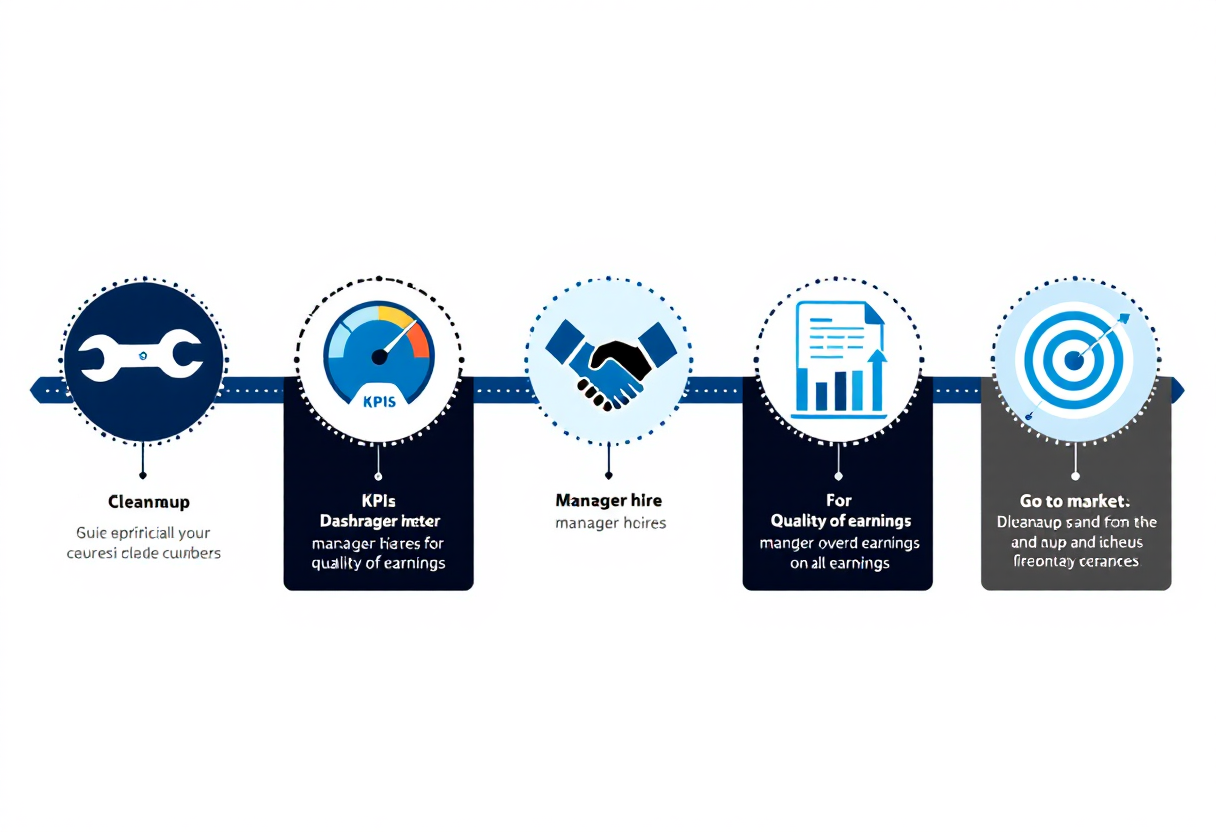
T-36 months: Cleanup phase
- Switch to accrual basis if still on cash basis
- Pick an FSM (ServiceTitan, Successware which is Authority Brands owned and has explicit chimney configuration, or Housecall Pro) and migrate
- Start tagging every potential EBITDA add-back as it happens
- Conduct W-2/1099 audit on helpers, junior sweeps, and seasonal masonry support; reclassify if needed
- Restruck related-party rent to FMV with appraisal
- Build the org chart and identify the GM hire (internal promotion target or external recruit)
- Begin CSIA CCS certification process on 2+ additional techs so the owner is not the sole certificate holder
- State licensing audit by outside counsel in every operating state (PA registration, CA contractor license thresholds, FL CSIA verification)
- Build the OSHA Fall Protection Program documentation per the NCSG-OSHA December 2023 settlement
- Enroll in the NCSG apprenticeship program if you employ apprentices
T-24 months: Financial discipline and KPI infrastructure
- GM onboarded and starting to take operational load
- Monthly close in 15 days; service-line P&L every month (sweep/inspection, repair, install, commercial, dryer vent)
- KPI dashboard: booking rate, conversion rate, average ticket by service line, jobs per tech per day, revenue per truck, member count, member renewal rate, off-season revenue percentage of summer capacity
- Launch the annual inspection membership push if penetration is under 30%; target 40%+ by close
- Launch off-season revenue programs (dryer vent C-DET cert, masonry repair, gas log conversion, commercial NFPA 96 grease duct)
- Pricing review: 5% to 8% list increase, dispatch fee held
- Begin diversification of customer base if any top customer is above 15%
- Document SOPs for every operational role
- Build the add-back bridge as a living document
T-12 months: QoE-ready close discipline, eliminate owner dependence
- Owner steps out of daily operations; GM runs the shop
- Owner takes a 2-week unplugged vacation as the stress test
- 3+ CSIA CCS-certified techs in place
- Run the sell-side QoE (budget $35K to $75K)
- Tighten balance sheet: clean A/R, isolate prepaid membership deferred revenue on its own line, deferred revenue recognized straight-line over membership period
- Final org-chart review; backfill any gaps
- Final compliance scrub (state licensing, CSIA records, W-2/1099, OSHA Fall Protection Program documentation, insurance limits, contractor bond where required, EPA records on any wood or pellet appliance installs)
- Lock in 12 months of clean service-line P&L for the CIM
T-6 months: Pre-marketing prep
- Engage M&A advisor (lower middle market sell-side specialist with home services experience; prioritize firms that have closed deals for Endura, Apex, or one of the multi-trade platforms). Typical fee structure: $25K to $50K monthly retainer credited against success fee of 5% to 10% of enterprise value, with modified Lehman scaling for the lower middle market
- CIM drafted from the QoE and operating model. Pull the recurring revenue story (annual inspection members, growth rate, renewal rate, ARR), the service-mix story (target state percentages), the geographic story (snowbelt vs. shoulder-season revenue programs), and the cert depth story (CSIA CCS bench)
- Teaser drafted (anonymized 1-pager)
- Buyer list finalized. Realistic buyer count for a $500K to $2M EBITDA chimney shop: Endura (highest probability for pure-play); 3 to 5 multi-trade home services platforms (Apex, Wrench, Heartland, Champions, Authority Brands) in the same metro or region; 2 to 5 search funds; 1 to 2 strategic regional competitors. The 25+ buyer count typical for HVAC is not realistic in chimney; expect a tighter, more focused list of 10 to 15 names
- Virtual data room populated with everything from the pre-LOI and confirmatory sections above
- Management presentation deck built and rehearsed
T-3 months: Go to market
- Teaser distributed; NDAs collected; CIMs distributed
- IOIs collected 2 to 3 weeks after CIM goes out
- Narrow to 3 to 5 finalists for management meetings (smaller universe than HVAC)
- Management meetings; LOIs solicited
- Select LOI; sign with exclusivity (typically 45 to 90 days)
- Enter confirmatory diligence; close
End-to-end from engagement to close: 9 to 12 months in a well-run chimney sweep process. The smaller buyer universe can speed this up if Endura or one strategic moves quickly, or slow it down if the universe is so thin that any single buyer drop-off materially impacts negotiating position (Auxo Capital Advisors sell-side process guide 2025; Wall Street Prep sell-side primer; Colonnade Advisors podcast 020).
Frequently Asked Questions
How long should I plan for before selling my chimney sweep business to a private equity buyer?
The owners who get top-quartile pricing start preparing 24 to 36 months before going to market. The minimum useful prep window is 12 months, because most of the high-leverage levers (lifting annual inspection membership penetration from under 20% to 40%+, installing a GM, getting on ServiceTitan or Successware, getting 2+ additional techs CSIA CCS-certified, building the OSHA Fall Protection Program documentation per the NCSG-OSHA December 2023 settlement, and running a sell-side QoE) need 12+ months of clean trailing-twelve-months data to be credible to a buyer. Chimney sellers who try to go to market in under 6 months typically leave 20% to 30% of enterprise value on the table.
What is a realistic EBITDA multiple for a $1M EBITDA chimney sweep business in 2026?
For a residential chimney sweep business at $1M EBITDA in 2026, the synthesized range is 4x to 6x. The bottom of that range applies to demand-only shops with under 20% recurring inspection revenue, owner-dependence on CSIA certification, and a concentrated customer base. The top applies to shops with 40%+ annual inspection membership recurring revenue, a GM in place, ServiceTitan or Successware running, multiple CCS-certified techs, and customer concentration under 10%. This range is synthesized from HedgeStone’s home services SDE benchmark, Endura’s published buy-box ($500K+ EBITDA, $2M+ revenue), IBBA Q4 2025 Market Pulse blended LMM data, and a 1x discount applied to comparable HVAC bands. Published chimney-specific EBITDA multiples are sparse, so a chimney seller’s recurring revenue mix and platform-fit narrative move the multiple more than the band itself.
What percentage of annual inspection membership revenue do PE buyers want to see?
40% or higher is the threshold that moves your business from a demand-only commodity profile into a recurring-revenue premium profile. Industry baseline penetration is estimated under 20% (cross-source estimate), so even modest improvement looks differentiated to a buyer. NFPA 211 Section 14.2.1 requires annual chimney inspection, and many homeowner insurance policies reference NFPA 211 compliance for claims defense, so the recurring program sells a code-mandated service rather than a discretionary upgrade. On a $750K EBITDA shop, trading at 3.5x vs. 5x is $1.1M of price from this single lever (estimate, synthesized from HedgeStone, ServiceTitan chimney content, and the Endura platform thesis).
Should I get a quality of earnings report done before going to market?
For chimney sweep businesses at $500K+ EBITDA, yes. A sell-side QoE costs $25K to $35K if revenue is below $5M, $35K to $75K typical for a healthy chimney shop with multiple service lines and 200+ active inspection members, and up to $150K for businesses with complex add-backs or messy books on the prepaid membership deferred revenue line (Eton Venture Services 2025; Morgan & Westfield QoE guide; Kahn Litwin Renza 2025). The ROI is leverage. If your QoE supports a 1x multiple uplift on a $750K EBITDA business at a 3.5x baseline, that is $750K of additional sale price for a $50K investment. More importantly, a pre-market QoE surfaces revenue recognition issues on prepaid memberships, working capital seasonality, and add-back weaknesses while you can still fix them rather than during exclusivity when the buyer re-trades the deal.
Is Endura Services the only real PE buyer for a chimney sweep business?
Endura is the only pure-play chimney and hearth PE roll-up of meaningful scale in 2026. They were formed by Argosy Private Equity in December 2024, launched publicly in March 2025, and have completed two disclosed add-ons (Chim Chimney Inc in Hermitage TN, March 14, 2025; A Merrie Sweepe in Portsmouth NH, 2025). Their published buy-box is $500K+ EBITDA and $2M+ revenue. But Endura is not the only realistic buyer. The multi-trade home services platforms (Apex Service Partners, Wrench Group, Heartland Home Services, Champions Group, Authority Brands at the franchise layer) all have HVAC, plumbing, or electrical footprint that can absorb chimney as a cross-sell add-on in the same metro. Below $500K SDE, search funds and BizBuySell, Murphy Business, and Sunbelt broker channels are the realistic buyer pool. A well-run process for a $500K to $2M EBITDA chimney shop should target 10 to 15 names total, vs. the 25+ typical for HVAC.
Do I need to stay on as the licensed or CSIA-certified chimney sweep after I sell?
If you are the only CCS-certified tech in the shop or the sole qualifier on a state-required license (PA registration, any state contractor license), almost always yes. The buyer prices CSIA cert concentrated in the owner the same way they price a master HVAC license held only by the owner: as a key-person risk that requires either an immediate post-close certified hire or a transition services agreement keeping the owner on for 12+ months. Estimate impact of the concentration: 0.5x to 1.0x multiple haircut. The fix is to get 2+ additional techs CSIA CCS-certified 12 to 24 months before going to market (1-week online course plus 100-question exam at 70% passing, $249/yr maintenance per CSIA.org), and to confirm a backup qualifier in any state where you hold the company’s standing. That work moves you from a 12-month seller-stays earn-out into a 3-month clean exit at a higher multiple.
What to Do Next
The chimney sweep owners who get the top-quartile multiple all do the same four things. They start preparing 24 to 36 months before they want to be out. They get 2+ additional techs CSIA CCS-certified so the owner is no longer the constraint. They put a GM in place 12+ months pre-sale. And they invest in a sell-side QoE before any buyer sees a CIM.
The chimney market in 2026 is one platform thin on the pure-play side and a thinner buyer pool overall than HVAC, which means two things. First, a clean, defensible adjusted EBITDA story and a documented annual inspection membership engine do more of the convincing work than they would in HVAC, because the buyer often does not have a deep mental model of what “good” looks like in chimney. Second, with fewer buyers in the room, every credible name matters more. The work in this playbook is what gets credible buyers to the table.
If you are 12+ months from a potential exit and want a structured pre-sale optimization roadmap, CT Acquisitions has home services operations specialists in our partner network who run multi-quarter prep engagements. If you are 6 to 12 months out and ready to start the sell-side process, our M&A advisory team runs the buyer outreach. Buyers pay our fee, not you. Either way, the first 30 minutes are free.
Ready to talk?
Schedule a 30-minute exit-readiness call
Or read more: Sell Your Chimney Sweep Business (active sale guide) | How to Prepare Your HVAC Business for a Sale or Exit | Private Equity in HVAC 2026: Active Buyers + Multiples
Ready to Explore Your Options?
A 30-minute confidential conversation is all it takes.

About the Author
Christoph Totter is the founder of CT Acquisitions, a buy-side M&A advisory firm in Sheridan, Wyoming. He is a published researcher in lower middle market M&A on Zenodo, Academia.edu, and ORCID, and an active contributor on LinkedIn on M&A, private equity, and business sales. CT Acquisitions works directly with 100+ buyers including PE platforms, family offices, search funders, and strategic consolidators. Buyers pay our fee, never sellers. No retainer, no exclusivity, no contract until close.