S Corp Asset Sale Goodwill: Personal Goodwill, Tax Treatment of the Sale, and the 2026 Founder’s Playbook
Quick Answer
Sale of goodwill tax treatment in an S corp asset sale: the gain passes through as long-term capital gain, taxed at up to 20% for active owners, plus a 21% built-in gains tax within 5 years of a C-to-S conversion.
By Christoph Totter, Founder of CT Acquisitions · Last reviewed: November 2026

General information for U.S. owners, not tax advice. The goodwill split is usually fixed in the letter of intent, so run these numbers with your CPA before you sign one.
Key takeaways
- An S corporation pays no entity tax on goodwill in most sales: the gain passes through on Schedule K-1, and an active owner pays up to 20% federal in 2026 (IRS Topic 409; NIIT excluded for active owners under IRS Topic 559).
- If the S corporation used to be a C corporation, IRC Section 1374 adds a 21% built-in gains tax on goodwill value that existed at conversion, for 5 years from the first day of the first S year.
- In our illustrative $3,000,000 goodwill sale, the built-in gains tax lifts federal tax from $600,000 to $1,104,000, an effective 36.8% instead of 20%.
- Personal goodwill sold directly by the owner sits outside the S corporation, so it escapes the 21% built-in gains tax; for an always-S owner it saves no federal income tax.
- Howard v. United States (9th Cir. 2011) and Muskat v. United States (1st Cir. 2009) are owner losses: a noncompete with your own company, or a priced noncompete with the buyer, defeated the personal goodwill claim.
How is the sale of goodwill taxed in an S corp asset sale?
Goodwill an S corporation built itself has zero basis, so the whole goodwill allocation is gain. The S corporation reports it, pays no tax on it unless Section 1374 applies, and passes it to shareholders as long-term capital gain on Schedule K-1. For 2026 that gain is taxed at 0%, 15% or 20%, plus 3.8% NIIT only for passive owners. The IRS Sale of a Business page treats each asset as sold separately.
| S corp goodwill situation | Tax character | Top federal rate, 2026 | Source |
|---|---|---|---|
| Always an S corporation, owner materially participates | Long-term capital gain on K-1 | 20% | IRS Topic 409; IRC 1411(c)(4) |
| Always an S corporation, owner is passive | Long-term capital gain plus NIIT | 23.8% | IRS Topic 559 |
| Converted from C status, sold inside the 5-year recognition period | 21% built-in gains tax, then capital gain on the remainder | 36.8% (39.8% if passive) | IRC 1374(b)(1); IRC 1366(f)(2) |
| Converted from C status, sold after the recognition period | Long-term capital gain on K-1 | 20% | IRC 1374(d)(7) |
| Personal goodwill sold by the shareholder | Long-term capital gain, outside the S corporation | 20%, NIIT unsettled | The Tax Adviser, 2016 |
| Goodwill the S corporation bought earlier and amortized | Ordinary up to amortization taken | 37% on the recapture slice | IRC 197(f)(7); IRC 1245 |
| Payment for a covenant not to compete | Ordinary income | 37% | The Tax Adviser, 2014 |
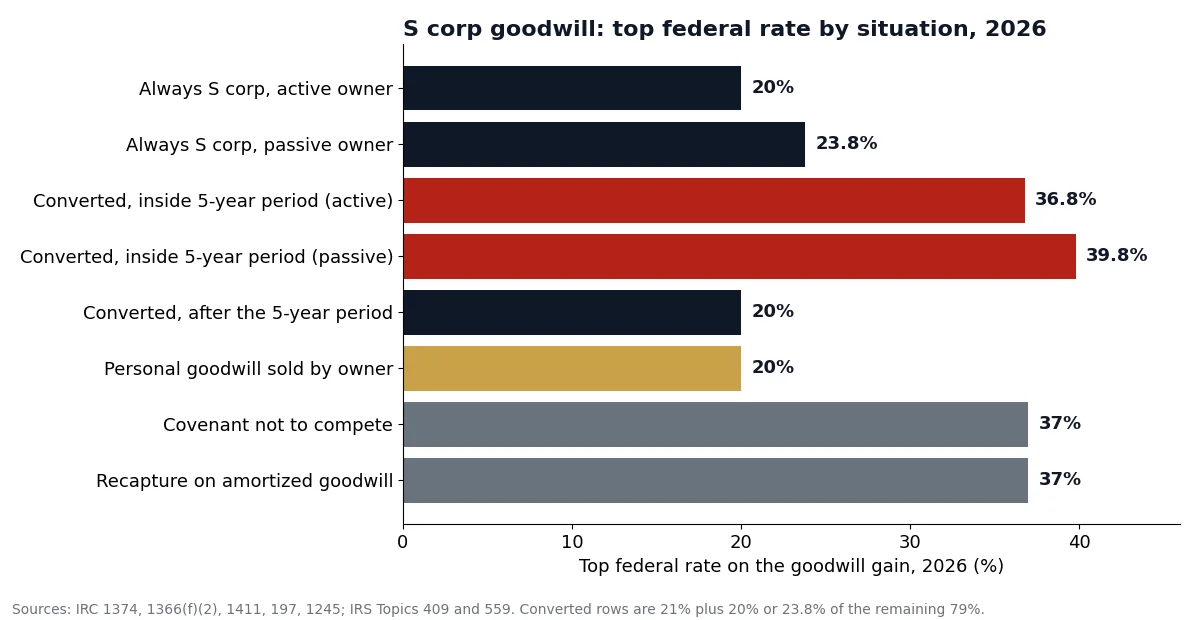
The 36.8% row is arithmetic, not a statutory rate: 21% built-in gains tax on each dollar, then 20% on the 79 cents left, because IRC Section 1366(f)(2) treats the built-in gains tax as a loss that reduces the gain passed through. For a passive owner the second layer is 23.8%, which gives 39.8%. The C corporation version of this math, and the full rate table for every entity, is in our guide to how goodwill is taxed when selling a business.
How does goodwill gain flow from the S corp to your return?
The S corporation sells the goodwill, the gain is computed at the entity, and it lands on your Form 1040 through Schedule K-1 in the same tax year. Your stock basis rises by the gain, so the cash distributed afterward is generally tax-free up to that basis. The sequence below follows the IRS Instructions for Form 1120-S and the Form 8594 instructions.
- Allocate the price. Buyer and S corporation each attach IRS Form 8594 to the return for the year of sale, with goodwill and going concern value in Class VII, the residual after Classes I to VI.
- Compute the gain at the entity. Self-created goodwill goes on Schedule D (Form 1120-S) as capital gain; recapture on goodwill bought and amortized goes on Form 4797 as Section 1245 property.
- Figure any built-in gains tax. A former C corporation inside the recognition period computes the 21% tax in Part III of Schedule D (Form 1120-S) and enters it on Form 1120-S line 23b.
- Pass the gain through. Net long-term capital gain goes to Schedule K-1 line 8a and net Section 1231 gain to line 9, reduced by any built-in gains tax under IRC 1366(f)(2).
- Adjust basis, then distribute. Your stock basis rises by the passed-through gain under IRC Section 1367(a)(1), and if the company has no earnings left from its C corporation years, a distribution up to that basis is not taxed again under IRC Section 1368(b).
Accounts receivable, inventory and depreciated equipment in the same sale produce ordinary income on the same K-1. That is why the buyer’s push to put more of the price in Class V equipment and less in Class VII goodwill costs you money; our guide to purchase price allocation in a business sale shows the class-by-class trade.
What is the built-in gains tax, and does it hit goodwill?
Yes, if your S corporation was a C corporation and the goodwill existed on the first day of the first S year. IRC Section 1374 taxes that pre-conversion appreciation at the 21% corporate rate when the S corporation sells inside a 5-year recognition period. Goodwill created after conversion, and gain above the built-in amount, are outside the tax. The seven rules below decide the bill.
| Rule | Statute or regulation | What it means for goodwill |
|---|---|---|
| Rate is the highest Section 11(b) rate | IRC 1374(b)(1); IRC 11(b) | 21% of net recognized built-in gain |
| Recognition period is 5 years | IRC 1374(d)(7)(A) | Starts on the first day of the first S corporation tax year |
| Only appreciation that existed at conversion counts | IRC 1374(d)(3) | Goodwill worth $1,000,000 at conversion caps the taxed gain at $1,000,000 |
| Total capped at net unrealized built-in gain | IRC 1374(c)(2) | Prior years’ recognized built-in gain uses up the cap |
| Taxable income limit, with carryover | IRC 1374(d)(2) | Gain above taxable income carries to the next recognition-period year |
| Installment sales stay in the tax | Treas. Reg. 1.1374-4(h)(1) | A sale inside the period stays taxable when later payments arrive after it |
| Tax paid reduces the pass-through gain | IRC 1366(f)(2) | Shareholders are taxed on gain minus the 21% tax |
The installment rule surprises sellers: under Treas. Reg. 1.1374-4(h)(1), a seller note signed inside the window keeps each later payment inside the built-in gains tax, even if it is paid after the 5 years end. Our comparison of an installment sale vs a cash sale covers the timing trade-offs that remain.
When does your recognition period end?
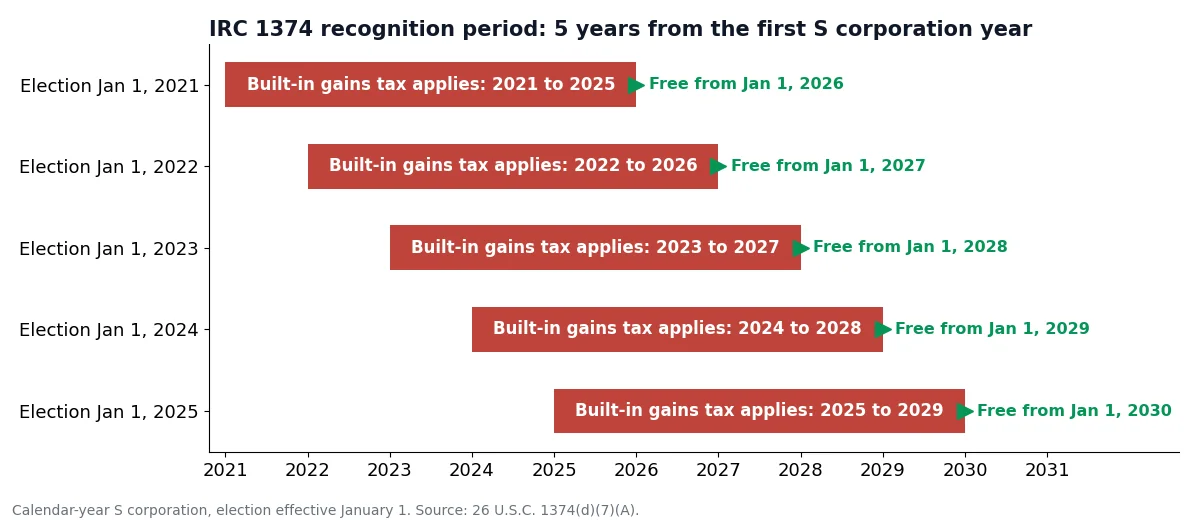
For a calendar-year S corporation, the 5-year recognition period under IRC 1374(d)(7)(A) runs from January 1 of the first S year through December 31 of the fifth. A closing on or after the first day of year six carries no built-in gains tax. The dates below assume an election effective January 1.
| S election effective | Recognition period ends | First closing date with no built-in gains tax |
|---|---|---|
| January 1, 2021 | December 31, 2025 | January 1, 2026 |
| January 1, 2022 | December 31, 2026 | January 1, 2027 |
| January 1, 2023 | December 31, 2027 | January 1, 2028 |
| January 1, 2024 | December 31, 2028 | January 1, 2029 |
| January 1, 2025 | December 31, 2029 | January 1, 2030 |
Worked example: $3,000,000 of goodwill under five S corp scenarios
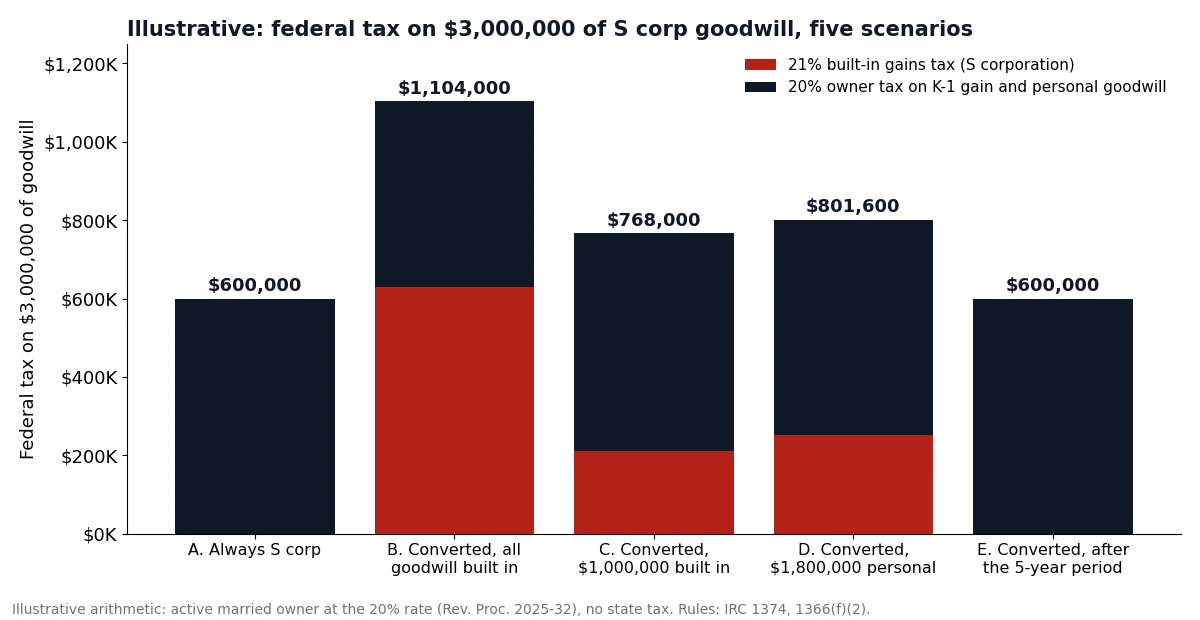
Illustrative: a married owner who materially participates sells an S corporation in 2026, and $3,000,000 of the price is self-created goodwill. Other income already puts the owner above the $613,700 top of the 15% band (IRS Rev. Proc. 2025-32), so every goodwill dollar is taxed at 20%. State tax is left out, and the built-in gains taxable income limit is assumed not to bind.
| Scenario (illustrative) | Arithmetic | Federal tax | Effective rate | Owner keeps |
|---|---|---|---|---|
| A. Always an S corporation | 20% x $3,000,000 | $600,000 | 20.0% | $2,400,000 |
| B. Converted 3 years ago, all goodwill built in at conversion | 21% x $3,000,000 = $630,000; 20% x $2,370,000 = $474,000 | $1,104,000 | 36.8% | $1,896,000 |
| C. Converted 3 years ago, appraisal shows goodwill worth $1,000,000 at conversion | 21% x $1,000,000 = $210,000; 20% x $2,790,000 = $558,000 | $768,000 | 25.6% | $2,232,000 |
| D. Converted 3 years ago, $1,800,000 sold as personal goodwill | 21% x $1,200,000 = $252,000; 20% x $948,000 = $189,600; 20% x $1,800,000 = $360,000 | $801,600 | 26.7% | $2,198,400 |
| E. Converted, closing after the recognition period ends | 20% x $3,000,000 | $600,000 | 20.0% | $2,400,000 |
Against scenario B, a conversion-date appraisal (C) saves $336,000, a personal goodwill carve-out (D) saves $302,400, and waiting out the window (E) saves $504,000. If the 3.8% NIIT applies to the personal goodwill in D, its tax rises by $68,400 to $870,000. Scenario A shows that an always-S owner gains nothing federal from a personal goodwill carve-out: that goodwill is already taxed once at 20%.
Does personal goodwill help an S corporation owner?
Only in specific cases. Personal goodwill is value tied to the owner’s own relationships and skill, owned by the owner and sold directly to the buyer. In a C corporation it avoids the 21% corporate layer; in an S corporation it avoids only the 21% built-in gains tax, because an always-S corporation has no entity layer to avoid. The table shows where the carve-out pays.
| Entity | Entity tax on enterprise goodwill | Federal saving from a personal goodwill sale | Source |
|---|---|---|---|
| Always an S corporation, active owner | None | None: both paths taxed at 20% | IRC 1366; IRS Topic 409 |
| Always an S corporation, passive owner | None | Up to 3.8% if NIIT does not reach personal goodwill | The Tax Adviser, 2016 |
| S corporation inside the recognition period | 21% on built-in gain | Up to 16.8 points: 36.8% falls to 20% | IRC 1374(b)(1) |
| C corporation | 21% corporate tax | Up to 19.8 points: 39.8% falls to 20% | IRC 11(b) |
On NIIT, Christopher Hesse argued in The Tax Adviser (May 2016) that most personal goodwill sales escape the 3.8% tax because the goodwill is a personally developed intangible, not passive income under IRC Section 1411(c)(1)(A)(iii). No regulation confirms it, so ask your CPA to model both outcomes.
Which court cases decide whether goodwill is personal?
Owners won when no employment agreement or noncompete tied them to their own company, and lost when one did or when the paperwork priced a noncompete instead. The Tax Court accepted personal goodwill in Martin Ice Cream Co. v. Commissioner, 110 T.C. 189 (1998), holding that “personal relationships of a shareholder-employee are not corporate assets when the employee has no employment contract,” as quoted in Payne, The Tax Adviser (May 2014).
| Case | Year | Result for owner | Deciding fact |
|---|---|---|---|
| MacDonald v. Commissioner, 3 T.C. 720 | 1944 | Won | Corporation had no contract right to his future services |
| Martin Ice Cream Co. v. Commissioner, 110 T.C. 189 | 1998 | Won | No employment contract or noncompete with the corporation |
| Norwalk v. Commissioner, T.C. Memo. 1998-279 | 1998 | Won | Accountants had no enforceable noncompete with their firm |
| Muskat v. United States, 554 F.3d 183 (1st Cir.) | 2009 | Lost | Signed a $1 million, 13-year noncompete with the buyer, then tried to call it personal goodwill |
| Howard v. United States, 9th Cir. No. 10-35768 | 2011 | Lost | Employment agreement and noncompete with his own professional corporation |
| H&M, Inc. v. Commissioner, T.C. Memo. 2012-290 | 2012 | Won | Goodwill belonged to the shareholder, so his pay was not disguised price |
Howard is the warning case, not a win. Dr. Larry Howard’s purchase agreement allocated $549,900 to his personal goodwill, yet the Ninth Circuit held that “self-serving language in a purchase agreement is not a substitute for a careful analysis,” and the proceeds were taxed as a corporate dividend. In Muskat, the Journal of Accountancy (May 2009) reports the First Circuit required “strong proof” to override a signed allocation, which the owner could not supply.
How do you set up a personal goodwill sale out of an S corp?
Treat it as two sales, decided before the letter of intent: the S corporation sells its assets, and you sell your personal goodwill under a separate agreement. The steps below come from the Payne analysis in The Tax Adviser (2014), the Howard opinion and the Section 1374 rules, in the order they need to happen.
- Pull every agreement between you and the company. An employment agreement or noncompete with your own corporation moved the goodwill to the entity in Howard (9th Cir. 2011); have counsel review it at least a year before a sale.
- Find your S election date. If it is less than 5 years before the target closing, list the first BIG-free closing date from the recognition period table and price the wait against the 21% tax.
- Get two valuations. One fixes goodwill value on the first day of the first S year, which caps the IRC 1374(d)(3) gain; the other splits personal and enterprise goodwill today.
- Write the split into the LOI. Name the personal goodwill amount in the letter of intent, because Muskat (1st Cir. 2009) shows a signed allocation is hard to undo later.
- Sign two purchase agreements and two bills of sale. One for the S corporation’s assets, one for your personal goodwill, each consistent with the Form 8594 the S corporation and buyer file.
- Price any buyer noncompete separately. Covenant payments are ordinary income at up to 37%, so each dollar moved from personal goodwill to the covenant costs up to 17 more cents; our guide to the non-compete clause in a business sale covers the terms buyers ask for.
If the buyer is a corporation that prefers buying stock, a Section 338(h)(10) election turns the stock sale into a deemed asset sale for tax, so the same goodwill and built-in gains rules apply; see our explainer on the Section 338(h)(10) election for business sellers.
Does the buyer lose anything when goodwill is personal?
Usually not on tax. A buyer amortizes purchased goodwill over 15 years under IRC Section 197(a) whether it buys the goodwill from the S corporation or from you, so $3,000,000 of goodwill yields $200,000 of deductions a year either way. The buyer’s real concerns are legal: who stands behind the personal goodwill in the reps, warranties and indemnity, and whether the relationships transfer.
Buyers therefore ask for a transition period written into the personal goodwill agreement, with introductions to key customers and a set number of months of support. Agree that schedule in the LOI, because it is also your evidence that the relationships were yours to sell, the fact that decided Martin Ice Cream (1998).
Selling an S corporation?
CT Acquisitions helps owners of founder-owned businesses make the most of their exit through a confidential sale, a recapitalization or exit planning, with a 500+ buyer network. We work for owners on the sell side. Our fee is success only: nothing upfront, and you pay nothing unless the business sells.
Which S corp goodwill move fits your situation?
Match your facts to a row before the LOI, because the goodwill split, any personal goodwill sale and the closing date are usually set there. Each row names the rule that drives the outcome, so you can ask your CPA about that specific section rather than a general question.
| If your situation is… | Then | Rule |
|---|---|---|
| If you have always been an S corporation and you work in the business | Expect 20% on goodwill and no NIIT; a personal goodwill carve-out adds paperwork, not federal savings | IRC 1411(c)(4); IRS Topic 559 |
| If you converted from a C corporation less than 5 years before the target closing | Model the 21% built-in gains tax and the date the recognition period ends | IRC 1374(d)(7)(A) |
| If the recognition period ends within 12 months of your target closing | Price waiting against the tax; in our example waiting saves $504,000 on $3,000,000 of goodwill | IRC 1374(a) |
| If your goodwill grew a lot after the S election | Commission a conversion-date valuation to cap the taxed gain | IRC 1374(d)(3) |
| If you converted recently and never signed an employment agreement or noncompete with the company | Value personal goodwill and sell it under a separate agreement | Martin Ice Cream, 110 T.C. 189 |
| If you signed a noncompete with your own company | Expect the IRS to treat the goodwill as corporate | Howard, 9th Cir. 2011 |
| If the buyer offers a seller note inside the recognition period | Expect later payments to stay subject to the 21% tax | Treas. Reg. 1.1374-4(h)(1) |
| If the company amortized goodwill from an earlier acquisition | Ask for the Section 1245 recapture amount before agreeing the allocation | IRC 197(f)(7), 1245 |
Owners still several years from a sale can also restructure first; our guide to the F reorganization in a business sale explains how an S corporation is moved under a new holding company before closing.
What do other guides get wrong about S corp goodwill?
Four claims circulate on first-page results and older pages, including an earlier version of this one. We checked each against the statute, the IRS form instructions or the court opinion, and the table puts the claim next to what the primary source says.
| Common claim | What the primary source says |
|---|---|
| S corporation goodwill is taxed at 36% to 40% | Only inside the IRC 1374 recognition period; otherwise an active owner pays 20% on the K-1 gain |
| Every S corporation seller pays the 3.8% NIIT on goodwill | IRS Topic 559 and IRC 1411(c)(4) exclude owners who materially participate |
| Howard established personal goodwill | The owner lost (9th Cir. 2011); Martin Ice Cream (1998) and H&M (2012) are the owner wins |
| Selling after the 5 years end avoids the tax even on a note | Treas. Reg. 1.1374-4(h)(1): an installment sale made inside the period stays taxable |
How we compiled this
We compiled this page in November 2026 from 16 primary documents: IRC Sections 11, 197, 1245, 1366, 1367, 1368, 1374 and 1411, Treas. Reg. 1.1374-4, IRS Rev. Proc. 2025-32, IRS Topics 409 and 559, the Form 1120-S and Form 8594 instructions, the IRS Sale of a Business page and the Howard opinion. Articles in The Tax Adviser and the Journal of Accountancy supplied case summaries; we excluded forum posts. The examples are our own arithmetic.
Frequently asked questions
How is the sale of goodwill treated for tax purposes in an S corp?
The S corporation reports the goodwill gain and passes it to shareholders on Schedule K-1 as long-term capital gain, because self-created goodwill is a capital asset with zero basis. For 2026 an active owner pays up to 20% federal. A former C corporation selling within 5 years of conversion also pays the 21% built-in gains tax under IRC Section 1374.
Is the sale of goodwill subject to capital gains tax?
Yes, when the goodwill was self-created and held more than one year: it is taxed at 0%, 15% or 20% for 2026, and passive owners add the 3.8% NIIT. Goodwill the S corporation bought and amortized is ordinary income up to the amortization taken under IRC Sections 197(f)(7) and 1245, and payments for a noncompete are ordinary income.
Does the built-in gains tax apply to goodwill?
Yes, if the S corporation was a C corporation and the goodwill existed on the first day of its first S year. IRC Section 1374 taxes that built-in gain at 21% when the asset is sold during the 5-year recognition period. Goodwill value created after the conversion date is not built-in gain, and a conversion-date appraisal documents the split.
Is acquired goodwill tax-deductible for the buyer?
Yes. A buyer amortizes purchased goodwill in equal amounts over 15 years under IRC Section 197(a), starting in the month of acquisition. The deduction is the same whether the goodwill is bought from the S corporation or from the owner as personal goodwill, so $3,000,000 of goodwill gives the buyer $200,000 of deductions a year.
Where do you report the sale of goodwill on an S corp return?
The S corporation and the buyer each attach IRS Form 8594 for the year of sale, with goodwill in Class VII. Self-created goodwill gain goes on Schedule D (Form 1120-S); recapture on amortized goodwill goes on Form 4797. Any built-in gains tax is figured in Part III of Schedule D and entered on Form 1120-S line 23b.
Is personal goodwill subject to the 3.8% NIIT?
The IRS has not ruled on it. A May 2016 analysis in The Tax Adviser concluded that most personal goodwill sales should not be subject to the NIIT, because the goodwill is a personally developed intangible rather than passive income under IRC Section 1411(c)(1)(A)(iii). Model the sale with and without the 3.8% before you rely on it.
Sources
- 26 U.S.C. sections 11, 197, 1245, 1366, 1367, 1368, 1374 and 1411; Treas. Reg. 1.1374-4 (Cornell LII). Accessed November 2026.
- IRS: Rev. Proc. 2025-32; Topics 409 and 559; Instructions for Form 1120-S; Instructions for Form 8594; Sale of a Business. Accessed November 2026.
- Howard v. United States, No. 10-35768 (9th Cir. Aug. 29, 2011), memorandum.
- Payne, “Goodwill as Part of a Corporate Asset Sale,” The Tax Adviser, May 2014; Hesse, “Personal Goodwill and Net Investment Income Tax,” The Tax Adviser, May 2016.
- “Noncompete Agreement,” Journal of Accountancy, May 2009 (Muskat v. United States, 554 F.3d 183, 1st Cir. 2009).
For federal and state rates across every structure, see our pillar on how much tax you pay when you sell a business.
Related Guide: F-Reorganization in a Business Sale: Pre-Sale S Corp Restructuring, Companion structure for S corp sellers preserving tax benefits
Related Guide: Installment Sale vs Cash Sale in a Business Sale, Spreading capital gains recognition across years
Related Guide: Opportunity Zone Fund After Selling a Business, Deferring and eliminating capital gains post-sale
Related Guide: Quality of Earnings (QoE) Report 2026, How buyers validate the financials underlying goodwill allocation
Want a Specific View of Your Business?
30 minutes, confidential, no contract, no cost. You leave with a view of your local buyer market and a likely valuation range.
30 N Gould St, Ste N, Sheridan, WY 82801, USA · (307) 522-0262 · Contact