
The Role of Investment Banks in Mergers and Acquisitions: A 10-Function Guide (2026)
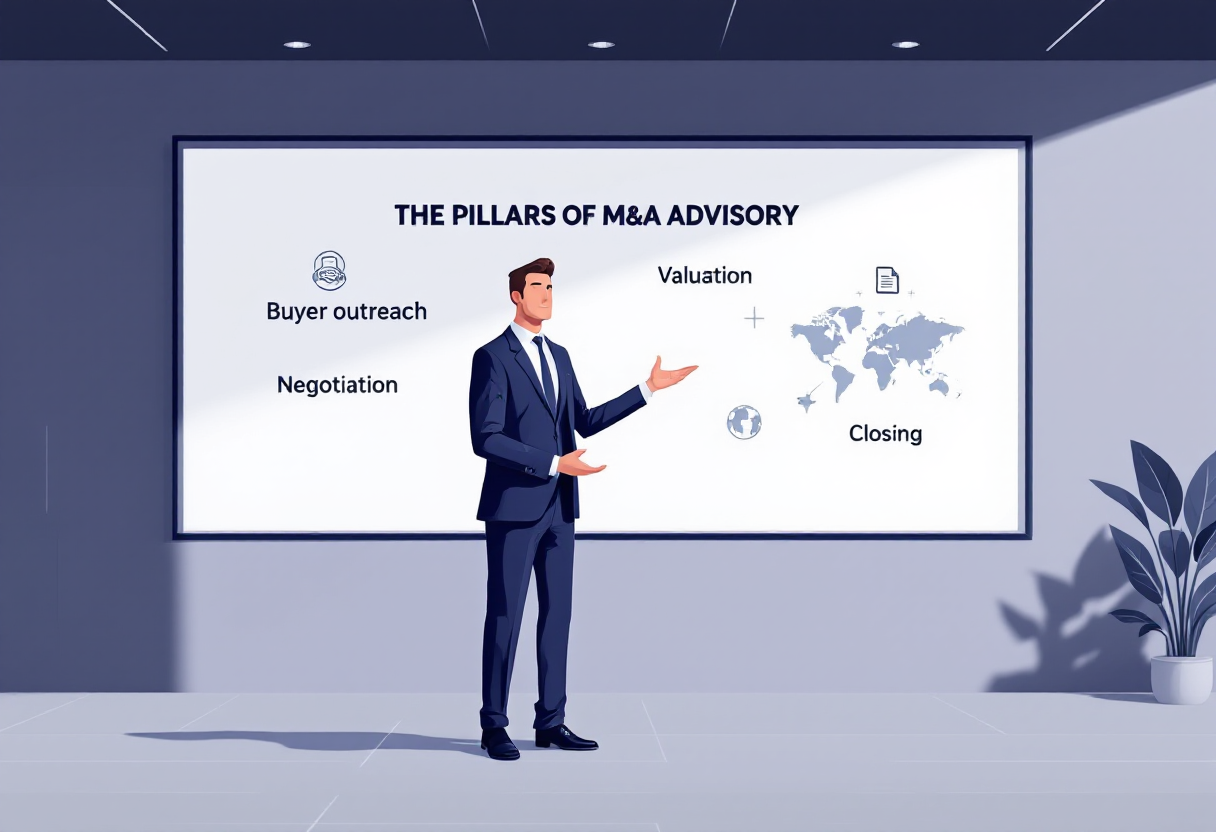
The role of investment banks in mergers and acquisitions spans ten distinct functions, from pre-LOI strategy and buyer sourcing to fairness opinions, auction management, financing, and post-close transition support, and on a typical lower-middle-market sell-side process the advisor’s contribution is worth a 15 to 25 percent premium over what an owner can negotiate alone, per the SRS Acquiom 2025 Deal Terms Study. For a $5M EBITDA business, that premium is roughly $4M to $7M of incremental enterprise value against a success fee of $1M to $1.75M.
Thinking about hiring an M&A advisor?
No fee to you on buy-side introductions; sell-side mandates are paid on success at closing. We run sell-side processes for lower-middle-market owners and the buyers cover our fee, not you. Talk to us before signing an engagement letter with anyone else.
Book a Free ConsultationWhat This Actually Means
An investment bank, in the M&A context, is the financial advisor that sits between a company and its eventual counterparty and runs the transaction. On the sell-side, the bank represents the seller and runs a process to maximize price, certainty, and terms. On the buy-side, the bank represents the acquirer and runs sourcing, valuation, financing, and negotiation. The bank does not buy the company, does not provide the financing directly in most middle-market deals, and does not act as legal counsel. The bank is the deal quarterback, the process owner, and the seller’s or buyer’s chief negotiator.
The function set is wider than most owners assume. Refinitiv’s 2025 mid-market league tables credit advisors with work across origination, valuation, marketing, diligence coordination, structuring, financing, and closing. The Capstone Partners 2026 Lower Middle Market Survey breaks the typical 9-month sell-side engagement into 14 named workstreams. Owners who hire an advisor and assume the deliverable is “find a buyer and negotiate the price” miss roughly 60 percent of what they are actually paying for.
This guide covers the ten functional roles investment banks play in mergers and acquisitions, sorted by where they show up in the deal timeline. It then covers the four-tier categorization of banks (bulge bracket, elite boutique, middle-market, lower middle-market), the fee structures that govern engagements, and a worked example showing how the math runs on a $5M EBITDA HVAC sale.
The 10 Roles Investment Banks Play in M&A
Investment banks in mergers and acquisitions act as the deal’s financial advisor. They value the company, find and approach buyers or targets, prepare the marketing materials, run the auction or negotiation, help arrange or test financing, issue fairness opinions, and coordinate diligence and closing. Most of their pay is a success fee at closing.
1. Strategic Advisory: Pre-LOI Thesis Development
Before any marketing document is written, the advisor helps the owner answer the prior questions. What is the company actually worth in the current market, not last cycle’s market? Is now the right time, or does a 12-month operational push lift EBITDA enough to justify waiting? What is the right deal shape: full sale, recapitalization with rollover equity, minority growth investment, or strategic sale to a competitor? Who is the natural buyer universe and what story will resonate with them? This pre-LOI phase usually takes 4 to 8 weeks and produces a one-page thesis the entire process is built around.
For buy-side mandates, strategic advisory means helping the acquirer define acquisition criteria, build a target list, and develop a thesis the board and lenders will support. Bain Capital, Audax, and Riverside, three of the most active middle-market platforms, expect their advisors to bring buy-side thesis work that is sector-specific, not generic.
2. Buyer Sourcing: The Advisor’s Rolodex
On the sell-side, the bank’s most expensive and least-replaceable asset is its book of buyer relationships. A mid-market advisor running an HVAC, plumbing, managed services, or industrial deal in 2026 has live, current relationships with 60 to 120 private equity platforms in that vertical, 20 to 40 strategic acquirers, and a long list of family offices and search funds. An owner working without an advisor typically knows 5 to 10 plausible buyers from personal experience.
The rolodex matters for two reasons. The first is funnel width: a 40-buyer outreach produces 8 to 15 indications of interest, which is enough to run a competitive auction. A 5-buyer outreach produces 1 to 2 indications, which is not a process, it is a private negotiation. The second is buyer quality: the advisor knows which PE platforms close on terms, which retrade in diligence, which pay in cash versus rollover equity, and which have dry powder right now. Capstone Partners’ 2026 LMM survey estimates the advisor’s rolodex is worth $5M to $30M in incremental enterprise value per deal, depending on size and vertical.
3. Target Sourcing: The Buy-Side Mirror
For buy-side engagements, the bank does the opposite work. The acquirer briefs the advisor on criteria: sector, geography, EBITDA band, growth profile, customer concentration tolerance, deal structure preferences. The advisor then builds a proprietary target list, often 100 to 400 companies, screens for fit, and runs initial outreach to test owner appetite for a conversation. The output is typically 8 to 15 owners willing to take a meeting, of which 2 to 4 progress to NDA, of which 1 closes in a 12 to 18-month cycle.
Buy-side mandates are common for PE platforms running add-on strategies, family offices building portfolios in a specific vertical, and strategic acquirers with a defined inorganic growth plan. The fee structure is different: retainers are larger ($25K to $100K per month), success fees are smaller (1 to 2 percent of enterprise value), and engagements last 12 to 24 months.
4. Valuation and Fairness Opinions
Investment banks produce four kinds of valuation work. The first is the pre-engagement opinion of value, a 5 to 15 page document the advisor uses to set seller expectations and bracket the realistic outcome range. The second is the formal valuation model built during engagement: discounted cash flow, public-company comparables, precedent transactions, and for PE buyers, an LBO model showing what the financial sponsor can pay and still hit a 20 to 25 percent IRR.
The third is the fairness opinion, a formal letter that the company’s board can rely on to discharge its fiduciary duty in approving a transaction. Fairness opinions are mandatory for ESOP transactions under ERISA, common for public company deals, and increasingly used for related-party transactions in private companies. The fourth is post-LOI defense work, where the advisor pressure-tests buyer assumptions during diligence to push back on retrade attempts. Houlihan Lokey is the global market leader in fairness opinions, with the firm advising on more fairness opinions annually than any other bank per Refinitiv 2025 league tables.
5. The CIM: Confidential Information Memorandum
The CIM, sometimes called the offering memorandum or “the book,” is the central marketing document of a sell-side process. It is typically 40 to 80 pages and covers: company overview and history, products and services, end markets and customers, competitive positioning, management team, financial performance (3 to 5 years historical plus a 3 to 5 year forecast), growth opportunities, and transaction rationale. The CIM is sent to qualified buyers under NDA and is the primary document buyers use to develop their indication of interest.
The CIM is not a sales brochure. It is a structured argument for why the company is worth more than its trailing financials suggest. A good CIM frames customer concentration as anchor accounts, frames forecasted growth as conservative against achievable upside, and frames management transitions as opportunity for the new owner. A bad CIM reads like a pitch deck, glosses over weaknesses buyers will find in diligence anyway, and produces lower indications of interest because buyers price uncertainty as risk discount. The CIM-writing skill is one of the clearest differentiators between strong and weak advisors.
6. Process Management and Auction Mechanics
Running a competitive auction is full-time work for 6 to 9 months. The advisor manages the NDA pipeline (typically 40 to 100 NDAs across the process), distributes the CIM, fields buyer questions, schedules management presentations (usually 8 to 15 separate meetings), runs the IOI collection round, runs the LOI round, manages buyer Q&A in diligence, and controls the calendar so all bidders are at comparable stages at comparable times. Information flow control is the single most important auction discipline: bidders who learn they are alone or who learn they are behind will reprice or walk.
The advisor also runs the seller’s process committee, typically the owner, CFO, and a board member or two. Weekly or twice-weekly process calls keep all parties aligned on deal status, buyer feedback, and decision points. The process manager function is what most owners underestimate when considering a self-run sale. Capstone Partners reports that 18 percent of unrepresented sell-side processes break, not because the deal economics fail, but because the owner cannot run the company and the process at the same time.
7. Negotiating Deal Structure
Headline price is one number. Net proceeds after structure is a different number, and the gap is often 10 to 30 percent. The advisor’s negotiation work covers a long list of structural levers: earnout terms (length, performance gates, measurement methodology), escrow amount and release schedule, working capital peg and true-up mechanics, representation and warranty insurance versus seller indemnity, asset versus stock sale tax treatment, Section 338(h)(10) elections, rollover equity terms (preferred or common, drag-along, tag-along), management incentive plans for the buyer’s hold period, and non-compete scope and duration.
Each of these is a sub-specialty. An advisor who has closed 50 lower-middle-market deals knows which clauses are market, which are aggressive, and which are non-starters. A first-time seller signing a buyer’s first-draft LOI typically gives away 10 to 20 percent of nominal value in structure terms that read as reasonable but bite at closing. The SRS Acquiom 2025 Deal Terms Study tracks the prevalence of these terms across thousands of closed deals and is the reference document most middle-market advisors use to argue what is market.
8. Due Diligence Coordination
Once an LOI is signed, the buyer’s diligence team enters the company. This includes a quality-of-earnings provider, legal counsel for buyer, tax advisors, insurance and benefits consultants, IT diligence, environmental consultants for industrial deals, and often a commercial diligence firm doing customer calls and market sizing. A typical mid-market diligence runs 60 to 90 days and produces 500 to 2,000 buyer questions in the virtual data room.
The advisor’s job in diligence is fourfold. First, set up and police the VDR, which means deciding what gets uploaded when and to whom. Second, manage the Q&A queue so the company is not buried in duplicate questions and so answers are consistent across workstreams. Third, prepare the management team for diligence interviews, which buyers use to probe operational and cultural fit. Fourth, identify mitigation strategies for issues diligence surfaces: customer concentration risk can be mitigated with a customer escrow, working capital volatility can be mitigated with a peg adjustment, environmental exposure can be mitigated with R&W insurance. A good diligence-phase advisor finds three to five mitigation moves that save 5 to 10 percent of nominal value over the course of the process.
9. Financing Coordination
For buy-side engagements, the bank often arranges acquisition financing. This means running a lender process in parallel with the company-side negotiation, soliciting term sheets from senior lenders (banks, BDCs, direct lenders), mezzanine providers, and unitranche specialists. The output is a financing commitment letter the buyer needs to close. Middle-market acquisition debt typically prices at SOFR plus 500 to 700 basis points for senior, with debt of 4 to 6 times EBITDA depending on industry and lender appetite.
For sell-side engagements, the advisor’s role with financing is to validate the buyer’s source-of-funds. A buyer with committed equity but uncommitted debt is a worse bidder than a buyer with both committed. The advisor pushes buyers to upgrade financing certainty as the process narrows and may run buyer reference calls with the buyer’s lender to verify the debt is real and the timeline is achievable. Financing certainty is one of the three or four most important variables a sell-side advisor optimizes for, alongside price, structure, and cultural fit with management.
10. Closing and Post-Close Transition
The final 2 to 4 weeks before closing are the most operationally dense phase of the deal. The advisor coordinates the closing checklist: definitive agreement final markup, schedules to the purchase agreement (often 200 to 500 pages of operational disclosures), board and shareholder consents, lender commitment letters in final form, escrow agreement and escrow agent setup, R&W insurance binding, working capital estimate, wire instructions, regulatory filings (HSR for deals above $119.5M as of 2025 per the FTC’s thresholds), and the closing flow of funds.
Post-close, the advisor’s role typically extends 30 to 90 days. This covers working capital true-up calculations, transition services agreement administration if the seller is providing ongoing services, escrow release tracking, and earnout administration if there are performance gates. Some sellers also retain their advisor for ongoing advisory through the earnout period, particularly when the earnout payment is large and the measurement methodology is complex. The post-close phase is what separates advisors who treat closing as the finish line from advisors who treat the full proceeds collection as the finish line.
The Four Tiers of Investment Banks
Not every bank does every deal. The market is segmented by deal size, sector specialization, and client type. The four-tier framework below is how most M&A professionals describe the landscape.
| Tier | Typical Deal Size | Representative Firms | Best For |
|---|---|---|---|
| Bulge Bracket | $500M+ enterprise value | Goldman Sachs, JPMorgan, Morgan Stanley, Bank of America, Citi, Barclays | Public company deals, cross-border transactions, large-cap PE sponsors |
| Elite Boutique | $250M+ enterprise value | Lazard, Houlihan Lokey, Evercore, Centerview, Moelis, PJT Partners | Restructurings, fairness opinions, sector specialists, conflict-free advisory |
| Middle-Market | $25M to $500M EV | Lincoln International, Houlihan Lokey middle-market, Capstone Partners, Brown Gibbons Lang, Stifel, Raymond James, William Blair, Mesirow | Lower-middle-market sponsor-backed deals, founder-owned exits in the $25M-$250M range |
| Lower Middle-Market | $5M to $50M EV | Madison Park Group, Tequity, BMI M&A, Cascadia Capital, Synergy Business Advisors, Generational Equity | Founder-owned exits, single-vertical specialists, sub-$5M EBITDA |
The wrong-tier mismatch is the most common owner mistake. A Goldman Sachs banker will not return calls on a $20M HVAC deal because the fee economics do not cover the team’s time. A local business broker should not be running a $200M industrial process because the buyer universe is wrong and the negotiation skill set does not match. The right tier for a $5M to $50M enterprise value transaction is a lower-middle-market boutique or the lower-market group of a middle-market firm. For $1M to $5M EBITDA deals, smaller boutiques and industry-specific shops fit better.
Sector specialization matters as much as size tier. Capstone Partners is strong in industrial and business services. Lincoln International is strong in industrials, consumer, and healthcare services. Houlihan Lokey is strong in financial sponsors coverage and special situations. Brown Gibbons Lang is strong in industrials and consumer. William Blair is strong in technology and healthcare. The owner’s first question when interviewing advisors should be: “How many deals have you closed in my exact sub-sector in the last 24 months?”
When the company is a bank: what a community bank M&A advisor does
Bank deals are their own corner of M&A. When a community bank sells, merges or buys a branch network, it hires an investment bank from the financial institutions group (FIG) world, usually a firm that does little else. The ten roles above still apply, but three things change.
- Regulatory approval is the critical path. A bank merger needs approval from the resulting bank’s primary federal regulator under the Bank Merger Act (the OCC, the FDIC or the Federal Reserve). Holding company deals also go to the Federal Reserve under the Bank Holding Company Act, and the Department of Justice reviews competition. The advisor plans the whole deal around that timeline.
- The valuation math is different. Banks are priced on price to tangible book value, price to earnings and the premium paid over core deposits. Buyers test earnings per share accretion and how many years it takes to earn back any tangible book value dilution.
- Fairness opinions are standard. Bank boards, often answerable to many local shareholders, rely on a fairness opinion before signing, and it is usually summarized in the materials shareholders receive before they vote.
Firms active as community bank M&A advisors include Piper Sandler, Keefe, Bruyette & Woods (part of Stifel), Stephens, Janney Montgomery Scott, D.A. Davidson, Hovde Group, Performance Trust and Olsen Palmer. Ask any candidate for bank deals it advised in your asset size range and region, and for its record on regulatory approval timing.
CT Acquisitions works with founder-owned operating businesses rather than bank charters. For more on how bank-focused advisory teams are organized, see our guide to FIG investment banking.
How Investment Banks Get Paid
Sell-side advisor fees come in four common shapes that almost always combine into a single engagement letter.
| Fee Type | Typical Range | Purpose |
|---|---|---|
| Retainer | $25,000 to $100,000 upfront, sometimes monthly | Covers advisor’s opportunity cost during pre-marketing, credited against success fee |
| Success fee (Lehman or modified Lehman) | 1 to 5 percent of enterprise value, scaled by deal size | Primary economic alignment, paid at closing only |
| Minimum fee floor | $500K to $2M depending on advisor tier | Floor protection for advisor on smaller-than-expected closings |
| Tail period | 12 to 24 months post-engagement | Protects advisor if the seller closes with a buyer the advisor introduced, after termination |
The Lehman formula and its variations remain the most common success-fee structure in middle-market M&A. The classic double Lehman is 10 percent of the first $1M of value, 8 percent of the second, 6 percent of the third, 4 percent of the fourth, and 2 percent of everything above. A modified Lehman flattens that into something closer to 5 percent on the first $1M, 4 percent on the next $4M, 3 percent on the next $5M, 2 percent on the next $10M, and 1 percent on everything above. On a $30M closing, that modified Lehman produces $660,000, a blended fee of about 2.2 percent. On a $10M closing, the same formula produces $360,000, about 3.6 percent. Smaller deals pay a higher blended rate because the fixed cost of running a process is similar regardless of size.
For buy-side mandates, fees flip the structure. Monthly retainers run $25K to $100K, the engagement spans 12 to 24 months, and the success fee on a closed acquisition is typically 1 to 2 percent of enterprise value. PE platforms with active add-on programs often use buy-side advisors on a flat-fee per closed deal basis once the relationship is established.
Worked Example: HVAC Owner with $5M EBITDA
An HVAC business owner in the Southeast has $5M of EBITDA on $32M of revenue. The business has 110 employees, $4M of recurring maintenance revenue, and three locations. The owner is 58 and wants to fully exit within 12 months. Friends in the industry have told him the business is “worth maybe 4 to 5 times,” which would put it at $20M to $25M. He interviews three advisors and engages Capstone Partners, a middle-market firm with a strong building-services practice.
The engagement letter terms: $50K retainer credited against success fee, modified Lehman success fee, $750K minimum fee floor, 18-month tail. The process timeline runs 9 months from kickoff to closing.
Months 1 to 2: Preparation. Capstone runs management interviews, builds the financial model with monthly trailing twelve months data, builds the 5-year forecast, drafts the CIM, builds the buyer list of 65 strategic acquirers and PE platforms, drafts the teaser and NDA. The owner spends roughly 20 hours per week on the process during this phase, mostly in meetings with the advisor and providing data.
Months 3 to 4: Marketing and IOIs. Capstone sends the teaser to 65 buyers, executes NDAs with 42, distributes the CIM. The IOI deadline produces 12 indications of interest, ranging from $26M to $38M. Capstone advises the seller to take 5 buyers into the management presentation round and to ask for revised IOIs after the meetings.
Months 5 to 6: Management presentations and LOIs. Five management presentations are held, each running half a day on site at the company. The revised IOI round produces 4 LOIs ranging from $30M to $34M. Capstone advises the seller to take 2 LOIs into a final-round negotiation. After 3 weeks of LOI markup negotiations, the seller signs an exclusive LOI with a strategic acquirer (a larger HVAC platform owned by a major PE firm) at $32.5M, a 6.5x multiple. The LOI includes a $2.5M escrow, an 18-month rep and warranty survival, a working capital peg at the trailing-twelve-month average, and 15 percent rollover equity in the buyer’s parent platform.
Months 7 to 9: Diligence and closing. Buyer’s QofE provider, legal team, and operational diligence consultants enter the data room. The VDR ends up with 1,400 documents and 850 buyer questions. Capstone manages the Q&A flow, runs weekly process calls, prepares the management team for 8 diligence interviews, and negotiates 3 specific issues that surface in diligence: a customer concentration finding (mitigated with a $400K customer-loss escrow carve-out), a vehicle title issue (mitigated through a pre-close cleanup), and a small wage-and-hour exposure (mitigated through R&W insurance). The deal closes on month 9 at $32.5M with the negotiated structure.
The fee math. The modified Lehman scale described below produces $685,000 on $32.5M, which is under the $750K minimum fee floor, so the fee is the $750K floor, about 2.3 percent. Less the $50K retainer credit, the closing-day wire to Capstone is $700K.
The premium captured. The owner’s pre-engagement DIY expectation was $22M (4.4x). Actual closing was $32.5M (6.5x). Gross premium: $10.5M. Less Capstone’s $750K fee. Net incremental cash to seller after fees: $9.75M. The advisor produced about $13 of net incremental seller proceeds for every $1.00 of fee paid. This is the math that drives why owners hire advisors despite the headline cost.
Common Mistakes Owners Make Around Investment Banks
Treating the fee as a cost, not a return on investment
A 4 percent blended fee on a $30M deal is $1.2M. The right question is not whether $1.2M is a lot of money (it is), but whether the advisor produces more than $1.2M of incremental enterprise value through process competition, structure negotiation, and diligence defense. On deals above $3M of EBITDA, the answer is almost always yes by multiples. On deals below $1M of EBITDA, the answer is usually no, and a business broker fits the economics better than an investment bank.
Hiring the wrong tier
A bulge-bracket bank will not run a $25M deal. A lower-middle-market boutique will struggle with a $300M deal because the buyer universe is wider and more institutional. The tier mismatch wastes the engagement on both sides. The right test is the advisor’s recent deal sheet: how many deals between $X-1 and $X+1 has the team closed in the owner’s sector in the last 24 months?
Negotiating the headline fee but not the engagement terms
Fee percentage is the visible number in the engagement letter. Tail period, minimum fee floor, expense reimbursement, and pre-existing-buyer carve-outs are the invisible numbers that often matter more. A 5 percent fee with a clean 12-month tail and a $500K floor is often cheaper in practice than a 3 percent fee with a 24-month tail, a $1.5M floor, and aggressive expense pass-through.
Signing the buyer’s first-draft LOI without advisor markup
Buyers issue first-draft LOIs that include exclusivity periods of 90 to 120 days, broad no-shop clauses, weak financing certainty language, and structure terms that favor the buyer (large escrow, long survival, aggressive working capital peg). An advisor’s first job after IOI selection is the LOI markup, where 5 to 10 percent of nominal value is typically defended or recovered. Owners who sign without markup give away that value before diligence even starts.
Picking the highest IOI instead of the best LOI partner
Indications of interest are non-binding and reflect what a buyer wants to pay if everything goes well. The IOI-to-close gap (how often the closing price matches the IOI) varies dramatically by buyer type. Strategic acquirers with synergy theses often retrade in diligence. PE platforms with disciplined underwriting often hold price but tighten structure. Family offices vary. The highest IOI is not the best LOI partner. The advisor’s job is to triangulate IOI level, buyer reputation, financing certainty, and cultural fit to pick the bidder most likely to close at or near the indicated price.
Underestimating the diligence drain
Owners imagine the hard work of selling is the negotiation. The hard work is actually diligence: 850 buyer questions, 1,400 documents, 8 management interviews, 60 to 90 days of accountants and lawyers inside the company. Owners who try to run the diligence phase without an advisor either let it consume the business (EBITDA softens in the trailing twelve months, buyer retrades) or let it consume themselves (mental fatigue, willingness to accept worse terms to get done). The advisor’s diligence-phase value is partly process management and partly emotional buffering.
The Sell-Side Process Timeline
- Months 1 to 2: Preparation and CIM drafting. Advisor builds the financial model, drafts the CIM, builds the buyer list, prepares NDA and teaser. Owner reviews and signs off on positioning.
- Month 3: Outreach. Teaser sent to qualified buyers, NDAs executed, CIM distributed under NDA.
- Month 4: Indications of interest. Buyers submit non-binding IOIs with valuation range, structure preferences, and process to close.
- Month 5: Management presentations. Top 4 to 6 bidders meet management on site, typically half-day sessions per bidder.
- Month 6: Letters of intent. Revised bids from the management-presentation pool, LOI negotiation with top 1 to 2 bidders, exclusivity to the chosen buyer.
- Months 7 to 8: Confirmatory diligence. QofE, legal, operational, tax, environmental diligence. VDR Q&A, mitigation negotiations.
- Month 9: Definitive agreement and closing. Purchase agreement negotiation, schedules drafting, closing mechanics, regulatory filings, wire transfer.
The 9-month timeline assumes a clean process with no surprises. Add 1 to 3 months for any of the following: customer concentration over 25 percent, multiple-class equity structures, foreign operations, regulatory approvals beyond HSR, EBITDA volatility in the trailing twelve months, or seller financing components requiring extended negotiation.
Frequently Asked Questions
Do I need an investment bank if I already have a buyer?
Sometimes yes, often no. If the buyer is a known strategic with a credible offer in a range the owner is happy to accept, hiring a banker to run a process may risk the relationship without producing a materially better outcome. In that scenario, a transaction attorney plus an independent quality-of-earnings provider is usually sufficient. If the buyer is a PE platform offering what feels like a strong number but the owner has no comparison points, an advisor can still earn the fee through structure negotiation and price discovery against a second bidder, even on a shortened timeline.
What is the difference between a business broker and an investment bank?
Business brokers typically handle deals under $2M of SDE at fees of 8 to 12 percent and rely on listing-based marketing (BizBuySell, Sunbelt, etc.). Investment banks handle deals from roughly $5M of enterprise value upward, charge 1 to 5 percent success fees on a Lehman or modified Lehman structure, and run direct outreach to qualified institutional buyers rather than listing the company publicly. The two markets rarely overlap, and the wrong choice for a given deal size produces a worse outcome regardless of advisor skill.
How long does a typical M&A engagement take?
A clean lower-middle-market sell-side process takes 6 to 9 months from engagement letter signing to closing wire. Add 2 to 4 weeks for the pre-engagement bake-off where the owner interviews advisors. Add 1 to 3 months for any complications: customer concentration, regulatory issues, EBITDA volatility, foreign operations, or earnout-heavy structures requiring extended negotiation. Buy-side mandates run longer, often 12 to 24 months for a platform investment and 6 to 18 months per add-on acquisition.
What is a fairness opinion and when do I need one?
A fairness opinion is a formal letter from an investment bank stating that the financial terms of a proposed transaction are fair from a financial point of view to a specific party (usually the company’s shareholders). Fairness opinions are mandatory for ESOP transactions under ERISA, standard for public company deals, common for related-party transactions in private companies, and increasingly used in private-company transactions to discharge board fiduciary duty. Fairness opinion fees are typically $250K to $1M depending on deal size and complexity.
Can I negotiate the advisor’s fee?
Yes, but the percentage is the wrong variable to focus on. The terms that matter more are the tail period, the minimum fee floor, the expense reimbursement language, and the carve-outs for pre-existing buyer relationships. A 4 percent fee with a 12-month tail, a $500K floor, and pre-existing buyer carve-outs is usually cheaper in practice than a 3 percent fee with a 24-month tail, a $1.5M floor, and no carve-outs. Negotiate the engagement letter, not just the headline number.
What happens if the deal does not close?
Most engagement letters provide that the retainer is non-refundable and that the success fee is paid only at closing. If the deal does not close because of buyer-side issues, the seller keeps the company and pays only the retainer. If the deal does not close because the seller walks for reasons not tied to material adverse changes, some engagement letters include a break fee or convert outstanding retainers into a flat fee for work performed. The tail period is the critical clause: if the seller closes with a buyer the advisor introduced within the tail period (typically 12 to 24 months post-termination), the full success fee is owed even though the engagement is technically over.
What does a community bank M&A advisor do?
A community bank M&A advisor is an investment bank that specializes in bank deals. It values the bank on tangible book value, earnings and deposit premium, finds and negotiates with merger partners, models accretion and tangible book value earnback, issues the fairness opinion the board relies on, and plans the deal around Bank Merger Act approval by the OCC, FDIC or Federal Reserve.
Who are the big 4 in M&A?
The phrase usually means the Big Four accounting firms, Deloitte, PwC, EY and KPMG, which run large transaction advisory practices covering due diligence, quality of earnings and tax structuring. They support deals rather than lead most sale processes. On the investment banking side, bulge-bracket banks such as Goldman Sachs, JPMorgan and Morgan Stanley regularly top global M&A league tables.
Why do so many M&A deals fail?
Harvard Business Review’s 2011 article The Big Idea: The New M&A Playbook put the failure rate of acquisitions at 70 to 90 percent across studies. Most failures come from overpaying or weak integration after closing, not from the sale process itself. An investment bank’s role mostly ends at closing, so buyers need their own integration plan and realistic synergy assumptions.
What to Do Next
If the owner is 12 to 24 months from a planned sale, the first step is an opinion of value from an advisor who works the relevant size band and sector. That conversation is usually free and produces a realistic price range, a buyer-universe sizing, and a directional read on whether to sell now or wait. The second step is the advisor interview process: meet 3 to 5 advisors who run deals in the relevant size and sector, compare their recent deal sheets, and negotiate engagement letter terms before signing.
CT Acquisitions works the opposite side of the table. No fee to you on buy-side introductions; sell-side mandates are paid on success at closing. For owners considering an exit, that means a no-fee conversation about realistic price, deal structure options, and what a buy-side outreach looks like in the owner’s specific sector. For owners who want a traditional sell-side process with a banker, we can point to the right tier and sector specialists without taking a referral fee.
Want to talk through your exit options?
One conversation is enough to figure out whether you need a banker, a broker, or a direct buy-side buyer. Book a call and we will walk through the realistic numbers for your business.
Book a Free ConsultationRelated guides: Why Hire an Investment Banker, How to Sell a Business, How Much Does an M&A Advisor Cost