
How to Sell a Business in 2026: The Complete Step-by-Step Guide From Valuation to Close
How to sell a business in 2026 breaks into eight discrete stages from readiness through close: (1) valuation and pre-sale prep 6-18 months out, (2) buyer identification and CIM creation, (3) confidential outreach and NDA execution, (4) initial buyer meetings and IOI/LOI, (5) definitive agreement drafting, (6) due diligence and Q&A, (7) purchase price adjustment and closing conditions, (8) close and post-close transition. Timeline typically runs 60-120 days from process launch to close for prepared sellers, longer without pre-sale readiness work.
This guide on how to sell a business covers every step a U.S. owner takes from the first private conversation with a spouse to the wire confirmation on closing day. It is written for owners of small businesses under $1M in EBITDA, lower-middle-market companies between $1M and $10M in EBITDA, and mid-market companies above $10M. The process is the same in shape. The price tag, the buyer pool, the advisor tier, and the documents differ at each level, and this article walks each of them.
The numbers behind the market matter before any step. The BizBuySell Insight Report tracks several thousand small business closings per quarter and shows median sale prices, revenue multiples, and cash flow multiples by sector. The IBBA Market Pulse Q4 2025 survey reports broker sentiment by deal size band. The Exit Planning Institute State of Owner Readiness research has documented for more than a decade that only 20 to 30 percent of businesses that go to market actually sell, and that 51 percent of U.S. private business equity sits with Baby Boomer owners who are at or past traditional retirement age. The owners who land in the 20 to 30 percent that close are not lucky. They prepare differently.
Key Takeaways
- For 2026 environmental services sale playbook with 60-120 day close, 100+ vetted PE / family office / search fund buyers, and no 6-12% broker fee, see our reference.
- Every serious buyer asks the same question in the first management meeting: why are you selling.
- An independent valuation does two things for an owner planning to sell a business.
- The deal size tier determines almost everything that happens next when an owner sets out to sell a business: the advisor you hire, the buyer pool, the documents, the fees, the time…
- The advisor is the second most important decision in the process after the decision to sell a business.
How to Sell a Business in 2026: The 12-Month Path
For 2026 environmental services sale playbook with 60-120 day close, 100+ vetted PE / family office / search fund buyers, and no 6-12% broker fee, see our reference. A clean sale of a private U.S. company takes nine to fourteen months from the day an owner decides to sell a business to the day the wire hits. SBA guidance tells owners selling a business to expect six to eleven months.
For 2026 environmental services sale playbook with 60-120 day close, 100+ vetted PE / family office / search fund buyers, and no 6-12% broker fee, see our reference.
A clean sale of a private U.S. company takes nine to fourteen months from the day an owner decides to sell a business to the day the wire hits. SBA guidance tells owners selling a business to expect six to eleven months, and that figure assumes the financials, contracts, and operational documentation are already in order before marketing begins. In reality, most owners selling a business need three to four months of preparation work before the first teaser goes out, which is why the realistic calendar to sell a business runs twelve months end to end.
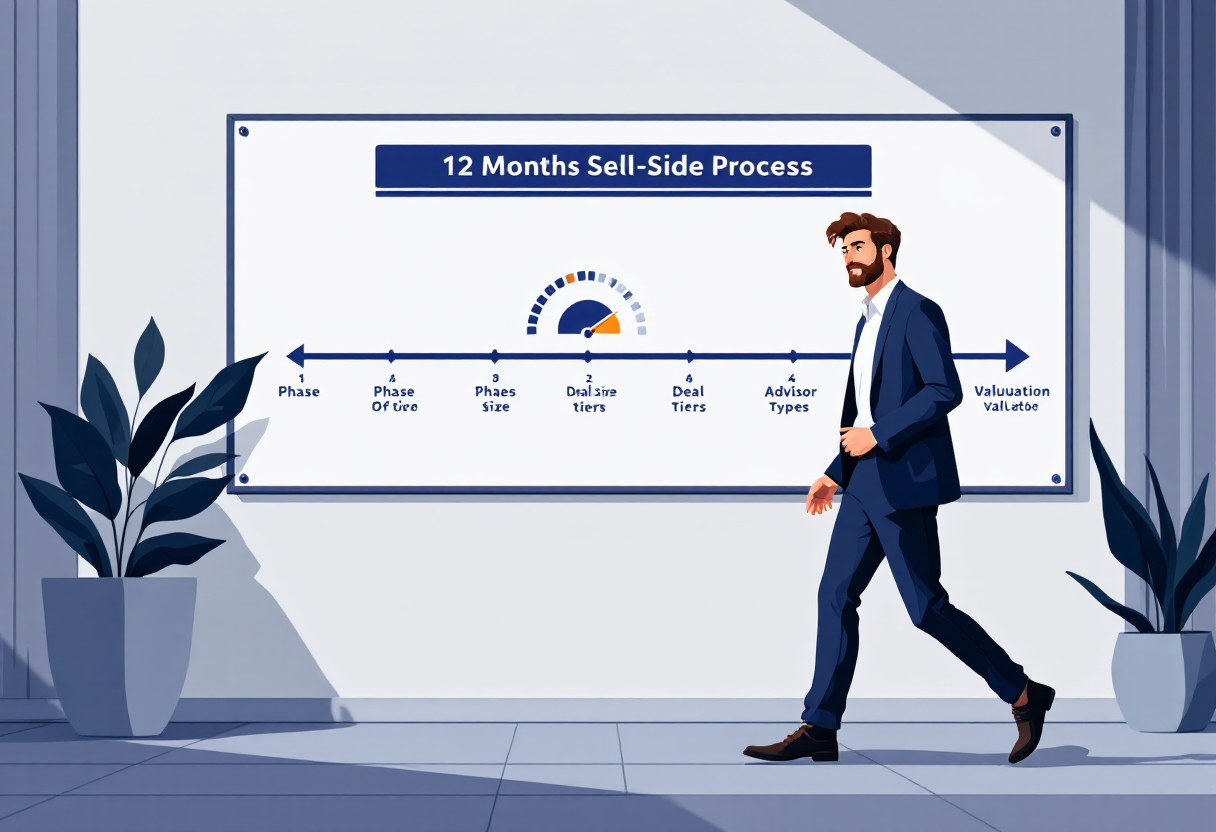
The path to sell a business breaks into five phases. Months one through three are preparation: cleaning financials, getting an independent valuation, picking an advisor, and writing the marketing materials. Months four through six are go-to-market: outreach, NDAs, management meetings, and indications of interest. Months six through eight are letter of intent and exclusivity. Months eight through eleven are due diligence and definitive agreement drafting. Month eleven or twelve is closing, funds flow, and the start of the transition.
Owners who try to shortcut this calendar usually pay for it in price. A rushed process to sell a business signals distress, attracts opportunistic buyers, and ends with a discount of fifteen to thirty percent off a clean-process valuation when selling a business. The Pepperdine Private Capital Markets Project has documented the price penalty for short sale processes across multiple survey years, and it consistently shows up in the data.
Step 1: Define Why You Are Selling (And Be Honest)
Every serious buyer asks the same question in the first management meeting: why are you selling. The answer becomes a recurring data point through the entire process. It shapes the buyer’s risk model, the valuation, the deal structure, and the post-close transition plan. Owners who fumble this question lose credibility in the first thirty minutes. The honest reasons to sell a business cluster in five buckets. First, retirement and age.
Every serious buyer asks the same question in the first management meeting: why are you selling. The answer becomes a recurring data point through the entire process. It shapes the buyer’s risk model, the valuation, the deal structure, and the post-close transition plan. Owners who fumble this question lose credibility in the first thirty minutes.
The honest reasons to sell a business cluster in five buckets. First, retirement and age, which the Exit Planning Institute research shows is the dominant motivation for Baby Boomer owners selling a business. Second, burnout or health, which is legitimate but needs to be paired with evidence that the business runs without the owner. Third, capital concentration, where the owner’s net worth is locked in one private company and they want to diversify. Fourth, a strategic ceiling, where the business has hit a level the owner cannot push past without capital or expertise they do not have. Fifth, a partner dispute or shareholder conflict, which buyers find acceptable if the resolution path is clear.
What does not work is hiding the real reason. If the business is losing a major customer, if a new competitor is taking share, if a regulatory change is about to hit the cost structure, that information surfaces in due diligence. When it surfaces late, buyers retrade the price or walk. Axial’s deal commentary repeatedly emphasizes that surprises during diligence are the single largest cause of broken deals in the lower-middle market.
The owner who wants to understand how to sell a business cleanly starts with the honest answer to this question. Write the answer in two sentences, run it past a trusted advisor, and use it consistently across every buyer conversation. Sister guide: I want to sell my business, now what.
Step 2: Get an Independent Valuation Range
An independent valuation does two things for an owner planning to sell a business. It anchors the owner’s price expectation in market reality, and it produces the working documents a broker or M&A advisor uses to position the business with buyers. Owners who skip this step almost always anchor too high, then either reject reasonable offers or burn out their broker chasing a number the market will not pay when.
An independent valuation does two things for an owner planning to sell a business. It anchors the owner’s price expectation in market reality, and it produces the working documents a broker or M&A advisor uses to position the business with buyers. Owners who skip this step almost always anchor too high, then either reject reasonable offers or burn out their broker chasing a number the market will not pay when selling a business.
The three accepted approaches used to value and sell a business are the market approach, the income approach, and the asset approach. The market approach compares the business to recent transactions of similar companies, drawing on databases like BVR DealStats, PitchBook, and the broker-reported transactions in the IBBA Market Pulse. The income approach uses a discounted cash flow model or a capitalized earnings model. The asset approach values the underlying balance sheet, which is rarely the right method for a going concern but is useful for asset-heavy businesses with low earnings.
For a credentialed independent opinion, owners hire a valuation professional holding one of the three accepted designations: the ASA (Accredited Senior Appraiser) from the American Society of Appraisers, the CVA (Certified Valuation Analyst) from the National Association of Certified Valuators and Analysts, or the ABV (Accredited in Business Valuation) from the AICPA. All three operate under Uniform Standards of Professional Appraisal Practice (USPAP), which is the governing standard for any defensible appraisal.
A formal USPAP-compliant valuation runs $7,500 to $25,000 depending on company size and complexity. A “calculation of value” engagement is cheaper, often $3,000 to $7,500, and is appropriate for pre-sale positioning rather than litigation or tax. Sister guide: when to hire a business valuation expert.
Step 3: Decide on Your Deal Size Tier (Small Biz vs Lower-Middle vs Mid-Market)
The deal size tier determines almost everything that happens next when an owner sets out to sell a business: the advisor you hire, the buyer pool, the documents, the fees, the timeline, and the multiple. Owners who do not know which tier they sit in often hire the wrong advisor and end up running a small-business process for a lower-middle-market company, or vice versa. Selling a business at the wrong.
The deal size tier determines almost everything that happens next when an owner sets out to sell a business: the advisor you hire, the buyer pool, the documents, the fees, the timeline, and the multiple. Owners who do not know which tier they sit in often hire the wrong advisor and end up running a small-business process for a lower-middle-market company, or vice versa. Selling a business at the wrong tier is the most common structural mistake in the market.
The three tiers, with rough boundaries:
Tier 1: Small Business. Annual revenue under $5M and adjusted EBITDA or seller’s discretionary earnings (SDE) under $1M. Most are owner-operated. The typical buyer is an individual searcher, a first-time acquirer using an SBA 7(a) loan, or a small local strategic. Median sale price tracks the BizBuySell Insight Report at roughly 2.4x to 3.0x SDE for the median transaction. The advisor is a business broker, often a one-broker shop or a regional firm. The marketing materials are a one-page teaser and a short confidential information memorandum. The process runs six to nine months.
Tier 2: Lower-Middle Market. Annual revenue between $5M and $50M and adjusted EBITDA between $1M and $10M. Most have a layer of management beneath the owner. The typical buyer is a private equity platform, an independent sponsor, a search fund, a family office, or a strategic acquirer with appetite for a bolt-on. Median multiples track at 4x to 7x adjusted EBITDA, with platform-quality companies in attractive verticals running higher. The advisor is an M&A advisor or a lower-middle-market investment bank. The marketing materials include a full confidential information memorandum, a financial data book with quality of earnings, and a populated virtual data room. The process runs nine to twelve months.
Tier 3: Mid-Market. Annual revenue above $50M and adjusted EBITDA above $10M. The owner is typically chairman or CEO with a full management team. The typical buyer is an upper-middle-market private equity fund, a public strategic, or a sovereign or pension-backed institutional acquirer. Multiples run 7x to 12x or higher for the right asset. The advisor is a middle-market investment bank with sector specialization. The marketing process is a formal managed auction. The timeline runs ten to fourteen months.
Sister guides: how to sell my business mid-market playbook and sell a small business by owner FSBO guide.
Step 4: Choose the Right Advisor (Broker, M&A Advisor, or IB)
The advisor is the second most important decision in the process after the decision to sell a business. The wrong advisor costs an owner selling a business six to twelve months and one to two turns of multiple on the price. The right advisor pays for their fee several times over. A business broker is licensed under state real estate law in some states and operates without a securities license.
The advisor is the second most important decision in the process after the decision to sell a business. The wrong advisor costs an owner selling a business six to twelve months and one to two turns of multiple on the price. The right advisor pays for their fee several times over.
A business broker is licensed under state real estate law in some states and operates without a securities license in others. Brokers handle the small-business tier. Look for credentials including the Certified Business Intermediary (CBI) from the International Business Brokers Association. Reasonable broker fees on small-business transactions run 10 to 12 percent of the sale price with a minimum fee of $15,000 to $50,000.
An M&A advisor handles the lower-middle market. Most operate under FINRA as registered representatives of a broker-dealer, which is required when the sale is structured as a securities transaction (a stock sale, a unit sale of an LLC taxed as a partnership, or any transaction touching securities). Look for membership in the M&A Source and the Alliance of Merger & Acquisition Advisors, and credentials including the Certified Merger & Acquisition Advisor (CM&AA). Fees structure as a retainer plus a success fee, with the success fee running 4 to 8 percent of transaction value depending on size and a Lehman or modified Lehman scale.
An investment bank handles the mid-market and upper-middle market. The bank operates as a FINRA-registered broker-dealer with a deep sector team. Fees run lower as a percentage (1 to 4 percent on the success fee) because the absolute dollars are large, with a meaningful retainer of $50,000 to $250,000 and milestone payments through the process.
The cost difference between tiers is large in percent terms, but the price uplift from running the right process at the right tier is larger. A lower-middle-market company that hires a small-business broker because the fee looked cheaper almost always trades at a small-business multiple. Sister guides: agent to sell my business advisor selection and business broker fees 2026 breakdown.
Step 5: Clean Up Financials and Eliminate Add-Backs
Buyers and their lenders price the business off adjusted EBITDA or, for owners selling a business under $1M of earnings, off seller’s discretionary earnings. Adjusted EBITDA starts with reported EBITDA and adds back legitimate one-time, non-recurring, and personal expenses that a new owner would not incur. SDE is broader, also adding back owner compensation and benefits. Common legitimate add-backs an owner uses when preparing to sell a business include the.
Buyers and their lenders price the business off adjusted EBITDA or, for owners selling a business under $1M of earnings, off seller’s discretionary earnings. Adjusted EBITDA starts with reported EBITDA and adds back legitimate one-time, non-recurring, and personal expenses that a new owner would not incur. SDE is broader, also adding back owner compensation and benefits.
Common legitimate add-backs an owner uses when preparing to sell a business include the owner’s above-market salary, a family member salary that does not match the work performed, personal vehicles or insurance run through the business, one-time legal fees from a settled lawsuit, severance paid for a one-time restructuring, non-recurring consulting expense for a strategic project, and rent paid to an owner-controlled real estate entity at above-market rates.
Buyers reject add-backs that the seller cannot document. They reject add-backs for normal-course-of-business items dressed up as one-time. They reject add-backs for cost categories the new owner will continue (a marketing campaign that drove ongoing revenue is not a one-time expense). The IRS audit risk on aggressive add-backs is also real, because every dollar added back to EBITDA was at some point deducted from taxable income.
For any deal at or above the lower-middle market, the seller commissions a sell-side quality of earnings (QofE) report. A QofE is a deep accounting investigation by a CPA firm that validates each add-back, normalizes working capital, and produces a defensible adjusted EBITDA. A sell-side QofE costs $35,000 to $125,000 and is the single highest-ROI document in the entire process. It compresses buy-side diligence, removes retrade ammunition, and supports a higher multiple. AICPA-credentialed transaction advisory firms produce most QofE reports.
Owners should also clean up the chart of accounts, reconcile every balance sheet line, separate personal expenses cleanly, and produce trailing twelve months financials updated within thirty days of any buyer meeting.
Step 6: Build the Marketing Materials (Teaser, CIM, Data Room)
The marketing materials are the buyer’s first window into the business. For any owner planning to sell a business, they have to be tight, accurate, and produced to the standard of the buyer pool the seller wants to attract. Materials produced for a tier-one buyer get a tier-one process; materials produced for a tier-three buyer do not. The teaser (or executive summary) is a one to two page anonymous document.
The marketing materials are the buyer’s first window into the business. For any owner planning to sell a business, they have to be tight, accurate, and produced to the standard of the buyer pool the seller wants to attract. Materials produced for a tier-one buyer get a tier-one process; materials produced for a tier-three buyer do not.
The teaser (or executive summary) is a one to two page anonymous document that describes the business, the industry, the revenue and EBITDA range, the asking price or range, and a contact for further information. The teaser does not identify the company. It is sent to a curated buyer list to qualify interest before an NDA is signed.
The confidential information memorandum (CIM) is the full marketing document, typically 35 to 75 pages. It contains a business overview, history, products and services, customer concentration analysis, supplier analysis, management team, employee headcount, financial summary with adjusted EBITDA bridge, growth opportunities, and a normalized financial model. The CIM is released only after an NDA is signed.
The data room is the document repository that holds the underlying evidence behind the CIM. It contains audited or reviewed financials, tax returns, customer contracts, supplier contracts, leases, employee agreements, intellectual property registrations, insurance policies, regulatory filings, and corporate governance documents. Modern data rooms run on platforms like Datasite, Intralinks, DealRoom, or Firmex. The seller and the advisor populate the data room before going to market, not after the LOI.
The Wolters Kluwer advisor guidance notes that buyers form their initial price view from the CIM and confirm it in the data room. A weak CIM caps the multiple before a single conversation happens.
Step 7: Identify the Buyer Universe (Strategic, Financial, Search)
Three broad buyer categories compete for private companies when an owner sets out to sell a business. Each pays for different things and demands different things. Strategic buyers are operating companies that acquire to add capability, geography, customers, or product. When selling a business to a strategic, the seller usually realizes the highest headline multiple. They can pay premium multiples because they capture synergies the seller cannot capture alone. Cost.
Three broad buyer categories compete for private companies when an owner sets out to sell a business. Each pays for different things and demands different things.
Strategic buyers are operating companies that acquire to add capability, geography, customers, or product. When selling a business to a strategic, the seller usually realizes the highest headline multiple. They can pay premium multiples because they capture synergies the seller cannot capture alone. Cost synergies (closing redundant overhead, consolidating facilities, eliminating duplicate vendor spend) and revenue synergies (cross-selling to the acquirer’s customer base, exporting the seller’s product into the acquirer’s geography) both support a higher price. Strategic buyers also have an integration plan that affects the seller’s employees, brand, and contracts, which the seller should address before signing.
Financial buyers are private equity firms, family offices, independent sponsors, and search funds. Selling a business to a financial buyer offers a roll-over equity option that participates in a second sale three to seven years later. They acquire to grow earnings over a hold period of three to seven years and then resell. Platform investments in a new vertical command premium multiples because the firm is willing to pay up to establish a foothold. Bolt-on investments to an existing platform pay less because the buyer is more disciplined and has alternatives. Financial buyers expect the existing management team to stay through the hold period and often require the seller to roll over 10 to 30 percent of equity into the deal.
Search-fund and individual buyers are MBAs, ex-operators, and high-net-worth individuals who acquire one business to operate themselves. They dominate the small-business tier and increasingly the lower end of the lower-middle market. Most fund through a combination of SBA 7(a) financing, search fund equity, and seller financing. The SBA 7(a) program finances acquisitions up to $5M with a 10-year amortization, which sets a practical ceiling on the price an individual buyer can pay without a meaningful equity check.
The seller’s advisor builds a curated buyer list of 50 to 500 names depending on tier, segments the list by buyer type, and sequences the outreach.
Step 8: Run a Confidential Auction or Targeted Outreach
The two go-to-market approaches used to sell a business are a broad auction and a targeted outreach . The choice depends on confidentiality risk, deal size, and the preference of the owner selling a business. A broad auction to sell a business releases the teaser to a buyer list of 100 to 500 names. Interested parties sign an NDA and receive the CIM. After two to four weeks, the advisor.
The two go-to-market approaches used to sell a business are a broad auction and a targeted outreach. The choice depends on confidentiality risk, deal size, and the preference of the owner selling a business.
A broad auction to sell a business releases the teaser to a buyer list of 100 to 500 names. Interested parties sign an NDA and receive the CIM. After two to four weeks, the advisor collects non-binding indications of interest (IOIs) from buyers willing to engage further. The seller and advisor invite a short list of five to ten IOI bidders to management presentations and data room access, then collect letters of intent (LOIs) from the finalists. The auction creates price tension and is the dominant format for lower-middle-market and mid-market sales.
A targeted outreach to sell a business narrows the buyer list to 10 to 50 names that the seller and advisor judge most likely to engage, most likely to pay a premium, and most acceptable as future stewards of the company. Targeted outreach reduces confidentiality risk because fewer parties see the materials, and it is appropriate when the seller has strong views about who the right buyer is.
Confidentiality is the dominant operational risk during the go-to-market phase. Employees, customers, and competitors who learn of a pending sale all behave in ways that hurt the deal. Employees update their resumes, customers slow their orders, and competitors recruit the salesforce. The advisor controls confidentiality through NDA discipline, anonymized teasers, staged disclosure, and careful sequencing of the management team’s involvement. Most lower-middle-market sales keep the full employee base in the dark until announcement at signing or closing.
Step 9: Manage NDAs and Buyer Screening
Every party who sees the CIM during the process to sell a business signs a confidentiality agreement first. The NDA covers the existence of the sale process, the information shared, non-solicitation of employees, non-solicitation of customers, and a defined term (typically two to three years). Buyers with operating businesses in the same vertical require additional protections including a non-competition restriction during the diligence window. Before sending the CIM, the advisor.
Every party who sees the CIM during the process to sell a business signs a confidentiality agreement first. The NDA covers the existence of the sale process, the information shared, non-solicitation of employees, non-solicitation of customers, and a defined term (typically two to three years). Buyers with operating businesses in the same vertical require additional protections including a non-competition restriction during the diligence window.
Before sending the CIM, the advisor screens each interested party on three criteria. First, financial capacity, confirmed by a buyer’s funds verification, a private equity firm’s fund size and dry powder, or an SBA pre-qualification letter for individual buyers. Second, strategic fit, confirmed by the buyer’s articulated thesis for the acquisition. Third, deal track record, confirmed by recent closed transactions of comparable size.
Tire-kickers cost the seller weeks of management time and risk confidentiality. Disciplined screening removes them before the CIM goes out. The Alliance of Merger & Acquisition Advisors publishes guidance on buyer qualification that most M&A advisors follow.
Buyer outreach for any deal of size includes a parallel review of antitrust risk. Acquisitions above the Hart-Scott-Rodino filing thresholds (the 2026 size-of-transaction test threshold is $126.4M, adjusted annually by the FTC) trigger pre-merger notification to the FTC and the DOJ. Most lower-middle-market deals fall below HSR thresholds, but mid-market deals frequently trigger filing and add 30 days to the closing calendar.
Step 10: Negotiate the Letter of Intent
The letter of intent is the most important document in the entire process to sell a business. The price set in the LOI rarely goes up. The terms set in the LOI become the baseline for the definitive agreement. An owner selling a business who treats the LOI loosely gives up most of the leverage they spent months building. Owners who treat the LOI as a non-binding formality and accept.
The letter of intent is the most important document in the entire process to sell a business. The price set in the LOI rarely goes up. The terms set in the LOI become the baseline for the definitive agreement. An owner selling a business who treats the LOI loosely gives up most of the leverage they spent months building. Owners who treat the LOI as a non-binding formality and accept the buyer’s first draft give up two to four turns of multiple in the final outcome.
A complete LOI covers nine elements. First, the purchase price and the structure (cash, rollover equity, seller note, earnout, stock consideration). Second, the working capital target and the mechanism for the working capital adjustment at closing. Third, the cash-free, debt-free treatment that defines what comes off the price to compensate for indebtedness. Fourth, the escrow or holdback for indemnification, typically 10 to 15 percent of purchase price for 12 to 24 months. Fifth, the representations and warranties insurance (RWI) approach, which is now standard above $20M in transaction value. Sixth, the exclusivity period, typically 60 to 90 days, during which the seller cannot negotiate with other buyers. Seventh, the conditions to closing (financing, regulatory, key employee retention). Eighth, the treatment of existing management equity and any rollover. Ninth, the post-close employment, consulting, and non-competition arrangement for the seller.
Each element is negotiated. The advisor and the deal lawyer mark up the buyer’s draft, push back on every aggressive term, and force the buyer to lift price or terms in exchange for concessions. The exclusivity clock starts when the LOI is signed, and from that moment the buyer has all the negotiating leverage. Getting the LOI right is the highest-leverage activity in the entire sale.
Sister guide: business exit plan step-by-step guide.
Step 11: Survive Due Diligence
Due diligence is the buyer’s deep investigation of the business. It runs 45 to 90 days after the LOI is signed and consumes most of the bandwidth of the management team selling a business during that window. The buyer’s team typically includes a financial advisor (often a Big Four or a specialized transaction advisory firm), a law firm, an insurance broker, a benefits consultant, an IT and cybersecurity firm, an.
Due diligence is the buyer’s deep investigation of the business. It runs 45 to 90 days after the LOI is signed and consumes most of the bandwidth of the management team selling a business during that window. The buyer’s team typically includes a financial advisor (often a Big Four or a specialized transaction advisory firm), a law firm, an insurance broker, a benefits consultant, an IT and cybersecurity firm, an environmental firm for industrial businesses, and increasingly a customer reference firm and a commercial diligence firm.
The buyer’s diligence requests fall into nine workstreams. Financial diligence verifies the quality of earnings, the working capital, the customer concentration, and the historical results. Legal diligence reviews contracts, litigation, intellectual property, corporate governance, and regulatory compliance. Tax diligence reviews federal, state, sales and use, and payroll tax positions. Operations diligence reviews supply chain, manufacturing, distribution, and key vendor relationships. HR and benefits diligence reviews employee agreements, retention risk, benefit plan compliance, and the ERISA position. IT and cybersecurity diligence reviews systems, data, and breach history. Insurance diligence reviews coverage and historical claims. Environmental diligence reviews permits, contamination history, and any Phase I or Phase II site assessments. Commercial diligence reviews customer references, win rates, and market position.
Surprises kill deals. Axial’s deal data shows that the largest single cause of broken LOIs in the lower-middle market is a material adverse finding in diligence. The defense is a sell-side QofE before going to market, a clean data room that anticipates the buyer’s questions, and a project management discipline that keeps requests flowing and answers on time.
A retrade is a request from the buyer to reduce the price after the LOI is signed, based on a diligence finding. Retrades happen in 30 to 50 percent of lower-middle-market deals according to broker survey data, and the typical retrade reduces price by 5 to 10 percent. Disciplined sellers with a strong sell-side QofE see lower retrade frequency and lower retrade magnitude.
Step 12: Sign the Purchase Agreement and Close
The definitive purchase agreement is a 60 to 200 page contract that documents every term of the deal to sell a business. For an asset purchase, it is an Asset Purchase Agreement (APA). For a stock or unit purchase, it is a Stock Purchase Agreement (SPA) or Membership Interest Purchase Agreement (MIPA). For a merger, it is a merger agreement governed by the relevant state’s corporate code, most often Delaware.
The definitive purchase agreement is a 60 to 200 page contract that documents every term of the deal to sell a business. For an asset purchase, it is an Asset Purchase Agreement (APA). For a stock or unit purchase, it is a Stock Purchase Agreement (SPA) or Membership Interest Purchase Agreement (MIPA). For a merger, it is a merger agreement governed by the relevant state’s corporate code, most often Delaware.
The agreement’s heaviest provisions are the representations and warranties, which are the seller’s contractual statements about the business. Reps cover authority to sell, capitalization, financial statements, taxes, contracts, employees, intellectual property, litigation, compliance with law, environmental matters, and customer and supplier relationships. Each rep that proves untrue after closing triggers an indemnification claim. The indemnification provisions define the basket (the deductible before claims can be made), the cap (the maximum exposure), and the survival period (the time window during which claims can be brought).
Representations and warranties insurance has become standard above $20M in transaction value and is appearing in deals as small as $10M. RWI shifts the indemnification risk from the seller’s holdback to an insurance policy, typically covering 10 to 15 percent of transaction value for a three to six year period at a premium of 3 to 5 percent of the limit. Insurance industry data confirms that RWI use has expanded rapidly in the lower-middle market over the past five years.
Closing involves the wire transfer of funds, the delivery of stock or asset transfer documents, the execution of all ancillary agreements (employment, consulting, non-competition, escrow, transition services), and the satisfaction or waiver of every closing condition. A competent deal lawyer manages the closing checklist that runs 50 to 150 line items. The seller receives the closing wire within hours of signing, sometimes the same day and sometimes the next business day depending on time zones and bank cutoffs.
Step 13: Plan the Post-Close Transition
The transition starts the moment the deal closes and runs for three months to three years depending on structure. Owners who treat the transition as an afterthought damage the business they just sold and either trigger earnout shortfalls or violate the non-compete that protects their consideration. Selling a business well includes selling it cleanly to the next stewards. Common transition structures include a 90-day full-time transition, a 12-month part-time consulting.
The transition starts the moment the deal closes and runs for three months to three years depending on structure. Owners who treat the transition as an afterthought damage the business they just sold and either trigger earnout shortfalls or violate the non-compete that protects their consideration. Selling a business well includes selling it cleanly to the next stewards.
Common transition structures include a 90-day full-time transition, a 12-month part-time consulting agreement, a 24 to 36 month employment arrangement with a defined role, and a board observer or chairman role that extends two to five years. The right structure depends on the buyer’s plan, the seller’s age and energy, the management team’s readiness, and the earnout if any.
The customer communication plan goes out the day of closing or the next business day. Key customers receive a joint call from the seller and the buyer. The salesforce receives the news and a script. The supplier base receives a written notification. The employee announcement happens at signing or closing depending on structure. The seller’s reputation in the industry rides on how this communication is managed, and reputational damage at this stage closes doors for any future venture the seller wants to start.
Earnouts are common in deals where the seller and buyer cannot agree on price for forward-looking growth. A typical earnout pays an additional 10 to 30 percent of total consideration over one to three years if the business hits defined revenue or EBITDA targets. Earnouts work when the seller controls the variables that drive the target. They fail when the buyer makes operating decisions (cutting marketing, raising prices, closing a location) that affect the target. The earnout language in the purchase agreement defines accounting methods, dispute resolution, and the buyer’s obligation to operate the business consistent with past practice.
Common Mistakes That Kill Sales
The same mistakes show up across thousands of broken deals. Owners who study them in advance before trying to sell a business avoid most of them. Trying to sell a business at a number the owner needs for retirement, not a number the market will pay. The market does not care about the owner’s retirement plan. Anchor to the independent valuation and the comparable transactions in the data, not to.
The same mistakes show up across thousands of broken deals. Owners who study them in advance before trying to sell a business avoid most of them.
Trying to sell a business at a number the owner needs for retirement, not a number the market will pay. The market does not care about the owner’s retirement plan. Anchor to the independent valuation and the comparable transactions in the data, not to a personal cash need.
Trying to sell a business with messy financials. The buyer’s first impression is the financial package. Cash basis books, missing reconciliations, and aggressive add-backs without documentation cost a turn of multiple before the first management meeting.
Letting customer concentration creep above 25 percent of revenue with no plan to address it before trying to sell a business. Buyers and lenders both apply heavy discounts for customer concentration. The fix is to either diversify before going to market or to negotiate longer-term contracts with the concentrated customers.
Hiring a small-business broker for a lower-middle-market deal. The broker may be competent within their tier, but the buyer pool, the document standard, and the negotiating sophistication required at the next tier are different.
Signing the buyer’s first LOI draft. Every LOI has 30 to 50 negotiable points. The seller who marks up the draft pulls 5 to 15 percent of price out of the buyer.
Treating due diligence as a checklist instead of a defense. Diligence is the buyer’s window to retrade. Anticipating buyer concerns in the sell-side QofE and the data room removes most of the retrade ammunition.
Forgetting taxes until the wire hits when selling a business. The difference between an asset sale and a stock sale on after-tax proceeds can run 20 to 35 percent of total consideration for a long-held C corporation. The owner who does no tax planning gives that difference to the IRS.
Failing to plan the post-close life after selling a business. The Exit Planning Institute research shows that 75 percent of business owners profoundly regret the sale within twelve months, most often because they did not plan the personal and professional life that comes after. The remedy is to start that planning before the LOI is signed.
Tax Optimization Across the Process
Taxes are the largest single line item in the net proceeds calculation when an owner sets out to sell a business, and the planning to reduce them starts long before the sale. Three levers matter most for any owner selling a business. First, the choice between an asset sale and a stock sale. Asset sales generally favor the buyer (step-up in basis, ability to depreciate intangibles, ability to leave behind.
Taxes are the largest single line item in the net proceeds calculation when an owner sets out to sell a business, and the planning to reduce them starts long before the sale. Three levers matter most for any owner selling a business.
First, the choice between an asset sale and a stock sale. Asset sales generally favor the buyer (step-up in basis, ability to depreciate intangibles, ability to leave behind unwanted liabilities) and disadvantage the seller (more ordinary income on depreciation recapture, double taxation for C corporations). Stock sales generally favor the seller (single layer of tax, all capital gains) and disadvantage the buyer (no step-up). The negotiated price often differs between an asset and a stock structure to compensate for the tax difference, and a competent CPA models both before the LOI is signed. IRS Publication 544 covers the sale of business assets.
Second, Section 453 installment sale treatment. When the seller takes a seller note for part of the purchase price, the gain on the deferred portion is recognized as the note is paid down, not at closing. This spreads the capital gain across multiple tax years and can reduce the effective tax rate by keeping the seller below the highest brackets in any single year. Installment treatment does not apply to publicly traded securities received as consideration and has specific rules under 26 U.S.C. Section 453.
Third, Section 1202 Qualified Small Business Stock (QSBS). If the company was organized as a C corporation, the stock was held for more than five years, and the gross assets were below $50M at the time of stock issuance, the seller may exclude the greater of $10M or 10x basis from federal capital gains tax. The 2026 enactments expanded the QSBS thresholds for newly issued stock under the One Big Beautiful Bill Act, with the cap rising to $15M and the asset test to $75M for stock issued after July 4, 2025. Most owners do not know about Section 1202 until it is too late to qualify, which is why the conversation with a tax advisor should happen years before the sale.
Additional structures to consider include the F reorganization for S corporation sellers (which can convert an asset sale into a stock sale for the buyer’s tax purposes while preserving the seller’s stock-sale tax treatment), the Section 1042 ESOP rollover for owners selling to an Employee Stock Ownership Plan (defers capital gain on a reinvestment in qualified replacement property), Opportunity Zone reinvestment for partial gain deferral, and charitable remainder trusts for owners with significant philanthropic intent. Each requires modeling at least 12 months before signing.
The Exit Planning Institute’s Value Acceleration Methodology and the AICPA Personal Financial Planning Section both publish frameworks that integrate the tax planning with the business sale planning.
Recent SMB, Lower-Middle, and Mid-Market Deals to Study
Three publicly disclosed transactions across the size spectrum show how the principles to sell a business play out at scale. At the small-business end, the SBA 7(a) program data published by the agency shows median acquisition financing of approximately $850,000 in 2025, with median sale prices closing at 2.8x SDE for service businesses and 3.2x for product businesses. Individual searcher and ETA (entrepreneurship through acquisition) deals dominate this range, with.
Three publicly disclosed transactions across the size spectrum show how the principles to sell a business play out at scale.
At the small-business end, the SBA 7(a) program data published by the agency shows median acquisition financing of approximately $850,000 in 2025, with median sale prices closing at 2.8x SDE for service businesses and 3.2x for product businesses. Individual searcher and ETA (entrepreneurship through acquisition) deals dominate this range, with a typical structure of 10 percent buyer equity, 80 percent SBA-guaranteed senior debt, and 10 percent seller note.
In the lower-middle market, a representative example is the 2025 acquisition of a regional HVAC services platform by a private equity-backed strategic. The seller’s $4.2M adjusted EBITDA traded at 7.5x for $31.5M total enterprise value, with $4.0M of rollover equity, a $3.5M seller note, and the balance in cash at close. The transaction was disclosed in the buyer’s S-1 filing when the parent company later went public, and the filing detail in the SEC EDGAR database shows the working capital adjustment, the indemnification structure, and the RWI policy at $3.5M of limits.
At the mid-market end, several 2025 and 2026 strategic acquisitions filed on Form 8-K disclose multiples in the 9x to 13x EBITDA range for software, healthcare services, and industrial technology companies. PitchBook and the GF Data middle-market report both confirm the multiple expansion in software relative to traditional industrials, which is consistent across 2023, 2024, 2025, and the first half of 2026.
Owners studying the size band above and below their own deal get the best feel for market dynamics. BVR DealStats aggregates more than 50,000 closed private transactions and allows filtering by SIC code, deal size, and year, which is the most useful database for owner-side benchmarking.
Academic Evidence on Private Company Sale Outcomes
Academic research on private company M&A is thinner than the public market literature, but two strands inform owners deciding how to sell a business. The NBER working paper series on small business succession documents the rate at which owners successfully transfer businesses and the financial outcomes of those transfers, finding that prepared owners with formal exit plans realize 20 to 30 percent higher net proceeds than reactive sellers. A second.
Academic research on private company M&A is thinner than the public market literature, but two strands inform owners deciding how to sell a business. The NBER working paper series on small business succession documents the rate at which owners successfully transfer businesses and the financial outcomes of those transfers, finding that prepared owners with formal exit plans realize 20 to 30 percent higher net proceeds than reactive sellers. A second strand of research published in the Journal of Finance and the Journal of Corporate Finance on private equity acquisition outcomes confirms that competitive auction processes produce price uplift in the 12 to 23 percent range relative to bilateral negotiations of comparable targets, controlling for size, vertical, and growth profile.
The implication for owners is direct. Preparation, competitive process, and professional representation each add to net proceeds, and the additive effect of all three is the difference between a successful sale and the 70 to 80 percent of sale attempts that the Exit Planning Institute research shows do not close at all.
How CT Acquisitions Runs Sell-Side End-to-End
CT Acquisitions runs sell-side M&A processes for owners across the small-business, lower-middle-market, and mid-market tiers who are ready to sell a business and want a full-service partner. The engagement starts with a no-cost confidential consultation in which the team reviews the financials, the market position, and the owner’s objectives. From that consultation, the team produces a preliminary valuation range and a recommended path forward, including which advisor tier fits the.
CT Acquisitions runs sell-side M&A processes for owners across the small-business, lower-middle-market, and mid-market tiers who are ready to sell a business and want a full-service partner. The engagement starts with a no-cost confidential consultation in which the team reviews the financials, the market position, and the owner’s objectives. From that consultation, the team produces a preliminary valuation range and a recommended path forward, including which advisor tier fits the deal size and which buyer pool to target.
For owners who engage CT Acquisitions, the firm runs every step covered in this article: independent valuation, financial cleanup, sell-side quality of earnings coordination, teaser and CIM production, data room build, buyer list curation, NDA management, IOI and LOI negotiation, due diligence project management, definitive agreement support, and post-close transition planning. The team includes credentialed M&A advisors with CM&AA and CBI designations and has placed transactions across industrial services, healthcare services, business services, and specialty manufacturing.
The firm’s process is documented in the sister playbooks at sell my business 2026 owner playbook, how to sell my business mid-market playbook, and sell a small business by owner FSBO guide. Owners considering a sale should also read I want to sell my business, now what for the decision framework, when to hire a business valuation expert for the valuation step, agent to sell my business advisor selection for advisor type, business broker fees 2026 breakdown for fee structures, and business exit plan step-by-step guide for the full exit plan.
The team can be reached for a confidential consultation at CT Acquisitions / Schedule a Call.
How to Sell a Business: Frequently Asked Questions
How long does it take to sell a business?
The realistic calendar to sell a business is nine to fourteen months from the day an owner decides to sell to the day the wire arrives. SBA guidance cites six to eleven months, and that range assumes three months of preparation work is already complete before the marketing phase starts. Owners who try to close faster than nine months almost always accept a price discount of 15 to 30 percent for the rushed process.
How much does it cost to sell a business?
Total transaction costs to sell a business run 8 to 15 percent of sale price for small businesses and 4 to 9 percent for lower-middle-market and mid-market deals. The largest item is the advisor success fee. Other costs include legal fees of $35,000 to $250,000 depending on size, sell-side quality of earnings of $35,000 to $125,000, valuation of $7,500 to $25,000, and data room and other administrative costs of $5,000 to $25,000.
Do I need a business broker or an M&A advisor?
For businesses with adjusted EBITDA below $1M, a business broker holding a Certified Business Intermediary credential from the International Business Brokers Association is the right tier. For EBITDA between $1M and $10M, an M&A advisor registered with FINRA and credentialed through the M&A Source or Alliance of Merger & Acquisition Advisors is the right tier. Above $10M, an investment bank with sector specialization is the right tier. Matching advisor to tier matters more than fee comparison.
What is adjusted EBITDA and why does it matter?
Adjusted EBITDA is reported EBITDA plus legitimate add-backs for one-time, non-recurring, or owner-discretionary expenses that a new owner would not incur. Buyers price the business off adjusted EBITDA multiplied by a market multiple. A clean adjusted EBITDA validated by a sell-side quality of earnings report supports the highest multiple, while undocumented or aggressive add-backs trigger retrades during due diligence.
What is a sell-side quality of earnings report?
A sell-side QofE is a deep accounting investigation by a CPA firm hired by the seller before going to market. The QofE validates each add-back, normalizes working capital, identifies revenue and expense quality issues, and produces a defensible adjusted EBITDA the buyer’s diligence team accepts. The cost runs $35,000 to $125,000 and is the single highest-ROI document in the sale process at any deal size above $1M in EBITDA.
Should I sell my business to a strategic buyer or a private equity firm?
Strategic buyers can pay higher multiples when buying a business because they capture cost or revenue synergies the seller cannot capture alone, but they often integrate the business and reduce the seller’s role within 12 to 24 months. Private equity firms typically pay slightly lower multiples but keep the management team intact, invest in growth, and offer the seller a roll-over equity position that participates in a second exit three to seven years later. The right choice depends on the seller’s preferences for the business’s future, the management team’s stability, and the rollover economics.
What is a letter of intent and how binding is it?
The LOI is a written offer that sets the price, structure, and key terms of the deal before the definitive agreement is drafted. Most LOI provisions are non-binding, but the exclusivity, confidentiality, and expense provisions are binding from signature. Once signed, the seller cannot negotiate with other buyers during the exclusivity period, which gives the buyer all the leverage. The LOI is the most important document in the entire process and deserves the most careful negotiation.
How do I keep the sale confidential from employees and customers?
Confidentiality when selling a business is managed through a tiered information flow. The teaser is anonymous. The CIM is released only after an NDA. The full data room opens to LOI signers in exclusivity. Within the company, only the seller and a small inner circle (CFO, COO, deal lawyer) know about the process until late stages. The full employee base typically learns at signing or closing, with a coordinated communication script. Most leaks happen through the buyer’s diligence team or the seller’s own employees who notice unusual activity, both of which are controlled through advisor discipline.
What taxes will I owe when I sell my business?
Federal tax depends on the entity structure, the holding period, and the deal structure. A long-held C corporation sold as a stock sale by a qualifying QSBS holder may pay zero federal tax up to the statutory cap. A C corporation sold as an asset sale faces double taxation. An S corporation or LLC sold as an asset sale recognizes some ordinary income for depreciation recapture and capital gain on the remainder. Section 453 installment sale treatment can defer recognition on a seller note. State tax adds 0 to 13.3 percent depending on the seller’s state of residence. The right structure can shift after-tax proceeds by 10 to 30 percent of total consideration, which is why tax planning starts at least 12 months before the sale.
What is the most common reason a sale falls apart?
The most common cause is a material adverse finding during due diligence that the buyer did not anticipate from the marketing materials. The defense is a sell-side QofE before going to market, a clean and complete data room, and disciplined response to buyer diligence requests. The second most common cause is a price retrade that the seller refuses to accept after the LOI. A retrade-resistant LOI with tight conditions, a strong sell-side QofE, and a backup bidder list reduces the seller’s exposure to retrade pressure.
To start a confidential conversation about how to sell a business, schedule a no-cost consultation at CT Acquisitions / Schedule a Call. The team will review the financials, the market position, and the objectives, then recommend a path forward including the right advisor tier, the right buyer pool, and the realistic price range for the deal.