
How to Prepare Your Tree Service Business for Exit in 2026: The 36-Month PE-Buyer Playbook
Preparing your tree service business for exit in 2026 is a 36-month playbook. The first 12 months tighten the operating story around ISA Certified Arborist depth, TRAQ qualification, utility line-clearance contract density, and equipment fleet age. The middle 12 fix pre-LOI diligence gaps around safety EMR, storm-cycle revenue normalization, and technician retention. The final 12 turn one offer into a real competitive process. Named consolidators include SavATree, BrightView Tree Care, Bartlett Tree Experts, Wright Tree Service.
Exiting your tree service business is the single largest financial event most owners will ever face. This guide is the no-fluff playbook for tree service business owners who are 12-36 months from sale, covering how PE-backed buyers actually value your business in 2026, the 12 levers that move your multiple, pre-LOI diligence, deal-killers to fix before going to market, and the full 36-month exit prep timeline.
Updated April 2026 · CT Acquisitions
Most tree service owners decide to sell, hire a broker, and find out 90 days later that their business is worth 30% to 50% less than they thought. Tree service has become one of the most PE-active home-services lanes since 2023, with five dedicated tree-care platforms formed in the 36 months ending Q2 2025 alone (Green Industry Law, “Forests of Deals”, 2025). Platform-quality businesses ($3M+ EBITDA) now trade in the 9x to 13x EBITDA range. But the same business owner who does not prepare can sell the same operation for half that. This guide is the 36-month playbook for how to prepare your tree service business for a sale or exit, built off how the most active tree-care buyers in 2026 actually behave. It covers what private equity buys, the 12 levers that move multiples, the documents PE asks for before they send an indication of interest, and the deal-killers that re-trade tree-care transactions during confirmatory diligence. Every number cites its source.
If you are 6 to 36 months from a possible exit, the work below is what turns a 4x EBITDA outcome into an 8x or 10x outcome. On a $2M EBITDA tree service business, that is the difference between an $8M sale and a $16M to $20M sale. Whether you want to prepare your tree service business for a sale to private equity, prepare your tree service business for an exit to a strategic acquirer like Davey or Bartlett, or simply maximize value over the next 1 to 3 years before going to market, the work below applies. One factor matters more in tree service than in any other home-services trade: workers compensation EMR. NCCI class code 0106 carries some of the highest base WC rates of any trade, and a 5-year EMR trend below 1.0 alone can shift the deal by 1x to 2x of multiple.
Building toward an exit in 12 to 36 months?
CT Acquisitions runs sell-side advisory for tree service and arborist owners at $1M+ EBITDA. We also have tree-care operations specialists in our partner network who run pre-sale optimization engagements when the timeline is longer. No fee to you on buy-side introductions; sell-side mandates are paid on success at closing.
What Private Equity Actually Buys in Tree Service (2026)
For 2026 bookkeeping sale playbook (2x-8x) at 2x-8x SDE/EBITDA with named buyers (Bench, Pilot, FinancePal, Patriot) and PE roll-ups, see our reference.
More than 50 PE firms are actively pursuing platform and add-on investments across landscaping, lawn care and tree services, per multiple industry M&A trackers (Auxo Capital Advisors landscape M&A coverage; Lawn & Landscape PE coverage). Five dedicated tree-care PE platforms were formed in the 36 months ending Q2 2025 alone: Tree Guardians (Halle Capital, 2023), Canopy Service Partners (Alpine Investors, 2023), Tree Care Partners (CPS Capital, 2022), A Plus Tree (Hyperion, 2022), and TreeServe (Soundcore, March 2025). This is a structural shift, not a one-time blip (Green Industry Law, 2025). The sponsor money flowing in is not random. PE buys specific profiles, and the profile you build determines the multiple you get.
The PE-attractive tree service profile
- EBITDA threshold for a platform-quality deal: $1M to $3M is the entry band where sponsor-backed platforms run a competitive add-on process. Above $3M, you become a platform candidate yourself. Above $5M with a healthy commercial mix, you are a true platform target for sponsors like Soundcore, Halle, or Alpine.
- Recurring revenue: Plant Health Care (PHC) penetration above 15% of revenue and 20%+ revenue under annual maintenance or inspection programs is the line between commodity and premium. Recurring revenue is the single biggest multiple driver in landscape and tree services (Auxo Capital Advisors; Beacon Advisors).
- Customer mix: Pure residential demand-only shops trade at the bottom of the band. Companies with utility line-clearance contracts, municipal tree-care MSAs, and commercial property management portfolios command the upper end of revenue multiples (CT Acquisitions, 2026; Peak Business Valuation, 2025).
- Geography: Sun Belt, Texas, Florida, Carolinas, plus dense Northeast and Mid-Atlantic metros are where 2026 sponsor demand concentrates. Stranded geographies discount.
- Customer concentration: No single account above 10% of revenue. Top 5 below 30%. Concentration above 20% triggers buyer pushback; above 25% triggers a 15% to 30% valuation discount or walk (Beancount.io, May 2026; Strategex; Eagle Rock CFO).
- ISA Certified Arborist depth: 3+ ISA Certified Arborists not counting the owner, with at least one Board Certified Master Arborist, one TRAQ holder per region, and one CTSP per crew.
- Workers comp EMR: Below 1.2 is the working threshold; below 1.0 is rare and premium. Tree-worker fatality rate is 30.5 to 41.0 per 100,000 FTE, as much as 11 times the all-industry average (NIOSH FACE; ScienceDirect, 2024). EMR is the most direct proxy for crew-safety culture and a make-or-break input on buyer underwriting.
- Owner role: Owner is in management, not climbing trees, not signing every estimate, not holding the only ISA Certified Arborist credential. GM in place 12+ months pre-sale.
Active tree service PE platforms and strategic acquirers in 2026
The list below covers the most active sponsor-backed and strategic tree-care buyers in the 2024-2026 cycle. This is who will see your teaser. Add-on counts are point-in-time. Sources include SavATree press room and Tracxn (20+ acquisitions), Davey Tree 2024 Annual Report (SEC EDGAR), Bartlett Tree Experts Tracxn list (22 acquisitions), BrightView 8-K filings, PRNewswire on Soundcore and TreeServe, Tree Guardians press releases, Halle Capital, Canopy Service Partners (PitchBook 537716-35), CPS Capital, Hyperion Capital Partners, HCI Equity, Sterling Investment Partners, NMS Capital, New State Capital, Warren Equity, Harvest Partners, Mariani Premier Group press, Ares (Landscape Workshop, May 2025), TruArc (Schill Grounds, January 2026), and Caravel Capital (Arbor Alliance).
| Platform | Sponsor / Owner | Profile |
|---|---|---|
| SavATree | Apax Partners (acquired 2021 from CI Capital) | 20+ acquisitions tracked by Tracxn; 2024 closes including Ken’s Tree Care, T4, Yellowstone Valley Tree Surgeons, Charleston Tree Experts, Cordwin, Organic Plant Care, Tree Mechanics; 2025 Branches Tree Experts (MD); 34+ states; $1M to $10M residential/commercial add-ons |
| Davey Tree Expert Company | Employee-owned ESOP since 1979 (8th largest US ESOP) | 70+ acquisitions since 2008; $1.84B 2024 revenue; 12,000+ employees; 2024: Wiseoak; national plus Canada; $1M to $20M residential and commercial |
| Bartlett Tree Experts | Private, family- and employee-owned | 22+ acquisitions per Tracxn; 2024-2025: Advanced Lawn Care (Boston/Cape Cod), Timberline (Memphis), Race Mountain (Dec 2024), Haupt Tree (Western MA), Britton (Napa), Action Tree (NJ); national plus Canada and UK; premium residential bias |
| BrightView Holdings (NYSE: BV) | Public company | $2.77B 2024 revenue (LM150 #1); July 2025 added Smith’s Tree Care (Newport News VA); commercial-only tree; $3M to $20M commercial |
| TreeServe | Soundcore Capital Partners (12th platform, formed March 2025) | Initial: Princeton Tree Care (NJ) + Clauser Tree Care (PA); Sept 22, 2025: Dave Leonard Tree Specialists (KY) + JL Tree Service (VA/DC); Dec 2025: Schneider Tree Care (Greenville SC); 5 platform companies in 9 months; multi-regional East Coast; $3M to $15M |
| Tree Guardians | Halle Capital (formed 2023) | 8+ partners; 2024: Hoppe (Milwaukee), Herrington (Savannah, Oct 2024), Gamma (St. Louis), Burke’s (NH); 2025: A Budget (Orlando), Caldwell (Roswell GA), Epperson (NC, Dec 2025); national residential; $1M to $5M |
| Canopy Service Partners | Alpine Investors (formed 2023) | Active 2024-2025 with Gray’s (Birmingham), Maguire (CA), Arbor Equity (GA); targeting $3M to $30M revenue partners; national |
| Tree Care Partners | CPS Capital (formed 2022 with Tree Tech) | 11+ add-ons; April 2024 added Knothead Tree and Lawn Care; 10 locations, 64 crews, 330+ staff; US and Canada; hold-forever model |
| Arbor Alliance (formerly Northside Tree Professionals) | Caravel Capital (Atlanta) | 3 deals 2025: Holcomb (Dallas, April), Georgia Tree Co (Atlanta, July), Jacksonville FL (Dec); Southeast plus Texas; $2M to $10M |
| A Plus Tree | Hyperion Capital Partners (acquired Nov 2022) | 2023 adds: Tree Preservation and Landscaping, The Tree Men, Treecology; ~95% commercial customer base, 2,000+ customers across CA/WA/OR/UT; West Coast; $1M to $10M commercial |
| Monster Tree Service | Authority Brands (Apax Partners + BCI) | Acquired by Authority Brands September 2020; 200+ franchise territories; national via franchise model with local certified arborist crews |
| LawnPRO Partners | HCI Equity Partners | 6+ acquisitions; August 2024 added Fairway Lawn & Tree Service (Cape Cod MA); tree, shrub, lawn and pest treatment programs; national residential; $1M to $5M |
| Xylem Tree Experts + Kendall Vegetation Services | Sterling Investment Partners (merger Sept 2022) | ~3,000 employees, 20+ states; August 2023 added Tom’s Tree Service (IA/MO); Sterling pursuing single-asset continuation fund 2025; national utility and storm; $5M to $50M |
| Gunnison Tree Services | Warren Equity Partners (acquired July 2020) | Platform formed June 2021 with Pittman, West Tree Service, Woodson; subsequent: Birchcrest Tree and Landscape; Southeast plus national utility; $2M to $15M |
| Treeways | NMS Capital | Platform: Jaflo (Allentown PA, 1965), Treesmiths, Hazlett Tree Service; utility vegetation Northeast plus Midwest; $5M to $20M utility |
| ArborWorks | New State Capital Partners plus Five Crowns Capital (acquired Nov 2021) | West coast utility line clearance and vegetation management; $5M to $25M utility |
| Yellowstone Landscape | Harvest Partners (acquired 2023) plus Neuberger Berman Capital Solutions minority (Dec 2024) | Tree division embedded; 2025 added Moore Landscapes (Chicago commercial); national commercial; $5M to $30M |
| Landscape Workshop | Ares Private Equity (acquired May 19, 2025 from Carousel Capital) | 38 locations across Southeast; November 2025 added Live Oak Landscape (Charlotte NC); commercial landscape including tree; $3M to $20M |
| Schill Grounds Management | TruArc Partners (acquired January 13, 2026 from Argonne Capital) | OH/KY/PA/IL/IN/MI/Ontario; commercial landscape; founder Jerry Schill stays CEO; $3M to $25M |
Add to that list the strategic acquirers. Davey Tree Expert Company is the largest, $1.84B 2024 revenue, employee-owned ESOP with 70+ acquisitions since 2008. ESOP exits give selling owners a real alternative to PE. Bartlett Tree Experts, private and family- and employee-owned, takes regional residential operations with a premium PHC orientation and integrates them under the Bartlett brand with access to Bartlett Tree Research Laboratories. TruGreen (CD&R-owned), LM150 #3, is active in residential tree and shrub bolt-ons. Asplundh Tree Expert Company, $5.5B+ revenue and the largest single utility vegetation contractor in North America, is the strategic of record for utility-focused operators, along with Wright Tree Service (~$750M revenue) and Lewis Tree Service (~$1.0B revenue). West Coast Arborists, the strategic of choice for California and Arizona municipal accounts, serves 220+ municipalities and operates its own ArborAccess platform with 3,000+ users.
Tree Service Valuation Multiples in 2026 (What You Are Actually Worth)
The multiple a buyer pays comes down to your size, your service mix, your recurring revenue, your geographic fit, and your EMR. Here is the 2026 range, cross-referenced from CT Acquisitions’ tree care valuation guidance, Peak Business Valuation, HedgeStone Business Advisors, Wexford Insurance, KMF Business Advisors, and Beacon Advisors.
SDE multiples (smaller, owner-operated, typically under $3M revenue)
| SDE band | SDE multiple | Profile fit |
|---|---|---|
| Owner-operator, single crew | 1.5x to 3.0x | Demand-only, owner climbing or running estimates (Yourexitvalue.com, 2025) |
| Under $500K SDE, established multi-crew | 2.5x to 3.5x | Mature small operation, multiple crews (CT Acquisitions, 2026) |
| Under $2M revenue, $120K to $350K SDE | 2.5x to 3.5x | Typical small-shop fit (CT Acquisitions, 2026) |
| Industry median residential tree service | 3.14x to 3.64x | Peak Business Valuation tree service multiples, 2025 |
| Premium with certified arborist depth plus contracts | 3.0x to 4.0x | Recurring base, ISA depth, TCIA accreditation (Peak Business Valuation; Beacon Advisors) |
EBITDA multiples (PE-attractive size)
| EBITDA band | Residential multiple | Commercial / Municipal / Utility multiple |
|---|---|---|
| Under $1M EBITDA | 3x to 5x | 4x to 6x |
| $1M to $3M EBITDA ($2M to $10M revenue) | 4x to 6x | 5x to 7x |
| $3M to $5M EBITDA ($10M to $25M revenue) | 6x to 8x | 7x to 9x |
| $5M+ EBITDA, regional platform ($25M to $50M revenue) | 8x to 10x | 9x to 11x |
| Platform-tier ($50M+ revenue, $5M+ EBITDA) | 9x to 12x | 10x to 13x |
Cross-checks: Wexford Insurance puts the broad market at 3.2x to 6.5x EBITDA. HedgeStone Business Advisors places the typical PE band at 3.5x to 5x EBITDA for sub-$1M EBITDA operators. KMF Business Advisors puts well-run multi-crew operations at 4x to 5x EBITDA. The platform-tier 9x to 13x band is consistent with the cadence of new platform formation 2022 through 2025 and with the structure of recent recapitalizations across landscape services. Treat any specific platform multiple as an estimate unless directly cited.
Recent disclosed tree-care transactions (2024-2026)
| Acquirer | Target | Date | Source |
|---|---|---|---|
| Soundcore Capital Partners | Princeton Tree Care (NJ) + Clauser Tree Care (PA) (formation of TreeServe) | March 2025 | PRNewswire “Soundcore Launches Its 12th Platform” |
| TreeServe (Soundcore) | Dave Leonard Tree Specialists (Lexington KY) + JL Tree Service (Fairfax VA) | September 22, 2025 | PRNewswire; PrivSource; PE Hub |
| TreeServe (Soundcore) | Schneider Tree Care (Greenville SC) | December 2025 | PRNewswire |
| BrightView Holdings (NYSE: BV) | Smith’s Tree Care (Newport News VA) | July 2025 | BrightView press release; StockTitan |
| Davey Tree (ESOP) | Wiseoak (tree care, landscaping, property management) | October 2024 | Tracxn Davey acquisitions list |
| LawnPRO Partners (HCI Equity) | Fairway Lawn & Tree Service (Cape Cod MA) | August 2024 | HCI Equity press release; PE Hub |
| Ares Private Equity | Landscape Workshop (majority recap from Carousel Capital) | May 19, 2025 | Businesswire |
| TruArc Partners | Schill Grounds Management (from Argonne Capital) | January 13, 2026 | Businesswire; Crain’s Cleveland |
| Neuberger Berman Capital Solutions | Yellowstone Landscape (minority; Harvest retains majority) | December 23, 2024 | PRNewswire |
| Arbor Alliance (Caravel Capital) | Holcomb Tree Service (Dallas) + Georgia Tree Company (Atlanta) + Jacksonville FL tree care company | April / July / December 2025 | Businesswire; Caravel Capital portfolio |
Specific transaction multiples in tree care are almost never disclosed publicly. Treat any platform multiple as an estimate unless directly cited. Across the deal flow above, the pattern is consistent: platform recaps land in the 9x to 13x EBITDA range, while bolt-on adds to those platforms land in the 4x to 8x range depending on size, recurring mix, and commercial weighting.
The 12 Value Levers That Move Your Multiple (Ranked by Impact)

These are the 12 levers that move tree-service multiples in the 24 months before a sale. Each one has a current state, a target state, and an estimated financial impact. The ordering is by dollar impact per unit of effort, based on cross-source synthesis from Tree Care Industry Magazine Exit Strategies series, Beacon Advisors, Peak Business Valuation, ArborStar, Turf Magazine, CT Acquisitions tree-care valuation guidance, and Auxo Capital Advisors landscape M&A coverage.
Lever 1: Build ISA Certified Arborist and TRAQ depth beyond the owner
Current: Owner is the only ISA Certified Arborist. Owner is the only TRAQ holder. No Board Certified Master Arborist on staff. One or zero CTSP designees. Target: 3+ ISA Certified Arborists not counting the owner; at least 1 ISA Board Certified Master Arborist; 1+ TRAQ holder per region or office; 1+ CTSP per crew; an internal pipeline of climbers progressing toward certification. Impact: Removes the single biggest key-person risk in a tree-service deal. ISA certification is personal and non-transferable per the ISA Certified Arborist Program Guide (August 2025): “Your certification is personal to you and may not be transferred or assigned to any other individual, organization, or entity.” If the owner is the only certified arborist, the buyer is buying a hat and trucks, not a business. Estimated +0.5x to 1.0x EBITDA multiple uplift, and in extreme cases the difference between a deal and no deal. How: Sponsor climber and foreman staff through ISA Certified Arborist exam preparation (Pearson VUE, $310 for ISA members or $440 for non-members), TRAQ course (2-day in-person plus half-day exam, $575 to $950 depending on chapter), and CTSP track via TCIA. Budget 18 to 24 months because experience requirements are real.
Lever 2: Shift revenue mix toward Plant Health Care and recurring inspection programs
Current: 80%+ removal and trimming, 0% to 5% PHC. Target: 15%+ PHC revenue at 30% to 50% gross margin; 20%+ revenue under annual maintenance or inspection programs with auto-renew. Impact: PHC margin runs 30% to 50% versus 15% to 25% for trimming and 10% to 20% for removal (Turf Magazine “Profitability of Tree Care Services”; ArborStar). On a $5M revenue business, shifting $750K of revenue from removal (15% margin) to PHC (40% margin) lifts gross profit by roughly $190K. At a 6x multiple, that lift alone is worth $1.1M+ at sale, and the recurring nature of PHC lifts the EBITDA multiple itself by an estimated +0.5x to 1.0x. How: Train climbing arborists into PHC consultative sales (soil plus disease plus insect inspection bundles); hire a dedicated PHC sales arborist; offer 3-tier annual programs (Basic, Plus, Premium) priced $400 to $1,500/yr per residential property; auto-renew with stored payment; require pesticide applicator licensing across the PHC crew (see Lever 11).
Lever 3: Lift commercial, municipal, and utility mix
Current: 100% residential, demand-only. Target: 30% to 50% commercial property management plus HOA plus municipal plus utility line-clearance revenue. Impact: Commercial, municipal, and utility contracts are the highest-multiple revenue in tree care because they are recurring and contracted. Companies with utility line-clearance contracts and municipal tree-care agreements command the upper end of revenue multiples (CT Acquisitions, 2026; Beacon Advisors; Peak Business Valuation). Estimated +1.0x to 2.0x EBITDA multiple uplift moving from pure residential to balanced mix. How: Hire a commercial sales arborist (typical comp $90K to $140K plus commission); pursue property management portfolios via local CCIM and BOMA channels; bid municipal RFPs (most require TCIA Accreditation or equivalent plus insurance minimums plus ISA Certified Arborist staffing); for utility work, pursue smaller IOU and co-op contracts via subcontract to a regional vegetation-management primary (Asplundh, Wright, Lewis, ACRT, ECI). Note: utility line clearance has its own ISA Utility Specialist credential requirement and prevailing-wage exposure on certain projects.
Lever 4: Move owner out of the chair, install GM 18 to 24 months pre-sale
Current: Owner runs sales, runs crews, holds the ISA Certified Arborist credential, signs every check, is on every estimate above $5K, is the only TRAQ holder. Target: GM in place 12+ months before going to market. Owner doing under 30 hours/week. Sales arborists and crew leads have promoted-from-within leadership. Owner-only roles documented and successor-identified. Impact: Owner-dependence is the single most-cited multiple haircut in tree-care valuation literature (Tree Care Industry Magazine Exit Strategies Parts 3 and 4; Beacon Advisors). On a $1M to $3M EBITDA business, removing key-person risk moves the multiple from the 4x to 5x band into the 5x to 7x band, worth $1M to $6M of price. How: GM hire 18 to 24 months pre-sale (typical GM comp $125K to $200K plus bonus in tree care). Document SOPs. Build a leadership scorecard. Transition customer relationships to sales arborists. Take a 2-week unplugged vacation as a stress test.
Lever 5: Adopt ArborGold or SingleOps and run a real monthly close
Current: Paper tickets, QuickBooks plus spreadsheets, no service-line P&L, no monthly close, technician productivity is anecdotal. Target: ArborGold or SingleOps in place 24+ months, monthly close within 15 days, real KPI dashboard (revenue per crew per day, crew utilization, average ticket per service line, conversion rate, PHC member retention). Impact: Estimated +0.25x to 0.75x multiple uplift, driven mostly by speed and credibility of data-room responses during diligence. Direct EBITDA lift through tighter job costing typically runs 3% to 8% of revenue (industry estimate from ArborGold and SingleOps customer case studies). How: Budget $20K to $80K implementation cost plus per-user license. Force crew adoption by tying payroll to job-completion compliance in the system.
Lever 6: Drive average ticket and pricing discipline
Current: Average ticket below benchmark; tech discretion on pricing; no annual price review; price-out only after work is performed. Target: Flat-rate pricing on common scopes (small tree removal, deadwood pruning, stump grinding); quarterly price book refresh; annual 5% to 8% list-price increase; revenue per crew per day above $1,000 (industry minimum) tracking toward $1,500+ on commercial-mix days. Impact: Direct EBITDA growth. A $5M revenue shop that lifts average ticket 8% adds $400K to revenue, with most of that dropping to EBITDA at tree-service blended gross margins of 40% to 60% (ArborNote pricing; financialmodelslab tree care profitability; TCI Magazine financial metrics). How: Flat-rate price book by scope; estimator training on options-based presentations; eliminate tech discretion on pricing; price all jobs in writing before performance. Track revenue per crew-hour against the ArborStar benchmark of $150+ per crew-hour and $412+ per hour on a 3-person crew.
Lever 7: De-concentrate the customer base and contract assignments
Current: Top customer above 15% of revenue (commonly happens with utility line-clearance subcontracts, large HOA portfolios, or municipal master-services agreements); top 5 above 40%. Target: Top customer below 10%; top 5 below 30%. Every commercial, municipal, or utility contract reviewed for assignment and change-of-control clauses with consent requirements identified. Impact: Concentration above 20% triggers buyer pushback. Above 25% triggers a 15% to 30% valuation discount or buyer withdrawal (Beancount.io, May 2026; Strategex; Eagle Rock CFO). Above 40%, multiple reduction of 1.0x to 2.0x is typical. How: Diversify into new commercial verticals, expand residential geographic footprint, kill the discount on the biggest account so the relative weighting shrinks naturally. For utility subcontracts, pursue parallel work with a second prime to reduce single-utility dependency.
Lever 8: Workers comp EMR improvement
Current: Tree-service industry EMR commonly 1.2 to 1.5. NCCI class code 0106 carries some of the highest base rates of any trade (1800insurance.com; Workers Compensation Shop; insureon). Average rate roughly $9.15 per $100 of payroll, range $3 to $10+. Target: EMR below 1.0 (rare and premium). Documented safety program meeting ANSI Z133 with weekly tailgate meetings, CTSP-led safety oversight, EHAP for all crews working near energized conductors, climber-rescue drills, daily equipment inspection logs. Impact: A strong safety record can reduce WC premium 20% to 40% (1800insurance.com), which on a payroll-heavy tree-service business with WC at $9 per $100 of payroll is a direct 1% to 2% lift to EBITDA. Compounds with the multiple-lift from the safety narrative in DD. Combined estimated impact: 0.25x to 0.75x multiple uplift plus 1% to 2% EBITDA flow-through. This is the lever where tree service differs most from other home-services trades. How: TCIA Accreditation (12 to 18 month process); CTSP designation for safety lead; ANSI Z133-aligned written safety program; near-miss tracking; post-incident root-cause analysis; monthly EMR worksheet review with broker; captive insurance evaluation at $5M+ payroll.
Lever 9: Storm-restoration revenue normalization
Current: Storm-year revenue (a major hurricane, ice storm, or derecho event) is reported as ordinary revenue, inflating LTM EBITDA, or storm revenue is hidden in tree-removal and presented as recurring. Target: Storm revenue separately classified in the chart of accounts. 3-year storm-revenue normalization presented in the QoE bridge (for example, normalize Hurricane Helene revenue down to a 5-year-average storm contribution). Impact: Buyers are highly skeptical of storm-heavy years. If you do not normalize them in the sell-side QoE, the buyer will normalize them lower than you would have, with a 1.0x to 2.0x effective multiple haircut on the inflated EBITDA. Or worse, you carry the storm number into the LOI and then get re-traded at confirmatory. This is the #1 re-trade item in tree-service confirmatory diligence. How: Track storm revenue separately the moment a major weather event hits. Present 5-year storm-contribution as a separate line in the EBITDA bridge. Reference the volatility explicitly in the CIM.
Lever 10: EBITDA add-back hygiene
Current: Owner mixes personal expenses through the business with no documentation; related-party rent at above-FMV (very common in tree service where owner often owns the shop yard, equipment storage, and chip-disposal lot); no add-back schedule. Target: Every potential add-back is documented as it happens with the underlying invoice; related-party rent restruck to FMV with appraisal on file; clean payroll for owner-family members. Impact: Every defensible dollar of adjusted EBITDA is multiplied by the buyer’s multiple. On a 6x multiple, $100K of clean add-backs equals $600K of sale price (Morgan & Westfield QoE guide; Tree Care Industry Magazine “What Business Owners Need to Know About EBITDA”). How: Monthly add-back log starting today. Document business purpose of every charge. FMV rent appraisal if the owner owns the real estate, especially the shop yard and chip-disposal lot, which are often non-trivial real estate footprints in tree service.
Lever 11: Compliance scrub on state contractor licenses, pesticide applicator licenses, and DOT
Current: State tree-contractor license in owner’s name; pesticide applicator license in 1 to 2 individuals; DOT compliance casual; CDL status of bucket-truck drivers undocumented. Target: State tree-contractor license transferable or with a clear post-close qualifier path (California C-49, New Jersey Licensed Tree Care Operator or Licensed Tree Expert, etc.); pesticide applicator licenses held by 3+ individuals (commercial applicator license required in every state where PHC programs are sold per Penn State Extension, Rutgers Pest Management, and multiple state DACFs); DOT compliance documented (USDOT number current, decals displayed, vehicle inspections logged, driver qualification files complete, ELD compliance where applicable per FMCSA); CDL Class A/B status documented for every driver of over 26,001 lb GVWR equipment (Arbortech DOT Compliance Checklist, 2025). Impact: Each of these can kill or re-trade the deal at confirmatory diligence. See the deal-killer section below. How: 24 to 12 month run-up, before the QoE.
Lever 12: TCIA Accreditation
Current: Not TCIA Accredited. Target: TCIA Accredited, with ANSI A300 and ANSI Z133 adherence documented. Impact: Signals safety, business hygiene, and bid-qualification for municipal and large commercial work. Required or strongly preferred on many municipal and utility RFPs. Estimated +0.25x to 0.5x multiple plus access to higher-margin commercial work that itself drives premium pricing (TCIA Accreditation program page; ArboStar tree care associations guide). How: 12 to 18 month application and inspection process. Budget $2K to $7K in fees plus internal documentation time. Annual surveillance audits follow.
Want to grow your business to maximize value before exiting?
We connect tree service owners with operations experts in our partner network who run 12 to 24 month pre-sale optimization engagements covering PHC build-out, ISA certification depth, EMR improvement, and commercial sales arborist hiring. The engagement pays for itself in incremental sale price.
What PE Asks Before They Send an LOI (The Pre-LOI Diligence Stack)
Before a PE firm commits to a letter of intent, they ask for a focused diligence package. The list below is the real ask from a 2026 PE firm targeting a tree-service business in CT Acquisitions’ pipeline. The “why” and “how to prepare” expand each item to what is typical across the industry. Tree service has two diligence items that no other home-services trade has: a 5-year EMR history under NCCI class 0106, and a full inventory of personal ISA credentials held by the owner and any staff.
1. Income Statements for 2024, 2025, and the latest trailing twelve months
Why PE asks: They are building the TTM EBITDA they will multiply. They want trend (growth rate, margin trajectory), seasonality (tree service revenue typically peaks April through October with a storm-driven spike in winter and early spring depending on geography), and any one-time movers. LTM is the bridge between the most recent year-end and today, so the headline price reflects current run-rate, not stale data.
How to prepare: Accrual-basis P&L by month, mapped to a clean chart of accounts. Service-line P&L (removal, trimming and pruning, plant health care, stump grinding, emergency and storm, commercial and municipal contracts) where possible. Reconcile to tax returns so there are no surprises in confirmatory diligence.
2. Balance sheet at the latest month
Why PE asks: Two reasons. First, to size the working capital peg they will set in the purchase agreement. Tree service is seasonal, so the peg matters. Second, to identify net debt (cash minus interest-bearing debt minus debt-like items including unfunded customer deposits, deferred revenue on prepaid annual PHC plans, accrued bonuses, accrued workers comp deductible, equipment lease balances). Both peg and net debt come out of the purchase price.
How to prepare: Tie the balance sheet to the trial balance. Isolate deferred revenue on prepaid PHC and inspection programs separately on the balance sheet (Maxwell Locke & Ritter on Deferred Revenue Treatment; CFO Secrets “Working Capital In M&A”).
3. Adjusted EBITDA bridge with add-back documentation
Why PE asks: They want the adjusted EBITDA story before they sink diligence cost into the file. Aggressive or undocumented add-backs discount the rest of your numbers.
How to prepare: Bridge from book EBITDA to adjusted, line by line. Document every add-back with invoice or payroll record. Common tree-service add-backs that hold up: owner compensation above market (owner pays self $250K but GM market rate is $150K means $100K addback per Tree Care Industry Magazine “Do You Know the EBITDA for Your Tree Care Company”), one-time legal fees, owner family-member payroll for unclear duties, owner vehicle and personal travel, owner health insurance and country-club, COVID-era ERC, software conversion one-time costs, related-party rent above FMV, one-time equipment purchases (a crane purchase year, for example), and storm-year revenue normalization. The storm normalization addback is sensitive; see Lever 9 above.
4. Anonymized employee roster (titles, start dates, pay, classification, certifications)
Why PE asks: Two risks. First, tech and climber retention versus industry churn. With a fatality rate 11x the all-industry average and physically demanding work, retention is a constant battle in tree care. Second, owner dependence and arborist concentration. If the owner is the only ISA Certified Arborist, the buyer treats it as a deal-killer key-person risk because ISA certification is personal and non-transferable per the ISA Certified Arborist Program Guide (August 2025).
How to prepare: Roster columns: role, hire date, full-time vs. part-time, W-2 vs. 1099 with classification rationale, comp structure (hourly, salary, commission, per-job production pay), and any active non-compete or non-solicit. Tree-service required: ISA Certified Arborist status, TRAQ status, ISA Board Certified Master Arborist status, ISA Utility Specialist status, EHAP (Electrical Hazards Awareness Program) status, Certified Treecare Safety Professional (CTSP) status, pesticide applicator license status by state, state-specific tree contractor license status (California C-49, New Jersey LTCO or LTE, etc.), CDL Class A or B status for bucket truck and chipper drivers, and CPR or First Aid currency. Calculate and disclose 12-month and 24-month rolling tech and climber retention.
5. Revenue breakdown by service line with job counts and average ticket
Why PE asks: The single most diagnostic exhibit. It tells the buyer (a) service mix (removal is volatile, high-ticket, low margin; trimming and pruning are recurring-cycle, medium margin; PHC is highly recurring, premium margin; storm and emergency are highest single-ticket but volatile; commercial and municipal recurring are lowest margin but highest multiple); (b) whether average ticket is growing, flat, or declining; (c) whether job count is growing through capacity or pricing.
How to prepare: Pull it from ArborGold, SingleOps, or whatever software you run. Three columns at minimum: total revenue by service line, jobs by service line, average ticket per service line, year over year 2022 through 2025 plus LTM. Reference benchmarks: top-performing tree-care crews generate over $150 per crew-hour ($412+ per hour for a 3-person crew) per ArborStar; target $1,000+ revenue per crew per day at the minimum; target crew utilization above 80% to 85% (financialmodelslab tree care profitability; TCI Magazine financial metrics).
6. Customer concentration (top 10 by revenue, with revenue per year for last 3 years)
Why PE asks: Tree service is a unique concentration story. Residential is highly fragmented but margins are lower. Commercial property management accounts, HOA contracts, municipal contracts, and utility line-clearance contracts are sticky and high-multiple, but a single account at 20%+ of revenue triggers haircut pricing or a buyer walk. Utility contracts are typically multi-year but have re-bid risk that buyers price in.
How to prepare: Top 10 customer concentration analysis. Contract review for assignment and change of control clauses. For municipal and utility contracts, identify renewal dates and any incumbent re-bid windows. If a single utility customer is above 20% of revenue, expect a concentration discount or a walk (Beancount.io May 2026; Strategex; Eagle Rock CFO; Wall Street Prep).
7. Recurring revenue snapshot (PHC subscribers, annual inspection program members, commercial recurring contracts)
Why PE asks: This is the multiple lever. They want absolute count, growth rate, churn and renewal rate (target 80%+ annual renewal on PHC), plan mix, average revenue per member, and the deferred revenue liability from prepaid annual programs.
How to prepare: Member count by month for the last 36 months. Renewal rate calculation. Revenue per member. Plan-mix breakdown. ARR snapshot. Isolate deferred revenue on the balance sheet from prepaid annual PHC programs.
8. Five-year business plan
Why PE asks: They underwrite a forward case (years 1 through 5 post-close). They want a credible growth story and a sense of how aggressive you are. They will overlay their own model on top, but your plan tells them whether you understand your own levers.
How to prepare: A simple operating model: revenue by service line, gross margin assumptions, overhead growth, EBITDA. Include crew build (climbers, ground crew, foremen, sales arborists), planned expansion territories or service lines (for example, adding PHC if not present, adding a commercial sales arborist), pricing actions, and commercial pipeline.
9. Equipment and fleet list
Why PE asks: Three reasons. First, CapEx forecast. Bucket trucks have 7 to 10 year useful life, chippers 8 to 12, stump grinders 10 to 15, cranes 15 to 25. The buyer models replacement capex post-close. Second, capital lease vs. owned vs. financed split. Leased equipment is debt-like and comes out of purchase price. Third, specialty equipment depth. Crane, grapple truck, mini-loader drive commercial-job capability and support premium multiples.
How to prepare: Spreadsheet: vehicle or equipment number, make/model/year, mileage or hours, ownership status (owned, financed, leased, residual), monthly payment if any, condition rating, DOT inspection status (annual for bucket trucks and chip trucks), wrap status. Flag any trucks needing immediate replacement (over 200K miles, expired DOT).
10. Insurance and workers comp schedule with EMR history
Why PE asks: Tree care is NCCI class code 0106 (Tree Pruning, Repairing or Trimming), one of the highest-rate WC class codes in any trade. Your 5-year EMR history is the single most direct proxy for crew-safety culture and a make-or-break input on buyer underwriting.
How to prepare: 5-year EMR history. 5-year OSHA 300 and 300A logs. Claims history with reserve amounts. List of safety certifications (TCIA Accreditation, CTSP staff, EHAP, CPR or First Aid currency).
11. Org chart with key-person identification
Why PE asks: They want to see whether the GM is in place, whether the sales arborist team can survive without the owner, whether there is depth at the ISA Certified Arborist level, and which roles are owner-only.
How to prepare: Org chart with role, reporting line, tenure, ISA, TRAQ, CTSP, and pesticide credential status, comp band, and key-person flag.
Confirmatory Diligence (After You Sign the LOI)
Once an LOI is signed and exclusivity starts (typically 45 to 90 days per Colonnade Advisors podcast 020), the buyer runs parallel workstreams. This is the depth of inspection your tree-service business will undergo. If anything was hiding, it surfaces here.
- Quality of Earnings (QoE). Outside accounting firm runs revenue cut-off testing (storm-month spikes are the most-scrubbed item in tree-care QoE), deferred revenue analysis (prepaid PHC plans), expense normalization, add-back validation, working capital trends. Buyer’s QoE cost: $50K to $250K typical for a $1M to $10M EBITDA tree service.
- Customer concentration and commercial DD. Customer-by-customer revenue analysis, calls with top commercial, municipal, and utility accounts, contract review (assignment, change of control, renewal dates, prevailing wage flow-through clauses on public projects).
- IT systems audit. ArborGold, SingleOps, ArborStar, or whatever ERP and FSM is in place. Data quality, integration capability with the platform’s stack, license counts, master data hygiene. ServiceTitan adoption in tree care is rising but still trails HVAC and plumbing materially.
- Legal. Entity good standing in every operating state, state tree-contractor licenses, pesticide applicator licenses, contracts assignment, IP, litigation history (especially any prior fatality or wrongful death), warranty and callback liability, real estate leases.
- HR and payroll. W-2 vs. 1099 classification audit (critical for crew labor; see Section 6 below), I-9 compliance, wage-and-hour exposure (overtime classification, prevailing wage compliance on public projects), Davis-Bacon flow-through for federal-funded tree work, benefits, PTO, EEOC and DOL claims, non-compete enforceability.
- Safety. OSHA inspection and citation history pulled directly from the OSHA database, ANSI Z133 compliance documentation, internal injury logs, workers comp claims history with reserves, EMR worksheet for the last 5 years.
- Environmental. Pesticide use records (state-mandated for PHC programs, retention 2 to 5 years depending on state per Penn State Extension and Maine DACF), used-oil and fuel and hydraulic disposal at the shop, any UST or vehicle-shop environmental exposure on owned real estate (Phase I ESA).
- Tax. Federal income, payroll, sales/use, property. Sales tax on labor and materials in states that tax tree services (varies by state and by residential vs. commercial; emergency storm work for insurance carriers has its own treatment in some states).
Why You Should Pay for Your Own Quality of Earnings Before Going to Market
A sell-side QoE is your own outside accountant’s QoE, paid for by you, before you go to market. In tree service it does four things: it pre-empts the buyer’s QoE by getting to the adjusted EBITDA number first with documentation; it normalizes storm-revenue volatility, which is the single most-scrubbed item in tree-care QoE; it surfaces issues you can fix before the buyer sees them (deferred revenue on prepaid PHC plans, working capital seasonality, add-back documentation); and it tightens the EBITDA number you take to market, directly driving headline price.
Cost
- $25K to $35K for QoE if revenue is below $10M (Eton Venture Services, 2025; Morgan & Westfield).
- $35K to $75K typical range for sell-side QoE on a healthy tree-service business with multiple service lines, PHC, and commercial contracts.
- Up to $150K for businesses with complex storm-revenue normalization, multiple entities, owner real-estate situations, or messy books.
ROI
A typical sell-side QoE in tree service costing $50K that supports a 1x multiple lift on a $2M EBITDA business returns $2M of price, a 40x ROI on the QoE investment (Citrin Cooperman; Warren Averett; KMCO sell-side QoE benefit articles; SC&H sell-side QoE guide). The tree-service-specific upside is even larger when the QoE properly normalizes a storm-heavy year. If you took 2024 LTM EBITDA at $2.5M to market and the buyer’s QoE re-cuts it to $1.8M after Helene-revenue normalization, that is a $4.2M to $5.6M re-trade at a 6x to 8x multiple. A pre-market QoE that handles the normalization for you, with documentation, pre-empts the re-trade.
Deal-Killers That Re-Trade Tree Service Transactions (Avoid These)
These are the recurring kill-shots cited across tree-care M&A advisory content and confirmatory diligence checklists. They turn a clean LOI into a re-trade, a holdback, an escrow, or a walk. Most are fixable in 12 to 24 months. None are fixable in 30 days.
1. Owner is the only ISA Certified Arborist (or the only TRAQ holder, or the only state contractor license qualifier)
ISA Certified Arborist certification is personal and non-transferable per the ISA Certified Arborist Program Guide (August 2025). TRAQ is personal and runs on a 7-year cycle. State contractor licenses (California C-49, New Jersey LTCO or LTE) require a qualifying individual. If that individual is the owner and they leave on closing, the buyer is buying a shell. This is the #1 tree-service deal-killer. Fix per Lever 1 above.
2. State contractor license and pesticide applicator license gaps
California’s old C-61 / D-49 was replaced with the new C-49 Tree and Palm Contractors license effective January 1, 2024 (California CSLB; Digital Constructive; Contractors I School). New Jersey requires statewide Licensed Tree Care Operator (LTCO) or Licensed Tree Expert (LTE). Multiple other states require state-level tree-contractor licensure with a qualifying individual. Pesticide applicator licenses are required in every state for PHC programs; they are state-specific with limited reciprocity (Rutgers; Penn State Extension; Maine DACF; Minnesota DACF). Buyer’s legal DD pulls all licenses; gaps trigger remediation or escrow holdback.
3. Workers comp EMR above 1.2 with thin documentation
Tree service is NCCI class code 0106, one of the highest-rate WC codes in any trade. EMR above 1.2 plus a sparse OSHA 300 log plus thin safety documentation reads as a chainsaw-and-heights accident waiting to happen, even if claims have been benign. Buyers price in either a premium step-up post-close or an indemnity escrow. Industry context: tree-worker fatality rate is 30.5 to 41.0 per 100,000 FTE, 11x the all-industry average (NIOSH FACE; ScienceDirect, 2024).
4. OSHA citation history and ANSI Z133 noncompliance
OSHA has no formal tree-care standard; instead, OSHA references ANSI Z133 (the Z133-2026 version became available digitally in May 2026 per ISA). OSHA cites Z133 sections when no OSHA standard applies (Tree Safety Institute; TCIA OSHA Standard advocacy page). Citation history on the OSHA database is public and is the first thing buyer’s legal counsel pulls. A pattern of serious-violation citations, especially involving felled-tree struck-by or fall-from-height incidents, is a re-trade item.
5. W-2 vs. 1099 misclassification on crew labor
Tree-service crews are commonly miscategorized as 1099 to dodge payroll tax. The IRS published a specific tree-removal case (IRS Form 14430-A example) where a groundsman was ruled W-2 because the employer controlled hours, methods, and equipment. Misclassification settlements range $10K to $100K+ per worker once back taxes, penalties, interest, and legal cost are aggregated. Worker misclassification is a top enforcement priority for both IRS and DOL (US DOL Misclassification page; ADP SPARK; IRS Worker Classification 101). Any single SS-8 filing by a former contractor opens a workforce-wide audit.
6. Customer concentration above 20% on a utility or municipal contract
Utility line-clearance work and municipal master-services agreements are sticky but re-biddable. A single utility account at 25%+ of revenue with a re-bid window inside the 5-year forward case triggers either a holdback or a 15% to 30% valuation discount, regardless of contract length. Buyers also pull contract-assignment and change-of-control clauses; many municipal and utility MSAs require consent on change of control.
7. Davis-Bacon and prevailing wage exposure on public-funded tree work
Davis-Bacon applies to federally-funded construction over $2,000 (US DOL Davis-Bacon Acts page; DOL Wage Determinations). Tree-removal and tree-trimming labor on federally-funded right-of-way and roadway projects can be classified as covered construction, alteration, or repair work depending on contract scope. Many state prevailing-wage statutes are broader. Tree contractors who have worked public projects without paying prevailing wage carry retroactive wage-claim exposure that surfaces in HR DD.
8. DOT noncompliance on bucket trucks and chippers
Bucket trucks above 26,001 GVWR require Class B CDL (Class A if towing a chipper over 10,000 lbs) per FMCSA. USDOT number requirement applies to commercial vehicles crossing state lines or above certain weight thresholds. Pre-trip inspection logs, driver qualification files, drug testing program enrollment, hours-of-service compliance, ELD where applicable. Tree-service operators routinely run sub-26,001 GVWR chip trucks specifically to avoid CDL requirements; buyer DD verifies actual GVWR and CDL status of every driver of every covered vehicle (Arbortech DOT Compliance Checklist, 2025; FMCSA Hours of Service FAQ). Gaps trigger fines and a deal-quality discount.
9. Pesticide applicator records gaps
Every state mandates pesticide-use recordkeeping for commercial applicators running PHC programs. Records typically required: applicator name and license number, date, location, product (EPA registration number), rate, target pest, environmental conditions; retention period typically 2 to 5 years depending on state (Penn State Extension; Mississippi State Extension; Maine DACF). Missing or incomplete records during DD trigger remediation, fines, or escrow.
10. Storm-revenue inflation in LTM EBITDA
Storm-driven revenue (hurricane, ice storm, derecho) inflates LTM EBITDA if it is not separately disclosed. The buyer’s QoE will normalize storm revenue down to a 5-year average. If the seller has not done that normalization in the sell-side QoE, the buyer’s adjustment becomes a 1.0x to 2.0x effective multiple haircut on the inflated number. This is the most common re-trade in tree-service confirmatory diligence.
11. Deferred revenue on prepaid annual PHC plans not isolated
Prepaid annual PHC programs (paid in January for the full year’s treatments) create a deferred revenue liability that buyers treat as debt-like, not working capital (Maxwell Locke & Ritter Deferred Revenue Treatment; CFO Secrets working capital). If this is not isolated on the balance sheet, the buyer will surface it during confirmatory DD and convert it from working capital to net debt, reducing purchase price by the prepaid balance. On a 2,000-member PHC program with $800 average annual fee billed in January, this can be $1M+ of price.
12. Owner real estate held in operating entity at above-FMV rent
The owner-owned shop yard, equipment storage, and chip-disposal site are typically non-trivial real estate footprints in tree service (often 1 to 5 acres in suburban-rural geography). Held in the operating entity at above-FMV rent, this distorts EBITDA up. Held in a sibling LLC at above-FMV rent, this is an add-back that needs documentation. Either way, the buyer wants FMV rent on a NNN basis and a clear path to either assume the lease or buy the real estate (Plante Moran sale-leaseback primer; Northmarq sale-leaseback guide).
13. Crane and specialty equipment leased rather than owned, with lease assignment restrictions
Large cranes, grapple trucks, and the most expensive bucket trucks are often financed or leased. Lease agreements may have anti-assignment clauses or change-of-control triggers requiring lessor consent. Equipment leases also count as debt-like items at close. Surface and resolve before LOI.
The 36-Month Exit Prep Timeline
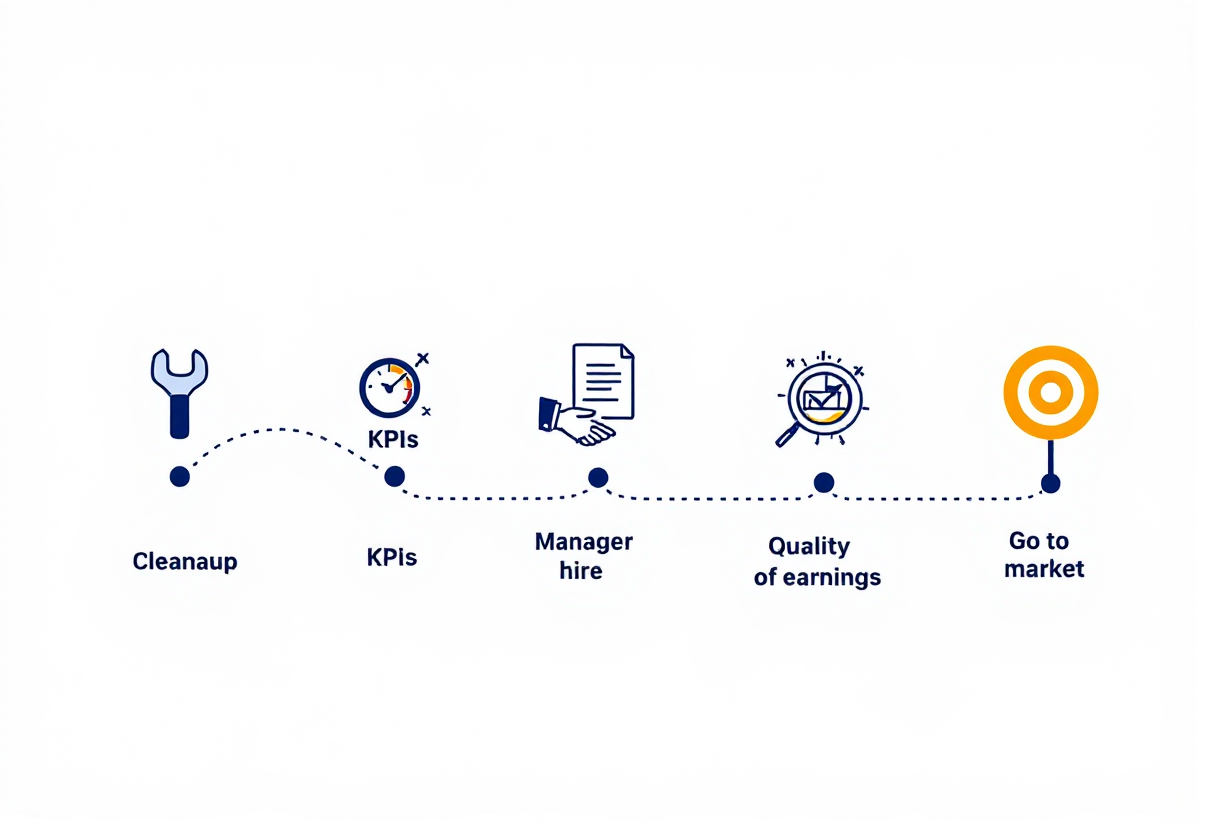
T-36 months: Cleanup phase
- Switch to accrual basis if still on cash basis
- Adopt ArborGold or SingleOps (budget 6 to 12 month implementation)
- Start tagging every potential EBITDA add-back as it happens
- Conduct W-2 / 1099 audit; reclassify if needed (settle exposure now while it is small)
- Restruck related-party rent (especially shop yard) to FMV with appraisal
- Build the org chart and identify the GM hire (internal promotion target or external recruit)
- Phase I ESA on any owned real estate (shop yard, chip-disposal lot)
- Sales/use tax compliance review by outside counsel in every operating state
- Begin building ISA Certified Arborist depth (Lever 1): identify 3 climbing arborists or foremen for sponsored exam track
- Begin TCIA Accreditation application (12 to 18 month process)
- Pull 5-year EMR history from WC carrier; build EMR improvement plan with broker
T-24 months: Financial discipline and KPI infrastructure
- GM hire onboarded and starting to take operational load
- Monthly close in 15 days; service-line P&L every month (removal, trimming, PHC, stump, storm, commercial recurring)
- KPI dashboard (revenue per crew per day, crew utilization, average ticket per service line, conversion rate, PHC retention, EMR)
- Launch or expand PHC program toward 15%+ revenue
- Pricing review: 5% to 8% list increase, dispatch fee held
- Begin diversification of customer base if any top customer is above 15%
- Hire commercial sales arborist if commercial mix is below 30%
- Document SOPs for every operational role
- Build the add-back bridge as a living document
- TCIA Accreditation in progress or achieved
- Storm revenue separately tracked in chart of accounts
T-12 months: QoE-ready close discipline, eliminate owner dependence
- Owner steps out of daily operations; GM runs the shop
- Owner takes a 2-week unplugged vacation as the stress test
- Run the sell-side QoE (budget $35K to $75K)
- Tighten balance sheet: clean A/R, kill dormant inventory, isolate deferred revenue on prepaid PHC
- Final org-chart review; backfill any gaps in ISA Certified Arborist, TRAQ, and pesticide applicator coverage
- Final compliance scrub (state contractor license transferability, pesticide records, W-2 / 1099, sales/use tax, DOT, OSHA)
- Final environmental scrub (pesticide records retention, fuel and oil disposal records, Phase I ESA)
- Lock in 12 months of clean service-line P&L for the CIM
- 5-year EMR trend confirmed downward, with a clean OSHA 300 log
T-6 months: Pre-marketing prep
- Engage M&A advisor (sell-side investment bank or M&A advisory firm specializing in home services and outdoor services). Typical fee structure: $25K to $75K monthly retainer credited against success fee of 4% to 8% of enterprise value with Lehman or modified Lehman scaling
- CIM drafted from the QoE and operating model. CIM highlights ISA-credential depth, TCIA accreditation, EMR trend, PHC penetration, commercial and municipal recurring mix
- Teaser drafted (anonymized 1-pager)
- Buyer list finalized. Realistic first-call list for a $1M to $5M EBITDA tree-service business: the 19 platforms in the table above, weighted by geography and customer-mix fit, plus strategic strategics like West Coast Arborists, RYAN Lawn & Tree, Almstead, Heartwood, and regional Russell Tree Experts
- Virtual data room populated with everything from the pre-LOI and confirmatory sections above
- Management presentation deck built and rehearsed
T-3 months: Go to market
- Teaser distributed; NDAs collected; CIMs distributed
- IOIs collected 2 to 3 weeks after CIM goes out
- Narrow to 4 to 6 finalists for management meetings (always include 1 strategic, 1 platform PE, 1 newer PE platform, 1 ESOP candidate)
- Management meetings; LOIs solicited
- Select LOI; sign with exclusivity (typically 45 to 90 days)
- Enter confirmatory diligence; close
End-to-end from advisor engagement to close: 9 to 12 months in a well-run process. Total runway from “I want to sell in 2 to 3 years” to closed: 24 to 36 months (Auxo Capital Advisors sell-side process guide 2025; Wall Street Prep sell-side primer; Colonnade Advisors podcast 020).
Frequently Asked Questions
How long should I plan for before selling my tree service business to a private equity buyer?
The owners who get top-quartile pricing start preparing 24 to 36 months before going to market. The minimum useful prep window is 12 months, because most of the high-leverage levers (lifting PHC penetration from under 5% to 15%+, getting 3 climbers ISA-certified, installing a GM, getting the EMR trend below 1.0, running a sell-side QoE) need 12+ months of clean trailing-twelve-months data to be credible to a buyer. Owners who try to sell in under 6 months typically leave 20% to 40% of enterprise value on the table.
What is a realistic EBITDA multiple for a $1.5M EBITDA tree service business in 2026?
For a residential tree service business at $1.5M EBITDA in 2026, the range is 4x to 6x. The bottom of that range applies to demand-only shops with under 5% PHC revenue, an owner who is the only ISA Certified Arborist, EMR above 1.3, and a concentrated customer base. The top applies to shops with 15%+ PHC revenue, 30%+ commercial mix, a GM in place, 3+ ISA Certified Arborists not counting the owner, EMR below 1.0, and customer concentration under 10% (CT Acquisitions tree-care valuation guidance, 2026; Peak Business Valuation, 2025; Wexford Insurance; HedgeStone Business Advisors). For a commercial-weighted tree service at the same $1.5M EBITDA level, the range shifts to 5x to 7x. The 36-month prep playbook moves you from the bottom of the band to the top.
Should I get a quality of earnings report done before going to market?
For tree service businesses at $1M+ EBITDA, yes. A sell-side QoE costs $35K to $75K typical, up to $150K for complex storm-revenue normalization or multi-entity situations (Eton Venture Services, 2025). The ROI is leverage. If your QoE supports a 1x multiple uplift on a $2M EBITDA business at a 6x baseline, that is $2M of additional sale price for a $50K investment, a 40x return. More importantly, a pre-market QoE handles storm-revenue normalization for you, with documentation, before the buyer’s QoE does it against you during exclusivity. Storm-revenue re-trades are the #1 re-trade in tree-service confirmatory diligence.
What percentage of plant health care or commercial recurring revenue do PE buyers want to see?
For PHC, the threshold that moves your business from commodity pricing into premium is 15% or more of revenue, at 30% to 50% gross margin, ideally with an auto-renew structure and an 80%+ annual renewal rate. For commercial, municipal, and utility recurring contracts, the threshold is 30% or more of revenue. Hitting both PHC at 15%+ and commercial recurring at 30%+ is what moves you from the 4x to 6x band into the 6x to 8x band on $1M to $3M EBITDA (CT Acquisitions, 2026; Beacon Advisors; Peak Business Valuation; Auxo Capital Advisors). The two are independent levers and they stack.
Will the buyer keep my crews and ISA Certified Arborists after they buy my business?
In almost every PE-platform deal, yes. Platforms like SavATree (Apax), TreeServe (Soundcore), Tree Guardians (Halle), Canopy Service Partners (Alpine), and Bartlett Tree Experts buy the business specifically because of the crews and the ISA-credentialed staff. Platforms typically retain crew leads with retention bonuses or rollover equity, hold field staff at existing comp or better, and integrate the brand under their platform name over 6 to 18 months. Where staff cuts happen is in duplicated back-office (bookkeeping, dispatch, HR) when the platform consolidates those functions. The diligence-stage employee roster and the close-day retention plan are designed to keep your crews and your ISA Certified Arborists.
My state tree-contractor license is in my name. Will it transfer to the new owner?
Generally, no, not automatically. California’s C-49 Tree and Palm Contractors license (replacing the old C-61 / D-49 effective January 1, 2024 per California CSLB) requires a qualifying individual with verified experience. If you are the qualifier, the buyer must designate a new qualifier with the required experience and pass-through within a set period or risk license suspension. New Jersey’s Licensed Tree Care Operator (LTCO) and Licensed Tree Expert (LTE) work the same way. The fix is to identify and qualify a non-owner staff member (typically the GM or a senior arborist) for the state license 12 to 24 months before going to market, so the license stays in place after the owner exits. This is one of the most common quiet re-trade items in tree-service confirmatory diligence (Friends of Urban Forests states requiring tree service provider registration).
What to Do Next
The tree service owners who get the top-quartile multiple all do the same three things. They start preparing 24 to 36 months before they want to be out. They get 3 climbers or foremen ISA-certified, install a GM 12+ months pre-sale, and drive EMR below 1.0. And they invest in a sell-side QoE that normalizes storm revenue before any buyer sees a CIM.
Tree service is one of the most PE-active home-services lanes in 2026. The buyer pool is real, the platform recapitalizations are happening at 9x to 13x EBITDA, and the structural tailwind is years deep. But the same buyer demand that produces top-quartile outcomes for prepared sellers also produces bottom-quartile outcomes for unprepared ones. The difference is 24 months of work.
If you are 12+ months from a potential exit and want a structured pre-sale optimization roadmap, CT Acquisitions has tree-care operations specialists in our partner network who run multi-quarter prep engagements covering PHC build-out, ISA certification depth, EMR improvement, commercial sales arborist hiring, and TCIA Accreditation. If you are 6 to 12 months out and ready to start the sell-side process, our M&A advisory team runs the buyer outreach to the platforms named above. No fee to you on buy-side introductions; sell-side mandates are paid on success at closing. Either way, the first 30 minutes are free.
Ready to talk?
Schedule a 30-minute exit-readiness call
Or read more: Sell Your Tree Service Business (active sale guide) | How to Sell a Tree Service Business in 2026 | Tree Care Business Valuation 2026: 8 Factors That Drive Multiples
Ready to Explore Your Options?
A 30-minute confidential conversation is all it takes.
