
Boat and RV Storage Business for Sale? How to Find, Price and Buy One (2026)
If you are looking at a boat and RV storage business for sale, you are buying two things at once: commercial land and a small operating business that rents parking spaces, canopies or enclosed units to vehicle owners. This guide shows where these facilities get listed, how to price them on a cap rate versus the seller’s cash flow, what the latest market data says, what to check in diligence, and what the purchase agreement should cover.
Christoph Totter · Managing Partner, CT Acquisitions
20+ home services M&A transactions across HVAC, plumbing, pest control, roofing · Updated October 5, 2026
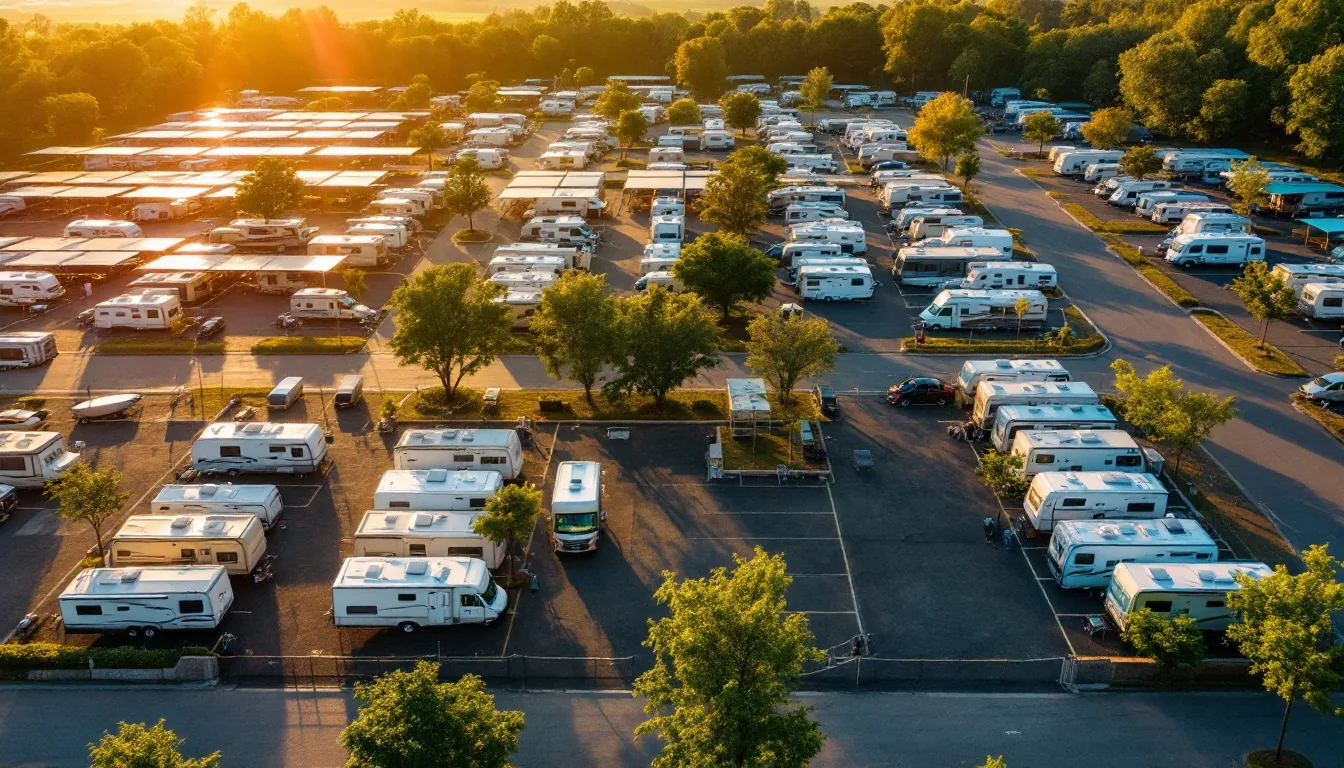
Boat and RV storage businesses for sale show up in three places: business-for-sale sites like BizBuySell and BusinessBroker.net (smaller lots, priced on the seller’s cash flow), commercial real estate sites and storage brokerages (larger facilities, priced on a cap rate), and off-market through owners and banks. Price every deal on your own normalized NOI, not the seller’s cash flow figure.
The short version
- Small lots are quoted on seller’s discretionary earnings (SDE), larger facilities on a cap rate. Convert both to NOI before you compare.
- Yardi Matrix counted 55 sales of dedicated RV and boat storage properties in 2025 as of its fall report, at over $570,000 per acre.
- Parking rents rose 4.4% year over year in September 2025 (Yardi Matrix), but heavily built markets such as Houston and San Antonio were close to flat.
- Underwrite reassessed property tax, paid management and a capital reserve. Owner-run P&Ls often leave all three out.
Where boat and RV storage businesses for sale are listed
Listings sit in separate markets, and each one quotes price differently. Search only one and you see a slice of what is for sale.
| Channel | What you will find | How price is quoted | Watch for |
|---|---|---|---|
| Business-for-sale sites: BizBuySell, BusinessBroker.net | Small owner-run lots, mixed storage sites | Asking price and seller’s cash flow (SDE) | Whether the land is included or leased |
| Commercial real estate sites: LoopNet, Crexi | Stabilized facilities sold as investment property | Cap rate on NOI, price per acre | Pro forma NOI shown as actual |
| Storage brokerages: national and regional teams | Larger and newer facilities, small portfolios | Offering memorandum, cap rate, call for offers | Short bid deadlines, fund competition |
| Banks and lenders | Foreclosed facilities, often new builds | Negotiated, thin operating history | Low occupancy, missing records |
| Off-market owners | Older family-owned lots | Whatever you agree | Cash-heavy books, owners not ready |
The lender channel is real. REBusinessOnline reported in February 2026 that Marcus & Millichap sold A-Affordable Boat & RV Storage in Valley View, Texas, a 451-unit facility built in 2023, for Ciera Bank, which had foreclosed on it in early 2025. No price was disclosed. New facilities that miss their lease-up plan come back to market through lenders.
Off-market deals take more work and often come with better terms. Map every storage lot in your target area using satellite views and county parcel records, pull each owner from the assessor, send a short letter and follow up by phone. Local marinas, RV dealers and boat repair shops know which lots are full and which owners are tired. Our guide to finding off-market self storage businesses covers the outreach in more detail.
CT Acquisitions is an M&A advisory firm for founder-owned businesses and works both sides of the table: on the buy side we find, vet and negotiate acquisitions for buyers, and on the sell side we run confidential sales for owners. How we are paid depends on the mandate, and you will know the terms in writing before any work starts.
What you are buying: land, product mix and a small operating business
A boat and RV storage facility is land, the improvements on it (paving or gravel, fencing, gates, cameras, canopies or buildings) and a business that rents space month to month. Most sites mix three products.
| Product | What it is | Rent | Build cost signal |
|---|---|---|---|
| Uncovered | Open parking behind a fence and gate | Lowest | About $15 per sq. ft. for basic fencing and asphalt (Toy Storage Nation) |
| Covered | Canopy roof, open sides | Middle | Another $30 to $50 per sq. ft. for canopies (Toy Storage Nation) |
| Enclosed | Garage-style units with doors | Highest | Highest; StorTrack found enclosed units at hybrid sites price about 55% above purpose-built enclosed storage |
Rent per square foot falls as spaces get bigger. In September 2025, Yardi Matrix put national advertised rates at $7.73 per square foot a year for small parking units (10×20 to 10×30), $4.92 for medium (12×20 to 12×30) and $3.80 for large RV-size units (12×40 to 12×50). A big RV space earns more per month but less per foot of land, so layout drives revenue.
Sector size depends on who counts. Yardi Matrix tracks 2,060 completed dedicated facilities plus 21,913 self storage properties that rent RV parking. StorTrack, with a wider definition, counted about 4,800 dedicated and 28,500 hybrid facilities in January 2026. Treat broad “undersupply” claims with care and measure your own trade area.
RV storage is not an RV park, which rents nightly sites and runs like hospitality (see how to buy an RV park). A site that is mostly enclosed units underwrites like traditional self storage, covered in our self storage acquisition guide.
How boat and RV storage businesses are priced: cap rate vs SDE multiple
Sellers price these facilities in two languages, and mixing them up is the most common way buyers overpay. A cap rate is net operating income divided by price, where NOI is after every operating cost, including paid management. An SDE multiple is price divided by seller’s discretionary earnings, which add back the owner’s pay and perks.
| Cap rate pricing | SDE multiple pricing | |
|---|---|---|
| Earnings measure | NOI, management and reserves paid | SDE, owner pay added back |
| Usually quoted for | Stabilized, larger facilities | Small owner-run lots |
| Land | Included by definition | Sometimes leased: ask |
| Main trap | Pro forma rents, old tax bills | Owner labor you will have to pay for |
Price divided by NOI is the cap rate turned upside down:
| Cap rate | Price as a multiple of NOI | Price for each $100,000 of NOI |
|---|---|---|
| 6% | 16.7x | $1,666,667 |
| 7% | 14.3x | $1,428,571 |
| 8% | 12.5x | $1,250,000 |
| 9% | 11.1x | $1,111,111 |
| 10% | 10.0x | $1,000,000 |
So a listing asking 5x SDE with the land included implies a cap rate far above what institutional buyers pay. Either it is a bargain, the land is not in the deal, or the cash flow will not survive diligence. It is usually one of the last two.
There is no public cap rate index for RV and boat storage. Cushman & Wakefield’s self storage outlook puts traditional self storage cap rates at an average of 5.8% over the latest six quarters it reported, after an all-time low of 5.0% in the fourth quarter of 2022. MMCG Invest, a feasibility consulting firm, wrote in April 2026 that dedicated RV and boat storage has historically traded 50 to 150 basis points wider than self storage, with stabilized Class A around 6.0% to 7.5% and Class B around 7.5% to 8.5%, and that the gap is narrowing. Small, older lots often sit outside those bands, so your own NOI rebuild matters more than any benchmark. Our self storage valuation guide applies the same method to enclosed facilities.
Two sanity checks help. Yardi Matrix estimated $256 million of 2025 sales volume across 55 properties, about $4.7 million per property on average (our math). And Toy Storage Nation’s development example puts a 3-acre, 190-space facility at about $2.3 million including land. Paying well above replacement cost where open land exists invites a new competitor next door.
Worked example: underwriting a 200-space facility
This is an illustration, not a real deal. The facility has 60 small (10×20), 90 medium (12×30) and 50 large (12×40) spaces. Rents use Yardi Matrix’s September 2025 national averages per square foot: about $129, $148 and $152 a month, or $343,920 a year at full occupancy. At an assumed 90% occupancy plus an assumed $9,000 of fees, effective gross income is $318,528.
| Line (annual, illustrative) | Seller’s P&L | Your underwriting |
|---|---|---|
| Effective gross income | $318,528 | $318,528 |
| Property tax (old assessment vs reassessed) | $14,000 | $38,000 |
| Insurance | $16,000 | $16,000 |
| Management (owner unpaid vs 6% of income) | none | $19,112 |
| Part-time site payroll | $24,000 | $24,000 |
| Utilities, repairs, software, gate, card fees, marketing | $23,000 | $23,000 |
| Capital reserve | none | $6,000 |
| Total expenses | $77,000 | $126,112 |
| NOI | $241,528 | $192,416 |
| Value at a 7.5% cap rate | $3,220,373 | $2,565,547 |
Same facility, same rents, same cap rate: a $654,827 gap, all from three costs the seller never paid. Taxes are the one buyers miss most. In California, for example, a change in ownership triggers reassessment to market value under Proposition 13, so the seller’s bill tells you nothing about yours.
Now test the debt. Pay $2,560,000 plus an assumed $60,000 of closing costs. The SBA minimum equity is 10% of that $2,620,000 project, or $262,000, leaving a $2,358,000 loan. At an assumed 7.75% rate over 25 years, debt service is about $213,728 a year. NOI of $192,416 covers that only 0.90 times, and SBA lenders need at least 1.15 times. Reaching 1.15 at that rate means a loan of about $1,846,000 and roughly $774,000 of equity, about 30% of the project. Run this before you sign a letter of intent.
Check the local market before you offer
National numbers hide wide local swings. Yardi Matrix’s Fall 2025 National RV & Boat Storage Report shows the split:
- National advertised parking rents rose 4.4% year over year in September 2025, the strongest reading since Yardi began tracking them.
- Markets with little new supply led: Los Angeles up 12.8%, New York and Connecticut 11.4%, Chicago 7.7%.
- Heavily built markets lagged: San Antonio 0%, Houston 0.5%, Kansas City 0.7%, Jacksonville 1% and Dallas 1.9%. In the slowest markets, supply delivered over 36 months averaged 19.7% of inventory, against 13% nationally.
- Acres under construction fell to 2.3% of inventory, from 3.3% a year earlier.
Then do the local work: call every competitor your tenants could reasonably drive to for rates and availability, ask the planning office about approved storage projects, check whether nearby HOAs ban driveway RV and boat parking, and get the seller’s monthly move-ins and move-outs for two years.
Due diligence checklist for an RV and boat storage acquisition
- Rent roll vs bank deposits. Tie 12 to 24 months of rent roll to bank statements. Cash rent and side deals show up here.
- Tenant files. Read the storage agreements, the delinquency list and any abandoned vehicles. State storage lien laws set the steps to sell abandoned property, and titled vehicles and boats often need extra notice.
- Zoning. Get written proof that outdoor vehicle storage is permitted, plus any conditional use permit.
- Environmental. Order a Phase I assessment. The EPA’s All Appropriate Inquiries rule recognizes the ASTM E1527-21 standard. Fuel, oil, dump stations and wash bays are the usual concerns.
- Title, survey and drainage. Confirm boundaries, easements, access and stormwater permits.
- Property tax. Ask the assessor how a sale changes the assessed value.
- Insurance. Get a binding quote before diligence ends; canopies carry wind and hail exposure.
- Physical condition. Paving, fencing, gates, cameras, lighting, canopies and any electrical service.
- Systems and brand. Confirm the software, gate system, phone number, website and reviews transfer.
- Supply pipeline. Recheck planning records right before closing.
Financing and tax: what to line up early
SBA 7(a) loans are the common route for owner-operators. Under the SBA’s SOP 50 10 8, effective June 1, 2025:
- The maximum standard 7(a) loan is $5,000,000.
- A complete change of ownership needs equity of at least 10% of total project costs. A seller note counts only if it is on full standby for the life of the loan and covers no more than half of the required equity.
- When at least 51% of the loan funds real estate, maturity can run up to 25 years.
- Debt service coverage must be at least 1.15 times.
- A third-party manager with sole discretion over operations makes the borrower an ineligible passive business. You must keep control of the budget, large spending, bank accounts and staff.
Lender appetite for storage varies, so talk to two or three SBA lenders before you offer. Our SBA 7(a) acquisition loan guide covers the process. Larger facilities usually use conventional commercial real estate loans.
In an asset purchase, buyer and seller each report the price split on IRS Form 8594. Land cannot be depreciated, but fences, roads and similar land improvements are 15-year property under IRS Publication 946. Under the One Big Beautiful Bill Act, qualifying property acquired after January 19, 2025 is eligible for 100% bonus depreciation (IRS Notice 2026-11). Ask your CPA about a cost segregation study before you agree on the allocation.
The agreement to sell a boat storage business: what it should cover
Most boat and RV storage deals close with a purchase and sale agreement for the land and improvements, plus an asset purchase agreement or bill of sale for the business: tenant agreements, equipment, gate and software systems, the name and the phone number. Have a real estate attorney and a business attorney review both, because each side has traps the other misses. The clauses that matter most:
- Price allocation between land, improvements, equipment and goodwill, matching your Form 8594.
- Rent roll warranty. The seller assigns every storage agreement and warrants the rent roll. Prepaid rent and deposits are credited to you at closing.
- Delinquent tenants and abandoned vessels. Who handles defaults, items left behind and lien sales already started.
- Zoning and permits as a closing condition.
- Environmental contingency tied to a clean Phase I report.
- Separate deadlines for diligence, financing and title.
- Transition and non-compete. The seller helps for a set handover period and does not open a competing lot nearby.
Agree the main terms in a letter of intent first, then hand them to counsel.
How to buy a boat and RV storage business, step by step
- Set your buy box: product mix, size, location and price range.
- Source in every channel: listing sites, storage brokers, lenders and direct owner outreach.
- Screen fast: rent roll, 12 months of deposits and the site plan, converted into NOI and a cap rate.
- Rebuild NOI and model the debt at 1.15 times coverage.
- Sign a letter of intent with price, deposit, diligence period and financing terms.
- Run diligence with attorneys, the environmental consultant and the lender in parallel.
- Close with insurance bound and tenant notices ready.
- Run the first 90 days quietly: hold rents, change gate codes, contact every tenant and walk every space before you change anything.
Frequently Asked Questions
Where can I find a boat and RV storage business for sale?
Smaller lots are listed on BizBuySell and BusinessBroker.net. Larger facilities appear on LoopNet and Crexi or through storage brokerages. Banks sell foreclosed facilities, and many good deals are off-market: find lots on county parcel maps, look up the owner and contact them directly.
How much does a boat and RV storage business cost?
Price depends mostly on acreage, product mix and occupancy. Yardi Matrix reported 2025 pricing of over $570,000 per acre, and its estimated $256 million of volume across 55 sales works out to about $4.7 million per property on average.
What cap rate should I pay for an RV and boat storage facility?
There is no public index. MMCG Invest estimated in April 2026 that stabilized Class A facilities trade around 6.0% to 7.5% and Class B around 7.5% to 8.5%, wider than self storage, which Cushman & Wakefield puts at about 5.8%. Small, older lots often trade outside those bands.
Should I value a storage lot on SDE or on a cap rate?
Start from SDE if that is what the listing shows, then subtract a market management fee, reassessed property tax and a capital reserve to get NOI. Divide NOI by the price to see the cap rate you are paying.
Can I use an SBA loan to buy an RV storage business?
Often, yes. Under SOP 50 10 8, SBA 7(a) loans go up to $5 million, need at least 10% equity on a change of ownership and require 1.15 times debt service coverage. A third-party manager with sole control makes the business ineligible.
What should an agreement to sell a boat storage business include?
It should transfer the land and the business, allocate the price, assign every storage agreement and credit prepaid rent and deposits at closing. It also needs zoning proof, a Phase I contingency, rules for delinquent tenants and abandoned boats, and a seller transition period and non-compete.
Is boat and RV storage a good business to buy?
It can be, because staffing needs are light. The risk is local supply. Yardi Matrix found 2025 rents close to flat in heavily built markets such as Houston and San Antonio, while markets with little new building posted double-digit gains. Buy where new supply is hard to add.
Want a Specific Read on Your Business?
30 minutes, confidential, no contract, no cost. You leave with a read on your local buyer market and a likely valuation range.
30 N Gould St, Ste N, Sheridan, WY 82801, USA · (307) 522-0262 · Contact