
Horizontal vs Vertical Integration Explained
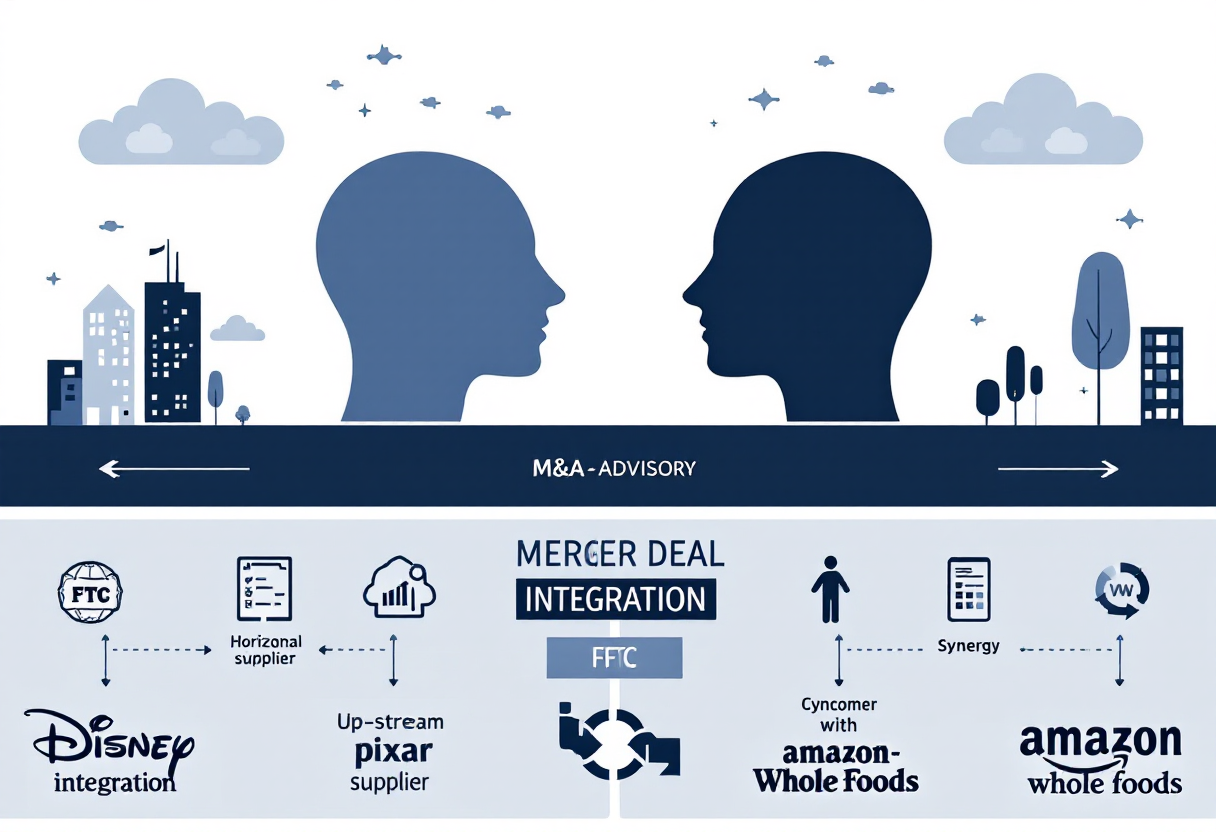
Horizontal vs vertical integration is the single biggest strategic choice on the M&A whiteboard: buy a competitor at your level, or buy a supplier or distributor above or below you. Each path reshapes margin structure, regulatory risk, and exit multiple in opposite directions. This guide walks the definitions, the named deals, the antitrust law that now governs both, the decision signals that point one way or the other, and the cases where integration of either type went badly wrong.
Horizontal vs Vertical Integration: The Short Answer
Horizontal integration is buying a competitor at the same stage of the value chain to gain market share, scale economies, and pricing power. Vertical integration is buying a supplier upstream (backward integration) or a customer or distributor downstream (forward integration) to internalize a margin, lock in supply, and own customer data. Horizontal deals get bigger; vertical deals get longer. The federal antitrust agencies now analyze both under one document, the 2023 Merger Guidelines issued December 18, 2023.
What Is Horizontal Integration?
Horizontal integration is the consolidation play. Two companies doing the same thing at the same stage of the value chain combine, and the merged entity has more units, more customers, more pricing power, and (usually) lower per-unit costs because fixed costs spread over a bigger revenue base. Picture a value chain laid out left to right: raw materials, components, manufacturing, distribution, retail, end customer. Horizontal integration buys sideways at the same point on that chain.
One-line examples: Two regional HVAC contractors merging to cover an entire metro. Two software firms with overlapping ideal customer profiles combining to cross-sell. Disney buying Pixar to consolidate animation studios. Exxon buying Mobil to combine integrated oil majors. Facebook buying Instagram to fold a competing photo-sharing network into the same social-graph layer. Kroger trying (and failing) to buy Albertsons to combine two of the largest US grocery chains.
For a deeper treatment of the deal structure itself, see our explainer on what is a horizontal merger.
What Is Vertical Integration?
Vertical integration is the control play. A company decides that owning an input or a channel matters more than buying it on the open market, and buys the counterparty instead of contracting with it. A bakery buys its flour mill (backward integration). A flour mill buys a bakery chain (forward integration). A streaming service buys a studio. A telecom buys a content library. Each move internalizes a stage of the value chain that used to sit with a third party.
Vertical integration splits into two directions. Backward integration moves upstream, toward suppliers and raw materials. Forward integration moves downstream, toward distributors, retailers, and the end customer. Apple buying P.A. Semi in 2008 to design its own chips is backward integration. Tesla running its own dealerships and Supercharger network is forward integration. Both flavors aim to capture a piece of the value chain, but the operating risk profiles are very different.
For the structural side specifically, see our companion piece on what is a vertical merger and on forward integration strategy and examples.
Horizontal vs Vertical Integration at a Glance
The two strategies trade off across almost every dimension a board cares about. Strip the case-study fog away and the comparison looks like this.
| Dimension | Horizontal Integration | Vertical Integration |
|---|---|---|
| Direction on the value chain | Sideways (same stage) | Up or down (different stage) |
| Target relationship | Competitor | Supplier or distributor or retailer |
| Primary goal | Scale, market share, cost takeout | Margin capture, supply security, data ownership |
| Capital intensity | Pay for an existing book of business | Pay for assets in a different cost structure |
| Time to value | 12 to 24 months | 24 to 60 months |
| Regulator risk | Direct: market concentration | Indirect: input or customer foreclosure |
| Synergy type | Mostly cost | Mostly revenue and margin capture |
| Integration risk | Cultural, headcount, ERP | Operational, talent gap, new P&L discipline |
| Exit consequences | Higher multiple from scale | Higher multiple from structural moat |
| Classic failure mode | Cultural blowup year one | Wrong operating system year three |
Horizontal Integration Examples
Horizontal integration drives most of the largest deals on record because the strategic logic is easy to explain to a board and the synergy math is easy to model. The following deals all consolidated competitors at the same stage of the value chain.
Disney and Pixar (January 2006, $7.4 billion)
Two animation studios at the same stage of the entertainment value chain. Disney got Pixar’s creative engine and the Steve Jobs-led leadership culture, Pixar got Disney’s distribution muscle and a controlling stake in the combined creative future. The completion was filed with the SEC as a Disney 8-K dated May 8, 2006. The deal is the textbook case of horizontal integration where the cultural fit problem was solved by leaving the acquired creative team almost entirely alone.
Disney and Marvel (December 2009, $4 billion) and Lucasfilm (October 2012, $4 billion)
Two more horizontal consolidations at the same content layer. Disney bought Marvel’s IP catalog and applied the same acquired-creative-autonomy playbook from Pixar under Kevin Feige; the Avengers-era box office validated the deal arithmetic. Three years later Disney picked up Star Wars and Indiana Jones. Combined with Pixar, the three deals turned Disney from a legacy studio into the dominant intellectual property holder in family-and-franchise filmmaking.
Disney and 21st Century Fox (March 2019, $71.3 billion)
The largest of the Disney horizontal stack, stacking film and TV libraries onto the existing Disney catalog ahead of the Disney+ streaming launch. The closing was filed as a TWDC 8-K dated March 20, 2019. Disney consolidated FX, National Geographic, the Fox film library, and a majority stake in Hulu, all sitting at the same value chain stage as existing Disney assets.
Exxon and Mobil (November 1999, $81 billion)
The largest oil industry merger in history at the time and a defining horizontal deal of the late 1990s consolidation wave. Two of the seven sisters from the broken-up Standard Oil trust reunited under a single corporate roof. The FTC reviewed the deal under the Clayton Act and required divestiture of more than 2,400 retail gas stations to clear it, documented in the FTC complaint and consent order in Exxon Corp. and Mobil Corp.. Same stage of the petroleum value chain, more upstream reserves, more downstream pumps, classic horizontal scale play.
Facebook and Instagram (April 2012, $1 billion)
A small horizontal deal at the time that became a benchmark acquisitions in modern antitrust. Two photo-sharing social networks combining. The FTC closed its original review in 2012 without action; eight years later the same agency filed a monopolization case against Meta and continues to argue, as of the trial that opened in April 2025, that the Instagram and WhatsApp acquisitions together gave Meta monopoly power over personal social networking services and should be unwound.
Facebook and WhatsApp (October 2014, $19 billion)
Another horizontal social-network deal that cleared regulatory review at the time and later became Exhibit B in the FTC’s ongoing monopolization case against Meta. The deal underscored a pattern regulators have since taken seriously: a series of horizontal deals each below the dominance threshold can produce a market structure that any single deal would not have triggered.
Marriott and Starwood (September 2016, $13.6 billion)
Two hotel operators with overlapping brand portfolios merged to create the world’s largest hotel company by room count. The horizontal logic was scale in the loyalty program (combined Marriott Bonvoy passed 230 million members), stronger procurement power, and the ability to offer franchisees a wider stable of flags. Cultural integration of the Starwood Preferred Guest base into Bonvoy was the most contentious operational step.
Microsoft and LinkedIn (December 2016, $26.2 billion)
Often called horizontal because both are technology platforms, the LinkedIn acquisition carries strong vertical characteristics too, as described in Microsoft’s 8-K filings at announcement. LinkedIn gave Microsoft a downstream distribution channel for productivity software and a proprietary professional dataset to feed Dynamics, Office, and later Copilot. The deal is a useful reminder that the horizontal versus vertical distinction is not always binary.
Capital One and Discover (closing 2025, $35.3 billion)
Two credit card issuers and payment network operators combining. Horizontal at the issuer level, with a vertical wrinkle because Discover owns its own payment network and Capital One historically rode the Visa and Mastercard rails. The Federal Reserve and OCC approved the deal in April 2025 after scrutinizing combined market share in subprime cards and the impact on network competition.
Kroger and Albertsons (blocked December 2024)
A textbook horizontal integration attempt that ran straight into the new merger enforcement regime. The FTC and a coalition of state attorneys general sued in February 2024; U.S. District Judge Adrienne Nelson of the District of Oregon issued a preliminary injunction on December 10, 2024 on grounds that the combined entity would reduce competition in regional grocery markets and in the labor market for union grocery workers. Grocery Dive’s coverage noted the divestiture package to C&S Wholesale Grocers did not cure the agency’s concerns. The deal was terminated days later and is now the central reference point for how aggressively horizontal grocery consolidation will be challenged under the 2023 Merger Guidelines.
Lockheed Martin and Aerojet Rocketdyne (abandoned February 2022)
The FTC sued in January 2022 to block this horizontal-and-vertical defense deal on input-foreclosure theory: Aerojet was one of two domestic suppliers of solid rocket motors, and the agency argued Lockheed would deny competitors access. The agency outlined its theory in the FTC’s January 25, 2022 press release announcing the suit, and Lockheed terminated the transaction weeks later. The case foreshadowed the broader tightening on both horizontal and vertical defense consolidation.
Vertical Integration Examples
Vertical integration deals get less press because the strategic logic is harder to summarize in a headline, but the value-creation thesis is often more durable when execution is right.
Amazon and Whole Foods (August 2017, $13.7 billion)
The defining forward integration of the last decade. Amazon, primarily an upstream online retailer and logistics company, bought a downstream brick-and-mortar grocery chain. The completion was filed with the SEC as a Whole Foods Market 8-K exhibit dated August 28, 2017. The deal gave Amazon physical retail presence, a fresh grocery supply chain, and 460-plus locations that could double as last-mile delivery hubs. It also remade Whole Foods pricing, assortment, and Prime member benefits inside the stores.
Amazon and Kiva Systems (2012) and AWS (build, not buy)
Amazon’s vertical stack is broader than Whole Foods. Amazon backward-integrated into warehouse robotics by buying Kiva Systems for $775 million in 2012 (renamed Amazon Robotics, described in Amazon’s 10-K filings). Amazon Web Services is a build-not-buy vertical move into the cloud infrastructure that originally supported Amazon’s own retail platform, then opened to outside customers. Together, the three moves illustrate how a single company can run vertical integration plays in multiple directions at once.
Tesla: in-house batteries, direct sales, Supercharger network
Tesla is the cleanest large-cap vertical integration story of the past 15 years. Tesla backward-integrated into battery cell manufacturing through its Nevada Gigafactory joint venture with Panasonic and ongoing in-house 4680 cell production, disclosed in successive Tesla 10-K filings. Tesla forward-integrated by selling directly to consumers through company-owned stores and online ordering, bypassing the franchised dealer model used by almost every other major automaker. And Tesla built its own Supercharger network rather than relying on third-party charging providers. The legal fight Tesla picked with state auto-dealer franchise laws is documented in the Iowa Law Review study on Tesla and crony capitalism.
Apple: in-house silicon and retail stores
Apple is the cleanest backward integration story of the last 15 years. Beginning with its acquisition of P.A. Semi in 2008 and accelerating through the M1 transition in 2020 and the move to in-house cellular modems in 2025, Apple steadily replaced merchant silicon with chips its own teams design. Apple also forward-integrated into retail through Apple Stores starting in 2001, capturing the channel margin that traditional consumer electronics brands gave away to Best Buy and the carriers. The result is a company that owns more of its end-to-end value chain than any other consumer hardware brand at its scale.
Netflix studios and IKEA forestry
Netflix started as a downstream distributor of content licensed from studios. Over the past decade it backward-integrated into content production, building original-content studios in Albuquerque and bringing producers, showrunners, and post-production crews in-house once the supplier margin to outside studios exceeded the build cost of internal capacity. IKEA runs the same playbook in raw materials: owning forests in Romania, the Baltics, and the US through Ingka Investments, plus particleboard and component plants under the Industry Division, for cost predictability, sustainability certification control, and capacity protection against wood pricing volatility.
AT&T and Time Warner (announced 2016, closed 2018, divested 2022)
The cautionary tale of vertical integration. AT&T (telecom and DirecTV distribution) bought Time Warner (HBO, Warner Bros., Turner content) for $85 billion. The DOJ Antitrust Division sued to block the deal on vertical foreclosure theory and lost twice: the district court approved it in June 2018, and the D.C. Circuit affirmed in February 2019 in a ruling summarized in Cahill Gordon’s memo on United States v. AT&T. Four years later, AT&T spun WarnerMedia out to merge with Discovery, effectively unwinding the vertical integration. The lesson: even when the antitrust theory does not hold up in court, the operational integration thesis must still hold up in practice.
Microsoft and Activision Blizzard (October 2023, $68.7 billion)
The most important recent test of vertical merger antitrust theory. Microsoft owns Xbox and Game Pass (downstream distribution), Activision owns Call of Duty and other content franchises (upstream production). The FTC challenged the deal on input-foreclosure theory. The Northern District of California denied the FTC’s preliminary injunction in July 2023, summarized in Davis Polk’s client update on Judge Corley’s PI denial. The Ninth Circuit affirmed in its May 7, 2025 opinion. The UK Competition and Markets Authority initially blocked the deal on cloud gaming grounds and then approved a restructured version under which Microsoft sold cloud streaming rights to Ubisoft. The case shows the gap between US and UK vertical merger review and the willingness of agencies to demand structural remedies on vertical theories.
Comcast and NBCUniversal (initial stake 2011, full ownership 2013)
Comcast, a cable distributor (downstream), bought NBCUniversal, a content producer (upstream). Classic vertical integration combining content with distribution. The deal carried multi-year FCC and DOJ behavioral commitments, detailed in the DOJ proposed final judgment in United States v. Comcast Corp., aimed at preventing Comcast from favoring NBCU content on its cable systems or denying NBCU content to rival distributors. The behavioral remedies expired in 2018, which is one reason regulators in the AT&T and Time Warner case wanted structural rather than behavioral relief.
Tesla and SolarCity (November 2016, $2.6 billion)
A controversial vertical integration play that combined a vehicle manufacturer with a residential solar installer to chase an integrated energy generation, storage, and transportation thesis. The deal faced shareholder litigation and was eventually upheld in Delaware Chancery Court when Vice Chancellor Slights ruled for Elon Musk in In re Tesla Motors Stockholder Litigation in April 2022. Whether the deal created shareholder value is debated; structurally it is a textbook vertical move across the energy value chain.
Apple and AuthenTec (October 2012, $356 million)
AuthenTec made fingerprint biometric sensors that Apple had been buying as a component. By acquiring the supplier, Apple internalized the technology that became Touch ID. Classic small-cap backward integration: buy the supplier, get exclusive access to the component, deny competitors the same capability. The same pattern shows up across Apple’s history of small chip and sensor acquisitions.
Standard Oil and Carnegie Steel: the historic vertical templates
Modern vertical integration has roots in the late nineteenth century. Andrew Carnegie’s Carnegie Steel owned iron ore mines (Mesabi Range), coal fields, coke ovens, ore ships, railroads, and rolling mills end to end. John D. Rockefeller’s Standard Oil owned wells, pipelines, refineries, barrel-making shops, and tank cars before the Supreme Court broke it up in Standard Oil Co. of New Jersey v. United States, 221 U.S. 1 (1911). The breakup, applied under the Sherman Act Section 1 rule of reason, created the seven sisters of oil majors and remains the most consequential antitrust ruling in American business history.
The Antitrust Lens: How the FTC and DOJ Treat Each
Antitrust treatment of horizontal vs vertical integration diverged sharply between 2020 and 2024. Understanding the current law matters because it determines which deals close and which get blocked.
The Statutes That Govern Both
Federal merger review sits on two statutes. The Clayton Act, Section 7 prohibits acquisitions whose effect “may be substantially to lessen competition, or to tend to create a monopoly.” The Sherman Antitrust Act of 1890 prohibits agreements in restraint of trade and monopolization. The Hart-Scott-Rodino Act requires acquirers above a notification threshold ($126.4 million in transaction value for 2026 reporting) to file premerger notification and observe a waiting period before closing.
The 2023 Merger Guidelines
The most important development is the joint 2023 Merger Guidelines issued by the FTC and DOJ on December 18, 2023, announced in a joint press release the same day. They replaced the 2010 Horizontal Merger Guidelines and the controversial 2020 Vertical Merger Guidelines, which the FTC had withdrawn on September 15, 2021 (the DOJ issued a parallel statement the same day). The 2023 Guidelines apply a single integrated framework to horizontal and vertical mergers across thirteen guidelines, lower the structural threshold for presuming a horizontal deal anticompetitive (concentrated market with significant share increase), recognize labor market effects as a theory of harm, and revive aggressive vertical theories under Guideline 5.
How Horizontal Deals Get Reviewed
The agencies define the relevant product and geographic markets, calculate market shares, and screen for concentration using the Herfindahl-Hirschman Index (HHI). Under the 2023 Guidelines, a post-merger HHI above 1,800 combined with a delta of more than 100 points presumes anticompetitive effect; the prior threshold was 2,500 / 200. Deals near or above that threshold draw a second request, a multi-month document and deposition process that adds nine to twelve months of timeline. The Kroger and Albertsons litigation followed this exact pattern: market definition (supermarkets, not all grocery), share calculation by metro, HHI screen, and a preliminary injunction motion under Section 13(b) of the FTC Act.
How Vertical Deals Get Reviewed
Vertical deals get analyzed on two theories of harm. Input foreclosure means the merged firm owns an input rivals need and may withhold it or raise its price; the Lockheed and Aerojet Rocketdyne challenge in 2022 was a pure input-foreclosure case (solid rocket motors). Customer foreclosure means the merged firm owns a distribution channel rivals need and may withhold access; the AT&T and Time Warner challenge in 2017 was a customer-foreclosure case (the DOJ argued AT&T would withhold Turner content from rival cable distributors).
Two recent rulings define the current vertical merger landscape. In the AT&T and Time Warner case, the D.C. Circuit affirmed in February 2019, holding the DOJ had not proved the foreclosure theory. In FTC v. Microsoft, the Ninth Circuit affirmed the PI denial in May 2025, finding the FTC had not shown a likelihood of success on its input-foreclosure theory regarding Call of Duty. Both rulings raise the evidentiary bar for vertical challenges in US courts.
What This Means for Dealmakers
Horizontal deals draw more enforcement attention in aggregate because the theory of harm is more direct. Vertical deals no longer get the near-automatic pass they had in the 2000s and 2010s, but the agencies keep losing contested vertical cases at trial. Founders contemplating a horizontal roll-up in a concentrated industry should plan for substantive second-request review when combined share approaches 30 percent in any relevant geographic market. Founders contemplating a vertical deal that combines a critical input or a critical channel with a competitor of the rival side should plan for a fight, model the legal cost, and consider structural remedies (divestiture, walled-off pricing) in advance.
Backward vs Forward Vertical Integration
Both flavors of vertical integration aim to internalize a piece of the value chain, but they solve different problems and carry different risks. The decision is rarely either-or in practice; many strategies blend both. Still, the comparison sharpens the thinking.
| Dimension | Backward Integration | Forward Integration |
|---|---|---|
| Direction | Upstream (toward suppliers) | Downstream (toward customers) |
| What you buy | A supplier of inputs or components | A distributor, retailer, or channel |
| Primary motive | Cost reduction, supply security, quality control | Margin capture, customer access, brand control |
| Capital intensity | Usually high (manufacturing, raw materials) | Variable (retail real estate, sales orgs) |
| Talent gap risk | Engineering and operations | Sales, merchandising, customer service |
| Working capital impact | Inventory and accounts payable move in-house | Receivables and DSO move in-house |
| Antitrust angle | Input foreclosure (denying rivals supply) | Customer foreclosure (denying rivals access) |
| Named-buyer example | Apple buying P.A. Semi (silicon) | Disney launching Disney+ (D2C streaming) |
Backward Integration: Named Cases
Apple buying P.A. Semi in 2008 for $278 million is the cleanest small-cap backward integration of the modern era. Apple was buying processors from third parties; after P.A. Semi the Apple chip team designed A-series, M-series, and now in-house cellular modems. The eventual margin and performance per watt advantage over merchant silicon is structural, not cyclical. Tesla’s Nevada Gigafactory joint venture with Panasonic and its in-house 4680 cell program are the same pattern in batteries. Netflix building its own studios is the same pattern in content. IKEA owning forests is the same pattern in raw materials.
Forward Integration: Named Cases
Disney launching Disney+ in November 2019 was a deliberate forward integration into direct-to-consumer streaming, capturing the subscription margin that previously went to Netflix and cable operators. Tesla running its own showrooms and Supercharger network is forward integration into retail and service. Apple Stores opening in 2001 forward-integrated past Best Buy and the wireless carriers. Nike Direct, the Nike strategy to grow direct-to-consumer through Nike.com and SNKRS apps, is forward integration into the channel and customer relationship. Each move trades higher operating complexity for direct customer data and full margin capture.
Pros and Cons: Side by Side
Horizontal Integration: Pros
- Faster time to value. The acquirer already runs the business model. Cost synergies show up in the income statement within 12 to 24 months.
- Concrete cost synergies. One CFO, one ERP, one HR stack, one insurance broker. SG&A consolidation usually runs 15 to 30 percent for similarly sized companies.
- Procurement scale. Combined purchasing power on materials, software, and services. Typically 3 to 8 percent of addressable spend.
- Geographic and customer expansion. Immediate access to new markets, routes, or accounts without organic build cost.
- Pricing power. A larger combined entity often has more pricing discipline in fragmented markets.
Horizontal Integration: Cons
- Antitrust exposure. Direct theory of harm under Section 7 of the Clayton Act. Higher chance of second request and litigation.
- Cultural integration risk. Most failed horizontal deals fail in year one of integration, not at the LOI stage.
- Headcount overlap. Difficult layoff decisions in roles that exist twice (sales, finance, IT).
- Customer attrition. Customers of the acquired company may use the merger as a reason to test alternatives.
- System consolidation cost. Picking one ERP, one CRM, and one billing platform is expensive and slow.
Vertical Integration: Pros
- Margin capture. Supplier or distributor margin becomes internal margin.
- Supply security. Reduces single-point-of-failure risk in concentrated supplier markets.
- Quality control. The acquirer can specify exactly what the upstream stage delivers.
- Customer data ownership. Forward integration captures the relationship and the usage data.
- Structural moat. Competitors keep paying for inputs or channels the acquirer now owns.
Vertical Integration: Cons
- Operating complexity. Running a stage at a different point on the value chain requires new operating muscles.
- Capital intensity. Manufacturing or retail real estate often dwarfs the original business in capex.
- Talent gap. Different functions, different culture, different compensation expectations.
- Antitrust risk on foreclosure theories. Real, even if courts are skeptical at trial.
- Reduced flexibility. Owning the supply chain means absorbing its cyclical volatility instead of contracting around it.
When Horizontal Integration Wins
Horizontal integration is the right answer when the operator already has a working playbook for the business and the constraint to growth is geography or share rather than capability. Specifically:
The market is fragmented and consolidating. Most service industries (HVAC, plumbing, pest control, landscaping, accounting, dental, veterinary, MSP) sit at fragmentation levels where the top 10 players combined hold less than 25 percent share. In those markets, horizontal roll-up is the dominant strategy for private equity and strategic acquirers because each tuck-in adds revenue at a multiple lower than the platform trades for.
Scale economies are meaningful and unexploited. If the combined entity will materially lower per-unit cost (procurement, route density, advertising efficiency, software licensing), horizontal integration creates real shareholder value beyond multiple arbitrage.
The acquirer’s operating system is portable. The reason horizontal integration is faster to value is that the acquirer already knows how to run the business. If the acquirer’s playbook (sales process, pricing discipline, technician training, back-office systems) lifts the acquired company’s margins, the synergy story is structural rather than one-time.
Regulatory exposure is manageable. The combined entity does not approach dominant share in any relevant product or geographic market, and the deal does not raise labor market concerns (an increasing focus under the 2023 Merger Guidelines).
For more on the structural case for combining two similarly sized companies, see our explainer on what is a merger of equals.
When Vertical Integration Wins
Vertical integration is the right answer when control of a value chain stage creates structural advantage that bigger horizontal scale cannot replicate. The cases include:
The supplier or channel margin is meaningful. If the acquirer is giving up 15 to 30 percent gross margin to an upstream supplier or downstream distributor, internalizing that margin can fund the acquisition multiple by itself.
Supply security is genuinely at risk. Industries with concentrated supplier bases (rare earths, semiconductor wafers, specialized components, certain pharmaceutical inputs) sometimes leave acquirers with no realistic alternative to backward integration when a supplier becomes a single point of failure.
Quality control directly drives end-customer outcomes. When input quality determines brand reputation (food, luxury goods, medical devices), owning the supplier locks in quality in a way that contracts cannot.
Customer data ownership matters. Forward integration gives the acquirer direct relationships with end customers. For companies whose competitive advantage depends on understanding usage patterns (software, consumer electronics, automotive telematics), the data is often worth more than the captured channel margin.
Bundling creates lock-in. When the acquirer can bundle its product with the acquired supplier’s input or channel in a way competitors cannot easily replicate, vertical integration creates structural competitive advantage. This is the Apple silicon thesis and a piece of the Microsoft and Activision Blizzard cloud gaming thesis.
Conglomerate Mergers: The Third Type Most Articles Forget
Horizontal and vertical are the two integration types every M&A primer covers, but a complete picture includes the third: conglomerate mergers, where the acquirer and target operate in entirely unrelated industries. Berkshire Hathaway is the canonical modern conglomerate, holding businesses in insurance (GEICO), railroads (BNSF), energy, food (Dairy Queen), apparel, and industrials. General Electric in its 1990s heyday under Jack Welch ran a similar conglomerate model across aviation, healthcare, finance, and appliances.
The strategic logic of conglomerate mergers is diversification of cash flow, cross-cycle stability, and reallocation of capital from mature businesses to higher-return platforms. The antitrust risk is the lowest of the three types because there is no direct competitive overlap and no input or customer foreclosure. The 2023 Merger Guidelines do contemplate conglomerate effects (tying, bundling, leveraging market power) under Guideline 6, but conglomerate challenges are rare in the United States. Conglomerate deals matter for any reader trying to classify a real-world transaction: if you see a deal that does not fit the horizontal or vertical mold, it is probably conglomerate.
When Integration Fails: The Cautionary Tales
Most M&A primers cheerlead. The honest version of this guide names the deals that did not work, because the failure modes are how you avoid the same outcome.
AOL and Time Warner (January 2001, $165 billion)
The largest merger in US history at the time and the most catastrophic integration failure. AOL (dial-up internet provider, downstream channel) and Time Warner (cable, film, magazines, music, upstream content) combined in a deal pitched as horizontal-meets-vertical at the dawn of the internet age. By 2002 the combined company wrote down $98.7 billion of goodwill, disclosed in the AOL Time Warner SEC filings. The internet bubble burst, AOL’s dial-up business collapsed, the cultural integration of internet and legacy media failed, and Time Warner spun AOL back out by 2009. The deal is the cautionary tale for any cross-stage combination of a fast-changing technology business with a legacy distribution asset.
Quaker Oats and Snapple (November 1994, $1.7 billion)
Quaker bought Snapple at the peak of the alternative beverage hype, planning to apply Gatorade’s beverage distribution playbook horizontally to the iced tea brand. The integration treated Snapple’s quirky direct-store-delivery distributor base like Gatorade’s mass-market grocery network, gutted Snapple’s distinct brand voice, and burned through customer loyalty. Quaker sold Snapple to Triarc in March 1997 for $300 million, a $1.4 billion loss in 27 months. The lesson: horizontal looks easy until the operating model and distribution channel are not actually similar.
Daimler-Benz and Chrysler (November 1998, $36 billion)
Pitched as a “merger of equals” between a German luxury automaker and an American mass-market automaker. The horizontal logic was scale in global auto manufacturing. The integration collided with two incompatible cultures (German engineering rigor versus Chrysler’s entrepreneurial improvisation), incompatible cost structures, and a shared platform strategy that never materialized. Daimler sold an 80 percent stake in Chrysler to Cerberus in May 2007 for $7.4 billion, less than a quarter of what it paid. Chrysler later filed for bankruptcy in 2009. The case underscores that horizontal scale is a thesis, not an automatic outcome.
Sprint and Nextel (August 2005, $35 billion)
Two wireless carriers combining horizontally to compete with Verizon and AT&T. The integration failed on technology incompatibility (Sprint’s CDMA and Nextel’s iDEN networks never reconciled), management turnover, and customer churn off the legacy Nextel push-to-talk product. Sprint wrote down $29.7 billion in 2008 and eventually combined with T-Mobile in 2020.
The pattern
Failed integrations share a diagnosis. The strategic deck called the deal horizontal or vertical, but the operating systems were too different to integrate (Daimler-Chrysler), the market thesis collapsed before the integration delivered (AOL-Time Warner), the acquirer applied its playbook to a target whose channel required a different one (Quaker-Snapple), or the technical assets could not be unified (Sprint-Nextel). Naming the integration direction does not substitute for diligence on whether it is operationally feasible.
Synergy Math: Where the Real Economics Live
Synergy modeling for horizontal vs vertical integration follows different patterns. Horizontal synergies cluster in SG&A consolidation (one executive team, finance, HR, and IT, typically 15 to 30 percent of combined SG&A for similar-sized companies), procurement scale (3 to 8 percent of addressable spend), real estate rationalization (highly variable, often material in route-based service businesses), and cross-sell revenue (real but often overstated, discount heavily).
Vertical synergies cluster in supplier or distributor margin capture (the acquired entity’s external margin becomes internal, the headline synergy on most vertical deals), quality and reliability improvement (sole-sourcing the input means specifying exactly what the acquirer wants), exclusivity value (denying the supplier or channel to competitors, scrutinized by regulators), and working capital changes (often a use of cash, not a synergy, because vertical deals expand the combined balance sheet).
The temptation in both deal types is to model on a run-rate basis from day one and ignore the realization curve. In practice, horizontal deals typically realize 60 to 70 percent of identified synergies by month 12 and 90 percent by month 24. Vertical deals typically realize less than 50 percent in year one and 70 to 80 percent by year three, because the operational complexity is higher. Discount the model accordingly.
The Economic Theory Behind the Choice
The academic literature on vertical integration runs deeper than most M&A primers admit. Oliver Williamson’s Nobel lecture “Transaction Cost Economics: The Natural Progression” argues that firms vertically integrate when the cost of contracting with an external supplier (writing the contract, enforcing it, renegotiating when conditions change) exceeds the cost of owning the supplier directly. Asset specificity, uncertainty, and frequency of transaction drive the calculation. Armen Alchian and Harold Demsetz’s classic “Production, Information Costs, and Economic Organization” in the American Economic Review (1972) framed the firm as a nexus of contracts solving team-production monitoring problems. Empirical work, including the JLEO survey on transaction cost determinants of vertical integration, found firms backward-integrate into inputs where asset specificity is high and contract less when inputs are generic.
The practical takeaway: backward integration usually makes sense when the input is highly specific to your business and a clean arms-length contract is unavailable. Forward integration usually makes sense when the channel captures customer data or relationship value otherwise inaccessible. Horizontal integration follows a different logic (scale economies, market power), but the same discipline of asking whether internalization actually beats the open market applies.
Master Deal Table
| Company | Deal | Year | Type | Direction | Value ($B) | Outcome |
|---|---|---|---|---|---|---|
| Disney | Pixar | 2006 | Horizontal | Sideways | 7.4 | Successful |
| Disney | Marvel | 2009 | Horizontal | Sideways | 4.0 | Successful |
| Disney | Lucasfilm | 2012 | Horizontal | Sideways | 4.0 | Successful |
| Disney | 21st Century Fox | 2019 | Horizontal | Sideways | 71.3 | Successful |
| 2012 | Horizontal | Sideways | 1.0 | Under litigation | ||
| 2014 | Horizontal | Sideways | 19.0 | Under litigation | ||
| Exxon | Mobil | 1999 | Horizontal | Sideways | 81.0 | Cleared with divestitures |
| Marriott | Starwood | 2016 | Horizontal | Sideways | 13.6 | Successful |
| Kroger | Albertsons | 2024 | Horizontal | Sideways | 24.6 | Blocked |
| Capital One | Discover | 2025 | Horizontal+Vertical | Sideways+Down | 35.3 | Approved |
| Lockheed Martin | Aerojet Rocketdyne | 2022 | Horizontal+Vertical | Sideways+Up | 4.4 | Abandoned |
| Amazon | Whole Foods | 2017 | Vertical | Forward | 13.7 | Successful |
| Amazon | Kiva Systems | 2012 | Vertical | Backward | 0.775 | Successful |
| Apple | P.A. Semi | 2008 | Vertical | Backward | 0.278 | Successful |
| Apple | AuthenTec | 2012 | Vertical | Backward | 0.356 | Successful |
| Microsoft | Activision Blizzard | 2023 | Vertical | Backward | 68.7 | Approved with remedies |
| AT&T | Time Warner | 2018 | Vertical | Backward | 85.0 | Unwound 2022 |
| Comcast | NBCUniversal | 2013 | Vertical | Backward | 30.0 | Successful |
| Tesla | SolarCity | 2016 | Vertical | Adjacent | 2.6 | Contested |
| AOL | Time Warner | 2001 | Vertical+Conglomerate | Backward | 165.0 | Failed; unwound |
| Quaker Oats | Snapple | 1994 | Horizontal | Sideways | 1.7 | Failed; sold |
| Daimler-Benz | Chrysler | 1998 | Horizontal | Sideways | 36.0 | Failed; unwound |
| Sprint | Nextel | 2005 | Horizontal | Sideways | 35.0 | Failed |
The Sell-Side Advisor’s View
The deals above are mega-cap transactions cited because they are public and well documented. The same strategic question shows up just as often in lower-middle-market deals where the dollars are smaller but the stakes for the founder are higher.
In our advisory practice, the typical lower-middle-market horizontal play looks like a $5 to $50 million revenue platform buying a $1 to $10 million revenue tuck-in in the same vertical, often in an adjacent geography. The synergy math is bounded but real: combined back office, shared sales infrastructure, route density, and procurement scale on the larger combined spend. These deals close in 90 to 150 days when both parties are motivated. The dominant risk is overpaying for a target whose owner has not actually built repeatable systems.
Lower-middle-market vertical integration is rarer but increasingly common in three patterns. Professional services platforms buying their largest subcontractor or referral partner to internalize margin and lock in capacity. E-commerce or DTC brands buying their fulfillment or last-mile provider when shipping costs become the dominant variable cost. Specialty manufacturers buying upstream component suppliers when concentration risk in the supply chain becomes existential.
The discipline either way is the same. Build a synergy model with conservative realization curves, stress-test the integration plan against the acquirer’s actual operating capacity, and validate the antitrust analysis early enough that surprises in the regulatory review do not blow up the timeline. For broader framing on how acquisitions fit corporate strategy, see our explainer on business acquisition meaning explained and the advantages of mergers and acquisitions with examples. If you are evaluating a move for your own business, the first conversation is not about valuation. It is about which integration direction fits your current capacity and where the durable advantage in your industry lives.
Frequently Asked Questions
What is the difference between horizontal and vertical integration?
Horizontal integration buys a competitor at the same stage of the value chain to gain market share and scale. Vertical integration buys a supplier upstream or a customer or distributor downstream to control an adjacent stage of the value chain. Horizontal makes you bigger at what you already do. Vertical makes you longer along the chain of stages between raw material and end customer.
What are 2 examples of vertical integration?
Amazon buying Whole Foods in 2017 is a forward vertical integration: Amazon, an online retailer and logistics company, bought a downstream brick-and-mortar grocery chain. Apple buying P.A. Semi in 2008 is a backward vertical integration: Apple, a consumer electronics company, bought a chip designer to internalize processor design instead of buying chips from third parties. Both deals capture margin and control a stage of the value chain the company previously rented.
What is an example of horizontal integration?
Disney buying Pixar in 2006 is a textbook horizontal integration: two animation studios at the same stage of the entertainment value chain combined to add scale and intellectual property. Other named horizontal deals include Facebook buying Instagram (2012), Exxon merging with Mobil (1999), Marriott acquiring Starwood (2016), and Kroger’s blocked attempt to acquire Albertsons (terminated December 2024 after the FTC won a preliminary injunction).
Is Amazon vertical or horizontal integration?
Amazon is primarily vertically integrated. The company runs in both directions: forward into physical retail (Whole Foods, Amazon Go, Amazon Fresh) and backward into warehouse robotics (Kiva Systems), shipping logistics (Amazon Air, last-mile delivery), and infrastructure (AWS, originally built for Amazon’s own retail platform). Amazon does run horizontal plays too (acquiring Zappos in 2009 to combine two online retailers), but the strategic identity of the company is vertical.
Is Disney vertical or horizontal integration?
Disney has run both. The Pixar, Marvel, Lucasfilm, and 21st Century Fox acquisitions are horizontal, consolidating studios at the same stage of the entertainment value chain. The launch of Disney+ in 2019 and earlier theme park investments are forward vertical integration into direct-to-consumer distribution. Disney’s modern playbook combines horizontal IP consolidation with forward integration into the channel that delivers that IP to consumers.
Why is vertical integration bad?
Vertical integration is not inherently bad, but it has well-known failure modes. It increases operating complexity because the acquirer is now running businesses with different cost structures, talent profiles, and capital cycles. It can reduce flexibility because the company absorbs supply chain cyclicality instead of contracting around it. It carries antitrust risk on input-foreclosure and customer-foreclosure theories under the 2023 Merger Guidelines. And the AT&T and Time Warner unwind in 2022, the AOL and Time Warner collapse, and the operational drag at vertically integrated automakers are all examples of when the integration thesis did not hold.
What is the main advantage of horizontal integration?
The main advantage is fast, measurable cost synergy. The acquirer already runs the business model, so SG&A consolidation, procurement scale, real estate rationalization, and systems consolidation produce concrete savings within 12 to 24 months. The strategic logic is easy to explain, the synergy math is easy to model, and the integration playbook is well understood. The trade-off is direct antitrust exposure and the cultural risk of merging two organizations doing the same work.
What are the disadvantages of vertical integration?
The four main disadvantages are higher operating complexity (running a business at a different stage of the value chain), higher capital intensity (manufacturing and retail assets often dwarf the original business), talent gap risk (the acquirer often lacks the operating discipline the target requires), and reduced flexibility (the company absorbs supply chain cyclicality directly). Vertical deals also carry antitrust risk on foreclosure theories under the 2023 Merger Guidelines, and the realization curve on vertical synergies is slower than on horizontal synergies.
Is Apple vertically integrated?
Yes, Apple is among the most vertically integrated consumer hardware companies at its scale. Apple has backward-integrated into silicon design (A-series and M-series chips, in-house cellular modems beginning in 2025), display engineering, and key sensor categories. Apple has forward-integrated into retail through Apple Stores, into payments through Apple Pay, and into services through the App Store, iCloud, and Apple TV+. The company also runs horizontal plays through music (Beats acquisition in 2014) and entertainment, but the dominant strategic posture is vertical.
Is Tesla vertically integrated?
Yes, Tesla is the most vertically integrated automaker in the modern industry. Tesla backward-integrated into battery cell manufacturing (Nevada Gigafactory with Panasonic, in-house 4680 cell production), forward-integrated into retail by selling directly to customers through company-owned stores and online ordering (bypassing the franchised dealer model), and built its own Supercharger network instead of relying on third-party charging. Tesla’s annual 10-K filings describe the strategy as deliberately vertical end to end.
What is forward vs backward vertical integration?
Backward vertical integration moves upstream, toward suppliers and raw materials. Examples: Apple buying P.A. Semi to design its own chips, Netflix building studios to produce its own content, IKEA owning forests for its furniture inputs. Forward vertical integration moves downstream, toward distributors, retailers, and end customers. Examples: Disney launching Disney+ for direct-to-consumer streaming, Tesla running its own showrooms and Supercharger network, Apple opening Apple Stores. Backward integration captures supplier margin and supply security; forward integration captures channel margin and customer data.
Which is better, horizontal or vertical integration?
Neither is universally better. Horizontal integration is the right answer in fragmented industries where scale economies are unexploited and the acquirer’s operating playbook is portable. Vertical integration is the right answer when supplier or channel margin is meaningful, supply security is at risk, customer data ownership matters, or bundling creates structural lock-in. Most companies eventually run both: a horizontal roll-up to build scale at the current stage, then a vertical move to capture margin upstream or downstream. The decision is governed by which trade-off (regulator risk versus operating complexity, fast cost synergy versus slow margin capture) fits the company’s current position and capability.