
What Is a Merger of Equals? The Structural Definition Investors and Sellers Need
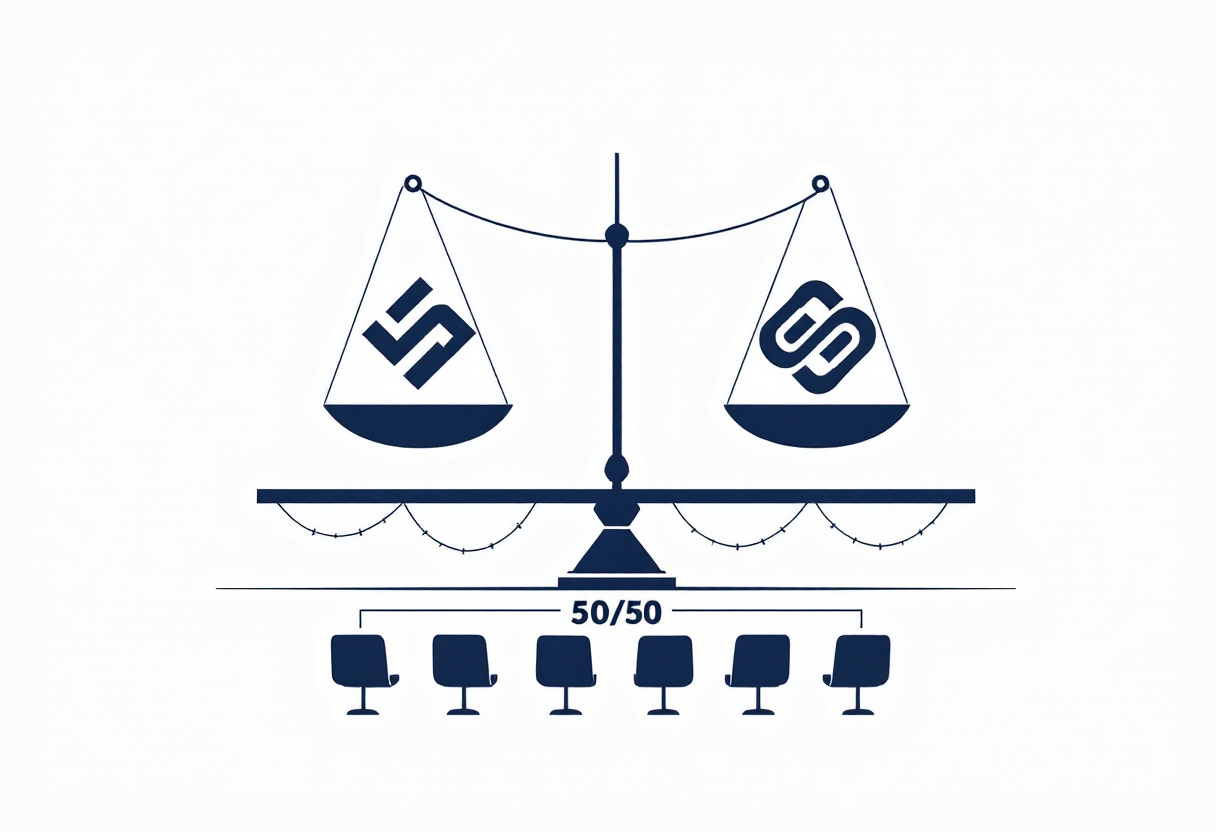
The textbook definition of what is a merger of equals is a corporate combination in which two companies of comparable size combine into a single new entity, both shareholder bases participate in the combined company on a roughly proportional basis, governance is split close to 50/50 at close, and neither side pays a control premium to the other. In practice, true mergers of equals are rare. Most deals announced under the merger-of-equals banner drift toward an effective acquisition within 24 months.
Considering a merger structure for your business sale?
Whether your transaction is genuinely structured as a merger of equals or is an acquisition wearing merger paperwork has real tax, governance, and operational consequences. CT Acquisitions advises sellers on which structure protects value and which creates risk. No fee to you on buy-side introductions; sell-side mandates are paid on success at closing.
Book a Free ConsultationWhat a Merger of Equals Actually Is
A merger of equals (often abbreviated MOE) is a specific kind of business combination in which two companies of similar size and market capitalization combine without one party being labeled the buyer and the other the target. In a clean MOE, neither set of shareholders is cashed out. Both groups exchange their old shares for shares in a newly named or jointly named combined company, the board is split close to evenly between directors of each legacy company, the senior management team includes executives from both sides, and no acquisition premium is paid on either side. The exchange ratio is set to reflect each company’s standalone fair value at signing, not a takeover price.
The label matters because it sets shareholder expectations about post-close governance, brand continuity, and tax treatment. A traditional acquisition cashes out the target’s shareholders and gives the acquirer’s board and management uncontested control. A merger of equals tells both shareholder bases that they will share governance and upside going forward. That promise is what makes MOEs hard to execute. Two boards and two C-suites have to agree on who reports to whom, whose office is headquarters, whose accounting system survives, and whose strategic plan wins when the two plans conflict.
It is worth distinguishing the MOE label from the underlying legal mechanics. From a corporate-law perspective, almost every MOE in U.S. public markets is technically a statutory merger under state law (often a forward or reverse triangular merger) and is registered with the Securities and Exchange Commission as a merger transaction. The merger-of-equals framing is a market and governance description, not a separate legal form. The IRS and the Financial Accounting Standards Board treat the deal under the same rules as any other corporate merger or stock-for-stock combination. We will come back to those rules in the tax and accounting sections below.
The Five Structural Elements of a Merger of Equals
Practitioners and academics generally agree on five structural elements that a deal needs to qualify as a merger of equals rather than an acquisition with friendly branding. Most deals announced as MOEs fail on at least one of these elements, which is part of why the post-close reality often looks like a takeover.
1. A New Combined Name (or Retained Name With Parity)
A genuine MOE either picks a new combined corporate name (Daimler-Chrysler, ExxonMobil, JPMorgan Chase) or keeps both names in some form that signals neither side disappeared. When one party’s name survives and the other’s is retired, you are usually looking at an effective acquisition. The brand decision is one of the first signals investors read. Sprint and T-Mobile announced as a merger of equals in 2018 but kept only the T-Mobile name and ticker, which is one of several reasons the post-close reality looked like an acquisition. We covered the deal mechanics in detail in our guide on whether Sprint and T-Mobile was a merger or acquisition.
2. Board Representation Split 50/50 or Near-Parity
The board of the combined company should have roughly equal representation from the two legacy boards. In a clean MOE, each side appoints the same number of directors (or each side appoints a slate within one or two seats of the other), with one or two independent directors selected by mutual agreement. When the combined board has 9 directors from one side and 4 from the other, the MOE framing is window dressing. Investors should look at the proxy statement’s director-nomination disclosure to see what the actual split is.
3. Equal C-Suite Split or Co-CEO Structure
Senior management in a true MOE is also split. The classic pattern is a co-CEO arrangement for a transition period of one to three years, with one CEO from each legacy company, followed by a pre-agreed succession plan. The CFO, COO, and other C-suite roles are similarly split. When one side gets the CEO and the other gets a transition advisory role, the deal is functionally an acquisition. Mergers of equals that work tend to have explicit, papered succession provisions in the merger agreement, so neither party can quietly shove the other out 12 months after close.
4. No Premium Paid and a Stock-for-Stock Fair-Exchange Ratio
In an acquisition, the buyer pays the target shareholders a premium over the target’s recent unaffected trading price, typically 20 to 40 percent for a public-company target. In a merger of equals, no premium is paid. The exchange ratio is set to reflect each company’s standalone fair value at signing, so a shareholder of Company A who owned 1 percent of Company A’s equity ends up owning a corresponding share of the combined entity calibrated to A’s contribution to combined value. The consideration is almost always stock rather than cash, because cash consideration cashes out one side and ends the equal-participation premise of the deal.
5. Social-Issues Parity on Headquarters, Employees, and Culture
The fifth element, often called the social issues in M&A practice, covers headquarters location, employee impact, culture integration, and where the combined company will be domiciled. A true MOE will often pick a new headquarters city or keep both legacy headquarters as dual offices. Headcount reduction targets will be applied across both organizations rather than concentrated on one side. Cultural integration plans will include representation from both legacy cultures rather than imposing the larger party’s playbook. These social-issues commitments are often what makes a deal a real MOE in the eyes of employees, regulators, and the public.
Why True Mergers of Equals Are Rare in Practice
Despite the appeal of the MOE label, true mergers of equals are uncommon. Most deals announced as MOEs become effective acquisitions within 24 months of close. The reasons are structural and recurring.
The first reason is governance ambiguity. Two co-CEOs and a 50/50 board create execution risk. Every major decision (capital allocation, layoffs, divestitures, product strategy) becomes a negotiation rather than a directive. When markets shift or competitive pressure mounts, the combined entity often needs decisive action, and a 50/50 governance structure tends to produce compromise outcomes that satisfy no one. The board eventually consolidates power on one side or the other, and the loser of that contest ends up looking like an acquired target.
The second reason is cultural collision. Two senior management teams that have spent years optimizing for different strategies, customer bases, and incentive systems rarely integrate without one culture dominating. Even when both sides try in good faith, the larger or faster-growing party’s playbook tends to win because it is what the combined company’s investors expect. The smaller or slower-growing party’s executives often leave within 18 to 24 months, taking institutional knowledge with them.
The third reason is the market’s preference for clarity. Investors and analysts want to know who runs the company, what the strategy is, and whose numbers to model. A combined entity with co-CEOs and dual headquarters is harder to value and harder to cover. Activist investors often push the board to pick a single CEO and consolidate operations, which formally ends the MOE framing.
The cleanest historical examples of MOEs that drifted into effective acquisitions are well-documented. The Daimler-Benz and Chrysler merger announced in May 1998 was marketed as a merger of equals under the new combined name Daimler-Chrysler. Within four years the German parent had taken operational control, the Chrysler side’s senior executives had departed, and Daimler ultimately divested Chrysler to Cerberus Capital Management in 2007 for a fraction of the original deal value. Court filings in Tracinda Corporation v. DaimlerChrysler AG (the Kerkorian lawsuit) and reporting in journalist Bill Vlasic’s coverage documented how the equal-merger framing did not match the post-close governance reality.
AOL and Time Warner announced their merger in January 2000 at a headline value of approximately $165 billion, also framed as a merger of equals. By the end of 2002 the combined company had reported a goodwill writedown of approximately $99 billion (per the AOL Time Warner 2002 10-K), the AOL executives in senior roles had largely departed, and the deal was being called one of the worst in corporate history. Journalist Nina Munk’s book “Fools Rush In” documented how the equal-merger framing concealed cultural and strategic incompatibilities that surfaced within months of close. The AOL name was dropped from the corporate brand in 2003, and the original transaction is now studied as a cautionary case in MBA programs.
US Airways and America West announced their merger in May 2005 as a merger of equals. The combined company kept the US Airways name and management team, but operational integration of pilot seniority lists took more than a decade and contributed to labor friction that persisted through the subsequent US Airways and American Airlines merger in 2013. The America West side’s leadership, including CEO Doug Parker, did ultimately take control of the combined airline, a partial exception to the more common pattern, but the deal still illustrates how MOE framing can mask years of integration cost.
Citicorp and Travelers Group announced their combination in April 1998 as a merger of equals, creating Citigroup with co-CEOs (John Reed from Citicorp and Sandy Weill from Travelers), a near-parity board, and a new combined name. Within two years the co-CEO arrangement had collapsed in a public boardroom fight. Weill consolidated control by 2000, Reed retired, and the Citicorp side’s culture was largely absorbed into the Travelers operating model. Even when social issues and naming work, governance ambiguity tends to break first.
Recent Deals Marketed as Mergers of Equals and What Actually Happened
The 2018 to 2024 deal cycle produced several high-profile transactions that were marketed as mergers of equals, with mixed outcomes.
Sprint and T-Mobile (2018 Announcement, 2020 Close)
The combination was announced in April 2018 as a $26 billion all-stock merger of equals, with Sprint shareholders receiving 0.10256 T-Mobile shares per Sprint share. The combined entity was named T-Mobile US, Inc., the TMUS ticker survived, the management team came from T-Mobile (John Legere as CEO, then Mike Sievert), and the Sprint brand was wound down within two years of close. Deutsche Telekom held approximately 43 percent of the combined company at close and SoftBank held approximately 24 percent (per the T-Mobile 2020 10-K), which gave the T-Mobile side effective control. The deal qualified for tax-free treatment under Internal Revenue Code Section 368(a)(2)(E) as a reverse triangular merger. By any operational measure, T-Mobile acquired Sprint. The merger-of-equals framing was a securities-law and tax-structuring choice, not a governance reality. See our full case study on whether Sprint and T-Mobile was a merger or acquisition for the deal-by-deal detail.
Bristol-Myers Squibb and Celgene (2019)
The Bristol-Myers Squibb acquisition of Celgene closed in November 2019 at a headline value of approximately $74 billion (per the 2019 BMS proxy statement). It was structured as a cash-and-stock transaction with Celgene shareholders receiving $50 in cash, one BMS share, and one contingent value right per Celgene share. The deal was technically an acquisition in both legal structure and accounting treatment, but BMS marketed several elements of the integration as merger-of-equals style (combined leadership team, retention of senior Celgene scientists, joint pipeline review). In practice, BMS was the surviving brand, the CEO was BMS’s Giovanni Caforio, and the combined company is referred to as BMS. The Celgene name was retired within a year of close. This is a useful example of the merger-of-equals language being applied to a transaction that is structurally an acquisition for the soft benefits of employee morale and pipeline continuity.
United and Continental (2010)
United Airlines and Continental Airlines announced their merger in May 2010 as a merger of equals. The combined company kept the United name and Chicago headquarters, but Continental’s CEO Jeff Smisek became CEO of the combined holding company and Continental’s globe livery was adopted by the combined fleet. This is a partial example of the rare case where the financially smaller party’s leadership wins post-close. The MOE framing broadly held for the first two to three years, though pilot seniority disputes created friction that took most of a decade to resolve.
Tax Treatment of a Merger of Equals
The tax treatment of a merger of equals depends on the legal form of the transaction, not the marketing label. The three most common forms used for MOE transactions are statutory mergers under Internal Revenue Code Section 368(a)(1)(A), reverse triangular mergers under Section 368(a)(2)(E), and stock-for-stock acquisitions under Section 368(a)(1)(B). Each has different requirements and tax consequences.
Statutory Merger: Section 368(a)(1)(A)
A statutory merger is the classic A-reorganization. One corporation merges into another under state corporate law, the merged corporation ceases to exist, and the surviving corporation assumes the merged corporation’s assets and liabilities by operation of law. To qualify as a tax-free reorganization under Section 368(a)(1)(A), the transaction must satisfy the continuity-of-interest doctrine (target shareholders must receive a meaningful equity stake in the surviving corporation, generally at least 40 percent of consideration in acquirer stock, per IRS guidance and Treas. Reg. 1.368-1(e)) and the continuity-of-business-enterprise requirement (the surviving corporation must continue the target’s historic business or use a significant portion of its assets in a business). When these requirements are met, target shareholders do not recognize gain on the exchange of their shares for acquirer stock.
Reverse Triangular Merger: Section 368(a)(2)(E)
The reverse triangular merger is the most common structure for large public MOEs because it preserves the target’s separate corporate existence as a wholly-owned subsidiary of the acquirer’s parent. In a reverse triangular merger, a subsidiary of the acquirer’s parent merges into the target, with the target surviving as a subsidiary of the parent. To qualify for tax-free treatment under Section 368(a)(2)(E), the consideration must be at least 80 percent acquirer voting stock, and the target must hold substantially all of its and the merger sub’s properties after the transaction. This is the structure used in the Sprint and T-Mobile deal. It is attractive because it preserves the target’s contracts, licenses, and corporate identity (which is helpful when the target has many third-party agreements that would require consent to assign in a forward merger or asset sale).
Stock-for-Stock Acquisition: Section 368(a)(1)(B)
The stock-for-stock reorganization (B-reorganization) is used when the acquirer wants to acquire control of the target by exchanging acquirer voting stock for at least 80 percent of the target’s stock. There is no formal merger under state law. The target survives as a subsidiary. To qualify for tax-free treatment, the consideration must be solely acquirer voting stock (no cash boot is permitted in a clean B-reorganization, with very limited exceptions). This is a cleaner structure for smaller MOE-style transactions where the parties want to avoid the regulatory complexity of a statutory merger.
The practical takeaway for sellers is that the tax efficiency of an MOE depends on stock-for-stock consideration and adherence to the continuity-of-interest and continuity-of-business-enterprise requirements. If the deal is structured with significant cash consideration, the transaction may fail tax-free reorganization treatment, and target shareholders may recognize gain at close even if the deal is marketed as a merger of equals. Always confirm the tax structure with qualified counsel before signing an LOI.
Accounting Treatment Under ASC 805
Here is where the merger-of-equals framing collides hardest with technical reality. Under Accounting Standards Codification (ASC) 805, Business Combinations, every business combination must have an identified acquirer for accounting purposes, even when the deal is marketed as a merger of equals. This requirement was clarified when the Financial Accounting Standards Board eliminated the pooling-of-interests method in 2001 (FASB Statement 141, later codified into ASC 805). Before 2001, qualifying mergers of equals could use the pooling method, which simply combined the two companies’ balance sheets at historical cost without identifying an acquirer or recognizing goodwill. After the elimination of pooling, every combination must apply the acquisition method, which requires identifying one party as the acquirer and the other as the acquiree.
ASC 805-10-25 provides guidance on identifying the accounting acquirer when the legal acquirer is not obvious. Factors include which party’s shareholders hold the largest portion of the combined entity, which party’s senior management dominates the combined entity, which party’s board controls the combined board, the relative size of the two parties, and which party initiated the transaction. In an MOE where the two parties are genuinely close to equal in size and governance, the accounting acquirer determination can be a difficult judgment call that auditors and the SEC may scrutinize.
The accounting acquirer designation has real consequences. The acquirer’s assets and liabilities are carried forward at historical book value. The acquiree’s assets and liabilities are remeasured to fair value at close, and any excess of purchase consideration over the fair value of identifiable net assets is recognized as goodwill on the combined company’s balance sheet. The acquiree’s revenue and earnings are only included in the combined company’s income statement from the close date forward, not for prior periods. This asymmetric treatment means the accounting acquirer’s historical financials become the combined company’s historical financials, which is one more reason why even genuine MOEs tend to look like an acquisition in the audited financial statements after close.
For business owners considering a merger structure with a similarly-sized partner, the accounting acquirer determination is worth raising early with auditors and legal counsel. Being the accounting acquirer is generally desirable because it preserves your historical financials and avoids fair-value remeasurement of your assets. Being the accounting acquiree means your balance sheet gets restated at close, your historical income statements drop out of the combined company’s reported results, and goodwill from the combination is allocated against your reporting units.
When Mergers of Equals Actually Work
MOEs are rare but not impossible. The conditions that produce successful mergers of equals tend to share three features.
The first is industry consolidation where neither party has scale to win alone. When two mid-sized banks combine in a consolidating regional market, or two specialty pharma companies pool their pipelines to compete with larger players, the strategic logic supports a real partnership rather than a takeover. Both sides need each other, which keeps governance honest. The 1998 BB&T and Southern National combination, the 2001 First Union and Wachovia combination (despite later issues), and several regional bank MOEs of the 2000s are examples where the equal-partner framing largely held for an extended integration period.
The second is complementary geographies with limited overlap. When two companies cover different geographic markets or different customer segments, the integration is more about geographic stitching than headcount rationalization. There is less direct conflict over whose retail footprint survives or whose sales team handles which accounts. This was a major part of the strategic logic behind United and Continental in 2010 (United was stronger in the Pacific and on the West Coast, Continental was stronger in the Americas and on the East Coast) and is a recurring theme in successful MOE-style combinations.
The third is similar cultures and operating models. When two companies have similar incentive structures, similar customer-service philosophies, and similar capital-allocation approaches, the cultural integration that breaks most MOEs becomes manageable. The two senior management teams understand each other’s playbooks because the playbooks are similar. This is one reason MOEs in regulated industries (banking, insurance, utilities) sometimes work better than MOEs in fast-moving consumer industries, because regulated incumbents tend to converge on similar operating norms.
Even when these conditions are met, successful MOEs almost always have explicit governance and succession provisions papered into the merger agreement. The original Citigroup co-CEO arrangement failed in part because the succession plan was vague. Successful co-CEO arrangements tend to have firm sunset clauses, pre-agreed succession to a single CEO, and binding committee structures that resolve disputes before they reach the boardroom.
How to Read an MOE Announcement as a Seller or Investor
If you are a business owner who has received an offer framed as a merger of equals, or an investor evaluating a public-company MOE announcement, here is the checklist that separates real MOEs from acquisitions wearing merger paperwork.
| Element | Real MOE | Acquisition in MOE Framing |
|---|---|---|
| Combined company name | New combined name or both names retained | One legacy name survives, other retired |
| Board composition | 50/50 or within 1 to 2 seats | One side holds 60 percent or more of seats |
| CEO arrangement | Co-CEO with papered succession, or balanced rotation | One side’s CEO takes the seat, other side gets advisory role |
| Premium paid | No premium; exchange ratio at unaffected market values | 20 to 40 percent premium to one side’s unaffected price |
| Consideration form | 100 percent stock-for-stock | Cash, or significant cash component |
| Headquarters | New location or dual offices | One side’s existing HQ |
| Ticker symbol | New ticker or hyphenated | One side’s existing ticker |
| Branding | Both brands retained 24 to 36 months minimum | One brand sunset within 12 to 18 months |
If a deal fails three or more of these tests, the merger-of-equals language is a marketing choice, not a governance reality. That does not mean the deal is bad. Many acquisitions create real value. It just means you should price and negotiate the transaction as the acquisition it actually is, with appropriate retention provisions, governance carveouts, and tax structuring.
Worked Example: Two Mid-Market Combinations Considering MOE Framing
Assume two regional HVAC distribution businesses are considering a combination. Company A has $80 million in revenue and $12 million in EBITDA, headquartered in Atlanta with 220 employees. Company B has $65 million in revenue and $10 million in EBITDA, headquartered in Charlotte with 180 employees. The two CEOs know each other from industry associations and have been talking about combining for two years.
Structure A (Acquisition by Company A): Company A acquires Company B for $60 million in cash and stock (roughly 6x B’s EBITDA). The combined company keeps Company A’s name, Atlanta headquarters, and CEO. Company B’s CEO takes a 12-month consulting role and exits. The combined board has 7 directors, with 5 from Company A and 2 from Company B. The Charlotte office becomes a regional hub. Headcount reductions of approximately 30 positions are concentrated on the Company B side. The transaction closes in 6 months and is accounted for under ASC 805 with Company A as the acquirer.
Structure B (Genuine Merger of Equals): The two companies combine into a new entity named NewCo Distribution, with dual headquarters in Atlanta and Charlotte. The combined board has 8 directors, with 4 from each legacy company and one independent director selected jointly. The two existing CEOs become co-CEOs for a 24-month transition period, with a binding agreement that the combined CEO role then passes to a successor selected by the combined board (with at least 3 of the 4 directors from each side approving). The consideration is 100 percent stock-for-stock, with exchange ratios calculated to reflect each company’s standalone fair value: roughly 55 percent of the combined equity to Company A’s shareholders and 45 percent to Company B’s shareholders. No control premium is paid. Both brand names are retained as operating divisions for 36 months. Headcount reductions are split proportionally across both sides. The deal is structured as a Section 368(a)(1)(A) statutory merger, with Company A identified as the accounting acquirer under ASC 805 (because A’s shareholders hold the largest share of the combined entity).
Structure A is what most middle-market combinations actually look like. It is faster, cleaner, and avoids the governance ambiguity that breaks most MOEs. Structure B preserves the spirit of equal partnership but adds 6 to 12 months of negotiation, additional complexity in the merger agreement, and ongoing execution risk through the co-CEO period. Whether Structure B is worth that cost depends on the strategic logic, the relationship between the two CEOs, and the willingness of both sides to live with the governance ambiguity for the first two years post-close.
Common Mistakes Sellers Make With MOE-Framed Offers
Treating the Merger Label as a Governance Commitment
The single biggest mistake is assuming that the merger-of-equals language in the announcement binds the buyer to ongoing equal participation. It does not. Unless the merger agreement papers explicit governance provisions (board composition, CEO succession, brand retention, headquarters location, executive retention), the merger-of-equals language is marketing. Six months after close, the surviving CEO can reorganize the combined company however the board approves. Get the governance commitments papered.
Underestimating the Cultural Integration Burden
Sellers sometimes assume that because the deal is called a merger, the two cultures will combine on equal footing. In practice, the larger party’s culture, incentive system, and operating norms tend to dominate within 12 to 24 months. If you care about preserving your team’s culture, you need to address that in the integration plan, not in the press release.
Accepting Stock Consideration Without Reverse Diligence
When you take buyer stock as MOE consideration, you are accepting equity risk in their business. You need to do diligence on the buyer’s balance sheet, customer concentration, regulatory exposure, and litigation history with the same rigor they apply to you. If you have not seen the buyer’s audited financials and management discussion of risks, you are flying blind.
Missing the Tax-Structure Window
The tax efficiency of an MOE depends on the deal qualifying as a tax-free reorganization under Section 368. If you accept cash consideration above the boot thresholds, or if the continuity-of-interest test is not met, the transaction can become fully taxable to you at close. Confirm the tax structure with qualified counsel before signing an LOI, not after.
Ignoring the Accounting Acquirer Question
Even in a genuinely equal merger, ASC 805 requires that one party be identified as the accounting acquirer. The acquirer’s historical financials become the combined company’s historical financials, and the acquiree’s assets are remeasured to fair value at close. If you are the accounting acquiree, your reported revenue, EBITDA, and historical trends drop out of the combined company’s reported results. This can matter for earn-outs, equity grants tied to combined-company performance, and post-close investor communications.
Skipping the Governance Sunset Clauses
Even well-structured co-CEO and balanced-board arrangements need pre-agreed sunset and succession provisions. The Citigroup co-CEO arrangement broke down in part because the succession plan was vague. If you are negotiating an MOE, push for explicit termination dates, supermajority requirements for replacing the original officers, and binding dispute-resolution provisions that survive at least 24 months post-close.
Frequently Asked Questions
What is the legal difference between a merger and a merger of equals?
There is no separate legal category for a merger of equals under U.S. corporate or securities law. A merger of equals is a market and governance description applied to certain statutory mergers (under state corporate law) or stock-for-stock reorganizations (under Internal Revenue Code Section 368). The deal documents filed with the SEC describe the legal form of the transaction (statutory merger, reverse triangular merger, stock-for-stock exchange) without using the merger-of-equals label as a legal classification. The MOE framing is a marketing and shareholder-communications choice.
Is a merger of equals tax-free for shareholders?
It can be, if the transaction qualifies as a tax-free reorganization under Section 368. The most common qualifying forms are Section 368(a)(1)(A) statutory mergers, Section 368(a)(2)(E) reverse triangular mergers, and Section 368(a)(1)(B) stock-for-stock exchanges. To qualify, the consideration must consist primarily of acquirer stock (continuity-of-interest), and the combined company must continue the target’s historic business or use a significant portion of its assets (continuity-of-business-enterprise). If the consideration includes significant cash above the boot thresholds, the transaction may become partially or fully taxable at close.
Why do MOEs almost always become acquisitions within 24 months?
Three reasons. First, governance ambiguity makes decisions slow and creates ongoing conflict. Second, two cultures rarely integrate on equal terms; one playbook tends to dominate. Third, the market and analyst community prefer clear leadership and a single strategy, so activist pressure often pushes the board to pick a single CEO and consolidate operations within 12 to 24 months.
Can a merger of equals be structured with cash consideration?
Technically yes, but it loses the tax-free treatment and is rarely characterized as a true MOE. The defining feature of an MOE is that both shareholder bases continue to participate in the combined entity. Cash consideration cashes out one side and ends the equal-participation premise. Mixed cash-and-stock deals can still be characterized as MOEs if the cash component is small (typically less than 20 percent of total consideration), but most genuine MOEs are 100 percent stock-for-stock.
What is the difference between an MOE and a joint venture?
A joint venture is a separate legal entity owned by two or more parent companies, each of which continues to exist as an independent company. An MOE combines two companies into a single surviving entity, with both legacy companies ceasing to exist as independent operations. Joint ventures preserve separate ownership of the parent companies’ broader businesses; MOEs combine the entire businesses of both parties into one new entity.
How do I know if an offer I have received is a real merger of equals or an acquisition?
Apply the eight-element checklist in the table above. If the deal fails three or more of those tests, you are looking at an acquisition with merger framing, regardless of the announcement language. Read the proposed governance section (board composition, CEO arrangement, executive retention), the consideration mix (cash vs stock), and the post-close branding and headquarters plans. The press release tells you what the buyer wants the market to think. The merger agreement tells you what the deal actually is.
Does ASC 805 always require identification of an accounting acquirer?
Yes. Since the elimination of the pooling-of-interests method in 2001 (FASB Statement 141, now ASC 805), every business combination must apply the acquisition method, which requires identification of one party as the accounting acquirer. The factors used to identify the accounting acquirer (relative shareholder ownership, board control, senior management dominance, relative size, transaction initiator) are set out in ASC 805-10-25 and are independent of the deal’s marketing or legal framing.
Key Takeaways for Owners and Investors
A merger of equals is a real category of corporate combination defined by five structural elements: combined or balanced naming, near-parity board composition, co-CEO or balanced C-suite, no control premium with stock-for-stock fair-exchange ratios, and social-issues parity on headquarters and employees. The label has real meaning when those elements are genuinely present and papered into the merger agreement. The label is marketing when those elements are absent or vague.
The historical record shows that most deals announced as MOEs become effective acquisitions within 24 months of close. Daimler-Chrysler, AOL Time Warner, Citigroup’s co-CEO arrangement, and Sprint and T-Mobile all illustrate how the equal-merger framing tends to collapse under governance ambiguity, cultural collision, and market pressure for clear leadership.
Tax treatment of an MOE depends on the deal qualifying as a tax-free reorganization under Internal Revenue Code Section 368. The most common forms used are statutory mergers (Section 368(a)(1)(A)), reverse triangular mergers (Section 368(a)(2)(E)), and stock-for-stock exchanges (Section 368(a)(1)(B)). Accounting treatment under ASC 805 still requires identification of one party as the accounting acquirer, regardless of MOE framing. The accounting acquirer’s historical financials carry forward; the acquiree’s assets are remeasured to fair value at close.
If you are a business owner evaluating an MOE-framed offer, treat the merger language as the start of a conversation, not the answer. Apply the eight-element checklist. Get the governance commitments (board composition, CEO succession, brand retention, headquarters, executive retention) papered into the merger agreement. Confirm the tax structure with qualified counsel. Run reverse diligence on the buyer with the same rigor they apply to you. The MOE framing can produce genuine value, but only when both sides commit to the structural elements that make it real.
Evaluating a merger or acquisition offer?
If you have a term sheet or letter of intent that uses merger-of-equals language and you want a second opinion on whether the structure protects your interests, book a free consultation with our team. We will walk through the governance terms, the tax treatment, the accounting acquirer designation, and the post-close branding and management plans with you. No obligation.
Book a Free ConsultationRelated reading: Is Sprint and T-Mobile a Merger or Acquisition? Full Case Study | Types of Mergers and Acquisitions | Sell Your Business with CT Acquisitions