
Auto Body Shop Valuation: Free Body Shop Valuation Calculator. What’s Your Body Shop Worth in 2026?
Body shop valuation figures and buyer attributions verified against primary sources (sponsor press releases, sponsor portfolio pages, SEC filings, trade press) as of August 24, 2026. Ownership positions change continuously; expect a refresh cycle every quarter.
What Is a Body Shop Worth in 2026?
Quick Answer
Auto body shop business valuation in 2026 ranges from 3x SDE for single-owner-operator collision repair shops without DRP relationships up to 9x EBITDA for managed multi-shop operators (MSOs) with deep DRP carrier ties, full OEM certification stacks, and ADAS calibration capability, and 8x to 12x EBITDA for platform-grade regional consolidators acquired by Caliber Collision (Hellman and Friedman, Leonard Green and OMERS, around 1,800 stores), Crash Champions (Clearlake Capital, around 750 stores), Gerber Collision (Boyd Group, TSX: BYD, around $5B Cdn market cap), Joe Hudson’s Collision (acquired by Boyd Group in January 2026), Classic Collision (TPG since 2024), and Quality Collision Group (Susquehanna Growth Equity). The central valuation driver is the quality of the direct repair program (DRP) relationships with State Farm, Progressive, GEICO, Allstate, and USAA, paired with OEM certification depth (I-CAR Gold Class, Tesla Approved, Honda ProFirst, Hyundai Recognized, BMW Certified, Mercedes-Benz Certified) and the ability to bill ADAS calibration revenue in-house at $300 to $600 per vehicle. A typical top-three DRP carrier concentration represents 30 to 50 percent of revenue at a healthy MSO, and a Tesla Approved certification alone can add $200K to $500K of enterprise value to a typical single-shop valuation.
Thinking about selling your collision repair shop?
Skip the formulas. A 15-minute confidential call gives you a real valuation range and tells you which buyers (Caliber, Crash Champions, Gerber, Joe Hudson’s, Classic, regional consolidators) would compete for your shop. No cost, no obligation.
Free Body Shop Valuation Calculator
Enter your revenue, EBITDA or SDE, and recurring revenue mix. The calculator applies the same tier logic documented below and returns a starting-point range in under a minute. It is a screening estimate, not a Quality of Earnings.
M&A advisory across 500+ active capital partners · Auto-aftermarket M&A: collision repair, mechanical service, glass · Updated June 24, 2026
Auto body shop business valuation in 2026 spans one of the widest ranges in auto-aftermarket M&A, from 3x SDE for owner-operator single-bay shops working only walk-in cash retail, up to 9x EBITDA for managed multi-shop operators with deep DRP relationships, OEM certification stacks, and in-house ADAS calibration revenue, and 8x to 12x EBITDA for platform-grade regional consolidators acquired by Caliber Collision, Crash Champions, Gerber Collision, or Joe Hudson’s Collision Centers. The reason the range is so wide is structural: collision repair is two very different businesses depending on whether the shop bills primarily through DRP agreements with the top US auto insurance carriers (State Farm, Progressive, GEICO, Allstate, USAA, Liberty Mutual, Farmers) or operates as a retail and small-fleet repair shop without those relationships. This guide maps the operator tiers, explains how Caliber Collision underwrites a target, walks through a worked $1.5M EBITDA Texas four-bay shop example, and identifies the pre-sale improvements that produce the most multiple lift before a sale. If you are a collision repair shop founder evaluating your options, this is the auto body shop business valuation framework you need. For the broader buyer-pool view, see our auto body shop seller hub and the sibling auto service business hub.
How CT Acquisitions Works
- How we are paid. The buyer in our network pays us at close. No retainer, no listing fee, no success fee, no commission, ever.
- No exclusivity contract. Walk at any time. If our buyer is not paying enough, hire a banker the next day. We have zero claim on you.
- Vetted buyers only, no leaks. We introduce you to one or two pre-mandated buyers sequentially. Your shop never gets shopped to Caliber and Crash Champions simultaneously.
- Top-of-market price AND the right buyer. Our fee scales with sale price (same incentive as a banker), matched on fit, not just the highest check.
- 60 to 120 days, not 9 to 12 months. We already know our buyers’ mandates (DRP carrier coverage, OEM certifications, ADAS bay count, geographic gaps) before we pick up the phone with you.
Key takeaways
- 2026 auto body shop business valuation multiples span 3x SDE for owner-operator retail-only single-bay shops up to 12x EBITDA for platform-grade MSOs acquired by Caliber, Crash Champions, Gerber, Joe Hudson’s, Classic, or Quality Collision.
- DRP relationships with State Farm, Progressive, GEICO, Allstate, USAA, Liberty Mutual, and Farmers are the single largest valuation driver. Top-three DRP concentration typically 30 to 50 percent of revenue.
- OEM certification stack (I-CAR Gold Class, Tesla Approved, Honda ProFirst, Hyundai Recognized, BMW Certified, Mercedes-Benz Certified, Pro Spot, aluminum-rated) directly drives multiple. Tesla Approved alone adds $200K to $500K of enterprise value.
- ADAS calibration revenue ($300 to $600 per vehicle, often 8 to 15 percent of total revenue at a modern shop) is the fastest-growing revenue line and a buyer favorite.
- Severity is rising 6 to 9 percent per year (CCC Intelligent Solutions data) while frequency drops 1 to 3 percent per year. Average severity now exceeds $5,000 per claim and total-loss rates have crossed 26 percent.
- Active platform consolidators in 2026: Caliber Collision (Hellman and Friedman, Leonard Green and OMERS, around 1,800 locations), Crash Champions (Clearlake Capital since 2020, around 750 locations), Gerber Collision (Boyd Group, TSX: BYD), Joe Hudson’s Collision (acquired by Boyd Group in January 2026), Classic Collision (TPG since 2024), Quality Collision Group (Susquehanna Growth Equity), Driven Brands NASDAQ DRVN (CARSTAR + 1-800-Radiator), and Kaizen Collision (Kinderhook Industries).
Table of contents
- Methodology and data sources
- The short answer: typical auto body shop business valuation in 2026
- The three auto body shop operator models
- Where the real value lives: DRP-led MSOs with OEM certification
- How buyers actually calculate an auto body shop valuation
- The seven factors that move auto body shop business valuation multiples
- Severity and frequency: the macro tailwind and headwind
- Other factors buyers evaluate
- Worked example: $1.5M EBITDA Texas 4-bay collision shop
- How to increase your auto body shop business valuation before selling
- Common mistakes that destroy a body shop valuation
- Frequently asked questions about auto body shop business valuation
- Want a Specific Valuation?
Methodology and data sources
CT Acquisitions · 2026 Buyer-Market Signal
What Collision PE Platforms Pay Premium For
Across our buy-side conversations with PE-backed collision platforms (Caliber Collision, Crash Champions, Joe Hudson’s, Classic Collision, Quality Collision Group, Kaizen Collision) and regional consolidators in 2026:
- DRP carrier diversity matters more than headline volume. A shop with State Farm, Progressive, GEICO, Allstate, and USAA each contributing 8 to 15 percent of revenue trades at premium to a shop with 60 percent of revenue from a single carrier. Single-carrier dependency triggers concentration discount of 0.5x to 1.5x.
- OEM certification stack is the gatekeeper. I-CAR Gold Class is table stakes. Tesla Approved adds $200K to $500K of enterprise value. Honda ProFirst, Hyundai Recognized, BMW Certified, and Mercedes-Benz Certified stack as additive premiums because the buyer can route those VINs to the certified shop post-close.
- In-house ADAS calibration revenue is heavily rewarded. Shops that sublet calibration give up 35 to 45 percent gross margin. In-house ADAS bay with Bosch, Hunter, or Autel calibration targets and certified technicians captures the full $300 to $600 per vehicle.
Multiple at a Glance · 2026
Auto Body Shop Business Valuation Multiples · 2026
By operator type and DRP / OEM coverage.
Source: CT Acquisitions analysis of collision M&A. DRP carrier diversity, OEM certification stack, and in-house ADAS calibration drive top-of-range multiples.
CT Acquisitions · Seller Conversation Insight
What Auto Body Shop Owners Tell Us in First Calls
Across our collision-shop seller conversations, three patterns are unmissable:
- A material share of body shop owners underestimate the value of their DRP relationships. Owners often report revenue without segmenting by carrier, and only realize during diligence that their State Farm Select Service or Progressive Direct Repair Program standing is the single most valuable asset on the balance sheet.
- Sublet ADAS calibration is the biggest hidden value gap. Shops sending calibrations to the dealer or a sublet calibration provider give up $200 to $400 of margin per claim, and buyers immediately model the in-house build as an EBITDA expansion lever.
- Taxes and Section 1031 exchanges on the shop real estate come up early. Roughly 7 in 10 shop owners also own their real estate, and sale-leaseback or split-deal structuring is one of the first questions raised before valuation.
CT Acquisitions · Buyer Network Insight
What Collision Repair Buyers Actually Prioritize
Across the buyer mandates in our network that include collision repair in their thesis (Caliber Collision, Crash Champions, Gerber Collision, Joe Hudson’s, Classic Collision, Quality Collision Group, Kaizen Collision, Driven Brands CARSTAR, and 15+ regional consolidators), the consistent diligence priorities are:
- DRP carrier scorecard standing. State Farm Select Service tier, Progressive Direct Repair Program tier, GEICO Auto Repair Xpress (ARX) tier, Allstate Good Hands Repair Network tier, and USAA STARS standing are pulled and reviewed. Top-tier scorecards (cycle time, CSI, severity per repair, supplements per RO) are the single most important diligence document.
- OEM certification stack and renewal status. I-CAR Gold Class current status, Tesla Approved (including ASE-certified Tesla technician), Honda ProFirst, Hyundai Recognized Collision Repair Center, BMW Certified Collision Repair Center, Mercedes-Benz Certified Collision Center, Pro Spot welding certification, and aluminum-rated capability (F-150 aluminum body certification specifically).
- In-house ADAS calibration capability. Documented calibration bay with Bosch ADS, Hunter ADASLink, Autel MaxiSys ADAS, or asTech remote calibration. Calibration revenue per repair order and gross margin per calibration are pulled directly from the management system.
PE-backed platform consolidators are the largest cohort in our active auto-aftermarket buyer network and consistently pay the upper end of EBITDA multiple ranges for DRP-led collision MSOs above $1.5M EBITDA when these three levers are in place.
Related Cluster GuideSibling auto-aftermarket benchmark: see how independent auto service shops compare in 2026, since collision and mechanical service share many of the same regional consolidator buyer profiles plus Driven Brands and Sun Auto Tire as adjacent acquirers.
This auto body shop business valuation guide follows CT Acquisitions’ 5-tier source hierarchy: T1 press releases for major sponsor transactions (Caliber Collision, Clearlake Capital Crash Champions, Boyd Group Joe Hudson’s, TPG Classic Collision, Susquehanna Growth Equity Quality Collision Group), T2 SEC and SEDAR filings (Boyd Group TSX: BYD, Driven Brands NASDAQ: DRVN), T3 sponsor portfolio pages, T4 industry-research publishers (CCC Intelligent Solutions Crash Course, Mitchell Industry Trends Report, Romans Group Top 25, FOCUS Investment Banking, BodyShop Business Top 100, Repairer Driven News), and T5 M&A trade press (Axial, BizBuySell, Capstone Partners, IBISWorld 81121b). Every numeric multiple range cited is reconciled against at least two T4 sources plus CT’s internal VERIFIED_MULTIPLES benchmark.
Tier framing: Headline multiple ranges reflect broad-market mid-market collision transactions. Premium PE-platform-tier multiples (8x to 12x EBITDA) reflect institutional-buyer underwriting on businesses that clear specific scale ($3M+ EBITDA), DRP scorecard, OEM stack, ADAS capability, geographic, and management-bench thresholds.
Verification window: All multiples and operator-tier figures verified June 2026 against the named T4 publishers’ most-recent reports plus CT’s active-engagement data. Multiples by tier are sensitive to severity-and-frequency cycle, DRP carrier program changes (notably State Farm Select Service tier rebalancing 2024-2025 and Progressive Snapshot integration into DRP routing), credit-market conditions, and customer-concentration; the cited ranges are starting points for transaction-specific valuation, not deal-specific quotes.
Collision-specific industry-data sources: CCC Intelligent Solutions Crash Course (annual severity, frequency, total-loss data), Mitchell Industry Trends Report (claim severity and parts inflation), Romans Group Top 25 Collision Repair Centers, FOCUS Investment Banking 2025 Collision Repair Industry Report. Boyd Group financial data (TSX: BYD) is the public-company comparable; sellers should pull current SEDAR filings rather than investor-portal pages. The CT VERIFIED_MULTIPLES collision repair lock is 4x-9x EBITDA broad market with 8x-12x for platform-grade DRP-led MSOs.
The short answer: typical auto body shop business valuation in 2026
| Business profile | Typical multiple | Example: $1.5M EBITDA |
|---|---|---|
| Owner-operator single bay, retail only, no DRP | 3.0-4.0x SDE | $4.5M-$6M (SDE basis) |
| Owner-operator, 1 DRP carrier, I-CAR Platinum technicians | 3.5-5.0x SDE | $5.25M-$7.5M (SDE basis) |
| Single shop, managed, 2-3 DRP, I-CAR Gold Class | 4.0-6.0x EBITDA | $6M-$9M |
| 2-3 shop MSO, full DRP stack, OEM certifications | 5.5-7.5x EBITDA | $8.25M-$11.25M |
| 3-10 shop MSO, full DRP + OEM stack + in-house ADAS | 6.0-9.0x EBITDA | $9M-$13.5M |
| Platform-grade regional MSO (10+ shops, Tesla Approved) | 8.0-12.0x EBITDA* | $12M-$18M* |
*Platform-grade tier reflects publicly reported PE-backed collision MSO transactions: the 2022 Crash Champions merger with Service King backed by Clearlake Capital, Boyd Group’s roughly $1.3 billion acquisition of Joe Hudson’s Collision Center that closed in January 2026 per Boyd Group’s closing announcement, TPG’s 2024 acquisition of Classic Collision from New Mountain Capital, and Susquehanna Growth Equity’s 2020 investment in Quality Collision Group. These multiples apply only to platform-quality operators (multi-shop footprint, full DRP scorecard, OEM stack, in-house ADAS, professional management). For broader benchmark context across auto-aftermarket M&A, see our auto service business hub.
The three auto body shop operator models
Before any auto body shop business valuation analysis, identify which of these models describes the shop. The multiple gap between the bottom and the top tier is 4x: a 3x SDE owner-operator versus a 12x EBITDA platform-grade MSO at the same EBITDA produces a 4x difference in enterprise value, holding everything else constant.
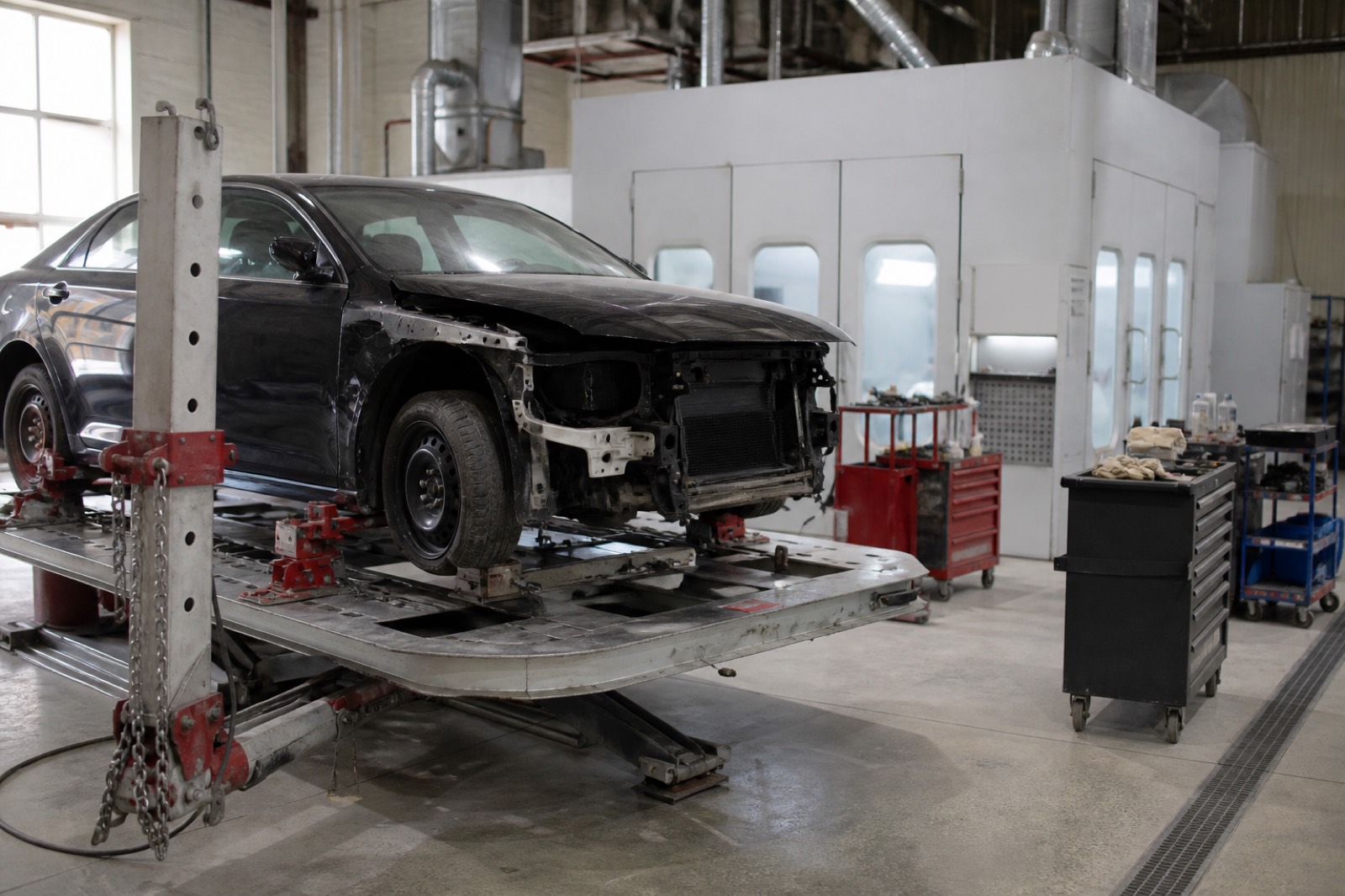
1. Owner-operator retail or limited-DRP shop
One to two bays, owner working in the shop (estimating, paint, or production), revenue $400K to $1.5M annually, EBITDA margin 10 to 16 percent. Mix: 60 to 90 percent retail cash and credit card, 10 to 40 percent from a single DRP carrier (often State Farm or USAA picked up locally). No OEM certifications beyond basic I-CAR (training, not Gold Class). ADAS calibration sublet to the dealer at zero or negative margin. Most commoditized tier; auto body shop business valuation 3x to 5x SDE.
2. Managed single shop or small MSO with DRP stack
One to three locations, 8 to 25 bays total, professional general manager in place separate from the owner, revenue $2M to $12M, EBITDA margin 14 to 22 percent. DRP carriers: 2 to 5 carriers (typically including State Farm Select Service, Progressive DRP, GEICO ARX, Allstate Good Hands, USAA STARS, Liberty Mutual GRP, Farmers Circle of Dependability). OEM certifications: I-CAR Gold Class current, Honda ProFirst, Hyundai Recognized, sometimes Pro Spot welding certified. ADAS calibration: mixed, often building in-house. Strategic acquisition-grade tier. Auto body shop business valuation 5x to 7.5x EBITDA. Caliber Collision, Crash Champions, Gerber Collision, Joe Hudson’s, Classic Collision, Quality Collision Group, and regional consolidators target this tier as tuck-ins.
3. Platform-grade regional MSO
10 to 50+ locations across a state or multi-state region, professional C-suite (CEO, CFO, COO, VP Operations), revenue $30M to $250M+, EBITDA margin 16 to 22 percent. Full DRP stack with top-tier scorecard standing on State Farm Select Service, Progressive Direct Repair, GEICO ARX, Allstate, USAA. Deep OEM stack: I-CAR Gold Class plus Tesla Approved (at minimum one location), Honda ProFirst, Hyundai Recognized, BMW Certified, Mercedes-Benz Certified, Toyota Certified Collision Center, and aluminum-rated capability across multiple locations. In-house ADAS calibration bay at most locations with Bosch, Hunter ADASLink, or Autel MaxiSys. CCC ONE or Mitchell Cloud Estimating with full management system integration. Platform anchor or strategic exit-grade tier. Auto body shop business valuation 8x to 12x EBITDA. Direct exit candidates for Caliber Collision, Crash Champions, Gerber Collision (Boyd Group), Joe Hudson’s, Classic Collision, or strategic IPO consideration.
Most collision shops above $1M EBITDA fall in tier 2. The path from tier 2 to tier 3 is the most valuable 18 to 36 month preparation arc available to a collision shop founder, and it typically expands the auto body shop business valuation multiple from 6x to 9x while EBITDA grows from $1.5M to $3M+: a 4x to 5x increase in total enterprise value.
Where the real value lives: DRP-led MSOs with OEM certification
Direct repair program (DRP) relationships and OEM certifications are the only structural assets that take an auto body shop business valuation from 4x EBITDA to 9x+ EBITDA. Understanding why matters: DRP routing volume is the closest thing to recurring revenue in collision repair. A State Farm Select Service shop in good standing receives consistent claim routing through State Farm’s preferred-shop algorithm. Progressive Direct Repair, GEICO Auto Repair Xpress (ARX), Allstate.
Direct repair program (DRP) relationships and OEM certifications are the only structural assets that take an auto body shop business valuation from 4x EBITDA to 9x+ EBITDA. Understanding why matters:
- DRP routing volume is the closest thing to recurring revenue in collision repair. A State Farm Select Service shop in good standing receives consistent claim routing through State Farm’s preferred-shop algorithm. Progressive Direct Repair, GEICO Auto Repair Xpress (ARX), Allstate Good Hands Repair Network, USAA STARS, and Liberty Mutual Guaranteed Repair Program work the same way. Top-three DRP carrier concentration represents 30 to 50 percent of revenue at a healthy MSO.
- DRP scorecards predict revenue durability. Each carrier tracks cycle time, customer satisfaction index (CSI), supplements per repair order, severity per repair, total loss rate, and parts mix. Top-tier scorecard standing is correlated with sustained routing volume and pricing.
- OEM certifications are now revenue gatekeepers, not vanity badges. Tesla insists routing go through Tesla Approved shops. Honda ProFirst, Hyundai Recognized, BMW Certified, Mercedes-Benz Certified, and Toyota Certified Collision Center each filter claim routing through their respective carrier and manufacturer referral systems. Tesla Approved alone adds $200K to $500K of enterprise value to a typical shop because Tesla volume is high-severity (battery, sensor, aluminum) and high-margin.
- ADAS calibration is the fastest-growing revenue line. 92 percent of new vehicles sold in 2024 had at least one ADAS feature (CCC Intelligent Solutions data). Recalibration is required on a growing share of collision claims at $300 to $600 per vehicle. Shops with in-house calibration capture full margin; shops that sublet give up 35 to 45 percent gross margin.
- Defensible against direct-to-consumer disruption. Unlike retail-only collision (which is cyclical and price-shopped on Google), DRP-routed volume is allocated by insurance carrier algorithm and is sticky to certified shops.
If a shop is primarily retail and one-DRP, the highest-return 18 to 36 month investment is building DRP carrier diversity and the OEM certification stack. It is slow and requires capital expenditure on OEM-specified equipment (Pro Spot welders, aluminum repair bays, OEM-specific scan tools), but it produces durable multiple expansion of 2x to 4x EBITDA.

Body shop valuation rules of thumb, and why buyers set them aside
Most owners first hear a shortcut. Per a widely read r/Autobody thread, owners often ask whether a body shop is worth 4x net income, and broker guides add per-bay and asset-based rules. These shortcuts work as a first sanity check on a small shop. They break down for any collision business with DRP relationships, OEM certifications, or more than one location.
- Per-bay value. DealStream’s rules-of-thumb guide describes assigning a dollar figure to each repair bay. It ignores how full those bays are, your cycle time, and whether insurers route work to you.
- Asset value. Business Buying Services says to use the asset method when a shop grosses under $400,000 a year, because the owner is earning a wage rather than a profit above it. At that size, the paint booth, frame machines, and other equipment set the price.
- Multiple of net income or SDE. Auxo Capital Advisors puts many single-location collision shops in a broad 3.0x to 5.5x SDE or EBITDA discussion range. That is the right starting tool for a single shop, as long as the earnings are normalized first.
Above a single owner-run shop, consolidators such as Caliber, Crash Champions, and Gerber price on normalized EBITDA, then adjust for DRP carrier mix, OEM certifications, ADAS calibration capability, and real estate. Owned real estate is valued separately from the operating business. If a rule of thumb and an EBITDA multiple disagree on your shop, the EBITDA view is the one a buyer will defend in a letter of intent. For the sale process itself, see our sell your auto body shop guide.
How collision repair buyers actually calculate the number
- Normalize the EBITDA. Adjust for owner compensation (owner often works as estimator or production manager), related-party transactions (real estate rent to owner-affiliated LLC at above-market or below-market rates), personal expenses, sublet calibration expense (added back if the buyer plans to bring in-house), and one-time costs (PPP, ERTC, prior litigation, equipment write-offs).
- Decompose revenue by carrier. Split by DRP carrier (State Farm, Progressive, GEICO, Allstate, USAA, Liberty Mutual, Farmers, Nationwide, Travelers, smaller carriers) and by retail / dealer / fleet. Pull the trailing 12 month carrier mix and the 3-year carrier trend. Carrier concentration above 50 percent from a single source is flagged.
- Pull DRP scorecards. Buyer requests current scorecards from each DRP carrier showing cycle time, CSI, supplements per RO, severity per repair, and tier standing. Top-tier standing on State Farm Select Service, Progressive DRP, and GEICO ARX is the most valuable single document in the data room.
- Audit OEM certification stack and renewal status. I-CAR Gold Class current and renewal date, Tesla Approved status and certified Tesla technician roster, Honda ProFirst, Hyundai Recognized, BMW Certified, Mercedes-Benz Certified, Toyota Certified, Pro Spot welding certification, aluminum-rated bay capability.
- Model ADAS calibration revenue and capture rate. Pull calibration revenue per repair order, sublet versus in-house mix, gross margin per calibration. Buyer models the in-house build (typical capex $75K to $150K for a calibration bay) as an EBITDA expansion lever.
- Compare to comparables and apply concluding multiple. Adjust for geography (DRP density and labor cost), real estate ownership (sale-leaseback, capex requirements), technician retention (median tenure, comp structure), and management bench depth.
The seven factors that move auto body shop business valuation multiples
1. DRP carrier mix and scorecard standing
The single largest auto body shop business valuation driver. A shop with State Farm Select Service top-tier standing, Progressive Direct Repair top-tier, GEICO ARX top-tier, plus Allstate Good Hands and USAA STARS as 4th and 5th carriers, each contributing 8 to 15 percent of revenue, trades at 7x to 9x EBITDA. A shop with one DRP carrier at 70 percent of revenue trades at 4x to 5x because carrier concentration is an existential risk. This is a 3 to 4 turn differential, worth $4.5M to $6M on a $1.5M EBITDA shop.
2. OEM certification stack depth
OEM certifications stack as additive premiums to auto body shop business valuation:
- I-CAR Gold Class: Table stakes. Required for most DRP carriers. Not a premium driver, but absence is a discount.
- Tesla Approved: Adds $200K to $500K of enterprise value on a single-shop basis. Tesla volume is high-severity and routes only to Tesla Approved shops.
- Honda ProFirst: Adds 0.2x to 0.4x EBITDA multiple. High-volume manufacturer with strong dealer referral integration.
- Hyundai Recognized Collision Repair Center: Adds 0.1x to 0.3x. Fast-growing manufacturer with insurance carrier alignment.
- BMW Certified and Mercedes-Benz Certified: Add 0.3x to 0.6x combined. High-severity luxury volume with strong margin per RO.
- Toyota Certified Collision Center: Adds 0.2x to 0.4x. Volume manufacturer with dealer routing.
- Aluminum-rated (F-150 specifically): Adds 0.2x to 0.4x. Required for F-150 aluminum body repairs, opens Ford dealer routing.
- Pro Spot welding certification: Table stakes for OEM-certified work. Required equipment investment $35K to $60K per location.
A platform-grade MSO typically holds I-CAR Gold Class + Tesla + Honda + Hyundai + BMW + Mercedes-Benz + Toyota at the lead location, with the certification stack thinning across satellite locations. The full stack at the lead location is itself a competitive moat.
3. ADAS calibration capability and revenue capture
ADAS calibration is the fastest-growing revenue line in collision repair. CCC Intelligent Solutions reports that 92 percent of new vehicles sold in 2024 had at least one ADAS feature, and that 38 percent of repairable claims in 2024 required at least one calibration (up from 28 percent in 2022). At $300 to $600 per vehicle, ADAS calibration revenue is now 8 to 15 percent of total revenue at a modern collision shop.
- In-house calibration bay with Bosch ADS, Hunter ADASLink, Autel MaxiSys ADAS, or Snap-on ADAS: Captures full $300 to $600 per vehicle at 55 to 70 percent gross margin. Capex $75K to $150K for the bay plus targets. Adds 0.3x to 0.6x EBITDA multiple.
- Sublet to asTech remote calibration or dealer: Captures partial margin, $50 to $150 per vehicle. Buyer models in-house build as an immediate EBITDA expansion lever.
- No calibration at all (calibration not performed or not billed): Material risk. DRP carriers increasingly require documented calibration on covered claims; failure to perform exposes the shop to comeback liability.
4. Technician retention and certification roster
Collision repair labor is structurally short across the US. Bureau of Labor Statistics data shows the auto body repair technician occupation projected to grow only 0 to 1 percent through 2032 against rising claim severity, creating a structural shortage. A shop with median technician tenure above 6 years, ASE-certified Master Collision Repair and Refinish technicians, and I-CAR Platinum technicians (highest individual certification) trades at premium because the technician roster is the largest single transferable asset to the buyer.
- Premium roster: Median tenure 7+ years, 60%+ of technicians ASE Master Collision certified, multiple I-CAR Platinum technicians, structured pay plan with retention bonuses.
- Good roster: Median tenure 4 to 6 years, 30 to 50 percent ASE certified, I-CAR Gold Class shop-wide.
- Average roster: Median tenure 2 to 4 years, mixed certification, flat-rate compensation only.
- Weak roster: High turnover, limited certification, technician shortage actively constraining throughput.
5. Shop management system and operational data
- Premium: CCC ONE Total Repair Platform or Mitchell Cloud Estimating with full integration to scheduling, parts ordering (CCC Parts, Mitchell PartsBench), DRP carrier portals, and accounting. 2+ years of clean data on cycle time, CSI, supplements per RO, severity per repair, parts mix, and labor utilization.
- Standard: CCC ONE or Mitchell Cloud Estimating with basic functionality, partial integration.
- Discount: Paper estimates, spreadsheet job tracking, or legacy estimating software without DRP carrier integration. Post-close technology implementation costs $25K to $75K per location and takes 3 to 6 months.
6. Real estate ownership and bay configuration
Most collision shops are real-estate-intensive: a typical 4-bay shop requires 8,000 to 12,000 square feet of building plus parking for 30+ vehicles (work-in-progress, parts hold, customer pickup). Real estate ownership versus lease materially affects deal structure:
- Owner-occupied real estate (typical 65 to 75 percent of shops): Real estate often sold separately at cap rate (industrial / flex cap rate 6.5% to 8.5%) outside the operating-business multiple. Sale-leaseback structures with PE buyer are common (15 to 20 year lease at market rent with 2 to 3 percent annual escalators).
- Leased real estate: Lease term, renewal options, and rent-to-revenue ratio reviewed. Sub-5-year remaining term with no renewal options is a discount.
- Bay configuration: Frame bay, paint booth (downdraft preferred over crossdraft), prep deck, ADAS calibration bay, aluminum repair bay (segregated from steel work). Modern bay layout supports higher throughput per square foot.
7. Severity-and-frequency cycle positioning
Buyer underwriting incorporates the macro severity-and-frequency cycle. Shops that have demonstrated the ability to grow severity per RO faster than industry average (above 6 to 9 percent annually) while maintaining DRP scorecard standing are valued higher because they convert the macro trend into shop-level revenue growth. Detail covered in the next section.
Severity and frequency: the macro tailwind and headwind
Two structural trends define collision repair economics and directly drive auto body shop business valuation: Severity is rising 6 to 9 percent per year. CCC Intelligent Solutions Crash Course data shows average repairable claim severity has risen from approximately $3,400 in 2019 to over $5,000 in 2024. Three drivers: (1) vehicle complexity (more sensors, ADAS, advanced materials including aluminum and high-strength steel), (2) parts inflation (OEM parts pricing up 5.
Two structural trends define collision repair economics and directly drive auto body shop business valuation:
Severity is rising 6 to 9 percent per year. CCC Intelligent Solutions Crash Course data shows average repairable claim severity has risen from approximately $3,400 in 2019 to over $5,000 in 2024. Three drivers: (1) vehicle complexity (more sensors, ADAS, advanced materials including aluminum and high-strength steel), (2) parts inflation (OEM parts pricing up 5 to 8 percent annually), and (3) labor rate increases (DRP-approved labor rates up 6 to 10 percent in major metros 2022-2024 as carriers acknowledge labor shortage). This is a tailwind for collision shops: revenue per RO grows mechanically.
Frequency is declining 1 to 3 percent per year. Mitchell Industry Trends Report data shows collision claim frequency declining roughly 1 to 3 percent annually as ADAS features (forward collision warning, automatic emergency braking, lane keep assist) reduce minor collisions. This is a structural headwind for total industry volume: fewer accidents per insured vehicle.
Net effect: revenue per shop is growing 4 to 7 percent per year on flat or declining unit volume. Total-loss rate has crossed 26 percent (CCC 2024 data) and continues climbing because rising severity meets the actual-cash-value cap on aging vehicles. Buyers underwriting an auto body shop business valuation in 2026 explicitly model these trends: a shop with above-trend severity growth (signaling OEM certification stack and capture of high-complexity work) trades at premium; a shop with below-trend severity growth (signaling residual retail and low-complexity work) trades at discount.
Implication for sellers: Two shops at $1.5M EBITDA with identical revenue can have very different valuations based on the trend line. A shop where severity per RO has grown 9 percent annually trades at 1.5x to 2x premium to a shop where severity per RO has been flat. Buyer diligence specifically pulls 3-year severity-per-RO trend by carrier.
Other factors buyers evaluate
Carrier concentration and DRP scorecard volatility
For DRP-led shops, top 3 DRP carrier concentration above 70 percent of revenue is a material risk. Loss of one carrier scorecard tier (State Farm Select Service drop from tier 1 to tier 3) can compress revenue 15 to 30 percent within 12 months. Buyer models adverse scorecard scenarios.
Environmental compliance and paint booth certification
EPA 6H rule (National Emission Standards for Hazardous Air Pollutants for Area Source: Auto Body Refinishing) compliance, state-level air quality permits, hazardous waste disposal (used solvents, contaminated wipes, sanding dust), and stormwater discharge permits. State-by-state variation. Clean compliance is expected.
Sublet versus in-house mechanical, alignment, and glass
Larger shops often bring mechanical work (suspension, steering), wheel alignment, and glass replacement in-house rather than sublet. In-house margin capture is meaningful but requires technician investment.
Insurance and warranty exposure
Garage liability, garagekeepers, workers comp, and lifetime warranty on workmanship. Comeback rate, warranty claim ratio, and prior litigation history reviewed in diligence.
Geographic footprint and DRP regional density
Single-metro focus with 3 to 8 shops in tight geographic cluster is the strategic-acquirer-preferred footprint. Caliber Collision, Crash Champions, Joe Hudson’s, and Classic Collision specifically target geographic fill-in acquisitions in markets where they have DRP coverage but limited shop density.
Worked example: $1.5M EBITDA Texas 4-bay collision shop
Business profile:
- 4-bay shop in Dallas-Fort Worth metro, 11,200 square feet, owner-occupied real estate
- $8.4M revenue, $1.5M reported EBITDA (17.9% margin)
- DRP carrier mix: 28% State Farm Select Service (tier 2), 19% Progressive Direct Repair (tier 2), 14% GEICO ARX (tier 2), 8% Allstate Good Hands, 5% USAA STARS, 6% Farmers, 15% retail, 5% dealer subcontract
- Top DRP carrier (State Farm) 28% concentration; top 3 DRP carriers 61% combined
- OEM certifications: I-CAR Gold Class current, Honda ProFirst, Hyundai Recognized, Pro Spot welding certified. No Tesla Approved. No BMW or Mercedes-Benz.
- ADAS calibration: in-house bay with Bosch ADS, captures 80% of calibrations in-house at $425 average per vehicle, 62% gross margin. Calibration revenue 11% of total revenue.
- Technician roster: 11 technicians, median tenure 5.5 years, 4 ASE Master Collision certified, 2 I-CAR Platinum, structured pay plan with retention bonuses.
- Shop management: CCC ONE Total Repair Platform 3 years with clean integration to DRP carriers and parts ordering.
- General manager in place separate from owner. Owner functions as estimator and DRP carrier liaison.
- Severity per RO trend: 7.8% annual growth 2022-2024 (above industry average).
- Owner comp $245K, replacement GM/estimator $165K. Personal expenses $55K. One-time costs (prior litigation settlement) $40K. Above-market real estate rent to owner LLC ($14K/month versus $11K market) $36K annual.
EBITDA normalization:
- Reported EBITDA: $1.500M
- Owner compensation adjustment: +$80K
- Personal expenses: +$55K
- One-time litigation costs: +$40K
- Above-market real estate rent normalization: +$36K
- Normalized EBITDA: $1.711M
Multiple assessment:
- Starting benchmark for single-shop managed operator with 5 DRP carriers, full DRP top-3 concentration above 60%: 6.0x
- +0.4x for above-trend severity growth (7.8% versus 6 to 9% industry range)
- +0.5x for in-house ADAS calibration at 80% capture rate
- +0.3x for Honda ProFirst + Hyundai Recognized + Pro Spot certification stack
- +0.2x for CCC ONE management system with clean 3-year data
- +0.3x for technician roster (5.5 year median tenure, ASE Master, I-CAR Platinum)
- −0.4x for single-DRP-carrier concentration (State Farm 28%, top-3 61%)
- −0.3x for absence of Tesla Approved, BMW, Mercedes-Benz
- −0.2x for owner-as-estimator (founder-dependent claim relationships)
- Concluding multiple: 6.8x
Indicative auto body shop business valuation: $1.711M × 6.8x = $11.63M (enterprise value, operating business only)
Plus real estate at cap rate: 11,200 SF building rented at $11K/month market = $132K NOI. At 7.5% industrial cap rate = $1.76M real estate value. Sale-leaseback to PE buyer with 15-year lease and 2.5% escalators is the typical structure.
Total exit proceeds: $11.63M operating business + $1.76M real estate = $13.39M
24-month improvement path:
- Add 5th and 6th DRP carriers (Liberty Mutual GRP, Travelers) to bring top-3 concentration below 50%: multiple to 7.0x. Outcome: $11.98M.
- Earn Tesla Approved status (capex $85K, certified technician training): multiple to 7.4x. Outcome: $12.66M. Tesla Approved alone adds ~$680K of enterprise value at this EBITDA.
- Earn BMW Certified Collision Repair Center status: multiple to 7.7x. Outcome: $13.17M.
- Transition founder-led DRP carrier relationships to dedicated DRP coordinator and estimator team: multiple to 7.9x. Outcome: $13.52M.
- Combined plausible 24-month outcome: 8.2x multiple. Operating business $14.03M + real estate $1.76M = $15.79M total proceeds.
$2.4M delta over 24 months of preparation on the operating business alone, before accounting for EBITDA growth from severity tailwind.

How to increase your auto body shop business valuation before selling
Highest ROI
- Diversify DRP carrier mix. Add 2 to 3 additional DRP carriers to bring top-3 concentration below 50%. Target Liberty Mutual GRP, Farmers Circle of Dependability, Nationwide Blue Ribbon, Travelers, MetLife Premier Service. 12 to 24 months of carrier application, on-boarding, and ramp.
- Earn Tesla Approved. Capex $75K to $120K for equipment (OEM-specified frame rack, aluminum work area, OEM scan tools), plus certified Tesla technician training. Single highest-ROI OEM certification: $200K to $500K of enterprise value per shop.
- Build in-house ADAS calibration bay. Capex $75K to $150K (Bosch ADS, Hunter ADASLink, or Autel MaxiSys plus targets), plus certified technician. Captures 35 to 45 percent gross margin per calibration that was being given to sublet.
- Add BMW Certified and Mercedes-Benz Certified. Combined capex $100K to $200K. Captures high-severity luxury volume with strongest margin per RO.
- Hire a dedicated DRP coordinator. Separate from owner. Manages scorecard performance on each carrier, handles supplement negotiations, owns CSI follow-up. 18 to 24 months runway to transition relationships.
Medium ROI
- Implement CCC ONE Total Repair Platform if not on CCC ONE or Mitchell Cloud Estimating.
- Achieve and document Pro Spot welding certification at all locations.
- Reduce top-DRP-carrier concentration below 30%.
- Bring mechanical, alignment, and glass in-house at flagship location.
- Structured technician pay plan with retention bonuses to lift median tenure.
- Document severity-per-RO trend by carrier (3-year trailing) for the diligence book.
Lower ROI
- Website redesign.
- Direct-to-consumer Google Ads on retail collision (carrier-routed volume is the durable channel).
- Minor cosmetic facility upgrades.
Common mistakes that destroy collision shop valuations
Single-DRP-carrier dependency above 50% of revenue. Loss of one carrier scorecard tier can compress revenue 15 to 30 percent within 12 months. Single-carrier shops trade at 1.5x to 2x EBITDA discount. Sublet ADAS calibration with no in-house plan. Giving up $200 to $400 per calibration to dealer or asTech is a direct margin leak that buyers quantify and discount. OEM certification lapses. Tesla Approved, Honda ProFirst, and luxury OEM certifications.
- Single-DRP-carrier dependency above 50% of revenue. Loss of one carrier scorecard tier can compress revenue 15 to 30 percent within 12 months. Single-carrier shops trade at 1.5x to 2x EBITDA discount.
- Sublet ADAS calibration with no in-house plan. Giving up $200 to $400 per calibration to dealer or asTech is a direct margin leak that buyers quantify and discount.
- OEM certification lapses. Tesla Approved, Honda ProFirst, and luxury OEM certifications require annual or biennial renewal with technician training and equipment validation. Lapsed certifications immediately compress claim routing.
- Owner-as-estimator without GM transition. If the owner writes the estimates and owns the DRP carrier relationships, post-close retention is a material risk and buyers model adverse retention scenarios.
- EPA 6H compliance gaps or paint booth violations. Air quality permit issues, hazardous waste disposal gaps, or stormwater violations can materially compress valuation or trigger escrow holdbacks.
- Above-market real estate rent to owner-affiliated LLC. Buyers normalize to market rent in EBITDA adjustments; aggressive related-party rent does not boost true earnings power.
- Aggressive classification of one-time retail work as recurring DRP revenue. Carrier mix line will be rebuilt from CCC ONE or Mitchell data; misclassification gets caught immediately.
- Technician turnover and unfilled bays. Empty bays are immediate throughput discount. Buyers underwrite labor at current run-rate, not promised hire plan.
Want to know what your collision shop is actually worth?
Benchmarks give you a range. A 15-minute confidential call gives you a real number, based on what Caliber, Crash Champions, Gerber, Joe Hudson’s, Classic, and regional consolidators are paying right now and which ones would compete for your shop. No cost, no obligation.
Getting a valuation for your collision shop
CT Acquisitions offers confidential auto body shop business valuation for collision shop founders. We specialize in DRP-led single-shop and small-MSO operators in the $500K to $5M EBITDA range, with direct buy-side relationships at Caliber Collision, Crash Champions, Gerber Collision (Boyd Group), Joe Hudson’s Collision Centers, Classic Collision, Quality Collision Group, Kaizen Collision, and 15+ regional consolidators. No fee to you on buy-side introductions; sell-side mandates are paid on success at closing. Founders pay nothing.
CT Acquisitions offers confidential auto body shop business valuation for collision shop founders. We specialize in DRP-led single-shop and small-MSO operators in the $500K to $5M EBITDA range, with direct buy-side relationships at Caliber Collision, Crash Champions, Gerber Collision (Boyd Group), Joe Hudson’s Collision Centers, Classic Collision, Quality Collision Group, Kaizen Collision, and 15+ regional consolidators. No fee to you on buy-side introductions; sell-side mandates are paid on success at closing. Founders pay nothing. Book a 15-minute conversation or start with our free valuation tool.

About the Author
Christoph Totter is the founder of CT Acquisitions, an M&A advisory firm working both sides of the table, headquartered in Sheridan, Wyoming. We work directly with 500+ buyers, search funders, family offices, lower middle-market PE, and strategic consolidators, including direct mandates with the largest collision repair consolidators (Caliber Collision, Crash Champions, Gerber Collision, Joe Hudson’s, Classic Collision) that other intermediaries cannot access. No fee to you on buy-side introductions; sell-side mandates are paid on success at closing. Connect on LinkedIn · Get in touch
Sources and references
Every multiple range, operator-tier figure, and industry-data citation on this auto body shop business valuation guide is sourced to a published industry-research publisher or to CT Acquisitions’ internal benchmark dataset.
Every multiple range, operator-tier figure, and industry-data citation on this auto body shop business valuation guide is sourced to a published industry-research publisher or to CT Acquisitions’ internal benchmark dataset.
- CCC Intelligent Solutions: Crash Course (annual industry report), severity, frequency, total-loss, ADAS calibration penetration data
- Mitchell Industry Trends Report, claim severity, parts inflation, labor rate trends
- Romans Group: Top 25 Collision Repair Centers, MSO consolidation tracking and revenue rankings
- FOCUS Investment Banking: 2025 Collision Repair Industry Report, M&A multiples and deal volume
- BodyShop Business Top 100, annual ranking of largest US collision MSOs
- Repairer Driven News, OEM certification program coverage and DRP carrier program updates
- Boyd Group (TSX: BYD) investor relations, public-company comparable for Gerber Collision; pull SEDAR filings directly
- Driven Brands (NASDAQ: DRVN) investor relations, public-company comparable for CARSTAR + 1-800-Radiator
- GF Data, Lower-middle-market EBITDA multiples by deal-size band (subscription-gated)
- CT Acquisitions VERIFIED_MULTIPLES dataset, Locked-in vertical-specific auto body shop business valuation multiple ranges reconciled against the above sources; updated quarterly
Last verified: June 24, 2026. Next refresh: quarterly (target 2026-09-24).
Disclaimer: This auto body shop business valuation guide is general valuation framework intelligence, not legal, tax, accounting, or transaction advice. CT Acquisitions is an M&A advisor working both sides of the table.
Auto body shop business valuation multiples
Auto body shop business valuation multiples typically run 3x to 5x SDE for owner-operated retail-led collision shops and 4x to 9x EBITDA for managed single-shop and small-MSO operators with DRP carrier diversity and an OEM certification stack. Platform-grade regional MSOs (10+ locations, full DRP, full OEM stack, in-house ADAS) trade at 8x to 12x EBITDA when acquired by Caliber Collision, Crash Champions, Gerber Collision, Joe Hudson’s, Classic Collision, or Quality.
Auto body shop business valuation multiples typically run 3x to 5x SDE for owner-operated retail-led collision shops and 4x to 9x EBITDA for managed single-shop and small-MSO operators with DRP carrier diversity and an OEM certification stack. Platform-grade regional MSOs (10+ locations, full DRP, full OEM stack, in-house ADAS) trade at 8x to 12x EBITDA when acquired by Caliber Collision, Crash Champions, Gerber Collision, Joe Hudson’s, Classic Collision, or Quality Collision Group. The single biggest driver is DRP carrier diversity paired with OEM certification stack: a shop with State Farm Select Service, Progressive Direct Repair, GEICO ARX, plus I-CAR Gold Class, Honda ProFirst, and Tesla Approved trades at materially higher multiple than a retail-only shop at the same EBITDA.
| Collision shop profile | Typical multiple | What drives it |
|---|---|---|
| Owner-operator, retail or 1 DRP carrier | 3x to 5x SDE | No carrier routing, limited certification |
| Managed single shop, 2 to 3 DRP carriers | 4x to 6x EBITDA | I-CAR Gold Class, some DRP routing |
| 3 to 10 shop MSO, full DRP + OEM + in-house ADAS | 6x to 9x EBITDA | DRP scorecard standing, OEM stack, ADAS revenue |
| Platform-grade regional MSO (10+ shops) | 8x to 12x EBITDA | Tesla Approved + full luxury OEM stack, professional management |
The factors that move an auto body shop business valuation most are DRP carrier scorecard standing on the top US insurance carriers (State Farm, Progressive, GEICO, Allstate, USAA), OEM certification depth (I-CAR Gold Class, Tesla Approved, Honda ProFirst, Hyundai Recognized, BMW Certified, Mercedes-Benz Certified, Toyota Certified), in-house ADAS calibration revenue capture, technician retention and certification roster, and the severity-per-RO trend versus industry average. Building DRP carrier diversity and earning Tesla Approved are the two highest-ROI pre-sale improvements available to most shop founders.
Frequently asked questions about auto body shop business valuation
What is the average auto body shop business valuation multiple in 2026?
Across all transactions, the simple average is 5x to 6.5x EBITDA. Managed MSO operators with full DRP stack and OEM certifications trade at 6x to 9x. Owner-operator retail-led shops trade at 3x to 5x SDE. Platform-grade regional MSOs (10+ locations, Tesla Approved, in-house ADAS) trade at 8x to 12x EBITDA when acquired by Caliber Collision, Crash Champions, Gerber Collision, Joe Hudson’s, Classic Collision, or Quality Collision Group.
How much does Caliber Collision pay for a typical 4-shop MSO?
Caliber Collision (Hellman and Friedman, Leonard Green and OMERS, around 1,800 locations) typically pays 7x to 9x EBITDA for 3 to 10 shop tuck-in MSOs in markets where Caliber has DRP coverage but limited shop density. Platform-grade regional MSOs (15+ shops, full luxury OEM stack) clear 9x to 12x EBITDA. Real estate is typically separated and sold on sale-leaseback (15 to 20 year lease at market rent with 2 to 3 percent annual escalators).
What DRP carrier concentration is healthy?
Top 3 DRP carriers below 60 percent of revenue is healthy. Top 1 DRP carrier below 30 percent of revenue is healthy. Above 50 percent revenue from a single DRP carrier triggers a concentration discount of 0.5x to 1.5x EBITDA multiple because loss of one carrier scorecard tier can compress revenue 15 to 30 percent within 12 months.
Do I add back owner salary to EBITDA?
Yes, partially. Normalize to a market-rate replacement cost for the owner’s actual role. If the owner functions as estimator and DRP coordinator, the replacement cost is typically $90K to $140K combined. For a $1.5M EBITDA collision shop, the owner-comp add-back is typically $60K to $120K.
Should I build in-house ADAS calibration before selling?
Yes, almost always. ADAS calibration is the fastest-growing revenue line in collision repair and the single most clearly modeled EBITDA expansion driver a buyer evaluates. Capex $75K to $150K for a calibration bay with Bosch ADS, Hunter ADASLink, or Autel MaxiSys plus certified technician produces 12 to 18 month payback at typical shop volume.
How do buyers evaluate my DRP scorecards?
They rebuild them. Each DRP carrier scorecard is pulled and reviewed for cycle time, customer satisfaction index (CSI), supplements per repair order, severity per repair, and tier standing on State Farm Select Service, Progressive Direct Repair, GEICO ARX, Allstate Good Hands, USAA STARS, Liberty Mutual GRP, and Farmers. Top-tier standing is the single most valuable document in the data room.
How long does it take to sell a collision shop?
90 to 150 days from LOI to close for a well-prepared DRP-led MSO. Preparation runway is 12 to 36 months depending on starting position. DRP carrier diversification and OEM certifications take 18 to 24 months minimum to build.
How much will I pay in taxes on the sale?
Federal long-term capital gains plus 3.8% NIIT on the goodwill portion. State taxes vary (Texas, Florida, Washington, Wyoming have no state income tax on capital gains). Structural planning (F reorganization, Section 338(h)(10) election, sale-leaseback on real estate, qualified small business stock 1202 exclusion where applicable) can reduce effective rate materially.
How does the severity-and-frequency trend affect my valuation?
Severity rising 6 to 9 percent annually and frequency declining 1 to 3 percent annually together produce roughly 4 to 7 percent annual revenue growth per shop on flat or declining unit volume. Shops with above-trend severity growth (signaling OEM certification and high-complexity work capture) trade at premium. Document the 3-year severity-per-RO trend by carrier in the diligence book.
How profitable is a body shop?
It varies widely with DRP volume, labor efficiency, and parts margins. Quality Collision Group says the shops that draw top offers from consolidators run EBITDA margins of 15 to 20 percent or more, along with $1 million or more in EBITDA and high-value OEM certifications. Shops below that level still sell, but usually to individual buyers or smaller operators at lower multiples.
Is a body shop valued on revenue or EBITDA?
On earnings. Small owner-run shops are usually priced on SDE, and shops with a management layer, DRP relationships, or several locations are priced on EBITDA. Revenue and per-bay rules of thumb are only rough screens, because two shops with the same sales can earn very different profits depending on cycle time, labor rates, and carrier mix.
Does owning the building change my body shop valuation?
Yes, but it is valued separately. Buyers usually price the operating business on EBITDA after charging a market rent, then either buy the real estate at its own appraised value or lease it from you. Selling the shop and keeping the building as a landlord is common, and it can raise your total proceeds over time if the lease is set at market.
What is the typical multiple for an auto body shop?
2026 auto body shop business valuation multiples range from 3x SDE for owner-operator retail-only shops to 9x EBITDA general market for managed MSOs with full DRP stack and OEM certifications, with platform-grade regional MSOs (10+ locations, Tesla Approved, in-house ADAS) reaching 8x to 12x EBITDA. Most transactions fall between 5x and 8x EBITDA.
How is a collision repair shop valued?
Revenue decomposition by DRP carrier, DRP scorecard rebuild on each carrier, OEM certification stack audit, ADAS calibration revenue capture analysis, technician retention review, shop management system data review (CCC ONE or Mitchell Cloud Estimating), and severity-and-frequency trend analysis. Real estate is valued separately at industrial cap rate (6.5% to 8.5%) and typically structured as sale-leaseback with PE buyer.
Does the State Farm Select Service program affect collision shop value?
Materially. State Farm is the largest US auto insurance carrier by personal auto premium volume, and State Farm Select Service tier standing is the single most valuable DRP relationship for most collision shops. Top-tier standing typically represents 20 to 35 percent of revenue at a DRP-led shop. Loss of Select Service standing can compress shop revenue 15 to 30 percent within 12 months and trigger immediate auto body shop business valuation compression.
Is Tesla Approved certification worth pursuing before selling?
Almost always yes. Tesla Approved adds $200K to $500K of enterprise value at a typical single shop. Capex is $75K to $120K plus certified Tesla technician training. Payback is typically 12 to 18 months at modest Tesla volume, and the certification is increasingly a gating requirement for platform-grade pricing from Caliber Collision, Crash Champions, Gerber Collision, Joe Hudson’s, Classic Collision, and Quality Collision Group.
How does ADAS calibration revenue affect collision shop valuation?
Materially and positively. ADAS calibration grew from approximately 28% of repairable claims requiring calibration in 2022 to 38% in 2024 (CCC Intelligent Solutions data). At $300 to $600 per vehicle and 55 to 70 percent gross margin in-house, calibration revenue is now 8 to 15 percent of total revenue at a modern shop. Shops with in-house calibration bay capture full margin and trade at 0.3x to 0.6x EBITDA premium.
Related resources
Auto body shop seller hub, state-by-state data Auto service business seller hub (mechanical, tire, alignment) Free valuation tool How to Sell a Service Business (full playbook) Landscaping business valuation HVAC business valuation.
Limitations of this analysis
Industry-data tier multiples are aggregated. CCC Intelligent Solutions, Mitchell, FOCUS Investment Banking, BodyShop Business, Romans Group, and Capstone Partners publish blended ranges across regional, mix, and capital-structure differences. Use these as a starting point for a transaction-specific valuation, not an answer. Subscription-gated figures are labeled. Where this guide cites GF Data or FOCUS Investment Banking proprietary deal data, the underlying report is paywalled. Premium-tier multiples reflect platform-quality operators only. The.
- Industry-data tier multiples are aggregated. CCC Intelligent Solutions, Mitchell, FOCUS Investment Banking, BodyShop Business, Romans Group, and Capstone Partners publish blended ranges across regional, mix, and capital-structure differences. Use these as a starting point for a transaction-specific valuation, not an answer.
- Subscription-gated figures are labeled. Where this guide cites GF Data or FOCUS Investment Banking proprietary deal data, the underlying report is paywalled.
- Premium-tier multiples reflect platform-quality operators only. The upper end (8x to 12x EBITDA) applies to operators with multi-shop footprint, $3M+ EBITDA, full DRP scorecard standing, deep OEM stack including Tesla Approved, in-house ADAS calibration, and transferable management bench.
- Real estate is valued separately. Owned shop real estate is generally valued at industrial cap-rate (6.5% to 8.5%) outside the operating-business multiple. Sale-leaseback structures with PE buyer are common.
- Auto body shop business valuation is sharply tiered by DRP carrier mix and OEM certification stack. The severity-and-frequency cycle and ADAS calibration revenue capture are first-order factors that aggregated industry data does not fully capture.
- This guide is general valuation framework intelligence, not legal, tax, accounting, or transaction advice.
Sources and further reading
The auto body shop business valuation multiple ranges and operator-tier figures in this guide draw on the following published 2025-2026 industry sources and CT Acquisitions internal benchmarks. CCC Intelligent Solutions, “Crash Course Annual Report” (2025), reporting average repairable claim severity exceeding $5,000, ADAS calibration requirement on 38% of repairable claims, and 92% of new vehicles with at least one ADAS feature. cccis.com Mitchell Industry Trends Report, quarterly publication.
The auto body shop business valuation multiple ranges and operator-tier figures in this guide draw on the following published 2025-2026 industry sources and CT Acquisitions internal benchmarks.
- CCC Intelligent Solutions, “Crash Course Annual Report” (2025), reporting average repairable claim severity exceeding $5,000, ADAS calibration requirement on 38% of repairable claims, and 92% of new vehicles with at least one ADAS feature. cccis.com
- Mitchell Industry Trends Report, quarterly publication on claim severity, parts inflation, and labor rate trends. mitchell.com
- FOCUS Investment Banking, “2025 Collision Repair Industry Report” for M&A multiples, deal volume, and platform consolidation tracking. focusbankers.com
- Romans Group, “Top 25 Collision Repair Centers” annual ranking and consolidation analysis. romans-group.com
- BodyShop Business, “Top 100 Multi-Shop Operators” annual ranking. bodyshopbusiness.com
- Boyd Group (TSX: BYD), SEDAR filings for Gerber Collision public-company comparable financial data.
- Driven Brands (NASDAQ: DRVN), SEC filings for CARSTAR and 1-800-Radiator segment financial data.
- GF Data, 2024-2026 quarterly LMM M&A reports for lower-middle-market multi-band EBITDA multiples. gfdata.com
- CT Acquisitions VERIFIED_MULTIPLES for auto body shop business valuation: SDE 3.0x-5.0x for owner-operator, EBITDA 4x-9x for managed MSO, 8x-12x for platform-grade as of June 2026.
Last verified: June 2026. Next refresh: quarterly.
Want a Specific Read on Your Collision Shop?
15 minutes, confidential, no contract, no cost. You leave with a read on your local buyer market (Caliber, Crash Champions, Gerber, Joe Hudson’s, Classic, regional consolidators) and a likely auto body shop business valuation range. Book a 15-Min Call See Our Full Approach Confidential · No Cost.
15 minutes, confidential, no contract, no cost. You leave with a read on your local buyer market (Caliber, Crash Champions, Gerber, Joe Hudson’s, Classic, regional consolidators) and a likely auto body shop business valuation range.