
Grease Trap & Used Cooking Oil PE Roll-Up Tracker 2026
By Christoph Totter, Managing Partner, CT Acquisitions. Last verified October 2026.
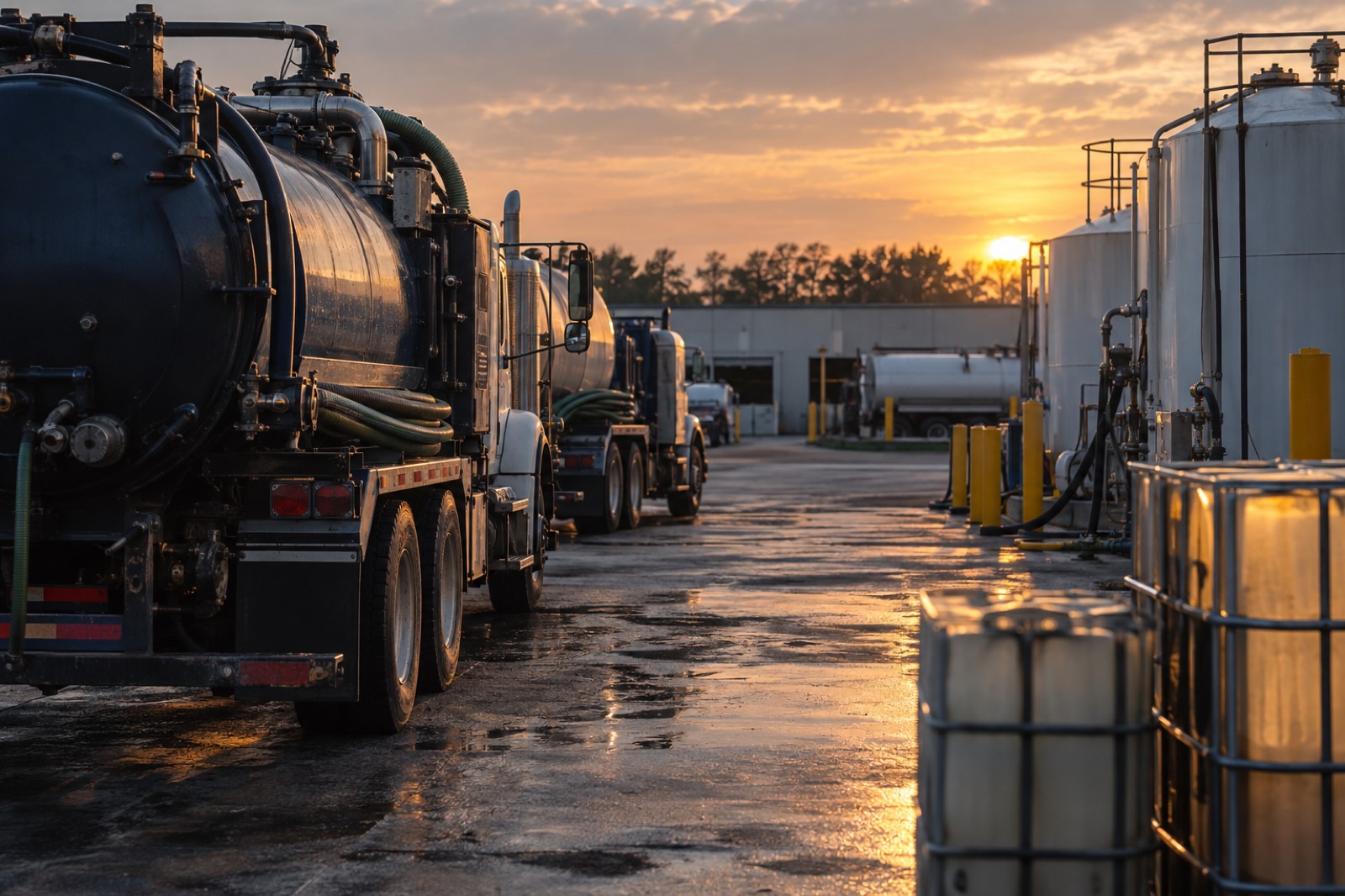
This grease trap PE roll-up tracker maps the private-equity sponsors and public strategics consolidating US grease trap servicing and used cooking oil collection routes, with each ownership position, deal date, and value carried to its named source and refreshed quarterly.
Not investment, legal, or tax advice. Not a solicitation.
This tracker is buy-side M&A research for investors, sponsors, and operators studying the grease trap PE roll-up picture. It is not a recommendation to buy or sell any security, not an offer or solicitation, and not legal, tax, or valuation advice. All deal values and multiples are drawn from the cited sources. If you are a sponsor or strategic evaluating this space, or an owner weighing a sale, you can book a confidential call with our team.
Key Takeaways
- The grease trap PE roll-up picture runs on two dedicated private-equity consolidators plus one dominant public strategic: Liquid Environmental Solutions (now Goldman Sachs Alternatives, acquired from Audax in 2025), Denali Water Solutions (TPG), and Darling Ingredients (NYSE: DAR), whose DAR PRO Solutions brand is described as North America’s number-one used cooking oil service provider.
- These are two bolted-together route businesses with opposite economics: grease trap / FOG pumping is a disposal-cost recurring service pulled forward by municipal cleaning mandates, while used cooking oil (UCO) collection is a negative-cost-of-goods commodity resale tied to the renewable-diesel and SAF feedstock cycle.
- As of mid-2026 the UCO feedstock cycle appears to be rising, not softening: one trade source puts US Gulf yellow grease near $1,150 to $1,250 per tonne in early 2026, with the HVO-to-UCO spread widening into April and May 2026 (energy-solutions.co).
- The grease trap cleaning market is fragmented, with top players collectively holding under 10% share per one syndicated estimate (verifiedmarketreports.com), which is the structural opening a roll-up is built to exploit.
- Every grease trap and UCO transaction in this tracker has an undisclosed multiple. We present a route proxy (BizBuySell route benchmark) and a scaled liquid-waste EBITDA band (roughly 6x to 12x) as labeled proxies, not as deal comps.
Quick answer: who is consolidating grease trap and UCO routes?
The grease trap PE roll-up picture is anchored by two dedicated private-equity consolidators and one public strategic. Liquid Environmental Solutions (LES), the purest grease trap plus UCO plus liquid-waste platform, passed from Audax Private Equity to Goldman Sachs Alternatives in a 2025 deal; Denali Water Solutions is a TPG-backed organics and specialty-waste roll-up carrying grease, FOG, and UCO routes; and Darling Ingredients (NYSE: DAR), through DAR PRO Solutions, is the dominant public used cooking oil aggregator. All deal values for the grease and UCO assets are undisclosed.
The grease trap PE roll-up picture is anchored by two dedicated private-equity consolidators and one public strategic, and the first job of this tracker is to name them accurately rather than guess. Liquid Environmental Solutions (LES), the purest grease trap plus used cooking oil plus liquid-waste platform we found, passed from Audax Private Equity to Goldman Sachs Alternatives in a deal announced in 2025 (Audax Private Equity, Goldman Sachs Alternatives). Denali Water Solutions is a TPG-backed organics and specialty-waste roll-up that carries grease, FOG, and UCO routes through brands such as Imperial Western Products and ALLPRO Pumping (Waste360). And Darling Ingredients (NYSE: DAR), through its DAR PRO Solutions brand, is the dominant public used cooking oil aggregator in North America (darlingii.com). Every grease and UCO deal value in this space is publicly undisclosed, so we treat all multiples as proxies and say so each time.
Methodology and confidence framework
This tracker covers US grease trap servicing and used cooking oil collection private-equity platforms and public strategics, with primary-source verification as of October 2026. Sources include SEC filings, sponsor and corporate press releases, and trade press. Where sources disagree on a date, count, or deal value, we show both and flag the conflict rather than pick one silently.
This tracker covers US grease trap servicing and used cooking oil collection private-equity platforms and public strategics, verified against primary and named secondary sources as of October 2026. Attributions were verified against primary sources (SEC filings, sponsor and corporate press releases, and trade press), ownership positions change continuously, and we refresh this tracker quarterly. Sources include SEC filings (Darling Ingredients 8-K and 10-K), sponsor and corporate press releases (Audax, Goldman Sachs Alternatives, TPG, Neste, Denali), and trade and business press (Waste Today, Waste360, Feed Strategy, Biodiesel Magazine). We apply three rules the reader can audit. First, we carry each figure with its named source inline. Second, where a figure is a proxy rather than a direct deal comp, or where it comes from a syndicated aggregator, we label it as such. Third, where sources disagree, for example on whether the LES transaction was announced in July or September 2025, or on LES location counts, we present both numbers and name the disagreement. We do not cite CT Acquisitions as a source for any statistic. Confidence tends to be highest on ownership and sponsor identity (primary press confirmation) and lowest on exact deal values, which in this space are generally not disclosed.
The two-engine demand picture: FOG mandate plus the UCO cycle
A grease trap and UCO route business bolts together two services with opposite economics. Grease trap / FOG pumping is a disposal-cost recurring service that local ordinances require on a fixed cadence. Used cooking oil collection is a commodity resale where the collector often pays the restaurant, and value rides the renewable-diesel, SAF, and LCFS cycle. Understanding both engines is the key to reading any deal in this space.
The grease trap leg is mandate-backed recurring demand. Pump-and-haul servicing of restaurant grease interceptors is non-discretionary because local fat, oil, and grease (FOG) ordinances require periodic cleaning. The EPA does not directly require grease traps at individual restaurants; instead the Clean Water Act General Pretreatment Regulations (40 CFR Part 403) require municipalities running publicly owned treatment works to operate pretreatment programs, and localities impose the grease trap cleaning rules on restaurants (greasetraplocator.com, secondary). Concrete examples include Houston, where city code is cited as requiring full pumping at least every 90 days, and Atlanta, cited with 14 and 90-day intervals (greaseconnections.com, secondary). We frame this correctly: the mandate is municipal and local, enabled by the EPA 40 CFR 403 pretreatment framework, not a direct federal EPA order. The practical point for an investor is that cleaning cadence is set by rule, generally every one to three months, which gives the grease trap leg recurring-revenue quality that does not depend on a discretionary spending decision by the restaurant.
The UCO leg is a commodity resale tied to the renewable-fuel cycle. Used cooking oil is collected from fryers and sold on to renderers, biodiesel, renewable diesel (RD), and sustainable aviation fuel (SAF) producers. For high-volume accounts collectors often pay the restaurant or collect for free, which makes it a negative or low-cost-of-goods resale model, the opposite of the disposal-cost grease trap leg (greasetraplocator.com, secondary). The value of that collected oil rides a policy-driven cycle. California’s Low Carbon Fuel Standard (LCFS) rewards low-carbon-intensity feedstocks with more credits, which is the structural reason UCO-based fuels command a premium (ICCT).
On the cycle direction, the data we found points up, not down. One trade source puts US Gulf yellow grease near $1,150 to $1,250 per tonne in early 2026 and UCO CIF ARA near $1,045 to $1,200 per tonne, with the US UCO price index rising in the second quarter of 2026 on renewable-fuel demand and the HVO-to-UCO spread widening from roughly $600 to $700 per tonne in early 2025 to above $2,000 per tonne in April and May 2026 (energy-solutions.co, secondary). The same source frames UCO as structurally undersupplied against 2030 SAF mandates. We want to be precise here: a common assumption is that renewable-diesel overcapacity is softening UCO in 2025 and 2026, but the sources we checked do not support that for UCO feedstock value, which is rising into mid-2026. The honest read is that UCO value is a tailwind as of mid-2026 and is also commodity-cyclical and policy-dependent on LCFS, the federal RFS and RIN market, and the 45Z clean-fuel credit. That cyclicality, not a current softening, is the risk an investor should price.
Market structure and fragmentation
The US grease trap cleaning market is small and fragmented. One syndicated estimate puts it near $0.9B in 2024 and reports that top players collectively hold under 10% share, with the field made up of numerous small and medium regional and local operators. That fragmentation is the opening a roll-up is designed to consolidate.
The US grease trap cleaning market is small relative to the attention it draws, and it is fragmented. One syndicated aggregator estimate puts the market near $0.9B in 2024 and roughly $0.95B in 2025, projecting about $1.45B by 2033 at roughly 6.0% CAGR, and reports that top players collectively hold under 10% share, with the field dominated by owner-operators and small to medium regional firms (verifiedmarketreports.com, secondary). We label the magnitude as one syndicated estimate rather than a settled figure; IBISWorld does publish a grease trap cleaning report, but its current numbers sit behind a paywall and we did not pull them, so we do not attribute any specific figure to IBISWorld (PRWeb). The structural takeaway holds regardless of the exact market size: a sub-10% top-share market made of owner-operators is precisely the shape a private-equity buy-and-build is designed to consolidate.
The dedicated PE consolidators
Two private-equity platforms are built partly or wholly on grease trap and UCO routes. Liquid Environmental Solutions (Goldman Sachs Alternatives, from Audax in 2025) is the purest grease trap plus UCO plus liquid-waste roll-up. Denali Water Solutions (TPG) is an organics and specialty-waste platform carrying grease, FOG, and UCO routes. Both deal values and multiples for the grease and UCO assets are undisclosed.
Liquid Environmental Solutions (Goldman Sachs Alternatives, ex-Audax)
Liquid Environmental Solutions (LES), founded in 2002 and headquartered in Irving, Texas, collects and treats waste from grease traps, oil-water separators, used cooking oil, and other non-hazardous liquid waste, serving restaurants, grocery, and hospitality customers. It is the most on-point dedicated grease trap plus UCO plus liquid-waste roll-up we identified. Audax Private Equity owned LES from 2017 and sold it to Goldman Sachs Alternatives in a deal announced in 2025 (Audax Private Equity, Goldman Sachs Alternatives). Sources differ on timing: the Businesswire release carried a July 23, 2025 date, while ESG Today dates the broader announcement to September 2025 (ESG Today). The deal value was not disclosed.
Under Audax, LES completed 13 add-on acquisitions and nearly doubled its footprint. Location counts also differ by source: the Audax release describes roughly 90 locations across 50 states, while the Goldman and press framing cites 64 service locations plus 26 treatment facilities. We cite both because they do not reconcile cleanly. Confirmed add-ons by name include New Orleans Grease Trap Cleaning, acquired under Audax ownership, and Grease Masters, a grease trap, commercial-drain, and UCO operator reported acquired in December 2025 under Goldman ownership, a date we flag for re-verification (Waste Today). LES is the clearest example of the buy-and-build thesis in this vertical: it owns treatment capacity as well as collection routes, which gives it margin and control that a pure pump-and-haul operator lacks.
Denali Water Solutions (TPG)
Denali Water Solutions is a TPG-backed organics and specialty-waste roll-up that carries grease trap, FOG, and UCO routes alongside its broader organics business. TPG Growth took control in a deal that closed January 29, 2020, acquiring from management and The Firmament Group (Waste360, PitchBook). Sources are muddy on whether a later TPG-affiliated transaction in 2024 recapitalized or re-acquired the business, so we flag the current fund structure as unverified and do not assert it. Denali has made 13 or more acquisitions since the TPG deal. The grease and UCO-relevant assets include Imperial Western Products (IWP), a Coachella, California operator that refines cooking oil and grease into biofuel and provides grease trap, oil collection, and wastewater services, acquired in a deal that closed April 29, 2022 and became Denali’s West-Coast centerpiece (GlobeNewswire); and ALLPRO Pumping, branded “a Denali company,” which runs grease trap cleaning, hydro-jetting, and UCO collection across Arizona, California, and Nevada (denalicorp.com). Other Denali add-ons surface in deal databases (Organix Recycling, Smart Recycling, Denali North Carolina, Jesse Baro, AWS Dredge, Veris Environmental), but we flag those dates for re-verification before treating them as fixed (Crunchbase). The IWP and ALLPRO brands show why Denali belongs in this tracker: it is not a dedicated grease trap pure-play like LES, but it is a genuine private-equity consolidator with real grease and UCO route density on the ground.
Darling Ingredients: the public strategic that sets the UCO bid
Darling Ingredients (NYSE: DAR) is the dominant public strategic in used cooking oil, not a PE platform. Its DAR PRO Solutions brand is described as North America’s number-one UCO service provider, and its UCO feeds Diamond Green Diesel, Darling’s renewable-diesel JV with Valero. Darling’s disclosed deals (Valley Proteins, FASA, Gelnex) all carry undisclosed EBITDA multiples.
Darling Ingredients (NYSE: DAR) is the dominant used cooking oil aggregator in North America and the strategic any private-equity consolidator competes against for oil volume. For fiscal 2024 Darling reported $5.7B in revenue and $278.9M net income across more than 260 locations on five continents, in Feed, Food, and Fuel Ingredients segments (darlingii.com FY2024 results, FY2024 10-K). Its DAR PRO Solutions brand is described as North America’s number-one used cooking oil service provider, serving roughly 200,000-plus foodservice locations (company figures vary across Darling’s own pages from 162,700 to 225,000, so we cite the range and note the disagreement). The collected UCO and trap grease route to Darling and on to Diamond Green Diesel (DGD), Darling’s renewable-diesel joint venture with Valero, from which Darling receives 50% of profits (darlingii.com). This vertical integration from fryer to renewable-diesel barrel is what lets Darling bid aggressively for oil volume, and it is the competitive backdrop every grease trap PE roll-up operates against.
Darling’s disclosed acquisitions give useful scale context even though their multiples are undisclosed. It acquired Valley Proteins for roughly $1.1B cash, announced December 28, 2021 and closed May 2, 2022, bringing 18 rendering and UCO facilities, about 1,900 employees, and 550 vehicles; Valley Proteins was one of the largest independent US renderers before the deal, and no EBITDA multiple was disclosed in the release (SEC 8-K, Feed Strategy). It acquired Brazil’s FASA Group for roughly R$2.9B (about $562.6M) in a deal closed around August 1, 2022, a rendering transaction relevant to Darling’s scale rather than to US grease routes. And it acquired Gelnex, a Brazilian gelatin and collagen producer, for roughly $1.2B cash closed March 31, 2023, which we include only as DAR-scale context because collagen is outside the grease and UCO route business (darlingii.com). The point for a grease trap investor is not these specific deals but the scale behind the strategic that competes for the same oil.
Other players: Neste, Baker Commodities, Buffalo Biodiesel
Three other names come up often and are frequently mislabeled. Neste owns Mahoney Environmental, not Darling. Baker Commodities is a private, family-owned renderer, not a PE platform. Buffalo Biodiesel is an independent collector that is heavily entangled in used cooking oil theft litigation, and we label every litigation claim as alleged.
Neste owns Mahoney Environmental, and this corrects a common error. Mahoney is not Darling-owned. Neste announced the acquisition in March 2020 and closed in May 2020. Mahoney, founded in 1953, is a leading US UCO collector and recycler that is EPA-licensed and also does grease trap cleaning, fresh-oil delivery, and equipment installation (Neste, Biodiesel Magazine). Effective January 1, 2024, SeQuential Environmental Services merged with Mahoney to become Mahoney Environmental Services, still under Neste, which expanded rather than reduced Neste’s US UCO collection (biobased-diesel.com). Neste is also reported to have acquired a UCO collection and aggregation business from Crimson Renewable Energy, though the date and terms of that deal are unverified in our sources and we flag them as such.
Baker Commodities is private and family-owned, not a PE asset. Baker Commodities is owned by the Andreoli family across three generations, was founded in 1937, is headquartered in Vernon, California, and runs nationwide UCO collection, rendering, and grease removal with roughly 900-plus employees. It is not private-equity-owned and not a Darling asset (bakercommodities.com). We include it so investors do not mistakenly map it to a sponsor; it is a large private strategic that competes for the same oil volume.
Buffalo Biodiesel is independent and legally exposed, and we label all litigation as alleged. Buffalo Biodiesel, founded in 2005 in Buffalo, New York, collects UCO from roughly 25,000 restaurants across 15 states and runs a biodiesel plant in Tonawanda. It is heavily entangled in UCO-theft litigation, reportedly both as a victim, with an alleged roughly $20M claimed loss in 2023 from drained containers, and as a named defendant, including an alleged federal suit brought by Darling over alleged vat theft (Buffalo News). We treat every litigation claim here as alleged and unproven, and we flag Buffalo Biodiesel as a legally exposed name an investor should diligence carefully rather than take at face value. We also note that a name raised in some summaries, “Grand Natural,” could not be independently verified in our research, so we omit it rather than present an unverified operator.
Deal-flow timeline (2020 to 2026)
The verified grease trap and UCO transactions cluster in 2020 to 2026. The table below lists each deal with acquirer, sponsor or parent, close date, disclosed value, and grease/UCO relevance. Every value shown is the disclosed headline figure; every EBITDA multiple in this space is publicly undisclosed.
| Target | Acquirer | Sponsor / parent | Date | Value | Grease / UCO relevance |
|---|---|---|---|---|---|
| Mahoney Environmental | Neste | Public (Neste) | Closed May 2020 | Undisclosed | High (UCO + grease trap) |
| Imperial Western Products | Denali Water Solutions | TPG | Closed Apr 29, 2022 | Undisclosed | High (grease / UCO / biofuel) |
| Valley Proteins | Darling Ingredients | Public (DAR) | Closed May 2, 2022 | ~$1.1B cash | High (rendering + UCO) |
| FASA Group | Darling Ingredients | Public (DAR) | Closed Aug 1, 2022 | ~$562.6M (R$2.9B) | Medium (rendering, Brazil) |
| Gelnex | Darling Ingredients | Public (DAR) | Closed Mar 31, 2023 | ~$1.2B cash | Low (collagen; scale context only) |
| SeQuential (merged into Mahoney) | Neste | Public (Neste) | Effective Jan 1, 2024 | Undisclosed | High (UCO) |
| LES (platform) | Goldman Sachs Alternatives | GS (from Audax) | Announced 2025 (July per Businesswire; ESG Today: Sept) | Undisclosed | High (grease trap + UCO + liquid waste) |
| New Orleans Grease Trap Cleaning | LES | Audax then GS | Under Audax ownership | Undisclosed | High (grease trap + UCO) |
| Grease Masters | LES | Goldman Sachs | Dec 2025 [re-verify] | Undisclosed | High (grease trap + UCO) |
All values and dates are per the sources cited above in the platform sections. Every EBITDA multiple for these deals is publicly undisclosed, which is itself a finding: the grease trap PE roll-up is happening at prices the market cannot observe directly, so any valuation reference has to be built from proxies.
Valuation multiples: route proxy plus a scaled EBITDA band
There is no public grease trap or UCO route multiples dataset, so every number here is a labeled proxy. Small owner-operator routes trade on SDE at low single-digit multiples; route proxies sit around 0.61x revenue and 2.35x SDE. Scaled licensed liquid-waste platforms are underwritten on EBITDA in a roughly 6x to 12x band. SDE and EBITDA are not interchangeable.
No public multiples dataset exists specifically for grease trap or UCO routes, so we use route and route-waste proxies and label them. The BizBuySell route benchmark (route businesses generally, used here as a proxy) shows a median asking price near $200,000, a revenue multiple range of 0.32 to 0.82 with a median of 0.61, and an earnings (SDE or cash-flow) multiple range of 1.29 to 3.59 with a median of 2.35; we flag that BizBuySell updates these quarterly and the live page should be confirmed before relying on it (BizBuySell route benchmark). A listing-aggregator estimate specific to grease trap cleaning puts small operators near 2.5x to 5x SDE on average revenue around $500K per year, which we present as a listing-level estimate, not a benchmark (bizbite.io, aggregator).
At the platform end, scaled route-waste and liquid-waste operators are underwritten on EBITDA. Advisory and educational sources put tuck-ins by large waste companies around 6x to 8x EBITDA, private-equity platform acquisitions around 7x to 9x EBITDA, and scaled licensed diversified operators around 9x to 12x EV/EBITDA; we treat these ranges as indicative rather than precise (ibinterviewquestions.com, morganbusinesssales.com). This gap is the roll-up arbitrage in one sentence: buy owner-operator routes measured on SDE at low single-digit multiples, aggregate them into an EBITDA platform worth roughly 8x to 12x, and the spread between the two is the return thesis. The qualitative value drivers that lift a platform within that band, asserted by the operators themselves rather than by a single study, include route density, number of accounts and contracts, a sticky municipal-contract base, contracted versus spot UCO exposure, ownership of treatment and processing assets (LES owns treatment facilities as well as routes), low customer concentration, and licensed transporter status in each jurisdiction.
Licensing and transfer risk as a consolidation driver
Per-jurisdiction liquid-waste transporter licensing is a consolidation driver, not a footnote. In Florida the liquid-waste-hauler license is not transferable, so a buyer cannot assume permits convey on a sale. Scaled, already-licensed platforms absorb this friction more easily than a single owner-operator can, which favors the consolidator.
Liquid-waste transporters must hold permits that are jurisdiction-by-jurisdiction and generally per-vehicle, annual, and inspection-gated. In Texas, haulers must register with TCEQ before any city permit, and TCEQ regulates transport of grease-trap and grit-trap waste and septage (TCEQ, City of Austin). City permits commonly run around $200 per vehicle per year with an annual inspection. The transfer risk is material and confirmed: in Florida the liquid-waste-hauler license is not transferable, and the county must be notified prior to the sale or legal transfer of the licensed establishment (Broward County license application). For an investor this cuts two ways. It is a diligence and continuity risk on any single acquisition, because a buyer may have to re-apply or re-register rather than inherit permits. It is also a consolidation driver, because a scaled platform that already holds licenses across many jurisdictions can absorb an acquired route’s re-licensing friction far more easily than a lone owner-operator buyer can, which tends to favor the licensed consolidator in a competitive process.
UCO theft and chain-of-custody
Used cooking oil volume is only as valuable as the collector’s locked, registered, theft-protected account base. California requires all grease transporters to register with CDFA, buying from an unlicensed transporter is a criminal offense, and UCO theft carries escalating penalties. Chain-of-custody and container security are real diligence items, not operational trivia.
UCO value depends on secure chain-of-custody. In California, all companies removing or transporting waste cooking grease (inedible kitchen grease) must register with the CDFA, a renderer buying UCO from an unlicensed transporter commits a criminal offense, and purchase and pickup records must be kept for at least two years; CDFA can revoke registrations, fine, and refer for criminal prosecution (CDFA, greasemanagement.org). UCO theft is a priced-in operational risk: California AB 1566 (2015) sets escalating penalties, cited at $1,000 and up to 30 days for a first offense, $5,000 for a second, and $10,000 and up to six months for a third (oilguyz.com, secondary). The alleged Buffalo Biodiesel loss and the alleged Darling suit noted above illustrate the scale this can reach. The investor takeaway is concrete: when underwriting a UCO collector, verify transporter registration in every operating state, review container-security and theft history, and separate contracted accounts from at-will accounts, because the contracted, registered, theft-protected base is what actually carries value.
Who should and should not expect a platform buyer
A licensed, route-dense grease trap and UCO operator with contracted municipal and commercial accounts in a consolidator’s geography is the profile a platform buyer looks for. An unlicensed, single-market, at-will-account operator with thin chain-of-custody is harder to place and tends to attract a local or search buyer rather than a sponsor platform.
Reading the demand side honestly helps an investor or operator set expectations. The profile that attracts a platform bid tends to share features: licensed transporter status across its operating states, genuine route density, a contracted account base weighted toward municipal and commercial customers rather than at-will residential-style accounts, secured UCO chain-of-custody with a clean theft history, and a location inside or adjacent to a consolidator’s existing footprint (LES across many states, Denali across the West and Southeast, Darling and Neste nationally for oil). The profile that is harder to place tends to be a single-market operator with unlicensed or thinly licensed transport, at-will accounts, and no treatment or processing assets; that business is still sellable, but it tends to attract a local strategic or a search or SBA buyer rather than a sponsor platform, and it tends to be measured on SDE rather than EBITDA. Neither outcome is good or bad in itself; the point is to match the business to the realistic buyer pool before running a process.
Related CT Acquisitions research
For what sellers actually receive and how to prepare a grease trap or UCO business for a sale, see our grease trap and used cooking oil business valuation guide, the seller-intent companion to this buyer map. For the adjacent route-waste consolidation picture, see our waste hauling PE roll-up tracker 2026. And for the cross-sector view of which sponsors are active where, see our private equity platforms by sector 2026. If you are a sponsor, strategic, or operator who wants to discuss a specific situation, book a confidential call with our team.
Frequently asked questions
Who are the dedicated grease trap PE roll-up platforms?
Two dedicated private-equity consolidators carry real grease trap and UCO routes: Liquid Environmental Solutions, acquired by Goldman Sachs Alternatives from Audax Private Equity in 2025, which is the purest grease trap plus UCO plus liquid-waste platform; and Denali Water Solutions, backed by TPG, which carries grease, FOG, and UCO routes through brands such as Imperial Western Products and ALLPRO Pumping. Darling Ingredients is the dominant public strategic rather than a PE platform.
Is Mahoney Environmental owned by Darling Ingredients?
No. Mahoney Environmental is owned by Neste, which announced the acquisition in March 2020 and closed it in May 2020. SeQuential Environmental Services merged into Mahoney effective January 1, 2024, still under Neste. This corrects a common assumption that Mahoney is a Darling asset.
Is Baker Commodities private-equity-owned?
No. Baker Commodities is private and family-owned by the Andreoli family, founded in 1937 and headquartered in Vernon, California. It is a large private strategic in UCO collection and rendering, not a PE platform and not a Darling asset.
What is the deal multiple on these grease trap and UCO transactions?
Every grease trap and UCO transaction in this tracker has an undisclosed EBITDA multiple. We use labeled proxies instead: a route proxy near 0.61x revenue and 2.35x SDE from BizBuySell, and a scaled liquid-waste EBITDA band of roughly 6x to 12x from advisory sources. SDE and EBITDA are not interchangeable.
Is the UCO cycle softening in 2026?
The sources we checked point the other way for UCO feedstock value. US Gulf yellow grease is cited near $1,150 to $1,250 per tonne in early 2026, the US UCO price index rose in the second quarter of 2026, and the HVO-to-UCO spread widened into April and May 2026. UCO value is a tailwind as of mid-2026, though it is commodity-cyclical and policy-dependent on LCFS, RFS, and the 45Z credit.
Why does licensing matter to a roll-up?
Liquid-waste transporter licensing is per-jurisdiction and often per-vehicle, and in Florida the hauler license is not transferable on a sale. A scaled platform that already holds licenses across many jurisdictions absorbs an acquired route’s re-licensing friction more easily than a single owner-operator buyer can, which tends to favor the licensed consolidator.
What is the difference between the grease trap leg and the UCO leg?
They have opposite economics. Grease trap or FOG pumping is a disposal-cost service that local ordinances require on a fixed cadence, giving it recurring-revenue quality. UCO collection is a commodity resale where the collector often pays the restaurant, and its value rides the renewable-diesel, SAF, and LCFS cycle.
How is Buffalo Biodiesel positioned?
Buffalo Biodiesel is an independent collector serving roughly 25,000 restaurants across 15 states, and it is heavily entangled in used cooking oil theft litigation, both as an alleged victim and as a named defendant. We treat every litigation claim as alleged and unproven and flag it as a name to diligence carefully.
Sources
- Audax Private Equity, sale of Liquid Environmental Solutions: https://audaxprivateequity.com/news/audax-private-equity-announces-sale-of-liquid-environmental-solutions
- Goldman Sachs Alternatives, Liquid Environmental Solutions: https://am.gs.com/en-us/individual/news/press-release/2025/liquid-environmental-solutions
- ESG Today, Goldman Sachs acquires LES: https://www.esgtoday.com/goldman-sachs-acquires-liquid-waste-solutions-provider-les/
- Waste Today, LES New Orleans acquisition: https://www.wastetodaymagazine.com/news/liquid-environmental-solutions-new-orleans-acquisition/
- Waste360, TPG to acquire Denali Water Solutions: https://www.waste360.com/mergers-acquisitions/tpg-to-acquire-denali-water-solutions
- PitchBook, TPG Growth to add Denali Water Solutions: https://pitchbook.com/newsletter/tpg-growth-to-add-denali-water-solutions
- GlobeNewswire, Denali acquires Imperial Western Products: https://www.globenewswire.com/news-release/2022/05/02/2433756/0/en/Denali-Water-Solutions-LLC-Acquires-Imperial-Western-Products-Inc.html
- Denali, ALLPRO Pumping brand page: https://www.denalicorp.com/our-brands/appumping
- Crunchbase, Denali Water Solutions timeline: https://www.crunchbase.com/organization/denali-water-solutions/company_overview/overview_timeline
- Darling Ingredients FY2024 results: https://www.darlingii.com/media/news/20250206-darling-ingredients-inc-reports-fourth-quarter-2024-results
- Darling Ingredients FY2024 10-K (SEC): https://www.sec.gov/Archives/edgar/data/916540/000091654025000008/dar-20241228.htm
- DAR PRO Solutions: https://www.darlingii.com/darpro
- Darling Valley Proteins 8-K (SEC): https://www.sec.gov/Archives/edgar/data/916540/000091654021000038/exh991-pressrelease122821.htm
- Feed Strategy, Darling completes Valley Proteins: https://www.feedstrategy.com/animal-nutrition/article/15442883/darling-ingredients-completes-valley-proteins-acquisition
- Darling, Gelnex acquisition: https://www.darlingii.com/en/media/news/20230402-acquisition-of-brazilian-gelatin-and-collagen-producer-gelnex
- Neste, Mahoney Environmental acquisition closed: https://www.neste.com/news/neste-s-acquisition-of-us-based-company-mahoney-environmental-closed
- Biodiesel Magazine, Neste to acquire Mahoney: https://biodieselmagazine.com/articles/neste-to-acquire-us-grease-collection-recycling-company-2516942
- Biobased Diesel, SeQuential merges with Mahoney: https://www.biobased-diesel.com/post/sequential-environmental-services-merges-with-mahoney
- Baker Commodities, about: https://bakercommodities.com/about-us/
- Buffalo News, UCO theft coverage: https://buffalonews.com/news/local/crime-courts/article_09b09db4-8ca3-11ef-9b87-4b734751c26f.html
- Verified Market Reports, grease trap cleaning market: https://www.verifiedmarketreports.com/product/grease-trap-cleaning-service-market/
- PRWeb, IBISWorld grease trap cleaning report notice: https://www.prweb.com/releases/grease_trap_cleaning_in_the_us_industry_market_research_report_now_available_from_ibisworld/prweb11882595.htm
- GreaseTrapLocator, EPA FOG regulations: https://greasetraplocator.com/epa-fog-regulations/
- Grease Connections, Atlanta FOG guide: https://greaseconnections.com/atlanta-grease-trap-regulations-fog-compliance-guide/
- GreaseTrapLocator, used cooking oil business: https://greasetraplocator.com/used-cooking-oil-business/
- Energy Solutions, UCO market 2026: https://energy-solutions.co/articles/sub/used-cooking-oil-uco-market-2026
- ICCT, lipids cap in California LCFS: https://theicct.org/the-case-for-a-lipids-cap-in-californias-low-carbon-fuel-standard-may24/
- BizBuySell, route valuation benchmarks: https://www.bizbuysell.com/learning-center/valuation-benchmarks/route/
- BizBite, grease trap cleaning service listing: https://bizbite.io/businesses/grease-trap-cleaning-service
- IB Interview Questions, waste services M&A playbook: https://ibinterviewquestions.com/guides/industrials-investment-banking/waste-services-ma-consolidation-playbook
- Morgan Business Sales, 2026 waste and environmental services M&A overview: https://morganbusinesssales.com/2026-waste-management-and-environmental-services-ma-overview/
- TCEQ, transporters and haulers FAQ: https://www.tceq.texas.gov/assistance/industry/oil-and-gas/transporters-and-haulers-commonly-asked-questions
- City of Austin, liquid waste hauler program: https://www.austintexas.gov/water/liquid-waste-hauler-program
- Broward County, waste transport license application: https://www.broward.org/Environment/Forms/Documents/Waste%20Regulation/AppWasteTransportLic.pdf
- CDFA, inedible kitchen grease registration: https://apps1.cdfa.ca.gov/IKG
- Grease Management, used oil collection: https://greasemanagement.org/usedoilcollection.html
- OilGuyz, California UCO theft prevention: https://oilguyz.com/blog/used-cooking-oil-theft-prevention-california-restaurants
About the author
This tracker was prepared by Christoph Totter, Managing Partner at CT Acquisitions (ctacquisitions.com), a buy-side M&A advisor and private-equity research platform working with 500+ capital partners across route-based and environmental-services verticals. We maintain continuously updated platform maps, deal-flow chronologies, and multiples references, and we refresh this tracker quarterly.
This tracker was prepared by Christoph Totter, Managing Partner at CT Acquisitions (ctacquisitions.com), a buy-side M&A advisor and private-equity research platform working with 500+ capital partners across route-based and environmental-services verticals. We maintain continuously updated platform maps, deal-flow chronologies, multiples references, and regulatory tracking for sponsors, family offices, and strategic buyers. For grease trap and used cooking oil roll-up research, sponsor engagements, or operator-side sale preparation, contact the team at ctacquisitions.com. Last verified October 2026.
Disclaimer
CT Strategic Partners LLC dba CT Acquisitions is a buy-side M&A advisor and is not a registered investment bank, broker-dealer, or appraiser. Multiple ranges are directional observations from cited sources and active engagement observations, not point estimates; where figures are proxies or sources disagree, they are presented as such. SDE and EBITDA multiples measure different things and are not interchangeable. Regulatory, licensing, and code references are general summaries, not legal or compliance advice; requirements vary by jurisdiction and change over time. Individual outcomes vary materially. Past patterns are not a guarantee of future results.