Private Equity Firms Specializing in Rollups: The 2026 US Consolidator Map by Sector
Private equity firms specializing in rollups in 2026 include KKR, Alpine Investors, Hellman & Friedman, Leonard Green, Welsh Carson and Apax: if one approaches you, the price depends on whether you are bought as a platform or an add-on.
By Christoph Totter, Founder of CT Acquisitions · Last reviewed: November 2026
Approached by a roll-up sponsor?
CT Acquisitions represents founders when a consolidator calls. We work for owners on the sell side. Our fee is success only: nothing upfront, and you pay nothing unless the business sells.
Key takeaways
- Add-ons made up about 74% of US private equity buyouts in 2025 through September 30, against a five-year average of 72% (PitchBook Q3 2025 US PE Breakdown, via Sidley Austin). A founder called by a roll-up is most often being priced as an add-on.
- PE-backed deals at $10M to $100M of enterprise value averaged 6.7x EBITDA in 2024, against 9.2x at $100M to $500M (GF Data Q4 2024). That 2.5-turn gap is the size premium a platform seller captures and an add-on seller usually does not.
- Rollover equity appeared in 63.6% of 2024 GF Data deals at an average 14.5% of price; Stout (January 2026) puts physician roll-up rollover at 20% to 40%.
- The typical PE hold is now 6.0 years across 13,757 exits from 2021 to mid-2026 (PrivateEquityInfo, September 2026). KKR has held Heartland Dental for 8.7 years as of November 2026, so a seller rolling into it today is closer to the next sale than one rolling into Champions Group (0.7 years under Blackstone).
- Three sponsor attributions that circulate widely are wrong: Neighborly is owned by KKR since 2021 (Business Wire), BrightSpring is KKR-backed, and Service King combined with Crash Champions under Clearlake in 2022, not with Caliber.
These sponsors concentrate on fragmented industries where the four largest firms earn under 10% of revenue.
Which private equity firms specialize in roll-ups in 2026?
The private equity firms specializing in roll-ups are sector repeat buyers: KKR and Welsh Carson in healthcare, Alpine Investors, Apax and Leonard Green in home services, Hellman & Friedman and Clearlake in collision repair, and Access Holdings and Axar in funeral services. Each list below names the sponsor, its platform and a dated public fact about that platform.
The table gives one anchor platform per sponsor with the date the sponsor entered and its latest disclosed scale. Location counts come from the platform or a named trade source; where only a deal value is public, the table shows that instead.
| Platform | Lead sponsor (entry) | Latest disclosed scale | Source |
|---|---|---|---|
| Heartland Dental | KKR (majority, March 2018) | More than 1,880 locations, about 3,100 doctors (September 2025) | Heartland Dental |
| Caliber Collision | Hellman & Friedman (majority, February 2019) | 1,863 locations at year-end 2025 | Focus Advisors |
| Crash Champions | Clearlake Capital (July 2022) | 662 locations at year-end 2025 | Focus Advisors |
| Apex Service Partners | Alpine Investors (continuation vehicle, October 2023) | 60 add-ons in 2025; 75 local brands in 46 states | Alpine Investors |
| Neighborly | KKR (July 2021) | 28 brands, more than 4,800 franchises at signing | Business Wire |
| Authority Brands | Apax Partners with BCI (September 2018) | Grew from 2 franchisors to 12 by 2022 | The Middle Market |
| Wrench Group | Leonard Green & Partners (April 2019) | $1.3 billion private credit refinancing (September 2025) | Private Equity Wire |
| Champions Group | Blackstone (February 2026) | About $2.5 billion deal value | Business Wire |
| Mavis Tire Express Services | BayPine with TSG Consumer (March 2021) | More than 4,400 locations after Pep Boys (August 2026) | Modern Tire Dealer |
| Foundation Partners Group | Access Holdings (June 2015) | 225 locations in 21 states | FPG fact sheet |
For the trade-by-trade view of plumbing platforms, see the private equity in plumbing guide. The mechanics behind these platforms are explained in how a PE roll-up strategy works.
Top US PE sponsors in healthcare services rollups
- KKR. Heartland Dental, majority owned since 2018 when KKR bought control from Ontario Teachers’ (OTPP); BrightSpring Health Services, which listed on Nasdaq as BTSG on January 26, 2024 at $13.00 a share, below its $15 to $18 range (SEC Form 424B4); PetVet Care Centers, 439 clinic listings (Private Equity Vet, October 2026).
- Welsh Carson Anderson & Stowe. U.S. Anesthesia Partners, the subject of a 2023 FTC roll-up suit; a final order on May 20, 2025 limits Welsh Carson’s involvement (FTC). United Musculoskeletal Partners, a 60% stake bought from Resurgens Orthopaedics in December 2021 (KFF Health News).
- Ares Management. US Heart and Vascular, a Nashville cardiology platform formed in 2021 (Cardiovascular Business). Ares also co-owns The Aspen Group with Leonard Green and American Securities.
- Webster Equity Partners. Cardiovascular Associates of America, launched December 2021, about 450 physicians in 2024 (Healthcare Dive). Webster sold Retina Consultants of America to Cencora on January 2, 2025 for a $4.4 billion cash outlay (Cencora 8-K).
- Linden Capital Partners and Audax. HOPCo, an orthopedic platform bought jointly in 2019 in a $400 million-plus deal (Private Equity International).
- JAB Holding and Gryphon Investors. NVA with 1,017 and Heartland Veterinary Partners with 333 veterinary listings (Private Equity Vet, October 2026).
Top US PE sponsors in home services rollups
- Alpine Investors. Apex Service Partners (HVAC, plumbing, electrical): 60 add-ons in 2025 after 47 in 2024; a $3.4 billion single-asset continuation vehicle in October 2023 (Alpine); Apollo funds agreed a minority stake in May 2026 (Apollo). Vertex Service Partners (roofing) made over 30 acquisitions in three years (ServiceTitan).
- KKR. Neighborly, bought from Harvest Partners in July 2021 with 28 brands including Mr. Rooter, Mr. Handyman and Aire Serv.
- Apax Partners. Authority Brands since 2018, alongside BCI; 246 new franchise owners in 2025 (1851 Franchise).
- Leonard Green & Partners. Wrench Group, bought from Investcorp in April 2019, with TSG and Oak Hill as minority investors since 2022 (Leonard Green).
- Goldman Sachs Alternatives. Sila Services, majority stake from Morgan Stanley Capital Partners in November 2024 at a reported $1.7 billion, about 17x EBITDA (Goldman Sachs; HomePros News).
- Blackstone. Champions Group from Odyssey in February 2026 at about $2.5 billion (Bloomberg).
- EQT. Anticimex in pest control since 2012, with more than 200 add-ons (EQT). The public strategic in the same trade, Rollins, closed 26 acquisitions in 2025 (Rollins 10-K).
Top US PE sponsors in auto / car wash / collision repair rollups
- Hellman & Friedman. Caliber Collision, majority owner since the Caliber and ABRA merger closed February 5, 2019, with OMERS and Leonard Green as minority holders (Leonard Green). Caliber filed a confidential draft S-1 in July 2025 (CollisionWeek).
- Clearlake Capital. Crash Champions, which combined with Service King in July 2022 (PR Newswire).
- Leonard Green & Partners. Mister Car Wash, taken private on May 19, 2026 at $7.00 a share, a $3.1 billion enterprise value; Leonard Green funds already held about 67% (Latham & Watkins).
- BayPine. Mavis Tire Express Services since March 2021 with TSG Consumer Partners (BayPine).
- Roark Capital. Driven Brands (Nasdaq: DRVN), over 4,200 locations at fiscal year-end 2025 (Driven Brands 10-K).
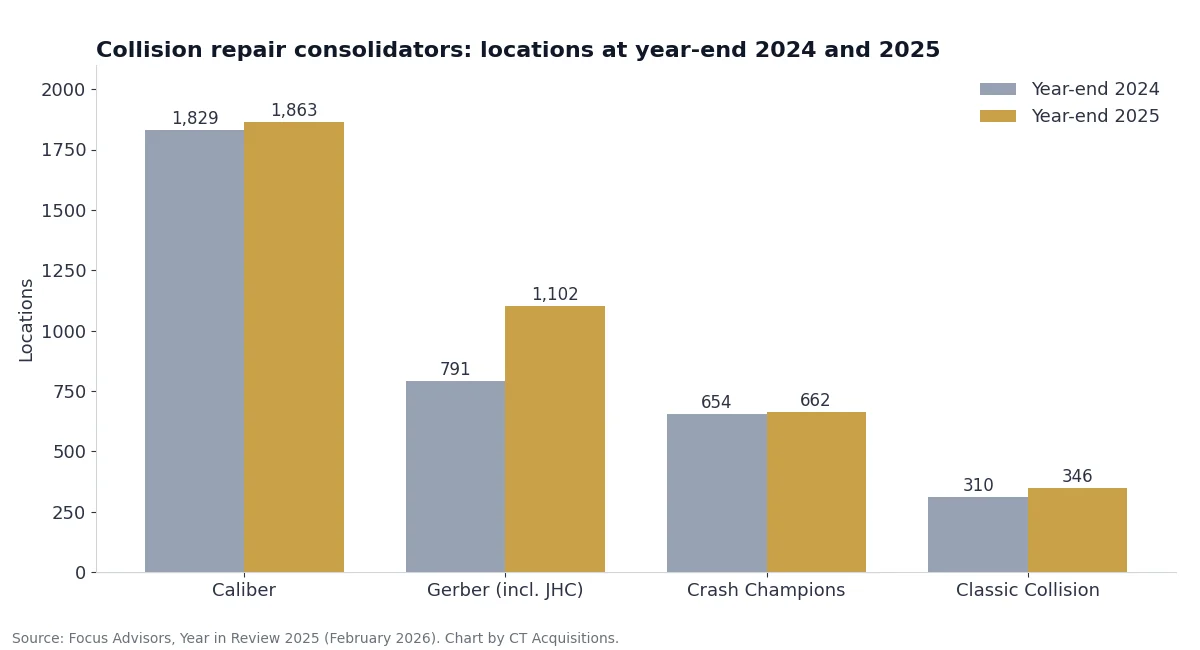
Collision repair shows how fast a roll-up map changes: Gerber went from 791 to 1,102 year-end locations in 2025 while Caliber added 34 and Crash Champions added 8 (Focus Advisors, February 2026). Gerber is owned by Boyd, a listed strategic, not a PE fund.
| Collision consolidator | Owner | Locations, year-end 2024 | Locations, year-end 2025 | Change |
|---|---|---|---|---|
| Caliber | Hellman & Friedman | 1,829 | 1,863 | +34 (+1.9%) |
| Gerber (incl. JHC) | Boyd Group (listed) | 791 | 1,102 | +311 (+39.3%) |
| Crash Champions | Clearlake Capital | 654 | 662 | +8 (+1.2%) |
| Classic Collision | Not stated in source | 310 | 346 | +36 (+11.6%) |
Source for the table: Focus Advisors Year in Review 2025, published February 2026.
Top US PE sponsors in commercial and industrial services rollups
- Altas Partners. Tecta America (commercial roofing) since 2018; Skyline Roofing in October 2025 was its 35th acquisition in a decade (Tecta America).
- AEA Investors. Nations Roof, closed July 2024 with 22 business units (AEA).
- Blackstone. AIR Control Concepts (commercial HVAC), sole institutional investor since January 2026 (Business Wire).
- Riverside Company and Align Capital Partners. Relay Fire and Safety since December 2022 (Riverside); Protegis Fire & Safety since December 2017 with 7 add-ons (Align).
- Alpine Investors. Astra Service Partners (commercial facilities services), launched as Orion Group in November 2020 (Business Wire).
Top US PE sponsors in funeral / death care rollups
- Access Holdings. Foundation Partners Group since June 2015, when it had 38 funeral homes; 225 locations in 21 states now (PR Newswire).
- Axar Capital Management. Everstory Partners, formerly StoneMor, taken private in 2022; 430 facilities including 374 cemeteries (Funeral Director Daily, April 2026).
- Birch Hill Equity Partners with Homesteaders Life. Park Lawn, taken private on August 9, 2024 for about C$1.2 billion (Bennett Jones).
- Public strategic: Service Corporation International (NYSE: SCI), 1,485 funeral locations and 500 cemeteries at December 31, 2025 (SCI 10-K).
Sector-specific roll-up sponsor maps: for platform-by-platform detail see the 2026 Home Health Roll-Up Tracker, the 2026 Orthopedic Tracker, the 2026 Ophthalmology Tracker and the dental DSO roll-up tracker.
PE firms specializing in software roll-ups, and who advises on them
The private equity firms specializing in software roll-ups are the software-only sponsors: Thoma Bravo, with about $170 billion of assets under management at June 30, 2026, and Vista Equity Partners, with more than $103 billion and over 90 enterprise software companies at March 31, 2026. They buy for recurring revenue and cross-sell, not for route density.
A firm that consolidates HVAC branches by geography is not the firm that bolts three vertical-software companies onto a shared billing and data layer. Thoma Bravo describes itself as software-focused (Thoma Bravo), and Vista lists over 90 enterprise software holdings (Vista FAQ). The previous version of this page also named Hellman & Friedman and Clearlake for software; we kept only sponsors whose own sites state a software focus.
On who advises: a sell-side M&A advisor positions a software or healthcare asset to the 3 to 5 consolidators already assembling a platform in that niche, rather than sending a teaser to every fund. CT Acquisitions maps the active consolidator in your sector first, then runs the process toward the sponsors whose stated playbook matches the asset, from a network of 500+ buyers.
Platform or add-on: how does a roll-up price your business?
A roll-up pays a platform price only for a business big enough to anchor the strategy, usually $5M or more of EBITDA with a management team. Everything smaller is an add-on, priced off the platform’s cost of capital. GF Data put 2024 PE deals at 6.7x EBITDA below $100M of enterprise value and 9.2x above it.
Every published source agrees on the direction of the gap; they differ on the size by sector. The table lines up the add-on and platform ranges each source states, with its date. Sector figures are opinions of named practitioners, not transaction databases, so read them as ranges, not quotes.
| Source and sector | Add-on or smaller deal | Platform or larger deal | Date |
|---|---|---|---|
| GF Data, all PE-sponsored deals | 6.7x ($10M to $100M enterprise value) | 9.2x ($100M to $500M) | 2024 |
| Dermatology Times, dermatology | 2x to 7x | 10x to 15x ($5M or more EBITDA) | August 2026 |
| Brian Colao, Dykema, via Group Dentistry Now, dental | About 5x to 6x | About 9x to 10x | June 2026 |
| Stout, orthopedics | Mid-single digits (tuck-ins) | Mid-teens | January 2026 |
| AAO EyeNet, ophthalmology | 5x to 8x | 8x to double digits | November 2019 |
| HomePros News and TheStreet, HVAC platforms of platforms | Not stated | About 17x (Sila, 2024); 18.5x reported (Champions, 2026) | 2024 to 2026 |
| CT Acquisitions working range (house view, not a dataset) | 4x to 6x ($500K to $5M EBITDA) | 6x to 9x ($5M to $25M or more EBITDA) | 2026 |
One caution on the HVAC row: TheStreet’s 18.5x for Champions Group does not reconcile with its own inputs, since $2.5B divided by $140M of EBITDA is 17.9x (TheStreet via Yahoo Finance, March 2026). Those multiples are paid for platforms with 1,800+ technicians, not for a single-branch contractor.
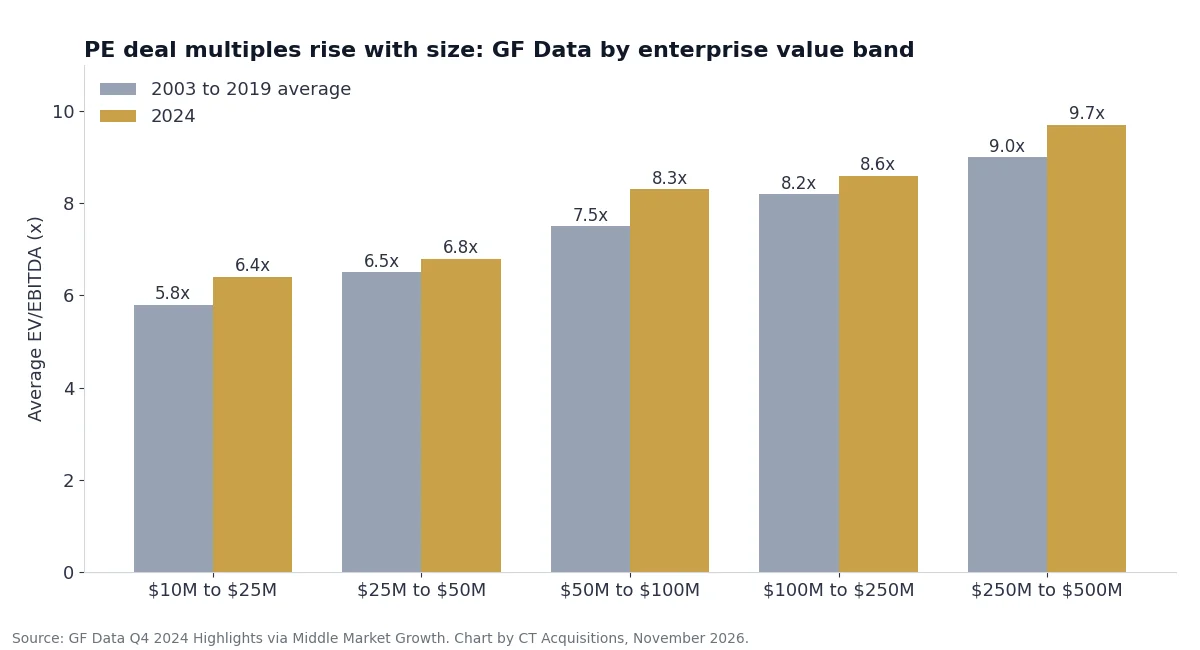
The same GF Data release splits 2024 deals into five size bands. The multiple rises with size in every band, which is the arithmetic a roll-up sponsor exploits: buy at the left of the chart, sell the combined company at the right.
| Enterprise value band (GF Data) | 2024 average EV/EBITDA | 2003 to 2019 average |
|---|---|---|
| $10M to $25M | 6.4x | 5.8x |
| $25M to $50M | 6.8x | 6.5x |
| $50M to $100M | 8.3x | 7.5x |
| $100M to $250M | 8.6x | 8.2x |
| $250M to $500M | 9.7x | 9.0x |
Worked example: one business, two routes
This is illustrative CT arithmetic, not a client deal. A founder with $5.0M of adjusted EBITDA sits on the line between the two CT working ranges. As an add-on at 6.0x with 10% rollover, or as a platform at 8.0x with 30% rollover, the cash wired at closing is the same $24.0M once a 10% escrow is held back; the 10% escrow matches the 2025 median for deals without RWI (SRS Acquiom 2026 Deal Terms Study via DealLawyers.com).
| Line (illustrative) | Sell as add-on | Sell as platform |
|---|---|---|
| Adjusted EBITDA | $5.0M | $5.0M |
| Multiple | 6.0x | 8.0x |
| Headline price | $30.0M | $40.0M |
| Rollover equity | 10% = $3.0M | 30% = $12.0M |
| Cash at close | $27.0M | $28.0M |
| Escrow held back (10%) | $3.0M | $4.0M |
| Cash wired at closing | $24.0M | $24.0M |
| Rollover worth at 0.5x / 1.0x / 2.0x / 3.0x | $1.5M / $3.0M / $6.0M / $9.0M | $6.0M / $12.0M / $24.0M / $36.0M |
| Total proceeds at 0.5x / 1.0x / 2.0x / 3.0x | $28.5M / $30.0M / $33.0M / $36.0M | $34.0M / $40.0M / $52.0M / $64.0M |
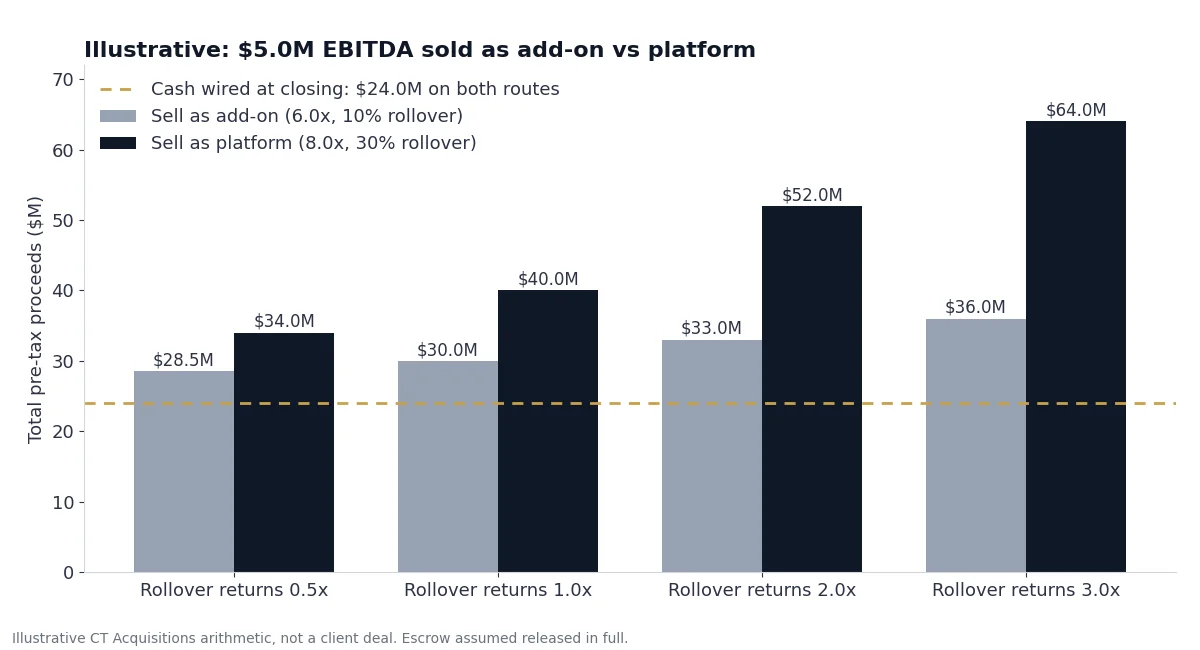
The platform route wins on headline by $10.0M, or 33%, but every extra dollar sits in rolled equity you cannot sell until the sponsor exits. If the second sale returns 2.0x, the platform seller ends $19.0M ahead; if the stake halves, the gap shrinks to $5.5M and the platform seller has also spent years running the roll-up. Total proceeds assume the escrow is released in full.
Should you sell to a roll-up as a platform or as an add-on?
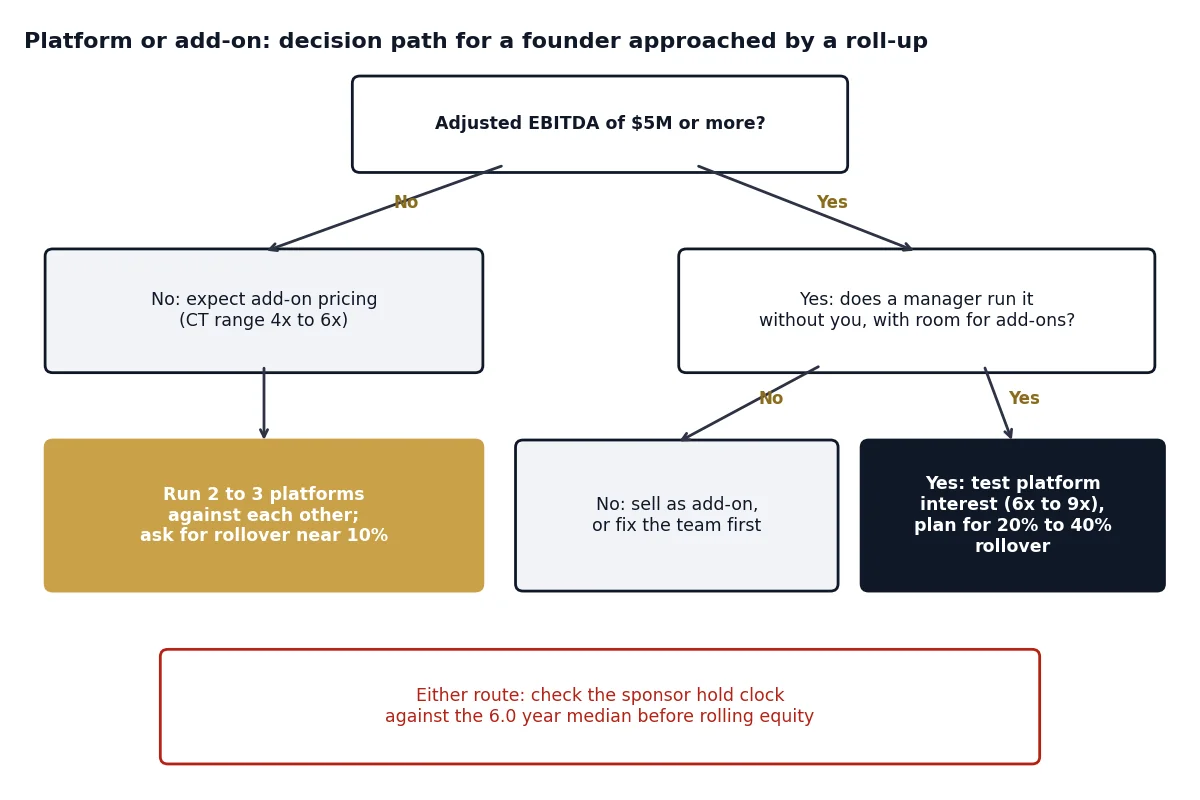
Choose the platform route only if your business has $5M or more of EBITDA, a team that runs without you and room for add-ons around it, and you can wait 5 to 7 years for the second payout. Otherwise sell as an add-on, keep rollover near 10% and run 2 to 3 competing platforms against each other.
| If your situation is | Then | Why (source) |
|---|---|---|
| If adjusted EBITDA is under $5M | Expect add-on pricing and make 2 to 3 platforms bid | CT working range 4x to 6x for $500K to $5M EBITDA |
| If EBITDA is $5M or more and a manager can run the business | Test platform interest before taking an add-on offer | GF Data size premium: 6.7x vs 9.2x (2024) |
| If you want out of day-to-day work within 12 months | Sell as an add-on and ask for the low end of rollover | Rollover often 10% to 30% (Porte Brown) |
| If the platform’s sponsor has held it 6.0 years or longer | Ask when the exit process starts; your rollover may be repriced soon | Median hold 6.0 years (PrivateEquityInfo, 2026) |
| If the platform was bought under 2 years ago | Model 4 or more years before your rollover pays | Same median hold |
| If the buyer already holds a large share of your local market | Budget time for antitrust questions and ask who pays for them | 2023 Merger Guidelines, Guideline 8 on series of acquisitions (DOJ) |
| If the deal value is above $133.9M | Expect an HSR filing and a 30-day waiting period | FTC, January 2026 |
Holding an offer from a roll-up?
We check whether you are being priced as a platform or an add-on, and bring competing platforms to the table. We work for owners on the sell side. Our fee is success only: nothing upfront, and you pay nothing unless the business sells.
How risky is rollover equity in a roll-up?
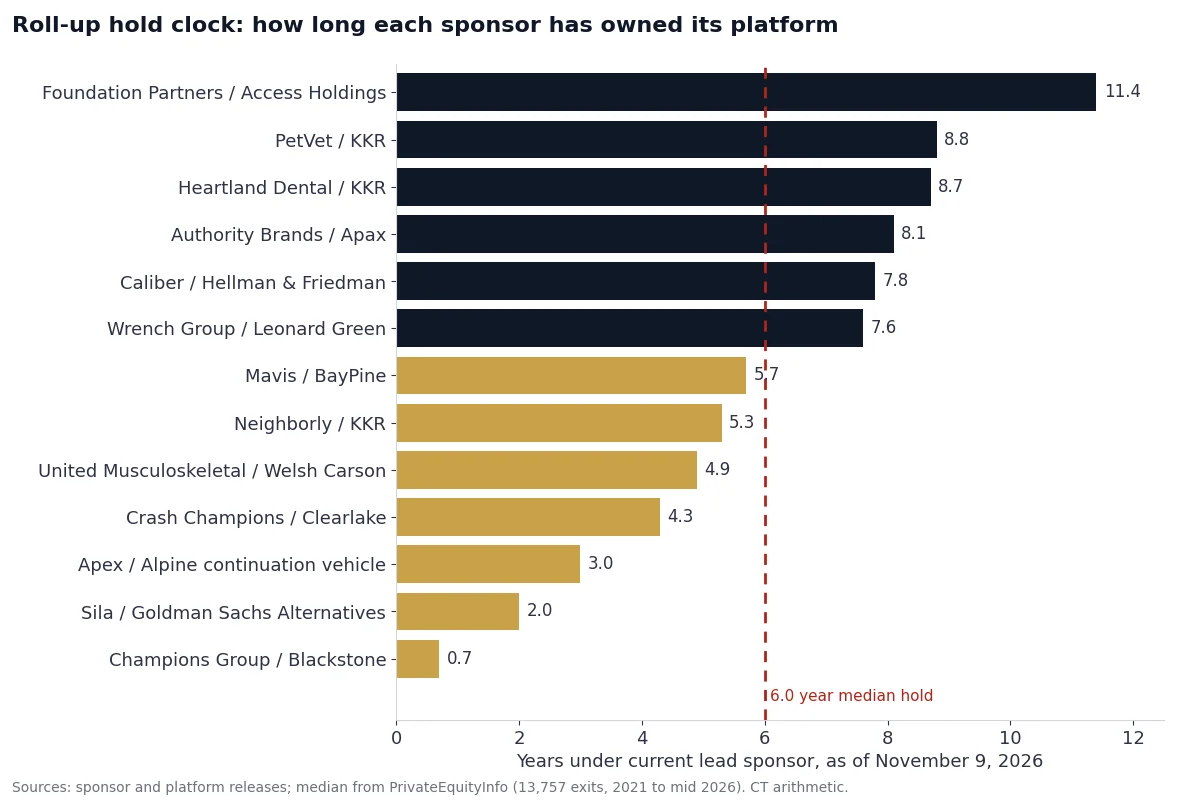
Rollover equity is the part of your price paid in the buyer’s stock, and it pays out only when the sponsor sells. GF Data found rollover in 63.6% of 2024 deals at 14.5% of price. The risk is timing and debt: a stake rolled into a platform held 0.7 years waits far longer than one held 8.7 years.
The hold clock below counts the years each named sponsor has owned its platform as of November 9, 2026, against the 6.0-year median across 13,757 exits (PrivateEquityInfo). It is CT arithmetic from the entry dates in the sources above; where only a month is public, mid-month is assumed.
| Platform / sponsor | Sponsor entry | Years held (Nov 9, 2026) | Versus 6.0-year median |
|---|---|---|---|
| Foundation Partners Group / Access Holdings | June 2015 | 11.4 | 5.4 years past |
| PetVet / KKR | January 3, 2018 | 8.8 | 2.8 years past |
| Heartland Dental / KKR | March 2018 | 8.7 | 2.7 years past |
| Authority Brands / Apax | September 24, 2018 | 8.1 | 2.1 years past |
| Caliber / Hellman & Friedman | February 5, 2019 | 7.8 | 1.8 years past |
| Wrench Group / Leonard Green | April 8, 2019 | 7.6 | 1.6 years past |
| Mavis / BayPine | March 5, 2021 | 5.7 | 0.3 years to go |
| Neighborly / KKR | July 8, 2021 | 5.3 | 0.7 years to go |
| United Musculoskeletal Partners / Welsh Carson | December 2021 | 4.9 | 1.1 years to go |
| Crash Champions / Clearlake | July 14, 2022 | 4.3 | 1.7 years to go |
| Apex / Alpine continuation vehicle | October 25, 2023 | 3.0 | 3.0 years to go |
| Sila / Goldman Sachs Alternatives | November 12, 2024 | 2.0 | 4.0 years to go |
| Champions Group / Blackstone | February 17, 2026 | 0.7 | 5.3 years to go |
A platform past the median is not a guaranteed exit: Caliber filed a confidential S-1 in July 2025 and was still unpriced in August 2026 (Matthews, September 2026). Debt matters too. The Aspen Group, owned by Leonard Green, Ares and American Securities, was looking for outside investors in May 2026 to handle roughly $3 billion of loans due the next year (Bloomberg Law).
Tax deferral on rollover depends on the buyer’s entity. Into a corporation, IRC Section 351 defers gain only if the transferors hold at least 80% control under Section 368(c) right after the exchange. Into an LLC taxed as a partnership, Section 721 has no control test. The full rules are in our guide to rollover equity tax treatment under Section 351.
What should you ask a roll-up sponsor before you sign an LOI?
Ask five things before signing a letter of intent: when the sponsor bought the platform and plans to sell it, what share class your rollover buys, how much debt sits above your equity, how any earnout is measured, and which 3 to 5 earlier add-on founders you may call. Each answer changes what your headline price is worth.
- Entry date and exit plan. Compare the answer with the 6.0-year median hold; a platform at year 7 may sell before your earnout ends.
- Share class of the rollover. Ask whether you buy the same units as the sponsor at the same price per unit, or a junior class behind preferred equity.
- Debt above your equity. GF Data recorded total debt of 3.7x EBITDA on Q4 2024 deals; ask the platform’s figure and when its loans mature.
- Earnout definitions. 24% of 2025 deals outside life sciences had an earnout (SRS Acquiom); get the metric, the measurement period and who controls pricing written into the LOI.
- Escrow and insurance. The 2025 median escrow was 10.0% without RWI and 2.8% with it; ask whether the buyer will bind a policy.
- Vesting and forfeiture. Rollover vesting of around 5 years with forfeiture if you leave is common in dermatology deals (Dermatology Times); ask for it in writing.
- Founder references. Call 3 to 5 founders who sold add-ons to the same platform and ask what changed in the first 100 days.
Our sample letter of intent to sell a business shows where each of these terms sits in the document.
Dangers and traps when selling to a roll-up
The costly mistakes are treating all sponsors as the same, rolling equity without reading the share class, and ignoring where the sponsor is in its hold. Each one moves money: a 30% rollover on a $40.0M price puts $12.0M at the mercy of the next sale, as the worked example above shows.
| Trap | What it can cost | What to do |
|---|---|---|
| 1. Treating all PE sponsors as identical | Add-on pricing from a generalist when a sector platform would pay more | Shortlist the sponsors named for your sector above |
| 2. Under-negotiating rollover equity | A junior class can return 0.5x while the sponsor earns 2.0x | Same class, same price per unit, tag-along rights |
| 3. Skipping PE references | Surprises on pay, staff and brand after closing | Call 3 to 5 earlier add-on founders |
| 4. Not understanding the exit horizon | Rolled equity locked for 5 or more years | Check the hold clock table |
| 5. Ignoring management incentive dilution | A pool of 9.51% on average (Goodwin 2018) sits ahead of or beside your stake | Ask the pool size and vesting terms |
| 6. Trusting deal velocity over fit | A platform closing 60 add-ons a year has a fixed integration template | Ask which of your systems and brands survive |
| 7. Missing antitrust timing | Delay or a blocked deal in concentrated local markets | Ask about FTC history; Welsh Carson’s 2025 order is the precedent |
| 8. Not vetting the sector playbook | A sponsor new to your trade learns on your business | Ask how many platforms it has run in your sector |
The Goodwin figure comes from its 2018 Rollover and Incentive Equity Survey, which found an average management incentive pool of 9.51% and rollover required in 63% of deals (Private Equity Wire). More on that pool in what a management incentive plan is.
Our POV in 2026
The roll-up map in 2026 is concentrated in a few sponsors per trade: KKR and Welsh Carson in healthcare, Alpine and Leonard Green in home services, Hellman & Friedman and Clearlake in collision repair. Alpine alone recorded 190 deals across its portfolio in 2025 (Alpine), which tells a seller how standardized the add-on process has become.
For a founder, the sector specialist is usually the strongest bidder, but only when it competes. A sole-source add-on offer is priced off the platform’s own 4x to 6x range; the same business shown to 2 to 3 platforms, and to a sponsor looking for its next platform, is how the price moves toward the right side of the GF Data chart.
Preparing to sell to a roll-up: 6 to 12 months out
- Identify the sector-specialist sponsors in your trade from the lists above and the most active PE platforms in 2026.
- Normalize EBITDA so add-backs survive a quality of earnings review; the $5M line decides platform or add-on.
- Calibrate price against the multiples table, by size band and by sector.
- Decide platform or add-on with the decision table, before the first meeting.
- Set your rollover terms: percentage, share class, vesting, tag-along. The founder rollover equity benchmarks give the ranges.
- Line up QoE, legal and tax support, including the Section 351 or 721 question.
- Run 2 to 3 platforms in parallel so no single sponsor sets the price; read what to do with an offer from a PE firm before replying.
How we compiled this
We rebuilt this page in November 2026 from 65 linked sources: SEC filings (Form 10-K, 8-K, 424B4), sponsor and platform press releases, FTC and DOJ documents, the US Code, GF Data and PitchBook summaries, and named trade publications. Each sponsor and platform from the June 2026 version was checked against a dated public record; entries we could not confirm were dropped or corrected. We did not use forum posts or survey our own clients.
Frequently asked questions
Which PE firms specialize in roll-ups?
In 2026 the most active roll-up sponsors by sector are KKR, Welsh Carson, Ares and Webster in healthcare; Alpine Investors, Apax, Leonard Green and Blackstone in home services; Hellman & Friedman, Clearlake and BayPine in auto; and Access Holdings and Axar in funeral services. Alpine’s Apex Service Partners alone closed 60 add-ons in 2025.
What PE firms are active in healthcare rollups?
KKR (Heartland Dental, BrightSpring, PetVet), Welsh Carson (U.S. Anesthesia Partners, United Musculoskeletal Partners), Ares Management (US Heart and Vascular), Webster Equity Partners (Cardiovascular Associates of America), Linden and Audax (HOPCo), JAB (NVA) and Gryphon (Heartland Veterinary Partners). Heartland Dental had more than 1,880 locations in September 2025.
Which PE firms are known for software rollup strategies?
Thoma Bravo and Vista Equity Partners are the software-only sponsors most associated with software roll-ups. Thoma Bravo reports about $170 billion of assets under management at June 30, 2026, and Vista more than $103 billion with over 90 enterprise software companies at March 31, 2026. Both buy for recurring revenue and cross-sell into an installed base.
Which firms specialize in add-on acquisitions?
Every platform owned by a roll-up sponsor buys add-ons, and add-ons were about 74% of US PE buyouts in 2025 through September 30, per PitchBook. The busiest named buyers include Apex Service Partners with 60 add-ons in 2025, Anticimex with more than 200 since 2012, and Tecta America with 35 acquisitions in a decade.
Who runs the largest US dental DSO roll-up?
Heartland Dental, majority owned by KKR since 2018 with Ontario Teachers’ keeping a significant stake, supported about 3,100 doctors in more than 1,880 locations across 39 states and DC as of September 2025. The Aspen Group is owned by Leonard Green, Ares Management and American Securities.
Who runs the largest US auto collision roll-up?
Caliber Collision, majority owned by Hellman & Friedman since February 2019 with OMERS and Leonard Green as minority holders, had 1,863 locations at year-end 2025. Crash Champions, backed by Clearlake, had 662 after combining with Service King in 2022. Gerber, owned by listed Boyd Group, grew to 1,102.
How much rollover equity do roll-up buyers ask for?
GF Data found rollover in 63.6% of 2024 PE deals at an average 14.5% of price. Porte Brown puts the common range at 10% to 30%, and Stout puts physician roll-ups at 20% to 40%, with recent orthopedic deals at 30% to 35%. Platform sellers usually roll more than add-on sellers.
Is it better to sell as a platform or an add-on?
A platform sale pays more on headline: GF Data put 2024 deals at 9.2x EBITDA above $100M of enterprise value against 6.7x below it. It also needs more rollover and years of work. Below $5M of EBITDA, most founders get add-on pricing and do best by making 2 to 3 platforms compete.
Sources
- GF Data, Q4 2024 Highlights, via Middle Market Growth (accessed November 2026): middlemarketgrowth.org
- PitchBook Q3 2025 US PE Breakdown (accessed November 2026): pitchbook.com
- PrivateEquityInfo, holding periods, September 2026: privateequityinfo.com
- SRS Acquiom 2026 Deal Terms Study via DealLawyers.com (accessed November 2026): deallawyers.com
- BrightSpring Form 424B4, January 2024: sec.gov
- SCI Form 10-K FY2025: sec.gov
- Driven Brands Form 10-K FY2025: sec.gov
- FTC final order, Welsh Carson, May 20, 2025: ftc.gov
- Focus Advisors, Year in Review 2025, February 2026: focusadvisors.com
- Alpine Investors, 2025 Year in Review (accessed November 2026): alpineinvestors.com
- 26 U.S.C. 351, 368 and 721 (accessed November 2026): law.cornell.edu
- Every other source is linked at its first mention in the text above (accessed November 2026).
Sell side only
Approached by a roll-up? Talk to us before you reply.
We tell you whether the offer prices you as a platform or an add-on, and which other sponsors in your sector should see the business. We work for owners on the sell side. Our fee is success only: nothing upfront, and you pay nothing unless the business sells.
The five pillars of how CT Acquisitions works
Sell Side Only
We represent founder-owned businesses: confidential sale, recapitalization and exit planning.
Success Fee Only
Nothing upfront, and you pay nothing unless the business sells.
500+ Capital Partners
Search funders, family offices, lower-middle-market PE, strategics.
Confidential Process
Introductions to the right buyers only. No public listing.
Terms in Writing
You see exactly how we are paid before any work starts.
About the Author
Christoph Totter is the founder of CT Acquisitions, a sell-side M&A advisory firm for founder-owned businesses, headquartered in Sheridan, Wyoming. We help owners make the most of their exit through a confidential sale, recapitalization or exit planning, with a network of 500+ buyers: search funders, family offices, lower middle-market PE and strategic consolidators. We work for owners on the sell side. Our fee is success only: nothing upfront, and you pay nothing unless the business sells. Connect on LinkedIn · Get in touch
Related research
- Private equity roll-up strategy
- What is a platform company?
- What is a bolt-on acquisition?
- Rollover equity in a business sale
- Equity rollover: founders keep skin in the game
- Selling your business to a private equity buyer
- Private equity firm explained 2026
- Manufacturing PE rollup tracker
- Plumbing PE rollup tracker
- Roofing PE rollup tracker