
Goodwill on the Balance Sheet: How It’s Calculated, Tested, and Treated in M&A (2026)
Goodwill On Balance Sheet in 2026 depends on scale, sector, and recurring revenue percentage. Named PE-backed and strategic acquirers pursue this vertical actively, and multiples clear meaningful ranges depending on platform readiness and market cycle timing. This page covers the operational specifics that matter to owner-operators considering a sale.
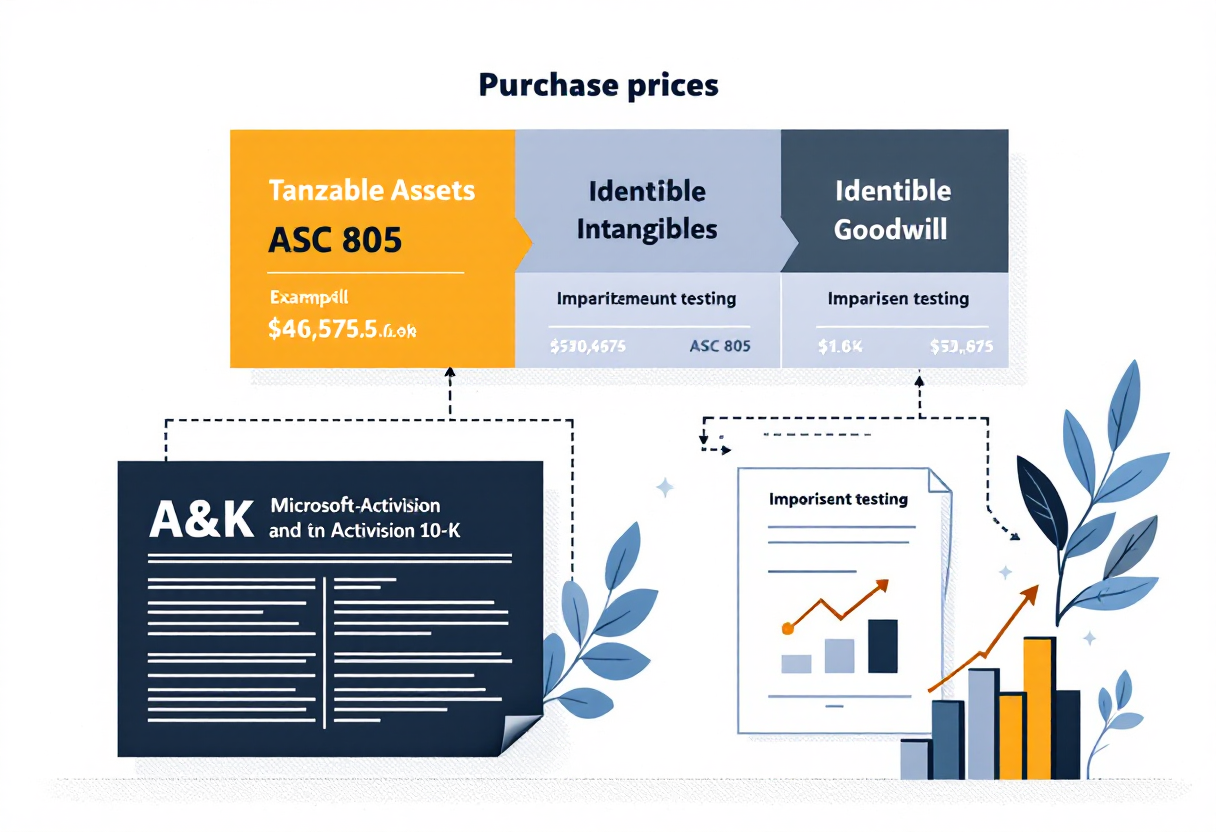
Goodwill on the balance sheet is the line that records what an acquirer paid for a target company above and beyond the fair value of every identifiable asset and liability it picked up in the deal. It only exists because someone bought a business, and once it lands on the balance sheet, it sits there as a non-current intangible asset that public companies test for impairment every year under FASB ASC 350. The number can be huge: Microsoft booked $51.0 billion of goodwill on its 2024 balance sheet after the Activision Blizzard deal closed, and Bristol-Myers Squibb’s goodwill jumped from $6.5 billion to $22.5 billion after it closed Celgene. This guide breaks down how goodwill gets created, where it sits in the financial statements, how the impairment test works under ASC 350-20, the private-company shortcut available under FASB ASU 2014-02, the tax treatment under IRC Section 197, and what sophisticated buyers actually look for when they review a target’s existing goodwill in a sell-side process.
What Goodwill on the Balance Sheet Actually Represents
Goodwill is an accounting plug. When a buyer pays $100 million for a company whose identifiable net assets (cash, receivables, inventory, PP&E, customer lists, technology, trademarks, less debt and other liabilities) are worth $60 million at fair value, the extra $40 million has to go somewhere on the buyer’s books. That somewhere is goodwill. It captures the value of things that are real but not separable enough to record as their own asset: assembled workforce, expected revenue synergies, brand reputation in markets where there’s no registered trademark, geographic adjacency, and the buyer’s belief that the combined business will earn more than the sum of its parts.
The FASB Master Glossary defines goodwill as the future economic benefits arising from other assets acquired in a business combination that are not individually identified and separately recognized. That definition is deliberately wide. It has to be, because goodwill is what is left over after every other identifiable asset has been priced and slotted into its own line.
Goodwill on balance sheet is reported as a non-current intangible asset, typically below property, plant, and equipment and above other intangibles like patents, trademarks, and customer relationships. Companies report it either on its own line (“Goodwill”) or grouped with “Goodwill and other intangible assets” with a footnote that splits the two. Under U.S. GAAP, goodwill is not amortized for public companies. It sits at its original recorded value until an annual or triggering-event impairment test forces a writedown.
That distinction matters. A patent acquired in the same deal gets amortized over its useful life and runs through the income statement every quarter. Goodwill does not. It is a static carrying value that only moves down, never up, and only when fair value drops below the carrying amount of the reporting unit. This is the framework ASC 350-20 codified after FASB Statement 142 was issued in 2001 and eliminated systematic goodwill amortization for public filers.
How Goodwill Gets on the Balance Sheet (M&A Origination)
Goodwill is born in one place and one place only: a business combination accounted for under ASC 805. If you build a business from scratch, the goodwill you create internally (your brand, your assembled team, your customer loyalty) never shows up on your balance sheet. GAAP does not let you recognize internally generated goodwill, because there is no arms-length transaction to anchor a number to. Only when somebody buys you does goodwill get put on paper, and it lands on the buyer’s books, not yours.
The mechanic is simple in concept. The buyer calculates the total consideration transferred (cash, stock, contingent payments, assumed debt) at fair value on the closing date. The buyer then performs a purchase price allocation (PPA) under ASC 805, in which every identifiable asset acquired and liability assumed is measured at fair value. Whatever is left over after all of those identifiable items have been priced is goodwill.
A few practical points. Goodwill is only recorded when the buyer obtains control of the target. Equity-method investments and asset acquisitions do not generate goodwill under ASC 805. Contingent consideration (earnouts) is included in the purchase price at acquisition-date fair value, which means changes to that fair value after closing can flow through the income statement rather than adjusting goodwill, depending on classification. Transaction costs (banker fees, legal fees, accounting fees) are expensed and not capitalized into goodwill under U.S. GAAP, which is a change from the pre-ASC 805 world.
The PPA is usually finalized within a one-year measurement period after closing under ASC 805. During that period, the buyer can adjust provisional fair values as new information emerges, and the offsetting entry runs through goodwill. After the measurement period closes, any further adjustments hit the income statement.
Purchase Price Allocation: The PPA Math Behind Goodwill
The purchase price allocation is the engine room. It is where the dollars get sorted into buckets, and the size of each bucket determines how much of the purchase price ends up as goodwill versus identifiable intangibles versus tangible assets. Buyers usually engage a valuation firm to run the PPA, because the fair-value measurements have to survive auditor review and, for public buyers, potential SEC scrutiny.
The standard PPA worksheet has four sections. First, total consideration transferred at fair value on the acquisition date. Second, fair value of identifiable assets acquired, broken into tangible (cash, AR, inventory, PP&E) and intangible (customer relationships, developed technology, trade names, non-compete agreements, in-process R&D, favorable leases). Third, fair value of liabilities assumed (AP, accrued liabilities, deferred revenue at fair value, debt, deferred tax liabilities created by step-ups in book basis without corresponding step-ups in tax basis). Fourth, the residual, which is goodwill.
Identifiable intangibles are the bucket where the most judgment lives, and they are usually the largest non-PP&E line items in a services or software deal. Customer relationships get valued using the multi-period excess earnings method (MPEEM), in which the analyst projects revenue from existing customers, deducts the contributory asset charges for the tangible and other intangible assets used to generate that revenue, tax-effects the remainder, and discounts the after-tax cash flows. Developed technology and trade names are usually valued using the relief-from-royalty method, in which the analyst estimates the royalty the company would have to pay to license the asset from a third party, applies it to projected revenue, tax-effects it, and discounts it. Non-compete agreements get a with-and-without analysis.
The bigger the identifiable intangible buckets, the smaller the goodwill bucket. That matters because identifiable intangibles get amortized over their useful lives and depress GAAP earnings, while goodwill sits frozen. Buyers face a tension. They want to defend a real PPA that captures the actual economics of the deal, but they also know that bigger identifiable intangibles mean bigger amortization expense and a larger drag on reported earnings per share. The auditor and the valuation firm anchor the answer in technical guidance like KPMG’s business combinations handbook, PwC’s business combinations guide, and EY’s financial reporting developments series.
Deferred tax liabilities are a non-obvious driver of goodwill size. In a stock acquisition with no Section 338 election, the buyer steps up the book basis of identifiable intangibles to fair value but inherits the seller’s lower tax basis. The difference creates a deferred tax liability that increases goodwill on a gross basis. That is why the same economic deal can produce different goodwill numbers depending on whether the deal is structured as a stock purchase, an asset purchase, or a stock deal with a Section 338(h)(10) election.
The Goodwill Formula: Purchase Price Minus Identifiable Net Assets
The mechanical goodwill formula is:
Goodwill = Consideration Transferred + Fair Value of Noncontrolling Interest + Fair Value of Previously Held Equity Interest – Fair Value of Identifiable Net Assets Acquired
That is the full version from ASC 805-30-30-1. For a typical 100% buy-out of a private target with no prior equity stake, two of the three additive terms drop out, and the formula collapses to:
Goodwill = Purchase Price – Fair Value of Identifiable Net Assets
Where Identifiable Net Assets = Fair Value of Identifiable Assets Acquired – Fair Value of Liabilities Assumed.
The noncontrolling interest (NCI) line shows up when the buyer acquires less than 100% of the target. Under ASC 805-20, the buyer measures NCI at acquisition-date fair value and includes it in the goodwill calculation. The previously held equity interest line shows up in a step acquisition, where the buyer already owned a piece of the target before the deal and remeasures that piece to fair value at closing, recognizing a gain or loss on the income statement.
The simplest sanity check is the gross-up. No fee to you on buy-side introductions; sell-side mandates are paid on success at closing. Goodwill is $100 – $62 = $38 million. That $38 million sits on the buyer’s balance sheet at its original recorded value until something forces an impairment.
Worked Example: $100M Acquisition With $40M Goodwill
Here is a fully worked example to make the mechanics concrete. Assume BuyCo, a strategic acquirer, agrees to acquire TargetCo, a private specialty services business, for $100 million in cash at closing. The transaction is structured as a stock acquisition with no Section 338 election. TargetCo has $5 million of debt that BuyCo assumes and refinances at close.
The PPA worksheet looks like this.
Total consideration transferred: $100 million cash + $5 million debt assumed = $105 million.
Identifiable assets acquired at fair value:
- Cash and equivalents: $3 million
- Accounts receivable: $8 million
- Inventory: $2 million
- Other current assets: $1 million
- Property, plant, and equipment: $18 million (stepped up from $12 million book)
- Customer relationships: $28 million (MPEEM, 10-year useful life)
- Developed technology: $9 million (relief-from-royalty, 7-year useful life)
- Trade name: $6 million (relief-from-royalty, indefinite life)
- Non-compete agreements: $2 million (with-and-without, 3-year useful life)
- Total identifiable assets: $77 million
Liabilities assumed at fair value:
- Accounts payable: $4 million
- Accrued expenses: $3 million
- Deferred tax liability on intangibles step-up: $5 million (calculated as the step-up in book over tax basis multiplied by the 21% federal rate plus blended state)
- Total liabilities assumed: $12 million
Identifiable net assets = $77 – $12 = $65 million.
Goodwill = $105 – $65 = $40 million.
On day one after closing, BuyCo’s balance sheet reflects a new $40 million goodwill line, $45 million of net identifiable intangibles (the $28 + $9 + $6 + $2 above), and a $5 million increase in deferred tax liabilities. The identifiable intangibles will amortize over their useful lives and produce roughly $5.2 million of annual amortization expense in year one ($28/10 + $9/7 + $2/3 plus the trade name which has indefinite life and is not amortized). The $40 million of goodwill will not amortize. It will sit at $40 million until BuyCo’s annual impairment test, or a triggering event, forces a writedown.
Where Goodwill Goes on a Balance Sheet (And Why It Is Not a Current Asset)
Goodwill goes on the asset side of the balance sheet as a non-current intangible asset. It sits in the long-term asset section, below property, plant, and equipment and grouped with other intangibles such as patents, trademarks, and customer relationships. Goodwill is never a current asset, because it cannot be converted to cash within a year and is not held for sale.
The reason goodwill lands in the non-current section comes down to what it is. It has no independent existence, no maturity date, and no way to be sold on its own. Under the FASB definition of a current asset, an item must be expected to convert to cash or be consumed within the operating cycle. Goodwill fails that test on every count, so it always belongs below the current-asset line, alongside the intangibles that carried over from a completed acquisition.
On a real balance sheet you will find goodwill listed as its own line item, separate from “other intangible assets,” because U.S. GAAP requires the two to be disclosed apart. This is why a reader can open a 10-K, as in the Microsoft-Activision walkthrough later on this page, and see a single goodwill figure that ties directly to the purchase price allocation. The line does not move with revenue or working capital. It changes only when an impairment charge writes it down or, for a private company electing ASU 2014-02, when scheduled amortization reduces it.
For a business owner reading a buyer’s balance sheet, the placement carries a signal. A large non-current goodwill balance means the company has paid premiums over identifiable net assets in prior deals, which tells you it is an active acquirer with an appetite for platforms like yours. When we run a sell-side process, we read that goodwill line to gauge how a buyer values intangibles it cannot touch. See our business valuation services for how we position your intangible value ahead of a sale.
Goodwill Impairment Testing Under ASC 350-20
Goodwill on balance sheet is tested for impairment annually under ASC 350-20, and any time a triggering event indicates that the fair value of a reporting unit might be below its carrying amount. Triggering events include macroeconomic deterioration, industry-specific declines, sustained drops in the buyer’s market capitalization, loss of key customers or contracts, loss of key personnel, regulatory action, and significant declines in the reporting unit’s actual cash flow versus forecast.
The current single-step test, codified after FASB ASU 2017-04 eliminated the old Step 2, works like this. The company identifies its reporting units. A reporting unit is an operating segment or one level below it, defined in ASC 350-20-35. The company assigns goodwill to each reporting unit at the date of acquisition based on the synergies expected to be generated. At each annual test date, the company estimates the fair value of each reporting unit, usually using a discounted cash flow analysis, a market-multiple analysis, or a combination of both. If the fair value of the reporting unit equals or exceeds its carrying amount, goodwill is not impaired and no further work is required. If the fair value is below the carrying amount, the company records an impairment loss equal to the shortfall, capped at the total goodwill assigned to the reporting unit.
Before performing the quantitative test, a company can elect a qualitative assessment (the “Step 0” screen). Under the qualitative option, the company evaluates whether it is more likely than not (greater than 50% likelihood) that the fair value of the reporting unit is less than its carrying amount. If the answer is no, the quantitative test can be skipped. If yes, the quantitative test is required. Most large public filers do the qualitative screen first and only run a full quantitative DCF when something has clearly changed.
Once an impairment is recorded, it cannot be reversed under U.S. GAAP. Even if the reporting unit’s fair value rebounds above carrying value in a future period, the goodwill stays at the impaired value. This is one of the major differences from IFRS, which also prohibits reversal of goodwill impairment but does allow reversal for some other intangibles.
Impairment charges hit the income statement as a non-cash operating expense on a line called “goodwill impairment” or grouped within “impairment of intangible assets.” The charge is added back in the operating section of the cash flow statement because it is non-cash. It reduces the goodwill line on the balance sheet. For public companies, large goodwill impairments are disclosed in the 10-K with a discussion of the triggering events, the valuation methodology, and key assumptions. The big-four impairment guides (PwC’s goodwill impairment guidance, KPMG’s subsequent accounting for goodwill, EY’s impairment FRD) walk through the mechanics in detail and are the working references most controllers and auditors use.
Private Company Goodwill Amortization Under ASU 2014-02
Public-company goodwill does not amortize. Private-company goodwill can, if the company elects the accounting alternative in FASB ASU 2014-02. That election, available since 2014, lets a private company amortize goodwill on a straight-line basis over 10 years (or a shorter useful life if the company can justify it) and only test for impairment when a triggering event occurs, rather than annually.
This is a meaningful operational simplification. Annual impairment testing is expensive. A reporting-unit DCF requires forecasts, discount-rate work, sometimes a third-party valuation, and audit review. For a private company without public-equity pricing as a reference point, the test is harder to support and easier to dispute. The accounting alternative cuts that cost dramatically by replacing the annual test with predictable amortization expense and a trigger-only impairment regime.
The election comes with strings. Under ASU 2014-02, the private company must apply the alternative to all existing and new goodwill, not just to selected acquisitions. The company must also decide whether to test for impairment at the entity level or the reporting-unit level. And if the private company later goes public, it must unwind the amortization retrospectively and restate its goodwill balance, which means an IPO-track private company should not elect the alternative.
The accounting alternative also extends to certain identifiable intangibles under FASB ASU 2014-18, which lets a private company avoid recognizing customer-related intangibles that are not capable of being sold or licensed separately, and non-compete agreements, as separate assets. Those values get rolled into goodwill instead. For a private specialty services business with a sticky customer base and standard non-competes, this can collapse a complex PPA into something much simpler.
In 2022, FASB voted to drop its multi-year project that would have extended an amortization-and-impairment model to public companies as well. The board concluded that the proposed changes would not improve the existing guidance enough to justify the disruption, and tabled the project in June 2022. Public-company goodwill therefore continues to live under the impairment-only model. FASB ASU 2025-06, despite sitting inside Topic 350 (Intangibles – Goodwill and Other), addresses internal-use software accounting under Subtopic 350-40, not subsequent accounting for goodwill itself.
Tax Treatment: Section 197 Tax Amortization vs Book Goodwill
Book goodwill and tax goodwill are different animals. IRC Section 197 requires that tax goodwill, when present, be amortized on a straight-line basis over 15 years (180 months) for federal tax purposes, regardless of any indicator of useful life. Section 197 also applies to other identifiable intangibles in a taxable asset acquisition, including customer-based intangibles, supplier-based intangibles, workforce in place, going-concern value, trademarks, and trade names.
Whether tax goodwill exists depends on the deal structure. In a taxable asset acquisition, or a stock acquisition with a Section 338(h)(10) or 336(e) election, the buyer takes a stepped-up tax basis in the acquired assets, including goodwill. That stepped-up basis amortizes over 15 years under Section 197 and produces real cash tax savings. In a vanilla stock acquisition with no election, the buyer inherits the seller’s existing tax basis in the assets. The book step-up creates a deferred tax liability rather than future tax deductions, and there is no tax goodwill to amortize.
That divergence between book and tax is the source of a very common question in M&A diligence. A buyer looking at a $40 million book goodwill number on the post-deal balance sheet should know whether that $40 million is also a tax asset (worth roughly $40 million / 15 = $2.7 million of annual tax deductions, or about $570,000 of annual cash tax savings at a 21% federal rate plus state) or whether it is purely a book number with no corresponding tax shield. The same $40 million has very different economic meaning in the two cases.
For sell-side processes, this is where the structuring conversation lives. An S-corp or LLC seller can usually offer the buyer a Section 338(h)(10) or 336(e) election, or convert the deal to an asset sale, which gives the buyer a stepped-up tax basis and 15-year amortization on tax goodwill. The seller typically demands a gross-up because the asset-deal structure produces ordinary-income tax on a portion of the gain rather than capital-gains rates. The Tax Adviser’s October 2025 piece on stock-acquisition purchase accounting walks through the mechanics in detail.
Negative Goodwill and Bargain Purchase Accounting
What if the fair value of identifiable net assets acquired exceeds the consideration paid? That situation creates negative goodwill, also called a bargain purchase. Under ASC 805-30-25-2, a bargain purchase is rare but real. It can happen when a seller is distressed and forced to transact below fair value, when a publicly traded target trades at a discount and is acquired at a small premium that still leaves the deal below fair value of its assets, or when assumed liabilities are smaller than originally thought after the measurement-period review.
The accounting treatment is non-intuitive. Negative goodwill does not sit on the balance sheet. Under ASC 805-30, the buyer first reassesses whether it correctly identified and measured all assets acquired and liabilities assumed, including any contingent consideration. If after that reassessment the bargain purchase remains, the buyer recognizes a gain on the income statement equal to the excess of identifiable net assets over consideration transferred. The gain is recorded in the period of the acquisition and disclosed in the footnotes.
Bargain purchases attract auditor scrutiny because they are unusual and because the easiest way to manufacture a one-time gain is to overstate the fair value of identifiable assets. The big-four guides (PwC business combinations guide, KPMG business combinations handbook) walk through the reassessment process in detail. In a sell-side process, a target balance sheet showing a recent bargain-purchase gain is a flag for buyer diligence.
How Buyers Interpret a Target’s Existing Goodwill in M&A
When CT Acquisitions reviews a target’s balance sheet in a sell-side process, the goodwill line tells us several things about the company’s history and tells the buyer several things about what to expect.
First, goodwill on the balance sheet means the target has been an acquirer itself. A founder-owned business that has never bought anybody typically shows zero goodwill. A roll-up that has bought eight bolt-ons in the last five years shows a goodwill line that maps roughly to those purchase prices net of identifiable assets. The size and growth of the goodwill line is a fingerprint of the target’s M&A history. Buyers reviewing a roll-up read this carefully, and so do sell-side advisors who need to defend it. We cover the broader diligence framework in our post-close due diligence checklist.
Second, the goodwill-to-equity ratio is a tangible-equity signal. A target with $80 million of book equity and $60 million of that being goodwill has very little tangible equity. In a downside scenario where the acquired businesses underperform and goodwill impairs, that target can run negative on tangible book quickly. That matters for covenants and for buyer-side financing committees. Damodaran’s January 2026 goodwill-by-sector dataset shows that goodwill as a percentage of total assets varies hugely across industries, with software and pharmaceuticals running 25-35%+ and capital-heavy sectors running closer to 5-10%.
Third, the impairment history is a sentiment marker. A target that has impaired goodwill in the last three years signals that prior acquisitions did not work out as expected. Buyers should read those impairment footnotes for the disclosed triggering events and key assumption changes, because the same dynamics often persist post-close. Hewlett-Packard’s $8.8 billion writedown of Autonomy in 2012 is the textbook example of how badly this can go when due diligence on the acquired business misses material issues.
Fourth, the goodwill allocation across reporting units inside the target tells you where the value is actually concentrated. If 80% of a $50 million goodwill balance is assigned to one reporting unit and that reporting unit has lost a key customer recently, the target’s stand-alone impairment risk is concentrated in a way the consolidated goodwill line does not reveal. We dig into reporting-unit-level allocation when we review a target’s books, both because it indicates concentration and because it foreshadows what the buyer’s own PPA will look like post-close. The framework ties into how we think about business valuation services more broadly.
The Microsoft-Activision Goodwill Walkthrough (Real 10-K Example)
Microsoft closed its $75.4 billion acquisition of Activision Blizzard on October 13, 2023. The PPA, as disclosed in Microsoft’s FY2024 10-K, allocated the purchase consideration as follows: goodwill of $51.0 billion, identifiable intangibles of $21.97 billion (with marketing-related intangibles at $11.62 billion, technology-based intangibles at $9.69 billion, and customer-related intangibles at $0.66 billion), other assets of $2.50 billion, and assumed debt and tax liabilities of approximately $13 billion. The identifiable intangibles carry an average useful life of approximately 15 years.
Several observations. Goodwill is roughly 68% of total consideration. That is high but not anomalous for software and entertainment deals, where the bulk of the business value lives in scaling network effects, brand equity, integrated workforce, and platform synergies that GAAP cannot price as separable intangibles. Microsoft allocated the goodwill to its More Personal Computing segment, which is the reporting unit that will be tested annually for impairment going forward.
Marketing-related intangibles at $11.62 billion is dominated by the Activision, Blizzard, and King brand portfolios. Technology-based intangibles at $9.69 billion captures the developed game technology, publishing platforms, and proprietary tooling. Customer-related intangibles at $0.66 billion is small relative to the deal size, which is consistent with a consumer-facing gaming business where players churn and reacquire constantly and there is no contractual customer base to value as a long-lived asset.
Almost all of the $51 billion of goodwill is non-deductible for tax purposes because the transaction was structured as a stock acquisition without a Section 338(h)(10) election. That means no tax shield on the goodwill amortization, and the gap between Microsoft’s GAAP and tax accounting for the deal will persist for the life of the asset. The full PPA disclosure in Note 8 to Microsoft’s FY2024 10-K is the working reference for any analyst trying to reproduce the math on a large-cap deal.
For context, two other recent megadeals show similar dynamics. Bristol-Myers Squibb’s 2019 10-K disclosed that the Celgene acquisition produced $22.5 billion of goodwill, taking total goodwill from $6.5 billion to $29 billion. ExxonMobil’s FY2024 10-K disclosed goodwill from the May 2024 Pioneer Natural Resources acquisition allocated to the Upstream segment, against a $63 billion stock consideration plus $5 billion of assumed debt. Capital One’s February 2024 8-K for the Discover deal projected approximately $3.5 billion of goodwill at the initial announcement, though the final number at the May 2025 close was reevaluated against a $51.8 billion fair-value purchase consideration.
Why Goodwill Impairment Is the Single Biggest Post-Deal Accounting Risk
Most of the M&A pain a buyer carries after closing shows up somewhere on the income statement: integration costs, severance, restructuring, lost customers, missed synergies. The cleanest signal that a deal has gone wrong, though, is a goodwill impairment charge. The charge is concentrated, disclosed, and unambiguous. No fee to you on buy-side introductions; sell-side mandates are paid on success at closing.
Three of the largest goodwill impairments in U.S. corporate history illustrate the stakes. Time Warner wrote down approximately $99 billion of goodwill in 2002 after the AOL merger. Hewlett-Packard wrote down $8.8 billion in 2012 on the Autonomy acquisition. AT&T impaired billions on the DirecTV acquisition over multiple years before spinning the business off. In each case, the impairment was not the cause of the value destruction. The deal economics were the cause. No fee to you on buy-side introductions; sell-side mandates are paid on success at closing.
The economic reality is that goodwill on balance sheet is an option on management’s ability to execute the deal thesis. If post-close cash flows match or exceed the underwritten case, goodwill is not impaired and the option pays off. If cash flows fall short for sustained periods, the impairment test forces recognition of the gap. That is why sophisticated buyers spend so much time on the synergy build, the integration plan, and the diligence on the target’s standalone forecast. The numbers behind the goodwill bucket are the same numbers that show up in the impairment test three, five, and ten years later. We unpack the integration framework in our business acquisition meaning guide.
For sellers, this is one reason why an aggressive purchase-price negotiation can backfire over a longer horizon. If a strategic buyer pays a number that requires post-close cash flow growth they cannot deliver, the impairment charge will follow, the deal will be called a failure publicly, and the buyer will be slower and more cautious in the next deal cycle. The pricing tension between getting the highest dollar today and getting paid in earnouts or rollover equity over time is partly a tension over whose balance sheet ends up carrying the impairment risk.
How CT Acquisitions Reviews Goodwill in Sell-Side Mandates
When CT Acquisitions takes a sell-side mandate, goodwill on balance sheet is one of the items we review during the financial preparation phase, well before the CIM goes out. Several specific items get checked.
The first check is the source of every goodwill dollar on the balance sheet. We trace the goodwill line back to the underlying acquisitions that generated it. For a target that has been a serial acquirer, that means pulling the PPAs from each historical deal and verifying that the goodwill, by acquisition, ties to the rollforward on the balance sheet. If the target has elected the private-company alternative under ASU 2014-02, we verify the amortization rollforward and the impairment-trigger history.
The second check is whether the goodwill has been touched since acquisition. Any impairment in the last five years requires a specific conversation. Was the impairment driven by deal-specific issues (loss of a key customer at the acquired business, departure of key personnel, technology obsolescence) or by macro factors (industry decline, recession)? Buyers will ask, so we want to have a clean answer ready in the diligence room.
The third check is whether the goodwill is allocated correctly across reporting units. For a multi-segment target, the allocation matters for the impairment test. We make sure the allocation method is documented, defensible, and consistent with how the company actually manages the segments. This sometimes surfaces issues where the bookkeeping has not kept pace with operational changes.
The fourth check is the interaction between goodwill and tax structure. For a target that may be sold in an asset deal or with a Section 338(h)(10) election, we model what the buyer’s tax goodwill amortization will look like and what the after-tax purchase price equates to from the buyer’s perspective. Knowing those numbers ahead of negotiation lets us defend value more credibly. The same framework gets stitched into how we walk a deal from enterprise value down to equity value at close.
The fifth check is the link between goodwill, intangibles, and the company’s reported EBITDA. Amortization of identifiable intangibles is added back to arrive at EBITDA, but goodwill impairment is typically also added back as a non-recurring item. Buyers will probe the adjusted EBITDA bridge to understand which add-backs are mechanical (intangible amortization) and which are judgment calls (impairments, restructuring). Our guide to amortization in EBITDA walks through the add-back logic, and our deeper piece on EBITDA meaning covers the full bridge.
The sixth check is how the company will present this to a buyer. Sophisticated buyers (both strategic and PE) understand goodwill. They know it does not amortize, they know it can impair, and they know it does not represent recoverable cash. They will not pay for goodwill on a target’s balance sheet the way they will pay for cash or AR. The goodwill is, from a buyer’s standpoint, just a placeholder that captures the history of prior deals. What matters is the operating business underneath. We make sure the management team understands this distinction so they can answer buyer questions cleanly during MP. Our guide to how investment bankers value a business walks through how the conversation actually unfolds in market.
Classified balance sheet: what it is and why it matters in M&A
A classified balance sheet groups assets and liabilities into current (within 12 months) and non-current categories, separating operating from non-operating items. In M&A, the classified balance sheet is the starting point for two calculations: (1) working capital PEG (current assets minus current liabilities, excluding cash and debt-like items), and (2) debt-and-cash-free enterprise value (removing cash, adding debt). Buyers require a classified balance sheet in the data room from month one.
Goodwill on the Balance Sheet: Frequently Asked Questions
Is goodwill a current asset?
No. Goodwill is a non-current (long-term) intangible asset. It cannot be converted to cash within a year and is not held for resale, so it never appears in the current-asset section of the balance sheet. It is reported below property, plant, and equipment, grouped near other intangibles.
Is goodwill on the balance sheet an asset or a liability?
Goodwill is an asset, specifically a non-current intangible asset. It sits on the asset side of the balance sheet, typically below tangible long-lived assets and grouped with or near other intangibles. It is not amortized for public-company GAAP filers but is tested annually for impairment under ASC 350-20.
Can goodwill on balance sheet go up after acquisition?
Outside the one-year measurement period after a business combination, goodwill cannot be increased on the balance sheet for the same acquisition. It can grow at the consolidated level when the company closes new acquisitions and books new goodwill from those deals. It can also be adjusted during the measurement period if provisional fair values are revised. Internally generated goodwill never gets recorded under GAAP.
What is the difference between goodwill and other intangible assets?
Identifiable intangibles (customer relationships, developed technology, trade names, patents, non-compete agreements) are separable from the business and can be valued and amortized on their own. Goodwill is the residual after every identifiable asset is priced. Identifiable intangibles amortize over their useful lives. Goodwill does not amortize for public GAAP filers but is tested for impairment annually.
How often is goodwill tested for impairment?
Goodwill is tested for impairment annually under ASC 350-20, and whenever a triggering event indicates that the fair value of a reporting unit might have fallen below its carrying amount. Triggering events include macroeconomic declines, industry-specific events, sustained drops in market capitalization, loss of key customers or personnel, and adverse regulatory action.
What happens to goodwill if a business is sold again?
When a business that has goodwill on its books is sold, the existing goodwill is included in the carrying value of the disposed business for purposes of calculating gain or loss on the sale. The new buyer does its own PPA and creates its own goodwill based on the new purchase price. The seller’s goodwill does not carry over to the buyer’s books.
Can goodwill on balance sheet be negative?
Negative goodwill (bargain purchase) is rare and is not recorded as a balance-sheet item. Under ASC 805-30, after reassessing the fair value of identifiable assets and liabilities, any remaining excess of identifiable net assets over consideration paid is recognized as a gain on the income statement in the period of acquisition.
Is goodwill tax-deductible?
It depends on the deal structure. In a taxable asset acquisition, or a stock acquisition with a Section 338(h)(10) or 336(e) election, the buyer can amortize tax goodwill on a straight-line basis over 15 years under IRC Section 197. In a vanilla stock acquisition with no election, the buyer inherits the seller’s lower tax basis and no tax goodwill exists.
What is the difference between book goodwill and tax goodwill?
Book goodwill is recorded under GAAP using fair value at acquisition and does not amortize for public-company filers. Tax goodwill, when present, is the buyer’s tax basis in goodwill resulting from a taxable asset acquisition or Section 338 election, and amortizes straight-line over 15 years under IRC Section 197. The two numbers are often different in size and behave differently over time.
Why is goodwill on balance sheet sometimes a large number?
Goodwill is large when a buyer pays a substantial premium over the fair value of identifiable net assets. This is common in software, pharmaceuticals, branded consumer products, and other industries where most business value lives in unrecorded items like assembled workforce, network effects, brand equity, and expected synergies. Microsoft’s $51 billion of goodwill from the Activision deal is a representative example.
Does goodwill on balance sheet affect EBITDA?
Not directly. Goodwill does not amortize for public-company filers, so it does not produce a recurring expense that runs through EBITDA. Goodwill impairment charges are non-cash and typically added back to arrive at adjusted EBITDA. Amortization of identifiable intangibles, by contrast, is a recurring non-cash expense that gets added back from EBIT to arrive at EBITDA. Our guide to amortization in EBITDA covers the full add-back logic.
Goodwill on balance sheet is among the most-discussed and least-understood items in M&A accounting. The number is born from a single moment (the closing date of a business combination), behaves differently from every other asset on the balance sheet (no amortization for public filers, one-way valuation movement, reporting-unit allocation), and carries the full weight of every assumption that went into the original deal thesis. For sellers preparing for a process, understanding how a buyer will read the target’s goodwill (and how the buyer will eventually book new goodwill from the deal) is part of the basic preparation work. If you are thinking through a sale and want a sell-side advisor who reads these line items carefully before they become buyer questions, book a call with our team.
One Response