
Amortization Meaning in EBITDA: PPA, QofE, and the Phantom Amortization Wedge (2026)
Amortization in EBITDA is the A: the non-cash expense that writes down the cost of intangible assets, such as customer lists, patents, software and trade names, over their useful lives. EBITDA adds it back because it uses no cash in the year it is recorded. In a business sale the add-back matters most after an acquisition, when a purchase price allocation creates large new intangible assets and a large amortization charge. This guide covers the definition, the accounting rules and how buyers treat the line.
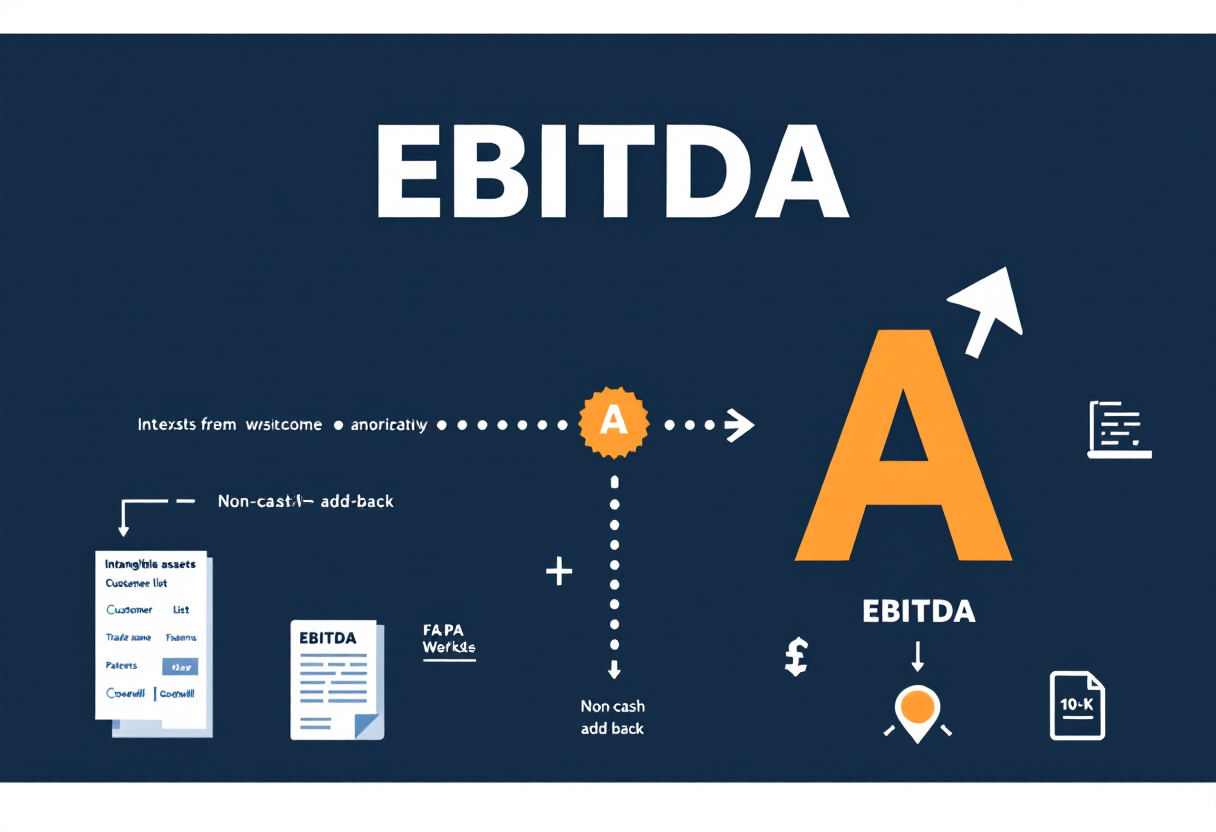
The amortization meaning in EBITDA is the non-cash accounting charge that spreads the recorded cost of acquired intangible assets (customer relationships, trade names, developed technology, non-competes, and the rest of the FASB ASC 805 identifiable intangibles list) across each asset’s useful life on the income statement. The A in EBITDA exists because a purchase price allocation after an acquisition almost always creates intangible assets that hit reported net income for years afterward without ever touching cash again. Sophisticated buyers add amortization back because the cash already moved at closing, the future expense is purely an accounting allocation, and ignoring the add-back would understate the operating earning power of any company that grew through M&A. This guide walks the full mechanic: the FASB rule that creates amortization, the IRC rule that taxes it differently, a worked Microsoft post-Activision example pulled from the FY2024 10-K, the goodwill exception, the private-company carve-out, the journal entry, the Quality of Earnings treatment, and the “phantom amortization” wedge that explains why private equity underwrites to EBITDA rather than GAAP net income.
Amortization Meaning in EBITDA: The One-Sentence Definition
Amortization in EBITDA is the non-cash expense that spreads the cost of intangible assets (customer lists, trademarks, patents, non-compete agreements, and acquired technology) across their useful lives, and it is the “A” that gets added back to net income so earnings reflect operating cash generation rather than accounting write-downs of purchased intangibles.
The reason amortization sits inside EBITDA is the same reason depreciation does. Both are book charges that reduce reported profit without moving cash in the period they hit the income statement. When you compute EBITDA, you strip amortization back out because the intangibles it writes down were paid for in an earlier period, usually at the moment of an acquisition. The expense you see today is an accounting allocation, not a fresh cash outflow.
This matters most for businesses built through acquisition. Under ASC 805, a buyer assigns part of the purchase price to identifiable intangibles, and those balances amortize over their useful lives (IRC Section 197 sets a 15-year life for tax). The larger the deal history, the heavier the amortization line, which is exactly why acquisition-heavy companies can post thin or negative net income while generating strong EBITDA. The “A” removes that distortion so buyers and lenders read the underlying earning power.
Keep the term precise. Amortization in EBITDA means the write-down of intangible assets, not the repayment schedule on a loan. Loan amortization is a financing cash flow and never touches EBITDA. If you are preparing to sell and want a clean earnings picture, our sell your business team recasts these add-backs the way a buyer’s quality of earnings review will.
What the A in EBITDA Actually Means (and the Loan-Amortization Confusion to Kill First)
EBITDA stands for Earnings Before Interest, Taxes, Depreciation, and Amortization. The acronym was popularized in the LBO era of the 1980s as a proxy for cash earnings available to service debt, and the Wikipedia entry traces the term back to John Malone of TCI Communications. Each letter strips a specific line from net income so a buyer or lender can isolate operating performance from capital structure, tax jurisdiction, and accounting policy.
The A in EBITDA refers to a single, narrow concept: the income statement charge that allocates the cost of an intangible asset across the period the asset is expected to generate economic benefit. Under U.S. GAAP, that charge is governed by FASB ASC 350 (Intangibles, Goodwill and Other) and, for intangibles acquired in a business combination, by ASC 805 (Business Combinations).
That is not the same as a loan amortization schedule. When a lender hands you a payment table that shows principal and interest splitting out across the term of a mortgage or term loan, that table is also called amortization, but it has nothing to do with the A in EBITDA. Loan principal payments are a financing cash flow on the statement of cash flows. They never hit net income, so there is nothing to add back. The amortization that EBITDA adds back is exclusively the income statement charge against intangible assets recorded under ASC 350. Several top-ranking explainers on this topic conflate the two; the rest of this guide treats only the intangibles version.
Amortization vs Depreciation: The One-Sentence Rule That Settles It
Depreciation allocates the cost of tangible assets (buildings, equipment, vehicles) under ASC 360 (Property, Plant, and Equipment); amortization allocates the cost of intangible assets (customer lists, trade names, developed technology, non-competes) under ASC 350 (Intangibles). Same accounting mechanic, different asset class.
Both lines are non-cash, both get added back to net income to reach EBITDA, and many companies present them on a single combined line labeled “depreciation and amortization” or “D&A”. The reason careful buyers track the distinction is what each line implies about future capital needs. Depreciation usually corresponds to ongoing maintenance capital expenditure (a delivery truck wears out, a roof needs reshingling, a server gets refreshed). Amortization frequently corresponds to a one-time historical purchase that will not repeat unless the company keeps acquiring. That asymmetry is the foundation of the EBITDA versus free cash flow debate, and it is why a thoughtful buyer subtracts maintenance capex separately when modeling cash flow.
| Attribute | Depreciation | Amortization |
|---|---|---|
| Asset type | Tangible (PP&E) | Intangible (customer lists, IP, goodwill in private-co election) |
| Common examples | Buildings, equipment, vehicles, leasehold improvements | Customer relationships, trade names, patents, developed technology, non-competes |
| Salvage value | Often non-zero (resale value at end of life) | Typically zero (no resale market) |
| Method | Straight-line, declining-balance, or units-of-production | Almost always straight-line; pattern-of-benefit allowed |
| Accounting standard (book) | ASC 360 | ASC 350 and ASC 805 |
| Tax treatment | MACRS per asset class | IRC Section 197: 15-year straight-line for acquired intangibles |
| EBITDA treatment | Added back | Added back |
The Intangible Assets That Get Amortized (Full ASC 805 and IRC 197 List, With 2024-26 PPA Examples)
Two parallel lists matter when a buyer or seller looks at an amortization line. The first is the book list under ASC 805-20, which prescribes the categories of identifiable intangibles a buyer must separately recognize when purchase price allocation is performed after a business combination. The big-four practitioner handbooks from KPMG, EY, and PwC all walk through the recognition criteria in detail.
The second list is the tax list under IRC Section 197, enacted in 1993, which sweeps an even broader set of acquired intangibles into a flat 15-year straight-line tax amortization period. The IRS intangibles landing page and 26 CFR 1.197-2 contain the regulatory framework, and Revenue Ruling 2004-49 is the canonical worked IRS example.
| Intangible Asset Class | Typical Book Useful Life (ASC 350) | Source / Notes |
|---|---|---|
| Customer relationships, customer lists, customer contracts | 5 to 15 years | Multi-period excess earnings method; based on historical attrition |
| Trade names and trademarks | 10 to 20 years, or indefinite life if brand expected to continue | Relief-from-royalty method; indefinite-life trade names get impairment testing not amortization |
| Patents | Legal life or useful life, whichever is shorter | U.S. utility patents run 20 years from filing per USPTO |
| Developed technology and capitalized software | 3 to 7 years | Internal-use software under ASC 350-40, updated by ASU 2025-06 |
| Non-compete agreements | 2 to 5 years | Tied to contract term; tax life always 15 years under Section 197 |
| Licensing and franchise agreements | Contract term | Renewable terms can extend life under ASC 350-30 |
| Backlog and order book | 1 to 3 years | Short life reflects burn-off as orders ship |
| Government licenses and permits (FCC, liquor, taxi medallions) | Often indefinite for book; 15 years for tax | FCC licenses commonly indefinite-lived per ASC 350-30 |
| Workforce in place | Not separately recognized for book (folded into goodwill) | Tax: 15 years under Section 197 if separately valued |
| Goodwill | Not amortized for public companies (impairment only); 10-year election for private companies under ASU 2014-02 | Tax: 15 years under Section 197 in an asset deal or 338 election |
Useful life is an estimate, not a rule. A customer relationship at a managed services firm with a 95 percent annual retention rate might carry a 15-year useful life; the same intangible at a transactional consumer business might run 3 to 5 years. The auditor reviews the assumption and the company documents the rationale at the time the intangible is recorded, often citing a third-party valuation report that ties useful life to observed attrition or expected economic benefit.
Why Amortization Gets Added Back to Net Income in EBITDA
The mechanical reason is that amortization is non-cash. The cash went out at acquisition close (or earlier, when the original intangible was acquired). The annual amortization expense is purely an accounting allocation that does not touch the bank account in the period it is recognized. EBITDA exists to approximate operating cash earnings, so removing non-cash charges (depreciation, amortization, impairment) gets the number closer to that goal.
The conceptual reason is comparability. Two companies otherwise identical can report very different net income figures if one grew organically and the other grew through acquisition. The acquired-growth company will carry meaningful amortization for years and report lower net income. EBITDA neutralizes that difference and lets a buyer compare operating performance directly. The British Business Bank explainer and the BDC glossary both surface the comparability point for SME audiences.
The valuation reason is multiples. Mid-market businesses sell on EBITDA multiples, not net income multiples, because buyers underwrite to the cash the business will generate and EBITDA is the most commonly disclosed proxy. Every dollar of amortization correctly added back is a dollar of EBITDA, and every dollar of EBITDA gets multiplied by the deal multiple to set enterprise value. In a 6x deal, missing $500,000 of amortization is $3,000,000 of lost value. For the full mechanic of how investment bankers convert EBITDA into purchase price, see our guide on how investment bankers value a business.
Worked Example: The Amortization Line in Microsoft’s FY2024 10-K Post-Activision
A real SEC filing shows the mechanic. Microsoft closed the Activision Blizzard acquisition on October 13, 2023 for approximately $75.4 billion in cash, the largest gaming-industry deal on record. The full Microsoft FY2024 Form 10-K is available on SEC EDGAR under CIK 0000789019.
The purchase price allocation Microsoft disclosed in the 10-K notes recognized roughly $50.9 billion of goodwill and a multi-billion bucket of identifiable intangible assets that get amortized. The intangibles included marketing-related assets (trade names like Call of Duty and World of Warcraft), customer-related assets (player base and subscriber relationships), technology-based assets (game engines and platform technology), and contract-based assets (publishing agreements). Useful lives ranged from 3 to 15 years depending on the category, with developed technology amortized over the shortest periods and trade names over the longest.
| Microsoft FY2024 10-K Disclosure (Post-Activision PPA) | Approximate Amount | Treatment |
|---|---|---|
| Total purchase consideration | $75.4 billion | Cash paid October 13, 2023 |
| Goodwill recognized | $50.9 billion | Not amortized; tested for impairment under ASC 350-20 |
| Identifiable intangible assets (marketing, customer, technology, contract) | Multi-billion bucket disclosed in PPA footnote | Amortized straight-line over 3 to 15 year useful lives under ASC 805 |
| Other assets and liabilities (tangible, deferred revenue, etc.) | Balance of consideration | Various treatments per applicable ASCs |
The result is that Microsoft’s reported net income carries a meaningful annual amortization drag from this single acquisition, while Microsoft’s reported EBITDA (and adjusted operating income measures the company highlights for investors) add that amortization back. The $50.9 billion of goodwill stays on the balance sheet and is tested for impairment annually under ASC 350-20; it does not amortize because Microsoft is a public company subject to FASB Statement 142, now codified in ASC 350.
For mid-market sellers, the Microsoft case is the macro version of what happens in any deal. The PPA process creates identifiable intangibles that hit the income statement for years; goodwill sits on the balance sheet and gets impairment-tested; the buyer’s reported net income drops while EBITDA stays clean. Every M&A practitioner who has ever read a post-deal 10-K has seen this pattern. The Microsoft example is useful only because the scale (a $75 billion deal) makes the line items unmissable in the financial statements.
Book vs Tax Amortization: ASC 805 and ASC 350 vs IRC Section 197
Book amortization (the income statement charge governed by FASB) and tax amortization (the deduction taken on the federal tax return governed by the IRS) are two completely different calculations that share a name. Confusion here is the single largest source of error in M&A due diligence reviews. The table below settles it.
| Dimension | Book Amortization (FASB) | Tax Amortization (IRS) |
|---|---|---|
| Governing rule | ASC 350 and ASC 805 | IRC Section 197 and 26 CFR 1.197-2 |
| Useful life | Asset-by-asset estimate (3 to 20 years typical; indefinite for some) | Flat 15 years straight-line for all Section 197 intangibles |
| Goodwill amortization | None for public companies (impairment only); 10-year election for private cos under ASU 2014-02 | 15 years straight-line if asset deal or 338(h)(10) / 336(e) election |
| Trigger for amortization | Asset recognized on balance sheet (whether acquired, internally developed if criteria met, or capitalized per ASC 350-40) | Acquired in a business or trade asset purchase |
| Stock vs asset deal | Same book treatment regardless of deal form | Asset deal or qualifying election = step-up basis and Section 197 deduction; straight stock deal = no new basis, no new deduction |
| Method | Straight-line (pattern-of-benefit allowed but rare) | Straight-line only |
| Salvage value | Typically zero | Always zero |
| Deferred tax effect | Mismatch creates deferred tax liability or asset recognized at acquisition per ASC 740 | Drives the mismatch on the book side |
| EBITDA treatment | Added back to net income | Not an EBITDA item (operates on the tax return, not the income statement) |
The deferred tax line in the table is the practical hinge. Because book useful lives are usually shorter than the 15-year tax period (a 7-year customer list versus 15-year tax life), book expense in early years runs higher than tax deduction in early years, which creates a deferred tax asset at acquisition. In later years, book expense has rolled off but tax deduction continues, reversing the timing difference. The deferred tax accounting is governed by ASC 740 and is one of the line items that Quality of Earnings providers always inspect.
The Goodwill Exception: Why Public Companies Don’t Amortize Goodwill
Before July 2001, public companies amortized goodwill over a useful life not to exceed 40 years under U.S. GAAP. FASB Statement 142 (now codified in ASC 350-20) eliminated goodwill amortization for book purposes and replaced it with an annual impairment test. The historical context and reasoning are summarized on the FASB goodwill impairment testing reference page.
The standard-setters concluded that goodwill does not have a determinable useful life. The premium a buyer pays over the fair value of identifiable assets reflects expected future cash flows, brand strength, market position, assembled workforce, and other attributes that do not decline on a predictable schedule. Forcing a 40-year (or any other) amortization period produced an arbitrary expense that did not reflect economic reality. The impairment-only model puts the burden on management to demonstrate, each year, that the goodwill remains recoverable.
The impairment test under ASC 350-20 works in two stages. The first stage is a qualitative assessment: management evaluates whether it is more likely than not that the fair value of a reporting unit is less than its carrying amount. If the qualitative test passes (no impairment indicators), no further work is required. If it fails or the company elects to skip it, a quantitative test is performed. The quantitative test compares the fair value of the reporting unit to its carrying amount including goodwill. If carrying value exceeds fair value, an impairment charge is recorded for the difference, capped at the carrying amount of the goodwill. The KPMG Goodwill Impairment Handbook is the standard practitioner reference for executing the test.
Whether an impairment charge should be added back to EBITDA is a judgment call. Most analysts do add it back because it is non-cash and non-recurring (the same goodwill cannot be impaired twice). The cleanest treatment is to add it back to EBITDA in the period recognized and disclose it separately so investors can see underlying performance trend without losing track of the value destruction signal.
The Private-Company Carve-Out: FASB ASU 2014-02 and the 10-Year Goodwill Amortization Election
Private companies have an alternative. In 2014, FASB issued Accounting Standards Update 2014-02, allowing private companies (and later, not-for-profits) to elect to amortize goodwill on a straight-line basis over a useful life not to exceed 10 years. The election also allows simplified impairment testing only when a triggering event occurs, rather than annually.
The reasoning, surfaced by the Private Company Council that developed the alternative, was that the annual impairment test imposed disproportionate audit and valuation cost on private companies whose financial statement users (lenders, owners, lower-tier investors) cared less about that signal than public-market analysts did. Many private companies have adopted the election to reduce audit complexity and produce more predictable annual expense patterns. Many mid-market sellers are sitting on goodwill recorded under it.
For EBITDA, the treatment is straightforward: amortization of goodwill recorded under the private-company alternative is added back the same way as any other amortization line. The fact that goodwill is amortizing on a 10-year schedule rather than sitting indefinitely on the balance sheet does not change the EBITDA mechanic; the expense remains non-cash and the add-back remains standard.
How Amortization Gets Created in an M&A Deal: ASC 805 Purchase Price Allocation, Step by Step
Most amortization on a private company income statement traces back to a prior acquisition. When a buyer acquires a target, ASC 805 (Business Combinations) requires the buyer to allocate the purchase price to the fair value of acquired tangible assets (cash, inventory, equipment, real estate), the fair value of acquired identifiable intangible assets (customer lists, trade names, technology, non-competes), and whatever residual amount is recorded as goodwill.
The PPA process is typically performed by a third-party valuation firm within the one-year measurement period under ASC 805. The valuation firm identifies and values each separately identifiable intangible using methods detailed in the PwC Business Combinations Guide and the EY Financial Reporting Developments handbook on intangibles:
- Multi-period excess earnings method for customer relationships and customer lists (the standard income approach for revenue-generating intangibles)
- Relief-from-royalty method for trade names and trademarks (estimates royalties the buyer avoids paying because it now owns the mark)
- Cost approach for assembled workforce (folded into goodwill rather than separately recognized for book)
- Replacement cost or with-and-without method for developed technology
- Income approach for non-compete agreements based on protected cash flows
The output is an amortization schedule that the company will use for the next 5 to 20 years to recognize amortization expense, plus a goodwill balance that sits on the balance sheet and gets impairment-tested. A typical PPA on a mid-market deal produces identifiable intangibles equal to roughly 20 to 40 percent of purchase price, with goodwill making up the difference between identifiable assets and total consideration. The Damodaran NYU dataset on goodwill by sector tracks the resulting goodwill-to-book-value ratios across U.S. industries, with technology, healthcare, and consumer-staples sectors carrying the highest goodwill loads relative to invested capital.
The Journal Entry
When amortization is recognized each period, the entry is:
- Debit: Amortization Expense (income statement)
- Credit: Accumulated Amortization (contra-asset on the balance sheet, reducing the intangible asset’s carrying value)
Over the asset’s useful life, accumulated amortization grows until it equals the original cost of the intangible, at which point the asset has been fully amortized and carries a zero net book value. The original cost stays on the gross intangible asset line; the contra account absorbs the cumulative expense. This is the same accounting structure used for depreciation of tangible assets (debit Depreciation Expense, credit Accumulated Depreciation), which is why the two lines so often appear on the same combined D&A line in a published income statement.
How Amortization Shows Up in a Quality of Earnings Report
The Quality of Earnings (QofE) report is the document the buyer’s accounting advisor produces during diligence to assess whether reported earnings are sustainable and whether the seller’s adjusted EBITDA is defensible. The QofE always has a section on non-cash items, and amortization is usually the first line in that section.
A competent QofE distinguishes three categories of amortization. The first is PPA amortization, which traces back to a prior acquisition and represents the burn-off of intangibles recorded under ASC 805. PPA amortization is universally added back to EBITDA without argument; it is non-cash, non-operating, and tied to a deal that already happened.
The second category is operational amortization, which traces to assets the business uses to generate revenue in its normal course. Capitalized internal-use software amortizing under ASC 350-40 is the most common example; the recent FASB ASU 2025-06 update modernized the recognition criteria for internal-use software costs and made the line more visible. The amortization is non-cash, but the underlying activity (paying engineers to write the software) is very much cash. A buyer who adds back the amortization without subtracting ongoing software development capex is double-counting cash flow.
The third category is amortization of capitalized contract acquisition costs under ASC 606, which subscription businesses often record when sales commissions are capitalized rather than expensed. The same caution applies: the amortization is non-cash but the sales and marketing engine that produces new contracts is cash-hungry.
The QofE report should call out each amortization category separately so the buyer can make an informed decision about which add-backs to accept. A seller who arrives at the table with this breakdown already prepared (rather than presenting a single lumped amortization line) earns credibility and accelerates diligence. For broader context on the diligence process, see our due diligence checklist after closing and our companion explainer on EBITDA meaning explained.
Phantom Amortization and Serial Acquirers: Why Private Equity Underwrites to EBITDA, Not Net Income
Serial acquirers (private equity-backed roll-ups, strategic consolidators, public companies on an acquisition streak) carry compounding PPA amortization that depresses GAAP net income year after year, even when the underlying operating businesses are generating cash exactly as projected. Analysts call this “phantom amortization” because the expense is real on the income statement but corresponds to no current-period cash outflow.
The phantom amortization effect explains why PE sponsors underwrite to EBITDA (or adjusted EBITDA, or cash EBITDA) rather than to GAAP net income or GAAP EPS. If you bought 10 companies in the last 5 years and the PPA on each generated, on average, $1 million of annual identifiable intangibles amortization, your reported net income is now $10 million lower than the cash earning power of the consolidated platform. Borrowing against, or pricing equity off, the GAAP number would systematically underprice the business.
Aswath Damodaran at NYU Stern has written extensively on the valuation distortions intangible assets create, including in his paper on valuing companies with intangible assets. His core argument: traditional accounting was built for tangible-asset businesses, treats most intangible investment as expense rather than capital, and then mis-categorizes the residual purchase-price intangibles as ongoing amortization. The net effect is that GAAP net income for intangible-heavy and acquisition-driven businesses understates economic reality, and EBITDA (or invested-capital-adjusted return metrics) is a closer proxy for value creation.
The practical takeaway for sellers: if your business carries amortization from prior acquisitions, build a roll-forward schedule showing when each tranche of amortization rolls off the income statement. Buyers reward sellers who do this work, because it shows reported EBITDA margins improving over time (as amortization burns off) without any change in operations. That margin trajectory supports a stronger valuation argument and reduces the time spent litigating add-backs.
Adjusted EBITDA: Where Amortization Sits in the Recasting Bridge
The adjusted EBITDA bridge starts at reported net income and walks up through a series of add-backs to a normalized cash earnings number. Amortization sits at the top of the bridge alongside depreciation, interest, and taxes because it is mechanical and non-discretionary. The contested adjustments come later. The typical bridge looks like this:
- Net income (GAAP)
- Add: Interest expense (the I in EBITDA)
- Add: Income tax expense (the T in EBITDA)
- Add: Depreciation (the D in EBITDA)
- Add: Amortization (the A in EBITDA, including PPA amortization, capitalized software amortization, capitalized contract cost amortization)
- = EBITDA (unadjusted)
- Add: One-time legal, professional, transaction, and severance costs
- Add: Sponsor management fees that go away at closing
- Add or subtract: Owner compensation normalization to market
- Add or subtract: Related-party rent normalization
- Add: Discretionary owner expenses (personal vehicles, family member salaries, club memberships)
- Add or subtract: Run-rate adjustments for contracts that signed mid-period (annualize) or customers that left (subtract)
- Add back: Impairment charges (if any), non-recurring inventory write-downs, foreign exchange losses on non-operating items
- = Adjusted EBITDA
Amortization rarely gets fought over because it is mechanical: the same number regardless of who runs the business, regardless of whether discretionary spending continues, regardless of whether a contract renews. Where amortization can become aggressive is when a seller adds back capitalized software amortization at a company that requires ongoing engineering investment to keep the software competitive, or amortization of capitalized contract acquisition costs at a subscription business with continuous sales and marketing requirements. The cleanest presentation discloses each amortization category separately so the buyer can choose which adjustments to accept.
EBITDA’s Limitations on Amortization: The Buffett Critique, SEC Reg G, and the IFRS 16 Lease Wrinkle
EBITDA has loud critics. Warren Buffett wrote in his 2000 Berkshire Hathaway shareholder letter that references to EBITDA make him shudder, asking whether management thinks “the tooth fairy pays for capital expenditures,” and Charlie Munger went further, calling EBITDA “bullshit earnings” because, in their view, both depreciation and amortization correspond to real economic costs that must eventually be funded with real cash. The Wikipedia entry traces this debate to Berkshire Hathaway’s annual letters.
The Buffett critique lands hardest in two cases. First, in capital-intensive businesses where depreciation reflects ongoing maintenance capex (trucking, manufacturing, franchise businesses with site refresh requirements), adding back depreciation without subtracting maintenance capex produces a number well above true cash earning power. Second, in software and intangible-heavy businesses where amortization of capitalized internal-use software or capitalized contract costs masks ongoing cash investment in those same activities, the EBITDA add-back overstates cash earnings.
The SEC has responded to EBITDA abuse with Regulation G, requiring public companies that present non-GAAP financial measures (EBITDA, adjusted EBITDA, cash EBITDA) to reconcile each measure to the most directly comparable GAAP measure (typically net income). Regulation G does not prohibit EBITDA, but it does force companies to show the add-backs, which in turn lets analysts and the SEC staff push back on aggressive recastings. The SEC Compliance and Disclosure Interpretations on non-GAAP measures document the staff’s positions on what crosses the line.
A separate wrinkle worth flagging: IFRS 16 (Leases), effective 2019, requires most operating leases to be capitalized on the balance sheet, with the resulting right-of-use asset depreciated and the lease liability accruing interest. The capital-lease accounting under IFRS 16 shifts what used to be rent expense (in operating costs) into depreciation and interest expense, which inflates EBITDA. U.S. GAAP differs: under ASC 842, an operating lease keeps a single straight-line lease cost inside operating expenses, so EBITDA is not inflated the same way. Cross-border analysts now compare pre- and post-IFRS-16 EBITDA carefully because the standard reshaped reported EBITDA without changing underlying cash economics.
Amortization in EBITDA: Frequently Asked Questions
What is amortization in EBITDA?
Amortization in EBITDA is the non-cash expense that allocates the cost of intangible assets, such as customer relationships, trademarks, patents, and non-compete agreements, over their useful lives. It is added back to net income when calculating EBITDA because it does not represent a cash outflow in the current period, so it distorts a company’s true operating cash generation. Note that this refers strictly to intangible-asset amortization under ASC 805, not to the repayment of loan principal, which never appears in EBITDA.
What does the A in EBITDA stand for?
The A in EBITDA stands for amortization. Amortization is the non-cash accounting charge that spreads the cost of an intangible asset (customer lists, trade names, developed technology, non-competes, capitalized software, goodwill under the private-company alternative) across the asset’s useful life on the income statement. It is governed by ASC 350 for U.S. GAAP and by IRC Section 197 for federal tax purposes.
Is amortization a cash or non-cash expense?
Amortization is a non-cash expense. The cash already moved when the intangible was acquired (or when the business combination closed). The annual amortization charge is purely an accounting allocation that has no effect on the bank account in the year it is recognized. That non-cash character is why EBITDA adds it back when calculating operating cash earnings.
Why do you add back amortization in EBITDA?
You add back amortization to EBITDA for three reasons. First, it is non-cash, so excluding it gets EBITDA closer to a cash-earnings proxy. Second, it improves comparability between companies that grew organically (low amortization) and companies that grew through acquisition (high amortization). Third, mid-market businesses sell on EBITDA multiples, so every dollar of amortization correctly added back multiplies into enterprise value at the deal multiple (often 4x to 10x for sub-$100M businesses).
What is the difference between depreciation and amortization?
Depreciation allocates the cost of tangible assets (buildings, equipment, vehicles) under ASC 360. Amortization allocates the cost of intangible assets (customer lists, trade names, patents, developed technology) under ASC 350. Same accounting mechanic, different asset class. Both are non-cash, both are added back to net income to reach EBITDA, and many companies combine them on a single “depreciation and amortization” line. The reason careful buyers track the difference is that depreciation usually corresponds to ongoing maintenance capex while amortization frequently corresponds to a one-time historical purchase.
What is an example of amortization in EBITDA?
Microsoft’s FY2024 10-K, filed with the SEC under CIK 0000789019, is the cleanest public example. Microsoft closed the Activision Blizzard acquisition on October 13, 2023 for approximately $75.4 billion, recognized about $50.9 billion of goodwill (not amortized), and recorded a multi-billion bucket of identifiable intangibles (trade names like Call of Duty, customer relationships, developed technology) that amortize over 3 to 15 year useful lives. The amortization expense from that PPA reduces Microsoft’s reported net income each year and gets added back to compute Microsoft’s EBITDA and non-GAAP operating measures.
Is goodwill amortized in EBITDA?
For public companies, goodwill is not amortized. FASB Statement 142, effective 2001 and now codified in ASC 350-20, replaced goodwill amortization with an annual impairment test. For private companies (and not-for-profits), FASB ASU 2014-02 created an election to amortize goodwill straight-line over a useful life not exceeding 10 years. When goodwill amortization is recorded under the private-company alternative, it is added back to EBITDA the same way as any other amortization line. Goodwill impairment charges (when they occur) are usually added back to EBITDA as well because they are non-cash and non-recurring.
How does amortization affect a business sale?
Amortization affects a business sale in three ways. First, on the seller side, every dollar of amortization correctly added back to EBITDA is worth the deal multiple in enterprise value (a $500K add-back at a 6x multiple is $3M of valuation). Second, on the buyer side, post-close PPA amortization will drag reported net income for years, which is why sophisticated buyers underwrite to EBITDA and not GAAP net income. Third, the structure of the transaction (asset deal vs stock deal vs 338(h)(10) election) determines whether the buyer gets the Section 197 tax shield, which can be worth 5 to 15 percent of enterprise value and is heavily negotiated.
What intangible assets get amortized?
Under ASC 805-20, separately identifiable intangibles with definite useful lives are amortized for book purposes. The most common categories are customer relationships, trade names with definite lives, patents, developed technology, non-compete agreements, backlog, and licensing or franchise agreements. Indefinite-life trade names and goodwill are not amortized for public companies (they are impairment-tested instead). For federal tax purposes, IRC Section 197 sweeps a broader list (including goodwill, going-concern value, workforce in place, customer-based intangibles, supplier-based intangibles, government licenses, and franchises) into a flat 15-year straight-line tax amortization.
Is amortization the same as a loan payment?
No. Loan amortization (the schedule that splits each payment into principal and interest over the life of a mortgage or term loan) shares a name with intangible-asset amortization but is a separate concept. Loan principal payments are a financing cash flow on the statement of cash flows; they never hit net income, so there is nothing to add back to EBITDA. The amortization in EBITDA refers exclusively to the income statement charge against intangible assets recorded under ASC 350. Several explainers on this topic conflate the two.
How many years do you amortize intangibles?
For book purposes, useful life is an asset-by-asset estimate based on expected economic benefit. Typical ranges: customer relationships 5 to 15 years, trade names 10 to 20 years (or indefinite), patents the shorter of legal life or useful life, developed technology 3 to 7 years, non-competes 2 to 5 years, backlog 1 to 3 years. For federal tax purposes, IRC Section 197 requires a flat 15-year straight-line period for all acquired intangibles regardless of book life. Private companies that elect the ASU 2014-02 alternative amortize goodwill over a useful life not exceeding 10 years.
Does amortization affect cash flow?
Amortization does not affect operating cash flow in the period it is recognized because it is non-cash. On the indirect-method statement of cash flows, amortization expense is added back to net income to reconcile to cash from operations, the same way depreciation is. The cash impact of the underlying intangible already happened (at the acquisition date or earlier capitalization point). Amortization can affect cash flow indirectly through its effect on cash taxes: book amortization reduces book pretax income, and tax amortization (under Section 197) reduces taxable income, which reduces cash taxes paid. The two amounts almost never match, which is why ASC 740 requires deferred tax accounting.
What is adjusted EBITDA vs EBITDA?
Unadjusted EBITDA is net income plus interest, taxes, depreciation, and amortization (the four line items in the acronym). Adjusted EBITDA starts with unadjusted EBITDA and adds back non-recurring, non-operating, or owner-discretionary items that distort comparability. Common adjustments include one-time legal and transaction costs, sponsor management fees, owner compensation normalization, related-party rent normalization, discretionary owner expenses, and run-rate adjustments for mid-period contract changes. The amortization add-back happens at the EBITDA step (mechanical, rarely contested). The contested adjustments happen at the adjusted EBITDA step. For deeper coverage of how EBITDA is built and how it interacts with capital structure, see our companion explainers on EBITDA meaning explained, business valuation services cost, what is net debt, and business acquisition meaning explained.
Does EBITDA include depreciation and amortization?
No. EBITDA is calculated before depreciation and amortization, so both are added back to net income along with interest and taxes. That is the point of the metric: it strips out non-cash charges for tangible assets (depreciation) and intangible assets (amortization) to show operating earnings. EBIT, by contrast, is calculated after depreciation and amortization.
Is amortisation in EBITDA the same as amortization?
Yes. Amortisation is the British spelling of the same charge. Under IFRS, finite-life intangible assets are amortised per IAS 38, while goodwill is not amortised and is tested for impairment per IAS 36. Under UK FRS 102, goodwill is amortised over its useful life, and over no more than ten years if that life cannot be reliably estimated. In every case, EBITDA adds the amortisation charge back.
What is a good EBITDA margin?
It depends on the industry. Software and asset-light service firms often run much higher EBITDA margins than distributors, restaurants or contractors, so compare against your own sector. Aswath Damodaran’s dataset at NYU Stern publishes margins by industry each January, and buyers compare your margin with peers before they apply a multiple. Amortization from past acquisitions does not reduce EBITDA margin, because it is added back.
One Response