Deferred Sales Trust IRS Guide: How a DST Defers Capital Gains Tax on Business Sales

A deferred sales trust defers capital gains tax by selling your business to a third-party trust for an installment note under IRC Section 453: the IRS has never approved it by name, and no ruling protects you.
Key takeaways
- A deferred sales trust (DST) relies on IRC 453: gain is taxed as principal arrives, but recapture is taxed in year one under IRC 453(i).
- The IRS has not named the deferred sales trust in any Dirty Dozen list. It listed monetized installment sales in 2022, 2023 and 2024 (
- Proposed regulations published August 4, 2023 (REG-109348-22, 88 FR 51756) would make monetized installment sales listed transactions; we found no final rule as of November 2026.
- On January 2, 2024 the IRS petitioned to enforce a summons against DST promoter Kaylor DST Services, LLC (Gray Reed summary of case 8:24-cv-00003).
- Above $5,000,000 of notes, IRC 453A charges interest on the deferred tax: about $66,500 a year on a $10M note at the 7% Q4 2026 rate (illustrative).
The statute behind the structure, subsection by subsection, is covered in our guide to IRC 453.
What is a deferred sales trust and how does it work?
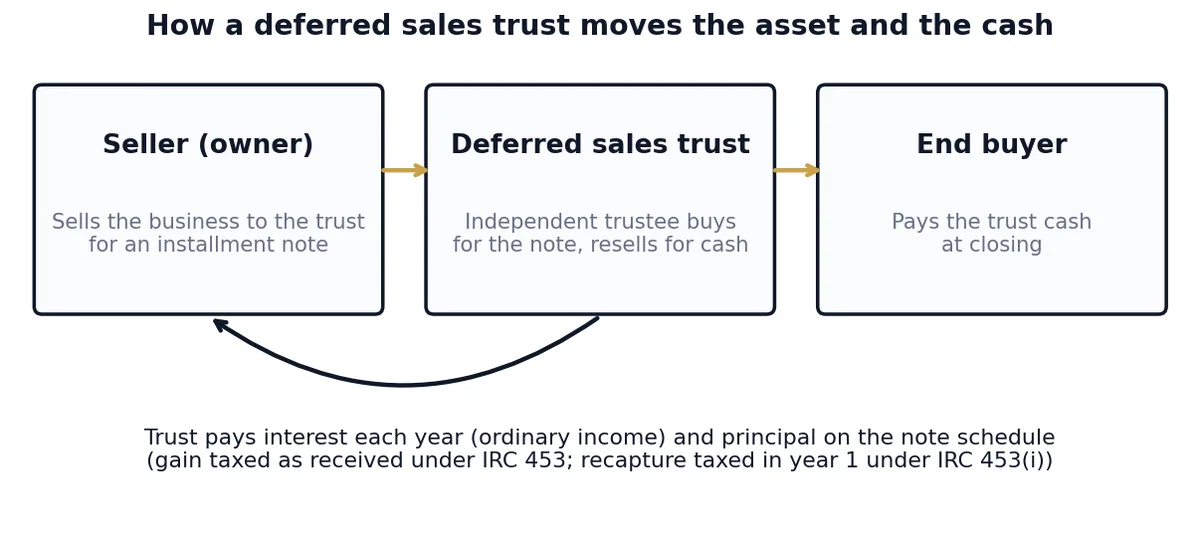
A deferred sales trust is an installment sale to an independent trust that resells the asset for cash. The seller takes back a promissory note instead of cash, so under IRC 453(b)(1) gain is reported as principal is collected. “Deferred sales trust” is a marketing name, not a Code term; its USPTO trademark application (serial 88508273) was abandoned March 24, 2021.
- Form the trust before any binding contract. The seller is a creditor of the irrevocable trust, not its trustee or beneficiary (Kitces, May 29, 2024).
- Sell to the trust for a note. The note rate must meet the Applicable Federal Rate (IRS AFR tables) or IRC 1274 and IRC 483 impute interest.
- Trust sells to the end buyer. Its basis equals the note amount, so a same-price resale produces little or no gain.
- Trust invests the cash. The trustee, not the seller, controls the portfolio.
- Trust pays the note. Interest is ordinary income; principal times the gross profit ratio is gain, reported on Form 6252 per IRS Publication 537.
Our Form 6252 installment sale guide covers the seller’s annual reporting; the trust files its own Form 1041.
What has the IRS said about deferred sales trusts?
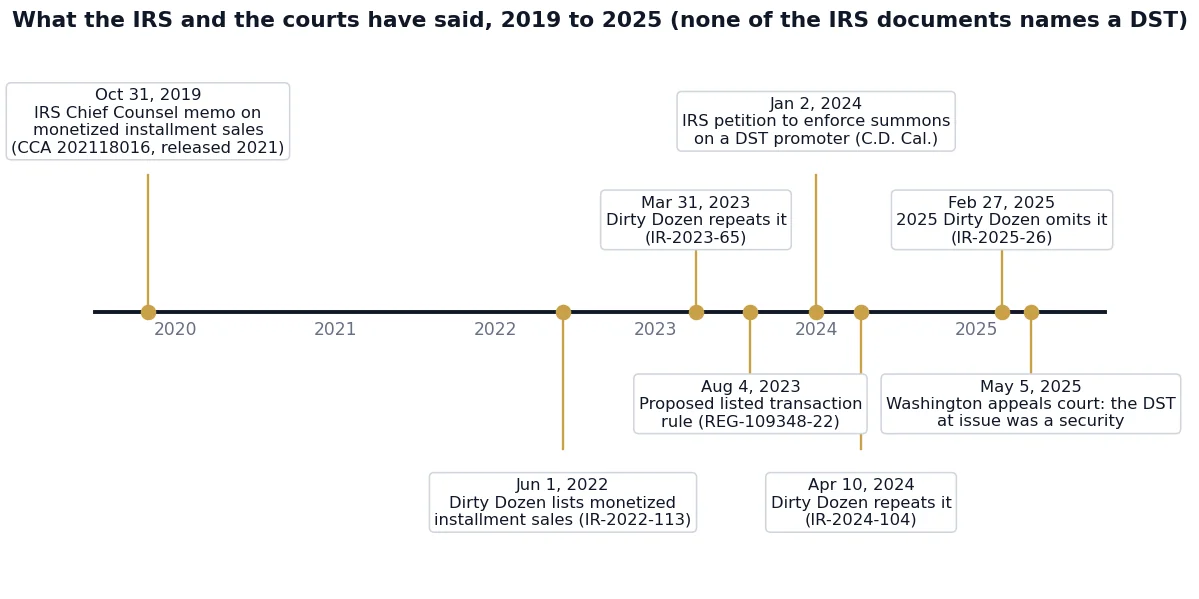
The IRS has published nothing that names a deferred sales trust, for or against. Its documents target monetized installment sales, where the seller also takes a loan funded by the sale proceeds. The closest action against DSTs is a 2024 summons petition against a DST promoter: an investigation, not a ruling.
| Date | Document | What it says | Names a DST? |
|---|---|---|---|
| Oct 31, 2019 (released May 7, 2021) | CCA 202118016 | Chief Counsel calls the promoters’ theory “flawed”, citing IRC 453(f), 453A(d) and Treas. Reg. 15a.453-1(b)(3) | No |
| Jun 1, 2022 | IR-2022-113 (Dirty Dozen) | Monetized installment sales “involve the inappropriate use of the installment sale rules under section 453” | No |
| Mar 31, 2023 | IR-2023-65 (Dirty Dozen) | Repeats the monetized installment sale warning for high-income filers | No |
| Aug 4, 2023 | REG-109348-22 (Prop. Reg. 1.6011-13); IR-2023-139 | Would make monetized installment sales listed transactions, with disclosure duties for participants and material advisors | No |
| Apr 10, 2024 | IR-2024-104 (Dirty Dozen) | Third listing of monetized installment sales | No |
| Feb 27, 2025 | IR-2025-26 (Dirty Dozen) | No installment sale item in the 2025 list | No |
Is the deferred sales trust on the IRS Dirty Dozen list?
No. The deferred sales trust does not appear by name in the 2022, 2023, 2024 or 2025 Dirty Dozen releases. Monetized installment sales appeared in IR-2022-113, IR-2023-65 and IR-2024-104. A DST that adds a loan to the seller secured by, or funded from, the trust’s cash looks like the monetized structure those releases describe, and IRC 453A(d) treats loan proceeds secured by an installment note as a payment on the note.
Did the IRS issue, or rescind, a private letter ruling on DSTs?
We found no published private letter ruling that names a deferred sales trust, and no published revocation of one. In Mariani v. Department of Financial Institutions, No. 87072-6-I (Wash. Ct. App., published 2025), the parties stipulated that the concept relies on Section 453 and “a private letter ruling”, without identifying it. Under IRC 6110(k)(3), a letter ruling may not be used or cited as precedent by anyone other than the taxpayer who requested it.
| Claim several DST guides make | What the primary source says |
|---|---|
| “The IRS has approved the DST” | No IRS document names it; Kitces (May 29, 2024) notes there has been no public IRS guidance on whether DSTs comply |
| “DSTs are on the Dirty Dozen” | Only monetized installment sales were, in 2022, 2023 and 2024 (IR-2022-113, IR-2023-65, IR-2024-104) |
| “A DST is just a trust, not an investment” | The Washington Court of Appeals upheld a finding that the DST at issue was a security; the promoter was fined $20,000 plus $15,000 in costs and fees |
| “The note defers all the gain” | IRC 453(i) taxes depreciation recapture in the year of sale; IRC 453(k)(2) excludes publicly traded stock |
Which IRC 453 rules decide whether the deferral holds?
Six Code provisions decide whether a deferred sales trust defers anything. The IRS’s own memo, CCA 202118016, applied three of them (453(f), 453A(d) and Treas. Reg. 15a.453-1(b)(3)) to monetized installment sales, and the same tests apply to any trust that buys for a note and resells for cash.
| Rule | What it does | What it means for a DST |
|---|---|---|
| IRC 453(b)(2) | Excludes dealer dispositions and inventory | Inventory is taxed in year one |
| IRC 453(i) | IRC 1245 and 1250 recapture is recognized in the year of sale | Depreciation is taxed at closing |
| IRC 453(k)(2) | No installment method for publicly traded stock | Public shares cannot use a DST |
| IRC 453(e) | A related buyer’s resale within 2 years is treated as paid to the seller | Trustee must not be related under IRC 267(b) or 318(a) |
| IRC 453(f)(3) and (4) | Only the acquirer’s note is not “payment” | A conduit trust’s note is payment, per CCA 202118016 (citing Rev. Rul. 77-414 and Wrenn v. Commissioner, 67 T.C. 576) |
| IRC 453A | Interest on deferred tax above $5,000,000 of notes; a pledge is a payment (453A(d)) | Annual interest charge; borrowing against the note ends deferral |
For how the installment method treats each payment outside a trust, see our installment sale tax treatment guide.
How much does the 453A interest charge cost on a large sale?
On a $10M deferred sales trust note, the IRC 453A charge is about $66,500 a year in this illustrative case. The charge equals the applicable percentage (face above $5,000,000 divided by total face) times the deferred tax liability (unrecognized gain times the 20% maximum capital gain rate) times the underpayment rate, which was 7% in Q4 2026 (IR-2026-98).
| Note face (gain 95%) | Applicable percentage | Deferred tax liability at 20% | Annual 453A interest at 7% |
|---|---|---|---|
| $5,000,000 | 0% | $950,000 | None |
| $10,000,000 | 50% | $1,900,000 | $66,500 |
| $20,000,000 | 75% | $3,800,000 | $199,500 |
| $50,000,000 | 90% | $9,500,000 | $598,500 |
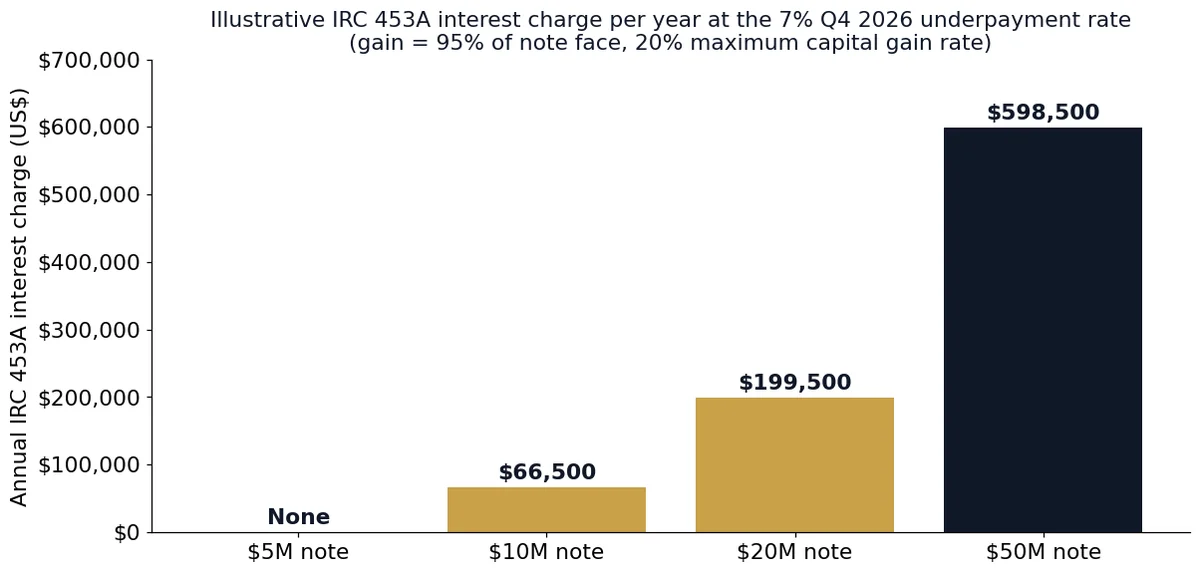
None of the top-ranked DST guides we reviewed run this arithmetic, so their breakeven claims overstate the benefit on notes above $5,000,000. IRC 453A(c)(5) treats the charge as interest; ask your CPA whether IRC 163(h) blocks the deduction.
Worked example: a $10M business sale into a DST
This illustrative example assumes a $10,000,000 sale, $500,000 basis, no recapture, a Texas seller, a 10-year interest-only note, the 23.8% top federal rate (20% under IRC 1(h) plus 3.8% under IRC 1411) and a 5% discount rate. It measures tax timing only, not investment returns or trust credit risk.
| Line | Cash sale | DST, 10-year note |
|---|---|---|
| Gain | $9,500,000 | $9,500,000 (gross profit ratio 95%) |
| Federal tax on gain | $2,261,000 in year 1 | $2,261,000 in year 10, if rates are unchanged |
| Present value of that tax at 5% | $2,261,000 | $1,388,058 |
| Value of deferral | Not applicable | $872,942 |
| IRC 453A interest, 10 years | Not applicable | $665,000 nominal; $513,495 present value |
| Deferral value after 453A | Not applicable | $359,447, before trustee, legal and tax opinion fees |
| Each 0.1% annual trustee fee on $10M | Not applicable | $10,000 a year; $77,217 present value |
Here the tax-timing benefit is gone once annual trust fees reach about 0.47% of assets, before setup costs. If Congress raises the capital gain rate before year 10, the balloon is taxed at the higher rate. Get a written fee schedule and rerun this table with your basis, state and term.
What should you ask a deferred sales trust trustee?
Ask a deferred sales trust trustee questions mapped to the rules regulators have used. In Mariani (No. 87072-6-I) no promissory note was formally executed, and the court upheld the finding that the arrangement was an unregistered security. Kitces notes that leftover trust assets can pass to the trustee.
- Are you related to me under IRC 267(b) or 318(a)? If so, IRC 453(e) applies.
- Who receives assets left after my note is paid?
- Is the note signed before closing, with a fixed schedule and an AFR rate?
- Is the arrangement registered or exempt under securities law?
- Will any loan to me be secured by the note or funded by trust cash? If yes, IRC 453A(d) and the 2023 proposed listed-transaction rule apply.
- Who signs the tax opinion, and do they share fees with the promoter? Ask whether the opinion addresses CCA 202118016.
Deferred sales trust vs 1031 exchange, CRT, installment sale and QSBS
A deferred sales trust is one of five deferral or exclusion tools for a sale. Each alternative has its own Code section; the DST relies on general installment rules with no IRS ruling behind it.
| Tool | Assets | Tax result | Key rule | Source |
|---|---|---|---|---|
| Deferred sales trust | Private business interests, real estate | Deferral as principal is paid | No IRS guidance names it | IRC 453 |
| Direct installment sale | Same | Deferral; buyer credit risk | Buyer’s own note, not an intermediary | IRC 453(f)(3) |
| 1031 exchange | Real property only | Deferral until replacement is sold | Identify in 45 days, close in 180 | IRC 1031(a)(3) |
| Charitable remainder trust | Any appreciated asset | Trust sells tax-free; payout taxed to you | 5% to 50% payout, 10% minimum remainder | IRC 664(d) |
| QSBS | Qualifying C-corp stock | Permanent exclusion | Original-issue stock, holding period | IRC 1202 |
Compare our charitable remainder trust guide, Section 1202 QSBS guide, 1031 exchange rules and structured installment sale page.
Should you use a deferred sales trust?
Use a deferred sales trust only when no cleaner tool fits and the 453A math still leaves a benefit after fees.
| If your situation is | Then | Rule |
|---|---|---|
| Your C-corp stock may qualify as QSBS | Test IRC 1202 first; exclusion beats deferral | IRC 1202 |
| You sell real estate and want to stay in real estate | Compare a 1031 exchange | IRC 1031(a)(3) |
| Note face above $5,000,000 | Add the 453A interest charge to the model | IRC 453A(b)(2) |
| Large depreciation recapture | Budget year-one tax on the recapture | IRC 453(i) |
| You need the cash now or want a loan against the note | Do not use a DST | IRC 453A(d); REG-109348-22 |
| Older seller planning to hold the note until death | Heirs owe income tax on the note with no basis step-up | IRC 691(a)(4); IRC 1014(c) |
| You have charitable intent | Compare a charitable remainder trust | IRC 664(d) |
Whether the deal is an asset or stock sale decides which rules apply, as our asset vs stock sale tax guide explains. CT Acquisitions helps owners of founder-owned businesses make the most of their exit through a confidential sale, recapitalization or exit planning, with a 500+ buyer network. We work for owners on the sell side. Our fee is success only: nothing upfront, and you pay nothing unless the business sells. Book a confidential call before you sign a letter of intent, so your tax counsel can structure the sale in time.
How we compiled this
In November 2026 we read 7 Code sections on Cornell LII, 7 IRS releases and memos, the August 4, 2023 Federal Register notice, the Mariani opinion and FTB Publication 1100. We excluded forum posts and promoter marketing, and quote no fee figures because no regulator or filed document we found publishes DST fees.
Frequently asked questions
What is the downside of a deferred sales trust?
The main downsides are tax and credit risk. No IRS ruling protects the structure, the IRS sought DST promoter records in a January 2, 2024 summons case, IRC 453A charges interest on notes above $5,000,000, and the seller is an unsecured creditor of a trust whose investments the seller cannot control.
How long can a deferred sales trust last?
A deferred sales trust lasts as long as its note. IRC 453 sets no maximum term; the note schedule sets it, often 10 years in promoter examples. Each year a note above $5,000,000 is outstanding, IRC 453A interest applies, and at death the unpaid note is income in respect of a decedent under IRC 691(a)(4).
Does a deferred sales trust pay taxes?
Yes. A deferred sales trust is a separate taxpayer that files Form 1041 on its investment income. Because the trust buys the asset for a note equal to the resale price, its own sale should show little or no gain. The seller pays tax on interest each year and on gain as principal arrives, using Form 6252.
What is the difference between a deferred sales trust and a Delaware statutory trust?
A Delaware statutory trust is a co-ownership vehicle that can count as replacement real property in a 1031 exchange under Rev. Rul. 2004-86. A deferred sales trust is an installment sale to a third-party trust under IRC 453 with no replacement property. Both use the initials DST, which confuses many searches.
Does a deferred sales trust avoid California tax if I move?
Not for California real property. FTB Publication 1100 says California taxes installment proceeds a nonresident receives to the extent the sale income is California source, and real property is sourced where it sits. Gain on intangibles is generally sourced to residence at the time of sale, so ask your CPA which applies.
Sources
- 26 U.S.C. 453, 453A, 664, 691, 1031, 1202, 6110, Cornell LII, accessed November 2026
- IRS CCA 202118016, released May 7, 2021, accessed November 2026
- IRS releases IR-2022-113, IR-2023-65, IR-2023-139, IR-2024-104, IR-2025-26, IR-2026-98, accessed November 2026
- 88 FR 51756, REG-109348-22, August 4, 2023
- Mariani v. Dep’t of Financial Institutions, No. 87072-6-I, Wash. Ct. App., accessed November 2026
- FTB Publication 1100 (2025), accessed November 2026
- Rev. Rul. 2004-86, accessed November 2026