
A business valuation service in 2026 delivers three different work products at three different price points. A sell-side M&A valuation range costs $0-$3K and produces a defensible price range based on SDE, EBITDA multiples, and buyer-pool comps. A calculation engagement runs $2-$8K with limited scope. A full USPAP-compliant appraisal costs $5-$25K and produces a signed report that survives IRS, tax court, divorce court, or SBA lender review. Which you need depends on who reads the number.
Business Valuation Service in 2026: What You Actually Get vs Sell-Side Range vs Appraisal
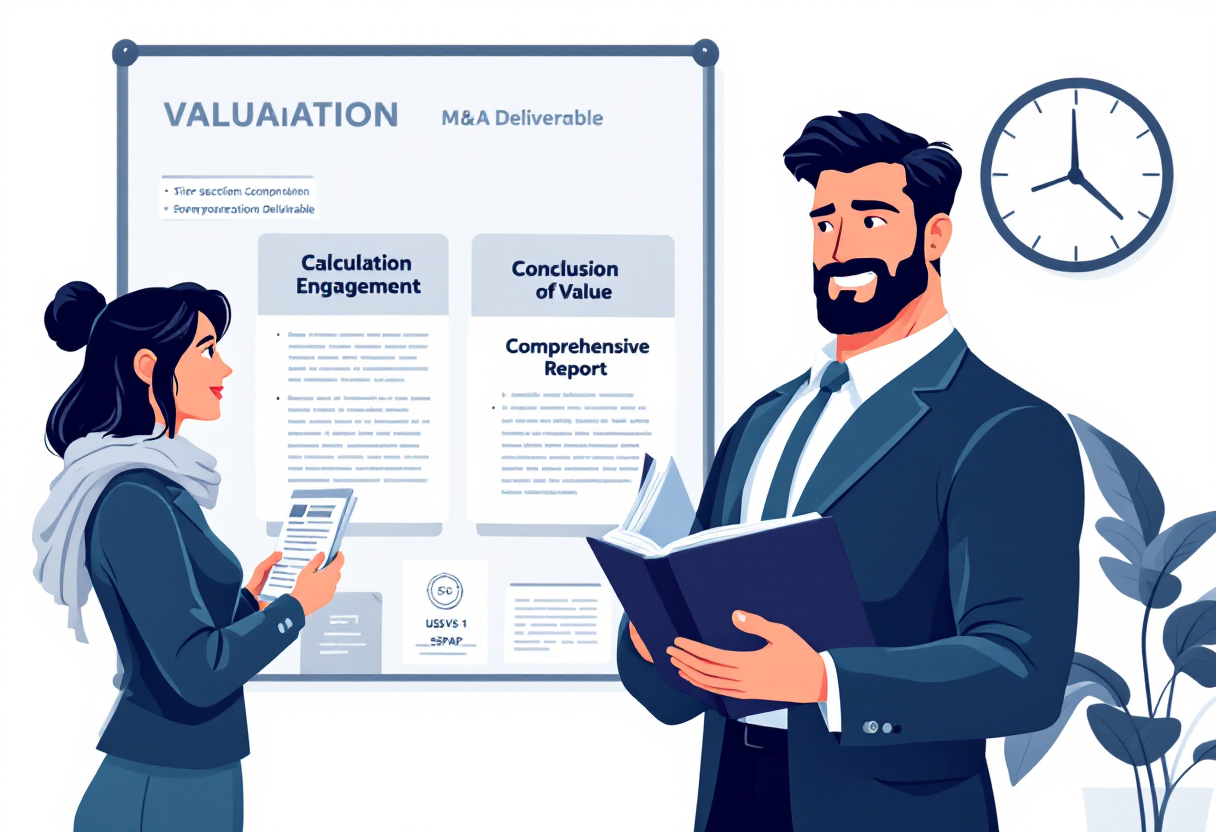
A business valuation service is the engagement under which a credentialed appraiser develops, documents, and signs a defensible opinion of value on a privately held company or an interest in one. This guide walks through exactly what the deliverable contains, which standards govern the work, what supporting documents you have to hand over, how the methods are applied inside the report, and how the scope changes based on the use case (an SBA loan, a sell side process, an estate filing, or a partnership buyout). When owners ask what they are paying for, this is the answer in granular detail.
If you came here trying to figure out the price tag, read our deep dive on cost first. If you are trying to figure out who to hire, the companion piece is business valuation expert: when to hire one. This article is about scope, not price and not credentials.
What a Business Valuation Service Actually Delivers
A business valuation service delivers four things, in this order. First, a signed written report (40 to 120 pages depending on tier) that states a conclusion of value or a calculated value as of a specific date. Second, an exhibit binder containing the underlying analyses (normalized income statements, weighted average cost of capital build, market multiple selection, transaction comparables, discount studies, and so on). Third, a certification page where the analyst signs under penalty of perjury or under the relevant professional standard. Fourth, a verbal walk through with the client and, if needed, a deposition or trial appearance.
The deliverable is not a spreadsheet with a number on it. A real valuation product is a closed loop of work papers that another credentialed analyst could pick up, re run, and tie out to the conclusion without calling the original appraiser. That auditability is the entire point.
The scope of work is set in the engagement letter at the start. The engagement letter names the subject entity, the interest being valued (100 percent equity, a 30 percent non controlling stake, a class of preferred, an operating subsidiary), the standard of value (fair market value, fair value, investment value, intrinsic value), the premise of value (going concern or liquidation), the valuation date, the purpose, the intended users, and any restrictions on use. Change any one of those inputs and the conclusion can swing materially. That is why the engagement letter is treated as a controlling document, not a formality.
The Three Service Tiers: Calculation, Conclusion, and Comprehensive
Under the American Institute of Certified Public Accountants Statement on Standards for Valuation Services No. 1 (SSVS-1, now VS Section 100), a valuation analyst can perform one of two engagement types: a calculation engagement, which results in a calculated value, or a valuation engagement, which results in a conclusion of value. The same standard governs both, but the depth of procedures is very different. In practice the market has settled on three commercial tiers stacked on top of those two standards.
Tier one is the calculation engagement. The client and the analyst agree in advance on the specific methods to apply, and the analyst applies only those. There is no requirement that the analyst consider all three approaches. There is no requirement that the conclusion be a single defensible number. The deliverable is typically 15 to 30 pages and is labeled as a calculated value, not a conclusion of value. This is appropriate for internal planning, ballpark exit conversations, mediation, and early stage transaction discussions. Cost: $2,000 to $5,000.
Tier two is the conclusion of value engagement, sometimes called a summary valuation report. The analyst is required by SSVS-1 to consider all three approaches (income, market, asset), apply the relevant ones, reconcile the results, and document the rejection of the others. The deliverable is typically 35 to 60 pages and concludes to a single value or a tight range. This is the workhorse tier for SBA loans, partner buyouts, smaller estate filings, and shareholder disputes that are unlikely to go to trial. Cost: $5,000 to $10,000.
Tier three is the comprehensive (or detailed) valuation report. Same conclusion of value standard, but the report is fully expanded with industry analysis, economic analysis, normalization narratives, method selection rationale, weighting, discount studies, and a complete appraiser certification. The deliverable is typically 70 to 120 pages plus exhibits. This is what you commission for IRS gift and estate filings, ESOP transactions, divorce litigation, and any matter where the report will be challenged. Cost: $10,000 to $30,000, sometimes higher for multi entity holdcos.
SSVS-1 Calculation Engagement: Limited Scope by Design
A calculation engagement under SSVS-1 is a limited scope product, and the standard requires the analyst to disclose that fact prominently. The calculation report carries language that reads, in effect: this is a calculated value, not a conclusion of value, and a conclusion of value might differ materially had a full valuation engagement been performed.
Within those limits, the analyst still does real work. They normalize the income statement (remove owner perks, true up rent, true up officer compensation to market). They select one or two methods (usually a single period capitalization of earnings and a single market multiple from a transactional database). They apply discounts if applicable. They sign a certification. What they do not do is the full economic and industry write up, the full reconciliation across all three approaches, or the full discount study.
Calculation engagements are not second class work. They are simply a different product, scoped to a different use case. The problem is that buyers of this product often mistake the calculated value for a conclusion of value and try to use it in a venue that requires the full engagement. A calculation will not hold up in tax court, will not satisfy IRS adequate disclosure under Section 6501, and will not survive a serious deposition. Use the calculation product for the use cases it was built for: planning, ballpark, early stage.
SSVS-1 Conclusion of Value: The Full Engagement
A conclusion of value engagement requires the analyst to perform every procedure listed in SSVS-1 paragraphs .21 through .45. That is the meaningful distinction between the two product tiers, and it is worth understanding what those procedures actually require.
The analyst has to analyze the subject company across non financial factors: nature of the business, history, products and services, markets and customers, governance and management, sensitivity to economic and industry conditions. They have to perform a financial statement analysis covering at least three (typically five) years, including normalization adjustments. They have to consider all three valuation approaches and document why each approach was applied or rejected. They have to apply discounts and premiums (for lack of control, lack of marketability, key person, blockage) with supporting empirical data. They have to reconcile the indicated values and document the weighting. And they have to issue a written report (detailed or summary) that contains every element required by SSVS-1 paragraphs .47 through .77.
That last point is the controlling one for the deliverable. The detailed report under SSVS-1 must include identity of the analyst, purpose and intended use, intended users, subject interest, standard and premise of value, valuation date, scope limitations, sources of information, financial information analyzed, non financial information analyzed, economic and industry data, all valuation methods considered, methods applied and not applied with reasoning, discounts and premiums, reconciliation, representation of the analyst, and a signed appraiser certification. Miss any of those, and the report is technically out of compliance.
Comprehensive Valuation Report: Sections and Page Count
Here is the typical section by section build of a comprehensive (tier three) report, with realistic page counts so you can sanity check what you receive. Total page count usually lands at 70 to 120 pages excluding exhibits.
| Section | Typical Pages | What It Contains |
|---|---|---|
| Letter of Transmittal | 1 to 2 | Cover letter stating the conclusion of value, addressed to the intended user. |
| Table of Contents | 1 to 2 | Section listing with exhibit cross references. |
| Engagement Definition | 2 to 4 | Subject entity, interest valued, standard and premise of value, valuation date, intended use and users, scope. |
| Sources of Information | 2 to 3 | Every document, interview, and database query used. |
| Company Description and History | 6 to 10 | History, ownership, products, customers, suppliers, employees, facilities, governance. |
| Economic Analysis | 4 to 8 | National and regional economic conditions as of the valuation date. |
| Industry Analysis | 4 to 8 | Industry structure, growth, competitive dynamics, regulatory environment. |
| Financial Statement Analysis | 10 to 18 | Historical financials, ratio analysis, normalization adjustments with narrative for each. |
| Valuation Approaches Considered | 2 to 3 | Why each of income, market, asset was applied or rejected. |
| Income Approach | 8 to 14 | Capitalized cash flow or discounted cash flow build, cost of capital derivation, terminal value, sensitivity. |
| Market Approach | 6 to 12 | Guideline public company method, guideline transaction method, multiple selection, screening rationale. |
| Asset Approach | 3 to 6 | Adjusted net asset method when applied, or rejection narrative when not. |
| Discounts and Premiums | 4 to 8 | Lack of control, lack of marketability, key person, blockage, with empirical support. |
| Reconciliation and Conclusion | 2 to 4 | Weighting of indicated values, final conclusion of value. |
| Appraiser Certification | 1 to 2 | Signed statement under SSVS-1 paragraph .65 or USPAP Standard 10. |
| Statement of Assumptions and Limiting Conditions | 2 to 3 | Standardized SALC language adapted to the engagement. |
| Appraiser Qualifications | 2 to 4 | Resume and credentials of the signing analyst. |
| Exhibits | 20 to 60 | Normalized financials, WACC build, comparable company tables, transaction tables, discount study extracts. |
Two things to watch for when you receive a draft. First, the reconciliation section should explain the weighting decision in plain language, not just present a weighted average table. Second, the exhibits should tie out to every number in the narrative. If the narrative says EBITDA of $4.2 million and the exhibit shows $4.1 million, the report is not ready to deliver.
Required Supporting Documents
The analyst cannot build a defensible report without a full documents package. Expect to upload these to a secure data room within the first week of the engagement. The list below is the standard package for an operating company.
- Five years of federal tax returns (Forms 1120, 1120S, 1065, or Schedule C) with all schedules and K 1s
- Five years of annual financial statements (audit, review, or compilation preferred)
- Trailing twelve month financial statements through the most recent month end
- Year to date general ledger or trial balance
- Detail of officer and owner compensation by year
- Detail of related party transactions, leases, and management fees
- Detail of non recurring items (lawsuits, one time gains, PPP forgiveness, ERC, insurance recoveries)
- Three year forward projection or budget with supporting assumptions
- Capitalization table and shareholder agreements
- Operating agreement, bylaws, buy sell agreement, and any restricted stock agreements
- Customer concentration analysis (top 10 customers by revenue, last three years)
- Supplier concentration analysis where relevant
- Employee headcount by function, key employee tenure, and any employment agreements
- Lease schedule, equipment schedule, and depreciation schedule
- Recent appraisals on real estate or equipment owned by the entity
- Backlog or contracted revenue schedule
- Marketing materials, website, organizational chart, and any pitch decks
- Prior valuation reports if any exist
If you are valuing a holding company or a multi entity structure, every operating subsidiary needs its own version of this package. That is one reason holdco valuations cost two to four times what a single entity engagement costs: the analyst is essentially performing several valuations and rolling them up. On valuation specifically, our deeper look at Maximize Your Pool Service Business Valuation covers the methodology buyers actually use. On valuation specifically, our deeper look at What Actually Affects Your Business Valuation in a Sale covers the methodology buyers actually use.
The Standard Valuation Methods Inside Every Report
Every conclusion of value report has to address the three approaches identified by both SSVS-1 and USPAP: income, market, and asset. Inside each approach there are specific methods, and a competent analyst will document which method was applied and why.
The income approach contains two primary methods. The single period capitalization of earnings method takes a normalized earnings base, divides by a capitalization rate (cost of capital minus expected growth), and produces an indicated value. It is best for stable, mature businesses with low expected growth volatility. The multi period discounted cash flow method projects cash flows for five to ten years, discounts them at a cost of capital, adds a terminal value, and sums to present value. It is best for businesses with non normalized growth, lumpy capex, or material expected change in the cost structure. Both methods require a cost of capital build, which is usually done as a build up model (risk free rate plus equity risk premium plus size premium plus industry premium plus specific company risk premium) or as a modified capital asset pricing model.
The market approach contains two primary methods. The guideline public company method screens public companies for comparability, calculates pricing multiples (EV to revenue, EV to EBITDA, price to earnings, price to book), and applies adjusted multiples to the subject. The guideline transaction method screens recent private company sales from databases like BVR, DealStats, and Pratts Stats, calculates multiples, and applies them. The market approach is highly persuasive to courts and the IRS when the data set is deep, and weakly persuasive when comparables are thin. A football field chart is the standard way to visualize the range of indicated values across these methods.
The asset approach contains one primary method for operating companies: the adjusted net asset method. The analyst restates every balance sheet asset to fair market value, restates every liability to fair value, and concludes to a net asset value. The asset approach is the controlling approach for holding companies, asset heavy businesses with weak earnings, and any liquidation scenario. It is generally not the controlling approach for operating businesses with meaningful goodwill or franchise value, where it tends to understate value.
Reconciliation across the three approaches is where judgment shows up. The analyst weights the indicated values based on data quality, relevance to the subject, and the standard of value being applied. A weighting scheme like 60 percent income, 30 percent market, 10 percent asset is common for a mid market operating company. A 70 to 100 percent weight on the asset approach is common for a holding company. The weighting must be explained, not just asserted.
USPAP-Compliant Service vs Non Compliant
The Uniform Standards of Professional Appraisal Practice (USPAP) is published by the Appraisal Foundation and contains ten standards. Standards 9 and 10 govern business valuation development and reporting respectively. The 2024 edition remains in effect under the open ended model the Appraisal Standards Board adopted, and there is no new USPAP book for the 2026 to 2027 cycle.
A USPAP compliant valuation engagement does several things that a non USPAP service may not do. The analyst certifies under USPAP Standard 10 that they have no present or prospective interest in the subject, that compensation is not contingent on the conclusion, that the analysis was performed in conformity with USPAP, and that no one provided significant assistance whose name does not appear on the certification. The report identifies whether it is an Appraisal Report or a Restricted Appraisal Report, and the Restricted version carries a use restriction confining it to the named client only. The analyst documents extraordinary assumptions and hypothetical conditions explicitly. And the workfile retention period under USPAP is at least five years (or two years after final disposition of any judicial proceeding the analyst testified in, whichever is later).
You should request a USPAP compliant report any time the audience for the report is anyone other than the owner: a lender, the IRS, a court, an opposing party, an ESOP trustee, or a board of directors. The marginal cost is small (often zero) because most credentialed analysts work to USPAP by default, but the protection is meaningful. ASA Business Valuation credential holders are required to comply with USPAP on every engagement. NACVA CVAs and AICPA ABVs typically also comply on engagements with external users.
SBA-Compliant Valuation Service: What SBA Requires
If your engagement is for an SBA 7(a) acquisition loan above $250,000 or for a change of ownership, the valuation has to follow the rules in the current SBA Standard Operating Procedure. SOP 50 10 8 took effect on June 1, 2025 and supersedes SOP 50 10 7.1, but the core valuation requirements are similar.
The SBA requires that the valuation be performed by a qualified source. Qualified means either (a) a credentialed appraiser with a recognized credential (ASA, ABV, CVA, CBA, or equivalent) or (b) a CPA who is not the business seller, has performed valuation engagements, and meets the lender’s qualification standards. The lender, not the borrower, must engage the appraiser. That last point trips up first time SBA borrowers: you cannot pick your own appraiser and bring them to the bank. The bank picks, and you pay through the loan.
The SBA valuation must include the standard of value (almost always fair market value), the valuation date, the purpose (the SBA 7(a) acquisition), the methods used, and a conclusion of value. SBA does not require USPAP compliance per se, but most SBA appraisers work to USPAP and SSVS-1 anyway because it is the cleanest defense if the loan is questioned later. SBA does require that the valuation support the purchase price at or above the agreed acquisition value, or the loan cannot close at that price.
Timeline for SBA valuations is typically two to four weeks, and cost typically runs $2,500 to $7,500 depending on the size of the deal and the complexity of the target. The deliverable is usually a summary report (tier two), not a full detailed report.
Tax-Court Defensible Valuation Service
If the report will land in front of the IRS for gift, estate, or income tax purposes, the bar is higher. The controlling guidance is Revenue Ruling 59-60, which lists eight factors the analyst must address: nature and history of the business, economic outlook of the industry, book value and financial condition, earning capacity, dividend paying capacity, goodwill or other intangible value, prior sales of the stock and block size, and pricing of comparable public companies. Every one of those factors has to be addressed in the report. Skipping one is a leading reason the IRS rejects valuations.
On top of Rev. Rul. 59-60, the report has to satisfy the adequate disclosure rules under IRC Section 6501(c)(9) and Treasury Regulation 301.6501(c) 1(f)(2). Adequate disclosure starts the three year statute of limitations running on the IRS challenging the gift. If adequate disclosure is not met, the IRS can challenge the gift indefinitely. Adequate disclosure requires a description of the transferred property, the transferor and transferee, the relationship between them, the basis for the value reported, and a description of any restrictions on the transferred property that were considered.
The IRS also requires that the appraiser meet the qualified appraiser definition in IRC Section 170(f)(11)(E) and the related regulations: the appraiser has earned an appraisal designation from a recognized professional appraiser organization or has otherwise met minimum education and experience requirements, regularly performs appraisals for compensation, and is not the donor, the donee, or related party. A report from a non qualified appraiser is treated as no appraisal at all for many tax purposes.
Defensible tax court reports are typically tier three comprehensive reports, USPAP and SSVS-1 compliant, addressing all eight Rev. Rul. 59-60 factors, with full discount studies for lack of control and lack of marketability. They run 80 to 150 pages and cost $12,000 to $40,000. The cost is high relative to other tiers because the analyst is, in effect, prepaying the work that will be needed if the IRS challenges and the case goes to litigation.
Service Timeline: 2 Weeks for Calculation, 4-8 Weeks for Full Report
Timeline is driven by tier, complexity, and how fast the client returns documents. The averages below assume the document package is delivered within seven days of engagement.
| Tier | Standard Timeline | Rush Timeline (25 to 50 percent surcharge) |
|---|---|---|
| Calculation engagement | 2 to 3 weeks | 5 to 10 business days |
| Conclusion of value (summary) | 4 to 6 weeks | 2 to 3 weeks |
| Comprehensive detailed report | 6 to 10 weeks | 4 to 5 weeks |
| Multi entity or holdco | 10 to 16 weeks | Rarely available |
| Tax court defensible (litigation grade) | 8 to 12 weeks | Not recommended |
The variable that most affects timeline is the document delivery cadence. If you send tax returns and financials in week one but withhold the customer concentration analysis until week four, the report will be late no matter how fast the analyst works. Build the data room before you engage the firm.
Other timeline drivers: the number of operating subsidiaries, the presence of real estate or equipment that requires separate appraisal, the need for normalization adjustments on owner compensation (which requires market comp data), and any unusual capital structure (preferred stock, warrants, profits interests, earnouts). Each of those adds analyst hours.
Business Valuation Service Cost by Tier
Costs vary by tier, firm, location, and complexity. The ranges below are what we see across the credentialed firms in 2026. A complete pricing breakdown lives in our cost guide, but the headline numbers are below.
| Tier | Typical Cost | Best Use Case |
|---|---|---|
| Calculation engagement | $2,000 to $5,000 | Planning, ballpark, mediation, internal use |
| Conclusion of value (summary) | $5,000 to $10,000 | SBA loan, partner buyout, divorce settlement, small estate |
| Comprehensive detailed report | $10,000 to $20,000 | Mid market sell side, ESOP feasibility, gift tax filing |
| Multi entity or holdco | $20,000 to $50,000+ | Family office, real estate operating companies, holdco structures |
| Tax court defensible | $15,000 to $40,000+ | Estate tax, large gift transfers, IRS audits, contested litigation |
| 409A valuation (early stage) | $1,500 to $5,000 | Common stock fair value for stock option grants, annual or transactional |
| ESOP annual update | $15,000 to $40,000 | Annual update required by ERISA for trustee, repeating engagement |
Two cost drivers that often surprise first time buyers. First, expert witness time is billed separately from the report. If the analyst has to give a deposition, that is usually $400 to $700 per hour on top of the report fee. If the analyst has to testify at trial, that is a separate engagement with a retainer. Second, updates and bring downs to a prior report typically run 25 to 50 percent of the original fee, not 10 percent, because the analyst has to re run the entire economic and industry analysis as of a new date.
How to Choose Between BV Firms
The shortlist criteria below is what we use when sourcing valuation work for sell side clients. It is not the only framework, but it is one that survives contact with hostile counsel, hostile bankers, and hostile IRS examiners.
First, credential of the signing analyst. The report has to be signed by an individual, not a firm. That individual should hold at least one of ASA BV, AICPA ABV, NACVA CVA, or CBA from the Institute of Business Appraisers. If the report will be challenged, the signing analyst is the person who will be deposed. Make sure that person has done it before.
Second, sample report. Ask the firm for a redacted sample report at the tier you are buying. A real firm will provide one. A firm that resists is signaling that the work product will not hold up. Read the sample with the SSVS-1 paragraph .51 to .77 checklist next to it and confirm each required element is present.
Third, the engagement letter. The engagement letter should name the signing analyst, the standard of value, the valuation date, the intended use and users, the scope, the timeline, the fee, and the workfile retention period. It should also state explicitly that compensation is not contingent on the conclusion. If the engagement letter is short, vague, or silent on any of those points, the firm is not careful.
Fourth, expert witness history. If the work might end up in court, ask how many depositions and trials the signing analyst has given testimony in over the last five years, and ask for case citations. A senior analyst will have ten to fifty depositions and several trial appearances. A junior analyst will have zero, which is fine for non litigated work but disqualifying for anything that might be contested.
Fifth, peer reviewer. Strong firms have an independent senior reviewer who signs the report alongside the lead analyst, or a documented internal review process. If a single junior analyst signs and ships without review, the firm is not running a quality control program.
Sixth, fit to use case. A firm that does mostly 409A work for venture backed startups is not the right firm for a 50 person manufacturing company sell side. A firm that does mostly estate work for family offices is not the right firm for an ESOP transaction. Ask about recent comparable engagements before you engage. Our companion guide on choosing a valuation expert goes deeper on the credential and use case fit.
How CT Acquisitions Integrates Valuation Service in Sell-Side Mandates
When CT Acquisitions runs a sell side mandate, we do not treat the formal business valuation service as an upfront sunk cost. We treat it as one of several pricing inputs that feed the go to market range. Here is how the pieces fit together.
Step one, our internal pricing exercise. We run a sell side pricing analysis on every mandate: normalized EBITDA, public comparable multiples, recent private transaction comparables in the vertical, buyer pool composition (strategic, financial, search funds), and the deal structure we think will clear the market. This is internal work product, not a formal valuation under SSVS-1. It feeds the asking price and the target range. Our guide on how to price a business for sale walks through this in detail.
Step two, a third party valuation when the use case demands it. We commission a formal SSVS-1 conclusion of value engagement when (a) the seller needs a defensible number for partner buyout, estate planning, or divorce settlement running in parallel with the sale; (b) the buyer pool is dominated by SBA financed buyers who will require an SBA valuation anyway; (c) the asset has unusual structure (multi entity, IP heavy, regulated) where third party validation strengthens the marketing materials. The valuation is not a substitute for our pricing analysis; it is a parallel document for a specific audience.
Step three, integration with the marketing process. We do not generally publish the formal valuation in the confidential information memorandum. Buyers do not buy at the valuation analyst’s conclusion of value; they buy at what the market clears at. We use the valuation as a floor reference in negotiations and as documentation for the buyer’s lender, not as a pricing anchor in the marketing materials. How investment bankers value a business covers the contrast in detail.
Step four, the closing package. If the deal is SBA financed, the buyer’s bank will commission its own SBA compliant valuation. We coordinate the document delivery so that the buyer’s appraiser gets the same data room our pricing analysis used. That cuts the SBA valuation timeline from six weeks to three weeks and reduces closing risk. If the deal is buyer financed without SBA, the buyer may still commission a quality of earnings and a third party valuation for the lender. Either way, the seller is better off having a clean valuation in hand than scrambling to produce one under deal pressure.
In short: the engagement we commission as part of a sell side mandate is not the pricing decision. It is documentation that supports the pricing decision and clears specific transaction friction. The pricing decision lives in the market.
Business Valuation Service: Frequently Asked Questions
Is a calculation engagement the same as a full business valuation?
No. A calculation engagement under SSVS-1 produces a calculated value, not a conclusion of value. The analyst applies only the methods agreed in advance with the client and does not have to consider all three approaches. The report is shorter, less defensible, and explicitly disclosed as limited scope. Use a calculation for planning and ballpark conversations, not for tax filings or litigation.
What is the difference between USPAP and SSVS-1?
USPAP is the standard published by the Appraisal Foundation that covers all appraisal disciplines including business valuation (Standards 9 and 10). SSVS-1 (now VS Section 100) is the AICPA standard for CPAs performing valuation work. The two overlap heavily but are not identical. Most credentialed analysts work to both standards simultaneously, and the report typically references both in the certification.
Do I need a USPAP compliant report for an SBA 7(a) loan?
The SBA SOP does not explicitly mandate USPAP, but it does require a credentialed appraiser whose work product holds up to lender scrutiny. In practice, almost every SBA business valuation report you receive will be USPAP and SSVS-1 compliant because that is the path of least resistance for the appraiser. Ask the lender’s policy if you are unsure.
How many years of financials do I need to provide?
The standard package is five years of tax returns and five years of annual financials, plus trailing twelve months through the most recent month end. For businesses with less than five years of operating history, the analyst will work with what exists, but the conclusion of value range will widen because the historical base is thinner.
Does a higher reported value cost more?
No. Reputable firms do not bill on a contingent fee basis tied to the conclusion. Doing so violates USPAP, SSVS-1, and every recognized credential code of ethics. If a firm offers a contingent fee, walk away. The fee should be a fixed price or hourly rate set in the engagement letter before work begins.
Can a CPA who is not a credentialed appraiser perform a business valuation?
A CPA can perform a calculation or valuation engagement under SSVS-1 even without the ABV credential, but the report will be weaker in venues where credentials are scrutinized (tax court, ESOP litigation, divorce trials). For any external use, hire a credentialed appraiser. For internal planning where defensibility is not at issue, a non credentialed CPA may be acceptable.
What is a discount for lack of marketability (DLOM)?
A reduction applied to the indicated value of an interest in a privately held company to reflect the fact that the interest cannot be quickly converted to cash the way a publicly traded stock can. Empirical support for DLOM comes from restricted stock studies, pre IPO studies, and option pricing models. Typical DLOMs for non controlling private interests range from 15 to 35 percent depending on the facts. The discount study is a separate exhibit in any defensible report.
How is the cost of capital calculated inside a business valuation?
The two standard approaches are the build up method and the modified capital asset pricing model. The build up method starts with the risk free rate (typically the 20 year Treasury yield), adds an equity risk premium, a size premium, an industry premium, and a specific company risk premium. The modified CAPM adds a beta adjustment to the equity risk premium. Both methods land in the 15 to 30 percent range for most private operating companies. The cost of capital build is a top-tier judgment heavy parts of any valuation and a top-tier attacked in litigation.
What is the difference between enterprise value and equity value in a valuation report?
Enterprise value is the value of the operating business independent of capital structure (debt and cash). Equity value is enterprise value minus interest bearing debt plus cash and cash equivalents. Most valuation reports conclude to enterprise value first and then bridge to equity value in the conclusion section. The enterprise value formula guide walks through this in detail.
What role does EBITDA play in a valuation report?
EBITDA is the most common earnings base used in the market approach and is a frequent base for the income approach as well. The analyst normalizes EBITDA by adjusting for owner compensation, related party rent, non recurring items, and other adjustments that bring the earnings to a market basis. EBITDA meaning explained walks through the components, and amortization in EBITDA covers the most misunderstood line.
One more practical note. Owners often ask whether the report can be delivered in stages. Strong firms will give you a preliminary indication of value at the midpoint of the engagement, before the report is drafted, so you can decide whether to keep going. That preliminary number is the indicated value from the income approach and the market approach before reconciliation, discounts, and final review. It is not a conclusion of value, and the firm will not put it in writing. But it is a useful checkpoint. If the preliminary number is far below or far above what you expected, you can pause the engagement, dig into the assumptions with the analyst, and adjust scope before the report is finalized. That conversation is much harder to have after the report is signed and delivered.
Another practical note on workfile retention. Both USPAP and SSVS-1 require the analyst to maintain a workfile for at least five years after the engagement, or two years after final judicial disposition if the work was used in litigation, whichever is later. The workfile contains every data point, calculation, source document, and email that supports the conclusion. If the report is ever challenged years later by an estate tax audit, a divorce reopener, or a partnership dispute, the workfile is the defense. Confirm in the engagement letter that the firm will retain the workfile for the required period and that you will have access on reasonable notice.
The bottom line: the deliverable is a documented opinion of value tied to a specific date, scope, and use case, signed by a credentialed individual under one or more recognized professional standards. The right tier depends on the use case. The right firm depends on the use case, the credential, and the audience for the work. Buy the product that matches the use case, not the cheapest or the most expensive option on the shelf.