
Best Cleaning Company Franchise Brands in 2026: Commercial vs Residential Compared
Best Cleaning Franchises Commercial Residential in 2026 depends on scale, sector, and recurring revenue percentage. Named PE-backed and strategic acquirers pursue this vertical actively, and multiples clear meaningful ranges depending on platform readiness and market cycle timing. This page covers the operational specifics that matter to owner-operators considering a sale.
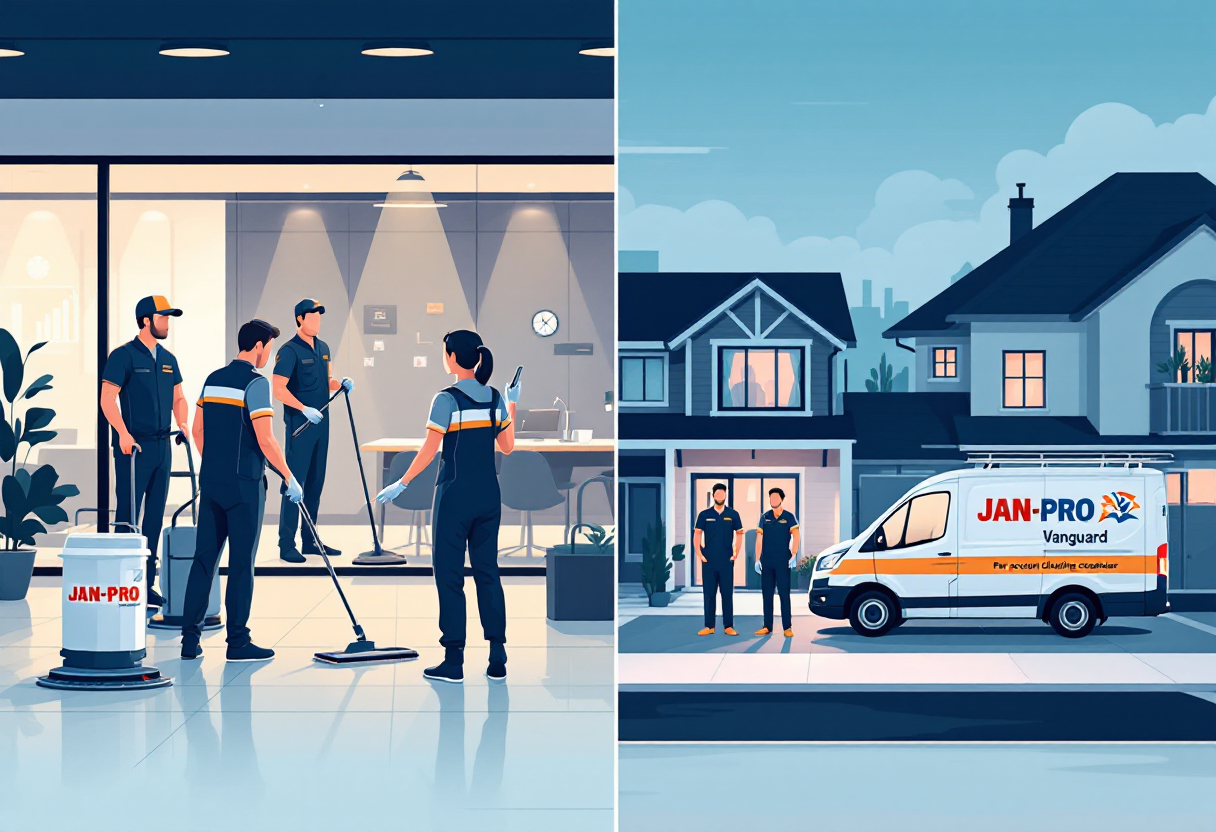
A cleaning company franchise sits at the intersection of two of the most durable cash-flow businesses in the United States: commercial janitorial contracts and residential maid services. Buyers ask us the same question every week. Should you pay $4,500 for a JAN-PRO unit license that comes with a starter book of business, $150,000 for a Molly Maid territory with vans and brand recall, or $400,000 for an Anago master that lets you resell the brand inside an entire metro? The answer depends on capital, time horizon, and whether you want to clean accounts yourself or build a sales-and-management business that subcontracts the actual work.
This guide is built for operators who treat franchise selection as an acquisition problem, not a brochure decision. We pulled FDD Item 7 disclosures from the largest brands, ran the per-account math on commercial versus residential models, and mapped the resale environment so you know what your exit looks like before you sign. Where a number comes from a Franchise Disclosure Document we link the source. Where the law has moved against a brand we name the case and the citation. By the end of this article you will know which cleaning company franchise structures actually create equity, which ones trap you inside someone else’s pricing power, and how multi-unit owners are exiting at three to five times seller discretionary earnings in 2026.
What a Cleaning Company Franchise Actually Includes
A cleaning franchise license bundles five things that an independent operator would otherwise have to build alone. Brand recognition matters less than people think in commercial cleaning, where buyers comparison-shop on price and reliability, but it matters a lot in residential, where homeowners search Google for “house cleaning near me” and click the name they have seen on a yard sign or a van wrap. Training programs vary from a single weekend class for a unit franchise to a full thirty-day curriculum for a master license that includes sales coaching, hiring playbooks, and territory mapping. Supply chain access through the franchisor often delivers chemicals, equipment, and uniforms at fifteen to twenty-five percent below open-market pricing, which protects gross margin when wages rise.
The fourth component is the proprietary technology stack. Coverall offers its Health-Based Cleaning System, Stratus markets a Green Clean Certified program, and Servpro brings restoration software that pulls insurance carrier work into a contractor’s pipeline. The fifth and most underrated piece is the customer acquisition channel. Master franchisors like JAN-PRO, Anago, and Vanguard run regional sales teams that sell accounts in bulk and assign them to unit franchisees, which is the only reason a $4,500 entry point can produce a working business in ninety days. Without that fed-account model the same unit franchisee would spend a year cold-calling office managers before landing the first contract.
The trade-off is control. Every cleaning franchise agreement gives the franchisor the right to set service standards, audit your accounts, redirect customers to other franchisees, and in some master systems take back accounts that fall below performance thresholds. Royalty fees run from five to ten percent of gross revenue, and most brands stack a separate brand fund contribution of one to three percent on top. Before you compare brands on entry price, model the all-in revenue share over five years. We cover that math later in the royalty fee definition section.
The Two Cleaning Franchise Models: Commercial vs Residential
Commercial cleaning and residential cleaning look similar from the outside. Both involve crews showing up to spaces and leaving them clean. The franchise economics could not be more different. Commercial cleaning is a business-to-business sale with recurring contracts, three to five-year terms, and a customer that pays on net-30 invoicing. Residential is a business-to-consumer sale with month-to-month relationships, weekly or biweekly service frequencies, and a customer that pays by card the morning of the clean.
That difference cascades through every line of the operating model. Commercial accounts produce average annual contract values of $8,000 to $40,000, with the work performed at night or early morning by part-time crews. Residential accounts produce average annual values of $2,000 to $4,000, with the work performed during the day by W-2 employees who also handle customer interaction. Commercial cleaning franchises typically run as master-and-unit pyramids, where a master franchisee sells accounts to unit franchisees who clean them. Residential franchises run as direct unit operators who employ their own staff, market locally, and own the customer relationship.
Commercial cleaning rewards capital scarcity and operational discipline. Margins are thin, six to twelve percent at the operator level, but contracts are sticky and growth comes from layering accounts onto existing routes. Residential rewards brand investment and local marketing. Margins are higher, fifteen to twenty-two percent on average, but customer churn is constant and growth requires steady spending on Google Ads, Yelp, and door hangers. Choose commercial if you want a low-glamour cash machine. Choose residential if you want a brand-driven local business with consumer-facing pride.
Commercial Cleaning Franchise Economics
Commercial cleaning franchises break into two structural tiers. The unit tier sits at the bottom and is what most buyers see advertised on Franchise Direct and Franchise Gator. Unit fees range from $2,500 to $80,000 depending on how much guaranteed account revenue the franchisor packages with the license. A buyer paying $4,500 for a small JAN-PRO plan gets roughly $1,000 per month in starter accounts. A buyer paying $50,000 to $78,000 gets a multi-account plan that should produce $8,000 to $14,000 in monthly revenue from day one, per the JAN-PRO 2026 FDD.
The master tier sits above the unit franchisees and is where the real wealth is created in commercial cleaning. A master franchisee buys exclusive rights to a metro and earns revenue four ways: an initial fee when they sell a unit license, a piece of every royalty their units pay to corporate, a sales and marketing fee they keep entirely, and a management override on the accounts they originate. Vanguard Cleaning Systems master franchises run $164,961 to $472,556 in total investment per their 2025 FDD. Anago Cleaning Systems masters require $219,000 to $339,000 in capital with a minimum cash position of $400,000.
Operating margins for commercial unit franchisees typically run six to ten percent of revenue after labor, supplies, royalties, and vehicle costs. Master franchisees who build to twenty or more unit operators in a metro can generate net margins of twenty to thirty-five percent because their revenue is fee-based rather than labor-based. That structural advantage is why most acquisitions in the cleaning category target master licenses rather than unit-level books of business.
Top Commercial Cleaning Brands (JAN-PRO, Vanguard, Stratus, Coverall)
The four largest commercial cleaning franchise systems by unit count are JAN-PRO, Coverall, Jani-King, and Stratus Building Solutions. Together they operate roughly twenty thousand franchised cleaning units across North America. JAN-PRO ranks at the top with more than ten thousand units and remains the most aggressive marketer of low-entry plans. Unit investments run $4,170 to $56,020 according to its Entrepreneur Franchise 500 listing. Regional developer licenses, which is what JAN-PRO calls master franchises, run $130,000 to $421,500 per the 2024 FDD review with average sales of $1.83 million for established regional developers.
Coverall markets its Health-Based Cleaning System as the differentiator and is particularly strong in medical, dental, and educational verticals where infection control matters. Unit investments run roughly $19,950 to $40,400. Jani-King is the legacy player, founded in 1969, with strong hotel and hospitality concentration. Investments start at $15,000 per the Franchise Gator 2026 listing. Stratus Building Solutions markets its Green Clean Certified program and runs unit investments of $4,450 to $79,750 with master licenses around $53,800.
Below the top four sit a layer of smaller but operationally interesting brands. Buildingstars operates a three-tier program with starter, executive, and ownership packages from $2,245 to $60,995. Office Pride targets faith-based operators and focuses on professional office buildings. ServiceMaster Clean spans both janitorial and disaster restoration with total investments of $104,300 to $179,750 per the VettedBiz FDD review. Servpro sits at the larger end with restoration-heavy revenue and investments north of $200,000 for most territories.
Residential Cleaning Franchise Economics
Residential cleaning runs on a completely different chassis. A typical residential franchisee buys a territory, hires four to ten W-2 cleaners, runs two to four branded vehicles, and markets directly to homeowners through Google Ads, Yelp, Nextdoor, and referral programs. Initial investments cluster between $100,000 and $200,000 for the leading brands. Royalty rates range from five to seven percent of gross revenue. Brand fund contributions add another one to two percent. The customer count per franchisee runs 200 to 600 active households, with revenue per customer of $1,800 to $3,600 annually depending on home size and cleaning frequency.
The financial appeal of residential is margin. Mature residential cleaning franchisees produce seller discretionary earnings of fifteen to twenty-two percent of revenue, which lets a $1.2 million-revenue operation generate $200,000 to $260,000 in owner profit. The drawback is labor. Residential cleaning has the highest turnover rate of any home services category, often exceeding seventy percent annually. That puts constant pressure on hiring, training, and quality control. A good franchisor provides scheduling software, route optimization, and recruiting playbooks that turn the labor problem from chaos into a process.
The other appeal of residential is the demographic tailwind. Dual-income households now make up roughly sixty percent of married-couple homes per the Bureau of Labor Statistics, and time-pressed homeowners increasingly treat cleaning as a non-discretionary service. Aging-in-place demand from sixty-five-plus households adds a secondary growth driver. The IFA’s 2026 Franchising Economic Outlook projects commercial and residential services franchises at 3.2 percent unit growth for the year, putting cleaning among the fastest-expanding categories.
Top Residential Cleaning Brands (Molly Maid, MaidPro, Merry Maids, Two Maids)
Molly Maid, owned by Neighborly, is the largest residential cleaning franchise system by brand recognition. The franchise fee is $14,900 plus a territory fee of $45,000 to $70,000. Total investment runs $139,900 to $197,200. Royalty is 6.5 percent on a declining tier as revenue scales, plus a 2 percent advertising fund. Net worth requirement sits at $250,000 with $50,000 in liquid capital. Neighborly bundles Molly Maid with Mr. Rooter, Mr. Electric, Rainbow Restoration, and other home services brands, which gives multi-brand operators cross-referral advantages that single-brand franchisors cannot match.
Merry Maids, part of the ServiceMaster family, runs at the lower end of the cost spectrum with about $50,000 in cash required for initial investment per its investment page. The brand is large, the unit count is dense, and the operating model is mature. MaidPro markets itself as a tech-forward residential brand with proprietary scheduling software. Total investment runs $109,860 to $158,650 with a $50,000 franchise fee.
The Cleaning Authority, also owned by Neighborly’s parent group, runs total investments of $101,572 to $169,044 with a franchise fee of $15,000 to $20,000. Two Maids uses a performance-based pricing model where customers rate each clean and that score drives the cleaner’s pay. Total investment is roughly $30,000 lower than MaidPro at the top end, and the franchise fee runs about half. The Maids targets higher-end residential customers with a four-person team-cleaning model. You’ve Got Maids rounds out the leading brands with a slightly lower entry point and a heavy focus on owner-operator launches.
Master Franchise vs Unit Franchise Structure in Cleaning
The single most important decision in evaluating a cleaning brand is whether to buy at the unit level or the master level. Unit franchises are operating businesses. You clean accounts. You hire cleaners. You collect revenue and remit royalties. Master franchises are sales-and-management businesses. You sell unit licenses to other people, you manage the brand inside a defined territory, and you collect overrides on every dollar of cleaning revenue your unit operators produce.
The economic difference is enormous. A unit franchisee in commercial cleaning who builds a $500,000 book of business probably produces $50,000 to $60,000 in owner profit. A master franchisee in the same metro who builds twenty-five unit operators each doing $200,000 in revenue collects fees on $5 million of underlying cleaning revenue. At a typical eight to twelve percent override and royalty take that produces $400,000 to $600,000 in fee revenue for the master, against carrying costs of perhaps $200,000 for the office, sales staff, and operations team. The net is a $200,000 to $400,000 fee-business profit on top of any direct accounts the master owns.
Master franchise rights are also the asset class where institutional acquirers shop. Family offices and lower-middle-market private equity buyers underwrite commercial cleaning masters at multiples of four to six times trailing twelve-month earnings, because the cash flow looks like a royalty stream rather than an operating company. Unit franchises typically transact at one to two times seller discretionary earnings unless they have built unusual customer concentration or geographic moats. If exit value matters to you, the master license is the structure that creates it.
A real-world example helps. Consider a metro with thirty unit franchisees averaging $180,000 in annual revenue each. That is a $5.4 million cleaning revenue base inside the territory. A master franchisee collects, on a typical structure, a 10 percent royalty plus a 4 percent management fee, for a 14 percent system take of roughly $756,000 per year in gross fee revenue. Subtract $250,000 to $325,000 in operating costs for the master office, sales staff, training infrastructure, and quality control inspectors, and the master generates $430,000 to $500,000 in EBITDA on a pure fee model. At a 4.5x multiple, that master license transacts for $1.9 million to $2.25 million on exit. Compare that to a unit operator with $180,000 in revenue and $18,000 in SDE selling at 1.5x for $27,000. The structural difference is two orders of magnitude.
Initial Investment Comparison Across All Cleaning Brands
The investment ranges below come directly from each brand’s most recent FDD Item 7 filings. Numbers are inclusive of franchise fee, equipment, vehicles where required, training, working capital, and reserves through the first months of operation. Buyers should read each FDD in full before signing, because Item 7 ranges are estimates and territory-specific costs can shift the high end materially.
Commercial unit franchises cluster at the low end. JAN-PRO units run $4,170 to $56,020. Stratus units run $4,450 to $79,750. Coverall units run $19,950 to $40,400. Anago units run $11,265 to $68,250. Buildingstars units run $2,245 to $60,995. Jani-King units start at $15,000 and scale based on territory size. These are the licenses where guaranteed account revenue is bundled with the franchise fee.
Commercial master franchises sit two orders of magnitude higher. Vanguard masters run $164,961 to $472,556. Anago masters run $219,000 to $339,000 with a $400,000 cash minimum. JAN-PRO regional developers run $130,000 to $421,500. Residential franchises sit in the middle. Molly Maid runs $139,900 to $197,200. MaidPro runs $109,860 to $158,650. The Cleaning Authority runs $101,572 to $169,044. Merry Maids requires roughly $50,000 in cash. ServiceMaster Clean runs $104,300 to $179,750 with a $32,500 franchise fee.
Royalty Structures and Brand Fund Math for Cleaning Franchises
Royalty math is where buyers most often misjudge the long-term cost of a cleaning company franchise. The headline royalty rate is only one component. Brand fund contributions, technology fees, supply mark-ups, and required local advertising spend stack on top. The real annual revenue share to the franchisor system can run twelve to fifteen percent of gross sales once everything is added.
JAN-PRO charges a 10 percent royalty plus a 4 percent management fee on accounts the master originates, which together approach a 14 percent system take on unit-level revenue. Vanguard charges 5 percent royalty plus an additional brand fund contribution. Molly Maid charges 6.5 percent royalty on a declining tier plus a 2 percent advertising fund. MaidPro charges a flat 7 percent royalty up to a cap. Stratus charges varying royalty tiers based on package level. Anago and Coverall structure royalties as flat percentages with separate sales and marketing fees that the master franchisee retains.
The practical question for a buyer is what percentage of every cleaning dollar leaves the operating business in the first five years. Model it conservatively. Assume 9 to 14 percent of gross revenue goes to royalty and fund payments. Add another 1 to 2 percent for technology or required supplies bought through the franchisor. Subtract that from your gross margin before labor and overhead. If your projected EBITDA margin under those assumptions is below ten percent, the brand premium is probably not worth paying. The royalty fee explainer walks through the math line by line.
Per-Account Revenue and Operating Margins in Cleaning
Per-account economics drive everything in commercial cleaning. The typical small office cleaning contract bills $400 to $1,500 per month for a 5,000 to 15,000 square foot space cleaned three to five nights per week. A midsize medical or professional office bills $2,000 to $5,000 per month. Large facilities such as bank branches with multiple locations, light industrial sites, and educational facilities bill $8,000 to $25,000 per month. A unit franchisee with twenty small accounts grossing $700 per month produces $168,000 in annual revenue. The same franchisee with five midsize accounts at $3,500 each produces $210,000. The same franchisee with one large account at $15,000 produces $180,000.
Labor consumes fifty-five to sixty-five percent of commercial cleaning revenue. Supplies and chemicals run four to seven percent. Vehicle and fuel costs run three to six percent. Royalties and brand funds run nine to fourteen percent. The remainder before overhead is roughly twelve to twenty percent gross margin, from which the operator must pay insurance, scheduling, billing, and their own time. Mature unit operators with disciplined route density and stable labor typically settle at six to ten percent net operating margin.
Residential per-account economics are tighter and more variable. A typical biweekly clean of a 2,400 square foot home bills $140 to $200 and takes three hours of cleaner time across two crew members. Annual revenue per recurring household runs $2,400 to $4,800. Labor consumes forty-five to fifty-five percent of revenue. Supplies, vehicle costs, and marketing each take three to seven percent. Royalties and brand funds run seven to nine percent. Mature residential operators settle at fifteen to twenty-two percent owner discretionary earnings, which is meaningfully higher than commercial unit franchisees and is the primary reason residential franchises trade at higher SDE multiples on exit.
Labor Math: The Single Biggest Operational Variable
Labor is where cleaning franchise economics live and die. The cleaning workforce is dominated by part-time and second-job workers who switch employers for fifty cents an hour. National average wages for commercial janitors run $14 to $19 per hour depending on metro, with residential cleaners running $16 to $24 per hour due to higher skill expectations and customer interaction. Turnover rates regularly exceed seventy percent annually across the category, which the International Sanitary Supply Association (ISSA) documents in its workforce reports.
Three operational variables determine whether labor sinks an operator or compounds into a moat. Route density is first. Cleaners who can be deployed to three or four nearby accounts per shift produce two to three times the revenue per hour of cleaners who drive thirty minutes between jobs. Franchisors that geographically cluster accounts inside a unit territory protect this. Hiring and training systems are second. Brands with structured onboarding and standardized cleaning protocols cut new-hire ramp time from two weeks to four days. Retention incentives are third. Brands that fund tenure bonuses, predictable schedules, and clear advancement paths cut turnover by thirty percent or more.
The Building Service Contractors Association International (BSCAI) publishes annual industry benchmarks on labor cost ratios, supervisor-to-cleaner ratios, and quality control inspection frequencies. Buyers evaluating a cleaning franchise should compare the brand’s labor cost ratio against the BSCAI benchmark of roughly fifty-five percent. Brands running materially above sixty-two percent on labor are either underpricing accounts or losing route density, both of which destroy unit-level returns over time.
Wage inflation is the other variable to watch. State minimum wage increases in California, New York, Washington, Massachusetts, and Colorado have moved janitorial base wages up four to seven percent annually since 2022, faster than commercial cleaning contracts can be repriced. Buyers acquiring multi-state portfolios should sort revenue by state and project labor cost increases against contract escalator clauses. Contracts without inflation escalators in high-wage states are silent margin compressors that look fine on the trailing twelve months and turn negative within eighteen months of acquisition. Always read the customer contracts before pricing the deal.
Workers compensation insurance is a quieter labor cost that surprises new buyers. Janitorial work carries a relatively high WC classification rate because slip-and-fall claims, chemical exposure, and repetitive motion injuries are common. Premiums typically run three to six percent of payroll. Brands with strong safety training programs and lower experience modifications cut this materially. When you compare two cleaning franchises with similar revenue and royalty profiles, ask each one for its system-wide WC experience mod. A brand averaging 0.85 saves a unit operator real money against a brand averaging 1.15.
SBA 7(a) Financing for Cleaning Franchise Purchases (2026 Reality)
SBA 7(a) lending is the dominant financing vehicle for franchise purchases between $150,000 and $5 million, and roughly ten percent of all SBA loans go to franchises per the Small Business Administration. Cleaning franchises sit inside the Personal Services category, which accounts for about seven percent of franchised SBA loans according to FRANdata reporting. The brand must appear on the current SBA Franchise Directory for lenders to approve the loan under expedited franchise processing.
Two material changes hit franchise SBA lending in 2026. First, the SBA sunset its SBSS automated scoring system on March 1, 2026, requiring lenders to rely on traditional credit analysis with deeper financial documentation. FRANdata’s commentary on the SBSS sunset notes that lenders now need stronger system-level performance data from franchisors, which longer-tenured cleaning brands provide more readily than newer ones. Second, the SBA franchise certification deadline was extended to June 30, 2026, after which any brand without a completed certification will drop off the directory and become ineligible for SBA financing.
For cleaning franchise buyers, the practical implication is that 2026 is a strong year to close on established brands with five or more years of franchise history, while smaller and newer cleaning brands may face financing headwinds. Buyers shopping JAN-PRO, Vanguard, Coverall, Stratus, Anago, Jani-King, Molly Maid, MaidPro, Merry Maids, The Cleaning Authority, Two Maids, and ServiceMaster Clean should expect to find lenders comfortable underwriting purchase prices from $50,000 to $500,000 with ten to twenty percent down. Loans for master franchises in the $200,000 to $500,000 range carry the most lender appetite because the unit economics are cleaner to underwrite.
Cleaning Franchise Resale Multiples and Exit Math
The exit math is the conversation buyers should be having with themselves before they sign a franchise agreement. Single-unit residential cleaning franchises typically resell at one to two and a half times seller discretionary earnings. A mature Molly Maid or MaidPro generating $200,000 in SDE on $1.2 million of revenue typically transacts at $400,000 to $500,000. Multi-unit residential operators with three or more territories and consolidated back-office operations transact at three to four times SDE because the buyer can be a financial buyer rather than an owner-operator. The resale market guide walks through which categories trade where.
Commercial cleaning unit franchises trade lower, typically one to two times SDE, because the underlying contracts are short, the brand premium is thin at the unit level, and labor management is challenging. Commercial cleaning master franchises trade much higher, four to six times trailing twelve-month earnings, because the cash flow is fee-based, the contracts cascade across multiple unit operators, and the buyer is typically a family office or lower-middle-market private equity group looking for platform consolidation in cleaning services.
The cleaning industry is in active consolidation. IBISWorld values U.S. janitorial services at $112 billion in 2026, growing 1.8 percent year over year, with 1.25 million businesses competing. That fragmentation is bait for institutional capital. Buyers acquiring multi-state master franchise portfolios in commercial cleaning are seeing competitive bidding from private equity sponsors who want a platform to bolt smaller masters onto. Residential cleaning is consolidating more slowly, but Neighborly and ServiceMaster are both actively acquiring multi-unit residential operators inside their own brand families.
Master-Franchisor Litigation Risk: California AB 5 and Other State Action
The single largest legal risk in commercial cleaning master franchising is misclassification of unit franchisees as independent contractors. California’s AB 5 codified the ABC test for worker classification, and the test asks whether a worker performs services outside the usual course of the hiring entity’s business. Unit franchisees who clean accounts are arguably performing the franchisor’s core service, which puts master franchise structures squarely in regulatory crosshairs.
The seminal case is Vazquez v. Jan-Pro Franchising International. After fifteen years of litigation, the U.S. District Court for the Northern District of California found in 2022 that JPI was liable for misclassification violations including unpaid minimum wages and unreimbursed business expenses. The Ninth Circuit’s 2021 decision in Vazquez applied the ABC test retroactively to franchise relationships in California, meaning every master franchise structure in the state is now exposed to similar litigation by current and former unit franchisees.
The risk is not limited to California. New Jersey, Massachusetts, and Illinois have adopted variations of the ABC test that could reach franchise classifications. Buyers acquiring a commercial cleaning master franchise should require the seller to disclose any pending or threatened classification litigation, review the franchisor’s FDD Item 3 litigation disclosures carefully, and price the deal with explicit reserves for potential reclassification exposure. The Bloomberg Law coverage of the Jan-Pro settlement is the most accessible primer on how this risk plays out in real money terms.
How CT Acquisitions Helps Cleaning Franchise Buyers and Multi-Unit Exits
CT Acquisitions advises buyers acquiring cleaning franchise units, master licenses, and multi-unit portfolios across the United States. Our work spans three buyer profiles. The first is the operator-buyer who wants to acquire one to three franchise units in a target metro. We map available resales, value them against trailing twelve-month financials, and negotiate purchase agreements that protect the buyer from undisclosed account churn and labor liabilities.
The second is the multi-unit consolidator who wants to roll up a regional cleaning portfolio under a single management structure. These buyers typically come from outside the franchise system and treat their first acquisition as a platform. We source off-market opportunities through our franchisee network, structure earnouts that tie purchase price to retained account revenue, and coordinate with the franchisor on territory consents.
The third is the sell-side multi-unit owner exiting a five-plus unit portfolio at full enterprise value. Sellers in this profile face two competing buyer pools: financial sponsors who pay higher multiples but want quality of earnings reviews, and strategic buyers from within the brand family who pay lower multiples but close faster. We run controlled processes that drive both pools into the same timeline, which lifts the closing multiple by half a turn on average. If you are considering an acquisition or an exit in cleaning, the business acquisition meaning guide covers the structural definitions, and the how to buy a franchise step-by-step playbook walks through the diligence sequence we run with clients.
For buyers exploring adjacent home services categories, the home services franchise opportunities directory cross-references cleaning against HVAC, plumbing, electrical, and other recurring-revenue trades. The handyman franchise opportunities page covers the closest operational neighbor to residential cleaning. For broader category context, best franchises to own in 2026 ranks cleaning against the full home services field. The franchise launch playbook covers operational standup for newly purchased units.
Process matters more than brand selection at the diligence stage. We typically run a sixty to ninety-day closing timeline that includes account-level revenue verification against bank deposits, a wage-and-hour file review for misclassification exposure, a customer-contract audit for assignment consent and inflation escalators, an equipment-and-vehicle inventory against the asset list, and a franchisor-relationship review covering territory rights, transfer fees, and renewal terms. Buyers who skip any of these steps tend to discover the issue six months after closing, when the fix costs ten times what it would have cost to surface during diligence.
What Counts as the Best Cleaning Franchise to Own
The best cleaning franchise to own is the one whose model matches your capital, your appetite for labor management, and your exit horizon. For a low-overhead cash business, the strongest commercial franchises are JAN-PRO, Vanguard, Stratus, and Coverall. For a brand-driven local business you build to sell, the leading residential franchises are Molly Maid, MaidPro, Merry Maids, and Two Maids.
There is no single “top cleaning franchise” that wins for every buyer, and any list that claims one usually ignores the two variables that decide your outcome. The first is recurring revenue. Commercial contracts renew monthly and behave like an annuity, which is why the best commercial cleaning franchises hold value even when a single account churns. Residential accounts renew too, but they attach to a brand and a local reputation rather than a written contract, so the house cleaning franchise you pick is only as strong as the marketing engine behind it.
The second variable is who carries the labor. Under most master-franchise commercial models, the master franchisor sells accounts to unit operators who clean them, so your job is account management rather than crew management. Residential brands run the opposite way: you hire, schedule, and retain your own cleaners, which means a top house cleaning franchise rewards operators who are good at people, not just at winning contracts. Match the model to your own strengths and the “best” question answers itself.
If your real goal is a sellable asset, weight recurring, contracted revenue above brand recognition. Buyers pay more for cleaning businesses with documented, transferable contracts and clean labor compliance, which is exactly where commercial models tend to hold an edge over single-location residential operators when it is time to exit.
Cleaning Company Franchise: Frequently Asked Questions
What is the best cleaning franchise to own?
There is no universal answer, because the best cleaning franchise depends on your capital and your strengths. If you want a low-overhead, contract-driven cash business, the strongest commercial names are JAN-PRO, Vanguard, Stratus, and Coverall. If you want a brand-led residential business with a marketing engine behind it, Molly Maid, MaidPro, Merry Maids, and Two Maids lead the house cleaning franchise category. Buyers planning to resell later should favor the recurring, contracted revenue that commercial models produce.
How much does it cost to start a cleaning franchise?
Commercial unit franchises start as low as $2,245 with Buildingstars and run up to $80,000 with Stratus and JAN-PRO at the high end of unit packages. Commercial master franchises run $130,000 to $472,000 with Vanguard, Anago, and JAN-PRO regional developers leading the upper range. Residential franchises run $100,000 to $200,000 with Molly Maid, MaidPro, The Cleaning Authority, and Merry Maids sitting in the middle of that range. Cash requirements vary by brand, but expect to need $50,000 to $250,000 in liquid capital depending on what you buy.
Which is more profitable, commercial or residential cleaning franchise?
Per dollar of revenue, residential cleaning franchises generate higher operating margins, typically fifteen to twenty-two percent of revenue versus six to ten percent for commercial unit franchisees. Commercial cleaning master franchisees outperform both at twenty to thirty-five percent net margins because their business is fee-based rather than labor-based. The right answer depends on whether you want to run an operating company (residential) or a sales-and-management business (commercial master).
Can I get an SBA loan for a cleaning franchise?
Yes, if the brand appears on the SBA Franchise Directory. Roughly ten percent of all SBA loans go to franchises, and cleaning brands sit inside the Personal Services category. Established brands such as JAN-PRO, Vanguard, Coverall, Molly Maid, MaidPro, and Merry Maids carry strong lender appetite. The SBA sunset its SBSS automated scoring system on March 1, 2026, so expect lenders to require deeper documentation in 2026 than they did in prior years.
What is the difference between a unit franchise and a master franchise in cleaning?
A unit franchise is the operating-level license. You clean accounts, hire cleaners, and collect revenue. A master franchise sits above unit operators inside a defined territory. The master sells unit licenses, originates accounts, and collects override fees on every cleaning dollar produced by unit operators in the territory. Master franchises require materially more capital, $130,000 to $475,000, but generate higher cash flow and substantially higher resale multiples.
How long does it take to break even on a cleaning franchise?
Commercial unit franchisees with bundled-account packages typically reach positive cash flow in six to twelve months because the franchisor sells them starter accounts before they open. Residential franchisees take twelve to twenty-four months to break even because they must build their customer base from scratch through local marketing. Master franchisees take eighteen to thirty-six months to reach mature cash flow because they are building both an account portfolio and a unit-franchisee roster simultaneously.
Are there cleaning franchises under $10,000?
Yes, several commercial cleaning brands offer entry-level unit licenses below $10,000. JAN-PRO starter plans begin around $4,170. Stratus Building Solutions starts at $4,450. Buildingstars starts at $2,245. These low-entry licenses come with limited starter account packages, so revenue is correspondingly modest. Buyers seeking meaningful income should expect to invest $20,000 to $80,000 in a unit franchise plan that includes enough account revenue to support the operator’s time.
What is the resale value of a cleaning franchise?
Single-unit residential cleaning franchises resell at one to two and a half times seller discretionary earnings. Multi-unit residential portfolios resell at three to four times SDE. Commercial unit franchises resell at one to two times SDE. Commercial master franchises resell at four to six times trailing twelve-month earnings because the fee-based revenue model attracts institutional capital. Multi-unit owners considering an exit typically realize the highest values by running a controlled process against both financial and strategic buyer pools.
What royalty rate do cleaning franchises charge?
Royalty rates in cleaning franchises typically run five to ten percent of gross revenue. Brand fund and advertising contributions add another one to three percent. Master franchise structures often layer an additional management or sales-and-marketing fee that brings the all-in revenue share to twelve to fifteen percent. Molly Maid charges 6.5 percent royalty plus 2 percent brand fund. JAN-PRO charges 10 percent royalty plus a 4 percent management fee. Vanguard charges 5 percent royalty plus brand fund.
Are cleaning franchises a good investment in 2026?
Cleaning franchises sit inside a growing category. IBISWorld values U.S. janitorial services at $112 billion in 2026, growing 1.8 percent year over year. The IFA’s 2026 Franchising Economic Outlook projects 3.2 percent unit growth for commercial and residential services franchises. Demand drivers include dual-income households, aging in place, hybrid office occupancy, and infection-control focus across medical and educational facilities. The category rewards disciplined operators with realistic labor expectations more than it rewards brand-chasers.
How do I evaluate a cleaning franchise before buying?
Run four checks before signing. First, read the FDD in full with particular attention to Item 7 (initial investment), Item 19 (financial performance representations), Item 20 (unit count growth and franchisee transfers), and Item 3 (litigation history). Second, call ten to fifteen current franchisees from Item 20 and ask about labor turnover, account retention, and the franchisor’s responsiveness to disputes. Third, model the all-in revenue share to the franchisor over five years including royalty, brand fund, and required purchases. Fourth, evaluate the resale environment by asking the franchisor for the average sale multiple of unit transfers in the past twenty-four months. A good cleaning franchise will produce clear answers to all four. A weak one will deflect.