
Grease Trap Business Valuation 2026: Grease Traps & Used Cooking Oil
By Christoph Totter, Managing Partner, CT Acquisitions. Last verified October 2026. Quarterly refresh target.
A grease trap business valuation in 2026 is harder than most trade valuations because you are usually pricing two businesses that happen to share a truck and a route, and they run on opposite economics. The grease-trap and FOG pumping leg is a disposal-cost recurring service whose demand is pulled forward by municipal cleaning ordinances. The used-cooking-oil (UCO) collection leg is a commodity-resale business where the collector often pays the restaurant for the oil and then sells it into the renewable-fuel feedstock market. One side is paid to take waste away; the other side pays to take a product away and resells it. A buyer who does not separate the two will misprice both, so the first job in any valuation here is to decompose the revenue by leg before reaching for a multiple.
We are CT Acquisitions, a buy-side M&A advisor. This guide walks through what buyers appear to pay for grease-trap and UCO route businesses in 2026, source by source, why the pricing metric changes as you scale, and what the licensing and transfer traps look like in diligence. Because there is no clean public multiples dataset for this exact vertical, we use route and liquid-waste benchmarks as proxies and label every one of them as such. Where our sources disagree, we quote each by name and let the disagreement stand rather than averaging it away.
Two route businesses, opposite economics
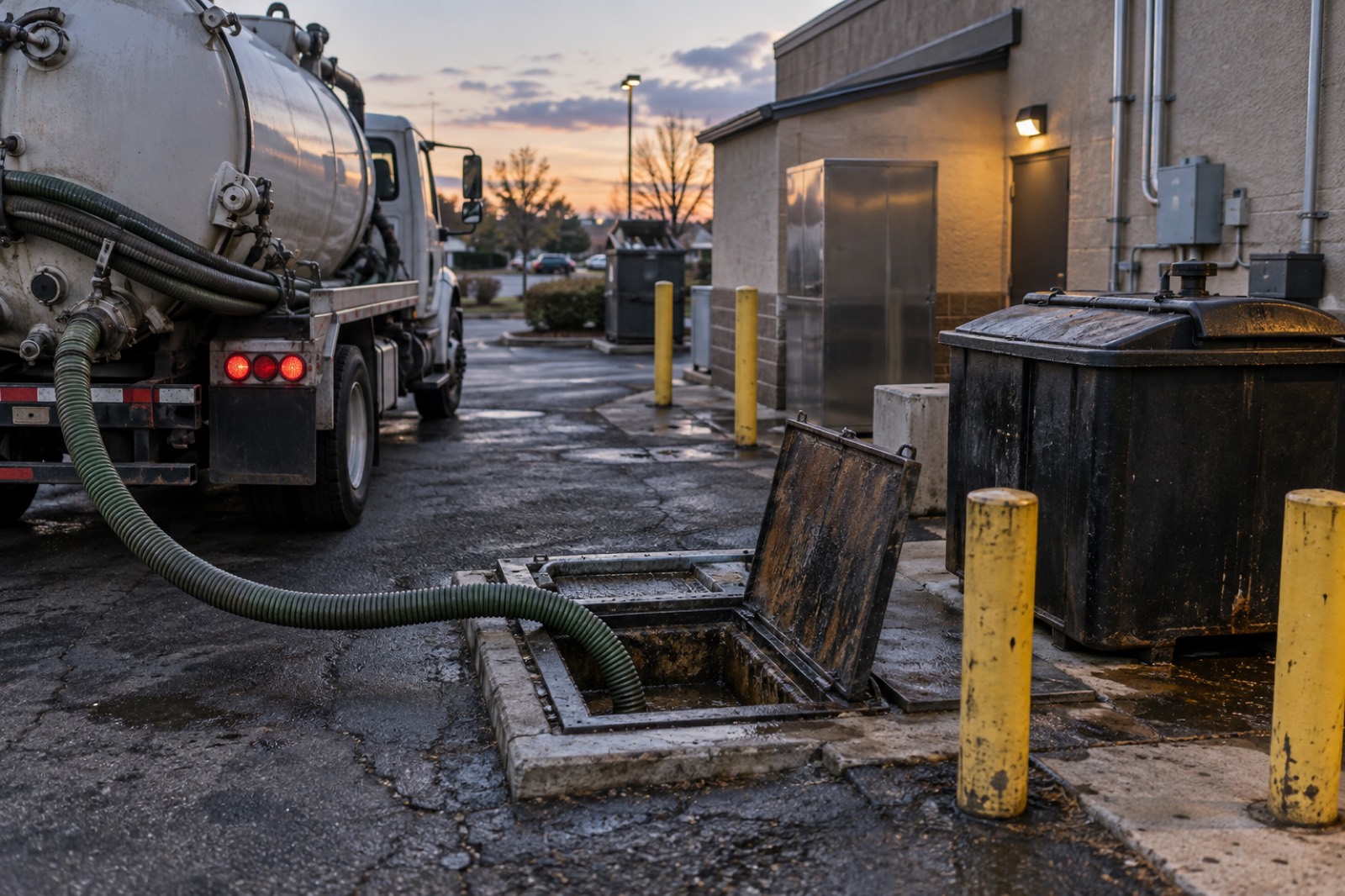
The structural fact that drives this whole valuation is that grease-trap/FOG pumping and UCO collection sit on opposite sides of the cost line. Grease-trap pumping is pump-and-haul of restaurant grease interceptors: the operator is paid to remove and dispose of FOG waste, and disposal is a cost of doing the work. UCO collection is the reverse. Collectors gather used fryer oil and sell it to renderers and biofuel producers, and for high-volume accounts they often pay the restaurant or collect for free to secure the oil, because the oil itself has resale value (greasetraplocator.com, secondary, accessed October 2026). The business descriptions of the large players confirm the pattern: Darling (DAR PRO), Baker Commodities, and Mahoney all pay for or compete to lock up high-volume oil accounts (greasetraplocator.com, secondary).
That difference matters in diligence because the two legs have different risk profiles. The grease-trap leg is a non-discretionary service whose demand is underwritten by local ordinance, which makes it sticky and predictable but caps its upside at a service-pricing ceiling. The UCO leg carries commodity-price exposure: when feedstock values rise the oil is worth more, and when the policy cycle turns the economics compress. A combined route business is therefore part annuity and part commodity position, and a buyer will underwrite each part differently. We treat them as two revenue lines that must be shown separately, not as one blended route number.
Which metric applies to you
Before anchoring on any number, understand that these businesses are not all priced the same way. There is a fork, and which side you land on depends on your earnings level, not your revenue.
Below roughly $1M in earnings, which is most of this market, grease-trap and UCO route businesses are priced on seller’s discretionary earnings, or SDE. The buyer pool at this level is SBA-financed individuals, local operators, and search funders, and SDE is the language they and their lenders use, because the buyer is stepping into the owner’s seat and replacing the owner’s labor.
Above roughly $1M in earnings, the convention shifts to adjusted EBITDA, because the buyer pool changes to platforms and sponsor-backed consolidators who normalize owner compensation and think in EBITDA turns. That is a genuinely different buyer with a different financing structure, not a cosmetic relabeling.
We will not quote an EBITDA multiple for a route business earning under $1M, and you should be wary of anyone who does. A back-calculated EBITDA multiple on a small, owner-operated route is an arithmetic artifact, not a price anyone offered. It is also worth being precise that SDE and EBITDA measure different things and are not interchangeable: SDE includes the owner’s compensation and discretionary items that EBITDA strips out, so a 3x SDE figure and a 3x EBITDA figure describe different businesses and different cash flows. You cannot convert one to the other by keeping the multiple and swapping the label. We also never quote a revenue multiple as a valuation; it is a cross-check only.
Where the bands fall in 2026
Here is where the published ranges sit, presented source by source and proxy by proxy. There is no public grease-trap or UCO route multiples study, so every figure below is a route or liquid-waste proxy, labeled accordingly. Anyone who hands you one tidy number for this vertical has quietly picked a proxy and hidden the rest.
| Source / proxy | SDE multiple | EBITDA multiple | Revenue (cross-check only) | Tier |
|---|---|---|---|---|
| BizBuySell Route benchmark | 1.29x to 3.59x (median 2.35x) | not published | 0.32x to 0.82x (median 0.61x) | PROXY, route businesses generally [confirm live] |
| Grease-trap-specific illustrative | 2.5x to 5x | not published | not published | listing aggregator [UNVERIFIED] |
| Route-waste tuck-ins (large waste cos) | not published | ~6x to 8x | not published | secondary advisory |
| PE platform acquisitions | not published | ~7x to 9x | not published | secondary advisory |
| Scaled licensed diversified operators | not published | ~9x to 12x EV/EBITDA | not published | secondary advisory |
Read the proxy labels. BizBuySell’s Route benchmark, which covers route businesses generally rather than grease or UCO specifically, puts the earnings (SDE/cash-flow) multiple at 1.29x to 3.59x with a 2.35x median, the revenue multiple at 0.32x to 0.82x with a 0.61x median, and median asking price near $200,000 across a range from below $105,500 to above $680,000 (BizBuySell Route valuation benchmarks; the page returned a 403 on direct fetch and the figures were captured via a BizBuySell-sourced search result, so confirm the live figures before you rely on them, as BizBuySell updates them quarterly). We present this as a proxy because a grease-trap or UCO route is a route business, not because BizBuySell measured this vertical.
The grease-trap-specific figure, flagged. One listing aggregator cites small grease-trap cleaning businesses at roughly 2.5x to 5x SDE on average revenue near $500,000 per year, implying around $190,000 of SDE (bizbite.io, listing aggregator, unverified). We present this as a listing-level estimate, not a benchmark, because it comes from an aggregator rather than a transaction dataset. Treat it as a directional sense of the small-end range and nothing more.
The scaled-platform bands. Once a route business is professionalized into a platform with management in place, buyers underwrite EBITDA and the multiple re-rates. Advisory and educational sources put tuck-ins by large waste companies at roughly 6x to 8x EBITDA, PE platform acquisitions at roughly 7x to 9x EBITDA, and scaled licensed diversified operators at roughly 9x to 12x EV/EBITDA (ibinterviewquestions.com and morganbusinesssales.com, secondary advisory, accessed October 2026). These are indicative ranges from advisory commentary, not a transaction study, so we treat them as directional.
The arbitrage that explains the whole roll-up. Owner-operator routes trade on SDE at low single-digit multiples, and a professionalized platform with management, density, and licensing trades on EBITDA in the 6x to 12x range above. The gap between those two is the roll-up thesis in this vertical: a consolidator buys owner-op routes at roughly 2.5x to 5x SDE and aggregates them into an EBITDA platform worth 8x to 12x. This is a synthesis of the proxy groups above, not a single published study, so we frame it as the mechanics of the arbitrage rather than a guaranteed re-rating for any one seller.
For where this sits relative to other trades, see our EBITDA multiple by industry guide. To get a directional read on your own numbers, our valuation tool is a reasonable starting point. For the buyer landscape and the named consolidators acquiring in this space, see our grease trap and cooking oil PE roll-up tracker, and for an adjacent route-based category, our waste hauling PE roll-up tracker.
The FOG-mandate recurring engine
The reason the grease-trap leg reads as an annuity is regulatory, but the regulation is local, and getting this right matters because the common shorthand is wrong. The EPA does not directly require individual restaurants to pump their grease traps. What actually happens is that the Clean Water Act’s General Pretreatment Regulations, 40 CFR Part 403, require municipalities that run publicly owned treatment works to operate pretreatment programs, and the localities then impose the grease-trap cleaning requirements on food establishments (greasetraplocator.com, secondary, accessed October 2026). So the correct framing is that local FOG ordinances, enabled by the EPA 40 CFR Part 403 pretreatment framework, mandate periodic cleaning. It is a municipal mandate, not a direct federal one, and you should state it that way in any diligence conversation.
The municipal mandates themselves are concrete and create non-discretionary demand. Houston requires every interceptor inside city limits to be fully pumped at least once every 90 days (greasetraplocator.com, secondary; verify the municipal code section before citing a section number). Atlanta works on 14-day and 90-day cleaning intervals (greaseconnections.com, secondary). Across the industry a common rule is the 25 percent rule, meaning clean when grease and solids reach 25 percent of liquid depth, with a typical cadence of every one to three months (same sources, secondary). Because a restaurant cannot legally skip these cleanings, the grease-trap leg generates recurring, calendar-driven demand that does not turn off in a downturn. That is the quality a buyer is paying for, and it is why a book weighted toward contracted, mandate-backed municipal and commercial accounts prices better than one built on at-will calls.
The UCO commodity cycle, framed honestly
The UCO leg is the opposite kind of asset, and it needs honest framing because the popular narrative is out of date. UCO is collected from fryers and sold to renderers, biodiesel, renewable-diesel, and sustainable-aviation-fuel producers, and its value rides the renewable-fuel feedstock cycle. As of 2026 that cycle has been a tailwind, not a headwind. UCO delivered CIF ARA ran roughly $1,045 to $1,200 per tonne and US Gulf yellow grease roughly $1,150 to $1,250 per tonne in early 2026, and the US UCO price index rose in the second quarter of 2026 on renewable-fuel demand, with the HVO-UCO spread widening from roughly $600 to $700 per tonne in early 2025 to more than $2,000 per tonne in April and May 2026 (energy-solutions.co, secondary, accessed October 2026). In plain terms, UCO value was rising into mid-2026, not softening.
The structural reason UCO commands a premium is policy. Under California’s Low Carbon Fuel Standard, low-carbon-intensity feedstocks earn more credits, so UCO-based biofuels are worth more than virgin-oil-based equivalents (ICCT and resourcewise.com, accessed October 2026). One view holds that UCO is structurally undersupplied against 2030 SAF mandates by a factor of three to five times (energy-solutions.co, secondary). The honest caveat is that this value is commodity-cyclical and policy-dependent: it rests on the LCFS, on the federal RFS and RIN market, and on the 45Z clean-fuel production credit, and if those policy supports change, the economics compress. We flag that cyclicality as the core risk on the UCO leg. We do not frame UCO as softening, because the 2026 data we found shows the opposite; we frame it as a tailwind that depends on policy and the commodity cycle holding. A buyer will ask whether the feedstock-price exposure is hedged or contracted, because an unhedged oil position is worth more in an up-cycle and less when the cycle turns.
Route density and the value lifters
Within each leg, the same qualitative drivers lift value, and most of them trace back to density and durability. Route density, measured by how many stops sit close together, is the first, because a denser route drops cost per stop and raises margin per truck. The number of accounts and contracts matters, as does a municipal-contract base, which is sticky precisely because it is mandate-backed. On the UCO side, collected volume matters, and so does whether the feedstock-price exposure is hedged or contracted rather than left fully open to the commodity cycle. Ownership of treatment, processing, or disposal assets lifts value through both margin and control, which is why a vertically integrated operator reads better in diligence than one dependent on third-party disposal. Low customer concentration helps, and licensed transporter status in each jurisdiction is itself a value driver, because it is both a barrier to entry and, as the next section shows, a transfer risk. These are qualitative drivers asserted by the operators and the deal patterns themselves, not quantified premia, so we present them as the levers buyers reward rather than as fixed percentage uplifts.
The licensing and transfer trap
This is the section that most often erodes a headline valuation in this vertical, and it deserves its own space because the paperwork does not follow the keys. Liquid-waste transporters must hold permits and registrations that are jurisdiction by jurisdiction and generally per-vehicle, annual, and inspection-gated. In Texas, haulers must register with the TCEQ before any city permit, and the TCEQ regulates the transport of grease-trap and grit-trap waste and septage (tceq.texas.gov and austintexas.gov, accessed October 2026). City permits commonly run around $200 per vehicle per year with an annual inspection (Shreveport and Cedar Hill TX permit documents, accessed October 2026). So a multi-truck operator across several jurisdictions is carrying a stack of per-vehicle, per-jurisdiction licenses that all have to be current.
The transfer risk is material and confirmed. In Florida, the liquid-waste-hauler license is not transferable, and the county must be notified prior to the sale or legal transfer of the licensed establishment (Broward County waste-transport license application, accessed October 2026). The practical implication for a sale is blunt: a buyer cannot assume the permits transfer. In many jurisdictions the buyer must re-apply or re-register, which creates both diligence work and genuine continuity risk, because the routes are only worth what they can legally keep servicing on day one after close. An owner who has mapped which licenses transfer, which require re-application, and how long re-registration takes in each operating jurisdiction presents a materially cleaner story than one who assumes continuity.
On the UCO side the transfer and diligence risk is chain-of-custody and theft, and California is the clearest case. The California Department of Food and Agriculture requires all companies that remove or transport waste cooking grease, which it calls inedible kitchen grease, to be registered, and a renderer that buys UCO from an unlicensed transporter commits a criminal offense; purchase and pickup records must be kept at least two years, and the CDFA can revoke registrations, fine, and refer for criminal prosecution (cdfa.ca.gov and greasemanagement.org, accessed October 2026). UCO theft is a priced-in operational risk: California AB 1566 (2015) sets penalties of $1,000 and up to 30 days for a first offense, $5,000 and up to 30 days for a second, and $10,000 and up to 6 months for a third (oilguyz.com, secondary, accessed October 2026). The scale of the exposure is real; Buffalo Biodiesel has claimed roughly $20 million in theft losses in 2023 and is tied up in UCO-theft litigation both as a claimed victim and as a defendant in a federal suit alleging vat theft, which we note only as an illustration of the risk and label the claims as alleged (Buffalo News and advancedbiofuelsusa.info, accessed October 2026). The takeaway for valuation is that UCO volume is only as valuable as the collector’s locked, registered, theft-protected account base, so a buyer will verify transporter registration in every operating state, container-security and theft history, and the split between contracted and at-will accounts.
What else buyers examine
Beyond the two-leg decomposition and the licensing map, buyers work through a consistent checklist. They look at the contracted versus at-will split on both legs, because mandate-backed municipal and commercial contracts underwrite the recurring quality that justifies the multiple. They look at customer concentration, because a route that leans on a few large accounts is fragile. They look at whether the operator owns its disposal, processing, or treatment assets, because vertical integration lifts margin and control. On the UCO leg specifically they look at collected volume, the contracted-versus-spot mix, and whether feedstock-price exposure is hedged. Running through all of it is owner dependence: if the owner is the driver, the dispatcher, the licensing contact, and the account relationship all at once, a buyer discounts for transition risk, because they are buying a business they intend to run without you.
Who is buying
The buyer universe here is unusually well defined for a fragmented trade, which is itself a signal. The grease-trap-cleaning market is fragmented, with top players collectively holding under 10 percent share and the rest spread across numerous small and regional operators (verifiedmarketreports.com, secondary, one syndicated estimate; treat the magnitude as a single estimate). Into that fragmentation, dedicated consolidators have formed. Liquid Environmental Solutions is the most on-point, a grease-trap, UCO, and liquid-waste roll-up founded in 2002 and headquartered in Irving, Texas, owned by Audax Private Equity from 2017 and sold to Goldman Sachs Alternatives, announced July 2025 (sources differ on announce versus close timing, and ESG Today dates the broader announcement to September 2025); under Audax it made 13 add-on acquisitions and roughly doubled its footprint, with location counts cited variously at about 90 across 50 states or 64 service locations plus 26 treatment facilities (audaxprivateequity.com, am.gs.com, and esgtoday.com, accessed October 2026). Denali Water Solutions, backed by TPG, is an organics and specialty-waste roll-up that carries grease-trap, FOG, and UCO routes, built out through deals including Imperial Western Products (closed April 29, 2022) and brands such as ALLPRO Pumping (globenewswire.com and denalicorp.com, accessed October 2026). On the strategic side, Darling Ingredients (NYSE: DAR), through DAR PRO Solutions, is the dominant North American UCO aggregator, serving a company-cited figure of roughly 200,000-plus foodservice locations (company figures vary between 162,700 and 225,000), with UCO routed to Diamond Green Diesel, its renewable-diesel joint venture with Valero (darlingii.com and FY2024 10-K, accessed October 2026).
We keep this summary deliberately short. For the full buyer map, the named platforms, their sponsors, and the disclosed transaction history, see our grease trap and cooking oil PE roll-up tracker. No transaction multiples have been publicly disclosed on the deals above, so we quote none, and any specific platform multiple you see attached to them is invented.
The 18 to 36 month preparation sequence
The levers that pay the most in this vertical are also the ones that take the longest to build, which is why the preparation window is best measured in years rather than months. We think in terms of roughly 18 to 36 months.
In the first stretch, the priority is route density and contract mix: tightening routes so cost per stop falls, competing for or expanding municipal and commercial contracts where you can qualify, and shifting both legs away from at-will work toward contracted, mandate-backed revenue. On the UCO side, this is also when to lock high-volume oil accounts under contract and decide how much feedstock-price exposure to hedge rather than leave open.
In the middle stretch, the work turns to management depth and diligence readiness: making the business run without the owner in the driver’s seat or on the licensing calls, separating the grease-trap and UCO revenue cleanly in the financials so a buyer can underwrite each leg, cleaning up add-backs so the SDE or EBITDA figure the business will sell at is defensible, and documenting container-security and theft controls on the UCO side.
In the final stretch, the job is the transfer path itself, because it takes the longest and carries the most risk. Map every transporter permit and registration by jurisdiction, confirm which transfer and which require re-application (remembering Florida’s license is not transferable and the county must be notified before transfer), confirm CDFA and equivalent UCO-transporter registrations in every operating state, and diligence each municipal and commercial contract for its own change-of-control terms. An owner who has done this presents a materially cleaner story than one who assumes the paperwork follows the keys, and it is the single area where a headline valuation most often erodes.
About CT Acquisitions
We are CT Acquisitions, a buy-side M&A advisor working across grease-trap, UCO, and adjacent route-based and environmental-services trades. Our network includes 500+ capital partners, and our job is to orient owners and buyers to what the market is actually doing rather than to a headline multiple.
Thinking about a sale within 18 months
No fee to you on buy-side introductions; sell-side mandates are paid on success at closing. Book a call.
Buyers and sponsors
For acquirers, we offer two services: vertical mapping that delivers targeted operators with direct contact data, or a retained search built to your thesis. Both start with a conversation. Book a call.
Frequently asked questions
What is a grease trap business worth in 2026?
It depends on your earnings level and the proxy you use, because there is no public multiples study for this exact vertical. As a route proxy, BizBuySell’s Route benchmark cites an earnings multiple of 1.29x to 3.59x SDE with a 2.35x median, and one listing aggregator cites grease-trap-specific businesses at roughly 2.5x to 5x SDE (unverified, aggregator). Below roughly $1M in earnings, price on SDE; above, on adjusted EBITDA. We present proxies as proxies rather than averaging them into one number.
Why are grease-trap and used-cooking-oil businesses priced as two things?
Because they run on opposite economics. Grease-trap pumping is a disposal-cost recurring service, where the operator is paid to haul waste away and disposal is a cost. UCO collection is a commodity resale, where the collector often pays the restaurant for the oil and sells it into the renewable-fuel feedstock market (greasetraplocator.com, secondary). One leg is a mandate-backed annuity, the other is a commodity position, and a buyer underwrites each differently, so they must be shown separately.
Should I use an SDE or an EBITDA multiple?
Below roughly $1M of earnings, use SDE; the buyer pool is SBA-financed individuals, local operators, and search funders who speak in SDE. Above roughly $1M, buyers shift to adjusted EBITDA. SDE and EBITDA multiples measure different things and are not interchangeable, so never quote an EBITDA multiple for a sub-$1M owner-operated route business.
Is the used-cooking-oil market softening in 2026?
No, the data we found shows the opposite. UCO value rose into mid-2026: US Gulf yellow grease ran roughly $1,150 to $1,250 per tonne in early 2026, the US price index rose in the second quarter, and the HVO-UCO spread widened to more than $2,000 per tonne in April and May 2026 (energy-solutions.co, secondary). The honest caveat is that UCO value is commodity-cyclical and policy-dependent, resting on the LCFS, the RFS and RIN market, and the 45Z credit, so the cyclicality is the risk, not softening.
Does the EPA require restaurants to clean their grease traps?
Not directly. The EPA’s Clean Water Act General Pretreatment Regulations, 40 CFR Part 403, require municipalities running treatment works to run pretreatment programs, and the localities impose the grease-trap cleaning requirements (greasetraplocator.com, secondary). So it is a municipal mandate enabled by the federal framework, not a direct federal mandate. Houston requires full pumping at least every 90 days and Atlanta works on 14-day and 90-day intervals (secondary), which is what makes the grease-trap leg a recurring, non-discretionary service.
Do the transporter licenses transfer when I sell?
Often not. Liquid-waste transporter permits are generally per-jurisdiction, per-vehicle, annual, and inspection-gated; in Texas haulers must register with the TCEQ before any city permit (tceq.texas.gov). In Florida the liquid-waste-hauler license is not transferable and the county must be notified before transfer (Broward County application). A buyer frequently must re-apply or re-register, which creates real continuity and diligence risk, so map every license by jurisdiction before you go to market.
What are the UCO chain-of-custody and theft risks a buyer checks?
In California the CDFA requires UCO transporters to register, and buying from an unlicensed transporter is a criminal offense, with records kept at least two years (cdfa.ca.gov). California AB 1566 sets escalating theft penalties up to $10,000 and six months (oilguyz.com, secondary). A buyer verifies transporter registration in every operating state, container-security and theft history, and the contracted-versus-at-will split, because UCO volume is only as valuable as the locked, registered account base behind it.
Who is buying grease-trap and UCO businesses right now?
Dedicated PE consolidators and a dominant strategic. Liquid Environmental Solutions (Goldman Sachs Alternatives, from Audax, 2025) is the purest grease-trap, UCO, and liquid-waste roll-up; Denali Water Solutions (TPG) carries grease-trap, FOG, and UCO routes; and Darling Ingredients, through DAR PRO Solutions, is the dominant North American UCO aggregator. No deal multiples were disclosed. For the full buyer map and transaction history, see our grease trap and cooking oil PE roll-up tracker.
Disclaimer
CT Strategic Partners LLC dba CT Acquisitions is a buy-side M&A advisor. We are not a registered investment bank, broker-dealer, or appraiser. Multiple ranges are directional observations from cited sources and active engagement observations, not point estimates; where figures are proxies or sources disagree, they are presented as such. SDE and EBITDA multiples measure different things and are not interchangeable. Regulatory, licensing, and code references are general summaries, not legal or compliance advice; requirements vary by jurisdiction and change over time. Individual outcomes vary materially. Past patterns are not a guarantee of future results.