
Turnkey Franchise Meaning and Options in 2026: What It Actually Buys You and Which Brands Come Closest
Turnkey franchise meaning and options in 2026: the word rarely means what buyers assume. A true turnkey franchise delivers a fully operational location with staff hired, systems in place, and initial customer flow already established. Brands that come closest include Ace Handyman Services, Two Men and a Truck, and some Great Clips resales. Realistic investment math for 2026: initial franchise fee ($20-75K), buildout ($100K-$500K), working capital ($30-100K), plus real ownership time even at genuinely turnkey brands.
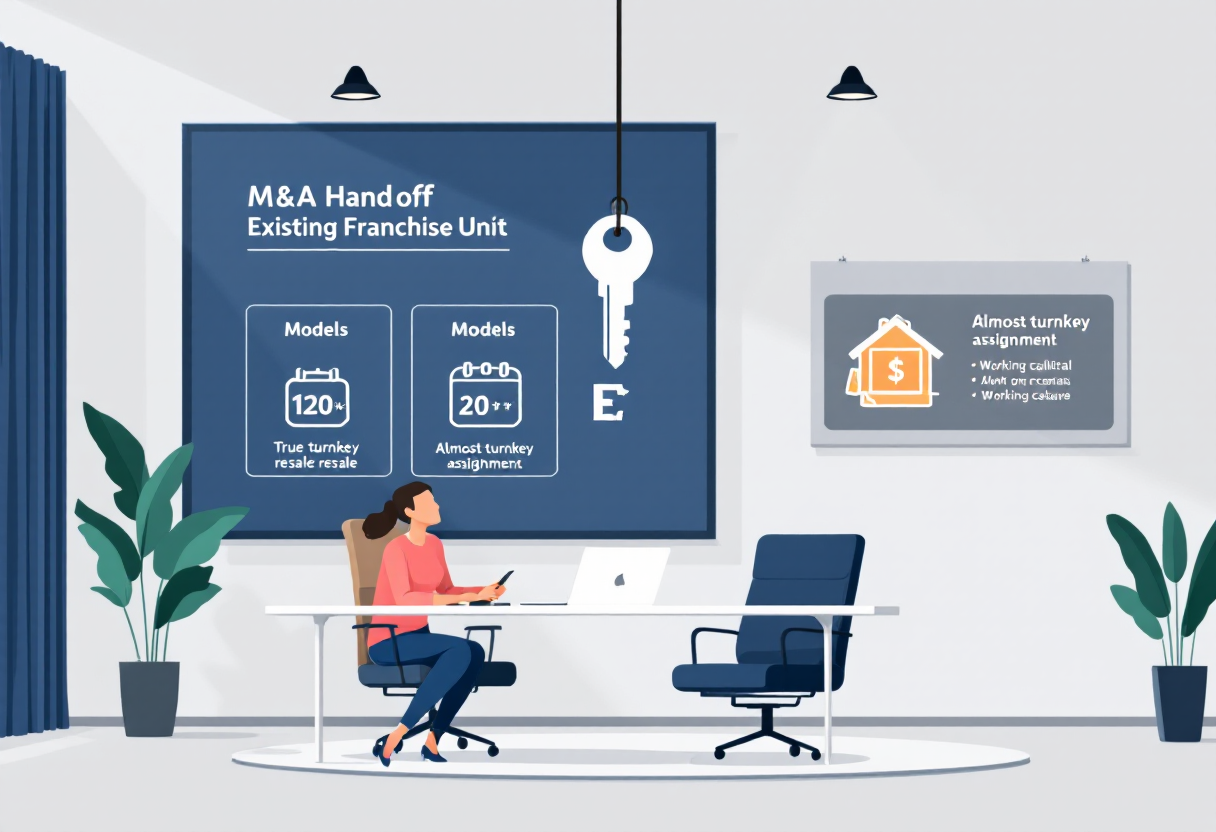
A turnkey franchise sounds like a finished business with the lights already on, but in practice the word covers everything from a fully-built convenience store handed to you on day one to a marketing brochure that promises a fast launch and quietly leaves twelve weeks of build-out on your plate. The difference between those two outcomes is the difference between a paycheck in month one and a working capital hole that swallows your savings before the first customer walks in. This guide cuts through the marketing language, defines the three real meanings of the term, ranks the brands that come closest to honest turnkey delivery, and walks through the financing math a buyer should run before signing any franchise disclosure document in 2026.
The stakes are higher than most first-time buyers realize. The International Franchise Association projects 845,000 franchise establishments operating in 2026, with more than 12,000 new units opening and total franchise output crossing $921 billion. Inside that growth, roughly one in four new franchisees buys an existing unit on the resale market rather than building from zero, and that resale path is the only route that genuinely earns the turnkey label.
What “Turnkey Franchise” Actually Means (Marketing vs Reality)
The word “turnkey” comes from construction, where a builder hands the owner a key to a finished building that needs nothing further. Applied to a franchise, the same idea would mean a buyer pays a single price, takes possession of a fully operational business with revenue, staff, equipment, and customers, and starts collecting cash flow in the first week. That definition exists in only one corner of the franchise market: the resale of an existing operating unit.
Every other use of the term is a softer claim. Some franchisors use turnkey to mean “we handle site selection, build-out coordination, and equipment ordering” which is genuine help but still leaves the buyer signing a lease, waiting for construction, and ramping a brand-new customer base. Other brands use turnkey to mean “we have a documented playbook” which is closer to a description of every modern franchise than a meaningful product feature. The phrase has drifted so far that the FranChoice consulting network openly warns prospects that turnkey is a spectrum, not a binary, and the buyer’s job is to figure out where on the spectrum a specific brand sits.
This matters because the federal disclosure regime does not police the word. The FTC Franchise Rule at 16 CFR Part 436 requires every franchisor to disclose twenty-three specific items in a Franchise Disclosure Document, but none of those items force a franchisor to define or substantiate the marketing word turnkey. Items 5 through 7 govern fees and initial investment, Item 11 governs franchisor obligations, and Item 19 governs financial performance representations, but turnkey itself is left to the franchisor’s website copy. A buyer who wants to know what a specific brand really delivers has to read the FDD, talk to existing franchisees on the Item 20 list, and compare the franchisor’s obligations against the buyer’s own remaining workload.
The Three Definitions of Turnkey Franchise
Across hundreds of franchise brochures and broker pitches, the word collapses into three distinct meanings. Buyers who confuse them lose money. Buyers who separate them clearly tend to pick the right path the first time.
Definition One: True Turnkey. A true turnkey deal is an existing operating unit purchased on the resale market. The seller is an active franchisee handing over a business with revenue history, staff, equipment, a lease, a customer base, and an Item 19 financial track record specific to that location. The buyer signs a transfer agreement, the franchisor approves the new owner under standard transfer clauses, and operations continue without a launch gap. This is the only category where the marketing language matches the experience.
Definition Two: Almost Turnkey. An almost-turnkey concept is a new unit in a brand whose model removes the two hardest parts of a launch: customer acquisition and physical build-out. Account-assignment cleaning franchises like Vanguard Cleaning Systems and JAN-PRO deliver guaranteed commercial accounts as part of the initial purchase, which means revenue starts in week one even though the buyer is technically a new franchisee. Route-driven home services brands inside Neighborly’s portfolio, such as Mosquito Joe and Mr. Rooter, sit in the same band because there is no storefront to build and the franchisor provides scripts, call routing, and brand search demand from day one.
Definition Three: Not Really Turnkey. A not-really-turnkey brand is a new-build brick-and-mortar concept marketed with turnkey language. Anytime Fitness, Servpro in its branch-build configuration, and most quick-service restaurants land in this bucket. The franchisor genuinely helps with site selection, design, equipment specs, and training, but the buyer still spends four to nine months on lease negotiation, permitting, build-out, hiring, soft opening, and grand opening before revenue stabilizes. The word turnkey in these brochures is shorthand for “we have a playbook,” which is true but not the same as a finished business.
True Turnkey: Buying an Existing Operating Franchise Unit on Resale
The cleanest path to a genuinely turnkey outcome is the resale market. On BizBuySell, BizQuest, and broker networks like Murphy Business and First Choice Business Brokers, a buyer can search “franchise resale” filters and pull up listings where the seller is an existing franchisee. The asking price typically reflects two to four times seller’s discretionary earnings, the lease is already executed, the staff is already trained, and the franchisor’s territory rights transfer with corporate approval.
The mechanics of a franchise resale are different from a new franchise sale. The seller’s franchise agreement contains a transfer clause that gives the franchisor a right of first refusal and a right to approve the new buyer’s financial qualifications, operating experience, and background. The franchisor charges a transfer fee, usually $5,000 to $25,000, and may require the buyer to attend the brand’s standard initial training. The buyer signs a new franchise agreement for the remaining term, which means the original term renews and the buyer takes on the brand’s current royalty rates and current FDD obligations, not the seller’s older ones.
Three real listing examples illustrate what the market looks like in 2026. A turnkey franchise resale food truck listing on BizBuySell offers an operating mobile unit with current routes and equipment. An ARCpoint Labs of Los Angeles resale offers an established lab with corporate accounts and staffing in place. A retirement-driven resale on the BizBuySell retiring owner index often comes with seller financing, which lowers the cash-down requirement and gives the buyer a transition coach already invested in the handover succeeding.
The advantages of a true turnkey resale are immediate. Revenue starts in week one. Existing customers reduce ramp risk. Staff continuity keeps operations stable. The buyer can underwrite the deal off three years of profit and loss statements instead of a franchisor’s Item 19 averages. The Small Business Administration’s 7(a) loan program treats acquisition financing more generously than startup financing because the lender can verify cash flow, which often translates to a lower down payment and better terms.
Almost-Turnkey: Franchisor Account-Assignment Models (Vanguard, JAN-PRO, Lawn Doctor)
The closest thing to true turnkey in a new-unit franchise purchase is the account-assignment model used by several commercial cleaning brands and a handful of home services brands. In this structure, the franchisor signs commercial contracts under the brand name through a corporate or regional sales team, then assigns those contracts to a franchisee at the time of purchase. The new owner walks into a business that already has revenue because the customer relationships were built by the brand, not by the franchisee.
Vanguard Cleaning Systems is the cleanest example. Vanguard offers janitorial franchise plans bundled with one or more pre-assigned commercial cleaning accounts. The 2026 FDD Item 7 range for a unit janitorial franchise starts in the low five figures because the franchisee is buying an account portfolio rather than a build-out. The master franchise structure sits above the unit franchise level and runs into six figures, but the unit franchise is the entry point that most owner-operators take. Royalty is 5 percent of gross revenue and is collected centrally because the franchisor invoices the customer directly, which also removes accounts receivable risk from the franchisee.
JAN-PRO runs a similar model. Unit franchisees pay $5,000 to $78,000 in total initial investment, including a $3,000 franchise fee, and JAN-PRO’s regional support team markets and secures cleaning contracts that are then assigned to franchisees. A “Negotiation Fee” equal to roughly the first month’s billing applies to each assigned account, which keeps the incentive aligned: the franchisor only gets paid when the franchisee gets a real customer. The regional developer level runs $130,000 to $421,500 with reported average sales of $1.83 million, which is a different product designed for buyers who want to build a sales territory rather than operate cleaning crews.
Lawn Doctor sits in the same category for residential lawn care. The 2026 FDD shows an Item 7 range of roughly $150,070 to $177,052 with a franchise fee in the $123,950 to $127,000 band. Lawn Doctor’s launch program includes a corporate-led customer acquisition push during the first weeks of operation, equipment specification, and an Item 11 obligation to provide initial training and ongoing operations support. The model is closer to almost-turnkey than to true turnkey because the buyer still has to register vehicles, hire technicians, and run routes, but the customer acquisition gap that kills most new home service businesses is largely solved by the corporate launch package.
Almost-Turnkey: Light Build-Out Concepts (Mosquito Joe, Mr. Rooter)
Route-driven home services concepts inside the Neighborly portfolio sit in the almost-turnkey band because they require no storefront, run from a home office or small warehouse, and benefit from corporate-funded brand search demand and shared call center infrastructure. Two of the most representative are Mosquito Joe and Mr. Rooter, both of which can launch in twelve to sixteen weeks if the buyer moves quickly on vehicle wraps, technician hiring, and state licensing.
Mosquito Joe’s 2026 FDD shows an initial investment range of $150,155 to $191,575 with a $42,500 franchise fee. The brand requires a $250,000 minimum net worth and $50,000 in liquid capital. There is no build-out because the model is route-based. The launch obligations under the franchisor’s Item 11 disclosure include initial training, marketing launch materials, call center setup, and access to Neighborly’s shared technology platform, which routes inbound leads from corporate sites and search campaigns to the local franchisee.
Mr. Rooter’s 2026 FDD shows a total investment range of $152,900 to $298,675 with a $42,500 franchise fee for a standard territory and $425 per 1,000 people for additional population. The plumbing model requires state licensing and a master plumber on staff in many states, which adds an operational obligation the franchisor cannot solve for the buyer. Net worth and liquid capital requirements run $250,000 and $100,000 respectively. Mr. Rooter is a top-tier established plumbing brands in the country, and its Item 11 obligations include the standard Neighborly stack: training, software, call center routing, brand campaigns, and an annual conference for franchisees.
Why are these called almost-turnkey rather than true turnkey? Because the customer base does not exist on day one. Even with strong brand awareness and centrally routed leads, a Mosquito Joe or Mr. Rooter franchisee has to convert those leads into recurring customers, hire and retain technicians, and build local reputation. Revenue ramps quickly compared to a brand-new independent home service business, but the first six months still demand active sales and operations work that a true resale would skip.
Not-Really-Turnkey: New-Build Brick-and-Mortar Concepts
Most brands that use turnkey in their marketing copy are new-build brick-and-mortar concepts, and the word in this context means “we have a documented playbook” rather than “you will collect revenue next week.” The buyer still spends four to nine months on real estate, permitting, construction, equipment installation, hiring, and grand opening before steady-state revenue arrives. None of those activities are removed by the franchisor’s support; they are merely guided.
Anytime Fitness is the cleanest illustration. The 2026 FDD shows a total investment range of $539,000 to $905,000, which includes franchise fee, build-out, equipment, signage, and initial working capital. The royalty model is unusual: a flat $799 per month, which means revenue scaling does not increase royalty cost. The brand is excellent, the support is real, and the equipment specification is genuinely faster than building an independent gym, but no one signs a five-year lease and runs a build-out in week one. Realistic timelines run six to nine months from FDD signature to grand opening.
Servpro in its standard branch configuration shows a 2026 FDD Item 7 range that varies by source but generally lands between $241,000 and $379,500 with a $100,000 franchise fee. Servpro’s brand is one of the strongest in restoration, the corporate dispatch system routes nationwide insurance claims to the closest franchisee, and the brand provides scripts and training that genuinely shorten the ramp. But the buyer still has to lease a warehouse, buy trucks and equipment, hire a crew, get licensed, and pass IICRC certification before the first call comes in. Calling that turnkey is a stretch the word cannot bear.
7-Eleven is the unusual case where the marketing claim is actually defensible. 7-Eleven obtains and bears the ongoing cost of the land, building, and store equipment in its single-store and multi-unit traditional franchise programs, and the company shares gross profits with franchise owners (50 percent to 58 percent to corporate depending on the deal) rather than charging a traditional royalty on sales. The franchisee buys into a fully built store with inventory and walks in to operate it. Startup runs three to six months. This is the closest a new-unit franchise gets to a true turnkey product, and the trade-off is a high gross profit split that compresses owner economics. The model works for operators who want a finished business and accept lower per-unit margin in exchange.
The True Cost of “Turnkey” Marketing Claims
When a buyer mistakes a not-really-turnkey concept for a true turnkey one, the cost shows up in three places: financing burn, owner salary, and personal credit exposure. The launch window between FDD signature and steady-state revenue is the period where every dollar of operating cost comes out of the working capital reserve. A buyer who budgeted for a one-month ramp and gets a six-month ramp has to either inject additional capital, take a personal loan, or watch the business stall.
The math is straightforward. A new Anytime Fitness location running at a $539,000 to $905,000 all-in investment will typically burn $25,000 to $45,000 a month in fixed costs during the pre-revenue period (lease, utilities, debt service, baseline staff). A six-month ramp that the brochure called turnkey eats $150,000 to $270,000 of cash before the membership base reaches breakeven. If the buyer financed the build with an SBA 7(a) loan at the maximum loan-to-cost, that gap usually has to be filled out of pocket because lenders set working capital reserves based on the franchisor’s published timeline, not the realistic one.
The same math applies more gently to almost-turnkey concepts. A Mosquito Joe launch with $150,155 to $191,575 in total investment can hit positive cash flow in months three to six because revenue builds steadily from the first treatment, but only if the buyer hires technicians on schedule and the local marketing budget is funded. A buyer who reads “turnkey” and assumes the corporate office will hand them customers will under-budget the local launch and stall.
The cleanest defense against this gap is to read the franchisor’s Item 11 disclosure carefully. Item 11 lists exactly what the franchisor is obligated to do before, during, and after the franchisee opens. Anything not in Item 11 is the buyer’s responsibility, regardless of what the marketing copy says. A franchisor that promises a turnkey experience but lists only training, software access, and a single field visit in Item 11 has disclosed the truth: the rest is on the franchisee.
Realistic 120-Day Timeline for a “Turnkey” Franchise
For an almost-turnkey concept in the home services or commercial cleaning bands, a disciplined buyer can compress launch into 120 days. The timeline below is the realistic version, not the franchise brochure version, and it assumes the buyer has financing pre-approved and the FDD has been reviewed.
Days 1 to 14: Legal and entity setup. Form the LLC or corporation, open business banking, finalize the franchise agreement, complete the franchisor’s onboarding paperwork, secure state licenses for the trade (plumbing, pest control, etc.), and order vehicle wraps and uniforms. Most franchisors begin training enrollment in this window.
Days 15 to 45: Training and infrastructure. Attend the franchisor’s initial training program, typically one to two weeks at corporate headquarters. In parallel, complete vehicle purchases or leases, order equipment, sign up for the franchisor’s technology stack (CRM, dispatch, payment processing, call routing), and begin recruiting the first technicians or crew members.
Days 46 to 90: Hire, equip, and launch marketing. Bring on the first two to four technicians, complete vehicle wrapping, install GPS and dispatch tools, launch the franchisor-coordinated grand opening marketing campaign, and begin taking the first leads from the corporate call routing system. For account-assignment cleaning concepts, the first assigned accounts go live in this window.
Days 91 to 120: First revenue and operational rhythm. Run the first full month of revenue, hit the first payroll cycle, file the first sales tax return, and meet with the franchisor’s field business consultant for the first post-launch performance review. By day 120, an almost-turnkey concept should be generating recurring revenue and operating on a normal weekly rhythm.
A new-build brick-and-mortar concept cannot be compressed this way. Lease negotiation alone often runs 60 to 120 days, permitting another 30 to 90 days, build-out 60 to 120 days, and hiring 30 to 60 days. A Servpro branch or an Anytime Fitness gym that hits soft opening at day 180 is on schedule, and day 270 is common.
Best Brands by Tier (Most Turnkey to Least Turnkey)
The brands below are ranked by how closely they match the literal turnkey definition. The ranking is based on Item 7 investment, Item 11 franchisor obligations, time from agreement to revenue, and the structure of customer acquisition.
Tier 1: True Turnkey (Resale Path). Any brand purchased as an operating unit on the resale market belongs in Tier 1. Common resale categories on BizBuySell and BizQuest include single-unit Subway, Dunkin’, Anytime Fitness, Servpro, Great Clips, and Two Men and a Truck. The brand matters less than the deal: a profitable existing unit beats a brand-new franchise of any flagship brand on the turnkey scale.
Tier 2: Almost-Turnkey New Units with Account Assignment. Vanguard Cleaning Systems, JAN-PRO, and select Coverall and Stratus Building Solutions plans sit here. The defining feature is corporate-secured commercial accounts assigned to the new franchisee at purchase, which produces revenue in the first month of operation. Investment ranges run from low five figures to roughly $150,000 depending on account package.
Tier 3: Almost-Turnkey New Units with Corporate Lead Routing. Mosquito Joe, Mr. Rooter, Lawn Doctor, Aire Serv, Mr. Handyman, Mr. Electric, and Two Maids and a Mop sit here. The defining features are no storefront, corporate-funded brand search, and centralized call routing. Investment ranges run $100,000 to $300,000 typical. Revenue ramp is three to six months to breakeven.
Tier 4: Equipment-Heavy New Build with Strong Support. Anytime Fitness, Crunch Fitness, F45, and Orangetheory sit here. Equipment is largely standardized, the franchisor specifies build-out tightly, and ramp is six to nine months. Investment runs $500,000 to $1.5 million.
Tier 5: Fully-Built Corporate-Owned Real Estate Model. 7-Eleven’s traditional single-unit program is the rare new-unit franchise that is closer to true turnkey than to new build because the corporation owns the land, building, and equipment and hands the franchisee a fully stocked store. The trade-off is the gross profit split, which transfers significant unit economics back to the corporate parent.
Tier 6: Not Really Turnkey (Quick-Service Restaurants and Full Build). Most QSR brands, restoration brands in their branch configuration, and personal service brick-and-mortar concepts sit here. Investment runs $200,000 to $2.5 million, ramp runs six to twelve months, and turnkey in the marketing copy means “we have a playbook” not “the business is built.” Examples include Servpro standard branch, Dunkin’ new build, Sport Clips new build, and most quick-service restaurants outside of resales.
Working Capital Reserve Even Turnkey Franchises Require
Working capital reserve is the cash a franchisee holds aside to cover operating costs while revenue ramps or to absorb a slow month. Even a true turnkey resale needs a reserve, because the transfer process disrupts staffing, the franchisor’s transfer fees consume cash, and the first ninety days of new ownership often see customer drop-off as existing patrons test the new owner.
The reserve targets below are based on the brand structures rather than franchisor disclosures, which under-state the figure systematically. A resale acquisition needs three months of operating expenses in reserve at close. An almost-turnkey account-assignment cleaning franchise needs six months. An almost-turnkey home services brand needs six to nine months. A new-build brick-and-mortar concept needs nine to twelve months. A new-build QSR needs twelve to eighteen months.
The franchisor’s Item 7 disclosure lists a working capital line, but the figure is usually labeled “additional funds for first three months” and is built off the franchisor’s modeled timeline, not the buyer’s realistic one. A buyer who borrows to the limit of Item 7 and assumes the franchisor’s number is correct is borrowing from the future to fund the gap between the brochure and reality. The cleanest defense is to take the franchisor’s Item 7 working capital figure and multiply by two for an almost-turnkey concept or by three for a new build, then keep that reserve in a separate operating account.
SBA 7(a) Financing for Turnkey Franchise Purchases
The Small Business Administration’s 7(a) loan program is the dominant financing path for franchise acquisitions in the United States. Loans up to $5 million are available, terms run up to ten years for working capital and twenty-five years for real estate, and the SBA guarantees 75 to 85 percent of the loan amount, which lowers risk for the lender and makes approval easier.
For an SBA loan to fund a franchise, the brand has to appear on the SBA Franchise Directory. The directory lists every franchisor whose FDD has been reviewed for SBA-eligibility purposes and assigns each brand a code that lenders use to confirm eligibility. A brand not on the directory cannot be financed through the 7(a) program. As of 2026, the directory includes thousands of brands across home services, restoration, fitness, food, retail, and commercial services, including all of the almost-turnkey brands discussed above.
Turnkey resales finance more easily than new-builds. A resale comes with three to five years of profit and loss statements, tax returns, and bank statements that prove cash flow. The lender underwrites against actual debt service coverage rather than projected, which usually translates to a 10 to 15 percent equity injection requirement rather than the 20 to 25 percent typical for a new-build franchise. A buyer with a $1 million resale target can often close with $100,000 to $150,000 down, while a buyer building a new Anytime Fitness with the same all-in investment needs $200,000 to $250,000 down.
The lender’s underwriting also covers transfer fees, franchisor training costs, working capital, and inventory. A clean turnkey resale package financed through SBA 7(a) can roll all of these into a single ten-year amortization, which keeps monthly debt service manageable and preserves the working capital reserve for actual operations.
The Best Path: Buying an Existing Turnkey Franchise on the Resale Market
The best path for a buyer who wants what turnkey actually promises is the resale market. The reasoning is straightforward: every other path leaves the buyer carrying launch risk. Even the strongest almost-turnkey concepts require three to six months to reach steady state, and during that window the buyer is running a startup with a brand attached, not a finished business.
A franchise resale eliminates four of the five hardest parts of business ownership. Customer acquisition is done because the existing customer base transfers with the unit. Staffing is done because trained employees are already on payroll. Lease and build-out are done because the physical location is operational. Brand training is partially done because the seller has years of operating knowledge to transfer during a transition period. The only remaining work is the operational transition itself, which the franchisor’s transfer process supports.
Sourcing a quality franchise resale takes patience. The BizBuySell marketplace lists thousands of franchise-tagged businesses at any given time, but only a fraction are well-priced and well-documented. The strongest deals come through three channels: business brokers who specialize in franchise transactions, the franchisor’s internal resale board (most major brands maintain one), and direct outreach to long-tenured franchisees in the desired territory who may be approaching retirement.
The diligence on a franchise resale follows a standard structure. Three years of profit and loss statements, three years of tax returns, twelve months of bank statements, the current franchise agreement, the franchisor’s transfer requirements, a customer concentration analysis, an employee retention review, the equipment condition assessment, the lease assignment terms, and a conversation with the franchisor’s franchise relations team to confirm transfer approval is realistic. A buyer who works through this list and signs only on a clean package gets the closest thing to turnkey the franchise market offers.
How CT Acquisitions Helps Turnkey Franchise Buyers
CT Acquisitions works with buyers who want to acquire an existing franchise unit or a multi-unit franchise platform rather than build from zero. The firm’s deal flow comes from direct outreach to franchisees approaching retirement, brokered resales across BizBuySell and BizQuest, and proprietary relationships with franchisors who refer their own outgoing operators. The team’s value to a buyer is twofold: access to deals that do not appear on public marketplaces, and a diligence process that catches the structural problems that make a “turnkey” resale anything but.
The most common buyer mistake is paying full asking price on a franchise resale without auditing customer concentration, lease terms, or technician retention. CT Acquisitions runs each candidate deal through a structured workup that includes a profit and loss normalization, a customer concentration test, a staff retention review, a lease and franchise agreement reading, and a franchisor transfer approval pre-check. Deals that survive the workup go to financing structure, where the team coordinates with SBA-preferred lenders to optimize debt service, working capital, and equity injection.
For buyers exploring related lanes, the firm also publishes resale-market research on adjacent categories. Buyers comparing brands should review the best franchises to buy on the resale market guide, the best franchises to own in 2026 rankings, the step-by-step franchise purchase walkthrough, and the franchise launch playbook for brands that do not have a resale path. For buyers targeting specific verticals, the handyman franchise opportunities review, the home services franchise opportunities guide, the commercial and residential cleaning franchise rankings, and the royalty fee structure explainer cover the brands most often considered alongside a turnkey search.
To start a search, schedule a call with the CT Acquisitions team. The intake covers the buyer’s investment band, geographic preference, operating background, target vertical, and time horizon. From there the team builds a candidate list, runs preliminary workups on the top three to five matches, and walks the buyer through the diligence and financing process on the deal that fits.
Turnkey Franchise: Frequently Asked Questions
What does turnkey mean in a franchise context?
In construction, turnkey means a finished building handed to the owner ready to use. Applied to a franchise, the literal version of that promise exists only when a buyer purchases an existing operating franchise unit on the resale market. Every other use of the word covers some mix of franchisor support, build-out coordination, and launch playbooks, none of which produce revenue on day one. A buyer who reads turnkey in a franchise brochure should ask the franchisor for a written timeline from FDD signature to first revenue and compare it against the brochure language.
Is a franchise resale the same as a turnkey franchise?
A franchise resale is the cleanest version of the turnkey concept. The buyer takes possession of an operating business with revenue, staff, equipment, lease, and customer base intact. The franchisor approves the transfer under standard transfer clauses and the buyer signs a new franchise agreement for the remaining term. Not every resale is a strong deal, but every strong resale meets the literal turnkey definition.
How much working capital do I need for a turnkey franchise?
For a resale acquisition, three months of operating expenses in reserve at close is the floor. For an almost-turnkey account-assignment cleaning franchise, six months. For an almost-turnkey home services brand, six to nine months. For a new-build brick-and-mortar concept marketed as turnkey, nine to twelve months. The franchisor’s Item 7 working capital figure is built off the franchisor’s modeled launch timeline and tends to understate the realistic reserve requirement.
What is the cheapest turnkey franchise to buy?
Unit-level commercial cleaning franchises with account assignment, such as Vanguard Cleaning Systems and JAN-PRO unit franchises, can be entered for under $25,000 in some markets because the buyer is purchasing a small package of assigned accounts rather than building infrastructure. These are not low-risk businesses, they are low-entry businesses, and the operator still has to deliver service quality to keep the accounts that were assigned at purchase.
Can I finance a turnkey franchise with an SBA loan?
Yes, if the franchisor appears on the SBA Franchise Directory. The 7(a) loan program funds franchise acquisitions and resales up to $5 million with terms up to ten years for working capital and equipment, twenty-five years if real estate is included. Resales typically finance more easily than new-builds because the lender can underwrite against verified cash flow rather than projected revenue. Equity injection requirements run 10 to 15 percent on resales and 20 to 25 percent on new builds.
How long does it take to launch a turnkey franchise?
A resale closes in 60 to 120 days from offer to operational handover, depending on franchisor transfer approval timing and SBA loan processing. An almost-turnkey account-assignment cleaning franchise reaches first revenue in 30 to 60 days. An almost-turnkey home services brand reaches first revenue in 60 to 120 days. A new-build brick-and-mortar concept marketed as turnkey runs 120 to 270 days from agreement to grand opening, with steady-state revenue another 90 to 180 days beyond that.
Does the franchisor pick the location for a turnkey franchise?
For 7-Eleven traditional units the answer is effectively yes, because the corporation owns the land, building, and equipment and the franchisee buys into a finished store. For almost every other brand the franchisor provides site selection criteria and may approve or reject a specific location, but the franchisee signs the lease and bears the lease obligation. For resales, the location is set because the existing store is the asset being sold.
What is the difference between turnkey franchise and turnkey business opportunity?
A turnkey franchise is governed by the FTC Franchise Rule and includes ongoing brand obligations, royalty payments, and franchisor support. A turnkey business opportunity is typically a one-time package sale (often a vending route, a website, or an online store) with no continuing franchise relationship. The disclosure regime is different: business opportunities fall under the FTC’s Business Opportunity Rule rather than the Franchise Rule, and protections for buyers are narrower.
How do I verify a “turnkey” claim before signing the FDD?
Read Item 11 of the FDD carefully. Item 11 lists the franchisor’s pre-opening and post-opening obligations in detail, and anything not in Item 11 is the franchisee’s responsibility regardless of marketing copy. Cross-check Item 11 against Item 19 financial performance representations to see whether existing units actually reach the revenue levels the brochure implies, and call at least five existing franchisees from the Item 20 list to ask how long their launch actually took.
Is 7-Eleven the most turnkey new franchise?
Among new-unit franchises (not resales), 7-Eleven’s traditional single-unit program is the closest thing to a true turnkey product because the corporation provides the land, building, equipment, and initial inventory and the franchisee walks into a fully built and stocked store. The trade-off is the gross profit split: 7-Eleven retains 50 to 58 percent of gross profit, which compresses owner economics relative to a standard royalty model. For operators who value finished infrastructure over per-unit margin, the model works. For operators who want maximum upside, a resale of a different brand at a fair price usually outperforms.
What questions should I ask a franchisor about turnkey delivery?
Five questions surface the truth quickly. First: what is the average time from FDD signature to first revenue across your last twenty franchisees? Second: what specifically does Item 11 obligate the franchisor to deliver, in writing? Third: how many of your launching franchisees reached the working capital figure in your Item 7 disclosure within the timeline you modeled? Fourth: what is the franchisee transfer approval rate over the last three years (for a resale path)? Fifth: can I speak with five randomly chosen existing franchisees from your Item 20 list before I sign?
Are turnkey franchises a good investment in 2026?
The IFA’s 2026 Franchising Economic Outlook projects 1.5 percent unit growth, 1.8 percent employment growth, and $921 billion in franchise output, with home services, fitness, and commercial cleaning leading the expansion. Inside that growth, well-priced franchise resales remain the strongest risk-adjusted return because the buyer pays for verifiable cash flow rather than projected ramp. The right answer to “is a turnkey franchise a good investment” depends entirely on whether the deal is a real turnkey (a clean resale or a 7-Eleven traditional) or a marketing turnkey (a new build with a playbook).
Sources and further reading: FTC Franchise Rule 16 CFR Part 436; 16 CFR 436.5 Disclosure Items; IFA 2026 Franchise Business Economic Outlook; IFA Franchising Economic Outlook archive; SBA Franchise Directory; SBA 7(a) loan program; BizBuySell franchise resale marketplace; BizQuest business-for-sale marketplace; Vanguard Cleaning Systems franchise FAQ; Vanguard Cleaning Systems 2026 FDD summary; JAN-PRO Cleaning Systems FDD; JAN-PRO franchise guide; Mosquito Joe at Neighborly; Mosquito Joe 2026 FDD summary; Mr. Rooter investment disclosure; Mr. Rooter 2026 FDD summary; Servpro franchise FDD; Servpro 2026 FDD summary; Lawn Doctor 2026 FDD summary; Anytime Fitness FDD; Anytime Fitness 2026 FDD analysis; 7-Eleven single-unit franchise overview; 7-Eleven franchise FAQ; Neighborly Brands corporate; FranChoice turnkey analysis; FranNet franchise resale guide; Franchise Chatter JAN-PRO regional developer FDD review.