
How to Buy an RV Park in 2026: Acquisition Playbook

Christoph Totter · Managing Partner, CT Acquisitions
M&A advisory across 500+ active capital partners · Specialty real estate M&A: RV parks, campgrounds, MHC · Updated June 6, 2026
To buy an RV park in 2026, expect to pay about 8x to 12.5x EBITDA (an 8-12% cap rate on stabilized NOI) for owner-operator single sites and about 11x to 20x EBITDA (a 5-9% cap rate) for multi-site / amenity-rich properties. SBA 7(a) financing covers most acquisitions under $5M; conventional commercial real estate financing for larger deals. Critical diligence: long-term site rent vs short-term transient mix, infrastructure age (water, sewer, electric, propane), seasonality / annual occupancy stability, lease terms remaining, and recent rent-increase track record.
TL;DR, the 90-second brief
- RV parks have become an attractive alternative real estate investment in the 2020s, with demand tailwinds from outdoor recreation growth, remote work flexibility, and aging Baby Boomer demographics.
- Most independent RV parks under $10M sell at 8 to 12 percent cap rates depending on quality, with NOI typically $150K-$1.5M for parks in the $1M-$15M deal range.
- The deal economics depend on site mix (full hookup vs partial vs primitive), seasonality, location (destination vs travel route), and infrastructure condition.
- The biggest first-time buyer mistakes: underestimating infrastructure capital needs, missing seasonality cash flow planning, and not understanding the operational complexity of guest hospitality alongside real estate management.
Key Takeaways
- RV parks typically trade at 8-12 percent cap rates; resort-quality at 5-7 percent, value-add parks at 10-13 percent
- Site mix matters: full hookup (water, sewer, electric) commands $50-$80 nightly; partial $30-$50; primitive $20-$35
- Seasonality is significant: snowbird destinations have winter peak, northern parks summer peak, year-round destinations more stable
- Critical due diligence: park infrastructure (water, sewer, electrical, roads), site mix and pad condition, KOA/Good Sam affiliation
- SBA 7(a) and 504 loans work for RV park acquisitions up to $5M-$15M combined; agency loans for larger deals
- Value-add opportunities: rate increases to market, amenity additions (Wi-Fi, pool, cabins), long-term resident conversion, store/laundry
How to Buy an RV Park, Step by Step
To buy an RV park, set your budget and financing first (SBA 7(a) loans go up to $5 million, per the SBA), pick a market by seasonality, source listings through campground marketplaces and brokers, screen three years of tax returns and occupancy, value the park on NOI and cap rate, then run infrastructure, environmental and zoning diligence before closing.
- Set the budget and financing path. Under SBA SOP 50 10 8, a change-of-ownership deal needs at least a 10% equity injection, and a seller note counts toward it only if it sits on full standby for the life of the loan. Get a lender’s read on the structure before you make offers.
- Pick the market type. A Florida or Arizona snowbird park, a northern summer park, a year-round destination and a highway travel park have different cash flow curves. Decide which seasonality you can carry through the slow months.
- Find parks for sale. Listings come from campground-specific marketplaces such as The Campground Marketplace, The Campground Connection and RVParkSales, from specialist brokers such as Parks and Places, from general commercial platforms like LoopNet and Crexi, and from direct letters to owners of parks that are not listed.
- Screen the numbers. Ask for three years of tax returns and profit and loss statements, as Campground Accounting recommends, plus monthly occupancy by site type and the long-term rent roll. Tie reported revenue to bank deposits.
- Value it and write the LOI. Price on stabilized NOI and a cap rate that fits the park’s quality and location, then make the LOI subject to financing, inspections and permit transfer.
- Run diligence and close. Inspect water, sewer, electrical and roads, order a Phase I environmental report, confirm zoning in writing, and line up the transfer of permits, the reservation system and prepaid guest deposits for closing day.
Why RV parks are attractive investments
For 2026 how to buy a competitor covering approach mechanics, synergy valuation, deal structure, financing, and antitrust considerations, see our reference.
For 2026 how to buy a route-based business covering route value drivers (customer concentration, contract terms, equipment), capital required, financing, and diligence, see our reference.
For 2026 motel acquisition playbook (2026) covering real-estate value, room economics, brand vs independent, SBA financing, diligence, and operating reality, see our reference.
For 2026 B&B acquisition playbook (2026) covering real-estate vs business split, capital required, financing options, diligence checklist, and operational realities, see our reference.
CT Acquisitions · 2026 RV Park Signal
What RV Park Buyers Find Out in Diligence
Across our buy-side conversations with RV park buyers in 2026:
- Infrastructure age is the under-modeled risk. Water, sewer, electric, propane systems 30+ years old face material near-term capex requirements buyer-priced separately.
- Site rent vs nightly transient mix drives multiple. Long-term site-rent revenue trades above transient/nightly because of cash flow predictability.
- Lease term remaining is the diligence cliff. Land-leased properties below 20 years remaining trigger renegotiation or buyer-led extension as LOI condition.
Multiple at a Glance · 2026
RV Park Acquisition Multiples · 2026
By property type and scale.
Source: CT Acquisitions analysis. SBA 7(a) financing under $5M, conventional CRE for larger. Diligence: infrastructure age, seasonality, lease terms, rent-increase track record.
Related Cluster GuideAdjacent specialty-service buyer playbook: see how how to buy a laundromat works in 2026.
For the 2026 FedEx route acquisition playbook with ISP costs, approval process, and SBA 7(a) financing, see our buyer’s guide.
RV parks combine several characteristics that make them attractive small-to-middle-market investments in 2026.
Demand tailwinds:
- RV ownership at all-time high: 11+ million American households own RVs (RVIA data)
- Outdoor recreation boom: post-COVID acceleration sustained
- Remote work flexibility: working from RV/campsite has become viable for many professions
- Aging Baby Boomers: 73+ million Americans in 60-78 demographic with mobility and discretionary time
- Younger demographic adoption: Millennial and Gen X interest in outdoor recreation rising
Limited supply:
- Most U.S. metros have zoning restrictions on new RV parks
- Existing supply is essentially fixed
- Destination markets (Florida snowbird, southwest winter, mountain summer) have meaningful supply constraint
- Conversion of existing parks to higher-value use (residential development) reduces supply
Real estate + operating business hybrid:
- Real estate component appreciates over time
- Operating business generates cash flow
- Combined return: 12-25 percent annually achievable (cash flow + appreciation + principal paydown)
Valuation framework: RV parks value on cap rate similar to other commercial real estate. Cap rate = NOI / Sale Price. Quality RV parks in destination markets at 5-7 percent cap; standard parks 8-10 percent; value-add parks 10-13 percent.
Who buys RV parks:
- Owner-operator entrepreneurs (typical $1M-$10M deals)
- Family offices and high net worth investors
- Private equity-backed roll-up platforms (Sun Communities expanded into RV/RV resorts, Equity LifeStyle Properties, Northgate Resorts)
- 1031 exchange buyers (deferred capital gains from prior real estate)
- Outdoor recreation focused investment funds
The owner-operator RV park buyer profile typically: 5-15 years business experience, $300K-$2M available capital, willing to work on-site or hire on-site manager, comfortable with hospitality operations, multi-year hold horizon.
Differences from mobile home parks (MHPs):
- MHPs: residents own mobile homes, stay 5-15 years, recurring monthly rent
- RV parks: guests bring their own RVs (or rent on-site cabins), stay nights/weeks/seasons, hospitality operations
- MHPs: minimal customer service, real estate focus
- RV parks: meaningful customer service, hospitality + real estate
For MHP comparison and contrast, see how to buy a mobile home park.
Why RV park demand is structurally rising
Multiple demand drivers compound: (1) RV ownership at record high, (2) Working from RV/campsite normalized post-COVID, (3) Domestic travel preferred over international by many demographics, (4) Aging Boomers with mobility, (5) Younger generations embracing outdoor recreation. RV park revenue has grown 15-25 percent over 2019-2025 in most markets. Demand growth combined with limited supply creates favorable investment dynamics.
RV park vs campground terminology
Industry uses overlapping terms: RV park (mostly RV sites with hookups), campground (mix of RV sites and tent sites), RV resort (premium amenities, longer-stay focus), state/national park campgrounds (government-owned, different rules). For acquisition purposes, RV parks and RV resorts are most attractive (highest revenue per site). Mixed campgrounds are valued similarly. Tent-only campgrounds are less attractive (lower revenue, more seasonal).
RV park site mix and revenue economics
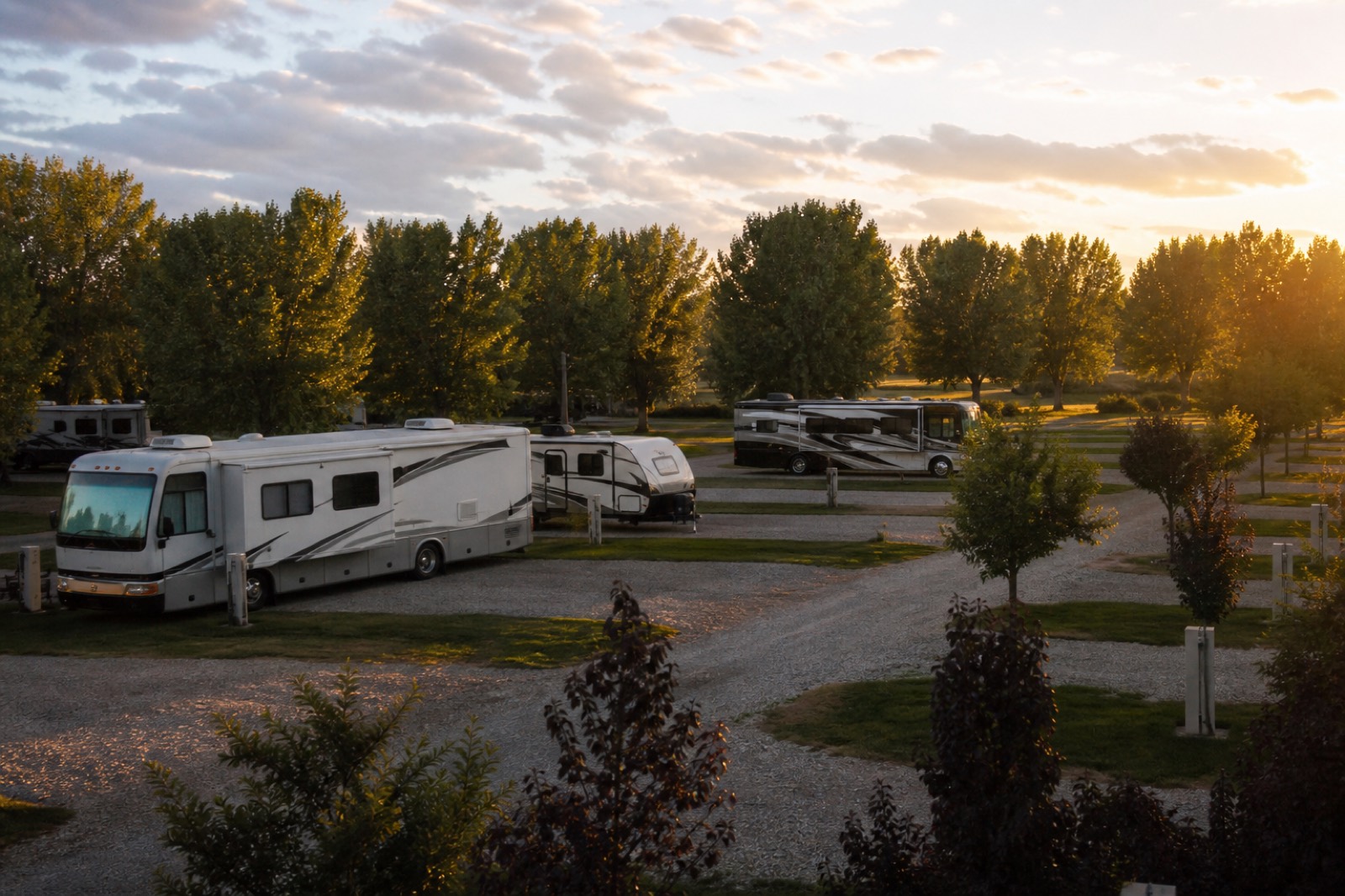
RV park revenue depends on site mix and seasonality. Understanding the economics is critical to valuation.
Site types and typical pricing:
Full hookup sites (water, sewer, electric, often Wi-Fi):
- Premium pricing: $50-$80 per night ($350-$560 weekly, $1,000-$1,800 monthly)
- Destination resorts: $70-$120+ per night
- Highest demand and revenue per site
Partial hookup (water, electric, no sewer):
- Mid-tier pricing: $30-$50 per night
- Many older parks have these sites
- Acceptable for shorter stays
Primitive sites (no hookups, tent areas):
- Budget pricing: $20-$35 per night
- Lower revenue per site
- Useful for park diversification
Cabin rentals (on-site cabins for non-RV guests):
- Premium pricing: $80-$200+ per night
- Higher revenue per unit but capital intensive
- Expands customer demographics
Long-term resident sites:
- Monthly rates: $400-$1,500/month
- Provides revenue stability and base load
- Different operational model (similar to MHP residents)
Typical RV park composition:
- Strong destination park: 70-90 percent full hookup, 10-30 percent partial, occasional primitive
- Standard travel park: 50-70 percent full hookup, 20-40 percent partial, 10-20 percent primitive
- Older legacy park: 30-50 percent full hookup, 40-60 percent partial, may have older infrastructure
Occupancy economics:
Occupancy varies dramatically by location and season:
- Florida snowbird destination: 95-100 percent winter (Oct-Mar), 30-50 percent summer
- Northern travel park: 80-95 percent summer (Jun-Sep), 20-40 percent winter or closed
- Year-round destination (Vegas, Phoenix, San Diego): 70-85 percent year-round
- Standard travel route park: 60-75 percent peak season, 30-50 percent off-season
Revenue mix beyond site rentals:
- Site rentals: 70-85 percent of revenue typical
- Cabin rentals: 5-15 percent
- Camp store and supplies: 3-8 percent
- Laundry: 2-5 percent
- Activities and amenities: 2-8 percent
- Long-term resident: 5-20 percent (varies)
Amenity investments and revenue impact:
- Wi-Fi (now essentially required): minimal revenue but customer expectation
- Pool: $10K-$60K investment, draws families, supports higher rates
- Laundry: $20K-$50K investment, $20K-$40K annual revenue
- Store: $30K-$80K investment, $30K-$80K annual revenue, modest margin
- Cabin rentals: $30K-$80K per cabin investment, $15K-$40K annual revenue per cabin
- Activities (pool table, playground, mini-golf): variable investment, drive longer stays
- Pet amenities (dog park, pet wash): $5K-$20K investment, customer attractor
For real estate-included business comparison, see how to buy a hotel.
Why full hookup percentage drives valuation
Full hookup sites command 2x the revenue of primitive sites. A 100-site park with 80 percent full hookup vs 40 percent full hookup has materially different revenue potential. Buyers should target parks with 60+ percent full hookup, or value-add parks where converting partial to full hookup is feasible. Conversion cost: $5K-$15K per site for adding sewer/water/electric upgrades.
Why long-term residents stabilize cash flow
Some RV parks have 10-30 percent of sites occupied by long-term residents (typically retirees in RVs living year-round at the park). Long-term residents pay monthly rates and provide stable base load. Trade-off: long-term residents occupy sites that could otherwise rent to higher-paying nightly travelers during peak season. Some buyers convert long-term sites to transient; others maintain mix for revenue stability.
RV park valuation: cap rate methodology
Marinas are also priced with a real estate and operating business split; if you are on the sell side of a waterfront asset, see how to sell a marina.
RV parks value on cap rate analysis similar to mobile home parks and other commercial real estate.
Cap Rate = NOI / Sale Price
Cap rate ranges by quality and location:
Destination resort (premium amenities, prime location): 5-7 percent cap Quality park in established market (good amenities, stable demand): 7-9 percent Standard park (decent location, basic amenities): 8-10 percent Value-add park (deferred maintenance, underperforming): 10-13 percent Seasonal travel route park: 9-12 percent (premium for seasonality risk)
Typical NOI by park size:
- 50-site park: $80K-$300K NOI
- 100-site park: $200K-$700K NOI
- 200-site park: $400K-$1.5M NOI
- 300+ site park: $700K-$3M+ NOI
RV park expense ratio:
- 30-45 percent of revenue typically
- 25-35 percent for well-run parks with strong operations
- 40-55 percent for value-add parks with high vacancy or operations issues
Working example-mid-size travel park:
- Site count: 100 sites (75 full hookup, 25 partial)
- Site mix revenue:
- 75 full hookup at $50/night × 60% occupancy × 365 nights = $821K
- 25 partial at $35/night × 50% occupancy × 200 nights = $87K
- Plus cabin rentals: $30K
- Plus store and laundry: $25K
- Plus other (Wi-Fi, activities): $10K
- Gross revenue: $973K
- Operating expenses (40 percent): $389K
- NOI: $584K
- At 9 percent cap rate: $584K / 0.09 = $6.5M
If same park has Wi-Fi, pool, and cabin upgrades + 75 percent full hookup × 70 percent occupancy: NOI jumps to roughly $800K, sale price at 7.5 percent cap rate = $10.7M. Capital improvements drive both NOI and cap rate compression.
For the broader valuation methodology, see business valuation methods 2026.
Why amenity upgrades drive multiple compression
Adding amenities (pool, cabin rentals, Wi-Fi upgrades, activities) does two things: (1) increases NOI through additional revenue and higher site rates, (2) attracts a different buyer pool (resort-style buyers vs basic park buyers). Resort-quality parks trade at lower cap rates (better multiples). A $3M value-add park becoming a $7M destination resort over 5-7 years is realistic with proper capital investment.
KOA and Good Sam affiliation premiums
KOA (Kampgrounds of America) franchise parks command roughly 10-15 percent revenue premium over equivalent independent parks because of brand recognition, central reservation system, and quality standards. Good Sam membership/rating system also provides marketing value. Franchise fees and ongoing royalties reduce some of the revenue premium but the net effect is typically positive.
Critical due diligence: infrastructure and seasonality
RV park due diligence covers commercial real estate standard items plus park-specific concerns.
1. Infrastructure assessment
Water system:
- Source: well, municipal, master-metered municipal
- Distribution capacity (peak summer holidays test capacity)
- Pipe age, material, condition
- Compliance with EPA and state environmental rules
Sewer system:
- Municipal sewer, on-site septic, or hybrid
- Capacity for peak occupancy
- Compliance with current standards
- Dump station capacity
Electrical:
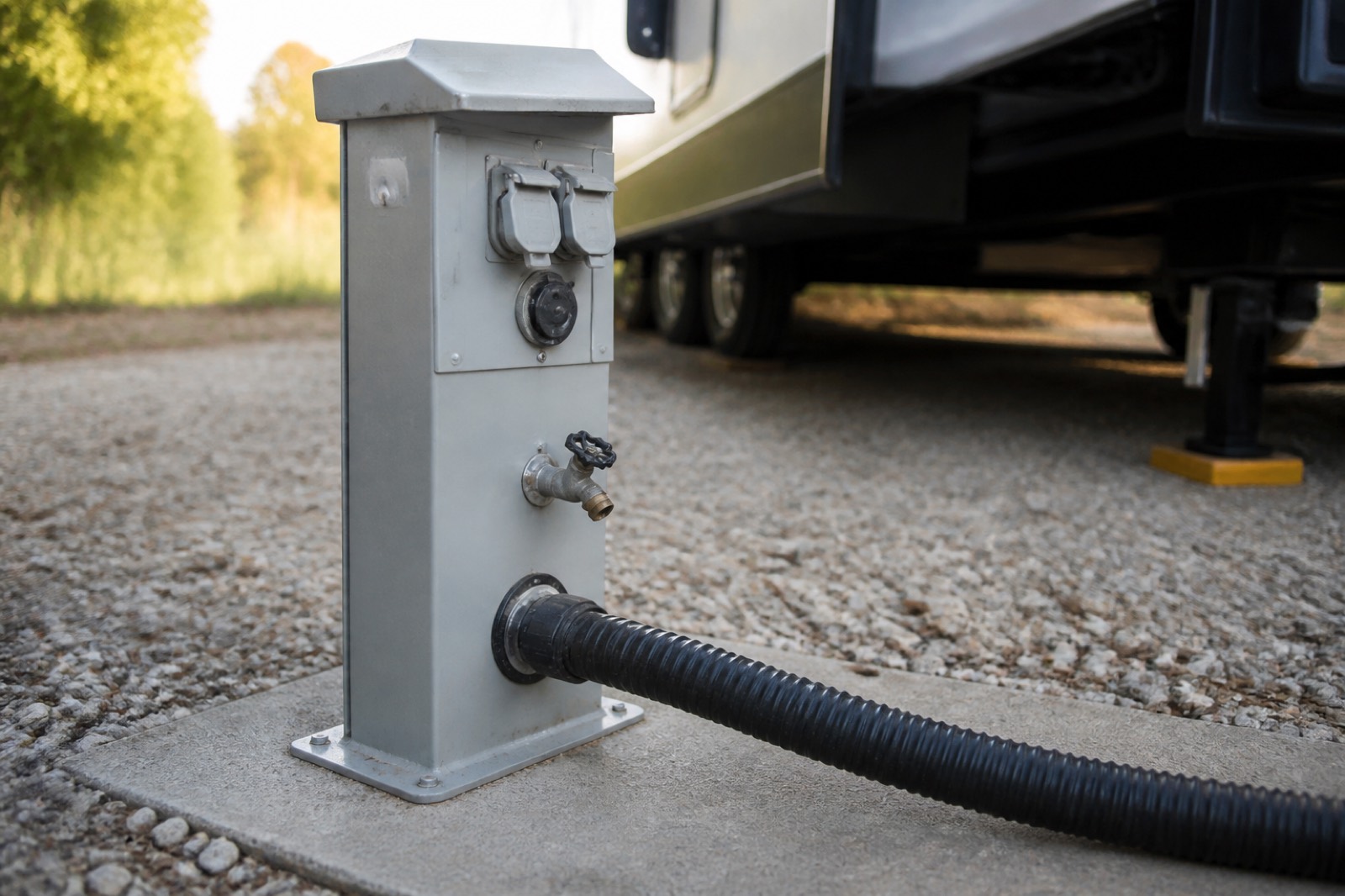
- Service capacity per site (30 amp vs 50 amp critical for full hookup)
- Pedestal condition and compliance with current code
- Overall site electrical infrastructure
Roads and pads:
- Paved vs gravel
- Condition and drainage
- Site pad condition (level, dimensions appropriate for modern RVs)
- Common road repair: $1K-$3K per site
Amenities:
- Pool: code compliance, filtration condition, decking
- Bathhouse: code compliance, condition, capacity
- Laundry: equipment age and condition
- Activity facilities: condition, code compliance
- Wi-Fi infrastructure (essential modern requirement)
Infrastructure capital needs: Most RV parks have $50K-$500K+ in deferred capital improvements at acquisition. Budget 5-15 percent of purchase price for first 24-month capital expenditures.
2. Seasonality analysis
Trailing 24-36 months of monthly occupancy and revenue. Plot the seasonality curve.
Questions to answer:
- What percent of revenue comes from peak season?
- What is the operational fixed cost during off-season?
- Is cash flow sufficient to cover off-season expenses?
- What is the working capital reserve needed for low-season?
- Are there off-season revenue strategies (long-term residents, winter storage, off-season hunting/fishing)?
Northern travel parks typically have 70-85 percent of revenue in May-September. Cash flow planning must account for 7-9 months of low or no revenue.
3. Environmental due diligence-Phase 1 environmental assessment ($2K-$5K), Phase 2 if Phase 1 reveals concerns-Floodplain assessment (critical for many RV parks), Wetlands assessment-Septic system condition (if applicable), Underground storage tanks (if any historical)
4. Local zoning and operational permits-Confirm current use is permitted under zoning-Verify operational permits are transferable-Check for moratoriums affecting future expansion-Health department permits for pool, food service, water systems
5. Reservations and customer base-Reservations system (campground software, point-of-sale), Customer base data (repeat visitors, demographics, geographic origin), Online reputation (Google, RVPark Reviews, Campendium, Good Sam ratings), Marketing channels (KOA central, paid search, social media, RV club affiliations)
For the broader due diligence framework, see business acquisition due diligence process.
Why 50-amp electrical service matters
Modern RVs (especially larger Class A motorhomes and fifth wheels) require 50-amp electrical service to run air conditioning, appliances, and electronics simultaneously. Older RV parks with 30-amp service limit which RVs can stay. Upgrading from 30-amp to 50-amp service: $2K-$5K per site. Parks with full 50-amp capability attract premium customers and command higher rates.
Floodplain risk is real
Many RV parks are located near rivers, lakes, or low-lying areas attractive to outdoor recreation. These areas often have flood risk. Verify FEMA flood maps for the property. Flood insurance for RV parks is meaningful expense. Recent flooding history affects insurance availability and customer perception.
Buying an RV Park Checklist
Buying an established RV park means paying for a track record, so the checklist is about proving that record is real and that the infrastructure behind it will hold up. Use this list alongside the diligence section above before you remove contingencies.
Financial records
- Three years of federal tax returns and profit and loss statements, reconciled to bank deposits
- Monthly occupancy and revenue by site type (full hookup, partial, primitive, cabins, long-term)
- Long-term and seasonal rent roll with move-in dates and current rates
- Prepaid reservations and deposits for future stays, which should be credited to you at closing
- State and local sales or lodging tax filings for transient stays
- Utility bills compared with any metered electric or water charges billed to guests
Infrastructure and land
- Water source and test results; under the EPA’s Safe Drinking Water Act rules, a system that regularly serves 25 or more people at least 60 days a year is a public water system with its own permit and testing duties
- Septic or sewer capacity at peak occupancy, plus the dump station
- Pedestal count by amperage and the condition of each, since larger motorhomes need the higher-amperage service
- Road, pad and drainage condition, and the FEMA flood zone for every part of the property
- Phase I environmental report, including any old fuel tanks
Legal and operations
- A zoning letter confirming the park is a legal use, and whether any sites are grandfathered
- Health department campground, pool and food permits, and whether each one transfers
- Franchise or affiliation agreements (KOA, Good Sam) and their transfer terms
- Reservation software data export, online reviews and repeat guest history
- Staffing, including seasonal workers and any on-site housing they receive
- Park rules, including any age limit on RVs, and how strictly they are enforced
Financing RV park acquisitions
RV park financing combines SBA loans for smaller owner-operator deals with commercial real estate loans for larger acquisitions.
Buyers combining real-estate acquisition with a going-concern operation often finance through SBA 7(a) financing for RV parks, which allows blended real-estate and business-value coverage.
SBA 7(a) loans for RV parks:
- Deal size: up to $5M
- Owner-operator requirement
- Down payment: 10-30 percent typical (10 percent is the SBA minimum equity injection)
- Amortization: 10 years on goodwill/equipment, 25 years on real estate
- Interest rate: SOFR + 2.75-4.75 percent
- Active SBA lenders: Live Oak Bank (specialty practice), Pinnacle Bank, BHG Bank, Newtek
SBA 504 loans for real estate portion:
- Combined with SBA 7(a) or conventional for total $5M-$15M
- 10-15 percent down payment on real estate
- Below-market fixed rate for 25 years
- Significant savings vs conventional
Conventional commercial real estate loans:
- For larger deals ($5M+)
- Down payment 25-35 percent
- Amortization 20-25 years
- Recourse typically required for smaller deals; can be non-recourse for $10M+
- Active CRE lenders: regional banks, life insurance companies, debt funds
Agency loans (Fannie Mae, Freddie Mac):
- For larger stabilized parks ($5M+)
- Below-market rates (often 100-200 bps below conventional)
- Strict qualification: NOI, debt service coverage, occupancy
- Less common for RV parks than MHPs but available
Seller financing:
- 15-25 percent of purchase price typical
- 5-year amortization, 6-8 percent interest
- Full standby for the life of the SBA loan if the note counts toward the equity injection
- Common in mid-sized deals; less common in institutional-quality parks
Bridge financing for value-add deals:
- For parks needing significant capital investment to stabilize
- 8-12 percent interest, often interest-only
- 1-3 year term, refinanced into permanent after stabilization
Typical capital stack for $4M RV park acquisition (owner-operator):
- SBA 7(a) for business + equipment: $1.5M
- SBA 504 for real estate: $1.5M
- Conventional for excess: $400K
- Seller note: $200K (5 percent on standby)
- Buyer cash: $400K (10 percent total down)
For SBA framework, see can an SBA loan be used to buy a business 2026.
Why Live Oak Bank dominates RV park SBA
Live Oak Bank built dedicated outdoor recreation and hospitality SBA practices. They understand RV park seasonality, infrastructure capital needs, amenity investments, and KOA franchise economics. Their underwriting is faster and more predictable than generalist SBA lenders. For owner-operator RV park acquisitions, Live Oak is typically the first call.
Why agency financing is uncommon
Fannie Mae and Freddie Mac primarily finance MHPs and apartment-style residential. RV parks fall in an awkward category: not residential apartments, not commercial retail, not standard hotel. Some agency programs include RV parks but with specific qualification requirements. Conventional CRE loans and SBA financing dominate the RV park space.
Value-add strategies and post-close operations
RV park value creation opportunities are similar in concept to MHPs but with hospitality-specific execution.
Value-add strategies:
1. Rate increases to market Many family-owned RV parks have nightly rates below market. Closing the gap to market over 2-3 years drives revenue growth.
2. Site mix upgrades Convert partial-hookup sites to full hookup ($5K-$15K per site). Increases per-site revenue 30-60 percent.
3. Wi-Fi infrastructure Modern Wi-Fi is essentially required. Strong Wi-Fi infrastructure ($30K-$100K investment) supports rate increases and customer satisfaction.
4. Amenity additions Pool, cabin rentals, expanded laundry, activities, pet amenities. Each adds revenue and supports rate increases.
5. Long-term resident conversion or expansion Depending on strategy, increase or decrease long-term residents to optimize cash flow.
6. Reservation system optimization Modern campground software (Campspot, CampLife, ResNexus) drives occupancy through better marketing integration.
7. Marketing improvements Website, online reputation management, paid search, KOA or Good Sam affiliation.
First 100 days post-acquisition:
Days 1-14:
- Property and operations title transfer
- Reservation system ownership transfer
- Staff one-on-one meetings (on-site manager, maintenance, housekeeping)
- Insurance policy updates
- Banking transitions
- Guest continuity (current reservations honored)
Days 15-30:
- Infrastructure assessment
- Site mix evaluation
- Amenity condition review
- Marketing review
- Long-term resident assessment
Days 31-60:
- Capital improvement planning
- Rate and pricing review (potential rate adjustments after 90 days)
- Reservation system optimization
- Marketing strategy refinement
Days 61-100:
- Quarterly performance review
- Strategic capital investment decisions
- Local community relationship building
- Marketing campaign launches
For the broader transition framework, see how to replace the seller after business acquisition.
Why amenity investment compounds
Adding amenities does more than generate amenity-specific revenue. Strong amenities support: higher site rates (premium for resort-quality), longer stays (drive amenity utilization), better online reviews (drive new customer acquisition), and customer loyalty (returning every year). The amenity investment compound through multiple revenue streams.
Seasonality cash flow planning
Northern parks with 7-9 month operating seasons require careful working capital planning. Generate sufficient peak-season cash flow to cover off-season fixed costs (insurance, property tax, utilities maintenance, key staff). Many seasonal park failures trace to inadequate off-season cash reserves.
Frequently Asked Questions
How much does it cost to buy an RV park?
Wide range. Small parks (30-50 sites, basic amenities): $500K-$2M. Mid-size parks (100 sites, full amenities): $2M-$6M. Larger destination parks (200+ sites with resort amenities): $5M-$25M. Most owner-operator buyers target $1M-$10M range. Real estate typically 70-85 percent of total value.
What is a typical cap rate for RV parks?
Varies by quality and location. Destination resorts: 5-7 percent cap. Quality established parks: 7-9 percent. Standard parks: 8-10 percent. Value-add parks: 10-13 percent. Seasonal travel route parks: 9-12 percent (premium for seasonality risk). Lower cap rate = higher price.
Can I use an SBA loan to buy an RV park?
Yes. SBA 7(a) for owner-operator deals up to $5M, often combined with SBA 504 for real estate portion. Live Oak Bank has specialty practice. Down payment typically 10-30 percent. Approval requires owner-operator commitment, clean compliance history, and stable revenue trend.
What is the difference between RV parks and mobile home parks?
Operations differ significantly: MHPs have residents who own mobile homes and stay 5-15 years (real estate focus, minimal customer service). RV parks have guests who bring their own RVs or rent cabins, stay nights to seasons (hospitality + real estate). MHPs are simpler operations; RV parks have more customer service complexity but also more revenue per site.
What is the most important due diligence item for RV parks?
Infrastructure assessment (water, sewer, electrical, roads, pads). Most RV parks have $50K-$500K+ in deferred capital improvements at acquisition. Independent infrastructure inspection by qualified engineer prevents surprise post-close capital costs. Pre-acquisition Phase 1 environmental assessment is also essential.
How seasonal are RV parks?
Highly variable. Snowbird destinations (Florida, Arizona, southern California): 95-100 percent occupancy winter, 30-50 percent summer. Northern travel parks: 80-95 percent summer, 20-40 percent winter (some close). Year-round destinations: 70-85 percent year-round. Seasonality drives cash flow planning-off-season expenses must be covered by peak-season cash flow.
What is the difference between full hookup, partial, and primitive sites?
Full hookup: water, sewer, electric (often Wi-Fi). Premium pricing $50-$80/night. Partial hookup: water and electric, no sewer. Mid-tier $30-$50/night. Primitive: no hookups, often for tent camping. Lower pricing $20-$35/night. Modern RVs require 50-amp electrical service for full functionality.
How long does it take to close an RV park acquisition?
Typical timeline: 90-150 days from LOI to close. Gates: SBA approval (60-90 days), environmental Phase 1 (30-45 days), infrastructure inspection (15-30 days), title and survey work (30-60 days, parallel). Seasonal parks: timing matters-many buyers prefer to close just before peak season to capture early revenue.
What is a KOA franchise and is it worth it?
KOA (Kampgrounds of America) is the largest RV park franchise system. KOA parks command roughly 10-15 percent revenue premium over equivalent independent parks because of brand recognition, central reservation system, and quality standards. Franchise fees and ongoing royalties (~3-8 percent of revenue) reduce some premium. Net effect typically positive for parks meeting KOA quality standards.
Should I buy an RV park as my first business?
Depends on your background and capital. Good fit: prior real estate or hospitality experience, comfortable with seasonality and customer service, $500K-$2M available capital, willing to work on-site or hire on-site manager. Challenging for first-time buyers because RV parks combine real estate, operations, and hospitality. Most successful RV park operators have prior business or real estate experience.
Is owning an RV park profitable?
It can be, but profit depends on site mix, occupancy and how much unpaid work the owner puts in. Parks with mostly full hookup sites and steady seasonal or long-term guests are the most consistent. Before buying, replace the seller’s unpaid labor with a paid manager in your model and budget for deferred infrastructure work, since both are common reasons paper profit shrinks after closing.
What is the 10 year rule for RV parks?
It is a policy some RV parks and resorts use to turn away RVs older than about ten years, or to require photos or an inspection before booking. It is a park rule, not a law. As a buyer, check whether the park enforces one, because it shapes the guest mix, nightly rates and reviews, and changing it can shift occupancy.
Should I buy an established RV park or build a new one?
Most first-time buyers are better off buying an established park. It comes with permits, zoning approval, utilities, reviews and booking history you can verify. Building means winning zoning approval, which many local governments restrict, plus utility and road construction and a ramp-up period with little revenue. Building can make sense for experienced operators who already control land in a supply-limited market.
Related Guide: How to Buy a Mobile Home Park, Alternative real estate investment with overlapping due diligence framework.
Related Guide: How to Buy a Hotel, Hospitality-focused acquisition framework.
Related Guide: Business Acquisition Due Diligence Process, Complete due diligence framework for real estate-included acquisitions.
Related Guide: Can an SBA Loan Be Used to Buy a Business, SBA 7(a) qualification framework for RV park acquisitions.
Want a Specific Read on Your Business?
30 minutes, confidential, no contract, no cost. You leave with a read on your local buyer market and a likely valuation range.
30 N Gould St, Ste N, Sheridan, WY 82801, USA · (307) 522-0262 · Contact