
Private Equity Roll-Up Strategy in 2026: Platform, Bolt-Ons, Multiple Arbitrage
A private equity roll-up strategy buys a platform company, adds smaller competitors at lower EBITDA multiples, and sells the combined group at a higher one: if you are the add-on, the offer reflects the platform’s math, not your ceiling.

By Christoph Totter, Founder of CT Acquisitions · Last reviewed: October 2026

Key takeaways
- Add-on acquisitions made up about 74% of US private equity buyouts in 2025 through September 30, against a five-year annual average of 72% (PitchBook Q3 2025 US PE Breakdown, as summarized by Sidley Austin, November 2025).
- In the illustrative model on this page, $15.0M of add-on EBITDA bought at 5.0x and sold inside a 10.0x platform creates $75.0M of enterprise value before any growth: multiple arbitrage is the largest single driver (worked arithmetic below).
- A $15.0M headline add-on offer in the worked example puts $7.5M in your account at closing once debt payoff, 20% rollover, a $2.0M earnout and a 10% escrow come out; the median escrow on 2025 deals without RWI was 10.0% of transaction value (SRS Acquiom 2026 Deal Terms Study via DealLawyers.com).
- Rollover equity defers tax only when the structure fits the statute: IRC Section 351 requires the transferors to hold at least 80% control under Section 368(c) immediately after the exchange, while Section 721 for LLCs taxed as partnerships has no control test.
- Add-on deals under $133.9M fall below the 2026 Hart-Scott-Rodino filing threshold (FTC, January 14, 2026), but Guideline 8 of the 2023 Merger Guidelines lets the FTC and DOJ review a whole series of acquisitions together.
| Number | What it means | Source |
|---|---|---|
| 74% | Add-ons as a share of US PE buyouts by deal count, 2025 through September 30 | PitchBook via Sidley Austin |
| 72% | Five-year annual average add-on share of US PE buyouts | Sidley Austin, citing PitchBook |
| 24% | Share of 2025 private-target deals with an earnout (excluding life sciences), up from 22% in 2024 | SRS Acquiom via DealLawyers.com |
| 10.0% | Median escrow as a share of transaction value, 2025 deals without RWI | SRS Acquiom via DealLawyers.com |
| 2.8% | Median escrow, 2025 deals with representations and warranties insurance (RWI) | SRS Acquiom via DealLawyers.com |
| 80% | Control the transferor group must hold for a Section 351 tax-deferred rollover | 26 U.S.C. 368(c) |
| $133.9M | 2026 HSR minimum size-of-transaction threshold for a federal premerger filing | FTC |
| 30 days | Initial HSR waiting period after both filings are received | 15 U.S.C. 18a(b)(1)(B) |
Looking to acquire in this space?
CT Acquisitions sources proprietary, off-market deals for serious buyers. Tell us your mandate and we will bring you businesses that fit. No cost to explore.
How does a private equity roll-up strategy work?
A private equity roll-up strategy works in five stages: a sponsor buys a platform company with management and systems, buys smaller add-ons in the same or adjacent markets, moves them onto shared finance, pricing and software, refinances as EBITDA grows, and sells the combined group. Add-ons made up about 74% of US buyouts in 2025 through September (PitchBook data via Sidley Austin).
- Buy the platform. The sponsor buys a company big enough to carry a CFO, shared systems and regional managers, typically $5M to $25M+ of EBITDA, at 6x to 9x EBITDA in CT Acquisitions’ working ranges.
- Buy add-ons. Smaller companies, usually $500K to $5M of EBITDA, join at 4x to 6x. Most add-on prices sit below the $133.9M HSR threshold, so no federal premerger filing or 30-day waiting period applies.
- Integrate. Each add-on moves onto the platform’s finance, CRM, dispatch and purchasing. Well-run platforms finish this within about 200 days of closing; add-ons still on their own books after that are a warning sign.
- Finance the build. Acquisition debt, sponsor equity, seller rollover equity and earnouts pay for the add-ons, as set out in the roll-up acquisition financing guide.
- Sell the combined group. The exit usually comes in years 5 to 7 after the platform purchase, to a larger sponsor or a strategic buyer, at 8x to 12x EBITDA in CT Acquisitions’ working ranges.
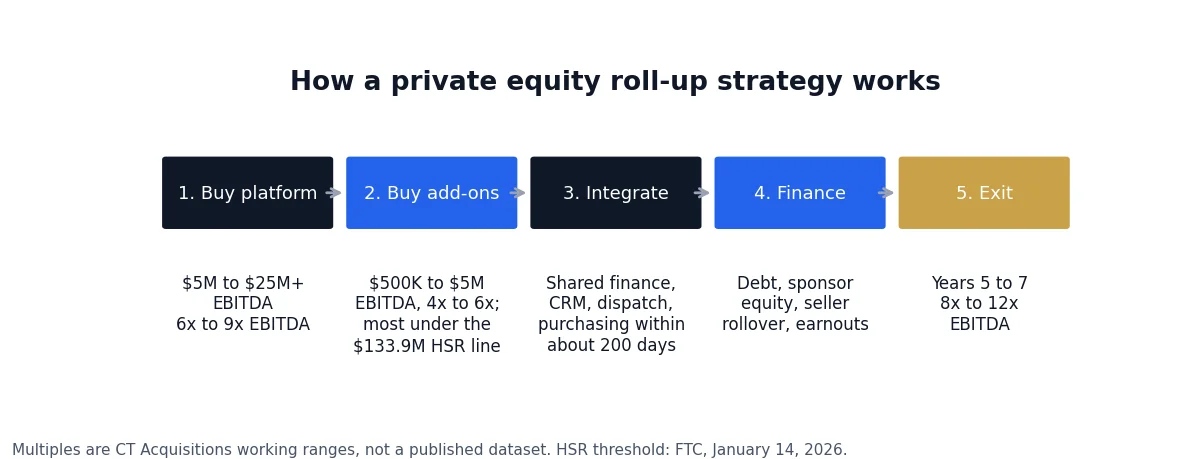
The same sequence is called buy-and-build when the sponsor stresses the integration work over the deal count; the buy-and-build strategy guide covers that framing for buyers. For a founder, both names lead to the same two deal types: the platform deal and the add-on deal, compared in the platform acquisition versus add-on explainer.
How does multiple arbitrage create the return?
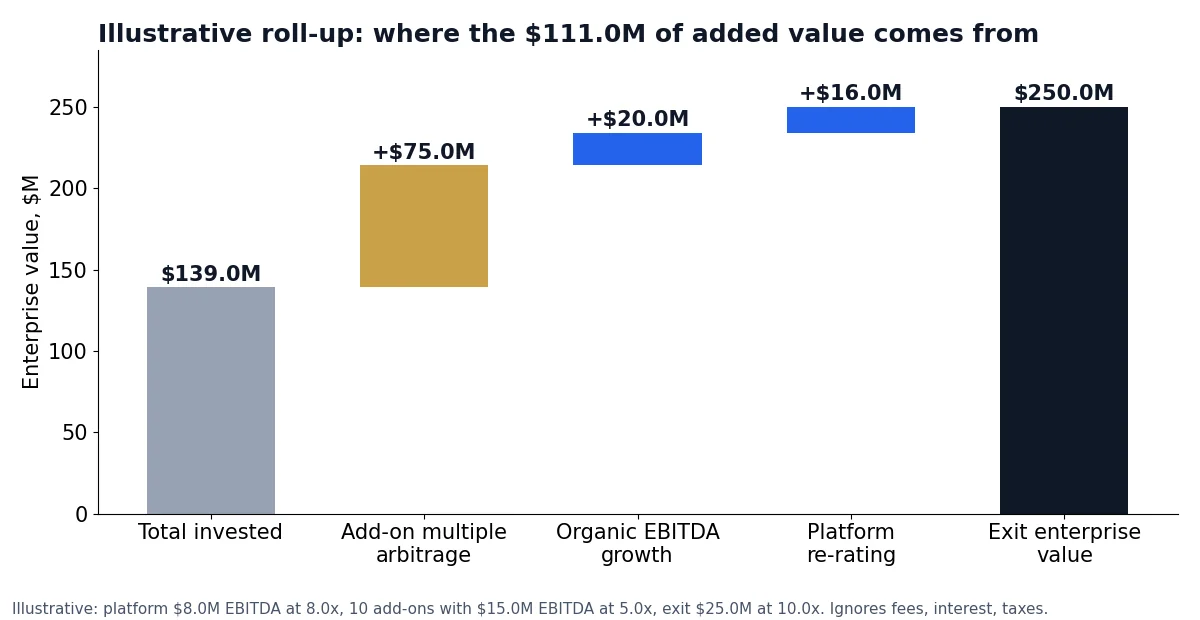
Multiple arbitrage is the gap between the EBITDA multiple a platform pays for small add-ons and the multiple buyers pay for the combined company at exit. In the illustrative model below, $15.0M of add-on EBITDA bought at 5.0x and sold at 10.0x adds $75.0M of enterprise value, more than organic growth ($20.0M) and platform re-rating ($16.0M) combined.

| Line | Value | Arithmetic or assumption |
|---|---|---|
| Platform EBITDA at entry | $8.0M | Assumption |
| Platform entry multiple | 8.0x | Inside the 6x to 9x CT working range |
| Platform price | $64.0M | $8.0M × 8.0 |
| Add-ons bought | 10 at $1.5M EBITDA each | Assumption: $15.0M of add-on EBITDA |
| Add-on multiple | 5.0x | Inside the 4x to 6x CT working range |
| Add-on spend | $75.0M | $15.0M × 5.0 |
| Total invested | $139.0M | $64.0M + $75.0M |
| Acquisition debt | $69.5M | Assumption: 50% of total invested |
| Sponsor equity | $69.5M | $139.0M less $69.5M of debt |
| Platform EBITDA at exit | $10.0M | $8.0M plus $2.0M organic growth |
| Combined EBITDA at exit | $25.0M | $10.0M + $15.0M (add-ons held flat) |
| Exit multiple | 10.0x | Inside the 8x to 12x CT working range |
| Exit enterprise value | $250.0M | $25.0M × 10.0 |
| Equity at exit | $180.5M | $250.0M less $69.5M of debt |
| Equity multiple (MOIC) | 2.6x | $180.5M ÷ $69.5M |
The model ignores fees, interest, debt paydown, taxes and add-on growth, so a real sponsor model will differ. The point it shows survives those simplifications: of the $111.0M gained between the $139.0M invested and the $250.0M exit value, $75.0M comes from paying 5.0x for EBITDA that later sells at 10.0x.
| Source of value | Arithmetic | Value |
|---|---|---|
| Multiple arbitrage on add-ons | $15.0M × (10.0 less 5.0) | $75.0M |
| Organic EBITDA growth at the platform | $2.0M × 10.0 | $20.0M |
| Re-rating of the platform’s own EBITDA | $8.0M × (10.0 less 8.0) | $16.0M |
| Total added enterprise value | $250.0M less $139.0M | $111.0M |
What happens if the exit multiple compresses?
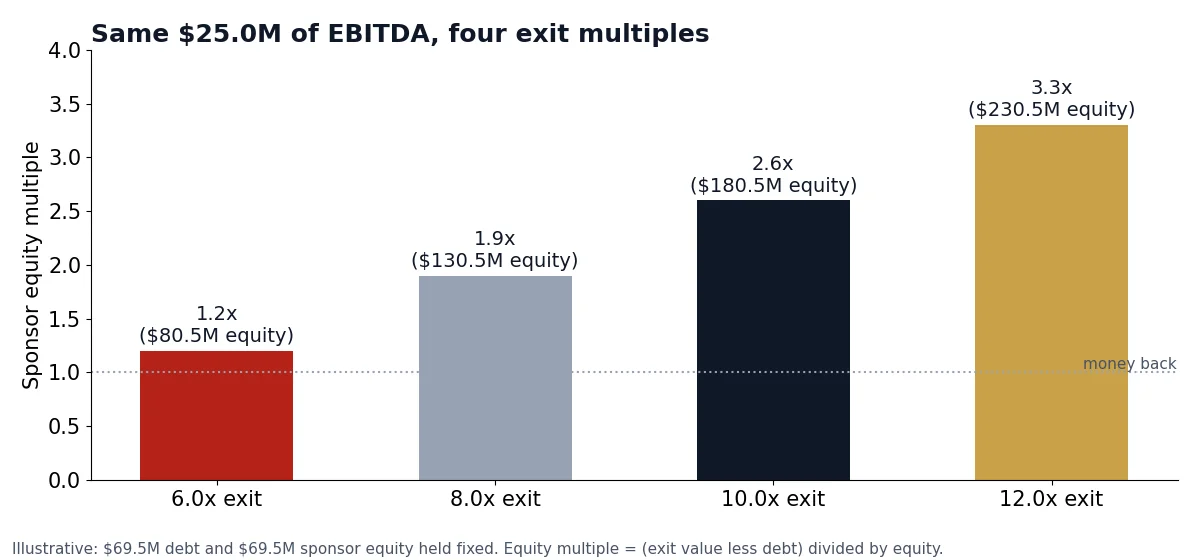
Exit multiple compression erases the arbitrage first, because the debt stays fixed while enterprise value falls. In the illustrative model, the same $25.0M of EBITDA returns 2.6x on sponsor equity at a 10.0x exit, 1.9x at 8.0x and 1.2x at 6.0x. A platform bought when buyers paid 11x and sold into a 9x market loses much of its spread.
| Exit multiple | Exit enterprise value | Equity at exit | Equity multiple |
|---|---|---|---|
| 6.0x | $150.0M | $80.5M | 1.2x |
| 8.0x | $200.0M | $130.5M | 1.9x |
| 10.0x | $250.0M | $180.5M | 2.6x |
| 12.0x | $300.0M | $230.5M | 3.3x |
Why does the combined company sell at a higher multiple?
A combined company with $25.0M or more of EBITDA sells at a higher multiple because more buyers can bid for it and it carries less single-owner risk. Large-cap sponsors, strategic acquirers and public companies rarely buy a $1.5M EBITDA business, yet compete for a platform with a CFO, audited reporting, shared systems and no customer above a few percent of revenue.
Your add-on price is set by the platform’s entry math, not by the exit multiple. A platform that expects to sell at 10.0x can pay 5.0x and keep the spread; it can also pay 6.0x for a strategic first add-on and still make money. Knowing which of those you are is the start of the negotiation, and the EBITDA multiples by industry table gives the sector context.
What does a platform pay compared with an add-on?
Platforms usually trade at higher multiples than add-ons because the sponsor is buying the management and systems it will build on. CT Acquisitions’ working ranges, carried from our deal work and not from a published dataset, put platforms at 6x to 9x EBITDA and add-ons at 4x to 6x, with premiums for a first add-on that opens a new region or service line.
| Dimension | Platform acquisition | Add-on acquisition |
|---|---|---|
| Typical EBITDA | $5M to $25M+ | $500K to $5M |
| EBITDA multiple | 6x to 9x | 4x to 6x; higher for first add-ons in a region |
| Management | Existing team stays and runs the platform | Owner can step back; platform leadership takes over |
| Process | Full auction, about 4 to 9 months | Often bilateral and shorter |
| Federal antitrust filing | Possible above the $133.9M HSR threshold | Rare: most add-on prices sit below $133.9M |
| Rollover equity asked | 20% to 40% common | 10% to 30% common |
| Seller’s bargaining position | Several competing sponsor bids | Often one or two platform suitors unless you run a process |
The $5M EBITDA line matters most. Above it, a business with a management team that stays can be marketed as a platform to sponsors starting a new thesis, which moves it from the 4x to 6x band into the 6x to 9x band. Below it, the realistic buyers are existing platforms buying you as a bolt-on.
Industry decides how many platforms compete for you. HVAC, plumbing, pest control, dental and veterinary practices each have several sponsor-backed consolidators in 2026; the fragmented industries ripe for consolidation report scores sectors, and the private equity firms specializing in roll-ups map names the sponsors and platforms by sector, so neither list is repeated here.
Considering a roll-up acquisition for your business?
CT Acquisitions works with 500+ active buyers, including PE platforms running roll-ups across home services, professional services, healthcare, and industrial sectors. We help founders evaluate roll-up offers, structure rollover equity, and capture second-bite economics. No fee to you on buy-side introductions; sell-side mandates are paid on success at closing.
Become a Vetted Partner & Get Deal FlowWhat does a roll-up offer mean for you as the add-on founder?
A roll-up offer is a headline enterprise value split into pieces that arrive at different times and carry different risks. In the illustrative $15.0M offer below, $7.5M arrives at closing; the rest is debt payoff, rollover equity, an earnout and an escrow. Earnouts appeared in 24% of 2025 private-target deals (SRS Acquiom 2026 study via DealLawyers.com).
| Component | Amount | Share of headline | When it arrives | Risk to you |
|---|---|---|---|---|
| Debt paid off at closing | $1.0M | 6.7% | At closing, straight to the lender | Fixed; reduces your proceeds |
| Rollover equity (20%) | $3.0M | 20% | At the platform’s exit, years later | Rides on the exit multiple and platform debt |
| Earnout | $2.0M | 13.3% | Over 18 to 24 months if targets are hit | Depends on how the metric is defined after integration |
| Indemnity escrow (10%) | $1.5M | 10% | 12 to 24 months after closing if no claims | Claims reduce it |
| Cash at closing | $7.5M | 50% | Wire on closing day | Low |
| Headline enterprise value | $15.0M | 100% | Sum of the lines above | Not a single payment |
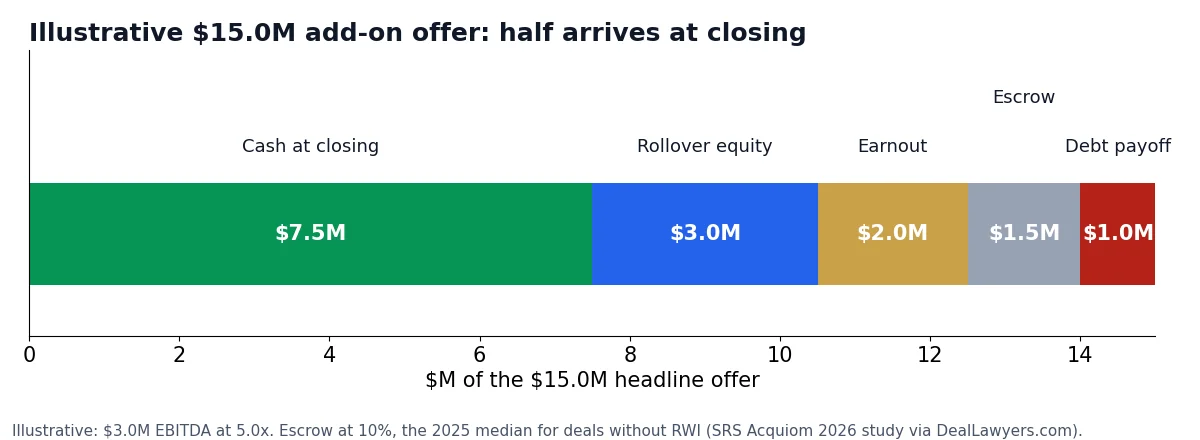
The escrow line is where a roll-up’s deal terms show up most clearly. In 2025, 88% of private-target deals had some escrow or holdback; without representations and warranties insurance the median escrow was 10.0% of transaction value, and with RWI it was 2.8% (SRS Acquiom via DealLawyers.com). Ask whether the platform will buy RWI on your deal, because on a $15.0M price that difference is roughly $1.1M held back for a year or more.
Earnouts are harder to measure inside a roll-up because your company stops having its own P&L once it moves onto shared finance and pricing. Write the metric, the accounting basis and the treatment of platform overhead into the purchase agreement before closing, as the earnouts explained guide sets out. Platforms often set the working capital peg on a trailing 12-month average; a seasonal business should ask for a 24-month or seasonally adjusted peg, as described in the working capital adjustment guide.
Should you take rollover equity in a roll-up?
Take rollover equity when you join early in the hold, the platform passes most of the seven checks below, and your units sit in the same class as the sponsor’s. In the illustrative model, $3.0M rolled at the platform’s entry price becomes $7.8M at a 10.0x exit; the same $3.0M rolled after the equity is already marked at 2.0x becomes $3.9M.

| Exit multiple (model equity multiple) | Rolled at entry price (year 1) | Rolled at a 2.0x mark (year 4) |
|---|---|---|
| 6.0x (1.2x) | $3.5M | $1.7M |
| 8.0x (1.9x) | $5.6M | $2.8M |
| 10.0x (2.6x) | $7.8M | $3.9M |
| 12.0x (3.3x) | $10.0M | $5.0M |
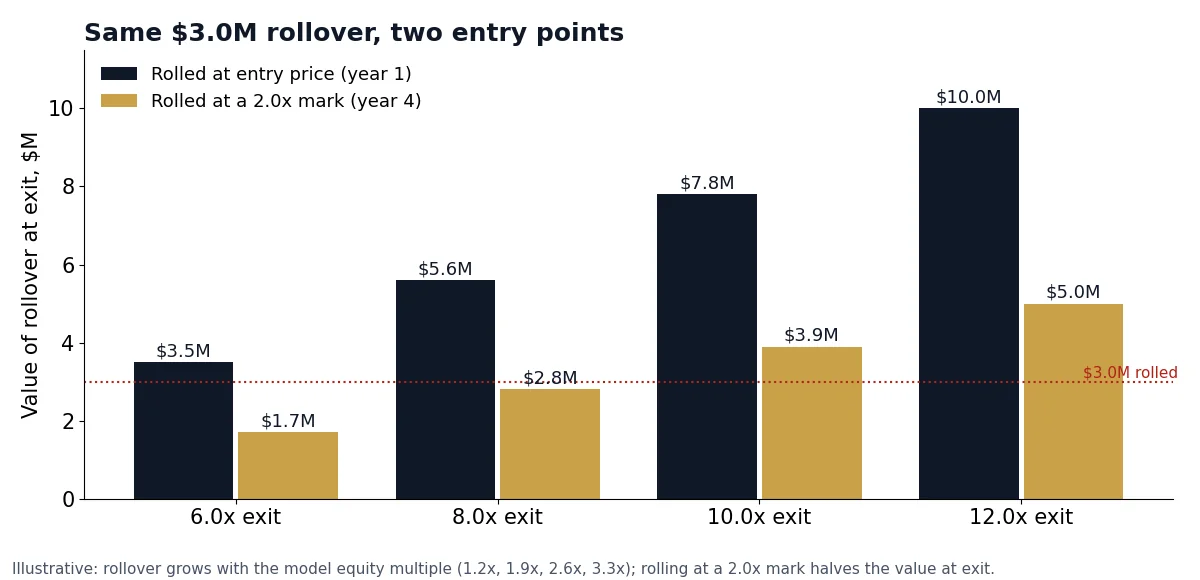
Late entry is the risk most founders miss. When you roll into a platform whose equity is already marked at 2.0x its cost, your units are priced at that mark, so an 8.0x exit returns $2.8M on the $3.0M you rolled. Ask the sponsor for the platform’s acquisition date, its target exit year and the price per unit you are rolling at, compared with the price the sponsor paid.
Dilution from later add-ons is mostly a percentage effect. When the platform issues units to later add-on sellers at fair value, your percentage falls but your value per unit does not. Value per unit falls when units are issued below fair value, when a management incentive plan pool vests, or when a preferred class with a liquidation preference sits above yours. The equity rollover guide for founders lists the governance terms to ask for: same class, tag-along rights and information rights.
Is rollover equity taxed when the deal closes?
Rollover equity is usually not taxed at closing when the exchange qualifies under IRC Section 351 for corporations or Section 721 for partnerships, but the cash you receive is taxed. Section 351 requires the transferors to hold at least 80% control under Section 368(c) immediately after the exchange, and an add-on founder rolling alone into an existing platform corporation does not meet that alone.
| Rule | What the text says | What it means for an add-on seller | Source |
|---|---|---|---|
| Section 351(a) | No gain or loss when property goes to a corporation solely for stock and the transferors control it immediately after | The rolled stock can be deferred, if the control test is met | 26 U.S.C. 351 |
| Section 368(c) | Control means at least 80% of total voting power and 80% of each other class of stock | Rolling 20% into an existing holdco does not reach 80% alone; the sponsor must contribute in the same transaction or a new holdco is formed | 26 U.S.C. 368 |
| Section 351(b) | Gain is recognized up to the money and other property received | Cash at closing is taxed; only the stock is deferred | 26 U.S.C. 351 |
| Section 721(a) | No gain or loss on contributing property to a partnership for a partnership interest | An LLC holdco taxed as a partnership has no 80% test, one reason many add-on rollovers use LLC units | 26 U.S.C. 721 |
| Section 453 | An installment sale is one where at least 1 payment arrives after the year of sale | Earnout and seller note payments can be reported as received, subject to the section’s limits | 26 U.S.C. 453 |
Several roll-up guides call rollover “tax-deferred” without conditions; the statute makes the deferral conditional. Before you sign the letter of intent, ask the platform’s tax counsel three things: which section the rollover relies on, who counts in the transferor group for the Section 368(c) test, and whether the holdco is a corporation or an LLC taxed as a partnership. The Section 351 rollover tax guide works through each structure.
S corporation sellers face one more structuring step. Buyers usually want a stepped-up basis in the assets, and an F reorganization before closing can give them that while you roll LLC units; the F reorganization steps guide lists the filings and their order. None of this is tax advice: the same deal can land differently depending on your entity, state and basis.
Can antitrust regulators stop a roll-up?
Rarely at the add-on stage, but the risk is real for serial buyers. The 2026 HSR threshold is $133.9M (FTC, January 14, 2026), so most add-ons need no federal filing, yet Guideline 8 of the 2023 Merger Guidelines lets the FTC and DOJ examine a series of acquisitions as a whole, and the FTC used that theory against a Texas anesthesia roll-up.
| Rule or case | What it says | Date | Source |
|---|---|---|---|
| HSR size-of-transaction threshold | A premerger filing is required above $133.9M (other tests also apply), up from $126.4M | Announced January 14, 2026 | FTC release |
| HSR waiting period | Ends on the thirtieth day after both completed filings are received | Statute | 15 U.S.C. 18a(b)(1)(B) |
| Merger Guidelines, Guideline 8 | When a merger is part of a series of multiple acquisitions, the agencies may examine the whole series | Released December 18, 2023 | DOJ and FTC |
| FTC Chairman memo | The joint 2023 Merger Guidelines are in effect and are the framework for FTC merger review | February 18, 2025 | FTC memo |
| FTC v. U.S. Anesthesia Partners | Complaint alleged a roll-up buying nearly every large anesthesia practice in Texas | Filed September 2023 | FTC |
| Welsh Carson final order | Sponsor must limit its involvement with USAP and notify the FTC of specified future physician practice acquisitions | May 20, 2025 | FTC |
For a founder, the practical question is timing. If the platform already owns several competitors in your metro area, Guideline 8 lets the FTC and DOJ review its whole series of deals, so ask whether it expects extra regulatory review and who carries that delay in the purchase agreement: a long outside date with no reverse break fee leaves your business in limbo while competitors recruit your staff.
Which roll-ups worked, and which failed?
Waste Management is the textbook success: it bought 133 small haulers and became the largest US waste disposal company (Vaughn, 2009). Valeant Pharmaceuticals is the warning: it bought more than 100 companies from 2008 to 2014, then collapsed under heavy debt and scrutiny of its pricing and accounting (The Globe and Mail, 2017).
| Roll-up | What it bought | Outcome | Lesson for a seller | Source |
|---|---|---|---|---|
| Waste Management | 133 small local haulers | Largest US waste disposal company; its founder Wayne Huizenga later ran the same play with AutoNation dealerships | Route density and shared landfills made the add-ons worth more together | Vaughn, 2009 |
| Valeant Pharmaceuticals | More than 100 companies, 2008 to 2014 | Collapse under debt and pricing and accounting scrutiny | Growth bought faster than it can be integrated hides a weak core; rollover rides on that core | The Globe and Mail, 2017 |
| U.S. Anesthesia Partners (Welsh Carson) | Large anesthesia practices in Texas | FTC suit in September 2023; Welsh Carson order in May 2025 | Dominating one local market draws antitrust review even without HSR filings | FTC |
The common thread is integration pace against deal pace. Before rolling equity into any platform, ask how many add-ons it closes per year, how many run on its systems today, and how same-store growth compares with acquired growth. The roll-up strategy case studies page covers more sector examples.
How do you tell a well-run platform from a risky one?
Ask the sponsor for evidence on seven lines before you accept rollover: integration pace, prices paid, organic growth, management, debt trend, where you join the hold, and the exit multiple in its model. A platform that passes six or seven is a reasonable home for 10% to 30% rollover; three or fewer passes means taking the maximum cash at closing.
| Check | Ask for | Pass | Fail |
|---|---|---|---|
| 1. Integration pace | Each add-on’s close date and the date it went live on platform systems | Most add-ons more than 200 days old run on shared finance, CRM and dispatch | Older add-ons still run their own books and software |
| 2. Price discipline | Multiples paid on recent add-ons | Mostly inside 4x to 6x, premiums only for first entry into a region | Routine 6x to 7x for add-ons that would normally trade at 4x to 5x |
| 3. Organic growth | Same-store revenue growth for add-ons held a full year | Acquired businesses grow after joining (our judgement: flat is a warning) | Growth comes only from buying more companies |
| 4. Management bench | Who runs the platform and what they ran before | CEO with prior roll-up experience, a full-time CFO, regional operators | The first company’s founder still does everything |
| 5. Debt trend | Debt to EBITDA at entry and today | Steady or falling as add-ons closed | Rising with each deal, or the sponsor will not share it |
| 6. Where you join the hold | Platform acquisition date and target exit year | Enough runway for your business to show in the exit numbers (exits usually come in years 5 to 7) | You join in the final year or two |
| 7. Exit multiple assumption | The exit multiple in the sponsor’s model | Inside the 8x to 12x platform range and near current comparable exits | Model assumes peak multiples; a drop from 11x to 9x would erase much of the gain |
- Six or seven passes: rollover in the 10% to 30% range is reasonable, and more can make sense if you believe in the exit.
- Four or five passes: keep rollover at the low end, push the difference into cash at closing, and get failed lines addressed in writing, for example a date for moving onto shared systems.
- Three or fewer, or refusal to share: treat rollover as a high-risk bet and bring a competing platform into the process before you sign.
Lines 5 and 6 outweigh the rest. Lenders are repaid before equity holders at exit, so a rising debt ratio can wipe out rollover even when your business performs, and the rollover table above shows a year-4 entry turning $3.0M into $2.8M at an 8.0x exit. If either line fails, score the platform in the four-or-five band at best.
Should you sell to a roll-up, a single platform or a strategic?
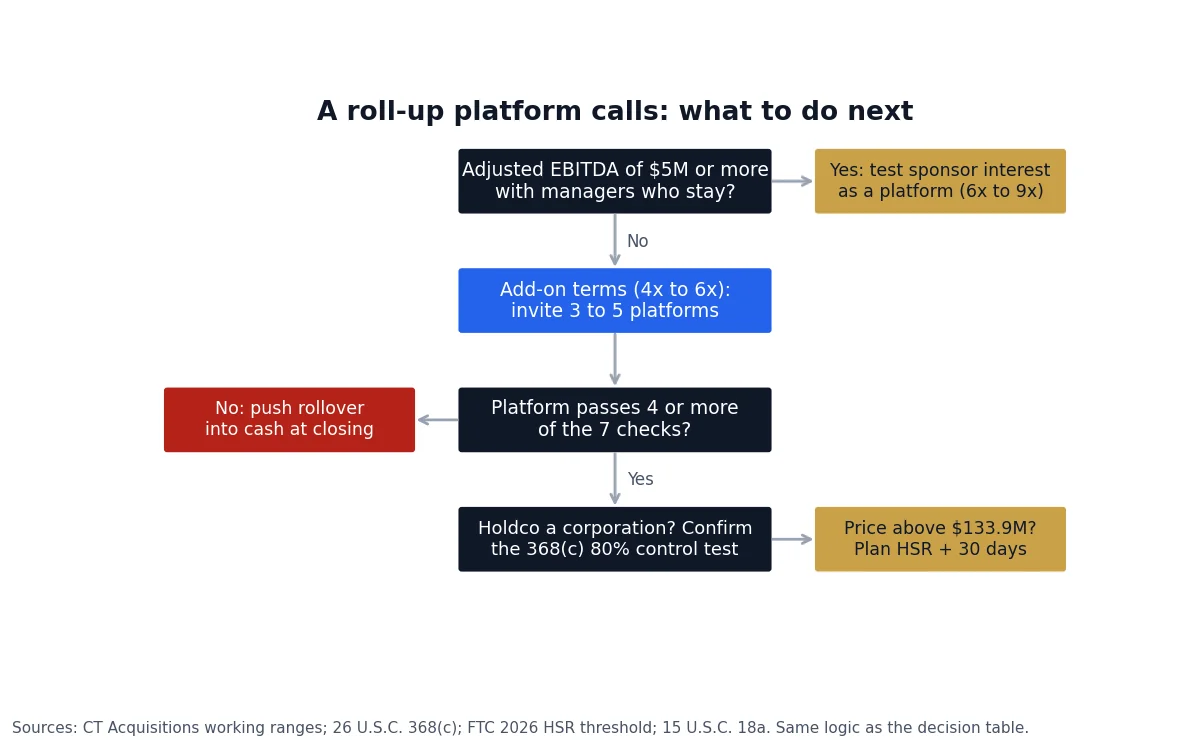
Sell to a roll-up platform when your EBITDA is under about $5M and you want a faster, often bilateral deal; market yourself as a platform when EBITDA is $5M or more with managers who stay; choose a strategic when you want a clean exit with little or no rollover. The decision table below turns each situation into a next step.
| If your situation is | Do this | Why |
|---|---|---|
| Adjusted EBITDA under $5M, no second management layer | Expect add-on terms and invite 3 to 5 platforms, not one | A single bidder prices off its own model at 4x to 6x |
| EBITDA of $5M or more with a CFO and managers who stay | Test sponsor interest in you as a platform before accepting add-on terms | Platforms trade at 6x to 9x against 4x to 6x for add-ons (CT working ranges) |
| You open a new region or service line for the platform | Ask for a first add-on premium above the 4x to 6x range | The platform needs the foothold before it can buy cheaper add-ons nearby |
| Rollover asked above 20% and the platform passes 3 or fewer of 7 checks | Push the difference into cash at closing | Rollover value depends on the platform’s exit and debt |
| You would join in the final 2 years of the hold | Keep rollover at the low end and confirm your price per unit | In the model, a 2.0x mark turns $3.0M into $2.8M at an 8.0x exit |
| Platform holdco is a corporation and you roll alone | Ask tax counsel how the Section 368(c) 80% test is met | Without control, Section 351 deferral fails |
| Deal value above $133.9M | Plan for an HSR filing and a 30-day waiting period | 15 U.S.C. 18a and the 2026 FTC threshold |
| Revenue is seasonal | Ask for a 24-month or seasonally adjusted working capital peg | A trailing 12-month peg can claw back cash at closing |
| You want a clean exit with no rollover | Favor strategic buyers | Strategics usually ask for 0% to 10% rollover (CT working range) |
CT Acquisitions advises founder-owned businesses on the sell side, the buy side and exit planning, with a network of 500+ buyers that includes PE platforms, family offices and strategic acquirers. For an add-on founder, that means several platforms bidding against the same data instead of one inbound offer; the selling to a private equity buyer page explains the process. No fee to you on buy-side introductions; sell-side mandates are paid on success at closing.
Want more deal flow in this sector?
We run targeted, confidential outreach to owners and bring acquirers proprietary deals that never hit the open market. Tell us what you are looking for.
How we compiled this
In October 2026 we read 11 primary documents: the U.S. Code text of 26 U.S.C. Sections 351, 368, 453 and 721 and 15 U.S.C. 18a on Cornell LII, the FTC’s January 14, 2026 HSR release and May 20, 2025 Welsh Carson release, the 2023 Merger Guidelines, the FTC Chairman’s February 18, 2025 memo, Sidley Austin’s November 2025 summary of PitchBook data and DealLawyers.com’s April 28, 2026 summary of the SRS Acquiom 2026 Deal Terms Study. PitchBook’s own PDF refused direct access, so its figures are quoted through Sidley Austin. The Waste Management and Valeant facts come from the two sources the earlier version of this page cited.
The multiple ranges are CT Acquisitions working ranges and are labelled as such. The roll-up model and the $15.0M offer are illustrative arithmetic with every input shown, not client deals. We excluded forum threads and unsourced roll-up failure-rate statistics.
Frequently asked questions
What is a roll-up in private equity?
A roll-up in private equity is a strategy in which a sponsor buys one platform company in a fragmented industry and then acquires smaller competitors to merge into it. Add-ons made up about 74% of US buyouts in 2025 through September (PitchBook, via Sidley Austin). The return comes from buying add-ons at lower EBITDA multiples than the combined company sells for.
How long does it take to execute a private equity roll-up?
Most roll-ups run five to seven years from the platform purchase to the exit, with add-ons bought in the early years and the final stretch used to show clean combined results. A single add-on closes faster than a platform deal because it is often bilateral and, below the 2026 HSR threshold of $133.9 million, needs no federal premerger filing.
What multiple do PE roll-ups pay for add-on acquisitions?
CT Acquisitions’ working range for add-ons is 4x to 6x EBITDA, against 6x to 9x for platforms and 8x to 12x for platform exits. These are working ranges, not a published dataset. A first add-on that opens a new region or service line can price above the range, because the platform needs that foothold before it can buy cheaper add-ons nearby.
Should I take rollover equity in a roll-up acquisition?
Take it when you join early in the hold, your units match the sponsor’s class and price, and the platform passes most of the seven checks on this page. In the illustrative model, $3.0M rolled at the platform’s entry price grows to $7.8M at a 10.0x exit, but only to $3.9M if you roll after the equity is already marked at 2.0x.
Is rollover equity taxed at closing?
The rolled portion can be tax-deferred under IRC Section 351 for corporations or Section 721 for partnerships, while the cash at closing is taxable. Section 351 requires the transferor group to hold at least 80% control under Section 368(c) immediately after the exchange, so ask the buyer’s tax counsel which section applies and how the control test is met before you sign the LOI.
Why do some PE roll-ups fail?
Roll-ups fail when the sponsor overpays for add-ons, borrows faster than EBITDA grows, or buys faster than it integrates. Valeant Pharmaceuticals bought more than 100 companies from 2008 to 2014 before collapsing under debt and pricing scrutiny (The Globe and Mail, 2017). In the illustrative model, an exit at 6.0x instead of 10.0x cuts the equity multiple from 2.6x to 1.2x.
What is a buy-and-build strategy in private equity?
Buy-and-build is another name for a roll-up: a sponsor buys a platform and grows it through add-ons, with shared systems, management and purchasing. Waste Management is the textbook case, built from 133 small haulers into the largest US waste disposal company (Vaughn, 2009). For a seller, buy-and-build and roll-up describe the same deal type and the same add-on terms.
Can my business be a platform instead of a bolt-on?
Possibly, if adjusted EBITDA is around $5M or more and a management team will stay after you step back. Platforms usually sell through a full auction over 4 to 9 months at 6x to 9x EBITDA in CT Acquisitions’ working ranges, against 4x to 6x for add-ons. Below about $5M of EBITDA, most businesses are bought as add-ons by an existing platform.
Sources
- PitchBook, Q3 2025 US PE Breakdown (October 2025), accessed October 26, 2026
- Sidley Austin, Sidley PE Insights: 2025 Year-to-Date Update for Private Equity Sponsors (November 2025), accessed October 26, 2026
- DealLawyers.com, summary of the SRS Acquiom 2026 M&A Deal Terms Study (April 28, 2026), accessed October 26, 2026
- SRS Acquiom, 2026 M&A Deal Terms Study key findings, accessed October 26, 2026
- 26 U.S.C. 351, Cornell LII, accessed October 26, 2026
- 26 U.S.C. 368, Cornell LII, accessed October 26, 2026
- 26 U.S.C. 721, Cornell LII, accessed October 26, 2026
- 26 U.S.C. 453, Cornell LII, accessed October 26, 2026
- FTC, 2026 HSR jurisdictional and fee thresholds release (January 14, 2026), accessed October 26, 2026
- 15 U.S.C. 18a, Cornell LII, accessed October 26, 2026
- U.S. DOJ and FTC, 2023 Merger Guidelines (December 18, 2023), accessed October 26, 2026
- FTC Chairman Andrew N. Ferguson, memo on the Merger Guidelines (February 18, 2025), accessed October 26, 2026
- FTC, final order with Welsh Carson (May 20, 2025), accessed October 26, 2026
- Jacqueline Vaughn, Waste Management: A Reference Handbook (ABC-CLIO, 2009), accessed October 26, 2026
- The Globe and Mail, The inside story of Valeant’s fall (March 29, 2017), accessed October 26, 2026
About the Author
Christoph Totter is the founder of CT Acquisitions, an M&A advisory firm working both sides of the table in Sheridan, Wyoming. He is a published researcher in lower middle market M&A on Zenodo, Academia.edu, and ORCID, and an active contributor on LinkedIn on M&A, private equity, and business sales. CT Acquisitions works directly with 500+ buyers including PE platforms, family offices, search funders, and strategic consolidators. No fee to you on buy-side introductions; sell-side mandates are paid on success at closing.
Related Guide: Family Office vs Private Equity: Buyer Comparison, How PE differs from FO as a buyer
Related Guide: Private Equity in HVAC 2026, Active HVAC roll-up platforms mapped
Related Guide: Private Equity in Roofing 2026, Active roofing roll-up platforms
Related Guide: 2026 Lower-Middle-Market Buyer Demand Report, 500+ active acquirers including roll-up platforms
Want a Specific Read on Your Business?
15 minutes, confidential, no contract, no cost. You leave with a read on your local buyer market and a likely valuation range.
30 N Gould St, Ste N, Sheridan, WY 82801, USA · (307) 522-0262 · Contact