
Succession Planning vs Workforce Planning: The 2026 CHRO and Board Guide
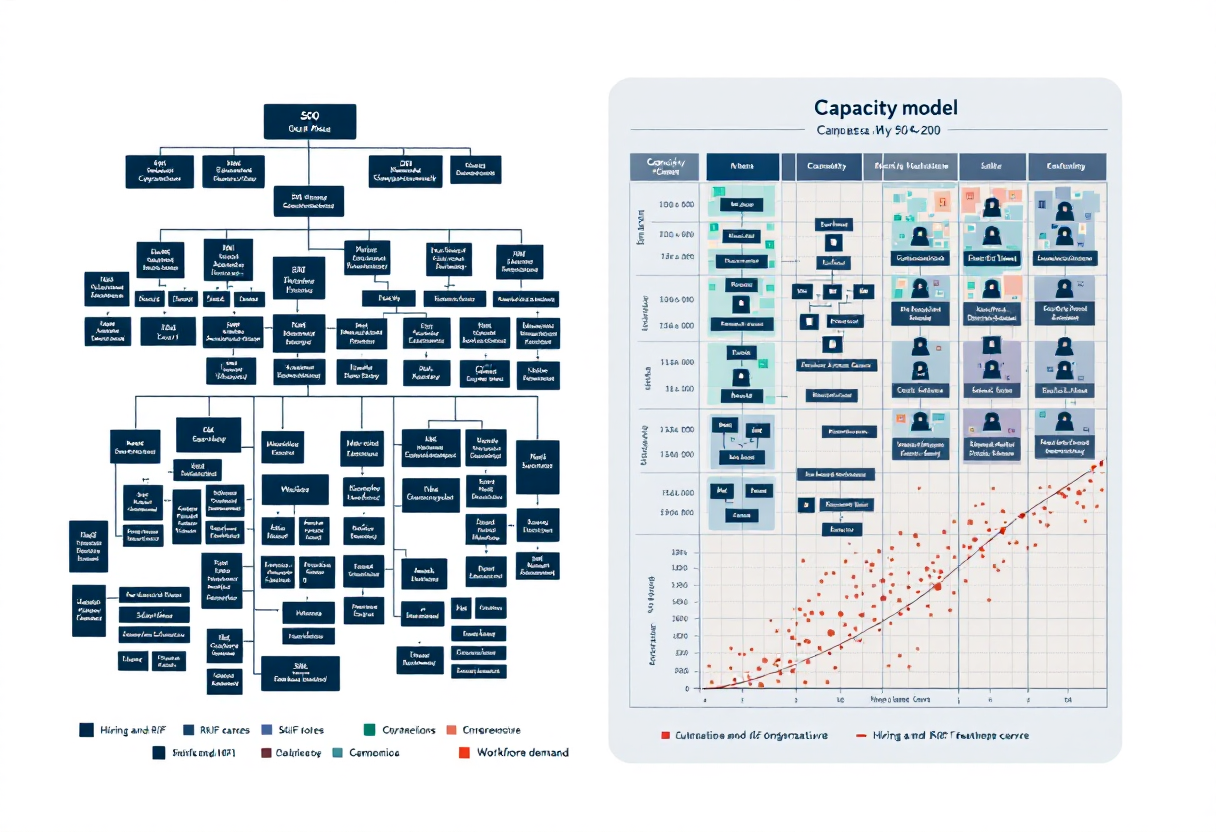
The distinction between succession planning vs workforce planning is the difference between protecting 50 to 200 named key roles and sizing the entire 5,000-plus person organization for the next three years of demand, and getting the two confused is how CHROs end up with deep CEO bench depth and a 14 percent skill-gap hole in the operating workforce. SHRM’s 2025 Talent and Succession Research Report found that 56 percent of HR functions run some form of succession program, while Mercer’s 2025 Global Talent Trends found only 28 percent of those same organizations run a quantitative workforce plan that ties headcount, skills, and total rewards to the three-year strategic plan. This guide walks through the two disciplines side by side so CHROs, board members, and HR strategists can run them as the complementary systems they are, and so sellers can show buyers a leadership pipeline and a capacity model that both stand up to diligence.
Planning a sale or carve-out in the next 12 to 36 months?
Buyer-paid M&A advisory. We work for the buyer, you keep more of your equity. We will tell you which key-role gaps move the multiple, and how your workforce plan reads to an acquirer’s integration team.
Book a Free ConsultationWhat This Actually Means
Succession planning is a key-role discipline. It identifies the named positions where a 90 to 180 day vacancy would damage enterprise value, customer relationships, or strategic execution, and then builds a pipeline of identified successors with development plans against those seats. The unit of analysis is the individual role and the individual successor. The output is a list of named positions (typically 50 to 200 in a mid-to-large organization), a readiness rating for each successor (often coded ready-now, ready in 1 to 2 years, ready in 3 to 5 years), and a development investment plan attached to each name.
Workforce planning is a whole-organization discipline. It sizes total headcount, total skills mix, and total payroll spend against the three-year strategic plan and the external labor market. The unit of analysis is the function, the location, and the skill family, not the individual seat. The output is a quantitative model with hiring numbers by quarter, attrition assumptions, skill-gap heat-maps, location strategy decisions (in-office, hybrid, offshore, nearshore), and a total-rewards alignment that holds the model together. In a 5,000 person company, workforce planning is making decisions about 800 to 1,200 hires, 600 to 900 exits, and 300 to 500 reskilling moves per year. Succession planning at the same company is making decisions about roughly 80 to 150 named seats and the 200 to 400 people in the broader successor pool.
Both disciplines are legitimate, both are run by HR, and most mid-market and enterprise companies need both. The problem the Mercer and SHRM data exposes is that organizations resource one and starve the other. The most common pattern is a well-staffed succession function (because the CEO and the board ask about it every quarter) and a workforce planning function that lives in a Finance-owned headcount spreadsheet, updated annually, with no skills layer and no location strategy. Buyers, regulators, and credit committees notice the imbalance.
The Eight Dimensions You Need to Understand
1. Scope: Key Roles vs Whole Organization
Current state in most organizations. Succession planning covers the C-suite plus the layer below, usually 8 to 20 seats. Workforce planning, where it exists, is a headcount budget produced once a year as part of the annual operating plan, with no skills decomposition and no location lens.
Target state. Succession planning covers every role where a 90 to 180 day vacancy would meaningfully damage revenue, margin, or customer retention, which in a 5,000 person company is typically 50 to 200 named positions across the C-suite, the second tier, key revenue producers, scarce technical roles, and critical regulatory or compliance roles. Workforce planning covers the entire workforce decomposed by function, skill family, location, and time horizon. Mercer’s 2025 Global Talent Trends report found that high-performing organizations run skill-level workforce models on 100 percent of the operating workforce, while average performers cover roughly 35 percent.
Impact on outcome. Key-role coverage protects against named-individual failure at the top of the house. Whole-organization coverage protects against the more common and more expensive failures: a 14 percent skill gap in cloud engineering that gates a product roadmap, an over-hire in a function that has to be unwound through a costly reduction in force 18 months later, or a location strategy that has the wrong 600 seats in the wrong city when the lease comes up for renewal.
2. Time Horizon: 3 to 5 Year Role View vs 12 to 36 Month Rolling Plan
Current state. Most succession charts show a snapshot. The talent review meeting is annual, the chart is updated quarterly at best, and the readiness ratings drift. Most workforce plans are a one-shot annual headcount budget that loses contact with reality within a quarter.
Target state. Succession planning operates on a 3 to 5 year per-role horizon, because that is how long it takes to develop a successor for a senior role from ready-in-3-to-5-years to ready-now. The talent review cadence is quarterly, with an annual deep dive at the board or compensation committee level. Workforce planning operates on a 12 to 36 month rolling horizon, refreshed every quarter with new demand signals, new attrition data, and a new external labor-market view. DDI’s 2025 Global Leadership Forecast found that organizations running quarterly talent reviews score 2.3 times higher on financial top-quartile performance than organizations running annual-only reviews, and Workday’s 2025 strategic workforce planning customer benchmarks show that quarterly-refreshed plans achieve 18 percent better hiring-plan accuracy than annual plans.
Impact on outcome. A 3 to 5 year per-role horizon builds bench depth. A 12 to 36 month rolling capacity model keeps the operating engine staffed. Run only the first and the C-suite is covered while the engineering function is 200 people short. Run only the second and the headcount budget hits but the CEO leaves and there is no successor.
3. Inputs: Talent Reviews and Readiness vs Business Plan and Demand Forecasts
Current state. Succession planning is fed by talent review data (performance, potential, readiness ratings) and qualitative assessments from senior leaders. Workforce planning, where it exists, is fed by a headcount budget number handed down from Finance with no demand signal underneath it.
Target state. Succession planning inputs are the 9-box grid output, individual development plan progress, external benchmarking of successor caliber, and qualitative assessments from the executive committee. Workforce planning inputs are the three-year strategic plan (new products, new geographies, new customer segments), demand forecasts by function (revenue per sales head, customers per service head, transactions per operations head), attrition models by function and location, external labor-market supply curves, and total-rewards competitiveness data. SHRM’s 2025 research found that organizations whose workforce plans are tied directly to the strategic plan have 31 percent higher revenue per employee than organizations whose plans are tied only to last-year-plus-X percent growth.
Impact on outcome. Succession inputs answer the question, who will run the business in five years. Workforce planning inputs answer the question, how many people, with what skills, in what locations, do we need to hit the three-year plan. Get the inputs wrong and the outputs are decorative.
4. Outputs: Named Successors and Development Plans vs Hiring Numbers, Capacity Model, and Skill Heat-Maps
Current state. Succession outputs are a chart and a binder of development plans. Workforce outputs are a headcount number in the operating plan.
Target state. Succession outputs are a named successor list (primary and secondary), a readiness rating per successor, an individual development plan tied to specific stretch assignments and external programs, and a quarterly talent review process that updates the whole stack. Workforce outputs are a quantitative capacity model (heads required to hit the plan by function, quarter, and location), a hiring plan (number of requisitions by quarter, by function, by location), an attrition model with a skill-weighted view of who is leaving, a skill-gap heat-map (current skill inventory vs required skill inventory at the 12, 24, and 36 month mark), and a total-rewards alignment showing whether current pay bands will close the gap or whether structural pay decisions are needed.
Impact on outcome. Succession outputs make the leadership transition decisions defensible. Workforce outputs make the headcount, location, and pay-band decisions defensible. Buyers, board members, and credit committees ask for both.
5. Data Systems: Workday Succession Module vs Workday Workforce Planning
Current state. Most mid-market HR functions run succession in a PowerPoint deck and workforce planning in an Excel sheet owned by Finance. Neither tool integrates with the HRIS, the ATS, or the LMS, and reconciling the two is a manual annual exercise.
Target state. Succession planning runs in a dedicated module of the HRIS (Workday Succession, SuccessFactors Succession and Development, Oracle Talent Management Cloud, or equivalent) that ties named positions to named successors, captures readiness ratings, links to the LMS for development plan progress, and feeds the quarterly talent review. Workforce planning runs in a dedicated planning module (Workday Adaptive Planning with the Workforce Planning extension, Anaplan, Visier, or equivalent) that ties demand drivers to headcount, captures attrition and skill data from the HRIS, and produces the quarterly capacity refresh. Workday’s 2025 strategic workforce planning customer benchmarks show that organizations using a dedicated workforce planning tool achieve 22 percent lower hiring-plan variance than organizations running the plan in Excel, and the Sierra-Cedar 2024-2025 HR Systems Survey found that 41 percent of large employers now run dedicated workforce planning software alongside their HRIS, up from 26 percent in 2022.
Impact on outcome. The systems are different because the data is different. Succession data is small (hundreds of named records), high-touch, and qualitative. Workforce data is large (tens of thousands of records), automated, and quantitative. Running one in the other produces a tool that fails at both.
6. Ownership: HR Business Partners and Executive Committee vs Strategic Workforce Planning Team and Finance
Current state. Succession planning is owned by the CHRO with HR business partners running the local talent reviews. Workforce planning is split between Finance (the headcount number) and HR (the recruiting plan), with neither side owning the skill or location decisions.
Target state. Succession planning is owned by the CHRO and the HR business partners, reviewed quarterly with the executive committee, and reviewed annually with the board or compensation committee. The decision rights sit with the executive committee. Workforce planning is owned by a dedicated strategic workforce planning team (typically 3 to 8 people in a 5,000 person company) inside HR, with a joint operating model with FP&A that aligns the capacity model with the financial plan. The decision rights are split: Finance owns the headcount budget, HR owns the skills and location strategy, and the executive committee approves the integrated plan. Mercer’s 2025 Global Talent Trends report found that organizations with a dedicated strategic workforce planning team are 2.4 times more likely to hit their three-year revenue plan than organizations where workforce planning is a part-time responsibility.
Impact on outcome. Clear ownership produces clear decisions. Split or ambiguous ownership produces a headcount budget that has nothing to do with the strategic plan and a succession chart that has nothing to do with the workforce model.
7. M&A Relevance: Buyer Diligence vs Synergy and Integration Headcount
Current state. Sellers walk into a sale process with a succession chart that names a successor for the CEO and not much else, and a workforce plan that is whatever the last operating plan said.
Target state. Succession depth is one of the top three non-financial diligence areas for strategic and private equity buyers. Capstone Partners’ 2025 Middle Market Year-End Review highlights leadership transferability as a top-three area where deals get re-traded after LOI, with re-trades averaging 8 to 12 percent off the original headline price when bench depth is found to be weaker than represented. Workforce planning shows up on the buyer side: synergy modeling, integration headcount targets, location consolidation decisions, and the total-rewards alignment between buyer and target are all driven off the target’s workforce model. A target with a credible 24 month rolling workforce plan is materially easier to integrate than a target whose headcount lives in a spreadsheet, and that ease of integration is priced into the multiple. The M&A Source 2025 Market Pulse Report notes that targets with documented operational planning systems (which include workforce planning) transact at a 0.3x to 0.6x EBITDA premium over comparable targets without such systems.
Impact on outcome. Succession depth protects the headline multiple. Workforce planning credibility shortens the integration timeline and protects the synergy case. Sellers who run both get the premium and the certainty of close. Sellers who run neither get the discount and the longer earnout.
8. The 4-Quadrant Decision Matrix
Current state. Most organizations resource succession and workforce planning based on what the board asked about last quarter, not based on a structured view of where each is most needed.
Target state. Run a simple 4-quadrant assessment for every function or business unit. The two axes are succession risk (probability and impact of a key-role vacancy in the next 24 months) and workforce coverage (current skill and headcount fit against the 24 month demand model). High-risk, low-coverage units need both succession and workforce planning, urgently. Low-risk, high-coverage units need neither beyond a maintenance cadence. High-risk, high-coverage units need succession planning focus, because the operating workforce is sized but the leadership bench is thin. Low-risk, high-coverage units in growth scenarios need workforce planning focus, because leadership is stable but the function is about to double in size.
Impact on outcome. The matrix forces the conversation. It tells the CHRO and the executive committee where the marginal HR dollar is best spent, which is rarely where the loudest stakeholder is asking.
Worked Example: Two 5,000 Person Healthcare Companies, Same Strategic Plan, Different Outcomes
Consider two fictional but realistic companies: Cascade Health Services and Beacon Care Group. Both employ 5,200 people, both produce roughly 480 million in revenue and 62 million in EBITDA in 2025, both operate multi-state outpatient and home-health networks, and both have a three-year strategic plan that targets 22 percent revenue growth, geographic expansion into three new states, and the addition of a virtual care service line. On paper, the strategic plans are identical.
Cascade Health Services. The CHRO runs a quarterly succession review covering the top 80 named positions. The CEO has a ready-now successor (the COO), the CFO has a ready-in-1-to-2-years successor, and 64 of the 80 named positions have at least one identified successor. The board reviews the succession chart annually. Workforce planning, however, lives in an Excel sheet owned by FP&A that says headcount should grow from 5,200 to 6,150 over three years, with no skills breakdown, no location strategy for the three new states, and no integrated view of how the virtual care service line will be staffed. The plan was last refreshed 11 months ago.
Beacon Care Group. The CHRO runs the same quarterly succession process, covering 95 named positions with similar coverage ratios. Beacon also runs a 5-person strategic workforce planning team that maintains a 24 month rolling capacity model in Workday Adaptive Planning. The model is refreshed every quarter against the strategic plan, decomposes headcount by function, skill family, and location, and feeds a hiring plan that recruiting executes against. The skill-gap heat-map shows a 12 percent shortfall in licensed clinical roles in the three new states and a 28 percent gap in virtual care technology roles, and the workforce plan has a dedicated funding line for closing those gaps through a mix of relocation, partnerships with regional nursing schools, and a targeted retention pay adjustment for the technology roles.
The outcome at the 24 month mark. Both companies execute leadership transitions cleanly because both run real succession planning. The CFO at each company retires on schedule, the successor moves in, and the transition is invisible to customers and investors. The difference shows up in the operating results. Cascade hits 87 percent of its hiring plan, misses the virtual care launch by two quarters because it cannot find the technology talent, and burns 4.1 million dollars in premium agency staffing to cover the licensed clinical gap in the new states. Beacon hits 96 percent of its hiring plan, launches virtual care on schedule, and avoids the agency premium because the workforce plan flagged the gap 18 months earlier.
The valuation math at exit. Both companies go to market in year three. At a base-case healthcare services multiple of 9.5x to 11.5x EBITDA for high-quality outpatient and home-health platforms in the 50 to 100 million EBITDA band, both businesses sit in the same headline range. Cascade transacts at 9.8x EBITDA on a trailing EBITDA of 71 million, for an enterprise value of roughly 696 million dollars, with a meaningful earnout tied to the virtual care launch the buyer is now responsible for. Beacon transacts at 11.2x EBITDA on a trailing EBITDA of 78 million, for an enterprise value of roughly 874 million dollars, with a clean structure and no earnout. The 178 million dollar spread is partly the trailing EBITDA difference and partly the multiple premium the buyer pays for a target whose workforce model and succession bench both stand up to diligence.
Beacon’s incremental investment was a 5-person workforce planning team (roughly 1.2 million dollars per year in fully loaded cost, or 3.6 million over the three years) plus the Workday Adaptive Planning license (call it 240,000 over three years). Total incremental workforce planning investment, generously calculated, is around 3.85 million dollars. The return at sale is several multiples of that figure even after netting against the trailing EBITDA delta. The math is consistent with the Mercer 2025 finding that workforce-planning-mature organizations are 2.4 times more likely to hit their three-year plan.
Common Mistakes
Calling a Headcount Budget a Workforce Plan
The single most common mistake in mid-market and enterprise HR functions. A spreadsheet that says headcount will grow from 5,200 to 6,150 over three years is a headcount budget. It says nothing about which functions, which skills, which locations, or which time periods. A real workforce plan is a quantitative capacity model with a skill layer, a location layer, and an attrition view, refreshed quarterly. Boards and buyers can tell the difference inside one diligence session.
Running Succession Planning Without a Skills Inventory
Succession charts that name a successor without specifying what skills the successor still needs to develop are decorative. The HBR piece “Why So Many Succession Plans Fail” by Larcker and Tayan, drawing on a multi-year study of CEO transitions, argues that the most common failure mode is naming a successor based on tenure or visibility rather than against a defined skills profile for the future role. A real successor list ties each name to a defined skills profile and a development plan that closes the gap.
Running Workforce Planning Without a Strategic Plan Underneath It
If the workforce plan is built off last-year-plus-X percent growth, it is not a workforce plan. It is a budget. A real workforce plan starts from the three-year strategic plan (new products, new geographies, new customer segments, new service lines) and works backward into the demand drivers (revenue per sales head, customers per service head, transactions per operations head) before it gets to headcount. Skip the strategic plan and the workforce plan is a guess dressed up in spreadsheet formatting.
Letting Finance Own the Skill and Location Decisions
Finance owns the headcount budget number. Finance does not own the skill mix or the location strategy, because those are talent decisions with multi-year consequences. When Finance owns the workforce plan end-to-end, the typical pattern is a plan that hits the budget number and misses the strategic objective, because Finance optimizes for cost and HR is not in the room when the trade-offs get made. The fix is a joint operating model where Finance owns the budget, HR owns the skills and location strategy, and the executive committee approves the integrated plan.
Treating the Two Disciplines as Substitutes
Some CHROs argue that succession planning is enough at the top of the house and workforce planning is enough for the rest of the organization. They are not substitutes. The C-suite needs both a named successor and a workforce model for the function it runs. The operating workforce needs both a skill-gap heat-map and a successor pool for the supervisory layer that runs it. Treating the two as either-or is how organizations end up with a deep CEO bench and a 14 percent skill gap in the operating engine, or vice versa.
Refreshing Annually Instead of Quarterly
Both disciplines decay quickly. SHRM’s 2025 data shows that organizations running succession reviews at least three times per year have 40 percent higher leadership bench depth than organizations running annual reviews. Workday’s 2025 customer benchmarks show that quarterly-refreshed workforce plans hit hiring-plan targets 18 percent more often than annually-refreshed plans. Annual refresh is a tax that pays out as missed plans and surprise vacancies.
Timeline and Process for Standing Up Both Disciplines
The build sequence below assumes a mid-to-large organization (1,500 to 10,000 employees) standing up integrated succession and workforce planning from a low base. Smaller organizations can compress the timeline; larger or more geographically distributed organizations should extend it.
Phase 1: Diagnose and scope (months 1 to 3). Run the 4-quadrant assessment by function and business unit. Identify the 5 to 10 highest-risk units (high succession risk, low workforce coverage) and start there. Pick the HRIS and planning toolset (Workday plus a workforce planning module is the common 2026 stack, but SuccessFactors plus Visier and Oracle plus Anaplan are equally credible). Define the operating model: who owns succession (CHRO and HRBPs), who owns workforce planning (a dedicated team inside HR with a joint operating model with FP&A).
Phase 2: Build the data foundation (months 3 to 6). Clean the HRIS data: positions, roles, skills, locations, performance ratings, potential ratings. Stand up the skills taxonomy (most organizations adopt a hybrid of an internal taxonomy and a commercial framework like Lightcast or SkyHive). Define the demand drivers by function (revenue per sales head and so on). Stand up the attrition model with at least 24 months of historical data.
Phase 3: Build the first integrated plan (months 6 to 9). Produce the first quarterly succession review for the named positions identified in Phase 1. In parallel, produce the first 24 month rolling workforce plan with skill-gap heat-maps and a hiring plan by quarter, function, and location. Bring the two outputs to the executive committee together and force the integration conversation.
Phase 4: Operationalize the cadence (months 9 to 12). Embed the quarterly talent review and the quarterly workforce planning refresh in the executive committee calendar. Define the board cadence (annual deep dive on both, with quarterly updates on the high-risk units). Define the KPIs (internal fill rate for leadership openings, hiring-plan accuracy, skill-gap closure rate, successor readiness progression).
Phase 5: Scale and mature (months 12 to 24). Expand succession coverage from the initial 5 to 10 units to the full 50 to 200 named positions across the enterprise. Expand workforce planning coverage to 100 percent of the operating workforce with quarterly refresh discipline. Add total-rewards alignment to the workforce planning output. Add external benchmarking to the succession output.
Phase 6: Sale or integration readiness (months 24 onward). If the organization is preparing for a sale, document both disciplines for the diligence room: succession charts with readiness ratings and development plan progress, workforce model with quarterly refresh history and hiring-plan accuracy. If the organization is preparing for an acquisition, use the workforce model to drive the synergy case and the succession chart to drive the integration leadership decisions.
How CT Acquisitions Approaches Succession Depth and Workforce Maturity in a Sale Process
CT Acquisitions is a buyer-paid M&A advisor. Buyers pay us, sellers keep more of their equity, and that incentive lets us tell sellers the truth about which HR and talent gaps will move the multiple. We see the same patterns repeatedly: sellers with a deep succession bench and a thin workforce model take a discount on integration certainty, sellers with a credible workforce model and a thin succession bench take a discount on key-role risk, and sellers with neither take both discounts.
For sellers planning a transaction in the next 12 to 36 months, the playbook is straightforward. Stand up real succession planning on the 50 to 200 named positions that drive enterprise value. Stand up real workforce planning on the full operating workforce with a quarterly refresh discipline. Document both in systems a buyer can audit. Walk into the diligence room with the talent review minutes, the readiness ratings, the workforce model history, and the hiring-plan accuracy data. That preparation typically returns several multiples of the direct investment in incremental purchase price and shorter time-to-close.
Frequently Asked Questions
Is succession planning a subset of workforce planning?
No. The two disciplines overlap on personnel data but operate on different units of analysis. Succession planning is named-individual, named-position, multi-year. Workforce planning is function-level, location-level, skill-level, rolling. A workforce plan does not produce a successor list, and a succession chart does not produce a hiring plan. Most mature HR functions run them as integrated but distinct processes with shared data and separate outputs.
Who should own workforce planning, HR or Finance?
HR should own the skill and location strategy, Finance should own the headcount budget number, and the executive committee should approve the integrated plan. The most common failure mode is letting Finance own the entire plan, which produces a budget that hits cost targets and misses strategic objectives. The second most common failure mode is letting HR own the plan in isolation from FP&A, which produces a wish list that has no financial constraint. The joint operating model is what works.
How big does an organization have to be to need formal workforce planning?
The practical threshold is around 500 employees or about 50 million in revenue, whichever comes first. Below that, workforce planning can be run as a quarterly conversation between the CEO, the CFO, and the head of HR with a one-page model. Above that, the complexity (multiple functions, multiple locations, multiple skill families, meaningful attrition) requires a dedicated tool and a dedicated process. By 5,000 employees, a dedicated 3 to 8 person workforce planning team is standard.
What is the right cadence for succession reviews and workforce planning refreshes?
Quarterly for both, with an annual deep dive at the board or compensation committee level. SHRM’s 2025 data shows that organizations running succession reviews at least three times per year have 40 percent higher bench depth, and Workday’s 2025 benchmarks show quarterly workforce plans hit hiring targets 18 percent more often. Annual-only cadence is a false economy because the plans decay fast and the cost of being wrong on a 12 month plan is materially higher than the cost of the quarterly refresh.
How does workforce planning interact with a reduction in force or restructuring?
A real workforce plan makes a reduction in force a quantitative decision rather than a panicked one. The skill-gap heat-map shows which skills to protect, the location strategy shows which sites to consolidate, the attrition model shows where natural reduction will close part of the gap, and the total-rewards alignment shows whether retention pay is needed for the people staying. Organizations that run reductions without a workforce model underneath them typically over-cut in skills they need 18 months later and have to rehire at a premium. Bureau of Labor Statistics Employment Projections 2024-2034 data on professional services, healthcare, and technology occupations is a useful external check on whether the skills being cut are about to get more expensive in the open market.
What do M&A buyers actually look at on the workforce side during diligence?
Buyers look at five things. First, the trailing 24 months of attrition by function and level, and the comparison to industry benchmarks. Second, the open-requisition aging report, because a stale requisition pipeline signals operational drag. Third, the skill-gap heat-map and what is being done about it. Fourth, the total-rewards competitiveness data, because a target that is below market on pay bands will lose people post-close. Fifth, the succession chart for the top 30 to 50 named positions, with readiness ratings and development plan progress. A target that can produce all five inside the first two weeks of diligence is materially easier to close than one that cannot.
What to Do Next
For CHROs and HR leaders standing up both disciplines, start with the 4-quadrant assessment and a 90 day plan to pick the toolset and define the operating model. For owners planning a sale in the next 12 to 36 months, start with the diligence-room view: what would a buyer’s HR diligence lead ask for on day one, and what would the answer be today. The gap between those two answers is the work.
Buyer-paid M&A advisory for owners planning a sale
We work for the buyer, you keep more of your equity. We will tell you which key-role gaps move the multiple, which workforce-planning weaknesses extend the earnout, and how to close both before the diligence room opens.
Book a Free ConsultationRelated reading: Replacement Planning vs Succession Planning | Effective Succession Planning | Sell Your Business