
How to Prepare Your Optometry Practice for a Sale or Exit (2026)
Updated April 2026 · CT Acquisitions

Most optometry owners decide to sell, hire a broker, and find out 90 days later that their practice is worth 30% to 50% less than they thought. The owners who get the top-quartile price start preparing 24 to 36 months before they ever talk to a buyer. This guide is the 36-month playbook for how to prepare your optometry practice for a sale or exit. It covers what private equity actually buys, the 12 levers that move multiples, the documents an OD-MSO will ask for before they send an indication of interest, and the deal-killers that re-trade optometry transactions during confirmatory diligence. Every number cites its source. Every recommendation comes from how the most active OD-MSO and eye care PE platforms in 2026 actually behave.
If you are 6 to 36 months from a possible exit, this is the work that turns a 4x EBITDA outcome into an 8x EBITDA outcome. On a $1.5M EBITDA optometry practice, that is the difference between a $6M sale and a $12M sale. Whether you want to prepare your optometry practice for a sale to a PE-backed OD-MSO platform, prepare your optometry practice for an exit to a strategic acquirer, or simply maximize value over the next 1 to 3 years before going to market, the work below applies.
Building toward an exit in 12 to 36 months?
CT Acquisitions runs sell-side advisory for optometry owners $750K+ EBITDA. We also have optometry practice operators in our partner network who run pre-sale optimization engagements when the timeline is longer. Buyers pay our fee, not you.
What Private Equity Actually Buys in Optometry (2026)
40+ PE-backed eye care MSOs are actively buying US optometry practices in 2026, with 35 PE-backed eye care deals closed in 2023, 18 in 2024, and 40+ total transactions through Q1 2025 counting both PE add-ons and strategic acquirers (Private Equity Stakeholder Project; FOCUS Investment Banking “Ophthalmology Practice Valuation 2026 Benchmarks”; Physician Growth Partners State of Eye Care PE Q1 2025; Review of Ophthalmology “Update: Private Equity in Ophthalmology”). 16 of the 25 largest healthcare PE investors per PitchBook have stakes in optometry or ophthalmology practices (Medscape 2026). The sponsor money flowing in is not random. PE buys specific profiles, and the profile you build determines the multiple you get.
The demographic tailwind matters. The American Optometric Association projects US demand for routine and medical eye exams to rise 19% and 62% respectively between 2021 and 2040, while the optometry workforce nets approximately 513 physicians annually. That is the underwriting thesis the PE platforms cite when they pay specialty premiums on the optometry side specifically. Over 13,000 US eye care practices remain as the addressable market for continued roll-up activity (Physician Growth Partners 2025).
The PE-attractive optometry profile
- EBITDA threshold for a platform-quality deal: $1M to $3M is the entry band where regional OD-MSOs run a competitive process. Below that, you are an add-on inside a roll-up at percent-of-collections pricing. Above $3M, you are an attractive bolt-on for the larger national platforms. Above $5M, you are a platform candidate or strategic-tier target.
- Owner-OD production share: Owner produces under 35% of collections; associate ODs carry the balance. Owner production above 50% triggers a 1.0x to 2.0x multiple discount (Practice Exchange; ODs on Finance; Arrowfish 2025).
- Optical capture rate: 75%+ of patients buying eyewear at the practice. National average is 60% per MaximEyes and Sullivan Management retail optical benchmarks. Capture rate is the single biggest optometry-specific EBITDA lever.
- Payer mix: 30%+ of exam revenue from medical billing (dry eye, glaucoma, diabetic retinopathy, post-cataract comanagement) vs. vision-plan-only. Medical exams reimburse $150+ vs. $80 for routine vision per Independent Strong and Review of Optometric Business 2025.
- Specialty mix: At least one differentiated specialty line (dry eye program with IPL or LipiFlow, scleral lens fitting, myopia control, vision therapy, low-vision) generating 15%+ of revenue. Specialty mix commands 1.5x to 3x higher EBITDA multiples vs. commodity commercial OD (FOCUS 2026).
- Recurring revenue: 10%+ of patients enrolled in an in-house membership plan ($35 to $49/mo per BoomCloud benchmark) and 60%+ of contact lens patients on annual-supply commitments.
- Geography: Sun Belt and high-growth metros (TX, FL, AZ, NC, GA, NV, CO) command demand premiums per FOCUS and Physician Growth Partners platform mapping.
- Payer concentration: No single vision plan (VSP, EyeMed, Davis Vision, Spectera) above 25% of collections.
Active optometry OD-MSO and eye care PE platforms in 2026
The list below covers the most active sponsor-backed platforms in the 2024-2026 cycle that employ ODs at scale. This is who will see your teaser. Practice counts are point-in-time; sources include Vision Monday, Eyewire+, Review of Optometric Business, Becker’s ASC, PitchBook, PrivSource, Physician Growth Partners, FOCUS Investment Banking, sponsor press releases, and CT Acquisitions’ own optometry buyer map.
| Platform | Sponsor | Profile |
|---|---|---|
| EyeCare Partners | Partners Group (since Dec 2019; $2.2B EV at entry; Apr-May 2024 debt exchange with $275M new money) | Largest US OD + MD platform: 700+ locations, 18 states, 300+ ophthalmologists, 700+ optometrists, 4,400+ clinical staff. Tuck-in $1M to $5M EBITDA. |
| MyEyeDr (Capital Vision Services) | Goldman Sachs Asset Management Merchant Banking (since 2019, $2.7B EV) | OD-heavy MSO: 900+ locations across 20+ states; 50/yr new-location cadence post-2026. Tuck-in $500K to $5M EBITDA. |
| AEG Vision (fka Acuity Eyecare Group) | Riata Capital + J.P. Morgan Asset Management | Pure-play OD MSO: 500+ practices, 5,000+ optometrists and associates, ~3M patients/yr (Aug 2025). TX, NM, CO, NE, OH, PA. Tuck-in $500K to $3M EBITDA. |
| EyeSouth Partners | Olympus Partners (since Sept 2022; sold retina business to Cencora for $1.1B Mar 2026, retained anterior segment) | OD + MD specialty MSO: 290+ physicians, 160+ locations, 11 states pre-divestiture. Southeast specialty. |
| Spectrum Vision Partners / OCLI Vision | Blue Sea Capital + GCM Grosvenor + Hamilton Lane | Northeast / Mid-Atlantic multi-specialty: 1,400+ employees, 150+ providers across CT, NJ, NY, PA, WV with ASC ownership. |
| American Vision Partners (AVP) | H.I.G. Capital (Mar 31, 2025 added Evernorth Care Group eye care services) | Sun Belt OD + MD MSO: 130+ doctors, 100+ centers, 25 ASCs, 25 satellite clinics across AZ, TX, NM, NV, CA. |
| Vision Innovation Partners (VIP) | Gryphon Investors (since 2022; Jun 2025 added Eye Care of Delaware) | Mid-Atlantic multi-specialty: 150+ providers, 68 locations including 12 ASCs across MD, DC, VA, PA, DE. Tuck-in $1M to $5M. |
| Keplr Vision | Imperial Capital + Golub Capital debt | Pure-play OD MSO: 600+ employees, multi-state (IL HQ). Formed mid-2019 by Total ECP + Visionary Eye Partners merger. |
| Total Vision | Bregal Sagemount | California pure-play OD MSO: continuous 2024-2025 CA tuck-ins (Riverside, Family Eyecare, i-Care, Golden Vision, Santa Clara, Dr. Goldstone). |
| Eye Health America | LLR Partners | Southeast MD-led platform with significant OD employment: 25+ practice locations. |
| US Eye | Pamlico Capital | FL core, Southeast: 30+ ophthalmologists and optometrists. |
| Comprehensive EyeCare Partners | PE-backed | Sun Belt comprehensive eye care, multi-state. |
| Atlantic Vision Partners | LLR Partners | Mid-Atlantic multi-specialty across VA + Carolinas. |
| Blue Sky Vision | Blue Sea Capital | Michigan flagship multi-specialty regional with multi-state expansion. |
| Midwest Vision Partners | Pamlico Capital | Multi-state Midwest multi-specialty. |
| SightMD | Chicago Pacific Founders + others | NY metro + NJ OD + MD multi-doc platform. |
Two flags for sellers planning a buyer slate. EyeCare Partners executed a distressed-debt exchange April-May 2024 with $275M new money and was downgraded by S&P Global Ratings in 2024; still actively recruiting partners, but advisors should ask about deal-pause risk before running them in a process. EyeSouth Partners divested its retina business to Cencora for $1.1B in March 2026 and retained anterior segment only; bidder appetite at the OD tier is intact but the platform is partially divested. Also worth noting: Acuity Eye Group (CA physician-owned) is distinct from AEG Vision; do not confuse the two. ClearVision Optical, acquired by Quadrum Capital January 7, 2025, is a frame distributor and not a clinical OD-MSO buyer. SVS Vision was acquired by German family-owned Fielmann Group AG September 1, 2023 and is a retail strategic, not PE.
Add to that list the strategic acquirers. Cencora (NYSE: COR) acquired Retina Consultants of America from Webster Equity Partners for $4.6B announced November 6, 2024 and closed January 2, 2025, implying 18.4x EBITDA per FOCUS Investment Banking analysis; followed in March 2026 with the $1.1B EyeSouth retina carve-out. McKesson (NYSE: MCK) agreed February 4, 2025 and closed April 2, 2025 on 80% of PRISM Vision Holdings from Quad-C Management for $850M, with PRISM physicians retaining 20%, anticipated $0.20 to $0.30 EPS accretion in year one and $0.65 to $0.75 by year three. EssilorLuxottica closed Optegra Eye Health Care (70+ care facilities, 5 European markets) in 2025 and has agreed to Signifeye (15 Belgian eye care centers) for Q1 2026 close; in the US, EssilorLuxottica owns LensCrafters, Sunglass Hut, Pearle Vision, Target Optical, and Vision Source (the largest US independent OD network at 4,700+ member practices and $3B+ combined revenue per Vision Monday). VSP Global / VSP Vision acquired Visionworks (700+ stores, 40 states) October 1, 2019. National Vision Holdings (NASDAQ: EYE) is the public commercial-optometry consolidator: 10 consecutive quarters of positive same-store sales and ~$1.95B FY2025 revenue at midpoint per its quarterly 8-Ks. Warby Parker (NYSE: WRBY) reported eye exam business growth over 40% YoY in 2024 representing ~5% of revenue per Q4 2024 earnings. 1-800 Contacts, KKR-owned, is expanding into clinical via ExpressExam and 6over6 AI in-home exams. Hoya and Carl Zeiss Meditec (XETRA: AFX, which acquired DORC in 2024) are equipment OEMs that supply your buyer rather than bid for you. Specsavers is the dominant UK retail strategic.
Optometry Valuation Multiples in 2026 (What You Are Actually Worth)
Optometry uses two valuation conventions in parallel, and owners should know both. The multiple a buyer pays comes down to your size, your specialty mix, your owner-OD production share, and your geographic fit. Here is the 2026 range, cross-referenced from FOCUS Investment Banking “Ophthalmology Practice Valuation 2026 Benchmarks”, Practice Exchange, Visionary Practice Group, ODs on Finance, Peak Business Valuation, Arrowfish Consulting, MyBCAT 2025-2026, Transitions Elite, and DVM Elite.
Percent of collections (smaller, solo OD practices)
| Practice tier | Percent of collections | Profile fit |
|---|---|---|
| Sub-$500K collections solo | 35% to 70% | Asset-purchase to local OD-buyer; often the only convention available at this tier (ODs on Finance; Visionary Practice Group) |
| $500K to $1M collections | 60% to 80% | Bulk of independent transactions (Practice Exchange; Optometry Times) |
| $1M+ collections with strong margin | 80% to 125% | Top end reserved for PE-ready solo or multi-doc commercial OD (MyBCAT 2025-2026) |
| AOA Journal historical mean | ~58.7% of gross income | 40% to 70% range covers most independent deals (AOA Journal per ODs on Finance; Optometry Times) |
The percent-of-collections convention masks profitability. A practice with $800K collections at 25% net margin is worth more than a practice with $1.2M collections at 10% net. The headline number is conventionally quoted gross of equipment, leasehold improvements, A/R, and frame inventory, which are typically purchased at separate book or appraised values. Above $1M EBITDA, EBITDA multiples take over.
EBITDA multiples (PE-attractive size)
| EBITDA band | General commercial OD multiple | Specialty / medical-heavy OD multiple |
|---|---|---|
| Under $500K EBITDA | 2.5x to 4x | 3x to 5x |
| $500K to $1M EBITDA | 3x to 5x | 4x to 6x |
| $1M to $3M EBITDA (add-on tier) | 5x to 7x | 6x to 9x |
| $3M to $5M EBITDA (emerging platform) | 7x to 9x | 9x to 11x |
| $5M+ EBITDA (platform-grade) | 8x to 12x (OD-only estimate) | 10x to 15x+ |
| Strategic / platform recap | n/a | 15x to 18x+ (Cencora/RCA 18.4x cited) |
Source: FOCUS Investment Banking “Ophthalmology Practice Valuation 2026 Benchmarks”; Peak Business Valuation “Valuation Multiples for an Optometry Clinic”; Arrowfish Consulting “Proven Guide to Optometry Practice Valuation 2025”; Transitions Elite; ODs on Finance; MyBCAT 2025-2026; DVM Elite; CT Acquisitions cross-reference.
An important differential: pure-ophthalmology platforms with ASC ownership and surgical procedural volume command structurally higher multiples than commercial optometry. The 10x to 15x range cited in the FOCUS 2026 benchmarks is anchored to ophthalmology + ASC platforms. Pure-OD multi-location groups at the same EBITDA scale should expect the lower end of that band, with our estimate at 8x to 12x for a $5M EBITDA pure-OD multi-location vs. 10x to 15x for a comparable MD+ASC platform. The gap closes if the OD platform has heavy medical optometry (dry eye, scleral lens, vision therapy) and an integrated ASC referral relationship. Multi-source synthesis confirms most optometry deals in the broader independent market sell for 3x to 6x EBITDA, with the platform-tier 10x to 15x+ band reserved for $5M+ EBITDA multi-doc multi-location specialty businesses (DVM Elite; Practice Exchange; multiple 2025-2026 brokerage guides).
Recent disclosed eye care transactions (2024-2026)
| Acquirer | Target | Date | Value | Implied multiple |
|---|---|---|---|---|
| Cencora (NYSE: COR) | Retina Consultants of America (from Webster Equity Partners) | Announced Nov 6, 2024; closed Jan 2, 2025 | $4.6B headline + $500M contingent; $4.4B cash for 85% | 18.4x EBITDA (FOCUS 2026 analysis) |
| McKesson (NYSE: MCK) | PRISM Vision Holdings (from Quad-C Management) | Agreement Feb 4, 2025; close Apr 2, 2025 | $850M for 80% stake; physicians retained 20% | Mid- to high-teens EBITDA (estimate) |
| Cencora (NYSE: COR) | EyeSouth Partners retina business (from Olympus Partners) | Mar 23, 2026 | $1.1B | Mid-teens EBITDA (estimate; pattern with RCA) |
| EssilorLuxottica | Optegra Eye Health Care (European 70+ care facility platform) | Closed 2025 | Terms undisclosed | Strategic European ophthalmology |
| Fielmann Group AG | SVS Vision (80+ stores, 9 US states, $100M+ 2022 revenue) | Sept 1, 2023 | Not disclosed | First strategic European entry to US retail optometry |
| H.I.G. Capital / American Vision Partners | Evernorth Care Group eye care services | Mar 31, 2025 | Not disclosed | Sun Belt OD + MD bolt-on |
| Partners Group / EyeCare Partners | $275M new money debt exchange (refinancing, not recap) | Apr-May 2024 | $275M new money | Capital structure reset; not a multiple print |
| Gryphon Investors / Vision Innovation Partners | Eye Care of Delaware | Jun 2025 | Not disclosed | Mid-Atlantic multi-specialty add-on |
Sources: Cencora 8-K November 2024 + January 2025 closing release; McKesson press releases February + April 2025; Olympus Partners “An Eye for an Eye” March 2026 release; EssilorLuxottica press; Fielmann Group press; American Vision Partners press March 2025; EyeCare Partners refinancing press April + May 2024; PR Newswire Gryphon/VIP June 2025; FOCUS Investment Banking 2026; Private Equity Stakeholder Project; PitchBook; PrivSource.
Notes on the comp set. The two cleanest disclosed platform-tier comps for 2024-2026 are Cencora/RCA at 18.4x EBITDA (retina) and McKesson/PRISM at an estimated mid- to high-teens (comprehensive ophthalmology). Both are MD-led platforms with ASC ownership; both buyers paid strategic premiums for specialty drug distribution and oncology-playbook scale economics. No pure-play OD-MSO platform recap has disclosed a clean multiple publicly in the 2024-2026 window. The MyEyeDr 2019 $2.7B EV (PE Hub reported 3.5x return for Altas Partners) is the most recent OD-heavy public benchmark. Add-on tier for a healthy $1M to $3M EBITDA OD practice sits in the 5x to 7x band; specialty/medical-optometry-heavy practices stretch into 7x to 9x at the same size.
The 12 Value Levers That Move Your Multiple (Ranked by Impact)

These are the levers that move optometry multiples in the 24 months before a sale. Each one has a current state, a target state, and an estimated financial impact. The ordering is by dollar impact per unit of effort, based on cross-source synthesis from FOCUS Investment Banking 2026, Practice Exchange “Complete Guide to Selling Your Optometry Practice in 2026”, ODs on Finance, Visionary Practice Group, Review of Optometric Business, MyBCAT, Sullivan Management retail optical benchmarks, and BoomCloud membership research.
Lever 1: Move owner-OD production below 35% of collections
Current: Owner OD produces 60%+ of collections. Target: Owner produces under 35%; one or two associate ODs carry the balance. Owner clinically active but not the production engine. Impact: Owner-OD dependence is the single most-cited multiple haircut in optometry valuation literature. Founder above 40% production triggers post-close revenue deterioration modeling (analog from Precision Dental Analytics applied to OD per Practice Exchange + ODs on Finance commentary). Estimate 1.0x to 2.0x multiple discount when owner production exceeds 50%. On a $1.2M EBITDA practice that is $1.2M to $2.4M of price. How: Hire associate(s) 18 to 24 months pre-sale. Associate compensation runs 14% to 20% of gross revenue, typically 15% to 18% on production-based comp with salary-floor structures at 20% to 24% of production above the floor (Review of Optometric Business; Integrated Planning & Wealth Management). Assign recall patients to associates first. Document SOPs so the practice runs without owner clinical involvement.
Lever 2: Build optical capture rate to 75%+
Current: Capture rate 55% to 65% (industry average per IrisMed and GPN Visions). Target: 75% to 85%+ capture (top quartile per MaximEyes and Sullivan Management retail optical benchmarks). Impact: Optical is 60% to 70% of practice revenue at 50% to 65% gross margin (KlinDeck; Wexford Insurance). Capture rate +15 points on a $1.5M revenue practice with 65% optical mix equals approximately $140K incremental optical revenue at 55% gross margin equals approximately $77K incremental EBITDA. At a 6x multiple that is $460K of sale price. Compounds over 24 months. How: Insurance-benefit-quote workflow at chairside (show patient out-of-pocket before they leave the exam room). Optician handoff at slit lamp. Frame board curation (200 to 400 SKUs per Sullivan Management benchmark, brand mix tuned to your demographic). Second-pair script as standard. FSA/HSA Q4 reminders.
Lever 3: Shift payer mix toward medical billing
Current: 80%+ exam revenue from vision plans (VSP, EyeMed, Davis Vision, Spectera, Superior Vision). Target: 30%+ exam revenue from medical billing (ICD-coded medical exams for dry eye, glaucoma suspect, diabetic eye exam, AMD monitoring, post-cataract surgery comanagement). Impact: Medical-coded exams reimburse $150+ vs. $80 for routine vision plan exams (Independent Strong / Review of Optometric Business “Making Every Exam Count” 2025). National average revenue per exam is $285; top performers reach $350 to $400. On a 5,000-exam-per-year practice, shifting 25% of exams from vision to medical at $70 incremental reimbursement equals $87,500/yr incremental collections at near-100% flow-through after marginal OD chair time. At a 6x multiple that is $525K of sale price. How: Medical billing training for front desk and biller. ICD-10 coding hygiene. Schedule medical follow-up slots distinct from annual exam slots. Build referral pipelines from local PCPs, endocrinologists (diabetics), rheumatologists (dry eye and uveitis), and cardiologists (HTN retinopathy). Adopt diagnostic technology (OCT, fundus photography, visual field) at the threshold supporting medical billing.
Lever 4: Launch or grow specialty services
Current: Commercial-only practice, no in-office dry eye procedures, no specialty CL fits, no myopia management. Target: At least one differentiated specialty service line generating 15%+ of revenue. Dry eye program with IPL or LipiFlow ($15K to $80K capex), in-office punctal plugs, lid hygiene, in-office Rx pharmaceuticals. Scleral lens fitting program (fitting set under $500; revenue can reach hundreds of thousands per Eye on Eye Care). Myopia management program (under $40K to launch fully equipped per CooperVision Practitioner case study; cited example added $75K bottom-line revenue first year per Review of Optometric Business). Impact: Per Review of Optometric Business case studies, specialty service mix lifts revenue per patient from $350 to $450 (commercial) to $1,200 to $1,800 (specialty-led), at 50% to 70% margins on most in-office procedures. Specialty practices command 1.5x to 3x higher EBITDA multiples vs. commodity commercial OD (FOCUS 2026). Estimate +1.0x to 2.0x EBITDA multiple uplift on a meaningful specialty program plus the underlying EBITDA growth. How: Owner CE plus certification in the specialty area. Hire a specialty-trained OD or bring a regional specialist in part-time. Add equipment (corneal topographer for scleral fits; OCT for dry eye and macular monitoring; meibography for dry eye; ortho-K trial set for myopia). Membership-plan structure to bundle specialty procedures.
Lever 5: Adopt and clean a modern PMS plus digital workflow
Current: Older PMS install with dirty data, no integrated optical POS, no automated recall, no digital phoropter integration. Target: Modern PMS (RevolutionEHR pricing starts at approximately $319/mo per Doctora 2025; Eyefinity; Compulink ONC-certified across 4,000+ practices and 16 Colleges of Optometry; Crystal PM; Officemate; MaximEyes) plus integrated optical POS plus automated recall (Weave, Solutionreach, Mango Voice, DoctorConnect) plus digital phoropter / OCT integration. Clean data hygiene. Impact: Direct EBITDA lift via efficiency (automated recall lifts recall response 50% to 65% vs. 30% to 40% manual per Apptoto; cuts no-shows up to 90%). Estimate +0.5x to 1.0x multiple uplift on the speed and credibility of diligence data room responses and post-close platform integration. RevolutionEHR Cloud-based unifies the clinical exam with the optical shop (a prescription entered in the lane is instantly visible to the optician for order fulfillment per Doctora 2025), which the diligence team spots in 30 seconds. How: 24 month run-up. Budget $20K to $80K for full digital workflow upgrade. PMS migration over 6 to 12 months with data cleanup. Tie associate-OD comp partially to data hygiene compliance.
Lever 6: Launch in-house membership plan and push contact lens annual supply
Current: No membership plan, or under 5% of patient base enrolled, CL patients on per-box rather than annual supply. Target: 10%+ of active patient base on a $35 to $49/mo membership plan (VisionHQ, BoomCloud, DirectOD, PatientPayments). 60%+ of CL patients on annual-supply commitments with manufacturer rebates passed through. Impact: Membership patients see retention jump from approximately 50% to approximately 90% (BoomCloud research). The membership plus annual-supply combo is the optometry analog of the HVAC maintenance contract: recurring, defensible, multi-year. Estimate +0.5x to 1.0x EBITDA multiple uplift on a meaningful program. Also lifts capture rate (members buy 90%+ of their eyewear in-house). How: VisionHQ or BoomCloud platform setup. Train front desk on conversion script. Pricing sweet spot $35 to $49/mo per published industry data. Tie tech bonus to membership enrollment.
Lever 7: Build recall rate to 85%+ with automated multi-channel cadence
Current: 43% to 62% recall (national average per Solutionreach and DoctorConnect); only 43% of active patients seen in last 12 months. Target: 85%+ recall reappointment; 77%+ of active patients seen in last 12 months (top quartile per DoctorConnect). Impact: A 5% retention lift can increase practice profitability 25% to 95% (Bain analog applied across optometry retention literature). On a 5,000-patient active base at $480 collections per patient, lifting recall by 20 percentage points adds 1,000 patients/yr at $480 equals $480K incremental collections, flow-through 30% to 40% to EBITDA equals $144K to $192K incremental EBITDA. At a 6x multiple that is $864K to $1.15M of sale price. How: Automated multi-channel recall (text plus email plus voice). Pre-block annual recall 6 months out at the previous visit. Stored payment plus 1-click reschedule. Tie front desk bonus to recall reappointment rate.
Lever 8: De-concentrate revenue from any single vision plan or referral source
Current: One vision plan (typically VSP) above 40% of collections; one corporate employer-group fee schedule the main driver; one referral specialist drives 30%+ of new patients. Target: No single payer above 25% of collections; multiple new-patient sources; meaningful direct-to-consumer marketing. Impact: Concentration triggers a buyer discount the same as any vertical. Loss of preferred-network status on a major vision plan during transition can reduce collections on that payer’s patients by 25% to 40% (analog from PPO Negotiation Solutions dental applied to OD per Acquisition Stars + DM Counsel coverage of vision plan re-credentialing). Concentration above 25% prices in 10% to 30% multiple discount; above 40%, 1.0x to 2.0x discount or buyer walks. How: Diversify new-patient sources (Google Ads, LSA, SEO, insurance directory listings, PCP referral programs). Medical-billing expansion (Lever 3) inherently diversifies revenue away from vision-plan concentration. Vision plan fee renegotiation 12 to 18 months pre-sale where possible.
Lever 9: Clean EBITDA add-back hygiene
Current: Owner personal expenses mixed through the practice, related-party rent above FMV with no appraisal, no add-back schedule. Target: Every add-back documented as it happens; related-party rent appraised at FMV; clean family-payroll documentation. Impact: Every defensible adjusted-EBITDA dollar is multiplied at sale. At a 6x multiple, $100K of clean add-backs equals $600K of price. Practice Exchange and ODs on Finance both stress this as the highest-ROI prep activity for 6-month-out sellers. How: Adopt a monthly add-back log starting today. Document business purpose of every charge. Get an FMV rent appraisal if the owner owns the real estate.
Lever 10: Working capital normalization with OD-specific deferred revenue isolation
Current: Wildly seasonal A/R (Q4 FSA spike, January benefits-reset spike), prepaid annual-supply CL orders not isolated, membership-plan prepaid months commingled with operating revenue. Target: TTM-average working capital stable and predictable; deferred revenue on prepaid annual-supply CL shown as a separate liability; membership-plan deferred revenue shown as a separate liability; frame consignment liabilities to luxury vendors carried separately. Impact: The working capital peg is set off the TTM average. Volatile working capital lets the buyer set a higher peg, which subtracts from purchase price. Estimate poorly managed working capital and deferred revenue cost 2% to 5% of enterprise value at close. How: A/R cleanup. Separate GL accounts for prepaid annual-supply CL and membership plans. Track frame consignment as a separate liability. Take a 3 to 6 month operating cash reserve per MyBCAT guidance and structure surplus distributions out of the operating entity quarterly.
Lever 11: Real estate decision (own or lease, and the sale-leaseback option)
Current: Owner owns the building and leases to the operating practice at above-FMV related-party rent. Target: Real estate in a separate LLC at FMV NNN lease with a clear path for the buyer to assume or buy the property. Impact: Separating real estate avoids forcing the buyer to underwrite property exposure. MSO platform buyers typically do not want to own real estate. A sale-leaseback to a medical-real-estate REIT (Global Medical REIT NYSE: GMRE, which closed a $69.6M five-property medical portfolio in Q1 2025 per its 8-Ks; Healthcare Realty; Welltower; Anchor Health Properties; MedCore Partners) can free up 100% of property value as cash, vs. 70% to 80% LTV via traditional financing (Matthews “Why Use Sale-Leasebacks to Maximize Medical Office Value”; Northmarq). Estimate +0.5x to 1.0x multiple on the operating practice. How: FMV market rent study now. Restruck rent. Decide pre-marketing whether real estate is in or out of the deal. Sale-leaseback negotiation with a medical REIT typically requires a 12 to 15 year lease term, NNN structure, 2% to 3% annual escalators.
Lever 12: Compliance scrub plus associate restrictive covenant cleanup
Current: License binders in the front office; OIG check not run; no DEA assignability plan in states with full TPA scope; OSHA program informal; HIPAA risk assessment older than 2 years; optical lab BAA not in place; associates on handshake or weakly-drafted agreements with non-competes that will not survive in the operating state. Target: Every provider screened against the LEIE monthly with documented log; DEA registration current per OD where applicable; state OD license plus therapeutic-pharmaceutical-agent license plus injection / oral-meds endorsement (where state scope permits) current per OD; OSHA bloodborne pathogen plus chemical safety program documented; HIPAA risk assessment annual; BAAs in place with optical lab, IT vendor, billing service, recall vendor; every associate OD on a written employment agreement with state-appropriate restrictive covenant. Impact: Each of these can kill or re-trade the deal at confirmatory. OSHA fines can exceed $160,000 per violation (Review of Optometric Business). HIPAA penalty exposure also six figures. State variance on non-compete enforceability is huge (see deal-killer section below). Buyer-side concern is post-close associate-OD flight to a competitor or to open a competing practice across the street. How: Cover this in months 24 to 12 of run-up. Use OIG/LEIE screening platform (ExclusionScreening, ProviderTrust, Verisys). Engage OD-specialized employment counsel to re-paper associate agreements with state-appropriate restrictive covenants and adequate consideration. Use Abyde, IDOC, or an equivalent HIPAA/OSHA compliance platform.
Want to grow your practice to maximize value before exiting?
We connect optometry owners with practice operators in our partner network who run 12 to 24 month pre-sale optimization engagements. The engagement pays for itself in incremental sale price.
What PE Asks Before They Send an LOI (The Pre-LOI Diligence Stack)
Before an OD-MSO or PE firm commits to a letter of intent, they ask for a focused diligence package. The list below is the real ask from a 2026 platform-tier buyer targeting an optometry practice in CT Acquisitions’ pipeline. The “why” and “how to prepare” expand each item to what is typical across the OD MSO buyer universe.
1. Income statements for the last 3 years plus LTM
Why PE asks: Building the trailing twelve months EBITDA they will multiply. They want trend (collections growth, optical capture rate trajectory, payer mix trend), seasonality (back-to-school spike, Q4 FSA/HSA spend, January benefits reset), and one-time movers.
How to prepare: Accrual-basis P&L by month. Service-line P&L broken out by exam revenue (vision exams, medical exams, contact lens evals, specialty fits), optical (frames, lenses, lens upgrades, second-pair), contact lens supply, ancillary medical procedures (foreign-body removal, punctal plugs, in-office dry eye procedures, IPL, LipiFlow, lid hygiene), vision therapy, and low-vision. Reconcile to tax returns.
2. Balance sheet at the latest month
Why PE asks: Two reasons. First, to size the working capital peg they will set in the SPA. Second, to identify net debt and debt-like items. Optometry-specific debt-like items include deferred revenue on prepaid annual-supply contact lens orders (six figures at year-end is common), prepaid membership-plan months, unused vision-therapy package balances, equipment leases on OCT / autorefractor / fundus camera / digital phoropter, frame consignment liability to luxury frame vendors, and unfunded compensation accruals on associate-OD bonus.
How to prepare: Tie the balance sheet to the trial balance. Isolate prepaid annual-supply CL deferred revenue as a separate line. Identify frame consignment vs. owned inventory.
3. Add-back estimates and adjusted EBITDA bridge
Why PE asks: Preview of the adjusted EBITDA story before committing diligence dollars. Aggressive or undocumented add-backs erode trust in the broader number.
How to prepare: Document every add-back with the underlying invoice or payroll record. Common OD-specific add-backs that hold up: owner-OD clinical compensation above market (associate OD comp is 14% to 20% of gross revenue, so an owner pulling $400K against a $200K to $240K replacement associate adds back $160K to $200K); owner family on payroll for unclear duties; owner vehicle, personal travel, country club; owner CE that is more personal than business; related-party rent above FMV (added back to the FMV delta with appraisal on file); one-time tech rollouts (PMS migration, OCT install, digital phoropter rollout); COVID-era ERC and PPP-forgiven amounts not properly handled; one-time legal fees from a divorce or owner real-estate transaction. Sources: Review of Optometric Business; ODs on Finance; Morgan & Westfield QoE guide.
4. Anonymized employee and provider roster (titles, start dates, pay, classification)
Why PE asks: Provider depth and tenure. Associate ODs W-2 or 1099? Production-based comp tied to what schedule? Owner-dependence test: who produces what share of collections? Optical tech / dispenser headcount vs. exam volume vs. capture rate (capacity gap is a fixable lever).
How to prepare: Columns include role (OD, optician, contact lens tech, biller, front desk, optical lab tech), state license number, hire date, W-2 vs. 1099 with classification rationale, comp structure (base plus production %, hourly, salary), any active non-compete or non-solicit. Calculate provider-by-provider production. Flag any provider doing 35%+ of collections, especially the owner.
5. Revenue breakdown by service line with procedure counts and average fee
Why PE asks: The single most diagnostic exhibit. Tells them (a) commercial/dispensary vs. medical optometry mix, (b) optical capture rate, (c) average ticket per exam line, (d) specialty service revenue mix.
How to prepare: Pull straight from RevolutionEHR, Eyefinity, Crystal PM, Compulink, Officemate, or MaximEyes. Show total revenue and collections by service line for 3 years plus LTM. Procedure counts by major CPT code (92002, 92004, 92012, 92014, 92015, 92133, 92134, 92250, 92083). Average fee per code. Capture rate by month (industry benchmark 60% national average, 75%+ top quartile). Second-pair rate. Contact lens annual-supply percentage. Medical-billing revenue percentage. Revenue per patient and revenue per exam (target $300 to $400 per comprehensive exam per Power Practice 2025; collections per refraction $480 to $490 top tier per Independent Strong).
6. Patient and membership plan data (active patients, new-patient count, recall rate, membership enrollment)
Why PE asks: Active patient base is the asset they are buying. Recurring revenue from recall and membership is the multiple driver.
How to prepare: Active patient count (patients seen in last 18 months) by month for 36 months back. New-patient count by month with source attribution (insurance directory, paid search, LSA, SEO, referral, walk-in). Annual recall rate. Membership-plan enrolled member count, monthly fee, plan mix, ARR snapshot, churn. Vision plan paneling roster with effective dates, fee schedules, and assignment language for VSP, EyeMed, Davis Vision, Spectera, Superior Vision, and any state Medicaid plus Medicare. Medicare PECOS enrollment status and DMEPOS supplier status (if billing diagnostic equipment).
7. Five-year operating plan
Why PE asks: Underwrites the forward case. The buyer will overlay their own model but wants to see if the seller understands their own levers.
How to prepare: Simple operating model: revenue by service line, gross margin assumptions, overhead growth, EBITDA. Capacity build (lanes added, ODs added, optical staff added), planned specialty additions (dry eye program launch, myopia control launch, scleral lens fits), pricing actions.
8. Equipment, OCT, autorefractor, and digital phoropter list
Why PE asks: CapEx forecast. Autorefractor/keratometer combo units run $8K to $15K; OCT lease $133/mo or $40K to $80K purchase; fundus camera $15K to $50K+; ultra-widefield $50K+ (KWIPPED; LabX; Next Vision Instruments; Liberty Capital Group). Useful life is 7 to 10 years on most diagnostic equipment. Capital leases are debt-like. Tech-stack compatibility with platform standards.
How to prepare: Spreadsheet of major equipment with purchase date, financing status (owned, financed, leased, residual), monthly payment, condition. Flag any equipment under recall or with active service contracts.
9. Frame inventory schedule
Why PE asks: Frame inventory is purchased separately at sale (typically at cost or wholesale value). The buyer wants to see frame board count, brand mix, vendor concentration, turnover rate, aging.
How to prepare: Inventory module export from the PMS. Frame count by vendor, average wholesale cost per frame, aging (months on board), turnover ratio. Target 200 to 400 SKUs on the board and 3x to 5x annual turnover (Sullivan Management 8 Retail Optical Benchmarks).
Confirmatory Diligence (After You Sign the LOI)
Once an LOI is signed and exclusivity starts (typically 60 to 90 days from LOI to close per MyBCAT and Practice Exchange), the buyer runs parallel workstreams over 6 to 10 weeks. This is the depth of inspection your practice will undergo. If anything was hiding, it surfaces here.
- Quality of Earnings (QoE). Outside accounting firm runs revenue cut-off testing, deferred revenue analysis on prepaid annual-supply CL orders (significant for OD), CPT-code utilization benchmarking, expense normalization, add-back validation, working capital trends. Buyer’s QoE cost: $50K to $250K typical for $1M to $10M EBITDA OD practices.
- Vision plan and payer contract audit. VSP, EyeMed, Davis Vision, Spectera, Superior Vision contract review for assignment language. New entity must re-credential with every payer. Medicare credentialing comes first (30 to 60 days), then Medicaid (up to 90 days), then commercial (90 to 120 days), sequentially, with no parallel processing (Revcycle Partners; AOA Medicare guidance; Acquisition Stars optometry M&A legal guide). Vision plan contracts do not transfer automatically.
- Clinical chart audit. Sample of patient charts checked for documentation supporting billed E&M, eye-codes, and special-test codes (92133 OCT, 92134 OCT-Retina, 92250 fundus photography, 92083 visual field). Most-flagged: extended ophthalmoscopy (92225/92226) coding density relative to specialty mix; refraction (92015) bundled separately or pre-medical-exam testing. CMS RAC, MAC, and commercial-payer audit risk.
- Legal. Entity good standing, OD license per provider, DEA registration per provider in states where OD has prescribing authority, OIG exclusion screening on every employed OD, state optometry board good standing, malpractice insurance coverage, restrictive covenant scope review on every associate OD.
- HR/Payroll. W-2 vs. 1099 classification audit for associates and opticians, I-9 compliance, wage-and-hour exposure, OSHA bloodborne pathogen plus chemical safety program documentation, HIPAA compliance posture, PTO accrual, EEOC/DOL claim history.
- Compliance and regulatory. Mandatory monthly LEIE check (civil money penalties up to $24,947 per violation per 2026 inflation adjustment). State optometry board good-standing on every OD. DEA registration current and assignable per OD (state-dependent on scope). OSHA bloodborne pathogen program, chemical safety data sheets, sharps log. HIPAA risk assessment current; Business Associate Agreements with optical lab, IT vendor, billing service, recall vendor (optical lab BAA is the most overlooked per Patient Protect and Accountable HQ).
- Real estate and lease. Change-of-control language in every lease. Lease assignment typically requires landlord consent (15 to 30 day response window). Personal guarantees often remain unless explicitly released. Many optometry practices co-tenant with retail or medical, which adds inducement and co-tenancy clauses to review.
- Tax. Federal income, payroll, sales/use tax on retail eyewear (most states tax frames and lenses; states vary on contact lenses; some states exempt prescription eyewear or have a partial exemption). Sales tax under-collection on retail optical is a recurring OD-specific re-trade risk.
- Corporate practice of optometry (CPOM) compliance. 33 states plus DC have some form of CPOM doctrine restricting non-licensed entities from owning a clinical practice (Permit Health; MedPathCompliance; GuardianMD CPOM 50-State Guide). The compliant structure in CPOM states is PC (licensed-OD-owned) plus MSO (non-OD-owned management entity) plus MSA (management services agreement). Oregon’s SB 951 (signed June 9, 2025) is the most restrictive CPOM regime in the country.
Why You Should Pay for Your Own Quality of Earnings Before Going to Market
A sell-side QoE is your own outside CPA firm’s QoE, paid for by you, before you go to market. It does three things: pre-empts the buyer’s QoE by getting to the adjusted EBITDA number first with documentation; surfaces issues you can fix before the buyer sees them (revenue recognition on prepaid annual-supply CL, CPT utilization benchmarking, related-party rent normalization, deferred-revenue isolation on membership plans); and tightens the EBITDA number you take to market, which directly drives headline price.
For optometry specifically, the sell-side QoE pre-empts four known re-trade vectors: owner-OD clinical compensation normalization, deferred-revenue treatment on prepaid annual-supply CL orders, frame inventory valuation (book vs. wholesale vs. consignment), and medical-billing code utilization benchmarked against CMS regional norms.
Cost
- $20K to $35K for QoE on a single-doc commercial OD practice under $3M revenue with clean books (Eton Venture Services 2025; Practice Exchange).
- $25K to $60K typical range for sell-side QoE on a healthy multi-location OD group or medical-optometry-heavy practice $3M to $10M revenue (Kahn Litwin Renza; EBIT Community).
- $60K to $150K for complex multi-entity OD groups with messy add-backs, multiple states, ASC equity, or sponsor-prep level rigor (Eton 2025).
ROI
Generic-industry QoE ROI example: $25M revenue, $5M EBITDA business. Moving the multiple from 5x to 6x equals $5M of additional sale price. A $50K QoE investment supporting the 1x lift is 100x ROI (Eton Venture Services 2025). Optometry-specific: at a $1.5M EBITDA single-location practice trading at 5x to 7x, a 0.5x multiple lift from clean QoE documentation equals $750K of sale price. The QoE costs $25K to $40K. 25x to 30x ROI on the QoE spend, before counting the value of pre-empting buyer re-trades during confirmatory.
Deal-Killers That Re-Trade Optometry Transactions (Avoid These)
These are the recurring kill-shots cited across optometry M&A advisory content and confirmatory diligence checklists. Most of them are fixable in 12 to 24 months. None are fixable in 30 days.
1. Vision plan re-credentialing exposure (VSP, EyeMed, Davis Vision change-of-control)
Vision plan contracts do not transfer automatically. They require new credentialing applications for any change of ownership, typically 30 to 90 days per plan (Revcycle Partners; Veracity EG). During the gap, the new owner cannot bill these plans under the seller’s provider number without a specific transition billing arrangement documented in the purchase agreement. Nine states (Alabama, Arkansas, Colorado, Florida, Kansas, Maine, Oregon, Virginia, West Virginia) have laws limiting how vision plans can change contract terms without provider agreement (AOA), which buyer-side counsel checks during DD.
2. Owner-OD producing above 50% of collections (key-person risk)
Founder above 40% production triggers post-close revenue deterioration modeling and discount; above 50% can move the multiple down 1.0x to 2.0x or trigger structure renegotiation (heavy earnout, multi-year post-close employment commitment, larger holdback) per Practice Exchange, ODs on Finance, and Arrowfish 2025.
3. CPT code upcoding (92133/92134 OCT, 92250 fundus photography, 92083 visual field)
OCT (92133/92134) billed at too high a percentage of comprehensive exams is the most-flagged CPT pattern in confirmatory. CMS RAC and commercial-payer audits routinely flag practices that bill diagnostic tests above regional medians without clinical-indication documentation. Patterns flagged: 92250 fundus photography on patients with no documented retinal pathology indication; 92083 visual field with no glaucoma or neuro indication; 92015 refraction separately billed where the vision plan considers it included. Estimate: $50K to $200K of upcoding-related revenue removed at confirmatory translates to $300K to $1.4M of enterprise value erased at a 6x to 7x multiple.
4. Sales/use tax exposure on retail eyewear
Most states tax retail eyewear (frames, lenses, contact lenses) as tangible personal property. Some states exempt prescription eyewear or have partial exemptions (Florida partial exemption; Pennsylvania exemption for prescription eyewear with conditions; New York taxes frames but exempts prescription lenses). State-by-state variance is significant. OD practices that under-collect on retail optical leave a multi-year tax exposure that surfaces in confirmatory tax DD as a holdback or escrow against purchase price.
5. W-2 vs. 1099 misclassification on associate ODs and opticians
Many independent OD practices run associate ODs as 1099 to dodge payroll tax. IRS, DOL, and state-labor enforcement renewed focus in 2024-2025. Settlement exposure range: $10K to $100K+ per misclassified worker once back taxes, penalties, interest, and legal cost aggregate. Any single SS-8 filing by a former contractor opens a workforce-wide audit.
6. OIG / LEIE exclusion on any provider or key employee
Every OD and key billing employee must be screened against the HHS-OIG List of Excluded Individuals/Entities. Civil money penalties up to $24,947 per violation (2026 inflation adjustment) plus False Claims Act exposure. Any flagged provider is a closing-blocker.
7. State-by-state non-compete enforceability post FTC vacatur (Sept 5, 2025)
The federal FTC noncompete rule was vacated September 5, 2025 (AOA, AHA, FTC, Jenner & Block, Foley & Lardner, Husch Blackwell, SHRM), so state law controls. Variance is huge. California: B&P 16600 voids most OD non-competes; sale-of-business exception applies to 25%+ owner sellers. Pennsylvania: effective Jan 1, 2025, bans noncompetes that impede certain healthcare practitioners (Honigman; Littler); optometry counsel recommends precautionary tightening. Texas: effective Sept 1, 2025, non-competes capped at 5-mile radius from primary practice site with buyout option capped at total annual salary (Honigman; Seyfarth). Oregon: SB 951 (effective June 9, 2025) imposed broad restrictions and tightened the CPOM regime to the most restrictive in the country (Permit Health; Nixon Law Group). Indiana: May 6, 2025 SB 475 banned physician non-competes with hospitals / hospital systems. Arkansas: bans physician non-competes. South Dakota: July 1, 2023 voids non-competes for most healthcare practitioners including optometrists, with a sale-of-business exception up to 2 years. Maryland: voids non-competes for licensed healthcare providers earning $350K or less in total annual compensation. Colorado: voids non-competes except for highly compensated employees ($127,091+ in 2025). Florida: enforces reasonable non-competes per FS 542.335 with limited carve-out at FS 542.336 for physicians in sole-specialty-provider counties. Buyers price post-close associate-OD flight risk into the deal when restrictive covenants are weak or unenforceable.
8. Corporate practice of optometry (CPOM) structural defects
33 states plus DC have some form of CPOM doctrine. If the seller’s operating structure does not match a compliant PC/MSO/MSA model in a CPOM state, the buyer may need to restructure pre-close, adding cost and time. Oregon’s SB 951 (June 9, 2025) is the strictest: MSO shareholders, directors, members, managers, officers, or employees cannot own shares or serve as a director or officer of the PC. Texas, California, Massachusetts are also restrictive. Some buyers will walk from a non-compliant structure in a strict CPOM state rather than fund the cleanup.
9. Missing optical-lab Business Associate Agreement and broader HIPAA / OSHA gaps
The optical lab relationship is the most commonly overlooked BAA requirement; most optometry practices never request or execute a BAA with their optical labs (Patient Protect “HIPAA Compliance for Optometry Practices 2026”; Accountable HQ). OSHA fines can exceed $160,000 per violation (Review of Optometric Business). HIPAA penalty exposure is also six figures. The retail-clinical interface where optical dispensaries operate within or adjacent to clinical practices creates access-control challenges that are structurally unique to optometry.
10. Deferred revenue on prepaid annual-supply contact lens orders not isolated
Prepaid annual-supply CL orders are a deferred-revenue liability the buyer treats as debt-like. If not separately tracked, the buyer’s confirmatory will surface it and re-trade purchase price. On a high-CL-volume practice the prepaid liability can be six figures.
11. Frame inventory valuation gaps and luxury consignment exposure
Frame inventory is purchased separately at sale (typically at cost or wholesale). Common DD issues: book frame inventory does not tie to physical count; old frame styles still on the board at full book value vs. write-down required; consigned luxury frames (Cartier, Lindberg, Tom Ford, Maui Jim) reported as owned inventory when they are vendor-owned; lab work-in-progress not properly isolated. Each creates an SPA-level inventory adjustment that subtracts from purchase price.
12. Equipment lease balances on diagnostic equipment
OCT, autorefractor, digital phoropter, ultra-widefield fundus camera, OptoMap, visual field, corneal topographer, IPL / LipiFlow leases. Operating leases that look like rent often have buyout balances at term that the buyer treats as debt-like. Capital leases sit on the balance sheet but are mis-reported in some QuickBooks setups. CapEx forecast for replacement (typical 7 to 10 year useful life) feeds the buyer’s net debt and post-close model.
13. State scope-of-practice misalignment with buyer’s national footprint
Only Oklahoma, Kentucky, Louisiana, and Alaska grant ODs full-practice authority including procedures and broad pharmaceutical prescribing (SUNY Optometry Licensure and Scope guide; Ferris Optometry; Weave; Eyes on Eye Care; Review of Optometry). National OD-MSO buyers integrating a practice across state lines have to plan around the highest-restriction state in their footprint. An OD whose practice value is built on procedural revenue available only in their state can face multiple compression if the buyer cannot replicate that revenue stream at other portfolio practices.
14. Lease change-of-control and personal-guarantee traps
Most optometry office leases include change-of-control language treated as an assignment requiring landlord consent (typical 15 to 30 day response window). Personal guarantees often remain in effect after assignment unless explicitly released, pre-negotiated, or addressed at transfer. Co-tenancy clauses in retail-adjacent or medical-office settings add additional consent layers. Typical assignment timeline runs 6 to 10 weeks.
The 36-Month Exit Prep Timeline
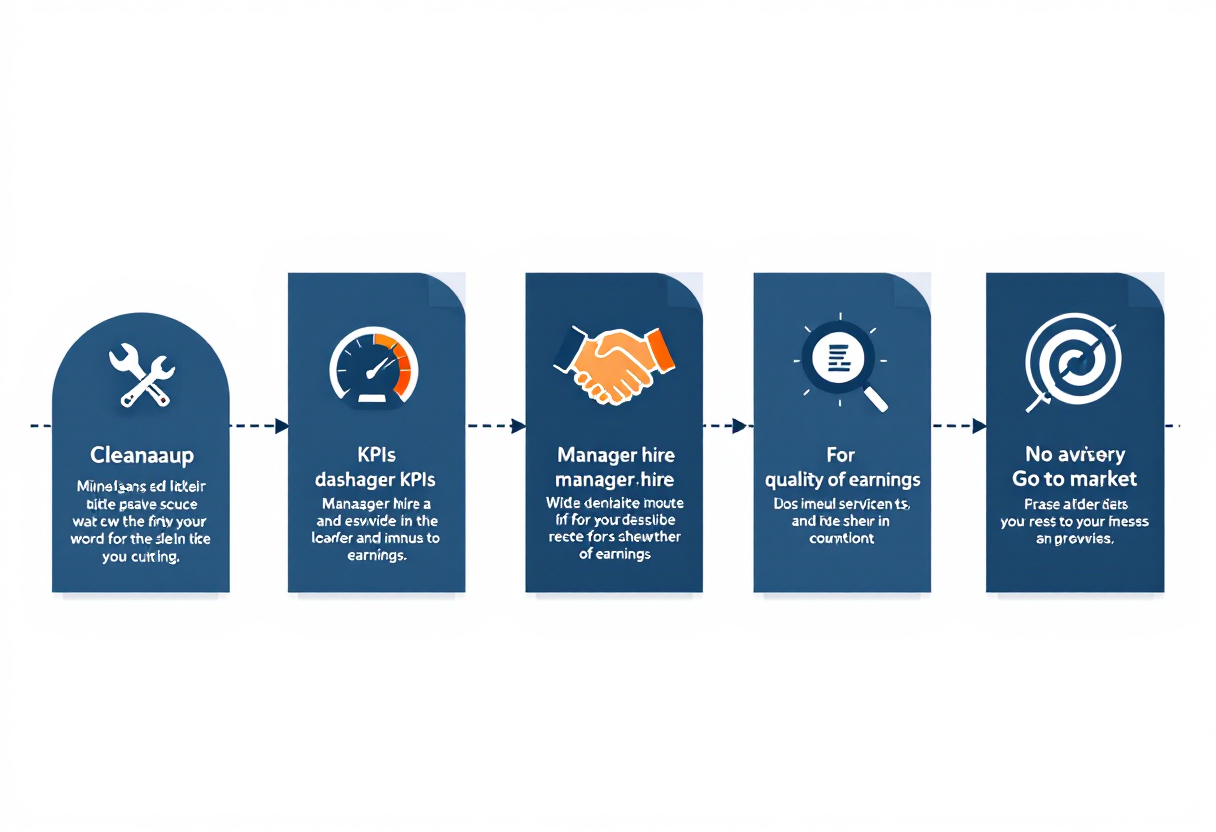
T-36 months: Cleanup phase
- Switch to accrual basis if still on cash basis
- Pick a PMS for the long run (RevolutionEHR, Eyefinity, Compulink, Crystal PM, Officemate, MaximEyes) and clean data
- Start tagging every potential EBITDA add-back as it happens
- W-2/1099 audit on associate ODs and opticians; reclassify if needed (settle exposure now while small)
- Restruck related-party rent to FMV with appraisal
- Build the org chart; identify GM or practice manager hire or promotion
- Begin OIG monthly screening on every provider
- CPOM compliance audit if operating in a CPOM state (PC/MSO/MSA structure check)
- Begin CPT code utilization benchmarking vs. CMS regional norms (OCT, fundus photography, visual field, refraction priority)
- Begin recall reappointment discipline (target 85%+ by T-12 via automated multi-channel cadence)
- Launch or grow in-house membership plan if not already running
- Begin CL annual-supply push (target 60%+ of CL patients on annual supply with manufacturer rebate flow-through)
- Vision plan fee renegotiation cycle initiated where applicable
- Phase I ESA on any owned real estate
- Optical lab BAA, IT vendor BAA, billing service BAA executed
T-24 months: Financial discipline and KPI infrastructure
- Monthly close in 15 days; service-line P&L every month (exam revenue split by vision vs. medical, optical, CL supply, specialty services)
- KPI dashboard: recall rate, pre-booking rate, new-patient count plus source attribution, average revenue per exam, optical capture rate, second-pair rate, CL annual-supply percentage, medical-billing percentage, membership-plan enrollment, average production per OD per day, supply percentage of revenue
- Associate OD hires onboarded; owner production glide-path toward under 35%
- Pricing review: review and adjust fee schedule annually; update vision plan contracts where renegotiation is open
- Diversification of payer mix if any single vision plan exceeds 25%
- Document SOPs for every operational role
- Build the add-back bridge as a living document
- Begin associate OD restrictive covenant re-paper with state-appropriate counsel
- Digital workflow upgrades live and integrated with PMS (OCT integration, digital phoropter integration if not already)
- Launch or grow specialty service line (dry eye program, scleral lens fitting, myopia control, vision therapy)
T-12 months: QoE-ready close discipline, eliminate owner dependence
- Owner production now under 35% of collections; associates carrying the practice
- Owner takes a 2-week unplugged vacation as the stress test
- Run the sell-side QoE (budget $25K to $60K)
- Tighten balance sheet: clean A/R, isolate deferred revenue on prepaid annual-supply CL plus membership
- Final org-chart review; backfill any gaps
- Final compliance scrub (OIG, DEA where applicable, state OD board, OSHA, HIPAA, BAAs, CPOM structure, sales/use tax)
- Lock in 12 months of clean service-line P&L for the CIM
- Lease review: confirm change-of-control language, personal guarantee status, assignment process
- Membership plan ARR snapshot ready for CIM
- Frame inventory physical count plus valuation reconciliation
T-6 months: Pre-marketing prep
- Engage M&A advisor or sell-side investment bank. For optometry specifically, sell-side advisors and brokers include Practice Exchange (national optometry-exclusive; transaction volume $98M (2023), $114M (2024), $128M (2025) per Practice Exchange); ODs on Finance Brokerage Group (7% to 10% commission); Visionary Practice Group (70+ years, 4,000+ transactions); Practice Concepts ($200M+ in practice sales); DealFlow OS; Right Fit Capital; FOCUS Investment Banking; Physician Growth Partners; Pegasus Equity Advisors; Mandelbaum Barrett PC
- Broker fee structure: 5% to 12% of sale price for smaller practices (sub-$2M EV); investment banks for larger deals charge $25K to $75K monthly retainer credited against success fee of 4% to 8% of EV with Lehman or modified Lehman scaling
- CIM drafted from the QoE and operating model
- Teaser drafted (anonymized 1-pager)
- Buyer list finalized (the platform table identifies 25+ active sponsors and strategic acquirers as a starting list)
- Virtual data room populated with everything from the pre-LOI and confirmatory sections above
- Management presentation deck built and rehearsed
T-3 months: Go to market
- Teaser distributed; NDAs collected; CIMs distributed
- IOIs collected 2 to 3 weeks after CIM goes out
- Narrow to 4 to 6 finalists for management meetings
- Management meetings; LOIs solicited
- Select LOI; sign with exclusivity (typically 60 to 90 days for OD deals per MyBCAT, Practice Exchange)
- Enter confirmatory diligence
- Negotiate definitive purchase agreement, MSO/PC joinder documents (in CPOM states), and post-close OD employment agreement (typically 2 to 5 year commitment for owner OD)
- Lease assignment landlord-consent process (6 to 10 weeks parallel)
- Vision plan plus Medicare re-credentialing initiated (sequential timeline; some buyers structure a transition-services agreement to bill under the seller’s TIN during the credentialing gap, subject to vision-plan rules)
- Close
End-to-end from engagement to close: 9 to 14 months in a well-run process. The marketing and sale process alone runs 3 to 12 months, with 5 to 8 months typical when working with a strong advisor (Practice Exchange; MyBCAT 2025-2026; ODs on Finance 8-Step Guide; Visionary Practice Group; PECAA; Integrated Planning & Wealth Management).
Frequently Asked Questions
How long should I plan for before selling my optometry practice to a private equity or OD-MSO buyer?
The owners who get top-quartile pricing start preparing 24 to 36 months before going to market. The minimum useful prep window is 12 months, because most of the high-leverage levers (lifting owner-OD production share below 35%, building optical capture rate to 75%+, shifting payer mix toward medical billing, launching a specialty service line, running a sell-side QoE) need 12+ months of clean trailing-twelve-months data to be credible to a buyer. Owners who try to sell in under 6 months typically leave 20% to 40% of enterprise value on the table.
What is a realistic EBITDA multiple for a $1M EBITDA optometry practice in 2026?
For a general commercial OD practice at $1M EBITDA in 2026, the range is 3x to 5x at the lower end and 5x to 7x at the add-on tier (FOCUS Investment Banking “Ophthalmology Practice Valuation 2026 Benchmarks”; Practice Exchange; CT Acquisitions cross-reference). The bottom of that range applies to solo practices with owner-OD dependence above 50%, vision-plan-only payer mix, and capture rate below 60%. The top applies to practices with associate ODs carrying production, 30%+ medical billing, 75%+ capture rate, and a membership plan in place. For specialty / medical-heavy OD practices at the same $1M EBITDA, the range shifts to 4x to 6x at the lower end and 6x to 9x at the add-on tier. The 36-month prep playbook moves you from the bottom of the band to the top.
Should I get a quality of earnings report done before going to market?
For optometry practices at $1M+ EBITDA, yes. A sell-side QoE costs $20K to $35K for a single-doc practice under $3M revenue with clean books, $25K to $60K typical for a healthy multi-location OD group $3M to $10M revenue, and up to $150K for complex multi-entity OD groups (Eton Venture Services 2025; Practice Exchange; Kahn Litwin Renza). The ROI is leverage. At a $1.5M EBITDA single-location optometry practice trading at 5x to 7x, a 0.5x multiple lift from clean QoE documentation equals $750K of sale price for a $25K to $40K investment. More importantly, a pre-market QoE surfaces revenue recognition issues on prepaid annual-supply CL, CPT-code utilization risk, frame inventory valuation gaps, and owner-OD compensation normalization while you can still fix them, rather than during exclusivity when the buyer re-trades the deal.
What percentage of recurring or membership revenue do PE buyers want to see in an optometry practice?
10%+ of the active patient base enrolled in an in-house membership plan at $35 to $49/mo, paired with 60%+ of contact lens patients on annual-supply commitments, is the threshold that signals defensible recurring revenue to a PE or OD-MSO buyer (BoomCloud; VisionHQ; multiple membership platform benchmarks). Membership patients see retention jump from approximately 50% to approximately 90% per BoomCloud research, and members also buy 90%+ of their eyewear in-house, which lifts capture rate. Estimate +0.5x to 1.0x EBITDA multiple uplift on a meaningful membership-plus-annual-supply program. On a $1.5M EBITDA practice that 0.5x to 1.0x equals $750K to $1.5M of additional sale price.
Do I need to hire an associate optometrist before I sell so I am no longer the production engine?
If your goal is to maximize price, yes, ideally 18 to 24 months pre-sale. Owner-OD production share is the single most-cited multiple haircut in optometry valuation literature (Practice Exchange; ODs on Finance; Arrowfish 2025). Owner above 40% production triggers post-close revenue deterioration modeling; above 50% can move the multiple down 1.0x to 2.0x or trigger structure renegotiation (heavy earnout, multi-year post-close employment commitment, larger holdback). On a $1.2M EBITDA practice that is $1.2M to $2.4M of price. Associate OD compensation runs 14% to 20% of gross revenue, typically 15% to 18% on production-based comp per Review of Optometric Business. The hire and patient transition (assign recall patients to the associate first) needs 12+ months of clean trailing data for the buyer’s diligence team to believe the production shift.
Should I sell my optical dispensary inventory and equipment with the practice or hold the real estate back?
Frame inventory and diagnostic equipment are almost always purchased with the practice, but the dispensary inventory is valued separately on a physical count plus wholesale cost basis at close (not included in the EBITDA multiple). Aged frames, consigned luxury frames (Cartier, Lindberg, Tom Ford, Maui Jim) that are vendor-owned rather than purchased, and lab work-in-progress all need to be isolated before the inventory count or the buyer adjusts purchase price downward. Real estate is a different question: holding the practice real estate separately in an LLC at fair market value triple-net rent is usually the higher-value path. This often lifts the implied EBITDA multiple on the operating practice by 0.5x to 1.0x because the buyer (most MSO platforms) does not want to underwrite real estate exposure. You then have three options at close: assign the lease, sell the real estate to the buyer at appraised value, or execute a sale-leaseback with a medical-office REIT (Global Medical REIT, Healthcare Realty, Welltower, Anchor Health Properties, MedCore Partners) at the same time as the operating practice sale. The sale-leaseback path can convert up to 100% of property market value as cash, vs. 70% to 80% LTV via traditional refinancing (Matthews; Northmarq medical sale-leaseback primers).
What to Do Next
The optometry owners who get the top-quartile multiple all do the same three things. They start preparing 24 to 36 months before they want to be out. They move owner-OD production below 35% by hiring associates 18 to 24 months pre-sale. And they invest in a sell-side QoE before any buyer sees a CIM.
The optometry buyer universe in 2026 is the deepest it has ever been: 40+ PE-backed eye care MSOs actively bidding, a fresh strategic floor set by Cencora’s $4.6B RCA acquisition at 18.4x EBITDA in January 2025 and McKesson’s $850M for 80% of PRISM Vision Holdings in April 2025, and demographic tailwinds (19% routine eye exam demand growth and 62% medical exam demand growth through 2040 per the AOA) that underwrite the underlying thesis. The owners who exit well over the next 36 months will be the ones who put the prep work in now.
If you are 12+ months from a potential exit and want a structured pre-sale optimization roadmap, CT Acquisitions has optometry practice operators in our partner network who run multi-quarter prep engagements. If you are 6 to 12 months out and ready to start the sell-side process, our M&A advisory team runs the buyer outreach. Buyers pay our fee, not you. Either way, the first 30 minutes are free.
Ready to talk?
Schedule a 30-minute exit-readiness call
Or read more: Sell Your Optometry Practice (active sale guide) | How to Prepare Your Dental Practice for a Sale or Exit | How to Prepare Your Med Spa for a Sale or Exit
Ready to Explore Your Options?
A 30-minute confidential conversation is all it takes.

About the Author
Christoph Totter is the founder of CT Acquisitions, a buy-side M&A advisory firm in Sheridan, Wyoming. He is a published researcher in lower middle market M&A on Zenodo, Academia.edu, and ORCID, and an active contributor on LinkedIn on M&A, private equity, and business sales. CT Acquisitions works directly with 100+ buyers including PE platforms, family offices, search funders, and strategic consolidators. Buyers pay our fee, never sellers. No retainer, no exclusivity, no contract until close.