
Franchise Valuation in 2026: Multiples, Multi-Unit Premium & Royalty Math
Franchise valuation for a resale: price normalized SDE or EBITDA, measured after royalty and ad-fund fees, at a size-based multiple of 2.0x to 5.5x (IBBA, 2025), then deduct transfer fees, required remodels and any short remaining term.
Key takeaways
- Main Street deals averaged 2.0x SDE under $500,000, 3.0x at $500,000 to $1M and 3.1x at $1M to $2M in Q4 2025; $2M to $5M deals averaged 4.1x EBITDA and $5M to $50M deals 5.5x (IBBA and M&A Source Market Pulse, February 2026).
- Royalty and ad-fund fees are operating costs, not add-backs: Dunkin’ charges 5.9% plus 5.0% of gross sales (2024 FDD) and Subway 8% plus 4.5% (Entrepreneur), so a $2,000,000 unit sends $218,000 to $250,000 a year to the franchisor before profit.
- A resale can reset the royalty: McDonald’s raised its royalty to 5% for new restaurants from January 1, 2024, while buyers of a franchised restaurant from another operator kept 4% (The Takeout, September 2023).
- At a 3.0x market multiple, an agreement with 5 years left and no renewal right supports about 2.29x, and one with 3 years left about 1.73x (CT Acquisitions arithmetic, illustrative; renewal terms sit in FDD Item 17 under 16 CFR 436.5(q)).
- SBA 7(a) buyers can borrow up to $5 million (SBA), need a 10% equity injection, and a seller note counts toward it only on full standby for the whole loan term under SOP 50 10 8, effective June 1, 2025 (Whiteford, May 2025).

How do you calculate the value of a franchise?
You calculate the value of a franchise by normalizing the unit’s seller’s discretionary earnings (SDE) or EBITDA after royalty and ad-fund fees, applying a multiple for its deal size, then subtracting the franchise costs a buyer inherits: the transfer fee, remodels due at transfer or renewal, and value lost to a short remaining term. The Franchise Disclosure Document supplies most inputs.
- Pull 3 years of unit P&Ls and your current FDD. You need Items 6, 12, 17, 19 and 20, defined in 16 CFR 436.5, plus your own signed franchise agreement, which controls where it differs from the current FDD.
- Normalize earnings. Add back the owner’s salary, personal expenses and one-time costs. Never add back royalty or ad-fund payments: they continue after closing. Units priced under about $2M use SDE; larger portfolios use EBITDA, the same split IBBA uses.
- Pick the deal-size multiple. Use the IBBA bands in the next section (2.0x to 3.1x SDE under $2M; 4.1x to 5.5x EBITDA above).
- Price the agreement reset. If FDD Item 17(m) requires the buyer to sign the current form agreement, recompute SDE at the new royalty and ad-fund rates.
- Price the remaining term. With fewer than 10 years left and no assured renewal, apply the term factor table below.
- Deduct required remodels. Get the franchisor’s written scope for any remodel tied to transfer (Item 17(m)) or renewal (Item 17(c)).
- Deduct the transfer fee. Item 6 states the amount; your agreement states who owes it.
- Clear the gates before marketing. Confirm buyer qualification criteria, any right of first refusal under Item 17(n), and, for SBA buyers, the brand’s status on the SBA Franchise Directory.
| Key number | What it means for a franchise sale | Source and date |
|---|---|---|
| 2.7 | Average cash flow multiple across 2,117 businesses sold in Q2 2026 (median sale price $349,250) | BizBuySell Insight Report via Small Business Trends, Aug 2026 |
| $350,000 | Median sale price of businesses sold in Q3 2026, up 17% year over year | BizBuySell Q3 2026 release, Oct 20, 2026 |
| 14 calendar days | Minimum time a buyer must hold the FDD before signing, when the franchisor is significantly involved in the resale | 16 CFR 436.2(a) and 436.1(t), current eCFR |
| $5 million | Maximum SBA 7(a) loan | SBA, accessed Oct 2026 |
| 10% | Minimum buyer equity injection on an SBA change-of-ownership loan; a full-standby seller note may supply up to 50% of it | SOP 50 10 8, effective June 1, 2025 |
What multiple does a franchise resale get in 2026?
No public dataset publishes a current franchise-only multiple, so price a franchise resale by deal size first. In Q4 2025, IBBA and M&A Source members reported averages of 2.0x SDE under $500,000, 3.0x at $500,000 to $1M, 3.1x at $1M to $2M, 4.1x EBITDA at $2M to $5M and 5.5x EBITDA at $5M to $50M. Franchise adjustments come after.
| Deal size (purchase price) | Earnings basis | Q3 2025 average | Q4 2025 average | Typical franchise seller |
|---|---|---|---|---|
| Under $500,000 | SDE | 2.0x | 2.0x | One owner-operated unit, SBA buyer |
| $500,000 to $1M | SDE | 2.8x | 3.0x | One higher-volume unit |
| $1M to $2M | SDE | 3.3x | 3.1x | Two units, or one with real estate rights |
| $2M to $5M | EBITDA | 4.0x | 4.1x | Three or more units with an area manager |
| $5M to $50M | EBITDA | 5.3x | 5.5x | Multi-unit platform with management depth |
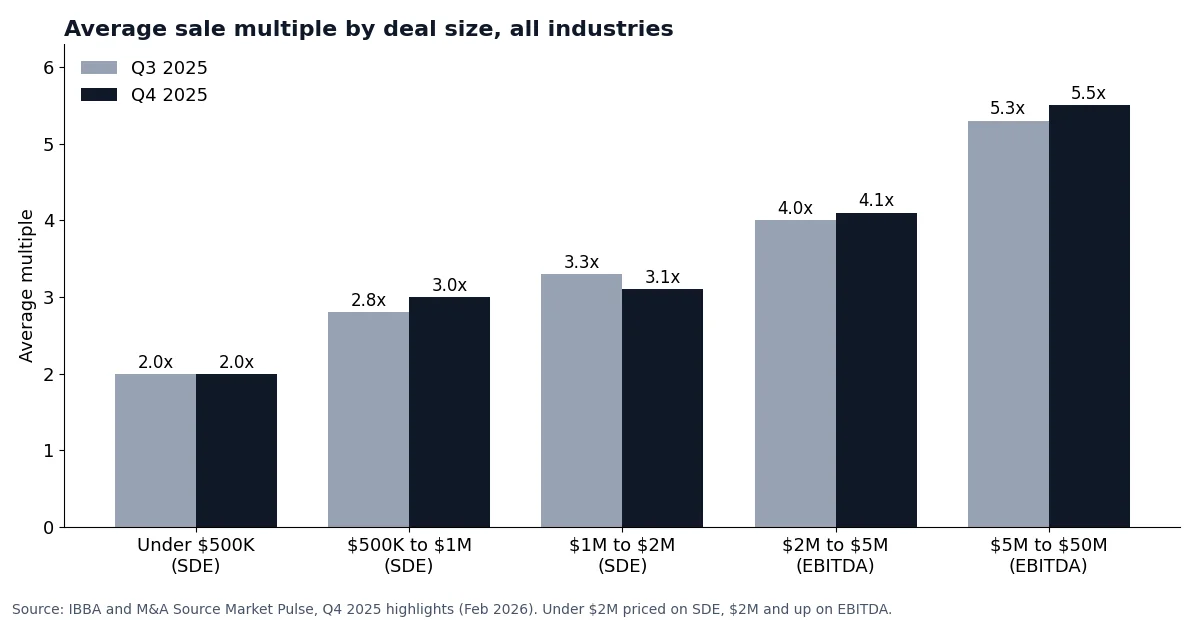
These bands are all-industry averages, not franchise data. Two franchise facts move a unit within or below its band: the royalty and ad fund already sit inside SDE, and the transfer clause in FDD Item 17 can shorten the buyer list. A unit the franchisor will only transfer to existing operators competes for fewer bids than the IBBA averages assume.
| What several guides say | Who says it | What the named data shows |
|---|---|---|
| Franchise businesses sell for 3x to 6x EBITDA | Viking Mergers, accessed Oct 2026, no dataset named | Units priced under $2M trade on SDE at 2.0x to 3.1x; EBITDA multiples of 4.1x to 5.5x apply to $2M to $50M deals (IBBA Q4 2025) |
| Single-unit resales sell for roughly 2x to 4x normalized earnings | Joey Friedman CPA, June 2026, cites unnamed “published market data” | The lower half of that range matches IBBA’s 2.0x to 3.1x SDE for deals under $2M |
| Brand multiples such as 5x to 7x EBITDA for McDonald’s operators | Earlier version of this page, labelled “CT Acquisitions analysis” with no deal data | Withdrawn in October 2026; no named source publishes brand-level resale multiples |
| Franchises sell at a large premium to independents | Common claim | BizBuySell’s Q2 2017 report: 2.44 average cash flow multiple for franchises vs 2.34 for all businesses, a 0.10 gap |
Do franchises sell for more than independent businesses?
Only slightly, on the last published comparison. BizBuySell’s Q2 2017 Insight Report found sold franchises at a 2.44 average cash flow multiple against 2.34 for all businesses, with a $232,500 median sale price against $229,000. Franchise median revenue was higher, $609,966 against $490,000, because royalty fees absorb part of the margin.
How do royalty and ad-fund fees change SDE?
Royalty and ad-fund fees are contractual costs that continue after closing, so buyers price SDE after them and reject any add-back. On $2,000,000 of gross sales, Dunkin’s 2024 rates of 5.9% plus 5.0% take $218,000 a year, and Subway’s 8% plus 4.5% take $250,000. That is why a franchise unit shows lower SDE than an independent with the same revenue.
| Brand | Royalty | Ad or marketing fund | Paid on $2,000,000 of sales | Source |
|---|---|---|---|---|
| Subway | 8% of sales | 4.5% | $250,000 (12.5%) | Entrepreneur listing, updated Dec 2022 |
| Dunkin’ | 5.9% of gross sales | 5.0% | $218,000 (10.9%) | 2024 FDD Items 5 and 6, via Franchise Chatter |
| Planet Fitness | 7% of EFT membership dues | 2% national fund, plus a local fund of the greater of $60,000 or 7% | $180,000 (9%, royalty and national fund only, on $2,000,000 of dues) | 2026 FDD, via Franchise Chatter |
| McDonald’s | 4% for existing restaurants and operator-to-operator purchases; 5% for new restaurants from Jan 1, 2024 | Not stated in the cited sources | $80,000 to $100,000 (royalty only) | QSR Web, Sept 25, 2023; The Takeout, Sept 27, 2023 |
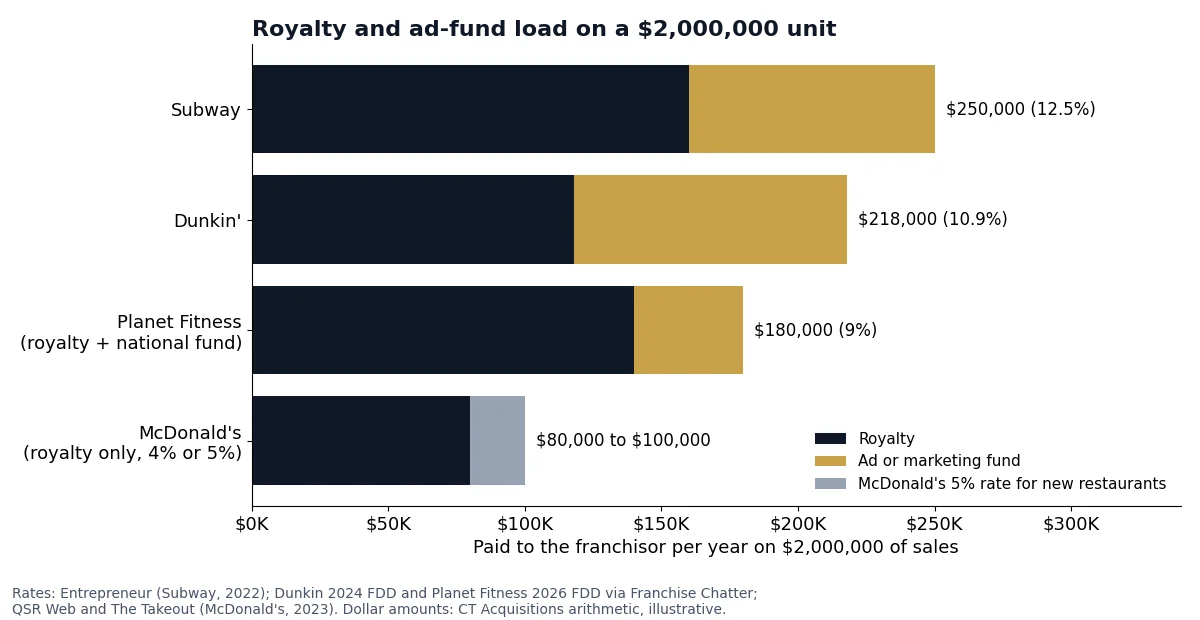
Sellers sometimes add the ad fund back as “marketing they could cut.” It fails in diligence, because the FDD makes the contribution mandatory. On an illustrative unit with $2,000,000 of sales and $300,000 of SDE, adding back a 5.0% ad fund lifts claimed SDE to $400,000 and, at 3.0x, inflates the ask from $900,000 to $1,200,000, a $300,000 gap the buyer’s accountant will remove. The royalty fee explainer covers how each fee is calculated, and the SDE vs EBITDA guide covers which add-backs survive diligence.
What happens if the buyer must sign the current franchise agreement?
The royalty can rise at transfer. Many transfer clauses, disclosed in FDD Item 17(m), require the buyer to sign the franchisor’s current form agreement. If that form carries 1 point more royalty, a $2,000,000 unit loses $20,000 of SDE, and at 3.0x the price falls by $60,000 (illustrative). McDonald’s shows the opposite case: operator-to-operator buyers kept the 4% rate after the 2024 change.
Selling a franchise business? Talk to an M&A advisor first.
We work sell side, buy side and exit planning, with a network of 500+ buyers that includes multi-unit operators, private equity, search funders and family offices. No fee to you on buy-side introductions; sell-side mandates are paid on success at closing. A 15-minute call gives you an estimate of your unit’s price range, the buyer types that fit, and what your transfer clause will require. Try our free valuation calculator first if you prefer.
How does the remaining franchise term change the price?
A franchise agreement is a finite license. Without an assured renewal, a buyer earns SDE only for the years left. At a 3.0x market multiple, which equals a 33.3% required return, 10 years left supports 2.83x, 5 years 2.29x and 3 years 1.73x (CT Acquisitions arithmetic, illustrative). FDD Item 17(a) to 17(c) disclose the term and renewal conditions.
| Years left, no assured renewal | Value factor (x SDE) | Value on $300,000 SDE | Haircut vs 3.0x |
|---|---|---|---|
| 3 | 1.73x | $520,000 | 42% |
| 5 | 2.29x | $686,000 | 24% |
| 7 | 2.60x | $780,000 | 13% |
| 10 | 2.83x | $849,000 | 6% |
| 20 | 2.99x | $897,000 | under 1% |
| Renewal assured on known terms | 3.0x | $900,000 | none |
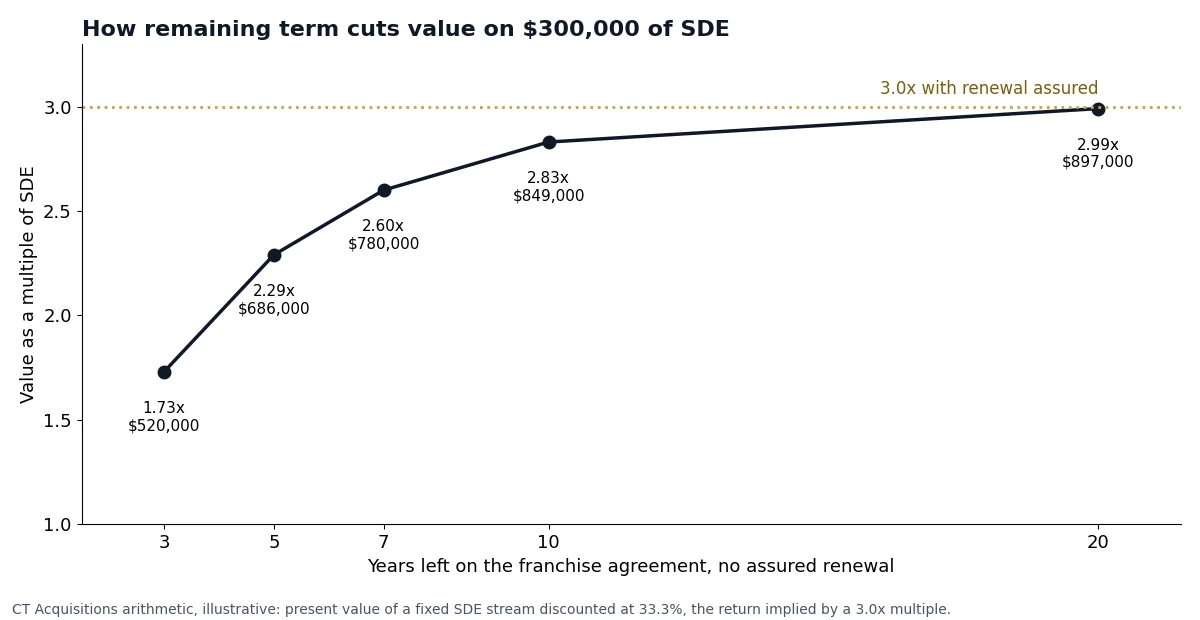
Term matters most below 10 years. McDonald’s, for comparison, signs 20-year agreements (The Takeout, September 2023), so a unit early in its term carries almost no term discount. If your agreement has under 5 years left, ask the franchisor in writing for the renewal fee and the remodel scope required under Item 17(c), and give buyers that letter. A known renewal cost is a deduction; an unknown one becomes a discount the buyer sets.
What do transfer fees, franchisor approval and ROFR do to a sale?
They decide who can buy and what you net. FDD Item 17 rows (l) to (o) under 16 CFR 436.5(q) disclose franchisor approval of a transfer, the conditions for approval, any right of first refusal (ROFR) and any option to purchase; Item 6 discloses the transfer fee. A ROFR lets the franchisor take your deal on the same terms, so every buyer prices that risk.
| FDD item | Section in 16 CFR 436.5 | What the buyer reads | Effect on your price |
|---|---|---|---|
| Item 6, Other fees | 436.5(f) | Transfer fee, renewal fee, audit and technology fees | Fees owed at transfer come off net proceeds |
| Item 7, Estimated initial investment | 436.5(g) | Cost to open a new unit | Caps price: a buyer compares your unit with building one |
| Item 12, Territory | 436.5(l) | Exclusive, protected or no territory | Protection supports the multiple; none invites a nearby unit |
| Item 17(a) to (c) | 436.5(q) | Term length, renewal right, renewal conditions such as remodels | Short term without renewal applies the term factor |
| Item 17(l) and (m) | 436.5(q) | Franchisor approval of transfer and its conditions | Narrows the buyer pool; may reset the agreement |
| Item 17(n) and (o) | 436.5(q) | Right of first refusal; option to purchase | Adds a waiting period and can chill outside bids |
| Item 19 | 436.5(s) | Financial performance representations | Benchmarks your unit’s sales against the system |
| Item 20 | 436.5(t) | Outlets opened, closed and transferred | Net closures thin the buyer pool |
| Item 21 | 436.5(u) | Franchisor’s financial statements | A weak franchisor raises buyer risk |
The FTC Franchise Rule treats a resale differently depending on the franchisor’s role. Under 16 CFR 436.1(t), a transfer by an existing franchisee where the franchisor has had no significant involvement is not a “sale of a franchise.” When the franchisor is significantly involved, the buyer must receive the FDD at least 14 calendar days before signing under 436.2(a), so build those days into your closing calendar.
- Read Item 17(l) to (o) and the transfer article of your signed agreement, and note any ROFR notice period it sets.
- Ask the franchisor for its written buyer criteria (net worth, liquid capital, operating experience) before you market the unit.
- Request the remodel or upgrade scope the franchisor will require at transfer, with a cost estimate.
- Deliver the signed letter of intent or purchase agreement to the franchisor in the form the ROFR clause requires; informal notice may not start the clock.
- Have the buyer complete the franchisor’s application and training while diligence runs.
- Get the landlord’s consent to assign the lease.
- Close, pay the transfer fee, and sign the franchisor’s transfer and release documents.
The franchise sales process guide walks through each stage from both sides of the deal.
What can FDD Item 19 tell a buyer about your unit?
Item 19, defined in 16 CFR 436.5(s), is where a franchisor may publish financial performance representations, and buyers use it to place your unit above or below the system. Planet Fitness’s 2026 FDD reports a $1,863,300 median annual EFT revenue for its middle third of franchised clubs, so a club near that line looks typical to a buyer reading the same document.
| Brand and FDD year | Item 19 figure | What it covers | What it leaves out |
|---|---|---|---|
| Planet Fitness, 2026 | Median annual EFT revenue $1,863,300 (middle third, 764 franchised clubs) | Franchised club dues revenue, 2025 | Franchisee expenses and profit |
| Planet Fitness, 2026 | EBITDA $708,853 (35.8%), middle third | Corporate-owned clubs only (262 of 270) | Equipment replacement and remodel costs |
| Dunkin’, 2024 | Average sales $1,546,413 | 2,976 freestanding drive-thru restaurants, 2023 | Unit profit |
Do not quote the Planet Fitness 35.8% EBITDA margin as a franchisee margin. It comes from corporate-owned clubs and, per the FDD summary, excludes equipment replacement and remodel costs, both of which a franchisee buyer funds. Use Item 19 for sales benchmarking only, and give buyers your own unit P&L for profit. Item 20 completes the picture: rising closures or transfers in your state warn buyers before your numbers do.
Is there a multi-unit premium when selling franchise units?
Yes, and most of it comes from crossing into a larger deal-size band. In Q4 2025 IBBA data, deals of $1M to $2M averaged 3.1x SDE while $2M to $5M deals averaged 4.1x EBITDA. Three units run by an area manager can sell on EBITDA in the higher band, so each unit can be worth more inside a portfolio than alone (illustrative).
| Line | One unit, sold alone | Three units, sold together |
|---|---|---|
| Unit-level SDE | $300,000 | $900,000 |
| Area manager replacing the owner | none | minus $120,000 |
| Earnings a buyer prices | $300,000 SDE | $780,000 EBITDA |
| Multiple (IBBA Q4 2025 band) | 3.0x ($500,000 to $1M) | 4.1x ($2M to $5M) |
| Price | $900,000 | $3,198,000 |
| Price per unit | $900,000 | $1,066,000 (about 18% more) |
The premium holds only if the area manager is real and documented. A three-unit owner who still runs every shift is priced as three single units. Fitness and restaurant portfolios follow the same arithmetic; the gym business valuation guide and the restaurant business valuation guide cover their sector-specific inputs.
How much is a franchise worth with $500,000 or $1,000,000 in sales?
Sales set the price only through earnings. A franchise unit with $1,000,000 in sales and an assumed 12% to 18% SDE margin after royalty and ad fund earns $120,000 to $180,000; at the 2.0x IBBA average for deals under $500,000, that is $240,000 to $360,000 before deductions. For comparison, all businesses BizBuySell recorded in Q2 2026 had a median $155,921 of cash flow on $692,087 of revenue.
| Question | Arithmetic | Result |
|---|---|---|
| $500,000 in sales | Assumed 12% to 18% SDE margin = $60,000 to $90,000; x 2.0 (under $500,000 band) | $120,000 to $180,000 |
| $1,000,000 in sales | 12% to 18% = $120,000 to $180,000; x 2.0 | $240,000 to $360,000 |
| A unit that makes $300,000 a year (SDE) | $300,000 x 3.0 ($500,000 to $1M band) | $900,000 |
| Is it worth 5 times profit? | 5.5x is the Q4 2025 average only for $5M to $50M EBITDA deals | Not for a single unit |
What does a full franchise valuation look like? A worked example
Here is one illustrative unit from headline price to net proceeds. It has $2,000,000 of sales, $300,000 of SDE after Dunkin’-level royalty and ad fund, 3.0x from the IBBA $500,000 to $1M band, a 1-point royalty reset at transfer, a $150,000 remodel due at transfer and a $20,000 transfer fee owed by the seller. Net proceeds land at $670,000, 26% below the $900,000 headline.
| Step | Input | Effect on price | Running total |
|---|---|---|---|
| Headline value | $300,000 SDE x 3.0 | $900,000 | $900,000 |
| Royalty reset at transfer (Item 17(m)) | 1 point on $2,000,000 = $20,000 less SDE, x 3.0 | minus $60,000 | $840,000 |
| Remodel required at transfer | Franchisor scope, illustrative | minus $150,000 | $690,000 |
| Transfer fee owed by seller (Item 6) | Illustrative | minus $20,000 | $670,000 |
| Net to seller before taxes and advisory fees | $670,000 |
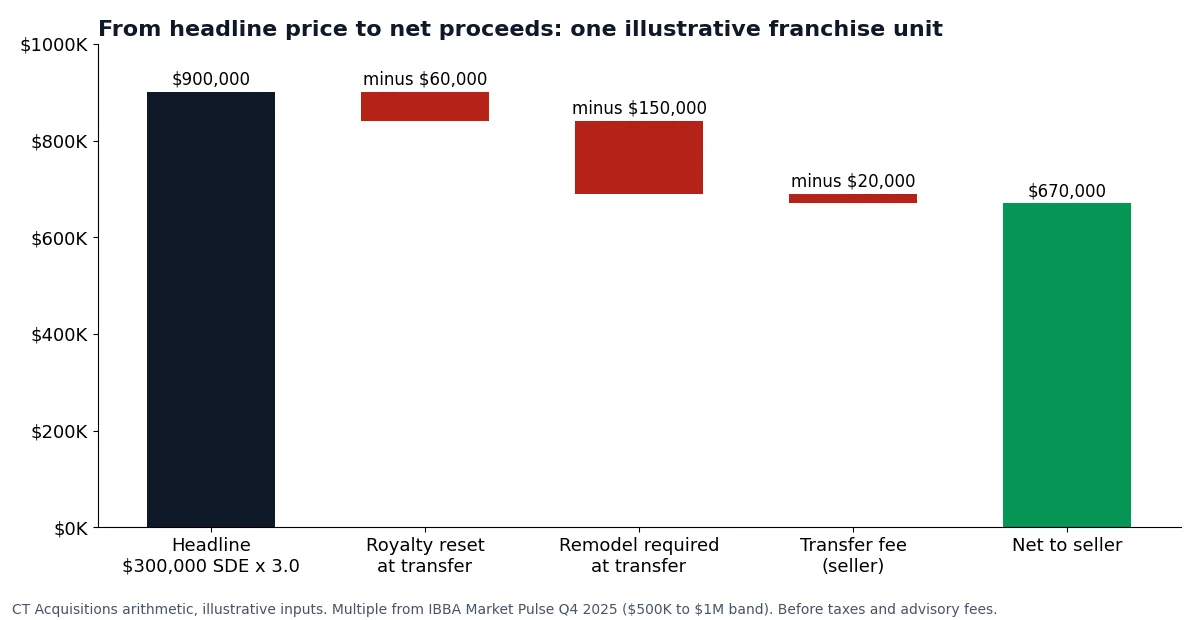
Two of the three deductions are knowable before you list. The transfer fee is printed in Item 6, and the franchisor can scope the remodel in writing. Getting both on paper lets you price them yourself instead of letting a buyer estimate them at the top of the range. The franchise resale guide lists the documents buyers request at this stage.
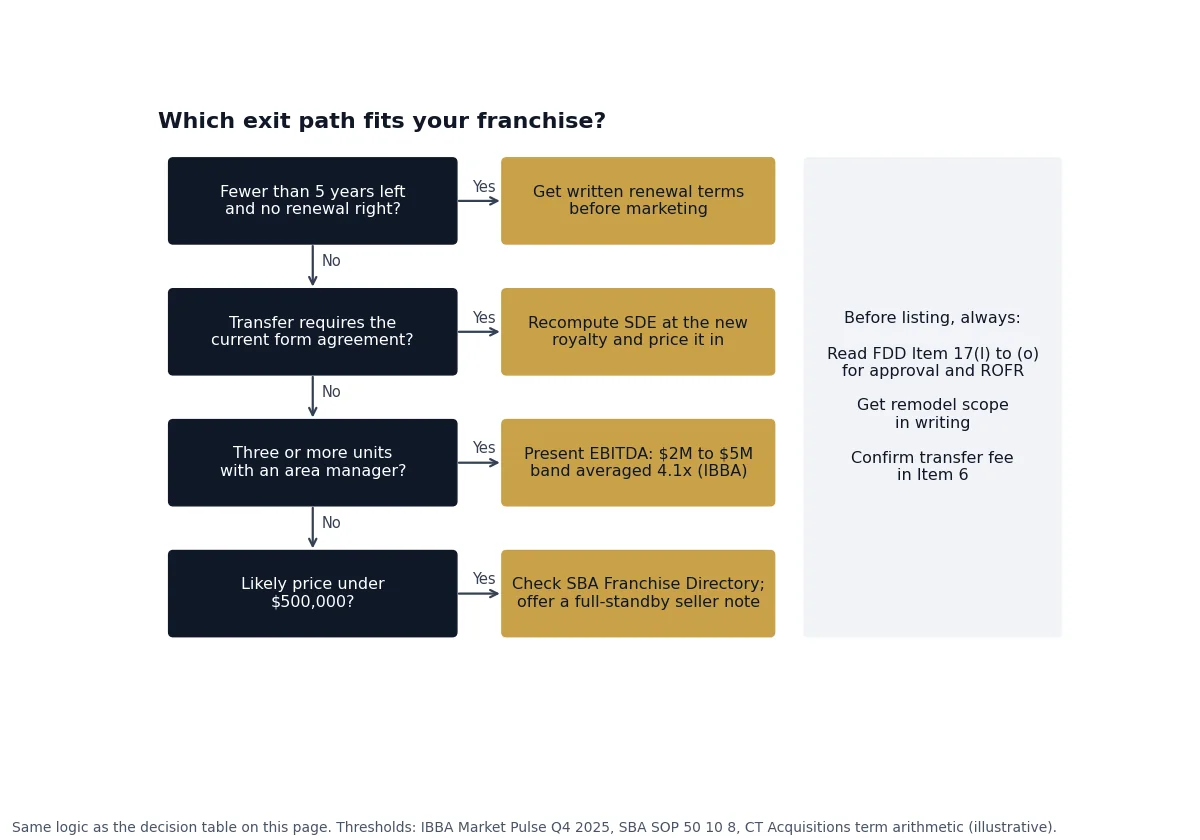
Which exit path fits your franchise?
Match the path to the facts in your FDD and P&L. A single unit under $500,000 usually sells to an SBA-financed operator, so brand eligibility on the SBA Franchise Directory comes first; three or more units with an area manager can reach EBITDA buyers in the $2M to $5M band. Short terms, resets and ROFR rights each need action before listing.
| If your situation is | Do this | Why |
|---|---|---|
| One unit, likely price under $500,000 | Confirm the brand on the SBA Franchise Directory; offer a seller note on full standby | SBA buyers need 10% equity, and a full-standby seller note can supply up to half of it (SOP 50 10 8) |
| Fewer than 5 years left, no renewal right | Get written renewal terms before marketing | Without them, 5 years supports about 2.29x instead of 3.0x |
| Transfer requires the current form agreement | Recompute SDE at the new royalty and price it into your ask | 1 point on $2,000,000 of sales costs $60,000 at 3.0x |
| Remodel due at transfer or within the buyer’s first years | Get the franchisor’s written scope and cost | A known cost is deducted once; an unknown one is discounted at the top of the range |
| Three or more units with an area manager | Present EBITDA and target multi-unit operators and private equity | The $2M to $5M band averaged 4.1x EBITDA in Q4 2025 |
| Franchisor holds a ROFR under Item 17(n) | Tell buyers at first contact and build the notice period into the LOI timeline | Buyers walk if a ROFR surfaces after diligence starts |
| Item 20 shows net closures in your market | Widen outreach and consider seller financing | Fewer operators in the system means fewer approved buyers |
For SBA-financed buyers, the SBA 7(a) acquisition guide covers loan structure, and the seller note guide covers standby terms. When you are ready to sell, the sell my franchise page explains how CT Acquisitions runs a franchise sale. No fee to you on buy-side introductions; sell-side mandates are paid on success at closing.
Want to know what your franchise is worth?
Benchmarks give you a range. A 15-minute confidential call gives you a real number, based on what active buyers are paying right now and which ones would compete for your business. No cost, no obligation.
How we compiled this
We compiled this page in October 2026 from 15 documents: the FTC Franchise Rule text (16 CFR Part 436 on eCFR), two SBA pages, a law-firm summary of SOP 50 10 8, the IBBA and M&A Source Market Pulse Q4 2025, three BizBuySell Insight Report releases, FDD fee and Item 19 summaries for Dunkin’, Planet Fitness and Subway, two press reports on McDonald’s 2024 royalty change, and two competitor guides compared in the correction table. We excluded forum threads and multiples published without a named dataset, and we label every worked example as illustrative.
Frequently asked questions
How do you calculate the value of a franchise?
Take the unit’s normalized SDE or EBITDA after royalty and ad-fund fees and multiply it by a deal-size multiple: IBBA members reported 2.0x SDE for deals under $500,000 and 4.1x EBITDA for $2M to $5M deals in Q4 2025. Then deduct the transfer fee, remodels due at transfer or renewal, and the value lost if fewer than 10 years remain on the agreement.
How much is a business worth with $1,000,000 in sales?
Sales alone do not set the price; earnings do. A franchise unit with $1,000,000 in sales and an assumed 12% to 18% SDE margin after royalty and ad fund earns $120,000 to $180,000. At the 2.0x average IBBA reported for deals under $500,000 in Q4 2025, that is $240,000 to $360,000 before transfer fees and remodel deductions (illustrative arithmetic).
Is a business worth 5 times profit?
Usually not at franchise-unit size. In Q4 2025, IBBA members reported an average 5.5x EBITDA only for $5M to $50M deals, while deals under $2M averaged 2.0x to 3.1x SDE. A single franchise unit earning $300,000 of SDE therefore prices nearer 3.0x, or $900,000, unless it sells inside a larger multi-unit portfolio.
Does the franchisor have to approve the sale of my franchise?
In most systems, yes. FDD Item 17, row (l), discloses whether the franchisor must approve a transfer, row (m) lists the conditions, such as buyer net worth, training and remodels, and row (n) says whether the franchisor holds a right of first refusal to buy your unit on the same terms. Your signed franchise agreement controls where it differs.
Who pays the franchise transfer fee?
FDD Item 6 discloses the transfer fee amount, and your franchise agreement says who owes it. Many agreements put it on the selling franchisee, and buyers and sellers often negotiate the split in the purchase agreement. Treat it as a deduction from net proceeds: an illustrative $20,000 fee on a $900,000 price costs 2.2% of the deal.
Can you sell a Chick-fil-A franchise?
No. Chick-fil-A keeps ownership of the restaurant, the real estate and the equipment, and operators run the business under an operator agreement that they cannot sell or transfer, so there is no resale value to build. A standard franchisee owns the unit’s assets and can sell it, subject to franchisor approval under FDD Item 17.
Sources
- FTC Franchise Rule, 16 CFR Part 436 (eCFR), sections 436.1(t), 436.2(a), 436.5 and 436.8, accessed October 2026.
- IBBA and M&A Source, Market Pulse Q4 2025 highlights, published February 2026, accessed October 2026.
- BizBuySell Q2 2026 Insight Report, via Small Business Trends, August 11, 2026.
- BizBuySell Q3 2026 Insight Report release, October 20, 2026.
- BizBuySell Q2 2017 Insight Report release, franchise comparison, accessed October 2026.
- SBA, 7(a) loans, accessed October 2026.
- SBA Franchise Directory, effective October 22, 2026, accessed October 2026.
- Whiteford, SBA SOP 50 10 8 client alert, May 6, 2025.
- Franchise Chatter, Dunkin’ 2024 FDD review, August 18, 2024.
- Franchise Chatter, Planet Fitness 2026 FDD review, September 21, 2026.
- Entrepreneur, Subway franchise listing, updated December 12, 2022.
- QSR Web, McDonald’s royalty change, September 25, 2023, and The Takeout, September 27, 2023.
- Viking Mergers, franchise page and Joey Friedman CPA, franchise valuation methods, both accessed October 2026.

About the Author
Christoph Totter is the founder of CT Acquisitions, an M&A advisory firm working both sides of the table, headquartered in Sheridan, Wyoming. We work directly with 500+ buyers, search funders, family offices, lower middle-market PE, and strategic consolidators, including direct mandates with the largest consolidators that other intermediaries cannot access. No fee to you on buy-side introductions; sell-side mandates are paid on success at closing. Connect on LinkedIn · Get in touch
Related guides
- Restaurant business valuation (2026)
- SBA 7(a) loans for business acquisitions
- Buyer archetypes: PE, strategic, search fund, family office
- 2026 lower middle market buyer demand report
- Business valuation calculator (2026)
- How to buy a franchise
- Normalized EBITDA and why buyers care
- Adjusted EBITDA: which add-backs buyers accept
Want a Specific Read on Your Business?
15 minutes, confidential, no contract, no cost. You leave with a read on your local buyer market and a likely valuation range.
The next practical step for owners inside this range is owner-side exit prep, which shows what to fix before going to market.