How to Prepare Your Web Design Agency for a Sale or Exit in 2026: The 36-Month Playbook
Preparing your web design agency for exit in 2026 works best as a 36-month process. The first 12 months tighten the operating story around retainer mix and specialty vertical concentration, the middle 12 fix pre-LOI diligence gaps around client retention and consultant utilization, and the final 12 turn one offer into a real competitive process where digital-agency aggregators compete.
Exiting your web design agency business is the single largest financial event most owners will ever face. This guide is the no-fluff playbook for web design agency owners who are 12-36 months from sale, covering how PE-backed buyers actually value your business in 2026, the 12 levers that move your multiple, pre-LOI diligence, deal-killers to fix before going to market, and the full 36-month exit prep timeline.
Updated April 2026 · CT Acquisitions

Most web design agency owners decide to sell, talk to a broker, and find out 60 days later that their business is worth 30% to 50% less than they thought. The owners who get top-quartile pricing start preparing 24 to 36 months before they ever circulate a teaser. This guide is the 36-month playbook for how to prepare your web design agency for a sale or exit. It covers who actually buys web, digital, and experience-design shops in 2026, the 12 levers that move agency multiples, the documents private equity asks for before they send an indication of interest, and the deal-killers that re-trade agency transactions during confirmatory diligence. Every number cites its source. Every recommendation is anchored to how the most active digital agency buyers in 2026 actually behave.
Pure-play “web design agency” private equity roll-ups are thin. The 2024 to 2026 cycle has been dominated by broader digital-transformation, experience-design, and performance-marketing platforms doing capability or capacity bolt-ons, plus hosting and CMS-tier acquirers like WP Engine extending the WordPress stack into agency territory. If you are 6 to 36 months from a possible exit, this is the work that turns a 4x EBITDA outcome into a 7x EBITDA outcome. On a $1.5M EBITDA agency, that is the difference between a $6M sale and an $11M sale. Whether you want to prepare your web design agency for a sale to private equity, prepare your web design agency for an exit to a strategic acquirer like WPP, Accenture Song, or WP Engine, or simply maximize value over the next 1 to 3 years before going to market, the work below applies.
Building toward an exit in 12 to 36 months?
CT Acquisitions runs sell-side advisory for digital agency owners at $1M+ EBITDA. We also have agency operators in our partner network who run pre-sale optimization engagements when the timeline is longer. No fee to you on buy-side introductions; sell-side mandates are paid on success at closing.
What Private Equity Actually Buys in Web Design and Digital Agencies (2026)
PE share of UK marketing services M&A reached 57% of all 2025 deals, the highest in five years and up from 46% in 2024 (Moore Kingston Smith, “M&A in UK media and marketing services Q4 2025”). In the US, roughly 2,300 digital marketing and advertising transactions closed in 2025 with strategic buyers at ~67% and PE at ~33% (Legacy Advisors, “2022 to 2025 U.S. Digital Marketing & Advertising M&A Report”). Adtech and marketing services M&A rose 13% over 2024 with median EV/EBITDA multiples in North America and Europe rising to 10.1x, up from 9.8x in 2024 (FE International 2026). The sponsor money flowing in is not random. PE buys specific profiles, and the profile you build determines the multiple you get.
The PE-attractive digital agency profile
- EBITDA threshold for a platform-quality deal: $1M to $2.5M EBITDA is the entry band where a sponsor-backed platform runs a competitive process. Below $500K EBITDA you are typically out of PE scope and into individual-buyer or strategic tuck-in territory. Above $5M EBITDA you become an attractive bolt-on for the larger digital transformation platforms (Bounteous, Hero Digital/Huge, Code and Theory Network). Above $15M EBITDA you are a platform candidate yourself.
- Recurring retainer revenue: 60%+ retainer mix is the line between project-heavy commodity pricing and recurring premium pricing. Project-heavy agencies trade at 3x to 4.5x EBITDA. Retainer-heavy agencies trade at 5x to 7x and above (FE International 2026). Retainer agencies achieve roughly 2.3x better retention than project-based shops.
- EBITDA margin: 20%+ EBITDA margin is cited as the number-one value driver by FE International (2026). Below 15% triggers risk-pricing and either band-dropping or aggressive earnouts.
- Client concentration: Top client below 15%, ideally below 10%. Top 5 below 30% to 40%. Single client above 20% triggers a 1.5x to 2x multiple discount or 25% to 40% earnout deferral (FE International 2026; Oak Street Funding 2025).
- Net Revenue Retention: NRR at or above 100% is the premium signal. Agencies maintaining clients 3+ years post roughly 2.5x higher profit (TMetric 2026 marketing agency benchmarks).
- Owner role: Owner is not the principal designer, not the principal developer, not the only sales channel. GM or CEO-replacement in place 12+ months pre-sale.
- Specialty: Platform specialty (Shopify Plus, WordPress VIP, Webflow Enterprise, Adobe Experience Cloud, HubSpot Diamond) or vertical specialty (healthcare, BFSI, B2B SaaS, regulated industries). Service-narrowing agencies averaged 13% growth vs. 7.5% market average and posted 30% net margins vs. 13% industry average (Promethean Research 2026 industry report).
Active digital agency PE platforms and PE-backed buyers in 2026
The list below covers the most active sponsor-backed platforms in the 2024-2026 cycle that absorb web, digital, and experience-design capacity. Note that few are pure-play “web design” roll-ups; most are broader digital transformation, performance marketing, or experience-design platforms whose appetite still pulls web and dev capability into the buyer universe. Sources include AEA Investors and New Mountain Capital press releases, Bounteous and Stagwell 8-K filings, PrivSource, Tracxn, PitchBook, Moore Kingston Smith, SI Partners, and Capital A case studies.
| Platform | Sponsor | Profile |
|---|---|---|
| Bounteous | New Mountain Capital (Bounteous + Accolite combination, Feb 2024; rebranded Jan 2025) | End-to-end digital transformation; ~5,000 employees globally post-merger; $20M to $100M+ revenue capability bolt-ons |
| Huge + Hero Digital | AEA Investors (acquired Huge from IPG, Dec 2024; combined with portfolio company Hero Digital) | One of the largest independent experience-transformation businesses; $10M to $50M revenue agency targets |
| Code and Theory Network | Stagwell (NASDAQ: STGW) | Added Instrument and Left Field Labs to the Network in Jul 2024 alongside Kettle, Truelogic, Rhythm, Mediacurrent; $5M to $30M digital agencies |
| Wpromote | ZMC (Zelnick Media Capital, 2022 platform investment) | Performance marketing + creative; Nov 2025 acquired Giant Spoon to form Wpromote x Giant Spoon |
| Power Digital | Court Square Capital Partners (2022 investment) | Tech-enabled growth marketing; Jan 2026 acquired Cardinal Digital Marketing (~100 employees, healthcare vertical); prior add-ons include Factorial, Covet PR, DataQ, Social Method |
| Croud | ECI Partners (UK, 2024 majority buy-out of LDC) | ~£190M EV at ~8.1x EBITDA estimate; £77.6M debt package from OakNorth, HSBC, Investec, Barclays; 500+ employees |
| Penta Group | Shamrock Capital (Aug 2025) | Strategic communications + AI/data/predictive analytics; $100M+ revenue; $190M private credit package; ~half of revenue attributable to proprietary AI |
| Fueled (with 10up inside) | Insignia Capital Group (Sept 2023 Fueled + 10up combination; rebranded under Fueled 2025) | WordPress development specialty agency; LMM digital transformation platform |
| WP Engine | Silver Lake (2018 investment, ongoing platform) | WordPress hosting + agency M&A engine; acquired StudioPress/Genesis 2018, NitroPack July 2024, Big Bite (UK agency) 2026 |
| Acquia | Vista Equity Partners (acquired Acquia ~$1B, 2019) | Drupal CMS / DXP; Cohesion low-code site builder (2023); active Drupal-specialty agency acquirer |
| group.ONE / dogado | Cinven + Ontario Teachers’ Pension Plan (2024 merger) | Pan-European SME web presence platform; absorbed Rank Math (2023) and WP Media; hosting + agency capability roll-up |
| Swanky | YFM Equity Partners (UK, £7.6M investment Apr 2026) | Shopify Plus / Platinum partner agency; example of partner-tier specialty PE play |
| Huble | PE-backed HubSpot Diamond partner platform | 2025 acquired Bubblebridge Interactive and Digitag (Brussels); HubSpot specialty bolt-ons |
| Samy Alliance | Bridgepoint Development Capital (Q1 2025 majority investment) | Social-first agency; larger LMM PE-backed buyer |
| Marlin Equity Partners | Tech-focused PE (~$9B AUM, 270+ acquisitions historically) | Active in tech-enabled services bolt-ons; $10M to $50M revenue targets |
| Bregal Sagemount | LMM/MM PE | $1.7B+ committed; digital agency capability plays across the portfolio |
| SkyView Innovations | PE-backed creative/sports/digital platform | 2025 acquired Hovercraft and OMM (creative + sports technology) |
Add to that list the strategic acquirers. WPP (NYSE: WPP) owns AKQA, Wunderman Thompson, and VML (the 2024-combined Wunderman + VMLY&R entity) and continues bolt-on acquisitions across digital, data, and tech. Omnicom (NYSE: OMC) closed its $13.25B acquisition of IPG in November 2025, creating a $25B revenue combined entity targeting $1.5B in cost synergies (Adweek, “Deals That Made 2025 a Landmark Year”). The combination disrupted enough client relationships to open opportunity for independent mid-market agencies to win unbundled work. Publicis Groupe (parent of Publicis Sapient, Razorfish, Digitas) and Havas (11 acquisitions in 2025, the most active holding company that year per Moore Kingston Smith) continue digital and data-centric acquisitions. Accenture Song reached $20B revenue in 2024 across 40+ digital agency acquisitions in the past decade and remains the largest single buyer of digital and customer-experience agencies globally (IDN Financials; medianews4u.com). Wipro acquired HARMAN’s Digital Transformation Solutions unit (5,600 employees) in December 2025, anchoring the top of the Indian IT services buyer pool that includes TCS Digital Engineering, Infosys Digital, HCL Technologies, Capgemini, Tech Mahindra, IBM iX, Cognizant Digital, and Deloitte Digital. For WordPress-vertical agencies specifically, WP Engine (Silver Lake) is the most active acquirer of agencies and adjacent tools. For Drupal-vertical agencies, Acquia (Vista Equity) is the natural buyer at scale.
Web Design Agency Valuation Multiples in 2026 (What You Are Actually Worth)
The multiple a buyer pays comes down to your size, your retainer mix, your client concentration, your specialty, your EBITDA margin, and whether you have any defensible IP or AI story. The 2026 range below is cross-referenced from FE International, Auxo Capital Advisors, Breakwater M&A, Merge, Capital A, Promethean Research, and Legacy Advisors.
SDE multiples (smaller, owner-operated, typically under $2M revenue)
| SDE band | SDE multiple | Profile fit |
|---|---|---|
| Under $250K SDE | 2.0x to 3.0x | Owner-operator, project-heavy (EBIT Community 2025; FE International 2026; Merge digital agency valuation) |
| $250K to $500K SDE | 2.5x to 3.5x | Owner-operator with a retainer base (FE International 2026) |
| Project-only, no retainer base | 2.0x to 2.5x SDE | FE International 2026 (retainer agencies achieve ~2.3x better retention than project-based) |
| Recurring retainer above 50%, owner not in delivery | 3.0x to 4.0x SDE | Merge “Valuing a Web Design Firm”; FE International 2026 |
EBITDA multiples (PE-attractive size)
| EBITDA band | Generalist web/design multiple | Tech-enabled / platform / vertical specialty multiple |
|---|---|---|
| Under $500K EBITDA | 2.5x to 3.5x | Typically below PE threshold |
| $500K to $1M EBITDA | 3x to 5x | 4x to 6x |
| $1M to $2.5M EBITDA | 4x to 6.5x | 5x to 7.5x |
| $2.5M to $5M EBITDA | 5.5x to 8.5x | 6.5x to 9.5x |
| $5M+ EBITDA | 7x to 12x | 8x to 12x+ |
| Performance/data/AI-tech-enabled (any band) | add 1x to 2x premium (estimate) | add 1x to 2x premium (estimate) |
Source: FE International 2026; Auxo Capital Advisors 2025; Breakwater M&A 2026. Cross-referenced with Legacy Advisors archetype data showing digital marketing agencies at 4.9x ($1-3M EBITDA), 6.1x ($3-5M), and 9.0x ($5-10M); growth marketing at 5.2x / 7.0x / 10.2x; performance marketing at 5.0x / 6.5x / 9.3x; account-based marketing at 5.5x / 7.6x / 10.6x across the same bands (Legacy Advisors 2026).
Real-world example from Auxo Capital: $12M fee revenue, 22% EBITDA margin ($2.64M EBITDA), 70% retainer mix yields an EV cluster of $18M to $21M depending on structure and buyer type, implying roughly 6.8x to 8.0x EBITDA at that band (Auxo Capital, “Digital Marketing Agency M&A Valuation”, 2025).
Recent disclosed digital agency transactions (2023-2026)
| Acquirer | Target | Date | Value | Implied multiple |
|---|---|---|---|---|
| New Mountain Capital | Bounteous + Accolite combination | Feb 1, 2024 | Undisclosed; combined ~5,000 employees | Not disclosed |
| AEA Investors | Huge (from IPG) + Hero Digital combination | Dec 5, 2024 | Undisclosed | Not disclosed |
| ECI Partners | Croud (UK) | 2024 | ~£190M EV (estimate) | ~8.1x EBITDA on £23.5M revenue (RockWater estimate; OakNorth release) |
| Stagwell | Instrument + Left Field Labs into Code and Theory Network | Jul 31, 2024 | Undisclosed | Not disclosed |
| Shamrock Capital | Penta Group | Aug 2025 | $100M+ revenue; $190M private credit package supporting deal | Not disclosed (FE International 2026) |
| Wpromote (ZMC) | Giant Spoon | Nov 2025 | Undisclosed | Not disclosed (Sidley Austin release) |
| Power Digital (Court Square) | Cardinal Digital Marketing | Jan 21, 2026 | Undisclosed; ~100 employees, healthcare vertical | Not disclosed |
| Omnicom | IPG (Interpublic) | Nov 2025 (close) | $13.25B | Strategic mega-deal; combined $25B revenue |
| Wipro | HARMAN Digital Transformation Solutions | Dec 2, 2025 | Undisclosed; 5,600 employees | Not disclosed (Wipro 6-K FY2025) |
| WP Engine (Silver Lake) | NitroPack, then Big Bite | Jul 2024, 2026 | Undisclosed | WordPress ecosystem M&A |
| YFM Equity Partners | Swanky (Shopify Plus partner) | Apr 2026 | £7.6M investment (Insider Media) | Not disclosed |
| Insignia Capital | Fueled + 10up merger | Sept 2023 | Undisclosed | WordPress development consolidation |
Sources: Bounteous press release Feb 1, 2024; AEA Investors press release Dec 2024; OakNorth release on Croud loan; RockWater “ECI Partners Buys Croud” 2024; PR Newswire Code and Theory Network expansion Jul 31, 2024; Shamrock Capital / Penta Group via FE International 2026; Sidley Austin Wpromote/Giant Spoon Nov 2025; Cardinal Digital Marketing / Power Digital release Jan 21, 2026; Adweek “Deals That Made 2025 a Landmark Year”; Wipro 6-K FY2025 (SEC EDGAR); WP Engine acquisition announcements; Insider Media April 2026 Swanky deal; Insignia Capital Fueled + 10up release Sept 2023.
The 12 Value Levers That Move Your Multiple (Ranked by Impact)

These are the levers that move digital agency multiples in the 24 months before a sale. Each one has a current state, a target state, and an estimated financial impact. The ordering is by dollar impact per unit of effort, based on cross-source synthesis from FE International, Auxo Capital Advisors, Breakwater M&A, Merge, Capital A, Promethean Research, TMetric, and Legacy Advisors.
Lever 1: Convert project revenue to recurring retainer revenue
Current: Project-heavy book, under 30% recurring monthly retainer revenue. Target: 60% to 80% retainer mix with 12-month minimum contracts that auto-renew and carry annual CPI or fixed-rate uplift clauses. Impact: Retainer agencies trade at 5x to 7x EBITDA vs. 3x to 4.5x for project-heavy (FE International 2026). On a $1.5M EBITDA agency, that delta is the difference between a $4.5M to $6.75M sale and a $7.5M to $10.5M sale. Retainer revenue is also 3x to 4x more predictable than project revenue (TMetric 2026 marketing agency benchmarks), which improves the buyer’s underwriting confidence. How: Productize ongoing services into clear monthly packages (CMS maintenance plus hosting plus analytics review plus monthly design hours plus quarterly strategy). Bundle one-time discovery into a 90-day onboarding fee then transition to retainer at month 4. Sales team comp tied to ACV, not to project value.
Lever 2: Drive client tenure and NRR above 100%
Current: Mixed tenure, gross retention 80% to 85%, NRR under 95%. Target: Average client tenure 24+ months, gross retention 90%+, NRR at or above 100% through documented upsell and cross-sell. Impact: NRR at or above 100% is the premium signal that supports top-of-band pricing (FE International 2026; Auxo Capital 2025). Agencies maintaining clients 3+ years post roughly 2.5x higher profit (TMetric 2026). Client transition risk is ranked the top buyer concern in agency M&A (FE International 2026), so lifting NRR directly addresses the biggest valuation headwind. How: Dedicated account manager on every top-10 client, QBR cadence, annual SOW renegotiation with a documented expansion playbook, NPS or CSAT measurement program, churn-cause root-causing.
Lever 3: De-concentrate the client base
Current: Top client above 20% of revenue, top 5 above 50%, most on month-to-month or 30-day notice. Target: Top client below 15%, ideally below 10%; top 5 below 30% to 40%; all top-10 on 12-month contracts with 90-day notice. Impact: Single client above 20% triggers a 1.5x to 2x multiple discount or 25% to 40% earnout deferral (FE International 2026; Linden Law Partners 2025). On a $2M EBITDA agency at a 6x multiple ($12M EV), a 1.5x multiple haircut is $3M of lost enterprise value plus deferral risk on what remains. How: A deliberate new-business engine that lands smaller accounts to dilute concentration; convert the biggest account to a longer-tenor multi-year MSA with broader scope; kill discounted pricing on the biggest account so revenue weight rebalances naturally; do not fire the top client unless you have already replaced the revenue.
Lever 4: Get above 20% EBITDA margin with utilization and realization discipline
Current: Sub-15% EBITDA margin; production team 50% to 60% billable; overhead exceeds 30% of AGI. Target: 20%+ EBITDA margin sustained 12 months pre-sale; 70% to 85% billable utilization on designers and developers; realization above 90% vs. list rates; overhead below 25% of AGI. Impact: EBITDA margin above 20% is the number-one value driver per buyer study (FE International 2026); below 15% triggers risk pricing. Cutting overhead from 30% to 25% of AGI increases profit by roughly 25% (TMetric 2026). $200K of EBITDA growth at a 6x multiple is $1.2M of sale price. How: Pod-based resource model with defined role ladders and bench tracking; restructure or kill project work that runs below target margin; weekly utilization and realization review; SOW templates with change-order discipline (scope creep typically erodes margin by 5% to 15% per TMetric 2026); automated time tracking instead of manual (manual capture is ~68% accurate, automated is ~91%+ per TMetric 2026).
Lever 5: Pick a platform or vertical specialty and own it
Current: Generalist agency taking any project that walks in. Target: Either a platform specialty (WordPress VIP Gold, Shopify Plus, Webflow Enterprise, Adobe Experience Cloud Specialized, HubSpot Diamond) or a vertical specialty (healthcare, BFSI, B2B SaaS, regulated industries, government, higher education). Impact: Service-narrowing agencies averaged 13% growth vs. 7.5% market average and posted 30% net margins vs. 13% industry average (Promethean Research 2026 industry report). Design agencies grew 3x faster than blended agencies (Promethean 2026). Specialists command 25% to 40% gross margins vs. generalists at 15% to 20% (TMetric 2026). Strategic acquirer premium: tech-enabled buyers like WP Engine, Acquia, and Adobe ecosystem platforms actively pay platform-specialty premiums to absorb capability. The Cardinal Digital Marketing acquisition by Power Digital in Jan 2026 explicitly cited healthcare vertical specialty as the acquisition rationale. The Mediacurrent acquisition by Code and Theory cited Drupal expertise. rtCamp anchors premium pricing on its status as Asia’s first WordPress VIP Gold Agency Partner since 2016. How: Pick the specialty 24 to 36 months pre-sale. Build the certifications, case studies, and partner-tier credentials. Contractor-only or refuse work outside the specialty so the case study and reference pool aligns.
Lever 6: Add tech-enablement (proprietary tools, productized services, AI workflows)
Current: Pure services delivery, no proprietary IP, no documented AI workflows. Target: At least one productized service line (subscription website-as-a-service, retained dev pod, monthly maintenance plus monitoring SaaS), a proprietary design system or component library, documented AI workflows with productivity benchmarks. Impact: Estimated +1x to 2x EBITDA multiple uplift for AI integration with genuine operationalization (FE International 2026; Breakwater M&A 2026). Penta Group / Shamrock Capital in August 2025 cited roughly half of revenue attributable to proprietary AI/data/predictive analytics, supporting a $190M private credit raise. AI-mature organizations report 22% efficiency gains, expected 28% near-term (FE International 2026). How: Pick one productized line and build it as a separate P&L; build internal AI workflows in design (Figma plugins), development (Copilot or Cursor at standard), QA (Playwright plus AI vision), and client reporting (LLM-summarized monthly reports), then document productivity gains as a buyer story.
Lever 7: Move the owner out of the chair
Current: Owner is principal designer or principal developer, lands every new client, signs every SOW, named on every credit-line covenant. Target: GM or CEO-replacement in place 12+ months pre-sale; head of growth running new business; head of delivery running operations; owner doing under 20 hours per week of operational work. Impact: Founder independence is listed as a top-tier value driver (Auxo Capital 2025; FE International 2026). For agencies the founder problem is especially acute because clients often “buy the founder,” and buyers assume 30% to 50% client churn at change of control if the founder personally owns the top relationships. Removing this risk moves a $1M to $3M EBITDA agency from the 4x to 5.5x band into the 5.5x to 7.5x band, worth $1.5M to $7.5M of price. How: GM hire 18 to 24 months pre-sale (typical GM comp $175K to $275K base plus bonus for an LMM agency); document SOPs; transition client relationships systematically to account directors; take a 4-week unplugged sabbatical 12 months pre-sale as the stress test.
Lever 8: Convert 1099 contractor stack to W-2 (or run a defensible classification audit)
Current: 30%+ of production capacity is 1099 contractors with no IP assignment, no non-compete, no exclusivity; some perform work in California or New York where the ABC test or similar standards apply. Target: W-2 for any worker who fails the DOL six-factor or ABC test; all 1099 contractors on signed agreements with IP assignment, work-for-hire language, confidentiality, and (where enforceable) non-solicit. Classification documented and defensible. Impact: Misclassification exposure is one of the cleanest deal re-trades buyers extract in confirmatory: $7K to $15K per worker average federal penalty, up to $100K+ per worker in high-enforcement states (CA, NY) when willful or combined with state-level fines (HQ Simple “Hidden Risks” 2025; ADP SPARK; Tax1099). The IRS can impose up to 41.5% of misclassified worker earnings in back taxes and penalties. A single SS-8 filing by a former contractor can open a workforce-wide audit (DOL 2025 enforcement guidance, May 1, 2025). How: Run the classification audit 24 months pre-sale with employment counsel. Reclassify and settle exposure while it is small. Tighten the 1099 contracts that remain. The DOL six-factor economic reality test went into effect in 2024 with renewed enforcement priority signaled in 2025.
Lever 9: Lock up IP ownership and open-source license compliance
Current: Code repositories mixed (some company-owned, some on the founder’s personal GitHub); contractor IP assignments missing or unsigned; open-source license inventory not maintained; modified GPL-licensed plugins sold to multiple clients without source-code distribution (potential GPL violation); design files on personal Figma accounts. Target: A single company-controlled source repository for everything billable; signed IP assignment from every employee and contractor at hire and going forward; open-source license inventory updated quarterly with Snyk or FOSSA scan; GPL-compatible distribution practices for all WordPress derivative work; trademarks registered on agency marks. Impact: A clean IP chain of title supports higher valuations because it reduces deal friction (Finerva 2025; Ocean Tomo 2025; Traverse Legal 2025). Missing IP assignments can force the buyer to escrow 5% to 15% of purchase price against the risk of a former contractor claiming co-ownership of delivered work. For WordPress agencies specifically, the InstaWP and Kinsta GPL guides (2025-2026) confirm that WordPress themes and plugins are automatically GPL-licensed because they are derivative works of WordPress; the GPL does not affect non-distributed work, but the moment a modified theme or plugin is redistributed, GPL terms govern. How: Retroactive contractor IP assignment sign-back where possible 24 months pre-sale; Snyk or FOSSA scan of all delivered code; trademark filings; consolidate repositories.
Lever 10: Earn the partner-tier credential (Shopify Plus, WordPress VIP, Webflow Enterprise, HubSpot Diamond)
Current: No partner-tier credentialing, or only at the entry level; partner agreements unread; change-of-control clauses unknown. Target: Active premium-tier status (Shopify Plus Partner, WordPress VIP Gold, Webflow Enterprise Partner, HubSpot Diamond, Adobe Specialized, Salesforce Crest) with active case studies, dedicated partner manager relationships, and partner-agreement change-of-control terms reviewed and surfaced in the data room. Impact: Estimated +0.5x to 1.0x multiple uplift primarily by widening the realistic buyer pool. The Huble platform-builder explicitly cites HubSpot Diamond status as a deal driver (Capital A 2025 case studies). YFM Equity Partners’ £7.6M April 2026 investment into Swanky was on the back of Swanky’s Shopify Plus / Platinum status. Multidots and rtCamp anchor premium pricing on WordPress VIP Gold credentialing. How: Identify the credential that aligns with the specialty (Lever 5); commit 18 to 24 months to building the case studies, project volume, and certifications the partner program requires; review the change-of-control clause in the partner agreement and (where the program permits) get written comfort that the credential transfers with a sale.
Lever 11: Clean balance sheet, working capital, and revenue recognition
Current: Cash-basis accounting; deferred revenue from prepaid retainers not isolated; WIP not tracked; lumpy month-end project revenue recognition; media spend booked as agency revenue (gross billings inflation); A/R aging tail beyond 90 days. Target: Accrual-basis with monthly close in 15 days; deferred revenue tracked with rollforward schedule; WIP schedule maintained; revenue recognized to delivery performance not to billing milestones; media spend isolated below the fee line; A/R aging under 60 days average. Impact: The working capital peg is set off the trailing 6 to 12 months (most commonly TTM average per BDO and Morgan & Westfield). Lumpy revenue recognition or unclear deferred revenue lets the buyer set a higher peg, which subtracts from purchase price. Estimate: poorly managed working capital can cost 2% to 5% of enterprise value at close. Auxo Capital lists “lumpy project recognition” and “media pass-through inflating revenue” as the two most common revenue-recognition red flags in digital agency QoE. How: Convert to accrual now if still cash-basis. Implement project accounting in a PSA (BigTime, Scoro, Productive, Mosaic, Kantata) with milestone-to-delivery alignment. Separate media spend and reimbursable costs from fee revenue on the P&L.
Lever 12: Compliance scrub (data privacy, accessibility, contracts)
Current: No GDPR or CCPA Records of Processing Activity (RoPA); client MSAs vary; DPAs with subprocessors missing; no SOC 2 or ISO 27001; cookie consent gaps on the agency site and on shipped client sites; no documented WCAG conformance audits on consumer-facing client sites. Target: RoPA documented; CCPA inventory complete; DPAs signed with all subprocessors; SOC 2 Type II in place 12+ months pre-sale if serving enterprise or regulated clients; cookie consent compliance verified on the agency site and at least documented for shipped client sites; WCAG 2.1 AA conformance audits on file for consumer-facing client deliverables with remediation responsibility contractually assigned. Impact: Each item can re-trade the deal at confirmatory. SOC 2 is increasingly table-stakes for enterprise and regulated-industry buyers. Tractor Supply Co paid a $1.35M CCPA penalty in September 2025; Disney settled at $2.75M in the same period as the largest CCPA fine to date (Acquisition Stars 2025). Cumulative GDPR fines reached EUR 7.1B by January 2026 (DLA Piper GDPR Survey January 2026). How: Cover this in months 24 to 12 of the run-up. SOC 2 Type II implementation typically takes 6 to 12 months; partner with a vCISO firm if there is no internal security lead.
Want to grow your business to maximize value before exiting?
We connect digital agency owners with operators in our partner network who run 12 to 24 month pre-sale optimization engagements. The engagement pays for itself in incremental sale price.
What PE Asks Before They Send an LOI (The Pre-LOI Diligence Stack)
Before a private equity firm commits to a letter of intent, they ask for a focused diligence package. The list below is the real ask from a 2026 PE platform targeting a digital agency in the CT Acquisitions pipeline. The “why” and “how to prepare” expand each item to what is typical across the industry.
1. Income Statements for the last 2 to 3 years plus latest LTM, with service-line breakdown
Why PE asks: They are building the LTM EBITDA they will multiply. For agencies the critical question is the project vs. retainer mix because retainer revenue is valued 1x to 2x higher than project revenue. They want trend, seasonality, any one-time movers (large project completions, lost-client cliffs), and the ratio of fee revenue to media pass-through.
How to prepare: Accrual-basis P&L by month. Service-line revenue split: retainer/AOR vs. project vs. maintenance/hosting vs. one-time. If you bill media or run pass-through media spend, isolate it below the fee line so the buyer sees real fee revenue not inflated gross billings (Auxo Capital lists “media pass-through inflating revenue” as a revenue-recognition red flag).
2. Balance sheet at the latest month
Why PE asks: Two reasons. First, to start sizing the working capital peg they will set in the purchase agreement. Second, to identify net debt and debt-like items, which for agencies typically include deferred revenue from prepaid retainers, unbilled WIP, accrued bonuses, capital leases on equipment, and owner shareholder loans. Both peg and net debt come out of purchase price.
How to prepare: Tie the balance sheet to the trial balance. Identify which liabilities are debt-like. Deferred revenue on prepaid annual retainers is the most disputed item for agencies, same pattern as HVAC prepaid maintenance plans.
3. Adjusted EBITDA bridge with documentation
Why PE asks: They want a sneak peek at your adjusted EBITDA story before sinking diligence cost into the file. If your add-backs are aggressive or undocumented, they discount the rest of your numbers.
How to prepare: Build the bridge from book EBITDA to adjusted EBITDA, line by line. Document every add-back with the underlying invoice or payroll record. Common digital agency add-backs that hold up: owner compensation above market (if owner takes $400K and a GM would cost $200K, $200K adds back); one-time legal or recruitment costs with invoices; owner family-member payroll without business purpose; owner vehicle and personal travel; country-club and owner health insurance; conference and travel related to founder thought-leadership disconnected from operating activity; related-party rent at above-FMV (added back to the FMV delta); one-time ERC credits; software conversion or migration one-time costs. Add-backs that do not survive QoE: vague “one-time” claims without documentation; inflated add-backs for pass-through media noise (Auxo Capital 2025; Morgan & Westfield 2025; KLR 2025).
4. Anonymized employee roster (titles, start dates, pay structure, classification, non-compete status by state)
Why PE asks: Stress-testing key-person and key-team risk. For agencies this is especially acute because senior designers, lead engineers, and account directors hold the client relationships. Buyers want to know what happens if the top 5 leave. They also want classification clarity because agencies are notorious for 1099 over-reliance.
How to prepare: Columns for role, hire date, full-time vs. part-time, W-2 vs. 1099 (with classification rationale), comp structure (salary, bonus, profit-share, equity, phantom equity), any active non-compete or non-solicit (and the states in which each is enforceable; the FTC non-compete rule was blocked by federal courts in August 2024 so state-by-state enforceability still applies), tenure. Industry benchmark: average agency size is 31 employees (Promethean Research 2026).
5. Revenue by service line, client, and engagement type (last 24 to 36 months)
Why PE asks: The single most diagnostic exhibit. Tells them retainer vs. project split, client concentration, which service lines are growing or declining, and whether top clients are sticky (NRR) or churning.
How to prepare: Three views: (1) revenue by service line by month for the last 36 months; (2) revenue by client by year for the last 3 years with a retention or loss flag; (3) average client tenure, GRR, and NRR calculated annually. Industry benchmark: 95% of agencies offer projects, 91% offer retainers, 88% offer both (Promethean Research). Best-in-class is retainer mix above 60% and NRR at or above 100% (Auxo Capital 2025; FE International 2026).
6. Customer concentration analysis (top 10 clients with % of revenue, length of relationship, contract terms)
Why PE asks: Concentration risk is the number-one deal-killer in agencies. Single client above 20% triggers 25% to 40% earnout deferral; above 30% is a deal-breaker for many PE platforms (Oak Street Funding agency M&A 2025; FE International 2026). Buyers also want to see notice periods, change-of-control clauses, IP assignment language, and MSA vs. SOW posture.
How to prepare: Top 10 client schedule: name (anonymized as “Client A” for teaser), revenue last 3 years, % of revenue, start date, contract type (retainer/AOR/project), notice period, change-of-control clause status, IP assignment language, key internal relationship owner, ongoing pipeline visibility.
7. Tech stack and proprietary IP inventory
Why PE asks: For digital and web design agencies specifically, IP is more complex than for service businesses. Buyers want to know what proprietary tools, frameworks, or IP travel with the business; what is work-for-hire and belongs to clients; what open-source license obligations attach (especially GPL on WordPress derivative work, MIT or Apache on JS frameworks, plugin license terms); and any SaaS spinoff potential. Proprietary IP creates defensibility and is listed as a top-tier value driver (FE International 2026).
How to prepare: Inventory of internal frameworks, design systems, code libraries, and project starters with documented authorship and IP assignment; any productized services (subscription website-as-a-service, retained development pods, monitoring or support SaaS); a license-compliance audit for all third-party components used in delivered work; trademark registrations on agency name and marks. The InstaWP and Kinsta WordPress GPL guides 2025-2026 make clear that WordPress themes and plugins are automatically GPL because they are derivative works of WordPress; custom work for a single client is not distributed and the GPL does not affect it, but the moment you redistribute or open-source modified themes or plugins, GPL terms apply.
8. Five-year business plan with sales pipeline and AI roadmap
Why PE asks: PE underwrites a forward case for years 1 through 5 post-close. For agencies they want sales pipeline 12 months out, the capacity build plan (designers, developers, PMs to hire), productized service expansion, M&A or geographic expansion, and AI integration roadmap.
How to prepare: An operating model showing revenue by service line, gross margin assumptions, headcount build, EBITDA target. Pipeline by source (inbound vs. outbound, owner referral vs. paid demand gen, partner channel). AI productivity assumptions (FE International 2026: AI-mature organizations report 22% efficiency gains, expected 28% near-term).
9. Org chart with bench depth flagged
Why PE asks: Bench depth and management succession are top buyer concerns (FE International 2026; Auxo Capital 2025). For agencies the buyer wants leadership beyond the founder: head of delivery, head of growth, head of finance, head of people. If the founder is sitting in three leadership chairs simultaneously (CEO plus head of sales plus creative director), that is flagged at IOI.
How to prepare: Org chart with role, tenure, comp band, and a succession plan flag for each leadership position.
10. Legal and regulatory snapshot
Why PE asks: Litigation history, IP disputes, contractor classification exposure, and data privacy posture (GDPR, CCPA, state laws).
How to prepare: An active and threatened litigation list; open IP disputes (including any GPL compliance disputes if modified plugins or themes have been redistributed; ADA Title III lawsuits if you build consumer-facing client sites; client claims for IP ownership disagreements); a data processing inventory if you handle client data; SOC 2 or ISO 27001 documentation if applicable to enterprise clients.
Confirmatory Diligence (After You Sign the LOI)
Once an LOI is signed and exclusivity starts (typically 45 to 90 days; agency confirmatory often runs to the longer end because of the IP, contractor, and data-privacy workstreams per Software Equity Group and Auxo Capital), the buyer runs parallel workstreams. This is the depth of inspection your agency will undergo. If anything was hiding, it surfaces here.
- Quality of Earnings (QoE). An outside accounting firm runs revenue cut-off testing (especially important for project revenue recognition where percentage-of-completion vs. milestone billing creates real differences), deferred revenue analysis on retainers and prepaid contracts, expense normalization, add-back validation, and working capital trends. For agencies the QoE specifically scrutinizes media pass-through, lumpy project-end revenue clusters, and any related-party transactions. Buyer’s QoE cost: typically $50K to $150K for $1M to $10M EBITDA agencies (Eton Venture Services 2025; DueDilio 2025).
- Customer concentration and commercial DD. Customer-by-customer revenue analysis, calls with the top 5 to 10 accounts (the buyer always calls anchor clients in confirmatory; surprises here re-trade the deal), contract review for assignment clauses, change-of-control triggers, IP assignment language, notice periods, and MSA vs. SOW posture.
- IT and IP audit. Code repository review for authorship and ownership, with classification of what is GPL, MIT, Apache, or proprietary. Open-source license compliance scan via Snyk, FOSSA, WhiteSource, or Black Duck. Contractor IP assignment audit: every 1099 designer or developer should have a signed IP assignment for the work product or that work is potentially owned by them, not by the agency. Domain, trademark, and copyright registrations reviewed. Any SaaS or internal-tool ownership documentation verified (Finerva 2025; Traverse Legal 2025; Ocean Tomo 2025).
- Legal. Entity good standing in every operating state; partner-program agreements (Shopify Plus, WordPress VIP, Webflow Enterprise, HubSpot, Adobe) reviewed for change-of-control clauses; contracts assignment; IP disputes; litigation history (active and threatened); warranty and rework exposure on delivered sites; office leases.
- HR and Payroll. W-2 vs. 1099 classification audit using the DOL 2024 six-factor economic reality test and California’s ABC test where any work is performed in CA; wage-and-hour exposure (especially if creative or technical staff are classified exempt but should be non-exempt under FLSA); I-9 compliance; non-compete enforceability by state; stock option or phantom equity plan documentation; any pending EEOC or DOL claims.
- Data privacy, security, and accessibility. Records of Processing Activity under GDPR Article 30; CCPA/CPRA data inventory; privacy notices on the agency site and on client sites where the agency acts as processor; subprocessor agreements; cookie consent compliance on shipped client sites; incident history. WCAG 2.1 AA conformance audits on consumer-facing or government-facing client deliverables (8,667 ADA Title III federal lawsuits in 2025 with website-specific cases up 27% YoY to 3,117 federal filings per EcomBack 2025 Annual Report and UsableNet ADA Tracker).
- Tax. Federal income, state income (state-by-state nexus is a recurring issue for digital agencies that hired remote staff post-COVID), payroll, sales tax (digital products and services are taxable in 20+ states with variation; SaaS taxability differs by state; even “design services” can trigger sales tax in some jurisdictions).
Why You Should Pay for Your Own Quality of Earnings Before Going to Market
A sell-side QoE is your own outside accountant’s quality of earnings, paid for by you, before you go to market. For digital agencies specifically it does four things: pre-empts the buyer’s QoE by getting to the adjusted EBITDA number first with documentation; surfaces issues you can fix before the buyer sees them (revenue recognition on lumpy projects, deferred revenue isolation, media pass-through, add-back documentation, contractor classification flags); forces clean separation of media pass-through from fee revenue, which is one of the most common confirmatory re-trade items in agency deals (Auxo Capital 2025); and tightens the EBITDA number you take to market, which directly drives the headline price.
Cost
- Sub-$1M EBITDA: $10K to $25K (Due Dilio 2025; EBIT Community 2025).
- $1M to $3M EBITDA: $15K to $40K typical band.
- $3M to $10M EBITDA: $25K to $100K range (Eton Venture Services 2025; Morgan & Westfield 2025).
- Multi-entity, multi-state distributed workforce (common for remote-first digital agencies) or with international subsidiaries: add 30% to 50%.
- Rush fees can add 25% to 50% to the engagement.
Estimate: digital agencies typically run $35K to $75K for sell-side QoE because of the combination of lumpy project revenue recognition, media pass-through normalization, multi-state distributed workforce nexus issues, and frequently related-party transactions to clean up.
ROI
Example: $25M revenue, $5M EBITDA digital agency. Moving the multiple from 6x to 7x equals $5M of additional sale price. A $60K sell-side QoE investment that supports the 1x lift is an 83x return (parallel to Eton Venture Services “Quality of Earnings Report Cost” 2025 framing). A $20K QoE engagement on a $2M deal that identifies $100K+ in valuation adjustments is a 5x ROI minimum (EBIT Community 2025). Note: only roughly 50% of LMM founder-led businesses commission a sell-side QoE despite the documented return (Middle Market Growth Fall 2025 GF Data report on QoE adoption). For digital agencies the under-adoption is even more pronounced because owners often think their books are “clean” when in reality the lumpy project revenue and media pass-through patterns are exactly what QoE catches.
Deal-Killers That Re-Trade Digital Agency Transactions (Avoid These)
These are the recurring kill-shots cited across digital agency M&A advisory content and confirmatory diligence checklists. Most are fixable in 12 to 24 months. None are fixable in 30 days.
1. Client concentration above 20% top-1 or 50% top-5
Top client above 20% triggers a 1.5x to 2x multiple discount or 25% to 40% earnout deferral (FE International 2026; Linden Law Partners 2025). Above 30% is a deal-breaker for many PE platforms (Oak Street Funding agency M&A 2025). SBA lenders, who finance much of the lower middle market, get uncomfortable at 20% (Wall Street Prep Customer Concentration guide). Industry guidance is below 15% top client (Merge; Auxo Capital).
2. Founder is the brand, the salesperson, and the senior designer or developer
Buyer assumes 30% to 50% client churn at change of control if the founder personally owns the top relationships. This is the single most-cited multiple haircut in agency valuation literature (FE International 2026; Auxo Capital 2025; Merge 2025).
3. Contractor (1099) misclassification, especially in California or New York
AB5 and the ABC test in California; DOL six-factor economic reality test federally as of 2024; renewed enforcement in 2025. Settlement exposure runs $7K to $15K per worker average, $100K+ per worker willful (HQ Simple 2025; ADP SPARK; Tax1099). For agencies with 30%+ 1099 workforce, back-tax-plus-penalty exposure can sit at 5% to 10% of enterprise value, which the buyer escrows or deducts from purchase price.
4. Work-for-hire and IP chain-of-title gaps
Contractor IP assignments missing or unsigned; design files on a founder’s personal Figma account; code on a founder’s personal GitHub; outside agencies subcontracted without back-to-back IP assignment to your agency. Any of these can force the buyer to escrow 5% to 15% against the risk of a former contractor or co-founder claiming co-ownership of delivered work (Finerva 2025; Traverse Legal 2025).
5. GPL and open-source license compliance gaps
For WordPress agencies, WordPress themes and plugins are automatically GPL because they are derivative works of WordPress (InstaWP GPL guide 2025; Kinsta WordPress GPL 2025; WordPress.org license page). Custom work for a single client is not distributed and the GPL does not apply, but the moment you redistribute or resell modified themes or plugins, GPL terms govern. Common violations: selling a “white-label” modified premium plugin to multiple clients without licensing per WordPress-VIP standards; bundling GPL-licensed code with restrictive license terms in a client deliverable. Surfaces in IP audit via FOSSA, Black Duck, Snyk, or WhiteSource scans.
6. ADA Title III and WCAG accessibility exposure on client sites
8,667 ADA Title III federal lawsuits were filed in 2025, with website-specific suits jumping 27% to 3,117 federal cases (EcomBack 2025 Annual ADA Website Compliance Lawsuit Report; UsableNet ADA Compliance Lawsuit Tracker). Settlement costs run $5K (demand letter) to $400K (class action), with $30K out-of-court and $85K court-judgment averages (Accessibility.build 2026; Saul Ewing 2025). Agencies are increasingly named as co-defendants when their consumer-facing client sites get sued. The April 2025 FTC final order against an overlay-tool provider added $1M in penalties plus restrictions on unsupported WCAG-compliance marketing claims (ABA Business Law Today August 2025). Buyer will diligence which client sites have WCAG 2.1 AA conformance audits on file and whether the agency or the client contractually owns remediation.
7. Data privacy posture (GDPR, CCPA, state laws)
No Records of Processing Activity, no CCPA data inventory, no signed DPAs with subprocessors, no documented retention or deletion schedules. CCPA penalty $2,663 per violation, $7,988 per intentional violation. Cumulative GDPR fines reached EUR 7.1B by January 2026 (DLA Piper January 2026 GDPR Survey). Tractor Supply Co paid $1.35M CCPA penalty in September 2025; Disney settled at $2.75M as the largest CCPA fine to date (Acquisition Stars 2025).
8. Revenue recognition issues on project work and media pass-through
Percentage-of-completion vs. milestone billing inconsistencies; project revenue clustered at month-end vs. delivery performance; media spend booked as agency revenue (gross billings inflation); deferred revenue on prepaid annual retainers not isolated on the balance sheet. The QoE will normalize all of these, and the result is typically a 5% to 20% reduction from reported EBITDA to QoE-adjusted EBITDA if it has not been pre-emptively cleaned up (Morgan & Westfield 2025; Auxo Capital 2025).
9. Award and credentials accuracy on the CIM
Inflated Webby, Awwwards, or CSS Design Awards counts; misstated platform partner tier (claiming “Shopify Plus Partner” when the agency was on the legacy program that was sunset December 31, 2024 and never converted to the unified Shopify Partner Program); claiming WordPress VIP Gold partnership without active credentials; AI capability claims that are not operationalized. All surface in technical and reference DD.
10. Non-compete enforceability across operating states
The FTC final rule on non-competes was issued April 2024 and blocked by federal courts August 2024; status remains state-by-state. California, Minnesota, Oklahoma, and North Dakota void most non-competes; many states limit them; some still enforce broadly. Distributed digital agencies with employees in 20+ states cannot rely on a single template. Buyer will diligence enforceability state by state. Roughly 30 million US workers were bound by non-competes as of April 2024 per FTC estimates (FE International; AdvisorLegacy 2025).
11. Sales tax exposure on digital services, SaaS, and design fees
Digital products and services are taxable in 20+ states with significant variation; SaaS taxability differs by state; some states tax “design services” as part of taxable digital products; distributed workforce creates nexus in states the agency may not have registered in. Buyer’s tax DD surfaces multi-year exposure that becomes a holdback or escrow at close.
12. Platform partner-tier loss risk at change of control
Many digital agency businesses depend heavily on a single platform partner channel. If the agency’s Shopify Plus Partner status, WordPress VIP Gold Partner status, Webflow Enterprise Partner status, HubSpot Diamond status, Adobe Specialized status, or Salesforce Crest status is at risk of demotion or revocation at change of control (some partner programs include transfer-of-ownership clauses), that risk is priced into the deal. Buyer will request the partner agreements and review the change-of-control clauses.
The 36-Month Exit Prep Timeline
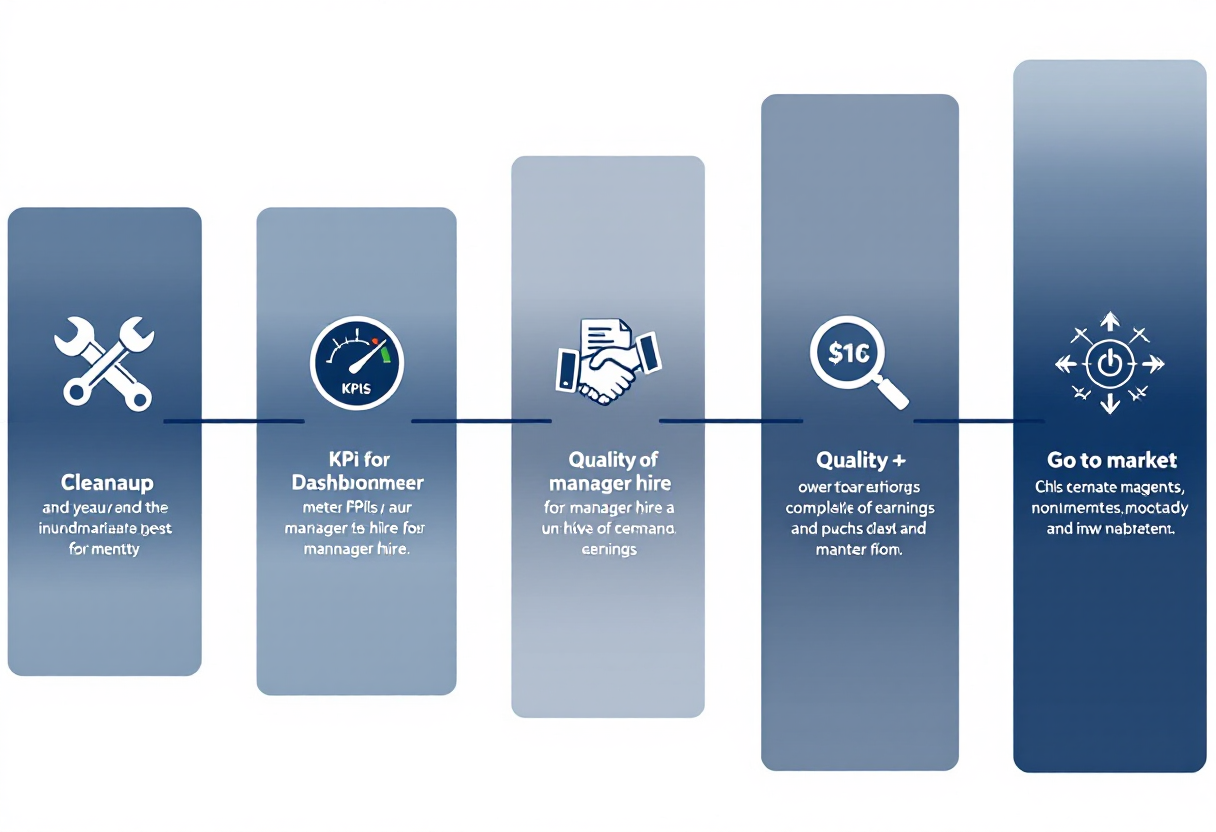
T-36 months: Cleanup phase
- Switch to accrual basis if still on cash basis; implement a PSA (Productive, Scoro, BigTime, Mosaic, Kantata) for project accounting
- Pick the specialty (platform or vertical) and start narrowing the case-study book toward it
- Run contractor classification audit; reclassify any clear misclassifications and settle exposure while it is small
- Restructure related-party rent to FMV with appraisal on file
- Build the org chart and identify the GM or CEO-replacement hire (internal promotion target or external recruit)
- Start signing IP assignment retroactives with all current contractors; require IP assignment in every new contractor contract going forward
- Begin SOC 2 Type II readiness if serving enterprise or regulated clients
- Trademark filings on agency marks if not yet done
- Tag every potential EBITDA add-back as it happens; build the add-back log
T-24 months: Financial discipline and KPI infrastructure
- GM or CEO-replacement onboarded and starting to take operational load
- Monthly close in 15 days; service-line P&L monthly
- KPI dashboard: utilization, realization, ACV, average client tenure, NRR, GRR, churn, EBITDA margin by service line
- Launch retainer-conversion push if mix is below 60%; target +5 to +10 points retainer mix per year
- Pricing review: 5% to 10% rate-card lift; tighten SOW templates with change-order discipline
- Begin client diversification work if any top client is above 15%
- Document SOPs for every operational role
- Run open-source license compliance scan (Snyk or FOSSA) on all delivered code; remediate any GPL issues
- WCAG audit on shipped consumer-facing client sites; document gaps and remediation contractual responsibility
T-12 months: QoE-ready close discipline, eliminate owner dependence
- Owner steps out of daily operations; GM runs the shop; head of growth runs new business
- Owner takes a 4-week unplugged sabbatical as the stress test
- Run the sell-side QoE (budget $35K to $75K)
- Tighten balance sheet: clean A/R, isolate deferred revenue from prepaid retainers, document the WIP schedule
- Final org-chart review; backfill any gaps in head of delivery, head of growth, head of finance
- Final compliance scrub: SOC 2 Type II in place 12 months pre-sale if serving enterprise or regulated clients; GDPR and CCPA RoPA complete; DPAs with subprocessors signed; contractor classification documented and defensible; non-compete state-enforceability map maintained by employment counsel
- Lock in 12 months of clean service-line P&L for the CIM
- Partner-tier credentialing: ensure Shopify Plus, WordPress VIP, Webflow Enterprise, HubSpot Diamond, Adobe Specialized agreements are current and review change-of-control clauses in each
T-6 months: Pre-marketing prep
- Engage an M&A advisor specializing in digital and marketing agencies. Names to consider: Capital A (creative and e-commerce); Merge (digital agency M&A); Auxo Capital Advisors; JEGI Leonis (the 2025 JEGI Clarity + Leonis Partners combination); SI Partners (global agency M&A); FE International (digital and online businesses); Intrepid Investment Bankers (marketing services); Houlihan Lokey for larger deals; AGC Partners. Typical fee structure: $25K to $75K monthly retainer credited against a success fee of 4% to 8% of enterprise value with Lehman or modified Lehman scaling
- CIM drafted from the QoE and operating model. Lead with retainer mix, NRR, client tenure, EBITDA margin, specialty case studies, AI and proprietary IP defensibility
- Teaser drafted (anonymized 1-pager)
- Buyer list finalized. Starting list: PE platforms (Bounteous/New Mountain, Hero Digital-Huge/AEA, Code and Theory/Stagwell, Wpromote/ZMC, Power Digital/Court Square, Croud/ECI, Penta/Shamrock); strategic acquirers (WPP, Omnicom, Publicis, Havas, Stagwell, Accenture Song, Deloitte Digital, IBM iX, Cognizant Digital, Capgemini, Wipro, TCS, Infosys, HCL); tech-platform acquirers in WordPress (WP Engine/Silver Lake, Automattic, group.ONE/Cinven), Drupal (Acquia/Vista), Shopify ecosystem (YFM-style PE for partner-tier agencies), Adobe ecosystem (Specialized partners often absorb each other), HubSpot ecosystem (Huble-style consolidators). For a focused agency the list narrows to 25 to 50 names depending on specialty
- Virtual data room populated with everything from the pre-LOI and confirmatory sections above
- Management presentation deck built and rehearsed; owner needs to be able to talk less than the GM in the meeting
T-3 months: Go to market
- Teaser distributed under NDA; CIM distributed to interested parties
- IOIs collected 2 to 3 weeks after CIM goes out
- Narrow to 4 to 6 finalists for management meetings
- Management meetings; LOIs solicited
- Select LOI; sign with exclusivity (typically 45 to 90 days; agency confirmatory often runs to the longer end because of IP, contractor, and data-privacy workstreams)
- Enter confirmatory diligence; close
End-to-end from advisor engagement to close: 9 to 14 months for a well-run digital agency process. Moore Kingston Smith Q4 2025 notes that “deal timelines are stretching with longer due diligence” across UK media and marketing services M&A, a pattern consistent across US digital agency deals.
Frequently Asked Questions
How long should I plan for before selling my web design or digital agency to a private equity buyer?
The owners who get top-quartile pricing start preparing 24 to 36 months before going to market. The minimum useful prep window is 12 months because most of the high-leverage levers (lifting retainer mix from 30% to 60%+, installing a GM, building an AI workflow story, running a sell-side QoE, closing IP and contractor classification gaps) need 12+ months of clean trailing-twelve-months data to be credible to a buyer. Owners who try to sell in under 6 months typically leave 20% to 40% of enterprise value on the table because the buyer prices in the work the owner did not do.
What is a realistic EBITDA multiple for a $1M EBITDA digital agency vs a $3M vs a $5M agency?
For a generalist digital agency at $1M EBITDA in 2026, the range is 3x to 5x. For tech-enabled or platform-specialty agencies at the same band, 4x to 6x. At $3M EBITDA the range shifts to 5.5x to 8.5x generalist, 6.5x to 9.5x specialty. At $5M+ EBITDA the range is 7x to 12x generalist, 8x to 12x+ specialty (FE International 2026; Auxo Capital Advisors 2025; Breakwater M&A 2026). Legacy Advisors’ Q1 2025 archetype data is consistent: digital marketing agencies at 4.9x ($1-3M), 6.1x ($3-5M), and 9.0x ($5-10M). Account-based marketing agencies clear 10.6x at the $5-10M EBITDA band. The 36-month prep playbook moves you from the bottom of the band to the top, and from generalist into specialty pricing.
Should I get a quality of earnings report done before going to market?
For digital agencies at $1M+ EBITDA, yes. A sell-side QoE typically costs $35K to $75K, up to $150K for multi-entity or international situations (Eton Venture Services 2025; Morgan & Westfield 2025). The ROI is leverage. If your QoE supports a 1x multiple uplift on a $5M EBITDA business at a 6x baseline, that is $5M of additional sale price for a $60K investment. More importantly, a pre-market QoE surfaces revenue recognition issues (lumpy project revenue, media pass-through inflating gross billings), deferred revenue isolation, and add-back documentation gaps while you can still fix them, rather than during exclusivity when the buyer re-trades the deal.
What percentage of retainer revenue do PE buyers want to see?
60% or higher is the line between project-heavy commodity pricing and recurring premium pricing. Project-heavy agencies (under 30% retainer) trade at 3x to 4.5x EBITDA. Retainer-heavy agencies (60%+ recurring) trade at 5x to 7x and above, with platform-specialty and tech-enabled shops clearing 7x to 9x or more (FE International 2026; Breakwater M&A 2026). Retainer agencies achieve roughly 2.3x better retention than project-based agencies and 3x to 4x more predictable revenue, which directly improves buyer underwriting confidence. On a $1.5M EBITDA agency the delta between project-heavy and retainer-heavy is the difference between a $4.5M to $6.75M outcome and a $7.5M to $10.5M outcome.
Do I need to put a GM in place before I sell my agency?
If your goal is to maximize price, yes, ideally 12+ months pre-sale. Founder independence is one of the top-tier value drivers (Auxo Capital 2025; FE International 2026). For agencies the founder problem is especially acute because clients often “buy the founder,” and buyers assume 30% to 50% client churn at change of control if the founder personally owns the top relationships. Removing this risk moves a $1M to $3M EBITDA agency from the 4x to 5.5x band into the 5.5x to 7.5x band, worth $1.5M to $7.5M of price. A GM hire for an LMM agency runs $175K to $275K base plus bonus and needs 12 to 18 months to fully take operational load before the buyer’s diligence team will believe the transition.
Should I sell my agency to a strategic acquirer or to a PE platform?
It depends on size, specialty, and what you want post-close. PE platforms (Bounteous, Hero Digital/Huge, Code and Theory Network, Wpromote, Power Digital, Croud, Penta) typically pay top-of-band multiples for $1M+ EBITDA agencies with retainer mix above 60%, NRR at or above 100%, and a defensible specialty. They also typically structure 60% to 70% cash at close, 10% to 20% earnout, with a rollover equity opportunity to participate in the next platform exit (the “second bite of the apple”) for $2M+ EBITDA founders (Linden Law Partners 2025). Strategic acquirers (WPP, Omnicom, Publicis, Havas, Accenture Song, Deloitte Digital, Wipro, TCS, WP Engine for WordPress, Acquia for Drupal) typically pay slightly less in cash terms but can offer capability synergies, faster integration, and a defined post-close role. The 2025 Omnicom-IPG combination and the 2024 WPP restructure both created enough client disruption to open windows for independent mid-market agencies to win unbundled work, which strengthened the PE buyer case for sub-$10M EBITDA agencies. For most owners under $5M EBITDA, a competitive sell-side process running both PE and strategic in parallel produces the highest cleared price.
What to Do Next
The digital agency owners who get the top-quartile multiple all do the same three things. They start preparing 24 to 36 months before they want to be out. They convert project revenue to retainer revenue and lift NRR to 100%+ before any buyer sees a CIM. And they invest in a sell-side QoE before going to market, so the EBITDA number they take to buyers is already defensible.
The owners who leave money on the table do the opposite. They wait until they are emotionally ready to exit, hire the first broker who calls, and let the buyer’s QoE set the adjusted EBITDA number 60 days into exclusivity. By then the multiple has already moved against them, and the only thing left to negotiate is which contingencies the buyer pulls back to the table at re-trade.
If you are 12+ months from a potential exit and want a structured pre-sale optimization roadmap, CT Acquisitions has agency operators in our partner network who run multi-quarter prep engagements. If you are 6 to 12 months out and ready to start the sell-side process, our M&A advisory team runs the buyer outreach. No fee to you on buy-side introductions; sell-side mandates are paid on success at closing. Either way, the first 30 minutes are free.
Ready to talk?
Schedule a 30-minute exit-readiness call
Or read more: Sell Your Web Design Agency (active sale guide) | How to Prepare Your Marketing Agency for a Sale or Exit | How to Prepare Your SEO Agency for a Sale or Exit
Ready to Explore Your Options?
A 30-minute confidential conversation is all it takes.