How to Prepare Your SEO Agency for a Sale or Exit in 2026: The 36-Month PE-Buyer Playbook
Preparing your SEO agency for exit in 2026 is a 36-month playbook. The first 12 months tighten the operating story around retainer mix and client concentration (both drivers of the multiple aggregators will pay), the middle 12 fix pre-LOI diligence gaps around client retention and consultant utilization, and the final 12 turn one offer into a real competitive process.
Exiting your seo agency business is the single largest financial event most owners will ever face. This guide is the no-fluff playbook for seo agency owners who are 12-36 months from sale, covering how PE-backed buyers actually value your business in 2026, the 12 levers that move your multiple, pre-LOI diligence, deal-killers to fix before going to market, and the full 36-month exit prep timeline.
Updated April 2026 · CT Acquisitions

Most SEO agency owners decide to sell, hire a broker, and find out 90 days later that their business is worth 30% to 50% less than they thought. The owners who get the top-quartile price start preparing 24 to 36 months before they ever talk to a buyer. This guide is the 36-month playbook for how to prepare your SEO agency for a sale or exit. It covers what private equity actually buys, the 12 levers that move the multiple, the documents PE will ask for before they send an indication of interest, and the deal-killers that re-trade SEO agency transactions during confirmatory diligence. Every number cites its source. Every recommendation comes from how the most active SEO and digital marketing agency buyers in 2026 actually behave.
If you are 6 to 36 months from a possible exit, this is the work that turns a 4x EBITDA outcome into a 7x EBITDA outcome. On a $1.5M EBITDA SEO agency, that is the difference between a $6M sale and an $11M sale. Whether you want to prepare your SEO agency for a sale to private equity, prepare your SEO agency for an exit to a strategic acquirer like a full-funnel performance agency or a software platform, or simply maximize value over the next 1 to 3 years before going to market, the work below applies.
Building toward an exit in 12 to 36 months?
CT Acquisitions runs sell-side advisory for SEO and digital marketing agency owners at $1M+ EBITDA. We also have agency operations specialists in our partner network who run pre-sale optimization engagements when the timeline is longer. No fee to you on buy-side introductions; sell-side mandates are paid on success at closing.
What Private Equity Actually Buys in SEO and Digital Marketing Agencies (2026)
Marketing services M&A returned to growth in 2024 and accelerated through 2025 and 2026. Capstone Partners’ Marketing Services Market Update shows digital marketing at 39.5% of all sector transaction targets, up 9.7% year over year, with PE buyer activity up 17.4% YoY (Capstone Partners, Marketing Services Market Update, 2026). Intrepid Investment Bankers’ H2 2024 recap identified “high ROI, high attribution performance marketing capabilities” as the dominant deal driver (Intrepid H2 2024 Marketing Services M&A Recap). The sponsor money flowing in is not random. PE buys specific profiles, and the profile you build determines the multiple you get.
One structural caveat for SEO-pure-plays. Disclosed comparable transactions are the thinnest in any agency M&A category. The only clean public comparables are Adobe’s $1.9 billion acquisition of Semrush at approximately 5x trailing revenue (announced November 19, 2025; closed April 28, 2026) and Falfurrias Capital Partners’ $320M growth investment in Brainlabs (September 2023). Nearly every other 2024 to 2026 SEO or digital agency add-on (Herringbone/Hennessey June 2025, Power Digital/Cardinal January 2026, Wpromote/Giant Spoon November 2025, Bounteous/Accolite February 2024, ECI/Croud October 2024, Brave Bison/Builtvisible March 2025) closed without disclosed multiples. SEO agencies also tend to trade at a slight discount to full-funnel performance agencies because of Google algorithm volatility risk, AI-content-farming exposure, and the AI-search transition raising terminal-value uncertainty.
The PE-attractive SEO agency profile
- EBITDA threshold for a platform-quality deal: $1M to $3M EBITDA is the entry band where sponsor-backed platforms run a competitive process. Below that, you are an add-on inside a roll-up or a SaaS-style broker transaction (FE International, Quiet Light, Website Closers). Above $5M EBITDA, you are an attractive bolt-on for full-funnel performance marketing platforms. Above $15M EBITDA, you are a platform candidate yourself.
- Recurring retainer revenue: 70% or higher is the line buyers want to see. Retainer clients stay 56 months on average versus 24 months for project clients (Focus Digital, Average Marketing Agency Churn, 2026). Retainer-led agencies post 18% annual churn vs. 42% for project-led shops, and 1.6% monthly gross-revenue churn vs. 4.2% project (Focus Digital, 2026).
- Client tenure: Above-industry-mean tenure is a premium driver. ANA/4As reports the average client to agency relationship is now ~7 years, more than double 3.2 years in 2016 (ANA, “Client-Agency Relationship Tenure Has Doubled Since 2016”, April 2025). Integrated full-service agencies average 87 months tenure; media-only agencies average 44 months.
- Enterprise vs. SMB mix: 64% of SEO agencies price retainers under $1,000 per month; only 15% charge over $2,000 per month (Arvow SEO Agency Statistics 2026; QuickSEO 2026). Enterprise SEO retainer pricing sits at $8K to $25K+ per month. An enterprise-skewed roster trades at a 1.0x to 2.0x multiple premium over an SMB-only book (FE International, 2026).
- Client concentration: No single client above 10% of revenue. Top 5 clients below 30%. Concentration above 20% triggers buyer pushback; above 25% triggers a 15% to 30% discount or buyer walk (Eagle Rock CFO; Midwest CPA; Wayfront 2025; Morgan & Westfield).
- Owner role: Owner is in management, not the chief SEO strategist or chief seller of record. GM or COO in place 12+ months pre-sale.
- Specialty depth: Defensible specialty in technical SEO, enterprise SEO, content strategy at scale, digital PR / earned-media link acquisition, or GEO / AI-search readiness commands a premium over generalist link-building shops.
Active SEO and digital marketing agency PE platforms in 2026
The list below covers the most active sponsor-backed digital agency platforms in the 2024 to 2026 cycle. This is who will see your teaser. Add-on counts are point-in-time and sometimes disagree across sources by plus or minus 20%; treat as directional. Sources include Tracxn, PrivSource, PitchBook, sponsor press releases, SEC filings, and trade press as of May 2026.
| Platform | Sponsor | Profile |
|---|---|---|
| Tinuiti | New Mountain Capital | Full-funnel performance marketing including SEO. Add-ons include Ampush (Jan 2023), Bliss Point Media (Aug 2021), The Ortega Group (Mar 2021). National North America; $3M+ EBITDA target. |
| Wpromote | ZMC (Oct 2022 platform); Monroe Capital debt | Acquired Giant Spoon Nov 20, 2025. Ad Age Performance Agency of the Year 2025. Combined entity Wpromote x Giant Spoon with Polaris proprietary tech. National US; $1M to $10M EBITDA. |
| Power Digital | Court Square Capital (Mar 2022 platform from Periscope Equity) | 2024 to 2026 add-ons: Factorial Digital (Nov 2024), Cardinal Digital Marketing (healthcare-focus, Jan 21, 2026), Endrock Growth & Analytics. National US, San Diego HQ; $1M to $5M EBITDA. |
| Bounteous x Accolite | New Mountain Capital | Merged Bounteous and Accolite into a 5,000-person digital transformation firm Feb 1, 2024. Serves 300+ Fortune 1,000 clients. Chicago HQ, global. Platform tier; $25M+ EBITDA add-ons. |
| New Engen | NewRoad Capital Partners + Insignia Capital Group | 2024 add-on Donut Digital (creative-led performance marketing, Sept 26, 2024); 2023 add-on LT Partners. Digital Agency of the Year 2024 US Agency Awards. Seattle HQ; $1M to $5M EBITDA. |
| Herringbone Digital | Trinity Hunt Partners | Vertical-specific digital marketing platform. Acquired Hennessey Digital (law firm SEO, 125 staff, June 11, 2025) and TNT Dental (dental SEO + paid media, March 2025). National; $1M to $5M EBITDA. |
| ROR Partners | Gemspring Capital | 2025 add-on Incline Marketing (organic location-based search, June 2025). AI-powered performance marketing platform. National US; $1M to $3M EBITDA. |
| Market Performance Group (MPG) | Sentinel Capital Partners | 2024 add-on Team Go (TikTok Shop, social commerce). Retail marketing solutions platform. National; $1M to $5M EBITDA. |
| Acceleration Partners | Mountaingate Capital (Dec 2020 platform) | Grovia acquisition (2024) was third add-on under Mountaingate. Partnership-marketing focus, 300+ employees, 40+ countries. Boston HQ; $1M to $3M EBITDA. |
| MSQ | One Equity Partners (controlling 2023; LDC minority) | EBITDA grew from £6M to £20M+ in 4 years under LDC; valued $228.2M when One Equity took control 2023. UK/US, global. Platform tier. |
| Brainlabs | Falfurrias Capital Partners (Sept 2023, $320M valuation) | Acquired Hanapin (US digital agency) post-deal. Founded by ex-Google’s Daniel Gilbert. 800% top-line growth in 4 years under prior Livingbridge ownership. UK/US, global; $1M to $5M EBITDA. |
| Croud | ECI Partners (Oct 2024, majority from LDC at 2.8x return) | UK-based digital agency, grew from 185 to 600+ employees under LDC. Explicit “US M&A war chest” thesis. UK HQ, US expansion; $1M to $5M EBITDA. |
| Brave Bison | LSE-listed; Stagwell-comparable challenger | March 2025 acquired Builtvisible (UK’s largest independent SEO + content + digital PR agency). Prior add-ons: Greenlight Digital, SocialChain, The Fifth (£7.6M). UK HQ; £2M to £10M revenue. |
| Dept | The Carlyle Group (Dec 2019 announce, Feb 2020 close) | Sale process opened 2023 (Carlyle, Morgan Stanley, Jefferies retained per ION Analytics). Global digital agency with 1,500+ headcount at acquisition. Amsterdam HQ, global. Platform tier. |
| Huge + Hero Digital | AEA Investors (Dec 5, 2024 from IPG) | IPG sold Huge to AEA; combined with Hero Digital April 2025 to create one of the largest independent experience-transformation firms. Google, McDonald’s, NBCU, Nike client base. National. Platform tier. |
| Stagwell (NASDAQ: STGW) | Public holdco (Mark Penn) | 11 acquisitions completed 2024. Q4 2024 net revenue growth 14%; Digital Transformation segment 20%. Targeting $5B revenue by 2029. Global; platform-to-network add-on. |
| Gemspring Capital (multi-platform) | Self | Active in digital marketing 2024 to 2025 per PE Hub. US; $1M to $5M EBITDA. |
| Bridgepoint (multi-platform) | Self | Active in digital marketing 2024 to 2025 per PE Hub (“Bridgepoint, Gemspring lead PE’s interest in digital marketing”). UK/US/Europe; mid-market. |
Add to that list the strategic acquirers. Full-funnel performance agencies (Tinuiti, Wpromote, Power Digital, Bounteous) are the most active acquirers of SEO-pure-play shops in the $1M to $5M EBITDA band. Large holding companies (WPP, Publicis, IPG, Omnicom, Brandtech Group) buy at the platform tier through their digital divisions. Software platforms also acquire in adjacencies: Adobe (NASDAQ: ADBE) acquired Semrush for $1.9B (announced Nov 19, 2025; closed April 28, 2026), explicitly building a generative engine optimization capability. Ziff Davis (NASDAQ: ZD) owns Moz via its iContact subsidiary (acquired June 2021). Conductor (Bregal Sagemount, $500M valuation Nov 2021) rolled up Searchmetrics (Feb 2023) and ContentKing (Feb 2022). Semrush itself acquired Backlinko from Brian Dean for mid-seven figures in January 2022. For an SEO-pure-play between $1M and $5M EBITDA, the most realistic buyer pool is the full-funnel performance platform tier, with secondary interest from software-side acquirers building agency-services capability.
SEO Agency Valuation Multiples in 2026 (What You Are Actually Worth)
The multiple a buyer pays comes down to size, recurring retainer mix, client tenure, enterprise vs. SMB skew, specialty depth, and client concentration. Here is the 2026 range, cross-referenced from FE International’s 2026 agency valuation benchmarks, First Page Sage’s 2025 Marketing Agency EBITDA Multiples report, Capital A, Breakwater M&A 2026, Auxo Capital Advisors, Agencies.co Definitive Guide 2026, and the IBBA Q4 2025 Market Pulse Survey.
SDE multiples (smaller, owner-operated, typically under $3M revenue)
| SDE band | SDE multiple | Profile fit |
|---|---|---|
| Under $500K SDE | 2.22x to 3.54x; average 3.33x | Owner-operated SEO shop (Peak Business Valuation 2025; First Page Sage 2025) |
| $500K to $1M SDE | 2.5x to 3.5x | Lower middle market baseline (Capital A 2025; David Jacobs Business Broker 2025) |
| Under $1M SDE, retainer-led | 2.5x to 4.0x | Retainer-led SEO shop with documented client tenure (FE International Agency Valuation Benchmarks 2026) |
| Local SEO / SMB-only book | 2.0x to 3.5x | Commoditized service mix (First Page Sage 2025; SEO.co Marketing Agency Valuations) |
| Content-marketing agency under $500K SDE | 2.0x to 3.5x | Content production heavy mix (First Page Sage 2025; BizBuySell active listings May 2026) |
EBITDA multiples (PE-attractive size)
| EBITDA band | SEO + content (retainer-led) multiple | Full-funnel digital / performance multiple |
|---|---|---|
| Under $500K EBITDA | 2.5x to 4x | 3x to 5x |
| $500K to $1M EBITDA | 3x to 5x | 4x to 6x |
| $1M to $2M EBITDA | 4x to 6x | 5x to 7x |
| $2M to $5M EBITDA | 5x to 7x | 6x to 9x |
| $5M to $10M EBITDA (specialty / enterprise SEO) | 6x to 9x | 8x to 11x |
| $10M+ EBITDA (platform tier, full-funnel) | 8x to 11x+ | 9x to 13x+ |
Source: FE International 2026; First Page Sage Marketing Agency EBITDA Multiples 2025; Capital A 2025; Breakwater M&A 2026; Agencies.co Definitive Guide 2026; Auxo Capital Advisors; Mergers & Acquisitions Net 2026.
A few benchmarks inside the bands. First Page Sage (2025) reports that for marketing agencies with average adjusted EBITDA of $2.4M, the recent transaction average was 6.46x, with some hitting 12x with strategic buyers. Top-tier agencies that sold at 8x to 12x in 2025 had three years of double-digit top-line growth, low client concentration, and customer lifespans above industry average. By marketing-agency category, the 2025 multiple bands ran: Account-Based Marketing 5.5x to 10.6x (highest), Growth Marketing 5.2x to 10.2x, Traditional Marketing 5.2x to 10.4x, Creative Marketing 4.6x to 8.1x, and Personal Reputation 4.5x to 8.2x (lowest, because of single-person key-person risk). IBBA Q4 2025 Market Pulse: $1M to $2M deals at 3.1x; $2M to $5M at 4.1x; $5M to $50M at 5.5x (industry-blended).
For a pure SEO agency in the $1M to $5M EBITDA band, the defensible 2026 multiple range is 4x to 8x adjusted EBITDA depending on the premium-driver scorecard. Source thinness note: the disclosed-multiple comparables that exist are skewed toward the platform-recap tier (Semrush at 5x revenue; Brainlabs $320M valuation), not the add-on band where most readers will sell.
Recent verifiable digital agency, SEO platform, and content agency transactions
| Acquirer | Target | Date | Value | Implied multiple |
|---|---|---|---|---|
| Adobe (NASDAQ: ADBE) | Semrush (NYSE: SEMR) | Nov 19, 2025 announce / Apr 28, 2026 close | $1.9B equity | ~5.0x trailing revenue ($376.8M) |
| Falfurrias Capital Partners | Brainlabs (growth investment) | Sept 2023 | $320M valuation | Not disclosed |
| AEA Investors | Huge (from IPG) | Dec 5, 2024 | Not disclosed | Not disclosed (estimate: high single digits revenue multiple) |
| New Mountain Capital | Bounteous + Accolite merger | Feb 1, 2024 | Not disclosed | Not disclosed |
| Trinity Hunt-backed Herringbone Digital | Hennessey Digital (law firm SEO) | June 10, 2025 | Not disclosed | Not disclosed (estimate: 6x to 9x EBITDA at vertical-specialist band) |
| Trinity Hunt-backed Herringbone Digital | TNT Dental (dental SEO + paid) | March 2025 | Not disclosed | Not disclosed |
| Power Digital (Court Square portfolio) | Cardinal Digital Marketing | Jan 21, 2026 | Not disclosed | Not disclosed |
| Power Digital (Court Square portfolio) | Factorial Digital | Nov 2024 | Not disclosed | Not disclosed |
| Wpromote (ZMC portfolio) | Giant Spoon | Nov 20, 2025 | Not disclosed | Not disclosed |
| ECI Partners | Croud (from LDC) | Oct 2024 | Not disclosed; 2.8x LDC return | Not disclosed |
| Brave Bison | Builtvisible | March 2025 | Not disclosed | Not disclosed |
| Bregal Sagemount | Conductor ($150M growth round) | Nov 2021 | $500M valuation | Not disclosed |
| Semrush | Backlinko | Jan 2022 | Mid-7-figures | Not disclosed (estimate ~3x revenue) |
Sources: Adobe news room; CNBC Nov 19, 2025; TechCrunch Nov 19, 2025; Falfurrias Capital Partners press; AEA Investors press / PRNewswire Dec 5, 2024; Bounteous press Feb 1, 2024; BusinessWire June 10, 2025 (Herringbone-Hennessey); Trinity Hunt Partners press; BusinessWire Jan 20, 2026 (Power Digital-Cardinal); Power Digital press Nov 2024 (Factorial); Wpromote press / Sidley Austin / MediaPost Nov 26, 2025 (Giant Spoon); ECI Partners press Oct 2024 (Croud); Brave Bison press March 2025 (Builtvisible); Bregal Sagemount press (Conductor); TheyGotAcquired.com / Semrush IR (Backlinko).
The 12 Value Levers That Move Your Multiple (Ranked by Impact)

These are the levers that move SEO agency multiples in the 24 months before a sale. Each one has a current state, a target state, and an estimated financial impact. The ordering is by dollar impact per unit of effort, based on cross-source synthesis from FE International 2026, Auxo Capital Advisors, First Page Sage 2025, Focus Digital, Sidekick Accounting, and Financial Models Lab. Multiple-expansion deltas per lever are synthesized from multiple agency valuation guides; specific numbers are estimates based on cross-source pattern recognition, not from a single primary citation.
Lever 1: Lift recurring retainer revenue share to 70% or higher
Current: Under 50% of revenue comes from monthly retainers. 64% of SEO agencies price retainers under $1,000 per month (Arvow 2026). 70% of SEO agencies make under $50K MRR. Target: 70% to 90%+ retainer revenue, average retainer $3K to $8K, with four-to-six-figure enterprise retainers where possible. Impact: A 70%+ retainer mix typically commands a 1.0x to 2.0x multiple premium vs. an otherwise identical project-led shop (FE International 2026; Auxo Capital Advisors 2026). Retainer clients stay 56 months vs. 24 months for project clients (Focus Digital 2026). On a $1.5M EBITDA business that delta is the difference between a $4.5M to $7.5M sale and a $7.5M to $15M sale. How: Convert one-off audit or project clients to ongoing retainer with a quarterly strategy + monthly execution structure. Price audits as entry products that convert to retainer. Restructure existing low-retainer clients on renewal to a productized retainer with documented scope. Kill project-only clients that do not convert within 12 months.
Lever 2: Move the owner out of the chief-strategist and chief-seller chair
Current: Owner is the chief SEO strategist, the chief seller, signs every proposal, sits on every QBR, and is the agency brand on LinkedIn. Target: GM or COO in place 12+ months before going to market; SEO director, content director, and technical SEO director leading client work; sales team running the pipeline. Owner doing under 30 hours per week of operational work. Impact: Owner-dependence is the single most-cited multiple haircut for SEO agencies (Lightning Path Partners; Chinook Capital Advisors; Bennett Financials). Buyers fear key-person risk because agency knowledge and client relationships live in the owner’s head. Removing it moves a $1M to $3M EBITDA shop from the 4x to 5x band into the 5x to 7x band, worth $1M to $6M of price. How: GM hire 18 to 24 months pre-sale at $150K to $250K base plus bonus and equity. Document client-strategy SOPs. Build a leadership scorecard. Transition client relationships to the account team. Take a 2-week unplugged vacation as the stress test. Reduce the owner’s name from email, Slack, proposals, and case studies wherever possible.
Lever 3: Get on a proper PSA stack and run a real monthly close
Current: QuickBooks plus Google Sheets plus Slack plus ad-hoc time tracking. No service-line P&L. No monthly close. Target: HubSpot or Salesforce for CRM; ClickUp, Asana, or Productive for project management; AgencyAnalytics or Databox for client reporting; QuickBooks Online or Xero with class or department tags for service-line P&L. Monthly close in 15 days. Real KPI dashboard. Impact: Estimated +0.5x to 1.0x multiple uplift, primarily because data-room speed and KPI defensibility translate directly into LOI competitiveness. 42% of agencies reclaimed 5 to 10 billable hours weekly after implementing a proper PSA (AgencyAnalytics 2025 benchmark). Lifts billable utilization toward the 75% to 85% benchmark (Sidekick Accounting 2026; Financial Models Lab). How: Budget $30K to $80K implementation. Force tech adoption by tying time-tracking compliance to bonus comp.
Lever 4: Drive average retainer dollar size and pricing discipline
Current: Average retainer $1K to $3K per month; price has been flat for three years; no productization tiers. 86% of SEO agencies have monthly retainers under $10,000 (Arvow 2026). Target: Average retainer $5K to $12K per month; price book with three tiers; annual 5% to 10% list-price increase; productized scope with named deliverables. Enterprise SEO retainer pricing band: $8K to $25K+ per month (Passionfruit AI SEO Pricing 2025; Singularity Digital GEO Cost 2025). Impact: Direct EBITDA growth that multiplies at sale. A $5M revenue agency with 50 retainer clients that lifts the average retainer by $1,500 per month adds $900K of annual revenue, with most dropping to EBITDA at retainer gross margins of 60% to 70%. At a 6x multiple that is $3M+ of additional sale price. How: Productize three tiers (Starter, Growth, Scale). Annual price review on every renewal. Eliminate “founder’s friend” anchor clients on next renewal. Move pricing presentation to options-based, with the highest tier as the anchor.
Lever 5: De-concentrate client base and kill the anchor-client trap
Current: Top client above 15% of revenue; top 5 clients above 40%. Target: Top client under 10%; top 5 under 30% (Morgan & Westfield; Eagle Rock CFO; Midwest CPA). Impact: Concentration above 20% triggers buyer pushback. Above 25% triggers a 15% to 30% discount or buyer walk. Above 35% triggers buyer withdrawal in many cases (Wayfront 2025; Midwest CPA). Multiple reduction of 1.0x to 2.0x is typical above 30% (Eagle Rock CFO; First Page Sage 2025). How: Diversify into adjacent verticals if the agency is single-vertical-deep. Expand geographic footprint. Kill the discount on the biggest account so its relative weighting shrinks naturally as smaller clients grow. Bring in a second anchor via outbound BD.
Lever 6: Build a technical-SEO and content-strategy specialty premium
Current: Generalist agency doing keyword research, on-page, light link-building, and monthly reporting. Target: Defensible specialty in one or more of: enterprise technical SEO (Core Web Vitals, schema, log-file analysis, Edge SEO, JS rendering); content strategy and production at scale (human-led, AI-augmented, structured for E-E-A-T); digital PR and earned-media link acquisition (HARO, Connectively, Featured, Qwoted-based outreach, journalist relationships, brand mentions); GEO / AI-search readiness (LLM citation tracking, entity SEO, structured data, AI Overview optimization). Impact: Estimated +0.5x to 1.0x multiple premium based on cross-source pattern (Onely best AI SEO agencies 2026; iPullRank brand positioning; FE International 2026). Specialty positioning also lifts the buyer pool because technical-SEO consultancies are scarce on the buy side. How: Hire one or two senior specialists (technical SEO lead $120K to $200K; content strategy lead $110K to $180K; digital PR lead $90K to $150K). Productize the specialty as a named service line. Publish case studies and pitch industry conferences.
Lever 7: Senior-strategist retention and depth
Current: 25%+ annual turnover. SEO and content directors are one or two years in. No internal leveling. Target: Under 15% annual turnover, named career ladder (associate, senior, lead, director, principal), documented compensation bands, non-compete or non-solicit on all senior strategists where state law allows. Impact: Replacement cost of a senior strategist is roughly 150% of salary in lost ramp and recruiting. Senior strategists with a $200K fully-burdened cost who walk with the client roster represent a real exit risk. Buyers price a 0.5x to 1.0x multiple haircut into key-strategist flight risk if there is no non-solicit in place (Locked On Leadership 2025; Chinook Capital Advisors). How: Career ladder with documented bands. Profit-share or phantom-equity for senior strategists. Non-solicit (not non-compete in California) with reasonable garden-leave terms. Equity vesting plan tied to the exit.
Lever 8: EBITDA add-back hygiene
Current: Owner mixes personal expenses through the agency with no documentation. Related-party payroll for spouse or children. No add-back schedule. Target: Every add-back is documented as it happens. Related-party payroll is at fair market value or eliminated. Clean monthly close. Impact: Every defensible dollar of adjusted EBITDA gets multiplied. On a 6x multiple, $100K of clean add-backs equals $600K of sale price (Morgan & Westfield QoE guide). How: Adopt a monthly add-back log starting today. Document business purpose. Get a fair-market comp study for the owner role. Eliminate ghost-employee payroll for family members. Common SEO agency add-backs that hold up: owner compensation above market, one-time legal fees, owner travel and entertainment, owner health insurance, M&A advisory fees on this transaction, conference and event one-time costs, ERC residuals, software-implementation one-time fees (HubSpot, ClickUp, AgencyAnalytics, Productive migration), retreat or offsite costs, one-time tool or data-vendor migrations.
Lever 9: Working capital normalization and deferred retainer revenue treatment
Current: Volatile A/R, no AR-aging discipline, prepaid retainer revenue sitting in a single cash account. Target: 30 to 45 day DSO. Deferred retainer revenue tracked separately on the balance sheet. TTM-average working capital stable. Impact: The working capital peg is set off TTM. Volatile working capital lets the buyer set a higher peg, subtracting from purchase price. Long-term deferred revenue (months 13+) is typically treated as debt outside the peg (Auxo Capital Advisors 2026; Morgan & Westfield NWC guide). Poorly managed working capital can cost 2% to 5% of enterprise value at close. How: Tighten A/R collection cycle. Move all clients to auto-pay (ACH or credit card). Isolate prepaid retainer liability on the balance sheet. Switch to accrual basis recognition (recognize month earned) if you are booking annual prepayments as Day-1 revenue.
Lever 10: AI / LLM / GEO workflow adoption (real, not spam)
Current: No formal AI workflow. Writers use ChatGPT ad hoc with no quality control. Either no documented LLM citation tracking on clients or none at all. Target: Documented LLM-augmented production workflow with human-led editorial QC. Structured-data and entity-SEO checklist on every client. LLM citation tracking for AI Overview and ChatGPT citations on each client. Internal LLM apps and prompt libraries as proprietary IP. Impact: FE International (2026) reports AI integration creates a measurable 1x to 2x multiple premium when accompanied by real workflow redesign, citing the McKinsey State of AI 2025 finding that only 6% of companies show real EBIT impact from AI and the determinant is workflow not surface. Traffic from LLMs grew 527% year over year in late 2025 (Semrush AI search study 2026), and the average AI-search visitor is 4.4x as valuable as the average organic visitor by conversion rate. How: Document the editorial workflow with named tools (prompt libraries, fact-check steps, human editor sign-off). Build a GEO / AI-search service line. Track LLM citations across the client portfolio using Profound, AthenaHQ, or Botify’s bot tracker. Avoid scaled content abuse (see Section 6 deal-killers).
Lever 11: Platform partnerships and certifications
Current: No Google Partner badge, no Semrush or Ahrefs partner tier, no BrightEdge or Conductor agency-partner relationship. Target: Google Premier Partner status where you cross-sell paid (top 3% of agencies per country, per ClicksGeek 2026); Semrush and Ahrefs partner tier; BrightEdge or Conductor agency-partner status; HubSpot Diamond or higher if cross-selling marketing automation. Impact: Estimated +0.25x to 0.5x multiple in buyer trust-signal value. Direct access to Google support teams and beta features (ClicksGeek 2026). Note: Google does not certify SEO services through the Premier Partner program (it applies to Google Ads spend plus certifications). For SEO-pure-plays, Semrush, Ahrefs, BrightEdge, and Conductor partner status is the equivalent trust signal. How: Maintain Google Ads certifications across the team. Hit the partner-tier thresholds annually. Publicize the badge on the website and CIM.
Lever 12: Detach agency brand from owner personal brand
Current: Owner posts on LinkedIn occasionally. No agency blog, no podcast, no industry-conference presence. Or worse, the agency brand IS the owner brand (Brian Dean / Backlinko was the cautionary example). Target: Agency-branded thought-leadership platform (podcast, newsletter, weekly blog, conference circuit speakers) operating independently of the owner’s personal brand. Impact: This is the second key-person risk by another name. If the owner is the agency brand, the buyer treats the entire goodwill as transferable risk. Detaching agency brand from owner brand is worth an estimated +0.25x to 0.75x multiple based on cross-source pattern. Brian Dean sold Backlinko to Semrush for mid-seven figures and stayed on part-time, partly because the brand was him (TheyGotAcquired.com 2022). Most owners cannot or do not want that arrangement. How: Hire a head of marketing for the agency. Get the senior strategists publishing under their own bylines. Promote the agency as the brand, not the owner.
Want to grow your business to maximize value before exiting?
We connect SEO and digital agency owners with operations experts in our partner network who run 12 to 24 month pre-sale optimization engagements. The engagement pays for itself many times over in incremental sale price.
What PE Asks Before They Send an LOI (The Pre-LOI Diligence Stack)
Before a PE firm or strategic acquirer commits to a letter of intent, they ask for a focused diligence package. The list below is the real ask from 2026 PE buyers and strategic acquirers targeting SEO and digital marketing agencies. The “why PE asks” and “how to prepare” expand each item to what is typical across the sector. Source backbone: Auxo Capital Advisors sell-side playbook 2025; Wall Street Prep sell-side primer; Colonnade Advisors podcast 020; Morgan & Westfield; Citrin Cooperman sell-side QoE guide; Riveron; BDO.
1. Income statements for 2023, 2024, and the latest trailing twelve months
Why PE asks: They are building the trailing-twelve-months adjusted EBITDA they will multiply. They want growth rate, margin trajectory, seasonality (often muted in SEO retainer businesses), and one-time movers. LTM is the bridge between most recent year-end and today so the headline price reflects current run-rate.
How to prepare: Accrual-basis P&L by month, mapped to a clean chart of accounts. Service-line P&L (SEO retainer, technical SEO, content production, link building / digital PR, GEO / AI-search retainer, paid media if cross-sold). Reconcile to tax returns so there are no surprises in confirmatory.
2. Balance sheet at the latest month
Why PE asks: First, to size the working capital peg they will set in the SPA. Second, to identify net debt (cash minus interest-bearing debt minus debt-like items including deferred retainer revenue, accrued bonuses, client prepayments, capital lease balances, and accrued tools or software annual licenses paid upfront). Both peg and net debt come out of the purchase price.
How to prepare: Tie the balance sheet to the trial balance. Isolate deferred retainer revenue, which is the most commonly disputed item for retainer-led agencies. Buyers will treat next-12-month deferred revenue inside NWC and 13+-month deferred revenue as debt outside the peg (Auxo Capital Advisors working-capital peg guide 2026; Morgan & Westfield NWC guide).
3. Adjusted EBITDA bridge with add-back documentation
Why PE asks: They want a sneak peek at the adjusted EBITDA story before sinking diligence cost. Aggressive or undocumented add-backs discount the rest of the numbers.
How to prepare: Build the bridge from book EBITDA to adjusted EBITDA, line by line. Document every add-back with the underlying invoice or payroll record. Common SEO agency add-backs that hold up: owner compensation above market (if the owner takes $400K but a GM would cost $200K, $200K adds back), one-time legal fees, owner family-member payroll, owner travel and entertainment, owner health insurance, country-club fees, M&A advisory fees on this transaction, conference and event one-time costs, ERC residuals, software-implementation one-time fees, retreat or offsite costs, one-time tool migrations. Reference: Morgan & Westfield QoE guide; Citrin Cooperman sell-side QoE.
4. Anonymized employee roster (titles, start dates, pay, classification)
Why PE asks: Two risks. First, senior strategist tenure vs. industry turnover. Agency staff turnover commonly runs 20% to 30% annually, and SEO senior strategists are the highest-flight-risk role because they can monetize their own client list. Second, W-2 vs. 1099 classification. SEO agencies often run writers, link-building outreach, and offshore production on 1099 or contractor agreements.
How to prepare: Roster columns: role, hire date, full-time vs. part-time, W-2 vs. 1099 (with classification rationale), comp structure (salary, bonus, commission, profit-share), and any active non-compete or non-solicit. Calculate and disclose 12-month and 24-month rolling retention. Particularly call out senior strategists (SEO directors, content directors, technical SEO leads) with tenure, comp, and non-compete enforceability; and 1099 writers, outreach VAs, and link-builders with classification basis. The DOL rescinded the 2021 two-factor test as of March 11, 2024, and the current totality-of-the-circumstances test makes long-term full-time 1099 writers servicing one agency client at the agency’s direction look like employees (DOL 2024; Windes Insights 2024; CLA 2024 Independent Contractor Rule).
5. Revenue breakdown by service line + average retainer + client counts
Why PE asks: This is the single most diagnostic exhibit. It tells them retainer mix vs. project mix, average retainer trajectory (flat or declining is a pricing-discipline red flag), service-line concentration risk (90% of revenue from link-building is brittle), and cross-sell penetration.
How to prepare: Three columns minimum: total revenue by service line, number of active clients by service line, average retainer per service line, year over year. Benchmarks against industry: 64% of SEO agencies price retainers under $1,000 per month, only 15% charge over $2,000 per month (Arvow 2026; QuickSEO 2026); 70% of SEO agencies make under $50K MRR; 86% have monthly retainers under $10,000. Enterprise SEO retainer pricing band: $8K to $25K+ per month. GEO-only retainer pricing: $2K to $2.5K+ per month (Singularity Digital 2025). Pull this straight out of HubSpot, ClickUp, AgencyAnalytics, Productive, or whatever PSA tool is in place.
6. Client list with tenure, ARR, renewal cadence, and service lines engaged
Why PE asks: Recurring retainer revenue is the single biggest multiple driver. They want absolute count of active clients, total ARR, average tenure, renewal rate (target above 85% annual), service mix per client (single-service vs. multi-service), and deferred revenue from any prepaid retainers.
How to prepare: Client list by month for the last 36 months. Renewal cohort tracking. ARR snapshot. Cross-sell penetration (percentage of clients on more than one service). Plan-mix breakdown. Buyer wants to see 85%+ client retention, ideally above 90% (Arrowfish Consulting 2026). Retainer-led agency churn benchmark is 18% annually (Focus Digital 2026). Small retainer agencies (1 to 10 employees) experience around 25% annual churn; large full-service agencies (51+) achieve 12% to 15%. Monthly gross logo churn under 3% is elite.
7. Client concentration analysis (top 10 by ARR and top 10 by revenue)
Why PE asks: Concentration above 20% triggers buyer pushback; above 25% triggers a 15% to 30% discount or buyer walk (Eagle Rock CFO; Midwest CPA; Wayfront 2025). SBA lenders, who finance much of the lower middle market, get uncomfortable at 20% (Wall Street Prep 2025).
How to prepare: Top 10 client list with ARR, monthly revenue, tenure, primary service line, contract end date or auto-renewal terms, change-of-control assignment provisions. Note that for SEO agencies the anchor-client pattern is common (one $50K-per-month enterprise client carrying the rest of the book at $5K per month each), which is structurally dangerous.
8. Five-year business plan
Why PE asks: PE underwrites a forward case (years 1 through 5 post-close). They want to see if there is a credible growth story and how it stacks against their own model.
How to prepare: A simple operating model: revenue by service line, gross margin assumptions, overhead growth, EBITDA. Include capacity build (heads), planned vertical expansion, productized vs. custom mix, GEO / AI-search service line build-out, planned price actions, and pipeline.
9. Tech stack, tools, and proprietary IP
Why PE asks: Two reasons. The buyer wants to roll the acquired agency onto the platform’s standardized stack. And the buyer wants to value any proprietary tooling (proprietary rank-tracking, custom dashboards, productized content-brief generators, LLM-prompt libraries, internal LLM apps). Proprietary tooling can defend a 0.5x to 1.0x multiple uplift.
How to prepare: List of all software (Semrush, Ahrefs, Conductor, BrightEdge, Botify, Screaming Frog, STAT, AccuRanker, AgencyAnalytics, HubSpot, ClickUp, Slack) with seat count, annual cost, renewal date. Separate document for proprietary IP: code repos, internal LLM apps, content-brief templates, custom GPTs, prompt libraries, training-data corpora. Verify all tool-stack license terms include assignment rights on change of control (some enterprise SEO tools have per-domain or per-account licenses that do not transfer without renegotiation).
10. Marketing and lead-source attribution and sales pipeline
Why PE asks: A diversified, trackable demand engine is what makes the business “transferable” in the buyer’s underwriting. If 60% of new clients come from the owner’s LinkedIn presence or speaking circuit, that is key-person risk by another name.
How to prepare: New-client source breakdown for the last 24 months: percentage inbound SEO, paid, referral, outbound, partner or affiliate, and owner-personal-brand. Top-of-funnel volume plus conversion to SQL plus conversion to closed-won plus average ACV per source.
Confirmatory Diligence (After You Sign the LOI)
Once an LOI is signed and exclusivity starts (typically 45 to 90 days per Colonnade Advisors podcast 020), the buyer runs parallel workstreams. This is the depth of inspection your business will undergo. If anything was hiding, it surfaces here.
- Quality of Earnings (QoE). Outside accounting firm runs revenue cut-off testing (especially deferred retainer revenue), expense normalization, add-back validation, working capital trends. Buy-side QoE cost: $50K to $250K typical for $1M to $10M EBITDA agencies (Eton Venture Services 2025; Moss Adams; Withum sell-side QoE). Output: a locked adjusted EBITDA number.
- Client concentration and commercial DD. Client-by-client revenue analysis, calls with top accounts, contract review (assignment clauses, change-of-control triggers, renewal dates, exclusivity, scope-creep penalties).
- SEO-specific technical DD. The unique workstream. The buyer’s SEO consultancy (Sandler Digital, Paradox SEO, SEO Hermit, Eyeful Media, or in-house) audits client-portfolio risk: manual action exposure (GSC penalty data across client portfolio); link profile audit (PBN exposure, paid link history, link-building partner identity); AI-generated content exposure (scaled content abuse risk per Google March 2024 policy); Helpful Content Update impact (percentage of client base that lost organic traffic since Sept 2023 HCU plus March 2024 core update); Core Web Vitals and crawlability on client sites. Approximately 70% of digital acquisitions have at least one material SEO issue affecting traffic valuation or post-close strategy (Paradox SEO 2026; Sunny Patel SEO DD 2026). Comprehensive SEO due diligence typically costs $5K to $25K (Sandler Digital 2025).
- IT systems audit. HubSpot, ClickUp, Productive, AgencyAnalytics, Function Point, plus the SEO stack. Data quality, integration capability with the platform’s standardized stack, license counts, master data hygiene.
- Legal. Entity good standing, IP assignment (especially content, creative, and code), client contract assignment, litigation history, warranty and SLA exposure, real estate leases.
- HR and payroll. W-2 vs. 1099 classification audit (the highest-exposure item for SEO agencies, see the deal-killer section), I-9 compliance, wage-and-hour (overtime classification for client-services and creative staff), benefits, PTO accrual, EEOC and DOL claims, non-compete enforceability in operating states (especially California where non-competes are largely unenforceable).
- Tax. Federal income, payroll, sales and use (some states tax digital services), property, state-level economic-nexus exposure (post-Wayfair) on out-of-state retainer revenue.
- Privacy and data security. GDPR exposure if any EU client base, CCPA, client PII handling, vendor data-processing agreements, breach history.
Why You Should Pay for Your Own Quality of Earnings Before Going to Market
A sell-side QoE is your own outside accountant’s QoE, paid for by you, before you go to market. It does three things: pre-empts the buyer’s QoE by getting to the adjusted EBITDA number first with documentation; surfaces issues you can fix before the buyer sees them (revenue recognition for retainer-led models, deferred revenue treatment, add-back documentation, contractor classification); tightens the EBITDA number you take to market, which directly drives the headline price.
Cost
- $20K to $35K for QoE if revenue is below $10M and books are clean (Citrin Cooperman 2024; Withum 2025; Moss Adams QoE).
- $35K to $75K typical range for sell-side QoE on a healthy agency with multiple service lines (Eton Venture Services 2025; RKL CPAs sell-side QoE).
- Up to $150K for businesses with complex add-backs, multiple entities, international clients, or messy books (Eton 2025; Doeren Mayhew QoE).
A standard mid-market QoE takes 3 to 6 weeks depending on complexity (BRC CPAs; Carr Riggs & Ingram).
ROI
Example commonly cited across QoE provider content: $10M revenue, $2M EBITDA agency. Moving the multiple from 5x to 6x equals $2M of additional sale price. A $50K QoE that supports the 1x lift is a 40x ROI (Eton “Quality of Earnings Report Cost”, 2025; Withum sell-side QoE strategic edge). The agency-specific QoE risk: revenue recognition on retainer contracts. The buyer’s QoE will normalize revenue recognition to month earned, regardless of when invoiced. Agencies that book annual retainer prepayments as Day-1 revenue get hit hardest. This is a fixable issue if surfaced 6+ months pre-sale.
Deal-Killers That Re-Trade SEO Agency Transactions (Avoid These)
These are the recurring kill-shots cited across SEO M&A advisory and confirmatory DD content. Most of them are fixable in 12 to 24 months. None of them are fixable in 30 days.
1. Client concentration above 20%
Top client above 15% gets buyers nervous; above 20% they price the discount; above 25% they walk or restructure (Eagle Rock CFO; Wayfront 2025; Midwest CPA; Morgan & Westfield). The anchor-client pattern (one enterprise client carrying 25%+ of revenue while the rest of the book is sub-scale) is the single most common SEO agency deal-killer in the $1M to $5M EBITDA band.
2. Owner is the chief SEO strategist, chief seller, and chief brand
Key-person risk. Brian Dean / Backlinko / Semrush is the cleanest precedent: brand goodwill ties to the founder, structural integration risk goes up, and earnout terms tighten as a result (TheyGotAcquired.com 2022; Locked On Leadership 2025; Lightning Path Partners 2025).
3. Link-building tactics history (PBNs, paid links, link schemes)
Catastrophic deal-killer. Google’s link spam policies explicitly prohibit private blog networks. PBNs trigger manual actions in Google Search Console with the “unnatural links” notice. Recovery takes 12 to 24 months with no guarantee of full restoration (Ahrefs glossary; Search Engine Land PBN guide; Semrush PBN blog). Sites relying on PBN links experienced 70% to 100% traffic drops after Google’s 2022 link spam update; in severe cases both money site and network sites get deindexed (PageOnePower; Semrush; OutreachLabs). Real precedent: Google acquired BeatThatQuote.com for £37.7M and the target had been employing shady SEO including doorway pages, paid links, and spam. It became a cautionary case study in agency M&A circles (Blue Square Management; Paradox SEO PE framework). Confirmatory DD WILL find this. The buyer’s SEO consultancy audits link profiles across the client portfolio.
4. Google penalty exposure on client sites (Helpful Content Update + March 2024 Core Update)
The March 2024 core update folded Google’s helpful content signals into the core ranking algorithm, with the integration expected to reduce low-quality or unhelpful content by 40% across search (Blogsmith 2024; Search Engine Land HCU library; Coalmarch). Of 671 travel publishers analyzed post-March 2024, 32% (213 sites) lost more than 90% of their organic traffic (Animalz, March 2024 update study). Google added manual penalties to deindex hundreds of websites, including some that previously had millions of monthly visitors. Site-wide penalties were introduced in the September 2023 update for hosting low-quality third-party content (Search Engine Land HCU; Boomcycle 2024). If the agency’s client base has any pattern of HCU-impacted sites, that gets surfaced in DD and discounted.
5. AI-content-farming exposure (Google March 2024 scaled content abuse policy)
Google formally defined “scaled content abuse” in its March 2024 spam policy update: generating many pages primarily to manipulate search rankings, with little or no value added for users, regardless of whether through automation, human effort, or some combination (Google Search Central, March 2024 blog; Digital Applied scaled content abuse guide; Innovation Visual March 2024 algorithm update). Sites using AI at scale to produce thin content were heavily impacted by the March 2024 core update. Some recipe sites, gaming sites, and product-review sites lost all indexed pages. Google deindexed entire AI-content-farming networks in subsequent enforcement waves. If the agency’s content production workflow is “ChatGPT-to-WordPress with no human editor” for client sites, that is in confirmatory DD scope and a re-trade trigger.
6. W-2 vs. 1099 misclassification
The single highest-exposure compliance item for SEO agencies, more so than for HVAC or trades. SEO agencies often run writers, link-building outreach, and offshore production as 1099 contractors. The DOL rescinded the 2021 two-factor test as of March 11, 2024, reverting to the totality-of-the-circumstances multi-factor test (DOL 2024; CLA 2024 Independent Contractor Rule; Windes 2024). Under the FLSA, a worker is an employee if their work indicates they are economically dependent on the employer. Receiving a 1099 does not make a worker an independent contractor (DOL Fact Sheet 13). DOL 2024 enforcement: $274M+ recovered in back wages, with misclassification a top enforcement priority. Federal penalties plus back wages typically run $7K to $15K per misclassified worker on average. In willful cases combined with state-level fines, total costs can exceed $100K per worker (HQ Simple; LiftHCM 2024). California’s AB5 is the most aggressive state-level enforcement: if a marketing agency hires freelance marketers doing work that IS the usual course of business, they are employees under AB5. Any single SS-8 filing by a former contractor opens a workforce-wide audit.
7. Client-type and brand-association risk
The “deal-killer client” pattern. Agencies with SEO clients in gambling, adult, supplements, MLM, payday lending, or other reputation-sensitive verticals get rejected by most institutional buyers because the post-close brand association is unacceptable. PE platforms holding portfolio companies in regulated industries (healthcare, financial services) cannot afford to associate. Estimate: a 10%+ exposure to deal-killer verticals can disqualify a buyer outright.
8. IP assignment gaps on contractor-produced work
SEO agencies that hire freelance writers and outreach VAs on 1099 must have IP-assignment clauses transferring copyright to the agency (and ultimately the client). Many agencies skip this. The buyer’s legal DD will find it, and any client-deliverable content where copyright was never properly assigned creates a re-trade.
9. Pending Google algorithm volatility exposure
Beyond historical penalties, the question is forward-looking algorithm exposure. An agency with 80% of its book on bot-driven AI Overview-exposed query SERPs is structurally more fragile than one with 80% on commercial-intent queries protected by transactional intent. Buyers run an algorithm exposure analysis on the top 10 to 20 clients.
10. Deferred retainer revenue accrual and ASC 606 issues
Agencies that book annual prepayments as Day-1 revenue rather than recognizing month-by-month create a revenue-recognition QoE re-trade. The buyer’s QoE will normalize this, reducing trailing EBITDA, sometimes by a meaningful percentage of revenue. If the agency gross-books media spend (rather than netting it) under ASC 606, the buyer will also restate revenue net, which can compress the multiple even if dollar EBITDA stays flat.
11. Non-compete enforceability gaps (especially California)
California non-competes are largely unenforceable. Even non-solicits face scrutiny. Senior strategists who walk after close with a client list are a real exit risk if the agency has a heavy California workforce. Document non-solicits in every state where they are enforceable; do not rely on unenforceable non-competes for buyer protection.
12. Tool-stack license non-transferability
Some enterprise SEO tools (Conductor, BrightEdge, Botify) have per-domain or per-account licenses that do not transfer on change of control without re-negotiation. Verify all tool-stack license terms include assignment rights, and have a list of any vendors who will require post-close renegotiation. Surfaced cleanly pre-LOI, it is a footnote. Surfaced in confirmatory, it is a re-trade item.
The 36-Month Exit Prep Timeline
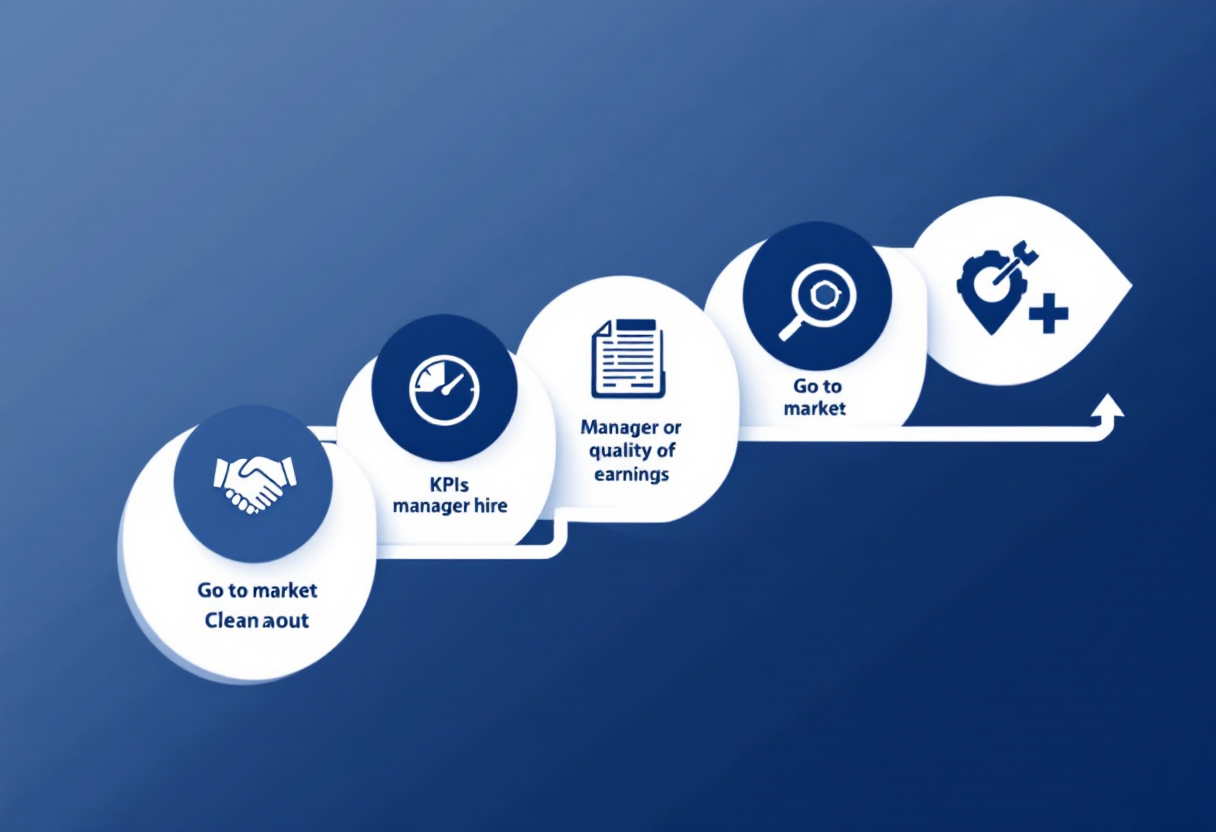
T-36 months: Cleanup phase
- Switch to accrual basis revenue recognition if still on cash basis (especially for retainer prepayments).
- Pick a PSA and time-tracking stack (ClickUp, Productive, Function Point) and migrate.
- Start tagging every potential EBITDA add-back as it happens.
- W-2/1099 audit; reclassify writers, outreach VAs, and link-builders if needed (settle exposure now while it is small).
- IP-assignment paperwork retrofit on every employee and contractor and past project.
- Phase I client-portfolio link audit and content-quality audit; remediate any historical PBN, paid-link, or scaled-content-abuse exposure across the client base.
- Define service-line P&L structure in QuickBooks or Xero (classes or departments).
- Build the org chart and identify the GM hire (internal promote target or external recruit).
- Identify deal-killer clients (gambling, supplements, MLM, payday) and decide whether to exit them.
T-24 months: Financial discipline and KPI infrastructure
- GM hire onboarded and starting to take operational load.
- Monthly close in 15 days; service-line P&L every month.
- KPI dashboard: retainer mix percentage, average retainer, monthly logo churn, average client tenure, revenue per FTE, billable utilization, gross margin by service line, top-10 client concentration.
- Launch productized retainer tiers; restructure existing low-retainer clients on renewal.
- Pricing review: 5% to 10% list increase annually; eliminate “founder’s discount” clients.
- De-concentrate client base if any top client is above 15%.
- Document SOPs for every operational role.
- Build the add-back bridge as a living document.
- Build a GEO / AI-search service line if not already in market.
- Launch agency-branded thought-leadership (podcast, newsletter, conference circuit) separate from the owner’s personal brand.
T-12 months: QoE-ready close discipline, eliminate owner dependence
- Owner steps out of daily client work and out of the seller-of-record role; GM or COO runs the shop.
- Owner takes a 2-week unplugged vacation as the stress test.
- Run the sell-side QoE (budget $20K to $75K).
- Tighten balance sheet: clean A/R, isolate deferred retainer revenue.
- Final org-chart review; backfill any gaps. Lock in non-solicit agreements with senior strategists where state law allows.
- Final compliance scrub: W-2/1099 audit, IP assignments, DPAs, state sales/use tax review.
- Lock in 12 months of clean service-line P&L for the CIM.
- Run an internal SEO-DD audit on the client portfolio (link profile, manual-action exposure, HCU exposure, scaled-content-abuse exposure).
T-6 months: Pre-marketing prep
- Engage M&A advisor (sell-side investment bank or M&A advisory firm specializing in marketing services). Typical fee: $25K to $75K monthly retainer credited against success fee of 4% to 8% of enterprise value, with Lehman or modified Lehman scaling.
- CIM drafted from the QoE and operating model.
- Teaser drafted (anonymized 1-pager).
- Buyer list finalized (the platform table above identifies 17+ active sponsors plus strategic acquirers as a starting list).
- Virtual data room populated with everything from the pre-LOI and confirmatory sections above.
- Management presentation deck built and rehearsed.
T-3 months: Go to market
- Teaser distributed; NDAs collected; CIMs distributed.
- IOIs collected 2 to 3 weeks after CIM goes out.
- Narrow to 4 to 6 finalists for management meetings.
- Management meetings; LOIs solicited.
- Select LOI; sign with exclusivity (typically 45 to 90 days).
- Enter confirmatory diligence including SEO-specific link-profile and content-quality audit; close.
End-to-end from engagement to close: 9 to 12 months in a well-run process (Auxo Capital Advisors sell-side process guide 2025; Wall Street Prep sell-side primer; Colonnade Advisors podcast 020).
Frequently Asked Questions
How long should I plan for before selling my SEO agency to a private equity buyer?
The owners who get top-quartile pricing start preparing 24 to 36 months before going to market. The minimum useful prep window is 12 months, because most of the high-leverage levers (lifting retainer mix to 70%+, installing a GM or COO, running a pre-sell QoE, running a client-portfolio link audit) need 12+ months of clean trailing-twelve-months data to be credible to a buyer. Owners who try to sell in under 6 months typically leave 20% to 40% of enterprise value on the table, and SEO-pure-play sellers in particular often discover deferred-revenue restatement or W-2/1099 misclassification issues that re-trade the deal during confirmatory.
What is a realistic EBITDA multiple for a $2M EBITDA SEO agency in 2026?
For an SEO-pure-play at $2M EBITDA in 2026, the range is 4x to 7x adjusted EBITDA. The bottom of that range applies to project-led shops with under 50% retainer revenue, owner-dependence, and SMB-only client base. The top applies to retainer-led agencies with 70%+ recurring revenue, a GM in place, enterprise client skew, a specialty position in technical SEO or GEO, and client concentration under 10% (FE International 2026; First Page Sage 2025; Capital A 2025; Breakwater M&A 2026). For full-funnel performance agencies at the same $2M EBITDA level, the range shifts to 5x to 7x and can reach 9x with strategic buyers. The 36-month prep playbook is what moves you from the bottom of the band to the top.
Should I get a quality of earnings report done before going to market?
For SEO agencies at $1M+ EBITDA, yes. A sell-side QoE costs $20K to $75K typical, up to $150K for complex add-back situations (Eton Venture Services 2025; Withum 2025; Doeren Mayhew QoE). The ROI is leverage. If your QoE supports a 1x multiple uplift on a $2M EBITDA business at a 5x baseline, that is $2M of additional sale price for a $50K investment, or roughly 40x ROI. More importantly, a pre-market QoE surfaces deferred-retainer-revenue normalization, contractor classification, and add-back weaknesses while you can still fix them, rather than during exclusivity when the buyer re-trades the deal.
What percentage of recurring retainer revenue do PE buyers want to see?
70% or higher is the line buyers want to see for a premium-multiple outcome. A 70%+ retainer mix typically commands a 1.0x to 2.0x multiple premium vs. an otherwise identical project-led shop (FE International 2026; Auxo Capital Advisors 2026). Retainer-led agencies post 18% annual revenue churn vs. 42% for project-led shops, and retainer clients stay 56 months on average vs. 24 months for project clients (Focus Digital, Average Marketing Agency Churn, 2026). On a $1.5M EBITDA business, the difference between a 50%-retainer book and an 85%-retainer book is roughly $3M to $5M of incremental sale price after the multiple compounding.
Do I need to put a general manager in place before I sell?
If your goal is to maximize price, yes, ideally 12+ months pre-sale. Owner-dependence is the single most-cited multiple haircut in SEO agency valuation literature (Lightning Path Partners; Chinook Capital Advisors; Bennett Financials; Locked On Leadership 2025). On a $1M to $3M EBITDA business, eliminating key-person risk moves the multiple from the 4x to 5x band into the 5x to 7x band, worth $1M to $6M of price. A GM hire runs $150K to $250K base plus bonus and needs 12 to 18 months to fully take operational load before the buyer’s diligence team will believe the transition. The cleanest stress test is whether the owner can take a 2-week unplugged vacation 6 months before going to market without anything breaking.
Should I be worried about AI search killing my agency’s value before I can exit?
AI-search uncertainty is real but the data so far cuts both ways. Traffic from LLMs grew 527% year over year in late 2025, and the average AI-search visitor is 4.4x as valuable as the average organic visitor by conversion rate (Semrush AI search study 2026). Agencies that have built a documented LLM-augmented production workflow, run LLM citation tracking on each client, and stood up a GEO / AI-search service line are picking up a 1x to 2x multiple premium per FE International (2026), referencing the McKinsey State of AI 2025 finding that workflow redesign (not surface AI use) is what drives EBIT impact. Agencies that have done none of that, or worse have leaned into scaled AI-content production, are exposed to both the Google March 2024 scaled-content-abuse policy and to buyer skepticism about terminal value. The way to convert AI uncertainty from a discount into a premium is to be visibly ahead of it 12+ months pre-sale, not to wait for the market to settle.
What to Do Next
The SEO agency owners who get the top-quartile multiple all do the same three things. They start preparing 24 to 36 months before they want to be out. They put a GM or COO in place 12+ months pre-sale. And they invest in a sell-side QoE before any buyer sees a CIM.
The bottom-quartile outcomes share a different pattern. The owner is still the chief SEO strategist when the teaser goes out. The book is 60% project, 40% retainer with one anchor client carrying 30% of revenue. Writers and outreach VAs are full-time 1099. There is no documented add-back schedule. The buyer’s QoE comes back with a deferred-retainer-revenue restatement that cuts trailing EBITDA by 12%. Confirmatory DD finds a client whose Helpful Content Update exposure was not disclosed in the CIM. The deal closes at 3.5x instead of 5.5x, or it does not close at all.
If you are 12+ months from a potential exit and want a structured pre-sale optimization roadmap, CT Acquisitions has agency operations specialists in our partner network who run multi-quarter prep engagements. If you are 6 to 12 months out and ready to start the sell-side process, our M&A advisory team runs the buyer outreach. No fee to you on buy-side introductions; sell-side mandates are paid on success at closing. Either way, the first 30 minutes are free.
Ready to talk?
Schedule a 30-minute exit-readiness call
Or read more: Sell Your Marketing Agency (active sale guide) | How to Prepare Your Digital Marketing Agency for Exit | Private Equity in Marketing Agencies 2026: Active Buyers + Multiples
Ready to Explore Your Options?
A 30-minute confidential conversation is all it takes.