How to Prepare Your Elevator Business for a Sale or Exit in 2026: The 36-Month PE-Buyer Playbook
Preparing your elevator business for exit in 2026 is a 36-month playbook, and the sector economics favor the prepared: recurring maintenance revenue is the value driver PE-backed elevator platforms underwrite hardest. The first 12 months tighten the operating story around maintenance-contract density, the middle 12 fix pre-LOI diligence gaps around technician licensing and safety records, and the final 12 turn one offer into a real competitive process.
Exiting your elevator business is the single largest financial event most owners will ever face. This guide is the no-fluff playbook for elevator business owners who are 12-36 months from sale, covering how PE-backed buyers actually value your business in 2026, the 12 levers that move your multiple, pre-LOI diligence, deal-killers to fix before going to market, and the full 36-month exit prep timeline.
Updated April 2026 · CT Acquisitions

Elevator service is one of the highest-multiple verticals in mechanical services, with platform-quality independents trading at 12x to 18x+ EBITDA in 2026 and the KONE / TK Elevator megadeal pricing the largest lift transaction in history at roughly 17x to 18x EBITDA. Most elevator owners decide to sell, hire a broker, and find out 90 days later that their business is worth 30% to 50% less than they thought because their maintenance contract base, route density, and mechanic depth were never built to take a buyer’s diligence. The owners who get top-quartile pricing start preparing 24 to 36 months before they ever talk to a buyer. This guide is the 36-month playbook covering what private equity actually buys, the 12 levers that move multiples, the documents PE will ask for before they send an indication of interest, and the deal-killers that re-trade elevator service transactions during confirmatory diligence. Every number cites its source. Every recommendation comes from how the most active elevator buyers in 2026 actually behave.
If you are 6 to 36 months from a possible exit, this is the work that turns a 6x EBITDA outcome into a 12x EBITDA outcome. On a $2M EBITDA elevator service business, that is the difference between a $12M sale and a $24M sale. Whether you want to prepare your elevator service business for a sale to private equity, prepare your elevator service business for an exit to a strategic acquirer like Otis, KONE, Schindler, or TK Elevator, or simply maximize value over the next 1 to 3 years before going to market, the work below applies.
Building toward an exit in 12 to 36 months?
CT Acquisitions runs sell-side advisory for elevator service owners $1M+ EBITDA. We also have elevator operations specialists in our partner network who run pre-sale optimization engagements when the timeline is longer. No fee to you on buy-side introductions; sell-side mandates are paid on success at closing.
What Private Equity Actually Buys in Elevator Service (2026)
For 2026 sell a foundation repair business with 500+ vetted PE / family office / search fund buyers, Groundworks (Cerberus) thesis, see our reference.
The US Elevator Installation and Service industry is sized at $54.9 billion in 2025, with 32,679 businesses and a five-year CAGR of about 2.6% (IBISWorld, “Elevator Installation and Service in the US Industry Analysis”, 2025). Maintenance and repair accounts for 45% of US elevator industry revenue in 2024 because of the large installed base requiring monthly servicing (PSMarket Research, 2024). For the global OEMs, service generates roughly 60% of revenue and nearly 90% of operating profit. Otis Worldwide booked 62.4% of 2024 net sales from Service at a 24.6% Service operating margin vs. 6.1% for New Equipment (Otis Form 10-Q, FY2025; Monexa, February 2025). That margin profile is why PE and the Big 4 OEMs are both relentless acquirers of independent service shops in 2026.
At least 13 active independent consolidators backed by named sponsors are buying in 2026 (CT Acquisitions, “Selling an Elevator Service Company”, 2026). Otis alone executed roughly 30 bolt-on acquisitions globally in 2024 against $87M of aggregate invested capital (Otis FY2024 commentary). The sponsor money flowing in is not random. PE buys specific profiles, and the profile you build determines the multiple you get.
The PE-attractive elevator service profile
- EBITDA threshold for a platform-quality deal: $1M to $3M is the entry band where sponsor add-on platforms run a competitive process. $3M to $10M is the dense-route multi-state tier with strong repair pull-through and a mod pipeline. $10M+ is the platform-candidate range where IUEC signatory shops with OEM authorizations attract Big 4 strategic interest.
- Contracted maintenance unit base: 750+ units under contract is the entry point for a real sponsor process; 2,000+ is platform-eligible. Renewal rates above 90% annually are achievable in elevator and are the single strongest defense of valuation (CT Acquisitions 2026; Eilla.ai 2025).
- Route density: 75 to 125 units per mechanic per route in dense metros is the benchmark. Below 60 units per mechanic, the buyer prices a labor-utilization haircut.
- Geography: NY tri-state, Southern California, Bay Area, Boston, DC, Chicago, Texas (Houston, Dallas, Austin), Philadelphia, and Miami are where 2026 sponsor demand concentrates. Stranded geographies discount.
- Customer concentration: No single REIT or property management portfolio above 15% of revenue. Top 5 below 30%. Elevator concentration risk often hides inside property management portfolios where one PM controls 20+ buildings on a master agreement.
- Mechanic depth: 5+ journeyman mechanics; cross-trained on multiple OEM controllers; documented succession on every long-tenured mechanic; QEI certification on 2+ inspectors.
- Owner role: Owner is in management, not signing every mod quote or running every union grievance. GM in place 12+ months pre-sale.
Active elevator service PE platforms in 2026
The list below covers the most active sponsor-backed and strategic elevator service platforms in the 2024-2026 cycle. This is who will see your teaser. Add-on counts are point-in-time; sources include CT Acquisitions, PrivSource, Tracxn, PitchBook, Berkshire Partners press releases, Businesswire announcements, Century Park press releases, Cinven self-reports, and CNBC / Reuters coverage of the April 29, 2026 KONE / TKE megadeal.
| Platform | Sponsor | Profile |
|---|---|---|
| American Elevator Group (AEG) | Arcline Investment Management | 12 partner companies across 22 states servicing 30,000+ units; built from Unitec, D&D Elevator, Jersey Elevator, Kencor Elevator, Pride & Service; 2021 group revenue over $350M; $1M to $10M add-on EBITDA |
| Specialized Elevator + 3Phase Elevator | Berkshire Partners (growth investment Jan 2022) | 13+ add-ons cumulative including West Virginia Elevator, Advanced Elevator, Halley Elevator, Vintage Elevator (Jan 2026), Wyatt Elevator (May 2026); national IUEC unionized platform with 390+ members servicing 20,000+ units; $1M to $10M |
| Axxiom Elevator | Gauge Capital (Sept 12, 2023) | 8 add-ons through Sept 2025 including Quality Elevator (MD), Liftech (CA, 90+ employees), Evolution Elevator (Staten Island), Ameritex (TX + Bay Area); AZ, CA, FL, TX, DC; $1M to $5M |
| ATIS Elevator Services | Thompson Street Capital Partners (TSCP) with KJA Elevator Consultants (Canada) | Multiple add-ons including A Smart Elevator Solution (CO), Technical Inspection Agency USA, M.A.N Elevator Inspections, Bayline Lift Technologies, Vinspec, Soberman Engineering; inspection and consulting heavy; $1M to $5M |
| Total Access Elevator | Century Park Capital Partners (April 25, 2024 platform) | 3 disclosed 2025 add-ons: Vertical Elevator Solutions (Mar 2025), LA Elevator (Aug 2025), TRE Elevator (Oct 2025); Southern California heavy; $1M to $3M |
| Elevator Service Inc. (ESI) | Carroll Capital (Greenwich CT family office, since 2019) | 6+ add-ons plus 5 greenfield markets including Allrise Elevator (St. Louis), Bounds Elevator (Madisonville), Metro Elevator (Twin Cities); Grand Rapids HQ, Midwest national push; under $1M to $3M |
| Ascend Safety Collective | Haven Capital Partners + Altaline Capital Management (launched May 2026) | New platform; actively recruiting independents; energy, healthcare, government, commercial, industrial |
| Champion Elevator | Thayer Street Partners (per PitchBook) | Platform with ongoing add-ons; April 2023 acquired Professional Elevator Services; NYC tri-state; 220 employees; under $1M to $3M |
| Maven Group (Maven Elevator) | Maven Capital Partners-backed | Multiple add-ons; Southeast; Axxiom + Evolution partnered through Maven channel in Florida |
| TK Elevator (TKE) | Advent International + Cinven + GIC + ADIA + RAG Foundation (carve-out July 2020); KONE agreed to acquire April 29, 2026 for $34.4B, expected close Q2 2027 pending antitrust | Continuous bolt-on of small independents; revenue grew from €7.9B at acquisition to over €9B in 4 years; adjusted EBITDA grew from €1.1B to over €1.5B (+40%); global with US heavy presence |
| Otis Worldwide (NYSE: OTIS) | Public, spun from United Technologies April 2020 | ~30 bolt-on acquisitions in 2024 ($87M aggregate invested) including Jardine Schindler Lifts Taiwan; Bay State Elevator (MA/CT/VT/upstate NY); Otis Korea acquired Schindler Korea business Oct 2025; $1M to $10M+ on US bolt-ons |
| KONE Inc (Helsinki: KNEBV) | Public, Finnish multinational | Announced April 29, 2026 acquisition of TK Elevator for $34.4B cash and stock; combined entity becomes world’s largest lift maker pending EU and US antitrust review |
| Schindler Group (SIX: SCHN) | Public, Swiss multinational | Sold Korea business to Otis Oct 2025; launched Schindler ReStore + ReNew modernization packages in US May 5, 2026; no large US service-channel acquisitions disclosed in 2024-2026 |
| Mitsubishi Electric Building Solutions | Public, Japanese | Absorbing Hitachi stake in Mitsubishi Hitachi Home Elevator Corp. (closing Q1 FY2027); 2022 acquired Sweden’s Motum AB |
| Pacific Avenue Capital Partners | Independent sponsor | Acquired Unitec Elevator from United Technologies (pre-Otis spin); NY tri-state; under $5M |
| Rcapital Partners LLP | UK PE | Acquired Liftec Express Ltd. from Otis UK June 2024 (5-company UK consolidation built by Otis over 25 years) |
The four major OEMs (KONE, Otis, Schindler, TK Elevator) control roughly 70% of the North American service market by units (Elevator Trade News commentary; PropTechVC, 2024). The independents hold the remaining 30% to 55% depending on the segment, which is exactly the pool that PE and the Big 4 are buying. The strategic acquirer set is dense: Otis is the publicly stated largest US service player by market share per IBISWorld 2025; Schindler told Reuters in late March 2026 it is “prepared to challenge any such deal before antitrust authorities” referring to KONE / TKE, which is itself a market data point for any seller currently in a process; Fujitec (TYO: 6406) is working with UBS Tokyo to explore sale to PE, with some major international PE groups already passed (Elevator World). Add to that the regional consolidators (Atis, Eastern Elevator under TJC, Stanley Black & Decker via Stanley Access on the door-and-entrance side), and the buyer set for a well-prepared independent is the deepest it has ever been.
Elevator Service Valuation Multiples in 2026 (What You Are Actually Worth)
The multiple a buyer pays comes down to your size, your contracted-unit portfolio, your route density, your service mix, and your geographic fit. Here is the 2026 range, cross-referenced from Eilla.ai’s elevator and escalator valuation playbook (2025), CT Acquisitions’ elevator sell-side guide (2026), and named transactions including the April 29, 2026 KONE / TKE megadeal and the 2020 Advent / Cinven TKE carve-out.
SDE multiples (smaller, owner-operated install or mod shops)
| SDE band | SDE / EBITDA multiple | Profile fit |
|---|---|---|
| Under $500K SDE, install or mod heavy | 2.5x to 4.0x | Owner-operator, no real maintenance base (Eilla.ai median private deal 6.2x EBITDA / 0.4x revenue across the broader sample) |
| $500K to $1M SDE, thin maintenance base | 4.0x to 6.0x | Eilla.ai 2025; CT Acquisitions 2026 entry band for owner-operated elevator service shops with limited contracted units |
| Demand / install only, no recurring contract base | 3.0x to 5.0x | Bottom of the elevator service range; trades like a generic small construction subcontractor rather than a recurring-service business |
EBITDA multiples (PE-attractive size)
| EBITDA band | Profile | EV / EBITDA range |
|---|---|---|
| $1M to $3M EBITDA | Established route, 40%+ maintenance revenue, owner still operational | 7.0x to 10.0x |
| $3M to $10M EBITDA | Dense routes, multi-state, strong repair pull-through and mod pipeline | 9.0x to 13.0x |
| $10M+ EBITDA, platform-quality | IUEC signatory, OEM-authorized on multiple brands, defensible contracted-unit portfolio | 12.0x to 18.0x+ |
| Big 4 service-portfolio or large independent platform recaps | National-scale recurring portfolios | 14.0x to 20.0x+ (Eilla.ai 2025 “Big 4 platforms trade 17x to 20x EBITDA”; Advent / Cinven TKE closed at ~17.3x EBITDA in 2020) |
| Scaled public independent maintainer | Very large recurring-revenue elevator portfolios | ~24x to 25x EBITDA (Eilla.ai 2025) |
Source: CT Acquisitions Elevator PE Map 2026; Eilla.ai Elevator and Escalator Valuation Playbook 2025; cross-referenced against named transactions including KONE / TKE (April 29, 2026), Advent + Cinven / thyssenkrupp Elevator (July 2020 close), Berkshire / Specialized + 3Phase, Gauge / Axxiom, and Century Park / Total Access. Note that most independent elevator service deals do not disclose multiples publicly. The KONE / TKE megadeal and the Advent / Cinven 2020 buyout are the two cleanest public multiple anchors at roughly 17x to 18x EBITDA; the add-on tier multiples come from CT Acquisitions and Eilla.ai cross-referenced against named transactions and platform behavior.
Recent disclosed elevator service transactions (2020-2026)
| Acquirer | Target | Date | Value | Implied multiple |
|---|---|---|---|---|
| KONE Inc (announced) | TK Elevator (Advent + Cinven exit) | April 29, 2026 | $34.4B EV (€29B) | ~17x to 18x EBITDA |
| Advent + Cinven + GIC + ADIA + RAG Foundation | thyssenkrupp Elevator (now TKE) | Closed July 2020 | €17.2B | ~17.3x EBITDA on €1.1B EBITDA |
| Berkshire Partners | Specialized Elevator (combined with 3Phase) | Closed January 21, 2022 | Terms not disclosed | Combined entity 390+ IUEC members servicing 20,000+ units |
| Gauge Capital | Axxiom Elevator | September 12, 2023 | Terms not disclosed; Axxiom subsequently raised $120M aggregate | Platform tier; 8 add-ons through Sept 2025 |
| Century Park Capital Partners | Total Access Elevator (platform acquisition) | April 25, 2024 | Terms not disclosed | Southern California platform; 3 add-ons in 2025 |
| Specialized Elevator (Berkshire) | Wyatt Elevator (Philadelphia) | May 7, 2026 | Terms not disclosed | Founders Tom and Dan Killion exiting; Bob Brumbach staying in leadership |
| Axxiom Elevator (Gauge) | Ameritex Elevator Services (San Antonio + Bay Area) | September 11, 2025 | Terms not disclosed | 8th platform add-on |
Sources: CNBC, Reuters, Yahoo Finance, Bloomberg coverage April 29, 2026 of KONE / TKE; Cinven “TK Elevator: a compelling carve-out” 2024; Mergersight “The €17.2 Billion Private Equity Buyout of thyssenkrupp’s Elevator Unit”; Berkshire Partners press releases June 3, 2021 and January 21, 2022; Mergr Gauge / Axxiom; PitchBook Axxiom profile; Century Park press release April 25, 2024; Businesswire / Yahoo Finance May 7, 2026 Specialized + Wyatt; Yahoo Finance September 11, 2025 Axxiom + Ameritex.
The 12 Value Levers That Move Your Multiple (Ranked by Impact)
These are the levers that move elevator service multiples in the 24 months before a sale. Each one has a current state, a target state, and an estimated financial impact. The ordering is by dollar impact per unit of effort, based on cross-source synthesis from CT Acquisitions 2026, Eilla.ai 2025, The Elevator Consultants, Elevator Blueprint, IUEC NEBA Agreement 2022-2027, and NAESA QEI certification standards. The ranking is different from HVAC because elevator valuation is contract-portfolio-driven, not pricing-driven. The contracted-unit portfolio is the core asset.
Lever 1: Grow and protect the contracted-unit maintenance portfolio
Current: Under 300 units under maintenance contract, mix of month-to-month and 1-year contracts, 30-day cancellation, renewal rate 75% to 85%, unclear MMR per unit. Target: 750+ units under contract, multi-year evergreen auto-renew, 60- to 90-day cancellation with material penalty, renewal rate 92%+, MMR per unit benchmarked to local market (residential $25 to $125/mo; small commercial $85 to $420/mo; high-rise / specialty $170 to $1,250/mo per Toledo Elevator, Elevator Blueprint, Action Elevator, Crane Elevator 2026 pricing data). Impact: This is the single highest-impact lever for elevator service valuation. Moving a shop from “thin maintenance base + install heavy” into “platform-quality contracted-unit base” moves the multiple from the 4x to 6x band into the 9x to 13x band (CT Acquisitions 2026; Eilla.ai 2025). On a $1.5M EBITDA shop, that delta is the difference between a $7M to $9M sale and a $14M to $20M sale. Buyers will also layer a Monthly Maintenance Revenue (MMR) multiple onto the contracted book; estimate typical 20x to 36x of monthly fee added to EV (which equates to 1.7x to 3.0x annual maintenance revenue) depending on contract term length and cancellation provisions. How: Convert demand calls to full-maintenance contracts via sales-mechanic referral comp; restructure existing 1-year contracts to 3- or 5-year evergreens at renewal; tighten cancellation clauses; price-tier into Bronze (parts only), Silver (parts + labor), Gold (full maintenance + 24/7 callback + priority response), with sales-team comp tied to Gold-tier conversion.
Lever 2: Increase route density (units per mechanic per route)
Current: 40 to 60 units per mechanic, mechanics driving 30+ minutes between calls, billable utilization below 50%. Target: 75 to 125+ units per mechanic depending on unit complexity and geography, mechanic drive-time under 20 minutes between calls, billable utilization above 65%. Impact: Route density is the single biggest variable-cost lever in elevator service and a buyer’s first quantitative test. Estimate: doubling units per mechanic in a dense metro takes mechanic-utilization gross margin from 35% to 55%+ (CT Acquisitions 2026; The Elevator Consultants commercial property management case study). On a $5M revenue shop with 60% maintenance, that swing is roughly $300K to $500K of EBITDA, which at an 8x to 10x multiple is $2.4M to $5M of additional sale price. How: Route-density target by metro, drop unprofitable outlying contracts at renewal, prioritize same-building / same-block contract sales, hire helpers (NEBA helper rate is 70% of mechanic rate per the 2022-2027 NEBA Agreement) to absorb low-complexity work and free mechanics for billable repair pull-through.
Lever 3: Drive billable repair revenue per contracted unit
Current: Under $400 of billable repair revenue per contracted unit per year; mechanics not trained on options-based presentation. Target: $800 to $2,500 of billable repair revenue per contracted unit per year on commercial accounts, driven by mechanic-identified repair recommendations with quoted scope and pricing. Impact: Every contract is a billable-repair annuity. Mechanics who identify and quote repairs on every PM visit drive billable-repair pull-through that often exceeds the maintenance contract revenue itself. Estimate: lifting repair pull-through from $400 to $1,200 per unit on a 500-unit book adds $400K of revenue at 55% to 65% gross margin, $220K to $260K of EBITDA, $1.8M to $3.4M of sale price at 8x to 13x. How: Mechanic comp on identified-and-sold repair work; flat-rate repair pricing book; quoting templates inside the FSM; dispatcher follow-up on every repair quote within 48 hours.
Lever 4: Build and document the modernization pipeline
Current: No modernization pipeline document; mods are ad-hoc; conversion rate on own customers’ mods is unknown. Target: Every contracted unit tagged with year-of-install, year-of-last-mod, controller make and model, hydraulic vs. traction, mod-candidate status (1- to 5-year horizon), estimated mod scope and revenue; documented conversion rate above 60% on own customers’ mods. Impact: A modernization on a hydraulic elevator runs $50K to $150K (Elevator Blueprint 2026); a traction modernization $100K to $250K+; full hydraulic mod in some metros can reach $400K+ (Crane Elevator Michigan data). ASME A17.1-2019 code-driven triggers (3D door protection, video communication, Door Locking Monitor upgrades) typically add $15K to $50K per unit. Even at 15% to 25% gross margin on mod, the EBITDA contribution is meaningful, and the strategic value to the buyer is the multi-year forward pipeline visibility. Estimate +0.5x to 1.0x multiple uplift on a clean documented pipeline (CT Acquisitions 2026). How: Data-cleanse the FSM unit-master; per-unit annual mod-candidate review; build a quoting library for typical mod packages (controller swap, cab interior, ropes, hydraulic-to-traction conversion, door operator upgrade); train mechanics to flag mod-candidate units.
Lever 5: Move the owner out of the chair
Current: Owner runs sales, dispatches mechanics, signs every job above $20K, holds the primary relationship with every top-20 customer. Target: GM in place 12+ months pre-sale; owner under 30 hours per week of operational work; sales transitioned to a dedicated salesperson; customer relationships transitioned to the sales team. Impact: Owner dependence is the second-most-cited multiple haircut in elevator service after contract quality. Estimate: removing key-person risk on a $1M to $3M EBITDA shop moves the multiple from the 7x to 8x band into the 9x to 11x band. Worth $1M to $6M of price (CT Acquisitions 2026). Owner dependence is ranked fifth here rather than second (as in HVAC) because in elevator service the contracted-unit portfolio is more transferable than the owner relationship in HVAC, but it is still a meaningful drag. How: Hire a GM 18 to 24 months pre-sale (typical GM comp $175K to $275K + bonus depending on metro and IUEC environment). Document SOPs. Build a leadership scorecard. Transition customer relationships to the sales team. Take a 2-week unplugged vacation as the stress test.
Lever 6: Get on a real FSM and run a monthly close
Current: Spreadsheets or QuickBooks only; no unit master; mechanics on paper tickets; no per-unit callback tracking; monthly close takes 30+ days. Target: BuildOps, ServiceTrade, FieldRoutes, Salesforce Field Service Lightning (FSL), or equivalent FSM in place 18+ months; unit-master clean; mechanics on mobile time-on-job; monthly close in 15 days; service-line P&L every month; per-unit dashboard (MMR, callback rate, repair-revenue pull-through, mod-pipeline status). Impact: Estimate +0.5x to 1.0x multiple uplift, driven mostly by data-room speed and KPI defensibility during diligence (cross-referenced from generic trades M&A literature; CT Acquisitions 2026). Independent of the multiple impact, FSM adoption typically lifts per-unit repair revenue 10% to 20% via faster quoting and better PM completion discipline. How: Budget $75K to $250K implementation cost plus per-mechanic license. Force mechanic adoption with payroll-tied job-completion compliance and weekly data-quality audits.
Lever 7: Tighten contract pricing discipline
Current: Contracts grandfathered at 5- and 10-year-old prices; no annual price-increase letter; one-off discounting to win bids without documentation. Target: 3% to 6% annual list-price increase on every contract at renewal; documented price-escalator clause on every new contract (CPI + 2% is common); zero off-list discounting without GM approval. Impact: A $5M revenue shop with $3M of maintenance revenue that lifts pricing 4% per year captures $120K of incremental annual revenue, virtually all of which drops to EBITDA (no incremental labor or parts cost). At an 8x to 10x multiple, that is $1M to $1.2M of additional sale price per year of disciplined pricing. How: Standard renewal letter template; CPI-linked escalator on every new contract; quarterly price-book refresh; sales team comp on net-new contract revenue, not gross.
Lever 8: Build licensed-mechanic depth and OEM controller capability
Current: 2 long-tenured mechanics carry all OEM-specific knowledge; no non-compete or non-solicit; QEI certification concentrated in 1 inspector; if signatory, no internal NEBA documentation or apprentice pipeline. Target: 5+ mechanic depth with documented succession; cross-trained on multiple OEM controllers (Otis MCS / GenII, Schindler 700 series, KONE EcoDisc, TKE TAC, Mitsubishi M-Series); QEI certification on 2+ inspectors; documented apprentice-to-mechanic pipeline through IUEC NEIEP (National Elevator Industry Educational Program) if signatory. Impact: Licensed-mechanic concentration is a key-person test on the labor side and a recurring re-trade item. Estimate +0.5x to 1.0x on multiple if you can show the buyer “we can lose any one mechanic and not lose the contract base” (CT Acquisitions 2026; NAESA QEI Certification; IUEC 2022-2027 NEBA Agreement). OEM-authorized service relationships on KONE, Otis, Schindler, TKE, and Mitsubishi equipment are functionally gold and should be documented separately in the data room. How: NEIEP apprentice intake schedule; OEM controller training (Otis, Schindler, KONE, TKE each run authorized service training programs); cross-training rotation; succession-plan document per long-tenured mechanic.
Lever 9: EBITDA addback hygiene
Current: Owner mixes personal expenses through the business, no documentation, related-party rent at above-FMV, no addback schedule. Target: Every potential addback documented as it happens with underlying invoice; related-party rent restruck to FMV with appraisal on file; clean payroll for owner-family members. Impact: Every defensible dollar of adjusted EBITDA is multiplied by the buyer’s multiple. On a 9x multiple (platform-eligible), $200K of clean addbacks equals $1.8M of sale price (Morgan & Westfield QoE guide; Citrin Cooperman sell-side QoE). How: Monthly addback log starting today. Document the business purpose of every charge. FMV rent appraisal if owner owns the real estate and the business rents it. Owner compensation above market (a $400K owner vs. a $200K to $250K GM cost equals a $150K to $200K addback) is the largest single line for most elevator service shops.
Lever 10: Working capital normalization (prepaid maintenance liability is the elevator-specific item)
Current: Prepaid annual maintenance contracts billed in advance but not isolated on the balance sheet; deferred revenue commingled with accrued expenses; modernization WIP recognized on cash basis; A/R aging not actively managed. Target: Deferred revenue on prepaid maintenance plans separately tracked on monthly BS; percentage-of-completion accounting on modernization WIP; TTM working capital stable and predictable; A/R aging under 45 days. Impact: The working capital peg in elevator service deals frequently includes a debt-like adjustment for unfunded prepaid maintenance liability. Without isolation, the buyer can argue a large adjustment that comes out of purchase price. Estimate: poorly managed deferred revenue can cost 2% to 5% of EV at close (Morgan & Westfield NWC guide; BDO NWC). Modernization WIP misstatement is the other big one; buyers commonly find $50K to $250K of misstated WIP per active mod project. How: Separate GL accounts for prepaid maintenance liability vs. other accrued; monthly schedule of contract anniversary dates and prorated unearned revenue; percentage-of-completion methodology documented for every active mod project; capture this in the QoE-prep workpapers.
Lever 11: Real estate decision
Current: Owner-owned shop and yard held in same entity as operating company, or in an LLC at above-FMV rent. Target: Real estate in separate LLC at FMV NNN lease to operating company; clear path for the buyer to assume the lease or buy the property. Impact: Separating real estate often lifts the implied EBITDA multiple on the operating business because the buyer is not forced to underwrite real estate (Plante Moran sale-leaseback primer; Northmarq sale-leaseback guide). Sale-leaseback can release up to 100% of property market value as cash vs. 70% to 80% LTV via traditional financing. Estimate +0.5x to 1.0x on the operating company multiple if handled cleanly. How: FMV market-rent study now. Restruck rent to FMV. Decide pre-marketing whether real estate is part of the deal or held back.
Lever 12: Compliance scrub (the elevator-specific items)
Current: State elevator contractor license in owner’s name as Responsible Party; QEI certification tied to 1 individual; ASME A17.1 code-compliance gaps on serviced units (especially NYC Local Law 196 / DLM, code-driven mod triggers); OSHA hoistway fall records uneven; W-2 vs. 1099 status of helpers unclear; sales / use tax exposure on elevator service revenue in Texas and Pennsylvania uneven. Target: License with a clear post-close Responsible Party transition path; QEI on 2+ individuals; ASME A17.1 / A17.3 deficiencies documented and remediated or quoted; OSHA 300 logs clean; W-2 / 1099 classification audit complete; state-by-state sales / use tax compliance verified. Impact: Each of these can kill or re-trade the deal at confirmatory diligence. See the deal-killer section below for specifics. How: Cover this in months 24 to 12 of the run-up, before the QoE.
Want to grow your business to maximize value before exiting?
We connect elevator service owners with operations experts in our partner network who run 12 to 24 month pre-sale optimization engagements. The engagement pays for itself in incremental sale price.
What PE Asks Before They Send an LOI (The Pre-LOI Diligence Stack)
Before a PE firm or strategic acquirer commits to a letter of intent, they ask for a focused diligence package. The list below is the standard pre-LOI ask from a 2026 sponsor or Big 4 strategic targeting an elevator service business. The “why” and “how to prepare” expand each item to what is typical across the industry. The elevator-specific exhibit that swings the entire process is item 5, the Contracted-Unit Portfolio Schedule.
1. Income Statements for 2024, 2025, and the latest trailing twelve months
Why PE asks: They are building the LTM EBITDA they will multiply. For elevator service they want service-line splits (maintenance vs. repair vs. modernization vs. new install) because the mix dictates the multiple. They are looking for seasonality, customer concentration in the install backlog, and any one-time movers.
How to prepare: Monthly accrual P&L mapped to a clean chart of accounts. Service-line P&L separating maintenance, repair, modernization, and new install. Reconcile to tax returns so there are no surprises in confirmatory diligence.
2. Balance Sheet at the latest month
Why PE asks: Working capital peg and net debt. For elevator service the debt-like items include prepaid maintenance liability (annual or multi-year contracts billed in advance), accrued mechanic vacation and pension (NEBA-rate IUEC liability if you are signatory), capital lease balances on service trucks and lift trucks, and any open warranty exposure on recent install or mod jobs.
How to prepare: Tie BS to trial balance. Isolate prepaid maintenance liability on a separate line. Pull pension and benefits accruals from your IUEC payroll system if union.
3. Adjusted EBITDA bridge and addbacks schedule
Why PE asks: They want to see your adjusted EBITDA story before they sink diligence cost. Aggressive or undocumented addbacks discount the rest of the file.
How to prepare: Line-by-line bridge from book EBITDA to adjusted EBITDA with documentation. Common elevator service addbacks that hold: owner compensation above market, related-party rent above FMV restruck to FMV, owner family-member payroll for unclear duties, one-time legal (especially around NYC Local Law 196 enforcement actions), QoE prep cost, software conversion cost, owner personal vehicle and travel, owner country club, NEBA strike-fund or special-assessment one-time charges.
4. Anonymized Employee Roster (titles, hire dates, pay, union status, certification status)
Why PE asks: Stress-testing two risks. First, licensed-mechanic depth and tenure. Loss of a few long-tenured mechanics can sink integration. Second, owner dependence. Third, NEBA / IUEC signatory status and pension liability. Union mechanic mix changes the cost structure and the assignability conversation.
How to prepare: Roster columns: role (apprentice, helper, mechanic, mechanic-in-charge, supervisor, GM), IUEC member status, NEBA classification, hire date, W-2 vs. 1099, comp structure, NAESA QEI certification status if inspector, state mechanic license status by state. Calculate rolling 12- and 24-month tech retention. Industry retention above 80% is satisfactory.
5. Contracted-Unit Portfolio Schedule (the diagnostic exhibit for elevator service)
Why PE asks: This is the single most important data exhibit in elevator service diligence. They want to see total units under maintenance contract, MMR per unit by service-level tier (full-maintenance vs. parts-and-labor vs. oil-and-grease), contract term length, cancellation provisions, contract anniversary date, unit type (hydraulic vs. traction vs. MRL vs. escalator vs. moving walk), OEM equipment brand, unit age, building type (hospital / office / hotel / residential / municipal / industrial), and customer name (top 25 itemized). They will calculate annual revenue per unit, repair-and-mod pull-through per unit, callback rate per unit, and route density by mechanic.
How to prepare: Pull from your FSM (BuildOps, ServiceTrade, FieldRoutes, Salesforce FSL). If you are still on spreadsheets that is itself a diligence flag. Three years of historical contract count, contract additions, contract losses (with reasons), and renewal rate. Calculate weighted-average remaining contract life. Benchmark contract pricing per unit per year (residential $300 to $1,500; small commercial $1,000 to $5,000; high-rise / specialty $2,000 to $15,000 per Toledo Elevator, Action Elevator, Elevator Blueprint, Crane Elevator 2026 pricing data).
6. Modernization Pipeline Schedule
Why PE asks: Modernization is where 5x to 20x service revenue per unit gets captured, and your own contracted-unit base is the highest-probability modernization pipeline. Buyers want to see the pipeline by unit age, controller status (proprietary vs. non-proprietary, obsolete vs. supported), ASME A17.1-2019 code-driven mod triggers, and your historical conversion rate from “candidate” to “signed mod”.
How to prepare: List every contracted unit with year of original install, year of last major mod, controller make / model, hydraulic vs. traction, mod-candidate status (1- to 5-year horizon), estimated mod scope and revenue. Pull historical conversion rate (units in pipeline that became signed mod / total candidates) over trailing 24 to 36 months.
7. Five-Year Business Plan
Why PE asks: PE underwrites a forward case (years 1 through 5 post-close). Standard elevator service scenarios include net-new contract adds, contract pricing actions (3% to 6% annual list increase is the industry pattern), modernization conversion, mechanic capacity expansion, and tier-1 metro expansion.
How to prepare: Simple operating model. Revenue by service line, gross margin assumptions, mechanic and helper headcount build, NEBA wage escalations (2022-2027 NEBA Agreement contains the schedule if you are signatory), planned territory or service-line expansion, modernization pipeline conversion.
8. Vehicle and Fleet List
Why PE asks: CapEx forecast for replacement; capital lease vs. owned vs. financed; wrap and brand condition for eventual rebrand. Elevator service uses a mix of service vans, parts trucks, and occasionally lift trucks or scissor-lift trailers for modernization jobs.
How to prepare: Spreadsheet with vehicle, make / model / year, mileage, ownership status, monthly payment if any, wrap condition. Flag any open lien holders.
9. OEM Authorizations and Parts Relationships
Why PE asks: Independent service shops fall into two camps. First, OEM-authorized on Otis, Schindler, KONE, TKE, Mitsubishi, Fujitec, Hitachi (the Big 4 and the Japanese tier authorize independent service companies on specific equipment lines, and these designations are functionally gold). Second, non-authorized but capable of servicing OEM equipment using OEM-equivalent parts. The buyer wants to know exactly which authorizations you hold, which proprietary controllers you can fully service, and which OEM relationships you maintain for parts.
How to prepare: List OEM-authorization letters, parts-supplier accounts, controller-make capability matrix (which controllers your mechanics are trained on and can fully diagnose). KONE’s proprietary drive architecture is the highest-friction case; document any specific independents you have built capability or escape paths for.
Confirmatory Diligence (After You Sign the LOI)
Once an LOI is signed and exclusivity starts (typically 45 to 90 days per Colonnade Advisors podcast 020 and Auxo Capital Advisors sell-side process guide), the buyer runs seven parallel workstreams adapted for elevator service. This is the depth of inspection your business will undergo. If anything was hiding, it surfaces here.
- Quality of Earnings (QoE). Outside accounting firm runs revenue cut-off testing, deferred revenue analysis (prepaid maintenance is the most-disputed line in elevator service), percentage-of-completion testing on modernization WIP, expense normalization, addback validation, working capital trends. Buyer’s QoE cost: $50K to $250K typical for $1M to $10M EBITDA elevator service. Output: an adjusted EBITDA number the buyer locks into the model (Citrin Cooperman; KLR; Eton Venture Services).
- Customer concentration and commercial DD. Customer-by-customer revenue analysis, calls with top accounts (property managers, REITs, hospital facility directors, university plant managers), contract review (assignment clauses, change-of-control triggers, renewal dates, cancellation provisions, payment terms). Elevator service concentration risk often shows up via property management companies (one PM holding 20+ buildings can swing 15% of revenue on a single relationship).
- IT systems audit. FSM platform (BuildOps, ServiceTrade, FieldRoutes, Salesforce FSL, or custom). Data quality, integration capability with the platform’s stack, license counts, contract-master data hygiene, callback-tagging discipline, unit-master accuracy. PE platforms typically standardize FSM across portfolio companies post-close.
- Legal. Entity good standing in every operating state, elevator contractor licenses by state (Florida DBPR, California CSLB C-11 + Cal/OSHA DIR Elevator Unit Certificate of Competence, Texas TDLR registration with Responsible Party, New York DOL elevator contractor license effective Jan 1, 2022, plus city-level NYC DOB for inspection and filing privileges), QEI status of inspector employees, contract assignment provisions on every maintenance contract, IP, litigation history (entrapment, fall, mechanic injury), warranty and callback liability on recent installs and mods, real estate leases.
- HR / Payroll. NEBA collective bargaining agreement assignability (if signatory under IUEC contract), W-2 vs. 1099 classification audit, I-9 compliance, wage-and-hour exposure including IUEC overtime and shift-differential rules, benefits and pension funding (IUEC Annuity, Pension, Welfare funds), PTO accrual, any pending NLRB / EEOC / DOL claims, non-compete enforceability in operating states.
- Environmental and Safety. OSHA 300 logs (hoistway falls, entrapment-related injuries, electric shock incidents), state elevator board incident reports, ASME A17.1 / A17.3 compliance status on serviced units, EPA Section 608 for any HVAC work in elevator machine rooms (less common but applies to some shops), Phase I ESA on owned real estate.
- Tax. Federal income, payroll, sales / use, property. Sales / use tax on elevator service in states that tax repair labor on tangible property is a recurring exposure (Texas and Pennsylvania both tax certain elevator service work; see Deal-Killers section below).
Why You Should Pay for Your Own Quality of Earnings Before Going to Market
A sell-side QoE is your own outside accountant’s QoE, paid for by you, before you go to market. For an elevator service business it does four things: pre-empts the buyer’s QoE by getting to the adjusted EBITDA number first with documentation; surfaces issues you can fix before the buyer sees them (revenue recognition on prepaid annual maintenance, working capital on deferred revenue, addback documentation, percentage-of-completion accounting on modernization jobs); tightens the EBITDA number you take to market, which directly drives the headline price; and for elevator specifically, validates the contracted-unit portfolio MMR data and renewal rate, which is the single most-scrutinized metric in elevator service diligence.
Cost
- $35K to $60K for QoE if revenue is below $10M (Eton Venture Services QoE cost guide 2025; Morgan & Westfield QoE).
- $50K to $100K typical sell-side QoE on a healthy elevator service business with multiple service lines (maintenance + repair + modernization + new install) (Kahn Litwin Renza buy-side vs. sell-side QoE; Eton 2025; Citrin Cooperman).
- Up to $150K for businesses with complex addbacks, multiple entities, large modernization WIP, or messy books (Eton 2025; Insero Advisors).
ROI
Standard example cited across QoE-provider content: $25M revenue, $5M EBITDA elevator service business. Moving the multiple from 8x to 9x equals $5M of additional sale price. A $75K QoE investment that supports the 1x lift equals a 67x ROI (Eton 2025; Insero “How Quality of Earnings Reports Shape M&A Deals”; Warren Averett “Benefits of a Sell-Side Quality of Earnings Report”). Industry pattern from generic small-business QoE literature: typical 4-to-1 ROI on sell-side QoE investment (Anders QoE blog; Eton 2025; KMCO “7 Benefits of a Sell-Side Quality of Earnings Report”). More importantly, a pre-market QoE surfaces revenue recognition issues, prepaid maintenance liability surprises, and modernization WIP weaknesses while you can still fix them, rather than during exclusivity when the buyer re-trades the deal.
Deal-Killers That Re-Trade Elevator Service Transactions (Avoid These)
These are the recurring kill-shots cited across elevator service M&A advisory content, the CT Acquisitions and Eilla.ai sell-side guides, and confirmatory diligence checklists. Most of them are fixable in 12 to 24 months. None of them are fixable in 30 days.
1. Customer concentration above 20% (often hidden inside property management portfolios)
Top customer above 15% gets PE nervous; above 20% they price the discount; above 25% they walk or restructure (general M&A practice; Morgan & Westfield Customer Concentration glossary). Elevator service is especially exposed because a single REIT or property management company often runs 20+ buildings under one master agreement, so the logo concentration looks fine but the decision-maker concentration is dangerous.
2. Month-to-month or 30-day-cancellation contracts
Multi-year evergreen contracts with strong cancellation provisions are what makes elevator service valuable. A book of 30-day-cancellation contracts trades at the bottom of the band even if the unit count is large (CT Acquisitions 2026; Elevator Consultants service-contract checklist).
3. State elevator contractor license tied to owner as Responsible Party
Most state regimes require a Responsible Party or Certificate of Competence holder for the elevator contractor license. Texas TDLR requires a Responsible Party with 3+ years of elevator contractor experience; California Cal/OSHA requires a Certificate of Qualified Conveyance Company (CQCC) or Certificate of Competence under DIR with 3+ years of conveyance experience; New York DOL requires elevator contractor license (effective Jan 1, 2022) with insurance minimums of $1M occurrence; Florida DBPR requires a registered elevator company employing a certified inspector / technician / certificate of competency holder with $100K / $300K minimum liability insurance. If the owner personally holds the qualifying credential and there is no successor on staff, the license does not transfer at close, and the buyer needs to either find a new qualifier or restructure the deal (TDLR Elevator Safety FAQ; Cal/OSHA Elevator Certification; NY DOL Elevator Licensing; FL DBPR Elevator Safety).
4. NYC Local Law 196 + Local Law 11 + DOB-NOW exposure (the highest-risk geography in the US)
NYC requires annual elevator inspections by DOB-authorized inspectors, annual Category 1 (CAT1) no-load safety tests, Category 5 (CAT5) full-load safety tests every five years, with active maintenance contracts with DOB-licensed elevator companies and filing through DOB-NOW. Penalties start at $1,000 per violation per month. Local Law 196 (the elevator inspection regime) plus building-side Local Law 11 (facade) and Local Law 152 (gas piping for buildings with gas service) together comprise the strictest compliance environment in the US elevator services market. Any open CAT1 or CAT5 findings on serviced units, missed inspection filings, or DOB enforcement actions surface immediately in diligence (NYC Buildings Elevator Compliance; KomplyOS NYC Local Laws Guide; LegalClarity NY Elevator Safety Laws; Milrose 2024 Inspection deadlines).
5. ASME A17.1 code-compliance gaps on serviced units (especially post-2019 code)
States that have adopted ASME A17.1-2019 may require 3D door protection, video communication, and Door Locking Monitor (DLM) upgrades, adding $15,000 to $50,000 per unit (Elevator Blueprint 2026). If serviced units are out-of-code and the maintenance contract puts compliance responsibility on the service company, the buyer prices the upgrade cost into the deal as a haircut or escrow. Sellers who have not done a code-compliance audit of their entire contracted base are exposed.
6. QEI (Qualified Elevator Inspector) certification tied to a single individual
QEI is certified by NAESA International (and NAEC) under the ASME QEI-1 Standard. New York State and many other jurisdictions accept NAESA QEI as the qualifying certification (NY DOL Elevator Licensing; NAESA QEI Certification). If your inspection-side revenue depends on 1 QEI individual who is the owner or a long-tenured employee with no non-compete, the buyer treats the entire inspection book as flight risk.
7. IUEC / NEBA collective-bargaining assignability and pension exposure
The 2022-2027 NEBA Agreement (signed April 2022 in DC, covering 31,000+ IUEC members across the National Elevator Bargaining Association) is the master CBA between the IUEC and the 6 largest elevator industry employers. Independent signatory shops sign the parallel Elevator Contractors of America (ECA) Agreement. Mechanic helper wage is 70% of mechanic rate; mechanic average national pay sits at $130K per year ($62.59 per hour) per ZipRecruiter 2026, NYC $142K ($68.47 per hour), Chicago $134K ($64.47 per hour). Pension and welfare-fund liabilities (IUEC Annuity, Pension, Welfare) become a debt-like item or post-close obligation that the buyer prices. Signatory-status changes require notice to the local; non-assignment or de-recognition is a deal-breaker for IUEC platforms like Berkshire’s Specialized + 3Phase, who advertise the unionized status as core to their positioning.
8. Proprietary controller exposure and OEM equipment lock-in
KONE, Otis, Schindler, TKE, and Mitsubishi each use proprietary control systems on portions of their installed bases. Independents legally can service OEM equipment using OEM-equivalent parts, but proprietary-controller maintenance has gaps (especially KONE’s drive architecture per Elevator Blueprint and Colley Elevator commentary). If a meaningful share of your contracted units are on orphaned proprietary controllers that are nearing end-of-life with no OEM parts support, the buyer either prices an obsolescence write-down or requires you to fund a mod program pre-close.
9. OSHA hoistway falls and entrapment-injury history
OSHA 1926.552 governs material hoists, personnel hoists, and elevators in construction. OSHA fall protection (29 CFR 1910 Subpart D, 1926 Subpart M) applies to elevator work when a fall hazard is present (OSHA Standard Interpretations 1999-08-30, 2010-03-02, 2023-12-05). Hoistway entrances must be protected by substantial gates or bars across the full width of the landing entrance. According to BLS data referenced in market research, approximately 17,000 people are injured and more than 30 casualties recorded annually from elevator and escalator accidents in the US. Open OSHA 300-log incidents in confirmatory diligence trigger insurance-rating questions, premium increases, and in severe cases willful-violation citations that re-trade the deal.
10. Sales and use tax exposure on elevator service in Texas, Pennsylvania, and other states that tax repair labor
Texas non-residential repair, maintenance, and installation labor on tangible property is taxable; elevator service to a commercial building falls in scope (Texas Comptroller). Pennsylvania taxes repair, maintenance, and installation on tangible property in many situations (Pennsylvania Department of Revenue Bureau of Audits Sales and Use Tax Manual). Shops that have under-collected on commercial service face multi-year exposure that surfaces in tax diligence as a holdback or escrow.
11. Insurance-coverage exposure on entrapment and fall liability
Standard elevator service general liability policies sit at $1M per occurrence (the floor required by NY DOL for elevator contractor license; Texas TDLR requires $1M / $500K property damage; FL DBPR requires $100K / $300K). Platform buyers typically expect $5M to $10M+ aggregate policy with proper umbrella and per-mechanic worker’s comp. Underinsurance is rarely a kill, but it is an immediate post-close uplift cost that gets priced into the deal.
12. Mechanic licensing concentration and IUEC poaching risk
36 of 51 US states (and DC) require an elevator mechanic license (PlainHireCheck; ContractorLicenses.org). If your shop’s keys-to-the-kingdom mechanic is also a long-tenured IUEC member with no non-compete, and a Berkshire / Arcline / Axxiom local platform is recruiting, the buyer assumes a poaching risk. Documented succession on every long-tenured mechanic mitigates this.
13. Modernization WIP and revenue recognition issues
Modernization projects span 4 to 18 months and use percentage-of-completion accounting. Shops that book mod revenue on cash basis or recognize too early carry restatement risk in the QoE. Buyers commonly find $50K to $250K of misstated WIP per active mod project at the typical $50K to $400K mod scope. The QoE adjustment comes out of EBITDA directly.
The 36-Month Exit Prep Timeline
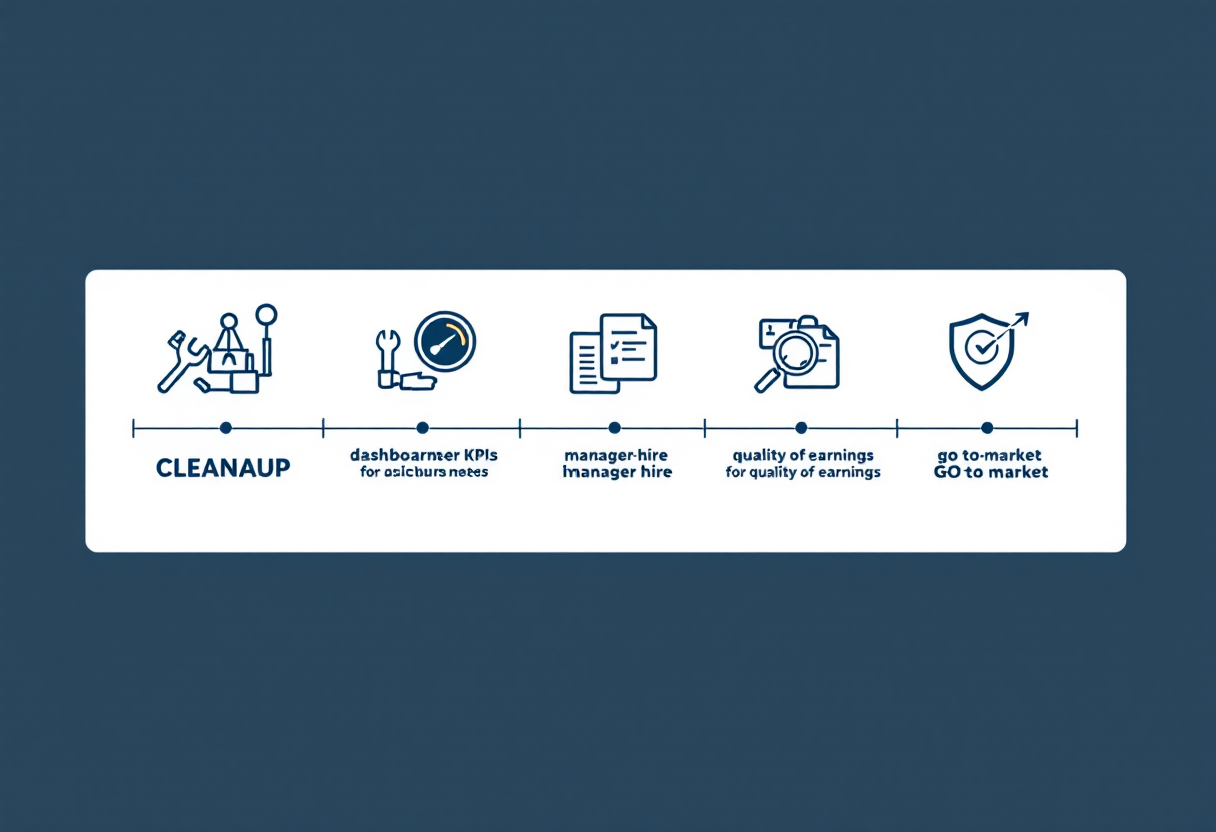
T-36 months: Cleanup phase
- Switch to accrual basis if still on cash basis; adopt percentage-of-completion for modernization WIP
- Pick an FSM (BuildOps, ServiceTrade, FieldRoutes, Salesforce FSL) and migrate, starting with a clean unit master and contracted-unit portfolio data
- Tag every potential EBITDA addback as it happens; build the bridge as a living document
- Conduct W-2 / 1099 audit; reclassify helpers if needed; settle exposure while it is small
- Restruck related-party rent to FMV with appraisal on file
- Build the org chart and identify the GM hire (internal or external)
- Phase I ESA on any owned real estate
- State-by-state sales / use tax compliance review by outside counsel (Texas and Pennsylvania exposure is the highest priority)
- Audit ASME A17.1 / A17.3 code-compliance status across the entire contracted-unit base; itemize code-driven mod triggers (3D door protection, DLM, video communication) by unit
- If signatory: document IUEC NEBA / ECA agreement assignability provisions; reconcile pension and welfare-fund liabilities
- Audit state elevator contractor licenses; identify successor Responsible Parties for the qualifying credential in every operating state
- QEI certification: get a second inspector certified through NAESA if currently single-threaded
T-24 months: Financial discipline and KPI infrastructure
- GM onboarded and starting to take operational load
- Monthly close in 15 days; service-line P&L every month (maintenance vs. repair vs. modernization vs. new install)
- KPI dashboard: MMR per unit, units per mechanic, callback rate per unit, first-time-fix rate (target above 80%), repair pull-through per unit, modernization pipeline conversion rate, contract renewal rate, mechanic billable utilization (target above 65%)
- Launch contract-conversion push: convert demand calls to multi-year contracts; restruck month-to-month to multi-year evergreen at renewal; tighten cancellation provisions
- Pricing review: 4% to 6% list increase at every renewal; CPI escalator on every new contract
- Begin customer diversification if any top customer (or property management portfolio) is above 15%
- Document SOPs for every operational role
- NEIEP apprentice intake (if IUEC signatory) and OEM controller training rotation for mechanics on Otis, Schindler, KONE, TKE, Mitsubishi platforms
- Build the modernization pipeline document (every contracted unit tagged with mod-candidate status)
T-12 months: QoE-ready close discipline, eliminate owner dependence
- Owner steps out of daily operations; GM runs the shop; owner takes a 2-week unplugged vacation as the stress test
- Run the sell-side QoE (budget $50K to $100K)
- Tighten balance sheet: clean A/R, isolate prepaid maintenance liability, reconcile modernization WIP
- Final org-chart review; backfill any gaps; succession documented on every long-tenured mechanic
- Final compliance scrub (license transferability, QEI status, OSHA 300 logs, W-2 / 1099, sales / use tax, environmental, ASME code)
- Lock in 12 months of clean service-line P&L for the CIM
- Insurance review and uplift to $5M to $10M aggregate GL if currently at single-million floor
T-6 months: Pre-marketing prep
- Engage M&A advisor (sell-side investment bank or M&A advisory firm specializing in industrial and mechanical services). Typical fee structure: $25K to $75K monthly retainer credited against success fee of 4% to 8% of EV, with Lehman or modified Lehman scaling (Wall Street Prep sell-side primer; Auxo Capital Advisors)
- CIM drafted from the QoE and operating model
- Teaser drafted (anonymized 1-pager)
- Buyer list finalized. Starting list of 25+ active buyers: AEG (Arcline), Berkshire (Specialized + 3Phase), Axxiom (Gauge), ATIS (TSCP), Total Access (Century Park), ESI (Carroll Capital), Ascend Safety Collective (Haven + Altaline), Champion Elevator (Thayer Street), Otis Worldwide, Schindler USA, KONE Americas, TK Elevator Americas, Mitsubishi Electric Building Solutions Americas, plus any new platform launches per PrivSource and PE Hub feeds
- Virtual data room populated with everything from the pre-LOI and confirmatory sections above
- Management presentation deck built and rehearsed
T-3 months: Go to market
- Teaser distributed; NDAs collected; CIMs distributed
- IOIs collected 2 to 3 weeks after CIM goes out
- Narrow to 4 to 6 finalists for management meetings
- Management meetings; LOIs solicited
- Select LOI; sign with exclusivity (typically 45 to 90 days)
- Enter confirmatory diligence; close
End-to-end from engagement to close: 9 to 12 months in a well-run process (Auxo Capital Advisors sell-side guide; Wall Street Prep sell-side primer; Colonnade Advisors podcast 020).
Frequently Asked Questions
How long should I plan for before selling my elevator service business to a private equity buyer?
The owners who get top-quartile pricing start preparing 24 to 36 months before going to market. The minimum useful prep window is 12 months, because most of the high-leverage levers (converting month-to-month contracts to multi-year evergreens, lifting route density from 60 to 100+ units per mechanic, installing a GM, getting on a real FSM with a clean unit master, running a sell-side QoE) need 12+ months of clean trailing-twelve-months data to be credible to a buyer. Owners who try to sell in under 6 months typically leave 20% to 40% of enterprise value on the table because the contracted-unit portfolio data, the modernization pipeline, and the addback bridge are not ready to defend.
What is a realistic EBITDA multiple for a $2M EBITDA elevator service business in 2026?
For an independent elevator service business at $2M EBITDA in 2026, the range is 7x to 10x. The bottom of that range applies to install or modernization-heavy shops with under 20% maintenance revenue, 30-day cancellation contracts, owner-dependence, and concentrated customer base. The top applies to shops with 40%+ recurring maintenance revenue, 750+ contracted units at 90%+ renewal rate, dense routes at 75 to 125 units per mechanic, a GM in place, and a real FSM running with clean per-unit data (CT Acquisitions 2026; Eilla.ai Elevator and Escalator Valuation Playbook 2025). For platform-quality $10M+ EBITDA shops with IUEC signatory status and OEM authorizations on multiple brands, the range moves into 12x to 18x+. The 36-month prep playbook moves you from the bottom of the band to the top.
Should I get a quality of earnings report done before going to market?
For elevator service businesses at $1M+ EBITDA, yes. A sell-side QoE costs $50K to $100K typical for elevator service with multiple service lines, up to $150K for complex addback situations or large modernization WIP (Eton Venture Services 2025; Kahn Litwin Renza; Citrin Cooperman). The ROI is leverage. On a $25M revenue, $5M EBITDA elevator service business, supporting a 1x multiple uplift from 8x to 9x equals $5M of additional sale price for a $75K investment, a 67x ROI (Eton 2025; Insero Advisors). More importantly, a pre-market QoE validates your contracted-unit portfolio MMR data and renewal rate (the single most-scrutinized metric in elevator service diligence) before the buyer’s QoE finds problems and re-trades the deal during exclusivity.
How many maintenance contracts and what renewal rate do PE buyers want to see?
The entry point for a real sponsor process is 750+ units under maintenance contract at 90%+ annual renewal rate. Platform-eligible is 2,000+ units. Within the unit count, buyers care about contract term (multi-year evergreen beats 1-year beats month-to-month), cancellation provisions (60- to 90-day with material penalty beats 30-day with no penalty), and MMR per unit benchmarked against local market (residential $25 to $125 per month; small commercial $85 to $420 per month; high-rise / specialty $170 to $1,250 per month per Toledo Elevator, Elevator Blueprint, Action Elevator 2026 data). Buyers will frequently layer a Monthly Maintenance Revenue (MMR) multiple onto the EBITDA multiple, valuing the contracted book at an estimated 20x to 36x of monthly fee added to EV (which equates to 1.7x to 3.0x annual maintenance revenue), depending on contract term length and cancellation provisions.
Do I need to put a general manager in place before I sell?
If your goal is to maximize price, yes, ideally 12+ months pre-sale. Owner-dependence is the second-most-cited multiple haircut in elevator service after contract quality. On a $1M to $3M EBITDA business, eliminating key-person risk moves the multiple from the 7x to 8x band into the 9x to 11x band, worth $1M to $6M of price (CT Acquisitions 2026). A GM hire runs $175K to $275K plus bonus depending on metro and IUEC environment, and needs 12 to 18 months to fully take operational load before the buyer’s diligence team will believe the transition. The 2-week unplugged vacation by the owner is the canonical stress test buyers use to validate the handoff.
Will my state elevator contractor license and QEI certification transfer to the new owner?
Usually not automatically. Most state regimes require a Responsible Party or Certificate of Competence holder for the elevator contractor license. Texas TDLR requires a Responsible Party with 3+ years of elevator contractor experience. California Cal/OSHA requires a Certificate of Qualified Conveyance Company (CQCC) or Certificate of Competence under DIR with 3+ years of conveyance experience. New York DOL requires elevator contractor license (effective Jan 1, 2022) with $1M per occurrence insurance minimums. Florida DBPR requires a registered elevator company employing a certified inspector, technician, or certificate of competency holder with $100K / $300K minimum liability insurance. If the owner personally holds the qualifying credential and there is no successor on staff, the license does not transfer at close and the buyer either finds a new qualifier or restructures the deal. The same applies to QEI certification, which is certified by NAESA International under the ASME QEI-1 Standard and is tied to specific individuals, not the company. Identify and certify successor Responsible Parties and QEI holders in months 36 to 24 of the run-up, not at month 3.
What to Do Next
The elevator service owners who get the top-quartile multiple all do the same three things. They start preparing 24 to 36 months before they want to be out. They build the contracted-unit portfolio (count, renewal rate, MMR per unit, cancellation provisions) as the single most defensible asset in the business. They put a GM in place 12+ months pre-sale, certify a second QEI through NAESA, and document succession on every long-tenured mechanic so no single individual carries the keys.
The KONE / TK Elevator megadeal announced April 29, 2026 at $34.4B EV (roughly 17x to 18x EBITDA) is the freshest, most-cited comp in elevator services M&A and resets the market for any seller currently considering a process. Schindler has already signaled it will challenge the deal at antitrust, which means a multi-quarter slog before the close. The sponsor buyer set (Arcline, Berkshire, Gauge, Century Park, TSCP, Carroll Capital, Haven + Altaline, Thayer Street) is deeper than it has ever been, and Big 4 strategic interest will not let up.
If you are 12+ months from a potential exit and want a structured pre-sale optimization roadmap, CT Acquisitions has elevator operations specialists in our partner network who run multi-quarter prep engagements. If you are 6 to 12 months out and ready to start the sell-side process, our M&A advisory team runs the buyer outreach. No fee to you on buy-side introductions; sell-side mandates are paid on success at closing. Either way, the first 30 minutes are free.
Ready to talk?
Schedule a 30-minute exit-readiness call
Or read more: Sell Your Elevator Service Business (active sale guide) | Buying an Elevator Service Business (buyer’s playbook) | Private Equity in Elevator Services 2026: Active Buyers + Multiples
Ready to Explore Your Options?
A 30-minute confidential conversation is all it takes.