How to Prepare Your Deck Building Business for a Sale or Exit in 2026: The 36-Month Playbook
Preparing your deck building business for exit in 2026 is a 36-month playbook. The first 12 months tighten the operating story around premium material mix (composite, aluminum) and referral network depth, the middle 12 fix pre-LOI diligence gaps around crew retention and warranty claims, and the final 12 turn one offer into a real competitive process. Outdoor living aggregators are early in their consolidation cycle, which is a favorable time to prepare.
Exiting your deck building business is the single largest financial event most owners will ever face. This guide is the no-fluff playbook for deck building business owners who are 12-36 months from sale, covering how PE-backed buyers actually value your business in 2026, the 12 levers that move your multiple, pre-LOI diligence, deal-killers to fix before going to market, and the full 36-month exit prep timeline.
Updated April 2026 · CT Acquisitions

Most deck-builder owners decide to sell, hire a broker, and find out 90 days later that their business is worth 30% to 40% less than they thought. The owners who get top-quartile pricing start preparing 24 to 36 months before they ever talk to a buyer. This guide is the 36-month playbook for how to prepare your deck building business for a sale or exit. It covers what private equity actually buys in a sector that has very few pure-play deck roll-ups, the 12 levers that move multiples, the documents PE will ask for before they send an indication of interest, and the deal-killers that re-trade deck-builder transactions during confirmatory diligence. Every number cites its source. Every recommendation comes from how the most active deck-adjacent buyers in 2026 actually behave.
If you are 6 to 36 months from a possible exit, this is the work that turns a 3.5x EBITDA outcome into a 6x EBITDA outcome. On a $1.5M EBITDA deck-building business, that is the difference between a $5.25M sale and a $9M sale. Whether you want to prepare your deck building business for a sale to private equity, prepare your deck building business for an exit to a strategic acquirer or an adjacent multi-trade exterior platform, or simply maximize value over the next 1 to 3 years before going to market, the work below applies. One framing point up front: deck-builder pure-play PE roll-ups are essentially absent compared to HVAC, plumbing, roofing, or even painting. Most deck-builder exits will go to multi-trade exterior platforms, regional outdoor-living roll-ups, the Archadeck franchise system under Empower Brands, or owner-operator buyers. That structural reality compresses multiples and shapes every section of this guide.
Building toward an exit in 12 to 36 months?
CT Acquisitions runs sell-side advisory for deck-building and outdoor-living owners $1M+ EBITDA. We also have construction-services operations specialists in our partner network who run pre-sale optimization engagements when the timeline is longer. No fee to you on buy-side introductions; sell-side mandates are paid on success at closing.
What Private Equity Actually Buys in Deck Building (2026)
The honest framing first. Deck-builder pure-play PE platforms are scarce. There is only one national franchise consolidator (Archadeck Outdoor Living under Empower Brands, owned by MidOcean Partners), a handful of multi-trade exterior platforms that increasingly add decking (Valor Exterior Partners, Renuity, Leaf Home, West Shore Home), several distribution and product-side roll-ups feeding the trade (PrimeSource Brands, Outdoor Living Supply), and some adjacent luxury landscape platforms (Diamond Landscaping). The headline manufacturer deal of the era is the James Hardie acquisition of The AZEK Company for $8.75 billion total transaction value that closed July 1, 2025 (James Hardie press release, July 1, 2025; Financier Worldwide, March 27, 2025). That deal consolidates product and distribution. It does not create a new strategic buyer of installer-service businesses. Construction services M&A overall reached 562 transactions in 2025, up 18.2% year over year per Capstone Partners Construction Services Market Update August 2025, but only a small slice of that volume is deck installers. The buyers you do have will pay for specific profiles, and the profile you build determines the multiple you get.
The PE-attractive deck-building profile
- EBITDA threshold for a platform-quality deal: $1M to $2M is the entry band where multi-trade exterior platforms and outdoor-living roll-ups run a competitive process. Below $1M, you are an owner-operator transition or a franchise resale. Above $3M EBITDA in deck-building specifically, you are an attractive bolt-on for the larger exterior or luxury-landscape platforms. Pure-play deck platforms at the $5M+ EBITDA tier are rare; most owners that size end up selling to multi-trade home-services consolidators.
- Recurring revenue mix: Project-based by nature, but recurring maintenance, wash, stain, seal, and repair contracts move the multiple. Under 5% recurring is the demand-only baseline. 15% to 25% recurring puts you into the premium band. Recurring revenue is the single largest multiple driver in any service business per Profitability Partners 2026 and Brentwood Growth contractor guides.
- Composite vs. wood mix: Composite specialty with manufacturer certification (Trex Pro Platinum or AZEK/TimberTech Platinum) signals quality alignment and enables extended labor warranties. Wood-plastic composites captured 28% of US decking demand in 2025, up 6 percentage points in 5 years (Farnsworth Group, “Composite Decking Market Trends”, 2025).
- Commercial / HOA / multi-family mix: 25% to 40% commercial work brings repeat customer relationships and contract revenue. 100% residential is the demand-only equivalent for deck builders.
- Geography: Sun Belt, Texas, Florida, Carolinas, Arizona, Colorado are where 2026 sponsor demand concentrates. Single-metro Northeast or upper Midwest shops carry a seasonality discount.
- Customer concentration: No single HOA management company or home-builder customer above 10% of revenue. Top 5 below 30%. Concentration above 20% triggers buyer pushback; above 25% triggers a 15% to 30% valuation discount or buyer withdrawal (Beancount.io, May 2026; Strategex; Eagle Rock CFO; Morgan & Westfield).
- Crew depth: Skilled deck-build carpenters are scarce. Above-average tenure and a documented apprentice-to-lead pipeline is a defensible asset.
- Owner role: Owner is in management, not running every estimate or running install crews. GM in place 12+ months pre-sale.
Active deck-adjacent PE platforms in 2026
The list below covers the most active sponsor-backed platforms touching deck-building and outdoor living in the 2024-2026 cycle. This is the buyer field you will see your teaser. The list is shorter than the HVAC equivalent of 27 platforms because deck-pure-play roll-ups barely exist. Add-on counts are point-in-time; sources include Empower Brands press releases via PR Newswire 2024-2026, Osceola Capital releases on Valor Exterior Partners, Greenbriar Equity on Renuity, Leaf Home / Gridiron Capital releases September 2025, Clearlake Capital on PrimeSource Brands acquisitions, Trilantic on Outdoor Living Supply, Kian Capital on Diamond Landscaping, Alpine Investors and Apollo on Apex Service Partners May 2026, Founders Advisors Home Services Update Summer 2025, Platinum Equity on PlayPower, and PE Hub outdoor-living coverage.
| Platform | Sponsor | Profile |
|---|---|---|
| Empower Brands (incl. Archadeck Outdoor Living) | MidOcean Partners | Only national pure-play deck franchise consolidator; 100+ Archadeck locations; 287 territories awarded across 10-brand portfolio since formation; surpassed $1B combined system sales |
| Valor Exterior Partners | Osceola Capital | Roofing, siding, windows, doors, skylights, insulation, decking explicitly named; 7 add-ons Sept 2024 through Nov 2025; $1M to $5M EBITDA add-ons |
| Renuity | Greenbriar Equity Group (acquired 2024) | Multi-category home improvement; 30+ states + DC; multiple acquired brands incl. Mad City Windows, FHIA Remodeling, Statewide Remodeling, MaxHome; $5M to $25M add-ons |
| Leaf Home + Erie Home | Gridiron Capital + Ares Management preferred equity | Merged September 2025; roofing, gutters, basement, garage flooring, bath, stair lifts; 48 US states + Canada; 100+ Erie Home locations; $5M to $50M |
| West Shore Home | Leonard Green & Partners ($250M Sept 2020) | Bath, windows, doors; M&A team actively hunting adjacent specialty remodeling across 40+ markets in 22 states; $3M to $25M |
| PrimeSource Brands | Clearlake Capital (since Dec 2020) | Product side: railing systems, gate hardware, fencing; 10 acquisitions since 2020 incl. Fortress Railing (July 2, 2025), Keylink (Jan 21, 2025), Advantage Industries (2026); not installers |
| Outdoor Living Supply | Trilantic North America (since late 2020) | Hardscape distribution: stone, brick, lighting, bulk materials; 12+ acquisitions incl. Garden Supply Hardscapes (Oct 2024), Geo. Schofield, Majestic Stone, Woodland Landscape Supply |
| Diamond Landscaping | Kian Capital (since Dec 2021) | Luxury residential landscaping; adjacent to high-ticket outdoor-living spend; 7 add-ons incl. Christensen Landscape Services (Feb 2026); nearly tripled revenue and EBITDA since Kian invested |
| Apex Service Partners | Alpine Investors (Apollo took minority May 28, 2026) | HVAC/plumbing/electrical primarily; 75 brands across 46 states; 13,000+ employees; ~$1.3B revenue; potential acquirer of multi-trade shops with deck adjacency |
| Founders Home Service Group | Grove Mountain Partners (via Founders Advisors) | Multi-trade home services consolidation; 13 home services deals in H1 2025 alone; $1M to $10M |
| Platinum Equity (PlayPower) | Platinum Equity | Outdoor recreational and outdoor living systems; PlayPower acquired from Littlejohn Sept 2025; platform-tier |
| Tenex Capital Management | Tenex | Outdoor living and systems exposure per PE Hub coverage; $5M to $25M |
| ADIA (Abu Dhabi Investment Authority) | ADIA | Outdoor living co-investments per PE Hub coverage; platform-tier |
Now the strategic acquirers. The story is dominated by one manufacturer-side mega-deal that reshaped the supply chain. James Hardie Industries closed its acquisition of The AZEK Company on July 1, 2025 at $8.75 billion total transaction value, including AZEK’s net debt of roughly $386M as of December 31, 2024. AZEK shareholders received $26.45 cash plus 1.0340 James Hardie shares per AZEK share. The combined company has $5.9 billion in net sales, $1.8B+ adjusted EBITDA at 31% margin pro-forma incl. synergies, with $625M total synergy projection ($125M cost, $500M commercial). The commercial logic: 55% of homeowners complete deck and siding projects together (James Hardie and AZEK joint press release March 2025; James Hardie press release July 1, 2025; Financier Worldwide March 27, 2025; Catalyst M&A Group analysis). That deal consolidates product and distribution. It does not create a new strategic acquirer of installer-service businesses. Trex Company, the other public composite manufacturer, holds roughly 50% to 60% North American composite-decking market share with $1.2B in 2025 revenue and is expanding distribution via Specialty Building Products and Weekes Forest Products in late 2025 (Trex Q4 2025 press release, February 24, 2026). Trex is not acquiring installers either. Fortune Brands Innovations bought Fiberon back in 2018 for $470M and has not made material deck-installer acquisitions since (LBM Journal, 2018; Fortune Brands 8-K filings). The practical takeaway: most deck-builder exits in 2026 will go to multi-trade exterior platforms, regional outdoor-living roll-ups, the Archadeck franchise system, or strategic owner-operator buyers. Pure-play deck strategic acquirers in residential service are essentially absent.
Deck Building Valuation Multiples in 2026 (What You Are Actually Worth)
The multiple a buyer pays comes down to your size, your service mix, your recurring revenue, your composite-specialty positioning, and your geographic fit. Here is the 2026 range, cross-referenced from Peak Business Valuation specialty contracting multiples, IBBA Market Pulse Q4 2025, Profitability Partners 2026 home services valuation report, Founders Advisors Home Services M&A Update Summer 2025, Brentwood Growth contractor guides, and First Page Sage Construction EBITDA & Valuation Multiples 2025.
Important framing for deck-builder valuations vs. other trades: deck-builder multiples sit below HVAC, plumbing, and electrical for several structural reasons. Deck builds are project-based vs. recurring. Lumber and material price exposure compressed margin on fixed-price work during the 2021-2023 spikes when framing lumber went over $1,500 per thousand board feet (Mordor Intelligence; Random Lengths). Seasonality is brutal in northern states with a 30% to 50% revenue drop in Jan/Feb. Trade-license barriers vary by state, with California Class B General Building and Florida CGC/CRC required but Texas relying on local permitting only. And the lack of pure-play PE roll-up demand means fewer competing bidders, which narrows multiples vs. HVAC’s 27-platform buyer field.
SDE multiples (smaller, owner-operated, typically under $3M revenue)
| SDE band | SDE multiple | Profile fit |
|---|---|---|
| Under $500K SDE, generalist deck builder | 2.0x to 3.0x | Peak Business Valuation Specialty Contracting multiples 2025; deck builders sit toward middle/low end of 2.39x to 3.49x range |
| $500K to $1M SDE, growing | 2.5x to 3.5x | Peak Business Valuation 2025; IBBA Q4 2025 Market Pulse |
| Trex Pro Platinum or AZEK Elite cert + composite specialty | 3.0x to 4.0x | Estimate; synthesized from Peak Business Valuation + Brentwood Growth contractor guides 2025; certification premium is not separately published |
| Generic construction business range | 2.0x to 4.5x SDE | DealFlowAgent 2025-26 EBITDA Multiples Guide; First Page Sage 2025 Construction Companies |
Reference: Peak Business Valuation reports specialty contracting businesses generally transact at 2.84x to 3.28x SDE. A $655K SDE specialty contractor at 3.10x equals $2,030,500 in enterprise value (Peak Business Valuation, “Specialty Contracting Valuation Multiples”, 2025).
EBITDA multiples (PE-attractive size, $1M+ EBITDA)
| EBITDA band | Residential project-heavy (estimate) | 30%+ commercial / HOA / maintenance mix (estimate) |
|---|---|---|
| $1M to $2M EBITDA | 3.5x to 5.5x | 5x to 7x |
| $2M to $5M EBITDA | 4x to 6.5x | 6x to 8.5x |
| $5M+ EBITDA multi-state outdoor-living platform | 6x to 9x | 7x to 11x |
| Top-tier diversified construction (broad reference) | 9x to 11x | Not applicable |
For reference, IBBA Q4 2025 lower middle market all-industry numbers: $1M to $2M deals printed roughly 3.1x EBITDA; $2M to $5M printed roughly 4.1x; $5M to $50M printed roughly 5.5x (IBBA / M&A Source Market Pulse Q4 2025 Survey, released January 2026, conducted Jan 1-15, 2026 across 350 business brokers and M&A advisors). Well-run growth-oriented residential home-services platforms with $2M+ EBITDA trade at 7x to 12x EBITDA per Profitability Partners 2026. Deck-pure-play platform-tier deals are rare and not separately published, so the figures above carry the “estimate” label where they extend beyond directly published deck-specific data.
Recent disclosed deck-adjacent transactions (2025-2026)
| Acquirer | Target | Date | Value | Implied multiple |
|---|---|---|---|---|
| James Hardie Industries (NYSE: JHX) | The AZEK Company (NYSE: AZEK) | Closed July 1, 2025 | $8.75B total transaction value | ~23x EBITDA on AZEK standalone basis (estimate; AZEK adj. EBITDA ~$381M FY24) |
| Gridiron Capital + Ares Management | Leaf Home / Erie Home merger | September 2025 | Not disclosed | Not disclosed |
| Osceola Capital / Valor Exterior Partners | 7 add-ons (Associate Roofing, Roofing King, Doing It Right, Kirkin Exteriors, Unisource Roofing, A. Caspersen Co., and others) | Sept 2024 through Nov 2025 | Not disclosed individually | Not disclosed |
| Clearlake Capital / PrimeSource Brands | Fortress Railing Products | July 2, 2025 | Not disclosed | Not disclosed |
| Clearlake Capital / PrimeSource Brands | Keylink | January 21, 2025 | Not disclosed | Not disclosed |
| Kian Capital / Diamond Landscaping | Christensen Landscape Services | February 2026 | Not disclosed | 7th add-on; Diamond has nearly tripled revenue and EBITDA since Kian invested |
| Apollo Funds (minority) + Alpine Investors | Apex Service Partners | May 28, 2026 | Not disclosed | Not disclosed |
| Greenbriar Equity Group | Renuity | 2024 | Not disclosed | Not disclosed |
Sources: James Hardie press release July 1, 2025; AZEK 8-K filings; Financier Worldwide March 27, 2025; Leaf Home press release September 2025; Gridiron Capital release; Osceola Capital releases via PR Newswire 2024-2025; Clearlake Capital press releases January 21, 2025 and July 2, 2025; Kian Capital press release; Pro Landscaper USA February 27, 2026; Apollo Global Management press release May 28, 2026; Alpine Investors release; Greenbriar Equity Group press release; Akerman LLP transaction notice. Note: deck-installer pure-play transaction values are almost never disclosed publicly because the deals are private and below SEC reporting thresholds. The closest benchmarks are the Archadeck franchise resale market and the Empower Brands portfolio economics, plus the specialty contracting Peak Business Valuation reference band.
Archadeck-specific reference benchmarks (Archadeck Outdoor Living 2024 FDD via Franchise Chatter January 2025, Sharpsheets, Vetted Biz): Average Unit Volume single territory $1,427,014; AUV multi-territory $2,806,890; average gross profit margin 38.5%; median single-territory franchisee earnings $151,401 to $194,658 estimated; total investment to open $120,000 to $139,000; royalty 6.5% sliding down to 3.5% above $3M, plus 1.5% brand fund and $50K local advertising minimum per territory. FDD performance based on 46 franchisees operating 77 territories for the full 12-month period ending September 30, 2024.
Deck Bros (Omaha) is the headline non-franchise growth case study cited across contractor podcasts. They scaled from $1M in 2020 to over $15M run-rate in 2025 on $400K marketing spend (ContractingEmpire case study; JobTread Builder Stories Podcast; Beyond Grit podcast with Robert Young, 2025). It is proof that deck-installer top-line can scale to PE-relevant size in 5 years if marketing and ticket discipline are right.
The 12 Value Levers That Move Your Multiple (Ranked by Impact)

These are the levers that move deck-builder multiples in the 24 months before a sale. Each one has a current state, a target state, and an estimated financial impact. The ordering is by dollar impact per unit of effort, based on cross-source synthesis from Profitability Partners 2026, Brentwood Growth, Peak Business Valuation, Founders Advisors Home Services M&A Update Summer 2025, and the deck-builder-specific operator content from Deck Bros, DeckPro Surface Solutions, Empire Home Solutions, and YellaSource.
Lever 1: Build a recurring maintenance, wash, stain, and seal contract base
Current: 0% to 5% revenue from recurring maintenance; one-time project shop. Target: 15% to 25% recurring revenue from annual wash, stain, seal, and minor repair contracts. Target 80%+ annual renewal. Impact: Recurring revenue is the single largest multiple driver in any service business (Profitability Partners 2026; Brentwood Growth contractor guides). Estimate +0.5x to 1.5x EBITDA multiple uplift. On a $1.5M EBITDA deck builder that is $750K to $2.25M of additional enterprise value. A documented maintenance contract base can also trade at a 1x to 2x annual revenue premium on top per Profitability Partners. How: Offer a 2-tier annual maintenance plan ($299/yr basic wash + inspect, $599/yr wash + stain/seal + minor board replacement). Sell at project close while the customer is enthusiastic. Auto-renew with stored payment. Bundle railing repaint, deck wash, and sealing per Empire Home Solutions 2026 and DeckPro Surface Solutions playbooks. One contractor cited a 230% revenue lift from upselling additional services alongside a stain refresh (DeckMaxtor / YellaSource 2025).
Lever 2: Move the owner out of the chair (GM in place)
Current: Owner runs sales, runs estimates, is on every job, signs every check. Target: GM in place 12+ months before going to market. Owner does under 30 hours/week of operational work. Sales lead, designer, and field operations have promoted-from-within leadership. Impact: Owner-dependence is one of the largest valuation killers in construction. Peak Business Valuation reports owner dependency can knock 20% to 30% off valuation. On a $1M to $3M EBITDA deck builder, GM in place can move the multiple from the 3.5x to 4.5x band into the 5x to 6.5x band. Estimate $1M to $4M of additional sale price. How: GM hire 18 to 24 months pre-sale (typical comp $125K to $200K plus bonus for deck/remodeling sector). Document SOPs for every operational role (sales, design, estimating, install, QC, callback). Transition customer relationships to the sales team and designer. Take a 2-week unplugged vacation as the stress test.
Lever 3: Get on Buildertrend or JobTread or Houzz Pro and run a real monthly close
Current: QuickBooks plus spreadsheets, no job-cost accuracy, no monthly close, crew productivity is anecdotal. Target: Buildertrend, JobTread, or Houzz Pro in place 24+ months. Monthly close within 15 days. Real KPI dashboard (estimate-to-close ratio, gross margin per project, average ticket, jobs per crew per month, callback rate). Impact: Estimate +0.25x to 0.75x multiple uplift, primarily from speed and credibility of data-room responses during diligence. Houzz Pro brings 3D rendering for design-build positioning; JobTread is user-friendly for small contractors; Buildertrend is the broader-feature standard for deck and remodel. Deck Bros (Omaha) scaled from $1M to $15M+ on JobTread. How: Budget $20K to $80K implementation cost plus per-user license. Force adoption by tying payroll to job-completion compliance in the system. Migrate historic job-cost data so the buyer’s QoE team has 24 months of clean job-level margin history.
Lever 4: Drive average ticket toward outdoor-living spaces, not single decks
Current: Average ticket $15K (deck only). Target: Average ticket $35K to $60K through outdoor-living adjacencies (pergola, screened porch, outdoor kitchen, fire feature, low-voltage landscape lighting). Impact: Direct EBITDA growth. A $5M revenue shop with an average ticket lift from $15K to $35K can hold job count constant and double revenue, with most of the incremental dropping to EBITDA at higher attached-product margins. Cross-reference Empower Brands data showing 70% to 100% ROI on outdoor living projects (Archadeck FDD 2024 via Franchise Chatter 2025). How: Designer on staff; 3D rendering software (Houzz Pro, Lowe’s deck designer, Home Depot deck designer, or paid tools like Coohom or SketchUp); product attachment program with composite + railing + lighting + outdoor-kitchen vendors; spec packages branded “Outdoor Living Studio” rather than “Deck Builder”.
Lever 5: Achieve and document Trex Pro Platinum or AZEK ELITE/Platinum certification
Current: Trex Pro Gold or unaccredited; AZEK/TimberTech Silver or Member tier. Target: Trex Pro Platinum AND AZEK/TimberTech Platinum, with extended labor warranty positioning. Per-market volume thresholds met. Impact: Estimate +0.5x to 1.0x multiple uplift in residential composite-heavy shops. The certifications act as a moat against generic competition because Platinum represents the highest tier and enables extended warranty programs that customers value. They also signal to PE buyers that the business has manufacturer-recognized quality. How: Submit Trex Pro Platinum application; complete required deck registrations (multiple with Trex railing) and Trex sales-rep review per the Trex resource page on becoming a TrexPro. For AZEK Platinum, demonstrate sales volume via invoice submission for renewal and complete advanced training in the TimberTech contractor program.
Lever 6: Build commercial, HOA, and multi-family mix
Current: 100% residential homeowner. Target: 25% to 40% commercial (HOA, condo, hotel, multi-family). Impact: Commercial work brings repeat customer relationships (HOA contracts roll annually; condo and hotel jobs often phase in tranches), more predictable revenue, and a recurring repair/maintenance pull-through. Estimate +0.5x to 1.0x multiple. How: Hire a commercial sales rep with HOA/condo board relationships. Target property-management firms (FirstService Residential, Associa, RealManage) and hotel reno PMs. Develop submission packages for HOA architectural review boards. Reference: M3Decks, Dream Decks, Fence and Deck Connection commercial deck contractor positioning (2025).
Lever 7: Tighten W-2 and 1099 classification
Current: Crew leads and framers run 1099; only office staff is W-2. No I-9 audit trail. Mixed classification rationale. Target: Crew leads and full-time framers on W-2; only true independent contractors (railing specialists, masons for hardscape adjacency, low-voltage electricians) on 1099 with documented independence test. Impact: Mitigates the single largest deck-builder deal-killer. IRS misclassification penalties run up to 41.5% of misclassified worker earnings in back taxes plus penalties (Deel 2025); construction-industry fines run up to $1,000 per violation. Plante Moran “Navigating Worker Classification” November 2025 flags renewed enforcement focus in 2025-2026. A buyer’s HR diligence will catch this; a clean classification book preserves $200K to $1M+ of purchase price depending on exposure size. How: Run an outside payroll classification audit 24 months pre-sale. Reclassify, settle exposure, document. Adopt 1099-NEC discipline (file for every sub paid $600+, per IRS 2025 requirements).
Lever 8: De-concentrate the customer base if commercial-heavy
Current: Top HOA management company or single home builder above 15% of revenue. Target: Top customer below 10%; top 5 below 30%. Impact: Concentration above 20% triggers PE pushback; above 25% triggers a 15% to 30% discount or buyer withdrawal (Beancount.io 2026; Strategex; Eagle Rock CFO; Morgan & Westfield; Wall Street Prep). SBA lenders, who finance many lower middle market deals, get uncomfortable above 20%. How: Diversify into new HOA / property management relationships, expand residential footprint, kill any discount that artificially inflates the biggest account’s weighting.
Lever 9: EBITDA add-back hygiene
Current: Owner mixes personal expenses through the business with no documentation; related-party rent at well above FMV; no add-back schedule. Target: Every potential add-back documented as it happens with the underlying invoice; related-party rent restruck to FMV with appraisal on file; clean payroll for owner-family members. Impact: Every defensible dollar of adjusted EBITDA gets multiplied. On a 5x multiple, $100K of clean add-backs equals $500K of sale price (Morgan & Westfield QoE guide; Brentwood Growth contractor guides). How: Monthly add-back log starting today. Document business purpose of every charge. FMV rent appraisal if the owner owns the real estate and the business rents it.
Lever 10: Working capital normalization (deferred revenue and progress-billing discipline)
Current: Big customer deposits sitting in operating cash; in-progress jobs not tracked separately; wildly seasonal A/R. Target: Customer deposits in a separate sub-ledger; in-progress jobs tracked with cost-to-complete; TTM-average working capital is stable. Impact: Working capital peg is set off the TTM average per BDO and Morgan & Westfield NWC guides. Deferred revenue and customer deposits are commonly treated as debt-like items (Lutz M&A Solutions; Forvis Mazars September 2024 “How Customer Contract Terms Impact Net Working Capital”). Failing to isolate them lets the buyer push them out of working capital AND into debt-like items, double-counting against purchase price. Estimate impact: poorly managed customer deposit accounting can cost 3% to 7% of enterprise value at close. How: Tighten A/R collection. Implement a progress-billing schedule. Use Buildertrend or JobTread to track deposits and percent-complete by job. Negotiate the carve-out treatment up front with the buyer’s QoE team.
Lever 11: Lumber price hedging or pass-through clauses
Current: Fixed-price contracts with no material price escalator. Lumber spike of 2021-2023 cratered margin on jobs in backlog. Target: Standard contract includes a material price escalator if the lumber index moves more than 10% between contract signing and material order. Alternatively, ride composite-specialty positioning where lumber exposure is structurally lower because composite and PVC is more stable in price. Impact: Removes one of the headline buyer concerns. Framing lumber swung between $430 and $475 per thousand board feet during 2024-2025 (Mordor Intelligence “Wooden Decking Market”; Random Lengths data); the 2021-2022 spike took lumber over $1,500. Composite decking price increases in 2025 (TimberTech raised across all lines April 2025) are material but less volatile. A documented hedge or escalator clause reduces the discount applied. How: Add escalator language to all new contracts. Shift sales mix toward composite and PVC where margin is more predictable. Document material cost as % of revenue by month for the last 36 months.
Lever 12: Customer-financing program quality (GreenSky, Hearth, Synchrony)
Current: Push GreenSky promotional 0% APR financing for every job; no tracking of dealer fees absorbed; no record of authorization workflow. Target: Multiple financing options (GreenSky, Hearth, Synchrony, Acorn Finance); tracked dealer fees as a separate P&L line; documented in-home sales authorization workflow with customer signature; tracked default rate (lender-reported). Impact: The CFPB action against GreenSky in 2021 ($9M refund order, $2.5M civil penalty for facilitating loans without consumer authorization, with approximately 6,000 consumer complaints and merchants at fault in at least 1,600 cases) made every PE buyer cautious about deck-builder financing books. Estimate impact: a messy financing book equals a 0.5x to 1.0x multiple haircut. Clean documentation removes the discount. How: Adopt e-sign authorization for every financing application. Train sales reps on disclosure. Track dealer fees (standard loans 3% to 6%, promotional 8% to 15%+ per LendEDU 2026, Acorn Finance contractor resources). Track customer cancellations and lender-reported defaults.
Want to grow your business to maximize value before exiting?
We connect deck-building and outdoor-living owners with operations experts in our partner network who run 12 to 24 month pre-sale optimization engagements. The engagement pays for itself in incremental sale price.
What PE Asks Before They Send an LOI (The Pre-LOI Diligence Stack)
Before a PE firm commits to a letter of intent, they ask for a focused diligence package. The list below is the standard pre-LOI ask for a deck-building business in CT Acquisitions’ pipeline. The “why” and “how to prepare” expand each item to what is typical across the industry, with deck-builder-specific items called out where they differ from generic home-services prep.
1. Income statements for 2024, 2025, and the latest trailing twelve months
Why PE asks: They are building the LTM EBITDA they will multiply. They want trend (growth rate, margin trajectory), seasonality, and any one-time movers. LTM is the bridge between the most recent year-end and today, so the headline price reflects current run-rate, not stale data. Deck-builder-specific: surface the seasonality pattern explicitly. Build a year-over-year revenue chart by month so the buyer can see Q2-Q3 peak and the Q4-Q1 trough. Northern shops should show a 30% to 50% revenue drop in Jan/Feb; that is expected and not a red flag, but unaddressed it makes the buyer skeptical of forward run-rate assumptions.
How to prepare: Accrual-basis P&L by month, mapped to a clean chart of accounts. Service-line P&L (new deck install vs. repair/remodel vs. stain/seal vs. railing vs. outdoor-living adjacencies like pergolas, outdoor kitchens, fire features) where possible. Reconcile to tax returns so there are no surprises in confirmatory diligence.
2. Balance sheet at the latest month
Why PE asks: Sizes the working capital peg they will set in the SPA. Identifies net debt (cash minus interest-bearing debt minus debt-like items). Deck builders carry an unusual debt-like item: customer deposits and progress-payment liability on jobs underway. Construction-contractor accounting treats customer deposits as deferred revenue (Levelset 2025; Forvis Mazars September 2024; Lutz M&A Solutions). A buyer in a cash-free, debt-free transaction will price these deposits as debt-like obligations or carve them out of the working capital mechanism with a “cost to serve” calculation (inverse of historical gross margin). On a deck shop with $2M of customer deposits at 28% gross margin, the buyer’s cost-to-serve carve-out can move purchase price by $1.4M+.
How to prepare: Tie the balance sheet to the trial balance. Separate customer deposits from completed-but-unpaid receivables. Isolate progress-billed retainage that a GC or HOA is holding. Identify which liabilities are debt-like vs. working capital.
3. Add-back estimates
Why PE asks: They want a sneak peek at adjusted EBITDA before sinking diligence cost. Aggressive or undocumented add-backs discount the rest of the file.
How to prepare: Build the bridge from book EBITDA to adjusted EBITDA, line by line. Document every add-back with invoice or payroll record. Common deck-builder add-backs that hold up: owner compensation above market ($150K to $250K GM cost replacement); owner truck and personal vehicle costs; owner family-member payroll; owner health insurance and country-club; one-time legal fees from a lien dispute or HOA approval lawsuit; one-time software conversion costs (e.g., migration to Buildertrend or JobTread); COVID-era ERC and PPP forgiveness; related-party rent at above-FMV (added back to the FMV delta); one-time material price spike absorbed on a fixed-price job (lumber spike 2021-2023). Reference: Morgan & Westfield QoE guide; Midstreet “Quality of Earnings Report”; Brentwood Growth construction guides.
4. Anonymized employee roster (titles, start dates, pay, W-2 vs. 1099)
Why PE asks: Two stress tests. First, carpenter tenure and depth, because skilled deck-build carpenters are scarce and the buyer wants to see if the crew is a defensible asset. Second, W-2 vs. 1099 classification: deck shops are notorious for running framers and helpers as 1099 to dodge payroll tax. The IRS can assess up to 41.5% of misclassified workers’ earnings in back taxes plus penalties; construction-industry fines run up to $1,000 per violation per Deel 2025 and Plante Moran “Navigating Worker Classification” November 2025.
How to prepare: Roster columns should include role (crew lead vs. framer vs. helper vs. railing specialist vs. designer), hire date, full-time vs. part-time, W-2 vs. 1099 with classification rationale, comp structure (hourly, salary, commission, piece-rate), active non-compete or non-solicit. Add columns for OSHA 10/30 certifications, first-aid/CPR, and manufacturer training certifications (Trex Pro Platinum, AZEK/TimberTech Platinum, Fiberon). Calculate and disclose 12-month and 24-month rolling crew retention. Run an outside 1099 audit BEFORE going to market.
5. Revenue breakdown by service line and project type (2022-2025 plus LTM, with job counts and average ticket)
Why PE asks: Single most diagnostic exhibit. Tells the buyer whether you are install-heavy or mixed, whether your average ticket is rising, and whether job count is growing through capacity expansion or just price.
How to prepare: Deck-builder columns: new deck installs (wood vs. composite vs. PVC); deck repair / refacing; railing-only projects; outdoor-living adjacencies (pergolas, screened porches, outdoor kitchens, fire features, lighting, fencing); maintenance, wash, stain, seal recurring; commercial, HOA, multi-family contracted work. Average ticket benchmarks: Zonda 2025 Cost vs. Value Report sets composite deck addition (16×20 ft) national average at $25,096 ($78/sqft installed) and wood at $18,263 with 94.9% resale recoup. Mid-grade composite installed at $35 to $55/sqft; premium composite $50 to $70/sqft; capped cellular PVC $55 to $80+/sqft (Ergeon 2026 “Deck Cost”). Deck Bros (Omaha) scaled from $1M to $15M+ at higher-end residential ticket; Archadeck single-territory AUV is $1.43M.
6. Customer concentration (top 10 customers)
Why PE asks: Same as any service business. Residential deck builders usually have very low concentration (one homeowner per project), which is a structural advantage. The risk is commercial-heavy or HOA-heavy shops where one HOA management company sends multiple projects per year, or one home-builder is a recurring source of new-construction deck work.
How to prepare: Top 10 by revenue over the last 36 months. Disclose any single source above 10%. Disclose whether any of the top 10 is a homeowner that has done multiple projects.
7. Five-year business plan
Why PE asks: PE underwrites forward years 1 through 5. Wants to see if you have a credible growth story and how aggressive you are. They will overlay their own model on top, but your plan tells them whether you understand your own levers.
How to prepare: Capacity build (crews and trucks, designer headcount), planned expansion into outdoor-living adjacencies (pergolas, outdoor kitchens, fire features, lighting), territory expansion, ticket and gross-margin assumptions, marketing investment plan, composite-vs-wood mix evolution toward composite premium tier.
8. Vehicle and fleet list
Why PE asks: Same as HVAC. CapEx forecast, owned vs. leased vs. financed, wrap and brand condition for any post-close rebrand. Deck-builder specifics: crew trucks, trailers, dump trailers, mini-excavators or skid-steers for footing work, post-hole augers. List equipment age and remaining useful life so the buyer can model replacement capex.
How to prepare: Spreadsheet with vehicle number, make/model/year, mileage, ownership status (owned, financed, leased, residual), monthly payment if any, condition, wrapped vs. unwrapped. Flag any vehicles with title issues (former salvage, lien holders to release).
9. Manufacturer certification status
Why PE asks (deck-builder specific): Trex Pro Platinum and AZEK/TimberTech Platinum certifications are the gold-standard signals to PE that the business has manufacturer-recognized quality. They enable extended labor warranties and customer-facing trust. Loss of certification equals loss of premium positioning.
How to prepare: Document active certifications, certification holder (company vs. individual employee), expiration / renewal dates, volume thresholds, and any open compliance items. Trex Pro Platinum is volume-threshold based per market; AZEK/TimberTech tiers run Member, Silver, Gold, Platinum and require sales-volume invoice submission for renewal.
10. Customer-financing default snapshot
Why PE asks (deck-builder specific): Customer financing through GreenSky, Hearth, Synchrony, or Acorn Finance is common on deck builds because tickets are in the $20K to $80K range. The CFPB’s 2021 enforcement action against GreenSky (the Bureau ordered up to $9M in refunds and $2.5M civil penalty for facilitating loans without consumer authorization) made buyers cautious. PE will ask for a 24-month history of financed jobs: dollar value, lender mix, application-to-approval rate, dollar value of contested charges or cancellations, and default rate as reported by the lender.
How to prepare: Pull from your financing dashboard. Document your in-home sales authorization workflow (paper or e-sign, customer-signed application).
Confirmatory Diligence (After You Sign the LOI)
Once an LOI is signed and exclusivity starts (typically 45 to 90 days per Colonnade Advisors podcast 020 and Auxo Capital Advisors sell-side process guide 2025), the buyer runs several parallel workstreams. This is the depth of inspection your business will undergo. If anything was hiding, it surfaces here.
- Quality of Earnings (QoE). Outside accounting firm runs revenue cut-off testing, deferred revenue and customer deposit analysis (critical for deck builders), expense normalization, add-back validation, working capital trends. Buyer’s QoE cost: $50K to $150K typical for $1M to $5M EBITDA deck builder.
- Customer concentration and commercial DD. For commercial-mix shops, customer-by-customer revenue analysis, calls with top HOA management companies, contract review including assignment and change-of-control clauses.
- IT systems audit. Buildertrend, JobTread, or Houzz Pro evaluation. Data quality, job-cost accuracy, integration capability. Cleaner the data, faster the diligence.
- Legal. State and local contractor license good standing; entity good standing; lien and litigation history (mechanic’s lien history is unusually important for deck builders because they often subcontract to framers, railing specialists, and electricians for low-voltage lighting); warranty and callback liability records; HOA architectural-approval correspondence on past jobs.
- HR and payroll. W-2 vs. 1099 classification audit (huge); I-9 compliance; wage-and-hour exposure including overtime classification for installers and helpers; OSHA records (fall-protection citations, see below); non-compete enforceability in operating states.
- Environmental. Generally lighter than HVAC because deck builders do not handle refrigerants. Phase I ESA on any owned property; vehicle-shop floor and used-oil disposal if you maintain trucks on-site.
- Tax. Federal income, payroll, sales/use, property. Sales/use tax exposure varies by state and contract structure (lump-sum vs. separated). Most deck builders use lump-sum contracts which means they pay sales tax on materials at purchase, no obligation to collect from customer in most states. Time-and-materials contracts trigger reseller treatment in AZ, CO, DC, HI, IN, MS, NE, NM, TX (Avalara 2023 “Sales tax requirements for construction contractors”; Wolters Kluwer 2025). A deck shop with mixed contract types that has not consistently collected and remitted in time-and-materials states sits on multi-year exposure.
Why You Should Pay for Your Own Quality of Earnings Before Going to Market
A sell-side QoE is your own outside accountant’s QoE, paid for by you, before you go to market. For deck builders specifically it does four things: pre-empts the buyer’s QoE by getting to “adjusted EBITDA” first with documentation; surfaces deck-builder-specific issues (customer deposit and deferred revenue treatment, percent-complete accounting on jobs in backlog, lumber-pricing margin volatility) BEFORE the buyer sees them; tightens the EBITDA number you take to market, which directly drives the headline price; and validates your job-cost margin claims at the project level, which is the deck-builder’s equivalent of the HVAC service-line P&L.
Cost
- $25K to $35K for sell-side QoE if revenue is below $10M (Eton Venture Services 2025; Morgan & Westfield QoE guide).
- $35K to $75K typical for sell-side QoE on a healthy deck builder with multiple service lines and mixed contract types (Kahn Litwin Renza buy-side vs. sell-side QoE 2025; Eton 2025).
- Up to $150K for businesses with complex add-backs, multiple entities, or messy books (Eton 2025; HCVT QoE article).
ROI
Standard QoE provider math: a $25M revenue, $5M EBITDA business. Moving the multiple from 5x to 6x equals $5M of additional sale price. A $50K QoE investment supporting the 1x lift is a 100x return (Eton “Quality of Earnings Report Cost”, 2025). Deck-builder-specific example (illustrative, estimate): a $4M revenue deck builder with $700K reported EBITDA but $200K of customer-deposit-related deferred revenue treated incorrectly. A pre-sale QoE restructures the working capital and net debt presentation and brings adjusted EBITDA to $850K with documented owner add-backs. At a 5.5x multiple, the differential is $825K. QoE cost $45K. ROI roughly 18x.
Deal-Killers That Re-Trade Deck Building Transactions (Avoid These)
These are the recurring kill-shots cited across deck-builder confirmatory diligence. Most are fixable in 12 to 24 months. None are fixable in 30 days.
1. State contractor license tied to the owner personally
California Class B General Building Contractor is required for deck projects valued at $500 in combined labor and materials, with the $1,000 threshold beginning January 1, 2025 per CSLB rule (CheckLicensed 2025; Insureon 2026 General Contractor License Requirements). Florida requires CGC or CRC license through DBPR for projects over $500. Texas has no statewide GC license but local permits are required in all jurisdictions and embedded specialty trades (electricians for low-voltage lighting) need TDLR licenses (PermitFlow Texas Contractor License Guide; CoverageCriteria 2026). If the qualifier is the owner, the license does not auto-transfer at sale. The buyer either needs a new qualifier on day one or restructures the deal.
2. W-2 and 1099 misclassification
Deck shops are notorious for running crew leads, framers, and helpers as 1099 to dodge payroll tax. The IRS can assess up to 41.5% of misclassified worker earnings in back taxes and penalties (Deel 2025; Remofirst). Per misclassified worker, federal penalties and back wages average $7K to $15K (Remofirst). Construction-industry fines run up to $1,000 per violation. Plante Moran “Navigating Worker Classification” November 2025 flags renewed DOL and IRS enforcement focus in 2025-2026. Any SS-8 filing by a former contractor opens a workforce-wide audit.
3. Customer deposit and deferred revenue treatment dispute
Deck builders collect 30% to 50% deposits at contract signing and progress payments through job completion. Construction-industry accounting treats these as deferred revenue (Levelset 2025). PE buyers in cash-free, debt-free deals treat them as debt-like items, reducing purchase price. A $2M customer-deposit balance at 28% gross margin produces a buyer cost-to-serve carve-out of about $1.44M (inverse-of-gross-margin formula per Lutz M&A Solutions). Most deck shops are unprepared for this line item.
4. Lumber price exposure on fixed-price backlog
The 2021-2022 lumber spike took framing lumber over $1,500/MBF before settling into the $430 to $475 range during 2024-2025 (Mordor Intelligence; Random Lengths). Deck shops with fixed-price contracts and no escalator clause absorbed margin destruction. The buyer’s QoE will model material cost as a percentage of revenue by month; a pattern of compressed margin in spike periods reveals contract structure weakness. TimberTech raised composite prices April 2025 (Advantage Lumber blog), and tariff-driven costs in 2025 increased construction services producer prices 4.2% year over year (Capstone Partners Construction Services Market Update August 2025).
5. OSHA fall-protection citations
Fall protection has been OSHA’s number-one cited violation 15 consecutive years; 5,914 fall protection citations were issued in FY2025. OSHA penalties: $16,550 per serious violation, $165,514 per willful or repeated as of January 2025. California lowered the residential fall-protection trigger height to 6 feet effective July 1, 2025, aligning with federal OSHA for residential framing. Deck builders work above-grade by definition; any pattern of past citations triggers escrow at close.
6. Sales and use tax exposure on materials and labor
Texas non-residential repair, maintenance, and installation labor is taxable (Texas Comptroller; Sales Tax Helper). Pennsylvania taxes repair, maintenance, and installation in many situations (PA Department of Revenue). Lump-sum contracts: contractor pays tax on materials at purchase (Avalara 2023; Wolters Kluwer 2025). Time-and-materials / separated: reseller treatment in AZ, CO, DC, HI, IN, MS, NE, NM, TX (Avalara). Mixed contract types with inconsistent collection and remittance create multi-year exposure that comes out of purchase price as a holdback or escrow.
7. Mechanic’s lien history and subcontractor exposure
Subcontractors are at risk of lien claims if paid late by the deck-builder GC. CSLB and 50-state lien-law tracking (Husch Blackwell 50 State Lien Map; Fullerton & Knowles; CNS Lien Guide April 2025) confirm that lien rights vary materially. Deck builders that subcontract framers, railing specialists, and low-voltage electricians need a clear lien-waiver workflow. The buyer’s legal DD will run lien searches on past jobs and on owned real estate. Open liens trigger remediation obligations or holdbacks.
8. HOA architectural-approval mishaps on past commercial work
HOAs typically review architectural requests in 30 to 60 days (LS Carlson Law 2025; HOA Leader). Some CC&Rs have auto-approval clauses (45 days). Deck builders who push past these timelines or do not maintain HOA approval correspondence on file can face customer-complaint exposure or legal action. The buyer’s legal DD will request HOA approval records on commercial and HOA jobs.
9. Customer-financing default rate or CFPB complaint history
The CFPB action against GreenSky in 2021 ($9M refund order, $2.5M civil penalty) for facilitating loans without consumer authorization remains the reference point. Roughly 6,000 consumer complaints alleged unauthorized loans; merchants were at fault in at least 1,600 cases. PE buyers scrutinize deck-builder financing books. Unusual cancellation patterns, in-home authorization workflow weakness, or any consumer-complaint history triggers detailed diligence.
10. Manufacturer certification loss risk
Trex Pro Platinum and AZEK/TimberTech Platinum require annual sales-volume thresholds. If your sales mix has shifted (e.g., toward Fiberon or Deckorators) and your Trex volume dropped below threshold, you risk losing Platinum. Loss of certification equals loss of extended warranty offer equals loss of premium positioning. The buyer’s commercial DD will verify certification status.
11. Designer or sales-leader key-person risk
High-ticket design-build deck shops often have one designer who originates 40%+ of the closed work. Same key-person risk as owner-dependence, but harder to fix because designer relationships with customers do not transfer easily. The buyer prices the discount if the designer is undocumented in the workflow or lacks a non-solicit and non-compete.
12. Buildertrend or JobTread data quality issues
If job-cost data is dirty (incomplete material costs per job, missing change-order documentation, missing per-job gross margin), the buyer’s IT diligence will surface it and the integration risk gets priced in.
The 36-Month Exit Prep Timeline
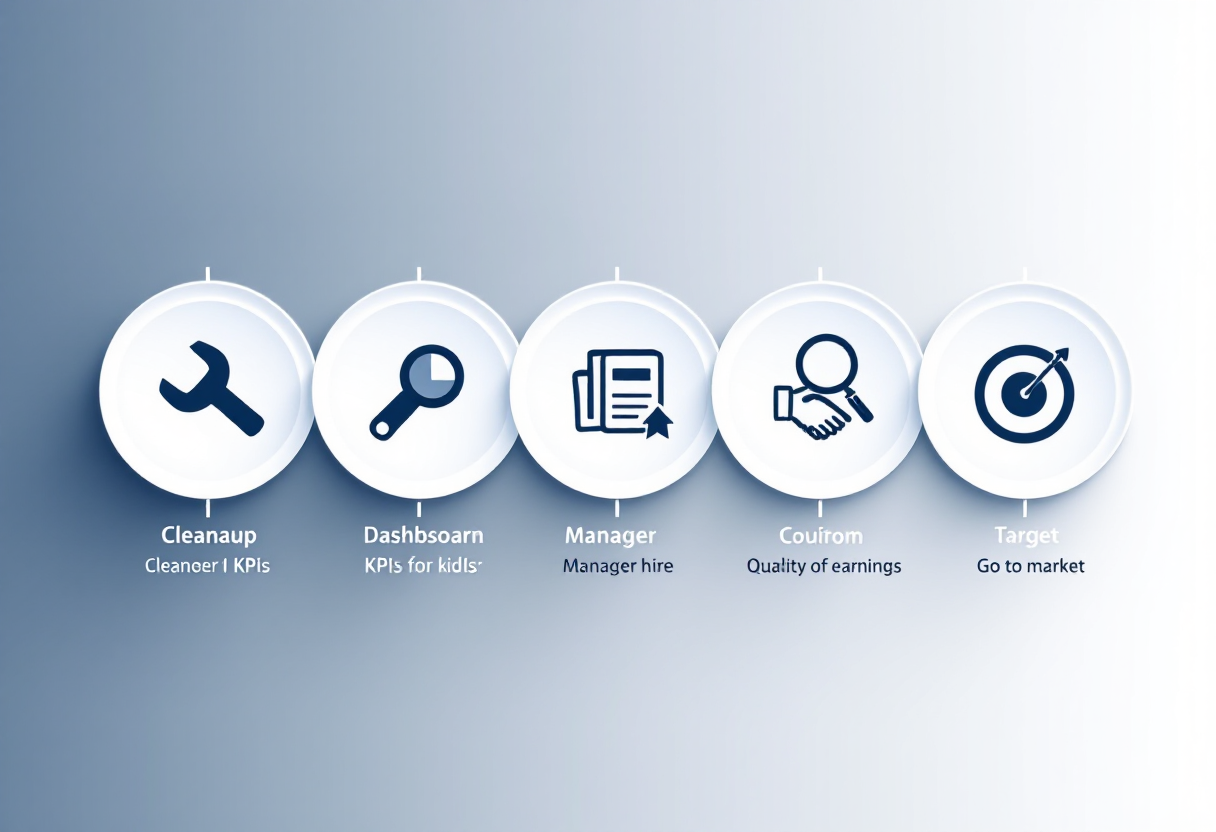
T-36 months: Cleanup phase
- Switch to accrual basis if still on cash basis
- Pick an FSM tool (Buildertrend, JobTread, or Houzz Pro) and migrate; plan 6 to 12 months for full team adoption
- Start tagging every potential EBITDA add-back as it happens
- Conduct an outside W-2/1099 audit; reclassify if needed; settle exposure now while it is small
- Restruck related-party rent to FMV with appraisal
- Build the org chart and identify the GM hire (internal promotion target or external recruit)
- Phase I ESA on any owned real estate
- Sales/use tax compliance review by outside counsel in every operating state
- OSHA fall-protection program documentation; right-size harnesses across the crew per the January 2025 PPE Fit Rule
- Begin pursuing Trex Pro Platinum and AZEK/TimberTech Platinum certifications if not already held
T-24 months: Financial discipline and KPI infrastructure
- GM hire onboarded and starting to take operational load
- Monthly close in 15 days; service-line P&L every month including new install vs. repair vs. railing vs. outdoor-living adjacencies vs. maintenance
- KPI dashboard: estimate-to-close ratio, gross margin per project, average ticket, jobs per crew per month, callback rate, designer pipeline
- Launch annual maintenance contract program if recurring revenue is under 10%
- Pricing review: 5% to 10% list increase; designer fee held
- Add material price escalator language to all new contracts
- Begin diversification of customer base if any top customer (HOA, builder) is above 15%
- Document SOPs for every operational role (sales, design, estimating, install, QC, callback)
- Build the add-back bridge as a living document
T-12 months: QoE-ready close discipline, eliminate owner dependence
- Owner steps out of daily operations; GM runs the shop
- Owner takes a 2-week unplugged vacation as the stress test
- Run the sell-side QoE ($35K to $75K budget)
- Tighten balance sheet: clean A/R; isolate customer deposits in a separate sub-ledger; track in-progress jobs with cost-to-complete; kill dormant inventory
- Final org-chart review; backfill any gaps
- Final compliance scrub (state license transferability, OSHA records, W-2/1099, sales/use tax, lien position, environmental, HOA approval records)
- Lock in 12 months of clean service-line P&L for the CIM
- Confirm Trex Pro Platinum and AZEK Platinum status; renew if approaching threshold
T-6 months: Pre-marketing prep
- Engage an M&A advisor (lower-middle-market sell-side investment bank or M&A advisory firm with home-services or specialty-contracting experience)
- Typical fee structure: $5K to $10K monthly retainer (81% of NA middle-market advisors charge monthly retainers per Divestopedia/Axial 2024-2025 Fee Guide), credited against success fee; Double Lehman scale of 10% on first $1M of enterprise value, 8% on second, 6% on third, sliding for larger deals; for $10M to $30M EBITDA deals, success fees typically 3% to 5% (M&A Community 2025; Auxo Capital Advisors Lehman calculator)
- CIM drafted from the QoE and operating model
- Teaser drafted (anonymized 1-pager)
- Buyer list finalized (starting list of 25+: Empower Brands / Archadeck corporate development for franchise growth; Valor Exterior Partners (Osceola); Renuity (Greenbriar); Leaf Home + Erie Home (Gridiron + Ares); West Shore Home (Leonard Green); Apex Service Partners (Alpine + Apollo); Founders Home Service Group (Grove Mountain); Diamond Landscaping (Kian, for luxury-adjacent); Outdoor Living Supply (Trilantic, distribution-side); PrimeSource Brands (Clearlake, product-side); Platinum Equity / Tenex Capital / ADIA outdoor-living generalists; regional remodeler PE platforms per Cherry Bekaert 2025 PE Report)
- Virtual data room populated with everything from the pre-LOI and confirmatory sections above
- Management presentation deck built and rehearsed
T-3 months: Go to market
- Teaser distributed; NDAs collected; CIMs distributed
- IOIs collected 2 to 3 weeks after CIM goes out
- Narrow to 4 to 6 finalists for management meetings
- Management meetings; LOIs solicited
- Select LOI; sign with exclusivity (typically 45 to 90 days)
- Enter confirmatory diligence; close
End-to-end from engagement to close: 9 to 12 months in a well-run process (Auxo Capital Advisors sell-side process guide 2025; Wall Street Prep sell-side primer).
Frequently Asked Questions
How long should I plan for before selling my deck building business to a private equity buyer?
The owners who get top-quartile pricing start preparing 24 to 36 months before going to market. The minimum useful prep window is 12 months because most of the high-leverage levers (lifting recurring maintenance revenue from under 5% to 15% to 25%, installing a GM, getting on Buildertrend or JobTread, running a sell-side QoE, building outdoor-living ticket lift, achieving Trex Pro Platinum or AZEK Platinum certification) need 12+ months of clean trailing-twelve-months data to be credible to a buyer. Owners who try to sell in under 6 months typically leave 15% to 30% of enterprise value on the table. For deck builders specifically, the absence of a dense PE buyer field means the prep work matters even more because each one of the 12 to 13 active platforms has to be convinced individually rather than the auction dynamic doing it for you.
What is a realistic EBITDA multiple for a $1.5M EBITDA deck building business in 2026?
For a residential project-heavy deck builder at $1.5M EBITDA in 2026, the range is roughly 3.5x to 5.5x (estimate). The bottom of that range applies to demand-only one-time-project shops with under 5% recurring revenue, owner-dependence, no manufacturer certification, fixed-price contracts with no lumber escalator, and concentrated customer base. The top applies to shops with 15%+ recurring maintenance revenue, a GM in place, Trex Pro Platinum or AZEK Platinum certification, outdoor-living ticket discipline, and customer concentration under 10%. For a deck builder at the same $1.5M EBITDA with 30%+ commercial / HOA / multi-family mix, the range shifts up to roughly 5x to 7x (estimate). Reference basis: IBBA Q4 2025 Market Pulse Survey released January 2026; Profitability Partners 2026 home services valuation report; Founders Advisors Home Services M&A Update Summer 2025; Peak Business Valuation Specialty Contracting multiples 2025. The 36-month prep playbook moves you from the bottom of the band to the top.
Do I need to get a Quality of Earnings report done before going to market?
For deck builders at $1M+ EBITDA, yes. A sell-side QoE costs $35K to $75K typical, up to $150K for complex add-back situations (Eton Venture Services 2025). The ROI is leverage. If your QoE supports a 1x multiple uplift on a $1.5M EBITDA business at a 4.5x baseline, that is $1.5M of additional sale price for a $50K investment. More importantly, a pre-market QoE surfaces deck-builder-specific issues (customer deposit and deferred revenue treatment, percent-complete accounting on jobs in backlog, lumber-pricing margin volatility on the fixed-price backlog) while you can still fix them, rather than during exclusivity when the buyer re-trades the deal by carving customer deposits out of working capital and into debt-like items.
What percentage of recurring maintenance revenue do PE buyers want to see in a deck building business?
15% to 25% recurring revenue is the threshold that meaningfully lifts the multiple. Deck builders are project-based by nature, so the recurring percentages PE looks for in deck are lower than the 40% threshold HVAC buyers want; the structural reality is that no deck builder is going to print 50%+ recurring. But the same multiplier logic applies. A documented annual wash, stain, seal, and minor repair contract base at 15% to 25% of revenue with 80%+ renewal can lift the EBITDA multiple by 0.5x to 1.5x (Profitability Partners 2026; Brentwood Growth contractor guides). On a $1.5M EBITDA shop that delta is $750K to $2.25M of additional enterprise value. The contract base itself can also trade at a 1x to 2x annual revenue premium on top.
Do I need to put a general manager in place before I sell my deck building business?
If your goal is to maximize price, yes, ideally 12+ months pre-sale. Owner-dependence is one of the largest valuation killers in construction. Peak Business Valuation reports owner dependency can knock 20% to 30% off valuation. On a $1M to $3M EBITDA deck builder, GM in place can move the multiple from the 3.5x to 4.5x band into the 5x to 6.5x band, worth $1M to $4M of price. A GM hire in the deck and remodeling sector runs $125K to $200K plus bonus and needs 12 to 18 months to fully take operational load before the buyer’s diligence team will believe the transition. The 2-week unplugged vacation stress test (owner offline for 2 weeks with the shop running normally) is the gut-check that the transition is real, not nominal.
How does the James Hardie and AZEK merger affect what my deck building business is worth?
Less than most deck-builder owners assume. The $8.75 billion James Hardie acquisition of The AZEK Company that closed July 1, 2025 reshapes the manufacturer landscape (combined $5.9B net sales, $1.8B+ adjusted EBITDA at 31% margin pro-forma incl. synergies, with $625M total synergy projection and a $500M commercial cross-sell thesis built on the fact that 55% of homeowners do deck and siding projects together). But the deal consolidates product and distribution. It does not create a new strategic acquirer that bids on installer-service businesses. Trex Company, the other public composite manufacturer, holds roughly 50% to 60% North American composite-decking market share with $1.2B in 2025 revenue, and is expanding distribution via Specialty Building Products and Weekes Forest Products in late 2025 (Trex Q4 2025 press release, February 24, 2026), but is also not acquiring installers. The practical impact for an installer-owner: the deal puts upward pressure on demand for premium composite product, which is good for shops positioned as Trex Pro Platinum or AZEK/TimberTech Platinum, but it does not add bidders to your buyer field. Your buyer field is still the multi-trade exterior platforms, regional outdoor-living roll-ups, the Archadeck franchise system, and strategic owner-operator buyers identified in the table earlier in this guide.
What to Do Next
The deck-building owners who get top-quartile multiples in 2026 all do the same handful of things. They start preparing 24 to 36 months before they want to be out. They put a GM in place 12+ months pre-sale. They build a recurring maintenance, wash, stain, and seal contract base to 15% to 25% of revenue with 80%+ renewal. They push average ticket from $15K single-deck builds into $35K to $60K outdoor-living projects with pergolas, fire features, lighting, and outdoor kitchens attached. They achieve and hold Trex Pro Platinum and AZEK/TimberTech Platinum certification. They invest in a sell-side QoE before any buyer sees a CIM.
The buyer field is shorter than HVAC’s. There is no dense field of 27 sponsor-backed platforms competing for your teaser. There are 12 to 13 multi-trade exterior platforms, regional outdoor-living roll-ups, a single national franchise consolidator (Archadeck under Empower Brands), and a handful of luxury landscape platforms with deck adjacency. That structural reality compresses multiples, which means the prep work is doing more of the heavy lifting per dollar of EBITDA than it would in a denser buyer market. If you do the prep work, the multiple lifts. If you do not, you trade at the bottom of the residential project-heavy band.
If you are 12+ months from a potential exit and want a structured pre-sale optimization roadmap, CT Acquisitions has construction-services operations specialists in our partner network who run multi-quarter prep engagements. If you are 6 to 12 months out and ready to start the sell-side process, our M&A advisory team runs the buyer outreach. No fee to you on buy-side introductions; sell-side mandates are paid on success at closing. Either way, the first 30 minutes are free.
Ready to talk?
Schedule a 30-minute exit-readiness call
Or read more: Sell Your Deck Building Business (active sale guide) | Sell Your Fencing Business | Sell Your Landscaping Business
Ready to Explore Your Options?
A 30-minute confidential conversation is all it takes.