
Investment Banking Associate: 2026 Career Guide to Comp, Work, and the Path to VP
Investment Banking Associate Career in 2026 depends on scale, sector, and recurring revenue percentage. Named PE-backed and strategic acquirers pursue this vertical actively, and multiples clear meaningful ranges depending on platform readiness and market cycle timing. This page covers the operational specifics that matter to owner-operators considering a sale.
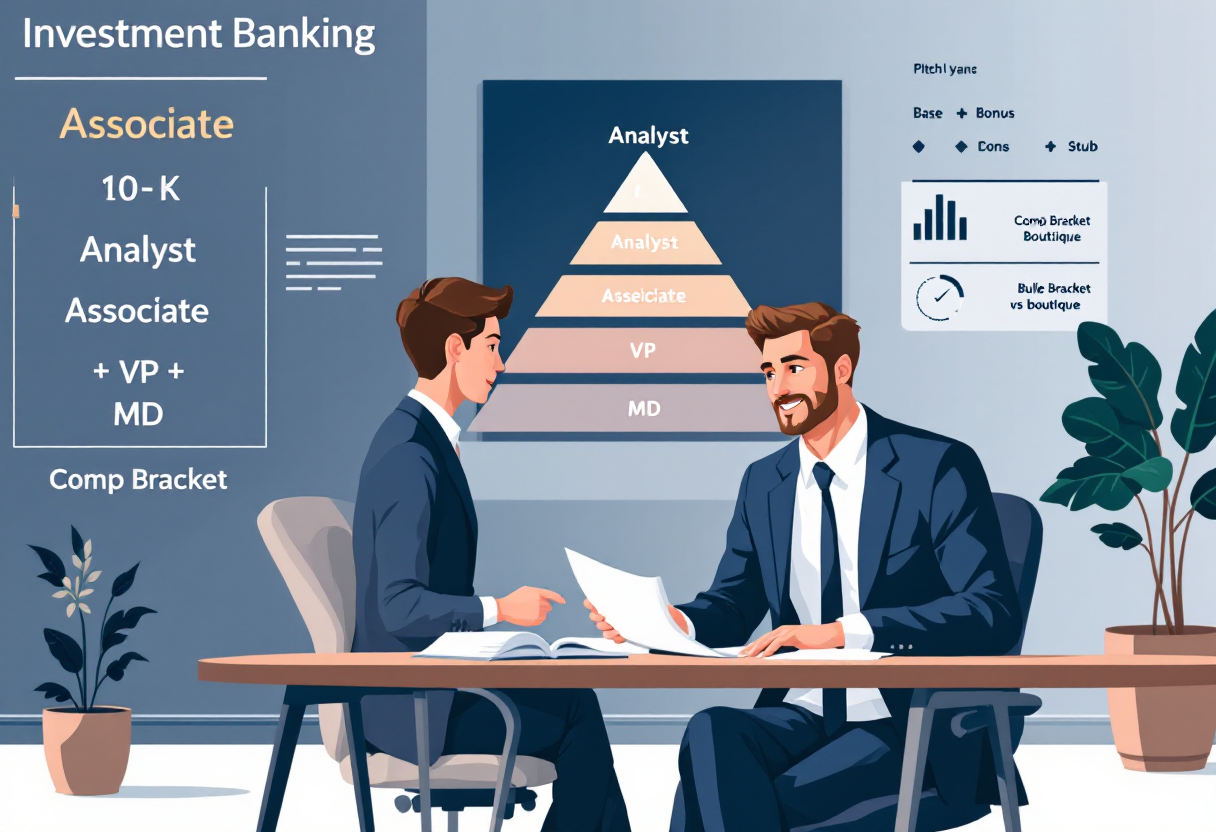
The investment banking associate sits at the most underestimated rung on Wall Street. You are one promotion above the analyst and three promotions below the managing director, which means you do enough work to feel like an analyst and carry enough responsibility to feel like a VP, often inside the same week. This guide is for the post-MBA hire reading offer letters from Goldman Sachs and Centerview, the third-year analyst weighing an A-to-A promote against a buy-side jump, and the M&A founder trying to read the room when a 28-year-old in a quarter-zip is running point on a $400 million sale. We pulled compensation numbers from Mergers & Inquisitions, Wall Street Oasis benchmarking, eFinancialCareers, and Wall Street Prep, then cross-checked against careers pages at Goldman Sachs, JPMorgan, Morgan Stanley, Evercore, Centerview, Lazard, and Moelis. What we found is uglier than the recruiting brochures and more interesting than the Reddit threads.
What an Investment Banking Associate Actually Does
An associate in investment banking is the person who turns a managing director’s voice memo into a 90-slide pitch deck by Monday morning. The investment banking associate role is the operating heart of every live deal team. They run the model, manage the analyst, edit the deck, send the data room invites, draft the management presentation, prep the CEO, take the markup from the VP, push back when the markup is wrong, and absorb the blame when something slips. They are the operating leader on the deal team. If the analyst is the engine and the VP is the steering wheel, the associate is the transmission. Nothing moves without them.
The job description for the investment banking associate role on most bulge bracket careers pages is almost comically vague. Goldman Sachs describes associates as people who “assist with the analysis and execution of mergers, acquisitions, and capital markets transactions,” which tells you nothing about the 80 hour weeks or the four AM PDF stitching. JPMorgan lists the role under its full-time post-MBA program, while Morgan Stanley calls associates “deal team leaders.” Closer to the truth: the associate is the person who learned analyst work two or three years ago, can now spot a broken sum in a comps table from across the room, and has earned just enough trust to be left alone with a client for thirty minutes.
Day to day, the associate owns three things. First, the deliverable. The pitch book, the CIM, the management presentation, the board materials, the lender package. Second, the analyst. One or two juniors who need to be staffed, taught, edited, and protected. Third, the process. Calendar, working group list, data room access, third-party reports, expert calls, regulatory clocks. The MD owns the relationship and the VP owns the framing. The associate owns the machine.
Associate vs Analyst: The Real Difference
The gap between a second-year analyst and a first-year associate is small in technical skill and enormous in expectation. A strong analyst can build an LBO model from a blank workbook. A strong associate can do the same and also explain to a chief financial officer, in plain English, why the model says what it says. That second skill is what the associate level pays for.
The work split breaks down like this. Analysts build, associates review. Analysts execute, associates direct. Analysts read the working group list, associates write it. Analysts answer the VP’s question on the call, associates anticipate it before the call. Per Mergers & Inquisitions, associates spend roughly 65 to 80 hours per week on the job, ten to fifteen percent lower than the 80 to 100 hour analyst grind, because they are no longer the last line of defense for typos at midnight. They are, however, on the hook for the analyst’s typos.
The biggest behavioral change is what happens when a senior banker asks a question on a Friday afternoon. The analyst’s job is to find the answer. The associate’s job is to decide whether the question is the right question, redirect if it is not, and then make sure the analyst delivers a clean answer by Saturday morning without burning out. That is a different job. If you want a longer comparison of buy-side and sell-side junior tracks, see our private equity analyst career guide.
Associate vs VP: The Step Up
The investment banking associate-to-VP transition is the hardest jump in the industry. Going from analyst to associate is mostly about reps and an MBA stamp. Going from associate to vice president is about whether you can sell. Per the Growth Equity Interview Guide breakdown, “most teams start to expect that Vice Presidents will have their own client relationships, meaning they have revenue responsibility.” A third-year associate who cannot show signs of becoming a rainmaker tends to plateau or leave.
The hours actually improve at VP. Per Mergers & Inquisitions career path data, VPs work 55 to 70 hours per week, ten to fifteen hours less than associates, because the work shifts from execution to project management. But the stress changes shape. The associate sweats whether the deck will be done by 8 AM. The VP sweats whether the deal will close, whether the client will hire the bank again, and whether the next CEO meeting will turn into a mandate. Wall Street Oasis threads on the promotion tell the same story over and over: the promote happens when you stop being the smartest person in the room and start being the most trusted.
One useful way to think about the difference: an associate runs a deal, a VP runs a team that runs deals, and a managing director runs a book of clients. If you cannot see yourself running clients, the VP title is a ceiling, not a step.
Two Paths to Investment Banking Associate (MBA vs Promote)
There are exactly two ways into the associate seat. You either go to a top MBA program and recruit in, or you get promoted from analyst, a track the industry calls A-to-A.
The MBA path. This is the dominant route in the United States. Per IB Interview Questions’ MBA recruiting guide, “MBA candidates recruit for Associate roles, face higher technical and behavioral expectations, and follow a compressed timeline centered on first-year fall networking and a 10-week summer internship with 70%+ return-offer rates.” The target schools are the M7 plus a handful of strong runners-up. Wharton’s 2024 MBA employment report shows financial services as the top destination, with investment banking as one of the largest sub-sectors. Harvard Business School’s recruiting data tells the same story: a meaningful percentage of every class lands in investment banking, often at the bulge brackets and elite boutiques.
The MBA recruiting timeline is brutal but predictable. Resumes go in by late fall of the first year. First-round interviews happen in January. Summer internships run ten weeks at $40,000 to $60,000 in salary plus a sign-on. Return offers go out in August. The yield on return offers at top firms regularly clears 70 percent, per M&I.
The A-to-A path. This is the analyst promote. You join a bank out of undergrad, work two or three years as an analyst, and get a direct promotion if the bank offers the track and you perform. Goldman Sachs, JPMorgan, Morgan Stanley, Bank of America, and Citi all run A-to-A pipelines, as do most of the elite boutiques. The path used to take three years and has compressed in recent cycles. Per M&I, “traditionally, it took 3 years to be promoted to Associate, but many banks have cut this time to incentivize long-term employment, so now it’s more like 2.0 or 2.5 years.”
A-to-A is cheaper than an MBA by roughly the price of an MBA, which is to say $250,000 or more in tuition and forgone wages. But it locks you into a single firm and a single group at the moment you might want to switch coverage areas. The MBA path costs more but resets your optionality. Both routes end at the same first-year associate desk. They do not end with the same network. For the buy-side equivalent of this decision, see our hedge fund vs investment bank career comparison.
2026 Investment Banking Associate Compensation: Base, Bonus, Total
This is the section everyone scrolls to. Investment banking compensation has reset twice since 2021, and the numbers below reflect mid-2026 reality at top US firms. Numbers below pull from Mergers & Inquisitions 2026 update, Wall Street Oasis benchmarking, Corporate Finance Institute, Wall Street Prep, and PrepLounge US salary data.
Base salary. First-year associates at large US banks earn $175,000 to $200,000 in base. By the third year, base climbs to $200,000 to $225,000. These numbers have moved very little since the 2022 reset and may not move again until junior comp pressure returns.
Bonus. Cash bonuses run 70 to 100 percent of base in a normal year and can clear 110 percent of base in a banner year at elite boutiques. A second-year associate at a strong bulge bracket typically takes home $150,000 to $200,000 in cash bonus. The same seat at Centerview or Perella Weinberg can clear $250,000 to $300,000 in cash bonus.
Total compensation. Total comp for US associate roles in investment banking in 2026 lands between $285,000 and $500,000, with a thick middle around $325,000 to $400,000. Third-year associates at top elite boutiques regularly clear $500,000 all-in. The Wall Street Oasis dataset shows the top decile of associate comp pushing $600,000.
Deferred compensation. About 20 to 30 percent of associate bonus dollars are deferred at most bulge brackets, vesting over two to three years in stock or restricted cash. This is the retention lever the banks pull when deal flow softens. The deferral percentage is closer to zero at the elite boutiques, which pay bonuses in cash and use the lack of golden handcuffs as a recruiting weapon.
Stub bonuses. If you start mid-year as a post-MBA hire in July or August, you get a stub bonus in your first calendar year, prorated for months worked. Stubs typically land at $35,000 to $50,000.
Comp by Firm Tier (Bulge Bracket vs Elite Boutique vs Middle Market)
Tier matters more at the associate level than at the analyst level because the bulge bracket’s training advantage has already been delivered. By year one as an associate, you are getting paid for output, not learning. Here is how the three tiers compare.
Bulge bracket. Goldman Sachs, Morgan Stanley, JPMorgan, Bank of America, and Citi. Base salaries cluster at $175,000 to $225,000 across associate years one through three. Cash bonuses typically run 80 to 95 percent of base. Total comp lands at $285,000 to $450,000. Deferral percentages on bonus are 20 to 30 percent. Brand on the resume is the strongest in the industry. The eFinancialCareers compensation tracker publishes year-end numbers each January.
Elite boutique. Evercore, Centerview, Lazard, Moelis, PJT Partners, Perella Weinberg Partners, Guggenheim Securities, Qatalyst. Base salaries are similar to bulge bracket. Bonuses run 90 to 120 percent of base in good years. Cash percentage is closer to 100 percent. M&I’s 2026 update notes that elite boutique associates earn “$50,000 to $100,000 plus more than the bulge bracket range” with bonuses paid “in 100 percent cash.” Total comp at the top firms regularly clears $500,000 for third-year associates. The deal exposure is narrower (mostly M&A and restructuring, less capital markets) but deeper. Our guide to boutique investment banks walks through how to think about this tradeoff.
Middle market. Houlihan Lokey, Lincoln International, Harris Williams, William Blair, Raymond James, Piper Sandler, Stifel, Solomon Partners, Baird, Jefferies (often slotted between MM and BB). Base salaries are $150,000 to $200,000 with bonuses running 60 to 90 percent. Total comp lands at $250,000 to $400,000, ten to twenty percent below bulge bracket per CFI. Promotion timelines tend to be shorter and client exposure earlier. The eFinancialCareers tracker notes that middle market firms increasingly compete with bulge brackets on cash bonus, even if base lags.
Regional and lower middle market. Below the named middle market shops sit hundreds of regional and lower middle market banks doing $25 million to $250 million enterprise value deals. Total comp for associates here runs $180,000 to $300,000, with the upside coming from shorter hours, faster promotion, and equity participation at some independent firms. See our M&A advisory firms how-to-choose guide for context on this tier.
A Day in the Life: From Pitch Book to Investment Committee
Here is what a Tuesday looks like for a second-year investment banking associate in a generalist M&A group at a bulge bracket. Times are approximate and pulled from M&I’s day in the life writeup, cross-checked against Wall Street Oasis threads and our own conversations with sell-side bankers covering the lower middle market.
8:30 AM. Read overnight email. Check on the analyst’s pitch book progress from last night. Review three model edits the analyst pushed at 2 AM. Spot two broken links. Send a polite Slack message that the analyst will read as not polite.
9:30 AM. Internal deal team call on the live M&A process. VP runs the agenda. Associate takes notes, gives an update on the working group list and the data room, and flags that the buyer’s diligence requests are sliding the timeline.
10:30 AM. Client call with the chief financial officer of the seller. VP and MD lead. Associate is on mute, taking notes, queueing up the next exhibit in the presentation. The CFO asks a question about working capital normalization. Associate slides a Slack message to the VP with the number.
11:30 AM. Edit the management presentation. Push a draft to the VP for markup. Field a request from the MD for a “quick” comps table on three new comparables. The “quick” request consumes the next four hours.
1:30 PM. Lunch at desk. Salad. Diet Coke. Re-read the latest buyer NDA tracker. Email the analyst with a redlined data room access list.
2:30 PM. Investment committee prep call with the bank’s internal capital commitments group. Associate walks the committee through deal economics, key risks, and the fee proposal. This is the first call where the associate is actually leading and being judged on it.
4:00 PM. New pitch staffing. MD wants a “quick pitch” for a CEO meeting Friday. Associate kicks off the pitch with the analyst, sets the deck outline, picks the comps, drafts the football field valuation methodology.
7:00 PM. Dinner at desk. Curry. Diet Coke.
8:00 PM. VP markup of the management presentation lands. Forty-three pages of redlines. Most are tone. A handful are real. Associate sends an email to the analyst with priorities and a 6 AM deliverable time.
10:30 PM. Final read of the CIM draft for the live deal. CIM goes to the client tomorrow. Associate makes seven changes, sends the markup to the VP, packs up.
11:30 PM. Home. Set alarm for 6:30 AM. Sleep.
That is 65 hours a week if every day looks like Tuesday. Most weeks have a bad day where it stretches to 16 or 17 hours. For more on the CIM specifically, our CIM in investment banking guide walks through the document the associate is editing at 10:30 PM.
The Three Skills Associates Must Master
If the analyst’s job in investment banking is to be technically perfect, the associate’s job is to be reliably useful in three different domains at once. Here are the three skills that separate associates who get promoted from associates who get pushed.
Skill one: writing clearly under time pressure. An associate writes more than any other rung in the bank. CIMs, management presentations, internal memos, lender package narratives, fairness opinion drafts, board materials, working group emails, weekly status updates. The reps that matter are not the pretty ones. They are the rough first drafts at 9 PM when a managing director wants something to read on the flight tomorrow. The associate who writes a 60 percent draft in 90 minutes will get more reps than the one who writes a 95 percent draft in eight hours, because the first one gets read and edited and the second one never gets seen.
Skill two: modeling without supervision. Associates do not build models the way analysts build models. They edit, audit, and direct. But they need to be able to drop into the model at 11 PM on a Sunday when the analyst is stuck, fix the broken net debt bridge, and re-run the sensitivity. Modeling as an associate is a survival skill, not a production skill.
Skill three: managing up. Every associate has multiple senior bankers staffing them simultaneously. Three live deals, two pitches, one annual review prep, a side project from the MD’s coverage senior. Each senior thinks their request is the priority. The associate who survives is the one who tells the analyst the right priority order, pushes back when the MDs ask for the same thing two different ways, and surfaces conflicts to the VP before they become fires. Per WSO promotion threads, the associates who make VP in three or four years are almost always the ones who managed up well, not the ones with the cleanest models.
Managing Analysts: The Leadership Transition
The first hard lesson of associate year one is that you are now responsible for someone else’s work. The analyst you are staffed with is a year or two younger than you and almost certainly went to a similar school and has a similar resume. You have to lead them anyway.
The good associates run a simple playbook. Set expectations on the first call. Be explicit about the deliverable, the deadline, and the format. Review work in person or on video, not in markup. Give feedback in the moment, not at performance review. Protect the analyst from the senior banker who keeps changing the brief at midnight. Push back on bad asks before the analyst sees them.
The bad associates do the opposite. They forward a senior banker’s email to the analyst with “please handle.” They mark up work without explanation. They take credit for the wins and blame the analyst for the misses. The analyst notices. The VP notices. The reputation builds. By year three, the bad associate has zero analysts who want to be staffed with them and a VP who has heard enough to slow down their promotion.
Per Growth Equity Interview Guide’s career path breakdown, the associate-to-VP promote depends heavily on whether you have built “the people skills to manage teams and the judgment to be trusted in front of clients.” The first half of that sentence is built in associate year one and year two, on the back of how you treat your analysts.
Client-Facing Work: When Associates Get In Front of CFOs
Associates do not run client meetings. They support them, prep for them, and over time take ownership of specific moments inside them. The progression looks like this.
Year one: the associate is on mute, taking notes, queueing exhibits. They send Slack messages to the VP with the right number when the CFO asks a working capital question.
Year two: the associate runs the working group call. They walk the buyer’s diligence team through the data room structure. They run the management presentation prep with the seller’s CFO. They are the bank’s first point of contact for the buyer’s analyst.
Year three: the investment banking associate runs the calendar with the seller and pre-briefs the management presentation. They handle the lender call. They negotiate small points in the purchase agreement working draft. The MD still owns the relationship, the VP still owns the framing, but the associate is now visible to the client as a name and a face, not a deck.
For an associate working a sell-side mandate, the moment you have arrived is when the seller’s CEO calls your cell phone with a question instead of calling the MD. That call is the first signal that you are becoming a banker. Our guide on the investment banking process for selling a company walks through the milestones where the associate’s client visibility actually compounds.
The 3-Year Track to VP
Most US bulge brackets and elite boutiques promote associates to vice president after three to three and a half years on the desk. Per M&I career path and Wall Street Oasis, the typical track looks like this.
Year one. Learn the bank’s templates. Pick up two or three live deals. Build a reputation for clean work, fast turnaround, and being someone the analyst is glad to be staffed with. Find one or two senior bankers who will sponsor you.
Year two. Take ownership of a deal end-to-end with the VP and MD. Run the working group, the diligence, the model. Take the markup pen on the CIM. Get visible internally on at least one big mandate. Show signs of judgment, not just execution.
Year three. Start carrying coverage. Pitch new clients. Lead an internal pitch effort without VP hand-holding. Show that you can hold a client meeting on your own for thirty minutes without producing a problem. Get the promote conversation with your senior sponsor.
Year three and a half. Promote to VP, or move firms to get the title. Banks rarely let strong associates walk to a lateral VP role at a competitor, so the cleaner path is internal promotion. If the bank passes, lateral. LinkedIn Top Companies Finance list tracks the firms with the strongest internal promotion rates.
Some banks compress the track. Centerview is famous for promoting in three years flat. eFinancialCareers reporting on bank-by-bank promotion rates shows that the firms with the highest VP promotion percentages tend to be the boutiques where the deal flow is concentrated and the senior bankers are paying attention.
Common Exit Opportunities for Associates
The exit landscape narrows from investment banking analyst to investment banking associate. Per M&I, headhunters do not court associates the way they court analysts. On-cycle private equity recruiting is built for second-year analysts. By the time you are an associate, the megafunds have already filled their pipeline.
the exits are real. Here is what associates actually do when they leave.
Private equity (off-cycle). Middle market and growth equity funds hire associates off-cycle, typically as senior associates or vice presidents. The skill set translates well for groups that need someone who can run a sell-side process from the buy-side. Pay is competitive with the bank base, with carry making up for lower cash bonus. Our private equity analyst career guide walks through the buy-side track and how the associate exit slots in.
Corporate development. Strategic acquirers, especially in tech and healthcare, hire associates into corp dev roles with titles like Manager or Senior Manager of Strategy and Corporate Development. Base salaries are $150,000 to $200,000, total comp $250,000 to $400,000, hours 50 to 60 per week, with company stock potentially worth multiples of base over a vest.
Growth equity. Funds like General Atlantic, Insight Partners, and Summit Partners hire associates with sell-side process experience. The pay is similar to PE megafund pay for the first two years, with carry meaningful by year three.
Hedge funds. Most fundamental long-short funds prefer analysts. Some event-driven, distressed, and special situations funds will hire associates who covered restructuring or specific sectors like financial institutions, energy, or healthcare. The pay range is the widest of any exit option.
Industry operating roles. CFO and VP of Finance roles at venture-backed companies. The pay is lower in cash but higher in equity upside.
Stay and promote. The under-discussed exit. About a third of associates at top banks stay through to VP, and a smaller share to MD. The economics of staying through VP are competitive with any buy-side exit, especially if the bank’s bonus pool is strong.
Associates at Lower-Middle-Market Firms vs Bulge Bracket
The investment banking associate experience varies more by firm than the analyst experience does. A first-year associate at Goldman Sachs has a different day than a first-year associate at a 25-person sell-side advisory firm in Chicago, even if both are technically running M&A processes.
At the bulge bracket, the associate sees fewer deals per year (three to five live mandates) but bigger ones ($500 million to $5 billion plus). The deals are heavily intermediated. There are co-advisors, separate legal teams, lender syndicates, regulatory review, and quarterly investment committee approvals. The associate’s job is to keep the machine moving. The brand on the resume is decisive. The exit options are the broadest in the industry.
At the lower middle market firm, the associate sees more deals per year (eight to fifteen live mandates) but smaller ones ($25 million to $250 million). The deals are lighter on process, heavier on hands-on work with the founder. The associate often runs the buyer outreach themselves, writes the CIM start to finish, sits in on the management meeting with the founder and the buyer, and helps negotiate the LOI. The brand on the resume is weaker. The exit options skew toward operating roles at portfolio companies, in-house corp dev, and middle market PE.
Both seats produce real bankers. The bulge bracket seat produces faster on the institutional side. The lower middle market seat produces faster on the founder-facing side. CFOs and founders who are selling their first business will often tell you the lower middle market associate is the one they trust, because the lower middle market associate is the one who actually answered the phone on a Saturday.
How CT Acquisitions Sees Investment Banking Associate Coverage
CT Acquisitions runs sell-side processes for lower middle market and middle market businesses with enterprise values from $5 million to $500 million. We see associates across the table on roughly half of our deals. Here is what we have learned from sitting across from them.
The bulge bracket associate is technically clean and procedurally rigorous. They run a tight process. The buyer list is comprehensive, the data room is well-organized, the management presentation is polished. Their weakness is that on a $40 million deal, the process is overbuilt. They will push a founder through a four-month process when the right answer was a six-week confidential negotiation with two strategics.
The elite boutique associate is the closest match for institutional founders selling premium assets. They are senior-attended on every meaningful interaction, they pick up the phone, and their analyst output is excellent. The fee economics only make sense above roughly $100 million in deal value, but on those deals they execute at a high level.
The middle market associate is often the best fit for the $20 million to $200 million sale. They have seen enough founder-led businesses to know how to handle a working capital normalization conversation without making the seller feel like a hostage. Their lender relationships are real. Their post-LOI execution is reliable.
The lower middle market associate is the partner you want on a $5 million to $25 million sale, especially when the seller has never sold a business before. The associate does the work themselves, returns calls within hours, and treats the founder like a client instead of a data point.
When a founder asks us which tier of bank to hire, we point them to our M&A advisory firms how-to-choose guide and our boutique investment banks explainer. The right answer depends on deal size, industry, and the founder’s tolerance for process. The associate is the day-to-day face of whichever firm gets picked, so it pays to ask in the pitch meeting which associate will be staffed and whether they will be available when the deal gets ugly.
For founders specifically considering coverage from a financial institutions group, our FIG investment banking guide walks through how sector specialist investment banking associates work. For those weighing buy-side versus sell-side career tracks, our companion guide to investment banking as a career goes deeper on the long-arc tradeoffs. And for context on the compliance and oversight side of investment banking, the Association of Government Accountants publishes useful reference material on how investment banking transactions intersect with federal financial reporting standards.
Investment Banking Associate: Frequently Asked Questions
How much does an investment banking associate make in 2026?
Total compensation for a US associate in investment banking in 2026 lands between $285,000 and $500,000, with a thick middle around $325,000 to $400,000. Base salary runs $175,000 to $225,000 across years one through three, with cash bonuses of 70 to 100 percent of base. Top performers at elite boutiques like Centerview and Perella Weinberg regularly clear $500,000 to $600,000 all-in.
What does an investment banking associate actually do?
The associate is the operating leader on a deal team in investment banking. They own three things: the deliverable (pitch books, CIMs, management presentations), the analyst (staffing, editing, mentoring), and the process (working group lists, data rooms, calendar). They report to a vice president and a managing director, and they typically work 65 to 80 hours per week.
How long does it take to be promoted from associate to VP?
The standard promotion track at US bulge brackets and elite boutiques is three to three and a half years. Some firms like Centerview promote in three years flat. Most associates who do not get promoted by year four either move firms for the title or exit to the buy-side or corporate development.
Do I need an MBA to be an investment banking associate?
No. Banks run two paths: post-MBA hiring from top programs (Wharton, HBS, Booth, Kellogg, Stanford, Columbia, MIT) and A-to-A direct promotion from analyst. A-to-A typically takes two to three years on the analyst desk. The MBA path costs more in tuition and forgone wages but resets your group and firm optionality.
Which firms pay investment banking associates the most?
Elite boutiques pay the highest total cash compensation for associates. Centerview, Perella Weinberg Partners, Evercore, Moelis, and PJT Partners regularly outpay bulge brackets by $50,000 to $100,000 in cash bonus. Bulge brackets like Goldman Sachs, Morgan Stanley, and JPMorgan offer comparable base but defer a larger share of bonus in stock.
What is the difference between an analyst and an associate?
An analyst builds models, makes slides, and answers questions. An associate edits the model, owns the slide deck, decides whether the question is the right question, and manages the analyst. The pay roughly doubles between the two levels and the hours drop by ten to fifteen percent.
What are the exit opportunities for investment banking associates?
Off-cycle private equity, growth equity, corporate development, hedge funds (selectively), industry operating roles like CFO or VP of Finance at venture-backed companies, and internal promotion to VP. The buy-side exits are narrower than they are for analysts because on-cycle PE recruiting targets second-year analysts.
How many hours does an investment banking associate work?
Per M&I and corroborating Wall Street Oasis threads, US associates work 65 to 80 hours per week. Capital markets groups (equity capital markets, debt capital markets, lev fin) tend to be ten to fifteen percent lower. M&A and restructuring tend to be at the top of the range during live mandates.
Is investment banking associate a good job?
For a 28 to 35 year old who wants to learn how complex transactions work, get paid $300,000 to $500,000, and keep optionality for buy-side, corporate, or operating roles, yes. For a 28 to 35 year old who values weekends, sleep, or autonomy over money and skills, no. The job is a high-cost, high-reward seat. Per the BLS Occupational Outlook for Financial Analysts, the broader financial analyst category projects steady growth and median pay around $99,890, well below front-office investment banking associate comp. The BLS data on Securities, Commodities, and Financial Services Sales Agents shows similar gaps versus front-office investment banking pay.
What is the path from associate to managing director?
Associate (years one through three) to vice president (years four through seven) to director or senior vice president (years eight through ten) to managing director (year ten plus). About one in ten associates makes it to MD at the same bank. The rest either lateral, exit to the buy-side, or step out to operating roles. The MD title is roughly fifteen years out from the first associate seat, depending on bank and group.
The bottom line. The IB associate seat is the highest-return role in finance for someone in their late twenties who wants real skills, real money, and real optionality. It is also, in any given week, one of the worst jobs in finance. The hours are long, the work is repetitive, and the analyst you are managing went to a better school than you. The associates who thrive treat the seat as a three-year apprenticeship in writing, modeling, and judgment, not as a five-year prison sentence. They cash in that apprenticeship to either ride the track to VP or to slingshot out to the buy-side or corporate development with the resume and the network that nothing else in investment banking can match.
If you are reading this trying to decide whether to take the MBA seat at Centerview or the lateral seat at a middle market firm in Chicago, the answer is almost always the firm where you will get the best reps with the best people. The brand matters less than the sponsor. The total comp matters less than what the comp says about how the firm values its associates. The hours matter less than whether the work is honest. Pick the seat where you will be a real banker in three years. The rest figures itself out.
For the buy-side equivalent of this analysis, see our private equity analyst career guide. For the long-arc career view, see our why investment banking as a career guide. For founders considering which bank to hire on a sale, our M&A advisory firms how-to-choose guide and boutique investment banks explained will save you a quarter and a fee point. For sector-specific paths, our FIG investment banking guide walks through coverage of financial institutions. And for those comparing the IB path to public markets careers, our hedge fund vs investment bank career comparison sets the two side by side.