How to Sell Your Restaurant Business Tax Implications: A Line-by-Line Guide (2026)
Understanding how to sell your restaurant business tax implications starts with one ugly number: on a $2M California restaurant sale, the all-in federal and state tax bill routinely lands between $700K and $850K, an effective rate north of 40% that catches almost every owner by surprise. The reason is not the headline capital gains rate. The reason is that a restaurant is the worst possible mix of asset classes from a tax perspective, with heavy Section 1245 depreciation recapture on kitchen equipment, ordinary-income inventory, a liquor license that lives in its own intangible bucket, and (in roughly 15% of cases) C-corp double-tax exposure on top of all of it. Owners who walk through the IRC Section 1060 allocation early, before the letter of intent is signed, regularly cut that bill by 20% to 35% through residency planning, installment structuring, and asset-allocation negotiation.
Sell smart, keep more.
CT Acquisitions builds the tax strategy into the LOI, not after. No fee to you on buy-side introductions; sell-side mandates are paid on success at closing. Free consultation, no obligation.
Book a Free ConsultationWhat This Actually Means
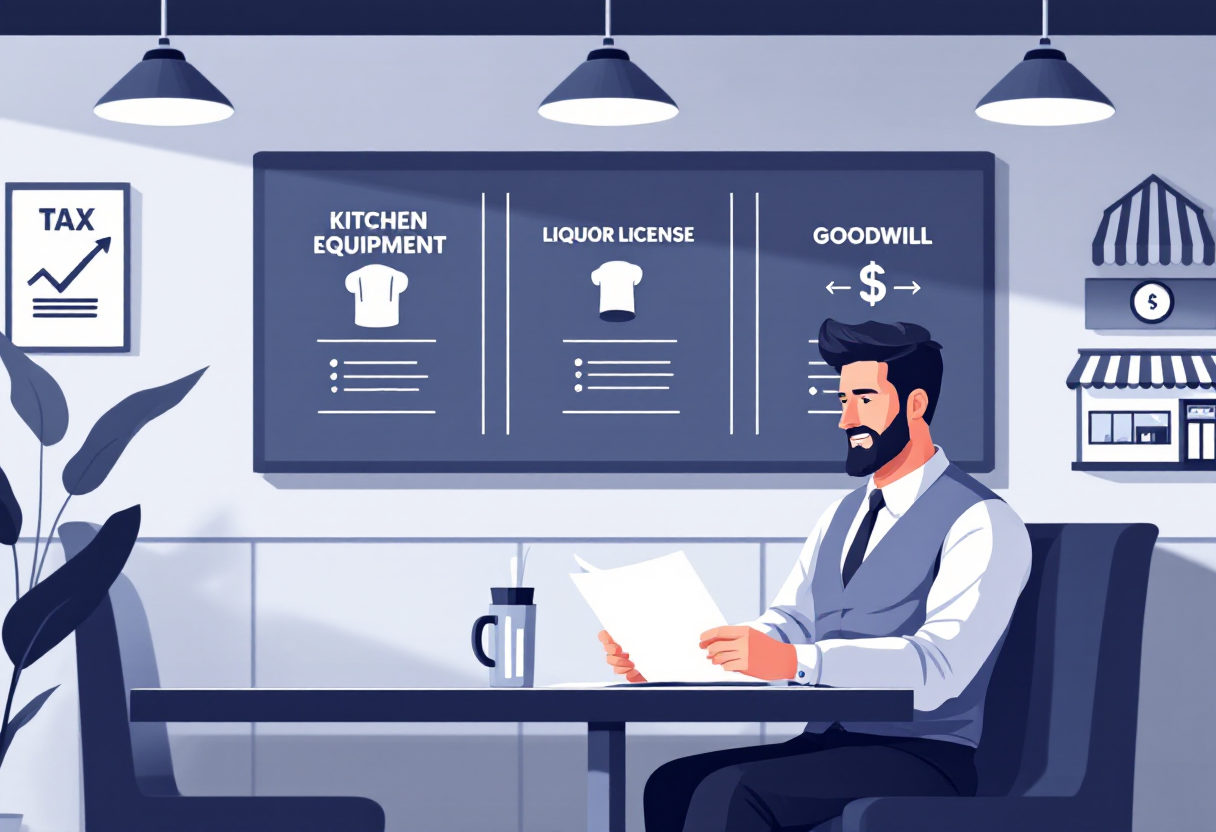
A restaurant sale is almost always structured as an asset sale, regardless of the seller’s entity type. Buyers refuse to inherit lease assignments, liquor license risk, employee tax history, and pending health-department complaints by acquiring stock or membership interests. That means IRC Section 1060 governs the allocation of the purchase price across the seven asset classes on Form 8594, and each bucket gets a different tax rate. Equipment recapture is taxed at ordinary rates up to 37%. Inventory is ordinary. Goodwill and the liquor license are long-term capital gain at 20%. Working capital is ordinary. Leasehold improvements get pulled into Section 1245 recapture just like equipment. The seller’s job is to push as much of the price into the capital-gains buckets as the appraisal will support.
The second wrinkle is entity type. About 85% of US restaurants operate as S-corps or LLCs taxed as partnerships, which means a single layer of tax at the owner level (per IRS SOI 2024 entity data and National Restaurant Association 2026 industry data). The remaining 15% are C-corps, where an asset sale triggers tax at the corporate level on the gain, then a second layer of tax when the after-tax proceeds are distributed to shareholders. C-corp restaurants are the ones most likely to consider a Section 338(h)(10) election, though the buyer almost never wants that risk for a small restaurant deal and the math rarely supports it. For S-corps and LLCs, the gain flows through to the owner’s personal return on Schedule K-1, taxed once at the federal and state level.
The third wrinkle is the cash problem. Restaurants are notoriously cash-intensive, and the diligence process exists in large part to verify that reported revenue reconciles with bank deposits, POS settlement reports, sales tax returns, and the general ledger. A sell-side Quality of Earnings (QoE) review that catches a 5% understatement of cash sales (intentional or otherwise) will either kill the deal outright or force a price reduction equal to several years of the under-reported cash. Owners who suppressed cash deposits to reduce sales tax or income tax in prior years face a binary choice at sale: come clean with amended returns and pay the back tax with penalties, or walk away from the deal. There is no middle path.
The Six Things You Need to Understand
1. Asset Allocation Under Section 1060: The Whole Game
Current state: The buyer and seller have agreed on a headline price (say $2M) and the deal is structured as an asset sale. Target state: File Form 8594 with an allocation that maximizes the capital-gain buckets (goodwill, liquor license) and minimizes the ordinary-income buckets (working capital, inventory, equipment recapture). Impact: Moving $200K of value from Class V equipment (37% ordinary recapture) to Class VII goodwill (20% LTCG) saves $34K of federal tax plus whatever state delta applies.
The default allocation for a $1M independent restaurant looks roughly like this: equipment $200K, liquor license $100K, goodwill $400K, leasehold improvements $150K, working capital $100K, inventory $50K. Of that $200K of equipment, roughly $150K is prior accumulated depreciation that gets recaptured as ordinary income under Section 1245. Of the $150K of leasehold improvements, the entire amount is typically Section 1245 recapture because qualified improvement property (QIP) was made 15-year property eligible for 100% bonus depreciation under the CARES Act technical fix, meaning most active restaurants have already deducted the full leasehold basis. The seller’s negotiating room is in the goodwill and liquor-license valuations, both of which require defensible appraisal support to survive IRS scrutiny.
Under Section 1060, the buyer and seller are required to use the same allocation on their respective Forms 8594. The IRS cross-references both filings; a mismatch flags both returns. The buyer wants more in equipment (5-year MACRS depreciation, fast tax shield). The seller wants more in goodwill (15-year Section 197 amortization on the buyer side, capital gains rate on the seller side). Sophisticated sellers commission a pre-LOI valuation from a restaurant-specialty appraiser to support a goodwill-heavy allocation, which the buyer can then defend on audit.
2. Section 1245 Depreciation Recapture on Kitchen Equipment
Current state: The restaurant has been operating for at least three years and the kitchen equipment is fully or near-fully depreciated on the tax books. Target state: Calculate Section 1245 recapture exposure before signing the LOI and bake the ordinary-income tax cost into the after-tax net-proceeds model. Impact: Equipment that has been depreciated from $200K original basis down to $50K book value, sold for $200K, generates $150K of Section 1245 recapture taxed as ordinary income (up to 37% federal plus state), not capital gain. On a typical kitchen, this is $50K to $80K of federal tax that owners forget to model.
Kitchen equipment is 5-year property under MACRS for tax purposes (commercial cooking equipment, walk-in coolers, dishwashers, ranges, ovens), and qualified restaurant improvements made before 2018 were 15-year property with bonus depreciation eligibility. The combination of accelerated depreciation and bonus depreciation under the Tax Cuts and Jobs Act means that almost every restaurant in operation for three or more years has fully written off its equipment for tax purposes. At sale, the full sale price of the equipment becomes Section 1245 recapture up to the amount of prior depreciation taken. Only the excess (if any) of sale price over original basis is treated as Section 1231 gain eligible for long-term capital gain treatment.
The same rule applies to leasehold improvements, refrigeration build-outs, HVAC modifications, and bar fixtures. Because qualified improvement property has been treated as 15-year property with 100% bonus depreciation eligibility for tax years 2018 through 2022 (phased down to 80% in 2023, 60% in 2024, 40% in 2025, and 20% in 2026 under the TCJA sunset schedule), the leasehold improvements bucket on most established restaurants is fully recaptured. Sellers who installed expensive build-outs in 2018 to 2020 and took 100% bonus depreciation now face the full recapture on sale.
3. The Liquor License: A Unique Restaurant Asset
Current state: The restaurant holds a transferable on-premises liquor license issued by the state Alcoholic Beverage Control (ABC) authority. Target state: Allocate fair market value of the license separately from goodwill on Form 8594, supported by a recent transfer comparable from the same state and license class. Impact: The license is treated as a Section 197 intangible amortized over 15 years on the buyer’s books, and as long-term capital gain to the seller. In high-quota states (California, New York, New Jersey, Massachusetts, Pennsylvania, Florida), the license can be worth $50K to $500K and represents a meaningful chunk of the capital-gain bucket.
Liquor license values vary wildly by state because each state runs its own quota system. California Type 47 full-on-sale licenses in quota counties have traded at $150K to $400K on the secondary market per California ABC transfer records 2024 and 2025. New Jersey plenary retail consumption licenses in high-density municipalities have crossed $1M on transfer. Pennsylvania restaurant licenses (R) in Allegheny and Philadelphia counties have ranged $150K to $300K. Florida quota beverage licenses (4COP) in Miami-Dade have traded $200K to $400K. Massachusetts all-alcohol licenses in Boston and Cambridge are quota-restricted and have transferred at $400K and above. New York full liquor licenses in Manhattan and Brooklyn carry secondary-market values of $100K to $300K depending on neighborhood and SLA backlog.
Two operational points matter at sale. First, the license does not automatically transfer with the asset sale; the buyer files a transfer application with the state ABC and approval typically takes 30 to 120 days depending on jurisdiction. Most deals close with the seller holding the license in escrow under a management agreement until the buyer’s new license issues, which means the seller carries license-holder liability for two to four months post-close. Second, the seller’s tax basis in the license is usually $0 if it was self-issued at original opening, or the original transfer-purchase price if acquired secondhand. The full sale-price allocation is long-term capital gain.
4. Real Estate: A Separate Sale Inside the Sale
Current state: The owner holds the real estate (land and building) personally or in a separate LLC outside the operating entity, and the buyer is willing to acquire the real estate as part of the transaction. Target state: Structure the real estate purchase as a separate transaction with its own appraisal, its own closing, and its own tax treatment. Impact: Land is pure long-term capital gain (20% federal max). Building is Section 1250 unrecaptured gain on prior depreciation, taxed at 25% federal max, plus regular LTCG on any excess. Typical restaurant real estate value: $300K to $500K for a single-unit suburban location, $800K to $2M for an urban or trade-area location. On the tax side, see our breakdown of Seller Financing Tax Implications & Structure for the structural choices that change after-tax proceeds.
The reason to keep real estate separate from operations is twofold. First, the rate stack is different: land never depreciates, so land gain is straight 20% LTCG with no recapture. Building gain is subject to Section 1250 unrecaptured depreciation, which sits at a 25% federal maximum (not the ordinary 37%), making real estate gain meaningfully lower-taxed than equipment gain even though both involve recapture concepts. Second, real estate can be 1031-exchanged into replacement investment property under Section 1031, deferring the entire gain indefinitely if the seller wants to roll into a triple-net lease elsewhere. Operating assets cannot be 1031-exchanged after the TCJA narrowed Section 1031 to real property only. On the tax side, our deeper look at asset sale vs. stock sale tax implications covers the structural choices that change after-tax proceeds.
The structural mistake owners make is putting the real estate inside the operating LLC. When that happens, the entire enterprise sells as one transaction with one allocation, and the building gain ends up taxed alongside the equipment gain at the seller’s personal rate. The fix (if the owner has time before sale) is to drop the real estate out of the operating entity into a separate LLC well before any sale discussion begins, with proper documentation that establishes economic substance and avoids the step-transaction doctrine. This planning move requires 18 to 24 months of separation to be defensible.
5. Franchise Considerations: If You’re Selling a Franchisee Location
Current state: The owner is a franchisee of a national brand (McDonald’s, Subway, Applebee’s, Chick-fil-A, Domino’s, Five Guys) and wants to sell the franchised location. Target state: Obtain franchisor approval, pay the transfer fee, and structure the sale so the transfer fee is a deductible expense to the seller. Impact: Franchise transfer fees range $25K to $150K depending on the brand. The fee is paid by the seller in most franchise systems and is deductible as an ordinary business expense in the year of sale, offsetting other ordinary income (recapture, inventory, working capital).
Franchise transfers are subject to franchisor approval, which is not automatic. The franchisor reviews the buyer’s net worth, operating experience, and (in some systems) requires the buyer to attend brand training of 4 to 12 weeks before closing. Some franchisors have right of first refusal (ROFR) on any sale, which means they can match the third-party offer and take the location themselves at the negotiated price. ROFR provisions extend the deal timeline by 30 to 60 days. Sellers should review the Franchise Disclosure Document (FDD) and the franchise agreement well before going to market to confirm the transfer-fee amount, the approval criteria, and any ROFR triggers.
The franchise location itself is governed by the same Section 1060 allocation analysis as an independent restaurant, with two additional intangibles to consider: the value of the unexpired term of the franchise agreement (a Section 197 intangible to the buyer, capital gain to the seller) and any prepaid royalties or marketing-fund balances (which roll into working capital). The franchisor’s required transfer fee is typically not a Section 197 intangible to the buyer; it is a current-period operating expense.
6. State Tax: Where the Deal Closes Matters As Much As How It Closes
Current state: The owner is a resident of a high-tax state and the restaurant operates in that same state. Target state: Plan state residency for the calendar year of close, complete a sell-side state tax compliance review for sales tax, payroll tax, and use tax exposure, and structure the deal to minimize state-level apportionment of the gain. Impact: California (13.3%), New York (10.9%), New Jersey (10.75%), Oregon (9.9%), and Minnesota (9.85%) all tax restaurant sale gains at the seller’s personal rate per Tax Foundation 2026 state rate data. A pre-sale move to Florida, Texas, or Nevada eliminates the state layer entirely on the personal-rate portion of the gain.
State residency for an active business owner is more contestable than for a passive seller. The state where the restaurant operates retains source-based jurisdiction over the gain attributable to property located in that state (the building, the equipment, the license), so a California restaurant sold by a now-Florida resident still owes California tax on the California-sourced portion of the gain. Pure goodwill and pure intangibles can sometimes be apportioned to the new state of residency, but the rules are aggressive and the Franchise Tax Board and New York Department of Taxation and Finance both audit departing high-net-worth sellers carefully. The full benefit of residency planning lands when the seller relocates 18 months or more before the close, sells or rents the prior-state house, and rebuilds physical presence in the new state.
State sales tax and payroll tax compliance carries its own risk at sale. Buyers require seller indemnification for sales tax under-payments, untaxed catering revenue, and worker-classification exposure on tipped employees. State-specific items to clean up before going to market: New York tip-credit reconciliation under the Hospitality Industry Wage Order, California PAGA and tip-pool compliance under Labor Code Section 351, Illinois Retailers Occupation Tax filings, and Texas mixed-beverage tax (8.25% on alcohol sold for on-premises consumption, reported on Form 67-100). Bulk sale notification rules in California, New York, New Jersey, and a handful of other states require the buyer to notify the state taxing authority before close, and failure to do so makes the buyer secondarily liable for the seller’s unpaid sales and use tax.
The Federal Tax Stack on a Restaurant Sale
Before walking through the worked example, it helps to see the full federal rate stack that applies to a restaurant deal. There are five separate federal rate buckets that fire in different combinations depending on the asset allocation, and the seller’s effective rate is a weighted blend across the buckets. The Tax Foundation 2026 federal rate report and IRS Publication 544 cover the underlying mechanics; the table below summarizes the rates as they apply specifically to a restaurant sale.
| Tax Bucket | Federal Rate (max) | Applies To (Restaurant Assets) | Section Cite |
|---|---|---|---|
| Long-term capital gain | 20% | Goodwill, liquor license, going-concern value, land | IRC Section 1(h) |
| Section 1245 ordinary recapture | 37% | Kitchen equipment, leasehold improvements, fixtures (up to prior depreciation) | IRC Section 1245 |
| Section 1250 unrecaptured gain | 25% | Real-property building (up to prior straight-line depreciation) | IRC Section 1250 |
| Ordinary income (non-recapture) | 37% | Inventory (food, alcohol), working capital, consulting agreements | IRC Section 61 |
| Net Investment Income Tax | 3.8% | Passive-activity portion of the gain (rarely applies in active-owner deals) | IRC Section 1411 |
The blend matters more than the individual rates. A restaurant sale with $400K of equipment recapture, $300K of leasehold recapture, $200K of working capital and inventory, and $1.1M of goodwill and liquor license produces an effective federal rate near 28% to 30% on the total gain. The same deal with $200K of equipment recapture, $150K of leasehold, $200K of working capital and inventory, and $1.45M of goodwill and liquor license produces an effective rate closer to 23%. The five-percentage-point difference is entirely a function of the Form 8594 allocation. Every dollar shifted from the 37% buckets to the 20% bucket saves 17 cents of federal tax, plus whatever state delta applies. State rates layer on top of the federal stack: California 13.3%, New York 10.9%, New Jersey 10.75%, Oregon 9.9%, Minnesota 9.85%, Illinois 4.95% flat, Texas 0%, Florida 0%, Nevada 0%, Tennessee 0%, per Tax Foundation 2026 state rate data.
Worked Example: A $2M California S-Corp Restaurant Sale
Consider Costa Brava Tapas, a fictional but realistic single-unit independent restaurant in San Diego, California. Owner Maria Costa, age 58, has run the business for 14 years. She owns 100% of the S-corp with a $50K basis. EBITDA is $400K and the buyer (a regional restaurant group) has offered $2M cash at close. Maria lives in California. The restaurant holds a California Type 47 license. Maria does not own the real estate (she leases). Without any tax planning, here is the asset allocation and the bill:
| Asset Class | Allocation | Tax Treatment | Federal Rate | Federal Tax |
|---|---|---|---|---|
| Kitchen equipment | $400K | $300K Section 1245 recapture (ordinary), $100K LTCG | 37% / 20% | $131K |
| Leasehold improvements | $300K | Section 1245 recapture (ordinary) | 37% | $111K |
| Liquor license (Type 47) | $200K | LTCG | 20% | $40K |
| Goodwill | $800K | LTCG | 20% | $160K |
| Working capital (receivables, prepaids) | $200K | Ordinary income | 37% | $74K |
| Inventory (food, alcohol) | $100K | Ordinary income | 37% | $37K |
| Subtotal federal | $2.0M | $553K | ||
| NIIT (3.8%) on LTCG-eligible gain | $1.1M | 3.8% | $42K | |
| California state tax (13.3% on full gain) | $1.95M gain | 13.3% | $259K | |
| Total tax, no planning | $854K | |||
| Effective rate on gain | $854K / $1.95M | 43.8% | ||
| Net proceeds | $2M minus $854K | $1.146M |
Now run the same deal with three planning moves started 18 months before close: (1) Maria establishes Texas residency at month 1, sells the San Diego house at month 9, and meets the no-California-presence test for the full calendar year of the close. (2) The allocation is renegotiated to shift $150K from leasehold improvements (full ordinary recapture) into goodwill (capital gain), supported by a defensible appraisal. (3) Maria structures $400K of the purchase price as a five-year installment note under Section 453, spreading the LTCG portion (not the recapture portion, which still hits in year one) over five tax years. Revised bill:
| Asset Class / Component | Allocation | Tax Treatment | Federal Rate | Tax |
|---|---|---|---|---|
| Kitchen equipment | $400K | $300K recapture, $100K LTCG | 37% / 20% | $131K |
| Leasehold improvements (reduced) | $150K | Section 1245 recapture | 37% | $56K |
| Liquor license | $200K | LTCG | 20% | $40K |
| Goodwill (increased) | $950K | LTCG | 20% | $190K |
| Working capital | $200K | Ordinary | 37% | $74K |
| Inventory | $100K | Ordinary | 37% | $37K |
| Subtotal federal | $2.0M | $528K | ||
| NIIT on LTCG portion | $1.25M | 3.8% | $48K | |
| California state tax (Texas resident, source rules) | (California-sourced portion only) | 0% personal, source rules limit gain | $0 personal | |
| Texas state tax | $1.95M gain | 0% | $0 | |
| Total tax, with planning | $576K | |||
| Effective rate on gain | $576K / $1.95M | 29.5% | ||
| Net proceeds | $2M minus $576K | $1.424M | ||
| Savings vs no planning | $278K |
Two notes on the worked example. First, the California source-rules question is fact-specific. The Franchise Tax Board has consistently asserted source jurisdiction over gain attributable to California-located tangible assets (equipment, leasehold improvements) regardless of seller residency, while pure goodwill and the liquor license are often apportionable to the new state of residency. The aggressive position is that Maria owes California tax on the equipment and leasehold portions ($550K combined gain, roughly $73K of California tax even as a Texas resident), bringing her actual total to roughly $649K. The conservative position is that the entire $1.95M gain stays sourced to California, in which case the residency move saves less. The right answer depends on Maria’s specific apportionment posture and the FTB audit climate at the time of sale. Second, the installment note in this example only spreads the LTCG portion across five years; depreciation recapture is fully taxable in year one regardless of when cash is received, per Section 453(i). For a heavy-equipment business like a restaurant, installment notes have limited tax-deferral benefit on the bulk of the ordinary-income exposure.
Common Mistakes
Modeling Tax on the Headline Price Instead of the Allocation
The single most common mistake is using a blended tax rate (often 25% or 30%) against the gain figure without working through the Section 1060 allocation. Restaurants always come in higher than the blended rate because of the equipment and leasehold recapture, and owners who agreed to deal terms based on a 25% tax assumption sometimes discover at filing time that they actually owe 40%+ on a portion of the proceeds. The fix is a deal-stage tax projection from a CPA who specializes in restaurant transactions, run against the draft Form 8594 allocation before the LOI is signed.
Letting the Buyer Drive the Allocation
Buyers have the same tax-planning incentive as sellers, in the opposite direction. A buyer who allocates aggressively to equipment and leasehold improvements gets faster depreciation deductions. The seller pays the recapture cost of that allocation. The negotiation has to happen during LOI drafting, not after closing. Sellers who sign an LOI with “purchase price allocation to be agreed” almost always end up with a buyer-favorable allocation by default, because the buyer’s CPA prepares the first draft of Form 8594 and the seller’s CPA sees it only at filing time.
Under-Reporting Cash and Hoping It Doesn’t Surface
Restaurants that have under-reported cash sales over the years face a dead-end at QoE. The Quality of Earnings analyst will reconcile POS sales reports against bank deposits, sales tax returns, and the general ledger. Gaps appear immediately, and they kill deals. The IRS routinely uses bank-deposit analysis on restaurant audits and back-taxes plus penalties for unreported income can exceed 50% of the under-reported amount. Owners who suppressed cash need to come clean with amended returns 12 to 24 months before going to market, paying the back tax and penalties up front, so the QoE shows clean reconciliation. There is no other path.
Forgetting Sales Tax and Payroll Tax Exposure
State sales tax under-payment, tip-credit miscalculations, worker-classification errors on delivery drivers, and unpaid use tax on out-of-state equipment purchases are the four most common buyer indemnification asks at close. Buyers either escrow 5% to 15% of the purchase price against these exposures for one to three years, or they price the risk into the headline number directly. Pre-market state tax compliance reviews (sales tax, payroll tax, use tax) by an outside CPA cost $5K to $15K and routinely surface $25K to $200K of exposure that owners did not know existed. Cleaning these up before market opens recaptures the discount the buyer would otherwise apply.
Ignoring the Liquor License Transfer Timeline
Sellers who treat the liquor license like any other asset are surprised when the buyer’s state ABC application takes 90 to 120 days post-LOI to approve. During that window, the seller typically holds the license in escrow under a management agreement, exposing the seller to liability for any ABC violations the new operator commits. The fix is to start the transfer application as soon as the LOI is signed, structure the management agreement to give the buyer operational control while the seller holds the license, and set deal-close milestones around license-approval dates rather than calendar dates.
Skipping the C-Corp Conversion Analysis
Restaurants operating as C-corps face a double-tax problem on an asset sale (corporate tax on the gain, then individual tax on the distribution). Some owners can mitigate this by converting from C-corp to S-corp at least five years before the sale, which starts the clock running on the built-in gains tax under Section 1374 and ultimately allows pass-through treatment of the eventual sale. The five-year holding period for built-in gains is a hard rule. Owners who try to convert in the last year before sale gain nothing; the BIG tax applies for the full recognition period. Owners with a 10-year exit horizon and a C-corp restaurant should run the conversion analysis early and decide whether the long-tail tax savings justify the operational cost of the conversion.
Timeline: 18-Month Planning Window for Maximum Tax Savings
The owners who keep the most after-tax dollars on a restaurant sale start tax planning 18 months before they expect to close. The owners who close at full retail and pay the headline tax rate started thinking about taxes the week the LOI arrived. Here is the standard 18-month timeline that CT Acquisitions uses for restaurant sellers in high-tax states.
Month 1 to 3: Diagnostic and entity review. Engage a restaurant-specialty CPA for an entity and tax-structure review. Confirm S-corp election is valid (or evaluate C-corp conversion timing). Pull three years of tax returns, depreciation schedules, and Form 4562 filings. Calculate Section 1245 recapture exposure on every fixed asset. Identify the liquor-license carrying basis and pull the most recent state ABC transfer comparables. Estimate the deal-day tax bill at the current allocation and current residency. Run scenarios for the two or three planning moves that have the highest expected value.
Month 3 to 6: Residency and entity moves. If a residency change is in play, execute it in this window. Establish physical presence in the new state, change drivers license and voter registration, file the prior-state final personal return, and start the 18-month domicile clock. If the C-corp conversion is in play (and the seller has more than five years before expected sale), file the S-corp election. If the real estate is inside the operating entity, evaluate whether to drop it out into a separate LLC.
Month 6 to 12: Compliance cleanup. Commission a sell-side QoE study and a state tax compliance review (sales tax, payroll tax, use tax, mixed-beverage tax where applicable). File any amended returns required to clean up historical under-reporting. Pay back tax and penalties up front so the deal closes with clean books. Reconcile POS reports to bank deposits for the trailing three years. Tighten up tip-pool documentation, worker-classification files, and franchise-fee records.
Month 12 to 15: Market preparation. Engage a sell-side restaurant M&A advisor. Commission a third-party appraisal of the liquor license, the leasehold improvements, and the goodwill to support the target Section 1060 allocation. Build the confidential information memorandum (CIM) and prepare the data room. Pre-qualify the franchisor approval process if applicable.
Month 15 to 18: Go to market. Run the structured process with a curated buyer list. Negotiate LOI with explicit Section 1060 allocation language. Execute the purchase agreement with seller-favorable tax representations and indemnification baskets. Manage the 60 to 120-day close including license transfer, franchise approval, and lease assignment. File Form 8594 with the agreed allocation. Make any post-close elections (installment sale, Section 453) on the seller’s personal return.
Frequently Asked Questions
Does a Section 338(h)(10) election work for a restaurant sale?
Rarely. Section 338(h)(10) requires a stock acquisition of an S-corp by a corporate buyer that treats the deal as an asset sale for tax purposes. Most restaurant buyers are individuals or restaurant groups acquiring through pass-through entities (LLCs, partnerships), not corporations, which disqualifies the election. Even when the buyer qualifies, the election adds complexity without changing the seller’s tax outcome materially in most restaurant deals (the S-corp seller already gets pass-through treatment on an asset sale). The election is more common in deals where the seller is a subsidiary of a corporate parent and the parent wants stock-sale legal mechanics with asset-sale tax treatment.
Can I 1031-exchange the restaurant equipment to defer the recapture?
No. The Tax Cuts and Jobs Act narrowed Section 1031 to real property only, effective for exchanges completed after December 31, 2017. Personal property and intangible assets are no longer eligible. Restaurant owners can still 1031-exchange the underlying real estate (land and building) into other investment real property, but the kitchen equipment, leasehold improvements, liquor license, and goodwill all settle at sale with no exchange treatment available. The recapture and capital gain on those assets is recognized in the year of sale.
What happens to the liquor license if the buyer’s ABC application is denied?
The deal typically closes with the seller holding the license in escrow under a management or operating agreement that gives the buyer day-to-day operational control. If the state ABC denies the buyer’s transfer application, the management agreement terminates and the assets revert to the seller subject to a defined unwind procedure in the purchase agreement. The risk to the seller is that operating revenue accrues during the escrow period and unwinding becomes legally messy. Most purchase agreements include a 90 or 120-day buyer-approval contingency with a clean walk-away right for both parties if the license does not issue by the outside date.
How is the inventory taxed at sale?
Inventory at sale is treated as a sale of inventory in the ordinary course of business, generating ordinary income to the seller for the difference between the sale-allocated value and the seller’s tax basis in the inventory (typically FIFO cost). For a $50K inventory allocation on a restaurant with $30K of tax basis, the $20K spread is ordinary income at the seller’s marginal rate. The buyer takes a stepped-up basis in the inventory equal to the allocated value. Alcohol inventory carries the same treatment as food inventory; no special rule applies because it is alcohol.
Are accrued employee tips the buyer’s problem or the seller’s?
The standard purchase agreement allocates accrued employee tip liability to the seller as of the closing date, paid out in the seller’s final payroll. Tip-pool obligations, accrued vacation, accrued sick pay, and any unpaid wages are all seller obligations through close, and the buyer typically requires a holdback or post-close true-up to verify the final payroll. Federal and state payroll tax obligations on those final wages are also the seller’s obligation. The buyer assumes future tip and wage obligations starting the day after close.
What sources should I cite when modeling the tax bill for my CPA?
The primary sources are IRC Section 1060 (allocation of purchase price), Section 1245 (depreciation recapture on personal property), Section 1250 (depreciation recapture on real property), Section 197 (intangible asset amortization), Section 453 (installment sales), and Section 1411 (NIIT). State sources are the Tax Foundation 2026 state individual income tax rate report, the California Franchise Tax Board residency audit guidelines, and the National Restaurant Association 2026 industry data for entity-type breakouts and average sale-price benchmarks. The AICPA M&A Tax Practice Guide is the practitioner cross-reference. State ABC offices publish license transfer records on request.
What to Do Next
Restaurant tax planning compounds. The same $2M deal closed with no planning leaves the owner with $1.14M of net proceeds. The same deal closed after 18 months of structured planning leaves the owner with $1.42M to $1.50M, a difference of $280K to $360K that comes entirely from work done before the LOI is signed. The work is not exotic, and the strategies are all in the Internal Revenue Code. The biggest payoff comes from starting early enough that the residency clock, the entity election clock, the QoE cleanup, and the appraisal work all have time to mature before the buyer is at the table.
CT Acquisitions runs the structured-process side of restaurant sales for owners with $1M to $20M of enterprise value. No fee to you on buy-side introductions; sell-side mandates are paid on success at closing. We work alongside the seller’s CPA and tax counsel during the diagnostic phase to model the deal-day tax outcome before market, build the buyer pool, negotiate the LOI with explicit Section 1060 allocation language, and manage the close through license transfer and franchise approval. The first conversation is a free 30-minute consultation to map your specific situation against the planning timeline above.
Get the tax math right before market.
Talk to a CT Acquisitions advisor about your restaurant sale. Free consultation, no upfront fees, buyer pays our commission.
Book a Free ConsultationRelated guides: How to Reduce Tax Liability for a Small Business Sale, How Much Tax to Pay on a $3M Sale of Business, Schedule a Confidential Consultation.