
How to Sell a Marina Business in 2026: The 12-Month Roadmap, Environmental Diligence, and 8-14x EBITDA Multiples
To sell a marina successfully, owners must prepare for a 12 to 18-month process focused on environmental due diligence, separating real estate from operating business valuations, and marketing to a specialized pool of waterfront buyers. Marinas trade at 8x to 14x EBITDA in 2026, well above typical service businesses, because of irreplaceable waterfront real estate and recurring slip-rental revenue.
Quick Answer
Marinas and yacht clubs trade at 8-14x EBITDA in 2026 (well above most service businesses) because of their recurring slip-rental revenue, irreplaceable waterfront real estate, and limited buyer competition. Valuation is driven primarily by: (1) total slip count and occupancy, (2) dry-storage capacity, (3) fuel-dock and service-yard revenue, (4) ancillary income from on-site restaurant, ship’s store, and boat sales, and (5) the underlying real estate (often valued separately from operations). Most marinas are sold as combined real-estate + operating business transactions, with the real estate often representing 40-60% of total value. Common buyers include consolidating private operators (Suntex, Safe Harbor, Westrec), hospitality REITs, family offices buying for legacy, and increasingly PE-backed roll-up platforms. Environmental compliance (fuel handling, stormwater, dredging) is the largest non-financial diligence factor and a frequent deal-killer.
Thinking about selling your business?
A 15-minute confidential call gives you a real valuation range and the buyers most likely to compete for your business. No cost, no obligation.
Sell a Marina is the topic of this guide, covering what it means, how it is calculated, and the 2026 benchmarks you can use to apply it to your own business.
Christoph Totter · Managing Partner, CT Acquisitions
M&A advisory across 500+ active capital partners · Marina, yacht club, & waterfront-asset transactions · Updated June 3, 2026
The U.S. marina industry comprises roughly 12,000 facilities representing $7-8 billion in annual revenue, and ownership has been steadily consolidating since 2018. Top consolidators, Suntex Marinas, Safe Harbor (Sun Communities), Westrec, Marinas International, and increasingly PE-backed roll-up platforms, have collectively acquired hundreds of independent marinas in the past five years. The result: a marina or yacht club in 2026 commands multiples roughly 50% higher than equivalent EBITDA in most service-business sectors, and high-quality coastal properties can trade well above 10x EBITDA.
This guide walks through the specific economics, buyer universe, and process steps for selling a marina or yacht-club business. It covers the unique valuation drivers (slip count, occupancy, dry-storage capacity, fuel-dock revenue, ancillary services), the real-estate vs operating-business split that’s central to marina deals, the environmental compliance issues that commonly derail transactions, and the current buyer landscape including consolidators, hospitality REITs, and PE roll-ups.
We are CT Strategic Partners, a U.S. M&A advisory firm, working both sides of the table, based in Sheridan, Wyoming. We work with 500+ active capital partners across the lower middle market, including a growing roster of buyers actively acquiring marina and waterfront-recreation assets. No fee to you on buy-side introductions; sell-side mandates are paid on success at closing. This page is educational. For a live conversation about selling your marina, contact our team directly.
A note on timing: the marina sector has been in a roll-up phase since approximately 2017, with multiples at historical highs. Whether multiples sustain into 2027-2028 depends on interest rates and consumer-recreation spending, but the long-term scarcity of permitted waterfront capacity means real-estate value remains structurally strong even if operating multiples compress.

Valuation drivers: what makes a marina worth 10x vs 14x
Related Cluster GuideOther real-estate-heavy specialty asset: see how self storage valuation works in 2026. Like marinas, self-storage trades on cap rates applied to NOI rather than pure EBITDA multiples.
Multiple at a Glance · 2026
Marina Valuation Multiples
2026 EBITDA multiples by marina type and structural quality.
Source: CT Acquisitions analysis of marina transactions and marina-recreation REIT activity (Safe Harbor, Suntex). Premiums driven by slip count, dry-storage capacity, fuel-dock revenue, and irreplaceable waterfront.
1. Slip count and occupancy
The single largest valuation driver. Total wet-slip count multiplied by average annual slip rental rate × occupancy = the recurring revenue base. Industry benchmarks:
- Premium coastal marinas (Florida, California, New England): $300-700/foot/year slip rental, 90-95% occupancy typical
- Mid-market regional marinas: $150-300/foot/year, 75-85% occupancy
- Inland lake marinas: $80-150/foot/year, 70-85% occupancy (often seasonal)
Sell a Marina is the topic of this guide, covering what it means, how it is calculated, and the 2026 benchmarks you can use to apply it to your own business. Slip revenue at 70%+ gross margin (after dockmaster, maintenance, insurance) contributes meaningfully to EBITDA.
2. Dry-storage and rack capacity
Dry-stack racks for boats up to 35-40 feet generate $100-200/foot/year and increase total revenue without requiring additional wet acreage. Modern automated dry-stack facilities (3-5 stories) can hold 300-500 boats on the same footprint as 50-80 wet slips. Buyers will look at total “boat positions” (wet + dry) as the capacity measure.
3. Fuel-dock revenue and margin
Fuel sales (gas and diesel) typically run $1-3M in annual revenue at 10-20% gross margin. While margin is modest, fuel-dock revenue is sticky (boaters return for convenient access) and supports impulse-purchase ancillary sales. Modern fuel-dock operations also include pump-out services, sewage handling, and slip-side fueling.
4. Ancillary revenue streams
- Service yard (mechanical, hull cleaning, winterization): $500K-$3M annual revenue at 25-35% gross margin
- Ship’s store / parts and supplies: $200K-$800K annual revenue at 30-40% gross margin
- Boat sales / brokerage: variable, often $1-5M annual revenue at 10-20% gross margin
- Restaurant and bar (on-site or leased): rental or operating revenue, variable margin
- Ship-store / merchandising: variable
5. Real estate value
The underlying real estate is often valued independently and represents 40-60% of total marina transaction value. Premium coastal real estate can trade at $200-500/SF of upland, plus the irreplaceable submerged-land lease or fee interest. Real estate often appraises at higher value than operating cash flow alone would support, buyers pay for the impossibility of replacing permitted waterfront capacity.
Real estate vs operating business: how to structure the sale
Marina sales are typically structured in one of three ways, each with different tax and operational implications:
Pattern 1: Combined sale (operating + real estate)
Most common. Buyer acquires both the operating business (LLC or S-corp) and the underlying real estate (often held in a separate entity). Purchase price is allocated between operating goodwill and real estate per a Section 1060 allocation. Buyer’s debt is typically split: operating company gets working capital + acquisition financing, real estate gets longer-term commercial mortgage at lower rates.
Pattern 2: Real-estate-only sale + lease-back to operator
Less common but increasingly used by hospitality REITs. The seller divests the real estate to a REIT (or capital partner), the operating business signs a long-term triple-net lease (15-25 years), and the seller may retain the operating business or sell it separately. Lower headline price for the real estate but recurring operating-business cash flow stays with the seller.
Pattern 3: Operating business sale + sale-leaseback later
Seller keeps the real estate and sells just the operating business to a strategic or PE buyer. Buyer signs a long-term ground lease. Seller continues as landlord with a stable inflation-adjusted rental stream for decades. Common in family-trust situations where the real estate is held in a generation-skipping trust.
Tax considerations
- Real estate gain: long-term capital gains (20% federal + 3.8% NIIT) if held >1 year. Depreciation recapture taxed at 25%.
- Operating goodwill: long-term capital gains, with QSBS exclusion possible if business is structured as C-corp with sufficient holding period
- Section 1031 like-kind exchange: real estate portion can defer tax via 1031 if seller acquires replacement real estate within 180 days. Many marina sellers use 1031 to roll into other commercial real estate (multifamily, industrial).
- Personal property recapture: dock structures, lifts, equipment depreciate as Section 1245 property and trigger ordinary-income recapture on sale (not capital gains).
Recommendation
For most marina sellers, the combined sale (Pattern 1) maximizes price and simplifies structure. But if the seller wants ongoing income or has 1031 needs, splitting the transaction (Pattern 2 or 3) can deliver better risk-adjusted outcomes. Engage M&A counsel and a real-estate specialist 6-12 months before sale to model alternatives.
Environmental compliance: the #1 marina deal-killer
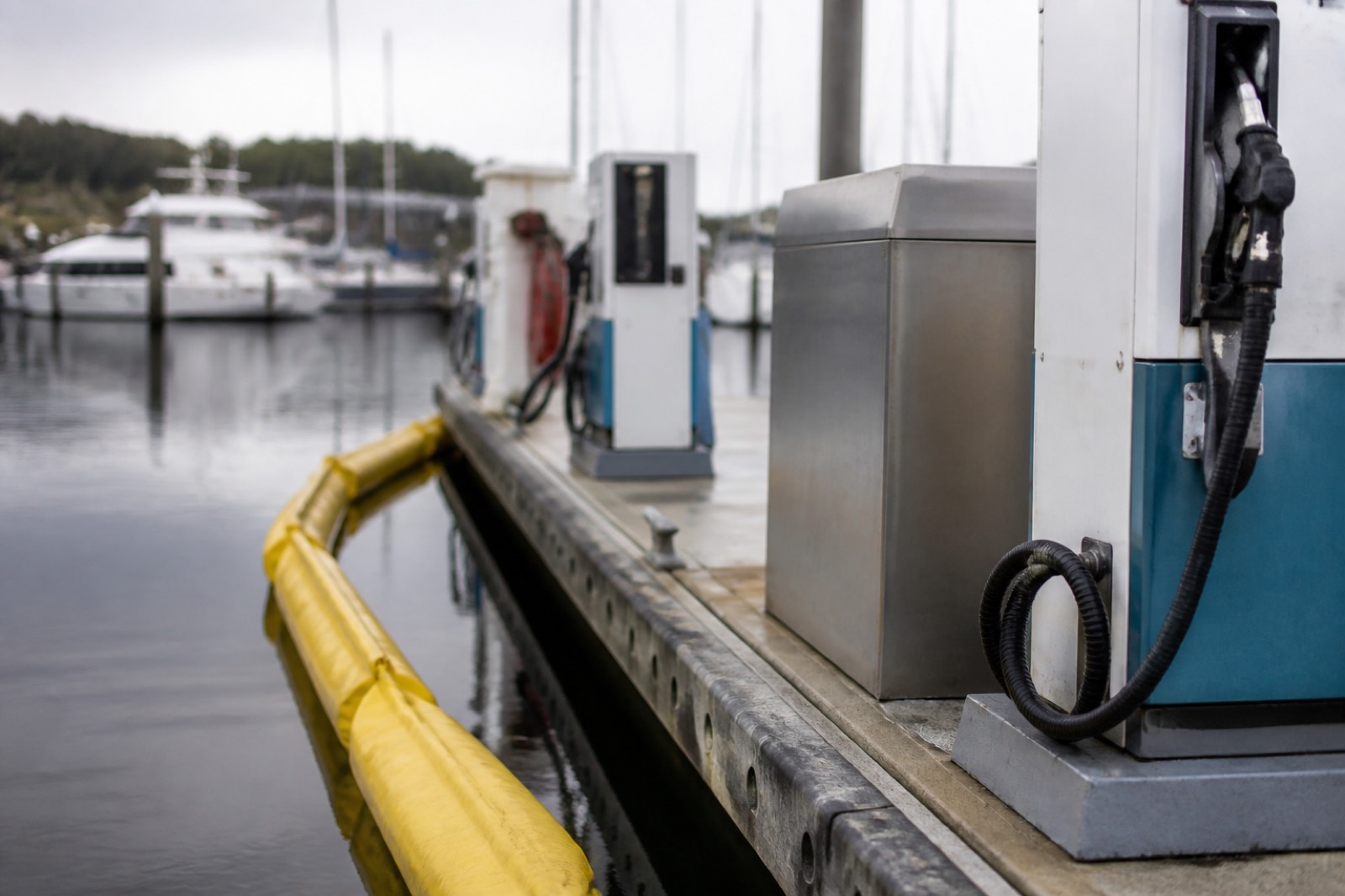
Environmental issues are the most common reason marina deals collapse, retrade, or face hostile diligence. Buyers will perform Phase I Environmental Site Assessments at minimum; many require Phase II (subsurface testing) for any marina with historical fueling operations. Sellers should be ahead of these issues before going to market.
Common environmental concerns
- Underground storage tanks (USTs): historical USTs (fuel, waste oil, hydraulic fluid) and any associated soil/groundwater contamination. Even properly-closed USTs require documentation.
- Surface fuel-handling: spills, leaks, vapor recovery, leak-detection compliance
- Stormwater management: NPDES permits, stormwater runoff controls, MS4 compliance
- Hazardous materials storage: anti-fouling paint, solvents, batteries, waste oil
- Bilge water and sewage: pump-out stations, no-discharge zones, MARPOL compliance
- Dredging history and permits: regular maintenance dredging requires permits; spoils disposal is increasingly restricted
- Wetlands / shoreline impact: any docking modifications since 1990 likely required Army Corps permits
- Submerged-land lease compliance: state-issued submerged-land leases have specific use and reporting requirements
- Endangered species concerns: manatee zones (Florida), salmon migration corridors (Pacific Northwest), eelgrass habitat (New England) all create specific operational constraints
Pre-sale environmental preparation
Sellers should consider engaging an environmental consultant 6-12 months before going to market to:
- Conduct a Phase I ESA preemptively (identifies issues before buyer discovers them)
- Compile all environmental permits, inspection reports, and compliance documentation
- Address known issues (cleanup, additional monitoring, regulatory closure) before sale
- Document the property’s environmental history in a way that supports buyer underwriting
Environmental insurance
For marinas with significant historical operations, environmental impairment liability (EIL) insurance can be transferred to the buyer or held by both parties as belt-and-suspenders coverage. Annual premiums of $25-75K can resolve buyer concerns and preserve deal value.
The 2026 marina buyer universe
Consolidator platforms (most common buyer)
- Suntex Marinas, backed by Centerbridge Partners, ~70 marinas, focused on high-value coastal/lake properties
- Safe Harbor Marinas, owned by Sun Communities (REIT), ~140 marinas, the largest U.S. operator
- Westrec Marinas, ~30 marinas, family-office backed, focused on Southern California and Florida
- Marinas International, independent platform, ~25 marinas
- Smaller regional roll-ups, multiple PE-backed platforms targeting specific geographies
Consolidators offer: speed of close (4-5 months), institutional credibility, willingness to pay 8-12x EBITDA for well-run assets. They impose: standardized operating systems, brand changes, often less local autonomy.
Hospitality REITs
Sun Communities (parent of Safe Harbor) is the dominant marina-investing REIT. Several others (publicly-traded and non-traded REITs) have started allocating capital to marinas as a hospitality-adjacent recurring-revenue asset. REITs typically pay strong prices for real estate and lease back to operators. Best fit for sellers prioritizing real-estate liquidity over operating-business sale.
Family offices and HNW operators
Many wealthy individuals are acquiring single marinas as legacy investments or as part of broader recreational-real-estate portfolios. Family offices typically pay competitive but not market-topping multiples; their value-add is patient capital and willingness to retain existing management.
Private equity (direct and roll-up)
Increasing PE interest in 2024-2026 as a defensive cash-flow asset. PE buyers typically need $3M+ EBITDA to consider direct platforms but will pay full multiples for high-quality assets. Add-on acquisitions at $1M-$3M EBITDA are common.
Strategic / individual buyers
Less competition from individual buyers because marinas require significant capital ($5M-$50M+ enterprise value) and operational expertise. Most individual buyers are existing marina operators looking to add a second location.
Curious what your business is actually worth?
A 15-minute confidential call gives you a real valuation range and tells you which buyers would compete for your business. No cost, no obligation, no pressure to sell.
The marina sale process: 12-month roadmap
To sell a marina, start more than a year before you want to close. Clean up environmental records first, split the real estate from the operating business, and normalize three years of financials. Then take it under NDA to a short list of consolidators, REITs, PE platforms and family offices, and run them against each other to an LOI.
Framework
The 12-Month Marina Sale Roadmap
Marina transactions take 12-18 months end-to-end because environmental due diligence is the #1 deal-killer. Use this roadmap to sequence your prep.
- Months 1-2. Compile environmental records: Phase I/II ESA, fuel-system records, dredging permits, waterfront-development approvals. Why first: environmental issues kill more marina deals than valuation gaps.
- Months 3-4. Separate real estate from operating business. Allocate value between PropCo (waterfront real estate at a cap rate) and OpCo (slip rental, fuel dock, repairs at an EBITDA multiple). This typically increases total proceeds 10-25%.
- Months 5-6. Normalize financials and engage a Quality of Earnings (QoE) provider. Document slip-rental rates by category, dry-storage capacity, fuel-dock margins, and recurring contracts.
- Months 7-8. Identify buyer universe: marina-recreation REITs (Safe Harbor, Suntex), private equity platforms, family-office aggregators, and strategic operators. Build a 10-15 buyer outreach list.
- Months 9-10. Confidentially approach 3-5 qualified buyers with a teaser. Execute LOI within 60-90 days of go-to-market.
- Months 11-12. Buyer diligence + definitive purchase agreement + close. Expect 60-90 days of data room work, environmental Phase II review if triggered, and a 60-120 day close window.
Months -12 to -6: pre-sale preparation
- Engage marina-specialty M&A advisor or buy-side firm with marina-buyer relationships
- Update financial statements; segregate marina-operating from real-estate from boat-sales (if multi-line business)
- Conduct preemptive Phase I environmental site assessment
- Compile permits, leases, environmental documentation, slip-holder roster, employee roster
- Document recurring revenue (slip leases, dry-storage contracts) with renewal terms
- Address any known operational or compliance issues
- Consider real-estate appraisal as separate valuation reference
Months -6 to -3: market preparation
- Prepare CIM (confidential information memorandum) and teaser document
- Identify target buyer universe (10-25 qualified buyers)
- Develop financial model with normalized EBITDA, growth scenarios, and real-estate split
- Negotiate confidentiality agreements with prospects
Months -3 to 0: marketing and LOI
- Distribute teaser; convert interested parties to NDA
- Distribute full CIM
- Management presentations with serious bidders
- Collect indications of interest, then LOIs from finalists
- Negotiate LOI economics and structure
Months 0 to 4: diligence and close
- Sign LOI with selected buyer (45-60 day exclusivity typical)
- Quality of earnings work, environmental diligence (Phase II if needed), real-estate appraisal, title work
- Definitive agreement negotiation (asset purchase, real-estate purchase, environmental indemnification)
- Financing close, regulatory approvals (submerged-land lease assignment if applicable)
- Close and transition
Common pitfalls in marina sales
- Underestimating environmental diligence timeline (can add 60-90 days)
- Failing to clarify real-estate vs operating split early enough
- Loss of slip-holders if transition is rocky (slip leases are typically annual)
- Regulatory delays for submerged-land lease assignment (varies dramatically by state)
- Buyer overestimating ability to raise rates aggressively post-close

About the Author
Christoph Totter is the founder of CT Acquisitions, an M&A advisory firm working both sides of the table, headquartered in Sheridan, Wyoming. We work directly with 500+ buyers, search funders, family offices, lower middle-market PE, and strategic consolidators, including direct mandates with the largest consolidators that other intermediaries cannot access. No fee to you on buy-side introductions; sell-side mandates are paid on success at closing. Connect on LinkedIn · Get in touch
Marina M&A and Acquisitions: Who Is Buying Marinas in 2026
If you want to sell a marina, the active buyers are a short list of consolidating platforms: Safe Harbor Marinas (owned by Sun Communities), Suntex Marinas (backed by Centerbridge Partners), Westrec Marinas, and Marinas International. These four groups drive most institutional marina acquisitions, and knowing which one fits your asset is the difference between a competitive process and a one-buyer negotiation.
Marina acquisitions in 2026 are concentrated at the top. Safe Harbor Marinas, operating roughly 140 marinas as the largest U.S. platform under the Sun Communities REIT umbrella, buys full-service waterfront assets with scale and dry-stack capacity. Suntex Marinas, with roughly 70 marinas and Centerbridge Partners capital behind it, competes for the same premium destinations. Both pay up for recurring slip and storage revenue, protected harbors, and clean environmental records.
Below the two national consolidators, Westrec Marinas runs roughly 30 marinas with family-office backing concentrated in Southern California and Florida, and Marinas International operates as an independent platform of roughly 25 marinas. These groups will look at single-location and regional operators that the national platforms sometimes pass over, which widens your buyer pool if your marina sits outside the top waterfront markets.
The practical takeaway when selling a marina is that a named, motivated acquirer list already exists, so the value is created by running these buyers against each other rather than accepting the first inbound call. A larger, recurring-revenue marina with a clean EPA stormwater compliance history and long ground-lease tenure will draw all four platforms; a smaller operator with environmental questions will draw fewer. If you are weighing a sale, our sell your marina business page walks through how to position the asset and structure the process before the first buyer conversation.
Marina Valuation: Multiples of Revenue and EBITDA
A marina’s operating business alone, before the real estate, is typically valued at 4x to 8x EBITDA, or roughly 1.5x to 3x gross revenue as a quick rule of thumb. Marinas with high-margin ancillary income, fuel, storage, service, and a ships store, and long waitlists for slips trade at the high end. The underlying real estate and the share of the waterfront the marina controls can push value well above the operating multiple alone.
| Marina profile | EBITDA multiple | Revenue multiple |
|---|---|---|
| Slips only, limited services | 4x to 5x | about 1.5x to 2x |
| Slips plus fuel, storage, service | 5x to 7x | about 2x to 2.5x |
| Full-service, waitlist, owned land | 7x to 8x+ | about 2.5x to 3x |
The factors that move a marina valuation most are slip occupancy and waitlist depth, the mix of high-margin services, fuel volume, lease versus owned submerged land, and storm and insurance exposure. Owned waterfront real estate is often the single biggest value driver in a marina sale.
How buyers cross-check a marina valuation: cap rate, NOI, and price per slip
An EBITDA multiple is only one of the numbers a marina buyer runs. Institutional buyers also price the marina like income real estate, then sanity-check the answer against price per slip. When the methods disagree, the gap usually points to the issue the buyer will push on in diligence.
1. Income capitalization: NOI divided by a cap rate
The core real-estate formula is value equals net operating income divided by the cap rate. National Marina Sales puts typical marina cap rates at 6% to 10%, with premium coastal assets at the low end. Using that formula, a marina with $1.5M of NOI is worth about $18.75M at an 8% cap rate and about $25M at a 6% cap rate. A small move in the cap rate moves value by millions, which is why buyers argue hard over it.
2. Price per slip
DealStream’s marina rules of thumb list a typical range of $5,000 to $15,000 per slip, with covered and premium slips above that band. On that rule of thumb, a 200-slip marina implies $1M to $3M for the slip base alone. Treat it as a floor check, not a price. It ignores dry-stack capacity, fuel and service income, and owned upland, and premium coastal marinas trade far above it.
3. What to do with the answers
Run all three methods before the first buyer call. Normalize NOI the way a buyer will: a market-rate management fee, real insurance and storm costs, and reserves for dock repairs and dredging. If your multiple-based value sits well above the cap-rate value, expect buyers to anchor on the lower number. If the cap-rate value is higher, the real estate is carrying the deal, and the PropCo and OpCo split covered in the roadmap above may get you paid for it.
Frequently Asked Questions
Who buys marinas when you sell?
The most active institutional marina buyers in 2026 are Safe Harbor Marinas (owned by the Sun Communities REIT), Suntex Marinas (backed by Centerbridge Partners), Westrec Marinas, and Marinas International. The two national platforms target premium full-service waterfront assets, while Westrec and Marinas International will consider single-location and regional operators. Running these buyers in a competitive process, rather than accepting one inbound offer, is what protects marina valuation.
What multiple should I expect for my marina?
Premium coastal marinas with high occupancy (90%+), strong ancillary revenue (service yard, ship’s store), and clean environmental profile trade at 12-14x EBITDA in 2026. Mid-market regional marinas trade at 10-12x EBITDA. Inland or seasonal marinas trade at 8-10x EBITDA. These multiples include the real estate, which often represents 40-60% of total value.
How do buyers value the underlying real estate?
Two primary approaches: (1) replacement cost, what would it cost to permit and build equivalent waterfront capacity today, often impossible at any price; (2) income capitalization, applied to slip rental and ground-lease cash flows. Premium coastal slips often trade well above the $5,000 to $15,000 per slip rule of thumb that DealStream lists.
What environmental issues most commonly kill marina deals?
Historical underground storage tanks with potential soil/groundwater contamination, undocumented fuel spills, expired or non-compliant stormwater permits, and incomplete records of historical dredging or shoreline modifications. Preemptive Phase I and II ESAs (where appropriate) before going to market dramatically reduce deal-collapse risk.
How long does a marina sale take?
Typically 12-18 months from initial advisor engagement to closing. Pre-marketing preparation: 6-9 months. Active marketing through LOI: 2-4 months. Diligence and close: 4-5 months. Marinas with significant environmental issues or complex real-estate structures (multiple owners, ground leases, conservation easements) take longer.
Should I sell the real estate and operating business together or separately?
Combined sale (Pattern 1) maximizes total price and simplifies structure for most sellers. Splitting (Pattern 2 or 3) makes sense if the seller wants ongoing income (lease-back), has 1031 exchange needs for the real estate, or wants to retain family-trust ownership of the property.
Who are the most active marina buyers?
Top consolidators in 2026: Safe Harbor (Sun Communities REIT), Suntex Marinas (Centerbridge), Westrec, Marinas International, and a growing field of PE-backed regional roll-ups. Hospitality REITs and family offices are also active. The competitive landscape is more concentrated than most service-business sectors, which works in sellers’ favor on premium assets.
Will the buyer want me to stay involved post-close?
Depends on buyer type. Consolidator platforms usually want 6-18 month transition; PE buyers often want 2-4 years with rollover equity; family offices may want 3-7 years of continued management. SBA-financed individual buyers are uncommon for marinas due to size, but when used, require shorter transition periods. Discuss expectations during initial buyer conversations.
What happens to existing slip-holder leases?
Slip-holder leases (typically annual or seasonal) transfer with the business under standard assignment provisions. Most leases continue with no disruption. Slip-holder loyalty is usually strong; turnover typically increases by 2-5% in the year after sale, which buyers underwrite into their model.
Are recreational/recreational REITs paying premium prices?
Hospitality and recreation REITs (especially Sun Communities) have been the most aggressive buyers since 2018, paying 12-14x EBITDA for premium coastal assets. Whether they continue at these multiples depends on interest rates and capital availability, the marina-recreation REIT thesis has held up well so far but is subject to broader real-estate cycle pressures.
Sources & References
- Association of Marina Industries (AMI), industry data, certification programs, environmental best practices
- States Organization for Boating Access (SOBA), public-access and regulatory framework
- National Marine Manufacturers Association (NMMA), recreational boating statistics
- U.S. Army Corps of Engineers, Section 10/404 permits for marina construction and dredging
- EPA Marina and Boatyard Stormwater General Permit, NPDES compliance framework
- Boats Group / IBI Magazine, marina industry M&A reporting
Last updated: May 16, 2026. For corrections or methodology questions, get in touch.
Want a Specific Read on Your Business?
15 minutes, confidential, no contract, no cost. You leave with a read on your local buyer market and a likely valuation range.
Broker fees carry a real drag on net proceeds. See our full broker fee benchmark for the numbers.
The prep sequence sits inside a broader owner playbook covered on our owner exit prep sequence.