How to Sell a Business Plan to Angel Investors: The Founder’s Pitch and Term Sheet Playbook (2026)
Learning how to sell a business plan to angel investors in 2026 starts with one uncomfortable truth: only 11.4 percent of pitched deals receive an angel check, according to the Angel Capital Association HALO Report 2025, and the average angel writes 4.2 checks per year against roughly 60 pitches reviewed. The founders who get funded are not the ones with the slickest decks. They are the ones who understand how angels actually score a pitch, what a SAFE versus a priced round actually costs in dilution, and which 12 to 15 slides answer the questions an angel will ask before they will wire money.
Raising angel capital with an exit in mind?
Founders who raise angel money today should already be thinking about the buyer who will acquire the company in 5 to 7 years. We review cap tables, SAFE stacks, and dilution math for founders pre-exit. No fee to you on buy-side introductions; sell-side mandates are paid on success at closing.
Book a Free ConsultationDisclaimer: This guide is for educational purposes only and is not investment, tax, or legal advice. Consult a securities attorney before signing any term sheet, SAFE, or convertible note.
What This Actually Means
Selling a business plan to angel investors is the act of convincing accredited individual investors to write personal checks ranging from $25,000 to $250,000 in exchange for equity, convertible debt, or a SAFE in a privately held early-stage company. Angels are not venture capitalists. They invest their own money, not a fund’s, and they make decisions on a personal-conviction timeline rather than a partnership-vote timeline. The HALO Report 2025 found the median angel check size in the United States was $37,500 in 2025, with syndicates aggregating individual angels into $500,000 to $2,000,000 rounds for promising deals.
The selling part is misleading. Founders do not pitch a plan, they pitch a thesis: a defensible answer to four questions an angel must believe before writing a check. Who is the team and why are they the right team to win this market? How big is the market and what share is reachable? What evidence exists that customers want this and will pay for it? And what terms make this investable at a price that returns 10x or more if the bet works? The CB Insights State of Venture 2025 reports that 75 percent of seed-stage angel rounds in the United States now use a SAFE or convertible instrument rather than a priced equity round, which means the founder is often selling a future-equity promise rather than equity at a fixed price today.
The rest of this guide unpacks the 12 to 15 slide pitch deck angels actually read, the four-factor scoring framework angels use, the three instruments (SAFE, convertible note, priced round) and what each costs in dilution, valuation negotiation math, typical check sizes by channel, the four routes to angels (AngelList, Republic, direct outreach, accelerator networks), and the due diligence process that comes after the handshake.
The 7 Things You Need to Understand
1. The 12 to 15 Slide Angel Pitch Deck
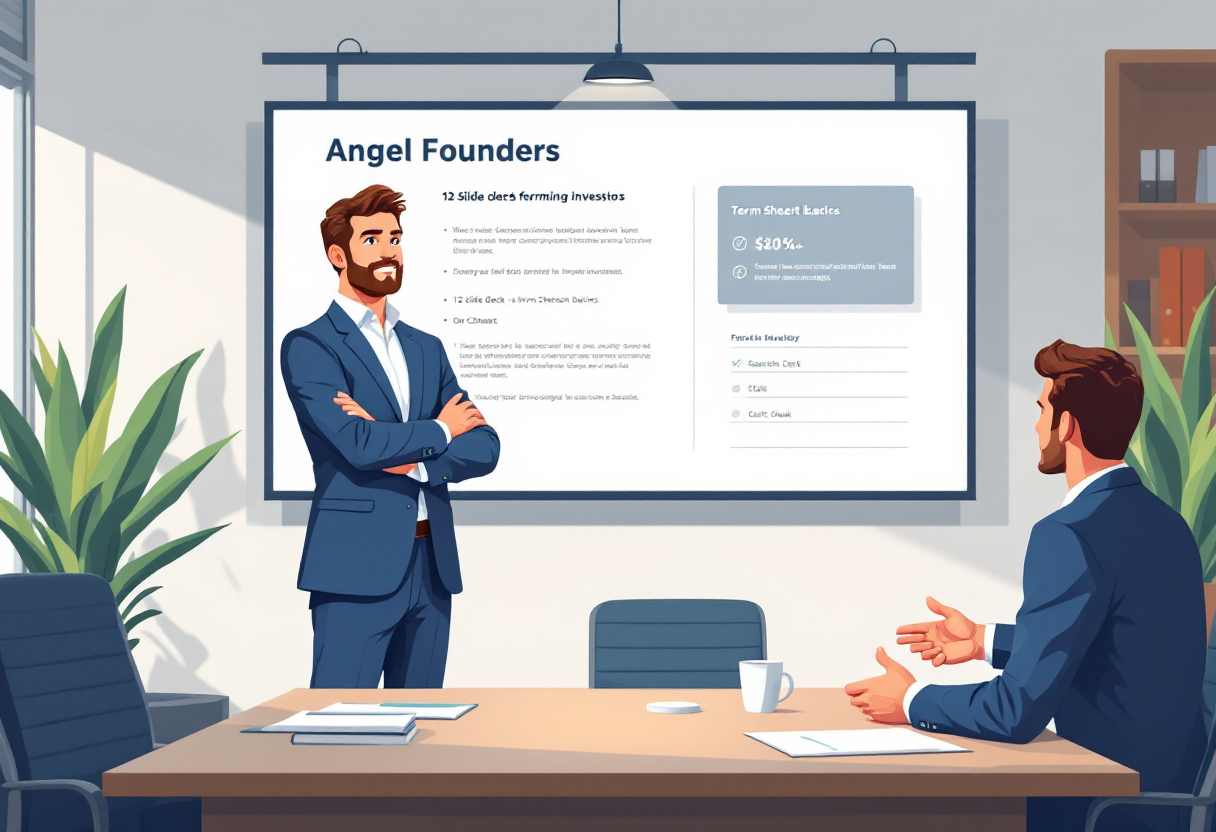
The angel pitch deck is not a sales deck. It is a structured proof document that lets a busy investor answer “yes, no, or learn more” inside 10 minutes. The Y Combinator Startup School deck template and the DocSend 2025 Pitch Deck Benchmark Report converge on a 12 to 15 slide structure with consistent slide order. The DocSend study, which analyzed 13,000 decks viewed by investors in 2024 and 2025, found that funded decks averaged 19 slides but the average investor spent only 3 minutes 21 seconds reading a deck. Every slide must earn its place.
The standard angel deck slide sequence: (1) Title slide with company name, one-line description, founder names, and contact. (2) Problem slide naming a painful, frequent, and expensive problem with a specific customer. (3) Solution slide showing the product and how it solves the problem in one screenshot or one diagram. (4) Why Now slide explaining the technology, regulatory, or behavioral shift that makes this possible now. (5) Market Size slide with TAM, SAM, and SOM with named sources (Gartner, IDC, Statista, or first-principles bottoms-up math). (6) Product slide with screenshots or demo link. (7) Traction slide with monthly recurring revenue, growth rate, customer count, retention, or pilot data. (8) Business Model slide with pricing, average contract value, and unit economics. (9) Go-to-Market slide with the channel strategy and customer acquisition cost. (10) Competition slide with a 2×2 matrix or feature comparison naming real competitors. (11) Team slide with founder backgrounds and why this team wins. (12) Financial Projections slide with 3-year revenue, gross margin, and burn rate forecasts. (13) The Ask slide with round size, instrument (SAFE, note, priced), valuation cap or pre-money, use of funds, and milestones. (14) Optional appendix with detailed financials, hiring plan, or cohort retention.
DocSend’s data showed that investors spent the most time on the financials slide (23.2 seconds on average), the team slide (12.4 seconds), and the competition slide (11.5 seconds), which means those three slides carry disproportionate weight. The lead and traction slides should be designed to make an investor want to schedule a call, not to close the deal inside the deck itself.
2. How Angels Actually Score a Pitch
Angels evaluate deals on four factors with consistent weighting across multiple academic and industry studies. The HALO Report 2025 published the most cited weighting model: team 40 percent, market 30 percent, traction 20 percent, terms 10 percent. The Kauffman Foundation Angel Returns Study (2007, updated 2024) and the Wiltbank ACA Returns Study both confirm that team quality and market size together explain roughly 70 percent of variance in angel investment outcomes.
Team at 40 percent means the angel is betting on the founder more than the idea. Specific signals angels weight: prior startup experience (especially a prior exit), domain expertise of 5+ years in the target market, complementary co-founder skills (technical plus commercial), full-time commitment, and track record of execution. First-time founders without a prior exit can compensate with deep domain expertise, a strong technical co-founder, and demonstrated traction.
Market at 30 percent means the angel needs to believe a 10x return is possible. The math is mechanical: an angel writes a $50,000 check at a $5,000,000 post-money valuation for 1 percent of the company. For that 1 percent to return $500,000 (10x), the company must exit at $50,000,000 or higher. For a 25x return on the same check, the company must exit at $125,000,000. Markets that cannot support a $100,000,000 exit are not angel-investable even if the business is profitable. Angels expect founders to present TAM (total addressable market, the global category), SAM (serviceable addressable market, the realistic geographic and product subset), and SOM (serviceable obtainable market, the 3 to 5 year capture target) with named sources.
Traction at 20 percent means evidence that customers will pay. The bar varies by stage. Pre-seed angels often invest on a strong team and prototype with 5 to 10 letters of intent or design partners. Seed-stage angels expect $10,000 to $50,000 in monthly recurring revenue, 10 to 20 percent month-over-month growth, and net revenue retention above 100 percent for SaaS. The First Round Capital 2024 State of Startups survey found that seed-stage rounds in 2024 closed at a median $1,200,000 MRR run-rate versus $480,000 in 2020, which means the traction bar has roughly doubled in four years.
Terms at 10 percent means the deal must be investable. A $5,000,000 valuation cap on a SAFE is investable for an angel; a $25,000,000 cap on a pre-revenue startup is not. Founders frequently lose deals not on quality but on terms that prevent a 10x return for the angel. The terms section below covers the math.
3. SAFE, Convertible Note, or Priced Round
The instrument is the legal structure under which the angel’s money enters the company. Three instruments dominate United States angel rounds in 2026, and the Y Combinator post-money SAFE has become the default for 65 to 75 percent of pre-seed and seed deals according to the Carta 2025 State of Private Markets report.
The Y Combinator post-money SAFE (Simple Agreement for Future Equity) is a 5-page convertible instrument that converts to equity at the next priced round. Two key terms: the valuation cap (the maximum valuation at which the SAFE converts) and the discount (a 0 to 20 percent reduction off the priced-round price, usually 20 percent if used). Post-money SAFEs are calculated on the post-investment cap table, which makes founder dilution mechanical and predictable. A $500,000 SAFE at a $5,000,000 post-money cap converts to exactly 10 percent of the post-SAFE cap table. The earlier pre-money SAFE was harder to model because dilution depended on how much other SAFE money was raised, which made stacking SAFEs dangerous for founders.
The convertible note is older and similar in mechanics but is debt rather than equity-deferred. Notes carry an interest rate (typically 4 to 8 percent), a maturity date (typically 18 to 24 months), a valuation cap, and a discount. If the company does not raise a priced round before maturity, the note technically comes due, though most angels extend rather than call. Convertible notes are appropriate when angels want creditor protection or when the company is raising in a jurisdiction where SAFEs are not commonly used (most non-US markets).
The priced equity round is a sale of preferred stock at a defined pre-money valuation. The standard structure is Series Seed Preferred or Series A Preferred with 1x non-participating preferred liquidation preference, weighted-average broad-based anti-dilution, pro-rata rights, information rights, and a board seat at $1,000,000+ check sizes. The NVCA Model Legal Documents (updated 2025) provide the industry-standard term sheet, stock purchase agreement, voting agreement, and investor rights agreement. Priced rounds cost the founder more in legal fees ($20,000 to $50,000 versus $2,000 to $5,000 for a SAFE) but provide certainty on valuation, dilution, and governance.
The Carta 2025 data shows the instrument split for US seed deals in 2024-2025: 52 percent post-money SAFE, 18 percent pre-money SAFE, 11 percent convertible note, 19 percent priced round. Priced rounds dominate at $3,000,000+ round sizes; SAFEs dominate below $2,000,000.
4. Valuation Negotiation: Pre-Money 101
Valuation negotiation with angels is mechanical rather than artistic. Three inputs set the negotiable range: comparable round data (what similar companies raised at), the math the angel needs (the cap that allows a 10x outcome), and the cap table impact on the founder (how much dilution is acceptable at this stage).
Comparable round data comes from PitchBook, Carta, and AngelList quarterly reports. The Carta 2025 State of Private Markets reported median pre-seed valuations of $7,000,000 to $10,000,000 post-money for software companies in 2024-2025, with a 50th to 75th percentile band of $8,000,000 to $14,000,000. Seed-stage post-money medians ran $14,000,000 to $20,000,000 for software with $500,000+ MRR. Hardware, biotech, and consumer companies trade at 30 to 50 percent discounts to software at the same stage.
The angel math constraint is the 10x cap. An angel writing $50,000 at a $10,000,000 post-money cap owns 0.5 percent; for that 0.5 percent to return $500,000, the company must exit at $100,000,000. Angels investing at $20,000,000+ caps on pre-revenue startups know the math does not work for them and will pass even if they like the founder. Founders pushing for inflated caps lose deals they could have won at $7,000,000 to $10,000,000.
The founder dilution constraint is the runway-to-next-round calculation. A standard founder dilution model: pre-seed gives up 10 to 15 percent, seed gives up 15 to 20 percent, Series A gives up 18 to 25 percent. After three rounds, founders typically retain 40 to 55 percent of the company. Founders who raise at inflated caps in the first round set themselves up for a down round at Series A, which damages morale, triggers anti-dilution adjustments, and burns the cap table. A modest cap at the first round with strong execution toward the next round is mathematically better for the founder than an inflated cap that the company cannot grow into.
5. Typical Check Sizes by Channel
Check sizes vary dramatically by the angel channel. The HALO Report 2025 and AngelList 2025 quarterly data set the benchmarks: individual angels write $25,000 to $50,000 median checks, with experienced angels writing $50,000 to $100,000 and “super angels” (former operators with 30+ portfolio companies) writing $100,000 to $250,000. Total round sizes for angel-only rounds typically run $250,000 to $1,500,000 aggregated across 5 to 25 individual angels.
Syndicates change the math. An AngelList syndicate aggregates a lead angel’s allocation across 30 to 200 backers, with the lead taking 10 to 20 percent carry on the upside. AngelList’s 2025 quarterly report showed the median syndicate deal size was $620,000 in Q4 2024, with top syndicates (those with 5+ realized exits) regularly assembling $1,500,000 to $2,500,000 rounds inside 14 days of the lead committing.
Accelerator-affiliated angel networks (Y Combinator alumni, Techstars network, 500 Global) often write $50,000 to $150,000 follow-on checks after an accelerator demo day, with the accelerator’s standard investment ($125,000 from Y Combinator on a post-money SAFE at a $375,000 cap for 7 percent, or $500,000 from Y Combinator’s $375,000 + $500,000 program from 2024 onward) providing the anchor.
6. AngelList, Republic, Direct Outreach, or Accelerator
Four channels reach angels. Each has different mechanics, time costs, and dilution implications.
AngelList is the dominant United States platform for angel deals. AngelList’s syndicates feature lets a lead angel post a deal with their network, and individual backers commit allocations of $1,000 to $25,000 each. Total processing fees run 5 to 10 percent of capital raised plus 10 to 20 percent carry to the lead. The advantage is speed: a hot deal can close in 14 to 30 days versus 60 to 120 days for cold outreach. The disadvantage is that AngelList rounds are public by default to backers, which makes a failed raise more visible.
Republic and StartEngine offer Reg CF (regulation crowdfunding) raises up to $5,000,000 per 12-month period under SEC rules amended in 2021. Reg CF allows non-accredited investors, which expands the potential investor pool but adds compliance costs ($5,000 to $20,000 in legal and platform fees) and creates a cap table with hundreds or thousands of small shareholders. Reg CF is appropriate for consumer brands with a community but adds friction for B2B SaaS that will later raise institutional capital. Most institutional VCs require Reg CF investors to convert to a holding entity (a special purpose vehicle) before a Series A.
Direct outreach is cold or warm contact with individual angels through LinkedIn, conferences, alumni networks, or angel-investor lists (such as the Angel Capital Association directory). Conversion rates are low: 60 to 100 outreach messages typically produce 5 to 10 meetings and 1 to 2 checks. The advantage is no platform fees and full founder control of the cap table. The disadvantage is time: a $500,000 round through direct outreach commonly takes 3 to 6 months.
Accelerator networks are the highest-conversion channel for first-time founders. Y Combinator (W26 batch acceptance rate 0.8 percent per YC’s published data), Techstars (1 to 2 percent acceptance rate), and 500 Global (1 to 3 percent) provide a starter check, mentorship, and an alumni angel network that writes follow-on checks after demo day. Y Combinator alumni in particular invest heavily in current-batch companies, with the median post-YC angel round closing at $1,500,000 to $3,000,000 inside 60 days of demo day per Y Combinator’s 2024 batch report.
7. The Due Diligence Process After the Handshake
An angel verbal commitment is not a check. The due diligence period between handshake and wire is where 25 to 35 percent of committed deals fall apart according to a 2024 Angel Capital Association survey of 412 angel investors. The process has four parallel tracks.
Founder diligence is the angel’s reference check on the founders. Expect 3 to 5 reference calls with prior employers, co-founders, customers, or investors. Angels are checking for integrity, execution quality, and team dynamics. Founders should warm references before the diligence starts and provide a list of 6 to 8 names so the angel can pick.
Legal diligence verifies the corporate structure, cap table, IP assignment, and prior fundraising documents. Expect requests for the certificate of incorporation, the cap table with options grants, the IP assignment agreements from all founders and early employees, prior SAFE or note documents, and the company’s employment agreements. Founders should have a clean data room ready before pitching.
Financial diligence reviews the company’s actuals (if any), projections, unit economics, and burn rate. For pre-revenue companies, this is a 30-minute conversation. For revenue-generating companies, expect the angel to request 24 months of bank statements, the QuickBooks or accounting export, customer cohort data, and a board-ready financial model.
Technical diligence applies to companies with proprietary technology. Expect the angel (or a technical advisor) to ask about the tech stack, infrastructure choices, IP defensibility, and key technical risks. For a software company, this is often a 60-minute call with the CTO. For deep-tech or biotech, the diligence can run 4 to 8 weeks with external reviewers.
Worked Example: A $750,000 Pre-Seed Round
Consider a fictional B2B SaaS company, BrightLedger, building accounting automation for SMB bookkeepers. Two co-founders (technical and commercial), 8 paying customers at $499 per month, $4,000 in monthly recurring revenue, and 18 months of runway with the current burn of $35,000 per month. The founders want to raise $750,000 to extend runway to 24 months and grow to $20,000 MRR.
The instrument choice. The founders pick a Y Combinator post-money SAFE for the legal simplicity and predictable dilution math, with a $7,500,000 post-money valuation cap. The cap is set by comparable Carta data on pre-seed B2B SaaS with $4,000 MRR in 2026, which clusters at $6,000,000 to $9,000,000 post-money.
The dilution math. A $750,000 SAFE at a $7,500,000 post-money cap means new investors collectively own exactly 10 percent of the post-SAFE cap table when the SAFE converts at the next priced round (assuming the cap is the binding constraint, which it will be if the next round is at any pre-money above $6,750,000). The founders go from owning 100 percent (less an option pool to be created) to owning 90 percent collectively, less any option pool created at the priced round.
The round composition. The founders target 1 lead angel for $150,000, 4 follow-on angels at $50,000 each ($200,000), an AngelList syndicate for $250,000, and Y Combinator’s standard $500,000 if accepted (this scenario assumes no YC). Without YC, the round composition shifts to a Republic Reg CF top-up of $150,000 to reach the $750,000 target.
The check math for the lead angel. The lead writes $150,000 into a SAFE at a $7,500,000 post-money cap. At conversion, the lead owns 2 percent of the post-SAFE cap table. For the lead to make a 10x return ($1,500,000), BrightLedger must exit at $75,000,000. For a 25x return ($3,750,000), exit must hit $187,500,000. The angel’s mental model: BrightLedger competes in the SMB bookkeeping automation category with comparable exits at Pilot (acquired by Bench, undisclosed), Botkeeper (raised $50,000,000 at $200,000,000+ post in 2022 per Crunchbase). A 10x outcome is mathematically plausible if the company reaches $5,000,000 to $10,000,000 ARR and exits at 7 to 10x revenue.
The timeline. From first pitch to first wire: the founders spent 8 weeks before the lead committed (52 first meetings, 23 second meetings, 4 verbal commits, 1 lead). After lead commitment, follow-on angels closed in 3 weeks. AngelList syndicate posting to close took 21 days. Republic Reg CF campaign launch to close took 11 weeks. Total elapsed time from first pitch to fully wired: 17 weeks.
Common Mistakes Founders Make Pitching Angels
Pitching Before the Team Slide Works
Founders frequently pitch when the team slide is incomplete (solo founder still hiring a CTO, or technical founder still hiring a commercial co-founder). Angels weight team at 40 percent. Pitching with a half-built team means starting from a 60 percent ceiling on the scoring framework. The fix: complete the team before raising, or be honest in the deck that the round funds the co-founder hire and have an LOI from the candidate.
Setting the Cap to Maximize Today, Not Optimize for the Next Round
Founders frequently push for the highest cap they can negotiate, then face a down round at Series A when the company has not grown into the valuation. A $20,000,000 post-money cap on a pre-seed SAFE means the Series A must price above $20,000,000 pre-money for the SAFE not to convert at a punishing dilution. Founders who anchor on the cap angels will accept at the current traction level, rather than the cap they hope to negotiate, build cleaner cap tables.
Stacking SAFEs Without Modeling Dilution
Pre-money SAFEs in particular can cause dilution surprises when stacked. A founder who raises three pre-money SAFEs at three different caps over 18 months may find at the priced round that the combined SAFEs convert to 35 percent of the company rather than the 20 percent the founder modeled. The post-money SAFE solves this because each SAFE’s percentage is fixed at signing, but the founder must still track total SAFE percentage to avoid overcommitting. The fix: model the cap table with every SAFE in a spreadsheet before signing each one.
Hiding Bad News in Diligence
Founders sometimes omit or minimize a co-founder dispute, a prior failed pivot, a customer concentration risk, or a regulatory question during diligence. Angels almost always find the issue, and discovery during diligence ends 60 to 70 percent of deals according to ACA survey data. The fix: surface bad news in the first pitch or the first follow-up, with the mitigation already in place. Angels invest in founders who handle hard problems well, not founders without problems.
Treating Term Sheet Negotiation as Optional
Founders sometimes accept the angel’s first-draft term sheet without modeling the downstream impact of liquidation preference, anti-dilution provisions, or pro-rata rights. A 2x participating preferred liquidation preference at the seed round can cost founders millions at a moderate exit. Pro-rata rights granted to too many angels mean the founder cannot fit a new lead VC into the Series A round without buying out the angels. The fix: hire a securities attorney experienced with angel rounds (typical fee $3,000 to $8,000 for SAFE review, $15,000 to $30,000 for priced round) before signing anything.
Ignoring the Exit Conversation Until Series B
Angels invest expecting an exit. Founders who refuse to discuss exit scenarios in the pitch raise concern that they have no plan to return capital. The fix: include an exit slide or paragraph showing comparable exits in the category (acquisition targets, IPO precedents) and a realistic range. This does not commit the founder to any specific exit path, but it shows the angel that the founder has done the math. Founders who later need to think about a strategic acquisition exit should read our guide on writing a business plan for acquisition.
Timeline: From First Pitch to Wire Transfer
The typical angel-round timeline from first pitch to fully wired round breaks into seven phases.
Phase 1: Deck preparation (2 to 4 weeks). Founders draft, iterate, and pressure-test the 12 to 15 slide deck with 5 to 10 friendly readers (other founders, advisors, prior investors if any). The deck should be tested for clarity, not for flattery. Friendly readers who say “I would invest” are less useful than friendly readers who say “I do not understand slide 7.”
Phase 2: Pipeline building (1 to 2 weeks). Founders assemble a target list of 80 to 120 angels using AngelList profiles, LinkedIn, the Angel Capital Association directory, alumni networks, and warm introductions from existing investors or advisors. The pipeline is segmented by likely fit, average check size, and connection strength.
Phase 3: First meetings (4 to 8 weeks). Founders take 30 to 60 first meetings (30 minutes each, usually video). Conversion from first meeting to second meeting runs 30 to 50 percent for a well-positioned round.
Phase 4: Second meetings and deep dives (3 to 6 weeks). Interested angels schedule 60 to 90 minute follow-ups with deeper questions on financials, team, market, and competitive risk. Conversion from second meeting to verbal commitment runs 25 to 40 percent.
Phase 5: Lead negotiation (2 to 4 weeks). A lead angel commits with a term sheet or a SAFE at a defined cap. The lead negotiation drives the round’s terms; follow-on angels typically accept the lead’s terms.
Phase 6: Follow-on commitment (2 to 4 weeks). After the lead commits, follow-on angels close quickly. Momentum matters: rounds that stall at 40 to 60 percent of target often die. The fix is a deadline (a “first close” date) that forces decisions.
Phase 7: Due diligence and wire (3 to 6 weeks). Each angel runs their diligence in parallel. SAFEs typically close inside 2 to 3 weeks of verbal commitment; priced rounds require 4 to 8 weeks of legal work. Wires hit the company bank account on the close date.
Total typical timeline: 17 to 30 weeks from deck draft to fully wired round. Founders who plan for less than 16 weeks frequently run out of runway before closing.
Risks, Disclosures, and Securities Law Basics
Raising money from angels is a securities offering subject to federal and state law. Founders who sell securities without understanding the framework face penalties up to rescission (refunding the investment) and fines from the SEC or state regulators. The basics every founder should understand before pitching.
Regulation D Rule 506(b) is the most common exemption for private angel rounds. It allows sales to an unlimited number of accredited investors and up to 35 non-accredited investors with no general solicitation (no public marketing of the round). An accredited investor under SEC Rule 501 is an individual with $1,000,000 net worth excluding primary residence, or $200,000 annual income ($300,000 joint) for the last two years. Founders should collect accredited-investor representation letters from every angel before accepting funds.
Regulation D Rule 506(c) allows general solicitation (public marketing of the round) but requires the founder to take reasonable steps to verify accredited status, typically through a third-party verification service such as VerifyInvestor or a CPA letter. Founders pitching publicly on LinkedIn, podcasts, or media must use 506(c) and verify, not 506(b).
State Blue Sky laws require notice filings in every state where an investor resides, typically within 15 days of the first sale, with filing fees of $100 to $500 per state. A 20-angel round across 10 states means 10 separate notice filings.
None of the above is investment, tax, or legal advice. Every founder raising capital should hire a securities attorney (typical cost $3,000 to $8,000 for a SAFE round, $15,000 to $30,000 for a priced round) before signing any documents or accepting any wire.
Frequently Asked Questions
How much equity should I expect to give up in an angel round?
The standard pre-seed to seed angel round in 2026 dilutes founders by 10 to 20 percent depending on the round size and the company’s traction. A $500,000 SAFE at a $5,000,000 post-money cap dilutes founders by exactly 10 percent. A $1,000,000 SAFE at the same cap dilutes by 20 percent. Founders raising $250,000 to $750,000 should target 10 to 15 percent dilution; founders raising $1,000,000 to $2,000,000 should expect 15 to 25 percent.
Do I need a lead angel to raise from other angels?
Yes, in nearly all cases. The lead angel sets the terms and provides social proof that other angels follow. Rounds without a lead struggle to close because each angel waits for someone else to set terms first. The Carta 2025 data shows 92 percent of seed rounds that closed in 2024-2025 had an identifiable lead investor. Founders should target a lead first, then build the round around the lead’s commitment.
What is the difference between a pre-money SAFE and a post-money SAFE?
The pre-money SAFE (the original 2013 Y Combinator instrument) calculates the SAFE-holder’s ownership based on the pre-money cap table at the conversion round, which means stacking multiple pre-money SAFEs dilutes earlier SAFE holders unpredictably. The post-money SAFE (released by Y Combinator in 2018, now the default) fixes each SAFE-holder’s percentage at signing based on the post-money cap, which makes dilution predictable for both founders and investors. The post-money SAFE is mechanically better for almost every situation in 2026.
Can I raise an angel round without being a Delaware C-corp?
Practically, no. United States institutional and angel investors expect a Delaware C-corp because Delaware law is well-understood, court precedent is established, and the post-money SAFE and NVCA documents assume Delaware C-corp status. LLCs are pass-through entities for tax purposes, which creates complications for venture investors. Companies that start as LLCs typically convert to Delaware C-corp before raising (a $3,000 to $7,000 process with a securities attorney).
How do angels expect me to value my pre-revenue startup?
Angels value pre-revenue startups based on comparable rounds, team quality, and market opportunity, not discounted cash flow or revenue multiples. The Carta 2025 data shows pre-seed pre-revenue software startups in the United States priced at $4,000,000 to $9,000,000 post-money in 2024-2025, with the median at $7,000,000 for solo founders and $9,000,000 for two-founder teams with prior startup experience. Founders should anchor their valuation expectation to comparable rounds in their category and stage, not to projected revenue 3 years out.
What happens if I do not raise a priced round before my SAFE matures?
Post-money SAFEs do not have a maturity date. They convert at the next priced equity round, an acquisition, or a dissolution event, whichever comes first. If the company never raises a priced round, the SAFE converts at acquisition (if the company is sold) or pays out from dissolution proceeds (if the company shuts down). Convertible notes are different: notes have a maturity date (typically 18 to 24 months) and a default interest rate. If the note matures without a priced round, the note technically comes due, though most angels extend rather than call. This is one reason post-money SAFEs are now preferred for both sides.
What to Do Next
Selling a business plan to angel investors is a process, not a pitch. The founders who close rounds are the ones who treat fundraising as a 17 to 30 week structured sales process with a defined pipeline, lead-first negotiation, and a clean cap table that supports the next round. The founders who treat fundraising as a single pitch that either lands or does not are the ones still raising 12 months later with depleted runway and damaged investor relationships.
Owners weighing DIY versus full-service representation should read our broker cost breakdown.
The deeper truth is that the angel round is the first step toward an exit, not the goal. Founders who raise with the exit in mind, who model dilution through Series A and B, and who pick angels who can help open doors at acquisition time end up with better outcomes than founders who optimize for the highest valuation at the first round.
Raising your angel round with the exit in mind?
We work with founders thinking ahead to the eventual sale. No fee to you on buy-side introductions; sell-side mandates are paid on success at closing. We will model your cap table through Series A, flag the SAFE terms that will hurt you at exit, and help you build the buyer-ready operating story that makes acquirers compete.
Book a Free ConsultationRelated reading: how to write a business plan for acquisition, private equity investment explained, and the sell your business hub for founders thinking 5 to 7 years ahead.