How Succession Planning Supports an Organization’s Strategic Training Plan (2026)
How Succession Planning Supports An Organizations Strategic Training Plan in 2026 depends on scale, sector, and recurring revenue percentage. Named PE-backed and strategic acquirers pursue this vertical actively, and multiples clear meaningful ranges depending on platform readiness and market cycle timing. This page covers the operational specifics that matter to owner-operators considering a sale.
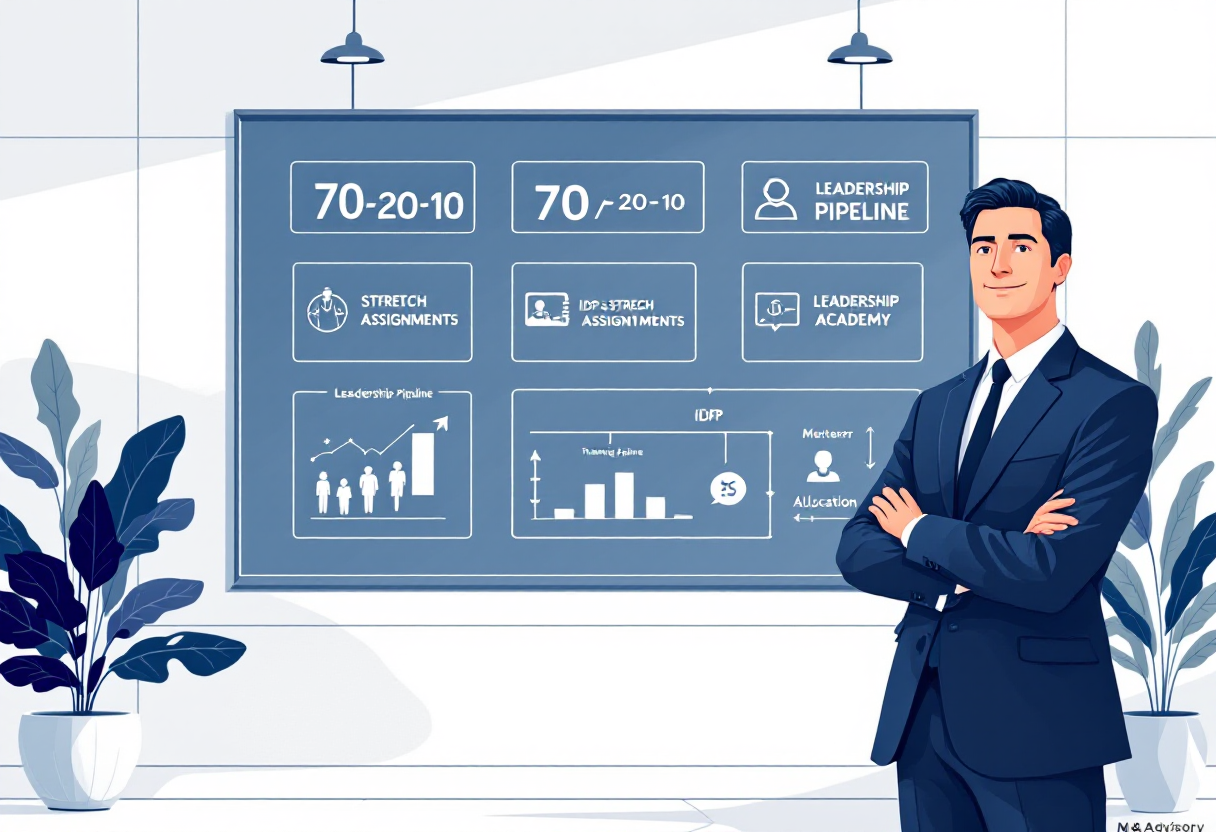
The question of how succession planning supports an organization’s strategic training plan is really a question about where the training budget gets pointed. A company that runs succession well does not spread its L&D dollars evenly across the workforce. It concentrates 60 to 70 percent of executive-development spend on the 5 to 15 percent of employees who are named successors to critical roles. ATD’s 2025 State of the Industry Report put average per-employee learning spend at $1,280 across all roles, but companies with mature succession programs spend $15,000 to $50,000 per high-potential per year, because that is where the return on training capital is largest. The succession plan is the targeting system. The training plan is the delivery system. When they are wired together, you build the bench. When they run separately, you spend money on courses that produce no successors.
Selling and worried buyers will see a thin development pipeline behind your named successors?
CT Acquisitions represents 500+ active buyers and knows exactly which L&D evidence makes diligence teams lean in. No fee to you on buy-side introductions; sell-side mandates are paid on success at closing.
Book a Free ConsultationWhy the Two Plans Have to Be One System
Most mid-market companies run succession and L&D as separate workstreams. HR business partners maintain the succession deck. The L&D team runs an annual training catalog, sends people to off-site programs, and tracks completion rates. The two groups meet maybe twice a year. The result is that named successors often receive the same generic leadership courses as everyone else, while the specific capability gaps that would actually make them ready (a P&L tour, a board exposure assignment, an M&A integration role) never get planned and funded.
DDI’s 2025 Global Leadership Forecast surveyed 13,695 leaders and 2,185 HR professionals across 50 countries and found that only 28 percent of organizations rate their leadership-development programs as effective at building bench strength. The 28 percent is not random. DDI’s finer-grained data shows that the effective programs share one structural trait: the succession plan dictates the development plan, not the other way around. A named successor for the COO role gets a development plan built backward from the COO competency model, not forward from whatever leadership course is on the calendar this quarter.
For owner-CEOs preparing to sell, this matters because buyers’ diligence teams ask the question directly. “Show me the development plan for your named successor to the CFO role. Show me what they have completed in the last 12 months, what stretch assignment they are on now, and what readiness gap remains.” If the answer is “they attended our annual leadership offsite,” that is a discount signal. If the answer is “they ran the integration of our most recent tuck-in acquisition for nine months, they sit on the audit committee as a non-voting observer, and their gap is treasury and investor relations, which they are closing through a six-month rotation with our outside CFO advisor,” that is a premium signal.
The 70-20-10 Model and Why Training Budgets Get Misallocated
The 70-20-10 model, developed by Morgan McCall, Michael Lombardo, and Robert Eichinger at the Center for Creative Leadership in the 1980s and refined into the Lominger framework, holds that effective leadership development comes 70 percent from on-the-job experience, 20 percent from coaching and mentoring relationships, and 10 percent from formal training and classroom learning. CCL’s 2025 research re-validated the model across 191,000 leadership-program alumni and found the proportions still hold within plus-or-minus 5 percentage points.
The practical problem is that most training budgets are spent in inverse proportion. ATD’s 2025 State of the Industry Report shows that 62 percent of corporate L&D spend goes to formal classroom and e-learning content, 24 percent to coaching and mentoring program infrastructure, and only 14 percent to the design and support of stretch assignments and rotational programs. Companies are spending the bulk of their development dollars on the activity that produces the smallest portion of actual capability growth.
A succession-integrated training plan flips the spend allocation to match where learning actually happens:
| Development Mode | Typical L&D Spend | Succession-Integrated Spend | What It Looks Like |
|---|---|---|---|
| On-the-job (70%) | 14% | 50 to 60% | Stretch assignments, P&L rotations, M&A integration roles, board exposure, special projects with measurable outcomes. |
| Coaching and mentoring (20%) | 24% | 25 to 30% | 1:1 executive coaching at $400 to $800 per hour, peer cohorts, sponsor relationships with board members or senior executives. |
| Formal training (10%) | 62% | 10 to 15% | Targeted classroom programs (negotiation, finance for non-financial leaders, governance), university executive education, certifications. |
The reallocation does not require a bigger budget. It requires that the named successor list, with capability gaps documented per individual, drives where the existing budget gets pointed. The L&D team stops being a course catalog and becomes a development engineer.
How Succession Plans Drive Training Budget Allocation
The mechanic is straightforward once the succession plan exists at sufficient detail. For each critical role, the plan names two to three successors with readiness horizons (ready now, ready in one to two years, ready in three-plus years). For each successor, the plan documents specific capability gaps measured against the target-role competency model. The training plan then allocates spend per individual against those gaps.
A worked allocation example, for a fictional 28M revenue distribution business with a 9.8M EBITDA, preparing for sale in 24 months:
- CEO successor (current COO, ready in 12 to 18 months): $48,000 development investment. Includes 80 hours of executive coaching at $550 per hour ($44,000), a 6-month rotation as interim GM of the Southeast region with full P&L, and one Harvard Business School AMP-equivalent short course ($14,000, partially budgeted in prior year). Stretch-assignment value is not in the cash line, but the opportunity cost of pulling them out of COO duties is significant.
- CFO successor (current Controller, ready in 18 to 24 months): $32,000. Includes CPA-CGMA continuing education ($4,000), an external coach focused on board-presentation skills ($18,000), and tuition reimbursement for a Wharton executive program in corporate finance ($10,000).
- CRO successor (current VP Sales, ready in 12 months): $26,000. Includes a Korn Ferry leadership assessment and feedback cycle ($8,000), a 12-month executive coach focused on enterprise selling and channel strategy ($16,000), and a national sales-leadership conference ($2,000).
- VP Operations successor (current Plant Manager at the Atlanta facility, ready in 24 to 36 months): $19,000. Includes Lean Six Sigma Black Belt training ($7,000), an external coach ($10,000), and an APICS supply chain certification ($2,000).
- Total executive-development spend on 4 named successors: $125,000.
- Total L&D budget at the company: $340,000 across 218 employees, or $1,560 per employee average.
- Concentration: 37 percent of total L&D spend on 1.8 percent of headcount, the four named successors. The remaining 63 percent of the budget funds compliance training, sales enablement, technical certifications, and frontline supervisor development across the rest of the workforce.
The numbers above are illustrative but consistent with what CT Acquisitions observes in pre-sale companies in the 5M to 25M EBITDA range that have moved past stage 3 maturity on succession (see our companion piece on succession planning vs succession management). The headline is that succession-driven concentration of training spend produces measurable readiness movement on the named successors, which is exactly what buyers’ diligence teams want to see.
Stretch Assignments: The 70 Percent That Actually Builds Leaders
Mercer’s 2025 Global Talent Trends survey of 12,200 executives reported that 78 percent of senior leaders promoted into C-suite roles credit a single stretch assignment, typically the first time running a P&L independently or leading a transformation initiative, as the experience that made them ready. CCL’s 2025 longitudinal study of 4,400 executives reached a similar conclusion: cross-functional rotations and P&L ownership predict promotion readiness more strongly than any classroom intervention or coaching engagement.
The categories of stretch assignment that produce the highest readiness signal, in order of impact based on CCL and Mercer 2025 data:
- P&L ownership. Running a business unit, region, or product line with full revenue and cost responsibility for a minimum of 12 months. The successor learns to read a balance sheet under pressure, hire and fire, allocate capital, and live with the consequences of their decisions. This is the single highest-impact stretch for any general-management successor.
- Cross-functional rotation. Moving a finance leader into operations, a sales leader into marketing, or an engineering leader into customer success for 9 to 18 months. The successor builds enterprise perspective and stops thinking in functional silos. Required for any CEO or COO succession.
- M&A integration team assignment. Leading or co-leading the integration of an acquired company. Compresses years of organizational-change experience into 6 to 12 months. Tests negotiation, prioritization, communication, and resilience under genuine ambiguity.
- Board exposure. Presenting to the board on a substantive topic at least quarterly, observing audit-committee meetings, or sitting on a not-for-profit board as a development assignment. Builds governance fluency and executive presence in front of skeptical audiences.
- Turnaround or fix-it assignment. Taking over an underperforming function, region, or product and being measured on the recovery. High-risk for the individual but the highest-signal experience for the organization. Reveals whether the successor can perform under genuinely adverse conditions.
- Startup or new-market launch. Building a function, business line, or geographic entry from zero. Tests entrepreneurial range and willingness to operate without a playbook.
- Customer-facing escalation lead. Owning the company’s worst customer or supplier relationships for a defined period. Builds negotiation and crisis-management muscle.
The mechanics of running stretch assignments well is where most companies fail. The assignment has to be real (not a shadow role), it has to have measurable outcomes (P&L results, project milestones, customer-satisfaction scores), it has to have a defined duration (typically 9 to 18 months), and it has to have a structured debrief (with the executive sponsor, the CHRO, and the successor’s coach). Heidrick and Struggles’ 2025 CHRO Survey found that only 31 percent of stretch assignments at Fortune 500 companies include a formal debrief, which is why so many produce ambiguous development signal.
Talent-Review-to-IDP Linkage: The Quarterly Operating Rhythm
The 9-box talent review is the diagnostic. The individual development plan, or IDP, is the prescription. The quarterly check-in is the dosing schedule. Without all three operating as a single loop, the succession plan and the training plan never actually connect.
The cadence that works at mid-market scale (200 to 2,000 employees):
- Semi-annual 9-box calibration. The executive committee meets for a full day twice a year. Each functional leader brings their team’s draft 9-box. Peers challenge placements (“you have her in the top-right but she has not led anything outside finance”). The CEO and CHRO facilitate. Output is a calibrated 9-box across all VP-plus roles, plus an updated list of high-potentials.
- IDP refresh within 30 days of calibration. Every named successor and every high-potential gets an IDP refresh tied to the calibrated 9-box outcome. The IDP names specific capability gaps, the development moves that will close them (training, coaching, stretch), the target completion dates, and the sponsor accountable for each move.
- Quarterly check-in between successor and sponsor. Each named successor meets monthly with their direct manager and quarterly with their executive sponsor (typically a board member or another C-suite executive who is not their boss). The quarterly meeting reviews IDP progress, surfaces obstacles, and adjusts the development plan if the stretch assignment is not producing the expected learning.
- Quarterly succession review on the executive committee calendar. Standing 90-minute meeting. Each critical-role owner walks through the readiness status of their named successors, what development moves happened in the last 90 days, what gaps remain, and the next 90-day moves. CHRO maintains a live readiness scorecard updated every quarter.
- Annual board-level talent review. The full board reviews the top two layers (C-suite plus VPs), discusses key-person risk, and approves the succession plan for the coming year. In companies with a talent or compensation committee, this becomes a standing committee responsibility.
The cadence is what separates active succession management from documentation. SHRM’s 2025 Talent and Succession Research Report found that organizations running the full quarterly-talent-review cadence produce internal promotions for 71 percent of executive openings, against 38 percent for organizations with annual-only reviews. The difference is not the talent. It is the operating rhythm.
Leadership Academy Structures: How the Best Programs Are Built
Companies above a certain scale (typically 5,000 employees or 1B in revenue) build internal leadership academies as the institutional home for the 70-20-10 model. The academy is not a course catalog. It is a designed system that combines selection, curriculum, stretch placement, coaching, and a cohort experience over 12 to 36 months. The most-studied examples each have a distinctive design philosophy worth understanding.
GE Crotonville (now operating as the GE Leadership Institute)
The Crotonville campus in Ossining, New York, operated as the model corporate leadership academy from 1956 onward and trained over 100,000 GE leaders before the 2022 GE business split. The signature programs were the Executive Development Course (4 weeks, for top-tier high-potentials), the Business Manager Course (3 weeks, for new general managers), and the Manager Development Course (2 weeks, for new managers). Crotonville’s design integrated CEO and senior executive teaching (Jack Welch personally taught Crotonville classes for 21 years), action-learning projects with real business outcomes, and a deliberate cohort experience that produced lifetime networks. The model has been studied by HBR, Stanford GSB, and INSEAD as the most influential corporate leadership-development structure of the 20th century. The campus continues to operate under GE Aerospace and the Crotonville curriculum has been licensed or adapted by dozens of companies.
McKinsey “Obligation to Dissent” and the Alumni Network
McKinsey does not run a leadership academy in the GE sense. It runs a partner-development system built around the apprenticeship model, the formal “obligation to dissent” principle, and the structured up-or-out partnership track. New consultants get 14 to 21 days of formal training in their first two years, but the bulk of development happens through engagement staffing decisions made deliberately to stretch capability. The alumni network, with over 38,000 members in 2025, functions as a sponsorship system that places former consultants into client-side executive roles and feeds the pipeline back to the firm. Heidrick and Struggles’ 2025 CHRO Survey reported that 19 percent of Fortune 500 CHROs are McKinsey alumni, the highest representation of any single firm.
Goldman Sachs Partner-Track Program
Goldman’s partner-selection process, biennial since 1999, is one of the most rigorous succession-and-development structures in any industry. The “cross-ruffing” interview process puts each partner candidate through 50 to 75 confidential interviews with current partners, who collectively decide the new partner class. Selection is preceded by 8 to 15 years of structured development through analyst, associate, vice president, and managing director roles, each with defined competency requirements and rotation expectations. The Goldman Pine Street Leadership Development program, established in 1999, runs the formal classroom and coaching layer that supports the apprenticeship and selection system.
Bain MBB Rotation and Leadership Lab
Bain’s leadership pipeline relies on deliberate engagement rotation across industry and capability practices, the Bain Leadership Lab for senior managers and principals, and external rotation through portfolio company executive roles or fellowships. Bain reports an 18-percent internal promotion rate to managing director annually, with average tenure to MD of 9.5 years. The combination of structured rotation and visible up-or-out cadence produces a partner class that has run multiple practice areas before reaching MD.
The Mid-Market Equivalent
Mid-market companies cannot fund a Crotonville. But they can build a scaled-down version. The components that translate:
- Annual high-potential cohort, 8 to 16 people. Selected through the 9-box calibration, sponsored by the CEO, with a kickoff retreat (1 to 2 days), monthly cohort sessions (half-day each), and a capstone project tied to a real business challenge.
- External university partnership. A regional business school (UNC Kenan-Flagler, Emory Goizueta, Notre Dame Mendoza, USC Marshall, and others) typically delivers a 6-month or 12-month custom program for $200K to $600K total, $25K to $50K per participant.
- Executive coaching for each cohort member. 6 to 12 months of 1:1 coaching at $400 to $800 per hour, typically 2 hours monthly, $10K to $20K per participant per year.
- Deliberate cross-functional rotation during the cohort year. Each participant takes on a project or assignment outside their function. The cohort holds quarterly check-ins where rotation experiences are shared, debriefed, and used as case material.
- Annual board exposure for the top quartile of the cohort. Presenting a project outcome to the board or sitting in on a board meeting as a development assignment.
The total cost runs $400K to $1.2M annually for a 12-person cohort, which is achievable for any company above $50M revenue. The output, measured over a 5-year window, is typically that 6 to 9 of the 12 cohort members are promoted into VP or C-suite roles internally, and 2 to 4 either leave for larger roles externally or move sideways into specialist tracks.
Coaching and Mentoring Program Design
The 20 percent of the 70-20-10 model is the layer most companies under-design. Coaching is treated as a perk or a remediation tool rather than a deliberate development mechanism for succession candidates. Mentoring programs are run as good-intent matchmaking with no structure. The result is that the coaching and mentoring spend produces ambiguous outcomes and gets cut first when budgets tighten.
The distinctions that matter for succession-integrated program design:
1:1 Executive Coaching
External executive coaches are the gold-standard layer for named successors approaching C-suite roles. Market rates in 2025 to 2026 run $400 to $800 per hour for ICF-credentialed coaches, $800 to $1,500 per hour for ex-CEO or ex-PE-operating-partner coaches, and $1,500 to $3,500 per hour for the top-tier executive coaching firms (Mobius Executive Leadership, The Leadership Circle, Hudson Institute). Typical engagement is 12 months, 2 hours monthly, $12K to $40K all-in per coachee. The coach reports to the coachee, not the company, with sponsor check-ins quarterly.
Group Coaching and Peer Cohorts
Group coaching at 1:6 ratio runs $1,800 to $3,500 per participant per year for a high-quality external coach. The structure is monthly 90-minute group sessions where each participant brings a real business challenge for peer-and-coach feedback. The hidden value is the peer cohort itself, which becomes a lifetime development network. CCL’s 2025 alumni data shows that cohort networks built during leadership development continue to function as development resources for 8 to 15 years post-program.
Mentorship vs Sponsorship
Mentorship is advice. The mentor offers perspective, opens doors when asked, and meets the mentee on the mentee’s schedule. Sponsorship is advocacy. The sponsor uses their political capital to advance the sponsee’s career, names them for stretch assignments, defends them in talent calibration meetings, and feels personally accountable for their advancement. DDI’s 2025 data shows that women and underrepresented-minority leaders who advance to C-suite roles are 4.2x more likely to have had a sponsor (not just a mentor) than peers who plateau at VP. Formal sponsorship programs are a deliberate part of mature succession systems. Sponsors are assigned, not requested, and the assignment includes specific advancement goals over a 24-month horizon.
Reverse Mentorship
Senior executives mentored by junior employees on specific topics (digital transformation, AI adoption, generational workforce shifts) was popularized by GE under Jack Welch in 1999 and re-validated in LinkedIn’s 2025 Workplace Learning Report as one of the highest-rated development experiences for senior leaders. Cost is essentially zero. The program design discipline is matching, structure, and time protection.
ROI Measurement: What Buyers and Boards Actually Track
The succession-to-training integration produces measurable outcomes that are now standard diligence asks from PE buyers and board-level governance reviews. The metrics that matter:
| Metric | Definition | Healthy Target | Source / Benchmark |
|---|---|---|---|
| Succession-bench depth | Percent of critical roles with at least one ready-now successor and one ready-in-2-years successor | 80%+ on top 2 layers | DDI 2025 Global Leadership Forecast |
| Internal promotion rate | Percent of executive openings filled internally over a rolling 24 months | 70 to 75% | SHRM 2025 Talent and Succession Research |
| High-potential retention | Annual retention rate among employees identified as high-potential in the most recent 9-box | 92%+ (vs 78% all-employee benchmark) | LinkedIn 2025 Workplace Learning Report |
| Time-to-readiness reduction | Change in average readiness horizon (ready-now, 1-2 years, 3+ years) across the successor pool year over year | 10 to 15% improvement annually | Mercer 2025 Global Talent Trends |
| Development plan completion | Percent of named successors with an IDP that has at least one stretch assignment, one coaching engagement, and quarterly progress documentation | 95%+ | ATD 2025 State of the Industry |
| Per-high-potential investment | Annual L&D spend per named high-potential, all-in (coaching, training, stretch-support, tuition) | $15K to $50K depending on role tier | ATD 2025 State of the Industry |
| Cost per filled critical-role vacancy | Fully loaded cost (search fees, transition cost, productivity drag) per critical-role fill | $45K to $90K internal vs $250K to $480K external | Heidrick and Struggles 2025 CHRO Survey |
The cost-per-fill differential is the single most compelling ROI calculation for boards skeptical of L&D spend. A 150K investment in internal succession development over 18 months that produces one ready successor saves the company 200K to 400K on the executive search alone, plus 9 to 14 months of productivity drag during an external onboard. On a sale, the same investment supports a 0.5x to 1.0x EBITDA multiple lift, which on a 10M EBITDA business is 5M to 10M of enterprise value (see our breakdown in what is the importance of succession planning).
Worked Example: Building an 18-Month Integrated Plan
Consider a fictional regional commercial-services company, Sentry Facility Solutions, doing 42M revenue and 8.4M EBITDA. Founder-CEO is 61 and wants to sell in 24 months. The current L&D spend is 285K annually across 312 employees ($913 per head average), with no concentration on succession candidates. The current succession plan names successors for the C-suite but has no IDPs, no quarterly reviews, and no documented stretch assignments. Here is the 18-month integration plan.
- Months 1 to 2: Diagnostic. CHRO and external consultant audit current state. Build the calibrated 9-box across VP-plus (38 people). Identify 4 named successors for C-suite roles, 8 named successors for VP roles, and 4 emerging high-potentials in director-level positions. Document specific capability gaps per individual against target-role competency models.
- Month 3: IDP and budget reallocation. Build IDPs for all 16 named successors and high-potentials. Reallocate L&D budget: hold total at 285K but shift 110K from generic leadership courses to per-individual stretch, coaching, and targeted training for the 16. Generic-workforce L&D drops from 220K to 110K (still funds compliance, sales enablement, technical certs, frontline supervisor training).
- Months 4 to 6: First stretch placements and coaching launches. COO-successor takes 12-month interim GM role for the Atlanta region. CFO-successor begins board-presentation coaching engagement. VP Sales successor enrolls in an enterprise-selling certification. The 4 director-level high-potentials each take on a cross-functional project lead role.
- Month 7: First quarterly succession review. Executive committee reviews readiness status, IDP progress, and stretch-assignment outcomes for the first quarter. Adjustments made to two IDPs based on early stretch-assignment signal.
- Months 8 to 12: Second calibration and second stretch round. Re-calibrate 9-box (semi-annual). Document changes from first calibration. Second round of stretch assignments: COO-successor takes on integration lead for a small tuck-in acquisition. CFO-successor begins observing audit committee meetings. Two of the director-level high-potentials promoted into VP roles based on stretch-assignment performance.
- Months 13 to 18: Third and fourth quarterly reviews, board presentation. Two more quarterly succession reviews. Annual board-level talent review at month 15. By month 18, succession bench depth at 82 percent on top two layers, internal promotion rate over the prior 12 months at 73 percent, average time-to-readiness reduced by 14 percent year over year. Documentation package built for the eventual CIM.
Cost of the 18-month build: approximately 180K incremental cash (external coaches, consultant facilitation, two stretch-related travel and tooling line items), plus internal time roughly equivalent to one-quarter FTE of CHRO over the period. Against a 24-month sale at 9x EBITDA (75.6M base case) where active succession management supports a 0.7x multiple bump, the L&D-and-succession integration adds approximately 5.9M of enterprise value at close. ROI on the 180K of incremental spend is 33x.
Common Mistakes
Treating L&D as a Course Catalog
The most common mistake is running L&D as a menu of generic offerings (annual leadership offsite, online certification library, ad-hoc tuition reimbursement) rather than as a delivery mechanism for individual development plans tied to succession. Named successors should get a tailored development program built backward from the target-role competency model, not the same offsite everyone else attends.
Funding Formal Training Over Stretch and Coaching
The 70-20-10 evidence is 40 years old and re-validated annually. Spending 62 percent of budget on the 10 percent of learning channel will not build leaders. Reallocate to stretch and coaching. The numbers do not require argument anymore.
Naming a Successor With No IDP
A successor name on a slide without an individual development plan, a sponsor, and a stretch assignment is fictional readiness. Buyers’ diligence teams know this and ask for the artifacts.
Running the Talent Review and the L&D Plan as Separate Workstreams
The talent review output (calibrated 9-box, identified high-potentials, capability gaps) has to drive the L&D plan input. If the L&D team builds a calendar of programs and then the succession team picks from it, the integration is backward.
Ignoring Sponsorship
Mentorship without sponsorship produces career advice without career advancement. For named successors, the sponsor relationship is non-negotiable. Assign sponsors deliberately, hold them accountable, and measure outcomes.
Cutting Coaching Budget First
When budgets tighten, executive coaching is often cut first because the ROI is harder to point at than a completed course. The CCL and DDI longitudinal data is unambiguous: coaching is one of the highest-ROI development investments for named successors. Protect it.
No Measurement
If the program does not track succession-bench depth, internal promotion rate, high-potential retention, and time-to-readiness, then there is no way to know whether the L&D spend is producing succession outcomes. Boards and PE buyers ask for these metrics now as standard.
Frequently Asked Questions
What is the right ratio of training spend on succession candidates vs the broader workforce?
For executive-development spend (coaching, leadership academy, stretch-assignment support), 60 to 70 percent should concentrate on the 5 to 15 percent of employees who are named successors and high-potentials. The rest of the L&D budget appropriately funds compliance, technical certifications, sales enablement, and frontline supervisor training across the broader workforce. ATD’s 2025 benchmark for per-high-potential investment is $15K to $50K annually, against a $1,280 all-employee average.
How do you build IDPs for named successors at scale?
The IDP template should include the target role, the competency model for that role, the specific capability gaps documented against the model, the development moves (stretch, coaching, training) that will close each gap, the target completion dates, the executive sponsor accountable for each move, and quarterly progress notes. Most HRIS modules (Workday Succession and Development, SAP SuccessFactors, Oracle HCM) include IDP functionality. For companies under 500 employees, a structured spreadsheet template works.
What is the difference between a mentor and a sponsor in a succession program?
A mentor offers advice and perspective. A sponsor uses their political capital to advance the sponsee’s career, names them for stretch assignments, defends them in talent calibration meetings, and feels personally accountable for their advancement. DDI 2025 data shows sponsorship is 4.2x more predictive of C-suite advancement than mentorship alone for women and underrepresented-minority leaders.
How long do executive coaching engagements typically run, and what does the spend look like?
Standard executive coaching engagement for a named successor runs 12 months, 2 hours monthly, with quarterly sponsor check-ins. ICF-credentialed coaches charge $400 to $800 per hour. Ex-CEO or ex-PE-operating-partner coaches charge $800 to $1,500 per hour. Top-tier firms (Mobius, The Leadership Circle, Hudson) charge $1,500 to $3,500 per hour. All-in annual investment is typically $12K to $40K per coachee.
Does a small business with 50 employees need a leadership academy?
No, but the principles apply at any scale. A 50-person company can run quarterly succession reviews, build IDPs for 3 to 5 named successors, fund 1:1 executive coaching for the founder’s successor at $20K per year, and provide 1 to 2 stretch assignments per successor per year. The total cost is $30K to $80K annually, achievable for any profitable small business. The formal cohort, custom university partnership, and leadership-academy infrastructure are only justifiable at $50M+ revenue.
What metrics should the board see annually on succession and L&D integration?
Succession-bench depth (percent of critical roles with named ready-now and ready-soon successors), internal promotion rate (rolling 24 months), high-potential retention rate, time-to-readiness movement year over year, IDP completion rate, per-high-potential L&D investment, and cost per filled critical-role vacancy (internal vs external). The Heidrick and Struggles 2025 CHRO Survey shows these are now the standard board-pack metrics at Fortune 500 talent committees.
How does AI-driven L&D fit into a succession-integrated program?
LinkedIn’s 2025 Workplace Learning Report shows that AI-personalized learning paths are now used by 47 percent of enterprise L&D teams, primarily for the 70 percent of the workforce that is not on the succession track. For named successors, AI-driven content recommendation is useful at the 10 percent (formal training) layer, but the 70 percent (stretch) and 20 percent (coaching) layers remain fundamentally human-designed. AI does not replace the executive sponsor relationship or the deliberate placement of a successor into a P&L assignment.
What to Do Next
If you are an owner-CEO planning to sell in the next 18 to 36 months and your L&D and succession plans are running on separate tracks, the single highest-impact move is to reallocate executive-development spend behind your named successors and run the first calibrated 9-box. SHRM, DDI, CCL, ATD, Mercer, and Heidrick and Struggles all converge on the same finding: organizations that integrate succession and training spend produce 70 to 75 percent internal promotion rates, 92 percent-plus high-potential retention, and 10 to 15 percent annual reduction in time-to-readiness. Buyers’ diligence teams now ask for those exact metrics. The companies that have them close at premium multiples. The companies that do not absorb the discount.
For the broader frame on what succession means at the company level, see our guide on the importance of succession planning. For the distinction between planning as documentation and management as an operating program, see our companion guide on succession planning vs succession management. If you are preparing your business for sale generally, our sell-your-business hub covers the full pre-sale preparation framework, of which succession-and-L&D integration is one of the highest-ROI workstreams.
Want a buyer’s-eye view of how your L&D and succession integration will read in diligence?
CT Acquisitions represents 500+ active buyers across PE platforms, family offices, and strategic acquirers. We can tell you in 30 minutes what your current bench-and-development posture will cost you at the negotiating table, and what the highest-ROI fixes are in the time you have before sale. No fee to you on buy-side introductions; sell-side mandates are paid on success at closing.
Book a Free ConsultationRelated reading: What Is the Importance of Succession Planning | Succession Planning vs Succession Management | Sell Your Business