
How Does LIBOR Impact Private Equity Funds: SOFR Transition Guide (2026)
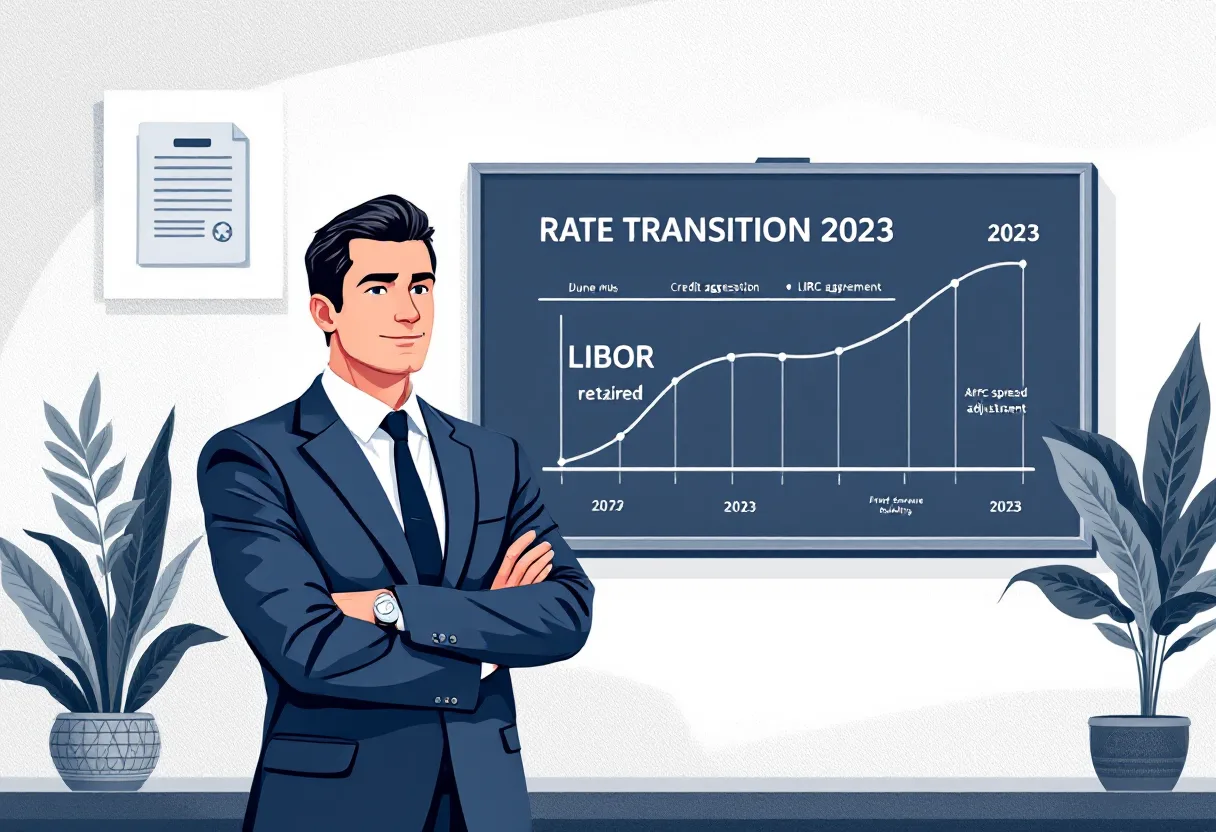
The question of how does LIBOR impact private equity funds is now a historical one with active consequences: LIBOR was permanently retired on June 30, 2023, but billions of dollars of legacy buyout loans, NAV facilities, and subscription lines still carry fallback language that ties them back to the old benchmark. The Loan Syndications and Trading Association (LSTA) reported that as of Q1 2025, more than 98 percent of the syndicated loan market had transitioned to the Secured Overnight Financing Rate (SOFR), with the residual 2 percent stuck in workout, amendments, or restructuring scenarios where LIBOR-era covenants still drive economics.
Selling a PE-backed business in the post-LIBOR market?
The shift from LIBOR to SOFR changed how syndicated loans price, how covenants trip, and how acquirers model debt service. We work with founders selling into PE buyers and structure deals around the new floating-rate reality. No fee to you on buy-side introductions; sell-side mandates are paid on success at closing.
Book a Free ConsultationWhat This Actually Means
The London Interbank Offered Rate, known as LIBOR, was for four decades the dominant floating-rate benchmark for global syndicated loans. Roughly 90 percent of pre-2022 LBO credit agreements priced their term loans and revolvers as LIBOR plus a spread, with LIBOR refreshed every one, three, or six months. When the Financial Stability Board (FSB) announced in 2017 that LIBOR would be phased out, the entire private equity capital stack, from fund-level subscription lines to portfolio company senior debt to mezzanine paper, faced a benchmark replacement problem with no clean precedent.
Private equity funds touch LIBOR in four distinct places: portfolio company debt (the LBO loans that finance acquisitions), fund-level NAV facilities (credit lines secured against the fund’s net asset value), capital call subscription lines (short-term financing against LP commitments), and derivative hedges (interest rate swaps and caps that protect against rate moves). Every one of these instruments needed to be repapered or amended to reference SOFR or another approved successor rate before the June 30, 2023 cessation date. The Alternative Reference Rates Committee (ARRC), convened by the Federal Reserve in 2014, published the framework that the U.S. dollar market eventually adopted.
The practical impact on PE funds shows up in three ways. First, base rates moved: SOFR is a transaction-based overnight rate, while LIBOR was a forward-looking term rate built from bank submissions. Second, credit spreads widened on legacy paper that required amendment, with consent fees adding 5 to 25 basis points to typical deals according to LSTA market data. Third, the manipulation risk that drove LIBOR’s demise (the 2008-2013 rate-rigging scandal that produced more than 9 billion dollars in regulator fines per the Federal Reserve Bank of New York’s enforcement summary) is now structurally lower because SOFR is built from approximately 1.5 trillion dollars of daily Treasury repo transactions rather than survey responses from 16 reporting banks.
The Eight Things You Need to Understand About LIBOR’s Impact on PE
1. What LIBOR Was and Why It Died
LIBOR was published daily by the ICE Benchmark Administration in five currencies and seven tenors, derived from a panel of contributing banks reporting where they could borrow unsecured from each other. The flaw was structural: by the late 2000s, the unsecured interbank lending market had thinned to near zero, so panel banks were submitting estimates rather than observed transactions. The 2008-2013 manipulation scandal revealed that traders at Barclays, UBS, Deutsche Bank, Royal Bank of Scotland, and others had been adjusting submissions to benefit derivative positions. Combined enforcement actions exceeded 9 billion dollars per the Federal Reserve’s published settlement record, and criminal convictions followed in the UK and US.
The FSB announced in July 2017 that regulators would no longer compel panel banks to submit LIBOR quotes after end-2021, later extended to June 30, 2023 for the most-used USD tenors (1-month, 3-month, and 6-month). The extension gave the market 18 additional months to remediate legacy contracts. ARRC, established by the Federal Reserve Board and the Federal Reserve Bank of New York, identified SOFR as the recommended successor in 2017 and published its final fallback recommendations between 2019 and 2023.
2. The SOFR Replacement
SOFR, the Secured Overnight Financing Rate, is calculated by the Federal Reserve Bank of New York based on actual transactions in the Treasury repurchase market. Per the New York Fed’s published methodology, SOFR draws on three segments of the repo market: tri-party general collateral, GCF Repo, and bilateral Treasury repo cleared through the Fixed Income Clearing Corporation. The combined daily volume averaged 1.6 trillion dollars in 2025 per New York Fed data, compared with the roughly 500 million dollars per day of unsecured interbank lending that supported 3-month LIBOR in its last years.
The structural difference matters for PE funds in three ways. SOFR is overnight, not term, so a 3-month SOFR rate must be constructed either by compounding daily SOFR over the period (the “in arrears” approach) or by deriving a forward-looking rate from SOFR futures (the “Term SOFR” approach published by CME Group). SOFR is secured by Treasuries, so it does not carry the bank credit risk premium that LIBOR did, which is why a credit spread adjustment was needed. And SOFR is published one business day in arrears, which changes payment mechanics on loan documentation.
3. The Credit Spread Adjustment (CSA)
Because SOFR is a secured rate and LIBOR was unsecured, switching a loan from LIBOR to SOFR without adjustment would systematically underpay lenders by the implicit bank credit premium. ARRC analyzed historical spreads and recommended fixed credit spread adjustments using a 5-year median calculation: 11.448 basis points for 1-month, 26.161 basis points for 3-month, and 42.826 basis points for 6-month, per ARRC’s final recommendations published in 2021. These are the “ARRC CSA” or “ISDA spread adjustments” and they were codified for federal law-governed contracts by the Adjustable Interest Rate (LIBOR) Act of 2022 (Pub. L. 117-103), signed in March 2022.
For a typical PE-owned business with a 200 million dollar term loan at LIBOR plus 450 basis points, the transition added roughly 26 basis points to the 3-month tenor, meaning the new all-in rate became SOFR plus approximately 476 basis points. On a 200 million dollar loan, that is about 520,000 dollars of additional annual interest expense compared with a clean LIBOR carryover, before any other credit-spread renegotiation. ISDA’s 2025 Benchmark Reform progress report confirmed that more than 99 percent of derivative contracts referencing legacy USD LIBOR have now been amended or expired.
4. LBO Loan Repricing and Amendment Mechanics
The 2020 ARRC “hardwired” fallback language, adopted by LSTA in its model credit agreement, automated the LIBOR to Term SOFR conversion. Loans with hardwired fallbacks transitioned mechanically on the cessation date without lender consent. The problem: most pre-2020 LBO loans used “amendment approach” fallbacks, which required active negotiation between the borrower and the agent bank, often subject to majority lender consent. LSTA estimated that approximately 70 percent of syndicated loans outstanding in mid-2022 had amendment-approach fallbacks, creating a remediation crunch in 2022 and the first half of 2023.
For PE sponsors, the amendment process meant negotiating with lender groups during a rising-rate cycle, when banks had control to extract additional concessions. Typical 2022-2023 LIBOR-to-SOFR amendments added 5 to 25 basis points of consent fee on top of the ARRC CSA, per LSTA market commentary. Some sponsors paired the SOFR amendment with covenant relief or extension requests, packaging multiple changes into a single fee event.
5. Term SOFR vs Daily Compounded SOFR
The institutional loan market converged on CME Term SOFR for most PE-owned company debt, while the derivatives market and some bank-syndicated investment grade loans use compounded SOFR in arrears. Term SOFR is published in 1-month, 3-month, 6-month, and 12-month tenors by CME Group, derived from SOFR futures and OIS swaps. It is forward-looking, set at the start of the interest period, and operationally identical to how LIBOR was used. Daily compounded SOFR is calculated by taking the daily SOFR rates over the interest period and geometrically compounding them, set at the end of the period.
The reason this matters for PE economics: Term SOFR is easier to operationalize, easier to hedge with vanilla swaps, and easier to forecast for debt service models. Daily compounded SOFR is more accurate (it reflects actual realized overnight rates over the period) and slightly cheaper from a basis-risk perspective, but it requires more sophisticated treasury operations. By 2025, LSTA data showed approximately 95 percent of syndicated institutional loans referenced Term SOFR, with the remaining 5 percent on simple or compounded SOFR variants.
6. Impact on GP and LP Economics
For the general partner (GP), the LIBOR transition increased deal-by-deal due diligence work and amendment costs that were typically charged to the fund as deal expenses. Larger sponsors with 50-plus active portfolio company loans faced cumulative remediation costs of low millions to low tens of millions of dollars, per Bain & Company’s 2024 private equity report. These costs were generally absorbed by the fund rather than the management company, although the allocation varied by limited partnership agreement (LPA) terms. Our companion piece on What Is Private Equity and How Does It Work dives deeper into this topic.
For limited partners (LPs), the transition was net neutral to mildly positive. The credit spread adjustment ensured that lenders were made whole, so the cost of debt did not jump artificially. The reduction in benchmark manipulation risk improved the integrity of floating-rate exposures across the portfolio. The one downside: SOFR is a secured rate, so during periods of bank stress (like March 2023 with the regional bank failures), SOFR and LIBOR would have diverged, with SOFR falling and LIBOR rising. That divergence would have produced a windfall for borrowers on legacy LIBOR debt and a hit for lenders, which is structurally less likely under SOFR.
7. NAV Facilities and Subscription Lines
Fund-level credit facilities, including subscription lines (secured by LP commitments) and NAV facilities (secured by portfolio NAV), almost universally priced on LIBOR plus 125 to 250 basis points in the pre-2022 era. These facilities transitioned to SOFR alongside portfolio company debt, with most large fund finance lenders (Wells Fargo, Sumitomo Mitsui Banking Corporation, Standard Chartered, ING, MUFG) updating their template credit agreements through 2022. The Fund Finance Association reported that as of 2025, the subscription line market had grown to approximately 800 billion dollars in committed capacity, virtually all SOFR-referenced.
The pricing impact for fund-level facilities was muted compared with LBO loans because credit spreads on subscription lines are tighter and ARRC CSAs represented a larger proportional bump. Some GPs used the transition as an opportunity to renegotiate broader terms, including advance rates against uncalled capital and concentration limits on LP credit quality.
8. Global Benchmarks Beyond SOFR
For PE funds with cross-border portfolios or non-USD denominated debt, the LIBOR transition meant managing multiple successor rates: SOFR in the United States, the Sterling Overnight Index Average (SONIA) in the United Kingdom, the Euro Short-Term Rate (ESTR) in the eurozone, the Tokyo Overnight Average Rate (TONA) in Japan, and the Swiss Average Rate Overnight (SARON) in Switzerland. Each jurisdiction adopted a slightly different transition framework, with the UK’s Financial Conduct Authority taking the most aggressive position (synthetic LIBOR ceased for GBP at end-2024 per FCA guidance) and the European Central Bank coordinating ESTR adoption.
The Bank for International Settlements (BIS) 2024 transition review found that overall global LIBOR transition was largely complete by end-2024, with isolated legacy issues in cross-border syndicated loans, securitizations, and structured finance vehicles. For PE funds running pan-European or pan-Asian platforms, treasury operations now manage four to five separate overnight rate curves rather than a single LIBOR curve, increasing operational complexity and requiring more sophisticated hedging.
Worked Example: A 250 Million Dollar LBO Loan Through the Transition
Consider a fictional portfolio company, Continental Industrial Coatings, acquired by a mid-market PE sponsor in 2019 for 425 million dollars with a 250 million dollar first-lien term loan B priced at LIBOR plus 425 basis points, 0 percent LIBOR floor, 7-year maturity. The loan had amendment-approach LIBOR fallback language.
In 2019, with 3-month LIBOR at approximately 2.10 percent, the all-in rate was 6.35 percent, producing annual interest expense of about 15.9 million dollars. As LIBOR rose in 2022 and 2023, the all-in rate climbed to roughly 9.50 percent by mid-2023 (3-month LIBOR at 5.25 percent plus the 425 basis point spread), producing annual interest expense of about 23.75 million dollars.
In March 2023, the sponsor’s treasury team negotiated a LIBOR to Term SOFR amendment with the agent bank. The terms: convert to 3-month Term SOFR plus 425 basis points, plus the ARRC-recommended 26.161 basis point credit spread adjustment, plus a 10 basis point consent fee added permanently to the spread. The new all-in rate became Term SOFR plus 461.161 basis points. On the cessation date of June 30, 2023, with 3-month Term SOFR at approximately 5.27 percent, the new all-in rate was 9.88 percent, or annual interest expense of about 24.7 million dollars.
The differential cost from the transition was approximately 950,000 dollars per year on a 250 million dollar loan: 36 basis points of additional spread (26 from the ARRC CSA and 10 from the consent fee) times 250 million dollars equals 900,000 dollars, plus the small basis difference between LIBOR and Term SOFR over the period. For the PE sponsor, this is a real but manageable cost that compresses portfolio company EBITDA by roughly 0.4 percent at the operating margin.
If Continental Industrial Coatings is sold in 2026 at a 9.5x EBITDA multiple, the 950,000 dollar annual interest drag translates to approximately 9 million dollars of enterprise value, or about 2 percent of the original 425 million dollar acquisition price. That is the LIBOR-to-SOFR transition cost embedded in the holding-period return for this single deal.
Common Mistakes PE Sponsors and Sellers Make Around LIBOR Transition
Assuming the Transition Is Fully Complete
Most syndicated debt has transitioned, but workouts, restructurings, and stressed credits often still reference LIBOR in their original credit agreements. Buyers conducting diligence on PE-owned businesses should verify the actual interest rate mechanic in the current credit agreement, not assume that the company is on SOFR. LSTA’s 2025 review identified approximately 2 percent of the loan market with unremediated LIBOR exposure, concentrated in distressed and restructuring scenarios.
Confusing Term SOFR with Compounded SOFR
These are different rates with different mechanics. Term SOFR is forward-looking, set at the start of the period. Compounded SOFR is backward-looking, calculated at the end. Treasury models that conflate them will misforecast cash interest payments. Most institutional loan documentation now specifies Term SOFR by reference to CME’s published rate, but earlier 2022 vintage amendments sometimes used simple SOFR or daily compounded SOFR.
Ignoring the Credit Spread Adjustment on Older Hedges
Interest rate swaps and caps that were entered to hedge a LIBOR-based loan need to be reviewed against the underlying loan’s transition mechanics. If the loan transitioned with a 26 basis point ARRC CSA but the swap transitioned via ISDA’s 2020 IBOR Fallbacks Protocol with a different spread, the hedge may no longer perfectly match the loan, creating basis risk. ISDA’s 2025 report indicated that mismatched fallback elections produced minor but measurable basis exposure for some funds.
Treating the LIBOR Act as a Universal Fix
The Adjustable Interest Rate (LIBOR) Act of 2022 only governs federal law and contracts where the parties had no fallback language or where the fallback was deficient. Most syndicated PE loans had at least some fallback language and are governed by New York state law, which has its own LIBOR replacement statute. The two statutes are compatible but not identical, and aggressive borrowers occasionally tested the boundaries during 2023 transitions.
Underestimating the Operational Burden
Moving from monthly or quarterly LIBOR resets to overnight SOFR with backward-looking compounding requires treasury system upgrades. Sponsors with 30-plus portfolio companies often discovered that their general ledger and forecasting tools were not built to handle daily rate compounding, requiring 6 to 12 months of operational remediation. The cost was usually absorbed at the portfolio company level.
Not Repricing Sale-Process Debt Service Models
When selling a PE-owned business, buyer financing models built before mid-2023 may still reference LIBOR conventions. Sellers should ensure that the confidential information memorandum (CIM) and management presentation reflect current SOFR-based debt assumptions, because buyer underwriting will price the new debt on Term SOFR forward curves and an outdated LIBOR-based model can create false expectations about debt capacity and interest coverage.
Timeline: The LIBOR Transition Sequence
Understanding the sequence helps PE professionals contextualize where current LBO loan documents sit:
- July 2017: FSB and UK FCA announce LIBOR phase-out; ARRC identifies SOFR as preferred USD successor.
- April 2018: Federal Reserve Bank of New York begins publishing SOFR daily.
- 2019-2020: ARRC publishes hardwired and amendment-approach fallback language for syndicated loans, bilateral loans, and securitizations.
- March 2021: ICE Benchmark Administration and UK FCA announce specific cessation dates: end-2021 for 1-week, 2-month, and non-USD LIBOR; June 30, 2023 for 1-month, 3-month, and 6-month USD LIBOR.
- March 2022: Adjustable Interest Rate (LIBOR) Act signed into U.S. federal law, providing safe harbor for tough-legacy contracts.
- 2022-Q1 2023: Active remediation period for amendment-approach loans; majority of syndicated loan amendments processed.
- June 30, 2023: USD LIBOR permanently ceases; CME Term SOFR becomes the dominant Term reference for syndicated PE loans.
- 2024: Synthetic USD LIBOR published by ICE Benchmark Administration for tough-legacy holdouts; FCA mandates synthetic GBP LIBOR cessation at end-2024.
- 2025: LSTA reports more than 98 percent of syndicated loan market on SOFR; ISDA reports 99 percent plus of derivatives transitioned.
Frequently Asked Questions
Does LIBOR still exist in any form in 2026?
The original panel-bank LIBOR was permanently retired on June 30, 2023 for USD tenors. The UK Financial Conduct Authority compelled ICE Benchmark Administration to publish a synthetic LIBOR through September 2024 for tough-legacy contracts, but that synthetic rate was discontinued at end-September 2024 per FCA confirmation. As of 2026, there is no published LIBOR. Any contract still referencing LIBOR is reading through to its fallback language or to the LIBOR Act statutory replacement.
How does LIBOR’s retirement affect my LBO debt covenants?
If the credit agreement was amended properly, covenants now reference SOFR-based all-in rates rather than LIBOR-based ones. Maintenance covenants (like maximum control ratios) are unaffected because they reference EBITDA and debt principal, not the floating rate. Interest coverage covenants are technically affected by the level shift from LIBOR to SOFR plus CSA, but the ARRC CSA was sized specifically to keep economic outcomes neutral, so well-drafted amendments did not create unintended covenant pressure.
Is SOFR more or less volatile than LIBOR was?
Overnight SOFR is more volatile day-to-day than LIBOR was, with occasional spikes around quarter-end and year-end balance sheet pressure points (the September 2019 repo spike being the canonical example). However, Term SOFR and compounded SOFR over 1-month or 3-month windows smooth out daily volatility and are comparable in stability to historical LIBOR per Federal Reserve Bank of New York analysis. For PE debt service forecasting, Term SOFR behaves similarly to how LIBOR behaved.
What happens if my legacy credit agreement has no SOFR fallback language?
The LIBOR Act of 2022 provides a statutory replacement: any USD LIBOR contract governed by U.S. law and lacking adequate fallback language automatically transitioned on June 30, 2023 to the Board-selected benchmark replacement, which is SOFR plus the ARRC tenor spread adjustments. Per the LIBOR Act, the statutory replacement is legally binding and protects parties from liability for the transition. New York state has parallel legislation that produces the same result for New York law-governed contracts.
How does SOFR affect interest rate hedging strategy for portfolio companies?
SOFR-based swaps and caps trade with high liquidity in the same tenors as the legacy LIBOR market, and ISDA’s standard documentation now defaults to SOFR. Hedging strategy for PE-owned floating rate debt is operationally similar: buy a cap to limit downside, enter a pay-fixed swap to convert floating to fixed. The pricing of swaps and caps now references the SOFR forward curve rather than the LIBOR forward curve, but the strategic logic is unchanged. Most PE sponsors continue to hedge a portion of floating-rate exposure during periods of rising or volatile rates.
If I am selling a business with PE-style debt financing, does the LIBOR-to-SOFR transition affect valuation?
Indirectly, yes. Buyers underwrite new debt on current SOFR forward curves, and the cost of debt influences the maximum purchase multiple a financial buyer can pay. The transition itself did not materially shift the cost of debt (ARRC CSA was designed to be economically neutral), but the move from a falling-rate to a rising-rate environment in 2022-2024 did increase debt costs and modestly compressed buyout multiples. Read more about how rates affect deal pricing in our guide on how interest rates affect mergers and acquisitions.
Why This Matters If You Are Selling Into a PE Buyer
For founders running businesses that PE firms are actively underwriting, the LIBOR-to-SOFR shift changes three concrete elements of the deal. First, buyer debt commitments are now quoted as SOFR plus a spread, and the spread itself has widened since the 2021 trough. According to LSTA 2025 syndicated loan data, average new-issue spreads for B-rated borrowers were approximately 425 basis points over Term SOFR in 2025, compared with approximately 350 basis points over LIBOR in 2021 for similar credits. That widening is a separate story from the LIBOR transition itself, but it overlaps in time, and many sellers conflate them.
Second, the SOFR forward curve is what buyers actually price against. A 2026 acquirer modeling a 5-year hold will look at the Term SOFR forward curve from CME, not at spot rates. As of early 2026, that curve was downward-sloping out 18 months and approximately flat thereafter per CME published data, which gives buyers more confidence in interest coverage projections than they had during the 2022-2023 rate-shock period. For sellers, this is supportive of multiples, especially for businesses with stable EBITDA conversion to free cash flow.
Third, the operational hygiene of your existing debt documents matters in diligence. Buyers conducting financial diligence will read the current credit agreement, and any unresolved LIBOR language, mismatched fallback hedges, or operational gaps from the 2022-2023 transition will surface as diligence findings. Cleaning these up before launching a sale process reduces purchase price chip risk. CT Acquisitions advises sellers on this as part of pre-launch positioning; for a deeper view on the broader PE buyer landscape, see our guide on how private equity investment really works.
What to Do Next
If you are running a PE-backed business or preparing to sell into a PE buyer, the LIBOR transition is now operational background, but its second-order effects (SOFR-based covenant mechanics, basis risk in legacy hedges, statutory replacements in older agreements) still show up in diligence and refinancing conversations. The right move is to confirm where your current debt sits, model debt service under realistic SOFR forward curves, and price any refinancing or sale-process debt against current market conventions.
CT Acquisitions advises founders selling businesses into PE buyers across operating, healthcare, and industrial verticals. Our acquirer network underwrites on current SOFR-based capital stacks, and we structure deals so the floating-rate debt assumptions are transparent to both sides. Buyers in our network pay our fees, not sellers. If you are evaluating an exit and want to understand how the current debt market will price your business, the conversation starts with a free consultation.
Ready to talk about an exit?
We work with founders selling to private equity, strategics, and family offices. No fee to you on buy-side introductions; sell-side mandates are paid on success at closing. The first call is a free strategy consultation.
Book a Free ConsultationRelated reading: how private equity investment really works, how interest rates affect mergers and acquisitions, and selling your business.