Environmental Services Business Valuation: Free Environmental Services Valuation Calculator. What’s Your Environmental Services Business Worth in 2026?
Environmental services business valuation in 2026 runs from 3.8x EBITDA for small environmental consultancies to 9.8x for Veolia’s post-synergy Clean Earth deal: permits, recurring revenue and size decide where a company lands.
Key takeaways
- Veolia closed its $3.04 billion purchase of Clean Earth on June 1, 2026 at 9.8x 2026 estimated EBITDA after run-rate synergies, per Veolia’s closing release; Clean Earth brought 19 treatment, storage and disposal facilities.
- Clean Harbors paid $400 million for HEPACO in March 2024: 11.1x HEPACO’s roughly $36 million of 2023 EBITDA before synergies and 7.1x after the $20 million of synergies it disclosed in its SEC-filed release.
- Republic Services paid about $2.2 billion for US Ecology in 2022, 14.1x US Ecology’s $156 million of trailing adjusted EBITDA before synergies, for a company with 16 RCRA permitted TSDFs (Republic Form 8-K).
- Private companies price lower: First Page Sage’s February 2025 tables put waste transportation companies with $3M to $5M of EBITDA at 6.1x and environmental engineering firms at 3.8x to 6.7x.
- A RCRA permit changes hands as a Class 1 modification with prior written approval under 40 CFR 270.40(b): revised application 90 days before the change, buyer’s financial assurance within six months.

Thinking about selling your environmental services business?
Skip the formulas. A 15-minute confidential call gives you a real valuation range and tells you which buyers would compete for your business. No cost, no obligation.
Scrap metal and fiber recyclers carry commodity price risk that hazardous waste operators do not; see the recycling business valuation guide for how buyers normalize it.
For a live example of a sponsor-backed consolidator buying a regional spill response firm, see how Crystal Clean acquired Green Site Services in November 2026.
Free Environmental Services Valuation Calculator
Enter your revenue, EBITDA, retainer or MSA share and permit position. The calculator returns a screening range in under a minute. It is not a Quality of Earnings, and the closed deals below show why a permitted TSDF operator and an unpermitted field services company land far apart.
How CT Acquisitions Works
- How we are paid. We work for owners on the sell side. Our fee is success only: nothing upfront, and you pay nothing unless the business sells.
- Confidential. No public listing, and nothing moves without your approval.
- Vetted buyers only, no leaks. We introduce you only to vetted buyers from a network of 500+ whose criteria fit your business.
- Price and fit. We run the process for the strongest price and for a buyer that will keep your permits, crews and customers in good standing after closing.
What is an environmental services business worth in 2026?
An environmental services business is worth a multiple of normalized EBITDA, and the multiple tracks who buys it. Strategic consolidators paid 7.1x to 9.8x after synergies in the two deals that published a post-synergy figure (HEPACO in 2024, Clean Earth in 2026). Private companies with $1M to $10M of EBITDA sit at 3.8x to 7.7x in First Page Sage’s 2025 tables.
| Yardstick | EBITDA multiple | Basis | Source and date |
|---|---|---|---|
| Listed US environmental and waste services companies (53 firms) | 15.61x | EV/EBITDA, positive EBITDA firms | Damodaran, NYU Stern, Jan 2026 |
| Republic Services / US Ecology, closed May 2, 2022 | 14.1x before synergies; 11.2x with $40M of synergies | CT arithmetic: $2.2B over $156M trailing adjusted EBITDA | Republic Form 8-K, Feb 9, 2022 |
| Clean Harbors / HEPACO, closed March 22, 2024 | 11.1x before synergies; 7.1x after | $400M over about $36M of 2023 EBITDA; 7.1x as stated by Clean Harbors | Clean Harbors 8-K, Mar 25, 2024 |
| Veolia / Clean Earth, closed June 1, 2026 | 9.8x | 2026 estimated EBITDA after run-rate synergies | Veolia release, Jun 1, 2026 |
| GFL Environmental Services sale, closed March 3, 2025 | Below 16x | CT arithmetic: C$8.0B over “over C$500 million” of adjusted EBITDA | GFL release, Jan 7, 2025 |
| Private waste transportation, $1M to $3M / $3M to $5M / $5M to $10M EBITDA | 4.9x / 6.1x / 7.7x | Private company sales by EBITDA band | First Page Sage, Feb 6, 2025 |
| Private landfills, same bands | 5.4x / 6.7x / 7.2x | Private company sales by EBITDA band | First Page Sage, Feb 6, 2025 |
| Private incineration, same bands | 4.3x / 5.0x / 5.7x | Private company sales by EBITDA band | First Page Sage, Feb 6, 2025 |
| Private environmental engineering, same bands | 3.8x / 5.3x / 6.7x | Private company sales by EBITDA band | First Page Sage, Feb 6, 2025 |
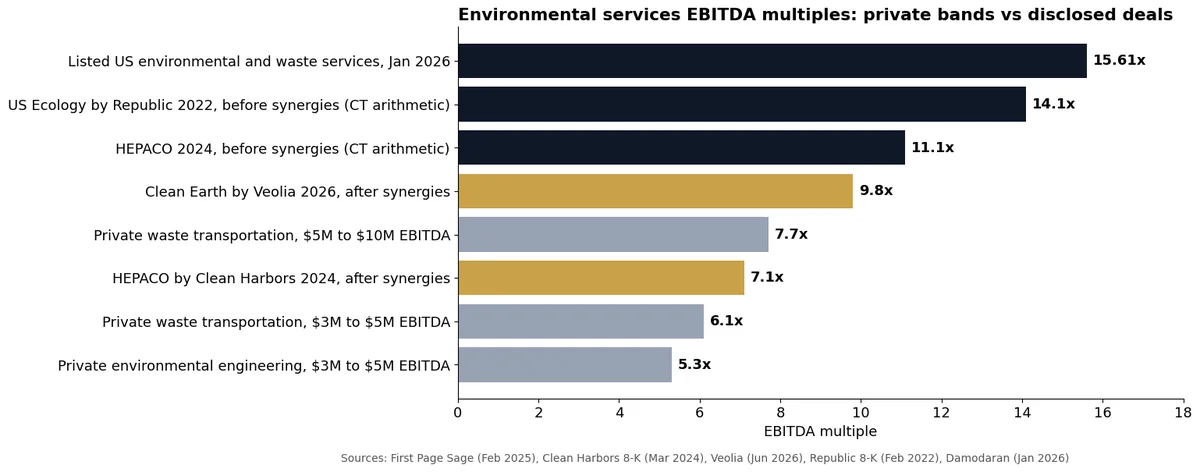
The gap between the public and private rows is size and synergy. Damodaran’s 15.61x covers listed companies such as Clean Harbors, which reported $1.17 billion of 2025 Adjusted EBITDA. A $4M EBITDA field services company is priced off the private bands unless a buyer with its own disposal network can take out costs, which is how Clean Harbors turned an 11.1x headline into 7.1x on HEPACO.
Which kind of environmental services business do you own?
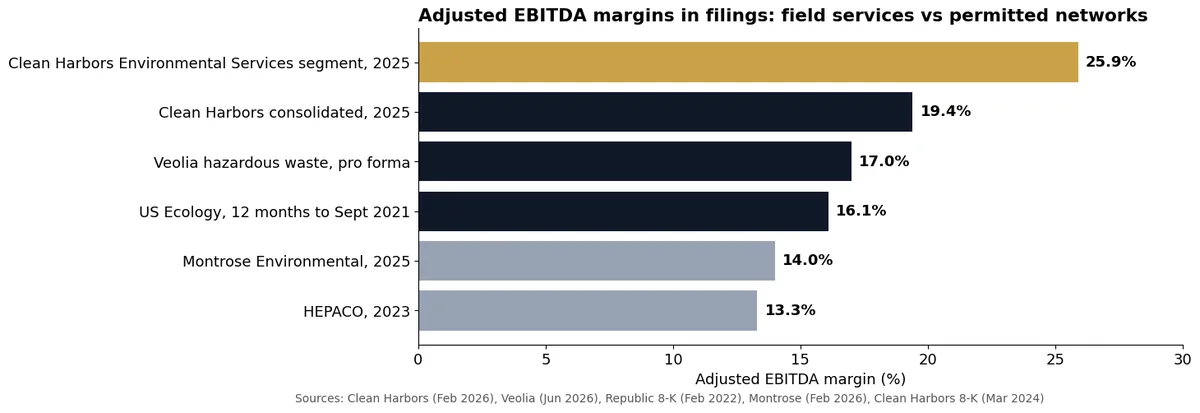
Buyers price five environmental services models against different comps: hazardous waste treatment and disposal, field and industrial services, remediation, emergency response, and consulting. Clean Harbors’ Environmental Services segment earned a 25.9% Adjusted EBITDA margin in 2025, while HEPACO, a field services and emergency response company, earned about 13.3% on 2023 revenue of $270 million.
| Model | What the buyer is paying for | Rule that gates it | Closest disclosed deal |
|---|---|---|---|
| Hazardous waste treatment, storage and disposal (TSDF) | Permitted RCRA Subtitle C capacity | RCRA permit under 40 CFR Part 270, fixed term up to 10 years | US Ecology (16 RCRA permitted TSDFs), Clean Earth (19 TSDFs) |
| Field and industrial services (vacuum, hydroblasting, tank cleaning) | Crews, trucks and plant contracts | Hazmat employee training, 49 CFR 172.704 | HEPACO: 900 vehicles, 40 locations in 17 states |
| Remediation | Site cleanup backlog and project execution | HAZWOPER training, 29 CFR 1910.120 | Montrose Environmental (listed peer, 14.0% margin in 2025) |
| Emergency response (spill, HAZMAT, OPA-90) | Retainer revenue plus billable callouts | HAZWOPER training, 29 CFR 1910.120 | HEPACO (Clean Harbors, 2024) |
| Environmental consulting and testing | Licensed staff hours and backlog | Professional licensure of the people who sign reports | Tetra Tech (listed peer, $4.62B net revenue, fiscal 2025) |
Most owners run two models at once. A company that is 60% industrial cleaning on time and materials and 40% emergency response retainer is priced mainly on the retainer share, because that revenue renews without a bid. If your business leans toward collection routes rather than hazardous material, our waste hauling business valuation guide covers route density pricing.
What margins do the filings show?
Margins in public filings set the ceiling a buyer will test your numbers against. A TSDF network earns more per revenue dollar than a field crew, which is the main reason the permitted rows in the deal table carry higher multiples.
| Company and period | Revenue | Adjusted EBITDA | Margin | Source |
|---|---|---|---|---|
| Clean Harbors, Environmental Services segment, 2025 | Not split here | Not split here | 25.9% | Clean Harbors results, Feb 18, 2026 |
| Clean Harbors, consolidated, 2025 | $6.03B | $1.17B | 19.4% (CT arithmetic) | Clean Harbors results, Feb 18, 2026 |
| Veolia, global hazardous waste, pro forma with Clean Earth | EUR 5.2B | Not stated | 17% | Veolia release, Jun 1, 2026 |
| US Ecology, 12 months to Sept 30, 2021 | $968M | $156M | 16.1% (CT arithmetic) | Republic 8-K, Feb 9, 2022 |
| Montrose Environmental Group, 2025 | $830.5M | $116.2M | 14.0% | Montrose results, Feb 25, 2026 |
| HEPACO, 2023 | $270M | About $36M | 13.3% (CT arithmetic) | Clean Harbors 8-K, Mar 25, 2024 |
What did buyers pay in recent environmental services deals?
Six disclosed deals since 2022 show the prices consolidators and sponsors paid. Republic Services paid $2.2 billion for US Ecology, J.F. Lehman & Company paid $45.50 a share for Heritage-Crystal Clean, WM paid $7.2 billion for Stericycle, Clean Harbors paid $400 million for HEPACO, Apollo and BC Partners valued GFL’s unit at C$8.0 billion, and Veolia paid $3.04 billion for Clean Earth.
| Closed | Buyer | Target | Price | Multiple the buyer published | Permitted assets named | Source |
|---|---|---|---|---|---|---|
| May 2, 2022 | Republic Services | US Ecology | About $2.2B including about $700M net debt; $48 a share | None; 14.1x trailing adjusted EBITDA by CT arithmetic | 16 RCRA permitted TSDFs, five hazardous waste landfills, seven wastewater treatment facilities | Republic 8-K |
| Oct 17, 2023 | J.F. Lehman & Company | Heritage-Crystal Clean | About $1.2B enterprise value; $45.50 a share | None published | Not stated in the release | Houlihan Lokey deal page; HCCI 8-K |
| Mar 22, 2024 | Clean Harbors | HEPACO (from Gryphon Investors) | $400M cash | 7.1x post-synergy | Not a TSDF owner; 40 locations in 17 states | Clean Harbors 8-K |
| Nov 4, 2024 | WM | Stericycle | About $7.2B enterprise value including $1.4B net debt; $62.00 a share | None; more than $125M of run-rate synergies | Medical waste network | WM 8-K |
| Mar 3, 2025 | Apollo and BC Partners funds | GFL Environmental Services | C$8.0B enterprise value; GFL kept a C$1.7B, 44% stake | None; below 16x on “over C$500 million” of EBITDA | Not stated in the release | GFL release |
| Jun 1, 2026 | Veolia | Clean Earth (from Enviri) | $3.04B cash | 9.8x 2026 estimated EBITDA after synergies | 19 TSDFs | Veolia release; Waste Dive |
What several guides say vs what the filings say
Valuation pages, including an earlier version of this one, repeat multiples that the buyers never published. The table sets each claim against the primary document.
| Claim seen in valuation guides | What the primary source shows | Source |
|---|---|---|
| WM paid about 13x for Stericycle | WM gave a $7.2B enterprise value and more than $125M of synergies, but no EBITDA multiple | WM 8-K, Nov 4, 2024 |
| Republic paid about 11x for US Ecology | Republic published no multiple; its own figures give 14.1x before synergies and 11.2x only with the full $40M of three-year synergies | Republic 8-K, Feb 9, 2022 |
| Clean Harbors paid 11x for HEPACO | Clean Harbors states 7.1x post-synergy; 11.1x is the pre-synergy arithmetic | Clean Harbors 8-K, Mar 25, 2024 |
| Environmental engineering firms sell for 4.1x to 6.8x (First Page Sage) | First Page Sage’s table shows 3.8x, 5.3x and 6.7x across the $1M to $10M EBITDA bands | First Page Sage, Feb 6, 2025 |
| Environmental services businesses sell for 5x EBITDA | A 2018 rule of thumb with no source; private bands run 3.8x to 7.7x by subsector and size | Viking Mergers (2018); First Page Sage (2025) |
| PFAS drinking water deadlines run to 2029 | EPA proposed on May 18, 2026 to move PFOA and PFOS compliance to April 2031; still a proposal in November 2026 | EPA proposed compliance extension rule |
Read a post-synergy multiple as the buyer’s price on its own synergy case. Veolia’s 9.8x includes the $120 million of synergies it expects by year four, so the multiple on Clean Earth’s standalone EBITDA was higher. That gap is the share of synergies a competitive process can win for a seller, and it only exists when a buyer with overlapping capacity is bidding.
Why does a RCRA permit move the price?
A RCRA hazardous waste permit moves the price because a buyer cannot build one inside a deal timeline. Under 40 CFR 270.40(b), an existing permit transfers as a Class 1 modification with the regulator’s prior written approval, and the buyer must post its own financial assurance within six months. Republic’s 2022 US Ecology deal bought 16 RCRA permitted TSDFs in one closing.
| Rule | What it requires | Effect on a sale | Citation |
|---|---|---|---|
| Permit transfer | Class 1 modification with prior written approval; revised permit application at least 90 days before the change; written agreement naming the transfer date | Closing cannot sit less than 90 days after the filing | 40 CFR 270.40(b) |
| Financial assurance handover | Seller stays on Part 264 subpart H until the buyer demonstrates compliance, within six months of the change | Seller’s closing cost instruments can run past closing; price them in the purchase agreement | 40 CFR 270.40(b) |
| Permit term | Fixed term of up to 10 years; land disposal permits reviewed five years after issuance | Buyers check the expiry date and renewal status | 40 CFR 270.50 |
| Liability coverage | At least $1M per occurrence and $2M annual aggregate for sudden events; $3M and $6M for nonsudden events at landfills, surface impoundments and land treatment units | The pollution policy must clear these floors before a buyer funds | 40 CFR 264.147 |
| Site worker training | 40 hours off site plus three days of supervised field work; eight extra hours for supervisors; eight hours of refresher training each year | Lapsed certificates show up in diligence as a fix before closing | 29 CFR 1910.120(e) |
| Hazmat transport training | Initial training within 90 days of hire or job change; recurrent training at least every three years | Driver files are sampled in diligence | 49 CFR 172.704 |
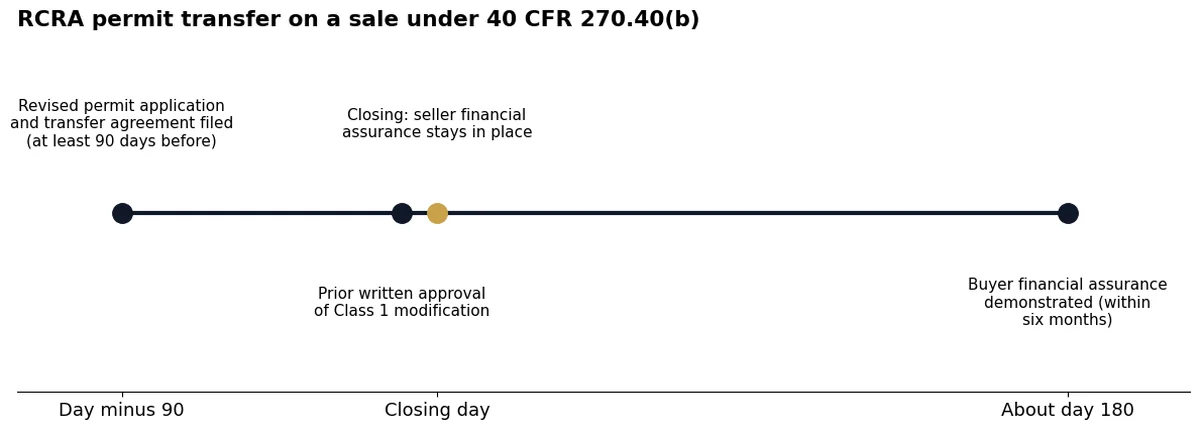
- At least 90 days before closing: the buyer files a revised permit application with EPA or the authorized state agency, naming itself as the new owner or operator.
- Same filing: seller and buyer submit a written agreement with the specific date for the transfer of permit responsibility, coverage and liability.
- Before closing: the Director gives prior written approval of the Class 1 modification.
- At closing: the seller’s Part 264 subpart H financial assurance stays in place.
- Within six months of the change: the buyer demonstrates its own financial assurance, and the Director notifies the seller that subpart H no longer applies to it.
Most field services companies never hold a TSDF permit; they ship waste to one. For them the matching question is who owns disposal capacity. Veolia’s closing release lists six high-temperature RCRA-permitted incineration units and 33 EPA-permitted treatment facilities in its combined US network, and a buyer with its own capacity can pay for synergies a financial buyer cannot claim.
How do buyers calculate the number?
Buyers normalize EBITDA, split revenue by model and by contract type, test permits and training records, then pick a multiple from the closest deal or private band. The order matters: a 26% top customer or a lapsed permit cuts the multiple after the add-backs are set, so each add-back needs a document behind it.
- Normalize EBITDA. Replace owner pay with a market salary and add back personal and one-time costs such as a resolved notice of violation. Buyers test each line; our guide to add-backs buyers accept lists the common ones.
- Split revenue. Separate TSDF, field services, remediation, emergency response and consulting, then MSA or retainer revenue from time and materials work.
- Inventory permits. List each RCRA permit with its 10-year term date, plus NPDES, air, DOT hazmat and state handler licenses, and any open corrective action.
- Review the customer book. Customer, contract term, renewal date and share of revenue for the top 10 accounts.
- Check people and fleet. HAZWOPER certificates, hazmat training dates under 49 CFR 172.704, truck ages and a three-year capital spending plan.
- Pick the yardstick. Private band for financial buyers; post-synergy deal multiples only where a buyer with overlapping capacity is in the process.
Worked example: a $4M EBITDA Gulf Coast field services company (illustrative)
This example is illustrative. A Houston company has $22M of revenue and $4.0M of reported EBITDA: 60% industrial cleaning on time and materials, 40% emergency response retainer, no RCRA permit, 47 HAZWOPER-certified field workers, 14 hazmat drivers, and a top customer at 26% of revenue on a 5-year MSA, with the top five at 62%.
| Line | Amount | Note |
|---|---|---|
| Reported EBITDA | $4.0M | From the tax return and reviewed statements |
| Owner pay above market | +$80K | Owner paid $320K; a replacement general manager costs $240K |
| Personal expenses | +$65K | Documented in the general ledger |
| One-time legal cost | +$40K | Notice of violation resolved in 2024 |
| Normalized EBITDA | $4.185M | The base for every row below |
| Yardstick | Multiple | Value on $4.185M | When it applies |
|---|---|---|---|
| Private waste transportation, $3M to $5M EBITDA (First Page Sage) | 6.1x | $25.5M | Financial buyer, no synergies |
| HEPACO post-synergy multiple (Clean Harbors) | 7.1x | $29.7M | Strategic buyer pricing on its own synergy case |
| Private waste transportation, $5M to $10M EBITDA | 7.7x | $32.2M | Only after EBITDA passes $5M |
| Clean Earth post-synergy multiple (Veolia) | 9.8x | $41.0M | Not a fit: a 19-TSDF permitted network |
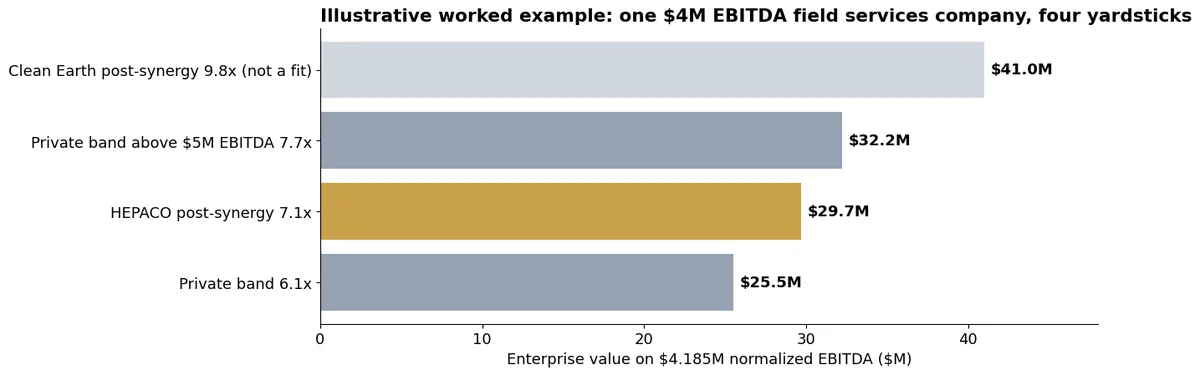
On these yardsticks the realistic range is $25.5M to $29.7M. The $4.2M between those two rows is the share of a strategic buyer’s synergies the seller wins, which is why it pays to have at least one disposal network owner in the process. The 26% top customer is the first item a buyer will use to argue for the lower row, and our guide on how earnouts work covers how that risk often gets priced.
What moves the multiple up or down?
Eight items move an environmental services multiple, and each one maps to a document a buyer will ask for. Permits, contract mix and customer concentration move the multiple most; training records, insurance limits under 40 CFR 264.147 and fleet age decide whether the price survives diligence or turns into an escrow.
| Driver | What the buyer asks for | Rule or threshold | Direction |
|---|---|---|---|
| RCRA permit status | Permit, expiry date, corrective action file | Fixed term up to 10 years, 40 CFR 270.50 | Up if active and clean; down if corrective action is open |
| Contract mix | MSAs and retainers with renewal dates | Share of revenue under multi-year MSAs | Up as the retainer share rises |
| Customer concentration | Revenue by customer for three years | Above 40% from one customer usually brings an earnout | Down |
| Workforce training | HAZWOPER certificates and refresher dates | 40 hours plus three days; eight hours each year, 29 CFR 1910.120(e) | Neutral if current; down if lapsed |
| Hazmat transport | Driver training files | Within 90 days of hire, every three years, 49 CFR 172.704 | Neutral if current; down if lapsed |
| Pollution insurance | Policy limits, retroactive date, claims | $1M / $2M sudden and $3M / $6M nonsudden floors, 40 CFR 264.147 | Down or escrow if under the floor |
| PFAS work | Signed PFAS projects and lab capability (EPA Method 1633) | PFOA and PFOS CERCLA designation effective July 8, 2024 | Up for signed backlog only |
| Fleet | Asset list with ages and a three-year capital plan | Example: 22 vacuum trucks at an average age of 5 years | Down by the cost of deferred replacements |
Clean Harbors set 2026 Adjusted EBITDA guidance at $1.20 billion to $1.26 billion, and Montrose guided to $125 million to $130 million. Both figures exclude new acquisitions, which is why both companies keep buying smaller operators to add growth on top of guidance.
How do PFAS rules change what buyers pay?
PFAS rules add demand for remediation and disposal, but buyers count only signed work. EPA kept the CERCLA hazardous substance designation for PFOA and PFOS, effective July 8, 2024, in a September 17, 2025 court filing, and Clean Harbors cited continued expansion in PFAS services in its fourth quarter 2025 results.
| Rule | Citation | Key date | Status in November 2026 | Effect on a valuation |
|---|---|---|---|---|
| PFOA and PFOS designated CERCLA hazardous substances | 89 FR 39124 | Effective July 8, 2024 | Retained by EPA on September 17, 2025; litigation pending | Cleanup demand at Superfund and industrial sites |
| PFOA and PFOS drinking water limits of 4.0 ppt | 89 FR 32532 | Compliance due April 2029 | Proposed on May 18, 2026 to move to April 2031; comments closed July 20, 2026 | Treatment demand from water systems may arrive later |
| EPA Method 1633 lab analysis | EPA test method for 40 PFAS compounds | In use | In use | In-house or partner lab capability supports PFAS project margins |
Show a buyer a PFAS project list with dates, customers and contract values. A pipeline pegged to the April 2029 drinking water deadline is the first number a buyer will haircut while EPA’s proposal to move that date to April 2031 is pending.
How is an environmental consulting firm valued?
Environmental consulting firm valuation uses professional services math: net service revenue, backlog and licensed staff, not permits and trucks. First Page Sage’s February 2025 table puts private environmental engineering firms at 3.8x EBITDA with $1M to $3M of EBITDA, 5.3x at $3M to $5M and 6.7x at $5M to $10M.
- Net service revenue. Lab fees, drilling subcontractors and other pass-through costs are stripped out, and margins are measured on what is left. Tetra Tech reported $5.44 billion of revenue but $4.62 billion of net revenue in fiscal 2025.
- Backlog and master service agreements. Multi-year MSAs with industrial clients, utilities or agencies play the role retainers play for field operators.
- Licensed staff below the founders. Professional geologists and engineers who sign reports and hold client relationships reduce key-person risk.
- Utilization and billing rates. Buyers compare billable hours and realized rates against peers to judge whether earnings hold after the sale.
- PFAS experience. Site investigation and remediation design for PFOA and PFOS sites draws on the same CERCLA designation as field remediation.
Most consultancies are small. ValuAdder estimates the average environmental consulting company produces about $1.3 million in annual sales with a staff of seven to eight, so many sell on seller’s discretionary earnings to individual buyers. Larger firms sell to listed consolidators such as Montrose, which reported $830.5 million of 2025 revenue. Our architecture and engineering firm valuation guide covers the net service revenue method in full.
Which valuation yardstick fits your business?
Pick the yardstick from what you own and who will bid. A permitted TSDF network is priced against consolidator deals; an unpermitted field services company with $3M to $5M of EBITDA is priced off the private 6.1x band unless a buyer with its own disposal capacity enters the process, which can move it toward the 7.1x HEPACO figure.
| If your situation is | Use this yardstick | What to do before a sale |
|---|---|---|
| If you hold an active RCRA TSDF permit with no open corrective action | Consolidator deals: 9.8x post-synergy (Clean Earth), 11.2x with synergies (US Ecology) | Line up the 90-day transfer filing and replacement financial assurance under 40 CFR 270.40(b) |
| If you run field services with $3M to $5M of EBITDA and no permit | 6.1x private band; 7.1x if a disposal network owner bids | Invite at least one strategic buyer with disposal capacity |
| If you run field services with $1M to $3M of EBITDA | 4.9x private transportation band | Move retainer customers onto multi-year MSAs |
| If you run a consultancy with $1M to $3M of EBITDA | 3.8x private environmental engineering band | Restate to net service revenue and document backlog |
| If one customer is above 40% of revenue | Same yardstick, with part of the price in an earnout | Sign a multi-year MSA with that customer first |
| If a notice of violation or corrective action is open | Expect an escrow or a lower multiple | Resolve it 12 to 18 months before going to market |
Want to know what your environmental services business is worth to today’s buyers?
Benchmarks give you a range. A 15-minute confidential call gives you a real number, based on what active buyers are paying right now and which ones would compete for your business. No cost, no obligation.
How do you get a valuation for your environmental services business?
CT Acquisitions gives owners of hazardous waste, remediation, industrial cleaning and emergency response companies a confidential valuation range against a 500+ buyer network. We work for owners on the sell side. Our fee is success only: nothing upfront, and you pay nothing unless the business sells. Book a 15-minute call, or start with our environmental services seller hub.
If you are 12 to 24 months from a sale, our environmental services exit preparation checklist lists the permit, insurance and contract documents to assemble first. For the sale process itself, from teaser to closing, read how to sell an environmental services company.
How we compiled this
We compiled this page in November 2026 from 24 documents, 19 of them primary: buyer and seller press releases and SEC exhibits for six closed deals, 2025 results releases from Clean Harbors, Montrose and Tetra Tech, the RCRA, OSHA and DOT rules in 40 CFR 264 and 270, 29 CFR 1910.120 and 49 CFR 172.704, and EPA’s PFAS rulemaking pages. Private multiples come from First Page Sage and public multiples from Damodaran’s January 2026 dataset. Multiples marked as CT arithmetic divide a published price by a published EBITDA figure; the worked example is illustrative. We did not use forum posts or unsourced broker rules of thumb as data.
Frequently asked questions
What is the typical EBITDA multiple for an environmental services business?
Private environmental services companies with $1M to $10M of EBITDA price at 3.8x to 7.7x in First Page Sage’s February 2025 tables, depending on subsector and size. Strategic buyers paid 7.1x post-synergy for HEPACO in 2024 and 9.8x post-synergy for Clean Earth in 2026. Listed peers traded at 15.61x EBITDA in Damodaran’s January 2026 data.
Did GFL sell its environmental services business?
Yes. GFL Environmental agreed on January 7, 2025 to sell its Environmental Services business to funds managed by Apollo and BC Partners at an enterprise value of C$8.0 billion, and the sale closed on March 3, 2025. GFL kept a C$1.7 billion equity stake, 44% at signing, and planned to use up to C$3.75 billion of the proceeds to repay debt.
How does a RCRA permit affect a hazardous waste business valuation?
An active permit gives a buyer treatment, storage or disposal capacity it cannot build on a deal timeline. Under 40 CFR 270.40(b) the permit transfers as a Class 1 modification with prior written approval, the buyer files a revised application at least 90 days before the change, and it must replace the seller’s financial assurance within six months.
How do you value an environmental consulting firm?
Restate revenue to net service revenue by removing lab and subcontractor pass-through costs, normalize EBITDA for owner pay, then apply a multiple for size, backlog and licensed staff. First Page Sage’s February 2025 table puts private environmental engineering firms at 3.8x, 5.3x and 6.7x EBITDA across the $1M to $10M bands. Small owner-run consultancies usually sell on seller’s discretionary earnings.
What is my environmental remediation company worth?
A remediation company without its own permitted disposal capacity is usually priced off private bands of 3.8x to 7.7x EBITDA in First Page Sage’s 2025 tables, unless a strategic buyer bids on synergies, as Clean Harbors did at 7.1x post-synergy for HEPACO. Signed PFAS work, multi-year MSAs and current HAZWOPER records under 29 CFR 1910.120 move it up.
Do PFAS regulations raise environmental services valuations?
They raise demand, but buyers value only signed work. EPA kept the PFOA and PFOS CERCLA hazardous substance designation, effective July 8, 2024, and on May 18, 2026 proposed moving the drinking water compliance date for the 4.0 ppt limits from April 2029 to April 2031, which pushes some treatment demand later.
Sources
- Veolia, Veolia completes Clean Earth deal (June 1, 2026), accessed November 2026
- Waste Dive, Clean Earth deal and Veolia hazardous waste business (November 24, 2025), accessed November 2026
- Clean Harbors Form 8-K exhibit, completion of HEPACO acquisition (March 25, 2024), accessed November 2026
- Republic Services Form 8-K Exhibit 99.1, agreement to acquire US Ecology (February 9, 2022), accessed November 2026
- Republic Services, completion of US Ecology acquisition (May 2, 2022), accessed November 2026
- WM Form 8-K Exhibit 99.1, completion of Stericycle acquisition (November 4, 2024), accessed November 2026
- Heritage-Crystal Clean Form 8-K exhibit, completion of J.F. Lehman merger (October 2023) and Houlihan Lokey transaction page, accessed November 2026
- GFL Environmental, agreement to sell Environmental Services business (January 7, 2025), accessed November 2026
- Clean Harbors fourth quarter and full year 2025 results (February 18, 2026), accessed November 2026
- Montrose Environmental Group 2025 results (February 25, 2026), accessed November 2026
- Tetra Tech fiscal 2025 results, Form 8-K Exhibit 99.1 (November 12, 2025), accessed November 2026
- Aswath Damodaran, EV/EBITDA by industry, US (January 2026), accessed November 2026
- First Page Sage, Waste Management EBITDA and Valuation Multiples (February 6, 2025) and EBITDA Multiples for Engineering Companies (February 6, 2025), accessed November 2026
- 40 CFR Part 270 (sections 270.40 and 270.50), 40 CFR Part 264 (subpart H, section 264.147), 29 CFR 1910.120 and 49 CFR 172.704, accessed November 2026
- EPA: 89 FR 39124 (CERCLA designation), 89 FR 32532 (drinking water regulation), the September 17, 2025 news release and the proposed PFOA and PFOS compliance extension rule page, accessed November 2026
- ValuAdder, Environmental Business Valuation, accessed November 2026
Disclaimer: This page is general valuation information, not legal, tax, accounting or transaction advice. Permit transfer terms depend on the EPA region or authorized state agency that issued your permit.

About the Author
Christoph Totter is the founder of CT Acquisitions, an M&A advisory firm headquartered in Sheridan, Wyoming, that helps owners of founder-owned businesses sell, recapitalize or plan their exit. We work with a network of 500+ buyers: search funders, family offices, lower middle market PE and strategic consolidators. We work for owners on the sell side. Our fee is success only: nothing upfront, and you pay nothing unless the business sells. Connect on LinkedIn · Get in touch
Want a Specific View of Your Business?
15 minutes, confidential, no cost. You leave with a view of your local buyer market and a likely valuation range.