How to Prepare Your Environmental Services Business for a Sale or Exit in 2026: The 36-Month Playbook
Preparing your environmental services business for exit in 2026 is a 36-month playbook. The first 12 months tighten the operating story around recurring service revenue and regulatory tailwind exposure, the middle 12 fix pre-LOI diligence gaps around permits and environmental liability, and the final 12 turn one offer into a real competitive process where PE consolidators bid against strategics.
Exiting your environmental services business is the single largest financial event most owners will ever face. This guide is the no-fluff playbook for environmental services business owners who are 12-36 months from sale, covering how PE-backed buyers actually value your business in 2026, the 12 levers that move your multiple, pre-LOI diligence, deal-killers to fix before going to market, and the full 36-month exit prep timeline.
Updated April 2026 · CT Acquisitions

Most environmental services owners decide to sell, hire a generalist broker, and find out 90 days later that their business is worth 25% to 40% less than they thought because a single open EPA Notice of Violation, an undocumented PFAS exposure, or a non-transferable RCRA Part B permit triggers escrow holdbacks the seller never modeled. The owners who get the top-quartile price start preparing 18 to 36 months before they ever talk to a buyer. This guide is the 36-month playbook for how to prepare your environmental services business for a sale or exit. It covers what private equity and strategic majors are actually buying in 2026, the 12 levers that move multiples, the documents buyers will demand before they send an indication of interest, the regulated-asset binder that controls permit transferability, and the deal-killers that re-trade environmental services transactions during confirmatory diligence. Every multiple, every dollar figure, and every named buyer in this guide traces to a primary source.
If you are 6 to 36 months from a possible exit, this is the work that turns a 6x EBITDA outcome into a 10x EBITDA outcome. On a $3M EBITDA hazardous waste or industrial cleaning business, that is the difference between an $18M sale and a $30M sale. Whether you want to prepare your environmental services business for a sale to private equity, prepare your environmental services business for an exit to a strategic acquirer like Clean Harbors or Republic Services, or simply maximize value over the next 1 to 3 years before going to market, the work below applies. The 2026 to 2027 window is the strongest seller’s market in environmental services in a decade. The owners who get organized now will trade at the top of the published bands.
Building toward an exit in 12 to 36 months?
CT Acquisitions runs sell-side advisory for environmental services owners $1M+ EBITDA. We also have environmental operations specialists in our partner network who run pre-sale optimization engagements when the timeline is longer. No fee to you on buy-side introductions; sell-side mandates are paid on success at closing.
What Private Equity Actually Buys in Environmental Services (2026)
Environmental services has become arguably the most consolidation-hungry vertical in the broader waste and recycling universe. Three macro shifts are driving it. First, the strategic majors have declared hazardous and specialty waste their primary growth lane because antitrust regulators block further municipal solid waste combinations. Waste Management closed its acquisition of Stericycle in November 2024 in a transaction valued at roughly $7.2 billion including assumed debt, expanding WM into regulated medical waste and adjacent specialty services (Waste Management press release, November 2024). Second, Republic Services acquired US Ecology for roughly $2.2 billion in May 2022, giving Republic a national TSDF network and deep-well injection capacity. Third, private equity has charged in behind the strategics. Goldman Sachs Alternatives Infrastructure announced its acquisition of Liquid Environmental Solutions from Audax Private Equity on July 22, 2025 and closed September 2, 2025, treating recurring-route liquid waste as core infrastructure. The fund flow is unmistakable.
The PE-attractive environmental services profile
- EBITDA threshold for a platform-quality deal: $3M to $5M is the entry band where sponsor-backed mid-market platforms run a competitive process. Below $3M, you are an add-on inside a roll-up at lower-end multiples. Above $5M, you become a meaningful bolt-on for the public majors. Above $15M EBITDA with multi-state footprint, you can run a full process against Clean Harbors, Republic Services, Tradebe, Heritage, and two or three infrastructure funds.
- Recurring route-based revenue: 50% or higher is the line between project-shop pricing and infrastructure pricing. Project-heavy remediation books trade at 5x to 7x EBITDA. Books with 50%+ recurring monthly milk-run hazardous waste pickup trade at 8x to 12x.
- Permit ownership: A real RCRA Part B TSDF permit, a Class II or Class V deep-well injection permit, or a hazardous waste transfer station permit is a moat. New permits are functionally unobtainable in most states.
- Geographic density: Dominating one DMA with route density above 8 stops per truck per day beats being thin across five states. Buyers will map customer locations and calculate density per metro.
- Customer concentration: No single customer above 15% of revenue. Top 5 customers below 40%. Above 25% concentration triggers earnout structures or buyer withdrawal.
- Owner role: Owner is in management, not running the largest project crews or signing every disposal manifest. VP Sales hired 18 months pre-sale.
- Clean enforcement history: Zero open NOVs, zero open consent orders, EMR below 1.0, no DOT or PHMSA open Corrective Action Plans. Any open enforcement matter must be resolved at least 12 months before going to market.
Active environmental services PE platforms and strategic acquirers in 2026
The list below covers the most active sponsor-backed environmental services platforms and the strategic public majors in the 2024-2026 cycle. This is who will see your teaser. Sources include the Goldman Sachs Alternatives July 2025 press release, Waste Management 8-K filings, Clean Harbors investor disclosures, Houlihan Lokey Q2 2025 environmental services update, Capstone Partners industrial and environmental services market update August 2025, and RL Hulett Q4 2025 environmental services update.
| Platform / Acquirer | Sponsor / Parent | Profile |
|---|---|---|
| Clean Harbors (NYSE: CLH) | Public strategic | $5.889B 2024 revenue; 100+ disposal facilities incl. 7 hazardous landfills; 870 locations; HEPACO ($400M, March 2024); Thompson Industrial ($110M, May 2023) |
| Republic Services (NYSE: RSG) | Public strategic | Acquired US Ecology May 2022 ($2.2B); active bolt-ons in hazardous and field services |
| Waste Management (NYSE: WM) | Public strategic | Closed Stericycle November 4, 2024 ($7.2B incl. debt); largest WM deal ever; regulated medical and information destruction |
| GFL Environmental (NYSE: GFL) | Public strategic | Active US hazardous and liquid waste add-ons |
| Veolia North America | Veolia (Paris-listed parent) | ~$45B group revenue post-SUEZ; active US hazardous platform |
| Tradebe Environmental Services | Spanish parent | Very active US roll-up; chemical, industrial, lab pack |
| EQ – The Environmental Quality Company | US Ecology legacy / Republic Services | National hazardous waste services |
| Heritage Environmental Services | CD&R | PE-backed; active in $5M to $50M EBITDA bolt-ons |
| Triumvirate Environmental | Gryphon-style mid-market | Lab pack, higher education, life sciences vertical strength |
| Cascade Environmental | Bernhard Capital Partners | Drilling, remediation, environmental construction |
| PSC Industrial Services | PE-backed | Industrial cleaning, vacuum truck, hydroblasting at scale |
| Wind River Environmental | Gryphon Investors | Liquid waste, septic, grease trap; recurring-route platform |
| Liquid Environmental Solutions | Goldman Sachs Alternatives (Sept 2, 2025 close) | Non-hazardous liquid waste; restaurants, grocers, hospitality, education |
| Verdantas | Sterling Investment Partners | Environmental consulting roll-up |
| Apex Companies | PE-backed | Environmental consulting and compliance roll-up |
| Montrose Environmental | Public (NYSE: MEG) | Testing, measurement, advisory, remediation |
Add to that list the infrastructure funds (Goldman Sachs Infrastructure, Brookfield Infrastructure, IFM Investors, EQT Infrastructure, Macquarie Asset Management) that target $25M+ EBITDA scaled platforms with meaningful contracted recurring revenue, and the traditional growth-equity and buyout sponsors (Audax, Bernhard Capital, Gryphon, Sterling, CD&R, KKR, Apollo, Oaktree, Warburg, Centerbridge) active in the $5M to $50M EBITDA range. Family offices, search funds, and independent sponsors round out the buyer universe at sub-$5M EBITDA, where multiples sit at 4x to 7x. Expect adjacent-vertical strategics like Cintas, Ecolab, Tetra Tech, and AECOM to keep eyeing the sector the way Waste Management eyed Stericycle.
Environmental Services Valuation Multiples in 2026 (What You Are Actually Worth)
Buyers do not pay a single blended multiple in environmental services. They sum the parts, applying differential multiples to each service line. The realistic 2025-2026 EBITDA multiple bands below assume clean financials at $3M+ EBITDA and clean regulatory posture, cross-referenced from Houlihan Lokey Q2 2025 environmental services update, Capstone Partners industrial and environmental services market update August 2025, RL Hulett Q1 and Q4 2025 updates, and First Page Sage waste management EBITDA multiples report 2025.
SDE multiples (smaller, owner-operated)
| SDE band | SDE multiple | Profile fit |
|---|---|---|
| Under $500K SDE | 2.5x to 3.25x | Single-state project remediation, owner-operator |
| $500K to $1M SDE | 2.75x to 3.5x | Industrial cleaning shop with limited recurring base |
| $1M to $2M SDE | 3.5x to 4.5x | Regional spill response or vacuum truck operator with MSAs |
| $1M+ SDE, 50%+ recurring route revenue | 4.0x to 5.0x | Hazardous waste transporter with monthly milk-run accounts |
EBITDA multiples by service line (PE-attractive size, $3M+ EBITDA)
| Service line | Multiple range (EBITDA) | Why the band |
|---|---|---|
| Hazardous waste transport + TSDF or transfer-and-disposal | 8x to 12x | Permit ownership is a moat; route density and recurring generator accounts |
| PFAS remediation specialists / treatment technology | 10x to 14x | Highest-multiple band; EPA CERCLA designation creates structural demand |
| Emergency response / spill response with 24/7 dispatch | 7x to 10x | High-margin (30% to 45% gross); MSA book with railroads and pipelines |
| Industrial cleaning (vacuum truck, hydroblasting, tank cleaning) | 6x to 9x | Lower multiple unless tied to multi-year plant MSAs |
| Environmental consulting (Phase I/II, compliance, permitting) | 7x to 10x | Recurring compliance retainers (Tier II, Title V, stormwater) drive top of band |
| Project remediation (Superfund, brownfield, UST removal) | 5x to 7x | Project-based and lumpy; discounted 1.5x to 2x vs recurring-route work |
Public-equivalent strategic platforms have printed higher headline numbers. Houlihan Lokey, Capstone Partners, and RL Hulett quarterly updates through 2025 report median strategic EV/EBITDA multiples in environmental services rising to roughly 20.9x in 2025 from about 15.0x in 2024, with private-equity-led transactions printing EV/Revenue multiples up to 1.4x. The bands above are the relevant numbers for owner-operators. The single biggest pre-sale value lever is shifting your revenue mix toward route-based hazardous waste pickup, TSDF throughput, PFAS, and emergency response in the 24 months before you transact, even if it means modestly lower nominal growth. A $4M EBITDA business with 60% recurring route plus TSDF plus PFAS plus ER will trade at 9x to 11x; the same $4M EBITDA business at 70% project remediation will trade at 5x to 7x.
Recent disclosed environmental services transactions (2024-2025)
| Acquirer | Target | Date | Value | Notes |
|---|---|---|---|---|
| Waste Management | Stericycle | Nov 4, 2024 | ~$7.2B incl. debt | Largest WM acquisition ever; regulated medical, info destruction |
| Goldman Sachs Alternatives Infrastructure | Liquid Environmental Solutions (from Audax) | Closed Sept 2, 2025 | Not disclosed | Non-hazardous liquid waste; infrastructure-fund template |
| Clean Harbors | HEPACO | March 2024 | $400M | HEPACO ~$300M revenue at acquisition; emergency response and field services |
| Clean Harbors | Thompson Industrial Services | May 2023 | $110M | Industrial cleaning bolt-on |
| Republic Services | US Ecology | May 2022 (announced Feb 2022) | ~$2.2B | National TSDF, deep-well injection, vacuum and dry-bulk fleet |
Sources: Businesswire (WM-Stericycle, November 2024); am.gs.com Goldman Sachs Alternatives press release (July 22, 2025); liquidenviro.com; Simpson Thacher counsel notice (stblaw.com); Clean Harbors investor disclosures; Republic Services 10-K filings; Houlihan Lokey transaction page for LES.
The 12 Value Levers That Move Your Multiple (Ranked by Impact)

These are the levers that move environmental services multiples in the 18 to 24 months before a sale. Each one has a current state, a target state, and an estimated financial impact. The ordering is by dollar impact per unit of effort, based on cross-source synthesis from Capstone Partners, Houlihan Lokey, RL Hulett, Auxo Capital Advisors, and Holland & Knight regulatory commentary.
Lever 1: Shift the revenue mix toward route + TSDF + PFAS + emergency response
Current: 60% to 70% project remediation; sub-25% recurring route hazardous waste pickup; no PFAS line tracked separately. Target: 50%+ recurring route revenue (monthly milk-run generators on MSA), documented TSDF throughput if you own a permit, separate PFAS P&L even if only 5% of revenue. Impact: The biggest single multiple driver in environmental services. A $4M EBITDA business with 60% recurring route plus TSDF plus PFAS plus ER trades at 9x to 11x. The same $4M EBITDA business at 70% project remediation trades at 5x to 7x (Houlihan Lokey Q2 2025; Capstone August 2025). That is a $16M to $24M swing on the same operating earnings. How: Convert spot generators to monthly milk-run accounts on auto-renewing MSAs. Repaper handshake contracts. Build at least one PFAS case study using granular activated carbon, ion exchange resin, or foam fractionation. Track customer count, average ticket, churn, and average contract length per service line in your accounting system at least 18 months pre-market.
Lever 2: Own a real permit (RCRA Part B, transfer station, or deep-well injection)
Current: Broker disposal to third-party TSDFs; no facility-specific operating permit. Target: RCRA Part B TSDF permit, 10-day transfer station permit, Class II or Class V deep-well injection permit, or equivalent state-issued specialty permit, with all financial assurance instruments current. Impact: Permit ownership is the single most defensible asset in environmental services. New TSDF permits are functionally impossible to obtain in many states, which means existing permits trade at a structural premium. Buyers pay 1 to 2 turns of EBITDA more for a permit-holding platform vs a broker (RL Hulett Q4 2025; Transect RCRA TSDF permit guide). How: If you already hold a permit, get the closure cost estimate refreshed and confirm financial assurance instruments are fully funded. If you do not, evaluate whether a permitted competitor is acquirable or whether your state allows new transfer station permits.
Lever 3: Build a documented PFAS capability before the wave
Current: No PFAS-specific revenue line; AFFF firefighting foam still onsite at one or more facilities; no PFAS sampling protocol for incoming waste streams. Target: Separate PFAS P&L with at least one repeat customer; documented PFAS treatment vendor relationships (GAC, ion exchange, foam fractionation); AFFF retired and inventoried; intake protocol for PFAS-bearing waste streams. Impact: EPA designated PFOA and PFOS as CERCLA hazardous substances in April 2024 (89 FR 39124), reaffirmed September 2025, and issued enforceable national drinking-water MCLs for six PFAS compounds in April 2024 (40 CFR Part 141). The US PFAS remediation market is estimated at roughly $2.0B in 2024 growing to ~$4.0B by 2033 per Verified Market Reports and Research Nester (CAGR ~8.7%); the PFAS concentration and destruction systems sub-segment is forecast at $2.7B in 2025 to $8.0B by 2036 (Future Market Insights). PFAS-capable platforms trade at the top of the band (10x to 14x EBITDA). How: Read the Holland & Knight October 2025 update on EPA’s PFAS rulemaking trajectory. Inventory every facility where PFAS-containing waste has been handled. Disclose AFFF on every owned site. Build one PFAS case study with named technology partner.
Lever 4: Move the owner out of the chair
Current: Owner runs sales, signs every disposal manifest, on every project bid above $50K, primary point of contact for the top 10 customers. Target: VP Sales hired 18+ months pre-sale at $175K to $275K plus bonus; Operations Director or COO running daily operations; primary customer relationships transitioned to the sales team. Impact: Owner concentration in sales is one of the top three deal-killers cited across environmental services M&A advisory content. If the owner is the primary salesperson, buyers will demand a 2 to 3 year employment or consulting agreement at minimum, and often discount the multiple by 1 to 2 turns on top. On a $3M EBITDA business, that is $3M to $6M of price (Capstone Partners; RL Hulett Q4 2025). How: Hire the VP Sales 18 to 24 months pre-sale. Document SOPs for every operational role. Transition the top 10 customer relationships to assigned account managers over 12 months. Take a 2-week unplugged vacation as the stress test.
Lever 5: De-concentrate the customer base
Current: Top customer above 20% of revenue, or single end-market (oil and gas drilling, single-site remediation) above 40% of revenue. Target: Top customer below 15%; top 5 below 40%; end-market mix spread across at least 4 verticals. Impact: Any customer above 15% revenue triggers diligence concern. Above 25% can kill a deal or force an earnout structure. End-market concentration in cyclical industries (oil and gas, single Superfund site) carries a separate discount because the cyclicality is unhedgeable. Combined exposure above 25% customer plus 50% cyclical end-market can take 1.5x to 2x off the multiple (RL Hulett Q4 2025). How: Diversify into new commercial verticals (food and beverage, pharmaceutical, semiconductor, healthcare, education) where regulated generator volume is recurring and less cyclical than oil and gas. Expand the geographic footprint within the existing service area before adding new metros.
Lever 6: Build 24/7 dispatch and an MSA book in emergency response
Current: Spot ER calls answered by the owner’s cell phone after hours; no documented response time KPI; MSA book limited to one or two pipeline customers. Target: Dedicated dispatcher headcount with rotating coverage; average response time tracked and below 60 minutes for high-priority calls; percent of calls answered live above 95%; MSA book size with named railroads, pipeline operators, chemical manufacturers, and state DOT contracts. Impact: ER is the highest-margin line in most environmental services books, running 30% to 45% gross margin vs 15% to 25% on project remediation. A documented dispatch capability with an MSA book also earns the 7x to 10x ER multiple rather than the 5x to 7x project remediation multiple. How: Hire dispatch; install call tracking; document HAZWOPER 40-hour and NICER Hazmat Technician rosters; pursue MSAs with Class I railroads, FERC-regulated pipeline operators, and your state DOT.
Lever 7: Clean the QoE 18 months before market
Current: Cash-basis books; service lines not segmented; owner personal expenses mixed through the business; related-party rent at above-FMV; no add-back schedule. Target: Two full years of accrual financials minimum; revenue segmented by service line (see Lever 1); revenue segmented by customer with any customer above 10% flagged; documented add-back schedule with footnote support for every entry; related-party rent restruck to FMV with appraisal on file. Impact: A clean quality of earnings can swing a deal by a full multiple turn (1.0x EBITDA). On a $3M EBITDA business at a 9x base, that is $3M of price. Owner comp normalization to a market salary for the role (typically $200K to $350K all-in) is the most common add-back and the most commonly challenged. How: Migrate to accrual now. Hire a regional CPA firm to compile or, better, review the financials. Build the add-back bridge as a living document with the underlying invoice attached to every entry.
Lever 8: Repaper contracts as MSAs with auto-renewal and price escalation
Current: Handshake customer contracts or three-page T&Cs; no auto-renewal; no CPI or PPI price escalation; no insurance and indemnity language. Target: Every recurring customer on a master service agreement with stated initial term (1 to 3 years), auto-renewal, indemnity, insurance requirements, change of control consent language, and price escalation tied to CPI or PPI. Impact: Contracted recurring revenue is the headline number for the recurring-revenue multiple. Buyers will demand greater than 85% gross retention and a stated average tenure of 4+ years on the contracted book. Repapering handshake books can lift the multiple half a turn to a full turn on its own, separate from the mix shift in Lever 1 (Capstone Partners; Houlihan Lokey). How: Engage outside counsel to draft a standard MSA template. Run a 6-month repapering campaign with the top 50 customers. Document signed MSA penetration as a KPI.
Lever 9: Normalize working capital and capex
Current: Working capital swings wildly month to month; AR aging beyond 60 days on government and municipal receivables; no maintenance vs growth capex split. Target: Trailing 12-month average working capital is stable and predictable; AR aging documented with reserves on receivables beyond 90 days; 5-year capex schedule by category (vacuum trucks at $350K to $500K, roll-offs, frac tanks, treatment skids, IBC totes) with replacement cycle assumptions. Impact: Most deals price on a working capital peg set at the average of trailing 12-month averages. A volatile pattern lets the buyer set a higher peg, which subtracts from purchase price. Estimated impact: poorly managed working capital can cost 2% to 5% of enterprise value at close. Capex categorization matters because buyers subtract maintenance capex from EBITDA-to-cash; misclassified maintenance capex inflates the multiple buyers will pay. How: Tighten AR collection cycle, especially on government and municipal accounts (which can run 90 to 120 days). Isolate maintenance capex from growth capex in monthly close. Get an appraisal on owner-owned real estate and restate rent at FMV.
Lever 10: Drive workers comp EMR below 0.85
Current: EMR above 1.0; rising claim frequency; no formal safety committee; sporadic toolbox talks. Target: EMR below 0.85; documented safety committee meeting monthly; toolbox talks documented weekly; OSHA 300 logs current; DART rates trending down year over year. Impact: EMR below 1.0 is table stakes in environmental services. Below 0.85 is a multiple driver. Above 1.0 triggers automatic price chips. The EMR is a public number; buyers will look it up via the state’s NCCI workers comp database. Above 1.10, expect a 0.5x to 1.0x multiple reduction. How: Hire or contract a dedicated safety director 18 months pre-market. Document every near-miss. Drive OSHA HAZWOPER 8-hour refresher compliance to 100%. Push claim severity down through return-to-work programs.
Lever 11: Modernize the fleet and document retention
Current: Average fleet age above 10 years; vacuum trucks above 12 years; no fleet replacement schedule; CDL hazmat-endorsed driver turnover above 30%. Target: Average fleet age below 7 years; vacuum trucks below 8 years; 5-year fleet replacement schedule on file; documented driver turnover below 25% with wage scales, benefits, and retention programs documented. Impact: Buyers will mark old fleet to maintenance capex and discount EBITDA. CDL hazmat-endorsed drivers are scarce; documented retention below the 25% to 30% industry average is a real multiple driver. A fleet that needs $1M of immediate truck replacement reduces purchase price by close to $1M dollar-for-dollar. How: Build a rolling capex plan that retires the oldest 15% of trucks per year. Document driver tenure, wage progression, and any retention bonuses. Track CDL hazmat endorsement counts by tech.
Lever 12: Compliance scrub and the regulated-asset binder
Current: Permits scattered across paper files in multiple offices; expired registrations in operating states; HAZWOPER training records kept on spreadsheets; no central tracking of EPA, OSHA, DOT, PHMSA, and state agency interactions. Target: Single digital binder containing every permit, license, registration, certification, and bond at the company level, every training and certification record at the personnel level, and every title, registration, and inspection at the asset level. EPA TRI Form R filings for the last 5 years. OSHA 300 logs for the last 5 years. Zero open NOVs or consent orders. Impact: Diligence teams will ask for all of this in week one of LOI. Missing or expired items kill deals or trigger price chips. The cleaner and more complete the binder, the faster diligence moves and the less likely the seller faces an indemnity carve-out or escrow on closing. Cover this in months 24 to 12 of the run-up, before the QoE.
Want to grow your business to maximize value before exiting?
We connect environmental services owners with operations experts in our partner network who run 12 to 24 month pre-sale optimization engagements. The engagement pays for itself in incremental sale price.
What PE and Strategic Acquirers Ask Before They Send an LOI (The Pre-LOI Diligence Stack)
Before a PE firm or strategic acquirer commits to a letter of intent, they ask for a focused diligence package. The list below is the real ask from a 2026 mid-market PE-backed environmental services platform targeting a regional hazardous waste transporter in CT Acquisitions’ pipeline. The “why” and “how to prepare” expand each item to what is typical across the sector.
1. Income statements for 2024, 2025, and the trailing twelve months segmented by service line
Why PE asks: They are building the LTM EBITDA they will multiply, and they want the service-line split because they apply differential multiples (see the valuation table above). They want trend (growth rate, margin trajectory), seasonality, and any one-time movers. LTM is the bridge between the most recent year-end and today, so the headline price reflects current run-rate, not stale data.
How to prepare: Accrual-basis P&L by month, mapped to a clean chart of accounts. Service-line P&L by the six categories in Section 1 (recurring route hazardous waste pickup; TSDF throughput; PFAS; emergency response; industrial cleaning; consulting; project remediation) where possible. Reconcile to tax returns so there are no surprises in confirmatory diligence.
2. Balance sheet at the latest month with debt-like items identified
Why PE asks: Two reasons. First, to start sizing the working capital peg they will set in the purchase agreement. Second, to identify net debt (cash minus interest-bearing debt minus debt-like items including unfunded closure cost reserves, post-closure trust fund gaps, customer deposits, accrued bonuses, deferred revenue on prepaid service contracts, and capital lease balances). Both peg and net debt come out of the purchase price.
How to prepare: Tie the balance sheet to the trial balance. Identify which liabilities are debt-like. For TSDF and landfill operators, the financial assurance gap (current closure cost estimate vs funded surety bond or trust) is the most commonly disputed item and often runs $1M to $10M.
3. Add-back schedule with documentation
Why PE asks: They want a sneak peek at the adjusted EBITDA story before they sink diligence cost into the file. If add-backs are aggressive or undocumented, they discount the rest of the numbers.
How to prepare: Build the bridge from book EBITDA to adjusted EBITDA, line by line. Document every add-back with the underlying invoice or payroll record. Common environmental services add-backs that hold up: owner compensation above market (typical normalization to $200K to $350K all-in), one-time legal fees on resolved NOVs, owner family-member payroll, owner personal vehicles, owner health insurance, one-time equipment scrap or gain, one-time consultant fees on prior permit modifications, related-party rent at above-FMV (added back to the FMV delta).
4. Customer concentration analysis with named customers and contract terms
Why PE asks: Concentration is the single most diagnostic exhibit in environmental services because the sector has a structural concentration problem (large industrial generators often dominate small to mid-market books). They want top 10 customers by name, revenue contribution, contract type (MSA vs purchase order), tenure, renewal date, and any change-of-control consent requirement.
How to prepare: Top 25 customers with revenue, tenure, contract type, MSA expiration, and consent language. Flag any customer above 10% of revenue. For government and municipal customers, document payment cycles separately.
5. Regulated-asset binder (permits, licenses, certifications, bonds)
Why PE asks: Permits are the moat in environmental services. Buyers want to know what you own, what is transferable, what triggers a CHOW (change of ownership) filing, and where the financial assurance gaps sit. Missing or expired permits are deal-killers.
How to prepare: Digital binder containing EPA RCRA generator status for every facility; EPA RCRA Part B TSDF permit if applicable; EPA hazardous waste transporter ID per state; US DOT registration with USDOT and MC numbers; PHMSA HMSP if applicable; state hazardous waste transporter registrations (FL DEP, CA DTSC, TX TCEQ, NY DEC, IL EPA, OH EPA, PA DEP); state used oil, waste tire, universal waste handler registrations; CDL fleet license summary with hazmat endorsements and TSA clearance; DOT drug and alcohol testing program; DOT HM-181 training records; IATA/IMDG certifications; OSHA 300 logs (last 5 years) with DART rates; EPA TRI Form R filings (last 5 years). At the personnel level: OSHA HAZWOPER 29 CFR 1910.120 rosters (40-hour, 24-hour, 8-hour refresher, supervisor 8-hour add-on); NICER Hazmat Technician certifications; confined space entry rosters; DOT medical cards; TWIC cards; Licensed Site Professional credentials (MA LSP, NJ LSRP, CT LEP, CA REA); PG and PE state licenses; asbestos abatement accreditations under AHERA; lead RRP firm and individual certifications under 40 CFR 745.
6. Insurance program and 10-year loss runs
Why PE asks: Environmental services is high-tail-risk territory. Buyers want CGL ($1M to $5M occurrence), Pollution Legal Liability or Contractors Pollution Liability ($5M to $25M occurrence and aggregate), high-limit auto ($5M+ with $10M umbrella common on hazmat fleet), workers comp with EMR, professional liability for any consulting work, cargo and hazardous cargo, and cyber. The 10-year loss run tells them whether the casualty trajectory is rising or falling.
How to prepare: 10-year loss runs from every insurer. Each open claim with reserve, defense cost incurred, and outside counsel name. Each closed claim above $50K with closing documentation. All known incidents NOT yet claimed (buyers will ask, and disclosure is required). All NOVs, consent orders, administrative orders, ROIs from EPA, state agency, OSHA, DOT, and PHMSA. Any pending or threatened litigation.
7. PFAS exposure disclosure
Why PE asks: EPA’s April 2024 CERCLA designation of PFOA and PFOS as hazardous substances created retroactive liability exposure. Buyers will demand specific PFAS-related disclosures and increasingly negotiate PFAS-specific indemnity carve-outs from the seller’s general indemnity package.
How to prepare: Disclosure of every site (yours or customer’s) where you have handled PFAS-containing waste. Disclosure of any biosolids handled or land-applied. Disclosure of foam fire suppression systems on any owned facility (AFFF firefighting foam is a major PFAS source). Read the Holland & Knight October 2025 update on EPA’s PFAS rulemaking trajectory across CERCLA, TSCA, RCRA, SDWA, and CWA before negotiating reps and warranties.
8. Environmental site assessments on owned real estate
Why PE asks: Any owned facility where waste has been handled is potentially contaminated. Buyers want a clean Phase I ESA under ASTM E1527-21 within 12 months of close on every owned property. A Recognized Environmental Condition in Phase I triggers Phase II.
How to prepare: Commission a current Phase I ESA on every owned property 6 to 12 months before going to market. If anything surfaces, complete Phase II early and either remediate or carve out the property from the deal. Baseline environmental reports for leased properties where waste is stored.
9. Five-year operating plan with capex by category
Why PE asks: Buyers underwrite a forward case. They want to see a credible growth story, capacity build requirements (drivers, trucks, treatment capacity, dispatch coverage), planned permit modifications or new permit applications, new service-line launches (PFAS treatment is the common 2026 example), and your view on M&A bolt-ons in the region.
How to prepare: Simple operating model: revenue by service line, gross margin assumptions, overhead growth, EBITDA, and capex by category (vacuum trucks, roll-offs, frac tanks, treatment skids, IBC totes, facility build-out). Include the regulatory pipeline (which permits expire when, which permit modifications you plan to file).
10. Anonymized employee roster with tenure, certifications, and comp
Why PE asks: CDL hazmat-endorsed drivers and HAZWOPER-trained technicians are scarce. Buyers stress-test tenure vs the 25% to 30% industry turnover. They also look for key-person dependence in the field tech ranks.
How to prepare: Roster columns including role, hire date, full-time vs part-time, W-2 vs 1099 with classification rationale, comp structure, active non-compete or non-solicit, HAZWOPER certification date and expiry, CDL hazmat endorsement, NICER certifications, and any state-specific credentials (LSP, LSRP, PG, PE). Calculate and disclose 12-month and 24-month rolling tech and driver retention.
Confirmatory Diligence (After You Sign the LOI)
Once an LOI is signed and exclusivity starts (typically 60 to 120 days in environmental services because of permit and CHOW work), the buyer runs seven parallel workstreams. This is the depth of inspection the business will undergo. If anything was hiding, it surfaces here.
- Quality of Earnings (QoE). Outside accounting firm runs revenue cut-off testing, deferred revenue analysis (prepaid service contracts and customer deposits), expense normalization, add-back validation, working capital trends, and capex segmentation between maintenance and growth. Buyer’s QoE cost: $75K to $300K typical for $3M to $15M EBITDA environmental services platforms. Output: an adjusted EBITDA number the buyer locks into the model.
- Customer concentration and commercial DD. Customer-by-customer revenue analysis, calls with top accounts, contract review (assignment clauses, change-of-control triggers, renewal dates). Buyer will call top 10 to 20 customers under NDA in the last 30 days of diligence to validate retention.
- IT systems audit. Dispatch and route optimization platforms, manifest tracking systems, EPA e-Manifest integration, billing and AR, fleet telematics. Data quality, license counts, and integration capability with the buyer’s portfolio platform.
- Legal. Entity good standing in every operating state, every license and permit (the critical environmental services items), contract assignment, IP, litigation history (active and threatened), warranty and indemnity exposure, real estate leases, all NOV and consent order history.
- HR / Payroll. W-2 vs 1099 classification audit (especially for hourly project labor), I-9 compliance, wage-and-hour exposure, DOT drug and alcohol program audit, OSHA HAZWOPER training compliance, EMR validation, any pending EEOC or DOL claims, non-compete enforceability in operating states.
- Environmental. Phase I ESA on every owned property; Phase II if Phase I identifies any REC; PFAS sampling on a sample of facilities; RCRA generator status validation; air permits (Title V, minor source); NPDES stormwater permits and SWPPP documentation; UST registrations and Phase I/II reports on any owned real estate.
- Tax. Federal income, payroll, sales and use, property, and unclaimed property. Sales tax exposure on service revenue varies state-by-state and is a recurring environmental services issue.
Why You Should Pay for Your Own Quality of Earnings Before Going to Market
A sell-side QoE is your own outside accountant’s QoE, paid for by you, before you go to market. It does three things: pre-empts the buyer’s QoE by getting to the adjusted EBITDA number first with documentation; surfaces issues you can fix before the buyer sees them (revenue recognition on multi-year remediation projects, deferred revenue on prepaid contracts, add-back weaknesses, closure cost reserve adequacy); tightens the EBITDA number you take to market, which directly drives the headline price.
Cost
- $35K to $75K for QoE if revenue is below $15M and books are clean.
- $75K to $150K typical range for sell-side QoE on a healthy environmental services platform with multiple service lines, multi-state operations, and TSDF or transfer station throughput.
- Up to $250K for businesses with complex add-backs, multiple entities, closure cost reserve restatements, or unresolved PFAS disclosures.
ROI
Example: $30M revenue, $4M EBITDA hazardous waste transporter with a transfer station permit. Moving the multiple from 8x to 9x equals $4M of additional sale price. A $100K QoE investment that supports the 1x lift is a 40x return. More importantly, a pre-market QoE surfaces issues the buyer would otherwise use to re-trade the deal during exclusivity. In environmental services, where revenue recognition on multi-month remediation projects and deferred revenue on prepaid service contracts are common sources of dispute, a clean sell-side QoE is the single highest-ROI dollar spent in the run-up.
Deal-Killers That Re-Trade Environmental Services Transactions (Avoid These)
These are the recurring kill-shots cited across environmental services M&A advisory content and confirmatory diligence checklists. Most of them are fixable in 12 to 24 months. None of them are fixable in 30 days.
1. Non-transferable RCRA Part B permits and the CHOW timeline
Under 40 CFR 270.40, an EPA or state-authorized RCRA Part B operating permit can be modified upon a change in ownership, but the modification requires a permit modification application to the issuing agency. This takes 6 months in well-run states and 24 to 36 months in problematic states. Deals close, but the permit transfer takes months to a year+ post-close. Buyers demand a transition services agreement keeping the seller on the permit until transfer, and some require the seller to remain a guarantor of compliance through the transfer period. State CHOW regimes (FL DEP, CA DTSC, TX TCEQ, NY DEC, NJ DEP, IL EPA) each have their own procedures (40 CFR Part 270; Transect TSDF permit transfer FAQ).
2. Open NOVs, consent orders, or administrative orders
Any open enforcement matter is a deal-killer until resolved. The permit modification public comment period during CHOW will surface every open item. Resolve at least 12 months before going to market. Disclose every closed matter in the data room with closing documentation.
3. Undisclosed PFAS exposure
EPA’s April 2024 CERCLA designation of PFOA and PFOS as hazardous substances created retroactive liability exposure. Undisclosed PFAS handling is the single fastest way to blow up a deal in 2025 to 2027. Buyers will demand specific PFAS indemnity carve-outs, separate escrows of 5% to 10% of TEV, and increasingly specific PFAS insurance coverage on top of base PLL. Disclose AFFF, biosolids, and every PFAS-touching site early (EPA CERCLA designation page; Holland & Knight October 2025 update).
4. Customer concentration above 25%
Any customer above 15% revenue triggers diligence concern. Above 25% can kill a deal or force an earnout. End-market concentration in cyclical industries (oil and gas drilling, single Superfund site) compounds the discount. Combined exposure above 25% customer plus 50% cyclical end-market can take 1.5x to 2x off the multiple (RL Hulett Q4 2025).
5. Owner concentration in sales
If the owner is the primary salesperson, buyers will demand a 2 to 3 year employment or consulting agreement and often discount the multiple by 1 to 2 turns on top. Hire a VP Sales 18 months before sale.
6. Underfunded closure cost reserves
TSDF and landfill operators must maintain closure and post-closure financial assurance under RCRA. If yours is underfunded vs current cost estimates, the gap comes out of purchase price dollar-for-dollar. Refresh the closure cost estimate 18 months pre-market and fund the gap from cash before going to market (40 CFR Part 264 Subpart H; EPA financial assurance).
7. Phase II findings on owned real estate
A Phase II that turns up a Recognized Environmental Condition triggers remediation escrow of 1.5x to 2x the estimated cleanup cost. Common in vehicle shop floors, fuel storage areas, used-oil disposal areas, and old underground storage tank locations. Phase I ESA on every owned property 6 to 12 months pre-market is the standard mitigation (ASTM E1527-21).
8. Workers comp EMR above 1.0
EMR below 1.0 is table stakes; below 0.85 is a multiple driver; above 1.10 triggers automatic price chips. The EMR is a public number; buyers look it up via state NCCI databases. Drive EMR down 18 months pre-market through documented safety programs, claim severity management, and return-to-work programs (NCCI).
9. DOT and PHMSA open Corrective Action Plans
Any open CAP on a DOT or PHMSA hazmat audit must be closed pre-LOI. CDL hazmat driver compliance, hazmat employee training under DOT HM-181 (3-year cycle), and PHMSA HMSP renewals are the common issue areas (PHMSA hazmat safety permit; OSHA 1910.120 HAZWOPER).
10. W-2 vs 1099 misclassification in project labor
Environmental services shops that run hourly project labor or short-tenure remediation crew as 1099 to avoid payroll tax are sitting on a liability. IRS settlements range $10K to $100K+ per misclassified worker once back taxes, penalties, interest, and legal cost are aggregated. DOL and IRS renewed enforcement in 2025. A single SS-8 filing by a former contractor opens a workforce-wide audit.
11. EPA criminal referral or OIG history
Any criminal referral or OIG investigation in the company’s history is a near-fatal item. Disclose early and price accordingly. Some buyers will not engage at all with a target carrying a criminal history; others will only buy via asset sale with broad environmental carve-outs.
12. Sales and use tax exposure on service revenue
Several states tax environmental services labor and disposal as taxable services. Owners frequently under-collect. Buyer confirmatory tax DD surfaces multi-year exposure that comes out of purchase price as a holdback or escrow. Outside counsel sales and use tax review in every operating state 12 months pre-market is the standard mitigation.
The 36-Month Exit Prep Timeline
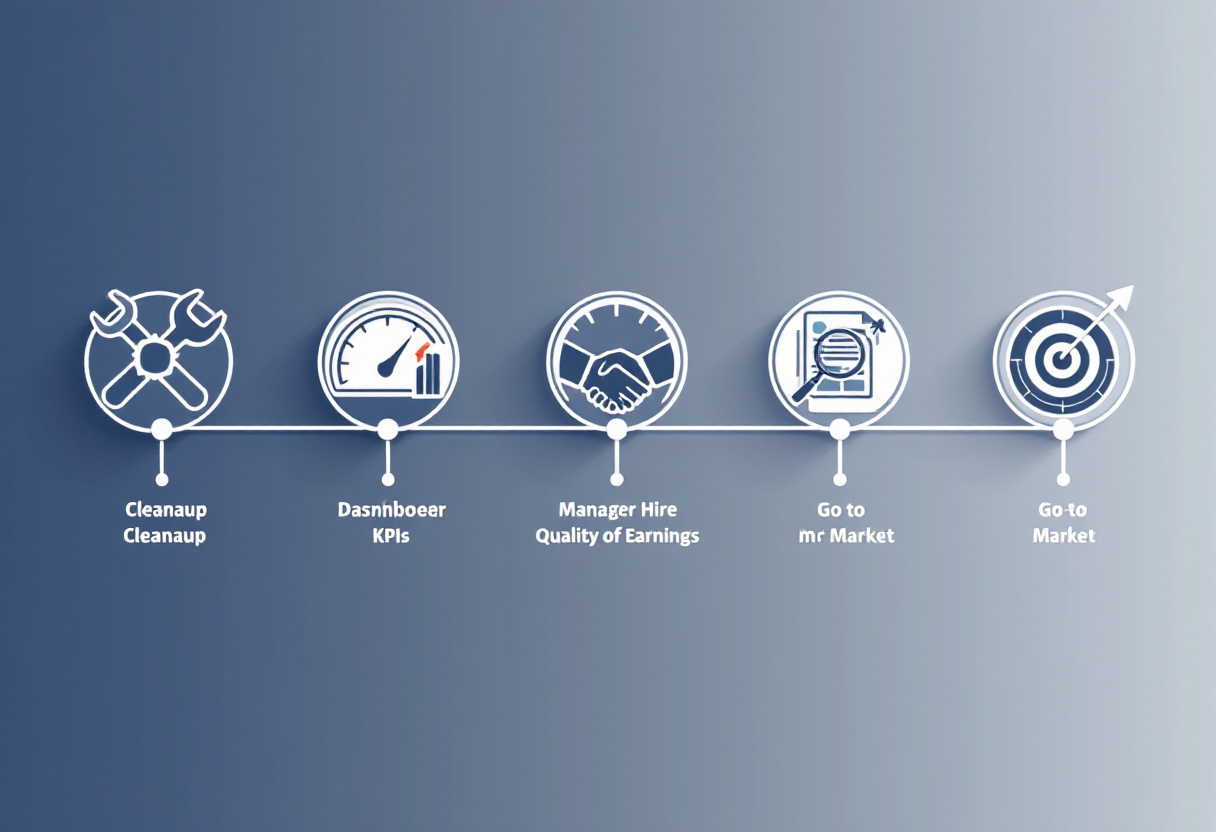
T-36 months: Cleanup phase
- Switch to accrual basis if still on cash basis
- Segment the chart of accounts by service line (route, TSDF, PFAS, ER, industrial cleaning, consulting, project remediation)
- Start tagging every potential EBITDA add-back as it happens
- Build the regulated-asset binder (permits, licenses, registrations, bonds, certifications)
- Refresh closure cost estimates on any TSDF or transfer station; fund any gap
- Restruck related-party rent to FMV with appraisal
- Phase I ESA on every owned property
- Begin PFAS exposure inventory; retire AFFF firefighting foam from owned facilities
- W-2 / 1099 audit; reclassify project labor where needed
- Sales and use tax compliance review by outside counsel in every operating state
T-24 months: Operating discipline, KPI infrastructure, and the sales hire
- Hire the VP Sales (or COO/Operations Director)
- Monthly close within 15 days; service-line P&L every month
- KPI dashboard: route density (stops per truck per day), gross retention by service line, customer count, average ticket, MSA penetration, EMR, response time on ER calls, dispatch live-answer percentage
- Begin contract repapering campaign with top 50 customers (auto-renewal, indemnity, insurance, CPI/PPI escalation)
- Resolve every open NOV, consent order, and administrative order
- Drive workers comp EMR toward 0.85 through formal safety program
- Build the PFAS line: one named technology partner, one repeat customer, separate P&L
- Document SOPs for every operational role
- Build the add-back bridge as a living document
T-12 months: Owner out of the chair, fleet refresh, QoE
- VP Sales fully owns top customer relationships; owner takes a 2-week unplugged vacation as the stress test
- Run the sell-side QoE (budget $75K to $150K)
- Refresh fleet replacement plan; retire trucks above 12 years
- Tighten balance sheet: clean AR (especially government and municipal), kill dormant inventory, isolate deferred revenue and customer deposits
- Final compliance scrub (permit currency, HAZWOPER rosters, DOT training, PHMSA HMSP, sales/use tax, environmental)
- Lock in 12 months of clean service-line P&L for the CIM
- Refresh Phase I ESA reports on owned real estate
- Pre-engage outside environmental counsel for the eventual reps and warranties negotiation
T-6 months: Pre-marketing prep
- Engage M&A advisor or sell-side investment bank with environmental services experience (Houlihan Lokey, Capstone Partners, BGL, RL Hulett, Auxo Capital Advisors, Harris Williams, Robert W. Baird, William Blair, Lincoln, KeyBanc; regional banks for sub-$15M EBITDA)
- Typical fees: 1% to 3% of TEV with a minimum success fee of $750K to $1.5M
- CIM drafted from the QoE and operating model (50 to 80 pages)
- Teaser drafted (anonymized 1-pager)
- Buyer list finalized: 15 to 30 names for targeted auction (best fit for most $3M to $15M EBITDA environmental services businesses)
- Virtual data room populated (Datasite, Intralinks, or Firmex)
- Management presentation deck built and rehearsed
- R&W insurance underwriting submission prepared (premium typically 2.5% to 4.5% of policy limit; retention 0.5% to 1.0% of TEV; PFAS carve-out norm but push for narrow exclusion)
T-3 months: Go to market
- Teaser distributed; NDAs collected; CIMs distributed
- IOIs collected 2 to 3 weeks after CIM goes out
- Narrow to 4 to 6 finalists for management meetings
- Management meetings; LOIs solicited
- Select LOI; sign with exclusivity (60 to 120 days in environmental services)
- Begin state CHOW filings the day exclusivity is signed
- Enter confirmatory diligence; close
End-to-end from banker engagement to close: 9 to 15 months in environmental services, longer than most sectors because of permit and CHOW work. Plan for 12 to 18 months from “go” decision to closed transaction.
Frequently Asked Questions
How long should I plan for before selling my environmental services business to a private equity or strategic buyer?
The owners who get top-quartile pricing start preparing 24 to 36 months before going to market. The minimum useful prep window is 18 months because most of the high-impact levers in environmental services (shifting revenue mix toward recurring route work, building a documented PFAS capability, refreshing the regulated-asset binder, driving the workers comp EMR below 0.85, hiring a VP Sales, resolving any open NOVs, running a sell-side QoE) need 12+ months of clean trailing-twelve-months data to be credible to a buyer. Owners who try to sell in under 6 months typically leave 20% to 35% of enterprise value on the table or get repriced during confirmatory diligence on permit, PFAS, or closure cost reserve issues that should have been resolved before market.
What is a realistic EBITDA multiple for a $3M EBITDA hazardous waste transporter in 2026?
For a hazardous waste transporter at $3M EBITDA in 2026 with clean financials, the range is 8x to 12x. The bottom of that range applies to project-heavy books with under 30% recurring route revenue, no permit ownership, owner concentration in sales, and EMR above 1.0. The top of that range applies to books with 50%+ recurring route revenue, a transfer station permit or RCRA Part B TSDF, top customer below 15%, EMR below 0.85, and a VP Sales in place. Adding a documented PFAS line pushes the multiple toward the 10x to 14x band reserved for PFAS specialists (Houlihan Lokey Q2 2025; Capstone Partners August 2025; RL Hulett Q4 2025). The 36-month prep playbook moves you from the bottom of the band to the top, worth roughly $12M of additional sale price on a $3M EBITDA base.
How does PFAS exposure affect my valuation and what should I disclose during diligence?
PFAS is the single biggest swing factor in environmental services valuation in 2026. EPA designated PFOA and PFOS as CERCLA hazardous substances in April 2024 (89 FR 39124) and reaffirmed the designation in September 2025, creating retroactive liability exposure for any party that handled PFAS-containing waste. Sellers with a documented PFAS treatment capability trade at the top of the multiple band (10x to 14x EBITDA for PFAS specialists). Sellers with undisclosed PFAS exposure trade at a discount of 5% to 15% of TEV through PFAS-specific escrows of 5% to 10% of purchase price, separate PFAS indemnity carve-outs, and sometimes specific PFAS insurance requirements on top of base Pollution Legal Liability. Disclose every site (yours or your customer’s) where PFAS-containing waste was handled, every biosolids land application, and every AFFF firefighting foam location on owned facilities. Read the Holland & Knight October 2025 update on EPA’s PFAS rulemaking trajectory before negotiating reps and warranties.
What happens to my RCRA Part B TSDF permit when I sell the business?
RCRA Part B operating permits are facility-specific and are not freely transferable. Under 40 CFR 270.40, the permit can be modified upon a change in ownership, but the modification requires a permit modification application to the issuing agency (EPA or state-authorized program). The modification process takes 6 months in well-run states and 24 to 36 months in problematic states. Practical consequences: the deal closes, but the permit transfer takes months to a year+ post-close; buyers demand a transition services agreement keeping the seller on the permit until transfer; some buyers require the seller to remain a guarantor of compliance through the transfer period; financial assurance instruments (closure cost surety bonds, post-closure trust funds) must be substituted by the buyer at close, often $1M to $10M of capital; the public comment period during CHOW will surface every open NOV or compliance gap. Plan for 12 to 18 months from “go” decision to closed transaction mostly because of permit work (40 CFR Part 270; Transect RCRA TSDF permit guide).
Should I pay for a quality of earnings report before going to market?
For environmental services businesses at $2M+ EBITDA, yes. A sell-side QoE costs $75K to $150K typical, up to $250K for complex add-back situations or multi-entity structures with closure cost reserve restatements. The ROI is straightforward. On a $4M EBITDA business at an 8x baseline, a 1x multiple uplift supported by a clean sell-side QoE equals $4M of additional sale price. More importantly, a pre-market QoE surfaces revenue recognition issues on multi-month remediation projects, working capital surprises (especially on prepaid service contracts and customer deposits), closure cost reserve adequacy, and add-back weaknesses while you can still fix them, rather than during exclusivity when the buyer re-trades the deal.
Should I sell my facility real estate with the business or hold it back?
For environmental services, holding the real estate separately is usually the higher-value path, with two caveats. First, any owned property carrying a TSDF permit or transfer station permit typically must be sold with the operating business because the permit is facility-specific and the buyer wants control over the site. Second, any property with Recognized Environmental Conditions identified in Phase I ESA should be addressed before deciding (either remediate or carve out and retain). For owned vehicle yards, dispatch offices, and equipment storage facilities, move the real estate into a separate LLC at fair market value triple-net rent to the operating company. This often lifts the implied EBITDA multiple on the operating business by 0.5x to 1.0x because the buyer is not forced to underwrite real estate exposure. You then have three options at close: assign the lease to the buyer, sell the real estate to the buyer at appraised value, or execute a sale-leaseback with a triple-net REIT investor at the same time as the operating company sale.
What to Do Next
The environmental services owners who get the top-quartile multiple all do the same five things. They start preparing 18 to 36 months before they want to be out. They shift revenue mix toward recurring route work, TSDF throughput, PFAS, and emergency response. They build the regulated-asset binder before any buyer sees a CIM. They hire a VP Sales 18 months pre-market so owner-concentration risk is off the table. And they pay for a sell-side QoE before they engage a banker.
The 2026 to 2027 window is the strongest seller’s market in environmental services in a decade. Strategic consolidation by Clean Harbors, Republic Services, Waste Management, GFL, Veolia, and Tradebe is running at full pace. Infrastructure funds and traditional PE are deeper than they have ever been. The PFAS regulatory tailwind is structural. Owners who prepare 18 to 24 months in advance with clean financials, segmented revenue, repapered contracts, current permits, low EMR, no open NOVs, and a documented PFAS capability will trade at the top of the published ranges. Owners who go to market reactively will give back 2 to 4 turns of multiple to escrows, earnouts, and indemnity carve-outs.
If you are 12+ months from a potential exit and want a structured pre-sale optimization roadmap, CT Acquisitions has environmental services operations specialists in our partner network who run multi-quarter prep engagements. If you are 6 to 12 months out and ready to start the sell-side process, our M&A advisory team runs the buyer outreach across PE platforms, strategic majors, and infrastructure funds. No fee to you on buy-side introductions; sell-side mandates are paid on success at closing. Either way, the first 30 minutes are free.
Ready to talk?
Schedule a 30-minute exit-readiness call
Or read more: Sell Your Environmental Services Business (active sale guide) | Sell Your Business (parent guide)
Ready to Explore Your Options?
A 30-minute confidential conversation is all it takes.