
Food Industry Mergers and Acquisitions in 2026: Deal Activity, Named Strategic Buyers, and EBITDA Multiples
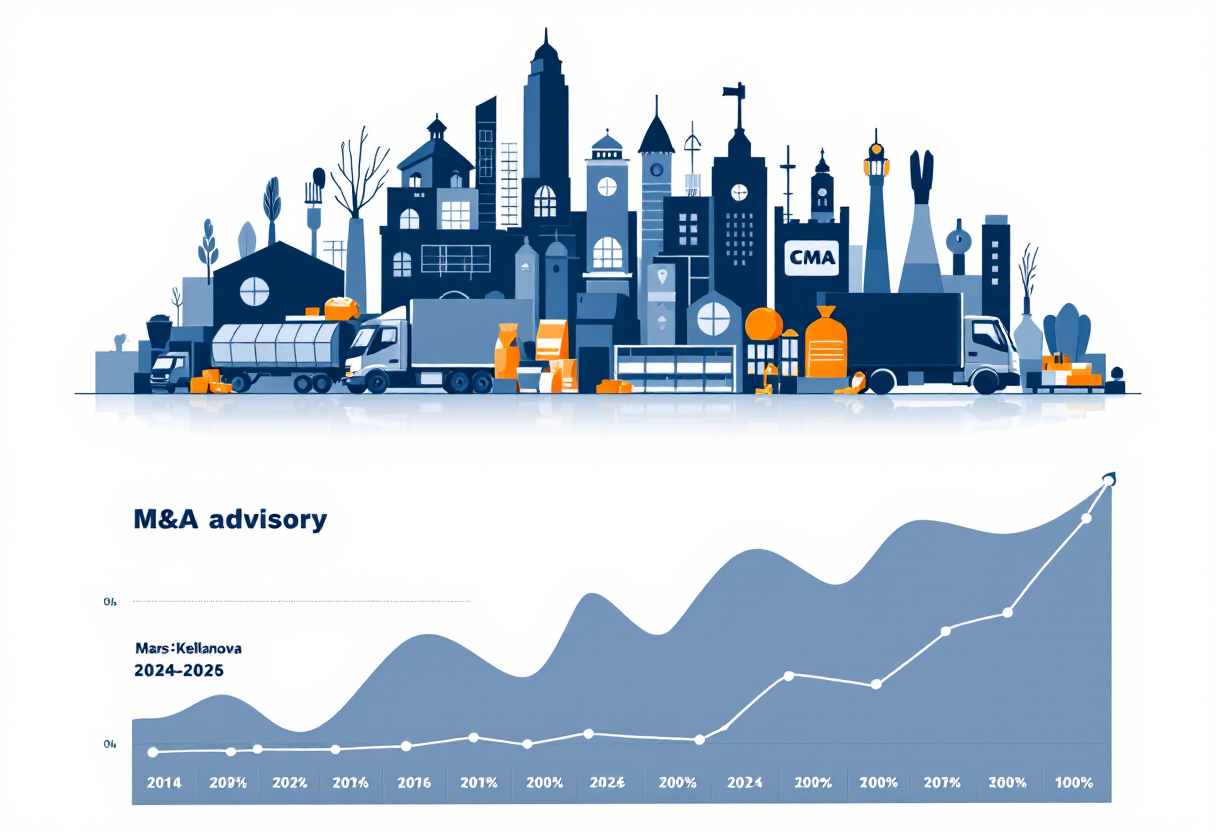
Food industry mergers and acquisitions in 2026 are being driven by three macro forces: private equity dry powder targeting recession-resilient consumer staples, strategic consolidation among CPG conglomerates protecting shelf space, and Gen-1 founder retirement across regional bakeries, specialty food brands, and food-service distributors. This guide breaks down the 2026 food sector M&A landscape, names the most active strategic and financial buyers, lays out current valuation multiples by sub-vertical, and explains how a founder should position a food business for sale.
Food Sector M&A in 2026: The Macro Picture
The food sector is one of the few corners of the broader M&A market that has held its bid through the 2023 to 2025 rate cycle. While generalist private equity pulled back on industrial and tech buyouts when the 10-year Treasury crossed 4.5 percent, food deal volume held up because the underlying cash flows are non-cyclical. People eat in recessions, premiumization continues even when discretionary spending tightens, and branded food companies generate the kind of repeatable EBITDA that lenders will still underwrite at 5 to 6 turns.
Three concrete data points frame the 2026 food sector M&A picture. First, announced food and beverage transaction value in 2024 cleared $95 billion globally, anchored by the Mars / Kellanova deal at $35.9 billion announced in August 2024. Second, middle-market food deal count (transactions between $25 million and $500 million in enterprise value) grew roughly 18 percent year over year from 2023 to 2024 per Capstone Partners data, with the bulk of activity in specialty CPG and food-service distribution rollups. Third, private equity now owns or controls more than 240 food and beverage platforms in North America, up from roughly 150 in 2019, meaning a meaningful share of 2026 to 2028 deal flow will be PE-to-PE secondaries and platform exits rather than founder-to-strategic primaries.
For a founder thinking about an exit window, the practical takeaway is that food sector M&A in 2026 is a seller’s market in the sub-verticals with scarcity (premium pet food, functional beverages, ethnic and Hispanic specialty food, clean-label snacks) and a balanced market in the legacy categories (mainstream bakery, commodity protein, regional food-service distribution). Process matters more in 2026 than it did in 2021 because buyers have rebuilt diligence muscle and will not pay 2021 multiples for assets that have not grown.
Food and Beverage M&A Outlook 2026: Deal Activity and Trends
The food and beverage M&A outlook for 2026 points to rising deal activity after a cautious 2024. Private equity is sitting on record dry powder and treating food as a recession-resilient place to deploy it, while strategic CPG acquirers are buying growth in categories their legacy brands cannot reach organically. The clearest 2026 trend is a flight to better-for-you, high-protein, and functional products, with buyers paying premiums for brands that own a fast-growing subcategory.
The direction of travel becomes obvious when you line up recent years. Food industry mergers and acquisitions cooled through 2024 as higher rates and stubborn input costs made buyers disciplined, then began recovering into 2026 as financing conditions eased and sponsors faced pressure to put committed capital to work. The deals getting done are concentrated where growth is: healthy snacks, functional beverages, better-for-you packaged goods, and pet food, rather than broad commodity categories where private label keeps compressing margins.
Three forces shape the 2026 food and beverage deal-activity forecast. First, private equity dry powder needs a home, and consumer staples offer durable demand that underwrites debt well. Second, large CPG strategics are using M&A as their innovation pipeline, acquiring insurgent brands rather than building them. Third, the premium has shifted decisively toward brands with a defensible position in a growing subcategory, which is why a smaller healthy-snacks or functional-beverage company can command a higher multiple than a larger business in a flat commodity segment. For a founder, the takeaway is that a differentiated brand in a rising category has more buyers competing for it in 2026 than at any point since the last cycle peak.
The Five Food Sub-Verticals Buyers Are Pursuing
Food is not a single market. Buyers underwrite each sub-vertical with different multiples, different diligence depth, and different strategic theses. The six sub-verticals where 2026 deal flow is concentrated are branded consumer packaged goods (CPG), food service distribution, bakery and specialty foods, prepared and convenience foods, beverage (both alcoholic and non-alcoholic), and pet food.
Strategic acquirers and food-sector sponsors can join buy-side application for food M&A for off-market platform and add-on flow.
Food-sector strategics and sponsors often review how the origination tech stack works when building an add-on pipeline against the industry consolidation curve.
Branded CPG. This covers shelf-stable and refrigerated branded products sold through grocery, mass, club, and online. Buyers want brands with distinct positioning, real velocity per point of distribution, and clean-label or better-for-you credentials. Kraft Heinz, General Mills, Conagra, Mondelez, Hershey, and Unilever all maintain active corporate development teams looking for tuck-in brands in the $50 million to $500 million revenue band. The strategic logic is shelf-space defense: if a category is growing and a strategic does not own a brand in it, a competitor will.
Food service distribution. Sysco, US Foods, and Performance Food Group dominate broadline distribution, but regional and specialty distributors (Italian, Asian, produce, protein, paper and disposables) trade actively at 8 to 12 times EBITDA. This is a rollup category where private equity sponsors aggregate regional players and either sell to the three majors or take the platform public. Driver shortages, fleet capital requirements, and food inflation have pushed several Gen-1 owners toward the exit door.
Bakery and specialty foods. Regional bakeries, ethnic specialty foods, gourmet and artisan brands, and frozen specialty all sit in this bucket. Multiples range 6 to 9 times for traditional bakery and 9 to 14 times for differentiated specialty. The buyer set is mixed: strategic acquirers like Flowers Foods and Grupo Bimbo for mainstream bakery, sponsors like Sun Capital, Centerbridge, and Stripes Group for specialty platforms.
Prepared and convenience foods. Refrigerated entrees, meal kits, deli, fresh prepared. This category has gotten harder to underwrite because of co-manufacturing dependency and short shelf life, but premium players with proprietary recipes and direct grocery relationships still attract competitive processes.
Beverage (alcoholic and non-alcoholic). Functional beverages, premium non-alcoholic, craft spirits, and ready-to-drink cocktails are commanding the highest multiples in food and beverage right now (12 to 18 times for category-defining brands). Coca-Cola, PepsiCo, Keurig Dr Pepper, Diageo, and Constellation Brands are all active acquirers, alongside sponsors like L Catterton, Stripes Group, and Lion Capital.
Pet food. Premium and super-premium pet food (especially fresh, frozen, and human-grade) is the highest-multiple category in food in 2026, with platform deals at 12 to 16 times and category-defining brands at 18 to 22 times. Mars Petcare, Nestle Purina, General Mills (Blue Buffalo), and Post Holdings drive strategic demand. The thesis is straightforward: pet humanization is a 15-year secular trend and premium attach rates keep expanding.
Strategic Buyers in Food M&A: Who Is Actually Acquiring
The strategic acquirer set in food is concentrated, well-capitalized, and led by corporate development teams that look at hundreds of deals per year. Knowing who is actively acquiring (versus who has been quiet) shapes how a banker positions a sell-side process.
Kraft Heinz. Active in condiments, sauces, and shelf-stable categories where the company can use its distribution muscle. Tends to pay disciplined multiples (8 to 11 times for tuck-ins) and prefers brands with margin structure that can be improved through Kraft Heinz manufacturing.
General Mills. Has been one of the most acquisitive strategics in food since the 2018 Blue Buffalo deal ($8 billion). General Mills is focused on pet, snacks, and natural and organic, and the corporate development team will pay premium multiples for category leaders. The recent divestiture of yogurt brands (sold to Lactalis in 2024) freed capital for further pet and snack acquisitions.
Conagra. Frozen meals, snacks, and shelf-stable specialty. Conagra has been a disciplined acquirer post the Pinnacle deal, focusing on brand revitalization rather than big platform M&A. Tuck-in targets in the $100 million to $500 million range fit the playbook.
Mondelez. Global snacks, with a particular appetite for chocolate, biscuits, and premium snacking platforms. Has been active in emerging markets and in functional snacking (better-for-you bars, low-sugar formats).
Hershey. Confection and salty snack adjacency (the SkinnyPop and Pirate Brands acquisitions established the salty snack platform). Hershey is selective but pays full multiples for assets that fit the strategic vision.
Unilever. Ice cream divestiture announced in 2024 has reshaped the food portfolio. Unilever is now more focused on prestige beauty and personal care than food, but legacy food and refreshment brands (Hellmann’s, Knorr, Magnum) still anchor a meaningful business that could see further portfolio reshuffling.
Sysco, US Foods, Performance Food Group. The Big Three of food service distribution. All three actively tuck in regional and specialty distributors to fill geographic gaps and add specialty capabilities (protein, produce, ethnic). Multiples paid are typically 8 to 11 times for clean platforms with route density.
Coca-Cola and PepsiCo. The two beverage giants are the most active strategic acquirers in non-alcoholic. Coca-Cola tends to use its bottling network and equity investment vehicle (Coca-Cola Ventures) to take minority stakes in emerging brands before acquiring. PepsiCo has been more direct, with major deals in functional beverage, sports nutrition, and Hispanic foods over the past five years.
For founders running a sell-side process, the practical implication is that a credible banker will reach 25 to 40 strategic buyers in a food deal, but only six to ten of those will engage seriously. The rest are courtesy outreach. The banker’s job is to know which corporate development team is in-cycle on a given category, which division head has budget authority, and which buyer has a competitive gap a target can fill.
Private Equity in Food: Active Sponsors and Their Theses
Private equity has become the dominant force in middle-market food M&A. The category checks every box a sponsor wants: recession resistance, repeatable EBITDA, fragmented buyer universes for exit, and meaningful operational improvement opportunity. The sponsors below are the ones a food founder will see in almost every competitive process.
L Catterton. Consumer-focused sponsor with one of the deepest food and beverage portfolios in private equity. Active across better-for-you food, premium beverage, and pet. L Catterton thesis is brand premiumization and direct-to-consumer optionality. Portfolio has included Kettle Cuisine, Hopdoddy, and dozens of consumer brands.
Advent International. Large-cap global sponsor with a major food and consumer franchise. Has been active in food service and CPG (Cinnabon parent Focus Brands, now GoTo Foods, is owned by Roark Capital, not Advent). Advent typically writes equity checks of $200 million and up.
Stripes Group. Growth equity sponsor with a strong food and beverage track record (Vital Proteins, Banza, Naked Wines). Stripes plays in the $50 million to $300 million revenue range and pays growth multiples for brands with strong velocity and category leadership.
Centerbridge. Special situations and buyout sponsor active in food manufacturing and food service. Comfortable with operational complexity and turnarounds.
Roark Capital. Franchised food service and consumer focus. Owns or has owned Inspire Brands (Arby’s, Buffalo Wild Wings, Sonic, Dunkin’), Focus Brands (Cinnabon, Auntie Anne’s, before the GoTo Foods rebrand), and dozens of other restaurant and consumer platforms. Roark is the dominant sponsor in franchised food service M&A.
Sun Capital Partners. Mid-market sponsor with active food and beverage portfolio across CPG, food service, and specialty manufacturing. Comfortable with operational improvement plays and carve-outs from strategic parents.
Lion Capital. Consumer-focused European sponsor with a track record in food and beverage (Picard, Premier Foods, Russell Hobbs, Weetabix historically). Active in premium consumer.
Beyond the named sponsors above, the food sector draws capital from Bain Capital, KKR, Blackstone, Apollo, TPG, Carlyle, CVC, Permira, and dozens of middle-market food-focused sponsors. For deeper context, see our overview of the top private equity firms you should know.
The PE thesis in food is rarely about cost-out alone. It is usually some combination of channel expansion (taking a regional brand national, or DTC into retail), category extension, professional management upgrade (Gen-1 founder to professional CEO), bolt-on acquisitions, and margin expansion through co-manufacturing optimization and trade spend discipline. A founder evaluating sponsor bids should ask each finalist to articulate which levers they intend to pull in years one through three.
Valuation Multiples by Food Sub-Vertical (2026 Benchmarks)
Multiples in food are sub-vertical specific and quality-adjusted within each sub-vertical. The ranges below reflect transactions closed in 2024 and 2025 plus indicative bids on processes running into 2026. Real multiples in a competitive process can be 1 to 3 turns above the range for category-defining assets and 1 to 2 turns below for businesses with concentration, declining velocity, or operational risk.
Branded CPG: 10 to 15 times EBITDA. Better-for-you, clean-label, and category-defining brands in growing categories command 13 to 18 times. Commodity or low-growth branded businesses trade at 7 to 10 times. The premium is paid for organic growth rate (high single digits or better), gross margin structure (35 percent plus), and distribution headroom.
Food service distribution: 8 to 12 times EBITDA. Broadline distributors with route density and customer concentration below 15 percent trade at the top of the range. Specialty distributors (Italian, Asian, protein, produce) trade similarly, with premium for differentiated supplier relationships. Regional broadliners with concentration issues or fleet capital needs trade at 6 to 8 times.
Bakery and specialty foods: 6 to 9 times EBITDA (mainstream); 9 to 14 times (differentiated specialty). Mainstream commercial bakery is capital-intensive and commodity-priced, hence the lower range. Specialty (gluten-free, sourdough, premium pastry, ethnic specialty) commands meaningful premiums when paired with branded distribution.
Prepared and convenience foods: 8 to 12 times EBITDA. Strong premiums for businesses with proprietary recipes, direct grocery relationships, and minimal co-manufacturing dependency. Discounts for businesses with high SKU complexity, short shelf life, or single-customer concentration.
Beverage premium: 12 to 18 times EBITDA. Functional beverage, premium non-alcoholic, craft spirits, and category-defining ready-to-drink brands clear 15 to 20 times in competitive processes. The beverage multiple premium reflects scarcity, scalability, and strategic value to the major beverage acquirers.
Pet food: 12 to 16 times EBITDA (premium); 18 to 22 times (category-defining brands). Pet is the highest-multiple food category in 2026. Fresh, frozen, human-grade, and functional pet platforms are scarce, growing 15 to 25 percent annually, and pursued aggressively by Mars, Nestle Purina, General Mills, and Post.
For background on the methodology bankers use to triangulate these ranges, see how investment bankers value a business.
Named 2024-2026 Food Sector Deals Worth Studying
The transactions below shaped food sector M&A from late 2023 through 2026 and continue to influence how strategic and financial buyers underwrite new deals.
Mars / Kellanova ($35.9 billion announced August 2024). Mars acquired Kellanova (the snacking and international cereal business spun out of the Kellogg’s split in October 2023) in the largest food deal of 2024. The transaction validated premium multiples for branded snacking platforms (Pringles, Cheez-It, Pop-Tarts) and gave Mars a true competing snacking and cereal franchise to Mondelez. The deal closed in 2025 after regulatory review.
Kellanova spin from Kellogg’s (October 2023). The split of Kellogg’s into Kellanova (global snacks and international cereal) and WK Kellogg Co (North American cereal) was the setup that made the Mars acquisition possible. The spin separated the high-growth snacking business from the lower-growth domestic cereal business and freed the premium multiple Mars eventually paid.
J.M. Smucker / Hostess Brands ($5.6 billion November 2023). Smucker acquired Hostess (Twinkies, Ding Dongs, HoHos) for $5.6 billion in late 2023. The deal extended Smucker into sweet baked snacks and meaningfully expanded the convenience store channel footprint. The multiple paid (roughly 17 times EBITDA) signaled that strategic buyers will pay full price for branded snacking scale.
Unilever ice cream separation (announced March 2024). Unilever announced the separation of its ice cream business (Magnum, Ben and Jerry’s, Wall’s, Breyers) into a standalone company. The separation, expected to complete in 2025 to 2026, will create one of the largest pure-play ice cream businesses globally and a potential M&A target or platform.
Campbell Soup / Sovos Brands ($2.7 billion completed March 2024). Campbell acquired Sovos Brands (Rao’s pasta sauce) for $2.7 billion, paying roughly 18 times EBITDA for the category-leading premium pasta sauce brand. The deal underlined how aggressively strategics will pay for premium velocity brands in growing categories.
General Mills divestiture of yogurt to Lactalis (announced 2024, closed 2025). General Mills sold its North American yogurt business (Yoplait, Liberte) to Lactalis and freed capital for pet, snack, and natural and organic acquisitions.
Post Holdings / multiple bolt-ons. Post has been one of the most consistent acquirers in food, with bolt-ons in pet (Perfection Pet Foods 2023) and ready-to-eat cereal. (Pacific Foods was acquired by Campbell Soup Company in 2017, not Post.) Post is the model for a serial acquirer that compounds shareholder value through disciplined M&A.
Food service distribution rollups. Performance Food Group, US Foods, and Sysco all closed multiple regional distributor tuck-ins through 2024 and 2025. Specific deals (the $2.1 billion Performance Food Group acquisition of Cheney Brothers, announced August 2024) illustrate the route density and channel expansion thesis driving consolidation.
For founders studying comparables, the lesson is that premium multiples are reserved for category leaders and growth. Commodity assets do not get the headlines or the multiples.
Food Industry Mergers and Acquisitions in 2026: The Packaged Goods Deals Announced So Far
The 2026 deal tape looks different from the 2024 megadeal year. Corporate Finance Associates found that brands with better-for-you, high-protein, international, or sustainable positioning made up 67.7% of branded food acquisition activity so far in 2026, the highest share since 2019, as reported by Food Dive in August 2026. The same report noted that megadeals were rare while transaction counts stayed near historical averages. On the packaged goods side, PwC’s 2026 midyear consumer markets outlook reported that CPG deal value more than doubled year over year in the first quarter of 2026, even as deal volume kept falling: fewer deals, bigger checks.
The largest announced transactions, per Food Dive’s 2026 deal tracker:
- McCormick and Unilever’s foods business, a $44.8 billion combination announced March 31, 2026, per Food Dive, joining Hellmann’s with McCormick’s spice and Frank’s RedHot portfolio.
- IFF’s food ingredients business to CVC Capital Partners for $4.3 billion, announced May 29, 2026, per Food Dive. A strategic carve-out bought by private equity.
- Ingredion and Tate & Lyle, a $3.6 billion acquisition announced June 8, 2026, per Food Dive, aimed at clean-label and lower-sugar ingredients.
- Intersnack and Utz Brands, a $2.9 billion take-private announced July 21, 2026, per Food Dive.
- Danone and Huel, a reported $1.2 billion purchase announced March 23, 2026, per Food Dive, adding powders and ready-to-drink complete nutrition.
- Smithfield Foods and Nathan’s Famous for $450 million, announced January 21, 2026, per Food Dive, a branded packaged meat add-on.
- Marzetti and Bachan’s for $400 million, announced February 10, 2026, per Food Dive, a better-for-you sauce brand.
Three lessons for a founder. First, ingredients consolidation is the biggest 2026 theme by dollar value, which matters if you supply or co-pack for the big ingredient houses. Second, carve-outs like the IFF sale show sponsors are buying the divisions large companies no longer want, so a corporate parent can be a seller as well as a buyer. Third, the mid-size brand deals (Bachan’s, Huel, Nathan’s) went to strategics paying for a defined position in protein, global flavors, or a recognized name. For how buyers build the numbers behind those prices, see our food manufacturing business valuation guide.
The Diligence Issues Unique to Food Deals
Food sector diligence is heavier than diligence in industrial services or distribution because the buyer is underwriting food safety risk, supply chain complexity, customer concentration, and trade spend accuracy. The issues below recur in almost every food deal and a founder who has not pre-empted them will lose multiple turns at the closing table.
Trade spend. Branded food businesses sell through grocery, mass, club, and convenience channels using a combination of list pricing, scan-down promotions, slotting fees, and end-aisle and feature programs. The accounting for trade spend (whether accrued to net revenue or to SG&A) varies, and adjusted EBITDA presented to buyers must reconcile to a clean trade spend reserve methodology. Buyers will spend weeks reconciling trade spend, and any aggressive accrual treatment will get unwound.
Customer concentration. A food business that derives more than 25 percent of revenue from a single grocery chain or a single food service customer will see multiple compression. Walmart, Costco, Kroger, and Sysco concentrations above 30 percent typically take 1 to 2 turns off the multiple. Sellers should be honest about concentration and have a credible diversification plan.
SKU profitability. Bottom-quartile SKUs in a branded food business often drag total margins down by 200 to 400 basis points. Buyers will conduct SKU-level profitability analysis and adjust EBITDA for the SKU rationalization a new owner would execute. Sellers who have already rationalized the tail show better presented EBITDA and avoid the buyer haircut.
Co-manufacturer dependency. Many branded food businesses use third-party co-manufacturers for some or all production. Buyers will diligence co-manufacturer contracts, single-source risk, and the cost difference between co-manufactured and self-manufactured units. A business that uses a single co-manufacturer for 60 percent of production will face questions about supply continuity and pricing power.
Cold chain integrity. Refrigerated and frozen food businesses live or die on cold chain. Buyers will diligence cold chain incidents, recall history, and the temperature monitoring infrastructure across DCs and distribution lanes. Any history of temperature excursions or recalls becomes a buyer-side risk reserve.
Inventory valuation and reserves. Food inventory has expiration risk, and the methodology for reserving slow-moving and short-dated inventory varies. Buyers will scrutinize the reserve methodology and may push for additional reserves at close, which directly reduces net working capital and therefore reduces the cash a seller receives at close. For more on closing-stage diligence dynamics, see due diligence checklist after closing mergers and acquisitions.
Channel chargebacks and deductions. Grocery and food service customers charge back for late delivery, damaged product, fill rate misses, and a long list of compliance issues. The deduction rate (deductions as a percent of gross sales) varies by channel and is a leading indicator of operational health. Buyers want to see a normalized deduction rate and a trended view of resolved versus disputed deductions.
Regulatory and FDA Considerations in Food M&A
Food businesses are FDA-regulated (and in some cases USDA-regulated for meat, poultry, and egg products) and the regulatory diligence in a food deal is more involved than in most other consumer categories. The framework below covers what buyers diligence and what sellers should have organized before going to market.
FSMA compliance. The Food Safety Modernization Act (FSMA) is the controlling food safety law for FDA-regulated facilities. FSMA compliance includes a Food Safety Plan, Preventive Controls, Foreign Supplier Verification, sanitary transportation rules, and intentional adulteration rules. Buyers will diligence FSMA compliance documentation in full.
HACCP audit history. Hazard Analysis and Critical Control Points (HACCP) plans are required for many food categories and audited regularly. The buyer will want to see the most recent HACCP audit reports, any corrective actions taken, and the cadence of internal versus third-party audits. Clean audit history with documented corrective actions is the gold standard.
FDA 483 observations and warning letters. When the FDA inspects a facility, observations are documented on Form 483. A clean inspection history is a positive diligence finding; recent 483s without documented closure are a buyer risk reserve. An FDA Warning Letter is a serious issue that will affect deal terms and may delay closing until remediated.
Recall history. The buyer will diligence every recall over the past five to seven years. The questions are: what was recalled, how was it identified, what was the root cause, what corrective actions were implemented, and has the issue recurred. A single Class I recall (reasonable probability of serious health consequences) without strong remediation will affect price and indemnification.
Third-party certifications. SQF, BRC, FSSC 22000, organic certification, kosher, halal, non-GMO Project, and other third-party certifications matter for both regulatory and commercial reasons. Buyers will diligence the certification history and the cost of maintaining each certification.
Allergen control. For facilities that produce products containing major allergens (peanut, tree nut, dairy, egg, soy, wheat, fish, shellfish, sesame), the allergen control program is a diligence focus. Cross-contact incidents, label review processes, and segregation procedures all get examined.
State and local regulatory layers. Beyond FDA, food businesses face state department of agriculture rules (especially for dairy, meat, and produce), local health department inspections (for food service), and a patchwork of labeling and ingredient rules (California Proposition 65, state by state sugar and sodium disclosure laws). Buyers expect a complete inventory of regulatory exposure by jurisdiction.
Working Capital and Inventory in Food Sector Deals
Working capital is one of the highest-stakes negotiations in any food deal because food businesses carry meaningful inventory, the inventory has expiration risk, and the seasonality of demand creates variability in normal working capital levels. The framework below covers what buyers and sellers fight about and how a founder should prepare.

The target working capital peg in a food deal is set as a trailing twelve months average of net working capital, typically adjusted for known anomalies (one-time inventory builds for product launches, abnormal customer payment timing). The peg is the level of working capital the seller commits to leave in the business at close. If actual working capital at close is below the peg, the seller pays the buyer the shortfall. If actual is above the peg, the buyer pays the seller the excess.
For food businesses, three issues complicate the peg negotiation. First, seasonal businesses (holiday baking, ice cream, snack peaks around football season and holidays) have working capital that varies 30 to 50 percent through the year. The TTM average is misleading and the buyer and seller need to agree on a seasonally adjusted peg or a peg measured as of a specific date.
Second, inventory reserve methodology directly affects the peg. If the buyer and seller disagree on the appropriate reserve for slow-moving or short-dated inventory, the disagreement shows up in the peg. Aligning on reserve methodology before going to market avoids surprises at close.
Third, customer deduction reserves and trade spend accruals are working capital items. A buyer may push for larger reserves than the seller has historically carried, which compresses net working capital and effectively transfers cash from seller to buyer at close. A well-run sell-side process forces this conversation early and locks the methodology in the purchase agreement schedules.
The practical advice for founders is to engage a quality of earnings provider three to six months before launching a process and work with that provider specifically on working capital methodology. The QoE working capital analysis becomes the seller-side anchor in the eventual negotiation.
The Co-Manufacturing and Private Label Question
Co-manufacturing (paying a third party to produce your branded product) and private label (manufacturing for retailer brands) are two strategic questions that come up in almost every food deal diligence. Both have valuation implications and both deserve clear positioning in the sell-side narrative.
Co-manufacturing dependency. Branded food businesses that produce all or most of their product through co-manufacturers face buyer scrutiny on three dimensions. First, single-source risk: if a single co-manufacturer produces more than 50 percent of volume, the buyer needs to underwrite continuity if that co-manufacturer fails or raises prices. Second, cost competitiveness: co-manufacturing costs typically run 200 to 500 basis points higher than self-manufactured equivalent unit costs, which means a buyer with internal manufacturing scale will model margin expansion from in-housing production. Third, contract terms: co-manufacturer contracts with short termination clauses or restrictive pricing escalators create buyer risk.
The seller-side positioning depends on the buyer type. Strategic buyers with manufacturing scale see co-manufacturing as an opportunity (they will in-house production and capture the margin). Financial buyers see it as a risk to mitigate or a cost to model into the operating plan. Either way, the seller should present co-manufacturer contracts, single-source exposures, and the make versus buy economics transparently.
Private label. Manufacturing for retailer brands (Kroger’s Simple Truth, Costco’s Kirkland Signature, Whole Foods 365, Walmart’s Great Value) is a separate question. Private label revenue is typically lower margin than branded revenue but provides volume that fills plant capacity. The valuation question is how the buyer values branded versus private label EBITDA. Most buyers will discount private label EBITDA by 20 to 40 percent relative to branded EBITDA because private label customer concentration is high, contract terms are short, and competitive resourcing risk is real.
For a business with meaningful private label exposure, the sell-side narrative should explicitly bridge total EBITDA into branded EBITDA and private label EBITDA and articulate the strategic role private label plays. If private label is filling otherwise idle capacity, the buyer can see it as accretive. If private label is competing for shelf space against the brand, the buyer will discount it more aggressively.
How a Founder Should Prepare a Food Business for Sale
Founders who run a disciplined preparation process before going to market consistently realize 20 to 35 percent higher multiples than founders who go to market reactively. The preparation framework below covers the 12 to 18 months before launching a sell-side process.
Eighteen months out: financial cleanup. Move from cash basis or hybrid accounting to full accrual GAAP. Get a Big Four or large regional audit if revenue exceeds $20 million. Implement a chart of accounts that mirrors what buyers want to see (gross sales, trade spend, net sales, COGS by category, gross margin, SG&A by function). Build a 36-month historical financial package by month, by SKU, by customer, by channel.
Twelve months out: operational and regulatory hygiene. Complete any open FDA 483 corrective actions. Refresh third-party certifications (SQF, BRC, organic). Pull together a clean recall history file with root cause and corrective action documentation. Document the food safety plan, HACCP plan, and supplier verification program. Conduct an internal mock audit and remediate any findings.
Nine months out: customer and contract review. Inventory all customer contracts, identify upcoming renewals or expirations, and shore up the at-risk relationships. Address concentration by adding new accounts where possible. Review co-manufacturer and supplier contracts and renew anything that expires within 24 months.
Six months out: quality of earnings and management presentation. Engage a QoE provider (Riveron, BDO, Grant Thornton, EisnerAmper, Cohn Reznick are all active in food) to produce a sell-side QoE. The QoE will identify adjustments, normalize working capital, and pre-empt buyer-side findings. Build the management presentation, the confidential information memorandum, and the financial model with the banker.
Three months out: process launch readiness. Tier the buyer universe (named strategics, named sponsors, secondary tier). Build the data room. Conduct management presentation rehearsals. Confirm the timeline (typical food sector sell-side runs 6 to 8 months from teaser to close).
For broader context on the strategic logic of M&A from a seller perspective, see advantages of mergers and acquisitions with examples and business acquisition meaning explained.
How CT Acquisitions Runs Food Sector Sell-Side Mandates
CT Acquisitions runs sell-side processes for founder-owned and family-owned food businesses in the $5 million to $75 million EBITDA range. The food practice is led by bankers with operating and M&A experience across CPG, food service, and specialty categories.
A typical CT food sector sell-side mandate runs the following process. Pre-marketing (weeks 1 to 8): full financial diligence, QoE coordination, regulatory file review, buyer universe construction, and CIM drafting. Marketing (weeks 9 to 16): buyer outreach, NDA execution, management presentations, and first-round IOIs. Diligence (weeks 17 to 26): buyer diligence, second-round bids, finalist selection, exclusivity, and purchase agreement negotiation. Closing (weeks 27 to 32): regulatory approvals, financing close, and transaction close.
The buyer universe for a typical food sector mandate includes 25 to 50 strategic acquirers, 30 to 60 financial sponsors, and 5 to 15 family offices and independent sponsors with food mandates. The banker’s job is to know which 40 to 80 buyers will actually engage and which are courtesy outreach.
For founders who want to understand how a strategic horizontal combination is structured (a competitor acquiring a competitor in the same sub-vertical), see what is a horizontal merger.
If you own a food business and want to discuss whether a 2026 or 2027 sale window makes sense, schedule a confidential consultation. The conversation will give you a clear-eyed view of what your business is worth, who the most likely buyers are, and what the process timeline looks like.
Food Sector M&A: Frequently Asked Questions
What is the outlook for food and beverage M&A in 2026?
The 2026 outlook for food and beverage M&A is one of recovering deal activity. After a cautious 2024, private equity dry powder and strategic CPG buyers are driving more transactions, concentrated in growth categories like healthy snacks, functional beverages, and better-for-you packaged goods. Brands that own a fast-growing subcategory are commanding premium multiples, while flat commodity segments see less buyer interest.
What multiple should a founder expect for a $20 million revenue branded food business?
The answer depends on EBITDA margin, growth rate, and sub-vertical. A branded food business with $20 million revenue, 18 percent EBITDA margin (so $3.6 million EBITDA), high single-digit growth, and a differentiated brand position in a growing category should expect 10 to 13 times EBITDA in a competitive process, or roughly $36 million to $47 million enterprise value. Commodity or low-growth businesses at the same revenue level may trade at 7 to 9 times. Premium beverage, premium pet, or category-defining specialty could clear 14 to 18 times.
How long does a typical food sector sell-side process take?
Six to eight months from process launch to close is typical for a clean food business in the $5 million to $50 million EBITDA range. The pre-marketing preparation (financial cleanup, QoE, CIM drafting) takes another 2 to 4 months before launch. Founders should plan for a 9 to 12 month timeline from initial banker engagement to wire transfer.
Are strategic buyers or financial buyers paying higher multiples in food in 2026?
It depends on the asset. Strategic buyers pay premium multiples for assets that fill a clear strategic gap and offer revenue or cost synergies they can underwrite. Financial buyers pay competitive multiples for platforms with growth runway and operational improvement opportunity. In categories like premium pet, functional beverage, and clean-label specialty, strategic and financial buyers are paying similar premium multiples because the strategic logic and the financial sponsor thesis converge.
What is the most common reason food deals break?
Quality of earnings adjustments. Buyer-side QoE often identifies trade spend accruals, customer deduction reserves, inventory reserves, and one-time addbacks that reduce adjusted EBITDA by 5 to 15 percent from the seller-side presentation. When the reduction is meaningful, the buyer reprices and the seller either accepts the new multiple or walks. A pre-marketing sell-side QoE is the single highest-ROI preparation step a founder can take to avoid this outcome.
How important is owning manufacturing versus using co-manufacturers?
It depends on the buyer. Strategic acquirers with manufacturing scale often prefer co-manufactured businesses because they can in-house production and capture the margin. Financial sponsors prefer self-manufactured businesses because they avoid co-manufacturer dependency risk. For a branded food business with strong velocity, either model can work as long as the economics and contract terms are transparent. For a private-label-heavy business, owned manufacturing usually commands a premium.
What are the top three FDA issues that affect food deal value?
First, recent Class I or Class II recalls without strong remediation documentation. Second, open FDA 483 observations or any active Warning Letter. Third, gaps in FSMA preventive controls or supplier verification programs. Any of these can cost 1 to 2 turns of multiple or trigger meaningful indemnification reserves. The preparation framework above (12 months out: operational and regulatory hygiene) addresses these head-on.
What are some recent acquisitions in the food industry?
Large 2026 announcements reported by Food Dive include McCormick combining with Unilever’s foods business, CVC Capital Partners buying IFF’s food ingredients unit, Ingredion buying Tate & Lyle, Intersnack taking Utz Brands private, Danone buying Huel, Smithfield buying Nathan’s Famous, and Marzetti buying Bachan’s. Most mid-size deals targeted protein, better-for-you, or global flavor brands.
Is packaged goods M&A slowing down in 2026?
Deal count is soft but deal value is not. PwC’s 2026 midyear consumer markets outlook reported that CPG deal value more than doubled year over year in the first quarter even as volume fell. Buyers are writing fewer, larger checks and concentrating on brands with a clear growth position, while flat commodity brands draw fewer bidders.