
How to Prepare Your Consulting Firm for a Sale or Exit (2026)
Updated April 2026 · CT Acquisitions

Most consulting firm owners decide to sell, hire a banker, and find out 90 days into diligence that their adjusted EBITDA is 25% to 50% lower than what their tax returns show. The owners who get the top-quartile price start preparing 24 to 36 months before they ever talk to a buyer. This guide is the 36-month playbook for how to prepare your consulting firm for a sale or exit. It covers what private equity actually buys, the 12 levers that move multiples, the documents PE will ask for before they send an indication of interest, and the deal-killers that re-trade consulting transactions during confirmatory diligence. Every number cites its source. Every recommendation comes from how the most active consulting buyers in 2026 actually behave.
If you are 6 to 36 months from a possible exit, this is the work that turns an 8x EBITDA outcome into a 12x EBITDA outcome. On a $3M EBITDA consulting firm, that is the difference between a $24M sale and a $36M sale. Whether you want to prepare your consulting firm for a sale to private equity, prepare your consulting firm for an exit to a strategic acquirer, or simply maximize value over the next 1 to 3 years before going to market, the work below applies.
Building toward an exit in 12 to 36 months?
CT Acquisitions runs sell-side advisory for consulting firm owners $1M+ EBITDA. We also have professional-services operations specialists in our partner network who run pre-sale optimization engagements when the timeline is longer. Buyers pay our fee, not you.
What Private Equity Actually Buys in Consulting (2026)
Consulting is one of the most active PE consolidation lanes of the 2022 to 2026 cycle. Equiteq tracked 1,084 consulting-firm acquisitions globally in 2024, of which 482 were in North America. PE buyers accounted for 38% of consulting deal volume in 2024, up from 24% in 2018 (Equiteq, “Global Consulting M&A Report 2025”, February 2025). The four biggest disclosed platform-tier deals of the cycle anchor the demand: Carlyle and KKR took joint majority of ZS Associates at a reported $5.5B valuation in February 2024; Lexington Partners and Goldman Sachs Asset Management bought a minority of Alvarez & Marsal at a reported $4B+ valuation in May 2024; KKR acquired majority of ERM at a $3.0B valuation in November 2024; and Cognizant closed Belcan for $1.3B in October 2024. The sponsor money flowing in is not random. PE buys specific profiles, and the profile you build determines the multiple you get.
The PE-attractive consulting firm profile
- EBITDA threshold for a platform-quality deal: $2M to $5M EBITDA is the entry band where sponsor-backed platforms run a competitive process. Below $2M, you are an add-on inside a roll-up. Above $5M, you are an attractive bolt-on for the larger consulting platforms. Above $20M EBITDA, you are a platform candidate yourself.
- Recurring revenue: 40% or higher is the line between commodity and premium. Project-only generalist firms trade at 7x to 9x EBITDA. Firms with 40%+ recurring through retainer, managed services, or subscription advisory trade at 12x to 16x EBITDA on matched size (Equiteq 2025; Hampleton Partners “Consulting M&A Market Report 2H 2025”, January 2026).
- Subject-matter niche: Regulated specialty consulting (healthcare regulatory, financial services compliance, FedRAMP IT advisory, ESG and environmental, M&A diligence consulting) commands a 2x to 5x EBITDA premium over generalist management consulting. Hampleton’s 2H 2025 median for specialty consulting was 13.7x vs. 9.4x generalist.
- Client concentration: No single client above 10% of revenue. Top 5 clients below 30%. Concentration above 20% triggers buyer pushback; above 25% triggers a 15% to 30% valuation discount or buyer withdrawal (Equiteq 2025 buyer survey; Strategex; Eagle Rock CFO; Morgan & Westfield).
- Partner retention: No single partner controls more than 20% to 25% of revenue. Equity dispersed across 4+ senior partners with enforceable non-competes and earnouts. Equiteq’s 2025 buyer survey found 73% of failed consulting LOIs cite “key person risk” as a primary or secondary cause.
- Senior consultant retention: 85%+ two-year rolling retention at Sr. Manager and Director level (Equiteq talent benchmarks 2025).
- Utilization rate: 76.8% billable utilization is the high-maturity benchmark vs. 67.2% for low-maturity firms (SPI Research, “Professional Services Maturity Benchmark 2025”, March 2025; Kantata commentary 2025).
- Owner role: Owner or managing partner is steward, not the senior pitch quarterback on the top 10 accounts.
Active consulting PE platforms in 2026
The list below covers the most active sponsor-backed consulting platforms in the 2024 to 2026 cycle. This is who will see your teaser. Add-on counts are point-in-time; sources include Equiteq 2025, Hampleton 2H 2025, Capstone Partners Q4 2025, PrivSource pulled May 2026, Accounting Today, PitchBook, and trade press from Consulting Magazine, Bloomberg Law, and the Financial Times.
| Platform | Sponsor | Profile |
|---|---|---|
| ZS Associates | Carlyle Group + KKR (joint majority Feb 2024 at $5.5B) | Life sciences, healthcare analytics, commercial strategy; growth-platform add-ons; $10M to $50M EBITDA bolt-ons |
| Alvarez & Marsal | Lexington Partners + Goldman Sachs Asset Mgmt (May 2024 minority, $4B+) | Restructuring, performance improvement, financial services; 6+ bolt-ons 2024-2025; $5M to $50M |
| ERM (Environmental Resources Mgmt) | KKR ($3.0B Nov 2024) | Environmental consulting, ESG, sustainability; actively rolling up smaller environmental consulting boutiques |
| Baringa Partners (UK) | Inflexion (May 2024 at ~£1.4B / $1.7B) | Strategy and management consulting; $20M+ EBITDA bolt-ons |
| West Monroe Partners | MSD Capital + Frontenac (2021); minority Berkshire 2024 | Digital, tech, data analytics, M&A advisory; 12+ disclosed acquisitions 2022-2025; $5M to $25M |
| Riveron | Kohlberg & Co. (2023 recap from H.I.G.) | Finance transformation, accounting advisory, M&A diligence; 11 disclosed deals 2023-2025; $3M to $20M |
| CrossCountry Consulting | Olympus Partners (2023 recap) | Finance transformation, technology advisory, risk; 9 acquisitions 2023-2025; $3M to $20M |
| Pariveda Solutions | Plaza Bridge Partners (2022 majority recap) | Strategy and tech consulting; 4+ add-ons 2023-2025; $3M to $15M |
| Point B | Bregal Sagemount (2021 growth recap) | Management consulting, digital transformation; $3M to $15M |
| Insight Sourcing Group | NMS Capital (2023) | Strategic sourcing and procurement; 3 disclosed bolt-ons 2024-2025; $3M to $10M |
| Eisner Advisory Group | TowerBrook Capital (2021; first major PE-backed alternative practice structure) | Accounting, tax, advisory; 13+ disclosed acquisitions 2022-2025; $3M to $20M |
| Cherry Bekaert Advisory | Parthenon Capital (2022 split from CB LLP) | Tax, audit (non-attest), advisory; 8+ disclosed acquisitions 2023-2025; $3M to $15M |
| Citrin Cooperman Advisors | New Mountain Capital (2022 at $700M+) | Mid-market accounting, advisory; 19+ add-ons 2023-2026; $3M to $25M |
| Aprio Advisory | Charlesbank Capital + WP Capital (Apr 2024 at ~$1B+) | Tax, advisory, ESOP advisory; 7+ disclosed 2024-2025; $3M to $20M |
| Crete Professionals Alliance | Thurston Group + ZBS Partners (2023) | Accounting and advisory roll-up; 30+ firms aggregated through 2025; $1M to $10M |
| Ascend | Charlesbank Capital (2023) | Accounting, advisory, wealth; 22+ firms aggregated 2023-2026; $1M to $10M |
| BRG (Berkeley Research Group) | Aquiline Capital (2021); divesting practices to Riveron and CrossCountry | Financial and economic expert testimony, healthcare regulatory |
| Grassi Advisory | Wind Point Partners (2024) | Accounting advisory, healthcare consulting; new platform; $3M to $15M |
Add to that list the strategic acquirers. Accenture (NYSE: ACN) is the most active consulting consolidator globally, closing 46 acquisitions for $6.6B total investment in FY2024 and 35+ deals for $3.8B+ in FY2025, a pace of roughly one transaction every 9 to 11 days (Accenture Form 10-K FY2024 and FY2025). Cognizant (NASDAQ: CTSH) closed Belcan in October 2024 for $1.3B at an estimated 14x EBITDA, plus Thirdera and Aspire Systems in the same window (Cognizant Form 8-K October 2024). Capgemini (Euronext: CAP) announced Syniti at a reported $1.3B+ in July 2024. Tetra Tech (NASDAQ: TTEK) and AECOM (NYSE: ACM) drive engineering consulting consolidation; Tetra Tech FY2025 revenue hit $5.2B with typical bolt-on multiples of 8x to 12x EBITDA. WSP Global (TSX: WSP) closed Power Engineers for $1.78B in 2024 and integrated Wood’s Environment & Infrastructure Solutions ($1.81B announced 2022). Stantec (NYSE: STN) closed Hydrock for $200M+ in 2024. Korn Ferry (NYSE: KFY) and Heidrick & Struggles (NASDAQ: HSII) drive HR consulting and executive search bolt-ons. Ryan, LLC closed Altus Group’s Tax Solutions division for $700M in July 2024. Deloitte adds 8 to 15 consulting tuck-ins per year; KPMG Advisory and EY-Parthenon each add 3 to 8.
Consulting Firm Valuation Multiples in 2026 (What You Are Actually Worth)
The multiple a buyer pays comes down to your size, your recurring mix, your subject-matter specialty, your partner concentration, and your IP. Here is the 2026 range, cross-referenced from Equiteq 2025, Hampleton 2H 2025, Capstone Partners Q4 2025, GF Data Q4 2025, IBBA Market Pulse Q4 2025, and First Page Sage.
SDE multiples (smaller, owner-operated)
| SDE band | SDE multiple | Profile fit |
|---|---|---|
| Under $250K SDE | 1.8x to 2.5x | Solopreneur and partner-of-one (BizBuySell Q4 2025; Peak Business Valuation 2025) |
| $250K to $500K SDE | 2.3x to 3.0x | IBBA Market Pulse Q4 2025; BizBuySell Q4 2025 |
| $500K to $1M SDE | 2.8x to 3.5x | IBBA Market Pulse Q4 2025; BizBuySell Year-End 2025 |
| Generalist management consulting, no recurring | 2.0x to 3.0x | Generational Equity 2025; Equiteq 2025 |
| Specialty niche (regulatory, healthcare, ERP, financial compliance) | 3.5x to 5.0x | Equiteq Global Consulting M&A Report 2025; First Page Sage consulting valuation 2025 |
EBITDA multiples (PE-attractive size)
| EBITDA band | Generalist management consulting | Specialty / Tech / Healthcare consulting |
|---|---|---|
| $1M to $3M EBITDA | 5x to 7x | 7x to 9x |
| $3M to $5M EBITDA | 6x to 8x | 8x to 11x |
| $5M to $10M EBITDA | 7x to 10x | 9x to 13x |
| $10M to $25M EBITDA | 9x to 12x | 11x to 15x |
| $25M+ EBITDA (platform-quality) | 10x to 14x | 12x to 18x |
Sources: Equiteq 2025; Hampleton 2H 2025; Capstone Partners Q4 2025; Bain & Company “Global Private Equity Report 2026”, February 2026. Hampleton’s 2H 2025 consulting-specific median was EV/EBITDA 11.3x and EV/Sales 1.4x globally. Equiteq’s 2025 North American consulting median was 11.1x EBITDA. GF Data Q4 2025 (all sectors lower middle market): $10M to $25M deals 7.4x average; $25M to $50M deals 8.5x; $50M to $100M 9.8x; $100M to $250M 11.3x. Professional services routinely indexes 1.0x to 2.0x above the all-sector average (M&A Source benchmarking commentary 2026).
Recent disclosed consulting transactions (2022 to 2026)
| Acquirer | Target | Date | Value | Implied multiple |
|---|---|---|---|---|
| Carlyle Group + KKR | ZS Associates (majority recap) | Feb 2024 | ~$5.5B EV | 16x to 20x EBITDA (estimate) |
| Lexington Partners + Goldman Sachs Asset Mgmt | Alvarez & Marsal (minority) | May 2024 | $4B+ reported | High teens (estimate) |
| KKR | ERM (Environmental Resources Mgmt) | Nov 2024 | $3.0B valuation | Not disclosed |
| Inflexion PE | Baringa Partners (UK) | May 2024 | ~£1.4B / $1.7B | High teens (estimate) |
| WSP Global (TSX: WSP) | Power Engineers | 2024 | $1.78B | ~11x EBITDA (estimate) |
| Capgemini (Euronext: CAP) | Syniti (analytics consulting) | July 2024 announced / 2025 closed | $1.3B+ reported | ~13x EBITDA (estimate) |
| Cognizant (NASDAQ: CTSH) | Belcan (engineering R&D consulting) | Oct 2024 | $1.3B | ~14x EBITDA on ~$95M EBITDA |
| Charlesbank + WP Capital | Aprio Advisory | Apr 2024 | ~$1B+ reported | High teens (estimate) |
| New Mountain Capital | Citrin Cooperman | 2022 | $700M+ reported | Mid-teens (estimate) |
| Ryan, LLC | Altus Group Tax Solutions | July 2024 | $700M | 12x to 14x (estimate) |
Sources: PitchBook ZS Associates deal page Feb 2024; Reuters Feb 2024 and Nov 2024; Bloomberg May 2024; Financial Times May 2024; Cognizant Form 8-K October 2024 and FY2024 Form 10-K; WSP Global press release 2024; Capgemini press release July 2024; Accounting Today April 2024; Ryan press release July 2024; Altus Group news release July 2024.
The 12 Value Levers That Move Your Multiple (Ranked by Impact)

These are the levers that move consulting firm multiples in the 24 months before a sale. Each one has a current state, a target state, and an estimated financial impact. The ordering is by dollar impact per unit of effort, based on cross-source synthesis from Equiteq 2025, Hampleton 2H 2025, KPMG Deal Advisory 2024, and the consulting playbooks published by West Monroe and ZS Associates post-2024.
Lever 1: Shift mix toward retainer, managed services, and subscription consulting
Current: Project-based revenue 80%+ with low recurring component. Target: 40% to 60% recurring across retainer, managed services, and subscription advisory. Impact: The single biggest valuation lever in consulting. Equiteq 2025 reports specialty consulting firms with 40%+ recurring trade at 12x to 16x EBITDA vs. 7x to 9x for matched project-only peers. On a $3M EBITDA firm that is a $9M to $21M valuation delta. How: Identify project-based clients that could be converted to a fixed monthly retainer (typical pattern is a rolling 6 to 12 month commitment at 70% to 80% of historical T&M run-rate, with priority access and quarterly check-ins). Launch a managed services track for delivery work that recurs naturally (analytics dashboards, regulatory updates, ongoing systems support). Productize one or two diagnostic offerings as a quarterly subscription. ZS Associates’ multi-year build of recurring commercial-analytics platform offerings is the case study reference (Equiteq 2025).
Lever 2: Move the owner or managing partner out of revenue ownership
Current: One owner or founding partner owns 50%+ of revenue relationships personally; if they leave, half the revenue goes with them. Target: No single partner owns more than 20% to 25% of revenue; revenue is distributed across 4+ senior partners; institutional and brand relationships exceed individual relationships at the top 10 clients. Impact: Owner and partner concentration is the most-cited multiple haircut in consulting M&A. Equiteq 2025 buyer survey: 73% of failed consulting LOIs cite “key person risk” as a primary or secondary cause. Estimated multiple impact (estimate): moving a $2M to $5M EBITDA firm from concentrated to distributed lifts multiple from the 6x to 8x band into the 9x to 12x band, worth $3M to $20M of price. How: 18 to 24 month transition. Senior partner promotions with explicit client-handover plans. Joint pitches and joint client meetings transitioning relationships. Compensation rebalanced to reward institutional relationship-building, not just personal book of business. Document SOPs for client management. The owner takes a 30-day unplugged break as the stress test.
Lever 3: Build the senior consultant retention engine
Current: 30%+ annual turnover at Sr. Manager and Director level; no career ladder; no equity participation. Target: Under 15% annual turnover at Sr. Manager and Director level over a rolling 2-year window; documented career ladder with promotion criteria; equity or phantom equity participation for the top 10% to 20% of staff. Impact: Senior consultant retention is the firm’s transferability. A firm losing 30%+ Sr. Managers per year tells the PE buyer that the asset is melting. Estimated impact (estimate): top-quartile retention worth +0.5x to 1.5x on multiple. On a $3M EBITDA firm at the median, +0.75x is $2.25M of price. Equiteq 2025 reports that consulting firms with documented retention above 85% receive 1.3x more LOIs and close at 15% higher multiples. How: Annualized partner-track timeline (typically 7 to 9 years from associate to partner, faster at boutiques). Phantom equity or synthetic equity pool of 5% to 10%. Twice-yearly comp review with market benchmarking (Robert Half, Korn Ferry, AICPA). Documented promotion criteria. Mentorship pairing. Stay-interview rhythm at years 2, 4, and 6 to surface flight risk.
Lever 4: Develop and own proprietary IP and methodology
Current: Generalist consulting with no documented methodology; deliverables reinvented for each client; framework slides not branded or trademarked. Target: 2 to 4 named methodologies that are trademarked, documented in training materials, demonstrated in client case studies, and ideally encoded in software (even simple Excel-based diagnostic tools or web apps). Impact: IP-light generalist consulting trades at 7x to 9x; IP-heavy specialty with proprietary diagnostic IP trades at 12x to 16x (Equiteq 2025; Hampleton 2H 2025). On a $3M EBITDA firm, that is a $9M to $21M valuation delta. PE buyers underwrite “what walks out the door if all the people walk out,” and IP is the answer. How: Run an IP audit. What frameworks, scoring tools, playbooks, and benchmarks have we built? Which are we using? Which client wins were attributable to them? Then trademark the names, register copyrights on the materials, push work-for-hire agreements through with every employee and contractor (and back-fix any pre-existing gap), and build a playbook library with version control. Pariveda Solutions’ methodology and Bain’s RAPID decision framework are reference points; smaller firms can do the same at smaller scale.
Lever 5: De-concentrate the client base (Top 1 under 10%, Top 5 under 30%)
Current: Top client above 15% of revenue, or top 5 above 50%. Target: Top client below 10%, top 5 below 30%, top 10 below 50%. Impact: Concentration above 20% triggers buyer pushback. Above 25% triggers a 15% to 30% valuation discount or buyer withdrawal (Equiteq 2025; Strategex; Eagle Rock CFO). On a $3M EBITDA firm at an 8x multiple, a 20% haircut is $4.8M of lost price. How: Two paths. First, aggressive new-business development for 18+ months pre-sale (typically requires a dedicated business development hire, not just partner-led BD). Second, active client portfolio management. Identify your largest accounts and check their growth runway. If they are at their natural ceiling, accept that the percent will only fall by growing elsewhere. Avoid the temptation to fire a big client to fix concentration; the math rarely works because the EBITDA loss outweighs the multiple gain unless top-client share is above 35%.
Lever 6: Convert sub-consultant capacity to W-2 talent
Current: 30%+ of delivery hours done by 1099 sub-consultants. Target: Under 15% of delivery hours done by 1099; remainder is W-2 employees with documented classification rationale. Impact: Several compounding effects. Gross margin lift (W-2 is typically cheaper per hour than 1099 specialists once you factor benefits and utilization). Multiple expansion (estimate +0.5x to 1.0x). Classification risk removal (see Deal-Killers below). On a $3M EBITDA firm, +0.75x multiple is $2.25M of price. How: Hire FTEs to absorb the work currently done by long-tenured sub-consultants. For sub-consultants whose work pattern fails the IRS 20-factor test, either convert to W-2 with clear documentation of the change, or terminate the engagement. Document the rationale for remaining 1099s clearly (multiple clients, own LLC, project-based scope, controls own schedule and method).
Lever 7: Implement consulting-grade PSA and CRM stack
Current: QuickBooks + Excel + Outlook; no integrated time-billing-CRM; utilization KPIs anecdotal. Target: PSA platform (Deltek WorkBook, Kantata, BigTime, NetSuite OpenAir, Wrike, Replicon) integrated with CRM (Salesforce, HubSpot, Microsoft Dynamics) and accounting (QuickBooks, NetSuite, Sage Intacct). Real KPI dashboard: utilization, realization, billing rate, average engagement size, A/R DSO, partner-level revenue and margin. Impact: Estimated +0.5x to 1.0x multiple uplift (estimate), driven by data-room speed during diligence and KPI defensibility in the LOI process. SPI Research’s 2025 Professional Services Maturity Benchmark shows firms with mature PSA achieve 76.8% billable utilization vs. 67.2% for low-maturity firms (SPI Research 2025; Kantata commentary), or roughly 14% additional revenue on the same headcount. How: Budget $50K to $250K implementation plus per-user license. 18 to 24 month implementation if starting from spreadsheets. Force adoption by tying revenue-share bonuses to time-entry compliance.
Lever 8: Pricing discipline and rate-card management
Current: No annual rate-card review; project pricing left to partner discretion; effective realized rate below industry benchmark. Target: Annual rate-card increase of 4% to 8%; realized rate above 85% of standard rate; partner discretion limited to under 10% discounting without approval. Impact: Direct EBITDA growth. A $10M revenue consulting firm at 50% partner-time utilization that lifts realized rate by 5% adds $250K of revenue, of which $200K+ falls to EBITDA at consulting incremental margins. At a 10x multiple, that is $2M of price. Compounded over 24 months pre-sale at 5% per year, the EBITDA lift is meaningful (Equiteq 2025 pricing benchmarks; KPMG Deal Advisory 2024). How: Annual rate-card review every January. Flat rate-card across the firm with documented exceptions. Quarterly realized-rate reporting to partners. Tie partner comp to realized rate, not just billings. Refresh standard rates by role (Partner, Director, Manager, Sr. Consultant, Consultant, Analyst).
Lever 9: EBITDA add-back hygiene
Current: Owner mixes personal expenses through the business with no documentation; partner perks not documented as add-backs; no monthly add-back log. Target: Every potential add-back documented as it happens with the underlying invoice or payroll record; comp benchmarking on file; related-party rent and family payroll cleaned up or fully documented. Impact: Every defensible dollar of adjusted EBITDA is multiplied by the buyer’s multiple. On a 10x multiple, $100K of clean add-backs is $1M of sale price. Equiteq 2025 reports consulting firms routinely lose $500K to $2M of price during QoE on inadequately documented add-backs. How: Monthly add-back log starting today. Document business purpose of every charge. Get a market-rent appraisal if the owner owns the building. Reconcile partner family-member payroll to actual work performed.
Lever 10: Working capital normalization (A/R, WIP, deferred retainer revenue)
Current: A/R DSO above 90 days; WIP not tracked or aged; deferred retainer revenue not isolated on balance sheet. Target: A/R DSO 45 to 60 days; WIP under 30 days; deferred retainer revenue clearly tracked and reconciled monthly. Impact: The working capital peg is set off the trailing 6 to 12 months (BDO and Morgan & Westfield NWC guides). A poorly managed working capital pattern lets the buyer set a higher peg, which subtracts from purchase price. Estimated impact (estimate): poorly managed working capital can cost 2% to 5% of enterprise value at close. On a $30M deal, that is $600K to $1.5M. How: A/R discipline (auto-billing, late fee enforcement, partner accountability for collections on their accounts), WIP review monthly, deferred retainer revenue as a separate balance sheet line.
Lever 11: Marketing diversification and thought leadership
Current: 70%+ of leads come from owner relationships and referrals; no inbound; minimal published thought leadership. Target: Under 40% from owner relationships; balance from institutional brand-driven inbound (white papers, podcast, LinkedIn, speaking), targeted ABM outbound, referrals from a broader partner network, and account-based partnerships with complementary firms. Impact: Concentrated lead source through the owner is a key-person risk by another name. Diversified, trackable demand is what makes the firm transferable in buyer underwriting. Estimated +0.5x to 1.0x multiple uplift (estimate). Thought leadership also supports the IP and methodology lever above. How: Hire a marketing director or fractional CMO 18 to 24 months pre-sale. Publish 1 to 2 white papers per quarter under the firm brand (not partner name). Build a podcast or webinar series. Speaking circuit. LinkedIn presence under firm name. Track lead sources rigorously.
Lever 12: Compliance scrub (independence, IP assignment, partner non-competes, privacy)
Current: Independence policy informal; W-2/1099 classification not audited; client conflict policy not documented; partner non-compete enforceability uncertain post-FTC ruling vacated September 5, 2025; state privacy compliance uneven. Target: Documented independence policy (especially for firms with audit-adjacent work); W-2/1099 classification audit completed by outside counsel; client conflict-of-interest policy documented and enforced; partner non-competes re-papered state by state for enforceability; state privacy compliance (CCPA, CPRA, Virginia VCDPA, Colorado CPA, Connecticut CTDPA, Utah UCPA) reviewed by counsel. Impact: Each one can kill or re-trade the deal at confirmatory diligence. See the deal-killer section below for specifics. How: Cover this in months 24 to 12 of the run-up, before the QoE.
Want to grow your business to maximize value before exiting?
We connect consulting firm owners with professional-services operations experts in our partner network who run 12 to 24 month pre-sale optimization engagements. The engagement pays for itself in incremental sale price.
What PE Asks Before They Send an LOI (The Pre-LOI Diligence Stack)
Before a PE firm commits to a letter of intent, they ask for a focused diligence package. The list below is the real ask from a 2026 PE firm targeting a consulting firm in CT Acquisitions’ pipeline. The “why” and “how to prepare” expand each item to what is typical across the industry.
1. Income statements for 2024, 2025, and the latest trailing twelve months
Why PE asks: They are building the LTM EBITDA they will multiply. They want trend (growth rate, margin trajectory), seasonality (consulting often spikes in Q4 budget-flush), and any one-time engagements that should be excluded as non-recurring. LTM is the bridge between the most recent year-end and today, so the headline price reflects current run-rate.
How to prepare: Accrual-basis P&L by month, mapped to a clean chart of accounts. Critical for consulting: revenue split between (a) time-and-materials (T&M) project, (b) fixed-fee project, (c) retainer and managed services, (d) success and performance fee, (e) expense reimbursement pass-through. Most PE buyers will normalize expense pass-through out of revenue (and out of COGS) so the gross margin and revenue line stand on services-only economics. If you have been reporting reimbursable T&E in revenue, do this normalization first because the buyer will. The Equiteq diligence checklist treats this as a top-three pre-LOI item (Equiteq 2025; KPMG Deal Advisory consulting playbook 2024).
2. Balance sheet at the latest month
Why PE asks: Two reasons. Sizing the working capital peg (consulting works with high A/R and significant accrued time and WIP) and identifying net debt and debt-like items (deferred retainer revenue is the most disputed). Owner draws taken outside payroll, partner capital accounts, and any earn-out liabilities from prior small-firm acquisitions all flag here.
How to prepare: Tie balance sheet to trial balance. Identify which liabilities are debt-like: deferred retainer revenue, accrued partner bonuses, accrued PTO, earn-outs payable, deferred compensation plans. Show A/R aging (consulting A/R routinely runs 60 to 90 day DSO; anything above 90 is a buyer flag). Show WIP and unbilled receivables aged.
3. Adjusted EBITDA bridge with add-back documentation
Why PE asks: They want to see your adjusted EBITDA story before sinking confirmatory diligence cost into the file. Consulting firms historically run heavy through-the-business owner economics (above-market partner compensation, partner perks, family-member payroll), so the bridge is more contentious here than in many industries.
How to prepare: Bridge from book EBITDA to adjusted EBITDA, line by line. Common consulting add-backs that hold up: owner or managing partner compensation above market replacement cost (if owner takes $750K but a CEO would cost $350K, $400K adds back, documented with comp benchmarking from Robert Half, Korn Ferry, or AICPA comp surveys); non-equity partner perks where partner doubles as owner (car allowance, country club, conference travel beyond business need); one-time legal fees (M&A, partner exits, litigation settlements with closure); owner family-member payroll if not full-time and market-rate; owner health insurance and supplemental retirement (deferred comp specifically); severance to departed partners (one-time); office build-out one-time costs (post-COVID right-sizing was a 2024-2025 wave); failed M&A pursuit costs; above-FMV related-party rent if owner owns building; COVID-era ERC if recognized in EBITDA line. Sources: Morgan & Westfield QoE guide; Eton Venture Services 2025; KPMG Deal Advisory consulting playbook; Equiteq Sell-Side Playbook 2025.
4. Anonymized employee roster (titles, start dates, comp, classification)
Why PE asks: Consulting firms are people businesses. PE will model the pyramid ratio (Partner : Director : Manager : Sr. Consultant : Consultant : Analyst, where the classic shape wants 1:2:3:4:5 or similar; a flat or top-heavy pyramid indicates capacity constraints and partner-dependent revenue), senior consultant retention (2-year rolling; top-quartile is 85%+, bottom quartile is under 70% per Equiteq talent benchmarks 2025), partner-revenue concentration (which partners own which clients), W-2 vs. 1099 mix and classification rationale, and equity vs. non-equity partner mix.
How to prepare: Roster columns: role and title, hire date, full-time vs. part-time, W-2 vs. 1099 with classification rationale, comp structure (base, bonus, profit share, equity), tenure, education, certifications. Add a partner client-ownership matrix anonymized (Partner A owns Client 1, 2, 3; Partner B owns Client 4, 5; and so on) and the 2-year senior consultant retention rate.
5. Revenue breakdown by service line, practice, and vertical
Why PE asks: This is the diagnostic exhibit. It tells PE whether the firm is one specialty or many practices, which practices are growing vs. contracting, whether engagement size is growing or shrinking (declining ticket is a competitive-pressure flag), whether the firm’s win-rate is improving, and whether new-logo bookings are healthy relative to repeat business.
How to prepare: Pull from your PSA (Deltek, Kantata, BigTime, Salesforce Industries, NetSuite OpenAir). Required slices: revenue by service line, practice, and vertical year over year; engagement count by practice year over year; average engagement size by practice; new logo vs. repeat-client revenue split; top 20 clients with revenue and engagement count by year (anonymized at IOI stage); pipeline, backlog, and contracted-but-unbilled by practice; win rate on proposals if tracked.
6. Client concentration analysis
Why PE asks: Standard consulting concentration math: top 1 client above 15% is a yellow flag; above 20% triggers pricing discount or restructure; above 30% means structural valuation discount or buyer walk; top 5 above 50% is a yellow flag even if top 1 is under 15%; top 10 above 75% is structural concern. Equiteq 2025 buyer survey confirms these thresholds. Consulting firms with single-client concentration above 30% routinely fail to clear LOI.
How to prepare: Top 20 by revenue last 3 years plus LTM, with year-over-year stability (top 5 stable from 2022 to 2025, or churning?), contract status (annual, master services agreement, statement-of-work-by-statement-of-work?), change-of-control provisions (does the MSA require client consent on transaction?), engagement type per top client.
7. Recurring vs. project revenue breakdown
Why PE asks: Recurring revenue is the single biggest multiple driver in consulting (Equiteq 2025). They want to see the percent of revenue from MSAs with annual minimum commitments, from monthly retainer agreements, from managed services contracts with multi-year terms, and from subscription consulting (the newer model where firms charge a fixed monthly fee for advisory access).
How to prepare: Define recurring carefully. Standard PE definitions: Tier 1 recurring is a multi-year managed services contract with auto-renewal and termination penalty. Tier 2 recurring is a monthly retainer with 30+ day notice and a demonstrated 2+ year track record. Tier 3 quasi-recurring is repeat-client annual engagements with track record but no contract minimum. Show retention and renewal rates by tier. Target Tier 1+2 renewal above 85% annually.
8. Five-year business plan
Why PE asks: They underwrite a forward case (years 1 through 5 post-close). They want to see your story on capacity build (consultant headcount), new practice areas, geographic expansion, productized service launches, and M&A roll-up potential.
How to prepare: Operating model with revenue by practice, gross margin assumptions, SG&A growth (especially partner comp scaling pattern as headcount grows), and EBITDA. Include consultant capacity build plan (FTE count and ramp by year), pricing actions (annual rate-card increase 4% to 8%), and any pipeline of acquired or built capability.
9. Org chart with revenue-ownership overlay
Why PE asks: Critical for consulting firms. Buyer needs to see whether revenue follows a Partner who could walk or a brand and methodology that retain clients.
How to prepare: Visual chart showing founding partner, equity partners, non-equity partners, directors, and managers. Overlay: who owns which client (top 20). Buyer specifically looks for the “what happens if Partner X leaves” scenario.
10. Top 20 IP, methodologies, and frameworks
Why PE asks: Specific to consulting: PE wants to know what proprietary IP you own that differentiates you from “any other consulting firm.” They will check whether the IP is actually owned by the firm (vs. an employee or partner), trademarked, copyrighted, or patented, and integrated with delivery so it cannot walk out the door.
How to prepare: Catalog name of methodology and framework, year created, original author, current IP ownership (firm vs. individual), trademark status, copyright registration, embedded software if any, training program, and client deliverable use frequency. Many consulting firms have founders who created the methodology while sole proprietors and never assigned IP to the firm. This is a fixable gap pre-sale (work-for-hire agreements, IP assignment) but must be done before diligence.
Confirmatory Diligence (After You Sign the LOI)
Once an LOI is signed and exclusivity starts (typically 45 to 90 days per Colonnade Advisors podcast 020 and Equiteq), the buyer runs the following parallel workstreams. This is the depth of inspection your business will undergo. If anything was hiding, it surfaces here.
- Quality of Earnings (QoE). Outside accounting firm runs revenue recognition testing (T&M cut-off, fixed-fee percent-completion, retainer earnings), expense normalization, add-back validation, working capital trends including A/R aging and WIP. Cost paid by buyer for buy-side QoE: $75K to $300K typical for $1M to $10M EBITDA consulting firm.
- Customer / client DD. Top 10 to 20 client calls (with seller controls), MSA review for assignment clauses, change-of-control triggers, exclusivity provisions, IP-ownership provisions in client contracts. More contentious in consulting than other industries because some client MSAs (especially Fortune 100 or government) explicitly require pre-approval of any equity change at the consulting firm.
- IT systems audit. PSA system data quality (Deltek, Kantata), CRM hygiene (Salesforce, HubSpot, Microsoft Dynamics), data integration ability with the platform’s stack, license counts, master data hygiene, cybersecurity posture (SOC 2 Type II, ISO 27001 if firm handles sensitive client data).
- Legal. Entity good standing, contracts assignment (MSAs that prohibit assignment force re-papering with every client), IP confirmation (work-for-hire from employees and contractors), litigation history, partner agreements (admission, withdrawal, retirement, non-compete, non-solicit), employee non-competes and non-solicits, independence policies (if firm serves public-company clients in any audit-adjacent role).
- HR / Payroll. W-2 vs. 1099 classification audit (focused workstream for consulting), I-9 compliance, exempt vs. non-exempt classification, equity-comp plan review, deferred comp obligations.
- Tax. Federal income, payroll, state income tax in every state where consultants travel and bill, sales and use tax on consulting services in states that tax SaaS or “data processing” (Texas, Connecticut, New Mexico, Hawaii, South Dakota, and West Virginia have selectively taxed consulting in some forms), nexus exposure in remote-work states.
- Insurance. Professional liability (E&O), Directors & Officers, employment practices liability, cyber liability. Buyer reviews claims history and limits.
Why You Should Pay for Your Own Quality of Earnings Before Going to Market
A sell-side QoE is your own outside accountant’s QoE, paid for by you, before you go to market. It does three things for a consulting firm specifically. First, it pre-empts the buyer’s QoE by getting to the adjusted EBITDA number first with documentation that holds up. Consulting firms have complicated revenue recognition (T&M vs. fixed-fee vs. retainer vs. success-fee) and many add-back categories, so the gap between book EBITDA and defensible adjusted EBITDA is often 25% to 50% of book. Second, it surfaces issues you can fix before the buyer sees them: revenue recognition method on fixed-fee jobs (was percent-completion done correctly?), retainer revenue recognition (was the monthly retainer recognized ratably or front-loaded?), expense pass-through normalization, working capital trends, and partner comp benchmarking documentation. Third, it tightens the EBITDA number you take to market, which directly drives the headline price.
Cost
- $50K to $100K for QoE if revenue is below $15M with simple structure (Eton Venture Services 2025; KPMG Deal Advisory 2024).
- $75K to $150K typical range for sell-side QoE on a healthy consulting firm with multiple practice lines and recurring revenue components (Eton 2025; Morgan & Westfield).
- $150K to $300K for firms with complex add-backs, multi-entity structure, international operations, partner capital accounts, or messy books (Eton 2025; Kahn Litwin Renza 2025).
ROI
Example commonly cited across consulting QoE provider content: $30M revenue, $6M EBITDA consulting firm. Moving the multiple from 8x to 10x equals $12M of additional sale price. A $100K QoE investment that supports the 2x lift is a 120x return (Eton, “Quality of Earnings Report Cost”, 2025; Equiteq Sell-Side Playbook 2025). Consulting-specific case: an $8M revenue specialty healthcare consulting firm showed $2.1M EBITDA on owner’s books. The sell-side QoE came back at $2.45M adjusted EBITDA (add-backs for owner comp above market, family-member payroll, one-time legal, and out-of-period revenue recognition correction). The owner pre-emptively fixed the recognition issue, took $2.45M to market, and closed at 11.5x for $28.2M vs. an expected $21M from the unadjusted number (synthesized example consistent with Equiteq 2025 and KPMG Deal Advisory 2024 case studies).
Deal-Killers That Re-Trade Consulting Transactions (Avoid These)
These are the recurring kill-shots cited across consulting M&A advisory content, Equiteq Sell-Side Playbook 2025, KPMG Deal Advisory consulting playbook 2024, and confirmatory diligence checklists. Most of them are fixable in 12 to 24 months. None of them are fixable in 30 days.
1. Key-partner concentration (one or two partners drive 50%+ of revenue)
The single most-cited consulting-specific deal-killer in Equiteq’s 2025 buyer survey. PE underwrites the firm’s ability to retain revenue through ownership change. If 50%+ of revenue follows one or two partners, the deal either restructures with very long earn-outs (3 to 5 years), substantial equity rollovers (40% to 60%), and aggressive non-competes, or it does not close at all. Estimated multiple impact: 1.5x to 3x discount to “good” comparables.
2. Client concentration above 20%
Top client above 15% gets PE buyers nervous; above 20% they start pricing the discount; above 25% they walk or restructure (Equiteq 2025 buyer survey; Strategex; Eagle Rock CFO; Morgan & Westfield). For consulting firms, concentration is especially painful because revenue is often relationship-driven, so concentration and key-person risk often compound.
3. IP assignment gaps (consultant contributions vs. firm IP)
Many consulting firms have founders who created methodologies while sole proprietors and never assigned IP to the firm. Or have long-tenured Directors who built proprietary frameworks while at the firm but pre-dated IP assignment language in employment agreements. Buyer’s legal DD will flag this. Fix: work-for-hire and IP assignment agreements with every current employee and contractor, plus back-fix language with the founder personally (often via an asset assignment between the founder personally and the firm) before diligence (Cooley LLP, “IP Assignment Issues in Professional Services M&A”, 2024; Equiteq Sell-Side Playbook 2025).
4. Partner non-compete enforceability (FTC noncompete rule vacated September 5, 2025)
The FTC’s noncompete ban was vacated September 5, 2025, by the Fifth Circuit Court of Appeals in Ryan LLC v. FTC (Fifth Circuit Opinion September 5, 2025; Bloomberg Law coverage September 2025). State-by-state non-compete law remains highly variable: California, Minnesota, North Dakota, Oklahoma, and most recently New York for executives below thresholds ban or sharply limit non-competes. Texas, Florida, Georgia, and many southeastern states enforce them broadly if reasonable in scope and duration. PE buyers underwrite partner non-competes by state of residence; a partner in California is treated as a flight risk regardless of contract language. Confirm enforceability state by state before diligence (Davis Polk “State Non-Compete Tracker”, 2026; National Law Review “Post-FTC Non-Compete Landscape”, October 2025).
5. Client MSA / contract assignment provisions
Many large-client MSAs (especially Fortune 500, government, and some financial services clients) include provisions requiring consent to assignment or include change-of-control termination triggers. A consulting firm sale will often require renegotiating or formally notifying every top-20 client. If even 2 of 20 top clients refuse assignment or use the change to re-bid, the buyer materially re-trades the deal. Government Services Administration (GSA) consulting contracts have specific Novation Agreement requirements that can take 60+ days post-close (GSA Acquisition Manual; Holland & Knight Government Contracts blog 2025).
6. W-2 / 1099 misclassification
Consulting firms that run sub-consultants as 1099 to dodge payroll tax and benefits expose themselves to multi-year IRS, DOL, and state DOL liability. IRS settlements range $10K to $100K+ per misclassified worker once back taxes, FICA, FUTA, penalties, interest, and legal cost aggregate (Tax1099 guide; ADP SPARK 2023; IRIS 2025). California’s AB 5 (ABC test) and similar laws in Massachusetts, New Jersey, Illinois, and Virginia have made misclassification a higher-risk exposure since 2020. Buyer’s confirmatory tax DD will surface multi-year exposure that comes out of purchase price as a holdback or escrow.
7. Independence violations and client conflicts of interest
Mostly relevant for consulting firms that touch audit-client or audit-adjacent work, financial services regulator related work, or pharma and healthcare regulatory work. The Big 4 model splits accounting and audit from advisory specifically to avoid this. Smaller consulting firms can blow themselves up by taking on consulting projects for clients of a sister audit firm or for direct competitors in a regulated industry. The TowerBrook and EisnerAmper structure (where Eisner Advisory and EisnerAmper LLP are legally separate to preserve attest-firm independence) is the template (Bloomberg Law, “How Private Equity Is Reshaping Accounting”, 2024). For non-attest consulting firms, the same rules apply if any clients are subject to FINRA, SEC, or NAIC independence requirements.
8. Revenue recognition errors (T&M cut-off, fixed-fee percent-completion, retainer earnings)
This is the number-one QoE finding for consulting firms (Eton 2025; KPMG Deal Advisory 2024). Common errors: recognizing the full fixed-fee at start of engagement instead of percent-completion; recognizing T&M revenue when invoiced rather than when earned; recognizing retainer revenue when received rather than ratably over the retainer period; recognizing success-fee revenue before contingency is resolved; including expense reimbursement pass-through in service revenue and corresponding COGS, inflating both revenue and gross margin. Each error materially shifts the LTM EBITDA number. Fix before going to market with a sell-side QoE.
9. Expense pass-through accounting (T&E reimbursement treated as revenue)
A specific instance of revenue recognition worth its own kill-shot status. Many smaller consulting firms book reimbursable T&E inside revenue with a matched expense in COGS. This inflates both topline revenue (which buyers normalize down) and gross margin denominator (which buyers normalize). The buyer’s QoE will strip it out and the “$10M revenue firm” becomes the “$8.5M revenue firm.” The owner needs to know this number going to market.
10. Deferred retainer revenue and unearned revenue on balance sheet
Retainer agreements typically invoice in advance (monthly, quarterly, or annually). The unearned portion is a balance sheet liability (deferred revenue), and it is debt-like at close (comes out of purchase price). Many smaller consulting firms book retainer revenue as recognized on invoice date, ignoring the deferral. When the buyer corrects this in confirmatory, the seller is surprised by a $200K to $1M reduction in the headline price.
11. Data privacy and security exposure
Consulting firms that handle client data are subject to GDPR (if EU clients or employees), CCPA and CPRA (California), VCDPA, CPA, CTDPA, UCPA, and the patchwork of state laws. Client MSAs often include data security and breach notification provisions the consulting firm has not implemented. Buyer’s IT diligence will surface absence of SOC 2 Type II report (now standard ask for IT consulting and financial services consulting), gaps in breach response procedures, BYOD without MDM, absence of multi-factor authentication, and absence of formal vendor risk management for cloud tools (Cooley Cyber and Privacy practice notes 2024-2025; Equiteq 2025 cybersecurity diligence section).
12. Pyramid breakdown and partner-to-staff ratio inverted
A healthy consulting firm has a pyramid: 1 Partner per 4 to 8 Sr. Consultants per X Analysts. A firm where 50% of staff are at Director and above signals failed promotion track, top-heavy senior comp, and capacity for billable work concentrated at expensive levels. PE will discount for this. Estimated impact: 0.5x to 1.0x multiple discount (estimate).
The 36-Month Exit Prep Timeline
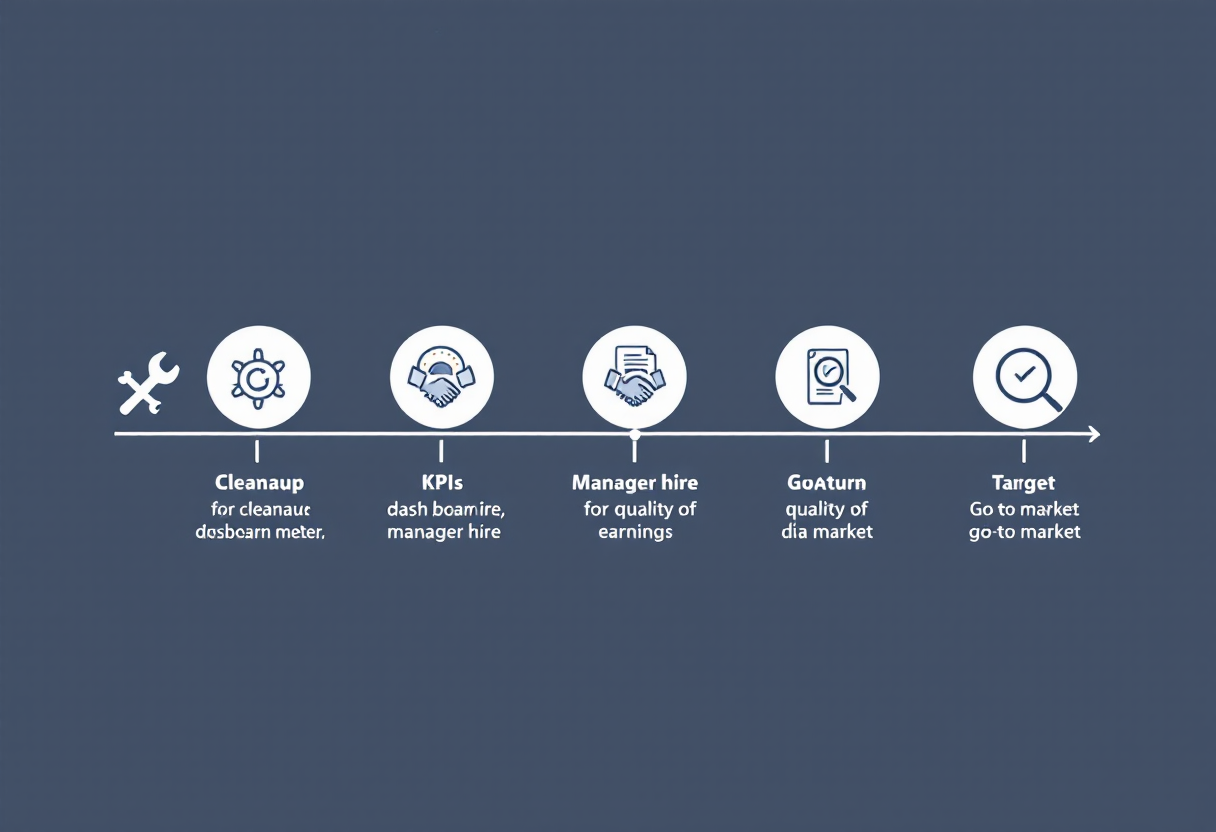
T-36 months: Cleanup phase
- Switch to accrual basis if still on cash basis
- Implement PSA (Deltek WorkBook, Kantata, BigTime, NetSuite OpenAir) plus CRM (Salesforce, HubSpot, Microsoft Dynamics)
- Start tagging every potential EBITDA add-back as it happens
- Conduct W-2/1099 audit by outside counsel; reclassify where needed (settle exposure now while it is small)
- Restruck related-party rent to FMV with appraisal
- Build org chart and identify the senior-partner-bench and promotion track
- IP assignment audit and back-fix work-for-hire gaps
- Partner agreement audit and re-paper to align with sale economics
- Begin proprietary IP and methodology documentation push (trademarks, copyrights, training materials)
- Independence and conflict-of-interest policy documentation if applicable
- State privacy law compliance review (CCPA, CPRA, VCDPA, CPA, CTDPA, UCPA) and any client data agreements
- Begin pursuit of SOC 2 Type II if IT consulting or handling sensitive client data
T-24 months: Financial discipline and KPI infrastructure
- Monthly close in 15 days; service-line P&L every month
- KPI dashboard live (utilization, realization, billing rate, A/R DSO, average engagement size, win rate, recurring percent, retention by senior level)
- Launch retainer, managed services, or subscription product if recurring is under 30%
- Annual rate-card increase implemented (4% to 8%)
- Begin client diversification push if top client is above 15%
- Document SOPs for every operational role
- Build the add-back bridge as a living document
- Hire or promote a GM or COO who can run the firm operationally; or hire a marketing director or fractional CMO if marketing is owner-dependent
- Senior consultant retention scorecard tracked formally
- Begin partner non-compete re-papering by state
T-12 months: QoE-ready close discipline, eliminate owner and partner dependence
- Owner and managing partner steps back from daily operations; senior partners or GM run the firm
- Owner takes a 30 to 60 day unplugged absence as the stress test
- Run the sell-side QoE (budget $75K to $150K typical, up to $300K for complex firms)
- Tighten balance sheet: clean A/R, age WIP, isolate deferred retainer revenue
- Final org-chart review; backfill any gaps
- Final compliance scrub (license transferability for any licensed practice, W-2/1099, sales and use tax, independence, IP assignment, partner agreements, state privacy)
- Lock in 12 months of clean service-line P&L for the CIM
- Refresh top-20 client MSAs to address assignment language where possible
T-6 months: Pre-marketing prep
- Engage M&A advisor (sell-side investment bank or consulting M&A specialist firm: Equiteq, Capstone Partners, Sundance Strategies, Berkery Noyes, Houlihan Lokey for larger). Typical fee structure: $25K to $100K monthly retainer credited against success fee of 3% to 7% of enterprise value, with Lehman or modified Lehman scaling
- CIM drafted from the QoE and operating model
- Teaser drafted (anonymized 1-pager)
- Buyer list finalized (30+ active sponsors and strategic acquirers as a starting list)
- Virtual data room populated with everything from the pre-LOI and confirmatory sections above
- Management presentation deck built and rehearsed
- Partner and equity alignment meeting: confirm everyone understands the process, expected timeline, role in management meetings, anticipated rollover equity, and earn-out structure
T-3 months: Go to market
- Teaser distributed; NDAs collected; CIMs distributed
- IOIs collected 2 to 3 weeks after CIM goes out
- Narrow to 4 to 6 finalists for management meetings
- Management meetings; LOIs solicited
- Select LOI; sign with exclusivity (typically 45 to 90 days)
- Enter confirmatory diligence; close
End-to-end from advisor engagement to close: 9 to 12 months in a well-run process. Consulting deals frequently extend to 12 to 18 months because of partner negotiation complexity, client consent re-papering on assignment-restricted MSAs, and extended IT and security diligence on consulting firms with sensitive client data (Equiteq Sell-Side Playbook 2025; Auxo Capital Advisors sell-side process guide; Wall Street Prep sell-side primer; KPMG Deal Advisory consulting playbook 2024).
Frequently Asked Questions
How long should I plan for before selling my consulting firm to a private equity buyer?
The owners who get top-quartile pricing start preparing 24 to 36 months before going to market. The minimum useful prep window is 12 months, because most of the high-leverage levers (lifting recurring revenue from under 20% to 40%+, distributing partner-revenue ownership, re-papering partner non-competes by state, running a sell-side QoE) need 12+ months of clean trailing-twelve-months data to be credible to a buyer. Owners who try to sell in under 6 months typically leave 15% to 30% of enterprise value on the table.
What is a realistic EBITDA multiple for a $3M EBITDA consulting firm in 2026?
For a generalist management consulting firm at $3M EBITDA in 2026, the range is 6x to 8x. The bottom of that range applies to project-only firms with under 20% recurring revenue, owner-dependent revenue ownership, and concentrated client base. The top applies to firms with 40%+ recurring revenue, distributed partner-revenue ownership, top client under 10%, and a documented and trademarked methodology (Equiteq Global Consulting M&A Report 2025; Hampleton Partners 2H 2025; Capstone Partners Q4 2025). For specialty consulting firms (healthcare regulatory, financial services compliance, FedRAMP IT advisory, ERP implementation, M&A diligence consulting) at the same $3M EBITDA level, the range shifts to 8x to 11x. The 36-month prep playbook moves you from the bottom of the band to the top.
What percentage of recurring or retainer revenue do PE buyers want to see?
40% or higher is the threshold that moves your firm from commodity pricing into premium pricing. Project-only consulting firms with under 20% recurring revenue trade at 7x to 9x EBITDA. Firms with 40%+ recurring through retainer, managed services, or subscription advisory trade at 12x to 16x EBITDA on matched size (Equiteq Global Consulting M&A Report 2025; Hampleton Partners 2H 2025). The standard PE definition for “recurring” carries three tiers: Tier 1 is a multi-year managed services contract with auto-renewal and termination penalty; Tier 2 is a monthly retainer with 30+ day notice and a demonstrated 2+ year track record; Tier 3 is repeat-client annual engagements with track record but no contract minimum. Target Tier 1+2 renewal above 85% annually.
Should I get a quality of earnings report done before going to market?
For consulting firms at $1M+ EBITDA, yes. A sell-side QoE costs $75K to $150K typical, up to $300K for firms with complex add-backs, multi-entity structure, international operations, or partner capital accounts (Eton Venture Services 2025; KPMG Deal Advisory 2024). The ROI is leverage. If your QoE supports a 2x multiple uplift on a $6M EBITDA firm at an 8x baseline, that is $12M of additional sale price for a $100K investment. More importantly, a pre-market QoE surfaces revenue recognition issues (T&M cut-off, fixed-fee percent-completion, retainer ratability), expense pass-through normalization, and add-back weaknesses while you can still fix them, rather than during exclusivity when the buyer re-trades the deal.
Do I need to redistribute partner-revenue ownership before selling my firm?
If you want to maximize price, yes. Owner and partner concentration is the single most-cited multiple haircut in consulting M&A. Equiteq’s 2025 buyer survey found 73% of failed consulting LOIs cite “key person risk” as a primary or secondary cause. If one or two partners drive 50%+ of revenue, the deal either restructures with very long earn-outs (3 to 5 years), substantial equity rollovers (40% to 60%), and aggressive non-competes, or it does not close at all. The fix is an 18 to 24 month redistribution: senior partner promotions with explicit client-handover plans, joint pitches and joint client meetings to transition relationships, compensation rebalanced to reward institutional relationship-building over personal book of business, and SOPs for client management. Estimated impact (estimate): moving a $2M to $5M EBITDA firm from concentrated to distributed lifts multiple from the 6x to 8x band into the 9x to 12x band, worth $3M to $20M of price.
How do I know if my client concentration is too high to attract PE buyers?
Standard PE thresholds for consulting firms: top 1 client above 15% is a yellow flag; above 20% they start pricing the discount; above 25% they walk or restructure; top 5 above 50% is a yellow flag even if top 1 is under 15%; top 10 above 75% is a structural concern (Equiteq 2025 buyer survey; Strategex; Eagle Rock CFO; Morgan & Westfield). For consulting firms, concentration is especially painful because revenue is often relationship-driven, so client concentration and key-person risk often compound. Pull your top 20 by revenue for the last 3 years plus LTM, with year-over-year stability, contract status, and change-of-control provisions on each MSA. If your top client is above 15%, start the 18-month diversification work now via new-business development and active client portfolio management. Do not fire a big client to fix concentration unless top-client share is above 35%; the EBITDA loss usually outweighs the multiple gain.
What to Do Next
The consulting firm owners who get the top-quartile multiple all do the same three things. They start preparing 24 to 36 months before they want to be out. They redistribute partner-revenue ownership and build recurring revenue past 40% before any banker sees a CIM. And they invest in a sell-side QoE so the adjusted EBITDA number they take to market is the number that closes.
The 2024 to 2026 cycle is the most active consulting M&A window in two decades. Carlyle and KKR’s joint majority of ZS Associates at $5.5B, Lexington’s minority of A&M at $4B+, KKR’s majority of ERM at $3.0B, and Cognizant’s $1.3B close of Belcan all happened inside a 10-month stretch in 2024. Inflexion paid roughly $1.7B for Baringa in the same window. Accenture has been closing one consulting acquisition every 9 to 11 days. The buyers are real, the multiples are concrete, and the sponsor money has not slowed in 2026. The question is whether your firm is ready when they call.
If you are 12+ months from a potential exit and want a structured pre-sale optimization roadmap, CT Acquisitions has professional-services operations specialists in our partner network who run multi-quarter prep engagements. If you are 6 to 12 months out and ready to start the sell-side process, our M&A advisory team runs the buyer outreach. Buyers pay our fee, not you. Either way, the first 30 minutes are free.
Ready to talk?
Schedule a 30-minute exit-readiness call
Or read more: Sell Your Consulting Firm (active sale guide) | Buying a Consulting Firm (buyer’s playbook) | What Is an Indication of Interest? 2026 IOI vs. LOI Guide
Ready to Explore Your Options?
A 30-minute confidential conversation is all it takes.

About the Author
Christoph Totter is the founder of CT Acquisitions, a buy-side M&A advisory firm in Sheridan, Wyoming. He is a published researcher in lower middle market M&A on Zenodo, Academia.edu, and ORCID, and an active contributor on LinkedIn on M&A, private equity, and business sales. CT Acquisitions works directly with 100+ buyers including PE platforms, family offices, search funders, and strategic consolidators. Buyers pay our fee, never sellers. No retainer, no exclusivity, no contract until close.