
Buy an Auto Body Shop in 2026: 3-12x EBITDA, DRP Carriers, OEM Certifications, ADAS Calibration
Buying an auto body shop in 2026 clears 3-12x EBITDA depending on scale, insurance-carrier relationships, and platform readiness. Owner-operator single-shop operators land 2-4x SDE. Multi-shop regional operators reach 5-8x EBITDA. Platform-quality MSO operators with 10+ locations push toward 10-12x. What drives value: DRP (Direct Repair Program) carrier panel placement, OEM certifications (I-CAR, Toyota, Honda), ADAS calibration capability, and paint/labor gross margin discipline. Named MSO consolidators include Caliber Collision, Gerber, Boyd Group, Service King, plus PE-backed regional platforms.
Quick Answer
Buying an auto body shop in 2026 means underwriting DRP (direct repair program) relationships, OEM certification stacks, and ADAS calibration capability. Multiples run 3x to 5x SDE for single-shop owner-operators, 4x to 6x EBITDA for managed single shops, 6x to 9x for multi-shop operators with 3 to 10 locations, and 8x to 12x for platform-grade MSOs that fit a strategic acquirer’s footprint. Caliber Collision, Boyd Group’s Gerber Collision, Crash Champions, Joe Hudson’s, Classic Collision, and Quality Collision Group dominate add-on bidding above $1.5M EBITDA. Independent buyers and search funders compete effectively in the $300K to $1.5M SDE band where the consolidators stop looking.
Updated June 2026 · CT Acquisitions
Buying an auto body shop in 2026 is fundamentally a bet on three things: the durability of the insurer relationship, the OEM certification stack, and the technician bench that can execute ADAS calibration on every vehicle that rolls in. The collision repair industry is in the middle of the most aggressive consolidation cycle in its history. Caliber Collision now operates roughly 1,800 stores, Boyd Group’s Gerber footprint sits north of 950 locations across North America, Crash Champions has stitched together close to 750 shops since 2019, and a half-dozen regional MSOs are sprinting to platform scale. For PE buyers, strategic consolidators, and independent operators alike, the opportunity is real. The pricing has moved. The diligence framework is unforgiving. This guide is the buy-side playbook.
How CT Acquisitions Works
- How we are paid. No fee to you on buy-side introductions; sell-side mandates are paid on success at closing.
- Confidential. No public listing, and nothing moves without your approval. We have zero claim on you.
- Vetted buyers only, no leaks. We introduce you only to vetted buyers whose mandates fit. Your business is never publicly listed.
- Top-of-market price AND the right buyer. Our fee scales with sale price (same incentive as a banker), matched on fit, not just the highest check.
- 60-120 days, not 9-12 months. We already know our buyers’ mandates before we pick up the phone with you.
Key takeaways
- Auto body deals run 3x to 5x SDE for single-shop owner-operators and 4x to 6x EBITDA for managed single shops in 2026.
- Multi-shop operators (3 to 10 locations) trade at 6x to 9x; platform-grade MSOs reach 8x to 12x.
- DRP carrier concentration is the single largest revenue risk; top-3 DRP often equals 30 to 50 percent of revenue.
- OEM certifications (Tesla Approved, Honda ProFirst, BMW Certified, Mercedes Certified) add real enterprise value, typically $200K to $500K per certified location.
- ADAS calibration capability ($300 to $600 per vehicle) is now a baseline requirement, not a differentiator.
- Caliber, Gerber, Crash Champions, Joe Hudson’s, Classic Collision, and Quality Collision Group dominate add-on bidding above $1.5M EBITDA.
Table of contents
- Why collision repair is the most consolidated aftermarket vertical
- What buyers are actually paying for auto body in 2026
- The six buyer archetypes in collision repair
- DRP relationships: the asset buyers actually underwrite
- OEM certification stack and ADAS calibration
- Due diligence: the collision-specific deep dive
- Structuring the offer
- Integration: where acquirers create or destroy value
- Financing an auto body acquisition
- Red flags that kill collision deals
- The CT Acquisitions perspective
- FAQs about buying an auto body shop
This guide covers how collision repair businesses are valued in 2026, which operational signals separate a 4x shop from a 9x MSO platform, how DRP and OEM dynamics actually drive enterprise value, what deal structures sellers will accept, and the integration mistakes that destroy value after close.
Why collision repair is the most consolidated aftermarket vertical
Three structural forces have pulled collision repair into the most active consolidation cycle in automotive aftermarket history, and the forces compound rather than offset each other.
First, insurer economics favor scale. The largest US auto insurers (State Farm, Progressive, GEICO, Allstate, USAA, Liberty Mutual) increasingly route claims through DRP networks that prefer multi-location operators with consistent cycle times, documented quality programs, and digital intake workflows. A single shop with one Progressive Service First or State Farm Select Service relationship is fragile. An MSO with twenty stores under the same DRP umbrella is structurally defensible.
Second, vehicle complexity has redrawn the cost curve. The average vehicle now carries 15 to 30 ADAS sensors (radar, lidar, cameras, ultrasonics) that require post-repair calibration. IIHS data shows that more than 90 percent of new vehicles sold in 2025 came equipped with at least one ADAS feature. The capital to handle aluminum body construction (Ford F-150, most luxury platforms), high-strength steel, EV battery isolation, and OEM-required scan and calibration tooling is well beyond what a typical $1.5M revenue single shop can justify. Scale spreads the capex.
Third, severity is up, frequency is down. Per CCC Information Services Crash Course data, average repair severity in 2025 reached approximately $4,800 per claim (up from roughly $3,100 in 2019), while claim frequency has declined as ADAS prevents lower-speed collisions. The remaining work is more complex, takes longer in the shop, and requires more sophisticated diagnostics. Operators who can’t execute on the severity side lose DRP standing.
For buyers, the implication is clean. Collision is a fragmented category (more than 32,000 independent shops in the US per IBISWorld) where insurer and OEM economics now reward scale, certification, and process discipline. The buyers who can credibly deliver those three things win the platform multiples. Everyone else is stuck pricing single-shop economics.
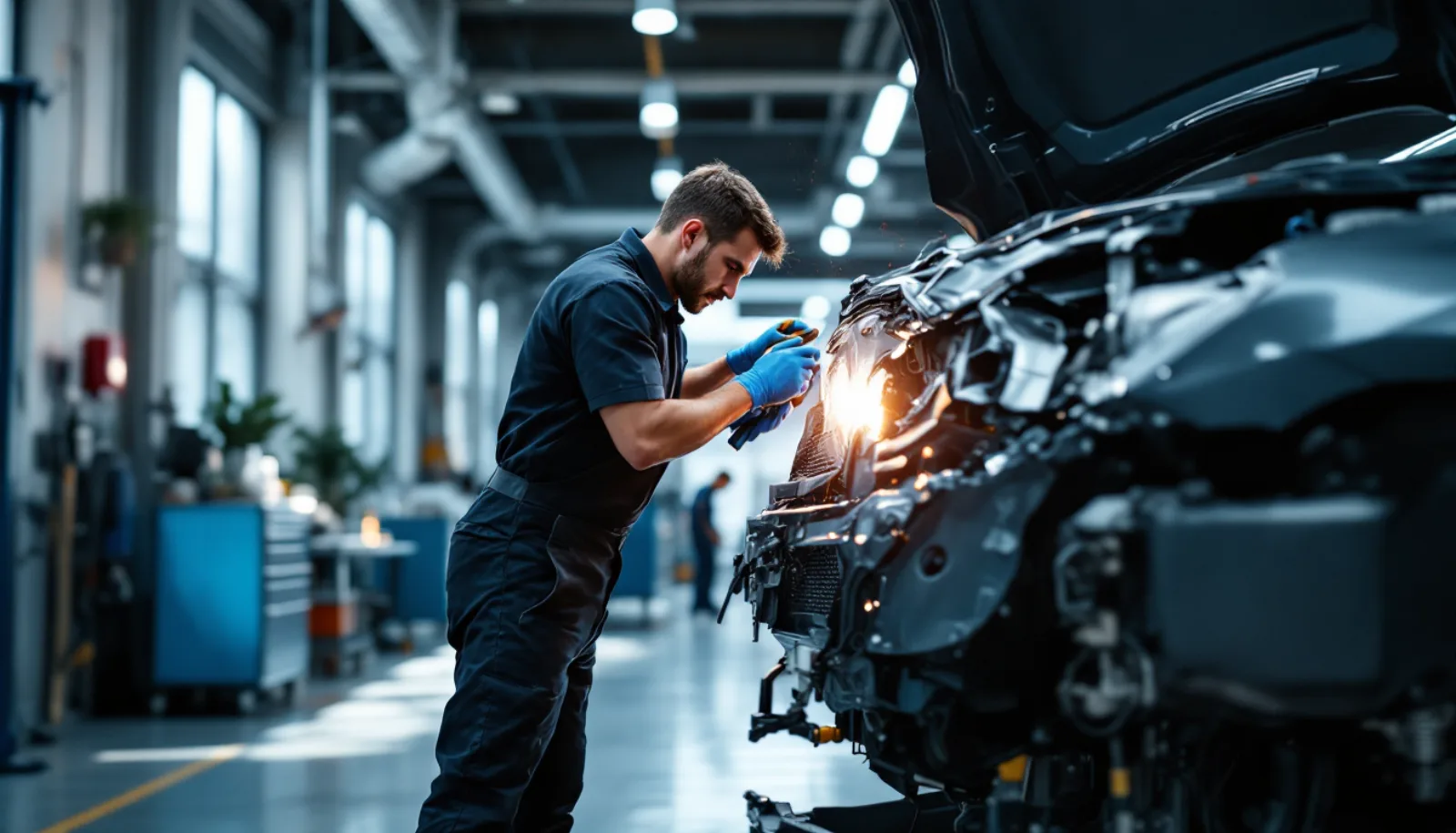
What buyers are actually paying for auto body in 2026
Valuation in collision is bimodal. There is a single-shop market dominated by SBA-financed independent buyers and an MSO market dominated by PE-backed strategics. The two markets price the same revenue stream very differently. Buying an auto body shop at the right multiple requires reading which market your target actually sits in.
| Operator profile | EBITDA / SDE multiple (2026) | What buyers pay for |
|---|---|---|
| Single shop, owner-operator, no DRP, no OEM cert | 3.0-3.5x SDE | Local cash flow only. Treated as a job. |
| Single shop, 1 DRP carrier, I-CAR Gold Class | 3.5-5.0x SDE | Established book, transferable to SBA buyer. |
| Single shop, managed, multi-DRP, OEM stack | 4.0-6.0x EBITDA | Platform-eligible single location. |
| Multi-shop operator, 3 to 10 locations | 6.0-9.0x EBITDA | MSO-track business with documented playbooks. |
| Platform-grade MSO, 10+ shops, full OEM | 8.0-12.0x EBITDA | Strategic anchor with synergy premium. |
The spread between 4x and 9x is not random. Sophisticated collision buyers model seven factors explicitly when buying an auto body shop:
- DRP concentration and depth. A shop with one DRP at 60 percent of revenue is fragile. A shop with five DRPs distributed across State Farm, Progressive, GEICO, Allstate, and USAA, with no single carrier above 25 percent, prices materially higher.
- OEM certification count and brand quality. Tesla Approved, BMW Certified, Mercedes-Benz Certified, Honda ProFirst, Hyundai Recognized, Ford Certified Aluminum, GM Collision Repair Network. Each meaningful certification adds enterprise value, with Tesla Approved typically worth $200K to $500K per shop because of the scarcity and ticket size.
- ADAS calibration in-house. Operators who do their own static and dynamic calibrations capture $300 to $600 per vehicle that competitors send to dealers or sublet vendors. Per-shop calibration revenue often runs $150K to $400K annually.
- Cycle time and severity discipline. Average length of rental (ALR) is the metric every DRP carrier watches. Sub-12-day ALR on drivable claims is platform-grade; over 16 days is a DRP downgrade risk.
- Technician retention and I-CAR status. Body, paint, and frame technicians are scarce. I-CAR Gold Class shop status requires majority of staff individually I-CAR trained; losing technicians can drop Gold Class designation, which cascades to DRP standing.
- Facility footprint and capex condition. Frame racks, paint booths (downdraft preferred), prep stations, ADAS calibration bays with proper floor leveling, aluminum-isolated work bays. Deferred capex shows up as a price reduction.
- Real estate ownership. Owned real estate adds optionality (sale-leaseback at close) and removes lease risk. A shop on a triple-net lease with five years remaining and a relocation clause is a different asset than one on owned property.
The 2026 pricing reality
Because the consolidators are competing aggressively for MSO-track targets, pricing has compressed upward in the $1.5M+ EBITDA segment. Platform-grade operators in the $2M to $8M EBITDA range routinely receive multiple LOIs at 7.5x to 10x. The Caliber Collision platform alone (Hellman & Friedman + OMERS + CapitalG since the 2019 Leonard Green and 2024 H&F-led recap) has acquired hundreds of locations since 2019. Crash Champions (Clearlake Capital since 2020, plus Service King absorption finalized 2022) has been the most active single-deal consolidator. Joe Hudson’s Collision Center went to Carousel Capital in 2024, fueling its Southeast roll-up. Classic Collision sits under Leonard Green & Partners since 2024. Quality Collision Group is the TSG Consumer Partners play.
For independent buyers and search-fund operators competing with this stack, the implication is that you either need a differentiated thesis (a specific regional pocket the platforms have skipped, a niche like exotic and luxury, a heavy-truck collision angle) or you need to fish below where the platforms cast. The $300K to $1.5M SDE single-shop band remains largely untouched by the consolidators and still trades at SBA-friendly 3.5x to 5x SDE.
The six buyer archetypes in collision repair
Understanding which buyer profile you fit (and which you compete against) changes how you structure your offer and where you fish for deal flow.
1. PE-backed strategic platforms (Caliber, Gerber, Crash Champions)
The mega-MSOs. Caliber Collision (Hellman & Friedman, OMERS, CapitalG) operates roughly 1,800 stores. Boyd Group’s Gerber Collision (TSX: BYD, market cap roughly $5B Cdn as of mid-2026) is the largest publicly traded operator. Crash Champions (Clearlake Capital) has stitched together approximately 750 locations since 2019. They pay the highest multiples for platform-track add-ons and move with institutional speed. Target profile: $1.5M+ EBITDA, multi-shop, multi-DRP, OEM stack present. They write 60 to 75 percent of purchase price at close.
2. Mid-platform consolidators (Joe Hudson’s, Classic Collision, Quality Collision Group)
Joe Hudson’s Collision Center (Carousel Capital since 2024) is rolling up the Southeast. Classic Collision (Leonard Green & Partners since 2024) operates a fast-growing Sunbelt platform. Quality Collision Group (TSG Consumer Partners) runs an MSO platform across multiple states. They compete with the megas on price for the right deal and often offer more thoughtful integration. Target profile: $1M to $5M EBITDA, regional clustering thesis.
3. Automotive strategics (Driven Brands, dealer groups)
Driven Brands (NYSE: DRVN), parent of CARSTAR and 1-800-Radiator, is a publicly traded automotive aftermarket consolidator. Large dealer groups (AutoNation, Lithia, Asbury, Group 1) increasingly operate captive collision centers and selectively acquire independent shops to feed their used-car reconditioning pipeline. They typically pay competitive multiples but with longer integration timelines and more corporate process.
4. Independent sponsors
Deal-by-deal capital, often LP commitments assembled per transaction. They compete on creative structuring (earnouts, rollover equity, seller notes) when they can’t match platform pricing. Good fit for sellers who want a long-term partner and a hold beyond five years.
5. Search funds
Individual operators with institutional backing looking for one collision shop to run. Target profile: $400K to $1.5M SDE, established DRP relationships, I-CAR Gold Class, a strong general manager or estimator capable of being elevated. Multiples: 3.5x to 5x SDE. Good fit for founders who want a clean exit with operational continuity.
6. Independent roll-up operators (self-funded MSOs)
Operators building 3 to 10 shop regional MSOs funded by a stack of SBA 7(a), seller financing, and mezzanine. Often former shop managers or estimators with industry credibility. Can’t match platform pricing but move fast on single-shop add-ons ($300K to $1M SDE) and offer the strongest operational continuity narrative.
DRP relationships: the asset buyers actually underwrite
When sophisticated buyers are buying an auto body shop, the DRP book is the single most scrutinized asset on the balance sheet. DRPs (direct repair programs) are the contractual relationships between collision shops and insurance carriers. A carrier on the DRP list refers claims, sometimes via a managed-repair platform, and the shop agrees to predetermined labor rates, cycle-time SLAs, and quality KPIs.
The economic reality: a top-3 DRP carrier typically equals 30 to 50 percent of a shop’s total revenue. State Farm Select Service is the most prized in most regions because of claim volume; Progressive Service First (and the Network Solutions tiering Progressive uses) is the second-most prized; GEICO Auto Repair Xpress, Allstate Good Hands Repair Network, USAA STARS, and Liberty Mutual Direct Repair round out the top six. Specialty carriers (Erie, Farmers, Nationwide, AAA mutuals) matter regionally.
DRP diligence framework
For every active DRP relationship, pull:
- Carrier name, tier or designation, and start date. Length of relationship matters. A 12-year State Farm Select Service relationship is more durable than one signed in the last 18 months.
- Volume and revenue by carrier, trailing 24 months. Concentration above 50 percent in any single carrier is a multiple drag.
- Carrier-published KPIs. Cycle time, customer satisfaction (CSI), supplement frequency, parts utilization, severity discipline. These are tracked by the carriers and a downgrade signal precedes a tier change by 6 to 12 months.
- Carrier audits and corrective action notices. A shop on an active corrective action plan is one quarterly review away from losing the relationship.
- Owner-relationship dependency. If the DRP came in because the founder knew the regional claims manager personally, the relationship is at transition risk. If it came through formal carrier vetting, it transfers with the asset.
The carriers have been quietly consolidating their DRP networks for the past three years. State Farm has reduced its Select Service roster materially in several regions; Progressive has reorganized Service First around its newer tiering structure; GEICO has been tightening Auto Repair Xpress entry criteria. The DRP book you acquire is not the DRP book you keep, and your diligence has to assume the carriers will continue to tighten.
OEM certification stack and ADAS calibration
OEM certification is the second pillar of collision repair enterprise value, and it has become a bigger driver in 2026 than at any point in the last decade. Certifications are awarded by individual automakers to shops that meet specified equipment, training, and process requirements. The most valuable certifications, in rough order of enterprise-value contribution:
- Tesla Approved Body Shop. Scarce (fewer than 250 in the US per Tesla’s public locator), high average ticket ($8K to $20K), and the only way to be paid for Tesla collision work without warranty risk. Adds $200K to $500K per certified location.
- BMW Certified Collision Repair Center. Aluminum-intensive, demands isolated work bays, requires BMW-specific training. Adds $100K to $300K per location.
- Mercedes-Benz Certified Collision Center. Similar profile to BMW. Adds $100K to $300K per location.
- Honda and Acura ProFirst. High volume (Honda is one of the top three US brands), modest per-ticket revenue, broad transferability. Adds $50K to $150K per location.
- Ford F-150 Certified Aluminum Repair. Required for the highest-volume vehicle in America. Mandatory aluminum-isolated workspace. Adds $50K to $150K per location.
- GM Collision Repair Network (CRN). Volume-driven, important in Midwest and Sunbelt. Adds $30K to $100K per location.
- Hyundai, Kia, Subaru, Nissan certifications. Each adds incremental value, typically $20K to $80K per location.
- I-CAR Gold Class. Shop-level designation, awarded when majority of technicians hold individual I-CAR training. This is table stakes for any DRP and most OEM certifications.
ADAS calibration capability
Per CCC Information Services data, more than 50 percent of repair orders now require some form of ADAS calibration (static, dynamic, or both). The OEM-published procedure is non-negotiable; misaligned ADAS sensors create liability exposure that no insurer will accept. Shops that handle calibration in-house with proper targets, scan tools, level floors, and lighting capture $300 to $600 per calibrated vehicle. Shops that sublet to dealers or third-party calibration providers (asTech, Caliber Calibration Services, AirPro Diagnostics) lose the margin and add cycle time.
For buyers, the diligence question is whether the target has invested in calibration capability or is still subletting. A shop with no in-house calibration is a capex line item ($75K to $150K per location plus 6 to 9 months of technician training) in the integration model. Factor it into the purchase price.
Due diligence: the collision-specific deep dive
Generic M&A diligence is necessary but not sufficient for collision. The category-specific signals are where deals are won and lost. Here’s what experienced collision buyers do beyond standard quality of earnings, legal, environmental, and insurance review.
Revenue mix decomposition
Pull 24 months of repair orders from the shop’s management system (CCC ONE, Mitchell RepairCenter, or Audatex Estimating). Bucket every RO into: DRP claim, non-DRP insurance claim, customer-pay (cash, deductible-only, paint and dent), fleet, sublet (towing, glass, mechanical), and parts. Then segment DRP by carrier and tier. The seller’s P&L will compress these categories; the buyer’s underwriting requires them separated.
Cycle time and severity audit
Average length of rental (ALR), keys-to-keys cycle time, and average severity by carrier. Pull the trailing 12 months from CCC ONE or equivalent. Compare to CCC Crash Course industry benchmarks. A shop running 14-day ALR against a 10-day industry median is a DRP risk, regardless of what the carrier scorecard currently shows.
Technician bench analysis
List every technician by role (body, paint, frame, prep, estimator, parts), tenure, I-CAR certifications held, and OEM-specific training. Calculate weighted I-CAR Gold Class compliance percentage. A shop that is one body tech away from losing Gold Class is fragile; that single technician departure cascades to DRP standing within 6 months.
Estimator and shop manager dependency
In collision, the estimator is often the highest-impact employee. They negotiate supplements with insurance adjusters, manage cycle time, and own customer relationships. A shop with one estimator handling 60 percent of file count is a key-person risk. Retention package for the estimator should be priced into the deal.
Equipment and capex condition
Walk the shop with someone who knows collision equipment. Inspect frame rack condition (Car-O-Liner, Chief, Celette), paint booth (Garmat, Global Finishing Solutions, USI Italia), prep stations, welders (MIG, resistance spot for aluminum, structural aluminum equipment), and calibration tooling (Bosch DAS 1000, Hunter ADASLink, Autel MaxiSys ADAS, asTech remote diagnostic capability). Deferred capex is the most common surprise in collision diligence.
Environmental and regulatory
Paint operations carry environmental compliance exposure. Verify EPA 6H rule compliance (paint booth filters, spray gun training), hazardous waste manifests, used oil and antifreeze disposal records, and any state-level air permits (California CARB, Texas TCEQ, etc.). Phase I environmental site assessment is standard for owned real estate. For leased shops, review the lease for environmental indemnification language.
Customer concentration stress test
Beyond DRP carrier concentration, look at fleet account concentration and any single commercial customer above 5 percent of revenue. Local rental car franchisees (Enterprise, Hertz), municipal fleets, and large local employers can be material concentration risks that don’t show up on the DRP map.
Structuring the offer
The best buyers win on structure as often as on price. A well-structured offer beats a higher nominal offer when it matches what the seller actually values.
The standard collision deal structure (2026)
- Cash at close: 65 to 75 percent of total consideration for single-shop deals; 70 to 80 percent for platform-track MSO deals.
- Seller rollover equity: 5 to 20 percent in platform deals where the seller continues operating one or more locations. 0 percent in clean-exit deals.
- Earnout: 10 to 20 percent over 12 to 24 months, typically tied to DRP retention, revenue retention, or specific OEM certification renewals.
- Escrow: 10 percent held 12 to 18 months against indemnification claims. Environmental indemnification often carries a longer survival.
- Seller note: 0 to 10 percent, subordinated to senior debt. Common in independent sponsor and SBA buyer deals.
- Real estate. Frequently sold separately (sale-leaseback to a triple-net REIT or held by seller under a long-term lease). The triple-net market for collision shops typically prices at 6.5 to 7.5 percent cap rates.
The earnout trap in collision
The single most destructive earnout in collision is one tied to DRP-driven revenue without controlling for carrier-side decisions the seller can’t influence. If State Farm tightens its Select Service network in your region six months post-close, the seller’s revenue earnout craters through no fault of their own. The structures that work in collision: gross repair order count retention (per DRP, trailing 12 months), technician retention (named individuals), and CSI scores against carrier-published thresholds. All three are within the seller’s 12 to 18 month sphere of influence.
Where smart buyers differentiate on terms
Sellers in collision weight non-price terms heavily, particularly first-generation owners selling shops they built over 25 to 40 years. The factors that move sellers (beyond cash): retention bonuses for named body and paint techs, commitment to keep the shop name on the building for a defined period (2 to 5 years), commitment to the existing DRP relationships and OEM certifications, employee benefits continuity, and a clear founder transition timeline. Buyers who pre-commit to these are routinely chosen over higher-bidding competitors who treat them as negotiable.
Integration: where acquirers create or destroy value
The collision sector has produced both the best and worst integration case studies in home and auto services. The deals that compound are the ones where buyers respect three principles.
Don’t disrupt DRP standing in the first 12 months
DRP relationships are personal. Regional claims managers know individual shop owners and estimators. A change of ownership announcement triggers a 90-day grace period and then carriers actively evaluate whether to keep, downgrade, or remove the shop. Buyers who change estimator workflows, replace shop managers, or impose unfamiliar process disciplines in the first 6 months risk losing carriers. The right move is to formally introduce the new ownership to every DRP carrier’s regional claims management within 30 days of close, confirm the existing service-level commitments, and freeze operational change for 9 to 12 months.
Retain body and paint technicians proactively
The skilled-trade shortage in collision is more acute than HVAC, plumbing, or electrical. Per BLS data, automotive body and glass repairer employment grew less than 2 percent over the past five years against rising demand. Top body and paint techs have offers from every MSO within a 30-minute drive. Smart buyers pre-commit retention bonuses (typically 15 to 25 percent of annual compensation, paid over 18 to 24 months) for named technicians before close, with the bonus contingent on continued employment.
Standardize on the right management system
CCC ONE is the dominant collision management platform. Most platform consolidators standardize on it. If the target is on Mitchell RepairCenter or Audatex Estimating, plan for a 6 to 9 month migration as part of the integration. Doing it in the first 60 days breaks operations. Doing it after month 18 risks ossification.
Financing an auto body acquisition
Capital structure in collision varies materially by deal size and buyer type. Some patterns are consistent in 2026.
SBA 7(a) for single-shop deals
Independent buyers and search funders rely heavily on SBA 7(a) for collision deals up to $5M purchase price. Rates run prime plus 2.0 to 2.75 percent on 10-year amortization. The constraint: SBA requires the seller to exit operationally within 12 months and limits the structure of seller financing. For collision deals where the seller wants a 2 to 3 year transition, SBA can be difficult. Live Oak Bank, Newtek, and First Bank of the Lake are among the most active SBA lenders in the automotive aftermarket.
Commercial bank acquisition lending
Regional and community banks with automotive aftermarket experience will lend 2.0 to 3.5x EBITDA at prime plus 1.5 to 2.5 percent. Cash flow covenants are typical, plus collateral coverage against equipment and real estate. Best for established multi-shop operators with predictable cash flow and clean financials.
Mezzanine and unitranche
For platform-track MSO deals or larger independent deals ($5M+ EBITDA), mezzanine or unitranche bridges senior debt and equity. Rates run 10 to 14 percent with warrants in some structures. Twin Brook, Monroe Capital, Antares, NewSpring Mezzanine, and regional SBIC funds are active in the automotive aftermarket.
Seller financing
Often 5 to 15 percent of purchase price, subordinated, 5 to 7 year term. Rates 6 to 8 percent. Useful for buyers who want to preserve cash and sellers who want yield on capital that would otherwise sit in escrow.
Real estate financing
Collision shops typically occupy 8,000 to 25,000 square feet of industrial real estate. SBA 504 is the dominant vehicle for owner-occupied real estate at acquisition (up to $5M SBA portion, 25-year amortization, fixed-rate). For sale-leaseback transactions at close, the buyer universe includes net-lease REITs (Realty Income, STORE Capital, Spirit Realty) and 1031 exchange investors. Cap rates for collision shops on long-term triple-net leases typically price at 6.5 to 7.5 percent.
Red flags that kill collision deals
Some deals shouldn’t close. The patterns that consistently predict post-close failure:
- Quality of earnings reveals more than 15 percent EBITDA adjustment. Common sources in collision: owner compensation normalization, aggressive WIP recognition on long-cycle claims, parts margin manipulation, related-party real estate rents below market.
- DRP carrier on active corrective action. If State Farm, Progressive, or any top-3 carrier has issued a corrective action notice in the last 12 months, the relationship is one review cycle away from downgrade.
- Body or paint technician turnover above 30 percent. The collision labor market is too tight for that level of churn. Indicates compensation, culture, or leadership problems that take 18 to 24 months to fix.
- Pending environmental issues. Open Phase I findings, missing hazardous waste manifests, paint booth filter compliance gaps, or any state air permit issues. The post-close exposure is real and the remediation timeline is uncontrollable.
- Litigation exposure on prior repair work. Collision shops face occasional lawsuits over post-repair vehicle performance, ADAS calibration failures, or alleged use of non-OEM parts without consent. Pull the litigation history.
- Real estate liability if leased. Lease with relocation clause, short remaining term, or environmental indemnification that flows to tenant. Each is a separately priced deal risk.
The CT Acquisitions perspective
We work both sides of the collision market: introducing sellers to qualified buyers and sourcing deal flow for institutional buyer networks. Our observations from the last 36 months of collision M&A:
- The strategic platforms are disciplined, not omnivorous. Caliber, Crash Champions, and Boyd Group all have specific geographic, multi-shop count, and EBITDA thresholds. Shops that don’t fit their criteria don’t get offers from them at all, regardless of how good the operation is.
- The mid-platforms are where pricing tension lives. Joe Hudson’s, Classic Collision, Quality Collision Group, and the next tier of regional MSOs frequently compete on the same single-shop or 3-shop deals. That is where competitive bidding actually moves price.
- Independent buyers and search funds are winning in the $300K to $1.2M SDE band. The platforms don’t bid below their EBITDA floors. SBA-financed independent buyers move faster, offer cleaner structures, and respect operational continuity in ways institutional buyers often can’t.
- The capex catch-up is the most under-modeled risk. Sellers often defer ADAS calibration capex, paint booth refurbishment, and OEM-certification recertification in the 24 months before a sale. Buyers who underwrite the trailing financials without modeling the catch-up capex are systematically overpaying.
- OEM certifications matter more every year. The OEM-required procedure mandate is tightening. Shops that aren’t certified for the volume brands in their market lose claims to certified competitors. Five years from now, this gap will be larger, not smaller.
If you’re a buyer, here’s what we recommend
Whether you’re a first-time search fund buyer, an independent sponsor assembling a regional MSO thesis, or a strategic platform looking for add-ons, the same playbook works for buying an auto body shop:
- Write down your thesis in one page. Geography, shop count target, DRP mix preference, OEM certification thresholds, integration model. Every shop you bid on should be defensible against that thesis.
- Build proprietary deal flow before you need it. Direct outreach to shop owners, relationships with collision-specific CPAs (FocusOn CPA, RBA Consulting, etc.), presence at SEMA, NACE Automechanika, and CIC (Collision Industry Conference), and direct connections with regional DRP claims managers who often know which shops are quietly exploring sale.
- Underwrite from the bay floor up. Walk every shop with a collision operations person. Look at the frame racks, paint booth condition, calibration setup, and technician work product before you look at the financials.
- Price the DRP risk explicitly. Build a sensitivity model where your top-3 DRP carriers each lose 50 percent of their volume over 24 months. If the deal still works at that scenario, the price is defensible. If it doesn’t, lower your bid or walk.
Working with CT Acquisitions as a buyer
We maintain a qualified buyer network of PE platforms, strategic consolidators, family offices, independent sponsors, and search funds active in collision repair and adjacent automotive aftermarket categories. If your acquisition thesis fits the deal flow we see, we’re direct, fast, and selective about the introductions we make. We don’t run broad auction processes. We match founders to the small number of buyers right for their specific shop.
For buyers, the structure means: no wasted time on mis-fit deals, early access to deals that haven’t hit the market, and a sellers-first reputation that founders trust. No fee to you on buy-side introductions; sell-side mandates are paid on success at closing.
If you’re actively acquiring in collision, set up a 30-minute conversation to walk us through your thesis. We’ll be direct about whether our deal flow fits.
Frequently asked questions about buying an auto body shop
What EBITDA multiple should I pay for an auto body shop in 2026?
For single-shop owner-operator businesses, 3.0 to 3.5x SDE is the floor and 4.0 to 5.0x SDE is competitive bidding for shops with at least one strong DRP and I-CAR Gold Class. Managed single shops with multi-DRP and OEM stack run 4.0 to 6.0x EBITDA. Multi-shop operators trade at 6.0 to 9.0x EBITDA. Platform-grade MSOs (10+ shops, full OEM, strong DRP across multiple carriers) reach 8.0 to 12.0x EBITDA. The factor that moves multiples most is DRP carrier diversity, followed by OEM certification stack and in-house ADAS calibration capability.
How long does it take to close an auto body shop acquisition?
From signed LOI to close, 75 to 120 days is typical for a well-prepared single-shop or small MSO deal. Real estate components, environmental Phase I or Phase II requirements, and multi-state DRP transfers can extend timelines to 150 days. The binding constraint is usually quality of earnings, environmental review, and lease assignment, not the buyer’s speed.
Should I use SBA financing to buy an auto body shop?
SBA 7(a) works well for independent buyers acquiring single shops up to $5M total deal value, and SBA 504 is the dominant vehicle for the real estate piece. Rates run prime plus 2.0 to 2.75 percent on 10-year amortization for 7(a) and 25-year for 504. The constraint is the SBA requirement that the seller exit operationally within 12 months, which conflicts with longer founder-transition structures common in collision. For deals where the seller wants to stay 2+ years, commercial bank financing is usually better.
What due diligence is required when buying an auto body shop?
Standard M&A diligence (quality of earnings, legal, insurance) plus collision-specific: DRP carrier-by-carrier revenue and KPI analysis, OEM certification inventory and renewal status, ADAS calibration capability audit, cycle time and severity benchmarking against CCC Crash Course, technician bench analysis with individual I-CAR status, equipment and capex condition, environmental Phase I (mandatory for owned real estate), EPA 6H paint operation compliance, and hazardous waste manifest review.
How important is the DRP relationship when buying an auto body shop?
It is typically the single most important asset on the balance sheet. Top-3 DRP carriers often account for 30 to 50 percent of total revenue. Diligence should map every DRP relationship: carrier, tier, start date, trailing 24-month volume, carrier KPI scorecards, any corrective action history, and owner-relationship dependency. Carrier consolidation of DRP rosters is an active risk; the DRP book you buy is not necessarily the DRP book you keep.
What OEM certifications add the most value to an auto body shop?
Tesla Approved is the highest-value certification due to scarcity and average ticket size, typically adding $200K to $500K per certified location. BMW Certified and Mercedes-Benz Certified each add $100K to $300K. Honda and Acura ProFirst, Ford F-150 Aluminum, and GM Collision Repair Network are volume certifications adding $30K to $150K each. I-CAR Gold Class shop status is table stakes for any DRP and most OEM certifications.
How much working capital do I need to close an auto body deal?
For a $1M EBITDA single-shop deal, expect to fund 8 to 12 percent of revenue in working capital at close (accounts receivable from DRP carriers and customers, parts inventory, work-in-process repair orders). That typically runs $400K to $700K on top of purchase price. For multi-shop deals, working capital requirements scale. Most lenders fold working capital into the senior facility, but confirm with your lender at term sheet.
Can I buy an auto body shop without industry experience?
Yes, with caveats. The cleanest path for non-operators is acquiring a shop with a strong general manager or lead estimator in place and structuring a 12 to 24 month founder transition. Search funders regularly acquire single-shop collision businesses using this approach. Avoid the absentee-owner thesis; collision is operations-intensive, DRP relationships are personal, and shops without active operational leadership deteriorate within 6 to 12 months.
How does ADAS affect collision shop acquisitions?
ADAS is now baseline. More than 50 percent of repair orders require some form of calibration per CCC Information Services data. Shops with in-house calibration capture $300 to $600 per vehicle that competitors send to dealers or third-party providers. A target without in-house calibration is a $75K to $150K capex line item plus 6 to 9 months of technician training in the integration model. Factor it into the bid.
Related resources for buyers
- Selling an auto body shop (seller perspective), useful context on what sellers are being told
- Auto body shop business valuation guide, multiples, methodology, and what drives enterprise value
- Buying an auto service business, adjacent vertical with similar dynamics
- Browse all buy-side verticals, full home services and aftermarket M&A coverage
Want a Specific Read on Your Acquisition Thesis?
30 minutes, confidential, no contract, no cost. You leave with a read on the collision M&A market in your target geography and what your bid range needs to be.

About the Author
Christoph Totter is the founder of CT Acquisitions, an M&A advisory firm working both sides of the table, headquartered in Sheridan, Wyoming. We work directly with 500+ buyers including search funders, family offices, lower middle-market PE, and strategic consolidators, including direct mandates with the largest automotive aftermarket consolidators that other intermediaries can’t access. No fee to you on buy-side introductions; sell-side mandates are paid on success at closing. Connect on LinkedIn · Get in touch