
Frontenac Recapitalizes Hayes Commercial: What It Means for Owners

On November 3, 2026, Frontenac recapitalized Hayes Commercial, a Chicago HVAC, plumbing and boiler contractor founded in 1918, buying it from TJM Capital Partners as a new platform for a facility maintenance services thesis.
By Christoph Totter, Founder of CT Acquisitions · Last reviewed: November 2026
Key takeaways
- Frontenac, a Chicago private equity firm, bought Hayes Commercial from TJM Capital Partners on November 3, 2026; terms were not disclosed (Frontenac release).
- Hayes is a new platform, not an add-on: Frontenac says it sourced the company through a thesis-driven pursuit in facility maintenance services, and President Mark Tibbetts, EVP Tim Johnson and Executive Chairman Bart McCartin stay on.
- The same Frontenac partner, Ron Kuehl, sits on the deal team for MCE (27 add-ons listed), Integrated Openings Solutions (8 listed) and CROM (4 listed), per Frontenac’s portfolio pages. Add-ons are the expected next step.
- Frontenac’s stated criteria are $5M to $40M of EBITDA for a platform (Frontenac strategy page). Smaller Midwest mechanical firms fit as add-ons, not platforms.
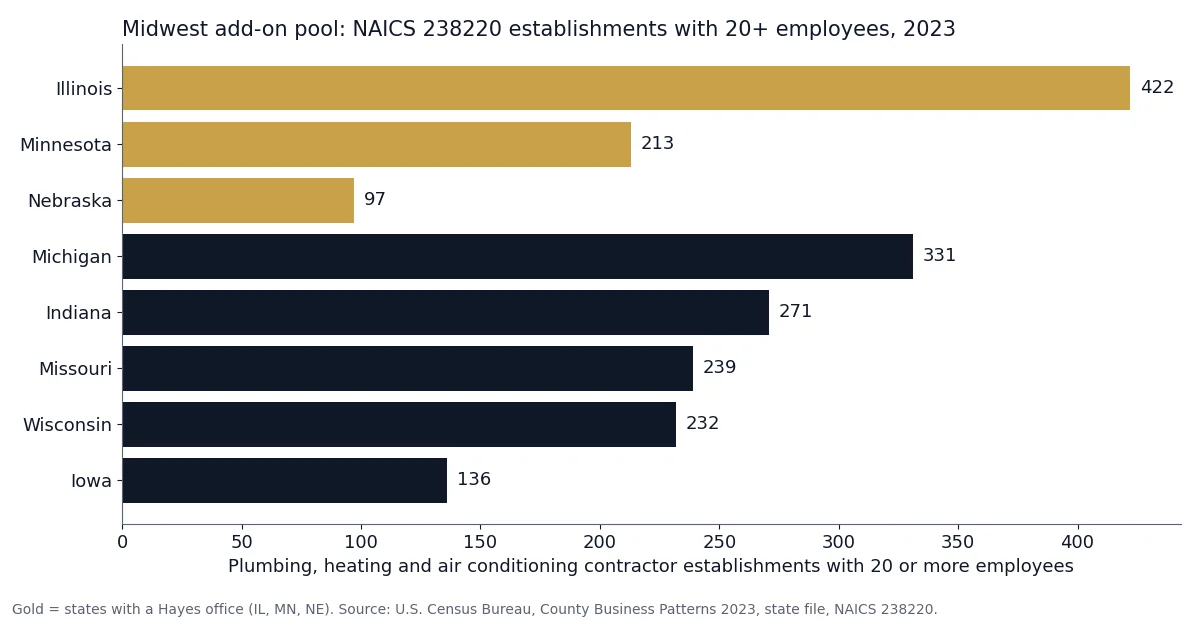
- The add-on pool is large: Illinois, Minnesota and Nebraska held 732 plumbing and HVAC contractor establishments with 20 or more employees in 2023 (Census County Business Patterns, NAICS 238220).
What did Frontenac buy, and what were the terms?
Frontenac bought control of Hayes Commercial, a 108-year-old commercial and industrial mechanical contractor headquartered in Chicago, from TJM Capital Partners in a recapitalization announced November 3, 2026. Financial terms were not disclosed. The management team stays and partners with Frontenac, two Frontenac CEO1ST operators join the board, and Lincoln International ran the sale for Hayes.
The Frontenac release describes Hayes as maintaining, repairing and installing HVAC, plumbing, boiler and building control systems for commercial and industrial customers across the Midwest, selling both to facility owners and to general contractors, with an in-house union workforce. Managing Partner Ron Kuehl said the deal brings “an attractive and resilient end market and meaningful opportunities for continued growth.”
| Deal term | What was disclosed |
|---|---|
| Announced | November 3, 2026, closed (post-close roles named) |
| Buyer | Frontenac, Chicago private equity, lower middle market buyouts |
| Seller | TJM Capital Partners, Chicago, founded 2008, owner since 2021 |
| Structure | Recapitalization in partnership with management; new platform |
| Price and multiple | Not disclosed |
| Management | Mark Tibbetts (President), Tim Johnson (EVP), Bart McCartin (Executive Chairman) continue |
| Board additions | John Barrett (CEO1ST Partner) and Eric Reisner (35+ years in commercial field service, HVAC and controls) |
| Sell-side advisor | Lincoln International |
| Buy-side advisor and counsel | KeyBanc Capital Markets; DLA Piper |
The deal sits in CT’s November 2026 home services acquisitions roundup, where Hayes is one of only two new sponsor platforms in HVAC, plumbing and mechanical that month.
Who is Hayes Commercial, and is it the same company as Hayes Mechanical?
Yes: the Frontenac release points readers to hayesmechanical.com, so Hayes Commercial and Hayes Mechanical are the same operating business. Daniel Hayes founded it as Dan Hayes Boiler & Repair Co. in 1918, it took the name Hayes Boiler & Mechanical Inc. in 1979, and today it lists offices in Chicago, La Vista (Omaha) and Brooklyn Center (Minneapolis).
The Hayes company history shows a boiler shop that kept adding recurring work: power boiler maintenance from 1967, rental boilers from 1970, then air conditioning, pipefitting and temperature controls.
The union ties run deep. The history page credits the family with helping build the Boilermakers Local 1 Training Center, and the Hayes leadership page notes that Joe Montagano Sr., Senior VP of Commercial Services, is a member of Pipefitters Local Union 597. Mark Tibbetts joined as CFO in 2010 and became President in 2018.
TJM Capital Partners bought Hayes in 2021 and added Edwards Engineering in 2025, according to Lincoln International’s deal page. Lincoln’s Luke Webb pointed to Hayes’ “strong recurring service and maintenance revenue.” That is the line a seller should note: the asset Frontenac paid for is the service book, not the project backlog.
What is Frontenac’s track record with platforms like Hayes?
Frontenac builds platforms by acquisition. On the industrial side, Ron Kuehl is listed on the deal team for MCE, Newterra, Integrated Openings Solutions, CROM and now Hayes, and Greg Ruffini on four of those five. MCE shows 27 add-ons on its portfolio page before its 2026 sale to Bertram Capital, IOS shows 8 since 2023 and CROM shows 4 since 2025.
| Platform | What it does | Frontenac entry | Add-ons listed | Exit | Source |
|---|---|---|---|---|---|
| MCE (Zelienople, PA, founded 1951) | Industrial distribution and repair | Recapitalized 2018 | 27 (2020 to 2026) | Sold to Bertram Capital, 2026 | Frontenac: MCE |
| Newterra (Coraopolis, PA, founded 1992) | Modular water and wastewater treatment | Recapitalized 2020 | 4 (2022 to 2024) | Sold to Grundfos, 2025 | Frontenac: Newterra |
| Integrated Openings Solutions (Olathe, KS, founded 2018) | Commercial door and access control service | Recapitalized 2023 with founders | 8 (2024 to 2026) | Active | Frontenac: IOS |
| CROM (Gainesville, FL, founded 1953) | Water infrastructure services | Recapitalized 2025 | 4 (2025 to 2026) | Active | Frontenac: CROM |
| Hayes Commercial (Chicago, founded 1918) | Commercial and industrial HVAC, plumbing, boilers, controls | Recapitalized 2026 | 0 so far | Active | Frontenac: Hayes |
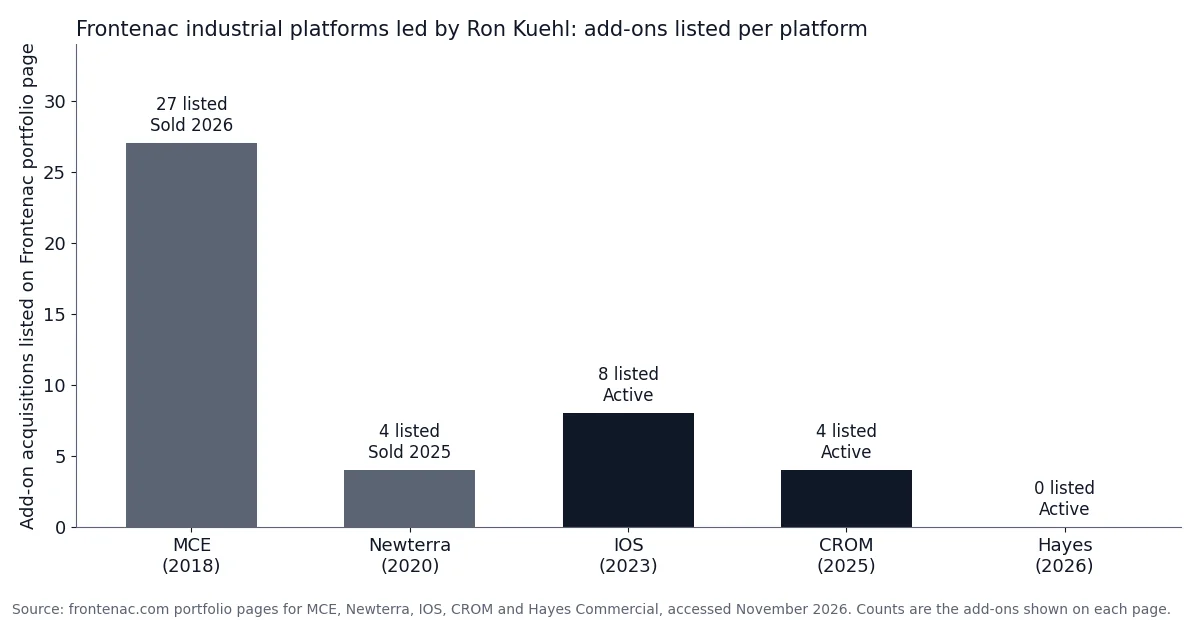
Three patterns stand out. First, every platform in the table was a recapitalization of an older founder or family business (MCE founded 1951, CROM 1953, Hayes 1918). Second, add-ons start fast: CROM announced its first add-on, Carolina Management Team, on August 4, 2025, six months after Frontenac’s February 3, 2025 entry. Third, add-ons extend geography: IOS entered Arkansas with Commercial Door and Hardware on May 4, 2026, and CROM expanded in Texas with Dobbs Coating Systems on July 15, 2026.
The exits also show the clock. Newterra ran from 2020 to a 2025 sale, and MCE from 2018 to a 2026 sale. A Midwest owner who sells to Hayes in 2027 should expect Hayes itself to be sold again within that kind of window, which is why rollover equity terms deserve as much attention as the cash price. Frontenac also owns CertainPath (since 2022), which trains residential HVAC, plumbing and roofing contractors.
How big is the Midwest commercial mechanical market Hayes can buy into?
Large and fragmented. In 2023, Illinois had 4,070 plumbing, heating and air conditioning contractor establishments (NAICS 238220) employing 41,112 people, and 422 of them had 20 or more employees. Across the three Hayes office states the count of 20-plus-employee shops was 732, and five neighboring states added 1,209 more, per Census County Business Patterns.
County Business Patterns does not split commercial from residential work inside NAICS 238220, so these counts are a ceiling on the add-on pool, not a list of union commercial shops. The useful filter for a Hayes-type buyer is size: a firm with 50 or more employees usually has a service manager, dispatch and maintenance contracts. Illinois had 131 such establishments, Minnesota 83 and Nebraska 35.
| State (NAICS 238220, 2023) | Establishments | Employees | 20+ employees | 50+ employees | Hayes office? |
|---|---|---|---|---|---|
| Illinois | 4,070 | 41,112 | 422 | 131 | Yes, Chicago |
| Minnesota | 1,816 | 21,283 | 213 | 83 | Yes, Brooklyn Center |
| Nebraska | 837 | 9,947 | 97 | 35 | Yes, La Vista |
| Michigan | 2,661 | 30,546 | 331 | 110 | No |
| Indiana | 2,008 | 26,484 | 271 | 83 | No |
| Missouri | 1,915 | 23,628 | 239 | 84 | No |
| Wisconsin | 1,944 | 23,507 | 232 | 76 | No |
| Iowa | 1,108 | 14,647 | 136 | 57 | No |
What do union mechanical trades earn in the Hayes metros?
Labor cost is the first thing a buyer models. In May 2025, the median plumber, pipefitter and steamfitter in the Chicago metro earned $103,380 a year, versus $101,630 in Minneapolis and $63,400 in Omaha, per BLS Occupational Employment and Wage Statistics. The Chicago figure is $39,980, or 63%, above Omaha’s.
| Metro (OEWS May 2025) | Plumbers, pipefitters, steamfitters (47-2152): employment | Median annual wage | HVAC mechanics and installers (49-9021): employment | Median annual wage |
|---|---|---|---|---|
| Chicago-Naperville-Elgin, IL-IN | 12,750 | $103,380 | 7,210 | $77,960 |
| Minneapolis-St. Paul-Bloomington, MN-WI | 6,730 | $101,630 | 2,420 | $77,490 |
| Omaha, NE-IA | 2,430 | $63,400 | 1,600 | $62,570 |
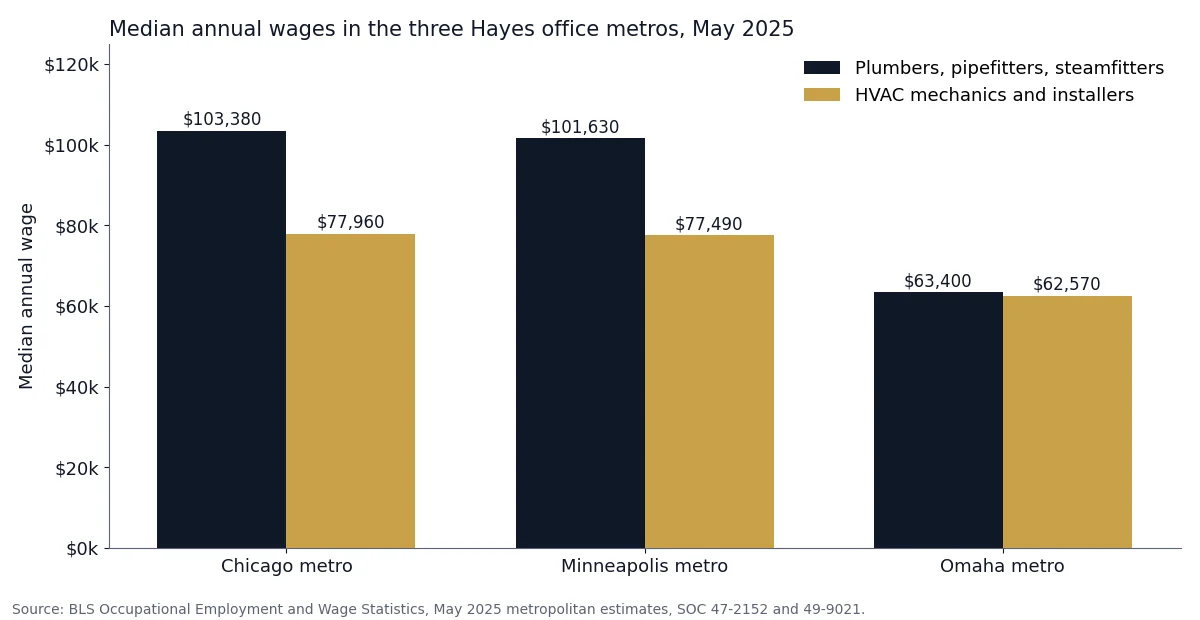
For a seller, the gap cuts two ways: a Chicago or Twin Cities shop must show billing rates that absorb union scale, and an Omaha-area shop is cheaper to run but will be checked for whether its workforce is signatory to the same unions as Hayes.
Which licenses does a buyer check in Illinois, Minnesota and Nebraska?
| License or rule | Who issues it | Why a buyer cares |
|---|---|---|
| Illinois plumber and plumbing contractor licenses, Illinois Plumbing License Law (225 ILCS 320) | Illinois Department of Public Health, which licenses about 8,900 plumbers | Licenses sit with individuals; a sale must keep the licensed plumbers employed |
| Chicago stationary engineer license, required to operate most steam and hot water boilers in the city | City of Chicago Department of Buildings | Boiler service and operating contracts depend on licensed engineers staying |
| Minnesota high pressure piping contractor license (needs a responsible licensed HPP pipefitter and a surety bond) | Minnesota Department of Labor and Industry | Industrial steam and process piping work in Minnesota cannot be permitted without it |
| EPA refrigerant technician certification, Type I, II, III or Universal (40 CFR 82.161) | U.S. EPA via eCFR | Chiller and rooftop work requires Type II or Type III certified technicians |
What is a commercial mechanical contractor like Hayes worth?
Frontenac did not disclose a price, so no multiple for Hayes exists. The closest disclosed Midwest print is Limbach’s July 2025 purchase of Pioneer Power, a Twin Cities industrial mechanical firm, for $66.1 million against about $10 million of expected adjusted EBITDA: roughly 6.6x, or 6.2x excluding $4.6 million of owned real property.
| Reference point | Disclosed figures | Implied multiple | Source |
|---|---|---|---|
| Limbach / Pioneer Power (Twin Cities, July 2025) | $66.1M price; about $120M revenue and $10M adjusted EBITDA expected from 2026 | 6.6x (6.2x ex real property) | Limbach release |
| IBP / Old Dominion Group (November 2026) | $698M enterprise value; about $68M LTM adjusted EBITDA | 9.3x with synergies, 10.3x before | IBP 8-K exhibit |
| EMCOR / P1 Construction (Lenexa, KS, November 2026) | $600M to $650M revenue; about $60M adjusted EBITDA; price not disclosed | Not disclosed; margin 9.2% to 10.0% | EMCOR release |
| CT commercial HVAC tiers (2026) | Project-led 5x to 6.5x; service-led with 30 to 40% maintenance mix 6.5x to 9x; maintenance platform with controls 9x to 12x | Range by service mix | CT commercial HVAC valuation guide |
The spread between 6.6x and 9.3x is mostly service mix and size. CT’s mechanical contractor M&A multiples report treats roughly 40% recurring service revenue as the gate to platform pricing, and the Pioneer Power margin (about 8.3%) and P1 margin (9.2% to 10.0%) give a sanity check on what a mechanical contractor’s EBITDA should look like.
Worked example: a Midwest add-on to Hayes (illustrative)
Assumptions are illustrative, not from any real company: a union commercial mechanical firm with $30 million revenue, $2.5 million adjusted EBITDA (8.3% margin) and 35% of revenue under maintenance agreements. At $2.5 million it sits below Frontenac’s $5 million platform floor, so it is an add-on candidate.
| Scenario (illustrative) | Multiple | Enterprise value | Basis |
|---|---|---|---|
| Priced as project-led | 5.0x | $12.5M | Low end of CT project-led tier |
| Priced at the service-led floor | 6.5x | $16.25M | CT service-led tier |
| Priced like Pioneer Power | 6.6x | $16.5M | Limbach disclosed print |
| Priced as service-led with controls | 9.0x | $22.5M | Top of CT service-led tier |
| 20% rollover at 6.6x | 6.6x | $13.2M cash at close, $3.3M rolled | Illustrative rollover share |
Each 1.0x step on $2.5 million of EBITDA moves the price by $2.5 million, which is why the maintenance agreement count is worth more effort than one more construction bid.
What does the Frontenac Hayes Commercial deal mean for mechanical contractor owners in the Midwest?
It means a new, funded Chicago buyer for commercial HVAC, plumbing, boiler and controls service firms, with a sponsor whose prior industrial platforms each made 4 to 27 listed add-ons. Owners of union or open shop Midwest service contractors with maintenance agreements should expect outreach and should prepare before the first call.
Who will Hayes want next?
- Density in its three metros. Chicago, Twin Cities and Omaha service shops add technicians and maintenance routes to existing dispatch. Illinois alone had 131 establishments with 50 or more employees in NAICS 238220 in 2023.
- Adjacent Midwest metros. Frontenac platforms extend geography by add-on (IOS into Arkansas, CROM into Texas). Michigan (331), Indiana (271), Missouri (239), Wisconsin (232) and Iowa (136) had 1,209 contractor establishments with 20 or more employees between them.
- Controls and building automation. Building controls is in the deal description, and Eric Reisner’s 35+ years include building controls businesses.
- Industrial boiler and process piping. Hayes’ history is boilers; a firm with stationary engineers or Minnesota high pressure piping capability fills the industrial side.
What to prepare before a platform calls
- A maintenance agreement schedule: customer, annual value, start date, renewal date and equipment count per site.
- Revenue split three ways: maintenance agreements, service and repair calls, and project work, by year for three years.
- A license map: which named employee holds each Illinois plumbing license, Chicago stationary engineer license, Minnesota HPP license and EPA Type II or III certification.
- Union documents: every collective bargaining agreement, the multiemployer pension plans you contribute to, and the latest withdrawal liability estimate from each plan.
- A second-tier org chart showing who runs service, dispatch and estimating without you.
What are the deal risks for a union contractor?
The biggest one is multiemployer pension withdrawal liability. Under ERISA section 4203(b) (29 U.S.C. 1383(b)), construction industry employers face a narrower withdrawal rule, and in an asset sale ERISA section 4204 (29 U.S.C. 1384) avoids a withdrawal only if the buyer keeps contributing and posts a bond or escrow for 5 plan years. A stock sale or recapitalization usually keeps the same contributing employer, which is one reason union shops often sell that way. Ask your ERISA counsel which rule your plans apply.
Rolled equity is paid when Hayes itself sells, not when you do, and Frontenac sold MCE and Newterra after 5 to 8 years. An earnout tied to project revenue can miss when a general contractor delays a job; see CT’s guide to earnouts in home services M&A. Key-person risk shows up as an owner employment agreement and retention bonuses for licensed staff.
Which other buyers are active in Midwest mechanical?
Hayes is not alone. Limbach bought Pioneer Power in the Twin Cities in 2025, EMCOR agreed in November 2026 to buy P1 Construction in Lenexa, Kansas, and IBP added the Old Dominion Group’s mechanical insulation business the same month. CT’s guide to platform acquisitions versus add-ons explains why a platform pays differently from a strategic buyer like EMCOR.
| If your company is… | Then… | Why |
|---|---|---|
| A Chicago-area commercial service firm with under $5M EBITDA and a maintenance book | Expect add-on interest from Hayes and prepare the agreement schedule now | Below Frontenac’s $5M platform floor; adds route density in Hayes’ home market |
| A Midwest mechanical firm with $5M to $40M EBITDA | Run a full process: you can be a platform for another sponsor or a large add-on | Inside Frontenac’s platform range, so you have more than one buyer type |
| A union shop contributing to multiemployer pension plans | Get withdrawal liability estimates and decide stock versus asset sale early | ERISA 4203(b) and 4204 change who carries the liability |
| A project-heavy contractor with under 30% maintenance revenue | Build the maintenance agreement book before selling | CT tiers price project-led firms at 5x to 6.5x versus 6.5x to 9x for service-led |
| A Twin Cities or Omaha industrial piping or boiler firm | Compare Hayes with strategic buyers such as Limbach | Limbach paid about 6.6x for Pioneer Power in the Twin Cities |
| An owner who wants to keep a stake | Negotiate rollover terms with the next exit in mind | Frontenac sold MCE and Newterra after 5 to 8 years |
A recapitalization like the Hayes deal is not the only route either; CT’s private equity recapitalization guide compares it with a full sale. We work for owners on the sell side. Our fee is success only: nothing upfront, and you pay nothing unless the business sells. If a platform like Hayes has called you, book a confidential call before you sign an LOI.
How we compiled this
We used 23 primary documents accessed in November 2026: buyer, seller-advisor and company pages, Census and BLS datasets, licensing pages, ERISA text and three acquirer releases. No figure comes from forums or deal databases.
Frequently asked questions
Who owns Hayes Commercial now?
Frontenac, a Chicago private equity firm, owns a controlling stake in Hayes Commercial after a recapitalization announced November 3, 2026. The management team, led by President Mark Tibbetts and Executive Chairman Bart McCartin, continues in partnership with Frontenac. TJM Capital Partners, which owned Hayes from 2021, was the seller.
How much did Frontenac pay for Hayes Commercial?
The price was not disclosed. Frontenac’s release says financial terms were not disclosed, and Lincoln International’s deal page gives no figures. The closest public reference is Limbach’s 2025 purchase of Pioneer Power, a Twin Cities mechanical firm, at about 6.6x expected adjusted EBITDA.
Is Hayes Commercial the same as Hayes Mechanical?
Yes. Frontenac’s release directs readers to hayesmechanical.com, the website of Hayes Mechanical, the Chicago contractor founded in 1918 as Dan Hayes Boiler and Repair Co. Its website lists offices in Chicago, La Vista, Nebraska and Brooklyn Center, Minnesota.
How much is a commercial HVAC company worth in Illinois?
Disclosed Midwest prints run from about 6.6x adjusted EBITDA (Limbach and Pioneer Power, 2025) to 9.3x (IBP and Old Dominion Group, 2026). CT’s 2026 tiers put project-led contractors at 5x to 6.5x and service-led firms with 30 to 40% maintenance revenue at 6.5x to 9x.
How do private equity add-on acquisitions work after a platform deal?
After buying a platform such as Hayes, the sponsor funds the platform to buy smaller firms that add technicians, routes or service lines. Frontenac’s CROM made its first add-on six months after entry. Sellers usually get cash at close, sometimes rolled equity and an earnout, and stay on through a transition.
Ask your M&A attorney and CPA how the multiemployer pension rules and your deal structure apply to your company before you sign a letter of intent.
Sources
- Frontenac Announces Partnership with Hayes Commercial, Frontenac, November 3, 2026, accessed November 2026.
- Strategy and investment criteria, Frontenac, accessed November 2026.
- Frontenac portfolio: Hayes Commercial, MCE, Newterra, Integrated Openings Solutions, CROM and CertainPath, accessed November 2026.
- TJM Capital Partners has sold Hayes Commercial to Frontenac, Lincoln International, 2026, accessed November 2026.
- Company History and Company Leadership, Hayes Mechanical, accessed November 2026.
- County Business Patterns 2023, state file, NAICS 238220, U.S. Census Bureau, accessed November 2026.
- Occupational Employment and Wage Statistics, May 2025 metropolitan estimates, Bureau of Labor Statistics, accessed November 2026.
- Plumbing program, Illinois Plumbing License Law (225 ILCS 320), Illinois Department of Public Health, accessed November 2026.
- Stationary Engineer License, City of Chicago Department of Buildings, accessed November 2026.
- High pressure piping contractor license, Minnesota Department of Labor and Industry, accessed November 2026.
- 40 CFR 82.161, Technician certification, eCFR, accessed November 2026.
- 29 U.S.C. 1383 and 29 U.S.C. 1384, Cornell LII, accessed November 2026.
- Limbach Acquires Pioneer Power, Limbach Holdings, July 1, 2025, accessed November 2026.
- IBP to acquire Old Dominion Group, 8-K exhibit, Installed Building Products, November 12, 2026, accessed November 2026.
- EMCOR Group announces agreement to acquire P1 Construction, EMCOR Group, November 13, 2026, accessed November 2026.