
Buy a Excavation Business in 2026: Multiples, Diligence, Deal Structures
Buying a excavation business in 2026 clears materially different multiples by scale, sub-vertical, and platform readiness. Owner-operator single-location operators typically land 3-5x EBITDA. Multi-unit regional platforms with strong management depth reach 5-8x EBITDA. Platform-quality operators with recurring service revenue push toward the top of the band. What decides where inside your target you underwrite: recurring revenue percentage, customer concentration, second-tier management, and diligence around regulatory compliance and licensing.
Quick Answer
Buying an excavation business in 2026 means underwriting bid-bonding capacity, equipment fleet residual value, and DOT prequalification limits before EBITDA multiples. Sub-$10M EBITDA site-prep operators transact at 4x to 8x EBITDA, while $20M+ heavy-civil platforms with bonding capacity above $50M command 6x to 11x. Platform-grade infrastructure consolidators reach 8x to 12x. The IIJA $1.2 trillion federal infrastructure tailwind, state DOT prequal moats, and a fragmented base of 41,000-plus US site-preparation firms make excavation one of the most active civil-services roll-up categories. Strategic acquirers like Granite Construction (NYSE: GVA), MasTec (NYSE: MTZ), and Sterling Infrastructure (NYSE: STRL) are paying premiums for fleet, crews, and federal qualifications.
Updated June 2026 · CT Acquisitions
Excavation and site preparation is the unglamorous backbone of every road, pipeline, data center pad, and subdivision in America. For PE infrastructure consolidators and strategic acquirers, buying an excavation business in 2026 looks structurally different from buying an HVAC or plumbing company. The asset is a fleet, the moat is a bonding line, the customer is often a state DOT or a GC on a federally funded job, and the tailwind is a $1.2 trillion infrastructure bill running through 2030. This guide walks through how to underwrite, structure, finance, and integrate an excavation acquisition without breaking the bonding capacity that makes the business worth buying.
How CT Acquisitions Works
- $0 to sellers on buy-side mandates. The buyer in our network pays us at close, so there is no retainer, listing fee, or commission on that path. Sell-side representation is a separate, fee-based engagement agreed in writing upfront.
- No exclusivity on buy-side introductions. Walk at any time. If our buyer isn’t paying enough, hire a banker the next day. We have zero claim on you. Sell-side engagements run on their own written terms.
- No auction, no leaks. We introduce you to one or two pre-mandated buyers sequentially. Your business never gets shopped.
- Top-of-market price AND the right buyer. Our fee scales with sale price (same incentive as a banker), matched on fit, not just the highest check.
- 60 to 120 days, not 9 to 12 months. We already know our buyers’ mandates before we pick up the phone with you.
Key takeaways
- Sub-$10M EBITDA at 4x to 8x; $20M+ heavy-civil at 6x to 11x; platforms 8x to 12x.
- Bonding capacity is the top diligence item. Surety lines run 5x to 10x net working capital.
- Equipment fleet (excavators $300K to $1.2M, dozers $400K to $800K) is the swing factor in working-capital adjustments.
- State DOT prequal and federal DBE/MBE certification create moats that survive ownership changes if filed correctly.
- The IIJA $1.2 trillion pipeline runs through 2030 and is reshaping public-sector demand by region.
- 60%-plus public sector with diverse agency exposure earns platform multiples.
Table of contents
- Why buying an excavation business is a platform play in 2026
- What buyers pay when buying an excavation business in 2026
- Six buyer archetypes for buying an excavation business
- Bonding capacity: the first diligence item
- Equipment fleet underwriting
- DOT prequalification and DBE/MBE moats
- Due diligence when buying an excavation business
- Structuring the offer
- Financing options when buying an excavation business
- Integration: where acquirers create or destroy value
- Red flags that kill excavation deals
- The CT Acquisitions perspective
- If you’re a buyer, here’s what we recommend
- Frequently asked questions about buying an excavation business
- Related resources for buyers
This guide covers how site-prep, utilities, and heavy-civil operators are underwritten in 2026, which signals separate a 4x dirt-mover from an 11x infrastructure platform, and how to integrate without losing the prequalifications and surety lines that make the business worth owning.
Why buying an excavation business is a platform play in 2026
Three structural drivers make excavation a high-conviction buy in civil services, funded by federal statute rather than consumer sentiment.
First, the IIJA tailwind. The Infrastructure Investment and Jobs Act authorized $1.2 trillion across roads, bridges, water, broadband, ports, and grid hardening, with appropriations running through fiscal year 2030. State DOTs began awarding meaningful IIJA contracts in 2024, and the obligation curve peaks 2026 to 2028. Excavation operators with competitive DOT prequal limits have seen the bid universe expand materially. Site-prep contractors riding the data center boom (Microsoft, Meta, Google, Amazon, Oracle, and CoreWeave committed roughly $400 billion in 2024 to 2026 capex) see an equally aggressive private-sector curve.
Second, fragmentation. The US has roughly 41,000 site-preparation contractors (NAICS 238910) plus 18,000 heavy and civil engineering firms (NAICS 237310). The top 10 players control less than 6% of the combined market. Granite Construction (NYSE: GVA) is the publicly traded benchmark at roughly $4B 2025 revenue. Sundt Construction is employee-owned ESOP and not for sale, which leaves the consolidation field open for PE infrastructure platforms and strategic add-ons.
Third, capital intensity. A competitive heavy-civil bid requires $5M to $25M in working equipment, a $20M to $100M surety line, and a workforce of qualified operators that takes years to build. New entrants do not show up. Buyers who acquire fleet, bonding, and crews are buying the moat itself.
The combination is rare: federally funded demand, structural barriers to entry, and enough fragmentation that platform plays have years of add-on runway. The challenge is that excavation is balance-sheet heavy, and buyers who underwrite it like a service business mis-price the fleet and bonding capacity.
What buyers pay when buying an excavation business in 2026
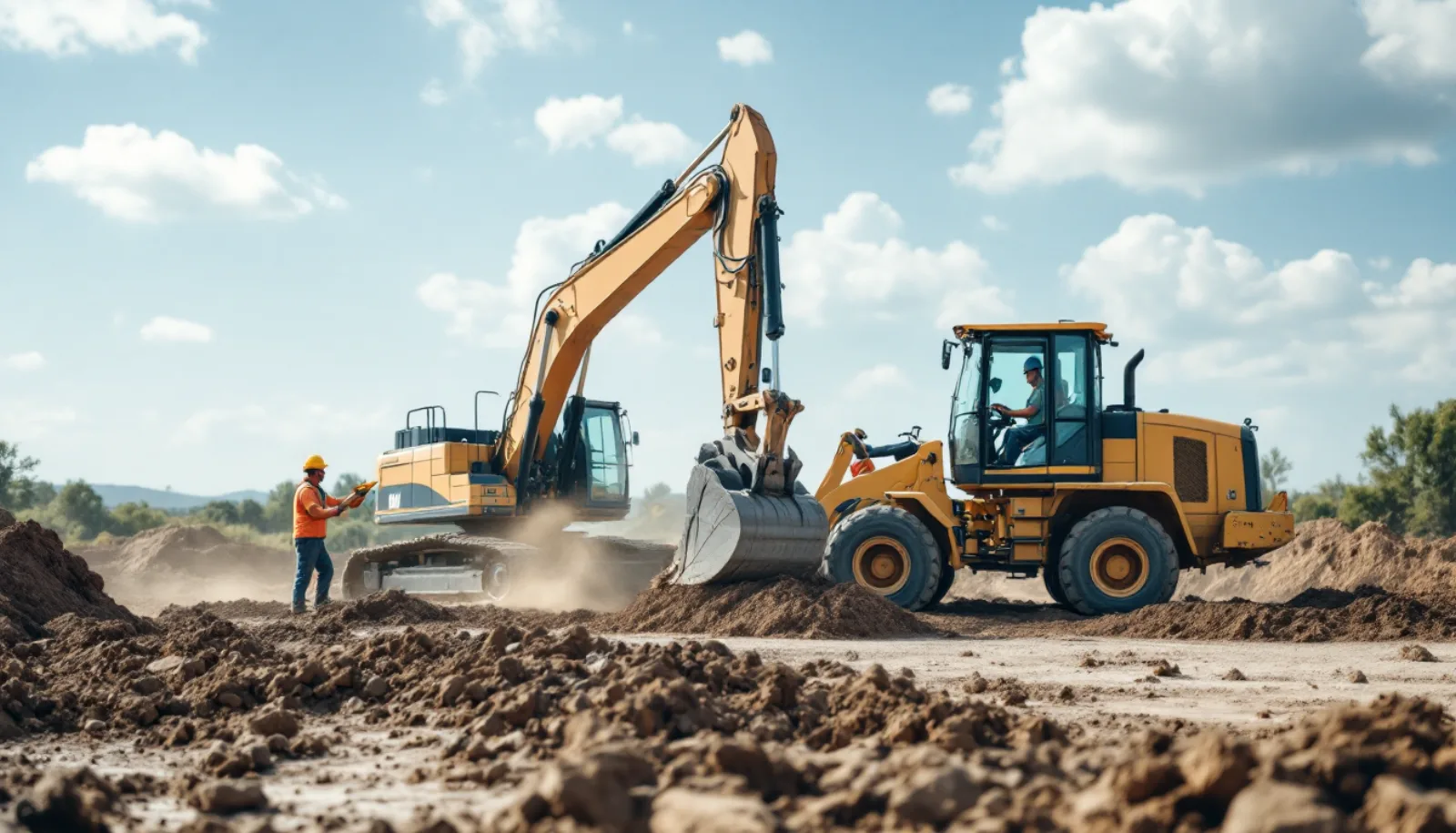
Valuation ranges are wide because excavation hides three distinct sub-businesses inside one NAICS code. A residential site-prep operator running 6 excavators on subdivision dirt work is a different asset class than a heavy-civil contractor with DOT prequalification building bridge approaches and stormwater systems. The multiples reflect the difference, and so does the bidding pool.
| Operator profile | EBITDA multiple (2026) | What buyers pay for |
|---|---|---|
| Residential site-prep, sub-$3M EBITDA, founder-led, no bonding | 3.5x to 5.0x | Cash flow plus fleet residual value. |
| Commercial site-prep, $3M to $10M EBITDA, modest bonding capacity | 5.0x to 7.0x | Established GC relationships, stable fleet utilization. |
| Utility excavation, $5M to $15M EBITDA, contractor licensing, DOT prequal | 6.0x to 8.5x | Public-sector exposure, repeatable bid cadence. |
| Heavy-civil, $20M+ EBITDA, $50M+ bonding line, multi-state DOT prequal | 6.5x to 11.0x | Platform-ready operator with federal qualifications. |
| Strategic platform anchor with DBE/MBE certification or geographic moat | 8.0x to 12.0x | Synergy premium for PE platform or strategic GC roll-up. |
The spread between 4x and 11x is not random. Sophisticated excavation buyers model these factors explicitly, and the diligence work goes well beyond standard quality of earnings:
- Bonding capacity. Single-project capacity and aggregate capacity from the surety. Operators with a $30M aggregate line bid jobs that 5x-bonded competitors cannot touch. This is the single largest multiple driver in heavy-civil.
- Public versus private mix. 60%-plus public sector with diverse agency exposure is platform-grade. 80%-plus private commercial with concentration in 2 to 3 GCs is a discount of 1 to 2 turns.
- Fleet age and residual. A fleet with a weighted average age below 5 years and rebuilds documented commands a premium. A fleet running tier-3 emissions engines or with deferred maintenance is a discount and a CapEx liability post-close.
- DOT prequalification breadth. Number of states prequalified, dollar limits per state, and the engineering classifications held (grading, drainage, structures, bridges).
- DBE/MBE/WBE certification. Federal Disadvantaged Business Enterprise certification on prime contracts and as a sub-tier credit for primes is a sustainable competitive advantage if it survives ownership change (typically requires the certified owner to retain 51%-plus voting control, which can constrain deal structure).
- Backlog conversion. Signed backlog 12 to 18 months out, with margin attached. Heavy-civil backlog at 1.5x trailing revenue with 12%-plus margin is high quality. Bid backlog without signed contracts gets discounted heavily.
The 2026 pricing reality
PE infrastructure platforms and strategic GCs (Granite, MasTec, Sterling, Kiewit, Sundt) compete aggressively for operators with $25M+ bonding capacity and clean DOT prequal in growth states. Platform-grade $5M to $15M EBITDA operators receive multiple LOIs at 7.0x to 9.0x. Sellers are sophisticated; underpricing is over in heavy-civil.
For independent sponsors and search funds, either develop a differentiated thesis (horizontal directional drilling, geographic moat in a state with limited prequalified competitors, wind-farm civil) or fish in the $1M to $3M EBITDA band where platforms do not show up. There, valuations are 4x to 6x SDE and founders prioritize continuity and crew preservation over price.
Six buyer archetypes for buying an excavation business
Understanding which buyer you are competing against in any given deal shapes how you structure your offer and where you find sourcing advantage.
1. PE infrastructure platforms
Sponsor-backed civil services platforms with 5- to 30-add-on theses over 3- to 5-year holds. Examples include Indus (Riverside Company), platforms backed by Bernhard Capital, OceanSound Partners, and the civil-services arms of Bow River, MidOcean, and Berkshire Partners. Target profile: $5M to $25M EBITDA, bonding above $25M, multi-state DOT prequal preferred. Pay 7.0x to 10.0x for platform anchors, 6.0x to 8.0x for add-ons. Move in 90 to 120 days and write 60% to 75% cash at close.
2. Strategic acquirers
Granite (NYSE: GVA, ~$4B), MasTec (NYSE: MTZ, ~$13B), Sterling Infrastructure (NYSE: STRL, ~$2.5B), Kiewit (employee-owned, ~$19B), and Sundt (ESOP, ~$2.7B) pursue tuck-ins when a target fills a geographic gap or adds capability. Integration is more thoughtful than a generic PE roll-up.
3. Engineering-led acquirers
Brown and Caldwell and similar engineering-led firms acquire civil contractors to extend design-build capability, particularly in water and wastewater. These buyers value engineering documentation, BIM/civil 3D capability, and complex-project track record more than pure dirt-moving volume. Multiples comparable to PE platforms with a premium for sophisticated estimating teams.
4. Independent sponsors
Deal-by-deal capital, typically a single principal or small team raising LP commitments per transaction. Compete on creative structuring (earnouts tied to backlog conversion, rollover equity for the founder, seller financing on equipment-only piece) when they cannot match platform pricing. Good fit for sellers who want a long-term partner and care about who runs the company after close.
5. Search funds
Individual operators with institutional backing looking for one business to run. Excavation is a credible search target because the founder-led $1M to $3M SDE band has limited PE competition. Multiples: 4x to 6x SDE. Best fit for residential and commercial site-prep where the operator does not need to inherit complex public-bid relationships. Search funders rarely have the working capital to support a $50M bonding line, which keeps them out of heavy-civil.
6. Roll-up founders and operator-led consolidators
Self-funded operators building regional platforms through SBA, mezzanine, and seller financing. Common in single-state plays where the founder has industry relationships. Cannot match PE pricing on platform-grade operators but win on smaller deals ($500K to $2M EBITDA) and offer the strongest operational continuity story. Often the right buyer for a retiring founder who wants the crews to stay employed.
Bonding capacity: the first diligence item
If you take one thing from this guide it is this. In excavation, the surety bonding line is the gating constraint on the business model. A contractor without a bonding line cannot bid public work. A contractor with a $5M aggregate bonding line is locked out of any individual job above roughly $2.5M (single-project capacity is typically 30% to 50% of aggregate). Buyers who do not understand the bonding math overpay for revenue that the post-close business cannot reproduce.
The surety math, simplified
A surety underwrites capacity as 5x to 10x net working capital and 10x to 20x tangible net worth, with the lower governing. A contractor with $3M NWC and $8M tangible net worth supports $15M to $30M aggregate capacity. Sureties also weigh character (claims history), capacity (single-project track record), and capital structure.
Why a deal can break the bonding line
Most acquisitions strip working capital through debt. A buyer taking $15M of senior debt against a $25M purchase ends up with materially less working capital and tangible net worth than the seller. The surety, reviewing the post-close balance sheet, may cut bonding in half. The buyer just paid for revenue capacity it can no longer support.
How sophisticated buyers handle this
- Engage the surety in diligence. Most heavy-civil sellers bond with Travelers, Liberty Mutual, Zurich, Chubb, or Berkley Surety. Get written confirmation on post-close bonding terms before signing the LOI.
- Preserve working capital. Less senior debt, more rollover equity, ABL facilities collateralized against receivables rather than amortizing term debt.
- Pre-negotiate a new surety if needed. If the sponsor brings a stronger balance sheet, transition to a surety that underwrites the consolidated entity. Plan 60 to 90 days.
- Restructure indemnity. Personal indemnity from the founder falls away at close. Replacement indemnity from the buyer must be in place before the surety releases the seller.
Equipment fleet underwriting
The equipment fleet is the second-largest asset on an excavation balance sheet and the most common source of working-capital adjustments at close. A typical $10M revenue contractor operates 15 to 30 pieces of yellow iron with aggregate replacement value $4M to $12M.
Equipment categories and 2026 replacement values
- Excavators (Cat 320 to 395, Komatsu PC210 to PC490): $300K to $1.2M new, $150K to $700K used at 3 to 5 years.
- Dozers (Cat D6 to D9, Komatsu D65 to D155): $400K to $1.5M new, $200K to $800K used.
- Wheel loaders and articulated dump trucks: $250K to $900K each.
- Motor graders, compactors, haul trucks, lowboys: $150K to $700K each.
- Skid steers, mini-excavators, support equipment: $40K to $150K each.
What fleet underwriting looks like
Pull the fixed-asset register with serial numbers, in-service dates, hour meters, and rebuild history. Cross-reference against EquipmentWatch or Ritchie Bros for FMV. The book-to-FMV gap can run $1M to $5M of unbooked value on a $10M-revenue contractor.
Equipment above 12,000 hours, deferred undercarriage repairs, or tier-3 engines that fail EPA stationary-source rules on federal sites are CapEx liabilities. A contractor needing to refresh 30% of fleet within 24 months carries $2M to $5M post-close CapEx that must be in the offer.
Fleet financing strategies
Most operators run a mix of owned and financed equipment. Terms from PACCAR Financial, Wells Fargo Equipment Finance, BMO, Caterpillar Financial, and Komatsu Financial run 5 to 7 year amortization at SOFR plus 250 to 400 bps. Sale-leaseback releases $2M to $8M at close (though the operating lease obligation shows up in surety capacity).
DOT prequalification and DBE/MBE moats
State DOT prequalification determines which contractors can bid state-funded transportation projects. Every state runs its own program. Texas, California, Florida, New York, Pennsylvania, Georgia, North Carolina, Ohio, Illinois, and Virginia run the largest programs by spend.
Prequalification requires audited financials, comparable project history (limits capped at 1x to 3x the largest similar project in the past 5 to 7 years), personnel resumes, equipment schedules, and surety capacity letters. 60 to 180 days per state, annual renewal.
For a buyer, prequalification has two valuation implications. First, it is portable through an asset or stock purchase if filed correctly, but requires affirmative notice to the DOT within 30 to 60 days post-close and a financial re-review. Botch the notice and the prequal lapses. Second, classifications and dollar limits define the bid universe. A buyer acquiring $40M Texas DOT prequal plus $25M Florida DOT prequal is buying a $400M to $600M annual addressable bid universe across two states.
DBE, MBE, and WBE certifications
Federal-aid projects (FHWA, FTA, FAA) carry DBE participation goals of 7% to 14% by dollar volume. A certified DBE subcontractor commands premium pricing as sub-tier credit for primes hitting federal goals. Certification requires the disadvantaged owner (race, gender, net worth limits) to hold 51%-plus voting control and operate the business day-to-day.
This certification is a moat that can also be a deal constraint. A change of control to a non-DBE 100% owner terminates the certification. Buyers preserve DBE status either by structuring a 49% acquisition with the certified owner retaining 51% control and a defined buyout path 3 to 7 years out, or by isolating the DBE work in a separate subsidiary with qualifying ownership.
Due diligence when buying an excavation business
Generic M&A diligence is necessary but not sufficient. Category-specific signals are where value creation and destruction happen. Beyond standard quality of earnings, legal, and insurance review:
Project-level revenue and margin decomposition
Pull 24 months of completed jobs at job-cost level. Bucket every job: residential site-prep, commercial site-prep, utility excavation, heavy-civil (DOT, bridges, structures), specialty (data center pads, wind farm civil), and T&M change orders. Calculate gross margin by bucket. The mix tells you which sub-business you are actually buying.
Backlog conversion analysis
Build an 18-month backlog schedule with signed contracts, start and completion dates, and contracted margin. Compare against trailing 18 months to see how reliably signed work converts at estimated margin. 30% slippage suggests scheduling or capacity problems that survive the transaction.
Estimating function audit
The estimating team is the most valuable group of employees in a heavy-civil contractor. Identify lead estimators by name, tenure, win rate by job size and project type, and post-completion margin variance against bid estimates. A founder who is also the lead estimator is a key-person risk requiring a 3-year employment commitment and a backlog-tied earnout.
Crew unit economics
Build a crew-level P&L for the trailing 12 months. Key metrics: labor hours per dollar of revenue, equipment utilization (target 1,400 to 1,800 productive hours per year on a primary excavator), travel time as a percentage of clocked hours, and crew gross margin contribution. The delta between top and bottom crews is typically 30% to 50%. That gap is where post-close value creation lives.
Surety claims history
Pull the 10-year surety loss history. A single payment or completion default in the past 5 years materially affects future bonding capacity. Get a written claims summary as part of the bonding letter.
OSHA, MSHA, and trench safety
Excavation is a high-hazard category. OSHA 29 CFR 1926.652 (trench safety, cave-in protection, shoring) is the most-cited regulation in the industry. Pull the contractor’s 10-year OSHA citation history, EMR rating (target below 1.0), and recordable injury rate. An EMR above 1.25 hurts bid prequalification on public projects and signals safety-culture problems.
Equipment lien and lease audit
Pull UCC filings and reconcile to the equipment schedule. Identify leased versus owned, cross-collateralized liens that complicate transfer, and assignment provisions on leases. A lease portfolio without assignment provisions requires lender re-underwriting at close.
Environmental and permitting
Site-prep carries stormwater (NPDES Construction General Permit), wetlands (Section 404), endangered species (Section 7), and brownfield contamination exposure. Pull compliance history, permits, and pending notices of violation.
Structuring the offer
The best buyers win on structure as often as on price, particularly in excavation where bonding capacity and equipment continuity matter more than headline multiple.
The standard excavation deal structure (2026)
- Cash at close: 60% to 75% of total consideration. Lower than home services because more deal value goes into rollover and earnout to preserve bonding capacity.
- Seller rollover equity: 10% to 25% in platform deals where the seller continues operating. Higher rollover preserves the surety relationship and signals founder commitment to backlog conversion.
- Earnout: 10% to 20% over 18 to 36 months, typically tied to backlog conversion, gross margin on completed work, or specific public-project awards.
- Escrow: 10% to 15% held 18 to 24 months against indemnification claims and warranty exposure on completed work.
- Seller note: 5% to 15%, subordinated to senior debt and to the surety indemnity, typical in independent sponsor and search fund deals.
Where smart excavation buyers differentiate
Sellers weight offer components in this order: cash at close percentage, surety continuity and indemnity timing, key-employee retention for estimators and superintendents, backlog-earnout achievability, and crew-preservation commitments. Price alone is often third or fourth for founders who spent 30 years building crews.
The earnout trap in excavation
The most destructive element is an EBITDA-tied earnout. Heavy-civil EBITDA swings on weather, change-order timing, and project margin variance that the seller does not control post-close. Earnouts tied to backlog conversion (revenue from pre-close signed contracts) or specific contract awards give the seller something to influence. Earnouts tied to forward-bid wins are functionally a price reduction.
Financing options when buying an excavation business
Capital structure for an excavation deal looks different from a typical service-business acquisition because of the equipment collateral and bonding capacity dynamics.
SBA 7(a) loans
SBA 7(a) financing supports buying an excavation business up to $5M in purchase price for independent buyers. Rates run prime plus 2.0% to 2.75% with 10-year amortization. The constraint: SBA requires the seller to exit operationally within 12 months, which conflicts with the founder-transition periods needed to preserve estimating capability and surety relationships. For excavation deals where the founder needs to stay 2 to 5 years to transfer relationships, SBA is rarely the right financing.
Asset-based lending (ABL)
ABL facilities collateralized against receivables, WIP, and equipment are the workhorse financing in heavy-civil. BMO, Wells Fargo, PNC, Truist, and Fifth Third run construction ABL teams. Advance rates 80% to 85% on AR, 50% to 60% on WIP, 75% to 85% on equipment FMV. Rates SOFR plus 250 to 400 bps. ABL preserves more working capital than term debt.
Equipment finance and sale-leaseback
For deals where the seller owns substantial fleet outright, a sale-leaseback at close releases cash from PACCAR Financial, Wells Fargo Equipment Finance, BMO, Caterpillar Financial, or Komatsu Financial. Terms run 5 to 7 year amortization at SOFR plus 275 to 425 basis points. The trade-off: the operating lease obligation reduces working capital on the surety’s view, so coordinate with the bonding underwriter before committing.
Mezzanine and unitranche
For platform deals or larger independents ($10M+ EBITDA), mezzanine or unitranche bridges senior debt and equity at 11% to 14% with warrants. Providers: Twin Brook, Monroe Capital, Antares, Audax, and construction-experienced SBIC funds.
Surety-friendly capital structures
Sophisticated PE platforms intentionally over-equitize to preserve surety capacity. A $25M deal with $8M senior debt, $5M seller rollover, and $12M equity closes at 2.0x senior-debt even when the market supports 3.5x. The IRR drag is offset by retained bonding capacity, which lets the platform bid larger jobs.
Integration: where acquirers create or destroy value
Excavation integrations break differently than home services. Risks concentrate in three areas.
Preserve the bonding line through close
Coordinate with the surety from LOI through close. Provide pro forma post-close balance sheet projections, confirm buyer indemnity replaces seller personal indemnity, and set bonding capacity at the post-close level before signing. Buyers who close without surety alignment routinely find the new line at 50% to 70% of the standalone level.
Hold the estimators
The estimating team builds the bid pipeline that becomes future revenue. Top estimators are scarce, well-compensated, and recruited aggressively the moment a deal is announced. Structure retention bonuses of 15% to 30% of annual compensation for named estimators, paid in 18 to 24 months, contingent on continued employment plus pipeline metrics. Lock this down before close, not after.
Preserve crew continuity and the safety culture
Excavation crews build trust over years. A crew working together for a decade routes jobs faster, handles unexpected ground conditions, and runs lower OSHA recordables than a recently assembled crew. Buyers who reorganize crews in month one chasing utilization metrics see EMR climb, recordables spike, and project margins drop. Document existing crew composition, identify the foreman-operator pairings that produce the strongest results, and change deliberately over 12 to 24 months.
Don’t break the bid pipeline
Public-sector bid timing runs on a calendar the buyer does not control. Missing 2 to 3 quarters of state DOT lettings while the surety re-underwrites can cost a year of backlog. Plan integration around the public-bid calendar.
Red flags that kill excavation deals
Some excavation deals should not close. The patterns that consistently predict post-close failure:
- Quality of earnings reveals more than 15% EBITDA adjustment. Usually from owner compensation, related-party equipment leases, percentage-of-completion accounting on unsigned change orders, or aggressive cost capitalization. A 10% to 15% adjustment is normal; above that the diligence premium typically makes the deal uneconomic.
- EMR above 1.25 or recent serious OSHA citations. The safety record affects future bonding capacity, insurance pricing, and prequalification on federal jobs. Recovery takes 3 to 5 years of incident-free operations.
- Bonding line expiring or surety relationship deteriorating. If the incumbent surety is signaling capacity reductions before close, the post-close balance sheet will not fix the underlying issue.
- Fleet age above 8 years weighted average with deferred maintenance. The post-close CapEx requirement can easily exceed two years of EBITDA.
- Customer concentration above 40% from one GC or one public-agency category. Loss of the relationship post-close can take 30% of revenue with it. Common in regional contractors that grew with one or two anchor GCs.
- DBE/MBE certification central to the thesis but threatened by the deal structure. If the certification dies at close, so does the bid premium that justified the multiple.
- Pending environmental claims or undisclosed brownfield exposure. Construction General Permit violations, wetland fill notices, or undisclosed contamination on completed sites can carry seven-figure cleanup obligations.
The CT Acquisitions perspective
Our observations from the last 24 months of civil-services M&A:
- Bonding capacity matters more than EBITDA quality. A $5M EBITDA contractor with a $40M bonding line is more valuable than a $7M EBITDA contractor with a $15M line. PE platforms model this; first-time buyers miss it.
- IIJA favors multi-state DOT prequal. Single-state contractors are competitive, but the platform thesis works better with 3 to 5 state qualifications. Buyers building platforms pay premiums for geographic breadth.
- Strategics move slower but pay more for the right asset. Granite, MasTec, Sterling, and Kiewit do not run aggressive proprietary outreach, but when a target matches a gap they pay 1 to 2 turns above PE platform pricing.
- Equipment fleet is the most-mispriced asset in lower-middle-market excavation. Founders write down yellow iron aggressively for tax. The book-to-fair-value gap is typically $1M to $5M of unbooked value on a $10M-revenue contractor.
- Estimating is the biggest key-person risk. More deals stall over estimator retention than founder transition. Locking down estimators before signing the LOI is a structural advantage.
If you’re a buyer, here’s what we recommend
Whether you are a first-time search fund buyer, an independent sponsor building an IIJA thesis, or a PE infrastructure platform looking for add-ons, the same playbook works:
- Write down your thesis in one page. States, sub-segment, bonding target, integration model, hold period. Test every deal against the thesis.
- Build surety and equipment-finance relationships before you need them. The fastest-closing deals have pre-arranged surety capacity. Travelers, Liberty Mutual, Zurich, and Berkley Surety run pre-mandate diligence for serious buyers.
- Underwrite from the bonding line and fleet up. EBITDA is necessary but not sufficient. Bonding capacity, fleet residual, DOT prequal, and estimator retention are where deal economics live.
- Source proprietary. Broker-listed deals attract every PE platform. Direct outreach via state DOT prequal lists, AGC of America, NUCA, and CPA referrals yields a higher hit rate.
- Don’t mistake a cheap multiple for a good deal. A 4x EBITDA deal for a founder-led residential site-prep with no bonding and an aging fleet is fairly priced. A 7x deal for a $10M EBITDA heavy-civil with $35M bonding and multi-state DOT prequal is often a bargain.
Working with CT Acquisitions as a buyer
We maintain a qualified buyer network of PE infrastructure platforms, strategic civil-services acquirers, family offices, independent sponsors, and search funds. We do not run broad auction processes; we match founders to the small number of buyers right for their specific business. For buyers, this means no wasted time on mis-fit deals and early access to deals that have not gone to market. We are paid by the buyer at close; founders pay nothing.
If you are actively buying an excavation business or building a civil-services platform, set up a 30-minute conversation.
Frequently asked questions about buying an excavation business
What EBITDA multiple should I pay when buying an excavation business in 2026?
Sub-$10M EBITDA site-preparation operators transact at 4x to 8x EBITDA. Heavy-civil above $20M EBITDA with $50M+ bonding lines transact at 6x to 11x. Platform anchors with multi-state DOT prequal and DBE/MBE certification reach 8x to 12x. The largest multiple driver is bonding capacity.
How does bonding capacity affect buying an excavation business?
Surety bonding capacity defines the bid universe. Single-project capacity is typically 30% to 50% of aggregate, which runs 5x to 10x net working capital. Acquisitions that strip working capital through senior debt often see post-close bonding cut in half. Engage the surety before signing the LOI.
How long does it take to close an excavation acquisition?
90 to 150 days from signed LOI to close. Binding constraints: surety re-underwriting, equipment lien and lease assignment, environmental diligence, and contract assignment on backlog jobs.
Can I use SBA financing when buying an excavation business?
SBA 7(a) works for site-prep deals up to $5M. The 12-month seller-exit requirement conflicts with founder-transition periods in heavy-civil. For deals above $5M, ABL plus equipment finance is the standard structure.
How do I source excavation deal flow as a buyer?
Highest-yield channels: state DOT prequalified-contractor lists, AGC of America and NUCA events, construction-specialized CPAs and M&A attorneys, surety-broker referrals, and buy-side advisors like CT Acquisitions.
What is the biggest mistake first-time excavation buyers make?
Underwriting excavation like a service business. They focus on EBITDA and miss bonding capacity, equipment residuals, and DOT prequal. The first 90 days commonly reveal a bonding line cut in half, fleet needing $2M of CapEx, and a key estimator in conversation with a competitor.
How does the IIJA affect excavation acquisitions?
The IIJA authorizes $1.2 trillion through FY2030, with state DOT obligations peaking 2026 to 2028. Operators with multi-state DOT prequal and DBE/MBE certification have materially expanded bid universes. PE platforms pay premiums for IIJA-positioned operators.
How much working capital do I need when buying an excavation business?
For a $20M revenue heavy-civil contractor, fund 12% to 18% of revenue at close (receivables, retainage, WIP, materials). Typically $2.5M to $4M on top of purchase price. ABL can finance much of it; confirm the peg and post-close bonding with the surety before committing.
Related resources for buyers
Want a Specific Read on Your Business?
30 minutes, confidential, no contract, no cost. You leave with a read on your local buyer market and a likely valuation range.
How much does it cost when buying an excavation business in 2026?
Platform-grade heavy-civil businesses run 7x to 11x TTM EBITDA plus working capital and fleet NAV. A $5M EBITDA contractor with $25M bonding and multi-state DOT prequal commonly transacts at $35M to $50M plus $1M to $2M working capital. Residential site-prep transacts at 4x to 6x EBITDA.
Can I buy an excavation business with no money down?
Not realistically. SBA 7(a) requires 10% equity; equipment-secured financing 15% to 25%. Surety underwriting requires meaningful tangible net worth post-close. Expect 25% to 40% of purchase price in equity for a $5M to $20M deal.
What due diligence is required when buying an excavation business?
Standard M&A plus excavation-specific: bonding capacity confirmation, fleet appraisal vs EquipmentWatch and Ritchie Bros, DOT prequal by state, DBE/MBE continuity, OSHA citation history and EMR, backlog conversion with margin, estimator unit economics, environmental compliance, and equipment lien audit.
Should I use a broker when buying an excavation business?
Buyer-side brokerage is rare. Most buyers source directly through DOT prequal lists and industry associations, or via buy-side advisors like CT Acquisitions. CT Acquisitions is paid by the buyer at close; sellers pay no fees.
What makes an excavation business a platform acquisition target?
Five characteristics: $5M+ EBITDA, $25M+ aggregate bonding, multi-state DOT prequal, weighted-average fleet age below 5 years with documented maintenance, and estimating independent of the founder. DBE/MBE adds a premium. Geographic fit for a PE platform is the swing factor.
Can I buy an excavation business without industry experience?
Yes, with structure. The cleanest path is acquiring a business with a strong GM and chief estimator plus a 24- to 36-month founder transition. Search funders do this in site-prep regularly. Heavy-civil is harder for non-operators because of bonding and prequal dynamics.

About the Author
Christoph Totter is the founder of CT Acquisitions, a buy-side partner headquartered in Sheridan, Wyoming. We work directly with 200+ buyers, including search funders, family offices, lower middle-market PE, and strategic consolidators, with direct mandates with the largest civil-services and home services consolidators that other intermediaries cannot access. On buy-side mandates the buyers pay us when a deal closes, not the seller. Sell-side engagements are fee-based, agreed in writing before we start. Connect on LinkedIn · Get in touch